



Abstract
The aim of the study was to investigate mathematics anxiety in autistic school-aged boys compared with non-autistic peers, by considering the distinction between trait and state components of mathematics anxiety. The study involved 110 boys aged between 8 and 16 years old: 50 autistic participants without intellectual disability and 60 non-autistic peers. The two groups were matched for age and full-scale intelligence quotient. Trait mathematics anxiety was assessed with a self-report measure, whereas state components of mathematics anxiety were measured in the context of a real-time assessment, in which participants had to report their emotional (valence, arousal) and cognitive (perception of competence, worries) responses before and after completing a math task with time pressure. Findings revealed no significant group differences for trait mathematics anxiety. However, autistic participants performed worse in the timed math test than non-autistic peers. After controlling for age and trait mathematics anxiety, lower valence, higher pre-test emotional arousal, and higher worries were reported by the autistic boys compared with the non-autistic counterparts. No group differences emerged for perception of competence. This study emphasizes the importance of considering the distinction between trait and state mathematics anxiety, in addition to acknowledging the impact that emotional aspects, thoughts, and worries may have on the school experience of autistic students.
Lay abstract
Autistic children and adolescents may encounter difficulties at school, especially in mathematics, experiencing a pattern of negative feelings, distress, and concerns, which has been called mathematics anxiety. We asked 110 boys (50 autistic, 60 non-autistic) aged between 8 and 16 years old to report their feelings toward mathematics. Specifically, we asked them to fill in a questionnaire on their levels of mathematics anxiety at school and to report their emotional (valence, arousal) and cognitive (perception of competence, worries) responses before and after completing a mathematical task with time pressure. Mathematics anxiety might be an important factor to consider when assessing academic functioning of autistic children and adolescents, to understand whether it can interfere with their school success and well-being. In our sample, no significant group differences emerged for mathematics anxiety experienced at school. However, autistic children and adolescents performed worse in the timed math test than non-autistic peers. Regarding emotional and cognitive factors, lower valence, higher arousal, and higher worries were reported by the autistic participants compared with non-autistic peers. No group differences emerged for perception of competence. Teachers and clinicians should be aware that time pressure could be a negative factor in terms of proficiency and worries in autistic children and adolescents. Furthermore, it is essential to discourage the development of resignation toward academic learning and to improve positive feelings, self-esteem, and self-awareness for a more supportive learning environment.
What is mathematics anxiety and how is it measured?
Among all school subjects, mathematics frequently evokes concerns and a sense of inadequacy among students (Hembree, 1990; Hill et al., 2016), underscoring a significant societal challenge given the importance of mathematical skills in both academic and practical contexts. Indeed, children may experience unpleasant emotions such as tension, worry, and fear while learning mathematics and when facing mathematical tasks in both academic settings and everyday life. This pattern of negative feelings has been called mathematics anxiety (MA), a specific form of anxiety associated with mathematics (Ashcraft, 2002; Caviola et al., 2022; Ma, 1999), which may arise in people with and without mathematics learning disabilities (Devine et al., 2018). Nevertheless, high math-anxious individuals often avoid math-related situations, and even if they do not evade them, their proficiency in mathematics tends to be reduced due to anxiety effects, underlining the negative correlation between MA and math performance (Carey et al., 2016; Hill et al., 2016; Namkung et al., 2019).
One of the pending questions in MA research is whether the exploration of the discrepancy between trait and state MA may foster theoretical understanding (Cipora et al., 2019, 2022). Trait MA refers to a long-term and generalized personality predisposition to respond with anxiety to situations in which mathematics is involved, whereas state MA denotes a temporary emotional condition that arises in response to a mathematical situation perceived as a stressor (Cipora et al., 2022; Mammarella et al., 2023). Some studies have investigated this distinction by comparing stable individual trait components of MA, with situational anxiety responses (state components; Bieg et al., 2015; Goetz et al., 2013; Mammarella et al., 2023; Orbach et al., 2019, 2020; Roos et al., 2015; Sorvo et al., 2022). Trait MA is described as a personality feature and is usually assessed by asking participants to fill in retrospective trait-like questionnaire on their feelings and fear of failure in math (Orbach et al., 2019). Instead, state components of MA can be measured with real-time assessments, by including time constraints during a mathematical task (Caviola, Carey, et al., 2017; Kellogg et al., 1999), with the purpose of studying the influence of temporary anxiety on task performance and related feelings, thoughts, and worries.
As concerns the specific components of MA, affective and cognitive factors have been conceived (Dowker et al., 2016; Ho et al., 2000), emphasizing the multidimensionality of this construct. A first dimension can be identified in the affective emotionality component, also called “arousal,” that refers to unpleasant physiological reactions to mathematical situations, whereas the cognitive “worry” component refers to concerns about performance and risk of failure, leading to fear of disapproval from those assessing one’s performance in comparison to a standard of achievement (Morris et al., 1978; Wigfield & Meece, 1988). Besides affective and cognitive factors, individuals’ perception of their own math abilities seems to be crucial for math achievement (Pekrun, 2006; Wigfield & Eccles, 2000), because self-awareness may help students to enrich their knowledge and empower their skills (Ganley & Lubienski, 2016; Jansen et al., 2013). However, MA may contribute to reduce perceived competence regarding math expertise (Lee, 2009; Malanchini et al., 2020). In combination with perceived competence, a positive valence toward math may be a function of outcome expectancy, assigning encouraging feelings to mathematics (Peixoto et al., 2017; Pekrun, 2006) and reducing the possible development of MA (Daches Cohen et al., 2021). The combination of arousal, worries, perceived competence, and valence might produce different dispositions toward math, generating significant consequences both on learning and on the way students approach mathematics.
Considering that MA can be a disabling factor for the neurotypical population, little has been done to understand whether MA can interfere with school success in students with neurodevelopmental disorders, such as autistic children and adolescents, whose primary diagnostic challenges and clinical characteristics can significantly impact their academic functioning.
Mathematics anxiety in autism
Autism is a lifelong neurodevelopmental condition characterized by persistent difficulties in reciprocal social interactions, social communication, in addition to the occurrence of restrictive, repetitive interests and behaviors (American Psychiatric Association, 2013). In addition to these primary diagnostic characteristics, autistic people often experience secondary outcomes, such as the development of negative emotions, worries, and anxiety across various living contexts (Adams et al., 2019; Lievore et al., 2022; Vasa et al., 2020; White et al., 2014). Indeed, anxiety ranks among the most prevalent comorbidities associated with autistic individuals (Hollocks et al., 2019; Nimmo-Smith et al., 2020; Simonoff et al., 2008; Spain et al., 2018) and has been detected as one of the factors that most interfere with successful academic functioning of autistic students (Adams et al., 2018, 2019; Ambrose et al., 2021; Lopata & Thomeer, 2014), both in terms of learning and the emotions associated with it. However, research on academic skills and on the impact of school-related anxiety on achievement for autistic children and adolescents has been restricted (for reviews, see Adams et al., 2019; Keen et al., 2016).
As concerns mathematics, the limited research available on autism presents a huge amount of variability, with some studies indicating mathematical giftedness (Baron-Cohen et al., 2007; Jones et al., 2009; Soulières et al., 2010; Wei et al., 2013), while others highlighting challenges in mathematics (Aagten-Murphy et al., 2015; Bae et al., 2015; Bullen et al., 2020; Oswald et al., 2016), and still others revealing similar math performance compared with non-autistic peers (Chiang & Lin, 2007), or a high variability in mathematical competence within the spectrum (Titeca et al., 2015). However, a recent meta-analysis (Tonizzi & Usai, 2023) suggests that autistic individuals exhibited lower performance compared with the control group with a small-to-medium effect, but the mathematical performance was significantly influenced by characteristics of the study samples, such as age, verbal intellectual functioning, and working memory. Instead, task-related characteristics did not influence the effect size.
Even fewer studies examined the impact of mathematical challenges, such as MA, on autistic individuals, and the results are inconsistent (Georgiou et al., 2018; Oswald et al., 2016). To the best of our knowledge, only one study assessed MA in a group of autistic children (Georgiou et al., 2018), in which autistic students reported lower MA than non-diagnosed peers. Oswald et al. (2016) revealed the association between anxiety and math achievement in autism, but in this case test anxiety (and not MA) was measured. However, anxiety was evaluated by using a trait-like questionnaire in both studies, leaving open the possibility that participants’ responses could have been influenced by subjective beliefs and reappraisal thoughts related to past experiences (Goetz et al., 2013; Roos et al., 2015). A systematic review noted some indications of nonspecific school-related anxiety in autism, but overall, research in this area remains extremely limited (Adams et al., 2019). In addition, social difficulties can affect the learning process of autistic children, as they may not actively seek out social learning opportunities, thereby potentially missing out on valuable learning experiences (Brook & Willoughby, 2015; Ricketts et al., 2013), and possibly leading to the development of performance-based anxiety in school. Given the partial evidence of autistic students experiencing mathematical challenges in different domains of mathematics, it could be worthwhile to conduct an in-depth analysis to determine whether MA occurs in this population.
The present study
To our knowledge, there are no studies that aimed to systematically explore MA in autistic school-aged boys aged between 8 and 16 years compared with non-autistic peers, by considering the distinction between trait and state components of MA. In the present study, trait MA was measured with a self-report questionnaire filled in by participants, whereas state components of MA were measured in the context of a real-time assessment, in which participants were asked to report their emotional and cognitive responses before and after completing a mathematical task with time pressure.
The aims of the current study are listed below:
(a) To assess trait MA through a self-report questionnaire in autistic and non-autistic school-aged boys.
(b) To evaluate the overall accuracy in a timed math test in groups of autistic and non-autistic school-aged boys without established mathematical difficulties, matched for age and full-scale intelligence quotient (FIQ).
(c) To investigate state measures in response to a timed math test, in particular emotional (valence, arousal) and cognitive (perception of competence, worries) factors, reported by participants before (pre-test measures) and after (post-test measures) the task. The purpose is to examine whether the rate of change from pre- to post-test in the state measures was different for the two groups (autistic, non-autistic), after controlling for participants’ age and trait MA. The rate of change from pre- to post-test in state measures may underline the presence of MA associated with time pressure during the mathematical task.
As concerns our first aim, our hypotheses are exploratory due to the sparse literature on the subject. Therefore, we have considered several equally plausible scenarios. On the one hand, lower levels of trait MA are expected in autistic participants, probably suggesting more positive feelings associated with mathematics than non-autistic peers, as reported by Georgiou and colleagues (2018). On the other hand, experiencing anxiety at school has been recognized as common in autistic youth (Adams et al., 2019; Ambrose et al., 2021; Lopata & Thomeer, 2014), thus higher levels of trait MA reported by the autistic participants would not be surprising too. However, it is worth considering that self-reported trait anxiety of autistic children may not be entirely reliable, as frequently conveyed in literature, suggesting parent–child disagreement (Blakeley-Smith et al., 2012) and no clear relationship between trait and state anxiety measures (Mertens et al., 2017). For this reason, the study of state MA components during real-time assessment may be particularly interesting to increase our knowledge on MA in autism.
Regarding the second aim, based on previous findings, it is worth hypothesizing that autistic children might perform better (Baron-Cohen et al., 2007; Wei et al., 2013) or similar (Chiang & Lin, 2007) to non-autistic peers in the mathematical test. However, previous studies did not implement a temporal stressor. Introducing time pressure during a mathematical task increases difficulty, prompting an anxious state that facilitates a truthful analysis of how anxiety interferes with task performance (Kellogg et al., 1999; Rieskamp & Hoffrage, 2008; Tsui & Mazzocco, 2006). Autistic children may be more sensitive to time constraints during the math task, as demonstrated by research in other domains (Grace et al., 2017; Nagy et al., 2021), also due to their proneness to school-related anxiety (Adams et al., 2019). Time pressure, and therefore state MA, may lower the performance of autistic participants (Aagten-Murphy et al., 2015; Bae et al., 2015; Bullen et al., 2020; Oswald et al., 2016).
Regarding the third aim, no previous study has investigated state components of MA in a real-time assessment by comparing groups of autistic and non-autistic school-aged boys, thus an exploratory approach has been adopted also regarding this research question. Based on the previous hypothesis about a worse performance under time pressure in autism, it seems reasonable to assume higher rate of change in state measures from pre- to post-test in this group, with lower valence and perception of competence, and higher arousal and worries compared with non-autistic peers. Nonetheless, autistic children may also perceive their mathematical performance to be higher than it is, possibly due to a lack of awareness of their academic competences (Furlano & Kelley, 2020).
Methods
Participants
The study involved 110 boys aged between 8 and 16 years old divided into two groups: 50 autistic participants and 60 non-autistic peers. The two groups did not statistically differ in chronological age, F(1, 108) = 0.25, p = 0.80, Adj R2 = −0.001, full-scale intelligence quotient (FIQ), F(1, 108) = −0.98, p = 0.33, Adj R2 = −0.001, non-verbal intelligence quotient (IQ), Block Design subtest: F(1, 108) = 0.03, p = 0.87, Adj R2 =−0.009, and verbal IQ, Vocabulary subtest: F(1, 108) = 1.56, p = 0.21, Adj R2 = 0.005.
Inclusion criterion for the current study was a standard score of 80 or more for FIQ as assessed by the Wechsler Intelligence Scale for Children (WISC IV; Wechsler, 2003). All participants were native Italian speakers. Participants who were taking medication, or with genetic conditions, a history of neurological diseases, comorbid diagnosis of learning disorders, or certified physical and intellectual disabilities, were excluded. Moreover, to further exclude the possibility of a learning disorder, specifically in mathematics, a standardized mental calculation subtest was administered to participants based on their enrolled class (AC-MT-3 6-14, Cornoldi et al., 2020; MT-Avanzate-3-Clinica, Cornoldi et al., 2017). Both groups ranged within the normal range in the mental calculation subtest for both accuracy and speed (in seconds); however, autistic participants were statistically less accurate, F (1, 108) = 13.51, p < 0.001, Adj R2 = 0.10, and slower, F (1, 108) = 58.48, p < 0.001, Adj R2 = 0.34, than non-diagnosed peers.
The non-autistic group comprised children and adolescents with no psychiatric, neurological, or neurodevelopmental disorders. All autistic participants had been previously diagnosed, according to the Diagnostic and Statistical Manual of Mental Disorders (4th ed., text rev.; DSM-IV-TR) or the Diagnostic and Statistical Manual of Mental Disorders (5th ed.; DSM-5; APA, 2000, 2013) or International Classification of Diseases (10th Revision; ICD-10) (World Health Organization [WHO], 1992) criteria. To confirm their diagnosis, an experimenter, blind to the group membership of the participants, was responsible for testing all the children using specific clinical assessment materials. Diagnosis of autism was confirmed using the Autism Diagnostic Interview–Revised (ADI-R; Rutter et al., 2005). The groups statistically differed in all subscales of ADI-R, Reciprocal social interaction: F (1, 108) = 190.6, p < 0.001, Adj R2 = 0.65; Language/communication: F (1, 108) = 129.3, p < 0.001, Adj R2 = 0.56; Repetitive behaviors/interests: F (1, 108) = 117.8, p < 0.001, Adj R2 = 0.54, with autistic participants having higher scores than those without.
Table 1 includes a summary of the participants’ characteristics and of the screening measures with groups’ comparison.
Descriptive statistics and statistical comparisons in autistic and non-autistic children and adolescents.
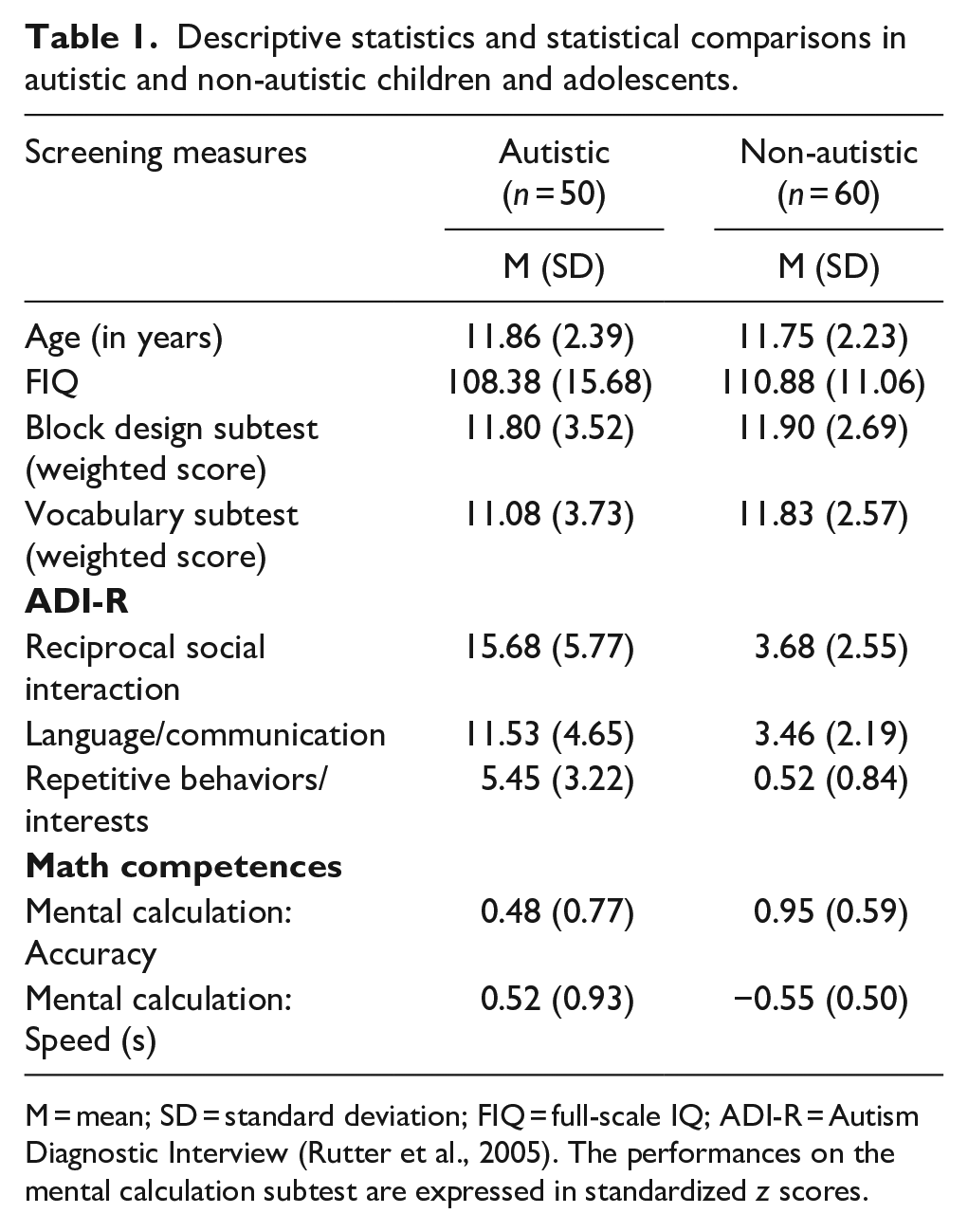
M = mean; SD = standard deviation; FIQ = full-scale IQ; ADI-R = Autism Diagnostic Interview (Rutter et al., 2005). The performances on the mental calculation subtest are expressed in standardized z scores.
Materials
Trait MA
Children were asked to complete the Italian version of the Abbreviated Math Anxiety Scale (AMAS; Caviola, Primi, et al., 2017; original version, Hopko et al., 2003), which includes nine Likert-type items ranging from 1 (“strongly disagree”) to 5 (“strongly agree”) related to feelings toward mathematics, regarding worries, negative thoughts, and affective dispositions. Higher scores on the scale indicate higher levels of MA. In this study, the total score (sum of the two subscales) was considered. Cronbach’s α = 0.86 (CI = 0.83–0.88).
Timed math test
A computerized mental calculation task was adapted from Caviola and colleagues (2016, 2018), whose purpose was to induce a consistent stress response due to the presence of time constraints. The task consisted of 60 multiple-choice trials (plus 3 practice trials with feedback) presented in 2 blocks of 30 trials each: the first block involved simple 2-digit additions (without carrying), the second involved simple 2-digit subtractions (without borrowing). The operations to be solved appeared at the top of the display with the three-answer options underneath arranged horizontally. Participants had to choose the correct answer between the three alternative choices, and the order of the three possible answers was counterbalanced. Participants had to press a keyboard key based on the position on the screen of the answer they wanted to select (“z” for the left choice, “v” for the one in the middle, and “m” for the right one). Time pressure was provided by the presence of a count-down clock that marked the time on the left-bottom side of the screen: participants had to solve the operations within the time limit of 10 s. If the time ran out, the program automatically moved on to the next operation. The total accuracy was considered in the subsequent analyses. As reported by Lievore, Caviola, and Mammarella (2024), Cronbach’s α = 0.91 [CI = 0.88–0.94].
State measures in response to the task
Besides performing the timed math task, children were also asked to report their emotional and cognitive subjective experience concerning the execution of the test. To do so, they were administered two self-report measures, before and after completing the task. Factors reported before starting the task are consistent with participants’ disposition in anticipation of the task (pre-test measures), whereas those reported after finishing the task relate to emotions and thoughts experienced during execution of the same (post-test measures). Emotional and cognitive factors reported by participants before and after the task are described below. Materials are also available on Open Science Framework (OSF): https://osf.io/mkqvp/?view_only=9d4197c371744e00b58970304a51fe98.
Emotional responses
The Self-Assessment Manikin (SAM) scale (Bradley & Lang, 1994; Lang, 1980) is a culture-free method of evaluating affective responses. It measures three dimensions related to an individual’s emotional reaction to various stimuli: valence (ranging from 1 = “unpleasant/negative” to 9 = “pleasant/positive”), arousal (ranging from 1 = “calm/bored” to 9 = “arousing/nervous”), and dominance (ranging from 1 = “out of control” to 9 = “under control”). Participants were instructed to indicate their current emotional state by selecting a point on a non-verbal pictorial scale representing a range of 9 points. Only valence and arousal were considered for the purposes of this study. The SAM has frequently been employed with Italian participants, demonstrating strong validity (Mammarella et al., 2023; Montefinese et al., 2014; Palomba et al., 2000). Correlations between the SAM and a semantic differential method of affective rating reach 0.94 for arousal and 0.97 for pleasure (Bradley & Lang, 1994). In addition, it has shown good reliability in children’s capacity to provide dimensional ratings of their emotional responses (McManis et al., 2001).
Cognitive responses
In addition to assessing participants’ emotional state, cognitive aspects were also measured using a questionnaire (Lievore, Caviola, & Mammarella, 2024; Mammarella et al., 2023) administered before and after completing the test. This questionnaire comprised 12 questions, with 6 focusing on perceived competence and the other 6 on worries about the task. An example from the post-test perceived competence scale is: “Did you feel confident about your performance on the test?” while an example from the worries scale is: “Were you concerned about how well you were doing during the task?.” Participants responded to each question using a 4-point Likert-type scale ranging from 1 (“not at all”) to 4 (“a lot”), and the total score for each scale was calculated. Higher scores on each scale indicated higher levels of perceived competence and worries, respectively.
For this sample, Cronbach’s α: Pre-test perception of competence = 0.82 [CI = 0.77–0.87]; Pre-test worries = 0.84 [CI = 0.79–0.89]; Post-test perception of competence = 0.90 [CI = 0.87–0.93]; Post-test worries = 0.87 [CI = 0.83–0.91].
Procedure
The study was approved by the ethics review board of the Psychology Research at the University of Padova and took place between January 2021 and July 2022. After obtaining the written informed consent of the participants’ parents, children were tested individually in a quiet room at specialized centers (autistic) or at school (non-autistic) during two sessions (a screening and an experimental phase) lasting approximately 40 min each. In the screening phase, the Block Design and Vocabulary subtests (WISC-IV; Wechsler, 2003) were administered, and only participants who scored in the average range in these subtests were included; also, mathematical competences were tested in this phase through the class-appropriate mental calculation subtest. Moreover, the ADI-R was administered to parents to assess autistic traits in their children. Then, the experimental phase took place, in which participants were asked to complete the timed math test, also reporting emotional and cognitive factors before (pre-test measures) and after the task (post-test measures). In this phase, participants also filled in the AMAS for trait MA. The timed math test was created using PsychoPy3 (Peirce et al., 2019) and administered with a laptop computer with a 15-inch LCD screen. Community members were not involved in developing the study.
Statistical approach
First, a series of univariate analyses of variance (ANOVAs) were performed to estimate differences between the two groups (autistic, non-autistic) in the measures of interest (trait MA, total accuracy in the timed math test). Effect sizes were also computed using adjusted R2. The Supplementary materials contain the descriptive statistics (M, SD), correlations divided by group membership, and statistical group comparisons in the variables of interests (see Table S1).
Second, linear mixed-effects models were run to examine the relationship between the response variables (Valence, Arousal, Perception of competence, Worries) and the fixed effects (Age, Trait MA, Group, Time). The interactions between Group × Time were also investigated to assess whether the effect of Time on the response variables differed across the two groups (autistic, non-autistic). Time was treated as a within-subjects fixed effect, representing the time-points (Pre-test, Post-test) in which subjective responses were registered (before and after the execution of the test), while Group was treated as a between-subjects fixed effect representing the categorical grouping variable (autistic, non-autistic). Age and Trait MA were included as continuous covariates in the models. Single participants were involved as random effects to consider their individual variability.
As reported in Table 2, ANOVAs between linear mixed models were run to examine the significance of the fixed effects (Age, Trait MA, Group, Time) and the interaction between Group × Time on the response variables. To enable comparisons between models, we created a full model with emotional and cognitive factors as response variables, and the above-mentioned predictors as fixed effects. Starting from the full model, we built the various models by removing one variable at time, to evaluate the principal contribution of the single fixed effect on the response variable. In addition, starting from the full model, we added the interaction effect (Group × Time) subsequently. We compared each model with the full model, using the Akaike Information Criterion (AIC) and the R2. The R2 represents the proportion of variance in the outcome variable which is explained by the predictor variables in the sample. In the context of linear mixed-effects models, conditional R2 measures the proportion of variance explained by both the fixed effects and the random effects in the model, whereas marginal R2 considers the proportion of variance explained by the fixed effects alone. A lower AIC and a higher R2 indicates a better model.
Linear mixed-effects models with emotional (valence, arousal) and cognitive (perception of competence, worries) factors as response variables.
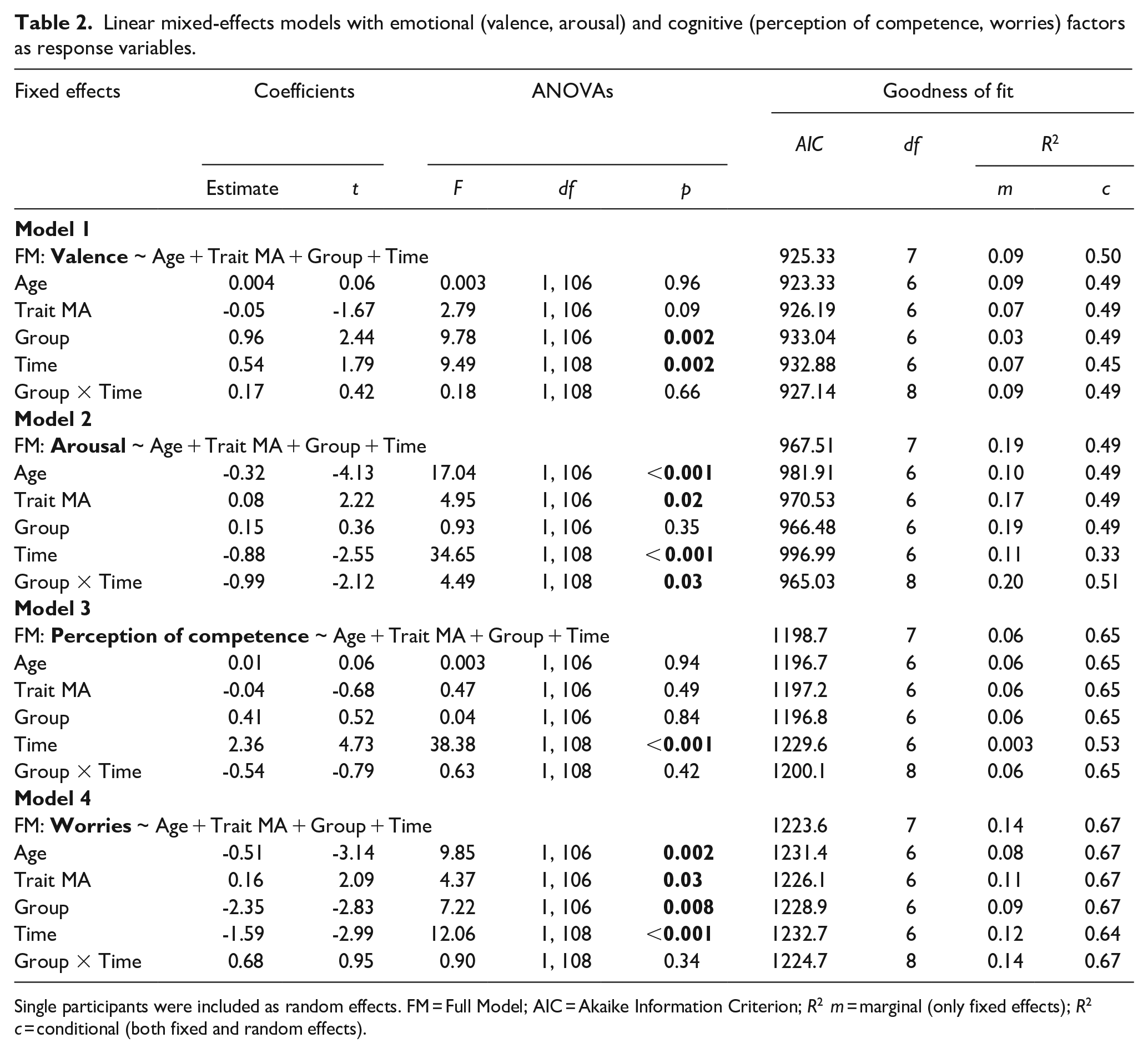
Single participants were included as random effects. FM = Full Model; AIC = Akaike Information Criterion; R2 m = marginal (only fixed effects); R2 c = conditional (both fixed and random effects).
Data were analyzed using R version 4.2.1 (R Core Team, 2022). The following R packages were used: “lmerTest” (Kuznetsova et al., 2017) for computing linear mixed-effect models, “lme4” package was used to run the regression models and the AIC (Bates et al., 2015), “effects” (Fox & Weisberg, 2019) and “ggplot2” (Wickham, 2016) for graphical effects. Data and R scripts are available on OSF: https://osf.io/mkqvp/?view_only=9d4197c371744e00b58970304a51fe98.
Results
No significant differences emerged for trait MA between the two groups, F (1, 108) = 1.12, p = 0.29, Adj R2 = 0.005, autistic: M (SD) = 20.86 (5.86); non-autistic: M (SD) = 21.88 (4.02). Significant differences between the two groups (autistic, non-autistic) were found in math accuracy, F (1, 108) = 19.98, p < 0.001, Adj R2 = 0.15, with autistic participants scoring worse in the timed math test than non-autistic peers, autistic: M (SD) = 0.51 (0.21); non-autistic: M (SD) = 0.68 (0.20).
Linear mixed-effects models
Model 1: valence
A main effect of Group was found for valence, F (1, 106) = 9.78, p = 0.002, with autistic participants reporting lower valence than non-autistic peers (as shown in Figure 1, Panel a). In particular, the full model (with Group) showed better goodness of fit (AIC = 925.33, df = 7; R2c = 0.50, R2m = 0.09), compared with the model without Group (AIC = 933.04, df = 6; R2c = 0.49, R2m = 0.03). A significant effect of Time also resulted for valence, F (1, 108) = 9.49, p = 0.002, with significant difference between pre- and post-test regardless of the groups’ membership. The full model (with Time) indicated better goodness of fit (AIC = 925.33, df = 7; R2c = 0.50, R2m = .09), compared with the model without Time (AIC = 932.88, df = 6; R2c = 0.45, R2m = 0.07).
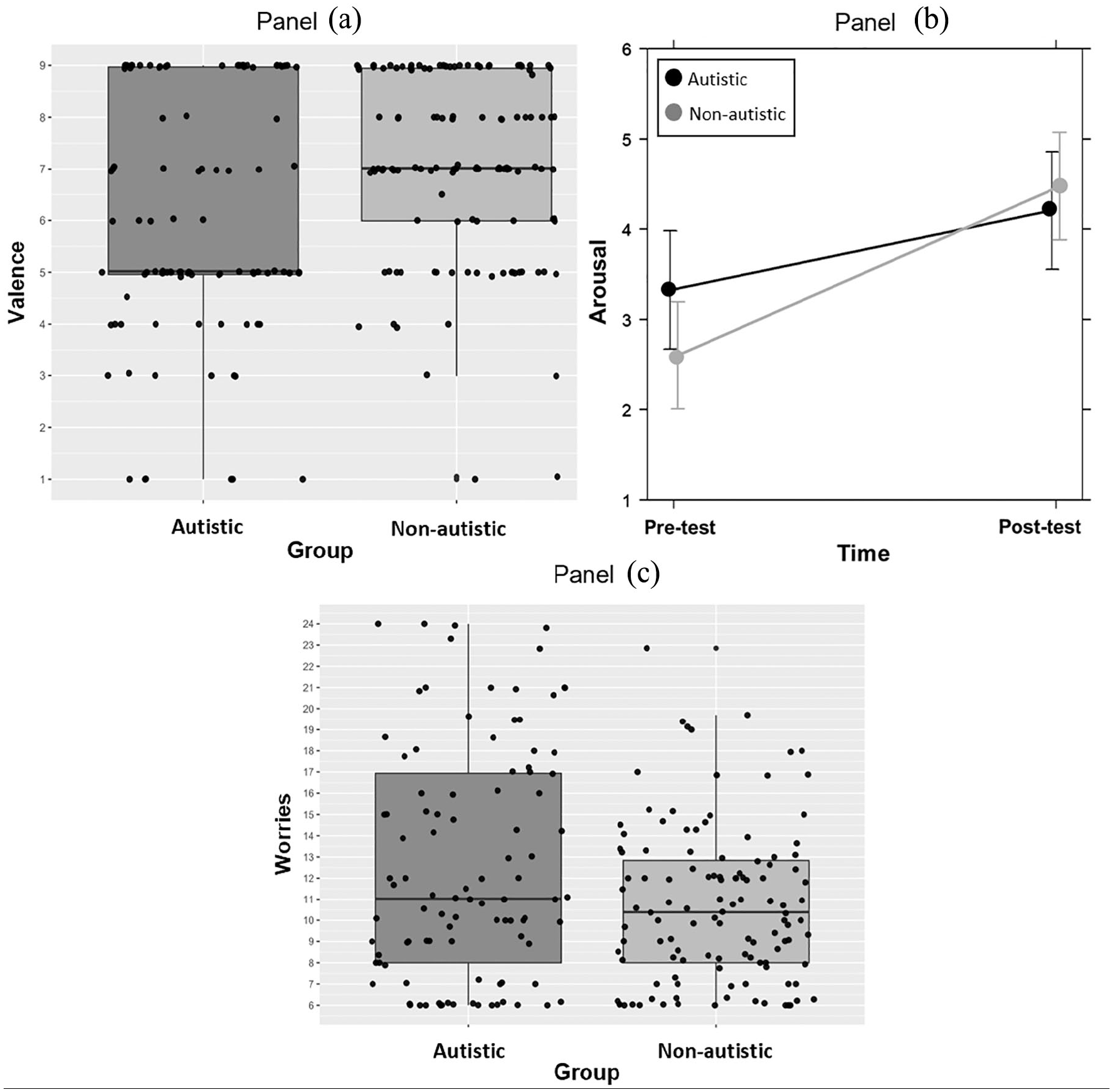
Statistically significant effects of group on valence (Panel a), group × time on arousal (Panel b), and group on worries (Panel c) in linear mixed-effects models.
Model 2: arousal
The main effect of Age emerged for arousal, F (1, 106) = 17.04, p < 0.001, with older participants reporting lower levels of arousal regardless of the group’s membership. In particular, the full model (with Age) showed better goodness of fit (AIC = 967.51, df =7; R2c = 0.49, R2m = 0.19), compared with the model without Age (AIC = 981.91, df = 6; R2c = 0.49, R2m = 0.10).
As concerns Trait MA, a main effect emerged, F (1, 106) = 4.95, p = 0.02, with higher trait MA predicting higher levels of arousal regardless of the group’s membership. In particular, the full model (with Trait MA) showed better goodness of fit (AIC = 967.51, df = 7; R2c = 0.49, R2m = 0.19), compared with the model without Trait MA (AIC = 970.53, df = 6; R2c = 0.49, R2m = 0.17).
We found a significant effect of Time, F (1, 108) = 34.65, p < 0.001, with significant difference between pre- and post-test regardless of the groups’ membership. The full model (with Time) indicated better goodness of fit (AIC = 967.51, df = 7; R2c = 0.49, R2m = 0.19), compared with the model without Time (AIC = 996.99, df = 6; R2c = 0.33, R2m = 0.11).
The interaction between Group × Time was also significant, F (1, 108) = 4.49, p = 0.03, with model with Group × Time (AIC = 965.03, df = 8; R2c = 0.51, R2m = 0.20) being a better-fitting model than the model without Group × Time (AIC = 967.51, df = 7; R2c = 0.49, R2m = 0.19). As shown in Figure 1 (Panel b), significant differences in pre-test arousal were observed between the two groups (autistic > non-autistic), which are then leveled out in the second time-point (post-test arousal).
Model 3: perception of competence
A significant effect of Time resulted for perception of competence F (1, 108) = 38.38, p < 0.001, with significant difference between pre- and post-test regardless of the groups’ membership. The full model (with Time) suggested better goodness of fit (AIC = 1198.7, df = 7; R2c = 0.65, R2m = 0.06), compared with the model without Time (AIC = 1229.6, df = 6; R2c = 0.53, R2m = 0.003).
Model 4: worries
The main effect of Age emerged for worries, F (1, 106) = 9.85, p = 0.002, with older participants reporting lower levels of worries regardless of the group’s membership. In particular, the full model (with Age) showed better goodness of fit (AIC = 1223.6, df = 7; R2c = 0.67, R2m = 0.14), compared with the model without Age (AIC = 1231.4; df = 6; R2c = 0.67, R2m = 0.08).
As concerns Trait MA, a main effect emerged, F (1, 106) = 4.37, p = 0.03, with higher trait MA predicting higher levels of worries regardless of the group’s membership. In particular, the full model (with Trait MA) showed better goodness of fit (AIC = 1223.6, df = 7; R2c = 0.67, R2m = 0.14), compared with the model without Trait MA (AIC = 1226.1, df = 6; R2c = 0.67, R2m = 0.11).
A main effect of Group was found, F (1, 106) = 7.22, p = 0.008, with autistic participants reporting higher levels of worries than non-autistic peers (as shown in Figure 1, Panel c). In particular, the full model (with Group) showed better goodness of fit (AIC = 1223.6, df = 7; R2c = 0.67, R2m = 0.14), compared with the model without Group (AIC = 1228.9, df = 6; R2c = 0.67, R2m = 0.09).
Finally, a significant effect of Time resulted, F (1, 108) = 12.06, p < 0.001, with significant difference between pre- and post-test regardless of the groups’ membership. The full model (with Time) suggested better goodness of fit (AIC = 1223.6, df = 7; R2c = 0.67, R2m = 0.14), compared with the model without Time (AIC = 1232.7, df = 6; R2c = 0.64, R2m = 0.12).
Discussion
The aim of the present study was to investigate MA among autistic and non-autistic boys aged 8–16, by considering the distinction between trait and state MA. Trait MA was estimated through a self-report questionnaire, while components of state MA were assessed in real-time assessment. The state anxiety was provided by the proposed math task, which was thought to elicit a temporary stress reaction due to the time constraints. Participants were asked to share their emotional and cognitive reactions before and after completing the timed math task.
As concerns our first aim, trait MA levels were assessed in autistic and non-autistic participants, revealing no significant differences between the two groups. Based on previous findings on the occurrence of school anxiety in autistic children (Adams et al., 2019; Ambrose et al., 2021; Lopata & Thomeer, 2014), higher reported trait MA was expected in this clinical group. However, as hypothesized, emotional self-awareness is increasingly suggested to be an area of difficulty in autism (Blakeley-Smith et al., 2012; Huggins et al., 2020; Mertens et al., 2017), thus trait-like self-reports might not be effective in fully capturing anxiety in this clinical group. For this reason, we expected that conducting a real-time assessment of emotional and cognitive aspects in respect during a timed mathematical task could provide valuable additional insights into the presence of MA in autism.
Recognizing the need to investigate math anxiety with an approach different from self-reporting, our second aim was to assess the overall accuracy in a timed math test among groups of autistic and non-autistic school-aged boys. To induce a stress response during the math task, a countdown clock marked the time, while participants had to solve the operations. Our findings confirmed our hypothesis, as autistic children and adolescents obtained a worse overall accuracy in the timed mathematical task compared with the non-autistic peers. Especially within the realm of mathematics, where stress and anxiety are widespread and there is a strong aspiration for excellence, individuals may fail to reach their full potential even if they possess the requisite skills (Beilock, 2008). The imposition of time constraints for solving mental calculations may have adversely affected autistic participants, leading to lower scores than their actual competencies (Beilock & Carr, 2001; Beilock et al., 2004). In this regard, contextual stress has the potential to impair cognitive resources and adversely impact performance, primarily because of the onset of anxiety and related concerns (Benny & Banks, 2015; Eysenck & Calvo, 1992). However, it is worth considering that previous research has also revealed poorer mathematical skills in autistic people (Aagten-Murphy et al., 2015; Bae et al., 2015; Bullen et al., 2020; Oswald et al., 2016; Tonizzi & Usai, 2023), regardless of the presence of a stress condition. Even if the autistic sample considered in this study was screened for mathematical skills, participants performed within the normal range in the mental calculation subtest for both accuracy and speed; however, autistic participants were less accurate, thus we cannot completely exclude the presence of slight math difficulties in this group. Moreover, other factors may have contributed to lower accuracy in the mathematical task among autistic boys, for example, cognitive aspects. Autistic individuals often experience delays in processing information (Zapparrata et al., 2023), which can affect their ability to accurately grasp mathematical concepts and execute calculations (Cheng et al., 2022). Moreover, challenges in executive functioning, such as difficulties in working memory updating or shifting (Demetriou et al., 2018; Lievore, Cardillo, & Mammarella, 2024), may further hinder their efficiency in solving mathematical operations (Živković et al., 2022). All in all, the occurrence of anxiety could have influenced the outcomes of autistic participants in the timed math test: assessing children’s state emotional and cognitive responses in the context of a real-time assessment might provide a more comprehensive overview of the phenomenon of MA (Orbach et al., 2019).
To provide an answer to our third research question, the state emotional and cognitive experiences reported by participants were assessed in respect of the timed math task. For this purpose, we compared pre-test with post-test measures, to gain knowledge about the change attributable to the stressful condition. The assessment of state MA measures comprised valence (pleasantness), arousal (bodily activation), perception of competence, and worries toward the task. After controlling for age and trait MA, mixed-effects models revealed two group’s effects, emphasizing a significant lower valence and higher worries in the autistic group compared with non-autistic peers, regardless of the time-points in which they reported their subjective experience. This emotional disposition may have influenced the mathematical performance of autistic children by consuming attentional and cognitive resources (Ashcraft & Kirk, 2001; Beilock, 2008), and distracting them from thinking about important math-related features, focusing instead on irrelevant information (Beilock & DeCaro, 2007). Moreover, mixed models revealed that the level of emotional arousal reported in anticipation to the task was statistically higher of that felt by the non-autistic children. The thought of having to take the math test could have pre-emptively influenced performance due to an increase in emotional arousal toward the task (Lyons & Beilock, 2012). Together with the evidence of lower valence and higher worries, the findings regarding arousal support the hypothesis of higher levels of MA in autism. Indeed, it seems that the timed math task was able to evoke a greater stress response in the autistic group than in non-autistic peers. Nevertheless, no significant differences among groups emerged for the perception of competence. Despite the lower performance, autistic participants did not report a lower perception of competence, highlighting potential unawareness of their mathematical competences (Furlano & Kelley, 2020).
Limitations, future directions, and implications
Our study contains some limitations that will be disclosed to encourage further investigations on this topic.
First, the sample solely consists of male participants. Future research should also include the female gender to understand if there are differences in trait and state MA between both autistic and non-autistic males and females. In the study, only boys were included due to the difficulty in recruiting autistic girls. Indeed, autism presents differently in girls than in boys, leading to underdiagnosis or misdiagnosis, with a male-to-female diagnostic ratio of 3:1 (Bölte et al., 2023). The reduced presence of autistic girls has hindered their recruitment and inclusion in the project. In general, girls consistently report significantly more MA than boys (e.g. Hill et al., 2016), thus it could be interesting to study if this difference is present also in autism in future research. Second, our experimental design lacked a control condition involving a math task without time constraints, preventing us from definitively asserting a direct correlation between overall accuracy and the state measures under time pressure. Nonetheless, drawing from existing literature, time pressure imposes limitations on cognitive function and behavior, triggering a well-documented state of anxiety (Caviola, Carey, et al., 2017; Kellogg et al., 1999). Third, our investigation lacked assessments of working memory. Consequently, our inference that distracting worries in autistic children may have adversely influenced their performance by overburdening cognitive resources warrants further exploration in subsequent research studies. Furthermore, we did not include a questionnaire addressing general anxiety, which could have provided insights into feelings of unease and distress experienced by participants in real-world scenarios. Similarly, future studies should also consider including a measure of test anxiety, to be able to isolate the effects of MA more accurately. It may ensure that any observed effects are more likely attributable to mathematics-specific factors rather than general test anxiety tendencies. Finally, psychophysiological activity, such as cardiac activation, could serve as objective, real-time measures of anxiety during math-related stressors. It is worth noting that children, especially autistic, may encounter difficulties in articulating emotions closely tied to bodily cues (Williams et al., 2023), such as somatic arousal in pressured situations, underscoring the necessity for more objective assessment methods (Mertens et al., 2017). In this regard, autistic participants might have experienced difficulties in reporting their feelings toward the mathematical task, due to limitations in verbal self-report and/or recognition of their own emotions (Huggins et al., 2020; Williams et al., 2023). Future research should check whether participants struggle or not with identifying and verbalizing emotions, to prevent incorrect conclusions about the emotional states of autistic individuals.
Besides the limitations, our findings could have both educational and clinical implications. First, it is worth noting that in our country (i.e. Italy), there is no system of specialized education classes specifically designated for students with neurodevelopmental disorders or specific medical conditions. Autistic students without intellectual disability are thus included in regular classrooms alongside their non-autistic peers. They participate in the same educational activities and curriculum as all other students, because they rarely need additional support outside the classroom. The absence of specialized classes implies that schools may not always have the resources to adequately address the needs of autistic students who are intellectually capable but may struggle with social communication and other challenges associated with autism. This situation emphasizes the importance of doing research on the impact that emotional aspects may have in academic contexts, for better accommodating the diverse needs of all students, to ensure they receive the support necessary for their learning success.
Overall, based on our research findings, teachers and clinicians should be aware that time pressure could be considered a negative factor in terms of proficiency and worries also in children without specific learning disorders, such as autistic students. As revealed by the assessment on emotional and cognitive aspects, time pressure can overwhelm them, leading to increased levels of worries, reduced pleasure toward mathematics, and decreased ability to perform tasks efficiently. Indeed, elevated anxiety can weaken cognitive function, making it harder for them to complete mathematical tasks accurately. For this reason, educators can create more supportive learning environments by avoiding tasks with time pressure, or by helping autistic individuals improve their time management skills. In addition, addressing the emotions associated with time pressure can enhance their overall functioning and reduce anxiety. Furthermore, it is important to discourage the development of resignation toward academic learning, to improve positive feelings, self-concept, and more supportive learning environments (Pekrun et al., 2017; Phan & Ngu, 2018). Concerning autistic children and adolescents, teachers and educators should be aware that their social challenges might interfere with academic engagement and motivation to learn. Social difficulties, such as challenges with communication, understanding social cues, and forming relationships, can lead to feelings of isolation and frustration in the classroom (Kasari & Sterling, 2013). These challenges may lead to decreased participation in group activities, unwillingness to ask questions or seek help, and an overall disengagement from the learning process. Therefore, educators should work for creating an inclusive classroom climate by using strategies that accommodate social differences, with the final goal of fostering successful learning. In addition, it is crucial to recognize that self-awareness plays a vital role in academic learning. As revealed by the evaluation of perception of competence in respect of the mathematical task, autistic students may not always have an accurate awareness of their performance due to challenges in self-monitoring. Therefore, efforts should be made to cultivate a sense of competence to ensure their success and to empower them to recognize their strengths but also skills that still need support (Demetriou et al., 2020). This aspect highlights the importance of targeted support and feedback from educators and caregivers.
In conclusion, MA might be an important factor to consider when assessing academic functioning also of autistic children and adolescents. Despite a worse performance of the autistic participants in the timed math test, group differences in trait MA did not emerge. However, our results on state subjective responses suggest that mathematical pressure could play an intensified role in autistic children and adolescents, according to reported valence, arousal, and worries.
Supplemental Material
sj-docx-1-aut-10.1177_13623613241299881 – Supplemental material for Trait and state mathematics anxiety in autistic and non-autistic school-aged boys
Supplemental material, sj-docx-1-aut-10.1177_13623613241299881 for Trait and state mathematics anxiety in autistic and non-autistic school-aged boys by Rachele Lievore and Irene C. Mammarella in Autism
Footnotes
Author contributions
Data availability statement

Declaration of conflicting interests
The author(s) declared no potential conflicts of interest with respect to the research, authorship, and/or publication of this article.
Funding
The author(s) received no financial support for the research, authorship, and/or publication of this article.
Ethics approval statement
The study was approved by the Ethics Committee on Psychology Research at the University of Padova.
Permission to reproduce material from other sources
No copyrighted works owned by third parties are included.
Supplemental material
Supplemental material for this article is available online.
References
Supplementary Material
Please find the following supplemental material available below.
For Open Access articles published under a Creative Commons License, all supplemental material carries the same license as the article it is associated with.
For non-Open Access articles published, all supplemental material carries a non-exclusive license, and permission requests for re-use of supplemental material or any part of supplemental material shall be sent directly to the copyright owner as specified in the copyright notice associated with the article.
