




Abstract
Time-based prospective memory involves tasks that must be executed at a specific time in the future. Individuals can complete time-based prospective memory tasks using internal attention and external attention. Field-independent and field-dependent cognitive styles are two of the most well-known cognitive styles. Field-independent individuals and field-dependent individuals prefer to use internal reference and external reference to process information, respectively, which implies that there may be differences in the processing mechanisms of the two cognitive styles when performing time-based prospective memory tasks. This study focused on differences in time-based prospective memory performance and processing mechanisms between field-independent and field-dependent cognitive style individuals under different time monitoring conditions. A total of 119 participants were recruited through an Embedded Figure Test and divided into four groups. Time monitoring conditions consisted of a free monitoring condition and a restricted monitoring condition. Participants in the restricted monitoring condition could only press the space bar once, whereas those in the free monitoring condition could check the time at any time and without restrictions. The results of the study showed that field-independent individuals expend less internal and external attention than field-dependent individuals. However, field-independent individuals have higher attention effectiveness and employ more strategies for processing time information. Field-independent individuals were also found to have better time-based prospective memory performance under both time monitoring conditions. Field-dependent individuals did check the time more often under the free monitoring condition, but their time-based prospective memory performance did not benefit from more external attention because although they expended more external attention, they did so less effectively. In short, compared with field-dependent individuals, field-independent individuals had better time-based prospective memory performance under both time monitoring conditions because they have higher attention effectiveness and adopt more strategies for the processing of time information.
Prospective memory (PM) refers to the memory involved in performing planned intentional actions in future situations (Einstein & McDaniel, 1990). PM with a clear external cue is termed event-based prospective memory (EBPM). For instance, we should buy some drinks when passing a grocery. PM with only a time cue is termed time-based prospective memory (TBPM). Remembering to take an English test at 8 a.m. on Friday is an example of this.
The success of PM is affected by many factors, including cognitive style (S. Li & Song, 2006). Cognitive style refers to the information processing patterns that individuals prefer to use (Peterson, 2006). Field-independent and field-dependent cognitive styles are two of the most well-known cognitive styles, differentiated by whether an individual tends to prefer internal or external references in their cognitive process (Mahvelati, 2020). We define individuals who use field-dependent strategies and field-independent strategies as field-dependent individuals and field-independent individuals, respectively. Field-independent individuals rely more on internal references for information processing; their psychological differentiation level and cognitive restructuring ability are relatively high, which is conducive to their use of their internal ability for cognitive processing. Field-dependent individuals rely more on external references for information processing, and thus, they are good at using external information to process tasks (Davis & Frank, 1979; S. Li & Song, 2006).
Field-dependent individuals and field-independent individuals may show great differences in PM ability. First, the successful implementation of a PM task is inseparable from an individual’s autonomous monitoring and attention switching (Costa et al., 2011). Compared to field-dependent individuals, field-independent individuals have higher metacognitive skills and superior attentional monitoring ability, which are beneficial for the monitoring of PM cues and task switching between ongoing tasks and PM tasks (C. Li et al., 2023). Second, field-independent individuals mainly rely on internal reference in information processing, so they will rely on internal abilities to a greater extent and expend more internal effort to ensure the completion of PM tasks (S. Li et al., 2005). Since, PM requires field-independent cognitive skills, it is likely that these individuals would outperform those that use field-dependent strategies. The current evidence does lend some support for this assertion. At present, some studies have focused on the influence of cognitive style on EBPM, and the results have shown that the PM performance of field-independent individuals is better than that of field-dependent individuals (S. Li et al., 2005; S. Li & Song, 2006; Meng et al., 2019), confirming the above point. Li & Song (2006) used the vocabulary judgment task (ongoing task) to explore the difference in EBPM between field-dependent individuals and field-independent individuals. The results showed that the EBPM performance of the field-independent individuals was significantly better than that of the field-dependent individuals. Compared with EBPM, TBPM involves no explicit external cues and requires more self-initiated attentional resources (Mioni et al., 2020). Thus, field-independent individuals should show a greater advantage with regard to TBPM than EBPM. There have been few studies on the influence of field-independent and field-dependent cognitive styles on TBPM. Mefoh and Ezeh (2016) used a self-report method to compare the TBPM performance of field-independent individuals and field-dependent individuals in daily life, and found that field-independent individuals reported better TBPM performance than field-dependent individuals. This confirms that the TBPM performance of field-independent individuals is significantly better than that of field-dependent individuals.
However, studies conducted thus far have certain limitations. First, existing studies have not reported the availability of external time information (e.g., viewing time), even though external information may have a greater impact on TBPM in field-dependent individuals. Field-dependent individuals tend to use external references and rely more on external information to process information (Boccia et al., 2017). Thus, in a situation where external time information can be fully obtained, the advantage of field-dependent individuals being better at utilizing external information may come into play. However, if individuals cannot obtain sufficient external information in the process of performing TBPM, they can only rely on internal competence and internal attention (Guo et al., 2022), and field-dependent individuals are at a disadvantage in this case. Therefore, the degree to which external information is available will change the attentional patterns of field-dependent individuals to a greater extent so that their TBPM performance is more affected by external time information than is the case for field-independent individuals.
Second, existing research has only used oral reports to determine daily PM performance, with no other objective indicators. The results obtained in such cases cannot objectively indicate whether cognitive style affects TBPM. In addition, existing studies have not focused on the processing mechanism by which field-independent and field-dependent cognitive styles affect TBPM. Compared with participants’ oral reports, a dual-task paradigm for exploring the processing mechanism of TBPM in a laboratory setting has certain advantages. The performance of ongoing tasks can reflect the processing mechanism of PM (Boag et al., 2019; Woods et al., 2020). TBPM involves both internal and external attention. An ongoing task can indirectly reflect internal attention, while time monitoring can directly reflect external attention (Hu & Qi, 2018; T. Huang et al., 2014). Further studies could use these indicators to elucidate the differences in processing mechanisms in TBPM between field-independent individuals and field-dependent individuals.
In its exploration of the processing mechanism, this study mainly focused on the changes in internal and external attention. However, in addition to objective indicators such as ongoing task performance and time monitoring, it is also worth noting what effective strategies individuals employ. Compared to field-independent individuals, field-dependent individuals have stronger time information processing ability (Mefoh & Ezeh, 2016; Teghil et al., 2019). Individuals with stronger internal abilities such as time estimation are more inclined to adopt effective strategies to improve the efficiency of time information processing when performing TBPM, thereby improving their TBPM performance (Gan & Guo, 2019). Therefore, this study also focused on the strategies adopted by field-independent and field-dependent individuals in performing TBPM tasks. This will help us to further determine the reasons for the differences between the two types of cognitive styles.
Based on the above analysis, this study planned to use a dual-task paradigm in a laboratory setting to explore the differences between field-independent and field-dependent individuals in TBPM under different time monitoring conditions. We speculated that field-independent individuals will have better TBPM than field-dependent individuals only under the condition of restricted time monitoring.
Method
Participants
This study involved 119 participants who were recruited from a pool of 208 college students (aged 18–24 years) using Zhang et al.’s (1981) revised Embedded Figure Test (EFT). All participants were familiar with the English alphabet. According to the EFT scores, the top 27%, approximately (with a score ⩾18), were included in the field-independent group, while the bottom 27%, approximately (with a score ⩽13), were included in the field-dependent group. In the free monitoring condition, there were 32 participants in the field-dependent group (Mage = 20.06, SD = 1.34) and 27 participants in the field-independent group (Mage = 20.19, SD = 1.43). In the restricted monitoring condition, there were 26 participants in the field-dependent group (Mage = 20.88, SD = 2.27) and 34 participants in the field-independent group (Mage = 20.35, SD = 1.52). When the experiment was completed, all participants received payment (about 3 dollars).
Instruments
Embedded Figure Test (EFT)
The EFT required participants to draw a designated simple figure in a complex figure. This task was composed of three parts, of which the first was not scored, while the second and third totaled 24 points. Participants with low scores (top 27%) were identified as the field-dependent group. The participants with high scores (the last 27%) were identified as the field-independent group.
Procedure
The experimental procedure was written using E-prime 2.0. At first, the instructions for the ongoing task were presented first, and participants practiced for 30 trials. A total of 24 letters of the English alphabet (except F and J) constituted the ongoing task materials. They were presented in black print against a white background. The ongoing task was a one-back task in which participants had to determine whether adjacent letters were the same. Participants were required to press the J key if they were the same; otherwise, they were required to press the F key (Guo & Gan, 2023). The plus sign fixation point (500 ms) appeared at the beginning of each ongoing task. Then, an English letter appeared in the same position. Finally, a blank screen appeared (The total presentation time of the letter and the blank screen was 2500 ms). The accuracy in the practice phase was required to be more than 0.8 in order for the participant to gain entry into the formal experiment. The instructions for the TBPM task were delivered at the start of the formal experiment. Participants were required to press the 1 key every minute in the TBPM task. Participants were instructed to complete the ongoing task and the TBPM task at the same time. The elapsed time could be checked at any moment by pressing the space bar. Participants in the restricted monitoring condition could only press the space bar once, whereas those in the free monitoring condition had no such restriction. Every 69 s, all the participants were given a break to rest. After they rested, they could press the P key to start the cycle of the next TBPM task. The procedure started timing from 0:00 at the beginning of each TBPM task. The formal experiment consisted of four TBPM tasks comprising a total of 92 ongoing tasks. The whole experiment lasted about 10 min.
Ethical considerations
The Academic Committee of Henan University granted ethics approval for this study (reference: 20220715001). All participants gave written informed consent.
Data analysis
Data were automatically collected by E-prime software and analyzed by SPSS 20.0. The Kolmogorov–Smirnov test showed that the data of all indicators were normally distributed and the data could be analyzed by analysis of variance. In view of the fact that this study adopted a between-participants experimental design of 2 (cognitive style: field-independent, field-dependent) × 2 (time monitoring conditions: free monitoring, restricted monitoring), we planned to use a 2×2 analysis of variance for all indicators.
Results
TBPM performance
If participants hit the 1 button within 5 s before or after 1 min, they were regarded to have completed the TBPM task correctly (i.e., within the window from 55 to 65 s). After excluding data beyond plus or minus three standard deviations, we analyzed the remaining data. A 2 (cognitive style: field-independent, field-dependent) × 2 (time monitoring conditions: free monitoring, restricted monitoring) analysis of variance was performed on the accuracy of TBPM, and the results showed that the main effect of cognitive style was significant, F(1, 115) = 5.92, p < .05, η p 2 = 0.04, Field-independent individuals (Mfree = 0.93, SD = 0.13, Mrestricted = 0.60, SD = 0.28) performed better than field-dependent ones (Mfree = 0.77, SD = 0.30, Mrestricted = 0.53, SD = 0.30). The main effect of time monitoring conditions was significant, F(1, 115) = 32.52, p < .001, η p 2 = 0.22, with free monitoring yielding better performance than restricted monitoring. However, the interaction between the cognitive style and the time monitoring conditions was not significant, p > .05 (see Figure 1).
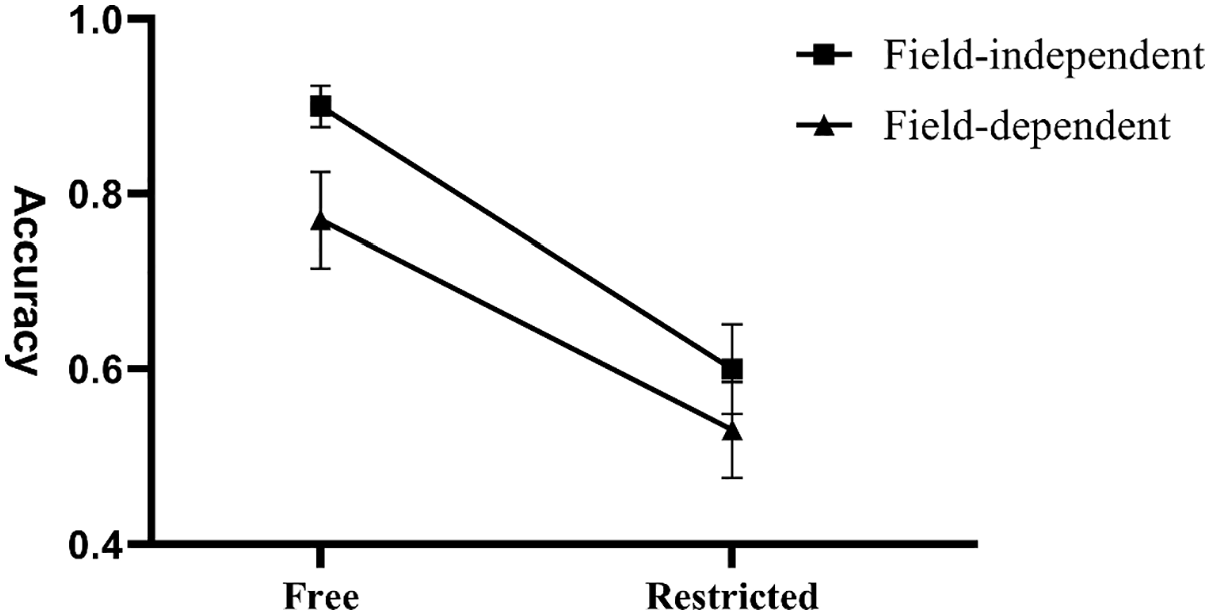
The TBPM performance. The main effects of both cognitive style and time monitoring conditions are significant in the TBPM performance. Free represents free monitoring condition. Restricted represents restricted monitoring condition.
Time difference of TBPM
The time difference of TBPM refers to the difference between the average time point of the participants pressing the 1 button and 60 s. A 2 (cognitive style: field-independent, field-dependent) × 2 (time monitoring conditions: free monitoring, restricted monitoring) analysis of variance was performed on the time difference of TBPM, and the results showed that the main effect of cognitive style was significant, F(1, 115) = 4.38, p < .05, ηp2 = 0.04, in that the field-independent group (Mfree = 1.19, SD = 0.76, Mrestricted = 3.20, SD = 2.29) had a smaller difference than the field-dependent group (Mfree = 2.15, SD = 1.54, Mrestricted = 3.74, SD = 2.57); The main effect of time monitoring conditions was significant, F(1, 115) = 25.39, p < .001, ηp2 = 0.22, with the time difference being smaller under free monitoring conditions than under restricted monitoring conditions. There was no interaction, p > .05.
Accuracy of ongoing task
A 2 (cognitive style: field-independent, field-dependent) × 2 (time monitoring conditions: free monitoring, restricted monitoring) analysis of variance was performed on the accuracy of the ongoing task, and the results showed that the main effect of cognitive style was significant, F(1, 115) = 6.76, p < .05, ηp2 = 0.06, with the field-independent group (Mfree = 0.93, SD = 0.04, Mrestricted = 0.90, SD = 0.04) performing better than the field-dependent group (Mfree = 0.89, SD = 0.05, Mrestricted = 0.90, SD = 0.04). The main effect of time monitoring conditions and the interaction between time monitoring and cognitive style were not significant, ps > 0.05.
Response time of ongoing task
A 2 (cognitive style: field-independent, field-dependent) × 2 (time monitoring conditions: free monitoring, restricted monitoring) analysis of variance was performed on the response time of the ongoing task, and the results showed that the main effect of cognitive style was not significant, that is, there was no difference between the field-independent (Mfree = 569 ms, SD = 46 ms, Mrestricted = 664 ms, SD = 72 ms) and field-dependent groups (Mfree = 611 ms, SD = 81 ms, Mrestricted = 659 ms, SD = 71 ms), p > .05. The main effect of time monitoring conditions was significant, F(1, 115) = 30.48, p < .001, ηp2 = 0.21, with reaction times faster under free monitoring than under restricted monitoring. The interaction between time monitoring conditions and cognitive style was not significant, p > .05 (see Figure 2).
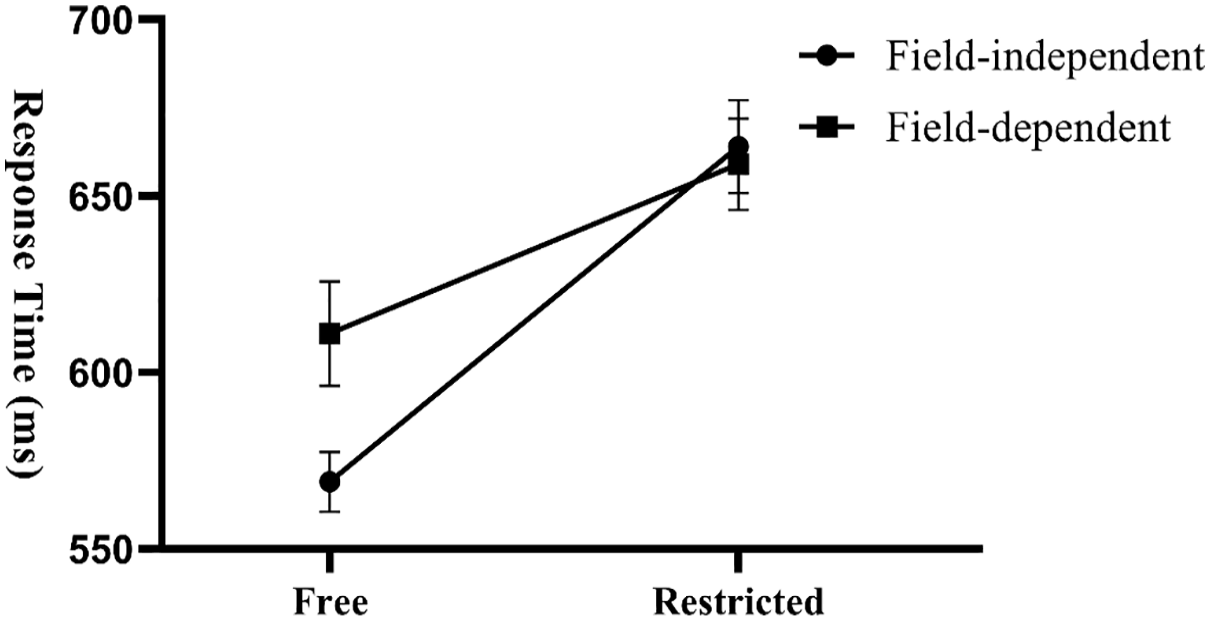
The response time of ongoing task. The main effect of time monitoring conditions is significant in the reaction time of ongoing task. Free represents free monitoring condition. Restricted represents restricted monitoring condition.
Number of time monitoring
A 2 (cognitive style: field-independent, field-dependent) × 2 (time monitoring conditions: free monitoring, restricted monitoring) analysis of variance was performed on the number of time monitoring (i.e., the number of times a participant checked the clock), and the results showed that the main effect of cognitive style was significant, F(1, 115) = 6.18, p < .05, ηp2 = 0.05, with the field-independent group (Mfree = 2.49, SD = 1.34, Mrestricted = 0.82, SD = 0.23) exhibiting less time monitoring than the field-dependent group (Mfree = 3.62, SD = 2.08, Mrestricted = 0.83, SD = 0.23). The main effect of time monitoring conditions was significant, F(1, 115) = 92.63, p < .001, ηp2 = 0.45, with more time monitoring under the free monitoring condition than the restricted monitoring condition. The interaction between time monitoring conditions and cognitive style was significant, F (1, 115) = 5.82, p < .05, ηp2 = 0.05. Further simple effects testing found that under the free monitoring condition, the field-independent group exhibited less time monitoring than the field-dependent group, p < .001, but under the restricted monitoring condition, there was no difference between the two groups, p > .05. For both the field-independent and field-dependent groups, there was more time monitoring under the free monitoring condition than under the restricted monitoring condition, ps < 0.001 (see Figure 3).
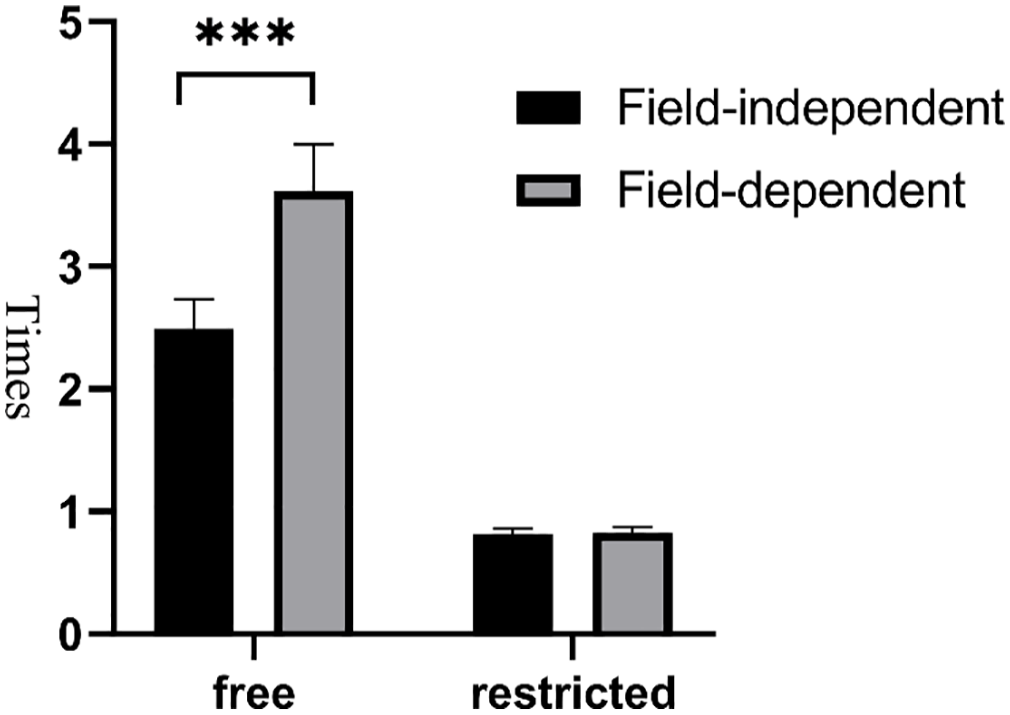
Number of time monitoring. Three asterisks represent p < .001. Free represents free monitoring condition. Restricted represents restricted monitoring condition.
Time difference in time monitoring
The time difference of time monitoring refers to the difference between the average time point of a participant’s time monitoring and 60 s. A 2 (cognitive style: field independent, field dependent) × 2 (time monitoring conditions: free monitoring, restricted monitoring) variance analysis was performed on the time difference of time monitoring, and the results showed that the main effect of cognitive style was significant, F(1, 115) = 5.13, p < .05, ηp2 = 0.04, with the field-independent group (Mfree = 10.78, SD = 5.05, Mrestricted = 11.98, SD = 5.38) exhibiting a smaller time difference than the field-dependent group (Mfree = 14.72, SD = 4.93, Mrestricted = 12.75, SD = 7.11). The main effect of time monitoring conditions and the interaction between time monitoring conditions and cognitive style was not significant, ps > 0.05 (see Figure 4).
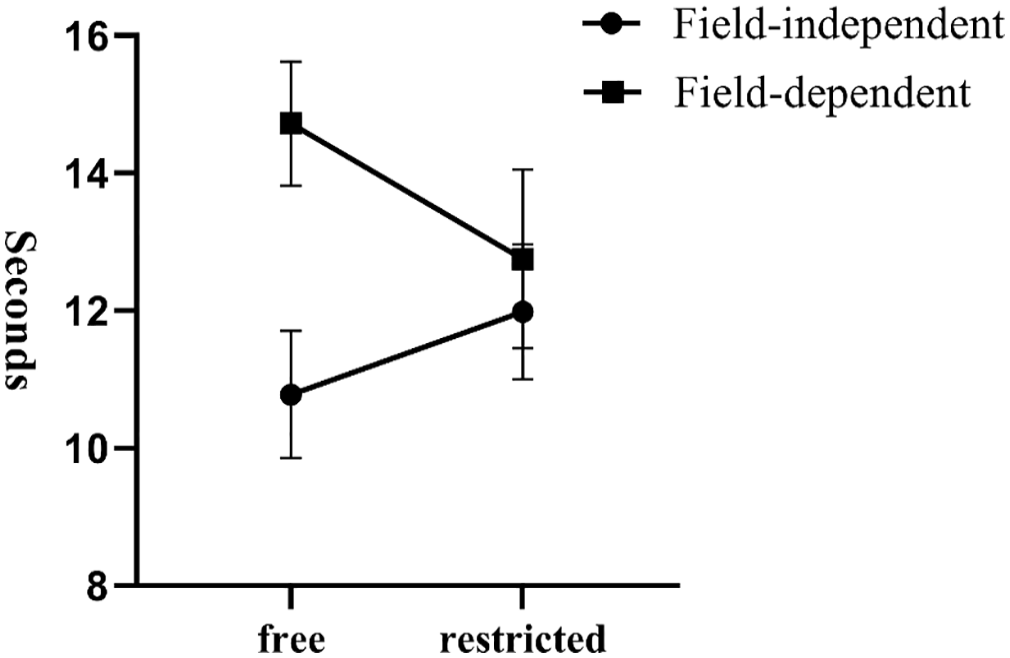
Time difference of time monitoring. The main effect of cognitive style is significant in the time difference of time monitoring. Free represents free monitoring condition. Restricted represents restricted monitoring condition.
Number of strategies
Regarding the strategies reported by the participants, we removed some vague descriptions (e.g., by feeling), and kept some clear and definite strategies (e.g., count the number, beats, etc.). ANOVA of 2 (cognitive style: field-independent, field-dependent) × 2 (time monitoring conditions: free monitoring, restricted monitoring) was performed on the number of strategies, and the results showed that the main effect of cognitive style was significant, F(1, 115) = 4.51, p < .05, ηp2 = 0.04, with field-independent participants (Mfree = 0.96, SD = 0.66, Mrestricted = 1.24, SD = 0.92) reporting more strategies than field-dependent participants (Mfree = 0.53, SD = 0.62, Mrestricted = 1.04, SD = 0.94). The main effect of time monitoring conditions was significant, F(1, 115) = 6.94, p < .01, ηp2 = 0.06, with more strategies reported under the restricted monitoring condition than under the free monitoring condition. The interaction between time monitoring conditions and cognitive style was not significant, ps > 0.05 (see Figure 5).
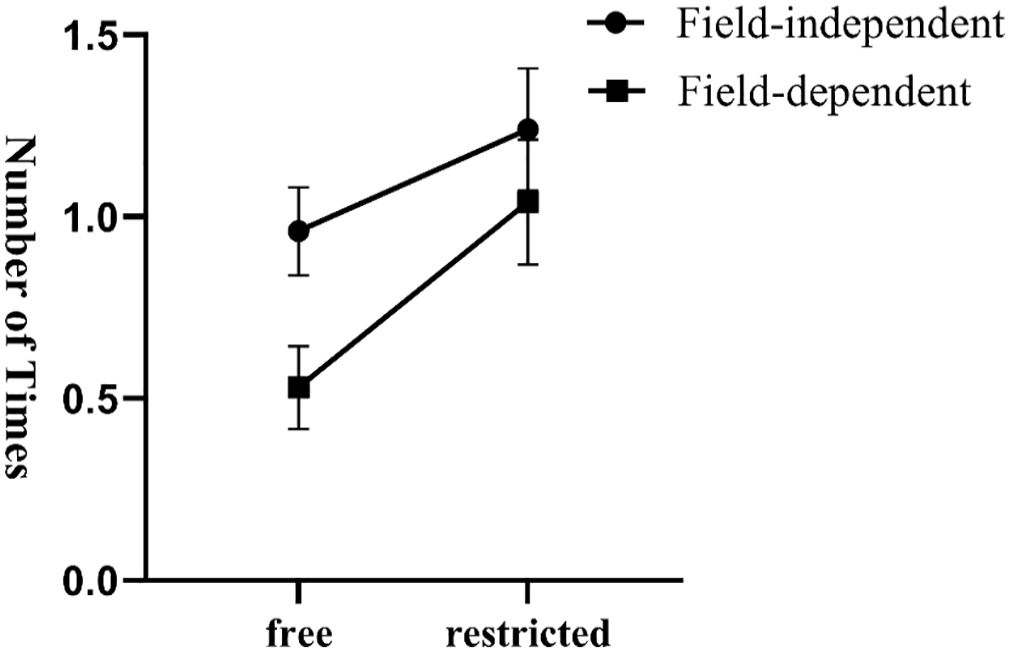
Number of strategies. The main effects of both cognitive style and time monitoring conditions are significant in the number of strategies. Free represents free monitoring condition. Restricted represents restricted monitoring condition.
Discussion
Field-independent individuals and field-dependent individuals have different preferences in cognitive processing, which determines how they rely on different abilities and attention patterns to process TBPM (Mefoh & Ezeh, 2016). Since field-dependent individuals rely more on external information, they may be more affected by time monitoring conditions. This study mainly explored the differences in TBPM between field-independent individuals and field-dependent individuals under different time monitoring conditions. In terms of the accuracy of TBPM, we found that the field-independent individuals were more accurate than the field-dependent individuals, and this result revealed that the field-independent individuals had more advantages than the field-dependent individuals in TBPM. This validates the results of previous studies. In addition, the results of this study also found that TBPM performance under the free monitoring condition was better than that under the restricted monitoring condition, indicating that the more often an individual checked the time, the better their TBPM performance. However, we did not find an interaction between cognitive style and time monitoring conditions, suggesting that time monitoring conditions did not affect TBPM differently between field-independent and field-dependent individuals. This is not consistent with our predictions. Finally, the results of the time difference of TBPM also fully verify the results of the accuracy of TBPM in this study.
The main purpose of this study was to explore the processing mechanism by which field-independent and field-dependent cognitive styles affect TBPM from the perspective of attention. TBPM involves both internal attention and external attention. While ongoing tasks can indirectly reflect internal attention, time-monitoring behavior can directly reflect external attention (Hu & Qi, 2018; T. Huang et al., 2014). The accuracy for the ongoing task in this study revealed that the field-independent group performed better than the field-dependent group, indicating that the field-independent group expended less internal attention when performing TBPM, contrary to our prediction. The reaction time in the ongoing task further showed that reaction times were faster under the free monitoring condition than the restricted monitoring condition, indicating that the free monitoring condition expended less internal attention than the restricted monitoring condition. We still did not find an interaction between cognitive styles and time monitoring conditions, suggesting that the internal attention of individuals with different cognitive styles was uniformly affected by time monitoring conditions. In addition, the results for the time monitoring times showed that the field-independent individuals checked the time less frequently than the field-dependent individuals only under the free time monitoring condition, but there was no difference between the two under the restricted monitoring condition. This indicates that the field-dependent individuals were more dependent on monitoring under the free time monitoring condition. However, under the restricted monitoring condition, the advantages of the field-dependent individuals could not be brought into play, and their time monitoring times were not different from those of the field-independent group. In conclusion, we found that, compared to field-dependent individuals, field-independent individuals did not expend more internal effort, and even showed reduced internal attention. Field-dependent individuals relied more on external attention than field-independent individuals when they could obtain time feedback at will, but limited time monitoring eliminated the differences in external attention between the two cognitive styles.
It is worth noting that the field-independent individuals had better TBPM performance than the field-dependent individuals under both time monitoring conditions. However, there was no difference between the two groups in terms of expending either internal or external attention. So, how did field-independent individuals achieve better TBPM performance than field-dependent individuals? First, the time difference of time monitoring showed that the time point of viewing time for field-independent individuals was closer to the 1 min time point than that for field-dependent individuals. The closer the time monitoring behavior was to the target time point, the higher the effectiveness of attention (Guo & Huang, 2021). The better TBPM performance of field-independent individuals should result from higher attentional effectiveness rather than more attentional expenditure. In addition, we found that field-dependent individuals exhibited more time monitoring under the free monitoring condition, which indicated that they had exerted their own advantages under the free monitoring condition. However, the time difference in time monitoring of field-dependent individuals under the free monitoring condition was smaller than that of field-independent individuals, indicating that although field-dependent individuals expended more external attention, the effectiveness of their attention was not high enough to significantly improve their TBPM performance. This further confirmed that the advantage of field-independent individuals at TBPM was more closely related to the effectiveness of attention, rather than the harnessing of attention. When individuals performed the TBPM task, they always made conservative estimates of the time interval of TBPM first, and then checked the time to obtain feedback, and thus time monitoring behavior could reflect the individuals’ time estimation ability to some extent (Khan et al., 2008). Some studies have directly verified the relationship between the effectiveness of attention and individuals’ time estimation ability, and the results revealed that the better the individuals’ time estimation ability, the higher the effectiveness of attention (Gan & Guo, 2019). Accordingly, we speculated that the better TBPM performance of field-dependent individuals would be related to their internal time estimation ability. Field-dependent individuals have better time estimation abilities, increasing their effectiveness at obtaining external feedback by looking at the time, thereby improving their TBPM performance.
Second, field-independent individuals also adopted more strategies to ensure the successful completion of the TBPM task. These strategies were all used actively to assist the processing of time information and required the consumption of self-initiated attention resources. At the same time, however, such strategies can improve the accuracy of an individual’s time estimation when performing a TBPM task (Vanneste et al., 2016; Zangrossi et al., 2021). Therefore, the better time estimation ability of field-independent individuals also resulted from the use of more active strategies. Since these strategies are actively generated by individuals and require a certain degree of internal attention, they are only suitable for the processing patterns of field-independent individuals who prefer internal references, which may be the reason why they adopt more strategies. In addition, although field-independent individuals spent more internal attention on strategies, these strategies reduced their attentional expenditure on time information processing. Compared with the increased attentional expenditure on the part of the former, the latter’s attention had decreased more, so we found the phenomenon of reduced attention among the field-independent individuals. Based on the above analysis, the advantage of field-independent individuals at TBPM tasks is not dependent on more internal attention, but instead results from better time estimation ability. Field-independent individuals have better time estimation abilities, which results in better TBPM performance without additional consumption of attention resources.
Although this study has yielded some interesting findings, it nonetheless has some limitations. First, the TBPM used in this study had a short duration. TBPM tasks in 1 minute could also be completed well depending only on time estimation ability (Voigt et al., 2014; Woods et al., 2020), in which case field-independent individuals could have an advantage. However, if the duration is long (e.g., in hours), it is difficult for individuals to perform TBPM tasks well if they do not refer to external time information and rely solely on internal time (Vanneste et al., 2016; Waldum & McDaniel, 2016; Williams et al., 2013). In this situation, field-dependent individuals are likely to rely more heavily on external time information, and their advantages are likely to be exerted to a greater extent. Second, this study mainly manipulated the availability of external attention through time monitoring conditions, but this method required individuals to view time spontaneously and consume a certain degree of internal attention. Field-dependent individuals are more inclined to passively receive external temporal information than to actively acquire it (Alexander & Barrett, 1975), and they may also benefit from this passive time information to a greater extent, thereby making up for its inadequacy in TBPM. Future studies should further explore the effect of field-independent and field-dependent cognitive styles on TBPM under the above two conditions.
This study is the first to systematically explore the processing mechanism by which field-independent and field-dependent cognitive styles affect TBPM. The results allow us to deeply understand the reasons for the differences between field-independent individuals and field-dependent individuals in TBPM. First, we verified from the TBPM processing that field-independent individuals rely more on internal temporal information processing (internal reference), while field-dependent individuals rely more on external information (external reference). This confirms the findings of previous studies. Second, this study provides field-dependent individuals with some indication of how to improve PM performance in daily life. On the one hand, field-dependent individuals can use more strategies in the process of prospective memory tasks. For example, counting can improve the accuracy of time estimation (X. Huang & Zhang, 1980). Therefore, field-dependent individuals can better estimate time through counting, so as to make up for the insufficient time estimation ability and improve their TBPM performance. On the other hand, external effective reminders can improve individuals’ internal time information processing ability (Guo et al., 2022). In daily life, we can set alarm clock to help the field-dependent individuals better complete the TBPM task.
Conclusion
This study mainly focused on the processing mechanism by which field-independent and field-dependent cognitive styles affect TBPM from the perspective of attention. The results showed that compared with field-dependent individuals, field-independent individuals expended less internal attention and external attention. Meanwhile they had higher attention effectiveness and adopted more strategies for processing temporal information, both of which were related to the internal time estimation ability. Field-dependent individuals did check time more frequently under the free monitoring condition, but they had poor effectiveness of attention. In short, compared with field-dependent individuals, field-independent individuals have better TBPM performance under both time monitoring conditions, which is attributed to their higher attention effectiveness and more strategies.
Footnotes
Compliance with ethical standards
All procedures performed in studies involving human participants were in accordance with the ethical standards of the institutional research committee and with the 1964 Helsinki Declaration and its later amendments or comparable ethical standards.
Data availability
Data are available from the corresponding author upon reasonable request.
Declaration of conflicting interests
The author(s) declared no potential conflicts of interest with respect to the research, authorship, and/or publication of this article.
Funding
The author(s) disclosed receipt of the following financial support for the research, authorship, and/or publication of this article: This study was supported by the Henan Provincial Philosophy and Social Science Planning Project (2202CJY045).
