




Abstract
The psychological processes contributing to emotional distress among university students in South Africa have not been extensively researched. The current study sought to examine the mediating role of repetitive negative thinking on the relationship between experiential avoidance and student emotional distress. A convenience sample of 419 students from a large public university in South Africa participated in this study. The results indicated that experiential avoidance and repetitive negative thinking positively predict emotional distress. Furthermore, repetitive negative thinking partially mediates the interaction between experiential avoidance and emotional distress. These findings highlight the importance of targeting experiential avoidance and repetitive negative thinking in the alleviation and management of emotional distress among students in the South African higher education environment.
Emotional distress (ED) is broadly understood as clinical and subclinical levels of negative emotion, particularly anxiety and depression (Marr et al., 2022). The endemic pressures associated with being a university student have been implicated in the development of ED (Auerbach et al., 2018; Bantjes et al., 2019). Furthermore, university students have been found to report higher levels of ED and mental health concerns than the general population (Ibrahim et al., 2013; Naser et al., 2020). South African university students from disadvantaged backgrounds, in turn, report greater ED than students from more advantaged backgrounds (Pillay et al., 2020; Spengler, 2019). The higher incidence of ED among students from disadvantaged backgrounds has largely been attributed to the effects of historical societal inequality, as well as the challenge of invariably being first-generation students (Jenkins et al., 2013; Noel et al., 2021).
The COVID-19 pandemic, lockdowns, and migration to online learning disrupted university life globally and placed students at risk of developing increased ED (Laher et al., 2021; Naidoo & Cartwright, 2020; Wieczorek et al., 2021). An emerging body of research highlights the risk posed to students in the developing world by COVID-19-related changes to the higher education sector. Academically at-risk female students from rural areas exhibit increased vulnerability to ED as a result of educational and social upheaval associated with COVID-19 (Alam et al., 2022; J. Lee et al., 2021). In addition, Hedding et al. (2020) draw attention to the disproportionate negative impact that the transition to online learning, unstable communication networks, high data costs, and an unreliable electricity supply have on students from disadvantaged communities.
Experiential avoidance (EA) refers to the unwillingness to remain in contact with distressing internal experiences such as thoughts, emotions, memories, and physical sensations (Hayes-Skelton & Eustis, 2020). EA is positively correlated with ED in the general population, as well as among university students (Akbari et al., 2022; Chou et al., 2018; Fernández-Rodríguez et al., 2018; Tavakoli et al., 2019). Within the South African context, Spengler (2019) found that EA was not only positively associated with ED among university students but also mediated the interaction between perceived stress and ED across both gender and socioeconomic status.
A positive relationship has been demonstrated between repetitive negative thinking (RNT) and ED among university students both internationally and in South Africa (Bottesi et al., 2018; Giorgio et al., 2010; Makhanya, 2017; Pretorius et al., 2015). Within the context of EA, RNT is hypothesised to function as an avoidance strategy, which paradoxically serves to prolong negative emotions, thereby sustaining and exacerbating ED (Dereix-Calonge et al., 2019; Ruiz et al., 2016, 2020). Empirically, higher levels of EA and RNT are associated with greater ED (Bjornsson et al., 2010; Giorgio et al., 2010; Tavakoli et al., 2019), while reduced RNT is linked to lower ED (Hijne et al., 2020). RNT has historically most frequently been conceptualised as rumination and worry (Nolen-Hoeksema & Davis, 1999; Watkins & Teasdale, 2001).
Rumination increases vulnerability to ED by enhancing the deleterious effects of negative mood on thinking and problem-solving, as well as by reducing instrumental behaviours, thus resulting in a loss of social support (Nolen-Hoeksema et al., 2008; Nolen-Hoeksema, 1991). Associations between rumination and EA have been demonstrated in the general population, as well as among students (Giorgio et al., 2010; Makhanya, 2017; Whisman et al., 2020). Furthermore, elevated rumination, in combination with increased EA, has been linked to an intensification of ED (Bjornsson et al., 2010; Giorgio et al., 2010). Ruiz et al. (2016) postulate that since rumination functions as a cognitive avoidance strategy, it represents a form of EA. Rumination is reinforced as a behavioural strategy by its efficacy as a means of avoiding unwanted memories and negative emotions (Giorgio et al., 2010; Ruiz et al., 2016). However, this avoidance generally serves to exacerbate the experience and impact of ED by impeding adaptive behavioural and cognitive coping strategies (Bjornsson et al., 2010; Giorgio et al., 2010). Consequently, rumination potentially serves as a mechanism through which EA maintains and exacerbates ED (Nolen-Hoeksema et al., 2008; Ruiz et al., 2016).
It has been suggested that much like rumination, worry functions as an avoidance response to perceived threats and emotional arousal (Borkovec et al., 1998; Sexton & Dugas, 2009). Worry has been identified as a significant transdiagnostic process in the development and maintenance of ED, consistently displaying correlations with ED across student and clinical populations (Bauer et al., 2020; Bottesi et al., 2018; Ryum et al., 2017). Nolen-Hoeksema and Watkins (2011, p. 589) define transdiagnostic processes as ‘fundamental processes underlying multiple, usually comorbid, psychopathologies’. Despite enabling avoidance of unwanted experiences, worry limits adaptive coping through a narrowing of behavioural repertoires and disengagement from value-driven behaviour (Borkovec et al., 1998; Ruiz et al., 2019). Several studies indicate that employing worry as a strategy to avoid unwanted experiences and sensations may paradoxically increase anxiety symptoms and other forms of ED (e.g., Akbari & Khanipour, 2018; Tavakoli et al., 2019). Conversely, disrupting worry appears to impede EA, while simultaneously increasing adaptive coping and reducing ED (Gil-Luciano et al., 2019; Ruiz et al., 2016). Worry thus appears to be instrumental in the maintenance of ED, as well as demonstrating a noteworthy positive relationship to EA (Tavakoli et al., 2019).
The present study
EA is positively associated with ED among South African university students (e.g., Spengler, 2019). Furthermore, both EA and ED are correlated with RNT, particularly rumination and worry (e.g., Dereix-Calonge et al., 2019; Ruiz et al., 2020). In addition, it has been proposed that RNT potentially serves as a mechanism through which EA maintains or increases ED (e.g., Borkovec et al., 1998; Nolen-Hoeksema et al., 2008; S. C. Hayes et al., 2006). The present study thus aimed to investigate whether RNT mediates the relationship between EA and ED among university students in South Africa. The hypothesised interaction is conceptually represented in Figure 1. In the conceptual model, it is proposed that EA influences rumination (Path a1), which in turn could affect ED (Path b1). Thus, EA is thought to indirectly influence ED through rumination via Path ab1. Furthermore, it is proposed that EA influences worry (Path a2), which may affect ED (Path b2). Therefore, EA may indirectly influence ED through worry via Path ab2. As proposed in the model, when RNT (rumination and worry) is kept constant, EA is thought to directly influence ED (Path c’).
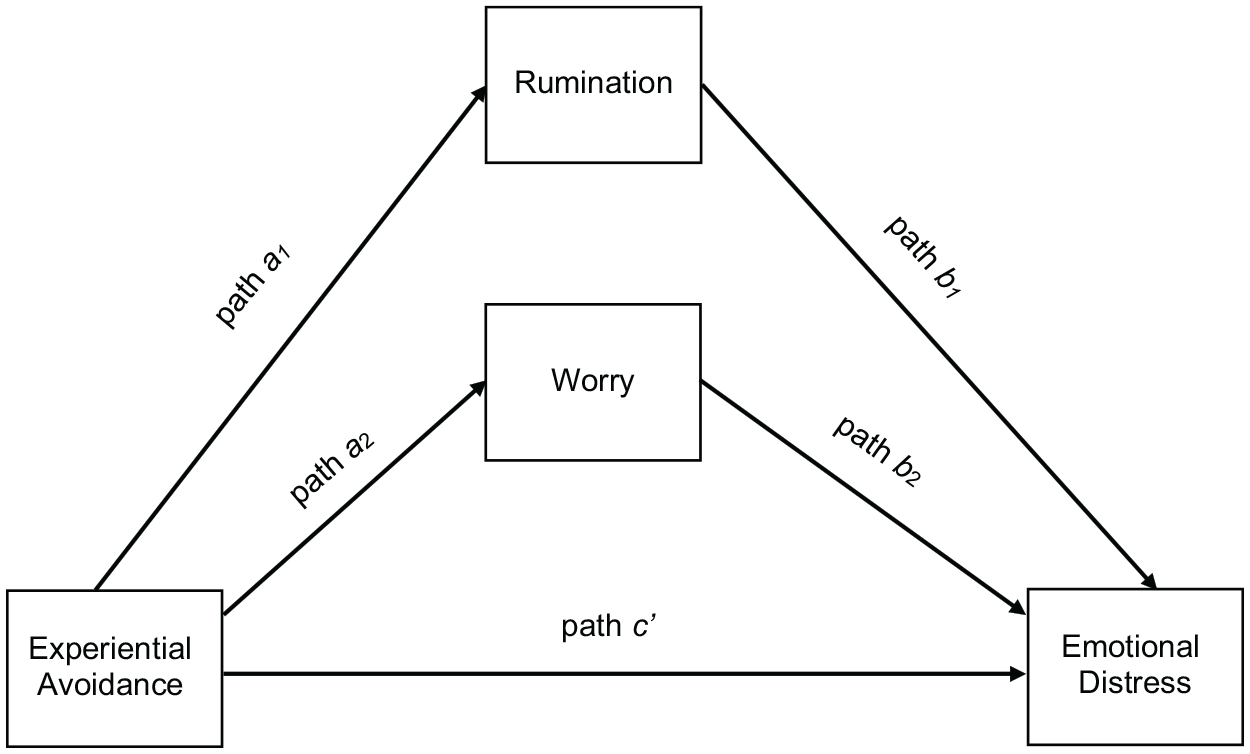
Conceptual parallel mediation model using the mediating effect of rumination and worry in the relationship between experiential avoidance and emotional distress.
Given reported differences in EA in terms of student generational status (first generation versus continuing generation) (e.g., Jenkins et al., 2013; Noel et al., 2021) and gender effects with respect to EA (e.g., Bottesi et al., 2018; Johnson & Whisman, 2013; Noel et al., 2021; Polanco-Roman et al., 2016; Pretorius et al., 2015), the potential impact of these demographic variables on EA, RNT, and ED was also explored.
Method
Participants
Participants were a convenience sample of 419 undergraduate students aged between 18 and 55 (M = 21.7, SD = 3.8) years from a large public university in South Africa. Most participants (75.2%) were female. First-generation students comprised 37.5% of the sample. Despite being enrolled at the time of data collection, first-year students were excluded as potential participants. Due to their relatively brief exposure to the higher education environment at the time data were collected (beginning of the first term), it was reasoned that these students had limited exposure to the stressors of university life. Most participants were in their second (41.3%) or third (41.8%) year of study.
Instruments
The seven anxiety-related items and seven depression-related items on the General Health Questionnaire (GHQ; Goldberg & Hiller, 1979) were combined as a measure of ED. The GHQ employs a four-point Likert-type scale with responses ranging from 1 (not at all) to 4 (much more than usual). Responses across all 14 items were summed to quantify ED, with higher scores indicating greater ED. A Cronbach’s α coefficient of .88 has been reported for the combined anxiety and depression subscales of the GHQ in a sample of South African university students (Spengler, 2019).
The Ruminative Response Scale (RRS; Nolen-Hoeksema, 1991) is a 22-item measure of rumination which employs a four-point Likert-type scale with responses ranging from 1 (almost never) to 4 (almost always). Responses across all items were summed to yield a total rumination score, with higher scores indicating greater rumination. An internal consistency coefficient of Cronbach’s α = .82 has been reported for the RRS total score in a sample of South African university students (Makhanya, 2017).
The Penn State Worry Questionnaire (PSWQ; Meyer et al., 1990) is a 16-item measure of worry that elicits responses along a five-point Likert-type scale anchored by 1 (not at all typical of me) and 5 (very typical of me). A total worry score was calculated by summing responses across all 16 items, with higher scores indicating greater worry. A Cronbach’s α coefficient of .81 has been reported for the PSWQ in a sample of South African university students (Pretorius et al., 2015).
The Acceptance and Action Questionnaire-II (AAQ-II; Bond et al., 2011) was employed as a measure of EA. The AAQ-II is a seven-item measure that employs a seven-point Likert-type scale with response options ranging from 1 (never true) to 7 (always true). A total EA score is calculated by summing responses across all seven items. Higher scores indicate greater EA. An internal consistency coefficient of Cronbach’s α = .89 has been reported for the AAQ-II by Spengler (2019) in a sample of South African university students.
Procedure
Data were collected during the first three weeks of the academic year. Invitations to participate in the study were sent via the official institutional email channels to all registered students who met the inclusion criteria outlined previously. The invitation described the purpose of the study and provided a link to the informed consent materials and online questionnaire. The link remained active for three weeks. Weekly reminder emails were sent out during this time.
Ethical considerations
Ethics approval was obtained from the General and Human Research Ethics Committee at the University of the Free State (UFS-HSD2020/1523/0812). Prospective participants were provided with detailed information regarding the purpose of the study, the voluntary nature of their participation, and how confidentiality and data security would be ensured. All participants provided written informed consent. No adverse events were reported.
Data analysis
Initially normative, descriptive, and correlational analyses were carried out. Thereafter, a between-group multivariate analysis of variance (MANOVA) was conducted to identify possible gender or student generational status differences with respect to EA, RNT, and ED. Ordinary least squares regression analyses were then employed to test the potential mediating effect of RNT on the interaction between EA and ED. Analyses were conducted using SPSS version 26.0 (SPSS; IBM Corp, 2019) and the PROCESS Macro version 3.5 for SPSS (A. F. Hayes, 2020).
Results
Descriptive statistics and correlations
As is apparent from Table 1, all four measuring instruments exhibit good internal consistency, with Cronbach’s α coefficients ranging from .91 for the GHQ and the AAQ-II to .94 for the RRS. Measures of skewness and kurtosis revealed no outliers or violations of assumptions. In addition, the study variables all exhibited statistically significant positive correlations to one another. All correlation coefficients are indicative of medium to large effect sizes (Cohen, 1992).
Reliabilities, correlations, and distribution of the study variables.
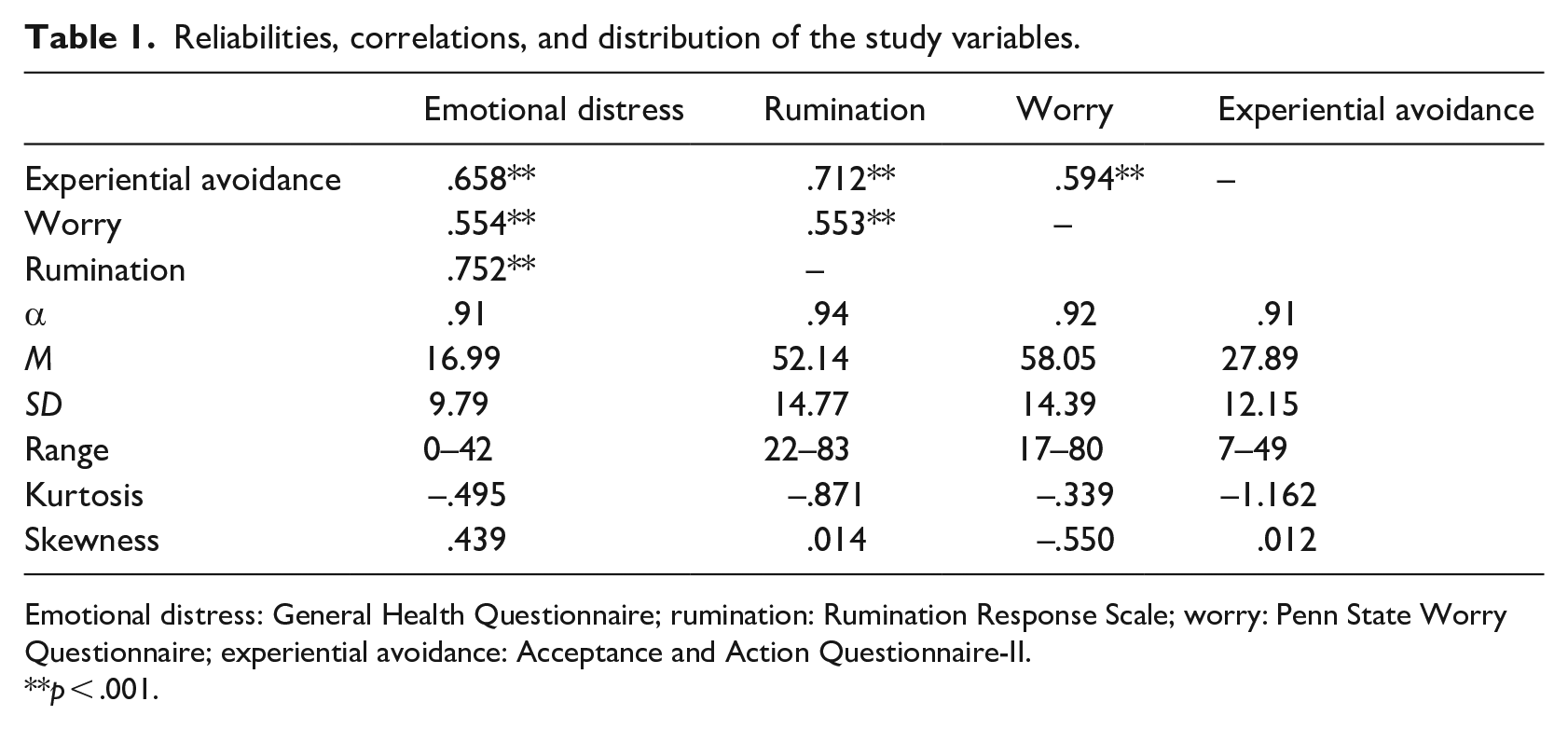
Emotional distress: General Health Questionnaire; rumination: Rumination Response Scale; worry: Penn State Worry Questionnaire; experiential avoidance: Acceptance and Action Questionnaire-II.
p < .001.
Tests for differences in gender and student generational status
A MANOVA was performed to investigate possible gender (male and female) and student generational status (first-generation students and continuing generation) differences in ED, EA, rumination, and worry. A Bonferroni adjusted level of significance of .014 was set to reduce the likelihood of a Type 1 error (Tabachnick & Fidell, 2007). Given that only two participants identified as non-binary, they were excluded from further analyses.
Preliminary testing did not reveal any serious violations of assumptions of normality, linearity, univariate and multivariate outliers, homogeneity of variance-covariance, and multicollinearity. The MANOVA indicated no statistically significant gender differences on the combined dependent variables (EA, ED, rumination, and worry) (F [4, 410] = 2.373, p = .052; Wilks’ Lambda = .977; partial eta squared = .023). Similarly, no significant differences were found with respect to student generational status (F [4, 410] = 1.650, p = .161; Wilks’ Lambda = .984; partial eta squared = .016). In addition, no significant interaction (between gender and student generational status) effect was evident (F [4, 410] = 1.938, p = .103; Wilks’ Lambda = .981; partial eta squared = .019). Consequently, the conceptual mediation model proposed in Figure 1 was only tested for the total sample.
Mediation model
The bias-corrected bootstrapping procedure described by A. F. Hayes (2017) was implemented to test for the mediating effect of rumination and/or worry on the interaction between EA and ED. The direct and indirect effects of EA on ED were investigated by regressing the proposed mediators on EA (rumination = path a1; worry = path a2), while ED was regressed on rumination (path b1) and worry (path b2). ED was also regressed on EA (via rumination and worry = path c’).
It is evident from Table 2 that EA, rumination, and worry jointly explain 61.2% of the variance in the ED scores of the participants. All three independent variables are statistically significant predictors of ED. However, when viewed in relation to EA (β = .184, p < .001) and worry (β = .147, p < .001), rumination (β = .542, p < .001) appears to explain a greater proportion of the variance in ED.
Regression model coefficients for EA, rumination, and worry as predictors of ED (n = 417).
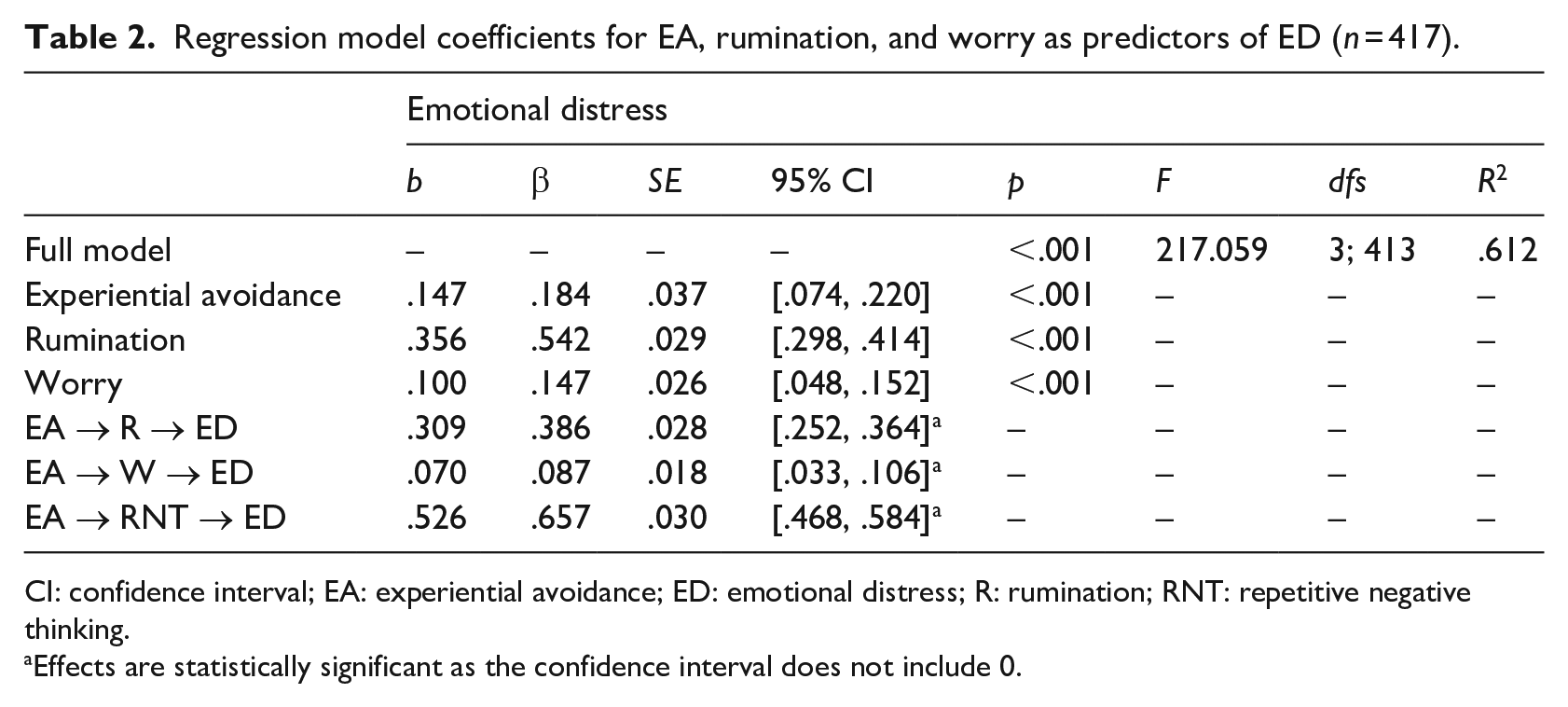
CI: confidence interval; EA: experiential avoidance; ED: emotional distress; R: rumination; RNT: repetitive negative thinking.
Effects are statistically significant as the confidence interval does not include 0.
The parallel mediation analysis depicted in Figure 2 indicates that EA is indirectly associated with ED via RNT. EA is positively related to rumination (a1 = .867, p < .001), and rumination is, in turn, positively associated with increased ED (b1 = .356, p < .001). Similarly, EA is positively associated with worry (a2 = .702, p < .001), which is subsequently related to an increase in ED (b2 = .100, p < .001). A 95% bias-corrected confidence interval based on 5000 bootstrap samples indicates that the indirect effects through rumination (a1b1 = .309, 95% CI [.252, .364]) and worry (a2b2 = .070, 95% CI [.033, .106]) are both entirely above zero. In addition, EA results in increased ED even when taking the indirect effect of RNT into account (c’ = .147, p < .001). It thus appears that both rumination and worry positively partially mediate the effect of EA on ED in the current sample.
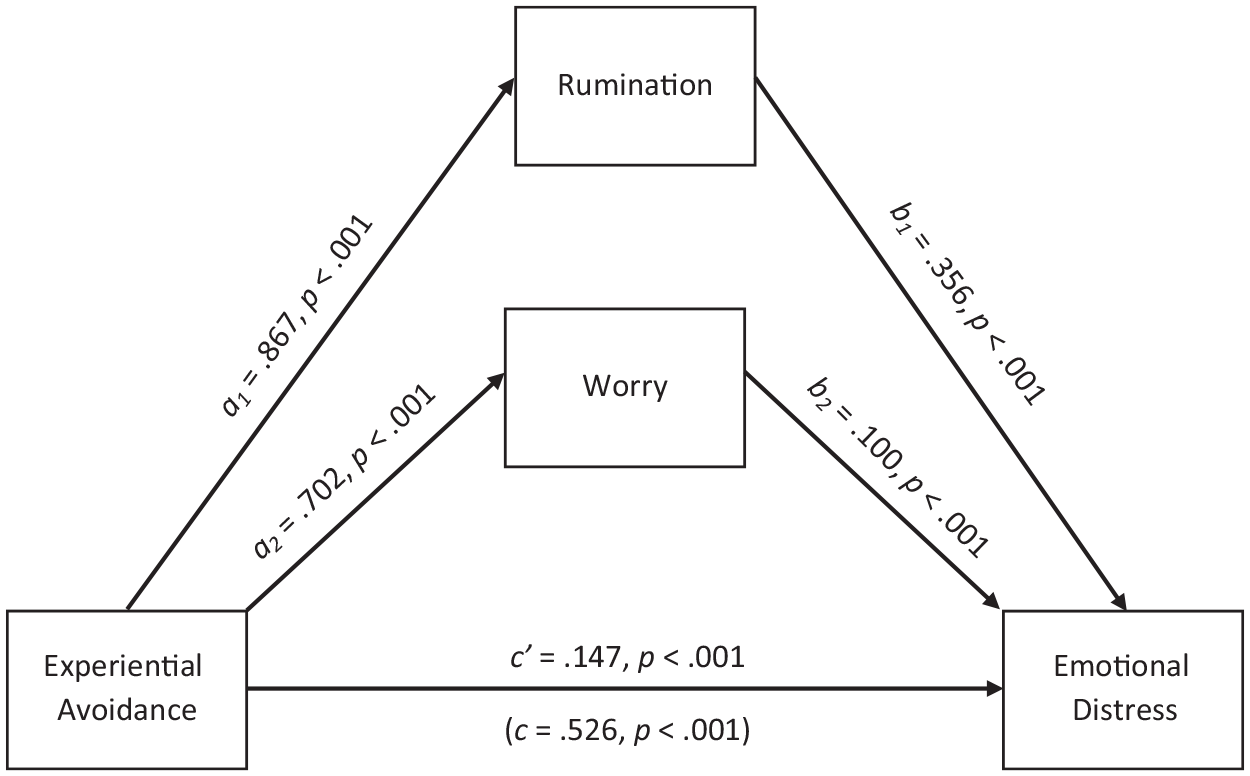
The mediating effect of rumination and worry in the relationship between EA and ED.
Discussion
The current study demonstrated a positive relationship between EA and ED. This finding is supported by research among students internationally (e.g., Chou et al., 2018; Tavakoli et al., 2019), as well as in South Africa (Spengler, 2019). Similarly, the positive correlations found between RNT and ED in the current sample are consistent with the international literature on ED among university students (e.g., Bottesi et al., 2018; Makhanya, 2017; Ryum et al., 2017; Tavakoli et al., 2019). Furthermore, worry, rumination, and EA contributed significantly to ED in the current sample, which is in line with findings in other student populations (Akbari & Khanipour, 2018; Bjornsson et al., 2010; Giorgio et al., 2010). Within the current study, rumination emerged as a stronger predictor of ED than either EA or worry. This finding complements previous research highlighting rumination as a predictor of ED (Kircanski et al., 2018; Spinhoven et al., 2018), as well as being more strongly correlated with ED than worry and a better predictor of relapse in both anxiety and depression (Spinhoven et al., 2018).
The existing literature on gender differences in RNT is inconclusive. Several studies suggest that gender differences exist with regards to RNT (Polanco-Roman et al., 2016; Pretorius et al., 2015; Ryum et al., 2017), while others have failed to identify gender effects (e.g., Akbari & Khanipour, 2018). No gender difference was found with respect to RNT in the current study. However, it should be noted that this sample predominantly comprised female students. Moreover, conceptualising rumination as a unitary construct may have masked gender differences previously reported with respect to the brooding and reflection components of rumination (Johnson & Whisman, 2013; Polanco-Roman et al., 2016).
The results of the current study appear contrary to existing research indicating that first-generation students may experience greater ED (Jenkins et al., 2013; Noel et al., 2021). It might be speculated that changes to the broader higher-education environment due to COVID-19 may have levelled the playing field between first-generation and continuing-generation students to a degree. While first-generation students may have been negatively impacted by remote learning, relocation from university campuses back to their home environments may have reduced the effect of systemic institutional discrimination, logistical challenges, and financial stress, while simultaneously increasing access to social support (Azmitia et al., 2018; House et al., 2020). The lack of variability in EA between first-generation and continuing-generation students in the current study is largely in keeping with existing literature (Merwin et al., 2009; Tavakoli et al., 2019). Conversely, the absence of significant differences in RNT between first-generation and continuing-generation students is unexpected. This may well be an anomaly resulting from the exclusion of first-year students from the sample. It has been suggested that senior students are less inclined to engage in dysfunctional coping strategies such as worry and rumination (Babicka-Wirkus et al., 2021; Van der Merwe et al., 2020).
Rumination partially mediated the relationship between EA and ED, whereby increases in EA elevated rumination and subsequently contributed to greater ED. This finding is strongly supported by the existing literature on EA, rumination, and ED. Rumination has previously been found to result in increased EA, as well as being associated with greater ED (Bjornsson et al., 2010; Giorgio et al., 2010; Tavakoli et al., 2019). Furthermore, Bjornsson et al. (2010) found that, when rumination is elevated, an increase in EA is associated with greater ED. Similarly, interaction effects were also found between EA, worry, and ED in the current study. More specifically, elevations in EA were associated with increased worry and greater ED. This is consistent with previous findings that individuals who tend to avoid or control internal experiences worry more (Akbari & Khanipour, 2018; S. C. Hayes et al., 2006), as well as with studies indicating that EA is positively associated with anxious symptomology, including worry (e.g., Tavakoli et al., 2019).
Taken together, the interactions reported between RNT, EA, and ED in this study appear to provide support for Ruiz et al. (2016) who suggest that RNT is a maladaptive EA strategy that serves to increase ED. In addition, the role of RNT in the interaction between EA and ED provides further support for interventions aimed at reducing ED through disrupting RNT and facilitating the acceptance of unwanted or distressing experiences (Dereix-Calonge et al., 2019; Ruiz et al., 2016).
The current study has certain limitations. First, the small sample, geographic specificity of the study, and exclusion of the first-year student cohort limit the extent to which the findings can be generalised. Second, due to the cross-sectional and correlational nature of the study, causality cannot be implied. Future longitudinal research would better determine the potential causal nature of the interaction between EA, RNT, and ED. Third, conceptualising rumination as a unitary construct may have masked gender differences previously reported with respect to certain aspects of rumination (Johnson & Whisman, 2013; Polanco-Roman et al., 2016). Alternative conceptualisations of rumination may uncover gender effects not evident in the current study. Finally, ensuring a more proportional distribution of male and female participants is recommended in future research to forestall the possible masking of gender effects in the interaction between RNT, EA, and ED.
Conclusion
This study found that EA, rumination, and worry significantly predict ED among South African university students. However, rumination emerged as a stronger predictor of ED than worry. The effect of EA on ED in this population is partially mediated by both rumination and worry (RNT). Finally, no differences in these interactions were apparent with regard to gender or student generational status. Findings from the current study suggest that mental health interventions aimed at the university student population should target both EA and RNT. However, prioritising interventions that specifically target rumination and worry might prove most therapeutically effective and cost-efficient. Particular attention should be paid to alleviating dysphoric mood, as well as disrupting brooding and other unproductive past-oriented cognitive processes.
Footnotes
Declaration of conflicting interests
The author(s) declared no potential conflicts of interest with respect to the research, authorship, and/or publication of this article.
Funding
The author(s) received no financial support for the research, authorship, and/or publication of this article.
