




Abstract
We examined the extent to which neuroticism, health anxiety, social anxiety, and social support predicted well-being in a sample of online users engaging in health-seeking behaviour. We used a cross-sectional online survey to recruit participants who engaged in online health-seeking behaviour. The study included 350 participants who were recruited online using social media platforms such as Reddit and Twitter. A multiple regression was conducted to examine the relationships between neuroticism, health anxiety, social anxiety, social support, and well-being. Participants completed a battery of measures on Survey Monkey consisting of a demographic questionnaire, International Personality Item Pool Big Five Markers, Leibowitz Social Anxiety scale, Short Health Anxiety Inventory, World Health Organisation Five Well-Being Index, and the Multidimensional Scale of Perceived Social Support. We found significant negative correlations between the indicated psychological variables and well-being, indicating that higher levels of neuroticism, social anxiety, and health anxiety were related to lower levels of well-being. We also found significant, positive correlations between the social support variables and well-being, indicating that more social support was correlated with better well-being. The results of the multiple regression demonstrate that neuroticism, health anxiety, family support, and friend support were significant predictors of well-being.
Well-being is a subjective construct that can be defined as a sense of satisfaction with one’s life in relation to functioning and feeling well (Huppert, 2009). Scholars such as Ryff (1989a, 1989b) view well-being as a multidimensional construct encompassing self-acceptance, autonomy, environmental mastery, positive relations with others, personal growth, and purpose in life. Conceptually, it is directly related to several constructs, such as happiness, flourishing, and psychological well-being (Sirgy, 2012). Well-being is associated with several positive outcomes such as creativity, workplace productivity, positive relationships, physical health, longevity, and prosocial behaviour (Diener, 2012; Diener & Seligman, 2004; Huppert & So, 2013; Knapp et al., 2011; Lyubomirsky et al., 2005; Oishi et al., 2016).
Understanding well-being is beneficial to individuals and society (Huppert, 2009). For example, the importance of well-being has resulted in some even arguing that well-being may at some points be more important than economic indicators in policy assessment (Diener & Seligman, 2004). In this article, we explored several predictors of well-being, namely, health anxiety, social anxiety, and social support among people who engage in online health-seeking behaviour. The internet has become a popular source of health information as this information is accessible, more affordable than seeing a health care professional, and can be less embarrassing when dealing with sensitive queries (Cline & Haynes, 2001; Redston et al., 2018). While health care costs may be increasing, thereby limiting accessibility (World Health Organisation, 2020), the internet is becoming increasingly accessible. People who engage in online health-seeking behaviour typically do so to seek information or support, or to supplement (or as an alternative to) medical advice relating to health (Atkinson et al., 2009; Mosa et al., 2012; Popovac & Roomaney, 2022). Studies show that 68% of German internet users (Nölke et al., 2015) and 71% of American internet users report engaging in online health information searches (Fox & Duggan, 2013).
Well-being and neuroticism
Neuroticism is a personality trait that broadly refers to the tendency to experience negative emotions and is characterised by poor self-regulation, difficulties dealing with stress, and strong reactions to perceived threats (Lahey, 2009). Neuroticism is associated with poor responses to environmental stress (Widiger & Oltmanns, 2017) and has also been significantly negatively correlated with well-being in several studies. For example, a study among 434 college students found that neuroticism was a significant predictor of subjective well-being (Zhang & Renshaw, 2020). Longitudinal data show that among older adults, lower levels of neuroticism were associated with higher well-being (Mueller et al., 2019; Potter et al., 2020).
Moreover, a meta-analysis was conducted to determine how well personality dimensions predicted well-being (Anglim et al., 2020). The researchers included data from 462 studies and found that, among the big five dimensions of personality, neuroticism was the strongest correlate of well-being (Anglim et al., 2020). These findings support our hypothesis that neuroticism may be a significant predictor of well-being.
Health anxiety
Health anxiety refers to the excessive fear of being ill (Hedman-Lagerlöf et al., 2019).
Those experiencing health anxiety may frequently visit their doctors or excessively search for information about their health. Individuals with health anxiety may engage in behaviours such as searching for health information to reduce their fear of illness (Abramowitz & Moore, 2007). Studies show an association between health anxiety and information seeking. For example, health anxiety was significantly correlated with online health information searches and active posting of health-related information online among 104 staff and students at a Dutch university (Baumgartner & Hartmann, 2011). In addition, health anxiety mediates the relationships between neuroticism and information seeking (Lagoe & Atkin, 2015). The relationship between health anxiety and online health-seeking behaviour was also demonstrated in a recent meta-analysis (McMullan et al., 2019).
Health anxiety is associated with cyberchondria or excessive online health-seeking behaviour (Hartmann & Baumgartner, 2011; McMullan et al., 2019). The internet may seem perfectly poised to provide an outlet for those with health anxiety to seek information about their health but can have a negative impact on these individuals. Research shows that even a 5-min search about a health concern or symptom can lead to a significant increase in health concerns (Pollklas et al., 2020). Research also shows that health anxiety impacts quality of life (Lebel et al., 2020). Considering this research, it is likely that health anxiety is negatively correlated with well-being.
Social support and well-being
Interpersonal communication is central to building social capital, which is broadly defined as the connections that are formed with other individuals that provide us with necessary social resources (Lin, 2008, 2017). This fulfils the basic human needs of belongingness and connection with others. While social capital relates to the resources resulting from social connections, social support is a behavioural component of this as it links to interactions that include advice-giving and emotional support. Therefore, these concepts are closely linked (Beaudoin & Tao, 2007). Both social capital and social support are considered to be among the most important aspects relating to well-being and life satisfaction (Trepte et al., 2012). Moreover, both online and offline forms of support are associated with physical and mental well-being (Bargh & McKenna, 2004; Helliwell & Putnam, 2004; Johnston et al., 2013). With increased social interaction possible in online spaces, such as social networking sites and online groups and communities, individuals can cultivate social capital via positive interactions and support from other users. For those with health concerns, online spaces provide an additional means of peer-to-peer support-seeking, which can lead to positive outcomes (Baptista et al., 2020). Thus, levels of social support are a critical component to examine in the context of the well-being of health group users as it would be expected that higher social support relates to higher well-being.
Social anxiety and well-being
Social anxiety or social phobia refers to a constant fear of social situations (Jefferson, 2001) and exists on a continuum ranging from shyness to social anxiety disorder or social phobia (Morrison & Heimberg, 2013). Socially anxious individuals avoid social interactions, and their social anxiety can be limiting or even debilitating (McNeil, 2010). However, mild to moderate levels of social anxiety that are situationally restricted can be transient (McNeil, 2010).
There is a paucity of research on the relationship between social anxiety and well-being. However, a study from Croatia found that feelings of loneliness mediate the relationship between social anxiety and social well-being, meaning that people who are socially anxious may still experience good social well-being if they do not feel lonely (Maričić & Štambuk, 2015). However, social anxiety remains problematic. Research among a cohort of treatment-seeking young adults concluded that those diagnosed with social anxiety disorder reported poorer quality of life than those diagnosed with obsessive compulsive disorder and major depression (Park et al., 2021).
Individuals with social anxiety are susceptible to problematic internet use (Lee & Stapinski, 2011), defined as the inability to control internet use, which leads to negative consequences, such as the avoidance or neglect of work, personal relationships, and health (Spada, 2014). For those who are socially anxious, the online space can provide a refuge from in-person interaction. However, to the authors’ knowledge, there is little available research on how social anxiety relates to well-being among those who engage in online health-seeking behaviour.
Rationale and hypotheses
The internet provides users with anonymity and removes some of the awkwardness associated with in-person health-seeking behaviour and may be more appealing to those who have social anxiety. The internet is also always available and may therefore suit individuals who are neurotic or have high levels of health anxiety and seek answers immediately. Furthermore, for those who do not have support from family and friends, the online health community can act as sources of support. The literature summary has provided some insight into the relationship between the variables, social anxiety, health anxiety, neuroticism, social support, and well-being. However, no studies have explored this combination of variables as predictors of well-being among those who engage in online health-seeking behaviour.
Our aim in this article was to examine the extent to which neuroticism (H1), health anxiety (H2), social anxiety (H3), and social support (H4) predicted well-being in a sample of online users engaging in health-seeking behaviour. We hypothesised that each independent variable would be a significant predictor of well-being.
Method
Participants
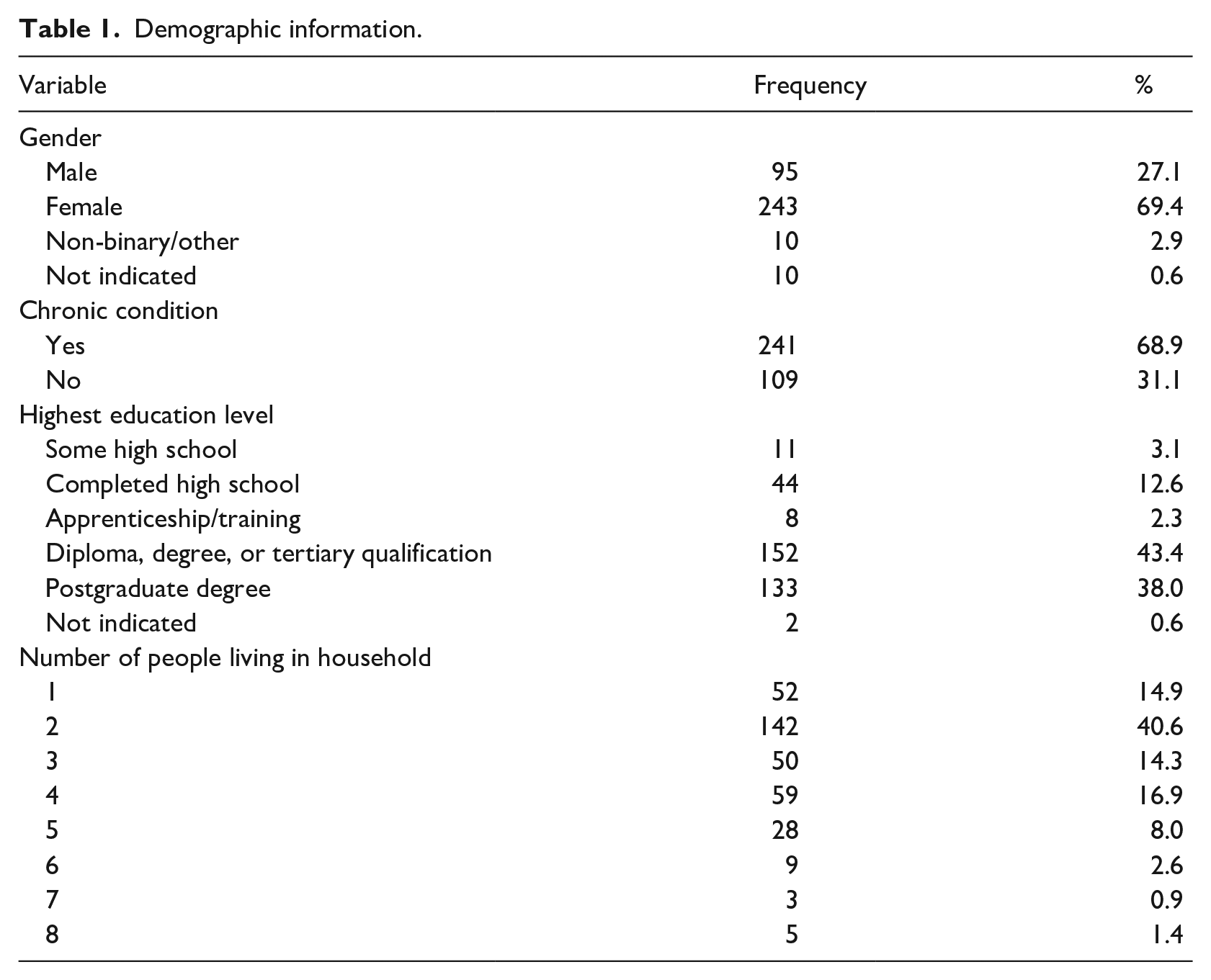
Data for this study were collected online during two data collection waves as part of a larger study that was concerned with the development of a measure of online health-seeking behaviour. A total of 541 and 204 people participated in the first and second data collection waves, respectively. Participants who did not complete all the measures were removed from the study, resulting in a final sample of 350 participants. The ages of participants ranged from 18 to 83 years (M = 36.73 years). Most of the participants were female (69.4%); had a chronic condition (68.9%); were well-educated with either a diploma, degree, or tertiary education (43.4%); and had two people living in their households (40.6%). See Table 1 for more information on the demographic variables.
Demographic information.
Instruments
Participants were asked to provide information on several demographic variables and completed questionnaires that measured subjective well-being, neuroticism, social anxiety, and health anxiety. Questionnaires were selected based on their suitability to measure these constructs and evidence of reliability and/or validity in similar research or populations.
Demographic questionnaire: Participants were asked to report on their age, gender and education level, the number of people living in their household, and to indicate whether they had been diagnosed with a chronic medical condition.
International Personality Item Pool Big Five Markers (IPIP-BFM-20): The IPIP-BFM-20 was used to assess personality (short-form of the NEO IPIP). The 20-item measure assesses personality on five dimensions, namely, neuroticism, agreeableness, openness to experience, extraversion, and conscientiousness. We administered all items but, in this article, only the data from the neuroticism subscale are reported. This subscale consists of four statements that assess neuroticism. Participants indicate the extent to which each statement describes them on a 5-point Likert-type scale. Cronbach’s alpha for the neuroticism subscale in the current sample was .73.
Leibowitz Social Anxiety Scale (LSAS): The LSAS (1987) was used to assess participants’ social anxiety. The measure contains 24 items that participants respond to using a 3-point Likert-type scale. We calculated a composite score for this measure, which demonstrated excellent internal consistency reliability (Cronbach’s α = .94). Higher scores indicate more social anxiety than lower scores.
Short Health Anxiety Inventory (SHAI): The SHAI was used to assess health anxiety (Salkovskis et al., 2002). The measure consists of 14 items and for each item participants select one of four statements that appears most relevant to them. Higher scores indicate more health anxiety than lower scores. The measure produced a good internal consistency reliability in the current sample (Cronbach’s alpha = .89).
World Health Organisation Five Well-Being Index (WHO-5): The WHO-5 was used to measure subjective well-being. The five-item measure is widely used (Topp et al., 2015). Test takers respond to five statements on a 6-point Likert-type scale, with higher scores indicating better well-being than lower scores, and raw scores below 13 indicate poor well-being (Topp et al., 2015). An internal consistency reliability of .91 was produced in the current sample.
Multidimensional Scale of Perceived Social Support (MSPSS): Perceived social support was measured using the MSPSS (Zimet, 1988). The measure contains 12 items across three subscales that measure support from (1) family, (2) friends, and (3) significant others. Participants rate the items using a 7-point Likert-type scale, with higher scores indicating better support than lower scores. Each four-item subscale produced strong internal consistency reliabilities, ranging from .92 for support from friends to .94 for support from significant other. To capture the effect of different types of social support on well-being, the individual subscales were used as separate variables in the analysis.
Procedure
Participants were recruited using social media. We advertised the study on various health-related discussion forums on Reddit and social media groups on Twitter and Facebook. As such, participants were actively seeking information related to health and illness online. Data collection for the first wave took place over several weeks, ending in February 2019, whereas data collection for the second wave took place between April and June 2021.
Data were collected using several questionnaires hosted on Survey Monkey. Participants accessed the questionnaires via a link that was provided on a flyer advertising the study. Participants were provided with information about the study, and those wishing to participate provided consent by selecting a consent button online. They were then presented with several questionnaires that took an average 25 min to complete. Participants could leave the study at any time by closing their browser. Participants were presented with a debriefing page after they completed the questionnaires.
Ethical considerations
The study received full ethical approval. The British Psychological Society Ethics Guidelines for internet Mediated Research were used to ensure ethical practice. Ethical clearance was granted by the University of Buckingham ethics committee and the Research Ethics Committee (Social and Behavioural Research) at Stellenbosch University (Approval Number: HSD-004630).
Data analysis
Data from the first and second waves were downloaded, combined, and then exported to the Statistical Package for the Social Sciences (SPSS), version 27. The data were cleaned, and demographic information summarised using descriptive statistics. The data were screened to determine the appropriateness of conducting a multivariate analysis. A multiple regression was conducted to examine the relationships between neuroticism, health anxiety, social anxiety, social support, and well-being. The psychological variables (neuroticism, health anxiety, and social anxiety) were entered into the first block, and social variables (family support, friend support, and significant other support) were entered into the second block. Well-being was the outcome variable.
Results
Well-being, health anxiety, social anxiety, neuroticism, and social support
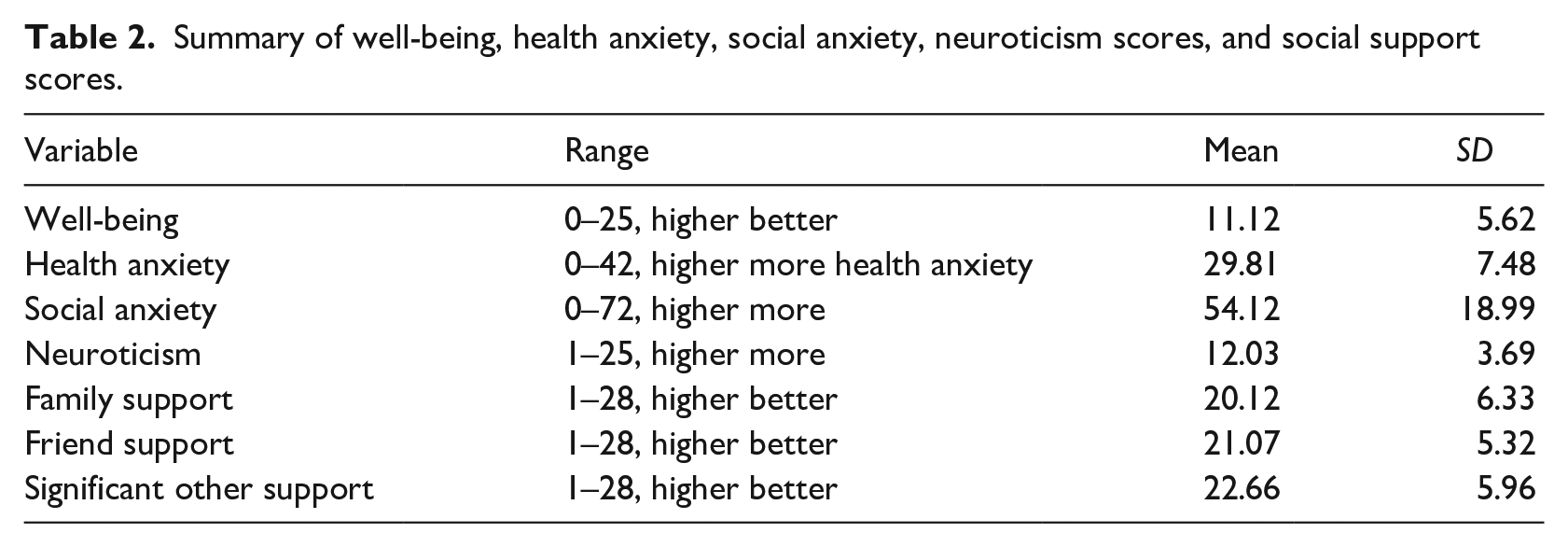
Participants reported on average poor well-being scores (M = 11.12; standard deviation [SD] = 5.62). We also found relatively high scores of health anxiety (M = 29.81; SD = 7.52) and social anxiety (M = 54.12; SD = 18.99). Participants also reported below-average scores for neuroticism (M = 12.03; SD = 3.69).
Participants also reported relatively good social support from friends (M = 21.07; SD = 5.32); family (M = 20.12; SD = 6.33), and significant others (M = 22.66; SD = 5.96). Descriptive statistics for the key study variables are shown in Table 2.
Summary of well-being, health anxiety, social anxiety, neuroticism scores, and social support scores.
Correlations between variables
We found significant correlations between the predictor variables and well-being. Health anxiety, social anxiety, and neuroticism were negatively correlated with well-being. The strongest correlations were found between well-being and neuroticism (r = –.56, p < .01), well-being and health anxiety (r = –.48, p < .01), and health anxiety and neuroticism (r = .45, p < .01). Family support (r = .33, p < .01) and friend support (r = .36, p < .01) were moderately correlated with well-being. Table 3 provides more information about the correlations between variables.
Correlations between well-being, health anxiety, neuroticism, and social anxiety.
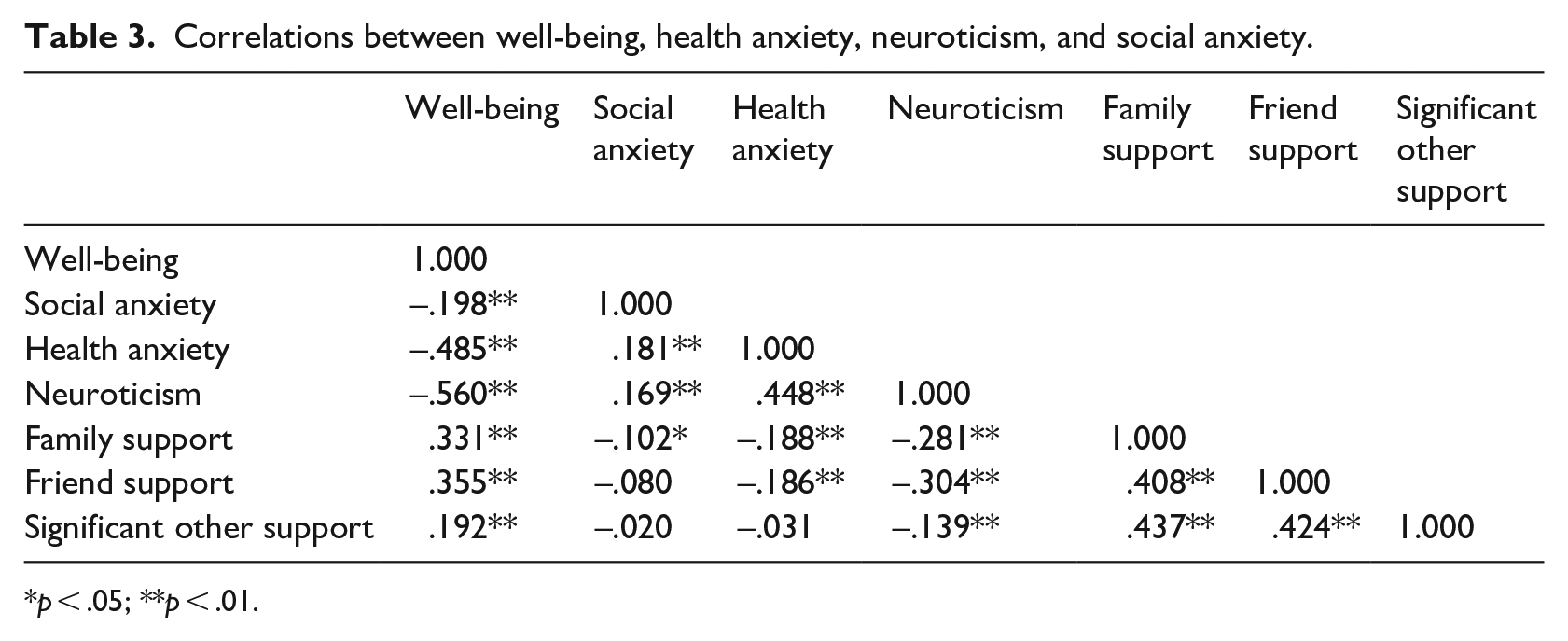
p < .05; **p < .01.
Predictors of well-being
Prior to conducting the regression analysis, we assessed several regression diagnostics, such as the variance inflation factors and the Cook’s and Mahalanobis distances. These tests indicated that the data were suited to a multiple regression.
Table 4 presents the regression model summary with well-being as the criterion variable. Both steps in the model were significant (p = .000). The linear combination of the psychological predictors explained 39% of the variance in well-being. In the second model, the addition of the social support variables increased the predictive power of the model slightly to 43%.
Model summary.
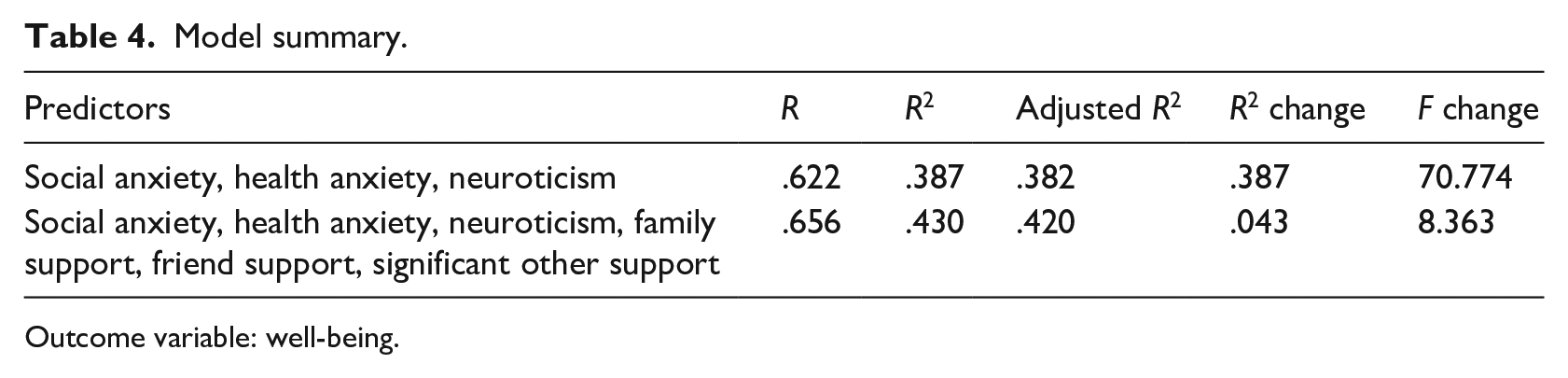
Outcome variable: well-being.
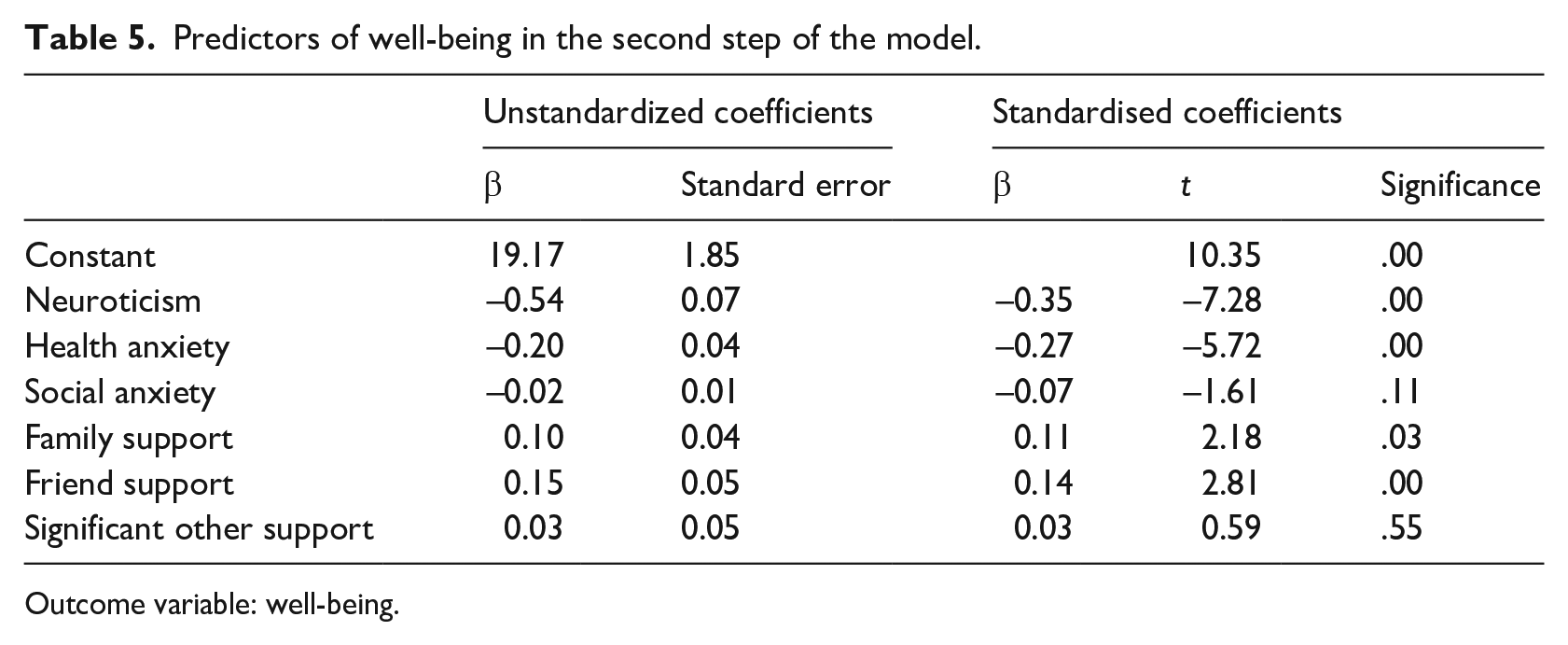
Table 5 shows that neuroticism, health anxiety, and family and friend support were significant predictors of well-being. The combination of neuroticism, health anxiety, and family and friend support were significant predictors of well-being, but significant other was not.
Predictors of well-being in the second step of the model.
Outcome variable: well-being.
The results indicate that H1 and H2 are supported as neuroticism and health anxiety both significantly predicted well-being. More specifically, both variables predicted lower well-being scores among users engaging in online health-seeking. Although there was a significant correlation between social anxiety and well-being, this association was weak. Social anxiety also did not significantly predict well-being in the regression analysis, thus H3 is rejected. Finally, H4 is accepted as social support was a significant predictor of well-being. However, only family and friend support positively predicted well-being, while support from significant others was non-significant.
Discussion
Our aim was to assess psychosocial predictors of well-being among people who engaged in online health-seeking behaviour. We assessed three psychological variables, namely, neuroticism, health anxiety, and social anxiety, and three sources of support, namely, family, friends, and significant others. We found negative correlations between the psychological variables and well-being, indicating that higher levels of neuroticism, social anxiety, and health anxiety were related to lower levels of well-being. Conversely, we found positive correlations between the social support variables and well-being, indicating that more social support was correlated with better well-being. We then conducted a multiple regression and found that neuroticism, health anxiety, and family and friend support were significant predictors of well-being. The fact that 69% of participants reported that they were diagnosed with a chronic condition is noteworthy and may explain the relatively high health anxiety scores. Health anxiety features prominently among patients with chronic illnesses (Lebel et al., 2020). This may also explain why they were engaging in online health-seeking behaviour. This finding supports research that concluded that there is a correlation between health anxiety and online health searches (Hartmann & Baumgartner, 2011; McMullan et al., 2019). We also identified health anxiety as a significant predictor of well-being, supporting the finding of Lebel et al. (2020) that health anxiety impacts quality of life.
There is little research on the relationship between social anxiety and well-being, but we found that participants in the current study reported high levels of social anxiety and that social anxiety correlated negatively with well-being. However, in the model, social anxiety was not a significant predictor of well-being when neuroticism, health anxiety, and social support were taken into consideration. This indicates that the relationship between social anxiety and well-being is a complex one, worthy of further examination.
Participants in the current study reported below-average levels of neuroticism, indicating that those who engage in online health-seeking behaviour may not be doing so because of general neurosis. However, neuroticism proved to be a significant predictor of well-being. The significant negative correlation found in the current sample between neuroticism and well-being was reported in several other studies among college students (Zhang & Renshaw, 2020), samples in Germany (Mueller et al., 2019; Potter et al., 2020), and a systematic review (Anglim et al., 2020). The research on the relationship between neuroticism and well-being is therefore well-documented.
Overall, participants reported high levels of social support. Research shows that people under the age of 40 years typically seek support from family members, whereas those above this age tend to seek support from friends and community members (Heinze et al., 2015). Participants in the current study were on average 37 years old and reported seeking support from family, friends, and significant others. The findings of the current study support other research that concluded that support is associated with well-being (Bargh & McKenna, 2004; Heinze et al., 2015; Helliwell & Putnam, 2004). Support from family and friends produced moderate correlations with well-being and were significant predictors of well-being. On the contrary, support from significant others was weakly correlated with well-being and not a predictor of well-being. These findings show that there is a distinction between the different sources of support and well-being that warrants further investigation.
Our study was limited by a broad definition of online health-seeking behaviour and inviting anyone who engaged in online health-seeking behaviour to participate in the study rather than setting a minimum time for engaging in online health-seeking behaviour as an inclusion criterion. In future, we may be more specific about inclusion criteria and limit studies to specific health populations.
Conclusion
This study has provided some insight into predictors of well-being among people who engage in online health-seeking behaviour. However, further research should be conducted to explore the complex nature of these relationships. In addition, qualitative studies must be conducted to explore the relationships between these variables and other factors that may be at play. This can contribute to developing a theoretical model that describes contributors to well-being among people who engage in online health-seeking behaviour. Furthermore, the results of the study indicate that neuroticism and health anxiety may be driving online health-seeking behaviour, but this must be explored in future research.
Footnotes
Data availability statement
The data that support the findings of this study are available on request from the corresponding author, R.R. The data are not publicly available due to ethical restrictions.
Declaration of conflicting interests
The author(s) declared no potential conflicts of interest with respect to the research, authorship, and/or publication of this article.
Funding
The author(s) received no financial support for the research, authorship, and/or publication of this article.
