




Abstract
Employee turnover and talent retention are both key concerns for higher education institutions because they are losing highly qualified staff members to the private sector and other higher education institutions that offer better rewards and benefits. This study explored the mediating effect of perceptions of organisational justice and trust relationships on the link between higher education institution staff’s psychological contract perceptions and satisfaction with organisational retention practices. The study involved a cross-sectional quantitative survey with a sample of (N = 493) full-time employees, both from academic and support staff, at an open distance learning higher education institution in South Africa. Structural equation mediation modelling and mediation analysis showed that organisational justice and trust relationships function as positive parallel and separate mediating mechanisms in the psychological contract – retention practices’ satisfaction link. The study highlighted the importance of employees’ psychological contract beliefs in the employee–organisation relationship, and especially in determining mutual expectations that guide and shape perceptions of organisational justice and trust. Employees’ satisfaction with retention practices is positively enhanced when they experience mutually satisfactory just and trustworthy relations in the organisation.
Keywords
Higher education institutions (HEIs) in Africa and, specifically, in South Africa, are facing massive challenges in terms of skilled human resources (HRs; Abugre, 2018; Deas & Coetzee, 2020). The retention of all employees at HEIs is crucial to societal life due to the responsibility of educating the future leaders of society and for conducting scientific research, while, in so doing, advancing knowledge (Coetzee & Rothmann, 2004; Robyn, 2012; Snyman, 2021). South African HEIs cannot afford to keep losing their valued and talented employees. Top employees voluntarily leaving the organisation create a gap that is expensive to fill and challenging to manage (Grobler & Jansen van Rensburg, 2019; Potgieter et al., 2018). It is essential that HEIs implement effective retention strategies that will result in employees being committed to their institution (Grobler & Jansen van Rensburg, 2019; Snyman, 2021).
Research highlights the importance of employees’ psychological contract expectations and perceptions of organisational justice and trust in the retention of employees (Bonilla, 2018; O’Meara et al., 2016; Stormbroek & Blomme, 2017). Significant associations have been evidenced between perceptions of the psychological contract, organisational justice and trust, and employees’ intention to leave (Cohen-Charash & Spector, 2001; Deas, 2017; Kaya et al., 2016; Khalid et al., 2018; Perreira et al., 2018). However, even though empirical research on the constructs of psychological contract, organisational justice and trust has made great strides during the past decade, there seems to be limited empirical research on the psychological contracts of academic employees and the link with core retention practices (Bordia et al., 2014; Deas, 2017; Fako et al., 2018; Johnston, 2016; Krivokapic-Skoko et al., 2009; Nutakki et al., 2015). Organisational justice and trust have been proven to mediate the relationship between the psychological contract and employment-related factors such as job satisfaction, commitment, well-being, work engagement, change management, intention to leave, and leadership (Agarwal, 2014; Brockner, 1990; Cassar & Buttigieg, 2015; Cohen-Charash & Spector, 2001; Erkutlu & Chafra, 2013; Robinson & Rousseau, 1994; Van den Heuvel et al., 2015). However, the link between perceptions of the psychological contract and retention practices through the psychological mechanisms of organisational justice and trust is still unclear, especially in the South African HEI context (Snyman, 2021).
The objective of this study was to examine the mediating effect of organisational justice and trust on the relationship between individuals’ psychological contract perceptions and their satisfaction with HR practices that influence staff retention (including compensation, job characteristics, training and development opportunities, supervisor support, career opportunities, and work-life balance policies). It was assumed that organisational justice and trust may function as explanatory intermediary mechanisms of the social exchange relationship denoted by the link between perceptions of the psychological contract and satisfaction with retention practices.
HR retention practices
Employee retention is described as the policies and practices that organisations apply to prevent valuable employees from leaving the organisation (Balakrishnan & Vijayalakshmi, 2014; Hong et al., 2012). Of relevance to this study are Döckel et al.’s (2006) six retention practices (compensation, job characteristics, opportunities for training and development, supervisor support, career opportunities, and work-life balance policies), which high technology South African organisations need to consider for the retention of employees (Döckel et al., 2006; Van Dyk & Coetzee, 2012). Retention strategies such as improving employees’ compensation packages, introducing flexible working environments, challenging jobs, improving employees’ career development, and training opportunities are critical in a global market which is faced with the shortage of skilled workers and, in particular, in the South African economy where HEIs are facing the growing problem of major employee turnover (Chabault et al., 2012; Deas, 2017; Snyman, 2021; Terera & Ngirande, 2014).
The psychological contract
The psychological contract comprises the unwritten agreement between employers and employees including perceptions of the obligations, rights, justice, and rewards to which employees believe they are entitled from their employer in return for their work, commitment, responsibility, and loyalty (Grobler, 2014). Social exchange theory (Blau, 1964; Stormbroek & Blomme, 2017) posits that employees and employers are parties to a social exchange relationship and that the successful, positive, and fruitful continuation of this exchange relationship is dependent on the fulfilment of the psychological (unwritten) promises and obligations that the parties to this relationship expect (Blau, 1964; Stormbroek & Blomme, 2017). Research by Deas (2017) indicated that positive psychological contract perceptions are linked with higher levels of satisfaction with retention practices such as compensation, job characteristics, training and development opportunities, supervisor support, career opportunities, and work-life balance policies. Previous studies further showed that a perceived breach of the psychological contract increases both intended and actual turnover and has a negative effect on work attitudes, behaviour, and perceptions of justice and trust (Kraak et al., 2017; Snyman, 2021; Stormbroek & Blomme, 2017; Van der Vaart et al., 2015; Van Dijk & Ramatswi, 2016).
Organisational justice
Organisational justice alludes to employees’ perceptions regarding the fairness of the way they are treated in their organisations (Colquitt et al., 2015). Fairness in an organisation makes employees feel that they are valued, while fair treatment creates feeling of respect and is an important element in employees’ perception of organisational justice (Gelens et al., 2014; Strydom et al., 2014; Xerri, 2014). Organisational justice has a significant effect on the state of employees’ psychological contracts and whether they experience contract violation (Morrison & Robinson, 1997; Nimmo, 2018’; Tziner et al., 2017). The perception of an unfair employment relationship and unfair employment practices correlates positively with employees’ intention to leave an organisation and employee turnover (Othman, 2008; Perreira et al., 2018). There is also a strong correlation between the overall perceptions of justice of employees and organisational trust levels (Bekmezci et al., 2022; Edezaro, 2022; Jiang et al., 2017; Oosthuizen et al., 2018).
Trust
Trust is strongly related to the psychological contract because it relies on mutual expectations and reciprocal faith that each party to a relationship has that the other party will fulfil their promises and treat the other party benevolently (Kreitner & Kinicki, 1995; Snyman, 2021). When there is trust in an organisation, the employees have faith and confidence in the organisation, which result in higher levels of organisational commitment (Martins, 2010; Potgieter & Mathonsi, 2021). Trust in organisations is purported to be formed by both personality factors and managerial practices including credibility, team management, information sharing, and work support (Martins, 2000, 2002; Martins et al., 1997; Von der Ohe, 2014, 2016).
Organisational justice and trust as mediating mechanisms
Previous research studies have confirmed that organisational justice and trust mediate the relationship between the psychological contract and employment-related factors such as job satisfaction, commitment, well-being, work engagement, change management, intention to leave, and leadership (Agarwal, 2014; Cassar & Buttigieg, 2015; Erkutlu & Chafra, 2013; Van den Heuvel et al., 2015). Employees’ perceptions of organisational justice in an organisation relate closely to fairness and trust (Mishra et al., 2015; Potgieter et al., 2015; Tulubas & Celep, 2012). Organisational justice enables trust and has a noteworthy effect on the social exchange relationship between an employer and an employee (Agarwal, 2014; Holtz & Harold, 2009; Jiang et al., 2017; Mishra et al., 2015; Othman, 2008; Potgieter et al., 2015; Tulubas & Celep, 2012; Xu et al., 2016). We, therefore, hypothesised that they both serve as psychological mechanisms that can either strengthen or weaken the relationship between the employees’ perceptions of the psychological contract and their satisfaction with organisational retention practices.
Research hypothesis. Organisational justice and trust relationships mediate the link between psychological contract perceptions and retention practices’ satisfaction.
Organisational justice and trust relationships are thus treated as outcomes of perceptions of the psychological contract, and if the psychological contract is fulfilled, positive perceptions of organisational justice and trust relationships are expected which enhance satisfaction with retention practices.
Method
Participants
The population was purposively targeted, and a random sampling technique was employed to ensure representativity of academic and support staff. The population consisted of 4882 employees. The sample was a random sample of (N = 493) permanently employed staff (99%); the majority of whom were married (64%), Black African (48%), females (63%), and aged between 46 and 55 years (31%) at a South African HEI. The response rate was 10.1%.
Instruments
The psychological contract
The Psycones Questionnaire (Guest et al., 2010; Psycones, 2006) scale comprises of 44 items that measure perceptions of employer and employee obligations, job satisfaction, and state of the psychological contract (e.g., ‘Has your organisation promised or committed itself to provide an environment free from violence and harassment’/‘Have you promised or committed yourself to respect the rules and regulations of the institution?’/‘Do you feel that organisational changes are implemented fairly in your organisation?’). Some responses are measured on a 6-point Likert-type scale (0 = no, the participant feels the promise were not kept; 5 = yes, promise fully kept) and some on a 5-point Likert-type scale (1 = strongly disagree; 5 = strongly agree). The scale has proven validity and internal consistency reliability (.87–.94: Snyman, 2021; .70–.95: Psycones, 2006).
Organisational justice
The organisational justice measure (OJM) (Colquitt, 2001) comprises of 20 items that measure perceptions of distributive, procedural, informational, and interactional justice on a 5-point Likert-type scale (1 = to a small extent; 5 = to a large extent: for example, ‘Does your (outcome) reflect what you have contributed to the organisation?’/‘Have you been able to express your views and feelings during those procedures?’/‘Has (he or she) communicated details in a timely manner?’/‘Has (he or she) treated you with respect?’). The scale has proven validity and internal consistency reliability (.93–.96: Snyman, 2021; .84–.96: Colquitt, 2001).
Trust relationship
The trust relationship audit (TRA; Martins & van der Ohe, 2005) comprises of 14 items that measure perceptions of trust within the relationship with the direct manager/supervisor and organisational trust on a 5-point Likert-type scale (1 = strongly disagree; 5 = strongly agree; 1 = never; 5 = always: for example, ‘The person I report to is fair in judging my performance’/‘Change in the organisation is managed effectively’). The scale has proven validity and internal consistency reliability (.84: Snyman, 2021; .94: Von der Ohe, 2014).
Satisfaction with retention practices
The retention factor measure (RFM; Döckel, 2003) measures satisfaction with six subdimensions of retention practices: compensation (13 items, for example, ‘My benefits package’), job characteristics (4 items, for example, ‘The job denies me any chance to use my personal initiative or judgement in carrying out work’), training and development opportunities (6 items, for example, ‘I can apply the training I receive, in the organisation’), supervisor support (6 items, for example, ‘My supervisor often lets me know how well he thinks I am performing on the job’), career opportunities (6 items, for example, ‘An employee’s career development is important to this organisation’) and work/life balance (4 items, for example, ‘My job affects my role as a spouse and/or parent’) on a 6-point Likert-type scale (1 = strongly dissatisfied; 5 = strongly satisfied). The scale has proven validity and internal consistency reliability (.64–.94: Snyman, 2021).
Procedure
The data were collected electronically via an online survey. Participants received an invitation stating the purpose of the research and a request to participate voluntary. They received an electronic link to the questionnaires.
Ethical considerations
The data were collected after obtaining ethics clearance from the research institutions (University of South Africa: ERC Ref#: 2016_HRM_015). Informed consent was obtained from the participants. The privacy, anonymity, and confidentiality of all the participants were ensured and honoured. All participants gave their permission to use the data for research.
Data analysis
Confirmatory factor analysis (CFA) was applied to assess the construct validity of the overall research measurement model before specifying the structural equation model for testing mediation effects (Dragan & Topolšek, 2014; Hair et al., 2019). Bivariate correlations and structural equation modelling (SEM) were then conducted to assess the associations between the construct variables and the parallel mediation effect of justice and trust. SPSS (2017) was used to calculate the descriptive statistics, reliability coefficients, and bivariate correlations. SAS software version 9.4 (SAS, 2013) was used for conducting the CFA and SEM. The JASP software version 0.16.3 (Jeffreys’s Amazing Statistics Program [JASP], 2022) was utilised to calculate the direct, indirect, and total effects of the mediation analysis. The more stringent bootstrapping procedure was used to assess the significance of the mediation effects with the lower level confidence interval (LLCI) and upper level confidence interval (ULCI) range not including zero.
Results
Construct validity of the measurement model
The construct validity of the overall research measurement model was tested before proceeding with the inferential statistical analysis (Dragan & Topolšek, 2014; Hair et al., 2019). The CFA tested the degree to which the measured variables in the research model represented the four constructs of psychological contract, organisational justice, trust relationship, and satisfaction with retention practices. We were especially interested in how well the items of each of the four constructs loaded onto their own construct in the overall research model (i.e., construct validity of the measurement model). The multi-factor CFA included the items as respective indicators of the relevant overall factors (latent variables) of each of the four measurement scales. The following rules of thumb (threshold values) were applied for good model fit, that is, evidence of construct validity (Hair et al., 2019): chi-square/degree of freedom (df) ⩽ 3, root mean squared error of approximation (RMSEA) ⩽ .06 or ⩽.08, standardised root mean squared error (SRMR) ⩽ .05, and comparative fit index (CFI) ⩾ .90.
Table 1 shows that the multi-factor solution CFA had a good fit with the data with the indices indicating RMSEA and SRMR of below .08 and a CFI ⩾ .90: chi-square/df ratio = 1.66, p < .0001, RMSEA = .04, SRMR = .06, and CFI = .91. The CFA results provided evidence of construct validity of the multi-dimensional research measurement model (i.e., the indicators of each scale had valid loadings onto their respective factors in the model) and that multi-collinearity was not a threat in specifying the mediation structural model.
CFA: construct validity of the research measurement model.
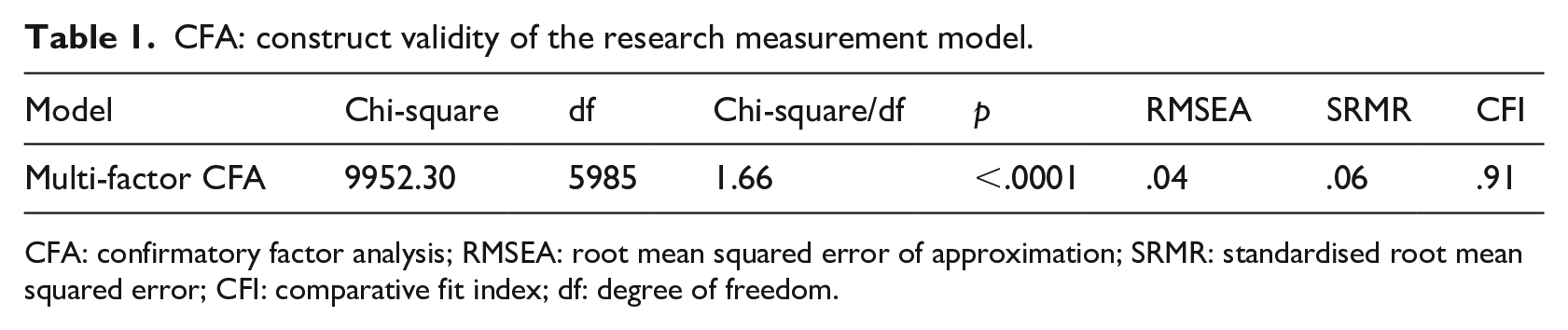
CFA: confirmatory factor analysis; RMSEA: root mean squared error of approximation; SRMR: standardised root mean squared error; CFI: comparative fit index; df: degree of freedom.
Descriptive statistics, reliability coefficients, and bivariate correlations
As shown in Table 2, the scale variables had high internal consistency reliability. The bivariate correlations between the construct variables were significant and positive, and ranged between r = .17 (small practical effect) and r = .72 (large practical effect) at p ⩽ .001.
Descriptive statistics, reliability coefficients, and bivariate correlations.
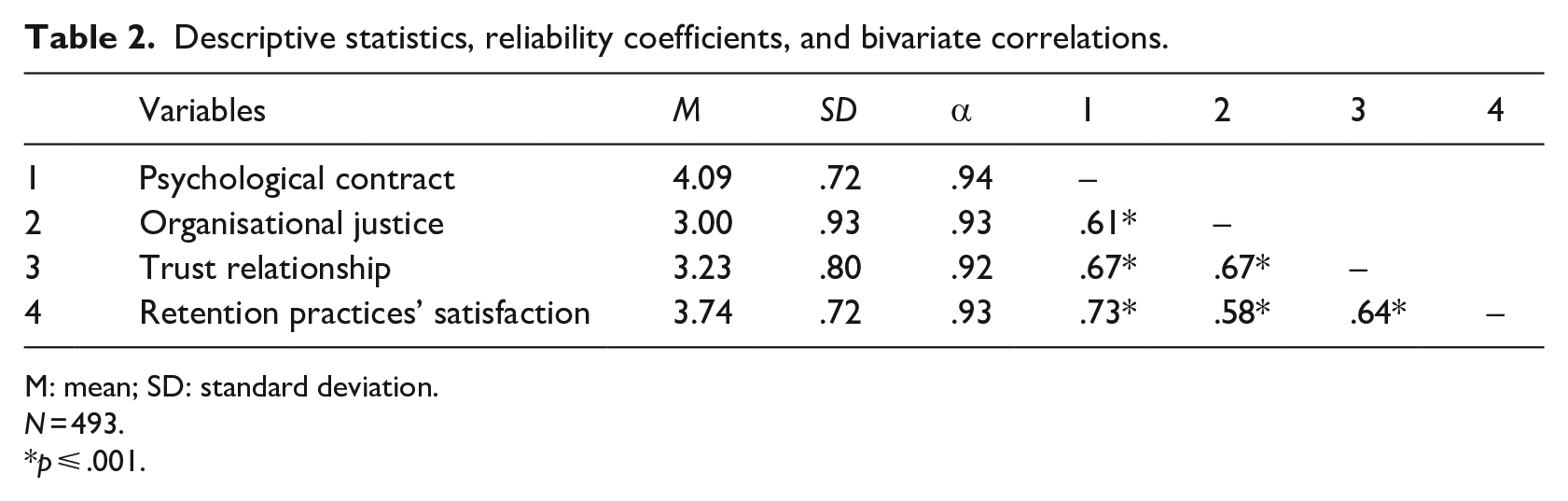
M: mean; SD: standard deviation.
N = 493.
p ⩽ .001.
Organisational justice and trust as parallel mediators
SEM was applied to test a simple parallel mediation mediator model. The use of latent variables in an SEM mediator model improves the accuracy of the mediation and overall parallel mediation effect measurement because the effects of unreliability in the mediators are removed (Ding et al., 2014). As shown in Table 3, two competing mediation models were tested. As guided by Hayes (2013), the mediators (organisational justice and trust relationships) were allowed to correlate with one another, but not to influence each other in causality.
Model fit statistics: competing structural models.
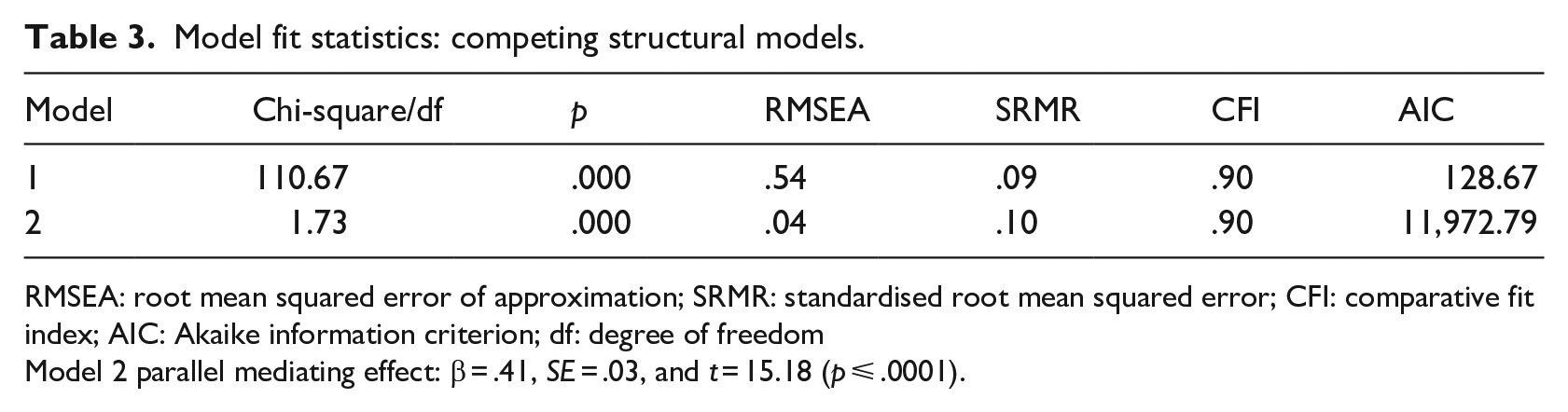
RMSEA: root mean squared error of approximation; SRMR: standardised root mean squared error; CFI: comparative fit index; AIC: Akaike information criterion; df: degree of freedom
Model 2 parallel mediating effect: β = .41, SE = .03, and t = 15.18 (p ⩽ .0001).
The SEM Mediation Model 1 included only the overall constructs, while the SEM Mediation Model 2 included the items of each construct loading onto the relevant overall construct of each scale. The SAS Covariance Analysis of Linear Structural Equations (CALIS) procedure with maximum likelihood to estimate the parallel mediation paths and overall parallel mediation effect was applied. Model 2 showed improvement in the chi-square/df (1.73; p = .000), RMSEA = .04, SRMR = .10, and CFI = .90. The improvement in the RMSEA was used as criterion for choosing Model 2 as best fit model. The overall parallel indirect (mediating effect) for Model 2 was β = .41, p < .0001 (t = 15.17), and standard error (SE) = .03.
As shown in Table 4 and Figure 1, the direct pathways of psychological contract to organisational justice and trust were positive and significant. In turn, the direct pathways from organisational justice and trust relationships to retention practices were also positive and significant. For parsimony reasons, the item loadings of Model 2 are not reflected in Figure 1.
Standardised path coefficients for the direct effects.
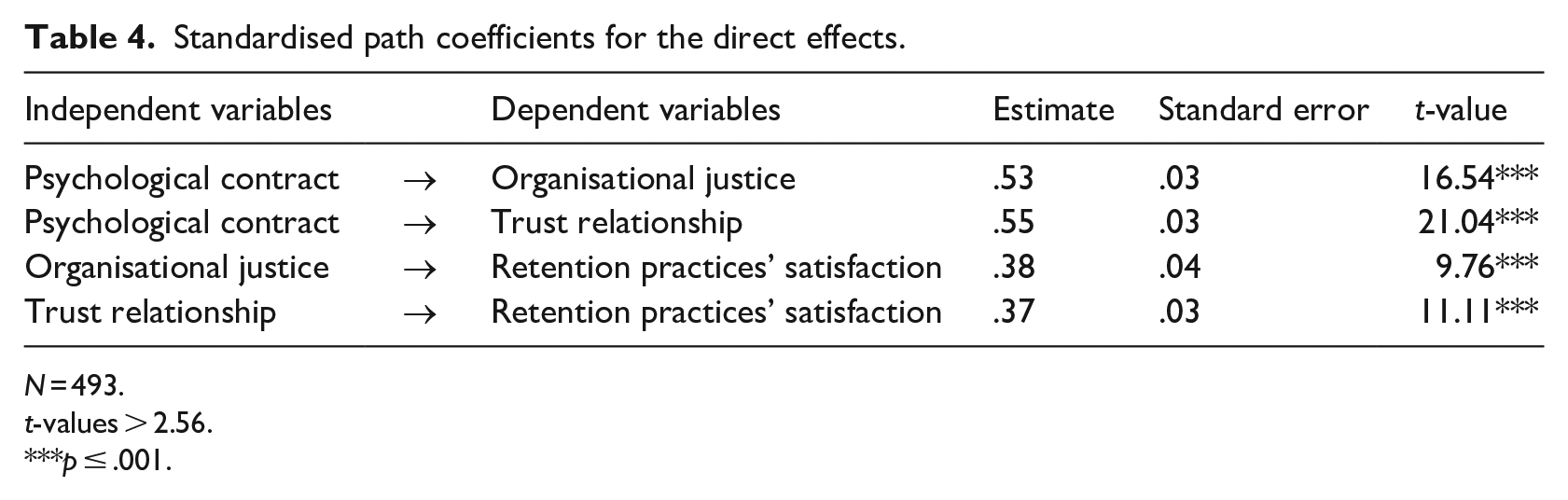
N = 493.
t-values > 2.56.
***p ≤ .001.
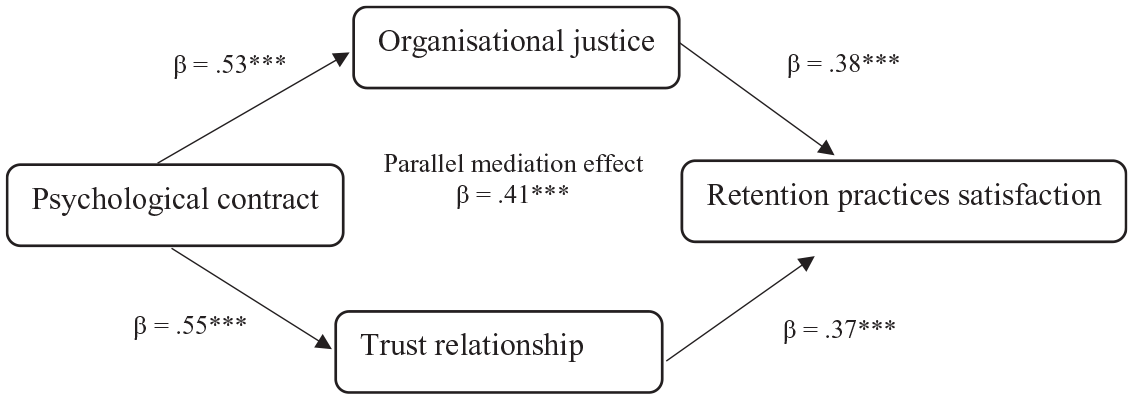
Standardised path diagram with simple direct effects and parallel mediation effect.
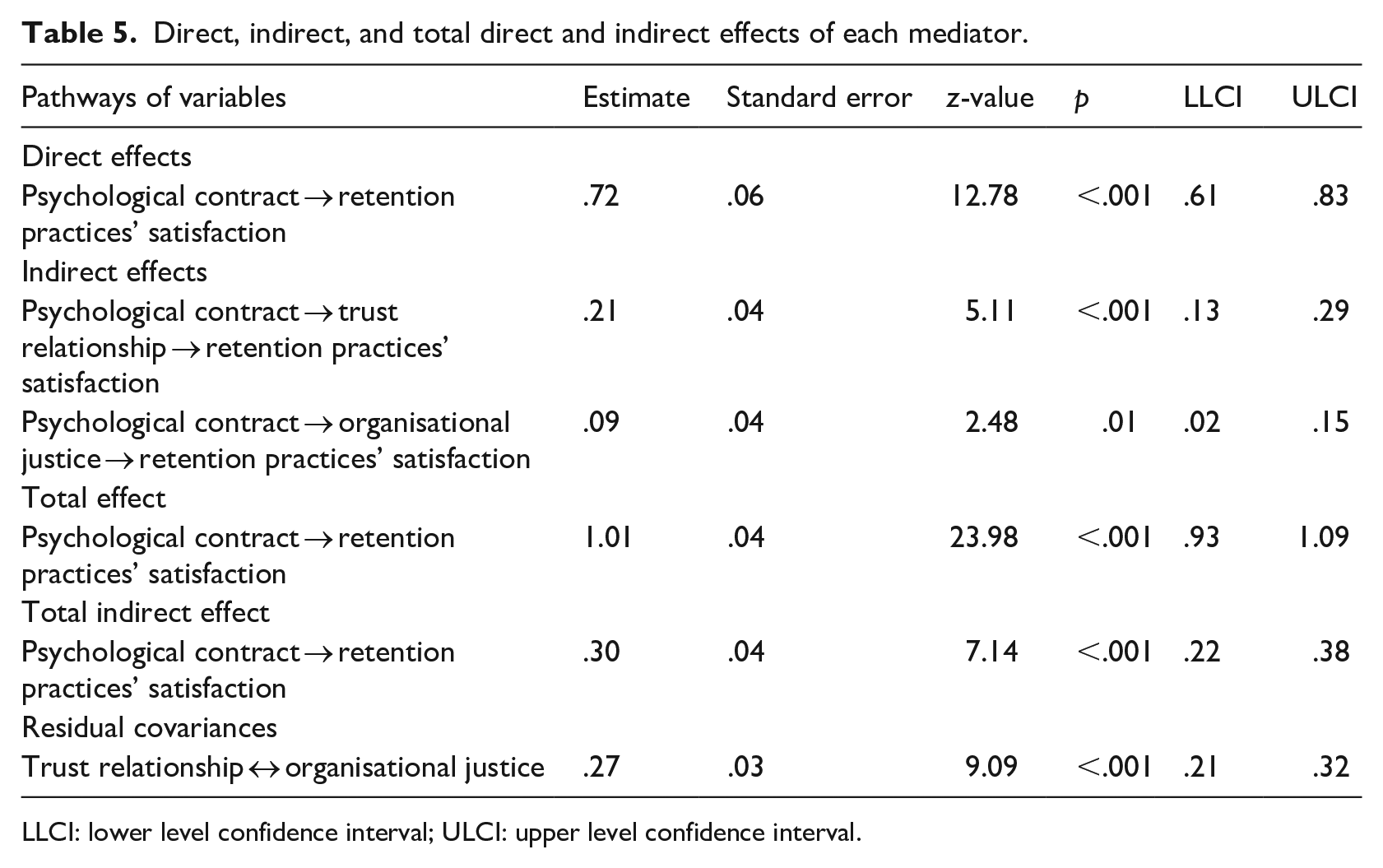
As reported in Table 5, the significance of the indirect effects of each mediator (organisational justice and trust relationships) was then tested separately with the JASP (2022) procedure. Delta method standard errors, normal theory confidence intervals (95%), and maximum likelihood estimation were applied.
Direct, indirect, and total direct and indirect effects of each mediator.
LLCI: lower level confidence interval; ULCI: upper level confidence interval.
Table 5 shows that both organisational justice (β = .09; p = .01; LLCI = .02; ULCI = .15) and trust relationship (β = .21; p = < .001; LLCI = .13; ULCI = .29) had each a significant and positive mediating effect. Trust relationship had a higher estimate value than organisational justice. Both variables had a significant correlation (β = .27; p = < .001; LLCI = .21; ULCI = .32) which appear to corroborate the positive parallel mediating effect observed in the SEM analysis. The total effects were significant which suggested only partial mediation effects (Hair et al., 2019). The results provided evidence in support of the research hypothesis.
Discussion
The results showed that both organisational justice and trust relationships function as illuminating mechanisms of the social exchange relationship represented by the connection between individuals’ satisfaction with the psychological contract and organisational retention practices. The findings suggest that satisfaction with the state of the psychological contract and the extent to which promises made within the exchange relationship have been kept by employees and employers, including the extent to which employees’ job needs have been fulfilled, result in positive perceptions about organisational justice and trust relationships. In turn, positive cognitions about organisational justice and trust relationships result in higher levels of satisfaction with retention practices. The results further suggest that the building of especially trust relationships may help to explain the link between perceptions of the psychological contract and satisfaction with retention practices. However, the role of organisational justice in explaining the link should also be considered.
The findings corroborate studies conducted in private and state organisations (Huang et al., 2019; Samuel, 2017) and among knowledge workers (Bhatnagar, 2014) on the mediating effect of organisational justice and trust relationships in the link between satisfaction with the psychological contract and organisational retention strategies. The findings are also in agreement with empirical studies showing that positive psychological contract–related perceptions result in positive perceptions about organisational justice (Nimmo, 2018; Rodwell & Ellershaw, 2016; Tziner et al., 2017), improve employees’ trust in their supervisors and organisation (Festing & Schäfer, 2014; Samuel, 2017), and as a result, strengthen staff retention (Karatepe & Shahriari, 2014; Tziner et al., 2017). Snyman (2021) further found distributive justice (i.e., fairness of the distribution of resources within the organisation) and stronger, positive trust relationships with supervisors/managers to function as the strongest mediators in the relationship between satisfaction psychological contract and retention practices.
The findings corroborate the notion of reciprocity as alluded to in the social exchange theory (Blau, 1964). The successful maintenance of the employer–employee exchange relationship is dependent on the fulfilment of the promises made in the psychological contract, and the honouring of a mutually trustworthy and just relationship (Blau, 1964; Cropanzano et al., 2007; Stormbroek & Blomme, 2017). Research showed that if promises are not kept and commitments not adhered to, it could have a harmful outcome on the fruitful prolongation of the exchange relationship (Lub et al., 2016). The findings suggest that HEIs should develop and implement retention strategies aimed at strengthening employees’ psychological contract perceptions, seeing that this may result in stronger perceptions of organisational justice and trust relationships, and in so doing, improve employees’ satisfaction with retention practices.
The findings of the study should be interpreted with caution owing to a number of limitations. First, the exploratory cross-sectional research design limits the generalisability of the findings to the participants involved in the study. Second, as a result of the exploratory correlational and simple mediation design, no cause–effect relations could be established but merely the magnitude and direction of associations between the variables. Third, the measures were self-report; hence, concerns about the possibility of common method bias should be considered in future research projects. Future research should consider studies that take into account the perspectives of both the employee and the employer. Moreover, this study explored mediation links between the overall constructs. Future research and longitudinal designs could explore mediation effects by including the subfactors of each scale to deepen insight into the mediation dynamics of organisational trust and justice. The confounding effect of participants’ sociodemographic characteristics should also be explored in future replication studies.
Conclusion
The study highlighted the importance of employees’ psychological contract beliefs in the employee–organisation relationship, and especially in determining mutual expectations that guide and shape perceptions of organisational justice and trust relationships. Employees’ satisfaction with retention practices is positively enhanced when they experience mutually satisfactory just and trustworthy relations in the organisation.
Footnotes
Author contributions
All authors contribute to the conceptual framework, data collection and analysis, and writing up of the research article.
Declaration of conflicting interests
The author(s) declared no potential conflicts of interest with respect to the research, authorship, and/or publication of this article.
Funding
The author(s) received no financial support for the research, authorship, and/or publication of this article.
