



Abstract
Researchers can use data visualization techniques to explore, analyze, and present data in new ways. Although quantitative data are visualized most often, recent innovations have brought attention to the potential benefits of visualizing qualitative data. In this article, the authors demonstrate one way researchers can use networks to analyze and present ethnographic interview data. The authors suggest that because many respondents know one another in ethnographic research, networks are a useful tool for analyzing the implications of respondents’ familiarity with one another. Moreover, respondents often share familiar cultural references that can be visualized. The authors show how visualizing respondents’ ties in conjunction with their shared cultural references sheds light on the different systems of meaning that respondents within a field site use to make sense of the social phenomena under investigation.
Scholars can use data visualizations to increase the accessibility of their research (Freese 2007; Freese and King 2018) and explore and analyze data in new ways (Healy and Moody 2014). Recognizing the potential reach of data visualizations, some journals now allow authors to publish stand-alone data visualizations. For example, the American Sociological Association’s first open access journal, Socius: Sociological Research for a Dynamic World, publishes data visualizations and extensive supplementary materials as part of its open-science ethos (e.g., Wu et al. 2020). Yet despite the analytic power of data visualizations, qualitative researchers rarely use them in their own research (Murphy, Jerolmack, and Smith 2021).
The lack of qualitative data visualizations is due partially to software limitations and methodological siloing (Goertz and Mahoney 2012). Statistical analysis programs allow a greater degree of data and code sharing because researchers use online repositories and compatible file types, whereas qualitative software programs tend to be proprietary. In turn, open-source options for creating data visualizations are more readily available for programs such as R or Stata than for qualitative software such as NVivo or Dedoose. Certain features of quantitative data, such as anonymity and aggregation, are more readily compatible with the most common visualization techniques, too. In comparison, ethnographic data includes identifiable information that can jeopardize confidentiality if improperly reported. In sum, the proprietary nature of qualitative analysis programs and the type of data ethnographers collect and analyze make data visualization and collaboration more difficult (Murphy et al. 2021).
Some methods for visualizing qualitative data for analysis and the presentation of findings do exist. For example, one can visualize codes and themes to increase reliability among researchers working with the same data (Abramson and Dohan 2015). Computational methods also ease data sharing for analysis within qualitative research teams (e.g., Abramson et al. 2018). Perhaps most notably, researchers studying semantic networks (Cottica et al. 2020) and digital text networks (Light 2014; Light and Cunningham 2020) have demonstrated the strengths of visualizing social network analysis (SNA). In addition to mapping textual data, networks make ties between respondents immediately visible, such as in studies of social media friendships and followers (Heer and boyd 2005; Murphy et al. 2021). Network visualizations thus provide a unique opportunity for social scientists to reveal connections between data points, be they people, words, or concepts.
In this article, we encourage ethnographers to embrace the utility of visualizing networks in two ways. First, we use this article to demonstrate a way ethnographers can visualize data and coding rarely seen in qualitative research articles without jeopardizing confidentiality. Second, this article shows how strategic collaboration with SNA scholars creates opportunities for visualizing ethnographic data in ways that can generate novel insights into one’s data. As a research team, we draw from our expertise across methodological divides to examine clustering effects within an ethnographic study of people who own sex dolls (Hanson 2022). By examining ties between respondents and shared cultural references, we were better able to appreciate how snowball sampling structured the data and limited certain findings. We conclude with a discussion of the potential for this practice to increase open-science practices among qualitative researchers generally.
Background
One of ethnography’s strengths is its applicability for researching difficult-to-reach populations (e.g., deviant, criminal, or small groups). Ethnographers have provided numerous in-depth analyses of societies’ transgressive, marginalized, and forgotten citizens (e.g., Bourgois 2003; Desmond 2016). Ethnography is useful for studying these populations, yet research on such communities faces numerous ethical concerns (Murphy et al. 2021). Mainly, ensuring confidentiality is important for ethnographers who build research relationships on trust (Babbie 2004). The digital age has magnified such concerns because exposure is only a few Google searches away (Murphy et al. 2021). One solution proposed by Markham (2012) is to provide fabricated data that simulate the essence of the hard data as examples in published work, so readers cannot enter quotations, phrases, or social media posts into search engines and find the original source. Digital ethnographers are thus caught in a double bind. On one hand, the proliferation of niche online communities provides numerous opportunities for studying transgressive phenomena (Adler and Adler 2008) and Internet searching makes access easier (DiMaggio et al. 2001). On the other hand, the Internet can just as easily be used to publicly out respondents, as ease of access to information threatens confidentiality.
Ethnography’s disciplinary, geographic, and analytic variations have also become more apparent in the digital age. At their core, ethnographic methods share “a commitment to the first-hand experience and exploration of a particular social or cultural setting on the bases of (though not exclusively by) participant observation” (Atkinson et al. 2001:4). However, varying approaches to ethnography have resulted in criticism of the method. From a positivist perspective, ethnography lacks standardization, transparency, reproducibility (Goertz and Mahoney 2012), and the “necessary” distance from research subjects that generates objectivity (see Adler and Adler’s [2016] reflection on Adler’s [1993] study of drug dealers and smugglers). Moreover, some have critiqued ethnography for being exploitative (see Stacey 1988). In response, ethnographers have advocated for better ethical standards and research practices. Computational techniques have been identified as one way to increase reproducibility (e.g., Abramson et al. 2018; Brooker 2022; Nelson 2017), as have iterative practices such as flexible coding (e.g., Deterding and Waters 2021) and triangulation (e.g., Burton and Obel 2011; Davis 2014; Laaksonen et al. 2017). Collectively, these efforts showcase the dynamic nature of ethnography and the need for developing and adopting new approaches to address criticisms of the tradition.
Ethnographic methods typically combine observational and interview data to understand the subjective processes underlying a social phenomenon, as attitudes alone are not a perfect predictor of behavior (Jerolmack and Khan 2014). Often, ethnographers begin by gaining entrée into their field site, be it material or digital, through key informants (Adler 1990). Then, through some combination of recruitment strategies, such as snowball sampling, ethnographers perform a series of in-depth interviews until reaching a point of saturation (Lofland and Lofland 1971). In studies of specific institutions or communities, research participants within the field site are often familiar with one another. Thus, respondents in many ethnographies, due to either the structure of the field site or the sampling techniques used by the researcher, are likely to share ties with one another (Mitchell 1974). Ethnographers may intuitively sense a network structure within their data, but the use of network visualizations explicitly unveils the organization of relations (Light and Moody 2020; Wasserman and Faust 1994).
The network organization within an ethnographic sample is not limited to ties between respondents. In addition to knowing each other, people within a field site often share similar ideas about their social world. For example, within ethnographic work on hard-to-reach populations, researchers may find their participants engage with similar cultural artifacts, such as books, movies, or other media related to their subcultural milieu, to help interpret or make sense of their own practices (Menchik 2019). This effect may be due to how cultural worldviews influence social networks, as people with similar worldviews might seek one another out and form communities (Vaisey and Lizardo 2010). Alternatively, a community’s cultural similarity might be due to disparately located people imputing systems of meaning onto similar situations (Norton 2014). Relatedly, belief system networks show how beliefs and attitudes are interrelated and thus yield insight into which specific beliefs and attitudes are most central or important to groups or ideologies (e.g., Boutyline and Vaisey 2017). Articulating the best way to model cultural mechanisms is not our goal, but we do suggest social networks are a useful tool for ethnographers wanting to analyze meanings that are salient to their respondents.
To demonstrate how network visualizations can help ethnographers analyze respondent ties and systems of meaning within their data, we use data from a digital ethnographic study of sex doll owners (Hanson 2022). Previous empirical research on sex doll owners was limited. Consequently, the research design of the ethnography was exploratory. The literature suggested that, like other transgressive communities, stigma is a pervading concern among doll owners, to such an extent that many lead a double life and do not reveal their desires or practices to family or friends (Döring and Pöschl 2018). Because of doll owners’ fear of being outed, ensuring confidentiality was paramount in recruiting interviewees and gaining permission from online forum moderators to observe and report on online activities. One theoretical claim made by roboticists that we wanted to evaluate via the subjective experiences of sex doll owners was that sex dolls and robots were becoming mainstream and shedding their stigmatizing quality (Levy 2007). Because sex doll and sex robot ownership is still rare, it is difficult to assess this claim quantitatively. These characteristics make the online sex doll community an ideal case for ethnographic study. By using data visualization techniques, we show (1) how SNA data visualizations can illuminate previously unseen patterns in qualitative data and (2) how visualizations can help ethnographers better understand the effects of snowball sampling on their findings.
Because SNA is concerned with relationality and connectedness, it is an appropriate method for examining how the social organization surrounding actors influences their experiences and outcomes (Wasserman and Faust 1994). When studying hard-to-reach populations, researchers often use respondent-driven strategies (e.g., snowball sampling) to find participants. In such cases, study participants refer other potential participants from their social network (e.g., Salganik and Heckathorn 2004). Visualizing the relations between participants and their shared cultural references can benefit researchers in several ways. As an interpretative advantage, if a small set of participants or cultural references are frequently mentioned (more central), they may have more influence regarding how respondents interpret their social worlds. In this case, specific sex doll owners, figures, and cultural references provide a heuristic for individuals in the community to understand their practices as transgressive and stigmatizing, or as gaining mainstream acceptance. Additionally, visualizing respondents’ ties provides valuable information about sample limitations. We present four network visualizations to illustrate these points.
Data Sample, Preparation, and Visualization
Data used in this article come from a digital ethnographic study conducted over 14 months (Hanson 2022). Here, we examine 21 (of 41) in-depth interviews in which respondents mentioned other community members. Interviews were conducted with informed consent and were recruited by three means. The majority of respondents self-selected into the study by answering research calls posted on a sex doll Internet forum. Interviewees were also recruited by sending direct messages to doll owners through social media accounts. The key informant Loosey Goosey self-selected into the study. As a key informant, Loosey Goosey was instrumental in snowball sampling that generated two interviews (AS and Moses). In turn, Moses recruited Sylvain, who suggested Venus, for a total of four snowball sampled interviews.
Because of the sensitivity of our subject, we took great care to protect the confidentiality of respondents. Interviews were audio recorded, transcribed, and deidentified. Pseudonyms were assigned to interviewees, and because doll owners typically personify their dolls and create separate social media accounts for themselves and their dolls, pseudonyms were assigned to the dolls as well. For additional privacy, we also use pseudonyms for businesses and occupations. We do not share full transcripts, and quotations are supplied only when we are confident they are specific enough to demonstrate the analytic point while also general enough that community members would not be able to identify the person on the basis of information in the quotation.
Initial coding of the data used the grounded theory approach common among exploratory qualitative studies (Charmaz 2014). The first round of coding yielded numerous codes, which we then collapsed into five major thematic codes: relationship dissolution, modern dating and feminism, exploring deviant or transgressive desires, sex toys, and individual rights. Analyzing these codes suggested that sociodemographic characteristics (mainly masculine and heterosexual identities) coupled with aging and relationship experiences over the life-course strongly shaped motivations for purchasing a sex doll and becoming a member of this transgressive subculture. Yet we still had unresolved data points. Why, for example, did interviewees frequently defer to media representations or discuss other community members when asked questions aimed toward evaluating claims regarding the mainstreaming of sex doll use (Levy 2007), rather than discussing their own experiences with stigmatization? Relatedly, certain media appeared in the interviews repeatedly. Might the frequency of these representations suggest something about how sex doll owners interpret themselves and their practice?
To explore these issues in greater detail, we generated social networks for visualizing the organization of respondents and mapping the cultural references of the doll community. We prepared two Excel files that could be imported into R for analysis. The first is an edge list with two columns. Column 1 details the interviewee’s pseudonym. In column 2, the researchers listed who (or what) the interviewee mentioned in the interview. Each mention is given a separate row to delineate each mention relationship. In other words, if respondent x mentions respondent i and cultural reference g, then there are two rows, one for each mention. Respondents were included only if they (1) mentioned another interviewee or (2) were mentioned by another interviewee. The second file is a table detailing each participant and reference. Three columns detail the pseudonym or name (if a nonparticipant reference), a shorthand ID, and the type of reference. The potential mention codes include participant, participant’s doll, public figure with a doll, the doll of a public figure, media reference, or science fiction reference. We separated science fiction and media references because the contexts in which those references are made in the original transcripts are analytically distinct. Furthermore, by individualizing each reference rather than reporting them in aggregate, we enable interested researchers to test different coding schemes (see our online repository and supplementary files). We conducted a community detection analysis that optimizes modularity, that is, it increases density within groups and decreases connections between groups, to show coherent, distinct groups in the sex doll community. Finally, although participants often mention their own dolls, we excluded these mentions from our visualizations, as we are more concerned with linkages across participants. 1
Analysis
We present four networks alongside illustrative qualitative data points and some analysis of what these networks suggest about the data and findings. The first network visualizes ties between respondents. In addition to showing respondents’ connections, this network also makes apparent the effect snowball sampling had on this study. The second network visualizes participant–cultural reference relationships, assessing the extent to which certain references are shared by respondents and thus may connect disparate participants through shared frames of reference. In the third network, we visualize respondent ties in addition to their mentioned cultural references. The fourth network reproduces the third but with a community detection algorithm applied to the network structure. Analysis of this network reveals how respondents’ ties reflect differing ideological positions within the doll community. Thus, we can visualize ideological fractions within the sample. In the first three networks, the color of the nodes indicates the mention code (e.g., participant; public figure with a doll). The color of the tie is the same as the node that receives it. The size of the node is determined by the number of times it is mentioned (“in-degree” in network terminology). In the fourth network, node color represents which community it belongs to, and the size of the node again reflects in-degree. Across all networks, nodes marked with “NA” indicate that they mention another participant or cultural reference, but were not mentioned themselves.
Visualizing Respondents’ Ties
In addition to being a small field site, snowball sampling guaranteed that some respondents in this sample knew each other. By visualizing every instance of a respondent mentioning another person or another person’s doll(s), we see four components in the data (see Figure 1).
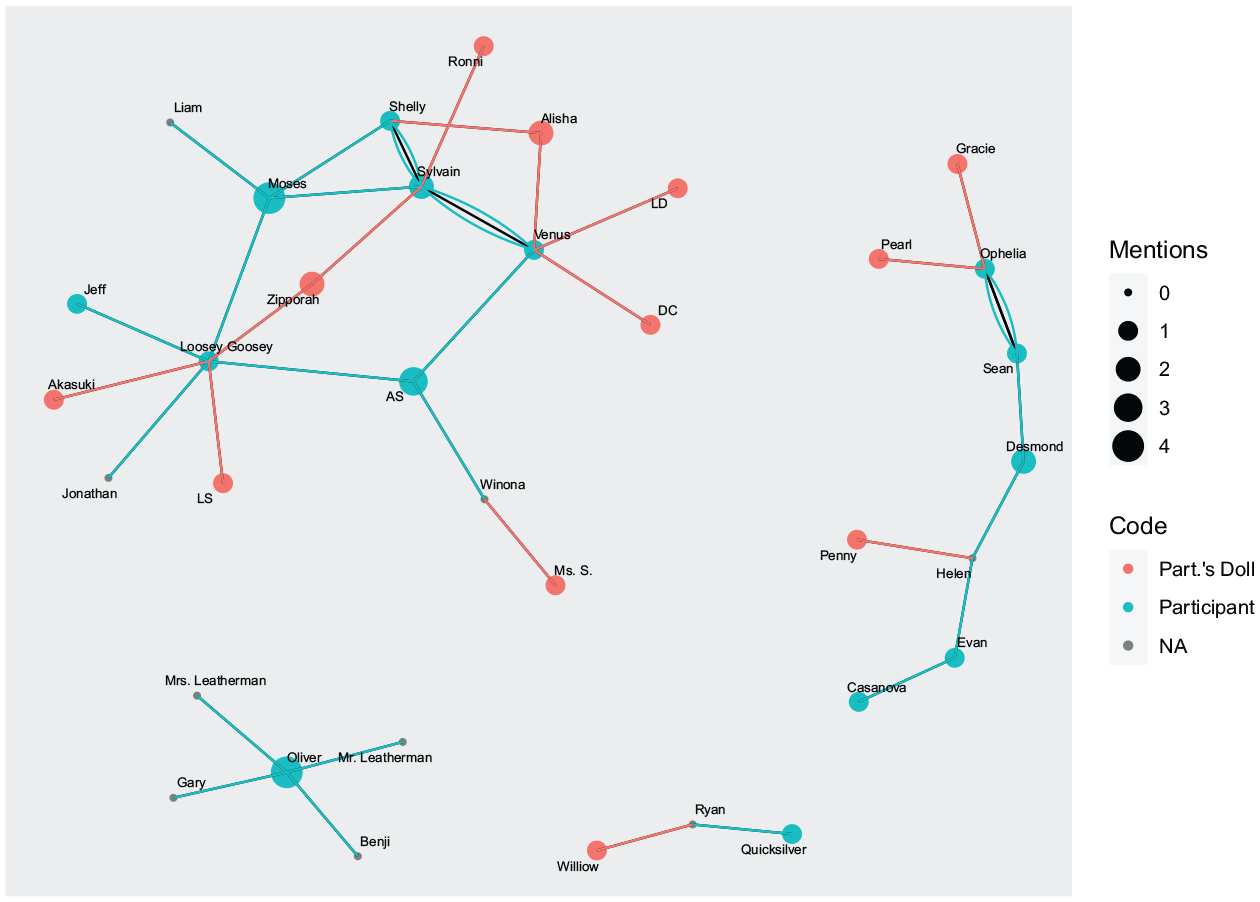
Network of mentions between participants or participants’ dolls.
The largest component suggests that snowball sampling had a large effect. AS, Moses, Sylvain, Shelly, Venus, Jeff, Loosey Goosey, and many of their dolls were mentioned by name. In some cases, such as AS and Sylvain, both of whom were recruited via snowball sampling, the mentions were reciprocal. As Loosey Goosey said, “I found Moses, which was really cool because, as soon as I created an account on Twitter, he’s the first person to send me a follower request.” Moses introduced Loosey Goosey to others in his personal network, and these doll owners became a group that interacts primarily with one another online. Three participants were mentioned by people in this component without being mentioned by others.
Another component in Figure 1 shows a different sort of mention: businesses. Four respondents were not mentioned by anyone else, but each mentioned Oliver, who is a professional doll vendor. Oliver specializes in importing dolls from overseas manufacturers and selling them to North American consumers. Benji, for example, noted, “I was able to acquire one [a doll] through Oliver at U.S. Doll Vending.” No respondents mentioned Benji, so our understanding of where Benji fits into the community is limited, but we can still visualize Oliver’s centrality in the network. Even in this small sample, Oliver’s role as a vendor is crucial because he is connected to participants who may not share direct connections.
Visualizing Systems of Meaning
Figure 2 visualizes the cultural references each respondent made. This network helps us see respondents’ different worldviews of this stigmatized practice. Whereas the previous visualization helps us understand how snowball sampling structured the data, this visualization reveals the different cultural references people make within the community. For example, numerous doll owners made references to science fiction. Blade Runner, a dystopian science-fiction film featuring a robotic sex worker named Priss, was referenced by four participants:
My doll is a fantasy for me . . . have you seen the movie Blade Runner?
Yeah.
In that movie, there’s a character, her name is Priss.
Yeah, the replicant.
So that is what my doll is. That’s what my doll Gracie is.
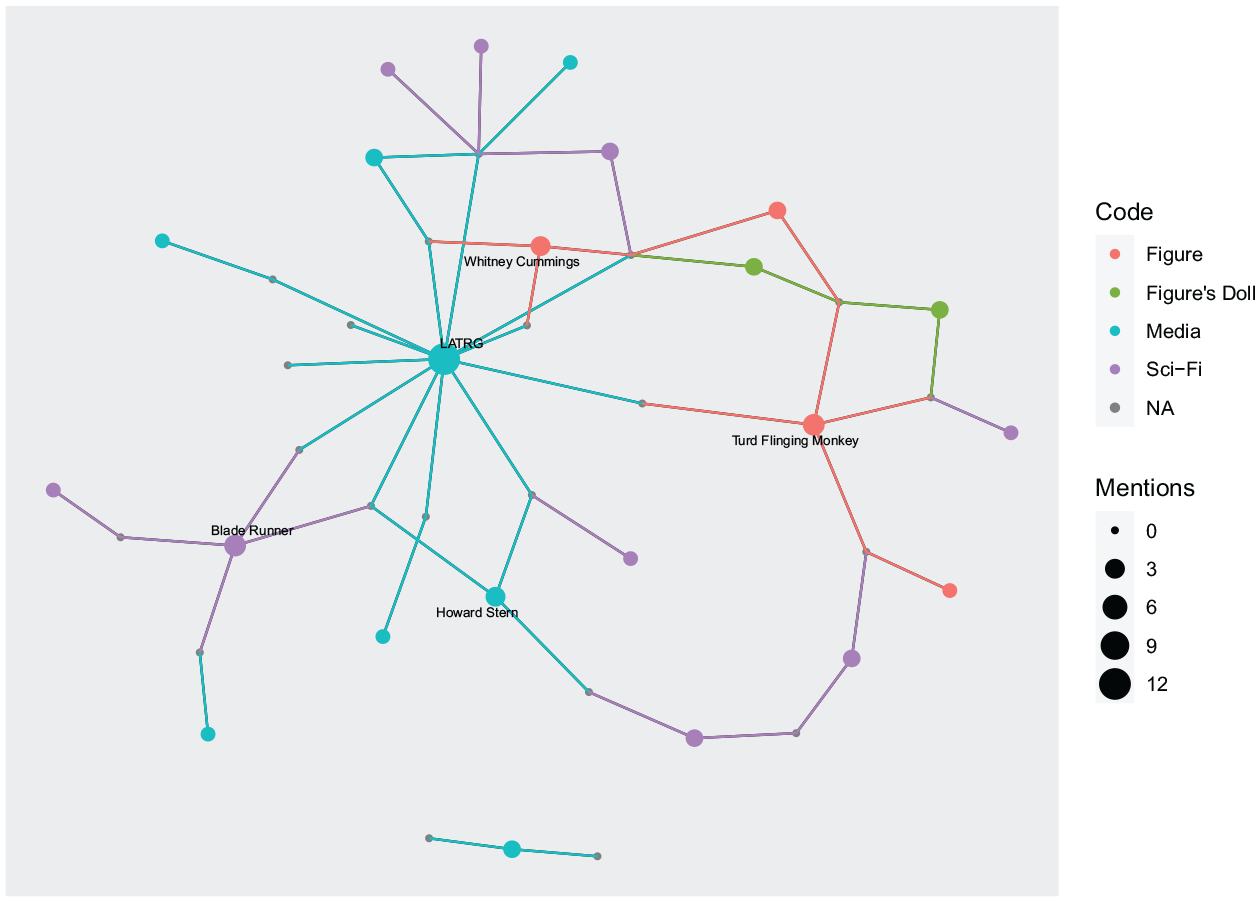
Network of mentions from participants to cultural touchstones.
Visualizing the proximity of cultural references is a tool for ethnographers to analyze different systems of meaning that influence how people make sense of their social position. Sean based his doll’s persona on the replicant Priss from the movie Blade Runner, whereas Evan mentioned Shaum Schwestern and Real Humans. In contrast to Blade Runner, which was mentioned by other doll owners, these references are unique to Evan. To make sense of these systems of meaning, contextual nuance is needed. The shows mentioned by Evan are European and not available in North American markets, nor is Shaum Schwestern translated into English. Evan lives in Berlin, Germany, so he has access to cultural references that North American doll owners lack. Visualizing these relations better revealed how interviewees’ geographic location explains their cultural references. Furthermore, by visualizing these cultural reference points, we can illustrate how these data overrepresent systems of meaning that are more salient in the United States.
Mapping Ties onto Shared Systems of Meaning
Using networks to visualize ethnographic data may be most useful in synthesizing respondent ties with ties to cultural references. Figure 3 illustrates how systems of meaning map onto respondents’ familiarity with one another. Figure 4 shows the same network but with a community detection algorithm conducted to highlight communities inductively found in the network structure. By combining these networks with ethnographic data points, we gain a powerful analytic tool for showing how doll owners are divided into different ideological camps. Moreover, by discussing these results in terms of the sampling strategy, it is easier to see where snowball sampling led to data limitations.
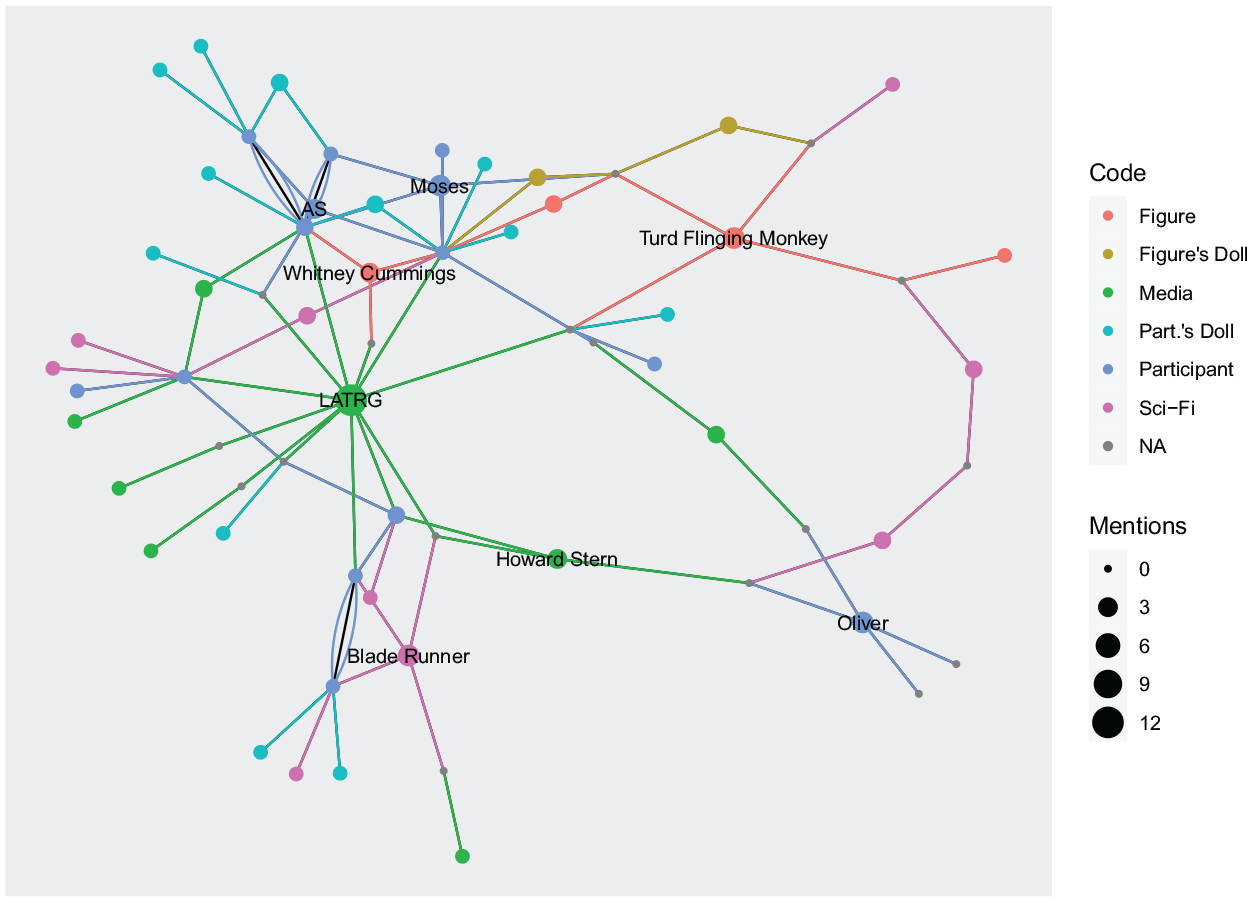
Network of mentions between participants, dolls, and cultural touchstones.
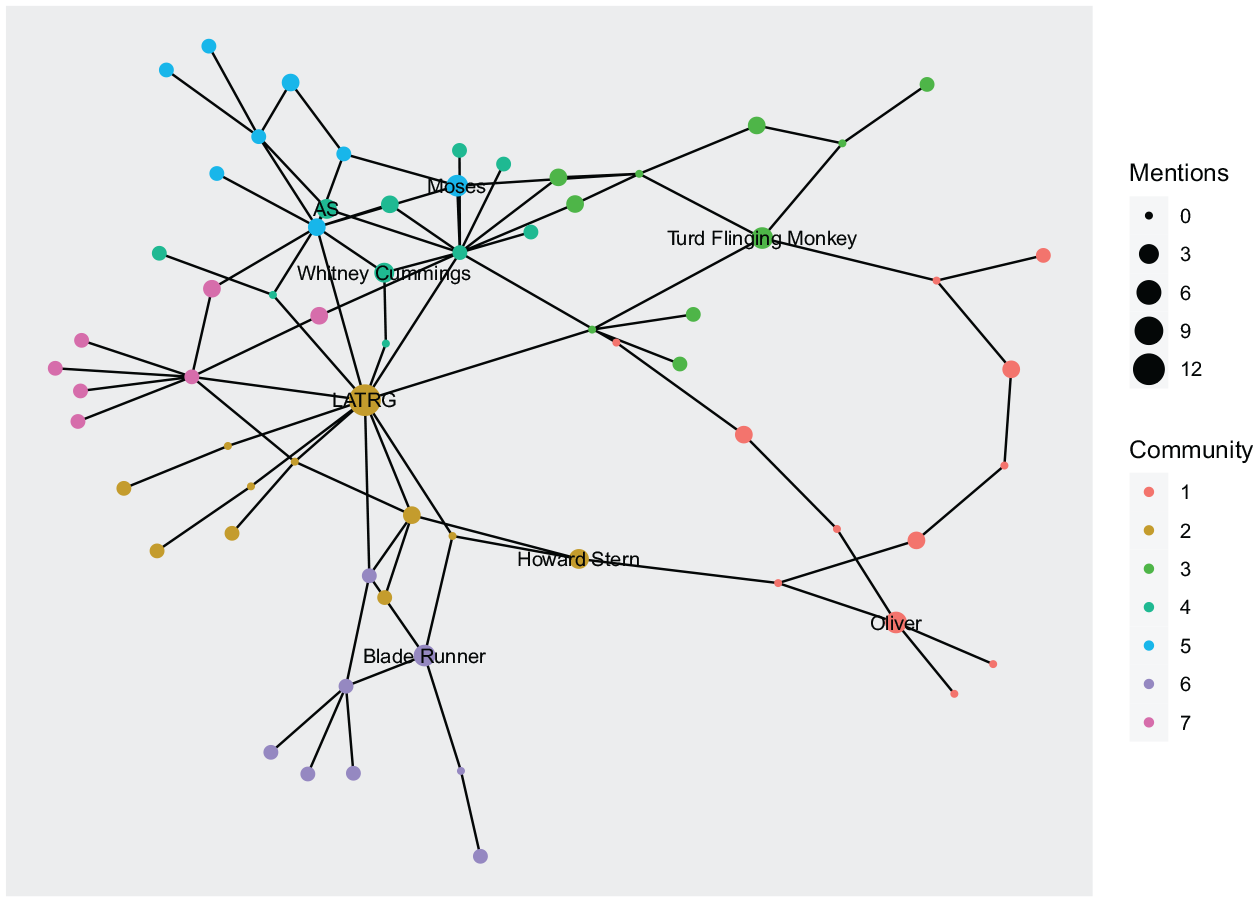
Community detection analysis of network of participants, dolls, and cultural touchstones.
Lars and the Real Girl (LATRG) is a central node. This Hollywood film, starring Ryan Gosling, is about a person who, as a result of his mental health issues, purchases a sex doll. In Figure 4, the importance of LATRG comes to light, as it forms the center of the normalization communities in general (communities 2, 4, 5, 6, and 7) and bridges its own group to the rest of the normalization groups. Doll owners were hesitant to conflate doll ownership with mental illness, but many welcomed mainstream representations of their sex practice:
Lars and the Real Girl was a very touching movie. I think that’s a movie that had to be made. It stereotyped, not everybody who has a doll is like that, disturbed, you know? But, all in all, it’s a good movie.
Sylvain’s position is representative of doll owners who hope their practice will be normalized. Because doll owners are aware of the stigma their sex practice carries, some think positive media representations will act as a normalizing force that leads to acceptance. Generalizing from this group of doll owners must be qualified, however, as many of the ties that connect respondents to LATRG and other “normalizing” representations (e.g., Whitney Cummings) are the same respondents who were recruited through snowball sampling. Stated another way, by visualizing the data in this way, we can better appreciate that frequent mention of LATRG, visualized as the observed density of ties centered on LATRG, was more likely an effect of the sampling strategy rather than representative of the community. Thus, although LATRG was mentioned by 12 participants, more than half of the sample with mentions, it would be unwise to generalize from their positionality. Indeed, it is possible these doll owners self-selected and referred others to the study on the basis of a shared view of academic research as a means of normalization. Moses (snowball sampled via Loosey Goosey, who in turn suggested Sylvain) was the only normalizing member who made his intention explicit during the interview. Because his motivation for participating in the study as a means of normalizing sex doll ownership was the only explicit mention, this was treated as a small case and not considered a major theme or finding during qualitative coding. This network, however, suggests this motivation may have been shared by more interviewees.
The risk of overstating doll owners’ desire for normalization is important when considering other factions of doll owners. In this network, we also see a segment of doll owners who identify with the men’s rights group Men Going Their Own Way (MGTOW). MGTOW doll owners view sex dolls as substitutes for relationships with women. Rather than viewing their dolls as sex toys they might use in addition to being in relationships with women, MGTOW doll owners believe that feminism and liberalism have corrupted heterosexual relationships (Hanson 2022). Thus, they see dolls as tools for curbing their sexual desires. These doll owners share distinct cultural references, as seen in Figure 3, including two MGTOW content creators, Sandman and Turd Flinging Monkey, as well as the latter’s doll, Celestina.
At one point not too long ago, I was looking at some Waifu workshop videos, online, by a guy who calls himself TFM, or Turd Flinging Monkey.
In Figure 4, we see that MGTOW references and participants also form two coherent and distinct groups (communities 1 and 3), separate from the normalization segments of the graph. The distinction between MGTOW doll owners and those who would prefer normalization is central to understanding this community from a sociological perspective. Whereas MGTOW doll owners are exclusively heterosexual men, there are also women, queer, and trans or nonbinary doll owners (in addition to heterosexual men who disavow MGTOW). In the approach demonstrated here, visualizing ties was a tool for triangulating qualitative findings and improving reliability. Although we could intuit this typology from thematic coding, visualization better contextualized how the sampling strategy affected the observed number of participants within each group.
Additionally, visualization made apparent how participants and cultural references connected in ways that were not readily apparent from thematic coding. For example, Howard Stern and Blade Runner are relatively close to each other, compared with LATRG and Whitney Cummings. Blade Runner, however, is the keystone to a more science-fiction-oriented group (community 6), whereas Howard Stern and LATRG (community 2) and Whitney Cummings (community 4) are in other normalization communities that relate to users’ making sense of their sex doll experiences through popular media portrayals and public figures’ sex doll use. As media genres, the proximity of these ties was unexpected. By returning to the demographic data and examining which participants made ties to these cultural examples, we realized that the proximity was due, at least in part, to age differences within the sample. Older doll owners were more likely to reference The Howard Stern Show (1986–2005) and Blade Runner (1982), whereas younger doll owners were more likely to reference LATRG (2007) and Whitney Cumming’s Can I Touch It? (2019).
Implications and Conclusions
Ethnographers often face a stack of fieldnotes, jottings, and interview transcripts that must be coded, analyzed, and presented, all with the care of making sure respondents’ identities remain confidential. These features of qualitative data do not preclude ethnographic researchers from visualizing their data, but they do present unique challenges. We suggest that SNA and network visualizations provide ethnographers with the opportunity to look at their data in new ways, share their data with other scholars, and perhaps even adapt their materials to be more in line with open-science practices.
Grounded theory is one of the most prominent ways qualitative researchers analyze data, but as scholars have suggested, computational methods create new lines of inquiry for analyzing qualitative data (Light 2014). In this article, we used SNA to explore data limitations and open new analytic lines. By visualizing respondent mentions and cultural references, we saw important patterns in the interview data. We saw which interviewees want their sex practice to be normalized, in contrast to those who view the doll community as a primarily masculine space. Furthermore, we connected specific cultural references, such as LATRG and Turd Flinging Monkey, to respondents’ systems of meaning about their practices, beliefs, and attitudes. Most importantly, we saw how our observation of ideas and references was affected by sample limitations. These effects were not known until we analyzed the networks. Other ethnographic projects could similarly visualize data to gain deeper insight into how sampling strategies affected the distribution of codes within their sample (e.g., if most respondents know one another, they likely share similar cultural references). Innovative applications of this approach could also visualize how different codes link respondents in meaningful ways.
Another benefit of using networks to visualize qualitative data is the potential for sharing data with other scholars. Quantitative research has led the charge in open science, likely because qualitative researchers worry that sharing data puts their respondents’ confidentiality at risk (Murphy et al. 2021). The approach demonstrated here is collaborative, as it draws on the expertise of an ethnographer and an SNA researcher. Together, we developed a way to share some research materials that increase transparency and create a model for scholars interested in taking a similar approach (see our online repository and supplementary files). We stop short of sharing full transcripts; this is both an institutional review board requirement and an important ethical decision for protecting our interviewees’ confidentiality. Nevertheless, we showcase an improved model of open qualitative research by providing more data and documentation than is typical of ethnographic work.
Another possible benefit of this approach is gaining insight into data saturation. For example, one could imagine an instance where an ethnographer, after having conducted many interviews and spending considerable time in the field, may still not have reached thematic saturation. In such cases, visualizing respondents in a network could provide insight into how dense or connected respondents are and show where potential holes in the sample lie. Conversely, if the sampling strategy causes saturation to be reached early, this may be the result of a too dense network of respondents, easily identifiable in network form. We believe this is consistent with recent calls for in-depth analysis and collaborative research in qualitative research, because SNA can identify communities that complement thematic codes in the data (see DeLuca, Clampet-Lundquist, and Edin 2016; Lareau and Rao 2016).
Presenting qualitative data using network visualizations is not without limitations. Perhaps most obviously, just like ethnographic methods, SNA requires expertise. For that reason, collaboration may provide an easier solution than developing an additional set of methodological skills. Emergent contributions at the intersection of qualitative and computational approaches and machine learning (e.g., Abramson et al. 2018; Brooker 2022) may have similar limitations but nevertheless present opportunities for cross-methodological collaboration. Another limitation, specific to longitudinal qualitative projects, is the difficulty in visualizing how ties develop over time. It is also worth considering to what extent a network effect is meaningful for a research population. If respondents are college students on a large campus who responded to a call for participants, for example, their cultural milieu may be similar because they attend the same school, despite sharing few or no personal ties with one another.
The contextual nature of qualitative data is compelling, but when faced with a dense wall of text it can be equally as cumbersome as a table. Visualizations provide a compelling way to tell a story about data (Healy and Moody 2014). Ethnographers often use visualizations to illuminate their study in ways text cannot (e.g., photos), but we argue that SNA has particular benefits for highlighting connections between respondents and cultural references. Future ethnographic studies can benefit from using networks to illustrate their analytic points, rather than relying on a series of idiosyncratic quotations.
As a final note, we caution researchers to not conflate reliability and transparency with generalizability, as the latter is not the goal of most qualitative research. As such, although being able to visualize the sum of relations in one’s data makes analyzing systems of meaning easier, it is important that researchers qualify how the connections form in relation to the data itself and not as representative of the population writ large.
Supplemental Material
sj-docx-1-smx-10.1177_00811750231195338 – Supplemental material for Networked Participants, Networked Meanings: Using Networks to Visualize Ethnographic Data
Supplemental material, sj-docx-1-smx-10.1177_00811750231195338 for Networked Participants, Networked Meanings: Using Networks to Visualize Ethnographic Data by Kenneth R. Hanson and Nicholas Theis in Sociological Methodology
Footnotes
Acknowledgements
We would like to thank Ryan Light and C. J. Pascoe for providing comments on previous versions of this paper. We would also like to thank the editors and reviewers at Sociological Methodology for their insights.
Funding
The authors disclosed receipt of the following financial support for the research, authorship, and/or publication of this article: Lawrence Carter Graduate Student Research Award, Research Award for Data Collection and Presentation University of Oregon Department of Sociology.

Supplemental Material
Supplemental material for this article is available online.
Notes
Author Biographies
References
Supplementary Material
Please find the following supplemental material available below.
For Open Access articles published under a Creative Commons License, all supplemental material carries the same license as the article it is associated with.
For non-Open Access articles published, all supplemental material carries a non-exclusive license, and permission requests for re-use of supplemental material or any part of supplemental material shall be sent directly to the copyright owner as specified in the copyright notice associated with the article.
