This article reviews the status of the trap-bath split in the counties of Leicestershire, Nottinghamshire, and Derbyshire in the East Midlands of England. The East Midlands forms a linguistic transition zone between northern English varieties which lack (part of) the trap-bath split, and southern English varieties which have this split. We examine the acoustic properties of trap and bath in the region to determine whether this pattern is stable over time or diffusing. Reading-passage data, stratified by age group, sex, and location are used to provide an apparent time and multilocal view on the distribution of the two vowel categories. Results suggest there is no complete overlap between these vowel sets in the region, although it varies across the East Midlands. Furthermore, we find the East Midlands apparently occupies a stable middle ground between northern and south-eastern varieties.
The main distinguishing features between northern and southern English varieties are found in the vowel system. Northern English varieties lack the innovative foot-strut split (Turton & Baranowski 2020; Jansen & Braber 2021) and part of the trap-bath split.
In brief, the foot-strut split is defined as the phonemic distinction between the short vowels found in RP (and other southern English accents in England) that distinguishes pairs such as put∼putt and look∼luck (Wells 1982a). The short vowel /u/ found in Middle English split into two separate phonemes /ʊ/ and /ʌ/, except in northern English accents where they remain one phoneme, /ʊ/. The trap-bath split is often generalized as lengthening of the trap vowel in pre-fricative (specifically voiceless fricative) and pre-nasal position. The resulting (bath) vowel is usually considered to be the same as the palm (and start in non-rhotic accents) vowel. While the first split leads to the increase of the short vowel system, the second split is part of a complex, incomplete series of sound changes through lexical diffusion which started in the area around London in the eighteenth century (Wells 1982a:134; Beal 1999:105ff) and is still ongoing. The broad view in the existing literature is that the bath vowel is realized as [ɑː] and trap as [a] (we will use [a] rather than [æ] to refer to the English low front vowel) in the south-east of England while northern English varieties retain a conservative [a] realization in certain groups of words in the bath lexical set. This paper aims to examine the acoustic properties of bath and trap, as well as examining speaker variation and investigating whether there are patterns of geographical diffusion. In section 2 we will briefly overview previous research which focuses on the trap-bath split generally as well as give an overview of the East Midlands area of England in terms of linguistic knowledge and articulate our research questions. Section 3 will outline the methodology used in this study and our data is analyzed in sections 4 and 5. In section 6 there is a discussion and conclusion of our findings.
2. Literature Review
Historically, the trap-bath split goes back to the Middle English /a/ vowel (Beal 1999; Gupta 2005:22). Initially, the lengthening of the bath vowel occurred before /s/, /f/, and /θ/ such as in class, staff, and bath. Later, the change was extended to words in which the vowel was followed by consonant clusters starting with /m/ or /n/, as in sample or grant (Gupta 2005:23). However, up to this day lexical items such as photograph, transport, plastic, plaque, and circumstance are subject to variation in the south-east of England1 (Hughes, Trudgill & Watt 2012:61).
In the north, words such as path and laugh are realized with a short front vowel while the pronunciation of half and master can vary between long and short (front) vowels. Wells (1982a:233) has explained: “The trap-bath split thus represents the ossification of a half-completed sound change, which seems to have come to a stop well before completing its lexical diffusion through the vocabulary which met the structural description of the lengthening rule.” Labov (1994) has described the trap-bath split2 as “a classic example” of a lexical split. The unpredictability of the split makes it hard for second dialect learners to acquire the system. “The only true path for learning the broad a class is to absorb it as a set of brute facts as a first language learner, or failing that, to be enrolled in a British public school in early childhood” (Labov 1994:334). A study by Evans and Iverson (2007) seems to confirm this observation. They examined the realization of bath by students from the north of England who studied in the south of England. The study found that although there are some minor changes in the production of bath, they still produce bath closer to the northern /a/ than southern /ɑː/ (Evans and Iverson 2007:3824).
The variation and changes in trap-bath have been the subject of several studies in different geographical areas of England (e.g., Gupta 2005 in the Midlands; Piercy 2011 in Dorset; Blaxter & Coates 2020 in Bristol; Halfacre 2023 in Tyneside) where the sound change is generally described as being very complex. The Survey of English (SED)3 data (see Upton & Widdowson 1996) has provided a simplified visualization of the geographical split by an isogloss. However, an isogloss does not provide any information about the constraints of the split surrounding this linguistic boundary. Nevertheless, the realization of the different bath tokens in the SED already suggests a somewhat complex linguistic situation (Blaxter & Coates 2020).
Investigating the split is obviously most relevant in areas where variation occurs; for example, Wells (1982b:345) has written that in the West Country counties such as Cornwall, Devon, and Somerset “the phonemic contrast relating to RP /æ/~/ɑː/ is absent or variable.” Therefore, this geographical region as well as adjacent areas seem to offer good scenarios to explore this complex linguistic situation. For example, Piercy (2011) investigated the status of bath and trap in the south-west of England. She has also included the lexical sets start and palm in her study as these lexical sets derive from Middle English short /a/ as well and are part of the series of sound changes. She found that the retraction of start appears to be a regular sound change while bath retraction occurs by means of lexical diffusion. In considering start (and palm), it is important at this point to note that while it is not clear in which order derhoticisation and the trap-bath split occurred, by the twentieth century all three of bath, start, and palm had /ɑː/ (Wells 1982b).
Another variety where the complexity of the trap-bath split is shown is Bristol English (Blaxter & Coates 2020) where south-western forms differ from the pattern found in the rest of southern England. Blaxter and Coates (2020) established that there is a wide variation in the backness of bath, where for some speakers the split is increasing as in this region the split is more to do with a length difference alone (rather than length plus quality), while others are undoing the split by shortening bath. The authors suggested such changes could be explained by the fact that the variation found in bath in this region is salient and speakers could be seeing certain usages as ‘posher’ (Blaxter & Coates 2020:30).
Similarly, the split is also seen to be complex in Cardiff where lexical distribution has been considered alongside vowel length and backing (Mees & Osorno 2017). Britain (2001:238) identified several constraints for the variation in the bath vowel in the Fenlands. However, he also reported substantial variation in the realization of a number of lexical items. Dann (2019) added the perceptual dimension in her Cornwall English study and has shown that long (/aː/) is a very salient perceptual feature of West Cornish English. Moreover, she provided evidence that an innovative [a] variant is emerging among adolescents with strong features of locally based prestige, distinguishing this feature from other southern English varieties.
In general, the realization of bath carries a lot of social meaning in the different areas of England (see e.g., Trudgill 1986). In the north of England, the use of [a] is seen as an identity marker (cf. Wells 1982b:354; Upton & Widdowson 2006; Foulkes & Docherty 2007:66) that is usually associated with northerness and/or working class, and Beal (2008:132) has argued that most northerners are quite proud of saying [baθ] instead of [bɑːθ].
Trudgill (1999:82) predicted that the trap-bath split is not diffusing any further to the north, writing that “we do not expect, on current evidence, the ‘pahth’ /pa:/ pronunciation of path to spread much further.” Britain (2001:239) also found this in the Fenlands (which includes large parts of Lincolnshire and Cambridgeshire and some parts of Norfolk and Suffolk): “[T]he ‘boundary’ appears not to have significantly moved over the century between the births of the SED informants in the late nineteenth century and the Fenland speakers at the end of the twentieth.” Strycharczuk, López-Ibáñez, Brown, and Leemann (2020) did not find any evidence for the south-eastern form in five urban northern English varieties (Liverpool, Manchester, Sheffield, Leeds, Newcastle). As this split is so salient within England, it will be interesting to examine what variation can be found at the isogloss between the two varieties, for example within the East Midlands region of England. The East Midlands region is often underrepresented in research on linguistic variation (Upton 2012:258)4 and as yet no trap-bath study has been conducted there, even though the area is most relevant to our sociolinguistic understanding of this split.5 The East Midlands can be described as a linguistic transition zone between the north and the south(-east) of England (Britain 2002:630), an idea which suggests that an area such as the East Midlands may show variants which are neither clearly northern nor southern variants but constitute intermediate forms. Recently, researchers like Flynn (2012), Braber (2014, 2015), Braber and Flynn (2015), and Braber and Robinson (2018), have taken more notice of the East Midlands as a linguistic area in its own right. In particular, Jansen and Braber (2021) have shown that the East Midlands is not a homogeneous linguistic area (in the same way the individual counties of Derbyshire, Nottinghamshire, and Leicestershire that make up these region are not homogenous).
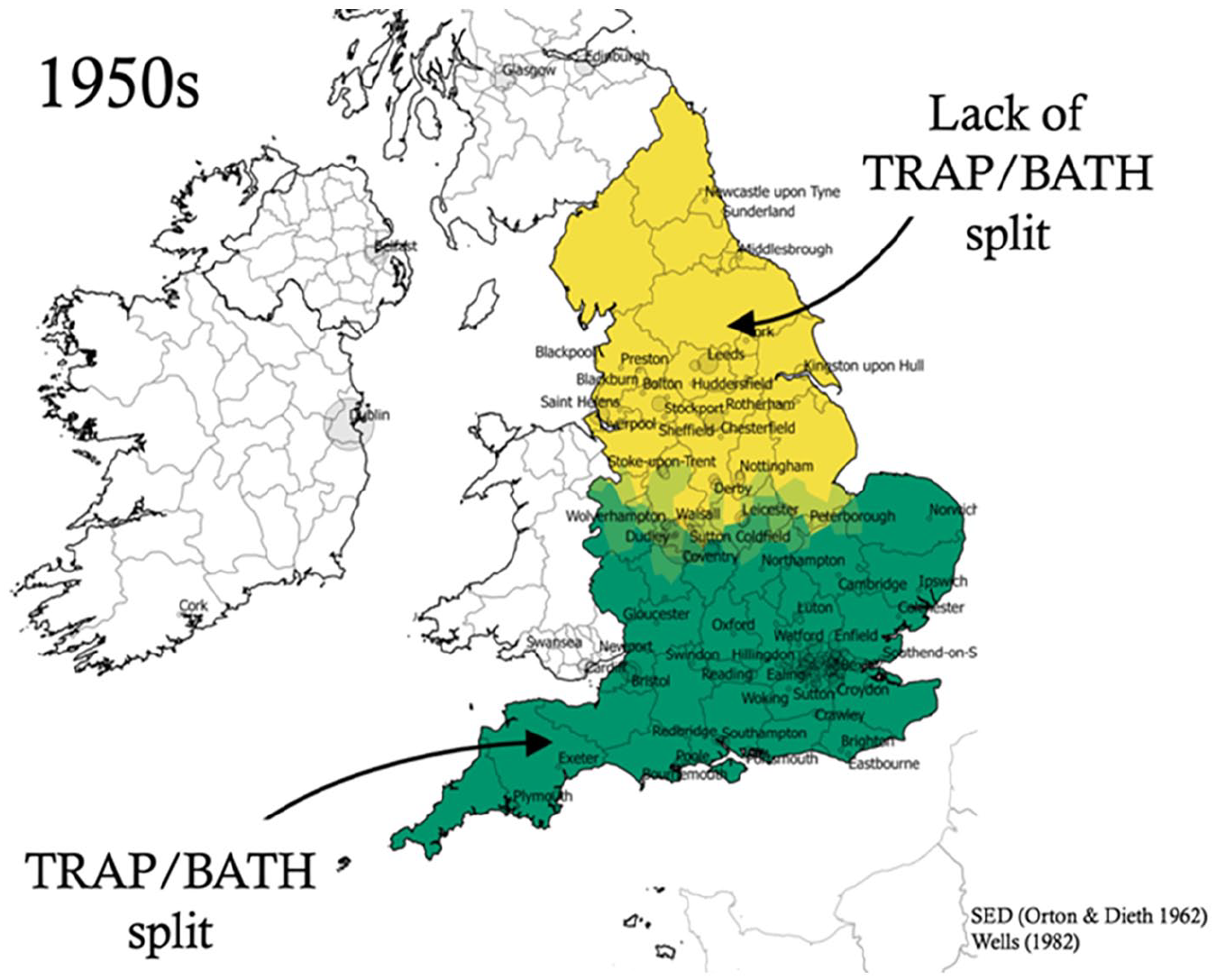
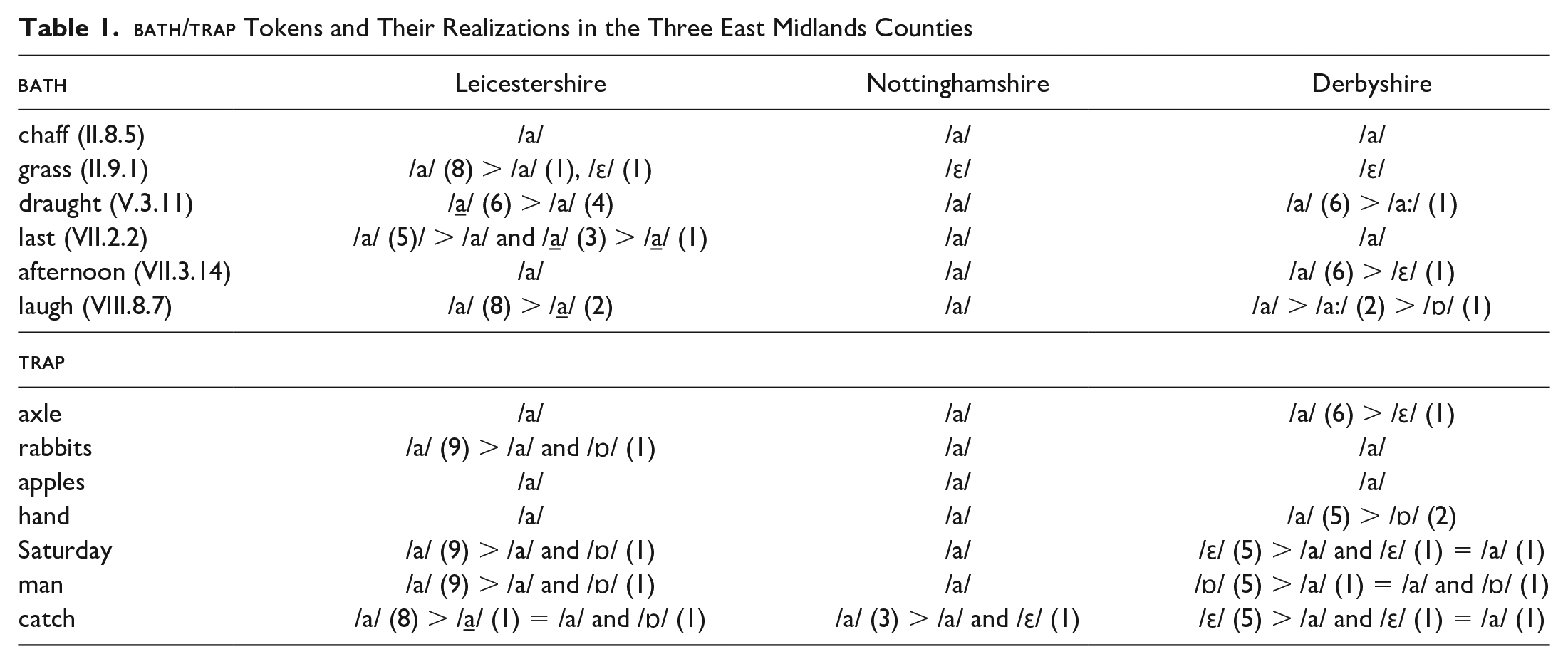
In order to provide a real time perspective, the SED (for full details see Orton et al. 1962–1971) is consulted here to establish the use of bath and trap in the East Midlands in the first half of the twentieth century (see Figure 1). Because of the incomplete nature of this change, each instance of the bath and trap vowels are listed in Table 1 (with exception of ‘thatch’ in the trap set, as most respondents gave a different word, ‘thack’). While the more traditional form /a/ (and to some extent /ɛ/) is almost exclusively found in Nottinghamshire, for some of the lexical items there are more retracted variants in Leicestershire (which were signaled as /a/ in the transcriptions).
trap-bath Split Based on SED Material
bath/trap Tokens and Their Realizations in the Three East Midlands Counties
bath
Leicestershire
Nottinghamshire
Derbyshire
chaff (II.8.5)
/a/
/a/
/a/
grass (II.9.1)
/a/ (8) > /a/ (1), /ɛ/ (1)
/ɛ/
/ɛ/
draught (V.3.11)
/a/ (6) > /a/ (4)
/a/
/a/ (6) > /a:/ (1)
last (VII.2.2)
/a/ (5)/ > /a/ and /a/ (3) > /a/ (1)
/a/
/a/
afternoon (VII.3.14)
/a/
/a/
/a/ (6) > /ɛ/ (1)
laugh (VIII.8.7)
/a/ (8) > /a/ (2)
/a/
/a/ > /a:/ (2) > /ɒ/ (1)
trap
axle
/a/
/a/
/a/ (6) > /ɛ/ (1)
rabbits
/a/ (9) > /a/ and /ɒ/ (1)
/a/
/a/
apples
/a/
/a/
/a/
hand
/a/
/a/
/a/ (5) > /ɒ/ (2)
Saturday
/a/ (9) > /a/ and /ɒ/ (1)
/a/
/ɛ/ (5) > /a/ and /ɛ/ (1) = /a/ (1)
man
/a/ (9) > /a/ and /ɒ/ (1)
/a/
/ɒ/ (5) > /a/ (1) = /a/ and /ɒ/ (1)
catch
/a/ (8) > /a/ (1) = /a/ and /ɒ/ (1)
/a/ (3) > /a/ and /ɛ/ (1)
/ɛ/ (5) > /a/ and /ɛ/ (1) = /a/ (1)
The East Midlands are a useful testing ground for Trudgill’s (1999:82) prediction that the trap-bath split will not diffuse any further northwards. A transitional status can make regional identity construction particularly fluid and complex (see e.g., Llamas 2007:579-580), specifically in ‘border’ areas.
Investigating the variation and change in the trap-bath split also has theoretical implications. Acquiring the split does not mean that speakers need to acquire a new phonemic category, but move a set of words from the trap position to the existing start/palm position. Unlike the foot-strut split, which involves acquiring a new phoneme (the vowel that would be found in strut) the trap-bath split does not require the speaker to acquire a separate phoneme, /ɑ/ is already in their inventory. Speakers can use a vowel that they already have for palm and start words. Therefore it is unlikely that the bath words would end up in a new position in the vowel space, creating an intermediate form (Halfacre 2023). However, the high indexical load and the change by lexical diffusion provide insights into the sociolinguistic nature of the progression of this split. Given the above description, the East Midlands is also a good testing ground for the development of splits in the wild and our research questions aim to examine variation among production of the bath and trap vowels in a sample of East Midlands speakers and whether this is changing in the region.
Research questions
What are the acoustic properties of bath and trap (and start and palm) in the three counties?
What is the geographical and speaker-age related distribution of bath and trap in the three counties?
Can a pattern of geographical diffusion of the trap-bath split be observed in the three counties or do we find stable variation as predicted by Trudgill?
3. Data and Methods
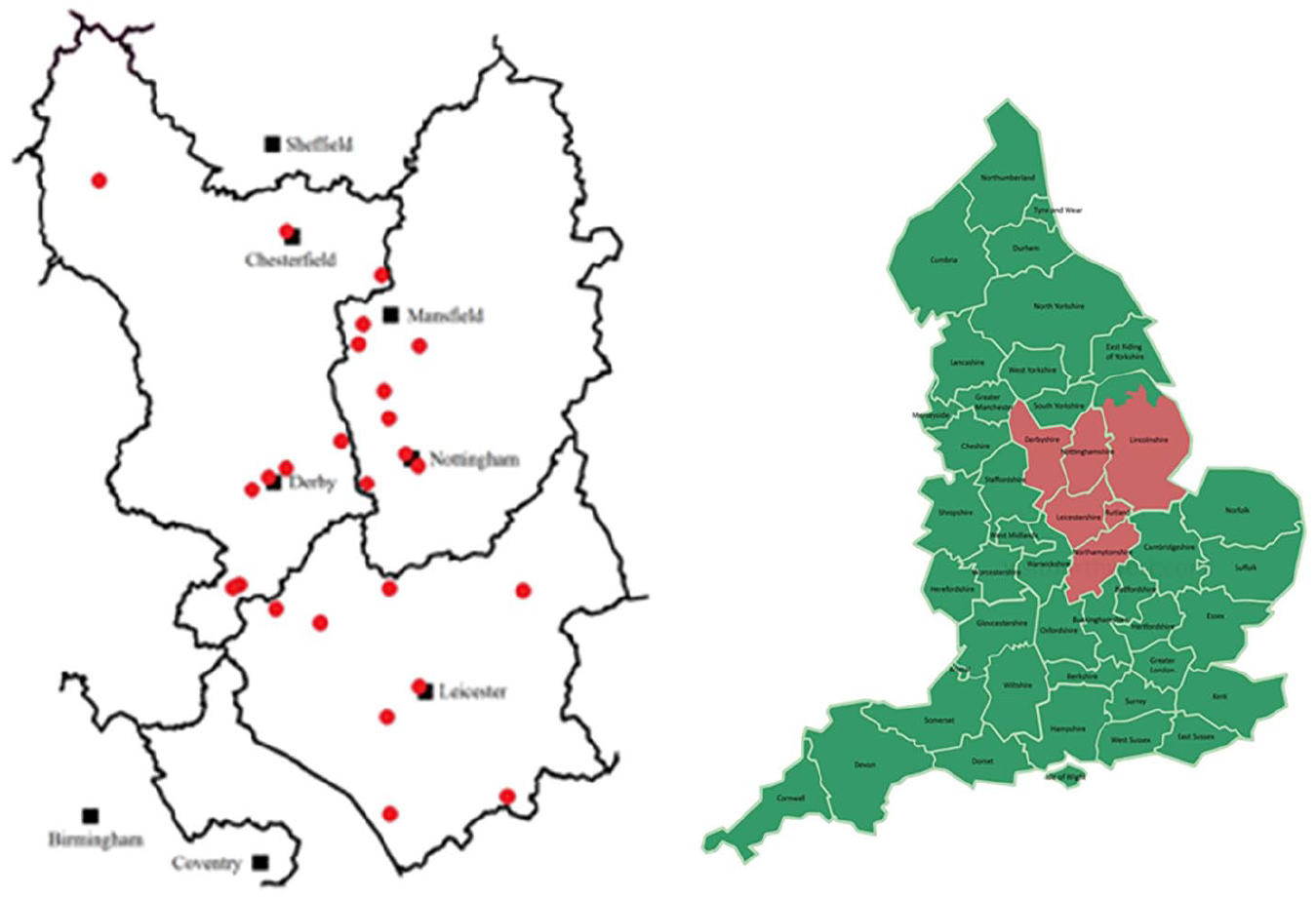
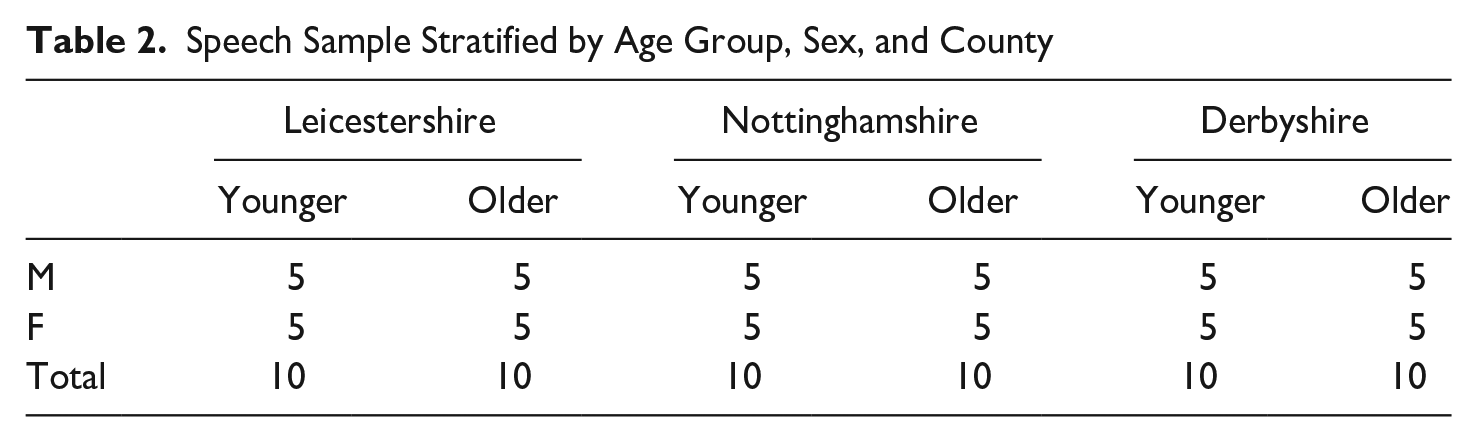
To answer the research questions, we created a speech sample of sixty British speakers; twenty speakers each from Leicestershire, Nottinghamshire, and Derbyshire (see Figure 2 and Table 2). The sample was sourced by a combination of convenience and snowball sampling, and stratified according to age (younger/older), gender (male/female), and place resulting in an identical number across all categories. In order to investigate whether apparent time change is observable, speakers were categorized in an older age group of over fifty-five years old and a younger group between eighteen and twenty-five years old to ensure an age gap between the groups.6 Each speaker twice read a text passage which contained words with bath, trap vowels, palm vowels, and start vowels (see the reading passage and tokens in Appendix I).
Map of East Midlands With Speaker Locations and Position Within England
Speech Sample Stratified by Age Group, Sex, and County
Leicestershire
Nottinghamshire
Derbyshire
Younger
Older
Younger
Older
Younger
Older
M
5
5
5
5
5
5
F
5
5
5
5
5
5
Total
10
10
10
10
10
10
Recordings were conducted by the first author and students from Nottingham Trent University who had been born and raised in one of the three counties under study in this project. The students who carried out recordings were briefed thoroughly about recording conditions and placement of the recording device. The recordings were made on different phones, recorded in mp4 format and converted to .wav using FreeConvert. Each recording was auditorily checked by the first author. After that, the recordings were transcribed in ELAN (Sloetjes & Wittenburg 2008).
The sound files were subjected to forced alignment of segments with FAVEalign (Rosenfelder, Fruehwald, Evanini & Yuan 2015), an automatic alignment tool adapted for sociolinguistic research. The program facilitates the automatic conversion of an orthographic transcription into phones by creating a phonemic transcription with a pronunciation dictionary and using an acoustic model to match the transcription to the sound file. All alignment was cross-checked by the third author. Following the alignment, we used FAVE-extract (Rosenfelder, Fruehwald, Evanini & Yuan 2015), a program which allows the automatic extraction of formant measurements for a given speaker in an aligned sound file. This was used to extract all vowel tokens of the reading passage which had a duration of at least 50 ms. These were measured at the temporal midpoint and included in the analysis. To compare vowel realizations between speakers, vowel measurements were normalized and converted to hertz with FAVE’s built-in transformation based on Lobanov (1971).
To investigate the status of bath and trap, we decided to use several measurements including overlap measurements. Different methods to measure the distribution of overlap exist. Johnson (2015) has stated that Bhattacharyya’s Affinity (Bhattacharyya 1943; henceforth BA) is a measure which is less sensitive to nested, crossed, skewed, or imbalanced distributions unlike the Pillai score. BA is a statistical measure of affinity that measures overlap between two cohorts in a two-dimensional space, using probability distributions, which makes it an ideal measurement for F1/F2 vowel distributions, which has been used to measure overlap in vowels (see, e.g., Stanley & Renwick 2016; Strelluf 2016, 2018; Warren 2018).
BA generates a coefficient between 0 and 1, 0 if no overlap exists between the two distributions and a coefficient of 1 for distributions which overlap completely, which is an advantage over Pillai scores, which do not reach 1 or 0. BA is included in the {adehabitatHR} package for R (Calenge 2023; R Core Team 2023).
4. Data Analysis: Overlap Between bath and trap
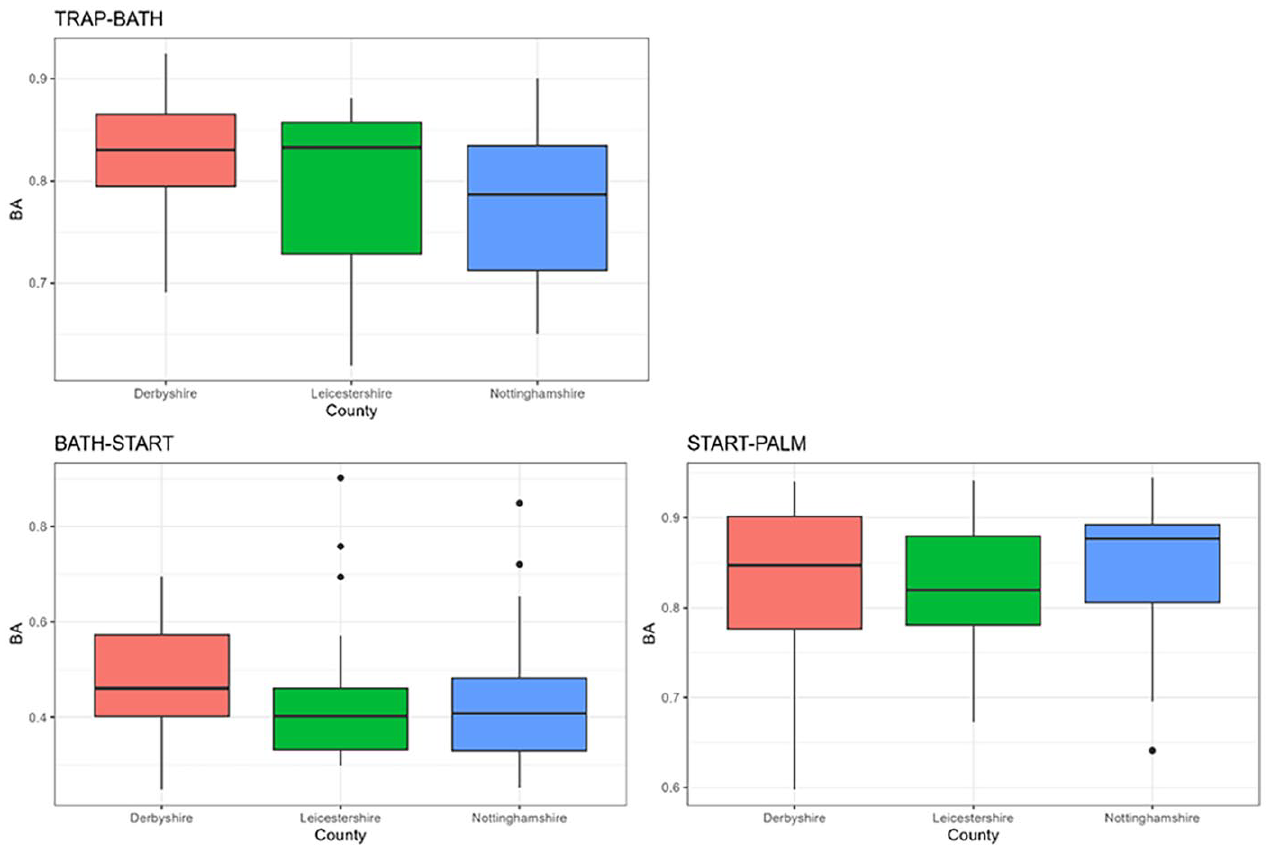
Figure 3 provides the BA (calculated per speaker) for trap-bath, bath-start, and start-palm for each of the counties.7 It can be seen that there is a high rate of overlap between trap and bath in each county. In Nottinghamshire the trap-bath overlap value is smaller than the other two counties, and Derbyshire shows the least variation. The overlap for bath-start is much lower in all three counties, though there is more variation, particularly in Leicestershire and Nottinghamshire. For comparison, the BA values for start-palm are also shown, demonstrating a high overlap, meaning that the vowels are realized very similarly.
Bhattacharyya’s Affinity for All Four Lexical Sets in All Three Counties (Calculated by Individual Speaker)
While the idea of an abrupt isogloss is promoted for the trap-bath split, we see slight differences in the overlap of trap and bath between the counties, which suggests a more gradual nature of the geographical distribution of the split. However, a straightforward south-north trajectory with Leicestershire as southernmost county showing least overlap is not found. The overlap is slightly lower in Nottinghamshire, geographically situated north of Leicestershire.
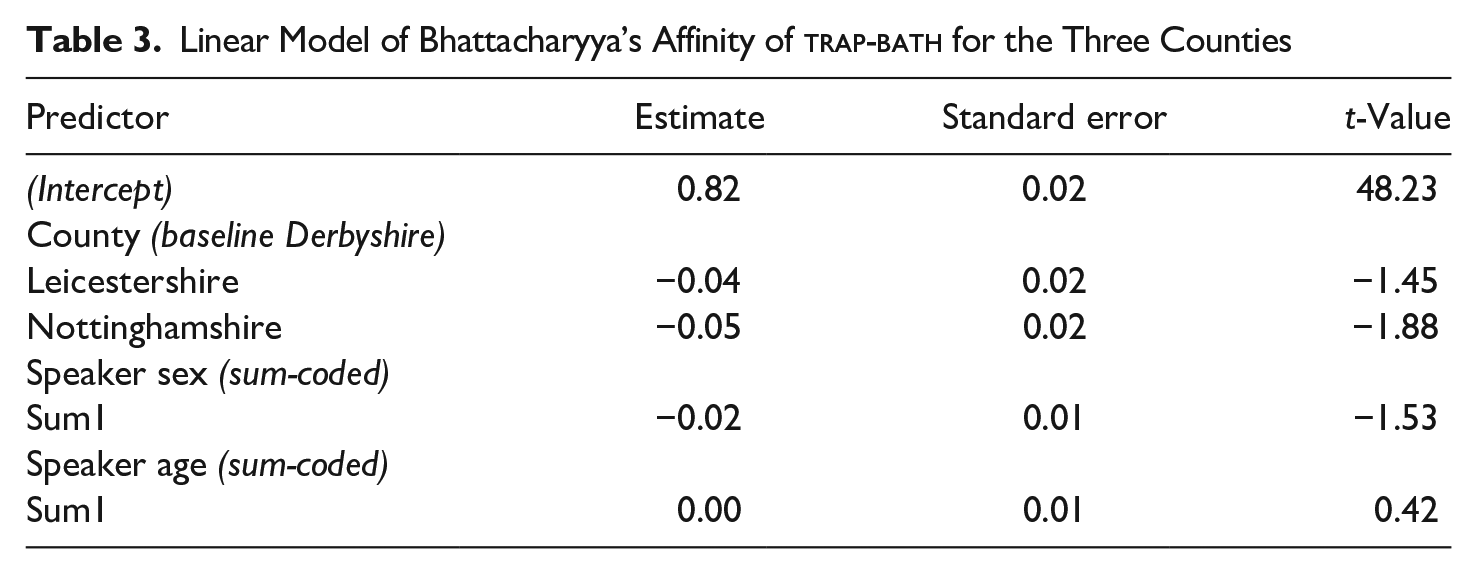
To further analyze the difference between the overlap in the different counties and understand the stability of trap-bath distribution in the region, the BA values were tested with a linear model (with lme4; Bates, Maechler, Bolker and Walker 2015 in R; R Core Team 2023—see Table 3 for details). The model shows that the mean BA for Derbyshire is 0.82, Leicestershire is 0.78, and Nottinghamshire is 0.77, with a t-value of less than 2.00.
Linear Model of Bhattacharyya’s Affinity of trap-bath for the Three Counties
Predictor
Estimate
Standard error
t-Value
(Intercept)
0.82
0.02
48.23
County (baseline Derbyshire)
Leicestershire
−0.04
0.02
−1.45
Nottinghamshire
−0.05
0.02
−1.88
Speaker sex (sum-coded)
Sum1
−0.02
0.01
−1.53
Speaker age (sum-coded)
Sum1
0.00
0.01
0.42
In addition to the trap-bath overlap, the bath-start and the start-palm overlap also did not show differences between the counties (results in Appendix II.)8. This means that, on the surface, we do not see any differences in the overlap distribution of bath-start and start-palm in these three counties of the East Midlands. In combination with the BA results for trap-bath, these initial results suggest a fairly stable situation for the vowel distribution of trap-bath in this region, which is in line with the prediction by Trudgill (1999:82) about the stability of this split or lack of it, in the present case. However, a closer look at the apparent time distribution of the overlap is needed to provide more information about the apparent stability of the split. The negligible effect of age (estimate = 0.01, t = −0.02) also strengthens the view that we see stability in the split (or lack thereof) across apparent time. These results have shown that a change in the overlap between the trap-bath lexical sets is unlikely in apparent time, which is an indicator that the distribution between bath and trap is stable in all three counties and that a northward movement of the split is less likely, predicted by Trudgill (1999:82). However, the results are restricted to the overlap of the vowels. Jansen and Braber (2021) have discussed that it is worth investigating the variation of trap-bath on the F1 and F2 level in order not to miss potential change. So, for this purpose, the status of the trap-bath split in each county is investigated separately, starting with Derbyshire. Because F2 is more relevant in this sound change (the split is predominantly in frontness, see Halfacre 2023), we focus on it as the only dependent variable in this study.
4.1. Results From Derbyshire
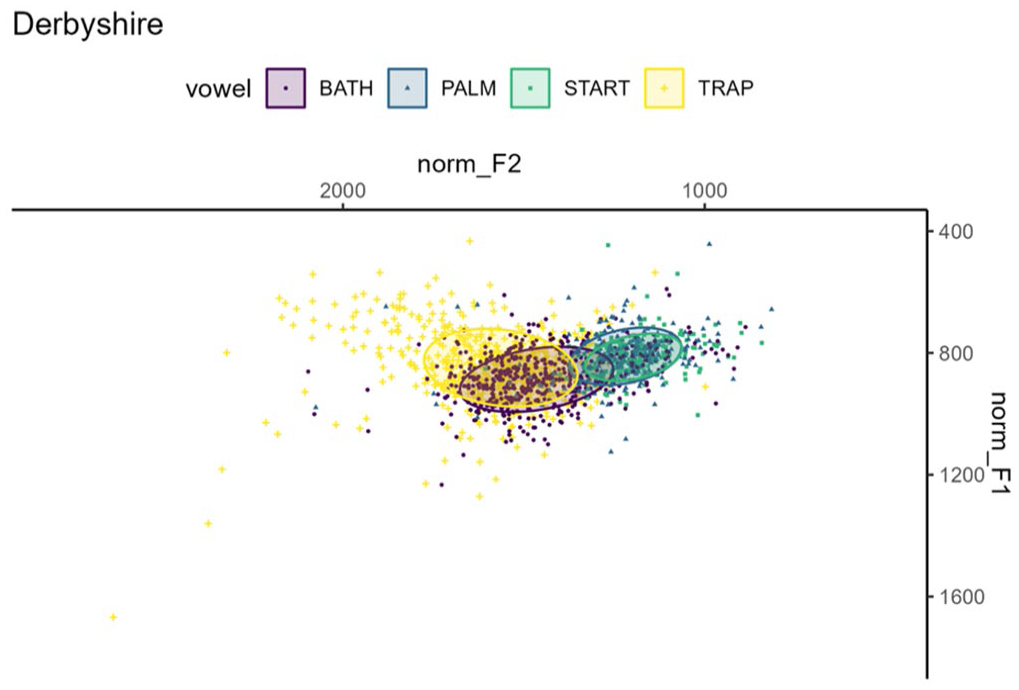
Figure 4 illustrates the distribution of trap, bath, palm, and start in Derbyshire. There is a clear division of trap and bath on the one hand and palm and start on the other hand in terms of place of production. palm and start are produced further back while trap and bath are produced further front. What is also noticeable is that while trap and bath have a large overlap, trap is fronter and higher than bath. palm and start overlap almost completely and, while the majority of bath tokens are produced fronter than start and palm, the vowel plot also shows that a number of bath tokens are produced in the back area where palm and start are produced. This means that there are individual tokens that seem to have a vowel quality which is more similar with the south-eastern back bath vowel than the northern front bath vowel.
Vowel Plot Showing the Distribution of trap, bath, palm, and start in Derbyshire
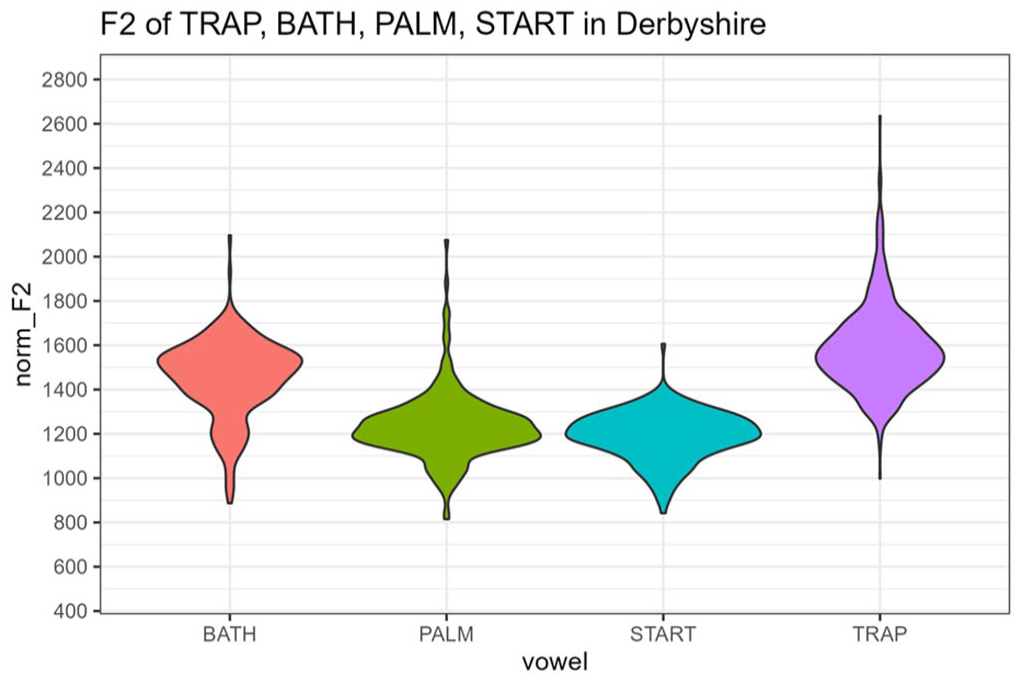
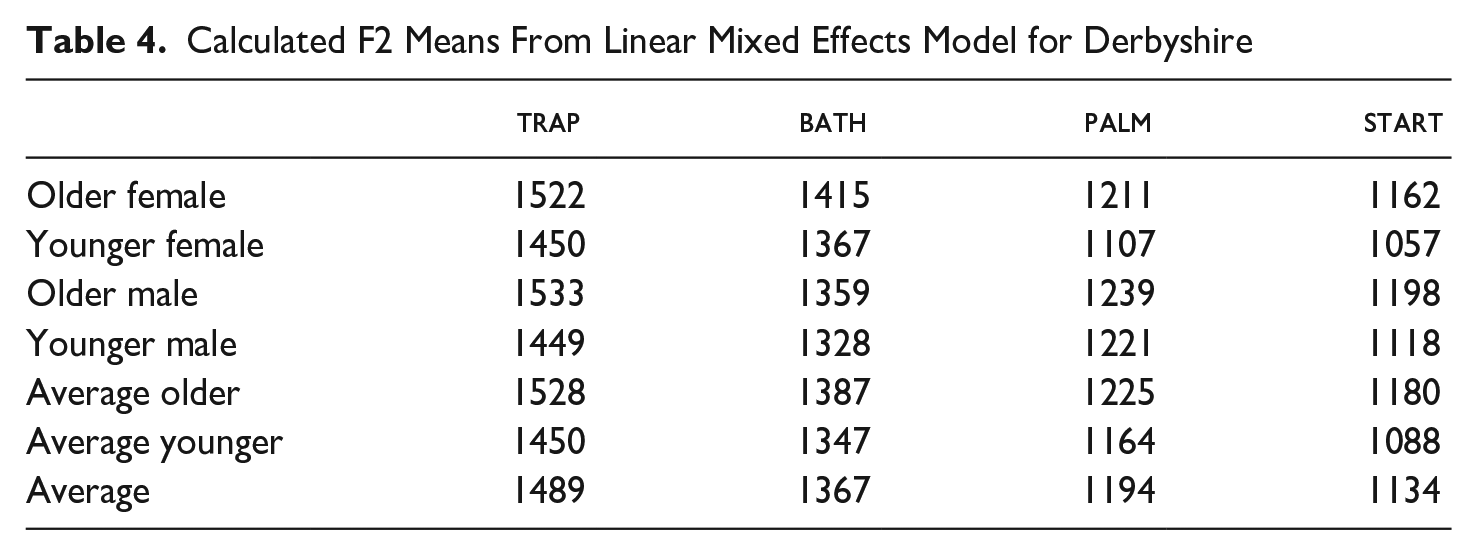
Figure 5 shows the distribution of F2 in all four lexical sets. It can be seen that trap has a distinctly higher F2 than all the other sets, but bath has a mean value in between the two groups. However, the shape of the violin for the bath group suggests that the F2 values sit in two groups, the majority with the same F2 as trap and a minority with the same F2 as palm and start. A linear mixed effects model was run on normalized F2 of all four lexical sets; Table 4 shows the mean values for each lexical set (by speaker age and sex). The model shows similar results to Figure 5, demonstrating that statistically the mean of palm and start are different from trap (by approximately 320 Hz), and bath is closer to trap. There is still some difference between trap and bath showing that in Derbyshire speakers there may be some tokens that are moving to a back vowel. The younger female speakers also show more retracted palm and start vowels (though not a different bath vowel).
Violin Plot of trap, bath, palm, and start in Derbyshire
Calculated F2 Means From Linear Mixed Effects Model for Derbyshire
trap
bath
palm
start
Older female
1522
1415
1211
1162
Younger female
1450
1367
1107
1057
Older male
1533
1359
1239
1198
Younger male
1449
1328
1221
1118
Average older
1528
1387
1225
1180
Average younger
1450
1347
1164
1088
Average
1489
1367
1194
1134
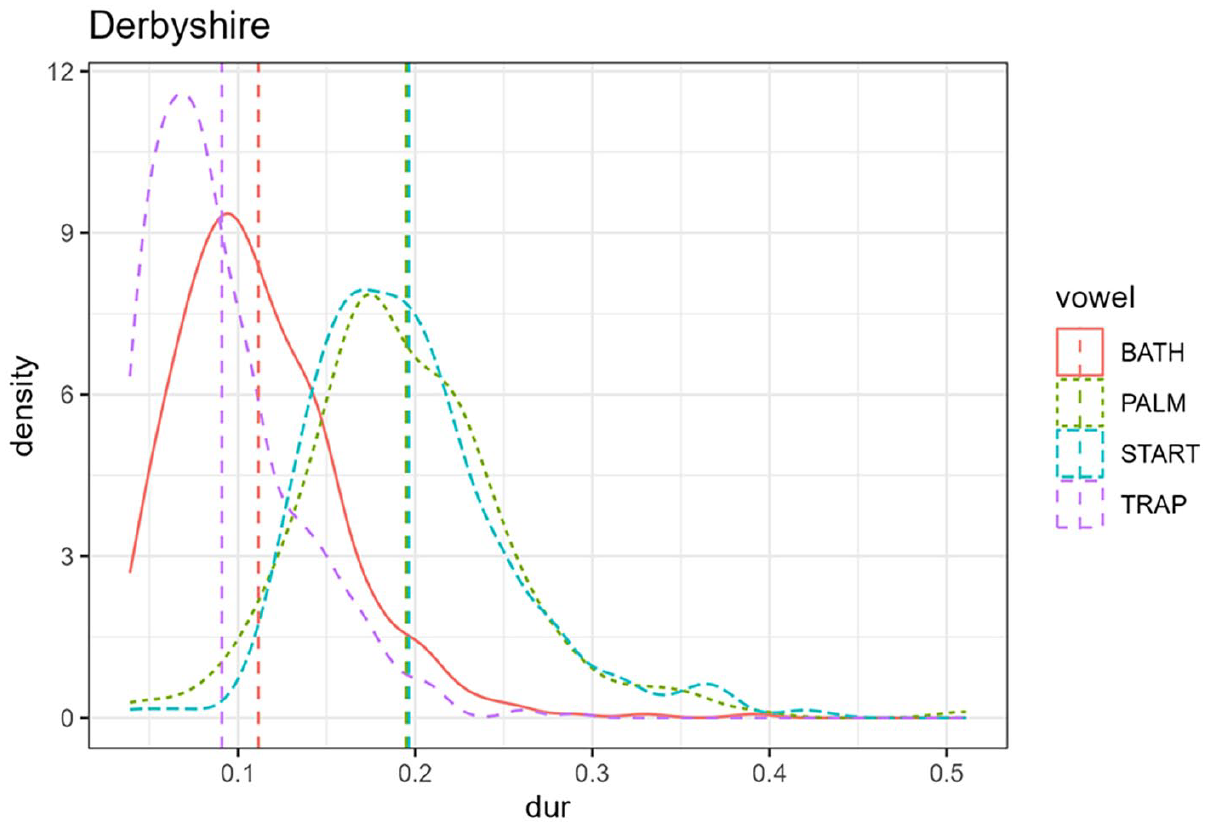
Duration is known to also vary within the low vowel system of English, and duration is also a significant effect in the model of F2. Figure 6 shows that there are more bath tokens with a higher duration than there are trap tokens, though not as many as there are start/palm tokens. Therefore, duration of the four lexical sets was modeled separately. The model did not show a significant difference in mean duration between trap and bath, though this does not rule out tokens with a higher duration.
Density Plot Showing the Distribution of Durations in trap, bath, palm, and start in Derbyshire
4.2. Results From Nottinghamshire
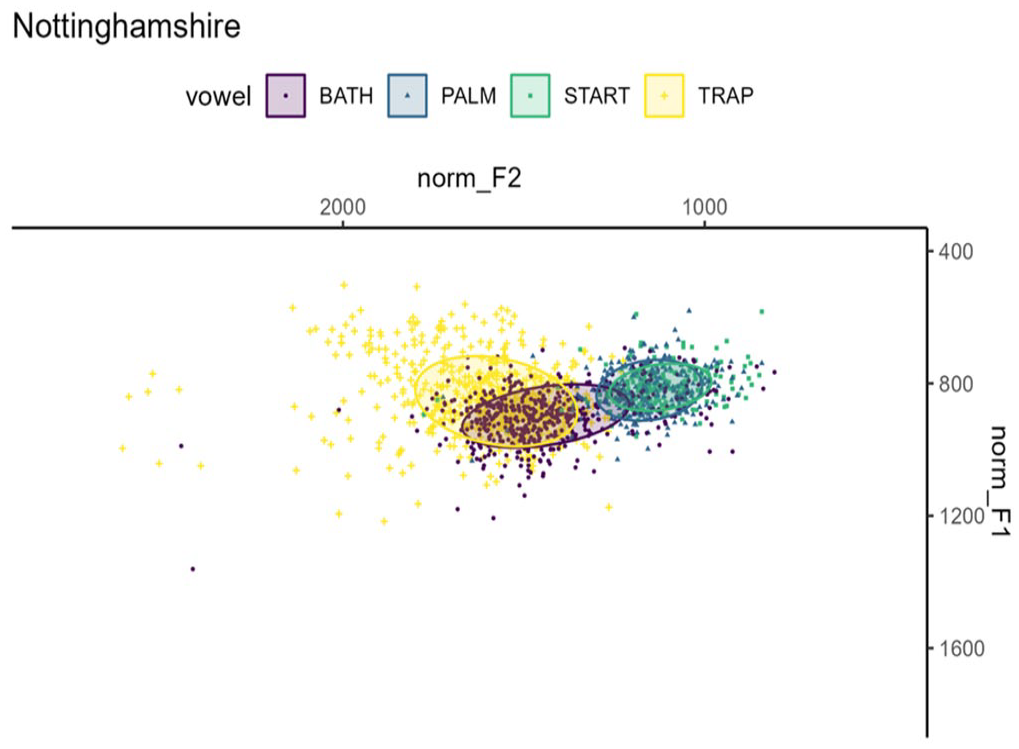
In the Nottinghamshire data (see Figures 7 and 8), at first sight, the general distribution of trap, bath, palm, and start in Nottinghamshire resembles the distribution of those lexical sets in Derbyshire. However, some differences are observable. The overlap between bath and trap is smaller than in Derbyshire, while palm/start seem to be more distinct from bath. Nevertheless, again there are bath tokens realized in the same space as start and palm, meaning some bath tokens are realized with a back vowel.
Vowel Plot Showing the Distribution of trap, bath, palm, and start in Nottinghamshire
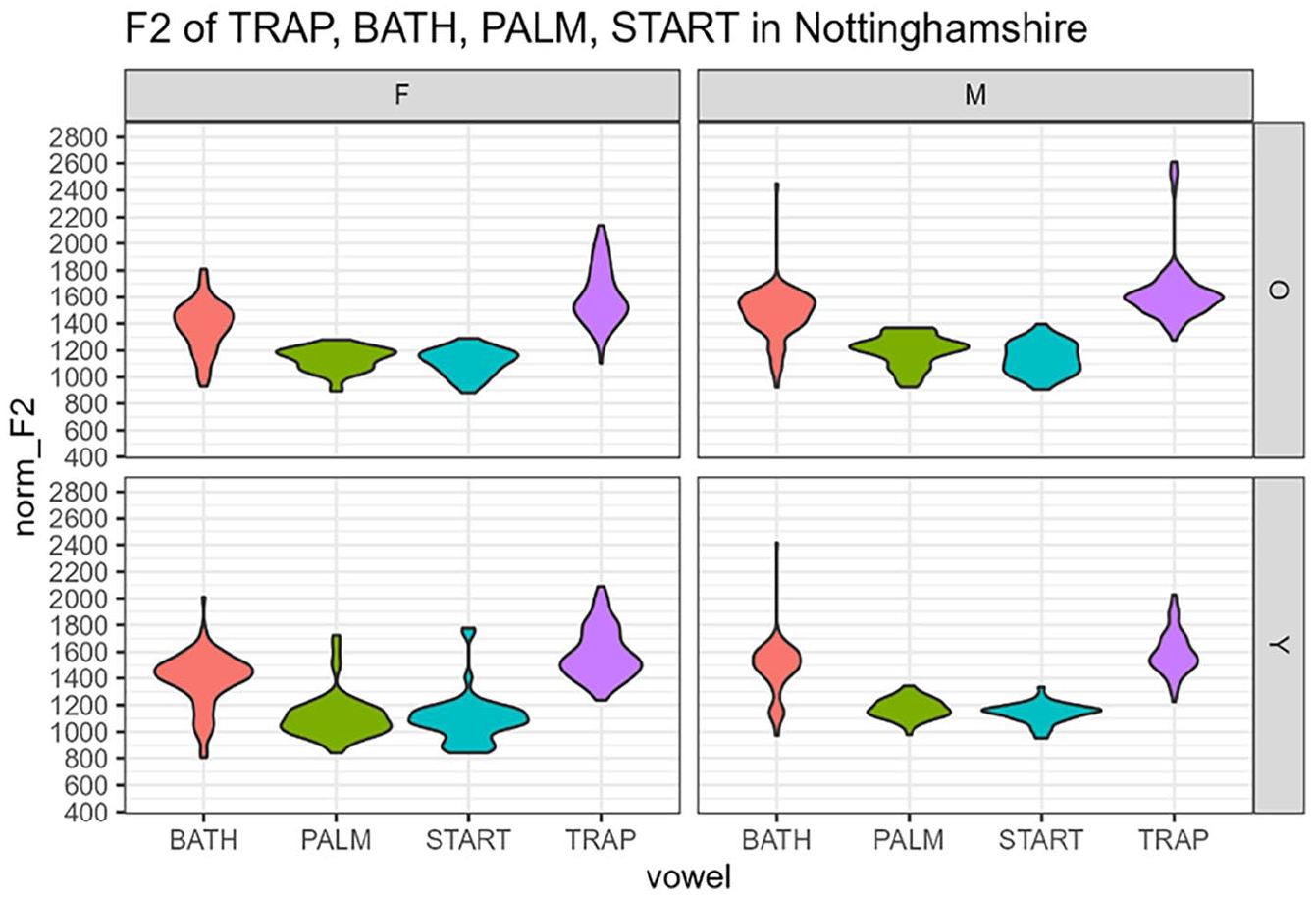
Violin Plot of trap, bath, palm, and start in Nottinghamshire
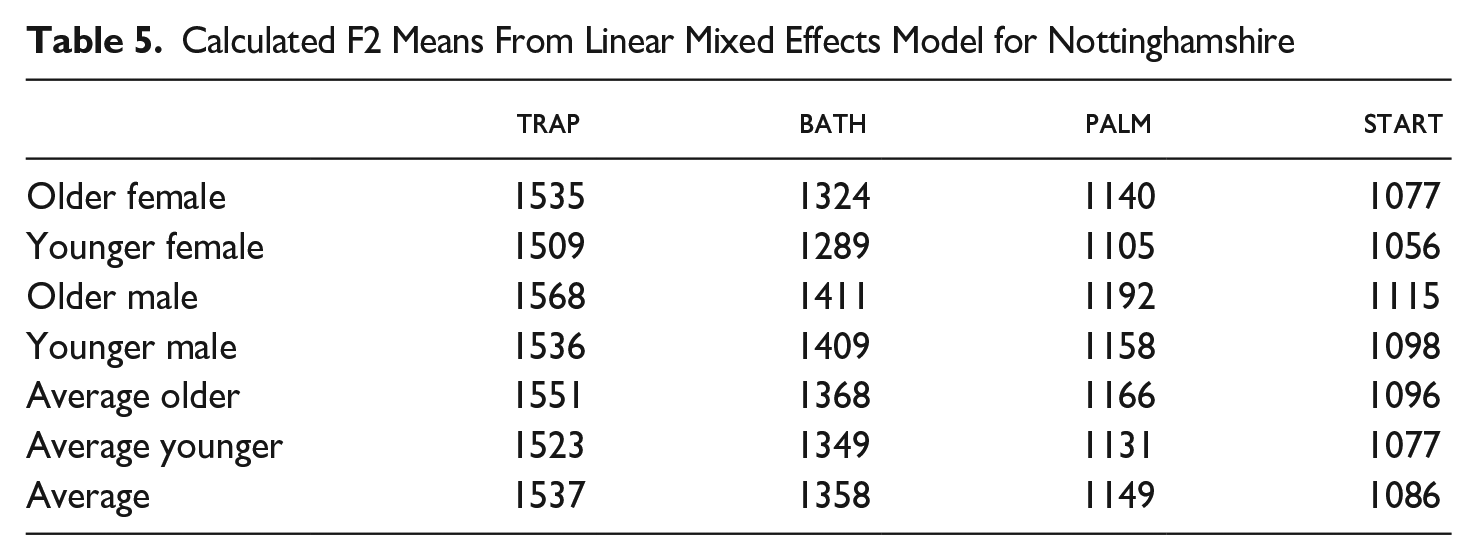
Modeling F2 in Nottinghamshire (see Table 5 for key values) showed that the mean F2 for the bath lexical set is 1358 Hz, in between the trap and the start/palm sets. Another variation worth noting in this model is that the female speakers, and particularly the younger female speakers, have a more retracted bath vowel (see Figure 8). If a trap-bath split is forming in this population, the female speakers may be leading the change (though the bath set overall does not show highly different values to those seen in the Derbyshire analysis above).
Calculated F2 Means From Linear Mixed Effects Model for Nottinghamshire
trap
bath
palm
start
Older female
1535
1324
1140
1077
Younger female
1509
1289
1105
1056
Older male
1568
1411
1192
1115
Younger male
1536
1409
1158
1098
Average older
1551
1368
1166
1096
Average younger
1523
1349
1131
1077
Average
1537
1358
1149
1086
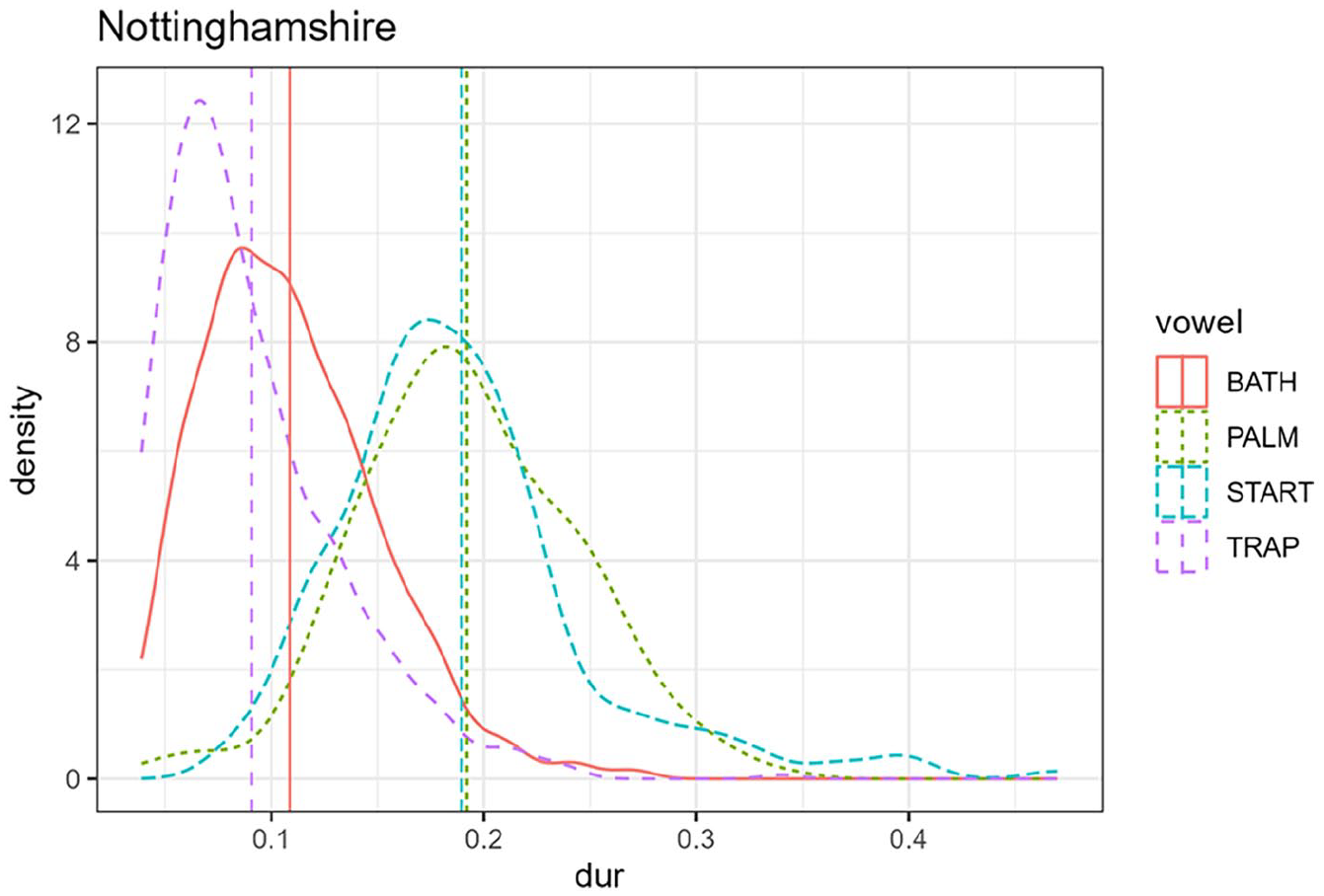
Again in the Nottinghamshire speakers, duration has a significant effect in the model of F2 and Figure 9 shows that there are more bath tokens with a higher duration. However, the results from analyzing duration alone did not show a significant effect.
Density Plot Showing the Distribution of Durations in trap, bath, palm, and start in Nottinghamshire
4.3. Results From Leicestershire
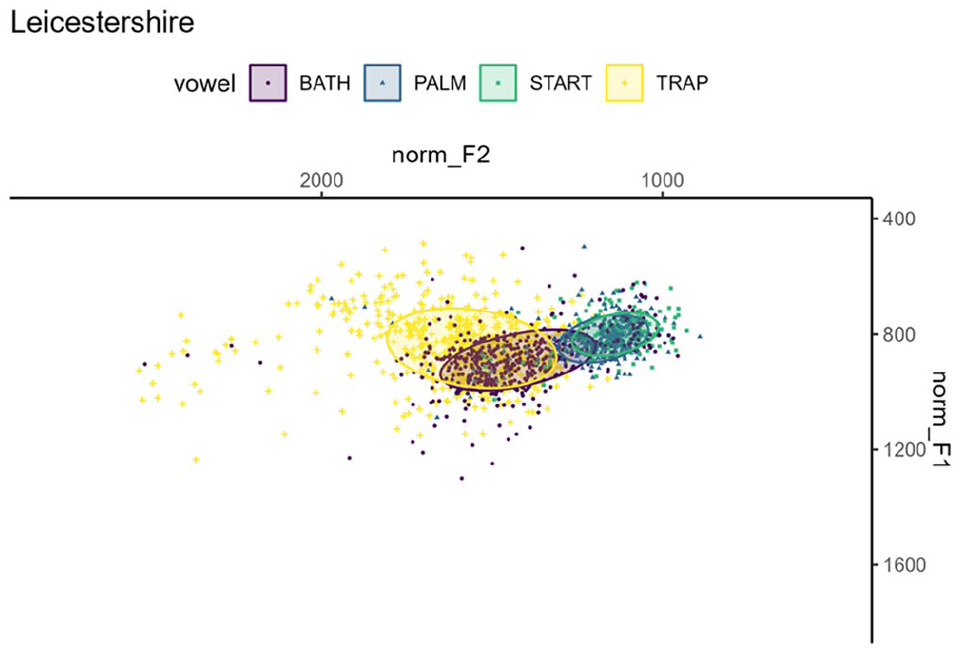
Finally, we turn to the distribution of the vowels in Leicestershire. This is the most southern of the three counties under investigation and Figure 1 shows that Leicestershire is situated in an area where variation between the northern and southern realizations of trap and bath was noted in the SED data. Again, we start with an overall view of the distribution of trap, bath, start, and palm in Figure 10. Similar to the other two counties, trap and bath overlap to a certain extent and start and palm overlap almost completely but are fairly separate from trap and bath.
Vowel Plot Showing the Distribution of trap, bath, palm, and start in Leicestershire
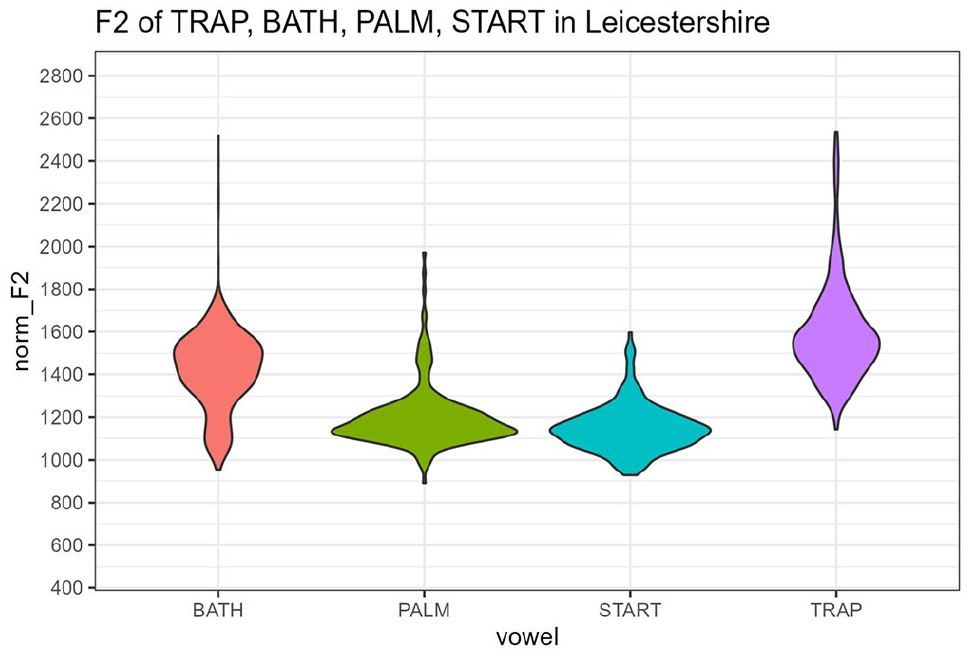
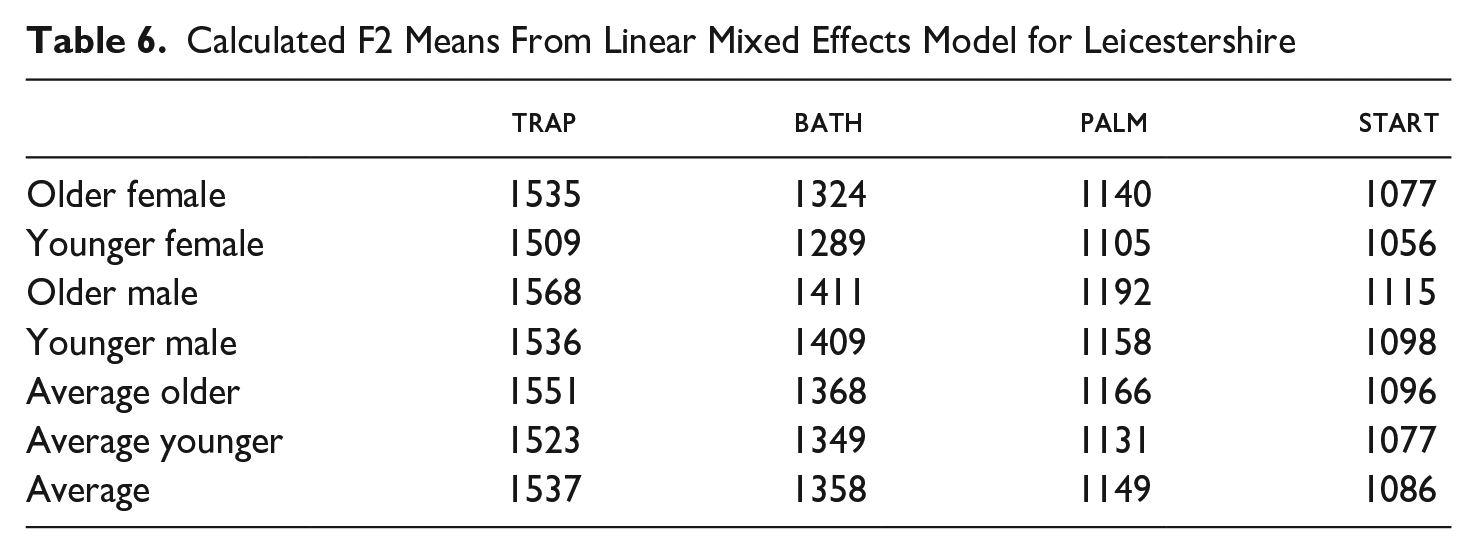
In similar results to the previous two sections, the speakers in Leicestershire have a mean of their bath lexical set between the trap and the palm/start positions (Figure 11, average values in Table 6), but closer to trap, implying that some items have moved from the trap to the bath positions. The younger female speakers show a lower mean F2 of bath, but also an overall more retracted vowel space, so the lower bath value is likely caused by a target that is slightly further back rather than more tokens moving than the other speakers.
Violin Plot of trap, bath, palm, and start in Leicestershire
Calculated F2 Means From Linear Mixed Effects Model for Leicestershire
trap
bath
palm
start
Older female
1535
1324
1140
1077
Younger female
1509
1289
1105
1056
Older male
1568
1411
1192
1115
Younger male
1536
1409
1158
1098
Average older
1551
1368
1166
1096
Average younger
1523
1349
1131
1077
Average
1537
1358
1149
1086
Unlike the other two counties, duration did not have a significant effect in the F2 model. For completeness a model of duration was run for these speakers with the density plot. Again, the bath lexical set did not show a significantly different duration from trap, and both were different from palm/start.
5. F2 and Duration of Individual Lexical Items
The trap-bath split has been described as lexical split in different varieties (see above). “Such lexical splits display a high degree of conditioning, and what seems at first like a complex rule of distribution. Closer examination of the situation shows that a rule is not justified, and that mastery of the new distribution demands knowledge of each particular lexeme” (Labov 1994:333).9 A few constraints have been identified for the trap-bath split and Wells (1982b) has grouped the lexemes in three categories within the bath lexical set. All three fit the phonological criteria (following voiceless fricative or nasal + voiceless fricative) but group 2 can be found to have a trap vowel in accents that would otherwise have a split and more pertinently for our current study group 3 can be found to have a palm vowel in accents that do not otherwise have a split (it is not clear in Wells or other more recent research what governs these groups; Halfacre (2023) has suggested a complex rule system such as that found in trap raising in US English):
1) path, laugh, master10 RP /pɑːθ/ etc., i.e. bath
2) dance, grant, demand RP /dɑːns/ etc., i.e. bath
3) half, palm, banana, can’t RP /hɑːf/ etc., i.e. bath/palm
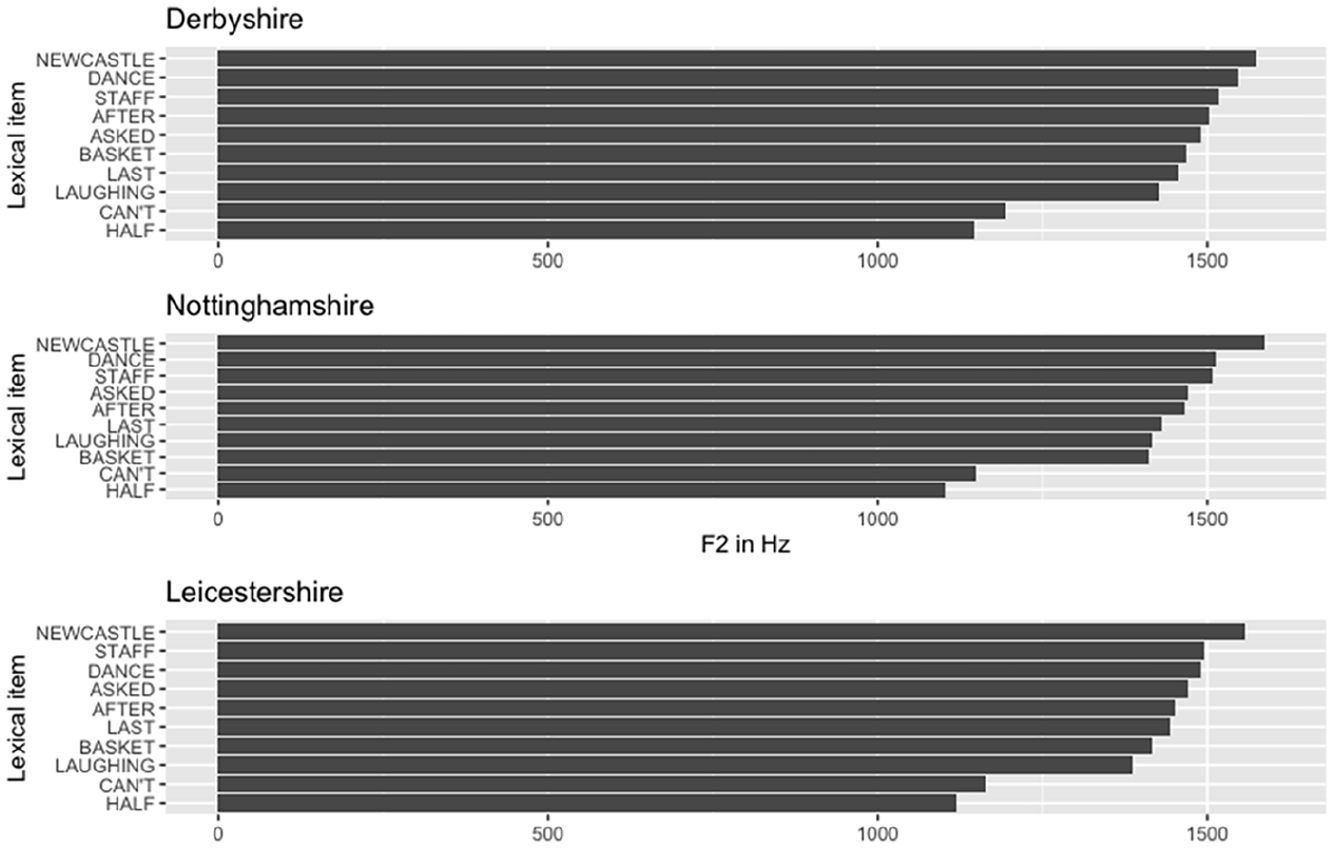
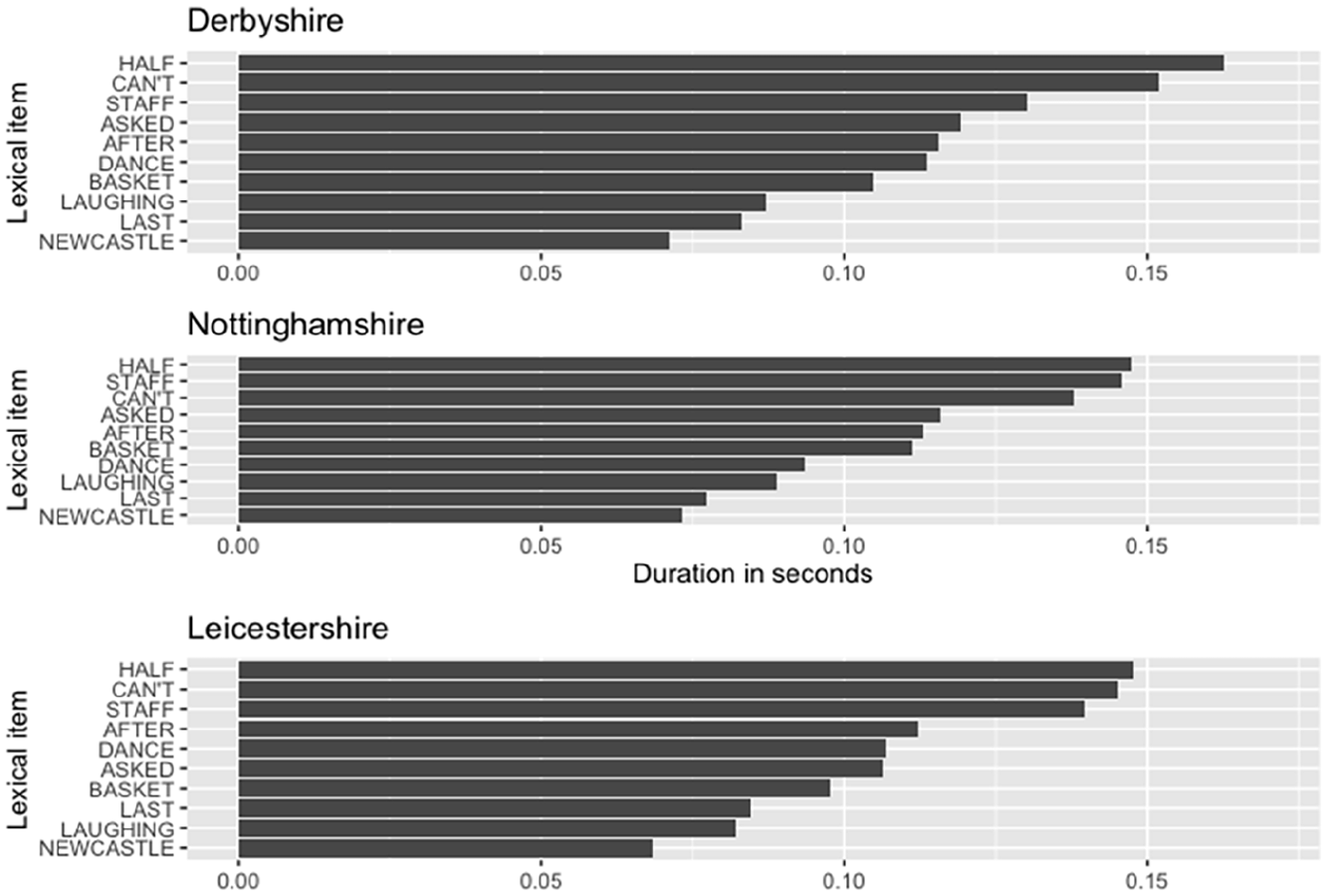
Categorizing the lexical items according to these groups is efficient in large, more lexically diverse datasets. The nature of the present dataset provides the chance to compare the average F2 value and the average length of a small set of ten lexical items belonging to the bath lexical set. Each speaker read them at least twice which provides a good base for comparing the individual items. Figure 12 provides the lexical item according to the average F2 value and county while Figure 13 sets out the information about the duration of the vowel in the individual lexical items in the three counties.
Lexical Items According to the Average F2 Value of the bath Vowel in the Different Counties
Lexical Items According to the Average Length of the bath Vowel in the Different Counties
The visualization in Figure 12 provides the information that the lexical item Newcastle has the highest average F2 value in all three counties while can’t and half have the lowest average F2 values by some length. The other lexical items align in between the extremes but even there, some similarities are found, for example, laughing is found at the lower F2 end in all counties while staff is found at the higher end.
Half has the longest average duration; despite having a following fricative, it is in the group most likely to be PALM (see Well’s categorization above), and this is the case across the counties, while Newcastle has the shortest average duration (Figure 13). Comparing the duration of half, that is, the lexical item with the longest vowel duration in all three counties, it is somewhat longer in Derbyshire (0.163 seconds) than in Nottinghamshire (0.147 seconds) and Leicestershire (0.148 seconds). The duration of the shortest lexical item Newcastle is shortest in Leicestershire (0.0684 seconds) and longest in Nottinghamshire (0.0732 seconds) with an average duration of 0.071 seconds in Derbyshire. The average duration difference between the lexical item with the longest vowel in the bath lexical set in this study and the shortest vowel (half and Newcastle) therefore is highest in Derbyshire (0.092 seconds) and lowest in Nottinghamshire (0.0738 seconds). In Leicestershire the duration difference is 0.0796 seconds.
The F2 and length analysis of the individual lexical items illustrates Labov’s (1994:333) point that speakers need to have knowledge of the realization of each individual lexical item because the F2 and length distinction is not restricted to the binary difference between trap and bath, but we actually find gradual F2 and length distinctions for the individual lexical item within the bath lexical set. This means that what we see here is more complex than a simple binary trap-bath distinction. The speakers in the three counties vary to a large extent within the bath lexical set. This study can only provide this initial finding, but more research such as perception sensitivity to these length distinctions might be a way to go forward in investigating this variation.
6. Discussion and Conclusions
We set out to answer three research questions. Our general finding is that speakers in East Midlands counties do not show a bath vowel that is completely within the trap position and that the overlap between trap and bath is smaller than for foot and strut (cf. Jansen & Braber 2021). The first question is concerned with the description of the acoustic properties of bath and trap (and start and palm) in the three counties. The data presented here provide a very homogenous picture of the status of the trap-bath split across the East Midlands and across apparent time, suggesting that the overlap between bath and trap seems to be stable, which is confirmed by the statistical modeling in section 6. We do not observe a change in progress based on the overlap measurement in Derbyshire and Nottinghamshire. Neither the differences in overlap between the counties, nor the difference in overlap between the age groups in the different counties is statistically significant. However, there is one exception: the group of younger female speakers in Leicestershire seem to show some retraction of the bath vowel. As stated in section 3, it is unlikely that speakers create a new vowel sound, because the split only requires moving bath items from the trap position to the palm/start position. However, the split is highly lexically specific, so a mean bath value found to be between trap and bath suggests that some items in the set have moved and others have not (similar to results found by Halfacre 2023 in Tyneside).
As noted above, there is more bath retraction by younger female speakers in Leicestershire than any of the other speakers, which suggests that there is a gradual south-north trajectory in degree of retraction.
The vowel dynamics of trap-bath usually also involve the realization of start and palm where trap and bath are set in relation to these vowels. A degree of retraction of was start and palm was found in the younger female speakers in Derbyshire.
The results for female speakers in Leicestershire leave us with the assumption that bath retraction is ongoing, albeit slowly, and that this process is going to continue due to younger female speakers leading this change. Therefore, we expect that the vowel distribution is becoming more similar to south-eastern English with trap in the front of the vowel space and bath, start, and palm at the back (see Table 1). However, it is important to stress that our expectation is that this change is happening very slowly.
This study also supports the view that the trap-bath split is created via lexical diffusion. Figures 11 and 12 show how individual lexical items show differences in length distinction causing the realization of trap-bath to be very complex in all three East Midlands counties. More research, especially on the perceptual-experimental level, could supply more information about the process of lexical diffusion and the perception of it. In addition, investigating lexical items in a larger corpus of sociolinguistic interviews could confirm the kind of gradual vowel length and F2 distribution.
While we have focused on linguistic factors, the social meaning of short ‘a’ should not be underestimated. Trudgill (1986:18) has stated that “It is . . . interesting to note that Northerners moving to the South and accommodating to Southern speech usually modify butter /bʊtə/ to /bʌtə/ or at least to /bətə/, but . . . would rather drop dead than say /dɑːns/: the stereotype that this is a Southern form is too strong.” This statement shows the strong feelings northerners tend to have toward their own bath pronunciation and the pronunciation of the vowel by southerners. However, Braber (2015) has pointed out that students in the East Midlands do not recognize their own dialects in a matched-guise task, which suggests that people in the East Midlands might not see this vowel as strong identity marker of the area. Braber (2014:7) has asked students whether they considered themselves northern, southern, Midlander, or nothing. While 26 percent of all participants stated that they are neither northern nor southern, there are some observations which might help explain our findings. In particular, the Leicestershire results presented in Braber (2014) are of interest. This study showed that 22 percent of the Leicestershire participants identified as southerners while 14 percent in Nottinghamshire and 7 percent in Derbyshire said the same. Our finding that younger females in Leicestershire seem to turn to use a more southern bath vowel therefore is in line with the findings by Braber (2014). Identifying as southerner most likely also means to use forms that are associated with the south(-east).
A finding which confirms the position of Nottinghamshire as more extreme than the other two counties is that the overlap measurement in Nottinghamshire is lower than in Leicestershire and Derbyshire. For the foot-strut split we find a similar result where speakers in Nottinghamshire show more extreme fronting of foot than in the other two counties (Jansen & Braber 2021).
Admittedly, this study applies a broad brush across the East Midlands when it comes to trap-bath variation. However, the multilocality approach taken here provides initial insights in “a sound change as it moves through the linguistic system” (Horvath & Horvath 2001:37) of the East Midlands. Dimensions such as urban-rural, social class, and ethnicity have not been taken into consideration. Future research, which we hope to base on community studies, may well consider these dimensions as they pose important questions for understanding variation and change, or explain the apparent stability of the trap-bath isogloss in the East Midlands. In addition, this study is based on read data which might have an influence on the use of vowel variation. Future research also needs to incorporate spontaneous speech to avoid self-conscious changes. Nevertheless, the present study provides only initial but hopefully eye-opening insights into the sociophonetic status of trap-bath variation in the East Midlands.
Footnotes
Appendix I
Declaration of Conflicting Interests
The author(s) declared no potential conflicts of interest with respect to the research, authorship, and/or publication of this article.
Funding
The author(s) received no financial support for the research, authorship, and/or publication of this article.
ORCID iDs
Natalie Braber
Sandra Jansen
Notes
Author Biographies
Natalie Braber is Professor of Linguistics at Nottingham Trent University. Her research focuses on Sociolinguistics, with a particular focus on language variation in the East Midlands. Her research also involves accent discrimination and language as intangible cultural heritage.
Caitlin Halfacre has a PhD from Newcastle University (2023) and is currently a Research Associate in Linguistics at Manchester Metropolitan University. Her research covers aspects of Phonetics, Phonology, Morphology, Sociophonetics, and Sociolinguistics but she is particularly interested in the interactions between social and regional variation, and constraints on individual variation.
Sandra Jansen worked as a sociolinguist specializing in L1 and L2 dialect contact and sociolinguistic aspects of teaching L2 English. She left academia in 2023 and she now works as a coach for academics who want to change careers.
References
1.
BatesDouglasMaechlerMartinBolkerBenWalkerSteve. 2015. Fitting linear mixed-effects models using lme4. Journal of Statistical Software67(1). 1-48. doi:10.18637/jss.v067.i01.
2.
BealJoan C.1999. English pronunciation in the eighteenth century. Oxford: Clarendon Press.
3.
BealJoan C.2008. English dialects in the North of England: Phonology. In KortmannBerndUptonClive (eds.), Handbook of varieties of English: The British Isles, 122-144. Berlin: Mouton de Gruyter.
4.
BhattacharyyaAnil Kular. 1943. On a measure of divergence between two statistical populations defined by their probability distributions. Bulletin of the Calcutta Mathematical Society35. 99-109.
5.
BlaxterTamsinCoatesRichard. 2020. The trap-bath split in Bristol English. English Language and Linguistics24(2). 269-306.
6.
BraberNatalie. 2014. The concept of identity in the East Midlands of England. English Today30(2). 3-10.
7.
BraberNatalie. 2015. Language perception in the East Midlands. English Today31(1). 16-26.
8.
BraberNatalieFlynnNicholas. 2015. The East Midlands: Nottingham. In HickeyRaymond (ed.), Researching Northern English, 369-392. Amsterdam: John Benjamins.
9.
BraberNatalieRobinsonJonnie. 2018. East Midlands English. Berlin: De Gruyter Mouton.
10.
BritainDavid. 2001. Welcome to East Anglia!: Two major dialect ‘boundaries’ in the Fens. In FisiakJacekTrudgillPeter (eds.), East Anglian English, 217-242. Cambridge: D.S.Brewer.
11.
BritainDavid. 2002. Space and spatial diffusion. In ChambersJackTrudgillPeterSchilling-EstesNatalie (eds.), The handbook of language variation and change, 603-637. Oxford & Malden, MA: Blackwell.
12.
BritainDavid. (ed.). 2007. Language in the British Isles. Cambridge: Cambridge University Press.
DannHolly. 2019. bath variation amongst early adolescents in West Cornwall. Paper presented at ICLaVE, Leeuwarden, The Netherlands.
15.
EvansBronwenIversonPaul. 2007. Plasticity in vowel perception and production: A study of accent change in young adults. Journal of Acoustical Society of America121(6). 3814-3826.
16.
FerragneEmmanuelPellegrinoFrançois. 2010. Formant frequencies of vowels in 13 accents of the British Isles. Journal of the International Phonetic Association40(1). 1-34.
17.
FlynnNicholas. 2012. A sociophonetic study of Nottingham speakers. York, UK: University of York PhD dissertation.
18.
FoulkesPaulDochertyGerard. 2007. Phonological variation in England. In BritainDavid (ed.), Language in the British Isles, 35-52. Cambridge: Cambridge University Press.
19.
GuptaAnthea. 2005. Baths and becks. A report on two prominent dialectal variables in England. English Today21(1). 21-27.
20.
HalfacreCaitlin. 2023. Variation and change in modern received pronunciation: Understanding interactions between private education and regional accent variation. Newcastle, UK: Newcastle University PhD dissertation.
21.
HorvathBarbara M.HorvathRonald J.2001. A multilocality study of a sound change in progress: The case of /l/ vocalization in New Zealand and Australian English. Language Variation and Change13(1). 37-57.
22.
HughesArthurTrudgillPeterWattDominic. 2012. English accents and dialects. 5th edn.London: Hodder Arnold.
23.
JansenSandraBraberNatalie. 2021. foot-fronting and foot-strut splitting: Vowel variation in the East Midlands. English Language and Linguistics25(4). 767-797.
24.
JohnsonDaniel Ezra. 2015. Quantifying overlap with Bhattacharyya’s affinity and other measures. Paper presented at NWAV44, Toronto, Canada. https://danielezrajohnson.shinyapps.io/nwav_44/. Accessed on September, 2023.
25.
KortmannBerndUptonClive (eds.). 2008. Handbook of varieties of English: The British Isles. Berlin: Mouton de Gruyter.
26.
LabovWilliam. 1994. Principles of linguistic change. Internal factors. Cambridge, MA: Blackwell.
27.
LeemannAdrianWalkerEleanorKirkhamSamBrownGeorginaNanceClaireBritainDavidBlaxterTamsin. 2019. Crowdsourcing variation and change in foot/strut and trap/bath across England. Paper presented at ICLaVE 10, Leeuwarden, The Netherlands.
28.
LlamasCarmen. 2007. “A place between places”: Language and identities in a border town. Language in Society36(4). 579-604.
29.
LobanovBoris M.1971. Classification of Russian vowels spoken by different speakers. Journal of the Acoustical Society of America49. 606-608.
30.
MeesInger M.Høøck OsornoChristina. 2017. The complexity of the bath words in Cardiff English. Linguistica57(1). 229-245.
31.
OrtonHaroldDiethEugenHallidayWillfridBarryMichaelTillingP. M.WakelinMartyn.1962–1971. Survey of English dialects: Basic materials. Introduction and 4 vols. (each in 3 parts). Leeds: E. J. Arnold & Son.
32.
PiercyCaroline. 2011. One /a/ or two? Observing a phonemic split in progress in the southwest of England. University of Pennsylvania Working Papers in Linguistics17(2). 155-164.
33.
R Core Team. 2023. R: A language and environment for statistical computing [computer program]. R Foundation for Statistical Computing, Vienna, Austria. https://www.R-project.org/. Accessed on September, 2023.
SloetjesHanWittenburgPeter. 2008. Annotation by category: ELAN and ISO DCR. Proceedings of the 6th International Conference on Language Resources and Evaluation. http://www.lrec-conf.org/proceedings/lrec2008/pdf/208_paper.pdf. Accessed on September, 2023.
36.
StanleyJoseph A.RenwickMargaret E.L.2016. Phonetic shift /ɔr/ phonemic change? American English mergers over 40 years. Paper presented at LabPhon 15, Ithaca, NY.
37.
StrellufChristopher. 2016. Overlap among back vowels before /l/ in Kansas City. Language Variation and Change28(3). 379-407.
38.
StrellufChristopher. 2018. Speaking from the heartland: The Midland vowel system of Kansas City. Durham, NC: Duke University Press.
39.
StrycharczukPatrycjaLópez-IbáñezManuelBrownGeorginaLeemannAdrian. 2020. General Northern English. Exploring regional variation in the North of England with machine learning. Frontiers in Artificial Intelligence3: Article48.
40.
TrudgillPeter. 1986. Dialects in contact. Oxford: Blackwell.
41.
TrudgillPeter. 1999. The dialects of England. Oxford: Blackwell.
42.
TurtonDanielleBaranowskiMaciej. 2020. Not quite the same: The social stratification and phonetic conditioning of the foot-strut vowels in Manchester. Journal of Linguistics57(1). 163-201.
43.
UptonClive. 2012. The importance of being Janus: Midland speakers and the ‘north-south divide’. In MarkusManfredIyeiriYokoHeubergerReinhardChamsonEmil (eds.), Middle and Modern English corpus linguistics, 257-268. Amsterdam: John Benjamins.
44.
UptonCliveWiddowsonJohn D. A.1996. An atlas of English dialects. Oxford: Oxford University Press.
45.
WarrenPaul. 2018. Quality and quantity in New Zealand English vowel contrasts. Journal of the International Phonetic Association48(3). 305-330.
46.
WellsJohn C.1982a. Accents of English, vol. 1: An introduction. Cambridge: Cambridge University Press.
47.
WellsJohn C.1982b. Accents of English, vol. 2: The British Isles. Cambridge: Cambridge University Press.