




Abstract
We attempt to further our understanding of the beginnings of language change by analyzing a semantic innovation in Multicultural London English: the use of still as a discourse-pragmatic item in utterance-final position. We show that the change follows well-attested processes of semantic change, so it could have occurred at any time and amongst any group of speakers. Its emergence now, amongst young men in inner city London, can be explained by considering not only well-known external factors such as population change but also by analyzing the interactional contexts in which the new meaning emerges and by relating this to the local peer group culture. In this way we gain insights into how speakers can be motivated to use a form with a new meaning during interactional moves that are especially important for them in their everyday lives.
1. Introduction
Multicultural London English (MLE) is a new dialect spoken in multilingual and multicultural boroughs of London. In these areas it has largely displaced traditional working-class London dialects such as Cockney. It results from the large-scale immigration from many different parts of the world that has occurred in London, as in many European cities, since the 1950s. Children growing up in linguistically diverse areas in London do not encounter a consistent target variety of English; instead, they are surrounded by what has been described as a rich ‘feature pool’ of linguistic forms containing, at the very least, elements from learners’ varieties of English, Englishes from the Indian subcontinent and Africa, Caribbean creoles and Englishes and local London and south-eastern vernacular varieties of English, as well as more standard-like varieties from various sources (Cheshire, Kerswill, Fox & Torgersen 2011; for the concept of the feature pool see Mufwene 2001). Children who speak a language other than English at home acquire combinations of features from the pool through a process of unguided second language acquisition (Winford 2003), sometimes modifying them into innovative features and new structures. The innovations spread through multiethnic friendship groups and so are used not only by young second generation immigrants but also by young people from longstanding local families whose parents and grandparents still speak a local London dialect. For young people who have acquired MLE in this way, it is an unselfconscious vernacular, in Labov’s (1972:256) sense of the term: their unmarked, unreflecting, unmonitored way of speaking. MLE is built on London English but characterized by a variable repertoire of innovations in every component of language. The emergence of MLE and its subsequent development is discussed in more detail by, amongst others, Cheshire, Kerswill, Fox, and Torgersen (2011), Ilbury (2023), Cheshire and Kerswill (forthcoming), Ilbury and Kerswill (2024).
It can take two or three generations for new varieties to stabilize (Siegel 1997) so, unsurprisingly, many current MLE forms are fluctuating. Some were used by young people for a while but have since disappeared. This is the case, for example, of the quotative this is + speaker, as in this is them “what area are you from?” (Fox 2012). Other MLE forms, perhaps especially the phonological features (such as near-monophthongs for the FACE and GOAT lexical sets), persist into adulthood and seem to be stabilizing (Kerswill and Torgersen 2021), perhaps even spreading beyond London (Cheshire, Kerswill, Fox & Torgersen 2013; Cheshire & Kerswill forthcoming). Whether or not the innovations survive, they all offer a rare opportunity to advance our understanding of how and why a language change begins.
In this article we focus on a semantic innovation in MLE: the meaning of still when used in utterance-final position. The new use of still is italicized in (1). 1
In this example the fieldworker had been wondering how Roshan and Kevin had come to know the other boys in their friendship group. Her presupposition that they may have met at school is reasonable since the boys live in the same area of London, but it turns out to be wrong, and Roshan’s reply tells her this. We will see later that Roshan’s addition of utterance-final still acknowledges his awareness of the contrast between the fieldworker’s expectation that the boys had met at school and the reality that they had not, with Kevin using stand-alone still in the same way, to reinforce his friend’s assertion. Still in examples such as (1), then, overtly acknowledges potential differences between the beliefs and perspectives of the speaker and addressees.
MLE was first attested in two research projects carried out in working-class areas of London. The first, Linguistic Innovators (Kerswill, Cheshire, Fox & Torgersen 2004-2007), compared a linguistically diverse inner city area, Hackney, with a far less diverse outer city area, Havering. The second, Multicultural London English (Kerswill, Cheshire, Fox & Torgersen 2007-2010), focused only on multilingual inner city areas (Hackney, again, and also Haringey and Islington). The research we report in this article was carried out for the second project; we do not analyze data from the first project since it contains only two tokens of utterance-final still. The new meaning has emerged in the speech of sixteen to nineteen year olds, especially young men, but because it develops through well-attested processes of semantic change it could have emerged at any time, with any group of speakers. In order to explain its emergence at this time and amongst this group of speakers we will draw on Traugott and Dasher’s (2002) Invited Inferencing Theory of Semantic Change, which assumes that semantic change occurs during interactions, and originates in the speech of a single speaker.
The article is organized as follows. In section 2 we briefly detail the semantic history of still and discuss some relevant previous research. We briefly describe the two research projects in section 3, focusing mainly on the second project, and provide details of the participants and our methodological procedures. The results of our analyses are given in section 4, where we analyze some typical interactions where the new meanings occur. Sections 5 and 6 contain a discussion and conclusion.
2. Still: Background
In present-day English still has several grammatical roles: it functions as a noun, verb, adjective, adverb, and discourse marker. We focus mainly on the adverb and discourse marker here since these are the most relevant precursors of the innovative utterance-final usage.
We begin, though, by noting that in Old English still was an adjective and adverb meaning ‘quietly’ or ‘without motion.’ During the Middle English period it developed temporal meanings in durative contexts, a natural inference from ‘without motion’ to ‘without change’ (Lewis 2020:133). Lewis (2020:136) further notes that in durative contexts the presence of still may indicate that the duration is unexpected, and that it is a small step to then infer that the event itself is unexpected, leading to concessive meanings of contrast and counter-expectation. The concessive uses had emerged from the temporal one by the end of the eighteenth century. During the late Modern English period still has been used continuously with an overlay of contrastive concessive meanings (Lenker 2010:180).
All these meanings of the adverb still persist today. (2)-(4) are examples from the Multicultural London English project.
The different senses are often seen as sharing a core meaning of marking an event or state that continues beyond expectation on some kind of scale (see, e.g., König & Traugott 1982, Lenk 1998:252, Ranger 2015:163). In (2), the scale is movement through space; in (3) it is time; and in (4) it is a specific ongoing action (the manager in the hairdressing shop where Esther works telling Esther to call the next client, despite an intervening condition that prevents the action from being accomplished—Esther’s inability to pronounce the client’s name). In all three examples there is a presupposition of counterexpectation, which adds a more subjective affective component to the meaning of the adverb. This is clearly seen in (2)-(4) by considering other items in the utterance: in (2) still emphasizes the fact that the person could not move despite his trying to do so, reinforced by and everything; in (3) there is a suggestion that the period of time for which people are on the waiting list is longer than it should be, made clear in Esther’s next clause, I don’t think that’s fair; and in (4) the incompatibility of the two juxtaposed events is emphasized with the help of even though.
During the eighteenth century still began to be used as an adverbial connector, sometimes in utterance-initial position and sometimes alone. In both cases it has a text-structuring function, linking two units of discourse. Its sense of contrast and counterexpectation means that still indicates that “one unit is seen as unexpected in the light of the other” (Quirk, Greenbaum, Leech & Svartvik1985: 639). Lenker notes a subjective aspect to this meaning, commenting that as a connector still is similar to a stance adverbial because it “adds the voice of the speaker to the proposition” (Lenker 2010:37). Bell (2010), similarly, finds that still operates on a rhetorical level to add the speaker’s perspective to an utterance, unlike the other adverbial connectors he analyzes in various sources of spoken American English. MLE speakers are no different from speakers of other varieties of English in using still in this way, as illustrated by (5). Here Roshan and William are reminiscing about how they used to cause a lot of trouble when they were younger; now, however, they are focusing on earning money so they are no longer interested in behaving badly. Roshan’s still introduces his opinion about the good old days, and introduces a contrast between the present day and the past: the old days were good, even though Roshan and William didn’t make any money then and were causing trouble.
The phrase but still has been used since the end of the seventeenth century (Lewis 2020:143). Lenk (1998:254), analyzing the London-Lund Corpus and parts of the Santa Barbara Corpus of Spoken American English, describes but still as a discourse marker with the textual function of marking a contrast between a general comment or opinion and the main conversational topic, or a return to the main topic after a conversational aside. Once again there is evidence of an affective component to the meaning: but still not only contributes a sense of counter-expectation but also provides a retrospective speaker comment to signal that what has just been expressed is bearable, or can be disregarded (Lewis 2020:130). MLE speakers use but still this way too, as (6) illustrates.
Omar’s utterance occurs during an argument with his friend. Omar says that although he understands his friend’s point of view (I get where you’re from) nonetheless he does not agree with him—in other words, what his friend has just expressed can be disregarded. As with other uses of the lexeme still there is a sense of continuation—this time of Omar’s own, unchanged, point of view—but here Omar acknowledges, with the but of but still, the contrast between his own and his friend’s perspective. The example confirms Lewis’s (2020:130) comment that in the phrase but still, still is becoming intersubjective, with a function bordering on hedging or politeness. We see this as a precursor to the function of still in its most recent innovative role as an utterance-final particle where, as we will see later, it is often used to communicate politeness.
The previous research on still does not mention its use as an utterance-final discourse-pragmatic item. We see this as confirming our view that it is a recent innovation. In our data the utterance-final form has a similar sense to but still, but the meaning is more clearly epistemic and intersubjective, unambiguously fitting Traugott’s definition of an intersubjective expression as one that allows speakers to express their awareness of their addressee’s attitudes or beliefs (Traugott 2010:35). We argued that still functioned in this way in (1). (7) is a further example.
Discourse-pragmatic items are by their nature multifunctional, so it is notoriously difficult to objectively attribute a specific meaning or function to them, but the preceding or following discourse often allows this to be done. It does so in (7). Here Robert and his friend Tau are talking to the fieldworker about their families. Robert begins his reply to the fieldworker’s question about whether he has any brothers by saying that he does (yeah yeah), but he then adds the information that one of them died. Perhaps his interlocutors looked surprised as he uttered one of them died though and perhaps this prompted him to add utterance-final still. Whether or not he was reacting to a facial expression of surprise, the fieldworker’s following query about what he had just said and his friend’s uuh uttered with rising intonation indicate that this is not what they had been expecting to hear. Robert’s utterance-final still pre-empts this, acknowledging what he assumes could be a gap between their expectations and what he has just told them.
The gradual shifts in the meaning and uses of still follow well-attested pathways of semantic change. The evolution from spatial to temporal and then to concessive-contrastive meanings is a typical movement from the physical domain toward a more abstract domain, and from concrete meanings to more subjective, speaker-attitudinal meanings. The burgeoning epistemic and intersubjective meanings expressed by but still are a further move along this well attested path, and utterance-final still continues the development. The semantic change involved is relatively minor, but as far as we know it has not occurred in other varieties of English.
Traugott and Dasher (2002) describe earlier semantic changes in the history of still in terms of their Invited Inferencing Theory of Semantic Change. As mentioned in section 1, the theory assumes that semantic change takes place during interactions as speakers and addressees (or writers and readers) negotiate meanings, and that semantic innovation begins with the speaker, who draws on existing meanings of a lexeme to innovate new uses. Speakers do so for a range of communicative purposes, such as their desire to inform, express beliefs and emotions, or solve problems of expression (Traugott & Dasher 2002:279). They may also, of course, simply wish to ensure the involvement of their addressees in the interaction (in the sense of Chafe (1982)) by using a form in an unexpected way. For communication to be successful, the pragmatically enriched meaning can be only minimally different from existing meanings, since it depends on an inference that the addressee is invited to draw from the unexpected innovative use. Traugott and Dasher point out that speakers do not necessarily expect the inference to become conventionalized, but if addressees replicate the new use when they themselves are speakers, we have the beginning of semantic change. Seeing the speaker as the initiator of semantic change explains why meanings tend to become increasingly based in the speaker’s subjective belief state or attitude toward the proposition they are expressing (Traugott 1989:34-45).
In order to understand why a speaker might use an existing lexeme in a new way, then, it is helpful to consider the interactions in which innovations occur. In the analysis that follows we examine the types of interactional context in which the new meanings of still occur, in an attempt to explain why the changes have emerged in this variety and amongst these groups of speakers.
3. Data and Methods
3.1. Data
As mentioned in the Introduction, our data comes from the 2007 to 2010 project Multicultural London English. The project aimed to discover how MLE patterns in terms of its acquisition, the use of innovative features across ethnic groups, and its status as an ethnically neutral variety. 127 speakers from six different age groups were recorded: 4-5, 8-9, 12-13, 16-19, 25-30, and about 40-50, with roughly equal numbers of female and male speakers. 2 With the exception of the oldest age group they were recorded with one or two friends. The researchers categorized the speakers into two groups: ‘Anglos’ and ‘non-Anglos.’ Anglos were from monolingual families of British origin who had been living in the area for at least two generations, usually more (corresponding to the official term ‘White British’), while the non-Anglo group was of mixed recent immigrant origin, speaking many different home languages as well as English. Friendship groups of the speakers in the five youngest age groups were ethnically very diverse such that almost all young people, including Anglos, were recorded with a friend whose linguistic background was different from their own. Small portions of the recordings consisted of questions from the fieldworker and answers from participants, but the presence of friends resulted in a great deal of lively and spontaneous informal conversation between the fieldworker and the young people. There were also self-recordings made by some sixteen to nineteen year olds. In total approximately 1.6 million words were transcribed from 120 hours of recorded speech.
We confine our analysis here to speakers who were fluent in English. We therefore excluded the four to five year olds, many of whom were only beginning to acquire English. We also excluded the forty to fifty year olds. These were mainly the caregivers of the children we recorded, and many had just begun to learn English. No speakers in these age groups used still with the new meaning. The final number of participants from the Multicultural London English project that we include in our analysis is presented in Table 1.
Age Groups and Number of Participants

3.2. Analytical Procedures
We began by extracting all tokens of still, whether or not they were utterance final. ‘Utterance’ was defined as an intonation unit: in other words as a stretch of speech with a coherent intonation contour, often preceded and followed by a short pause. We excluded tokens of still that were unclear or part of a false start, as in (8)
Rather than relying on transcripted speech we listened to every potential token of utterance-final still in order to identify the intonation contour. In this way we identified tokens within an individual speaker’s turn where still was in utterance-initial rather than utterance-final position. We found that in initial position still functioned as an adverbial connector, as in (5), rather than as a discourse-pragmatic item. There were just two stand-alone tokens of still with a discourse-pragmatic function (one is from Kevin, seen in (1)).
There were eight tokens where we were unable to decide whether to interpret still as a temporal adverb in final position or as an utterance-final tag. In (9), for example, Robert is replying to the fieldworker’s question about how he would describe himself.
In informal spoken English the temporal adverb still is often in final position, so Robert’s still in I like Jamaica still could be interpreted as an adverb expressing continuation of his positive feelings toward his country of origin. Equally, however, still could be seen as an utterance-final particle acknowledging that although the fieldworker might legitimately expect Robert to describe himself as British (since he has just said that this is what he wants to do, with I wanna say I’m British yeah), he also wants to say he is Jamaican. We assume that these ambiguous cases are bridging contexts, typical of the early stages of semantic change. These contexts trigger an inference that there is another more plausible interpretation of the utterance other than the conventional meaning (Heine 2002:84). As contexts supporting the inference-driven new meaning become more frequent, the new meaning conventionalizes and eventually occurs in contexts that are incompatible with the original meaning (Evans & Wilkins 2000:550, Larrivée & Kallel 2020). (1) and (7) are examples of this kind of incompatible context.
We then focused on utterance-final still, identifying the interactional contexts in which it occurred. In doing so we were following the recommendations of Traugott and Dasher (2002:283), who suggested that in future research it would be important to document in which text types particular changes are favored, and by which groups of people. Kiesling (2011:173), somewhat similarly, notes that the earliest meanings of new variants must be “restricted to particular kinds of moves in interactions or to very specific people.” Wherever possible we based our analysis of interactional context on the basic definitions given by Guy, Horvath, Vonwiller, Daisley, and Rogers (1986:35) of the five main text types that occurred in their sociolinguistic interviews: fact, opinion, explanation, description, and narrative. These were identified on the basis of the questions asked by an interviewer: factual texts were short responses to questions such as where do you live?, without evaluation or explanation, opinions gave the participant’s personal view on a subject, usually in response to a question what do you think . . .?, explanations gave a reason for something, usually in reply to a question beginning with why . . ., descriptions depicted, for example, a childhood game or a primary school and were usually uttered in reply to a question beginning how or specifically asking for a description, and narratives were sequences with a temporal juncture relating past personal experiences, as defined by Labov and Waletzky (1967). In Guy, Horvath, Vonwiller, Daisley, and Rogers’s data narratives often occurred in response to a specific question in the interview protocol, but they also occurred spontaneously.
Since there was a great deal of informal spontaneous conversation in our data we could not always use Guy, Horvath, Vonwiller, Daisley, and Rogers’s method of identifying text types on the basis of the interviewer’s question. Where this was not possible we therefore identified the broad pragmatic function and schematic structure of different clauses or sequences within a speech turn (see also Britain 1992:88), considering these as interactional moves, in Kiesling’s (2011) sense. The pragmatic functions mainly corresponded to facts, opinions, explanations, and descriptions, as for Guy, Horvath, Vonwiller, Daisley, and Rogers’s text types. Any one speech turn often contained a number of different types of interactional move. As an example we divide Tau’s speech turn in (10) into enumerated interactional moves.
Tau had volunteered to the fieldworker and his friend that he had once been part of a gang, and the fieldworker then asked if it was a big gang. Tau’s lengthy speech turn begins with a factual response to the fieldworker’s question in (a), followed in (b) with what we considered to be a description of the current state of affairs (the gang is recruiting more members but it is still not big) and then, in (c), an opinion (they’re a bunch of poom pooms). 3 In the move we have labeled (d) Tau begins a lengthy explanation to show why he holds this opinion. It is because whenever a fight began (something went down) between his friend and the gang, the gang blamed Tau. He begins to explain this (they’re like when something went down), then breaks off to further explain why he used to go with his friend to the gang’s neighborhood (the ends)—because his friend had constant arguments (beef) with the gang—and then finishes the explanation (when something ‘went down’ with them, they all blamed him). Finally, in (e), Tau begins to recount a narrative about a specific fight, encouraged by the fieldworker’s question (what happened?). We show only the beginning of the narrative here.
4. Results
4.1. Overall Distribution of Still
Table 2 shows the relative proportions of the grammatical categories of all tokens of the lexeme still for the age groups whose speech we analyzed. By far the most frequent use of still is the adverb: this accounts for between 94 and 100 percent of still tokens for all age groups other than the sixteen to nineteen year olds. It is only speakers in this age group who use utterance-final still, which of course explains their relatively lower proportion of adverb usage. For sixteen to nineteen year olds, utterance-final still accounts for 29 percent of their still tokens. The sixteen to nineteen year olds also use a higher proportion of but still expressions than other age groups, perhaps confirming its role as a precursor to utterance-final still.
Percentage (n) Grammatical Roles of still Lexemes by Age Group

Table 2 shows that the sixteen to nineteen year olds contribute more speech to the dataset than other age groups, so it is possible that this accounts at least to some extent for their more frequent use of but still and their sole use of utterance-final still. However, it is relevant that the sixty-eight tokens of utterance-final still are uttered by six different speakers who all produce more stretches than other individuals of the kind of informal conversational interactions where innovations are most likely to occur.
4.2. Social Distribution of Utterance-Final Still
The six speakers who used utterance-final still were all young men. Table 3 gives their pseudonyms, self-described ethnicity and language background as well as the number of tokens they utter.
Speakers Using Utterance-Final still
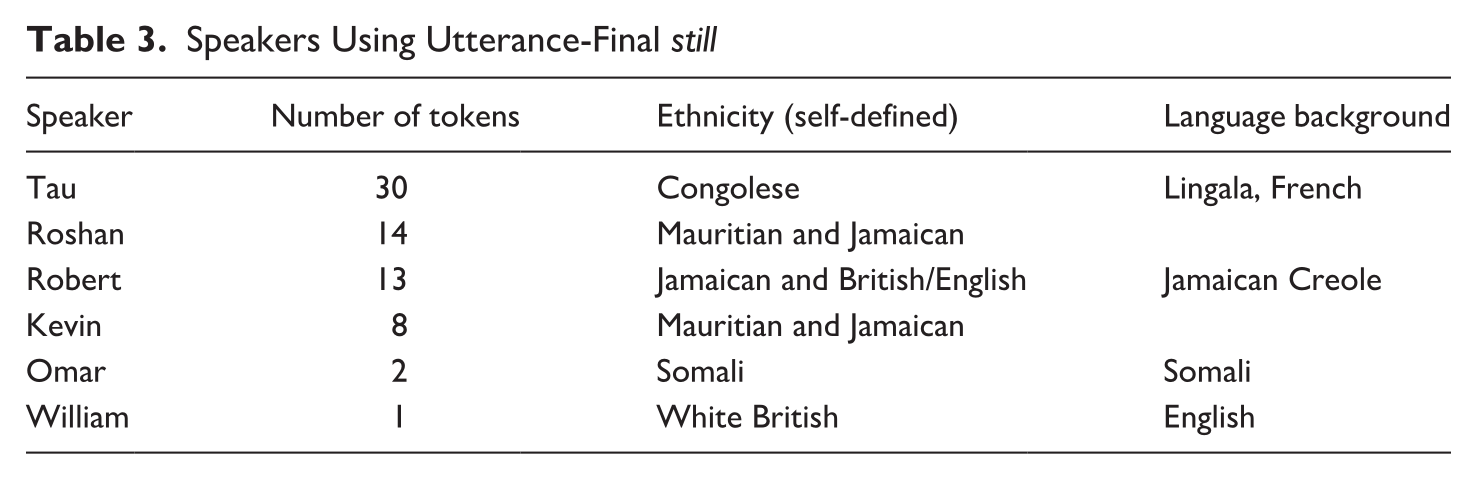
Two points are worth mentioning. First, the two speakers who use the highest number of tokens of utterance-final still, Tau and Roshan, are not only amongst the six speakers who produce a great deal of informal spontaneous conversational speech but also amongst those who contribute the highest overall number of words to the corpus. It is possible therefore that more speakers would have uttered utterance-final still if we had been able to record more speech from them. To set against this, however, there are other speakers who contribute more words (notably, two female speakers) but who do not produce utterance-final still; and Robert, who also uses a high number of tokens of utterance-final still, is amongst the speakers who contribute the lowest number of words to the corpus.
Secondly, and perhaps more relevantly, language contact may have played a part in the emergence of the utterance-final form. Still occurs as an utterance-final particle in Jamaican Creole (Peter Patrick, personal communication, November 23, 2021), and although the speaker who uses utterance-final still most frequently is Congolese (Tau), three of the six speakers who use the innovative form (Roshan, Robert, and Kevin) either speak Jamaican Creole themselves or, based on what was said during their recordings, are likely to be exposed to it via family members. It is possible therefore that utterance-final still is part of the rich mix of forms in the local feature pool and that it has been taken up by non-Creole speakers as a direct linguistic borrowing. Many of the non-Creole speakers who participated in both the Linguistic Innovators and the Multicultural London English corpora, in fact, use words of Jamaican Creole origin (e.g., ends, ‘neighborhood,’ and wagwan, ‘what’s going on’). The lack of research on discourse-pragmatic items in Jamaican Creole means that we cannot know whether MLE speakers use utterance-final still in the way that it is used in Jamaican Creole or whether, instead, they have taken up the form and subsequently used it in ways they find strategically important (as we describe in section 4.3).
We should note, too, that some Jamaican Creole vocabulary is now firmly established in contemporary British and international youth cultures through its use in hip-hop and dancehall music (Mair & Lacoste 2013:91; Gerfer 2017) and, of particular relevance here, in grime—a distinctly British genre that emerged in East London in the early 2000s. Mair (2013) claims that Jamaican Creole vocabulary is used by young people throughout the English-speaking world to signify ‘urban street credibility.’ Perhaps utterance-final still is part of this phenomenon, used to create a credible urban street persona for those speakers who use it, including, perhaps, some of the speakers in Table 3. 4
The most likely scenario in our view is that both language contact and internal factors have played a role in the emergence of utterance-final still. Some MLE speakers may use the form symbolically, along with other words and expressions from Jamaican Creole. Some may have taken it from the local feature pool, possibly adapting its pragmatic functions for their own purposes. For other speakers, its epistemic intersubjective sense may have emerged as a straightforward semantic change in the way we have described, with its utterance-final position influenced either by the Jamaican Creole use or by the wealth of other utterance-final particles used by MLE speakers (see section 5) and, indeed, in English more generally (Haselow 2012). The bridging contexts we described in section 3.2 strongly suggest that for at least some speakers utterance-final still developed as a (local) semantic change.
4.3. Interactional Contexts of Utterance-Final Still
Table 4 shows the number of tokens of utterance-final still that occurred in the different interactional moves. We do not attach any importance to the numbers, since the interactional moves were dependent on unpredictable aspects of the ways the interviews developed, especially the dynamics of the conversations that arose between friends. The Table simply reports our finding that utterance-final still occurs in all types of interactional moves. The examples that follow show how the form functions in these moves (in no particular order).
Distribution of Utterance-Final still by Text Type or Interactional Move

We have already seen an example of utterance-final still as part of a factual interaction, in (1). Factual utterances were almost all addressed to the fieldworker in reply to her direct questions. Other types of interaction in which utterance-final still occurs were more often directly addressed to the speaker’s friend or arose during general conversation between the friends and the fieldworker.
Example (11) illustrates the use of utterance-final still in a narrative. Tau was recounting a lengthy story to his friend and the fieldworker about an occasion when he had been arrested for something he had not done. In the section of the narrative we show here Tau relates how even his mother did not believe that he was innocent when she was summoned to the police station. In our data narrators sometimes use utterance-final still when reporting their own speech, as Tau does here (the first still in the extract), or the speech of another protagonist. The second still occurs in a stretch of narrative where he briefly sums up the point of his story (I’m guilty for something I didn’t do).
We assume that Tau’s first still, addressed in his story to his mother, acknowledges his mother’s belief that he was guilty. His second still, we assume, emphasizes his innocence to his addressees, perhaps accepting that, like his mother, they may not necessarily believe in his innocence.
In (12), utterance-final still occurs in an opinion, during a discussion between Kevin and the fieldworker.
Although several of the adolescents mentioned skipping classes at school when they were younger, Kevin’s obviously I went to school suggests that he is offended by the implication in the fieldworker’s question that he may have done so. He then explicitly refers to what he assumes the fieldworker believes about him (you think I’m naughty or something yeah?) and goes on to correct this assumption, using utterance-final still (I’m a good youth still). This is a clear example of the intersubjective meaning that still has developed; it draws attention to the contrast between what Kevin assumes to be the fieldworker’s view and the reality (or Kevin’s opinion of the reality) that Kevin is “a good youth.” It may also draw attention to the contrast Kevin goes on to draw between his good behavior at school and the difficulties of being good on the streets (it’s a mad thing on the roadside). As in (1), you get me is used to emphasize the shared understanding that Kevin wants to accomplish.
(13) is an example of utterance-final still in an explanation, in an interaction where Tau and Robert are discussing their forthcoming birthdays.
Tau is pleased to learn that Robert is younger than he is (nice one nice one) but then appears to realize that Robert may have misunderstood his reaction—perhaps as indicating Tau’s sense of superiority at being slightly older than Robert. He therefore goes on to give a reason for being pleased (most people are older than me), closing his explanation with still. His concern for Robert not to misunderstand his reaction is shown by his further explanation that he hates being the youngest member of his friendship group, accompanied by the address term man with its connotations of friendship and solidarity (Cheshire 2013). There is a sense of contrast, shown by the comparative older and superlative youngest as well as by still, but the main function of still is to announce a contribution to the interlocutors’ shared understanding (an epistemic sense) as well as to accomplish politeness in communication (a social sense) by demonstrating Tau’s recognition that his remark could have been unintentionally face-threatening.
The social meaning of utterance-final still is also clear in the descriptive text in (14), where Tau and Robert are discussing their abilities in martial arts.
Tau tells Robert that although he knows the right moves to beat any opponent, he isn’t going to tell Robert what they are. The shared laughter that follows shows that Tau’s contribution is interpreted in a positive light, despite the potentially face-threatening aspect of Tau’s refusal to tell his friend what the moves are.
Tau’s utterance-final still in (14) is immediately preceded by though. As many as twenty-seven (40 percent) of the utterance-final still tokens collocate with though (always in the order though still), a figure that is worth a comment. Speakers sometimes use two discourse markers rather than one to highlight new meanings, disambiguate the multiple meanings that discourse-pragmatic particles can have, and ensure that the addressee interprets a new form in the way the speaker intends (Aijmer 2002:2; Cheshire 2007:185). They have done so in the past for still; during the late sixteenth and early seventeenth centuries when still was developing concessive and contrastive meanings, it frequently co-occurred with a preceding yet, which had been contrastive since the thirteenth century (Lewis 2020:136). Although utterance-final though can have many discourse functions (Haselow 2012), a longstanding function is to soften an assertion, by mitigating disagreement or modifying the illocutionary force of an utterance (Pomerantz 1984:76-77; Haselow 2012:194). This can be especially important in interactions that have the potential to be confrontational, such as (14). Though still, then, draws attention to the contrast between what Robert might expect (that Tau will tell him what the moves are—indicated by Robert’s trust) and what will in fact happen (Robert will not be told). The weight of using two particles rather than one, we suggest, highlights the discourse-pragmatic item and thereby reinforces both the contrast and the mitigation: in other words, both the epistemic and the social aspects of intersubjectivity (Traugott 2012:9).
A slightly different outcome is shown in (15), where still is part of an opinion. Here William, Robert, and Drew are discussing their preferred musicians in a lively conversation where there is a great deal of overlapping speech. Robert’s first nomination of Chris Brown is ignored; his second attempt, this time with though still, is accepted by William. In this second interactional move Robert’s utterance-final still acknowledges his friends’ opinions about who are the best musicians, while insisting on and emphasizing his own, different opinion. We suggest that the ‘double whammy’ of two utterance-final particles in the collocation though still strengthens the illocutionary force of Robert’s contribution, with the result that his opinion is no longer ignored.
The interactional moves we have illustrated all show how speakers use utterance-final still with an intersubjective meaning that expresses their acknowledgment of their interlocutors’ beliefs, opinions, or feelings and thereby helps to construct a discourse that is harmonious. In the next section we consider why still has developed these functions almost exclusively in the speech of sixteen to nineteen year old young men in the inner city areas where we carried out our research.
5. Discussion
At the time of our research, the inner city locations where our participants lived were amongst the poorest boroughs in London. In the 2001 Census, Hackney, Islington, and Haringey were ranked first, fourth, and tenth, respectively, out of a total of 355 boroughs in England in terms of a range of indicators of social deprivation. As in many socially and materially deprived urban centers the young men we recorded spent much of their time ‘hanging out’ on the streets with their friends (Lawson 2013; Torgersen 2020), where they were necessarily involved in the local street culture. We acknowledge that street culture is varied, and often discussed with a disproportionate focus on gangs, crime, and violence (Ross 2020:4); nonetheless, it was clear from our recordings that violence, confrontation, and danger were a central part of the lives of the young men whose speech we recorded. Frequent topics of conversation included encounters with rival gangs, the dangers of leaving their immediate neighborhood, gun crime, and knife crime. Some were involved in low level criminal activities, including drug running for older men in their locality. Many either were or had been members of territorial gangs that were localized to the immediate neighborhood or even to the housing estate where they lived. Even those speakers who were not members of a gang were likely to be attacked if they left their immediate neighborhood and encountered young men on the street who did not know them. Many of the narratives told by the sixteen to nineteen year old young men recounted their experiences of violent confrontations (see Pichler (2021) for a comparative analysis of the narratives produced by young men and women in the Linguistic Innovators corpus). We will suggest below that the emergence of new meanings of still amongst sixteen to nineteen young men can be explained by considering the nature of the street culture that shaped their everyday experiences. Young women do not live on the streets to the same extent nor in the same way as the young men. Pichler (2021) found that many of the young women’s narratives were about interpersonal or romantic relationships, unlike those of the young men. If young women did discuss the violence of the streets it was more often in terms of their having witnessed a crime or an attack rather than of having experienced and taken part in the violence themselves.
First, though, we note that by using still in utterance-final position, MLE speakers are following a general tendency in present-day English. Several lexemes, particularly sentence adverbs, have recently developed new discourse-pragmatic functions and moved to final position (Lenker 2010:213). Haselow (2012) points out that in this position they serve an important function in the unplanned production of speech, since they are a last opportunity for speakers to comment on what they have just said. They can be added to what speakers have just uttered to influence how it will be interpreted by their interlocutor, or to modify an utterance that, once spoken, they realize could become problematic (Haselow 2012:203). Discourse-pragmatic items such as these are usually multi-functional, but they often tend to have a core pragmatic function. We have argued that for utterance-final still, the core function is to explicitly acknowledge the perspectives of addressees when they contrast with those of the speaker, and that this is one way that speakers maintain a harmonious discourse.
English still is not the only utterance-final particle to have recently emerged among young MLE speakers with the function of maintaining harmonious relationships within the peer group. Another is you get me, seen in examples (1) and (12). The majority of you get me tokens (80 percent) in the combined data from Kerswill, Cheshire, Fox and Torgersen’s (2004-2007, 2007-2010) MLE projects (Linguistic Innovators and Multicultural London English) are utterance-final (Torgersen, Gabrielatos & Hoffmann 2017). Like still, you get me is used far more often by young men than by young women. The inclusion of both first and second person pronouns in you get me suggests a function of aligning the understandings of speakers and their interlocutors, which its use in (1) and (12) confirms.
Address terms are frequently utterance-final too, and they also construct solidarity between interlocutors. Kerswill’s (2013) keyword analysis comparing the speech of sixteen to nineteen-year-olds in inner city Hackney and the quieter, less violent outer city borough of Havering, revealed that young people in the two areas used different address terms. Bruv occurred about six times more often in Hackney than in Havering, with a frequency of 149.9 per million words in Hackney compared to just 24.5 per million words in Havering. Bred (from bredren), blad and the related terms blood and bled also occur in Hackney. These terms all imply ‘brother’ by referring to a blood relationship. In the Multicultural London English corpus these terms are rarely used by other age groups or by female speakers. For young men of the same age in Havering, the most frequent address term is mate, a form that is also used as a noun to refer to a friend, as in then I said I was gonna meet my mate at seven (Kerswill 2013). The precarious and confrontational street culture in inner city Hackney seems to require a more intimate term than mate, in order to explicitly construct a friend as a member of the same gang rather than as a rival. 5
Utterance-final still, then, is just one of a number of final particles used by young male speakers in inner city areas of London that construct solidarity and maintain harmonious relationships with addressees. We suggest that their emergence can be linked to the environment young men in the inner city must deal with in their everyday lives. A discussion of street culture is beyond the scope of this article but, clearly, navigating and surviving this fiercely competitive and confrontational world demands that its citizens simultaneously maintain self-respect and interpersonal harmony with members of their own friendship group. The function of utterance-final particles in the rapid production of speech makes them useful, if not essential communicative resources for this purpose. When seen from this perspective, still seems an indispensable addition to the forms that can be tagged to an utterance by male adolescents in inner city London.
6. Conclusion
There is nothing linguistically remarkable about the semantic change we have analyzed in this paper. We assume that the well-attested pathways of change along which the new meanings of still have developed are related to general human cognitive processes of invited inferencing, as described by Traugott and Dasher (2002). Speakers invite their addressees to draw on inferences (conscious or unconscious) that are salient in the community, in the sense that they are available and recurrent (Traugott 2012). For utterance-final still, the available inferences arise from the meanings of contrast and counterexpectation that have been part of the semantics of the lexeme still since at least the eighteenth century; these are available both in the local community and in the wider English language. We have argued that the emergence of still in final position reflects the crucial role of utterance-final particles in the online production of speech, and may also be influenced by the availability of utterance-final still in Jamaican Creole.
Since the change is unremarkable, it could have occurred at any time, with any group of speakers—and may well occur amongst other groups of English speakers in the future. One obvious reason for its emergence now, in inner city London, is the recent large-scale population movement that has brought speakers of a wide range of languages and dialects to specific areas of the city. Population movement has long been assumed to be a relevant factor in the actuation of language change (Herold 1997; Labov 2001:504). In London this has resulted in the process of unguided group second language acquisition of English we described in section 1, which fosters a relatively low influence of prescriptive norms and a high tolerance of variation. It can therefore speed up changes that may well have happened anyway. MLE is replete with linguistic innovations, as we mentioned in section 1. Other external factors that account for the emergence of the innovative features of MLE are discussed by Cheshire (2020).
The innovation we have discussed here, though, allows us to go further, and consider why a language change emerges within one specific group of speakers rather than another—in this case, amongst young sixteen to nineteen year old men in inner city areas—and to consider the relevant discourse contexts in which changes may emerge.
Utterance-final still is not restricted to any one text type, as we have seen. It emerges in interactions where politeness considerations are especially important, such as when speakers realize that what they have just said could be face-threatening or when they are disagreeing with their interlocutor. We have shown that in interactions of this kind speakers recruit and enrich existing meanings and pragmatic functions of the lexeme still to ensure that their interactions are harmonious and non-confrontational. We suggested above that the aggressive and confrontational nature of the local street culture means that doing so is especially important for young male speakers during interactions with members of their own peer group, with whom it is essential to maintain a harmonious relationship, but the new uses of still occur with other interlocutors too: we saw, for example, that they also occur in discussions with the fieldworker.
The change we have analyzed, then, is internally motivated, but in order to understand what has prompted its emergence at this time and amongst this group of speakers we needed, as for any new language change, to also take account of external factors—in this case, the local environment and culture, as well as population movement. In addition, we needed to consider the interactional contexts in which the new meanings emerged and how these relate to the communicative needs of the groups of speakers living within the local culture. These will vary, of course, from one community to another and from one group of speakers to another, but they are likely to be equally important for understanding the emergence of new language changes elsewhere.
Footnotes
Declaration of Conflicting Interests
The author(s) declared no potential conflicts of interest with respect to the research, authorship, and/or publication of this article.
Funding
The author(s) disclosed receipt of the following financial support for the research, authorship, and/or publication of this article: The research described in this article was financed by the UK Economic and Social Research Council, as follows: Kerswill, Paul, Jenny Cheshire, Sue Fox & Eivind Torgersen (2004-2007). ESRC Research Project, RES -000-23-0680. Kerswill, Paul, Jenny Cheshire, Sue Fox & Eivind Torgersen (2007-2010). ESRC Research Project, RES 062-23-0814.
