




Abstract
In the framework of postcolonial Englishes and their evolutions, Hong Kong English represents an extraordinary case in that the political independence of Hong Kong from the British in 1997 did not result—as in most other cases—in a self-governing political body, but a formal re-integration of Hong Kong into China. As the handover of Hong Kong also marks a drastic linguistic re-orientation, this short-term diachronic paper studies newspaper data from before and after the 1997 handover. With a view to the structural object of investigation, particle placement, the exploration of relevant predictors and their effects in Hong Kong English sheds light on whether and, if so, how the end of British colonial rule has left linguistic traces in particle-placement choices. Using a sample of 322 particle verbs extracted from the South China Morning Post Corpus (SCMPC) and employing random forests, the study reports that pre- and post-handover constructional choices of particle placement are largely compatible with one another. Said choices are mainly guided by principles related to cognition and eurhythmy that—at least in the period observed—appear unlikely to be affected fundamentally by language-external political change.
Keywords
1. Introduction
Greenbaum’s (1996:11) bon mot “[p]olitical independence is a precursor of linguistic independence” underlines the disruptive nature of a nation’s liberation from a foreign oppressor in terms of the linguistic developments this political process can unleash. The case of Hong Kong is extraordinary in this regard since its independence from the British in 1997 coincides with its handover to China since that year marked the end of the British leases of Chinese territories in Hong Kong. As a Special Administrative Region (SAR) of the People’s Republic of China, Hong Kong can thus not be considered a self-governing political body, but sociocultural adjustments and particularly changes in language policy in the wake of the handover can nevertheless be assumed to leave their marks on local linguistic developments in Hong Kong.
In the world Englishes paradigm, influential models of varietal development such as Moag (1982, 1992) or Schneider (2003, 2007) have profiled political independences from British colonizers as sociolinguistically deterministic or at least decisive with a view to the future development of regional varieties of English. Still, said models do not project the same post-independence developmental trajectory since Moag (1982:282-283) anticipates a phase of restriction involving the “displacement of English by a local official language,” making “English [. . .] revert to the status of a foreign language.” In contrast, Schneider (2003, 2007) regards the political independence of a former British colony as a prerequisite for the evolutionary progress of a postcolonial English, manifesting itself in the emergence of endonormatively stabilized structural preferences and the subsequent diversification of the postcolonial English concerned into regionalized sociolects and dialects. Although both models overtly consider former colonial territories’ independences salient catalysts for local future linguistic developments, the question is whether and how the distinct evolutionary trajectories Moag (1982, 1992) and Schneider (2003, 2007) profile can be tested empirically. It appears reasonable to consider Moag’s (1982, 1992) developmental end point—restriction entailing varietal reversion to EFL status—a phase where the local variety of English will use and appreciate local structures less in exchange for an exonormative structural orientation toward historically and contemporarily maximally influential varieties such as American or British English. Empirically, one would thus expect localized features to become less frequent and prominent after independence. In contrast, an increase in structural localization after independence would be more in line with Schneider’s (2003, 2007) prediction that varieties will diversify socially and regionally in the post-independence era and, consequently, further deviate from exonormative standards provided by for example, American or British English.
What makes the endeavor of empirically investigating the applicability of Moag’s (1982, 1992) and Schneider’s (2003, 2007) models delicate is (a) the general lack of large-scale corpus data for world Englishes and (b) the fact that many independence movements are temporarily notably removed from the present day, making it all the more difficult to collect a critical number of texts for corpus-linguistic study. Yet, given that Hong Kong’s independence from the British dates back to 1997 and is thus relatively recent and corpus data before and after the handover of Hong Kong from the British to China are available, an examination of how structural choices may have been affected by the independence from the British seems more than timely.
In this light, the present study seeks to investigate the short-term diachronic development of Hong Kong English (HKE) writers’ choices with regard to the alternation phenomenon particle placement, that is, the distinction between the verb-particle-object (vpo) construction, as in (1), and the verb-object-particle (vop) construction, as in (2), in newspaper data from before and after the handover. Structural phenomena such as particle placement are ideal to investigate the development of underlying norms in postcolonial Englishes in that they are located at the lexis-grammar interface, which is considered the optimal structural yardstick to observe whether and how variety-specific norms emerge in postcolonial Englishes (Schneider 2007:46).
(1) And he’s going to give up lunch in 1993. (SCMPC_1993-01-01_90)
(2) If we don’t work problems out with other ethnic groups (SCMPC_1993-04-15_79)
In our short-term diachronic corpus environment, we set out to explore these research questions:
Which factors influence HKE writers in making their particle-placement choices and how do these factors influence particle placement?
To what extent are these factors and their influences on particle placement short-term diachronically variable in HKE, potentially representing structural effects rooted in the political independence of Hong Kong from the British in 1997?
The paper is structured as follows. In section 2, earlier findings on HKE and particle placement are presented, section 3 outlines data and methods, results are presented in section 4 and discussed in the concluding section 5.
2. Theoretical Background
In section 2.1, a brief overview of the history and variety-specific structures of HKE is provided. Predictors for and their effects on particle placement are summarized in section 2.2.
2.1. Hong Kong English: A Synopsis
Although the roots of English in Hong Kong can be traced back to trade activities in the early seventeenth century, Hong Kong only became a British colony in the early 1840s during the First Opium War. In the following century, English “began to spread, notably through the various mission schools that were established in Hong Kong” (Bolton 2000:267). Despite this spread of bilingualism in Hong Kong, “education in English was only accessible to a small segment of the indigenous population” (Schneider 2007:135). The second half of the twentieth century was marked by both the “expansion of English medium secondary education” (Evans 2009:281) and a language campaign “which pressed for greater recognition of Chinese” (Bolton 2000:268). With these opposing forces at work, Hong Kong was handed over to China in 1997, administratively becoming the Hong Kong Special Administrative Region of the People’s Republic of China. At this point, 38.1 percent of the population claimed at least some knowledge of English (Bolton 2000:269) and despite the high status of Cantonese—as it was promoted by the Chinese government (e.g., Bolton, Bacon-Shone & Kang Kwong 2020:462)—English continued “to maintain its role as a language of government at the level of written documentation” (Bolton, Bacon-Shone & Kang Kwong 2020:459). In fact, English kept its prestige among the population of Hong Kong and in 2001, 43 percent of the population aged five and over claimed they used English as their usual or another language (Hong Kong Census and Statistics Department 2002:39).
Alongside research on its phonology (e.g., Hung 2000, 2012; Lam 2017) and lexis (e.g., Hung 2012; Evans 2015), HKE has also been subject to syntactic investigations covering variable subject-verb agreement (e.g., “She like to go there” (Gisborne 2009:159; Calle-Martín & Romero-Barranco 2017)), tense marking (e.g., “[He] has just uh get get back [. . .]” (Seoane & Suárez-Gómez 2013:13)), the use of pseudo-passives (e.g., “And it can find in carrots.” (Hung 2012:128)) and is it as a universal tag question (e.g., “We have an interesting situation here, is it?” (Wong 2007:53)). More recent studies have employed multifactorial analyses to study syntactic alternations in HKE. Heller (2018) found that the choices of genitive constructions by HKE speakers differ from those made by British English (BrE) speakers. In two studies on the dative alternation, Deshors (2014) and Gries and Deshors (2015) found that “prepositional dative constructions serve as default constructions” (Deshors 2014:300) in both learner and second-language varieties in more complex contexts which include new recipients, passive voice, and longer constituents.
2.2. Particle Placement: Predictors and Their Structural Effects
Previous research on particle placement has shown that the choice between the two constructions concerned highly depends on the accessibility of the direct object. More accessible constituents, that is, constituents that are shorter or contain given information, tend to precede less accessible constituents (e.g., Behaghel 1909; Gries 2003; MacDonald 2013). With regard to the particle placement alternation, this translates into vpo constructions becoming more frequent as the accessibility of the direct object decreases. Several variables measure the degree of accessibility, including the complexity, concreteness, definiteness, length, and idiomaticity of the direct object, as well as the surprisal of the particle given the verb of the particle construction. Research has shown that indefinite (3) and abstract (4) direct objects, as well as literal (as opposed to idiomatic) constructions (5) favor the vop construction (e.g., Gries 2003; Wulff & Gries 2019) because they are usually considered “less newsworthy” (Grafmiller & Szmrecsanyi 2018:390).
(3) They can work things out easily. (SCMPC_1993-08-09_175)
(4) they would prevent him getting his old job back. (SCMPC_2002-04-30_54)
(5) Mr Kingsley tried to take the pistol out but it apparently got stuck (SCMPC_1993-01-13_187)
Furthermore, the choice of constructions generally follows the principle of end-weight (Behaghel 1909) with longer objects (6) favoring the vpo construction (e.g., Gries 2003; Grafmiller & Szmrecsanyi 2018; Wulff & Gries 2019), while simpler objects such as pronouns (7) more frequently occur in the vop construction (Gries 2003)—not least because pronouns are usually shorter than modified noun phrases, highlighting that the complexity of a direct object tends to correlate with its length. Lastly, Grafmiller and Szmrecsanyi (2018) found a high surprisal value of the particle given the verb of the particle construction to correlate with a frequent use of the vop construction since particles with higher surprisal values hold more information content and thus follow the direct object.
(6) staff hadn’t the heart to bring out their usual mixture of news, lifestyle, people and pop music (SCMPC_1993-01-16_170)
(7) despite strong Government reservations about who would carry them out. (SCMPC_1993-01-31_3)
In addition to factors that measure the accessibility of the direct object or the particle, segment alternation as well as rhythm alternation have shown to influence the choice of particle-verb construction (Grafmiller & Szmrecsanyi 2018; Wulff & Gries 2019). Speakers tend to alternate between both consonants and vowels as well as stressed and unstressed syllables and avoid consonant and stress clashes. Finally, the presence of a directional prepositional phrase that directly postmodifies the particle-verb construction (8) was found to favor the vop construction (Fraser 1976; Gries 2003; Grafmiller & Szmrecsanyi 2018). However, Gries (2003) argues that this is not the case if the preposition of the directional prepositional phrase equals the particle of the particle verb.
(8) who can trace their male lineage back to that village (SCMPC_2002-06-05_73)
Regarding particle placement—the object of investigation of the present study—in HKE, Grafmiller and Szmrecsanyi (2018) report that several predictors significantly influence the choice between the vop and vpo constructions. They observe that, in HKE, the length of the direct object exerts the strongest influence on this choice followed by the effect of persistence and surprisal of the particle. 1 The longer the direct object, the higher the probability that a HKE speaker will choose the vpo construction. However, the higher the surprisal of the particle given the verb of the particle verb, the higher the probability that the speaker will choose the vop construction. The probability for vops also rises if the previous particle verb was a vop construction as well as if a directional prepositional phrase follows the particle verb.
3. Methodology
The corpus data and methods of data extraction and selection are outlined in section 3.1. In section 3.2, the predictors used for data annotation are described and exemplified and summary statistics are provided before section 3.3 presents the statistical modeling techniques.
3.1. Corpus Data and Data Extraction and Selection
The empirical basis to observe the short-term diachronic development of particle placement in HKE before and after the handover stems from the South China Morning Post (SCMP), Hong Kong’s most widely circulated—and consequently probably most influential—English-medium newspaper selling an average of more than 100,000 copies per day. The SCMP texts, which were made available digitally through the newspaper upon request, are taken from 1993 (approximately 24.7m words) and 2002 (approximately 4.8m words) respectively given the years’ temporal equidistance to the handover on July 1, 1997. To ensure that the analysis represents HKE, news agency reports were removed from the dataset. While the period of roughly ten years to observe potential lexicogrammatical change is comparatively short, (a) earlier studies such as Mair (2006) or Leech, Hundt, Mair, and Smith (2009) indicate that narrow time spans can be useful in observing grammatical change and (b) a sensitive statistical set-up to detect relatively nuanced structural developments is employed. Still, one might wish for temporally parallel spoken data to establish whether speech shows exactly the same trends observed in the newspaper data, which, however, serve important standardizing functions in (still) largely uncodified varieties like Hong Kong English.
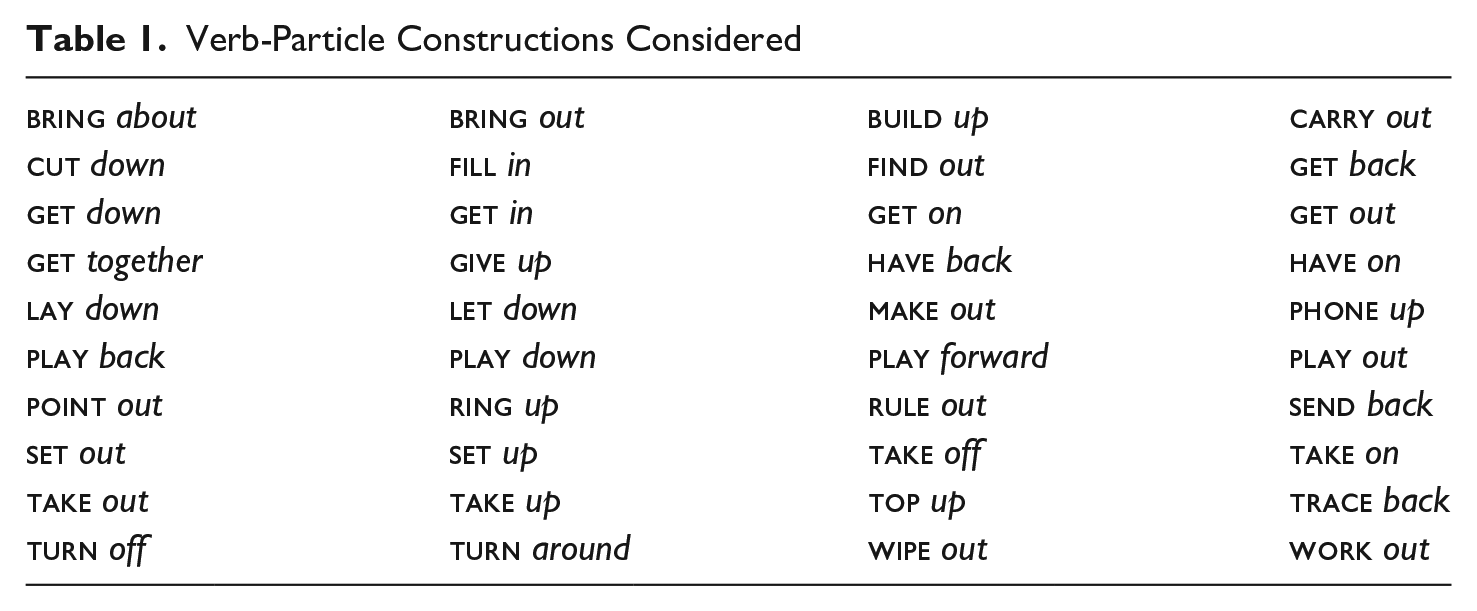
For the extraction of particle-placement constructions from the SCMP corpus, the forty verb-particle combinations were used that Gries and Stefanowitsch (2004:112) attested in the British component of the International Corpus of English in the context of their methodological exploration of the distinctive collexeme analysis (see Table 1). We collected (inflected forms of) the verbs and looked for the corresponding particle to the right of the verb, allowing a maximum of five words to occur between the verb and the particle (Gries 2003:76). We aimed at a balanced dataset that would feature equal amounts of the alternants and of examples from the pre- and post-handover period. Consequently, we did not preserve the natural distribution of vop and vpos within said time frames. Examples involving (a) passives, (b) phrasal-prepositional verbs, (c) verbs and particles spread across clause boundaries, or (d) direct objects in the form of clauses or relative pronouns were discarded to retain only instances of choice contexts for the particle-placement alternation. Given that vops were notably less frequent than vpos in the corpus environment, we kept all the alternating examples of vops, but sampled from the alternating vpos under consideration of the distribution of the verb-particle combinations evident from the vops.
Verb-Particle Constructions Considered
3.2. Data Annotation with Summary Statistics
In line with earlier research on particle placement (e.g., Grafmiller & Szmrecsanyi 2018; Wulff & Gries 2019), each of the 322 examples retained for analysis was annotated with regard to the following predictors:
(9) the time has come to give it up (SCMPC_1993-01-22_174) (10) If we don’t work problems out with other ethnic groups (SCMPC_1993-04-15_79) (11) How I gave up my glitzy job in television to have the time of my life (SCMPC_1993-01-09_169)
(12) we are working on getting our team together (SCMPC_2002-04-26_41) (13) British producers have let people down (SCMPC_1993-02-01_67)
(14) it wishes to bring about significant change (SCMPC_1993-01-07_200) (15) if he wanted to get back the jewellery he should go to Macau (SCMPC_1993-01-04_81)
(16) It may spur a new generation to take up stamp collecting (SCMPC_1993-01-02_110) (17) Zhang will carry out research on the history of media reform (SCMPC_1993-02-11_166)
(18) he would persuade drug addicts to give up the habit first (SCMPC_1993-01-08_119) (19) Parliament voted to send the bill back to committee for a final vote (SCMPC_1993-01-01_130)
The predictors
3.3. Statistical Modeling
To model the short-term diachronic development of particle placement in HKE, we considered mixed-effects regression modeling as well as random forests. Yet, regression modeling operates under distributional assumptions which are not always met by corpus-linguistic data often involving many data points for certain combinations of predictors, but few or none for others, multicollinearity of predictors, and other issues that do not allow modeling data via regressions. Given that we faced convergence issues when attempting to model the particle-placement data at hand with regressions, we opted for random forests as the statistical modeling technique—also because it has already been applied successfully to various datasets from different world Englishes. The switch from regressions to random forests has consequences on how particle placement is modeled. While mixed-effects regression models can explicitly separate fixed from random effects, random forests account for random effects by constructing individual trees on the basis of only a selection of observed examples and predictors, thus avoiding overrepresentation of certain writers in the construction of the random forest. Regression models may also entail a tendency to overfit, that is, include too many explanatory variables to model training data well, although not all of the explanatory variables should be included when modeling datasets other than the training data. Random forests with cross-validation built into the algorithm are less likely to overfit and can be constructed relatively fast while still achieving classification accuracies comparable to those of regressions (Heller 2018:90). 4
Although random forests are geared toward accounting for interactions between predictors, they do not necessarily make it convenient to observe them through the typical random forest outputs, that is, variable importance and partial dependence plots. When only single-term predictors are included in the random forest formula, it is impossible to distinguish whether the predictors concerned act as what in regression terminology would be a main effect, an effect that remains unaltered in the light of the configurations of the other factors modeled, or an interaction effect, an effect that changes as the other factors modeled change. For this reason, we follow Gries (2020) in that we—as also alluded to in Strobl, Malley, and Tutz (2009:341)—enhance the random forest through the addition of interaction predictors created from the single-term predictors.
The creation of binary interaction predictors does not pose a challenge for the combination of two categorical variables such as
In order to receive an optimal random forest, its hyperparameters for number of trees and variables for splitting considered were set in a way that they produce the smallest out-of-bag error possible. The final random forest has a C-score of 0.9552 and a classification accuracy of 90.37 percent, which is statistically highly significantly better (p < .001) than a baseline model predicting the most frequent constructional choice. Given that vop and vpo have been sampled to be equally frequent in the dataset analyzed, this baseline accuracy is 50 percent.
Although 322 observations in total might appear a small number of examples for multifactorial modeling, the fact that random forests bootstrap these observations to create random subsets of examples for the construction of individual trees in the forest makes the statistical effects observed robust. Paired with the reported classification accuracy and C-score, there is ample evidence that the random forest created provides reliable insights into how HKE writers make particle-placement choices.
4. Results
In this section, the results from the random-forest analysis show what constraints operate in terms of particle placement with the HKE writers. Before the multifactorial results are presented, Table 2 offers descriptive statistics for the constructional choices in the light of the predictor levels annotated to get a first impression of the results.
Descriptive Statistics for vop and vpo According to Predictors Studied
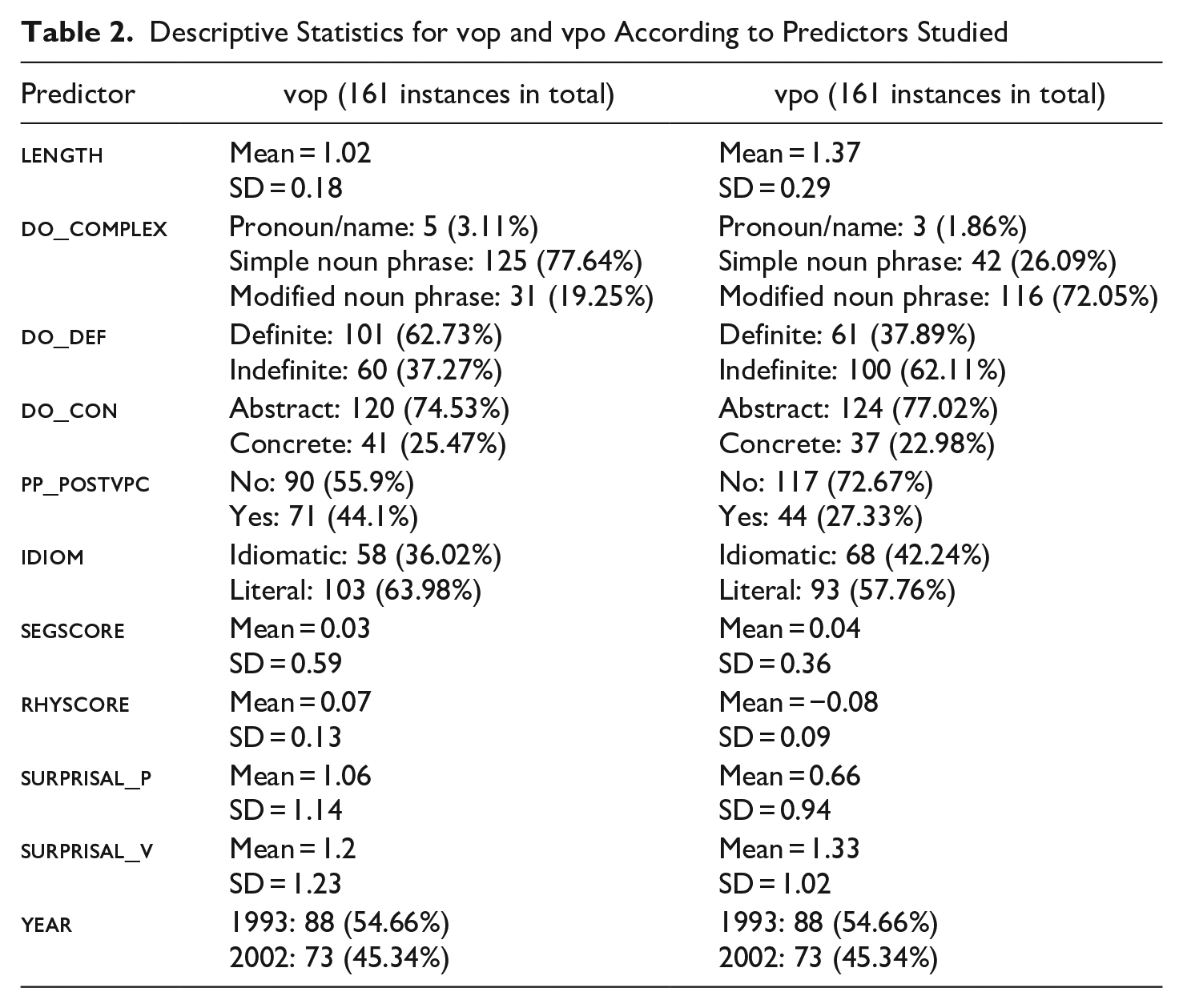
In line with the principle of end-weight (Behaghel 1909), vpos feature on average longer direct objects (1.37) than vops (1.02). This increased length of direct objects in vpos compared to vops finds reflection in that vpos most often feature modified noun phrases as direct objects (72.05 percent) whereas simple noun phrases (77.64 percent) constitute the majority of direct objects with vops. With vops, most direct objects are definite (62.73 percent) while the largest parts of direct objects in vpos are indefinite (62.11 percent). In terms of concreteness of the direct object and postmodification through a prepositional phrase, vops and vpos share similar preferences toward abstract direct objects and non-postmodification through a prepositional phrase, but these preferences are more pronounced with vpos than with vops. As regards idiomaticity, the majority of the vop (63.98 percent) and vpo constructions (57.76 percent) are non-idiomatic. The constructions observed generally meet principles of segment and rhythm alternation better than their alternative unobserved constructions to the exception of rhythmic principles with vpos. Surprisal values for particles are higher with vops than with vpos while the reverse is true for surprisal values for verbs.
The results of the random forest modeling the constructional choice between a vop and a vpo are provided via a variable importance plot and partial dependence plots. Variable importance plots show the relative importance of predictors for the dependent variable. A standard measure to report variable importance in a random forest is mean decrease in Gini, indicating how much the model quality would suffer in case the predictor concerned was left out of the random-forest model (Bernaisch 2022). The variable importance plot for the alternation between vop and vpo for HKE newspaper authors is provided in Figure 1 and visualizes the importance of the thirty most important (interaction) predictors.
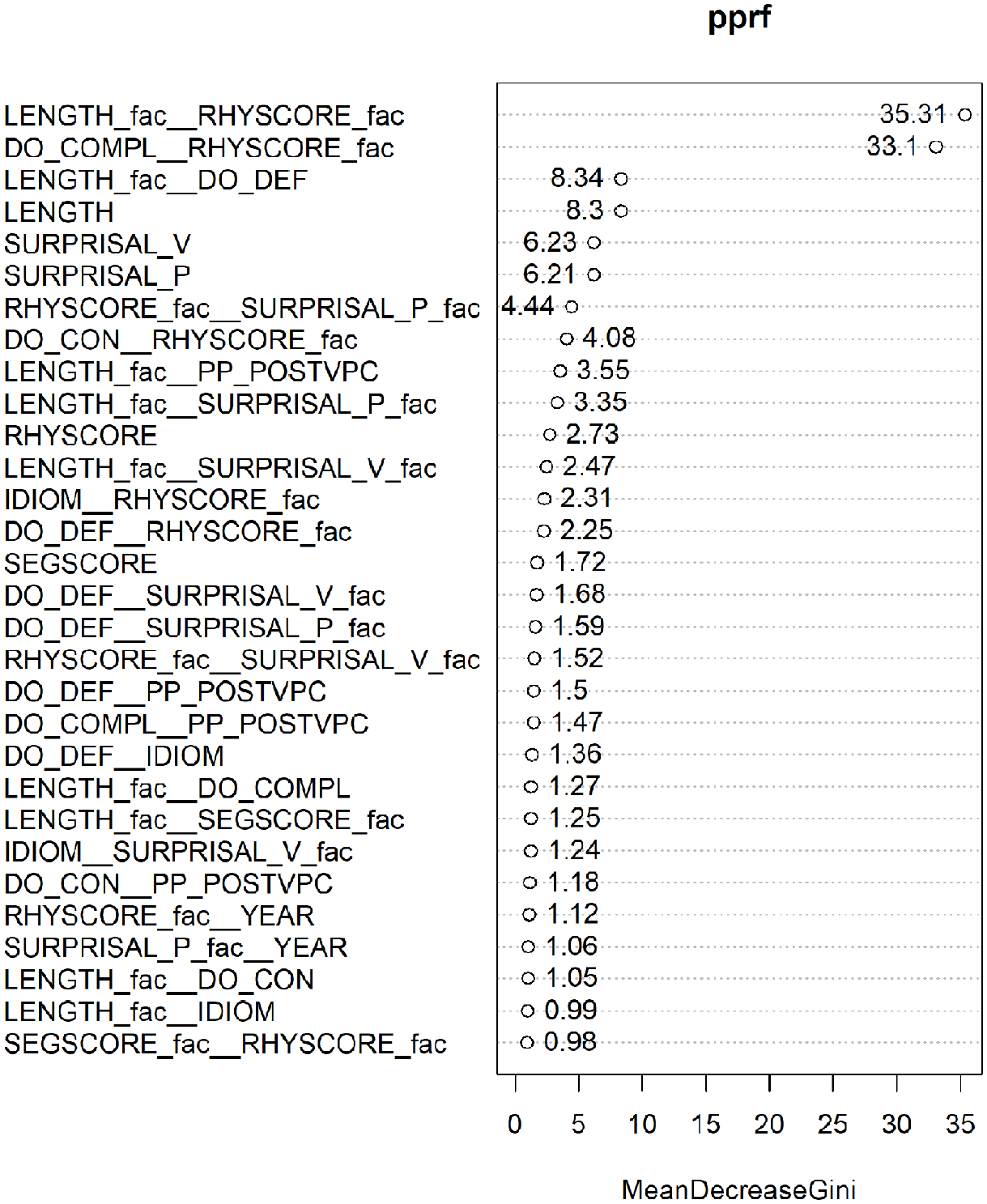
Variable Importance Plot for Particle Placement in HKE
With a notably higher variable importance than the remaining predictors, the interaction predictors
To illustrate salient mechanisms of particle-placement choices in HKE, the effects of the predictors
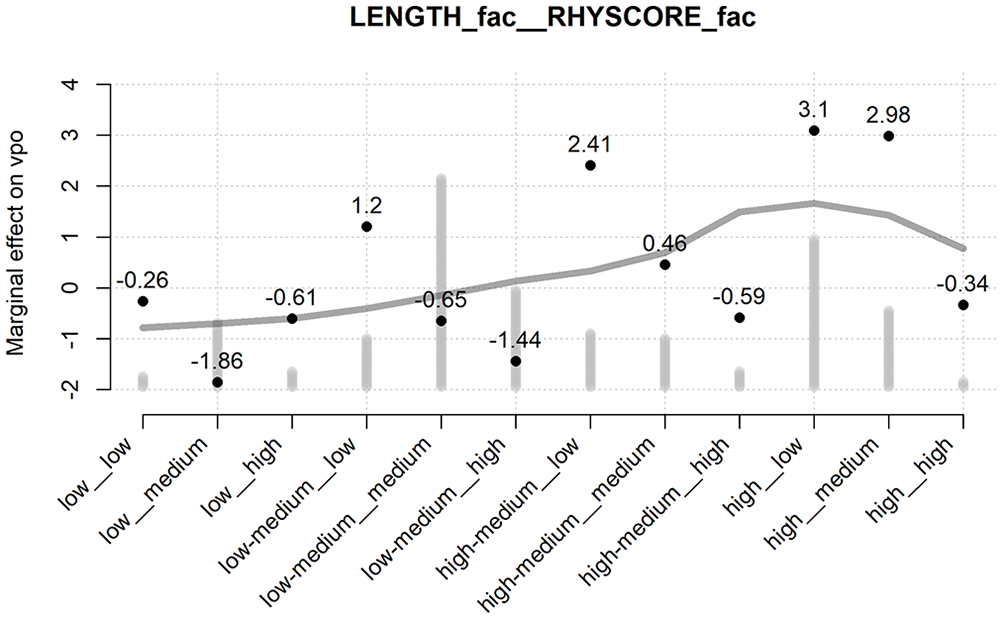
Partial Dependence Plot for
The levels of
(20) When it happens, getting the family together is an enjoyable occasion. (SCMPC_1993-01-14_89)
(21) At the weekend, British newspapers reported that Princess Diana was willing to give up custody of her two sons for a quick divorce. (SCMPC_1993-01-12_184)
Still, what cannot be ignored is how
In line with this observation, it has been argued that eurhythmy of syllable stress is not of equal importance for different syntactic alternations in that alternations involving noun and verb phrases (e.g., the dative alternation) with several potentially larger syntactic units are more sensitive toward word-level rhythmic characteristics than syllable-level rhythmic constraints, which appear more relevant for example, the genitive alternation operating within a noun phrase and generally smaller syntactic units (Shih 2017). As particle placement does not order units of similar structural complexity as does the dative alternation, syllable-related eurhythmy might be more relevant than word-level rhythmic constraints. Still, for particle placement choices by HKE writers, syllable-related eurhythmy appears secondary when the default surface structure, vpo, is produced, but apparently becomes more important when the less frequent and consequently more marked vop realization is used since speakers and interlocutors may pay more attention to the eurhythmy of the marked than to that of the default variant. The partial dependence plot for
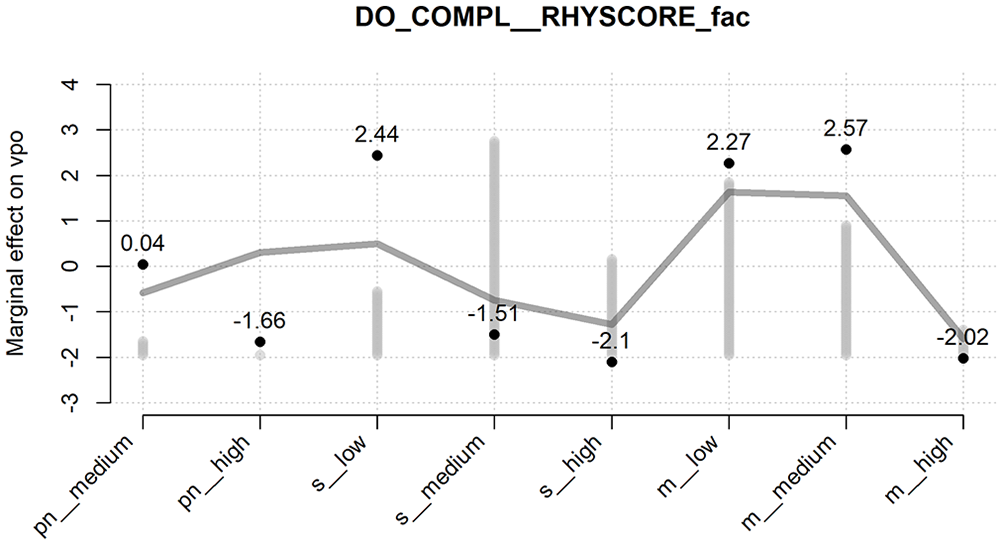
Partial Dependence Plot for
The levels on the x-axis are organized according to
(22) We need to understand the crux of the problem and how serious it is before we can work out effective measures. (SCMPC_1993-01-18_82)
(23) I do try to convince everyone to give up chocolate forever. (SCMPC_1993-01-31_147)
The partial dependence plot for
(24) to press officials to persuade Pyongyang to give up its nuclear programme. (SCMPC_2002-10-19_49)
(25) With the election already a write-off, the left now has to work out how it can turn the situation round before legislative elections (SCMPC_2002-04-23_59)
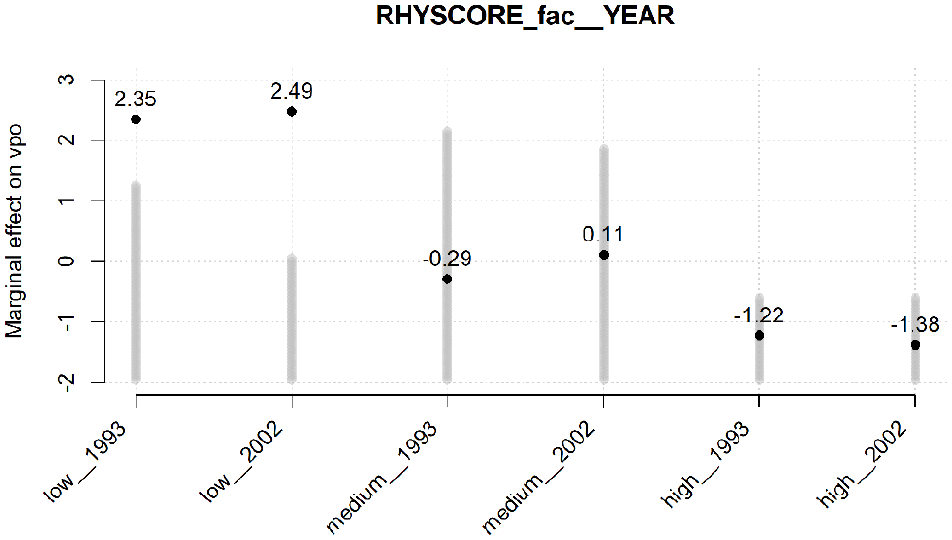
Partial Dependence Plot for
For the interaction predictor
(26) the officials seem reluctant to give up control over their numbers (SCMPC_2002-10-15_75)
(27) increased fuel prices by up to 27 per cent just over a week ago, taking electricity tariffs up by an average 13 per cent (SCMPC_1993-01-19-66)
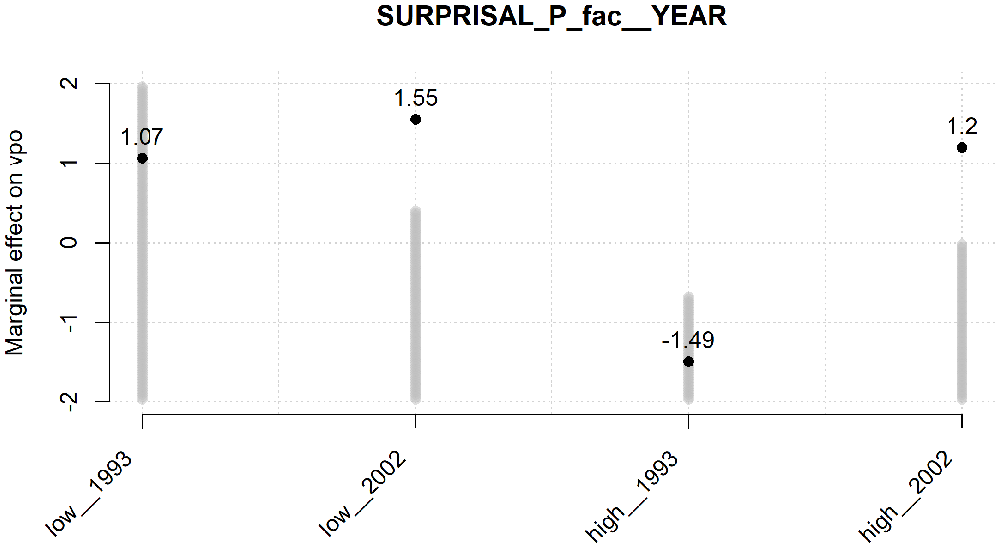
Partial Dependence Plot for
5. Discussion
The insights gained on the choice between a vop and a vpo in HKE are certainly compatible with results reported in earlier research on particle placement in HKE. Grafmiller and Szmrecsanyi (2018) employ data from the International Corpus of English (ICE; Greenbaum 1996; Greenbaum & Nelson 1996) and the Corpus of Web-Based English (GloWbE; Davies & Fuchs 2015) to study particle placement synchronically in a total of nine varieties including HKE. Although their data is on average more recent and also stylistically more varied in the light of the genre diversity in ICE than the material at hand, their variable importance measures profile the length of the direct object as the most important predictor for particle-placement choices in HKE (Grafmiller & Szmrecsanyi 2018:397). To provide an answer to the first research question concerning which factors influence HKE writers’ particle placement choices in what ways, the present study opted for the operationalization of
Still, particle placement in the HKE newspaper data is also sensitive to
Grafmiller and Szmrecsanyi (2018:404) employ measures of similarities and differences across the nine variety-specific models to unveil how close or distant the individual varieties are from one another and conclude that “native varieties [are] so similar to each other, while the Outer Circle varieties are so dissimilar, both to the native varieties and to one another.” With regard to particle placement, there can thus be no doubt that HKE—along with the set of other Englishes—has established variety-specific quantitative preferences, although certain predictors such as those operationalizing length or surprisal behave comparatively uniformly across the nine varieties. Against this background they argue that the relative stability of the grammar(s) of world Englishes rests in general principles of language processing: the cumulative effect of universal biases in language processing gives rise to the typological patterns we observe across languages and phenomena. Since all language users are sensitive to these biases, we expect similar general tendencies to predominate as structures that satisfy users’ biases become more frequent. At the same time, the periodic emergence of novel (uses of) lexical items and or semantic/pragmatic functions will lead to fluctuations in the quantitative associations between specific variants and features of the linguistic context that users implicitly learn (Grafmiller & Szmrecsanyi 2018:406)
These widely applicable principles of language organization allowing certain degrees of variation alluded to here, but are instrumental in accounts of the synchronic grammatical homogeneity across various world Englishes. With a view to the second research question regarding the stability of factors for and their effects on particle placement, this paper shows that these principles are not only stable synchronically across a set of (postcolonial) Englishes as indicated by earlier research, but also short-term diachronically within HKE. As described in section 4, the short-term diachronic difference in the HKE data at hand, which has been captured through the predictor
Given this evidence and other research on syntactic alternation phenomena (e.g., Bernaisch, Gries & Mukherjee 2014; Deshors & Gries 2016; Heller, Bernaisch & Gries 2017; Röthlisberger, Grafmiller & Szmrecsanyi 2017), Grafmiller and Szmrecsanyi propose that the grammars of world Englishes are less variable than their respective lexical and phonetic/phonological systems. While empirically establishing the relative degree of variability on these structural levels across world Englishes certainly poses a challenge, two aspects might deserve attention in a discussion of this hypothesis: the common core of English (Quirk, Greenbaum, Leech & Svartvik 1985:16) and foci of methodological approaches.
Book-length dictionaries on Hong Kong (Cummings 2011), Indian (Nihalani, Tongue, Hosali & Crowther 2004; Carls 2017), or Sri Lankan English (Meyler 2007) may leave the impression that variety-specific lexical items and associated meanings abound. Still, in relation to what could be argued to be a standardized stock of more than 600,000 lexemes of English—some of which are admittedly sourced from world Englishes themselves—in the Oxford English Dictionary, the approximately 2500 variety-specific entries in Meyler’s (2007) Dictionary of Sri Lankan English may signal a rather limited scope for lexical variability in world Englishes. Although in their definition of the common core of English Quirk, Greenbaum, Leech, and Svartvik (1985) only explicitly mention grammatical characteristics, there is an allusion to the principle of common core being just as applicable to other structural levels of language organization.
[a]
If one conceptualizes the common core of English as an integrated and interacting system of common cores for individual structural levels, for example, phonetic/phonological, morphological, lexical, grammatical etc., then degrees of variability on these structural levels—although they evidently exist—are by communicative necessity limited not only to the grammatical level since speakers of world Englishes would want to be certain that they remain mutually intelligible around the world, which is also particularly pertinent to the sound level.
Furthermore, the methodology to capture grammatical variation in world Englishes may also—at least to a certain extent—be self-limiting. Also, this study falls into the category of alternation studies in world Englishes, where a well-researched alternation phenomenon (e.g., particle placement or dative, genitive, voice alternation etc.) for which important predictors are known and whose realizations are frequent enough to devise multifactorial statistical models is studied. In the light of pressures from the common core of English, the function of English as a lingua franca (Bernaisch 2015:209), and the universal principles of language production and processing already mentioned, only relatively limited varietal grammatical variation can be expected. Although the need for multifactorial statistical models is indisputable, it is just as indisputable that these can only capture parts of the variability associated with a particular grammatical phenomenon. In an unpublished corpus of Hong Kong students’ exam scripts from 1999 to 2001 featuring annotation for noteworthy linguistic structures, potentially localized/indigenized/nativized verb-particle combinations are also evident. Still, their potentially innovative nature as evident from examples (28) to (30) is challenging to adequately represent in a multifactorial setting for particle placement.
(28) Japan and Korea also grow up very fast. <00 marked exams 1 docx_SN = 00074_SC = 8>
(29) However, will it carry out some problems or troubles to the Form 7 graduates when they are working? <00 marked exams 1 docx_SN=00100_SC=8>
(30) some employers and educationalists in Hong Kong are setting off a debate to discuss whether Hong Kong students should follow. <00 marked exams 2 docx_SN=00317_SC=14>
In (28), the verb-particle combination GROW up is employed to refer to the development of countries, although the process of growing up is defined as “To advance to or towards maturity. Of persons, esp. in past participle” (Oxford English Dictionary 2022) and thus habitually employed with animate entities in the common core of English. The metaphorical extension of GROW up to describe developmental processes of inanimate entities could not be represented by the kind of alternation studies of particle placement conducted here since they always involve a direct object, which, however, is not constructionally licensed here and would fall out of the scope of a multifactorial particle-placement study. Yet, this innovative verb-particle use undoubtedly instantiates an example of grammatical variation, which, however, flies under the radar of the types of multifactorial approaches employed so far. Although the examples featuring CARRY out in (29) and SET off in (30) could—from a constructional perspective—be included in the multifactorial statistical set-up of the present study and its predecessors due to the occurrence of direct objects along with the particle verbs, the predictors routinely used are not necessarily geared toward capturing the semantics of localized meanings, that is, that of ‘causing sth.’ for HKE CARRY out and that of ‘starting sth.’ for HKE SET off.
Admittedly, under consideration of the common (grammatical) core of English, these semantically nativized variants are notably infrequent—particularly in relatively standardized formats such as newspaper texts while cross-varietally shared verb-particle constructions instantiating senses long established in English dominate. From a purely frequentist perspective, these localized (meanings of) particle verbs are thus only peripherally relevant for understanding underlying mechanisms in particle placement in HKE, but they—although quantitatively marginal—represent integral elements in the nativization of HKE. While probabilistic accounts of grammatical alternations profile important gradual variety-specific preferences, it seems conducive to not restrict academic perspectives and attention to what can be represented in (established) predictors for multifactorial analyses, but—to do justice to the individual Englishes described and to establish a fuller picture of grammatical variability in world Englishes—to also keep one’s eyes open for products of non-probabilistic indigenization.
The question to what extent the findings at hand can inform the empirical applicability of Moag’s (1982, 1992) and Schneider’s (2003, 2007) models to pre-and post-independence particle placement choices remains to be discussed. Although widely appreciated and frequently applied, Moag’s (1982, 1992) or Schneider’s (2003, 2007) developmental models are generally so sociolinguistically complex that it is challenging to devise from them structural hypotheses that can be tested by corpus-linguistic means (Hundt 2021). Still, what can be tested corpus-linguistically are their predictions for post-independence periods—Moag predicts a restriction of an ESL back to an EFL variety while Schneider anticipates a further localization and diversification of a world English. Given that the vast majority of particle-placement choices writers from 1993 and 2002 made are compatible with one another as evident from the marginal role of
Also, the time period studied here might be too short. To observe effects of the handover on structures of HKE which might be catalyzed by a slow cultural and administrative re-integration of Hong Kong into China scheduled to be complete in 2047, a wider diachronic time span might be required.
As regards caveats of this study, the data at hand imposed certain restrictions preventing even more detailed insights into particle placement choices in HKE. First, the SCMPC does not provide author information, hindering (a) the integration of potentially relevant sociobiographic predictors and (b) the modeling of an explicit random effect per speaker. Second, although studies such as Mair (2006) or Leech, Hundt, Mair, and Smith (2009) empirically show short-term diachronic change, the empirical investigation of Moag (1982, 1992) and Schneider (2003, 2007) would probably benefit from a widening of the time span observed. The methods of future studies on particle placement in HKE could address the issues just mentioned and rely on—also temporarily wider—diachronic data with BrE controls that offer rich sociobiographic speaker information, although this type of data seems currently unavailable for HKE. As such, fundamentally different statistical designs like a mixed-effects model to establish the importance of YEAR as a sociolinguistic predictor or a Variation-Based Distance and Similarity Modeling (VADIS; Szmrecsanyi, Grafmiller & Rosseel 2019) are also—with their own benefits and drawbacks—in principle conceivable with a view to the research questions at hand. Additionally, other lexicogrammatical features will need to be explored to gauge the extent to which the relative short-term diachronic stability of HKE particle placement attested here also holds for other structures at the lexis-grammar interface of HKE.
Footnotes
Declaration of Conflicting Interests
The author(s) declared no potential conflicts of interest with respect to the research, authorship, and/or publication of this article.
Funding
The author(s) received no financial support for the research, authorship, and/or publication of this article.
