



Abstract
When restrictive adverbs are negated, an additive reading is produced (e.g., not only). This is particularly common in correlative constructions with a corrective part optionally introduced by but (e.g., not just in England but also in Scotland), but can also appear in other syntactic contexts. This study investigates formal and functional variation in the use of the four most common variants of negated restrictives (not only, not just, not simply, and not merely) from the perspective of constructional and usage-based approaches to language. The study is based on a dataset of 1599 tokens, annotated for formal, functional, and extralinguistic variables, and is analyzed using hierarchical configural frequency analysis. The contrastive correlative construction not only X but (also) Y appears as the central grammatical context for negated restrictives in English. In addition to its high frequency, not only displays the least variability in both form and function, which suggests a high degree of conventionalization. The less frequent variants of negated restrictives have more diffuse usage profiles, suggesting they are less conventionalized and may be emergent constructions which have not yet conventionalized into stable parts of the language. Methodologically, the study suggests an alternative to modeling alternations, which enables the detection of different degrees of conventionalization and which avoids conceptualizing alternations as choices conditioned by independent variables.
1. Introduction
When a restrictive adverb is negated, an additive reading is produced. The canonical grammatical pattern for negated restrictives in English consists of not followed by only and has a corrective continuation, optionally introduced by but. Example (1) illustrates the pattern with but, and (2) illustrates the pattern without. The continuation may optionally include an additive expression, such as also in (1). In addition, negated restrictives can appear without an explicit corrective continuation, as in (3).
(1) Systematists need not only to communicate with nature conservationists but also to appraise them. (BNC, FBP, 469) 1
(2) The fact that they can see how counterproductive it is not only doesn’t seem to stop them, it makes matters worse. (BNC, CKS, 747)
(3) One does not simply walk into Mordor.
The restrictive in negated restrictive constructions may be either an adverb or an adjective. In this study, I focus on restrictive adverbs, which are sometimes called exclusive adverbs or particles (e.g., König 1991; Beaver & Clark 2008). I concentrate on negated uses of the four most common restrictive adverbs in the British National Corpus (BNC 1991-1994): only, just, simply, and merely. 2
While English negation (Jespersen 1917; Klima 1964; Horn 1989; Tottie 1991; Mazzon 2004) and restrictives (Taglicht 1984; König 1991; Nevalainen 1991; Coppock & Beaver 2014) are well studied, their combinations have received less attention. The few mentions in the literature tend to be in passing (Jacobsson 1951:66-74; Tottie 1986:101; Rudolph 1996:302-304; Horn 2000:148-157, 183-185; 2019:278-279; Huddleston & Pullum 2002:588; Beaver & Clark 2008:233-238, 267-272; Hasselgård 2010:253; Silvennoinen 2017:section 4.2.2; 2018:3, 23), and the negation of restrictives in English is not the primary focus of any study that I know of. Corpus-based studies are particularly rare, which has led the literature to operate mainly on examples deemed prototypical, leaving the internal variation of negated restrictive constructions largely unexplored. A rare exception is Charles (2009:157-159), which does mention negated restrictives as a device for constructing a stance. However, even that study concentrates on broad generalizations in the forms and functions of negated restrictives in one genre.
By focusing on four functionally related expression types, this study is an example of research on morphosyntactic alternations. However, it moves beyond typical alternation research by centering both formal and functional variability of the patterns examined. Alternation research has tended to posit alternations as choice points between equally conventionalized and broadly synonymous constructions (e.g., the dative alternation: They gave me the book versus They gave the book to me; see Pijpops 2020). Similar to early studies in variationist sociolinguistics, alternation research has followed the principle of semantic equivalence. As many authors have pointed out (see especially Lavandera 1978), semantic equivalence is nearly impossible to achieve at levels other than phonology. In the study of discourse-pragmatic variation, researchers have sought to define the variable context in ways that take semantic variability into account, for instance by keeping form rather than semantics constant (Pichler 2013; Waters 2016). This study adopts a similar approach: the object of study is defined formally (negator with a restrictive adverb in its focus), and the functional variation of this formal pattern is included in the analysis. One of the aims of this study is to show that such an approach holds promise even for the study of morphosyntactic alternations.
Another aim of this study is to develop a principled way to include the degree of conventionalization in the analysis of alternating patterns. Relatedly, negated restrictives sometimes but not always participate in broader syntactic patterns, such as the not only X but also Y construction in (1), and the different variants do so to varying extents. In such cases, it may not be reasonable to posit the restrictive adverb as the relevant choice; it may rather be the broader construction in which the negated restrictive appears.
In this article, I provide a corpus-based investigation of negated restrictives in British English, using the British National Corpus as my source of data. My perspective is informed by usage-based linguistics, particularly the view that language is a dynamic system that consists of form-function pairings (Croft 2001; Hilpert 2014; Goldberg 2019) which form a network of more or less conventionalized patterns that are continuously shaped by language use (Hopper 1987, 2011; Bybee 2006, 2010; Diessel 2019; Schmid 2020). The issue of conventionalization is particularly central to my study: I argue that negated restrictive constructions differ in terms of how conventionalized they are, with some patterns being emergent rather than fully conventionalized into the inventory of constructions in English. Alternation and emergence are two aspects of the usage-based approach that have seldom been considered together. Addressing their interplay entails paying attention to less frequent patterns in the data in addition to the most prevalent ones, and this consideration has an effect on the choice of statistical methods (see section 3).
The paper begins by discussing some background on restrictives, negation, and their combinations, as well as alternations (section 2). This is followed by a discussion of the corpus as well as the methods used to collect and analyze the dataset (section 3). After that, the results are presented, starting with single variables and continuing to a multivariate analysis using hierarchical configural frequency analysis (section 4). A discussion of the results and their implications concludes the paper (section 5).
2. Background
2.1. Restrictives and Negation
Restrictives (also known as exclusives) are elements whose semantics are usually described as a combination of two parts, one positive and the other negative. To say that something is “only x” means that it is x but no more than, or nothing else than, x (e.g., Horn 1969). Consider the example in (4).
(4) This is only for fun. (Coppock & Beaver 2014:372)
The positive component of (4) is ‘This is for fun,’ and the negative is ‘This is for nothing other than fun’ (Coppock & Beaver 2014:372). English has an extensive group of expressions for communicating content roughly similar to (4), the most common of which are listed in (5)-(7) (adapted from Coppock & Beaver 2014:372; see also Nevalainen 1991).
(5) This is just/merely/simply/exclusively/solely for fun.
(6) This is for fun alone.
(7) The sole/only/exclusive purpose of this is fun.
The expressions in (5) and (6) are restrictive adverbs while those in (7) are restrictive adjectives. This study focuses on adverbs, specifically the four most common ones in the BNC: only, just, simply, and merely (see Charles [2009:153] for a similar restriction). Unless noted otherwise, I use the term “restrictive” to refer to these four words in their use as adverbs. This does not mean that these four adverbs form a closed set or a paradigm, however.
Both restrictives and negation have been described as expressions that bear “focus.” In negated restrictive constructions, the restrictive adverb is the focus of the negation. This is determined by their relative order: in English, the focus is generally to the right of the element that bears it (Taglicht 1984), though (6) is an exception to this pattern. However, not all uses of restrictives are focal in the sense of identifying a clear set of alternatives (cf. Rooth 1985). A case in point is (3), where walk is modified by simply, suggesting that something more than walking is needed to get through to Mordor but leaving this alternative unclear. The term “exclusive” is sometimes intended to refer only to those uses of restrictives that do identify a set of alternatives, from which some are excluded. While the difference is not established in the literature, I use restrictive here in part to avoid this connotation.
While they share a common semantic core, the restrictives are not fully synonymous. In addition to their respective non-restrictive meanings (e.g., Aarts 1996; Aijmer 2005; Davidse & Ghesquière 2016; Brinton 2017:97-104, 114-120; Ghesquière 2017), it seems that only is a relatively neutral restrictive, while just, simply, and merely may have affective meanings in addition to the basic restrictive semantics (Wierzbicka 1991:346-354). Syntactically, only seems to be special: it is compatible with negative polarity items and allows inversion when modifying an adverbial, while the other restrictives are not and do not, as shown in (8) and (9). In these examples, just and simply do not seem to be possible. Inversion is also possible for not only.
(8) Only/?Just/?Simply/?Merely young writers ever accept suggestions with any sincerity. (adapted from Klima 1964:311)
(9) [. . .] only/?just/?simply/?merely in a few cases do they exercise their ancient functions. (Jacobsson 1951:55)
It has frequently been noted that negated restrictives often appear with an optional corrective continuation, as shown in (10). Horn (2000:151) notes that when not only is used before a finite verb phrase, as in (11), or clause-initially with inversion (12), a corrective continuation is obligatory; according to Horn (2000:151), the other variants (i.e., not just, not merely, and not simply) cannot be used in contexts such as those of (11) and (12). Inversion has the effect of backgrounding the part with not only (Horn 2019:278). Not only can be used without a corrective part in other syntactic contexts, as in (13), but in its special syntactic contexts, the corrective is obligatory, as illustrated by (14).
(10) He doesn’t only/just/merely/simply like her (—he loves her).
(11) He not only/*just/*merely/*simply likes her, he loves her.
(12) Not only/*just/*merely/*simply does he like her, he loves her.
(13) He doesn’t only like/*not only likes her.
(14) *Not only [does he like her]. (Horn 2000:151, slightly adapted)
Negated restrictives thus seem to occur often in larger contrastive patterns in which the negative clause is accompanied by a correction (Silvennoinen 2017). The correction typically appears as a continuation, as in (15), but it may also precede negation, as in (16).
(15) Mr Ashdown would not only be brave to take such a risk, he would also be extremely foolish. (Silvennoinen 2017:4.2.2)
(16) They, not just their managers, should be involved in the design or purchasing process, and consulted about their tasks. (Silvennoinen 2017:4.2.2)
It has been suggested that not only forms an idiomatic phrase whose syntax and semantics are not predictable (Beaver & Clark 2008:234). In particular, the not only X but (also) Y construction has been seen as the canonical context for negated restrictives (Charles 2009:158), but the existence of analogous constructions for the other restrictives is mentioned occasionally as well (e.g., Davidse & Ghesquière [2016:106-107] on not merely X but (also) Y). Negated restrictives do occasionally appear in other contrastive constructions, however, as shown in (16), as well as without any explicit contrast, as in (3), where the addition is implicit.
Negated restrictives also differ from one another in functional terms. Consider the examples in (17) and (18), adapted from Coppock and Beaver (2014:379).
(17) Mary didn’t invite only/just John and Mike.
(18) John isn’t only/just a graduate student.
In (17), the negated restrictive has a positive reading (John and Mike were invited), while in (18), the reading can be either positive (John is a graduate student, but he is also a good juggler) or negative (John is not a mere graduate student but a full professor). This difference in semantic polarity has been analyzed as stemming from the difference in scalarity in these examples (Beaver & Clark 2008:234-236; Coppock & Beaver 2014:379). The example in (17) invokes categorial alternatives: the invitees of a party are different entities, and not only inviting John and Mike means that some other categorial alternatives were invited too (e.g., Harry), thus expanding the set without removing John and Mike. By contrast, (18) invokes a scale, in which case not just being a graduate student means having a status higher than that, which may preclude being a graduate student (e.g., when John is a full professor). As a reviewer points out, however, there are also scalar examples with positive polarity, such as (19). 3
(19) To one trained in the more-than-circumspect world of Ultra at Bletchley, the press and public expectation of immediate news and information, not just about military successes and casualties, but even about questions of tactics – and that in advance of the action – seemed incomprehensible. (BNC, AMC, 1729)
The polarity of negated restrictives has been found to interact with syntax and the choice of restrictive. In those contexts where not only has an obligatory corrective continuation (e.g., 11 and 12), the meaning is positive, but when not and only are not adjacent to one another, the effect is less strong (Horn 2000; Beaver & Clark 2008:234-235). According to Beaver and Clark (2008:237), not just and not merely appear to have negative interpretations more readily than not only, but positive readings are also possible.
2.2. Negated Restrictives as an Emergent Alternation
Studying the variation between the four main variants of negated restrictives (not only, not just, not simply, not merely) can be cast as a study of a grammatical alternation, that is, the competition of functionally more or less equivalent alternatives (see Pijpops 2020). While phonological alternations may not lead to semantic differences between variants, lexical and grammatical alternations almost always do (see Lavandera 1978). As section 2.1 showed, negated restrictives are no exception in this regard. On the levels of the lexicon and grammar, the study of alternation may also seek to characterize the syntactic, semantic, pragmatic as well as sociolinguistic differences among the variants.
There is thus both formal and functional variability in negated restrictives. My approach to these constructions is informed by usage-based theories of language that conceive of grammar as a network of signs, that is, words and constructions (e.g., Diessel 2019). Signs differ as to their conventionalization, defined as how established they are in the language community (Schmid 2020) and varying between emergent and fully conventionalized (or “sedimented”; see Hopper 1987, 2011). While this is commonly acknowledged in the literature, it is seldom addressed explicitly in grammatical alternation studies, even when they adopt the usage-based approach. These studies typically model alternations as choices between two or more structurally analogous alternatives, such as the dative alternation (Bresnan, Cueni, Nikitina & Baayen 2007) or the particle placement alternation (look up the word versus look the word up; Gries 2003). A common procedure in such studies is to exclude cases in which variation is deemed impossible (see D’Arcy & Tagliamonte 2015). This makes sense from the perspective of regression modeling, but it leaves many highly conventionalized usage patterns outside of the study. Thus, these studies do not include the full range of degrees of conventionalization and emergence, let alone describe or measure them. Usage-based approaches, however, recognize that some constructions are more conventionalized than others; the grammar network is constantly changing under the pressure of usage (Hopper 1987, 2011; Diessel 2019). For grammatical alternations, this means that the variants might not exhibit the same degree of conventionality, especially when they are associated with larger constructions or phraseological patterns (Bybee & Eddington 2006). To foreshadow the results of this study, not only is more conventionalized than the other variants both formally and functionally. Negated restrictives thus enable us to make a theoretical point: the variants of an alternation need not be equal in terms of conventionality, and an alternation may interact with the process of emergence.
The process of emergence is particularly interesting for negated restrictives since the additive reading can be compositional: as seen in section 2.1, the reading of the construction can be analyzed as the interaction between a negator and a scalar or categorial restrictive. On the other hand, some of the formal properties of negated restrictives, notably inversion with not only, cannot be explained purely by semantic composition. There is also cross-linguistic evidence that negated restrictive constructions occupy different positions on the cline from emergent to conventionalized. For example, Svensson (2011) argues that the French non seulement X mais Y ‘not only X but Y’ construction exhibits a broader range of uses than its Swedish counterpart inte bara X utan Y. It thus makes sense to ask whether the English negated restrictives can also be placed on a cline from more to less conventionalized while expanding the scope of the inquiry from not only X but also Y to the full range of uses that negated restrictives have. To investigate this possibility, usage data and methods that enable varying degrees of conventionalization to be determined are required.
3. Data and Methods
3.1. Data Collection
The data for this study was collected from the British National Corpus (BNC) through the BNCweb interface (see Hoffmann, Evert, Smith, Lee & Berglund Prytz 2008). The BNC is a balanced, multi-genre corpus of British English as it was spoken and written in the early 1990s. It contains 100 million words, approximately 10 million of which represent spoken language of various kinds. When this research was carried out, the 2014 version of the BNC had not been released yet. While the original BNC represents language use that is somewhat dated, it enables an analysis that extends to a wide variety of genres and registers, including casual conversation. The question of whether there have been changes to negated restrictive constructions in English since the 1990s remains to be investigated in future work.
The dataset that was used in the analysis was collected by querying for the lemma
(20) Erm and it, it was us, I mean not only do we, I mean we develop her a a response [. . .] (BNC, D95, 537)
(21) ‘I might not go just yet . . .’ (BNC, H94, 1868)
(22) Things couldn’t be solved so simply. (BNC, ED4, 3432)
(23) One could avoid this difficulty of having to describe what we do not and cannot know only if the histories satisfy the no boundary condition: they are finite in extent but have no boundaries, edges, or singularities. (BNC, H78, 1488)
(24) Just because data satisfy expectations does not mean that they are correct. (BNC, ALV, 238)
(25) That is not to say only experts need apply for these jobs; we run a programme of training weekends and people taking up committee posts should be strongly encouraged to attend an appropriate local training weekend. (BNC, GXG, 4249)
This yielded a total of 1599 tokens of negated restrictives, distributed over 1046 corpus texts (946 in the written subcorpus, 100 in the spoken subcorpus). Most corpus texts thus only contributed one token to the dataset.
3.2. Data Annotation
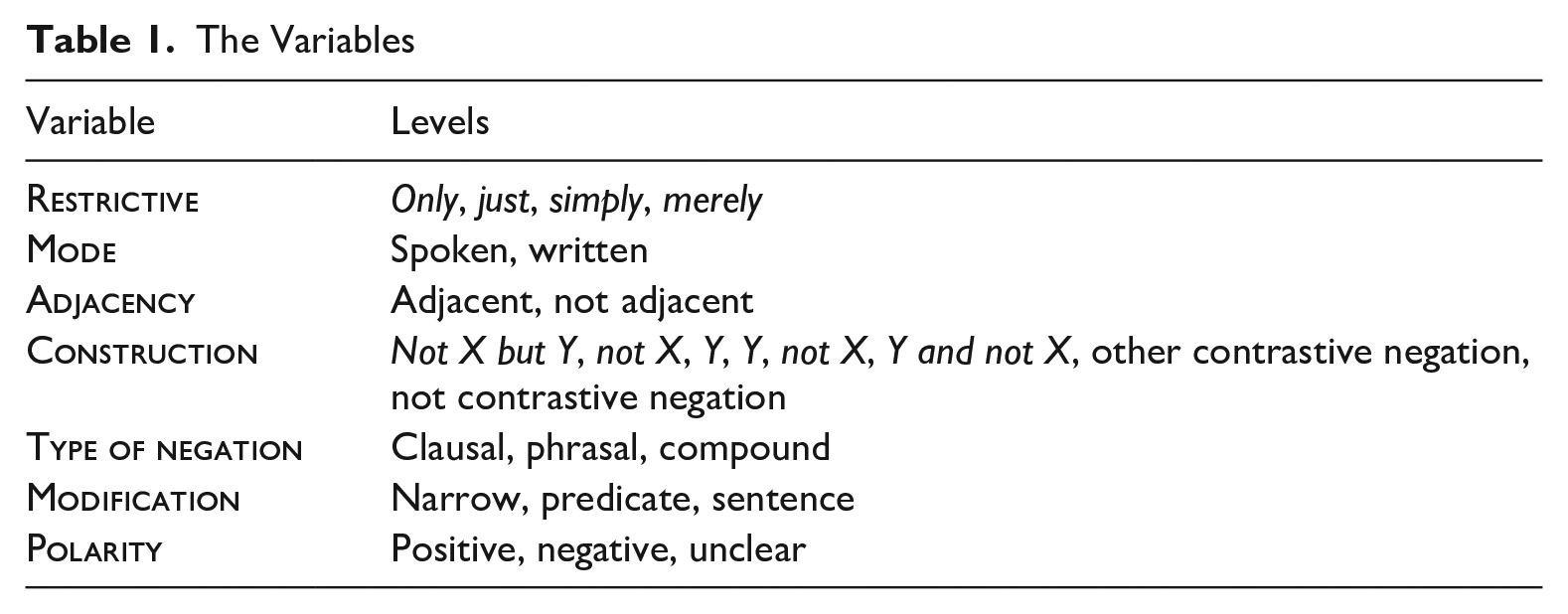
The data were annotated for five formal and functional variables (
The Variables
M
(26) Systematists need not only to communicate with nature conservationists but also to appraise them. (BNC, FBP, 469)
(27) Experience does not consist of simply being faced with an event but is more a consequence of the construct system’s revision towards greater validity. (BNC, H83, 1655)
(28) The duke’s local supporters in East Anglia appear not only disparate but also relatively insignificant. (BNC, HWK, 803)
(29) Not only are aitches dropped, appalling vocals now reign virtually supreme in the realm of pronunciation. (BNC, AKS, 289)
(30) With targets set, the person delegating must give every encouragement along the way and not simply ignore the task until the next target date arrives. (BNC, BME, 404)
(31) Now at last he had an opportunity to act, not merely to argue. (BNC, EFW, 980)
(32) We must do something about the cuts. Not just accept them as if they’re inevitable. We must protest. (BNC, ANY, 885-887)
(33) You don’t miss a day off school just because you’re going to France for a day. (BNC, KC2, 1315)
(34) This holds not merely within the private-for-profit sector but among non-profits and government bureaus as well. (BNC, HH2, 994)
(35) Such operations have the advantage of removing the pollutants entirely from the waste stream ie the compounds do not merely undergo a change of state within the environment [. . .]. (BNC, ALW, 1840)
(36) To praise God, says C. S. Lewis, ‘not merely expresses but completes the enjoyment; it is its appointed consummation.’ (BNC, ARG, 1805)
(37) Not only would a list of varieties make a book like this out of date in a short time, it would not help you either. (BNC, CMM, 42)
(38) Our continued investment in production facilities not only [ensures a top quality product] but sets the standard for state of the art operations. (BNC, J24, 205)
(39) The duke’s local supporters in East Anglia appear not only [disparate] but also relatively insignificant. (BNC, HWK, 803)
(40) Not only [is this implication unfair] but often the comments on Swiss law are misleading. (BNC, CKX, 200)
(41) It wasn’t just that [she was strikingly beautiful]; there was an unworldly air about her. (BNC, G3S, 521)
(42) At this level it is likely that you will be responsible not only for the supervision of legal staff but also for staff with a variety of disciplines. (BNC, HAJ, 1287)
(43) The purpose is to check that you are not just having a prolonged holiday but are actually living as a resident abroad. (BNC, CMK, 1796)
(44) Although all these theories flourished during the latter half of the nineteenth century and the early decades of the twentieth, the links between them are not simply the product of historical circumstance. The most important links are political. (BNC, EAJ, 651)
3.3. Statistical Analysis
The resulting dataset was analyzed statistically using R, the open-source environment for statistical computing (R Core Team 2022). I conducted both univariate and multivariate analyses. At the level of univariate analysis, I considered the frequencies of the individual variable levels against the restrictive adverbs. At the level of multivariate analysis, the variables were subjected to hierarchical configural frequency analysis. Configural frequency analysis (CFA) is an extension of statistical significance testing that applies to configurations of variable levels: it shows which configurations are more frequent than expected and which are less so, using the chi square test (Von Eye 1990; Hilpert 2013:55-66). A configuration is a set of variable levels. For example, (45) illustrates the following configuration:
(45) The current NHS reforms have again targeted its managerial structure and many changes not only affect, but actively involve nurses. (BNC, EE8, 532)
The configurations that are more frequent than expected are called “types,” and those that are less frequent than expected are called “antitypes.” Thus, the types represent ways of using negated restrictives that are typical in the data, while the antitypes express ways that are less typical than would be expected.
Hierarchical configural frequency analysis (HCFA) differs from regular CFA in that it also considers subsets of variables. For example, the configuration of
One way in which HCFA differs from the methods usually employed in alternation studies is that there is no division into independent and dependent variables. Rather, HCFA considers the observed frequency of the configuration as a whole against its expected frequency, given the observed frequencies of the individual variable levels. The analysis may thus also uncover patterns that recur in the dataset but are not tied to any specific restrictive. This is a useful property for this study since language users may generalize over semantically similar expressions (see Cappelle 2006; Perek 2012), such as the four restrictives or a subset of them, thus using them interchangeably in some contexts. By potentially indicating configurations that are identical apart from
On a more general level, not distinguishing between independent and dependent variables enables a change of perspective compared to most alternation studies. Research on alternations has often tacitly assumed that there is a choice between the alternating variants. It is not clear, however, that language users would always choose between just those expressions that a linguist has thought to include as variants in an alternation study, nor is it always evident that such discrete alternatives exist for the language user in all contexts. Furthermore, it is not always straightforward to determine which variables are the cause and which the effect. The present research design avoids these issues by zooming in on usage patterns in an exploratory way, and the statistical method has been chosen with this aim in mind.
4. Results
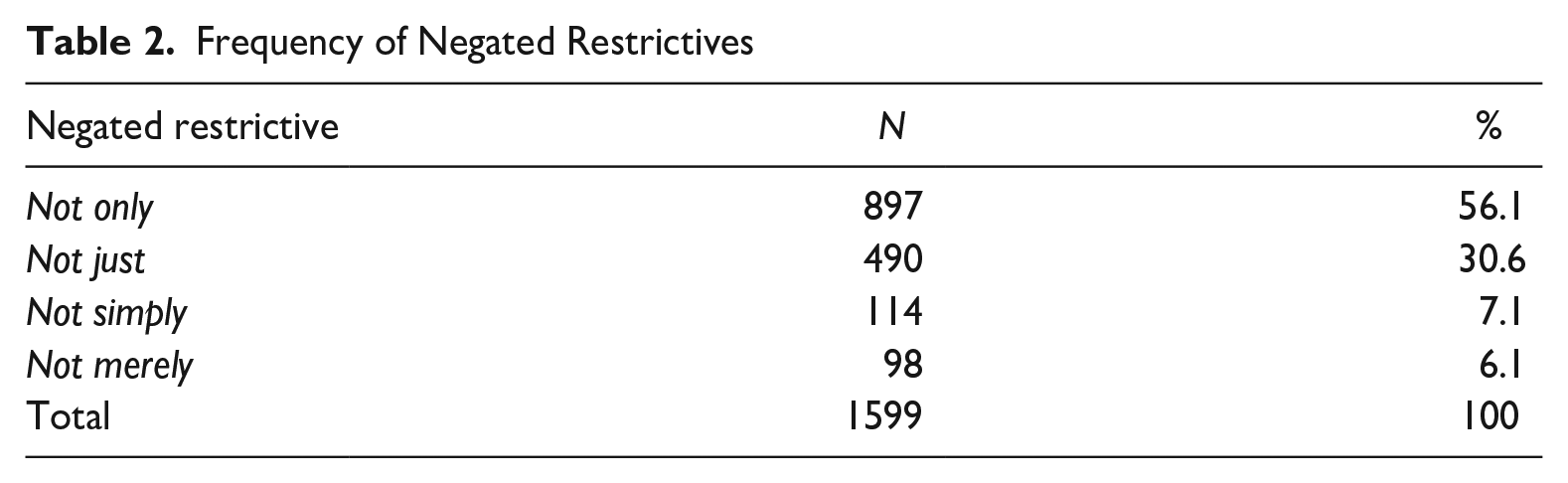
As reported in section 3.1, the dataset consists of 1599 tokens of negated restrictives. Table 2 shows the distribution of the restrictive adverbs in my data. Not only is the most frequent variant, followed by not just. Not simply and not merely are much rarer. These figures are broadly in line with Charles’s (2009:151) study, except for the fact that not simply was rare in her data.
Frequency of Negated Restrictives
4.1. The Variables
In this section, I consider the variables of this study one by one as they relate to the choice between the four variants of negated restrictives. These variables form the basis for the multivariate analysis in the next section.
Table 3 shows the distribution of negated restrictives in the spoken and written subcorpora (
Distribution of Negated Restrictives According to
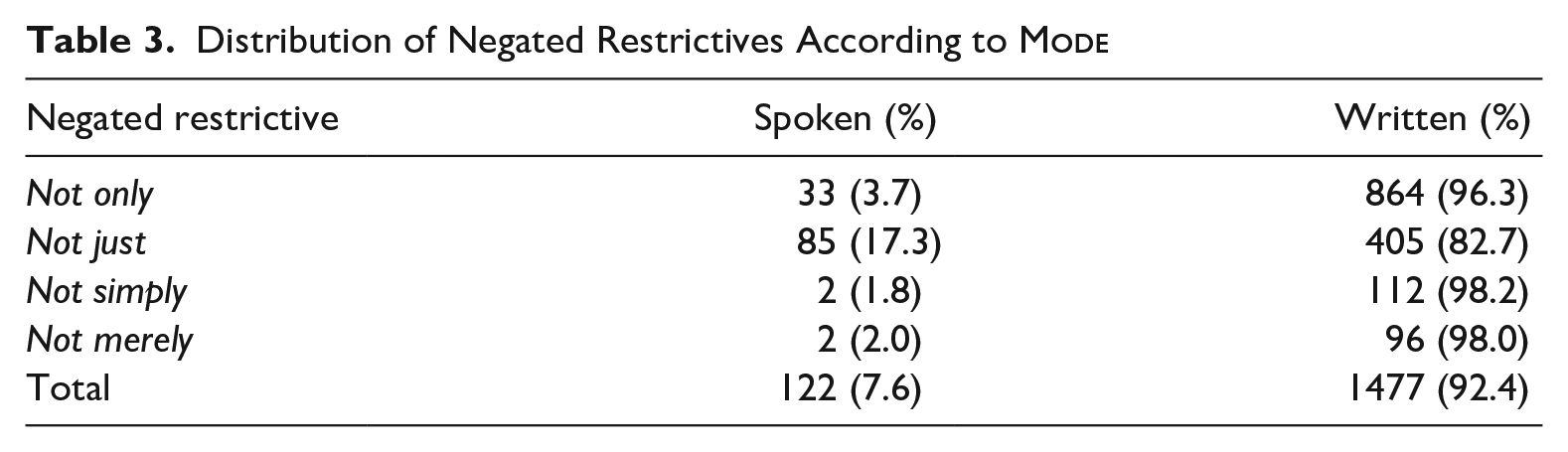
Table 4 shows the distribution of adjacent and non-adjacent cases in the four variants (
Distribution of Negated Restrictives According to
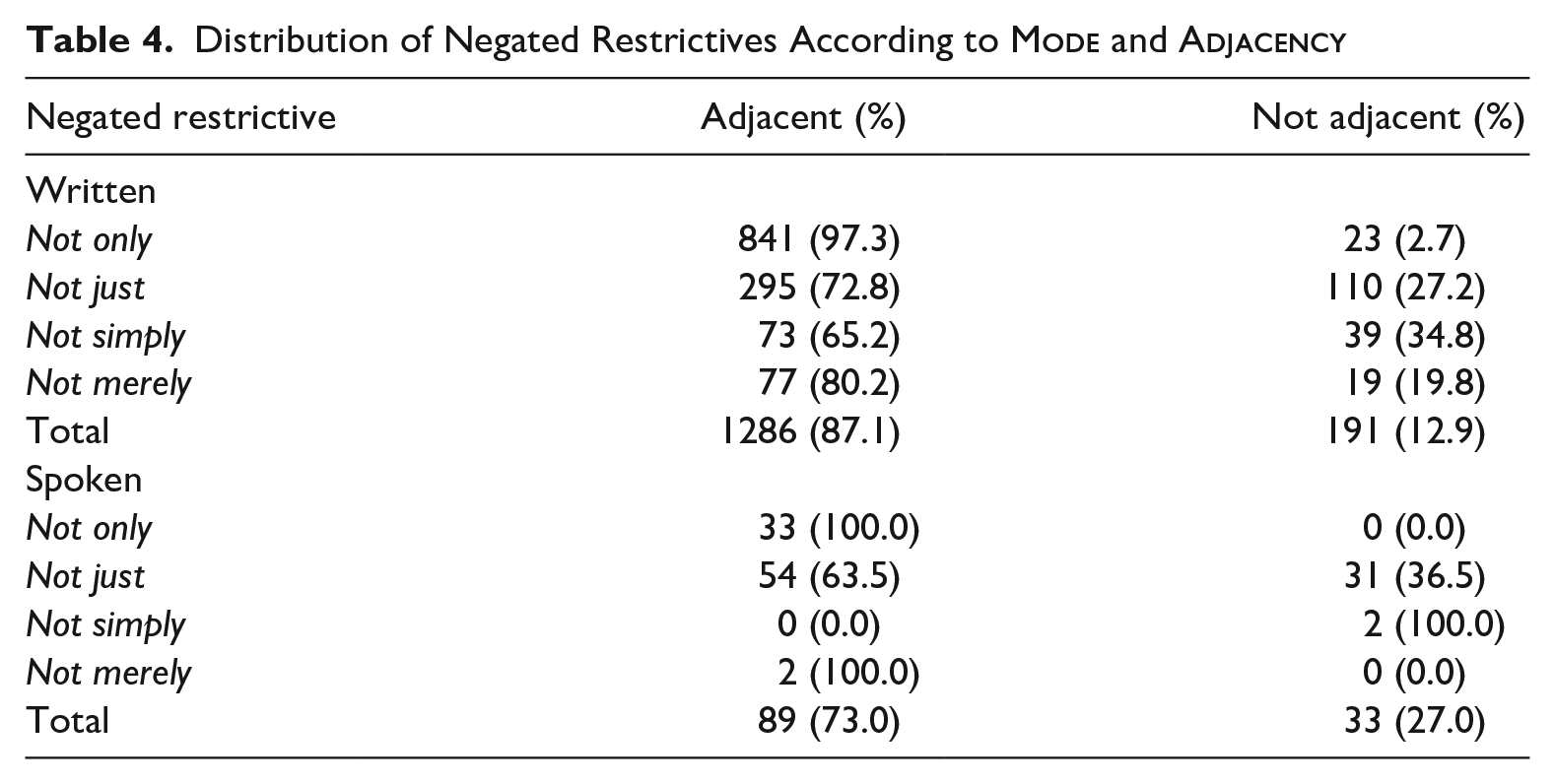
Table 4 shows that in written language, only and simply are the furthest from one another: not only is almost exclusively a tight collocation, appearing adjacently frequently, while simply is often non-adjacent from not. Not just and not merely are between these two. In speech, not only is exclusively found as adjacent, whereas not just is adjacent approximately two thirds of the time. Not simply and not merely are so rare in speech that it is not possible to make generalizations regarding the effect of
Table 5 shows the cross-tabulation of the four restrictives and the constructional schemas (
Distribution of Negated Restrictives According to
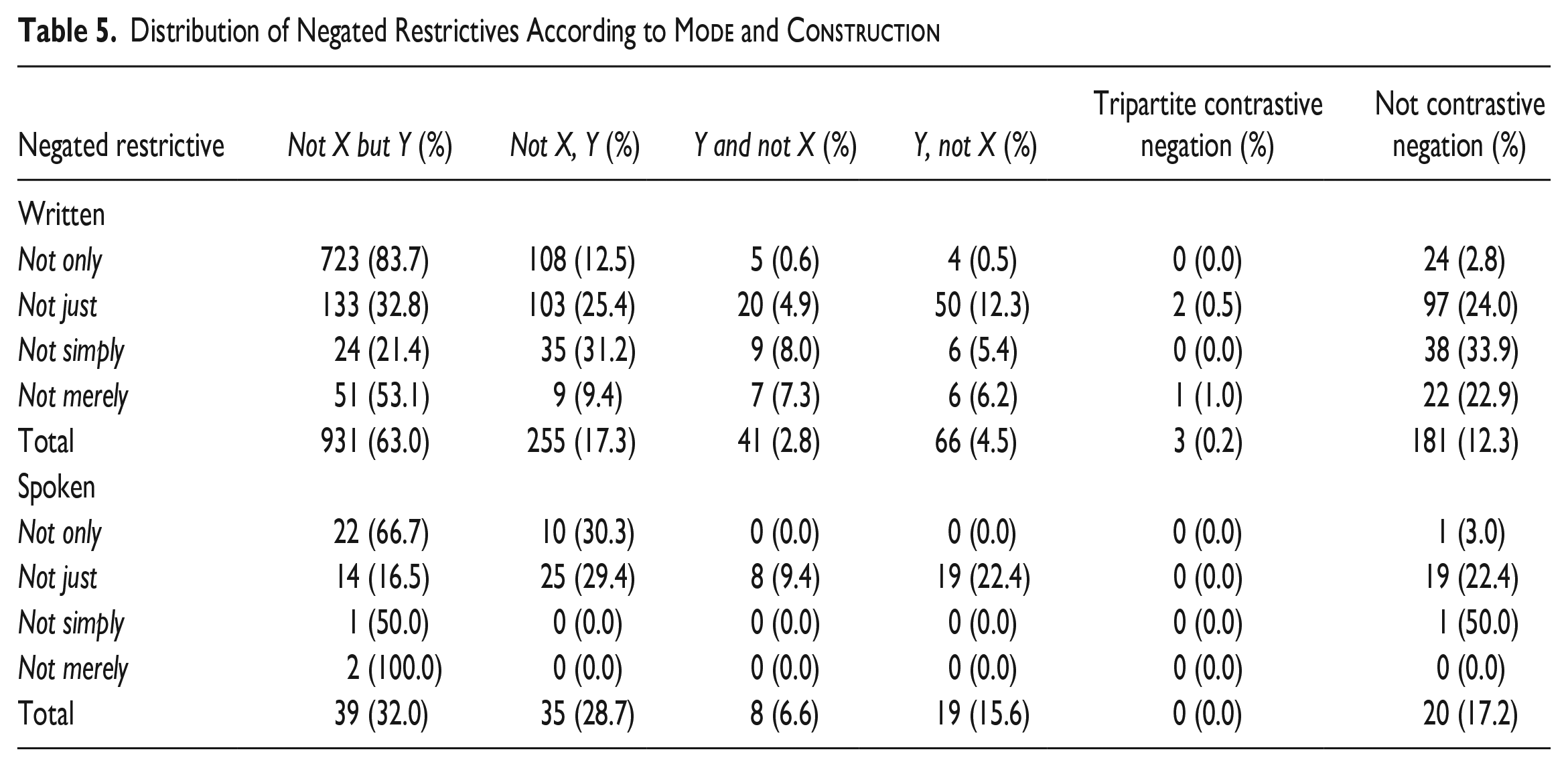
In the written subcorpus, the behavior of only differs from the rest: not only is clearly associated with the not X but Y schema, forming the pattern not only X but (also) Y. Not only is also notably absent from non-contrastive uses and even contrastive uses in which the negation follows the affirmative. Even though the not X but Y schema is prevalent also with the three other variants, none of them is as strongly associated with it as not only, although not merely is close. Not just and not simply show a preference for the asyndetic variant, not X, Y, and not simply also has a high proportion of non-contrastive uses. Not just also often appears in the Y, not X schema. The findings from the spoken subcorpus largely follow those in the written data, although the not X but Y schema is less prevalent than in writing.
Table 6 shows the distribution of the negated restrictives and the types of negation (
Distribution of Negated Restrictives According to
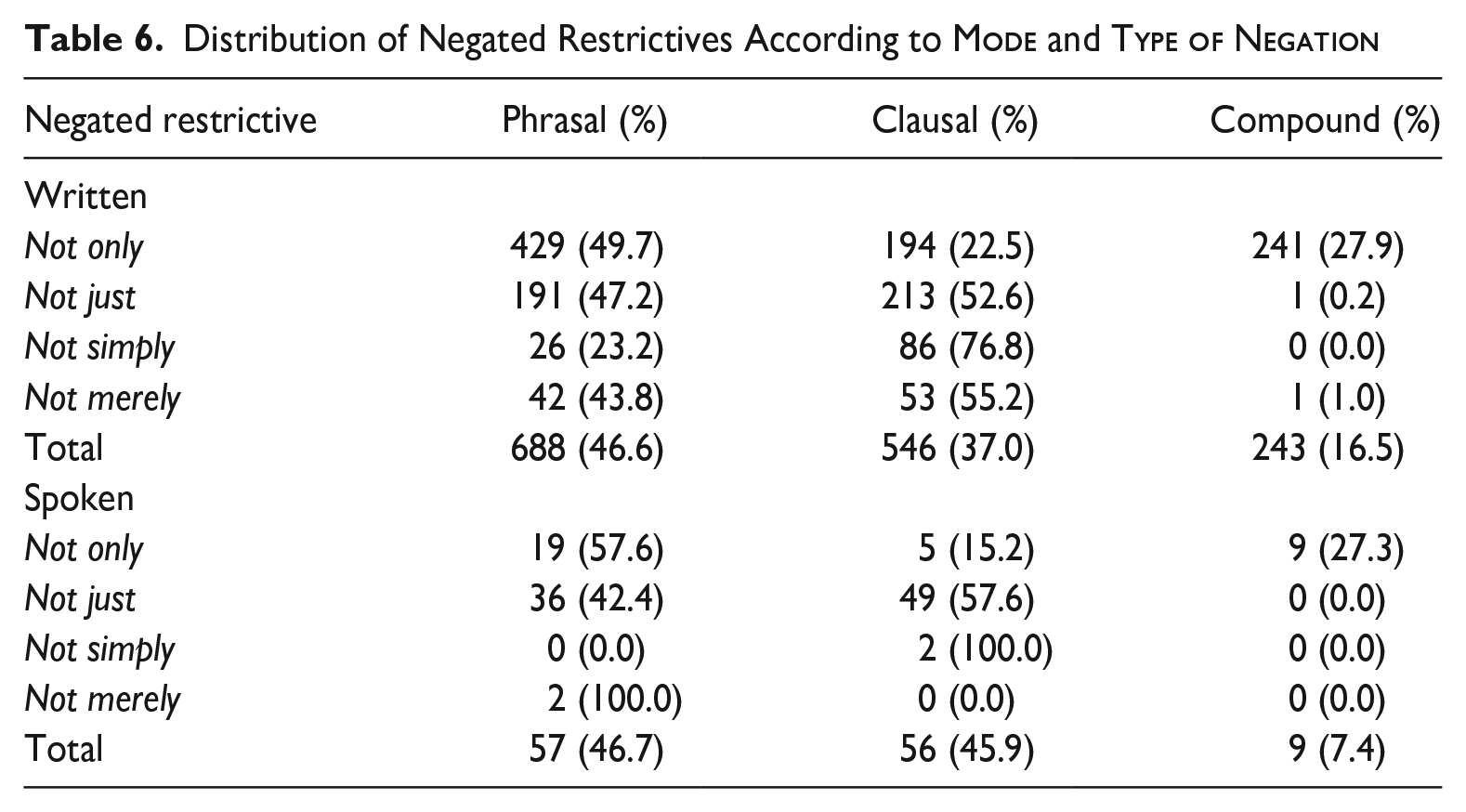
The findings of Table 6 are mostly in line with judgments that the compound use is associated with not only. However, (46) and (47) (the same as 36) are counterevidence to Horn’s (2000:151) judgment that compound uses of not just and not merely would be ungrammatical—see (11) and (12). These are incidental attestations, but they may suggest that the restriction against such constructs is not absolute, at least for some speakers.
(46) The result is absurd. It could have been avoided by having the same verb in ss.18 and 20 or by the Lords in Wilson deciding that “cause” and “inflict” covered the same ground. The House took the point further: not just did “inflict” require direct application of force, but so did assault occasioning actual bodily harm and common assault. (BNC, HXE, 2290‒2292)
(47) To praise God, says C. S. Lewis, ‘not merely expresses but completes the enjoyment; it is its appointed consummation.’ (BNC, ARG, 1805)
Table 7 shows the distribution of negated restrictives in categories of
Distribution of Negated Restrictives According to
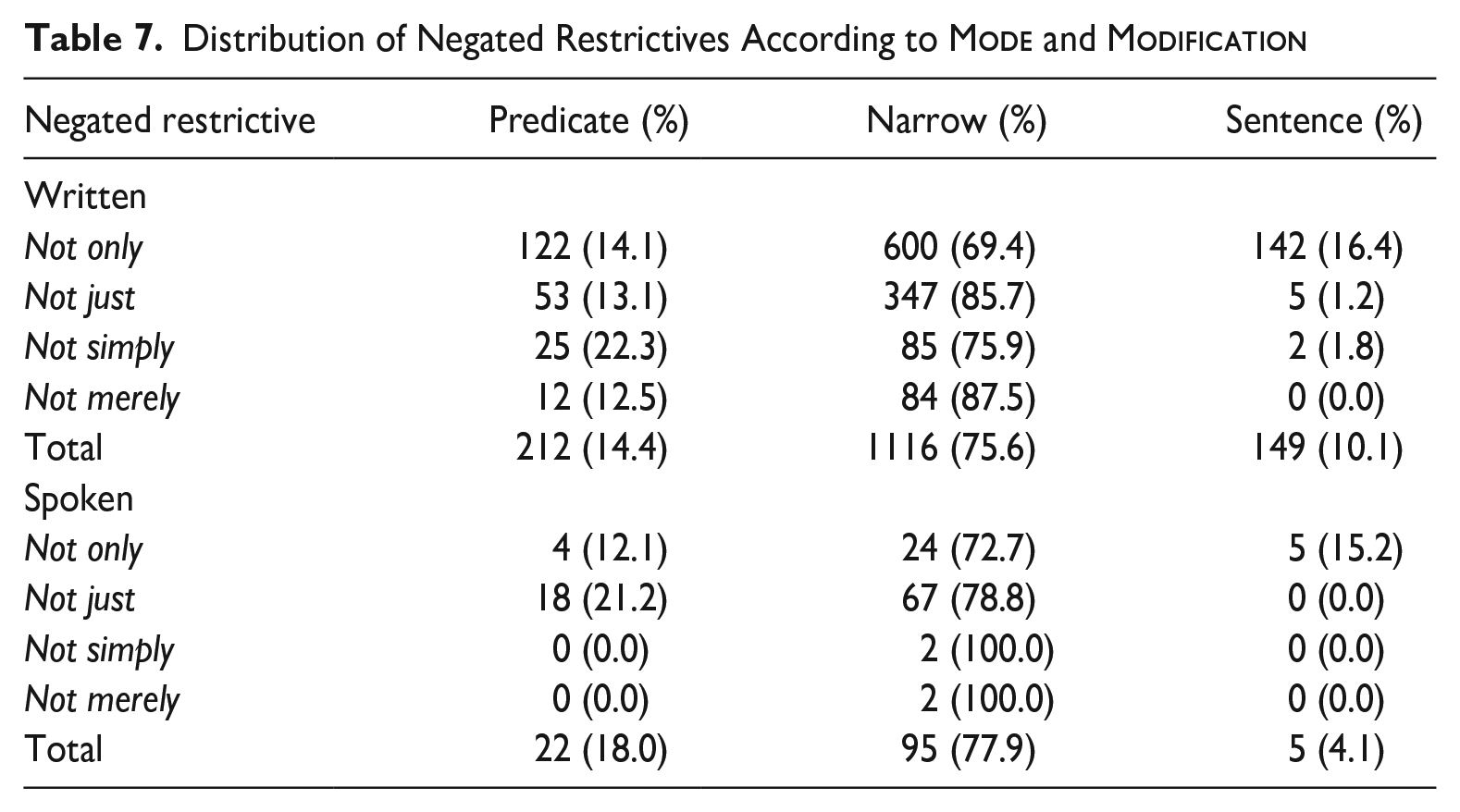
These results indicate that, in written language, the modification of narrow constituents is the preferred alternative for all variants, especially not just and not merely. This is not surprising given the association between negated restrictives and contrastiveness, since narrow focus is frequently associated with contrast. The category of sentence modification is most frequent with not only, with a few cases with not just and not simply. In practice, not only appears mostly with the inversion construction, while not just and not simply appear with the inferential construction. The spoken data follows the tendencies found in the written data.
Table 8 shows the distribution of the negated restrictives and
Distribution of Negated Restrictives According to
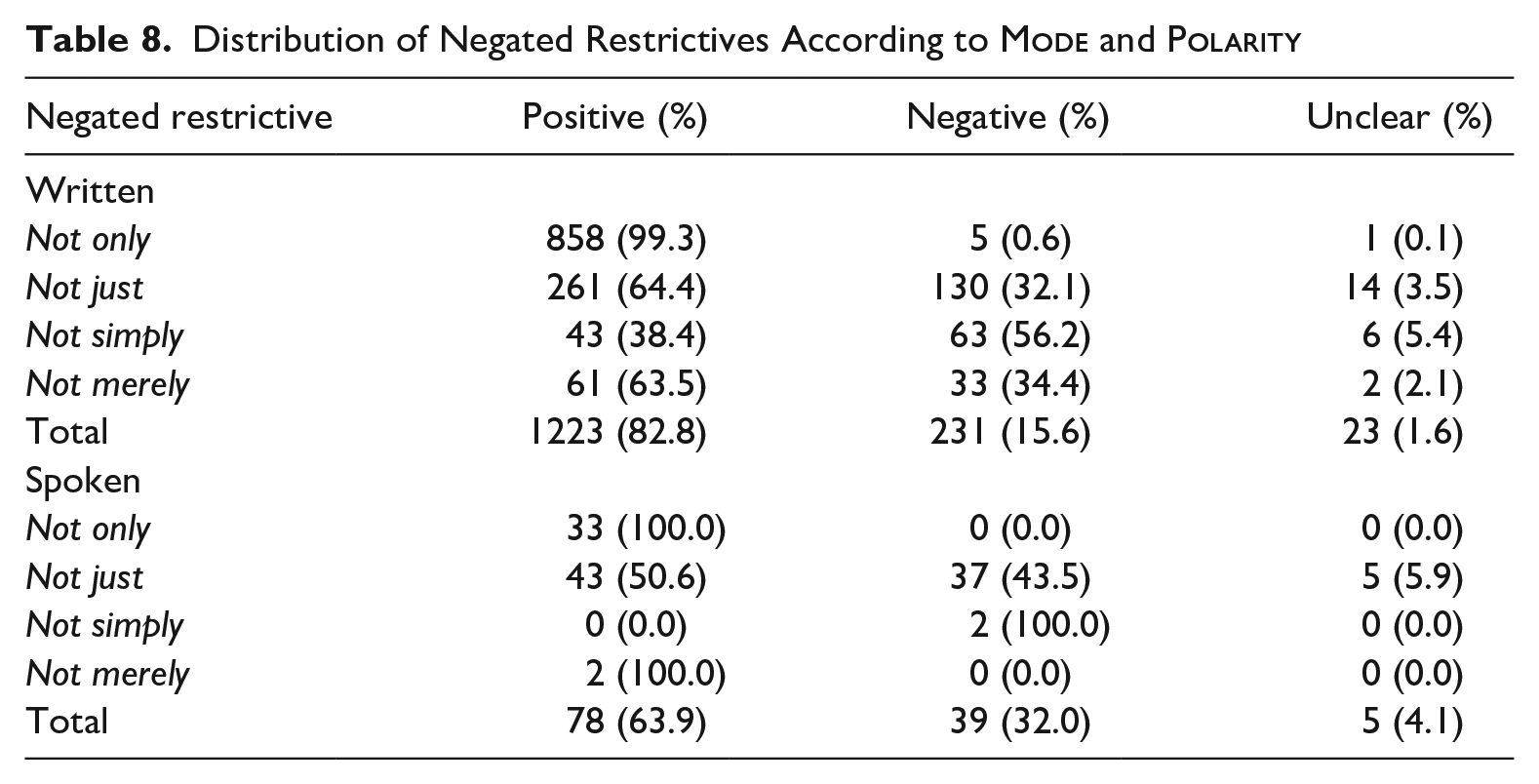
In the written subcorpus, not only virtually always associated with a positive interpretation, as in (48). Not simply is the most likely to be negative, as in (49), and not just and not merely are again between the other two, although both are more closely aligned with a positive interpretation, as in (50) with not just. These findings are in line with previous studies that suggest that the expression modified by not only is part of a non-scalar set that automatically receives a positive interpretation (Horn 2000:148-151). There are occasional cases of unclear polarity for all variants. In the spoken subcorpus, similar tendencies obtain for not only and not just as in the written subcorpus.
(48) Not only are some birds known to detect infrasound, but one species has been shown to produce infrasonic calls. (BNC, FEV, 1108)
(49) The imaginary conversations he held as he travelled the country roads were not simply distractions to while away his lonely journeys but rehearsals of the arguments he would use to outsmart the hunters and send them back home empty-handed. (BNC, FRJ, 685)
(50) Access and freedom-to-roam are issues dear to the heart of most Scots, but it is not just boots and shoes that are involved nowadays, but canoes, windsurfers, paragliders, boats of all kinds, and bikes. (BNC, CHK, 242)
To summarize, when considered individually, the variables suggest that not only and not simply pattern in opposition to each other, not just syntactically but also semantically and pragmatically. In line with previous research, these usage patterns suggest that not only has become heavily conventionalized in the positive interpretation, and it also appears in relatively fixed syntactic environments. Not simply is much more likely to be interpreted in a negative way, and its syntactic contexts are quite variable. Not just and not merely were between these two extremes, with not just being favored in speech.
4.2. Multivariate Analysis
I now turn to the typical usage patterns of negated restrictives in the data by using the variables as input to the HCFA. HCFA was performed in R using the HCFA 3.2 program (Gries 2004; see also Gries 2009:248-252). The p-values were adjusted using Holm correction.
There are many variables, and some overlaps exist between them. Using a large number of variables would lead to a large proportion of very small expected values among the configurations, which can be problematic for the application of HCFA (Von Eye 2002:66-69). Since there are relatively few tokens from the spoken sub-corpus, I have restricted the multivariate analysis to the written sub-corpus. Thus, the variable
The HCFA builds on the chi-square test. The chi-square test assumes that all data points are independent of one another; thus, it may yield anticonservative results if one language user has produced multiple tokens or if there are multiple tokens from the same usage event (see Kilgarriff 2005). While the majority of corpus texts that are represented in the dataset contributed only one token, the number of tokens ranged between 1 and 14 per text.
6
To protect against idiolectal effects distorting the analysis, I ensured that there was only one token per corpus text by using the function distinct in the dplyr package. This reduced the written dataset to 946 tokens. In addition, I removed cases with tripartite contrastive negation (three tokens) and with unclear polarity (twenty-three tokens) since these are small categories that are difficult to analyze meaningfully. This means that, of the 1477 tokens in the written dataset, 927 are used in the HCFA. Furthermore, the levels Y and not X and Y not X were combined in the variable
The results of the HCFA are shown in Table 9. The table indicates the variable levels in each configuration, the frequency of the configurations in the dataset (Freq.), their expected frequencies (Exp. Freq.), and the decision of the significance test (Sig.). The last column indicates whether the configuration is a “type,” an “antitype,” or neither. Recall that a type is a configuration that is more frequent than expected and thus a good candidate for a conventionalized pattern, while an antitype is less frequent than expected. A dot in the first three columns indicates that the configuration is not specified for that variable.
The HCFA Types
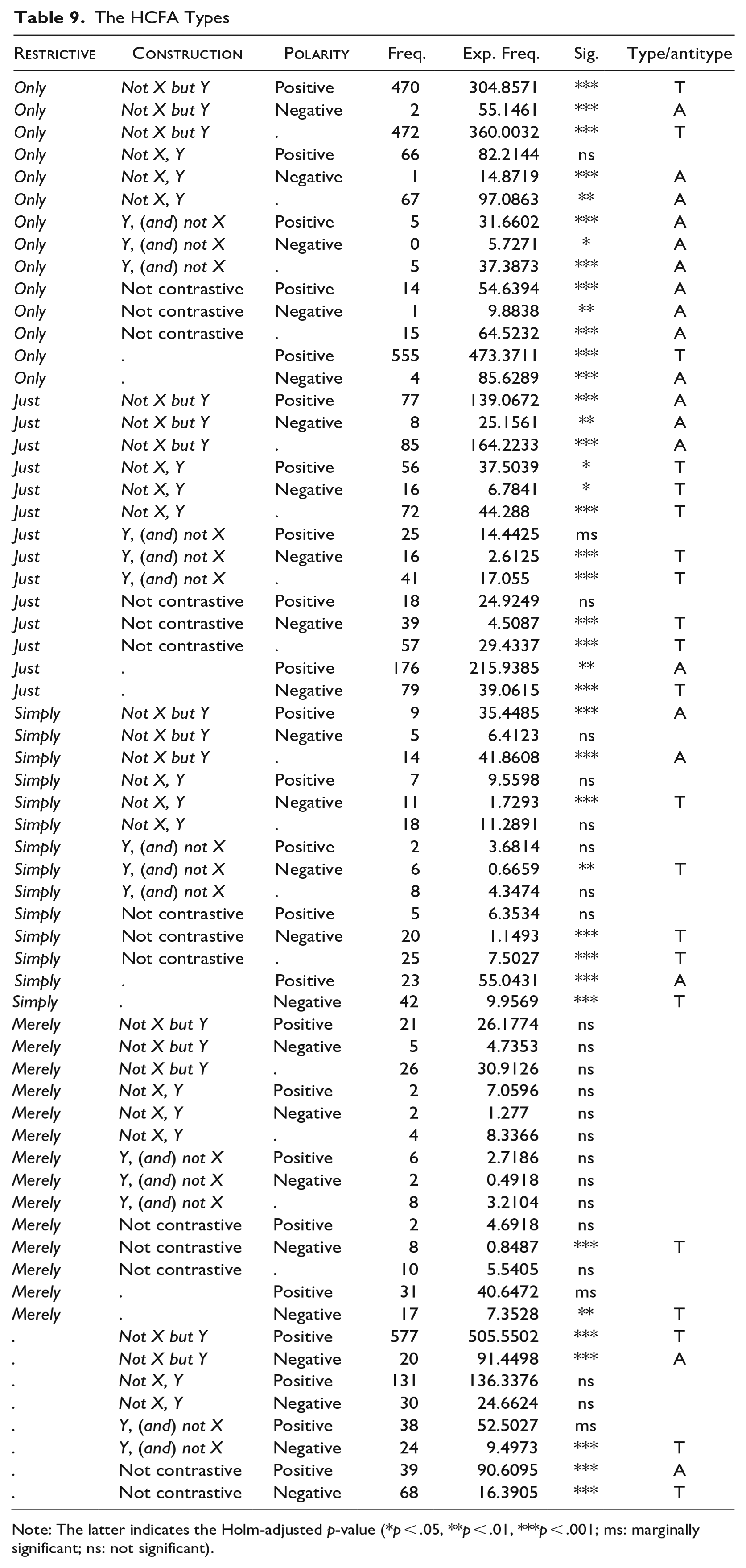
Note: The latter indicates the Holm-adjusted p-value (*p < .05, **p < .01, ***p < .001; ms: marginally significant; ns: not significant).
The HCFA indicates that there are three types for not only, and they all suggest that the most typical configuration for this variant, and for negated restrictives in general, is only, not X but Y, positive. This configuration, illustrated in (51), accounts for a majority of not only cases. Most other configurations are antitypes, which further underlines the centrality of the configuration in (51) for not only.
(51) The weaving horse not only swings its head and neck, but also the front end of its body from side to side. (BNC, ADF, 365)
There are eight types for not just; these are formed with three constructions: not X, Y; Y, (and) not X; and a construction without a contrast. These are illustrated in (52)-(54), respectively. The not X, Y construction is a type with both positive and negative interpretations with not just, and it is also a type with not just without a specification for polarity. By contrast, the other two constructions are types only with the negative interpretation and without a polarity specification, even though the negative interpretation is in the minority with the Y (and) not X construction. The not X but Y construction is an antitype with not just, as is the positive interpretation of the negated restrictive. These results are due to the fact that these categories have lower relative frequencies with not just than with not only.
(52) But the success of the experiment at Snowshill shows that organic gardening is not just an eccentric alternative; it can also produce better results. (BNC, G2L, 568)
(53) For such groups leisure was an assertion of collective rights, not just a badge of exclusive status. (BNC, FP9, 1349)
(54) But a wolf doesn’t turn into a watchdog just by folk wishing it. (BNC, APW, 2201)
There are five types for not simply. All of these types are shared with not just. There are three constructions with negative interpretations: not X, Y; Y, (and) not X; and a non-contrastive construction. In addition, the non-contrastive construction is a type without the polarity specified. Negative polarity is also a type with not simply. Examples that illustrate the features that are more typical of not simply than negated restrictives more generally are given in (55) and (56). The antitypes of not simply are associated with the not X but Y construction and positive polarity.
(55) Petitions did not begin simply to be pressed on parliament in large numbers on a few issues; the range of grievances expanded in petitioning. (BNC, CLN, 660)
(56) In opposing human spirit to human force I am not simply setting cognition against physique. (BNC, CHC, 755)
There are two types for not merely: one that pairs it with negative interpretation and another that further specifies the construction to be not contrastive. An example of the latter type is given in (57). The figures are fairly low, which indicates that most of the time, not merely is used in ways that are equally or more typically fulfilled by the other variants, especially not only. There are no antitypes for not merely.
(57) The principle of induction cannot be justified merely by an appeal to logic. (BNC, FBE, 249)
Finally, there are three types that are not specified for the restrictive. Unsurprisingly, the configuration of not X but Y, positive is a type even without not only. The configuration of Y, (and) not X, negative is also a type in its own right, although it is, in practice, rare with restrictives other than just. As can be expected, the configuration not contrastive and negative is also a type, but this combination was a type also with not just, not simply, and not merely.
5. Discussion and Conclusion
The results in section 4 demonstrate that there are differences among the variants of negated restrictives in terms of form and meaning as well as modality, this final one evidenced by the higher prevalence of not just in the spoken component of the BNC. It is further shown that certain configurations of these variables and the four restrictives form types and antitypes. The types reveal the distinctiveness of each variant in the data. This enables us to account for the degree of conventionalization that each of these variants displays. The overall picture is that, as suggested in previous research, there is a close connection between negated restrictives and contrastive negation, but this connection is not absolute, and it manifests itself differently for each variant.
It is worth noting that the types and antitypes of the four variants are detected by comparing them to one another, which might lead to overemphasizing differences. For example, the not X but Y schema is antitypical with just even though just and the not X but Y schema co-occur 147 times in the dataset (133 tokens in the written subcorpus and 14 tokens in the spoken subcorpus). The reason for this is that the not X but Y schema accounts for a smaller proportion of the just data than it does for merely and especially so for only. The results of the HCFA should thus be interpreted against the univariate results.
Previous research on negated restrictives has focused on not only, suggesting, among other things, that it is a fixed expression with unconventional syntax and semantics. The findings of this study support this view and allow us to state the peculiarity of not only more precisely. Not only displays a high degree of conventionalization: it has mostly sedimented into the correlative not only X but (
Not just is the second most common variant of negated restrictive in writing and the most common in speech. Syntactically, it has a less clear profile than not only does. It appears moderately frequently with the not X but Y and the not X, Y constructions, although the former of these is an antitype in the HCFA. Unlike not only, not just also appears in the Y, not X construction relatively often.
Not just, not simply, and not merely all have types that are associated with non-contrastive and negative contexts. The HCFA also identified a type with these properties but without an association to any single restrictive. These properties are particularly salient for not simply. These are largely compositional and likely not (or perhaps only weakly) conventionalized uses of negated restrictives. 7
My results resemble those of Bybee and Eddington (2006) in that the central member of the category of negated restrictives in writing, not only, is also the one that displays the most distinctive behavior in both form and function. Moreover, the more peripheral members of this category (not simply and not merely) can also appear in contexts that appear to have been formed in an emergent, piece-meal fashion. My findings reflect the fact that simply appears to be less grammaticalized than the other restrictive adverbs studied here: it is transparently a derived form of the adjective simple, which is itself a central adjective (see Quirk, Greenbaum, Leech & Svartvik 1985:403-404). Only and just are not derivations from a synchronic point of view. Merely in turn is also transparently derived from an adjective, mere. However, mere is a peripheral adjective which is unambiguously a member of the restrictive family itself (and therefore somewhat grammaticalized), unlike simple, which is one only in some of its uses.
Some of the results may also be related to the ages of the constructions. Not only is the oldest of the variants considered here, having established itself in the Middle English period, and it has been the most frequent negated restrictive variant, at least for written language, for centuries (Nevalainen 1991:123-162). Interestingly, Nevalainen’s (1991) data suggests that not just X but (
There are several issues around negated restrictives that are left for future research. First, this study has not addressed restrictive adjectives (e.g., only, mere) even though they too can appear in the focus of negation and be used additively. Second, while this study is strictly synchronic, a historical and comparative perspective would increase our understanding of the diachronic processes that have led to the usage patterns of negated restrictive constructions identified in this study. Third, the quantitative approach of this study could usefully be complemented by a qualitative study of the textual functions of negated restrictives, as well as of scalarity and categoriality.
As emphasized in section 3, the HCFA does not posit a causal relationship from one set of variables to another, unlike those alternation studies that employ statistical modeling such as logistic regression. Indeed, I would caution against operationalizing
The emergent quality of some of the usage patterns discussed here stands out from the usual suspects of grammatical alternation studies. In many alternation studies, there is a tacit assumption that the alternatives are equally conventionalized, perhaps even in a paradigmatic relationship with one another. For many topics traditionally addressed in the alternation literature, such as the dative alternation, this assumption is reasonable: the alternating constructions have a long history of co-existing (Zehentner 2017), and their functional equivalence seems to be psycholinguistically real (Perek 2012). Negated restrictives are different since especially the most frequent variant, not only, is strongly associated with a specific constructional schema, not only X but (also) Y, and similar associations can be found for the other variants. I hope to have shown that the perspectives of alternations on the one hand and emergent grammar on the other need not be seen as incompatible. Rather, they both highlight different aspects of the network-based conception of grammar. As seen here, alternations may interact with emergence, and this interaction can be described in a principled way.
Footnotes
Acknowledgements
This paper has benefited from critical and constructive comments by Elizabeth Peterson, Maija Surakka, anonymous reviewers, and the editors of the journal. I thank all of them for their contribution. I alone bear responsibility for any shortcomings of the paper.
Declaration of Conflicting Interests
The author declared no potential conflicts of interest with respect to the research, authorship, and/or publication of this article.
Funding
The author disclosed receipt of the following financial support for the research, authorship, and/or publication of this article: The author gratefully acknowledges the funding from the Finnish Research Council (grant number 332529, “Negation in Clause-Combining: Typological and usage-based perspectives (NiCC)”) and the Finnish Cultural Foundation, as well as the FinELib consortium for covering the costs of publishing the paper open access.
