



Abstract
This article examines the development of the subordinators till and until as minor complementizers in the Late Middle English and Early Modern English periods. An analysis of data obtained from a number of sources shows that till/until underwent a process of secondary grammaticalization, emerging as complementizers introducing clauses governed by the desiderative predicate
1. Introduction
As shown in previous research (López-Couso & Méndez-Naya 2015), subordinators with an originally adverbial use, for example, as if in (1), constitute one of the pathways leading to the emergence of new complementizers, as illustrated in example (2). In (2), as if does not introduce an adverbial clause of comparison (functioning as an adjunct), but rather a complement clause which expresses an internal argument of the predicate
(1) He talks as if he has a potato in his mouth (adapted from Quirk, Greenbaum, Leech & Svartvik 1985:1110) (2) It seemed as if / that he was trying to hide his true identity (adapted from Huddleston & Pullum 2002:962)
The use of these complementizers, which are referred to as “minor” because of their low frequency, has been mentioned in the literature on complementation at various times, though mostly in passing (e.g., Lakoff 1968:69, note 7; Huddleston 1971:177-178; Warner 1982:180-185, 221-224; Mitchell 1985:15-17; Noonan 1985:104; Quirk, Greenbaum, Leech & Svartvik 1985:1175, note a; Fanego 1990:19-20; Bender & Flickinger 1999; Huddleston & Pullum 2002:962, 1151-1152). More recently, however, López-Couso and Méndez-Naya (2015) have addressed minor complementizers at length, to examine, on the one hand, the category of minor complementizers itself and, on the other, the history and use of individual clause connectives such as as if, as though, but, if, lest, like, and though (e.g., 1998, 2001, 2012; see also López-Couso 2007; Brook 2014).
The present investigation aims to contribute to this field of research by considering the emergence and loss of two additional clause connectives, namely till and until. Both are attested in complementizer function during Early Modern English (henceforth EModE) up to the Late Modern English period (henceforth LModE). They illustrate a transition from an original use as adverbial temporal subordinators of forward span (for this label, see Quirk, Greenbaum, Leech & Svartvik [1985:533-534]), as in (3), to a marginal, short-lived use as complementizers with the desiderative verb
(3) He slepeth. . .Al nyght til the sonne gan aryse. ‘He sleeps. . . all night till the sun began to rise.’ (MED, s.v. til, conj. 1a.(a); (c1390) Chaucer CT.ML.(Manly-Rickert) B.791) (4) the one hath the spirit which saith come, the other shake at the mention of this comming: the one longeth till these shadowes flie away, and that day breake on them; the other can no more desire his comming, then the guiltie fellon can the comming and presence of the iudge.
(EEBO BYU; 1612, T. Taylor, A commentarie vpon the Epistle of S. Paul written to Titus)
On the basis of the data obtained from a number of sources detailed in section 5, the aims of the present study are the following:
(i) to observe the diachronic evolution of till/until-clauses occurring with
(ii) to discuss why till/until-complements emerged as a lexically specific phenomenon occurring only with
(iii) to discuss why till/until failed to survive as complementizers in the history of English.
As a broader implication, the study seeks to address the central question of how and why linguistic elements are lost (section 3), a topic which has not always been brought to the fore in diachronic linguistics, especially as compared to the attention given to the emergence and spread of new elements and new categories (Hundt 2014:167; Kranich & Breban 2021:1). Competition with systemic alternatives will be proposed as one of the factors motivating the loss of till/until-complements, which are seen to decline in the face of the continued growth of to- and for. . .to-infinitives as verb complements in the course of the LModE period (see De Smet 2013).
The remainder of this paper is organized as follows. Section 2 addresses the previous literature on the shift from adverbial subordinator to complementizer function and introduces a number of criteria for complementhood. Section 3 explains the notions of loss, competition, and marginality, which will be invoked as explanatory tools in later sections. Section 4 provides a preliminary overview, based on the existing literature and on lexicographic sources such as the Dictionary of Old English (DOE), the Middle English Dictionary (MED), or the Oxford English Dictionary (OED), of the historical development of the English subordinators of forward span, in particular till/until (section 4.1), and of the verb of desire
2. The Historical Shift from Adverbial Subordinator to Complementizer
The change from adverbial subordinator to complementizer (henceforth A > C) examined in this article is a phenomenon which has been observed cross-linguistically, in English as well as in other languages, like Latin, Spanish, or Georgian (Hewitt 1987:219; López-Couso & Méndez-Naya 2015:195-196). As discussed by López-Couso and Méndez-Naya (2015:195) in relation to each of the clause links they investigate, this change has been seen to occur in a number of adverbial domains in the history of English, including those of comparison (as if, like, as though), exception or negative condition (but), condition (if), negative purpose (lest), and concession (though) (see also Kortmann 1997:79-89). In addition, López-Couso and Méndez-Naya (2015:193-196) have interpreted the change A > C as a case of secondary grammaticalization; as noted by Hopper and Traugott (2003:175), the traditional process of grammaticalization of lexical items can be extended to cases in which there is an “increased grammaticalization of already grammatical items in specific contexts” (see also Breban 2014:470). This is precisely what happens when adverbial clause links acquire the function of complementizer, since these already possess a grammatical function as adverbial subordinators which becomes even more grammatical when they are used as complementizers.
Researchers have put forward a set of criteria to investigate the complement status of clauses introduced by minor complementizers, and how they differ from adverbial clauses. Based mainly on the discussion in Huddleston and Pullum (2002:219-228) and López-Couso and Méndez-Naya (2012:173-178, 2015:189-191), the first and major criterion that is of relevance for complement status is licensing by a predicate (Criterion 1). It is a general property of complements that they need to be licensed, since every predicate projects certain participant roles. Thus, predicates meaning ‘fear, dread’ contain, as part of their argument structure, two participants: an experiencer and a participant that provokes fear. Discussing this kind of predicates in earlier English, López-Couso (2007) finds that these predicates are often followed by clauses with the conjunction lest (Old English, henceforth OE, þy læs (þe); Middle English, henceforth ME, the lesse the, thi les the, lest); this connective originally meant ‘so that not’ and introduced adverbial clauses of negative purpose. Sometimes, a twofold reading is possible, as in (5), containing the OE verb
(5) Alyse me of Esaues handa, mines broðor, for þam ðe ic hyne deliver me from Esau’s hands my brother because I him swyðe ondræde, þe læs ðe he cume & ofslea ðas modra mid much fear lest he come & kill the mothers with heora cildum their children (c1000, Genesis 32.11; cited from López-Couso 2007:22)
Here, on the one hand, the þe læs ðe-clause can be interpreted as a clause of negative purpose: ‘Deliver me from the hands of Esau, my brother, because I fear him very much, lest he come and kill the mothers with their children.’ On the other, the sequence could also be viewed as a type of appositional structure, attested in OE and ME (cf. Warner 1982:91-99), where a noun phrase (NP) (hyne ‘him’ in 5) was followed by a finite clause which specified further the respect in which what was said about the NP held true: ‘Deliver me from the hands of Esau, my brother, because I fear him very much, [I fear] that he may come and kill the mothers with their children.’ Eventually, the inference that the clauses following
(6) but bycause this texte of sayncte Paule is in latyn, and husbandes commonely can but lyttell laten, I fere leaste they can-not vnderstande it. ‘but because this text of Saint Paul is in Latin, and farmers in most cases know little Latin, I fear that they cannot understand it.’ (Helsinki Corpus; 1534, A. Fitzherbert, The book of husbandry, 99; cited from López-Couso 2007:14, my translation)
The change in status from adverbial clause to complement clause can be put to the test by applying two other morphosyntactic criteria diagnostic of complementhood. One is whether the minor complementizer introducing a complement clause can be replaced by another complementizer “without any perceptible change of meaning” (Criterion 2; Huddleston & Pullum 2002:962; see also Quirk, Greenbaum, Leech & Svartvik 1985:1175, note a, 1184, note b); this is what happens, as pointed out by López-Couso and Méndez-Naya (2012:175, 184-189, 2015:190), in (7), first quoted in section 1 and repeated here for convenience.
(7) It seemed as if / that he was trying to hide his true identity (adapted from Huddleston & Pullum 2002:962)
A third diagnostic concerns the ability of these clauses to occur in parallel with other complements (Criterion 3). Thus, since “coordination is a relation between two or more elements of syntactically equal status” (Huddleston & Pullum 2002:66), based on the fact that the as if-clause in (8) is coordinated with a that-complement clause, López-Couso and Méndez-Naya (2015:190) conclude that the as if-clause and the that-clause both perform the same syntactic function as complements of the verb
(8) Now, driving the horse and sulky borrowed from Mynheer Schuyler, he felt as if every bone was topped by burning oil and that every muscle was ready to dissolve into jelly and leave his big body helpless and unable to move (Brown Corpus; 1961, S. Longstreet, Eagles where I walk; cited from López-Couso & Méndez-Naya 2015:190)
I will return to the criteria for complementhood presented in this section in section 6.2.
3. Loss, Competition, and Marginality
In processes that are characterized as grammaticalization, loss is often considered as the last stage of development (Rehn 2021:161). Hopper and Traugott (2003:172) point out that “at the extreme end of the history of a particular form as a grammatical marker we might find loss, either of form alone or occasionally of both form and function.” Discussing the study of loss as a unified phenomenon, Kranich and Breban (2021:1) note that attention in diachronic linguistics has largely focused on the emergence and spread of new elements and new categories. Robust generalizations regarding paths, processes, and motivations have been formulated and tested with regard to the development of new grammatical elements out of lexical material and to the acquisition of new grammatical functions. However, as extensively as emergence has been researched, solid insights into the demise and eventual loss of grammatical elements and categories are still lacking. There are mechanisms, hypotheses, and generalizations that need to be formulated to further our systematic study of loss (Kranich & Breban 2021:2); there are also potential universals specific to loss which need to be discussed against the background of what we know about the emergence of new elements and categories (Kranich & Breban 2021:4, 9-10). An example is the universal principle of “Survival of the Frequent,” which states that “when a grammatical distinction is given up, it is the more frequent category that survives” (Haspelmath 2004:18).
One of the language-internal factors that has been identified as contributing to processes of loss is competition, which can be defined as “a situation in which two or more competing forms exist for the same function and one is eventually selected at the expense of the other(s)” (Rudnicka 2019:84; also Hopper & Traugott 2003:172; Hundt & Leech 2012:176). According to Hundt (2014:171), two prerequisites are to be considered for competition to play a role in an observed language change process: (a) constructions in competition have to be truly equivalent, that is, they have to compete “for the same linguistic environment,” and (b) a decrease in the frequency of the declining element is associated with a frequency rise of competing structures (see also Hundt & Leech 2012:176). Two cases of competition in the history of English investigated by Hundt and Leech (2012) are the decline of which as a relativizer and of for as a conjunction, at three equidistant periods in the recent history of American and British English. Their findings support the view that the demise of which and for is interrelated with the rise in frequency, respectively, of relative that and the conjunction because (Hundt & Leech 2012:183, 186).
Little attention has also been paid to what Joseph (1997) has referred to as marginal data, which involve those peripheral facts in a language that are highly particularized, being often keyed to the behavior of particular lexical items. Marginal data are frequently viewed as “the epitome of ‘anti-generalization’” (Joseph 1997:197). The assumption here is that, while the “core” of language represents the real basis for the emergence of linguistic knowledge and rules, many peripheral facts are nothing more than a list of exceptional behaviors. However, there is much of interest in studying linguistic marginalia because, as Joseph (1997:210) points out, “all linguistic knowledge starts out as marginal — only after enough bits of information have accumulated and the pieces begin to be fit into a system do broad ‘generalizations’ emerge.” Linguistic marginalia thus lead to crucial insights into the nature of language and linguistic competence: speakers have a considerable amount of knowledge that is highly particularized, and the domain of the specific forms the ground for the generalizations they make based on extensions over an ever wider set of particular facts. The margins, therefore, are deserving of a more prominent place in linguistic debate and analysis (Joseph 1997:209-210) and, as I argue in this paper, pose a valuable source of empirical data, not only for the study of particularized facts, but also for furthering our understanding of the inner workings and general principles of grammatical change and loss.
4. Historical Overview
Prior to the discussion of corpus findings in section 6, the present section offers a preliminary overview to provide a larger conceptual and historical backdrop for the study. I base this discussion on the existing literature and on lexicographic sources such as the DOE, MED, and OED. The historical development of the English subordinators of forward span, in particular till/until, is treated in 4.1, and of the verb of desire
4.1. The Development of English Temporal Subordinators of Forward Span
As discussed by Kortmann (1997:345-348) and Rissanen (2011), among others, the system of adverbial connectives has been subject to considerable change over the history of English. I focus here on the category of subordinators which are the concern of the current analysis, that is, temporal subordinators of forward span referring to a point of time in the future. By far the most common item in OE was oþ (þæt/þe) ‘until’ (Mitchell 1985:II, 388-395; Traugott 1992:259-261; Rissanen 2007:64), illustrated in (9).
(9) Alecgað hit ðonne forhwæga on anre mile þone mæstan dæl fram þæm dwelling, [. . .] oþ þe hyt eall aled bið on þære anre mila ‘Then they lay the largest amount within one mile of the dwelling, [. . .] until it is all laid out within the one mile’ (Or 1 1.20.30; cited from Traugott 1992:175-176)
Apart from oþ (þæt/þe), three other connectives are also found sporadically in OE and ME in uses that can roughly be paraphrased as ‘until,’ namely ere (cf. OED, s.v. ere, C.conj.), to (OED, s.v. to, †C.conj. 1.a.), and OE hwonne/hwænne ‘when’ (DOE, s.v. hwonne, hwænne, Adv. II.A.3.). The short-lived use of to as ‘until’ is illustrated in (10); as regards ere, in the vast majority of its occurrences it served as a conjunction of anteriority (‘before’), but mainly after negative matrix clauses it could sometimes shade into the meaning ‘until’ (cf. DOE, s.v. ær, conj. III.B.1.; MED, s.v. er, conj.(1) 2a.), as in (11).
(10) Þe kyng þere soiourned to he was hoole. ‘The king sojourned there until he was healed.’ (MED, s.v. tō̆, conj. 1.(a); c1400(?a1300) KAlex.(LdMisc 622) 5893) (11) ne cræwð se cocc ær ðu wiðsæcst me þriwa ‘the cock [will] not crow until you deny me three times’ (DOE, s.v. ær, conj. III.B.1. Jn (WSCp) 13.38; cf. Io: non cantabit gallus donec me ter neges)
Hwonne/hwænne ‘when’ was an interrogative adverb in OE, and had not yet developed into the temporal conjunction it is today; it did so after having replaced the temporal conjunctions þa ‘when’ and þonne ‘when’ in the ME period (Mitchell 1985:II, 402-407; Fischer 1992:352-353). As an interrogative adverb, hwonne/hwænne was sometimes employed, as noted by the DOE (s.v. hwonne, hwænne, Adv. II.A.3.), to introduce a dependent interrogative clause after semantically appropriate heads like “verbs or verbal phrases referring to mental processes or emotion (i.e. of thinking, discerning, considering, heeding, observing, waiting, expecting, hoping, dreading, desiring, longing for, etc.).” In such cases, translators render hwonne/hwænne as ‘[a/the time] when’ or as ‘until,’ though, as Mitchell (1985:II, 403) points out, “hwonne can be explained as an interrogative in all the OE examples — in both native texts and those based on a Latin original.” Instances of this usage can be seen in (12) and (13), with the hwonne-clause following the OE verbs
(12) [. . .] hæleð langode [. . .] hwonne hie of nearwe ofer nægledbord [. . .] stæppan mosten [. . .] ‘[. . .] the man longed [. . .] [for the time] when from durance they might step over the nail-fastened side [of the ark] [. . .]’ (DOE, s.v. hwonne, hwænne, Adv. II.A.3.; GenA 1431; see also B&T, s.v. næglian, Verb I.) (13) hie selfe wæron ælce dæg [. . .] ondrædinge hwonne hie on þa eorþan besuncene wurden ‘they themselves were every day [. . .] fearing [the time] when they would be sunk into the earth’ (DOE, s.v. hwonne, hwænne, Adv. II.A.3.; Or 2 6.50.9)
From late OE, till, borrowed from Old Norse, begins to appear in northern texts, at first only in prepositional use, equivalent to to, and as such governing NPs (OED, s.v. till, A.prep.; also Rissanen 2007:69-70). Its earliest attested use as a temporal conjunction of forward span dates from early ME, illlustrated in (14). The synonymous until is also a borrowing from Old Norse, recorded from the fourteenth century (OED, s.v. until, B.conj.; Rissanen 2007:74).
(14) Þar he nam þe biscop..&..hise neues & dide ælle in prisun til hi iafen up here castles. ‘There he arrested the bishop.. &.. his nephews & put all in prison till they gave up their castles.’ (OED, s.v. till, B.conj. 1.a.; 1154 Anglo-Saxon Chronicle (Laud) anno 1137; see also Mitchell 1985:II, 388)
As shown by Rissanen (2007:74), ME saw the quick and complete replacement of oþ by til as an adverbial subordinator, perhaps because til (CVC) was “phonetically weightier” than oþ (VC), which was, furthermore, formally very similar to the coordinator oþþe ‘or.’ With regard to the synonymous until, its frequency of usage relative to till has varied throughout its history (Rissanen 2005), being dialectally restricted during the ME period. From about 1800 its frequency has risen steadily (see OED, s.v. until, B.conj.), and in Present-day English (henceforth PDE) it has superseded the short form till, even in spoken language (Quirk, Greenbaum, Leech & Svartvik 1985:533-534).
4.2. Syntactic Patterning of the Verb of Desire Long in OE and ME
Prior to the discussion of findings in section 6 below, I provide here an overview of the phrasal and clausal patterns attested with
The various sources mentioned above reveal that
(15) [. . .] for eche man longeth aftur goode and þe laste goode and best in whych only man schulde reste is blys. ‘[. . .] for every man longs for good, and the greatest and best good on which man should only rest is heavenly bliss.’ (PPCME2; c1400, CMWYCSER) (16) Hom longeþ tramtris þe trewe [. . .] Him longs Tramtris the truth ‘He, Tramtris, longs for the truth [. . .]’ (MED, s.v. lō̆ngen, v.(1) 2.(e); c1330 (?a1300) Tristrem (Auch) 1275) (17) This maide longede sore, And lovede him durneliche [. . .] ‘This young woman longed grievously, and loved him secretly [. . .]’ (OED, s.v. long, v.1 6.†b.; c1300 Life & martyrdom Thomas Becket (Harl. 2277) (1845) l. 45) (18) Me longeð heoneward. Me longs hence ‘I long [to go] hence.’ (OED, s.v. long, v.1 †5.; c1225 (▶?c1200) St. Katherine (Royal) (1981) 876) (19) Þe cwen..longede forte seo þis meiden [. . .] ‘the queen longed to see this young woman [. . .]’ (PPCME2; c1225 ?c1200, CMKATHE)
In zero complement examples, the desired argument is syntactically unexpressed, because it can be inferred from the co(n)text (see Fillmore [1986:96] for a discussion of the pragmatic conditions controlling this type of elision in PDE). This can be seen in (17), where the identity of the desired can be retrieved from the pronoun him in the succeeding clause.
2
This use of
The clausal complements representing the desired argument seem to have been, in most cases, infinitive clauses, as in (19). However, very occasional examples of
(20) Somdel hem longede [. . .] þt heuene cloue ofte atwo to sauy eiþer side. ‘They very much longed [. . .] that heaven repeatedly came apart in two to save each side.’ (MED, s.v. lō̆ngen, v.(1) 2.(e); a1350 (?c1280) SLeg.Prol.CV (Ashm 43) 45) (21) Þa longede swuðe Luces þon kinge ære he mare wuste of þan lauerd Criste. ‘Then Luces the king longed greatly until he knew more about the Lord Christ.’ (MED, s.v. lō̆ngen, v.(1) 2.(a); c1275(?a1200) Lay.Brut (Clg A.9)10124) (22) [. . .] this worthi kniht of Grece [. . .] Tok ore on honde and sore him longeth / Til he the water passed were. / Whan he cam to that yle there, / He set him on his knes doun strauht [. . .] ‘[. . .] this noble knight from Greece [. . .] took [the] oars in [his] hands, and longs him [i.e., he longs] grievously until he had crossed the sea. When he arrived at that island there, he immediately knelt down [. . .]’ ((a1393) Gower CA (Frf 3) book 5, lines 3684 through 3690; see MED, s.v. lō̆ngen, v.(1) 2.(a))
Importantly for my analysis, examples (21) and (22) seem to be open to a double reading. On the one hand, they could be interpreted as instances of the pattern with a zero complement; the desired arguments are not explicit at the surface, because they can be inferred from the ere- and till-clauses that follow. In other words, the sentences would signal a feeling of yearning on the part of the desirers (King Luces and the noble knight, respectively) until the time when the states of affairs designated by the temporal clauses are achieved. Note also the use of the intensifying adverbs swuðe ‘greatly’ and sore ‘grievously’ quantifying the degree of longing, as in the intransitive example (17).
On the other hand, it could also be argued that, in (21) and (22), the specification of the time longed for has shaded into the specification of the event or situation wished for, such that the expression of a feeling of longing until something happens becomes equated with the longing and desire that something happens; in this second interpretation, the dependent clauses are not time clauses any more, but complement clauses, so that appropriate paraphrases for them would be, respectively: ‘King Luces longed greatly to know more about the Lord Christ’ and ‘he longs grievously to have crossed the sea.’
The historical record does not provide any other example involving the connective ere, seen in (21), but in the case of the connective till similar examples, dating from the sixteenth century onward, can be found in the OED and in my data; it is my hypothesis, discussed in the remainder of this article, that till-clauses were effectively mapped onto one of the participant roles of
Important in this connection is also the semantically related collocation
(23) þincþ him tó lang hwænne hé beó genumen of ðyses lifes earfoþnyssum
‘it seems to him too long [to the time] when he shall be taken from the troubles of this life’
(B&T, s.v. hwanne, Adverb II.; Homl. Th. i. 140, 9)
In the course of ME we find examples where
(24) Alle him þenkeþ swiþe longe Til þou comest hem amonge. ‘It seems very long to all of them till you come among them.’ (OED, s.v. till, B.conj. 1.d.; c1330 Assump. Virg. (B.M. MS.))
This historical overview has shown that in ME the verb of desire
For the sixteenth and seventeenth centuries, however, the OED (s.v. long, v.1 6.†b.) provides several clear examples of
5. Material and Methodology
I first carried out a pilot study of till/until in the EModE period. For this purpose, I consulted a subset of about twenty million words extracted from the Early English Books Online Corpus 1.0 (EEBOCorp 1.0, circa 525 million words, 1470-1700; Petré 2013; on the compilation of the subcorpus, see Castro-Chao [2021:79-100]). The data obtained showed that the collocation
Syntactic Patterns of
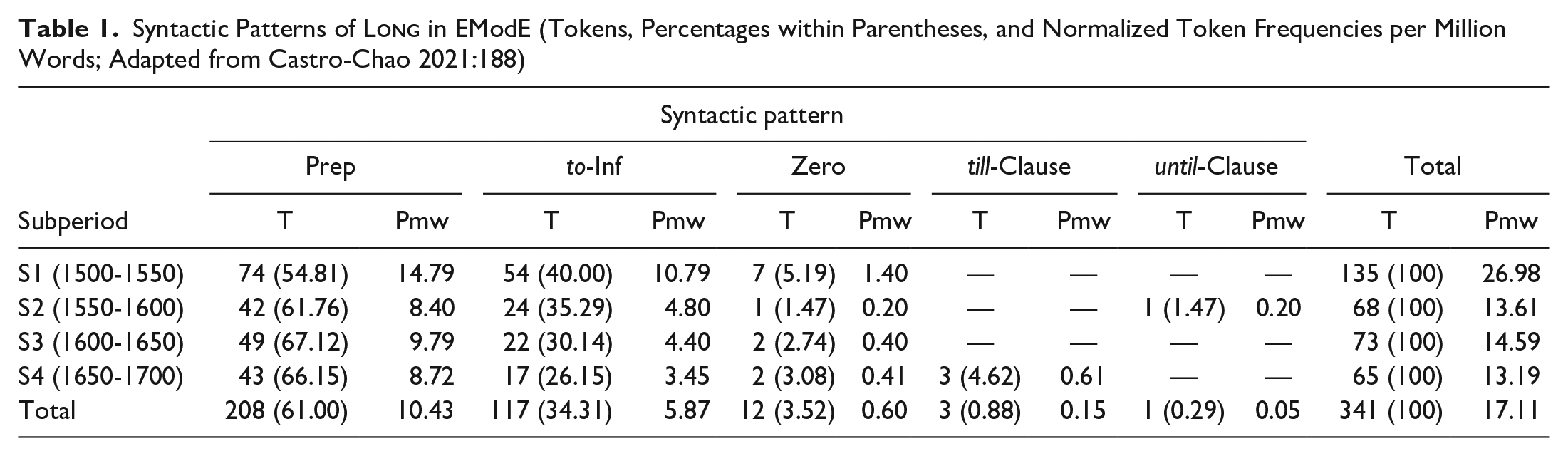
In light of the low frequency of
The dataset was then expanded to include also LModE and PDE. For this purpose, I used two additional corpora: (a) the Corpus of Late Modern English Texts, version 3.0 (CLMET3.0; De Smet, Diller & Tyrkkö 2013), a corpus comprising about thirty-four million words structured into three seventy-year subperiods (1710-1780, 1780-1850, 1850-1920), and covering five major genres (narrative fiction, narrative non-fiction, drama, letters, and treatise); and (b) the Corpus of Historical American English (COHA, circa 475 million words, 1820-2019; Davies 2010), covering also five major genres (TV/movies, fiction, magazine, newspaper, and non-fiction). The searches in CLMET3.0 were conducted with WordSmith Tools 8.0, 64 bits (Scott 2022) by means of the search strings “long* till” and “long* until,” which yielded only two instances of
Lastly, to explore the hypothesis that till/until-complements died out because of competition from to-infinitives and for. . .to-infinitives, data for these patterns were collected as well. For EModE, I consulted the twenty-million-word extract from EEBOCorp 1.0 as well as EEBO BYU. The pattern with to-infinitive complements was found to occur with notable frequency in EModE (see section 6.1), so I used only the twenty-million-word subcorpus from EEBOCorp 1.0. After manual sifting, this corpus yielded 117 instances of
For LModE, I made use of CLMET3.0 to retrieve data on to-infinitives—using the search string “long* to”—and on for. . .to-infinitives—using the string “long* for.” After manual sifting, the corpus yielded a total of 800 tokens of to-infinitives and nine tokens of for. . .to-infinitives.
6. Findings and Discussion
6.1. Syntactic Patterning of the Verb of Desire Long in EModE
Based on data drawn from the twenty-million-word subcorpus extracted from EEBOCorp 1.0 (see section 5), Table 1 provides an overview of the syntactic patterns attested with the verb
As can be observed, two of the complement types attested in earlier periods of English (see section 4.2), namely noun phrase complements and complements of direction realized by adverbs, have disappeared in EModE. At this stage, prepositional phrases introduced by for (155 tokens; example 25) or after (fifty-three tokens; example 26) constitute the most frequent type of complement. This is followed by to-infinitive clauses (example 27) and zero complements (example 28). There are only four instances of till/until-clauses (example 29) that are ambiguous between an adverbial and a complement reading (see 6.2). Example (28) illustrates the intransitive use of
(25) There is no doubt, but the sickeman for his health sake longeth for a medicine [. . .] (EEBOCorp 1.0; 1607, L. Ducci, Ars aulica or the courtiers arte) (26) Let vs thinke vpon this with diligent mynde, let vs long after this with our whole hart [. . .] (EEBOCorp 1.0; 1574, St. Augustine, Certaine select prayers gathered out of S. Augustine’s meditations) (27) And therfore wept he tenderly & longyd to lyue lenger [. . .] (EEBOCorp 1.0; 1529, T. More, The supplycacyon of soulys made by syr Thomas More) (28) I knew a pore woman with childe which longed and beinge overcome of her passion eate flesh on a fredaye which thinge she durst not confesse in the space of xviij. yeres [. . .] ‘I knew a poor woman with child who felt a strong yearning [for meat], and being overcome by her desire, ate meat on a Friday, a thing which she did not dare to confess for eighteen years [. . .]’ (EEBOCorp 1.0; 1528, W. Tyndale, The obedie[n]ce of a Christen man) (29) And if he see a storm coming, he will make some haste to secure him before it falls; as the Husbandman hurries in his corn, when he sees danger of the rain. Thou long’st till thy corn be in the barn; And Christ longs till thou be in heaven. He is not compleat without thee [. . .] (EEBOCorp 1.0; 1668, R. Steele, The husbandmans calling shewing the excellencies, temptations, graces, duties)
From a diachronic perspective, prepositional patterns increase from 54.81 percent of uses in subperiod 1 to 66.15 percent in subperiod 4. To-infinitives, by contrast, decrease, dropping steadily from 40 percent in subperiod 1 to 26.15 percent in subperiod 4. Zero complements, for their part, remain below 6 percent of uses throughout the period.
6.2. Frequency and Status of till/until-Clauses with Long from 1470 Onward
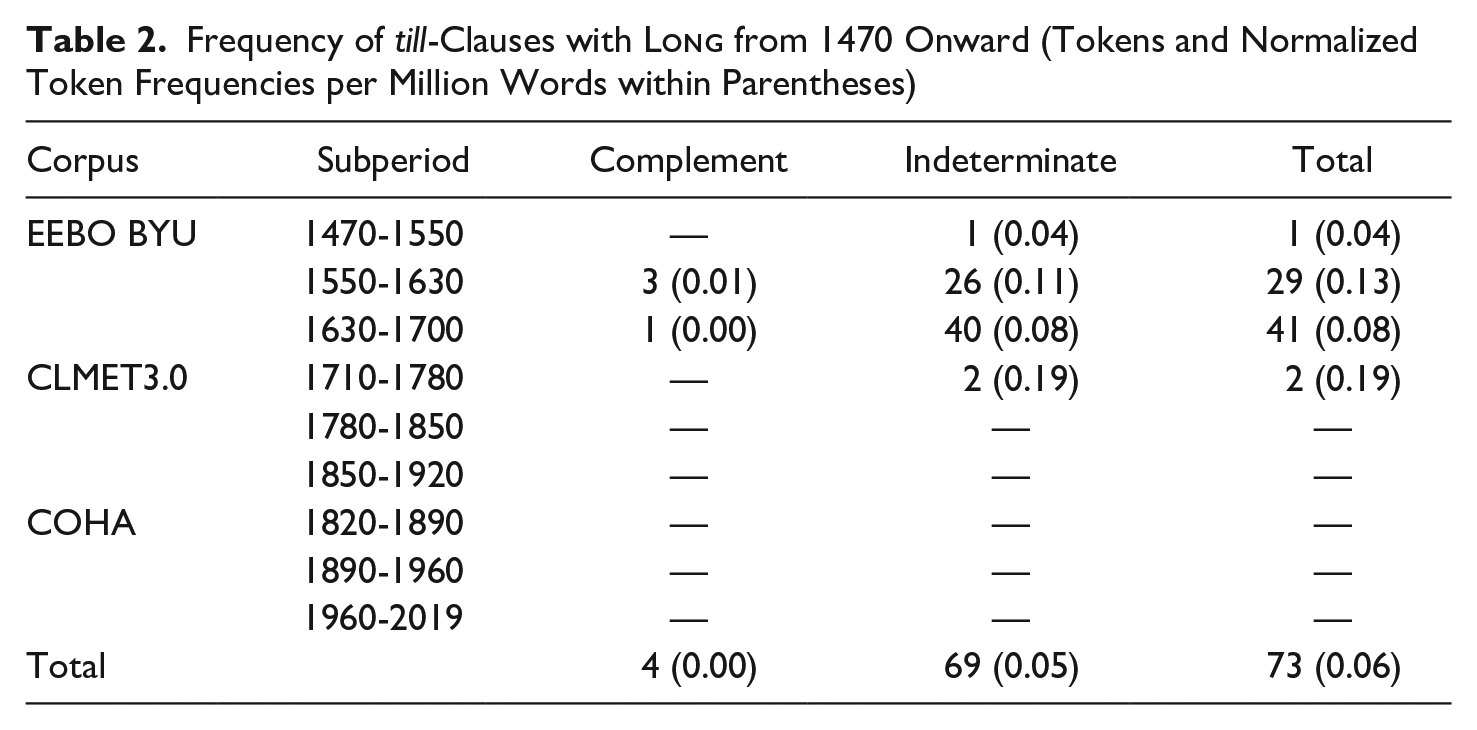
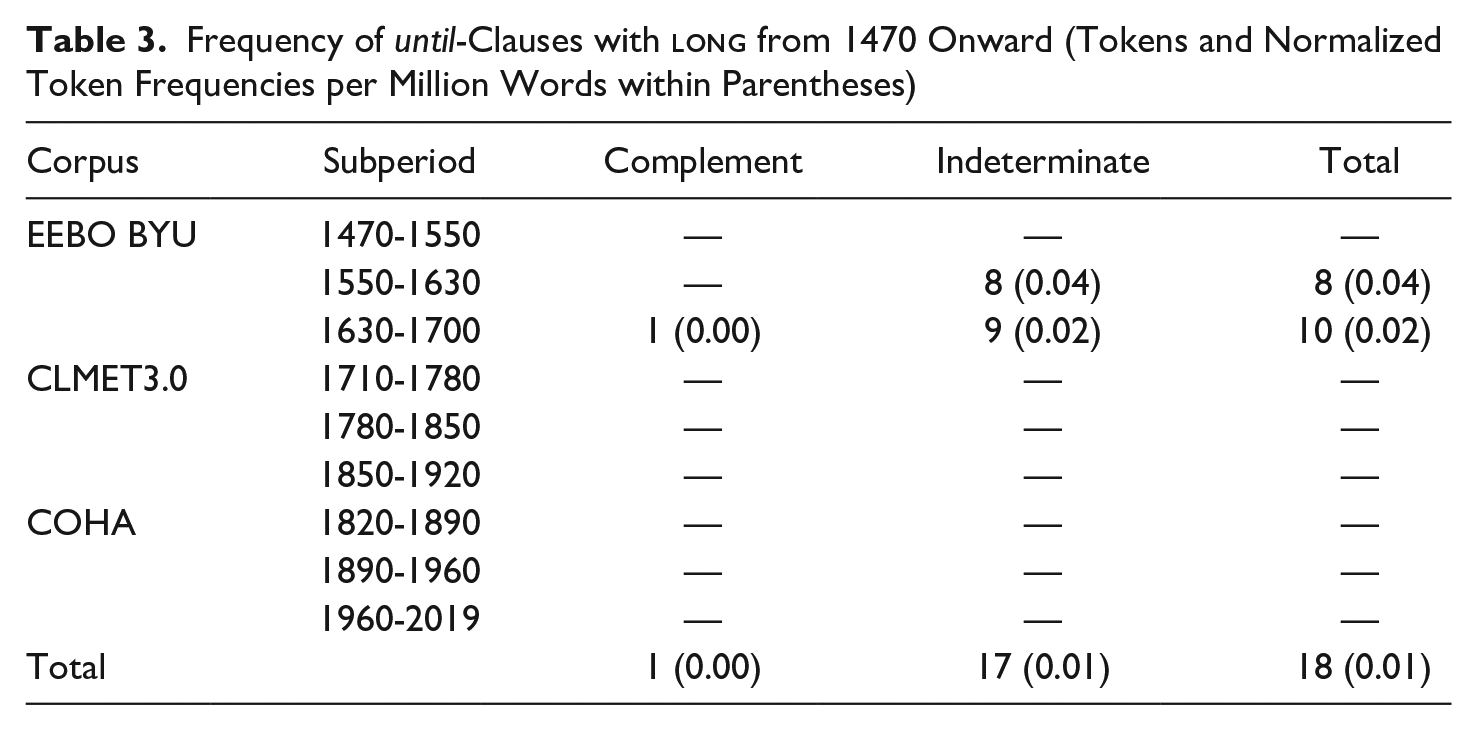
The results for till- and until-clauses in EEBO BYU (1470-1700) and CLMET3.0 (1710-1920) are displayed in Tables 2 and 3. Two categories of clauses have been distinguished: complement clauses (five tokens), which can be identified as such on the basis of the morphosyntactic criteria for complementhood expounded in section 2, and indeterminate clauses (eighty-six tokens), which constitute the great majority of instances. The category “indeterminate” includes tokens where both an adverbial and a complement reading are possible; an example is (30).
(30) you have not met with moderate men, i am one that on occasion can spend, and then again spare, but pray you enter, i long till my wife and my son see you [. . .] (EEBO BYU; 1659, Aristophanes, The worlds idol)
Here, as was the case with examples (21) and (22) discussed in section 4.2 earlier, a double interpretation seems possible.
Frequency of till-Clauses with
Frequency of until-Clauses with
A different interpretation is that the till-clause is mapped onto the second argument of
In the case of a few of the examples I have counted as indeterminate, the interpretation of the till/until-clause as an adverbial clause of forward span appears to be somewhat preferable, because of the presence in the overall context of some kind of temporal specification. Such is the case, for example, of the temporal frame implicit in the noun day and the future-oriented verb group shal come in (31), which support a reading as ‘I am restless until that day shall come.’
(31) [. . .] i know while i am in this body i shal never be with the lord as i should be, but I long til that day shal come (EEBO BYU; 1661, S. Marshall, The vvorks of Mr Stephen Marshall)
Yet, even in cases like this, a complement reading (‘I long for that day to come’) cannot be ruled out, and the application of the two morphosyntactic criteria for complementhood outlined in section 2 fails to solve the ambiguity.
Yet despite this persistent ambiguity, the corpus data do offer evidence that the shift A > C, that is, the reinterpretation of an originally adverbial till/until-clause as a complement, effectively took place. Clear indications of such shift can be found in the ability of the till/until-clauses following
(32) the one hath the spirit which saith come, the other shake at the mention of this comming: the one longeth till these shadowes flie away, and that day breake on them; the other can no more desire his comming, then the guiltie fellon can the comming and presence of the iudge (EEBO BYU; 1612, T. Taylor, A commentarie vpon the Epistle of S. Paul written to Titus) (33) they long for death, even as a hungry man longeth for any meate, or as a woman with child longeth for some speciall meate, as a fish longs for the baite, or as an angler longeth till the fish bites, or as a beleever (which as it is the most spirituall, so the most ardent desire of all) desires, to have any promise fulfilled [. . .] (EEBO BYU; 1643, J. Caryl, An exposition with practical observations)
In (33), the sequence as an angler longeth
A roughly analogous example is (34), where the until-clause occurs in parallel to the prepositional object for his inheritance.
(34) let us therefore (as an holy divine would have us) spend many thoughts upon it [i.e., this most glorious place]; let us enter into deepe meditations of the inestimable glory of it: let us long untill we come to the fingering and possession of it: even as the heire longeth for his inheritance (EEBO BYU; 1632, R. Bolton, Mr. Boltons last and learned worke)
A second, albeit more indirect, piece of evidence also suggesting that till/until-clauses with
The data from EEBO BYU and CLMET3.0 also reveal that till/until-clauses with the predicate
6.3. The Extension of till/until-Clauses from the Adjective Long to the Predicate Long
Section 4.2 referred briefly to the lexicalized collocation
(35) so deepely did the kings words pierce their brests, that with a generall voyce, Reuenge they cry, now euery man the inuasiue Greeke detests, and thinkes it long, til they can greece defie, Soone after this, the king his nobles feasts [. . .] ‘the king’s words pierced their hearts so deeply, that with a collective voice they cry ‘Revenge!’; now every man detests the invading Greeks, and thinks it [a] long [time], until they can defy Greece. Soon after this, the king feasts his nobles [. . .]’ (EEBO BYU; 1609, T. Heywood, Troia Britanica) (36) this made me the more impatient; and so it was, that being invited thither to dinner again the next day, i thought long till the time was come, and had not (the next day) been long there, but told the master of the house, before much company, that were then present, what i had heard of the man [. . .] (EEBO BYU; 1672, M. Casaubon, A treatise proving spirits, witches, and supernatural operations)
Though the sequence
Frequency of
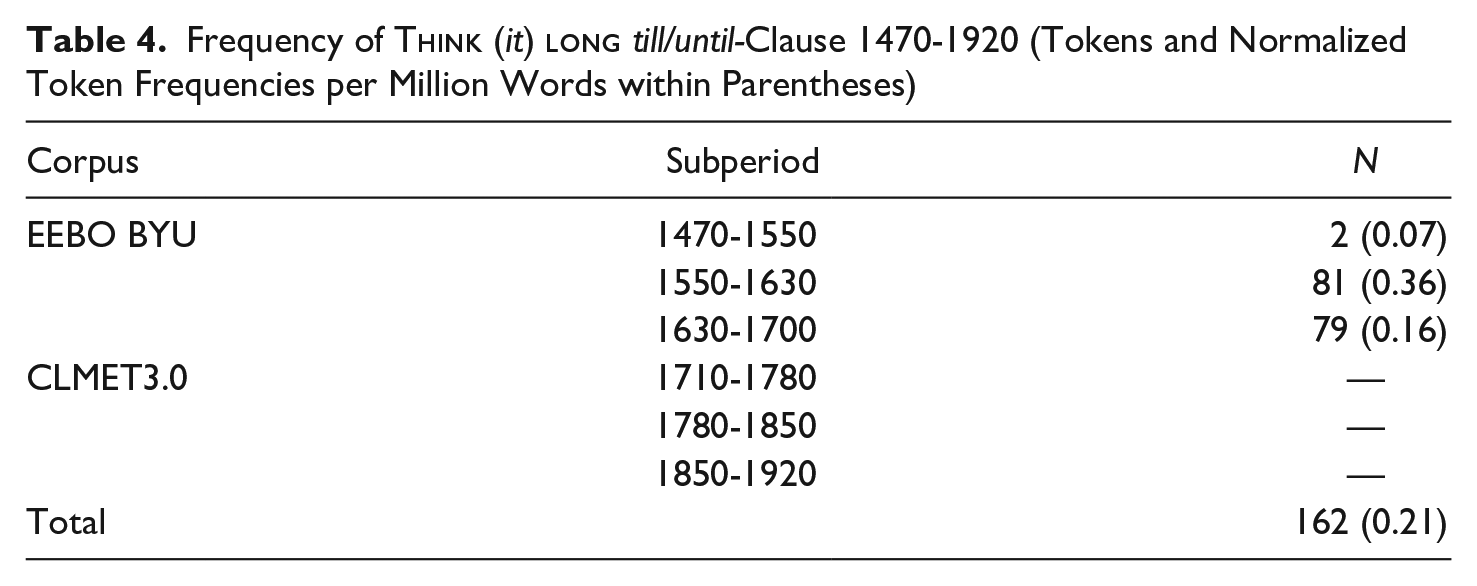
These findings suggest that the use of till/until-clauses with the predicate
The evidence presented in section 6.2 (Tables 2 and 3) also shows that instances which receive a clear, unambiguous adverbial reading are never encountered in the data; this suggests that, once till/until-clauses had spread to
(37) I knew a pore woman with childe which longed and beinge overcome of her passion eate flesh on a fredaye which thinge she durst not confesse in the space of xviij. yeres [. . .] ‘I knew a poor woman with child who felt a strong yearning [for meat], and being overcome by her desire, ate meat on a Friday, a thing which she did not dare to confess for eighteen years [. . .]’ (EEBOCorp 1.0; 1528, W. Tyndale, The obedie[n]ce of a Christen man)
When
6.4. The Loss of till/until-Complement Clauses
Section 6.2 showed that till/until-clauses following
6.4.1. To-Infinitives versus till/until-Complements
As discussed in section 6.1 (Table 1), to-infinitive clauses figure prominently among the complementation patterns of
Frequency of to-Infinitives with
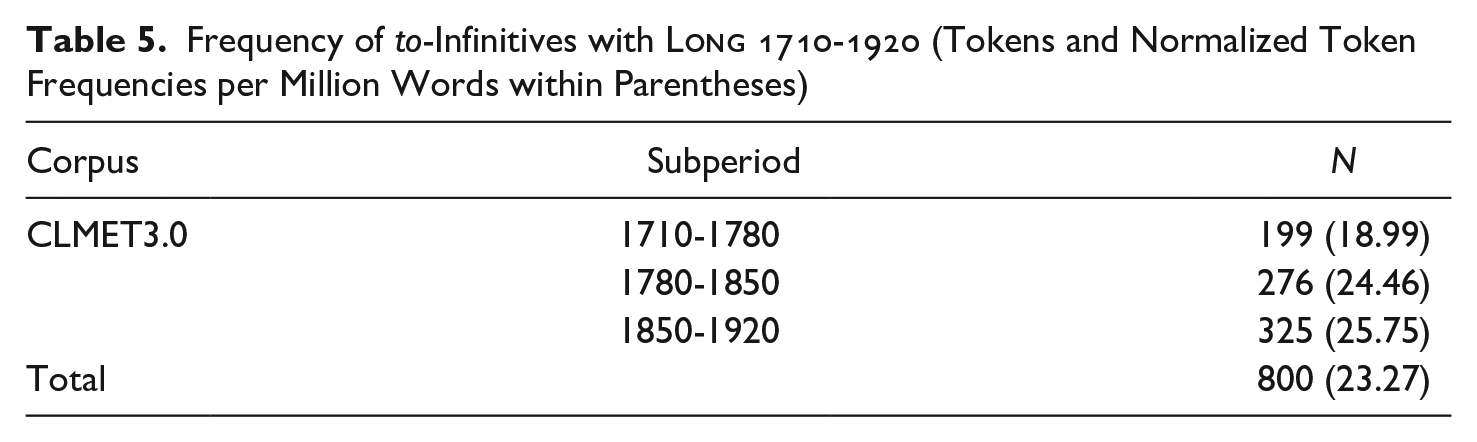
The EModE periods in which to-infinitives show the lowest frequencies—that is, EEBOCorp 1.0 subperiods 2 (1550-1600, 4.80 pmw), 3 (1600-1650, 4.40 pmw), and 4 (1650-1700, 3.45 pmw; see Table 1)—coincide chronologically with the periods when the collocation
Such replacement might be interpreted as largely resulting from the operation of the process of “equi-deletion” (Noonan 1985:65-68). As is well known, “[e]qui-deletion (equi) deletes subjects of complements when they are coreferential with (i.e., refer to the same individual or thing as) some argument in the matrix” (Noonan 1985:66); its application yields reduced complements, such as to-infinitives. Thus, a sequence like *Zekei expects that Zekei will plant the corn is anomalous in PDE and has to be rephrased as Zeke expects to plant the corn.
Equi-deletion is a syntactic rule that applies solely to complementation structures, as in the example just mentioned. Adverbial clauses, which are adjuncts, fall outside its scope, hence the grammaticality of sentences like Ii have lived here since Ii moved from London or Ii did it because Ii wanted to, where the matrix and subordinate clause subjects are coreferential. The till/until-complements following
(38) Come lead the way, I long till I am there (EEBO BYU; 1594, C. Marlowe, The troublesome raigne and lamentable death of Edward the second) (39) [. . .] that villanous [. . .], sir richard clare longs till he bee at the Nunry (EEBO BYU; 1608, Author unknown, The merry deuill of Edmonton)
Coreferentiality occurs in a total of thirty-six out of ninety-one tokens, or 39.56 percent, of the till/until-clauses in my data. This suggests that, as such clauses came to be parsed as complements by language users, the process of equi-deletion may have resulted in to-infinitives replacing till/until-complements in same-subject situations. In addition, this development can no doubt also be connected to the general tendency for finite complement clauses to be replaced by non-finite ones that has been at work in English in the course of history. As Denison (1998:257-258) points out, “[a] long-term trend in English has been the growth of nonfinite complement clauses at the expense of finite clauses,” a trend which continues, and becomes very noticeable, in LModE (see also Aarts, López-Couso & Méndez-Naya 2012:878).
6.4.2. For. . .to-Infinitives versus till/until-Complements
The rise of for. . .to-infinitives has been examined in depth by De Smet (2013). Formally, this pattern involves a structure in which a noun phrase introduced by for acts as the subject of a following to-infinitive with which it forms a constituent (De Smet 2013:73); two corpus examples are (40) and (41).
(40) Sometimes when I am rather tired I lean rather languishingly on a rock, and long for some famous Beauty to get down from her Palfrey in passing, approach me, [. . .], and give me - a dozen or two capital roastbeef Sandwiches. (CLMET3.0; 1816-20, J. Keats, Letters of John Keats to his family and friends) (41) She welcomed back her old enchanted dream of life, and longed for the old dark door to close upon her [. . .] (CLMET3.0; 1844, C. Dickens, Dombey and Son)
For. . .to-infinitives emerge in object position only at the beginning of the eighteenth century (De Smet 2013:78-79, 90; see also Visser 1973:2244-2248), and they spread to predicates such as
Semantically, for. . .to-infinitives are associated with goal-oriented meaning (De Smet 2013:77, 88), as illustrated by (42) with the verb
(42) He has to talk to the country in terms which will make the voters yearn for him to replace John Major before another year is out. (Collins Cobuild Corpus; cited from De Smet 2013:88) (43) as those who are diseased with a rheumatism, being worse in the night than the day, impatiently long for the rising sun to dispel the oppressing Humors, and cheer their spirits [. . .] (EEBO BYU; 1684, W. Bates, The great duty of resignation to the divine will)
Table 6 shows the evolution of for. . .to-infinitives with
Frequency of for. . .to-Infinitives with
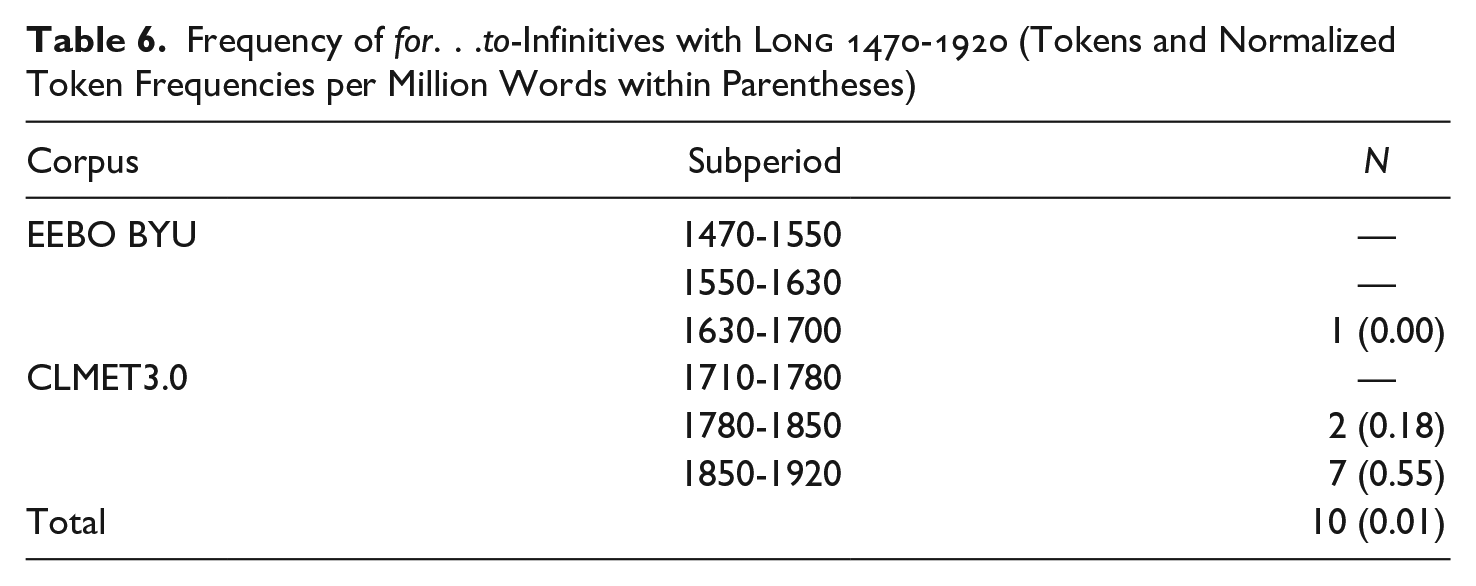
In 6.4.1, I invoked coreferentiality as a likely factor behind the replacement of till/until-clauses by to-infinitives. However, 60.44 percent (fifty-five tokens) of till/until-clauses following
(44) I long till edward fall by Warres mischance, for mocking marriage with a dame of France. (EEBO BYU; 1623, W. Shakespeare, Mr. William Shakespeares comedies, histories & tragedies)
7. Summary and Conclusion
This article has addressed the development of the adverbial subordinators till and until as minor complementizers introducing clauses governed by the desiderative predicate
One of the factors which seems to have prompted the sudden, though short-lived, popularity of till/until-clauses with
The case of till/until-complements thus provides a good example of what Joseph (1997) has referred to as marginal data (section 3). The common assumption is that the core aspects of language lend themselves to a greater degree of generalization, whereas marginal phenomena are only exceptional and tend to resist systematic investigation, being “often hard to integrate into broader, more far-reaching analyses” (Joseph 1997:197). The present study, however, has shown that the spread of till/until-clauses to
The decline of till/until, on the other hand, can also be approached and understood in terms of developments involving competition between variants and the eventual replacement of grammatical elements (e.g., Hundt & Leech 2012; Hundt 2014). It thus furthers our insights into the role of competition in processes of loss by exploring obsolescence in a lexically specific domain, allowing us to reconsider the generalizations and universals involved in it from the perspective of linguistic marginalia. Taking frequency of occurrence as a measure of the entrenchment of linguistic units and constructions (Langacker 1987:59), the newly-emerged, low-frequency till/until-complements had few chances to survive when facing the competition as verb complements of the more frequent to- and for. . .to-infinitives and their continued growth in the course of LModE; since frequency of exposure leads to greater memory strength, a frequent linguistic unit is remembered better (Bybee 1985:119). The present case thus provides evidence in favor of the principle Survival of the Frequent (section 3) as a potential universal which claims that “[w]hen a distinction is given up, only the most entrenched category survives” (Haspelmath 2004:19; see further Kranich & Breban 2021:9-10; cf. Kuo 2021). As Traugott notes (2014:17), “each [construction] has its own history within the constraints of larger patterns,” and constructional loss, like constructional emergence, involves interacting changes affecting constructions within a network (Kuo 2021:144-153).
Footnotes
Acknowledgements
Thanks are due to the editors and anonymous reviewers of JEngL for their most valuable suggestions on an earlier version, and to Teresa Fanego and Nuria Yáñez-Bouza for their guidance and support. Needless to say, any shortcomings are my own.
Declaration of Conflicting Interests
The author declared no potential conflicts of interest with respect to the research, authorship, and/or publication of this article.
Funding
The author disclosed receipt of the following financial support for the research, authorship, and/or publication of this article: For generous financial support I am grateful to the European Regional Development Fund, the Spanish Ministry of Science and Innovation (grant PID2020-114604GB-100), and the Regional Government of Galicia (grants ED431B 2020/01 and ED481B-2021-046).
