



Abstract
This study examines production of the vowels /æ/, /ɛ/, and /e/ among three different English-speaking ethnic populations in Manitoba, Canada, focusing on patterns of raising and vowel overlap in prevelar contexts. Although raising of /æ/ before /ɡ/ has been documented for the Prairies region of Canada generally, its specific occurrence in Manitoba as well as the occurrence of vowel merger(s) there has not previously been examined in detail. This study finds that pre-velar patterns are distinguished by coda voicing, with voiceless /k/ producing lowering and some retraction while voiced /ɡ/ and /ŋ/ produce similar raising and especially fronting patterns in preceding /æ/ and /ɛ/. Statistical analysis of spatial and temporal qualities shows that, while complete merger is not observed between any of the three vowels, there is much more substantial overlap in their productions before the voiced velars than in other contexts; in contrast, the voiceless velar /k/ is associated with productions which often substantially diverge from these. The results suggest that Manitoba speakers’ productions of these vowels share some features of other dialects with velar-affected productions, but the arrangement of these features in Manitoba may represent a unique configuration having a potential, incipient, or early-stage prevelar merger of /æ/ and /ɛ/, mainly without the participation of /e/. Social factors such as conservatism and extra-local affiliation are also found to play a role in production.
1. Introduction
This study investigates the production of the phonological process known as “prevelar raising” or “bag-raising” among English speakers in the province of Manitoba, Canada. Under prevelar raising, the vowel /æ/ in bag and similar words having a final /ɡ/ is raised to a higher position in acoustic space. This process has been documented in several North American English dialect regions including the Pacific Northwest (Freeman 2014; Wassink 2015, 2016; inter alia) and US Upper Midwest (Bauer & Parker 2008; Purnell 2008; inter alia). In such dialects, a raised /æ/ vowel as in bag can overlap acoustically with the otherwise contrasting vowels /ɛ/ in beg and/or /e/ in bagel such that these classes of words, i.e., these separate vowels when they occur in prevelar contexts, are homophonous or merged to some extent. In Canada’s Prairies region, which includes Manitoba, situated between the Pacific Northwest and the Upper Midwest, occurrence of prevelar raising has been previously documented (Labov, Ash & Boberg 2006; Rosen & Skriver 2015). However, the extent to which Prairie bag-raising involves actual or potential merger with either beg or bagel is currently unknown, as is the precise realization or degree of prevelar raising as it is produced across the three Prairie provinces (Alberta, Saskatchewan, and Manitoba). This study, focused on the easternmost Prairie province of Manitoba, examines acoustic productions of the vowels /æ/, /ɛ/, and /e/ across various phonological contexts, including in prevelar position. The results provide a platform for comparison to studies on prevelar raising in other regions, while also expanding the scope of the investigation in two respects. Ethnolinguistic differentiation, a social aspect of language variation that is under-researched in Manitoba and the Prairies more generally, is addressed through the inclusion of several major ethnic groups. Methodologically, the scope of analysis is also expanded by addressing both spatial (acoustic formants) and temporal (acoustic duration) aspects of production: first under separate linear regression models of spatial and temporal differences and then using generative additive models of formant trajectories which unite the two.
Section 2 provides important background information covering the occurrence of prevelar raising and its association with front-vowel merger in North American English varieties. This section is followed by discussion of the social context relevant to this study, highlighting the Mennonite and Filipino communities in Manitoba, who make up important components of the corpus which provides the data analyzed. Next, the materials and methods are described in section 3. The results are then presented in section 4, arranged as follows. First, I investigate static vowel positions in acoustic space, comparing differences both across and within relevant coda contexts, with velar codas being the main area of concern. Next, I focus on vowel duration patterns, following a similar approach in terms of coda contexts. The final stage of analysis concerns dynamic vowel trajectories, incorporating both positional and durational information. Section 5 discusses how these findings relate to prior literature.
2. Background
2.1. Geographic Context: Prevelar Raising and Front-Vowel Merger in North American English
Prevelar raising has been documented in two key regions of the United States: the Pacific Northwest, particularly in Washington state (Reed 1952, 1961), and the Upper Midwest, particularly in Wisconsin (Zeller 1997). While its origins are not entirely agreed upon, researchers have identified several phonetic and phonological factors which may have driven this change to occur independently in different dialects (see Mielke, Carignan & Thomas (2017) for an excellent overview). The western Canadian region of the Prairies, comprising the provinces of Alberta, Saskatchewan, and Manitoba, is yet a third key location for prevelar raising, forming a geographic link between the Pacific Northwest and Upper Midwest (Figure 1). Map of Selected Prevelar Raising Areas of North America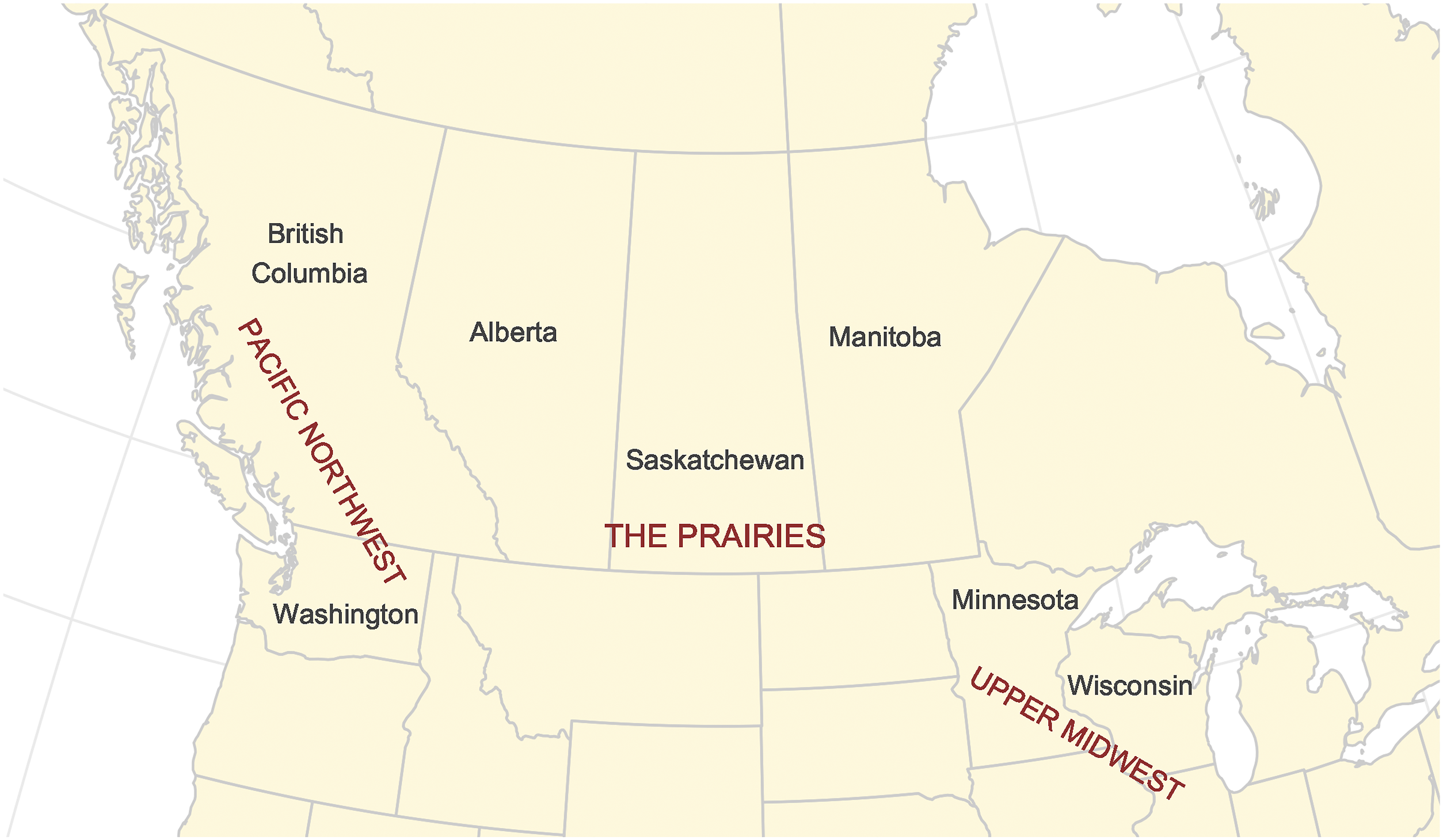
Prevelar raising in the Prairies has been documented by numerous studies, including The atlas of North American English (ANAE; Labov, Ash & Boberg 2006); however, outside of the Pacific Northwest (Swan 2016), Canadian prevelar raising is not typically linked with American productions as a common cross-border dialectal feature. In a multi-provincial study, Boberg (2008:145-147) found Canada-wide occurrence of prevelar raising, with the greatest degree of raising occurring in western Canada and particularly on the Prairies. Here, the Cartesian distance (across the vowel space as a two-dimensional plane) between non-raised /æ/ (e.g., trap versus raised bag) was significantly greater than regions in eastern Canada including southern Ontario, but only slightly greater than British Columbia. In Boberg (2010:208), raising of
Evidence for prevelar raising in the Pacific Northwest was perhaps first documented in dialectological studies by Reed (1952, 1961). Modern research on the acoustic productions of the
In Victoria, British Columbia—just across the Canadian border from Seattle—Roeder, Onosson, and D’Arcy (2018) showed that the degree of
Regarding the Prairies, Rosen and Skriver (2015) documented social patterning of
Returning to the US, prevelar raising in the Upper Midwest was first documented by Thomas (1947; cited in Bauer & Parker 2008). Analysis of this as a change in progress began under Zeller (1997). The ANAE (Labov, Ash & Boberg 2006) subsequently identified a prevelar merger of Wisconsinite
Manitoba’s particular geopolitical position along with its economic and cultural ties provide multiple linkages to those dialect regions where prevelar raising is a prominent feature. As a Prairie province, Manitoba shares many commonalities with Alberta, linguistically and otherwise. As a western Canadian province, it is further linked to British Columbia and, by proximity, the extended Pacific Northwest. However, Manitoba also lies immediately adjacent to the Upper Midwest, specifically the state of Minnesota. Minneapolis (population 3.6 million; US Census Bureau 2021) is the closest major center to Winnipeg at approximately 700 kilometres distance, with which it has important economic and cultural ties. In contrast, the closest comparably-sized Canadian cities of Vancouver (4.7 million; Statistics Canada 2016) and Toronto (13.5 million) are each more than 2000 kilometres away from Winnipeg, and even the two largest Prairie cities, Edmonton (1.3 million) and Calgary (1.4 million), are twice as far from Winnipeg as Minneapolis. It would not then be very surprising if there were indeed more similarities between Minnesota and Manitoba speech than have already been documented (Lopez-Backstrom & Koffi 2020), including production of prevelar raising.
2.2. Social Context: Mennonite and Filipino Settlement in Southern Manitoba
As with any colonized territory, the original linguistic landscape of Manitoba has been dramatically reshaped over the course of its colonization. Some of the Indigenous languages of the province are in relatively healthy shape in comparison with those in other parts of Canada and the United States, but they all have nonetheless been overwhelmed and had their viability threatened by the migration into Manitoba of settlers and other immigrants from countries and regions around the world bringing their languages with them. 1 The transformation of the ethnic and linguistic makeup of Manitoba over the past century and a half is certainly remarkable. According to the most recent census data (Statistics Canada 2016), the top ten ethnicities by proportion currently represented in Manitoba’s population (total of 1.28 million) include: English (19.8 percent), Canadian (19.4 percent), German (17.8 percent), Scottish (16.8 percent), Ukrainian (14.5 percent), Irish (12.6 percent), French (12 percent), First Nations (11.5 percent), Métis (7.3 percent), and Filipino (6.7 percent). Of those languages with a greater than one-percent share of “mother tongue” speakers, English is by far the largest reported in the census at 71.4 percent, followed by German (5.1 percent), Tagalog (3.8 percent), French (3.1 percent), Punjabi (1.5 percent), and Cree (1.1 percent), Cree being the only Indigenous language to surpass this very minor threshold. While religion was not surveyed in the 2016 Canadian census, data from 2011 shows Mennonites comprising 3.8 percent of the population (Statistics Canada 2011). This last statistic is relevant to the connection between ethnicity and language use because, within the Manitoba context, German ancestry, German language fluency or heritage, and Mennonite religious affiliation (personal or familial) are strongly linked.
Despite its history of diverse in-migration and settlement, ethnolinguistic variation is little-documented in Manitoba. Certain distinctive production patterns of ethnically Filipino-Winnipeggers (Tran 2018; Onosson, Rosen & Li 2019) and Mennonite-Manitobans (Hadei 2020; Onosson 2020) have only recently been documented. Being of particular social and linguistic importance within Manitoba, the Mennonite and Filipino communities were therefore selected to form major components of the corpus utilized for the present study (see section 3.1). The following subsections provide a short synopsis of each community.
2.2.1. Mennonite-Manitobans
The majority of ethnic German-Manitobans trace their ancestry back to Mennonite communities who migrated en masse to Canada from a region centered in and around present-day Ukraine (then part of the Russian Empire) towards the end of the nineteenth century. Mennonites living in Imperial Russia found their pacifist way of life threatened by the removal in 1870 of previous military exemptions amid a program of Russification (Sawatzky 1970:150). In that same year, Manitoba entered the Canadian confederation as its first western province, following the Métis uprising under Louis Riel, who were seeking self-governance in their territory, which was centered in the region around the modern-day city of Winnipeg. This development was followed by a strong push by the Canadian federal government for increased immigration to the province to counteract further civil unrest and aid in rapid development of the Canadian West (Friesen 1987:195-204). The out-migrating Mennonite communities thus became one of the principal groups targeted by Canadian government initiatives promoting Canadian in-migration, such that two regions of the province, the West and East Reserves, were specifically dedicated for Mennonite immigrants. Settlement proceeded quickly, and by 1880 nearly 7000 migrants occupied the two Reserves (Sawatzky 1970:147), an impressive number considering that a decade earlier Manitoba’s total population had been only some 12,000 people (Friesen 1987:201). During their time in Russia/Ukraine, the Mennonite communities had diverged along religious lines, with some favoring a more liberal view and greater integration with non-Mennonite society, and others being more conservative and insular. When resettling in Manitoba, the latter more conservative sect occupied the East Reserve while more liberal-minded groups (including a splinter group from the East Reserve) occupied the southerly West Reserve along the international border (Klassen 1981:22-23).
Although originating as religious communities and functioning as such in other regions in the present day, Mennonites may be considered a kind of ethnicity within the twenty-first century Manitoba context, as some of the descendants of those early migrants abandon the formal religion itself and yet maintain cultural ties with other, more religiously-minded Mennonite communities. Labov (2001:245) has noted that ethnicities are not comparable across different social contexts, because “[w]hat makes one ethnic group different from another will differ from one society to another.” The function of being Mennonite in Manitoba was discussed explicitly by one of the interviewees in the present study, a Winnipeg resident partially descended from early Mennonite migrants to the province: Because my last name is [REDACTED], it’s a Mennonite name, it came from my dad’s side. So, I’ve always had sort of an, identified with Mennonites, largely due to the last name, and the fact that my dad grew up in an area of the province that’s heavily Mennonite, and they did go to a Mennonite church, and they did farming. The Mennonites, a lot of them do, they are farmers. So that whole world is connected to the farming, and the last name, and my dad can speak some of the German […] I was eight, my brother was twelve when my grandfather died. That sort of ended that era of the farm, ‘cause then they sold a bunch of the farm off, my dad sold off his part. And so that experience came to an end […] And so, I didn’t have that connection anymore to the farm. But growing up we went to […] a multi-denominational church. There were a lot of people in the church that had Mennonite backgrounds, but it wasn’t, it was not a Mennonite church. And in a lot of cases, people say that you’re not actually a Mennonite. A Mennonite is actually, should be, is by definition someone who goes to a Mennonite church, because it’s a religious, but it’s also cultural […] My dad argues that you have to be going to a Mennonite church if you’re Mennonite, if you call yourself a Mennonite. Of course, you can say you have Mennonite background. So, I have Mennonite background. (LIPP interview #435)
As this passage highlights, an individual’s status as “a Mennonite” is not necessarily linked to their religious affiliation nor their participation in a traditional Mennonite lifestyle, although such a disconnect may lead to a qualifying statement of oneself as “having” a Mennonite background rather than simply “being” Mennonite. It is in this sense that it seems most similar to other ethnicities, as many other (non-Mennonite) study participants similarly described themselves as “having” various ethnic backgrounds, rather than “being” that ethnicity (see also section 2.2.2).
2.2.2. Filipino-Manitobans
Arriving in Manitoba much more recently than Mennonites and other early-period (pre-twentieth century) settler communities, Filipino-Manitobans have quickly become one of its most influential and sizeable ethnic groups. Following the implementation of Canada’s 1967 Federal Skilled Worker Program, Winnipeg became a focal point for Filipino migration, beginning with the recruitment of nurses and textile workers who helped to raise its profile as a location with employment opportunities for skilled and professional-class female migrants from the Philippines (Mais 2012; Malek 2019). The Philippines has continuously ranked as the top source country for migration to Manitoba since the 1980s, providing between 23 and 36 percent of all in-migration over the past forty years (Statistics Canada 2016). Ethnic Filipinos comprise 9.7 percent of Winnipeg’s overall population and 37.8 percent of its visible minority population, defined as “persons, other than Aboriginal peoples, who are non-Caucasian in race or non-white in colour” (Statistics Canada 2021), more than double the equivalent proportions of any other major Canadian city; nationally, ethnic Filipinos make up just 2.3 percent of the general Canadian population.
Although Filipino is a considered a distinct ethnicity within Canada, it is important to mention that the Philippines is a multi-ethnic society within which Filipino is simultaneously a nationality and an ethnicity, akin to some usages of “Canadian” in that respect (see the earlier reference to Canadian as the second-largest ethnic group in Manitoba). While a range of distinct Philippine ethnic groups and languages are represented in Manitoba, including Ilocano, Visayan, Kapampangan, Cebuano, and others, it is the Tagalog language, associated with the eponymous ethnicity (the second-largest ethnic group in the Philippines) which is by far the most widely-spoken, to the extent that mother-tongue Tagalog speakers outnumber French as well as all of Manitoba’s Indigenous languages, and are only exceeded numerically by English and German (typically Mennonite) speakers.
Among the Filipino participants in the present study, all of whom are Canadian-born, ethnic self-identity was a common topic of discussion, typically framed as a choice between Filipino, Canadian, Filipino-Canadian, and the least common variant: Canadian-Filipino. As with Mennonite-Manitobans, this choice of ethnic self-identification can be framed in terms of cultural membership, familial ties and heritage, and personal history: “[I identify as] probably like Filipino-Canadian just because, I don’t know. I don’t feel myself as really Canadian, uh, just because, I don’t know, I can speak Tagalog and stuff I guess, so both, but not fully Filipino ‘cause I wasn’t born there” (LIPP interview #209).
Cultural differences, especially for these second-generation participants, were often a point of reference: “I think of myself as Canadian but, Filipino roots or traits. How is that differentiated from Filipino-Canadian? Generally, when people relate Filipino-Canadian, in my opinion, is they think of themselves as Filipino first before Canadian. I don’t identify myself as that because I’m born here so I have Canadian values. I carry some traits from my parents, from what they taught us […] but no, I’m more Canadian” (LIPP interview #208).
Unlike most Mennonites, in the case of Filipino-Manitobans ethnic identity can also pertain to phenotypic differences, as mentioned by another participant: “I would say I’m Canadian-Filipino, I would be Canadian first ‘cause I feel like that’s my identity, like I am Filipino background, but in terms of culture I’m more Canadian but my skin is just brown so I’m Filipino” (LIPP interview #212).
3. Material and Methodology
Participant Demographics
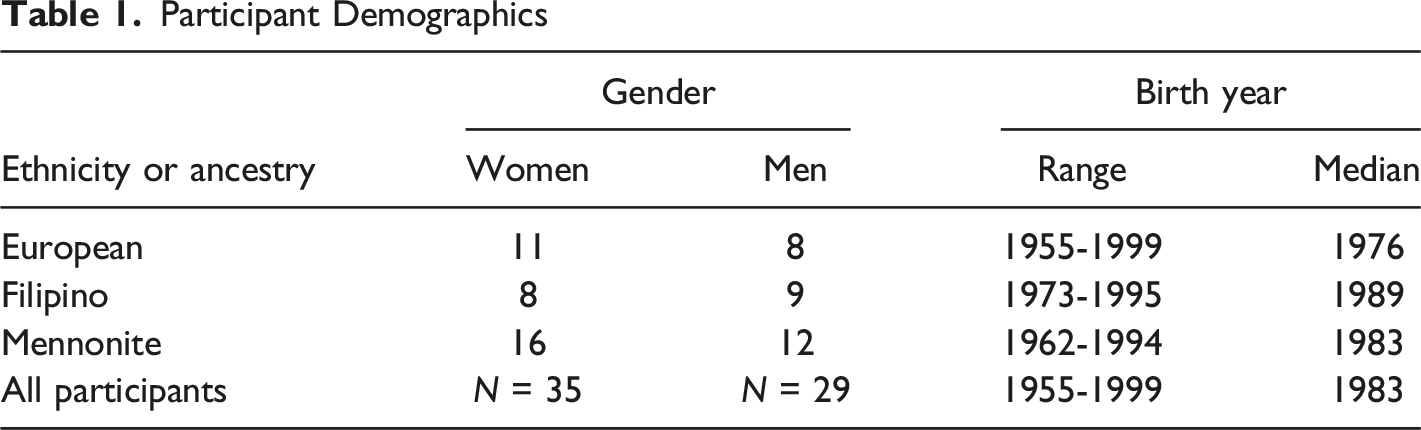
LIPP interview sessions were typically held at the residence of the interviewee and conducted by an interviewer who shared the same ethnic background or identity as the interviewee. Digital recordings were made at 44.1 kHz in uncompressed 16-bit WAV format, using an H2n Zoom handheld audio recorder, with individual Sennheiser EK 100G2 wired lavaliere microphones. Each LIPP recording session consisted of three components: a word list, two reading passages, and a sociolinguistic interview typically lasting between forty-five to ninety minutes in duration. For this study, only the interview recordings were analyzed. Most prior research on prevelar raising has relied on data deriving from reading tasks; indeed, interview data is relatively under-utilized across sociolinguistic studies, most likely due to the inherent additional workload which it necessitates. However, because of the possibility that prevelar raising in Manitoba may represent a change in progress, it was deemed optimal to investigate speech captured in a relatively low formality context.
Manual transcription of the LIPP interview audio files was carried out in ELAN (v5.6-FX; Wittenburg, Brugman, Russel, Klassman & Sloetjes 2006). The transcribed text was then processed in FAVE (v1.2.2; Rosenfelder et al. 2014), which provides per-token global data measurements including formant means and durations, as well as discrete timepoint-based formant values at five evenly-spaced intervals between 20 to 80 percent of token duration, inclusive. Tokens of the /æ/, /ɛ/, and /e/ vowels were extracted from the LIPP Manitoba interviews. Tokens were restricted to those bearing primary stress and not occurring before liquid segments (/l/ and /ɹ/) or non-velar nasals (/m/ and /n/), to limit potential confounds when considering non-velar codas as a group,
3
yielding 44,936 tokens in total (23,374 for /æ/, 9177 for /ɛ/, and 12,385 for /e/)
Two formant normalization methods were utilized. For statistical comparisons, the normalized values in Hertz provided by FAVE were adopted, as this scale is familiar and therefore readily interpretable (with the caveat that different normalization methods may produce different results from those obtained here). For data visualization, the z-score or Lobanov method (Lobanov 1971) was used, 4 wherein raw formant values in Hz are transformed as a proportion of their aggregated range across all vowels on a per-speaker basis; z-scaled formant data arguably produces a superior visual representation of cross-formant dynamicity and relative proportions in the vowel space.
Some phonetic and language-internal motivations for prevelar raising have been proposed. The ANAE notes that the likelihood of merger of the
The first stage of analysis examines static positional differences between vowel tokens. For this, FAVE-normalized mid-point F1 and F2 values were evaluated using linear regressions. Linear mixed effects regression models (LMERMs) were built using the lme4 package (Bates, Mächler, Bolker & Walker 2015). Dependent variables included (FAVE-normalized)
A set of LMERMs were built for each dependent variable for each vowel. The simplest model in each set excluded all social factors and was structured as follows:
The second stage of analysis examines durational differences. Studies such as Wade (2017) demonstrate that durational differences can play a critical role in distinguishing vowels which are otherwise merged acoustically. Vowel duration differences were compared under LMERMs following the same procedures discussed for static formants. These are accompanied by visualizations of duration as boxplots, a standard statistical tool for representing a single continuous variable.
The final stage analyzes vowel formant trajectories, uniting the positional and temporal data, using generalized additive mixed models (GAMMs; Hastie & Tibshirani 1990; Wood 2017). GAMMs compute “smooths” across different conditions, e.g., between different vowels in a unique coda context. Visual comparison of the degree of cross-smooth overlap provides an indication of where, when, and whether they represent significantly different conditions. It is thus possible to examine more precisely how the various trajectories are differentiated from each other in a way that single-variable analyses cannot. GAMMs were built following the general formula y ∼ s(x, k = 5, bs = “cs”) + s(random.effect, bs = “re”) where y represents a given formant, x represents a given phonological condition (vowel or coda type), and k (knots) relates to time-series (here, the five timepoints provided by FAVE), based on methodology described in Sóskuthy (2017). Inclusion of
4. Results
Figure 2 plots the mean formant positions across Manitoba’s monophthongal vowel system in F1xF2 space, aggregated across all participants and undifferentiated for region, ethnic background, gender, or age. Several features of the Manitoba vowel space are notable: it is somewhat compact in the F2 dimension, with the most back vowel being /o/ at F2 = 1256 Hz; /u/ is advanced/centralized; /ʌ/ is very low and back; and /æ/ is the lowest vowel in the system. The lowest-vowel status of /æ/ in Winnipeg was previously observed by Hagiwara (2006), who noted it as being consistent with production of Canadian Shift (Clarke, Elms & Youssef 1995). With regard to the focus of the present study, it is worth mentioning that the mean positions of the vowels /æ/, /ɛ/, and /e/ are relatively distant from each other. The Manitoba Vowel Space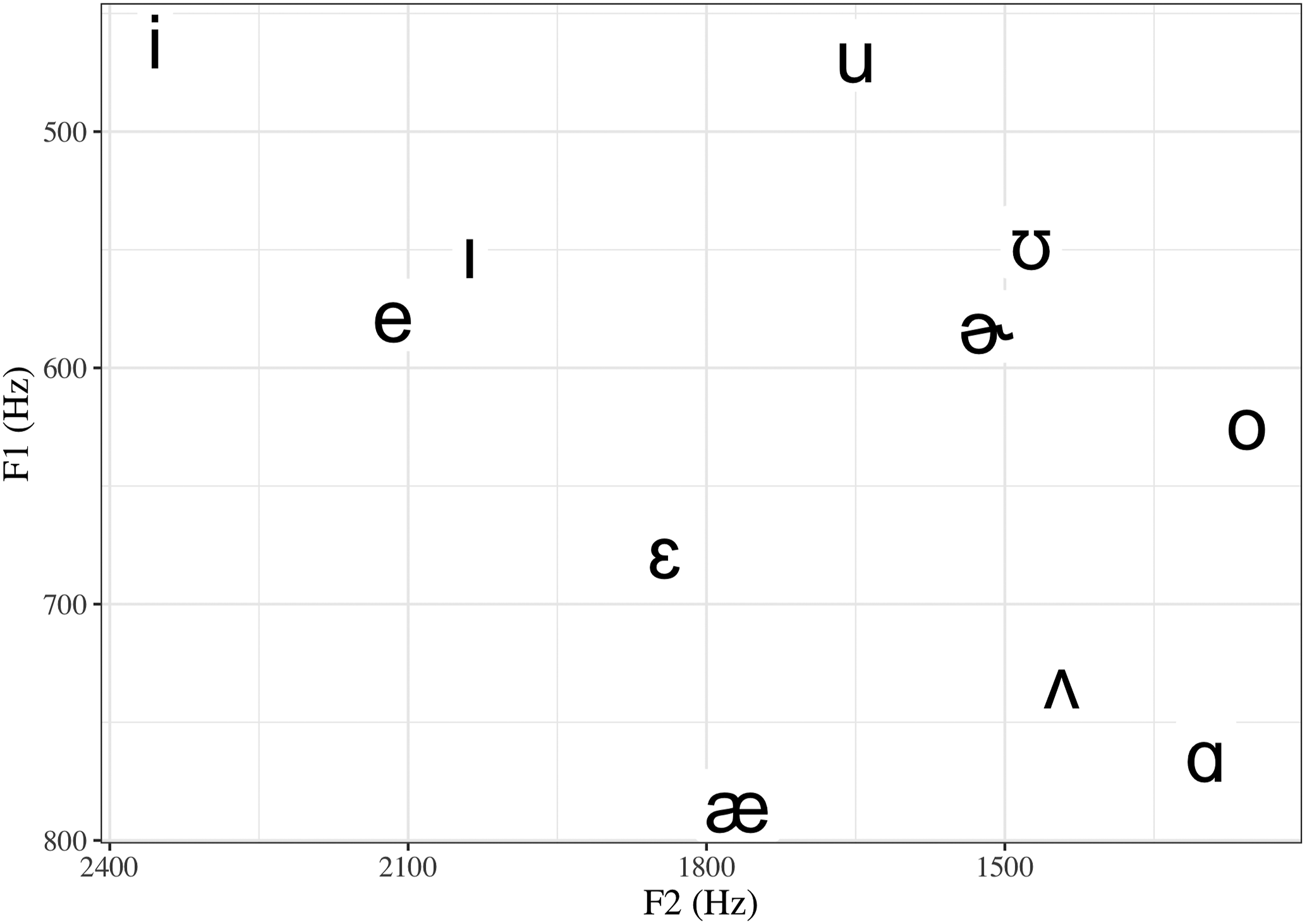
4.1. Static Vowel Positions
The examination of static vowel positions using LMERMs approaches the data from two distinct viewpoints. The first compares vowel formants (F1 and F2) as they occur within each of the three target
4.1.1. Static Vowel Positions Across Coda Contexts
Linear Mixed Effects Regression Models: Vowel Formants by Coda Context
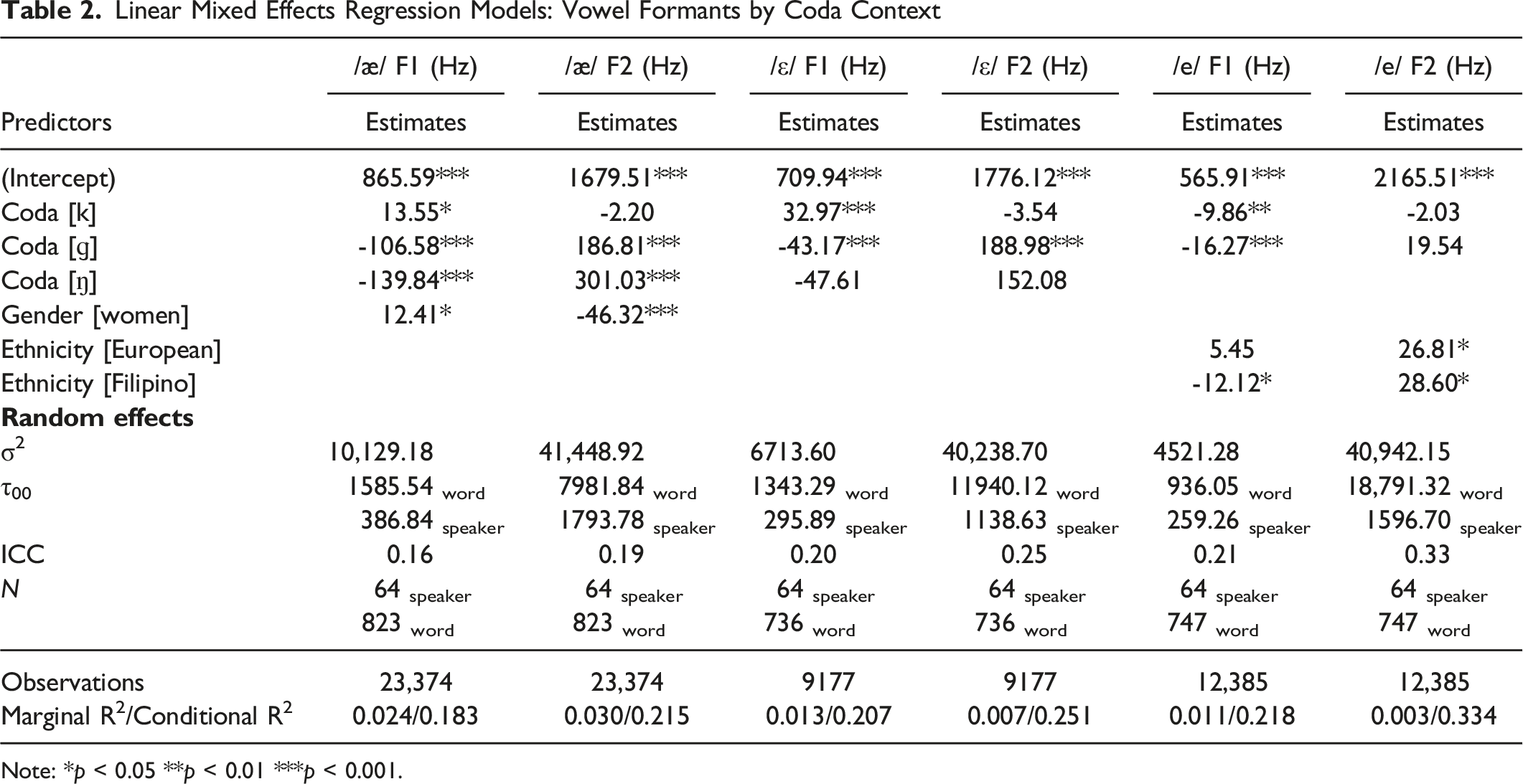
Note: *p < 0.05 **p < 0.01 ***p < 0.001.
Significant differences between Vowel Formant Density Distributions Across Coda Contexts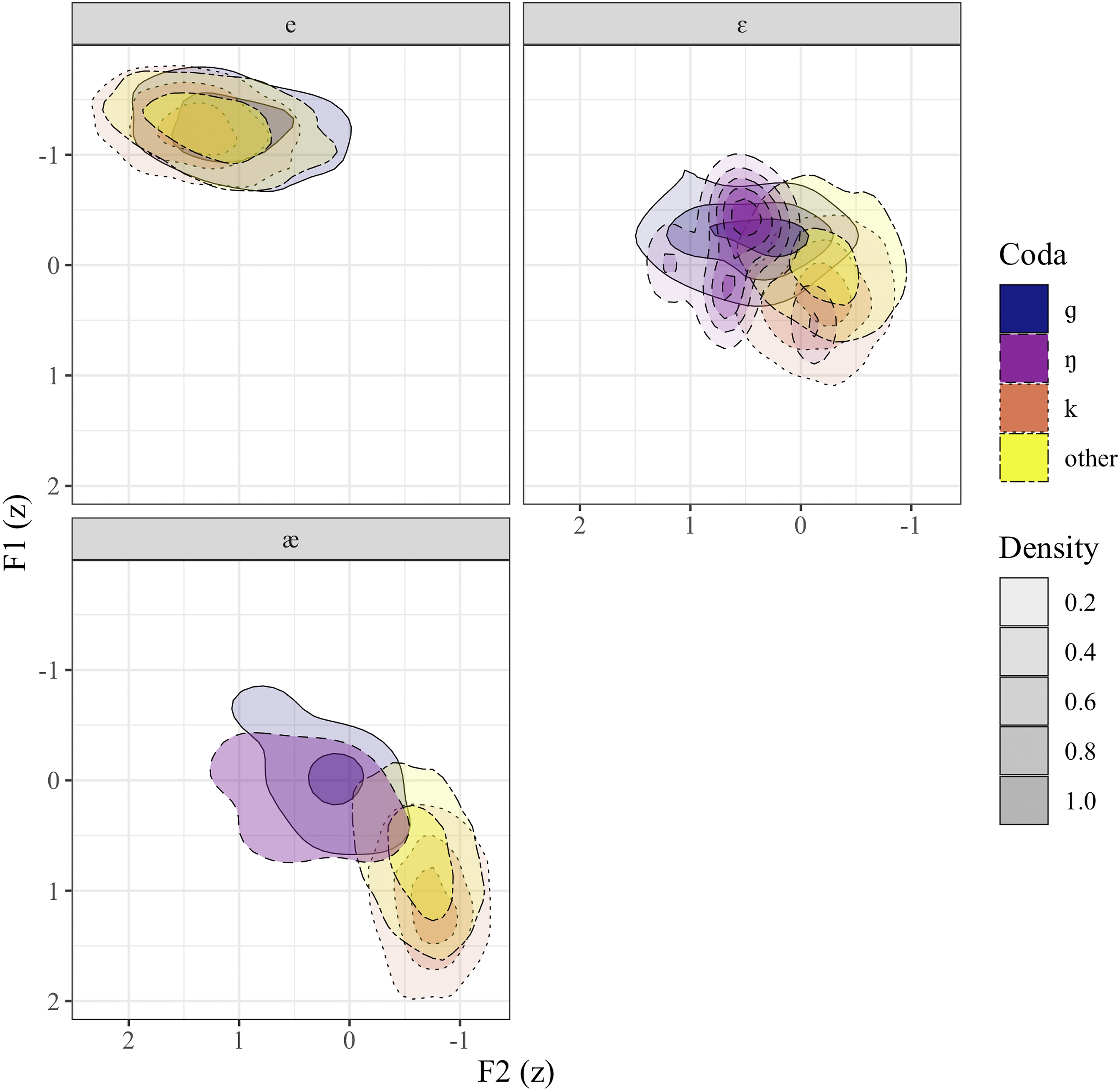
In the lower (left) panel of Figure 3, the tendency for both /ɡ/ and /ŋ/ to induce raising and advancement of /æ/ relative to non-velar other codas is very clear, and contrasts markedly with /k/ which has a diametrically opposed pattern showing lowering and some retraction relative to the other category. In the upper right panel, /ɛ/ exhibits a similar pattern as /æ/ albeit with a reduction in magnitude of positional difference between codas. (As mentioned before, tokens of /ɛ/ before /ŋ/ were very rare in the data and should not be relied upon too heavily; this is apparent in its uneven density distribution here.) The preceding patterns strongly contrast with those for /e/ as depicted in the upper left panel, which shows a much more cohesive arrangement across all coda types.
4.1.2. Static Vowel Positions within Coda Contexts
Linear Mixed Effects Regressions: Vowel Formants within Coda Contexts
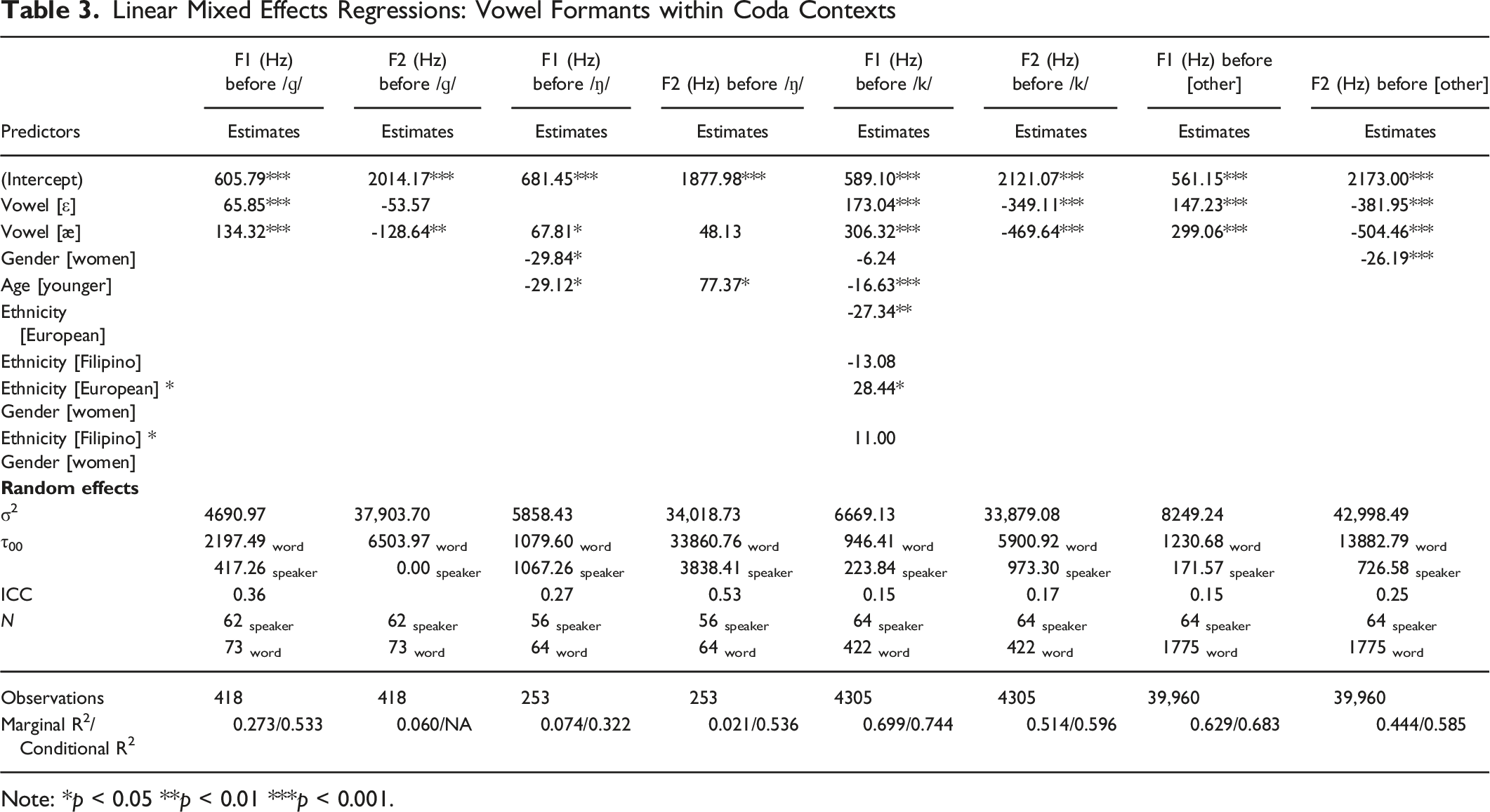
Note: *p < 0.05 **p < 0.01 ***p < 0.001.
Looking at the social factors,
The degree of overlap by vowel across Vowel Formant Density Distributions Within Coda Contexts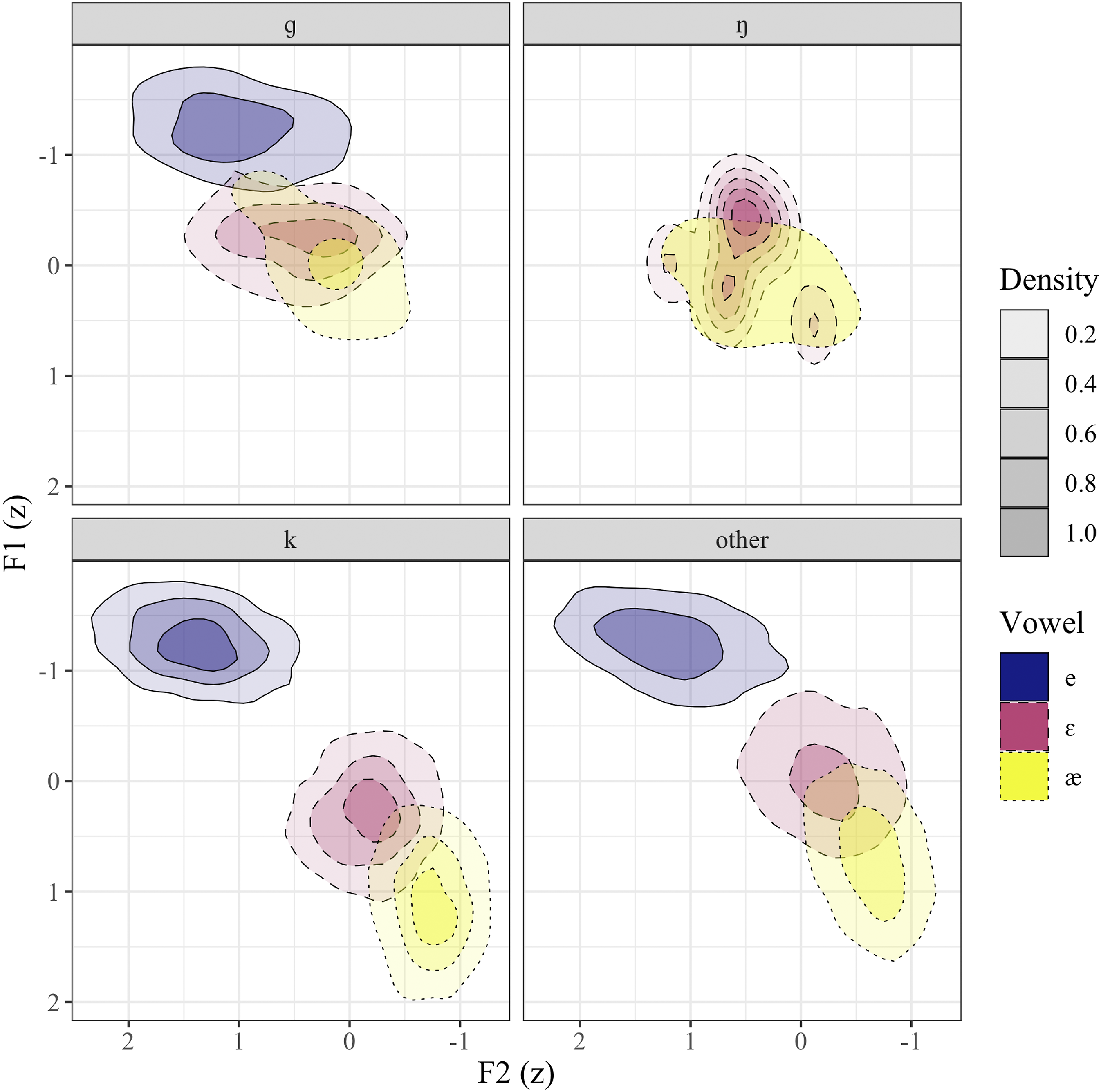
4.1.3. Summary of Static Vowel Position Results
To summarize the main findings regarding static mid-point vowel positions: (i) Women’s /æ/ vowels are lower and more retracted than men’s (ii) European /e/ is higher than Mennonite /e/ (iii) Filipino /e/ is higher and more advanced than Mennonite /e/ (iv) Coda /k/ correlates with lowered /æ, ɛ/, and raised /e/ (v) Coda /ɡ/ correlates with raised and more advanced /æ, ɛ/, and raised /e/ (vi) Coda /ŋ/ correlates with raised and more advanced /æ/ (vii) B
4.2. Vowel Durations
Linear Mixed Effects Regressions: Vowel Duration by Coda Context
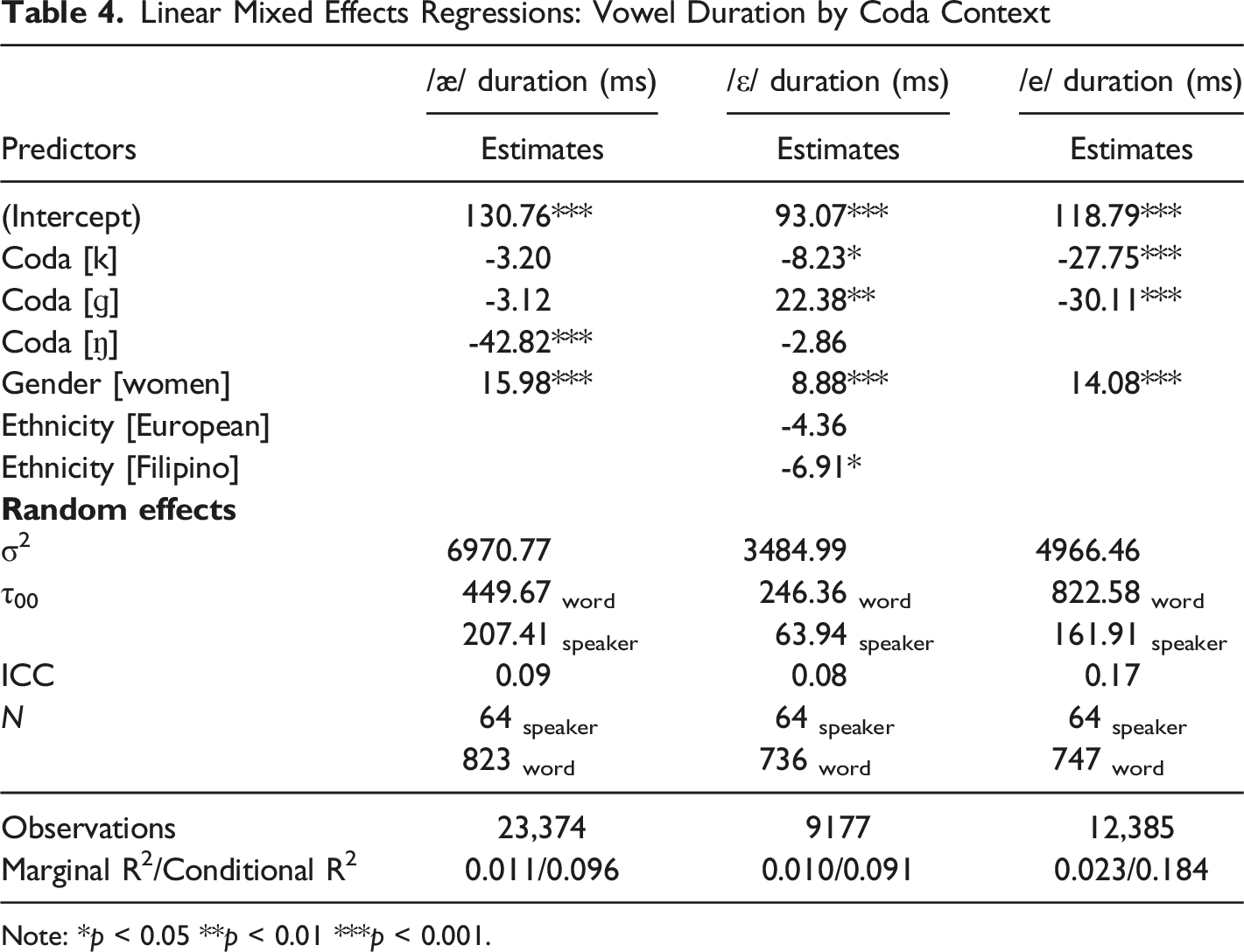
Note: *p < 0.05 **p < 0.01 ***p < 0.001.
The vowel /æ/ has both the longest average Vowel Duration Distributions Within Coda Contexts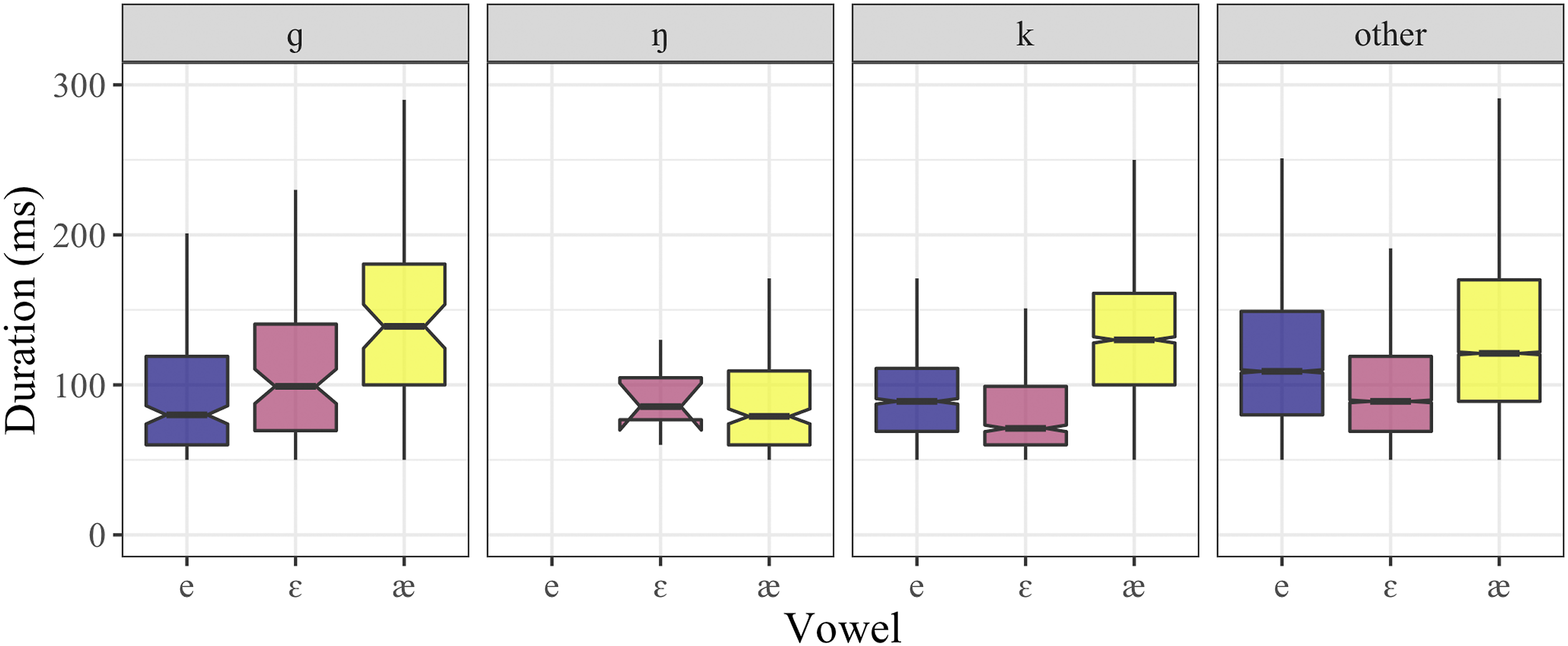
Linear Mixed Effects Regressions: Vowel Durations within Coda Contexts
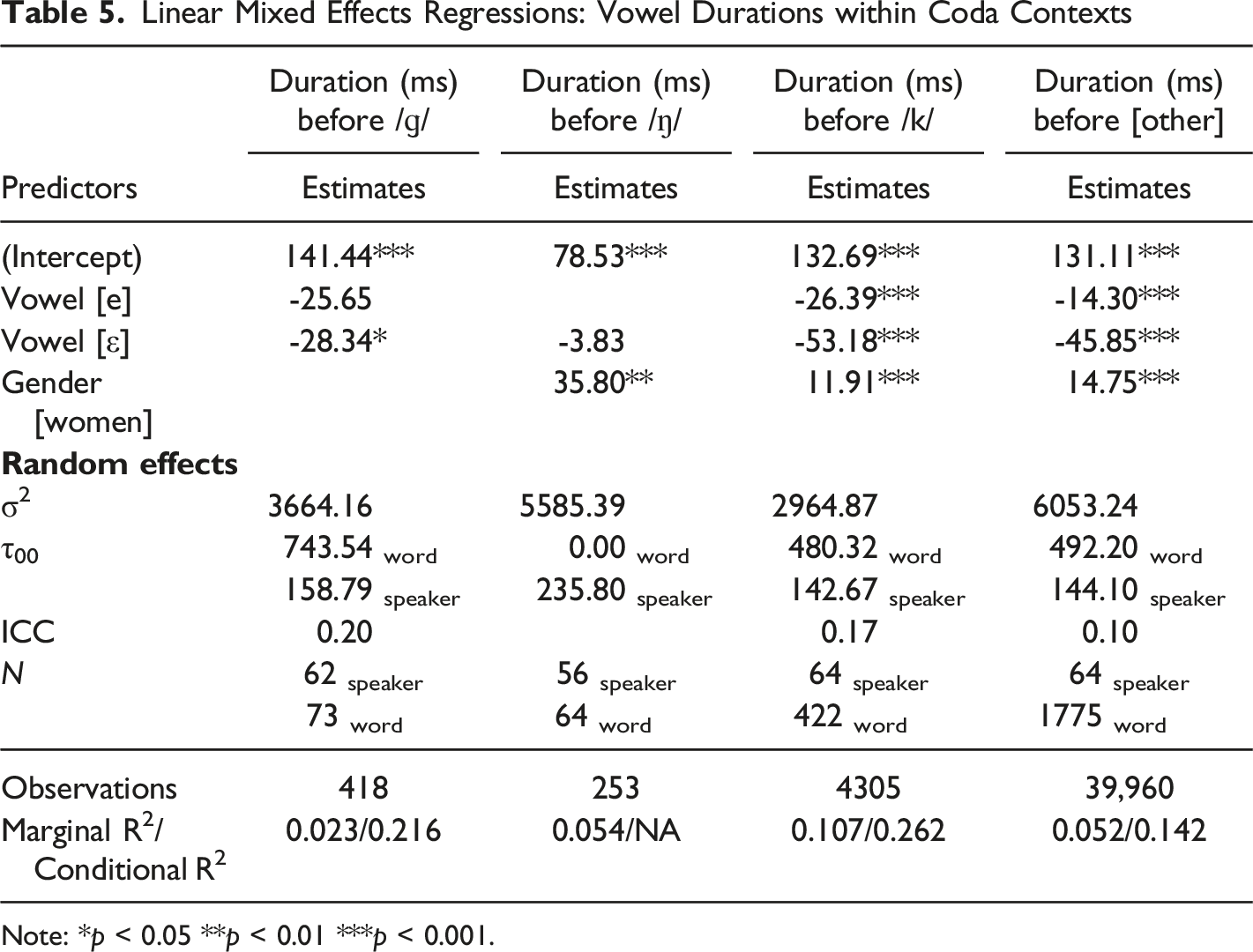
Note: *p < 0.05 **p < 0.01 ***p < 0.001.
4.2.1. Summary of Vowel Duration Results
To summarize the main findings regarding vowel durations: (i) /æ/ is the longest vowel with the least cross-coda variation (ii) /ɛ/ is the shortest vowel with the greatest cross-coda variation (iii) Coda /k/ correlates with abbreviated duration of /ɛ, e/ (iv) Coda /ɡ/ correlates with increased duration of /ɛ/, and abbreviated duration of /e/ (v) Coda /ŋ/ correlates with abbreviated duration of /æ/ (vi) Women produce consistently longer vowels than men (vii) Filipino /ɛ/ is shorter than Mennonite /ɛ/
4.3. Dynamic Vowel Trajectories
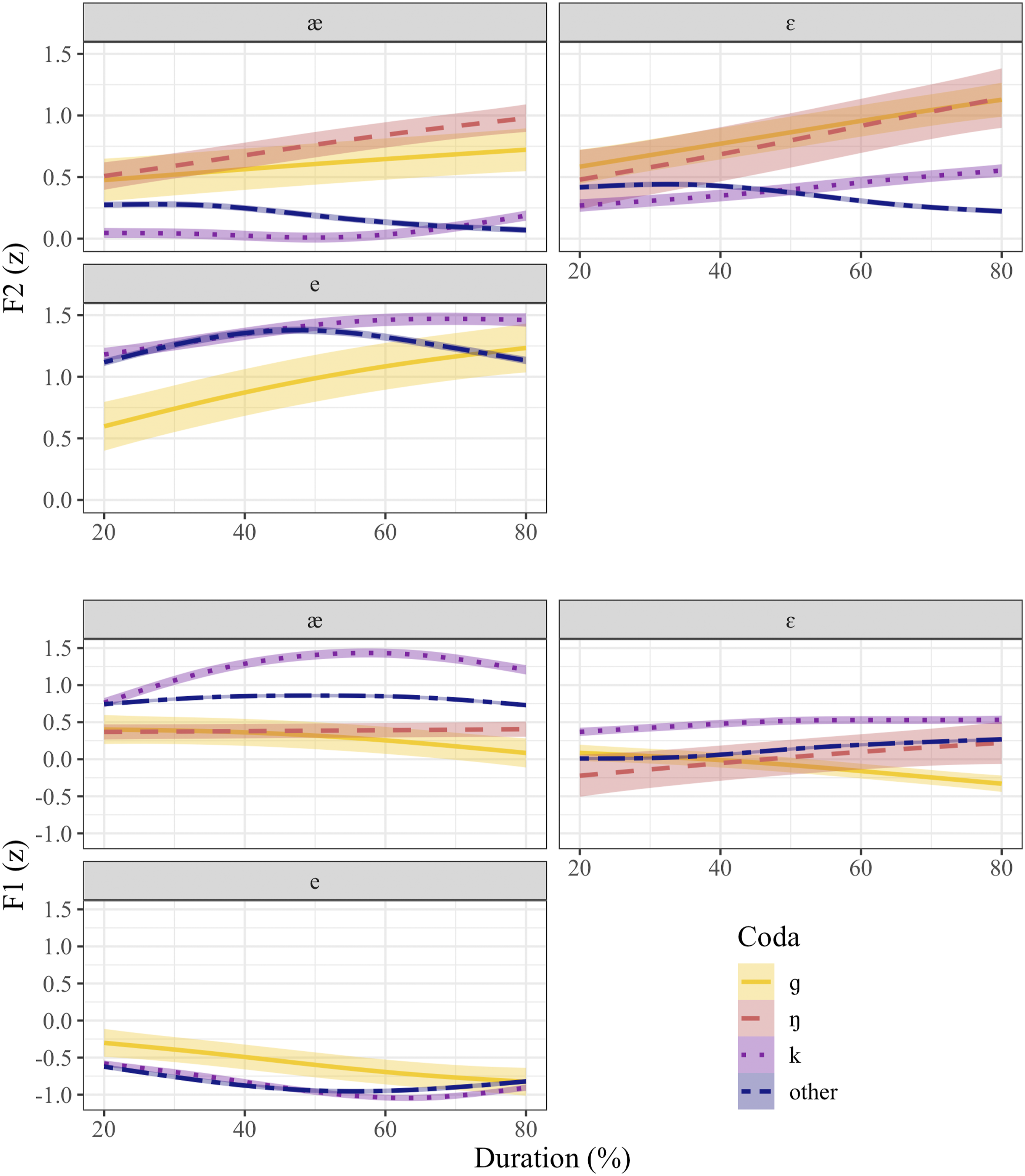
The GAMMs analyses of FAVE vowel formant (F1 and F2) trajectory data build upon the preceding results, incorporating both the spatial and temporal qualities of the vowels. Visualizations of the GAMMs for vowel Vowel Formant Trajectories Within Coda Contexts Vowel Formant Trajectories Across Coda Contexts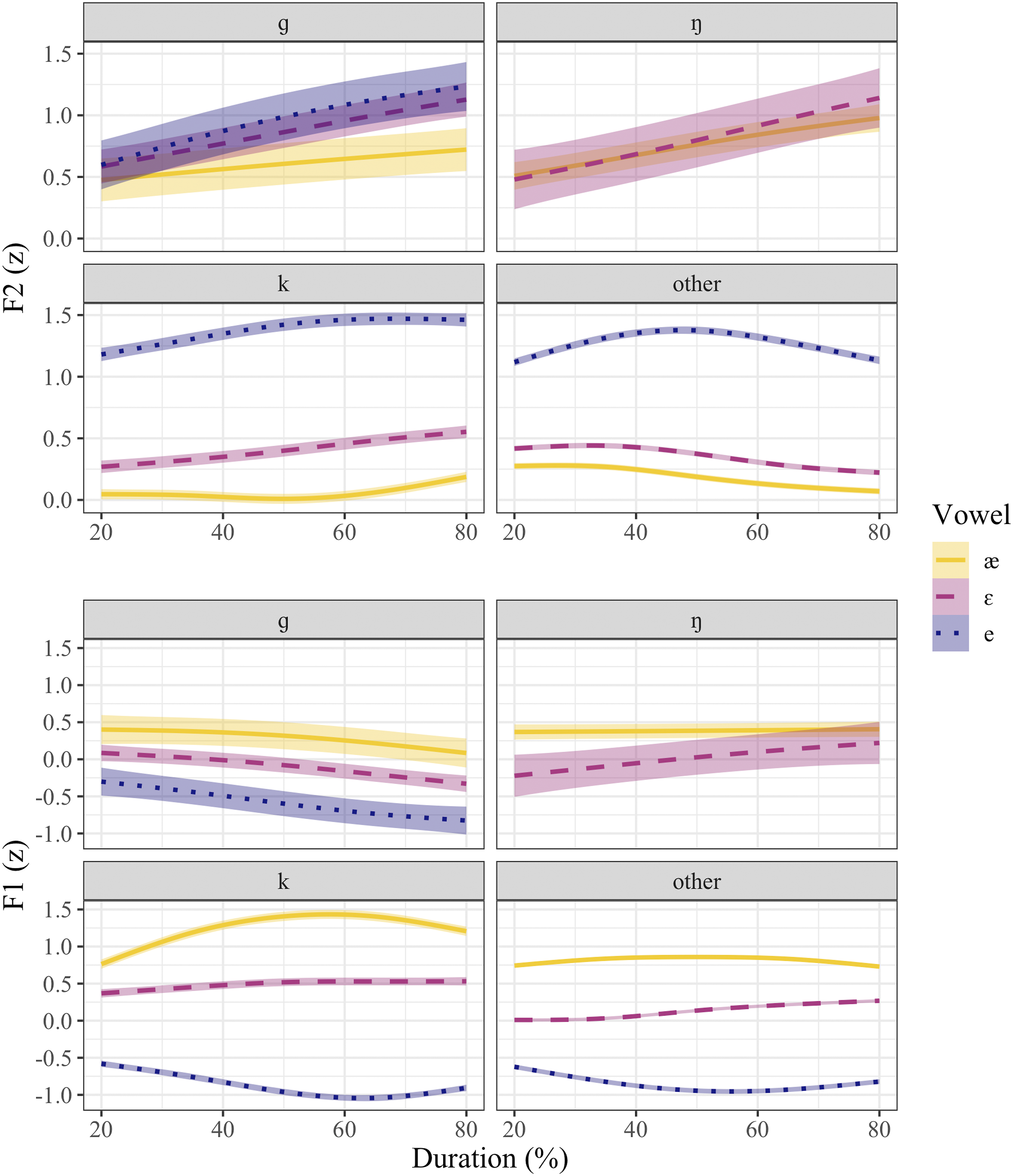
It is readily apparent in Figure 6 that the between-vowel differences are markedly reduced for both F1 and F2 before the voiced nasals /ɡ/ and /ŋ/ as compared with /k/ and other codas. For F2 before /ɡ/, the smooths for the vowels /ɛ/ and /e/ overlap across their full durations, which is also true for F2 of /ɛ/ and /æ/ before /ŋ/. Under GAMMs analysis, this cross-smooth overlap indicates that the two trajectories are not significantly different from each other; in other words, /ɛ/ and /e/ have statistically identical F2 trajectories before /ɡ/, as do /ɛ/ and /æ/ before /ŋ/. While the F1 conditions (the lower plots in Figure 6) do not show any cases of full-duration overlap, the cross-vowel trajectories before both /ɡ/ and /ŋ/ are much closer to each other than before /k/ and other
In Figure 7, the trajectories for both F1 and F2 of /æ/ show clear distinctions in all four coda conditions, with the voiced velar codas /ɡ/ and /ŋ/ having the greatest degree of overlap. Interestingly, the formant trajectories of /æ/ before the voiceless velar /k/ are further from the voiced velar contexts than for other codas. /ɛ/ exhibits the least degree of overall cross-coda context difference. For F2, its trajectories before /ɡ/ and /ŋ/ are fully overlapped and clearly diverge from the other conditions, and the respective F1 trajectories are overlapped for most of the vowel duration as well; the pre-/k/ context once again exhibits a distinctive trajectory for both formants. For /e/, the pre-/ɡ/ trajectories of both F1 and F2 depart from both /k/ and other codas for nearly the entire duration (with some overlap towards vowel offset). In contrast, the formant trajectories of /e/ before /k/ and other are fully overlapped for at least the first half of the vowel.
4.3.1. Summary of Vowel Trajectory Results
To summarize the main findings regarding vowel trajectories: (i) F1 and F2 trajectory differences are generally minimized before voiced velar codas /ɡ, ŋ/ (ii) F1 and F2 trajectory differences are generally maximized before voiceless velar /k/ (iii) F2 trajectories of /ɛ/ and /e/ fully overlap before /ɡ/ (iv) F2 trajectories of /ɛ/ and /æ/ fully overlap before /ŋ/ (v) F1 and F2 trajectories of /æ, ɛ/ show full or near-full overlap between both voiced velar coda /ɡ, ŋ/ contexts (vi) F1 and F2 trajectories of /e/ are most divergent before /ɡ/
5. Discussion and Conclusion
This study contributes to our knowledge of the state of language production and variation in Manitoba and the Prairies in several ways. First, it provides an update and expansion to Hagiwara’s (2006) study of Winnipeg vowel production by providing an overview of the vowel space of (southern) Manitoba (Figure 2). The examination of ethnolectal differences between European, Filipino, and Mennonite speakers further builds on related work (Tran 2018; Onosson, Rosen & Li 2019; Hadei 2020), which has begun to indicate how language use can vary between some of the major ethnic groups present in Manitoba. This is important because our understanding of ethnolectal variation in the Canadian west, and especially the Prairies, is somewhat limited at present. This study also provides the first detailed acoustic analysis of prevelar raising/merger among Manitoba English speakers. Given Manitoba’s unique position relative to other regions where similar phenomena occur and the general interest on these topics in the research community, this is an important addition to the state of our knowledge.
In one of the most recent studies on North American English prevelar raising, Stanley (forthcoming) found that the Prairies comprise part of the general region where the rates of occurrence of both
While the raised/fronted nature of the productions of /æ/ and /ɛ/ is quite clear in the data from this study, the answer to the question of whether prevelar vowel merger occurs in the speech of Manitobans is less conclusive. Cross-vowel formant comparisons within the various coda contexts (see Table 3 and Figure 4) reveal that the strongest case for merger is between /æ/ and /ɛ/ when occurring before the velar nasal /ŋ/, with the caveat that low token counts for /ɛ/ should induce some caution in making too strong a claim. In pre-/ɡ/ context, there is a large degree of overlap between these vowels, more so than elsewhere; but they nevertheless do maintain some degree of difference from each other. This is also the sole context where some amount of overlap between all three vowels occurs, i.e., including /e/. However, there is certainly too little overlap to argue for merger of either /æ/ or /ɛ/ with /e/ in this context. In addition to formant comparisons, consideration of durational differences (see Tables 4 and 5, as well as Figure 5) suggests that this component of production is further implicated when it comes to any potential for merger. The duration of /ɛ/ is most alike the other two vowels before /ɡ/ and especially /ŋ/ (excluding /e/ from the latter) than in other contexts. The GAMMs trajectory comparisons (Figures 6 and 7) further confirm these observations. Before /ŋ/, the F2 trajectories of /æ/ and /ɛ/ are virtually identical, and they show partial overlap before /ɡ/. And for F1, their trajectories are in closer proximity before both voiced velars than in other contexts. /e/ also shows the closest proximity to the other vowels before /ɡ/; its F1 trajectory approaches them more closely here than elsewhere, and its pre-/ɡ/ F2 trajectory exhibits overlap with /ɛ/ across the entire duration. Taken together, these findings do make a good case for the identification of early or incipient
The investigation of ethnolectal effects in this study have revealed a few interesting cross-ethnic differences. Filipino speakers differentiate themselves from Mennonites by producing more raised and advanced /e/, and briefer /ɛ/ vowels. European speakers also produce more advanced (but unraised) /e/ productions than Mennonites, and European women more closed vowel positions before /k/ relative to Mennonite men; conversely, Mennonites produce more retracted /e/, and Mennonite men more open pre-/k/ vowels.
A coherent explanation for these differences might be found within concepts such as conservatism and extra-local identity. In establishing the social factor intercepts for the LMERMs, the choice was made to use groups which were thought likely to be more conservative; for gender, this meant selecting male speakers, and for ethnicity it meant selecting the rural and more religiously-affiliated (at least historically) Mennonites. The results showing that (rural) male Mennonites have distinct pre-/k/ vowel productions from European women seem to match the hypothesis that the former would be the most conservative among all social groups, although it is not clear why the locus of this effect should be found here, among all the features investigated. A broader investigation into Mennonite speech production in the future might help to clarify how such productions are situated within their overall vowel system.
A previous acoustic study in Winnipeg (Onosson, Rosen & Li 2019) found a greater degree of adoption of Canadian Shift (Clarke, Elms & Youssef 1995), an ongoing chain-shift, among Filipino speakers relative to European speakers. Filipino-Winnipegger productions in that study aligned more with Toronto or Vancouver speakers rather than with local non-Filipino counterparts in Winnipeg, which was attributed to a greater adherence to extra-local trends occurring in those larger and more influential cities, following Hall-Lew’s (2009) “emergent linguistic marketplace” model. The exchange of linguistic capital in the form of the production of prestigious (on the national stage) changes in progress such as Canadian Shift may be more significant to Filipino-Winnipeggers than some of their non-Filipino counterparts. Filipino speakers in Winnipeg may be motivated to not only aim to match their productions to those innovations occurring in communities such as Toronto and Vancouver, but at the same time to also enhance the perception of their adoption of those innovative productions through other means, where available. In the present study, productions of /e/ were found to be significantly advanced or fronted among both Filipino and European (urban) Winnipeggers relative to (rural) Mennonites, with additional significant raising by Filipino speakers. Note that the general production in Manitoba of /e/ and /ɪ/ (see Figure 2) sees these two vowels occupying similar positions in the vowel space, closer to each other than almost any other pair of vowels. While there are many other acoustic differences between these two vowels such as tense/lax quality and duration, increasing their positional difference would inarguably serve to further differentiate them from each other acoustically. Advancement of /e/ represents an urban/rural split within Manitoba, which provides a degree of positional separation between /e/ and /ɪ/. The additional raising of /e/ among Filipino speakers serves to further increase this distance, with the result that the distinction between /e/ versus /ɪ/, two of the most proximate of all vowels for Manitobans generally, is greater among Filipino speakers than for other ethnicities (among those investigated here). It is possible that the increased distinctiveness of /ɪ/ achieved through /e/-fronting serves to enhance the perception that Filipino speakers are participating more strongly in the Canadian Shift as it pertains to this vowel, which is (currently) the final vowel to be involved in the pull-chain and whose productions thus differ more across social/regional dialects in comparison with the other vowels in the chain. This is of course only conjecture at this point; a perception study would need to be performed to establish whether this effect is even perceptible, and how listeners may be responding to it or what sociolinguistic associations it may carry.
A further point related to the Canadian Shift concerns women’s production of /æ/, which is more lowered and retracted than men’s. The Canadian Shift, a.k.a. “Short Front Vowel Shift” (Boberg 2019) or “Low-Back-Merger Shift” (Becker 2019), is argued to be driven by the initial down-and-backward movement of /æ/, driving a chain-shift through the lax front vowels, involving first /ɛ/ and eventually /ɪ/. This gender difference supports the analysis of the Canadian Shift as an ongoing change in progress, with women leading the change, and with Manitoba productions being generally conservative such that a gender difference can still be observed even for the initiating vowel.
How do this study’s findings relate to previous analyses of prevelar raising in Canada? The ANAE reported prevelar merger of /æ, e/ across the Prairies and into northern Ontario, “determined by examining the degree of overlap between /æg/ and /eyC/ […] combined with evidence of a front upglide” (Labov, Ash & Boberg 2006:181). The present study accords with this finding: Figure 4 shows a small degree of overlap between the two vowels (which would be even larger under the ANAE’s inclusion of all codas for /e/), and Figure 7 shows lowering of /æ/ F1 towards offset. Mielke, Carignan, and Thomas (2017:344) looked at differences in realizations of /æ/ before different velar codas, finding that for Canadians “/æŋ/ involves more tongue raising and lower F1 (relative to /æɡ/ and /æk/).” However, their Canadian sample included only three southern/eastern Ontarians and one New Brunswicker. The findings from the present study show that, for Manitobans, the relationship between /ɡ/ and /ŋ/ is reversed, finding the former correlating with lower F1 (and higher F2) values for /æ/ (see Figure 7). Relative to Mielke, Carignan, and Thomas’ (2017) results, this study indicates the value in carrying out detailed phonetic analyses of smaller population areas. As already discussed, Stanley (forthcoming) described Manitobans as exhibiting both
Where do this study’s findings situate Manitoba with respect to the other major regions where prevelar raising, fronting, and/or merger have been shown to occur? Among research focused on communities in the Pacific Northwest, some of the most recent studies such as Swan and Becker (2021) and Freeman (2019, 2021) describe a three-way merger between /æ/, /ɛ/, and /e/; not only are
Finally, we consider the other region having a strong association with prevelar raising: the Upper Midwest. While closest to Manitoba, the situation in Minnesota is not yet well-documented enough when it comes to many aspects of prevelar raising to make a strong comparison. Koffi (2014) found that
This study has documented the productions of /æ/, /ɛ/, and /e/ in Manitoba and examined their potential for changes in production and/or merger in prevelar contexts. It has also revealed some of the important social factors at play, such as conservatism and the contrasting effect of adherence to extra-local speech patterns, in either the maintenance or development of ethnolectal difference in the province. This work contributes to research concerned with western Canadian/Prairie/Manitoba English, to the literature on prevelar raising and merger, and to the study of ethnolectal differentiation in Canada. All three of these fields represent ever-growing bodies of research, to which this study offers some important findings to be integrated into our broader understanding of North American English dialect patterns.
Footnotes
Acknowledgements
This research was conducted in present-day southern Manitoba, being original lands of the Anishinaabeg, Cree, Oji-Cree, Dakota, and Dene peoples, and the homeland of the Métis Nation. This study was made possible thanks to a Post-doctoral Fellowship (#756-2019-0627) from the Social Sciences and Humanities Research Council of Canada. Data collection and transcription relied in part on the team of undergraduate and graduate research assistants working in the Sociolinguistics Laboratory at the University of Manitoba’s Department of Linguistics, without whose efforts this study could not have been completed. Finally, many thanks to Dr. Nicole Rosen for inviting me to participate in the Languages in the Prairies Project and providing access to the LIPP corpus, thereby enabling this contribution to the linguistic documentation of my home region and dialect.
Declaration of Conflicting Interests
The author(s) declared no potential conflicts of interest with respect to the research, authorship, and/or publication of this article.
Funding
The author(s) disclosed receipt of the following financial support for the research, authorship, and/or publication of this article: This study was supported by Social Sciences and Humanities Research Council of Canada; 756-2019-0627.
