




Abstract
This paper focuses on the use of combined pronouns (s/he, his or her, him/her, etc.) as an example of late twentieth-century non-sexist language reform which had an overt democratizing aim. Within the scope of second-wave feminism, the use of combined pronouns increased the visibility of women in discourse by encouraging the use of feminine pronouns (she, her, hers) alongside masculine pronouns (he, him, his). Despite their promotion, however, the use of combined pronouns is relatively rare. This paper uses the LOB and Brown families of corpora to diachronically and synchronically study patterns in the use of combined pronouns in written American (AmE) and British English (BrE) from the 1930s to the early 2000s. The analysis not only determines what forms these patterns take, but questions whether combined pronouns are influenced by (a combination of) syntax and/or semantics, and questions whether combined pronouns are really democratic at all.
1. Introduction
It is widely reported that the English pronoun paradigm “lacks” an animate third-person singular epicene (gender-neutral) pronoun. This position can be disputed, given the extensive research showing singular
Section 2 provides an overview of the epicene pronoun issue. Section 3 contextualizes debates about the use of combined pronouns as a solution to the apparent privilege of masculine forms. Consideration is given to non-sexist language reform, democratization, and the role of combined pronouns in reinforcing a gender binary. Section 4 introduces the source materials and notes the benefits of using corpora for analyzing pronouns (especially pronouns which are relatively rare). It documents how the corpora were mined for all instances of combined pronouns and how the analysis proceeded. Section 5 is divided into sections on diachronic change (section 5.1), men-first language (section 5.2), and antecedent types and stereotypes (section 5.3). Section 6 draws the analyses together to discuss the future potential for combined pronouns to act as a democratizing linguistic feature.
2. The Context of Combined Pronouns
Historically, it has been argued that English does not have a (formally-endorsed) gender-neutral third-person animate singular pronoun. Based on the established third-person pronoun paradigm (Figure 1), as printed in grammar guides and taught in schools (in both L1 and L2 contexts), speakers of English must decide between

Standard English Third-person Pronoun Paradigm
A problem arises, however, for more general references, like someone or anyone, or when you have to refer to an individual but do not know their gender, as in (1).
(1) The driver behind me kept flashing _______ headlights.
It is unlikely that the person making such a statement (written or spoken) knew the gender of the driver in the car behind. Nevertheless, they need to choose a pronoun to fill the gap in (1). Traditionally, as prescribed from the eighteenth century onwards (see Bodine 1975; Baron 1986; Tieken-Boon van Ostade 2006; Paterson 2014), the pronoun of choice to fill this gap would be generic
One of the implications of using generic
Whilst the wider ramifications of pronoun choice are not perhaps that evident in the first example, close analysis of (2) can help to bring the implications of pronoun choice to the fore. In (2), which is taken from the British English 2006 corpus (Baker 2009; see section 3), the use of his or her makes it clear that both male and female politicians are within the scope of potential referents for a politician. By contrast, the use of generic
(2) The BBC and much of the media now take the position that what a politician does in his or her private life is not the business of the rest of us, so long as it is legal. (BE06_B01)
(3) The BBC and much of the media now take the position that what a politician does in his private life is not the business of the rest of us, so long as it is legal.
In the same vein, Vainapel, Shamir, Tenenbaum, and Gilam (2015:1514) argue that masculine generics—of which generic
One way to make explicitly clear that the sex of a politician in (2) or the driver in (1) is unknown is to use a combined pronoun: “The driver behind me kept flashing his or her headlights.” 1 The use of his or her makes it explicitly clear that the antecedent—in this case the noun phrases the driver (behind me) and a politician—can refer to both men and women. Thus, viewed through the lens that gender is binary, no one is excluded from the potential referents of these sentences. However, these examples make explicit that the driver or a politician can refer to anyone whose pronouns include his or her. This does not, therefore, include everybody, an issue discussed in section 3.
3. Pronouns as Political
The active promotion of combined pronouns is one example of non-sexist language reform associated, initially, with second-wave feminism in the 1960s-1990s. The use of generic
The argument that combined pronouns represent a form of linguistic democratization sits alongside other examples of language change. For example, Baker (2010:69) argues that diachronic changes in English, such as the relative increase in feminine pronouns in the LOB family of BrE corpora (see section 4), could suggest moves towards “reductions in gender-based bias.” He argues similarly for AmE that the apparent decrease of terms like men in the Brown family corpora (see section 4) could be an indication of “a decline of male-focused discourse” (Baker 2017:101). Indeed, Farrelly and Seoane (2012:394) note that one key example of democratization in English has been the “identification and progressive elimination” of sexist language “reflecting a desire to avoid sexual and social distinctions” (see also Loureiro-Porto & Hiltunen, this issue). Combined pronoun use, then, is one linguistic feature which relates to wider trends in language change across varieties of English and which, in this case at least, was prompted by campaigns against non-sexist language.
The impact of such campaigns can be seen in the continued endorsement of combined pronouns in grammar books and official style guides, such as those produced by Microsoft (2018) and the United Nations (2018). In my analysis of grammar books published in the twenty-first century (Paterson 2014:123), I found that the majority of grammars that discussed gender-neutral pronouns endorsed the use of combined pronouns. Furthermore, the United Nations’ (2018) guidelines relate specifically to the visibility of women in discourse as they note that
Nevertheless, the promotion, institutional endorsement, and use of combined pronouns is important to debates about wider democratization in English. One of the key components of democratization is “the phasing out of overt markers of power asymmetry with the aim of expressing greater equality and solidarity” (Farrelly & Seoane 2012:393). Opposition to male-as-default forms of language, such as generic
However, it is possible to take a more critical view of combined pronouns. This is not a question of the fact that some people (and institutions) are reluctant to use them due to their apparently ugly aesthetic. Rather, considering combined pronouns within more modern (post-structuralist) approaches to language and gender, the use of The concept of two—and only two—sexes is so deeply entrenched in Western societies that it has gained the status of a natural fact in public opinion. Insights from the biosciences, however, suggest that a continuum would be a much more adequate characterisation of gender diversity. Yet, everyday discourses of gender sketch it as a strictly binary category (female/male), neglecting inter-gender overlap and intra-gender diversity.
Arguably, the most democratic use of pronouns would be to eliminate gender entirely by using something like singular
Of course, there are additional factors to consider. For example, research has shown that gender-stereotyping on nouns can influence the pronouns that people choose for unknown referents. That is, someone referring to a generic doctor, soldier, or footballer may be more likely to use
Tracing combined pronoun use through history can shine a light on the uptake of such forms, as well as provide further information about the type of antecedents likely to be used with combined pronouns. The paper thus addresses the following research questions:
i. Is there evidence of diachronic and/or synchronic variation in combined pronoun use (from the 1930s to the early 2000s)?
ii. Is there evidence that the use of combined pronouns has been influenced by democratizing language reforms?
iii. What factors (syntactic and/or semantic) appear to influence combined pronoun use?
4. Materials and Methodology
To investigate the use of combined pronouns and their potential relationship to non-sexist language reforms, this paper draws on tools from corpus linguistics. Corpus linguists have a range of tools at their disposal, such as frequency counts, keyword lists, and tools which calculate collocation (how likely words are to occur in close proximity to one another). In the present case, the analysis draws on two particular tools: corpus queries are used to extract all tokens of combined pronouns from the corpora under analysis, and concordance lines—where the results of a query are presented within their immediate co-text—are used to facilitate antecedent resolution. That is, the concordance lines were manually analyzed to determine the antecedents of the combined pronouns.
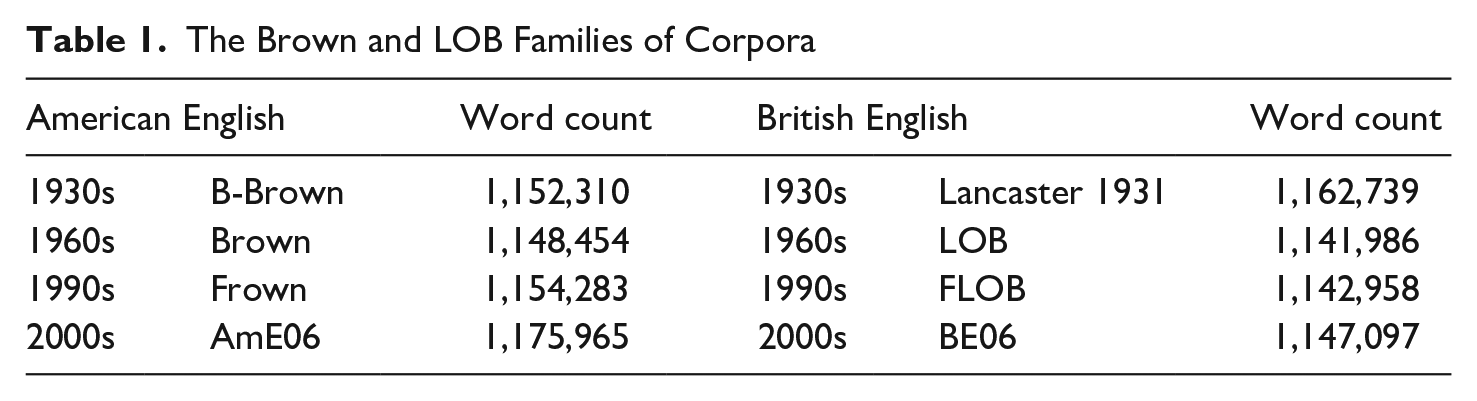
This paper follows in a long line of research using corpora to investigate epicene pronoun use (e.g., Pauwels 2001; Laitinen 2007; Paterson 2011, 2014; Stormbom 2018; Loureiro-Porto, this issue; see also Curzan 2014 for corpus data on generic/gender-specific job titles in AmE). It uses two sets of corpora—the Brown family of AmE and the LOB family of BrE (Table 1)—which are well established reference corpora suitable for analyzing “ongoing grammatical change in the twentieth century” (Hundt & Leech 2012:187). The sampling frames for all the corpora are consistent (see Baker 2009 for more details), making them useful resources for comparing features of language across time and across varieties. They correspond to four time periods (the 1930s, 1960s, 1990s, and the 2000s) and the texts within them cover a range of different genres, from press reportage and religious texts to multiple sub-genres of fiction (romance, science fiction, detective fiction, etc.). As such, they represent a snapshot of written language at each collection point.
The Brown and LOB Families of Corpora
The corpora were searched for all forms of
To determine the antecedents of the combined pronouns, all of the hits returned by the query were downloaded as concordance lines with a span of fifty words either side. Manual analysis of the hundred-word co-text was enough to match each combined pronoun to its antecedent. In all of the corpora, there were only two erroneous hits where the query results were not combined pronouns but were actually two different pronouns referring to separate entities (as in 4).
(4) The thought of being left behind without him or her sister [. . .] (BE06_P28)
This suggests that the co-occurrence of two pronouns in a contrastive (him or her) or binomial (him and her) construction are very likely to be combined pronouns. The alternative, where each pronoun corresponds to a different referent, is rare. Additionally, it is worth noting that there are no instances where combined pronouns were used as part of a meta-discussion about pronoun reference. Finally, two further queries—(she|her|hers|herself) and (he|him|his|himself)—extracted all case forms of
5. Results
Table 2 shows the number of combined pronouns in each corpus. The results have been normalized to number of occurrences per million words (pmw) to account for the fact that the corpora were very slightly different in their overall word count. For example, B-Brown comprises 1,152,310 words, while BE06 comprises 1,147,097 words. The raw number of combined pronouns in each corpus is provided in parentheses. The table shows that combined pronouns are relatively rare in the corpora overall. In the earlier corpora, there was also a slight tendency for multiple tokens to occur in the same text. F06 in B-Brown, for example, accounts for three of the six tokens in the corpus, which suggests that combined pronouns were even rarer at the earlier time points as they clustered in a small number of texts.
Frequencies of Combined Pronouns (N = 252)
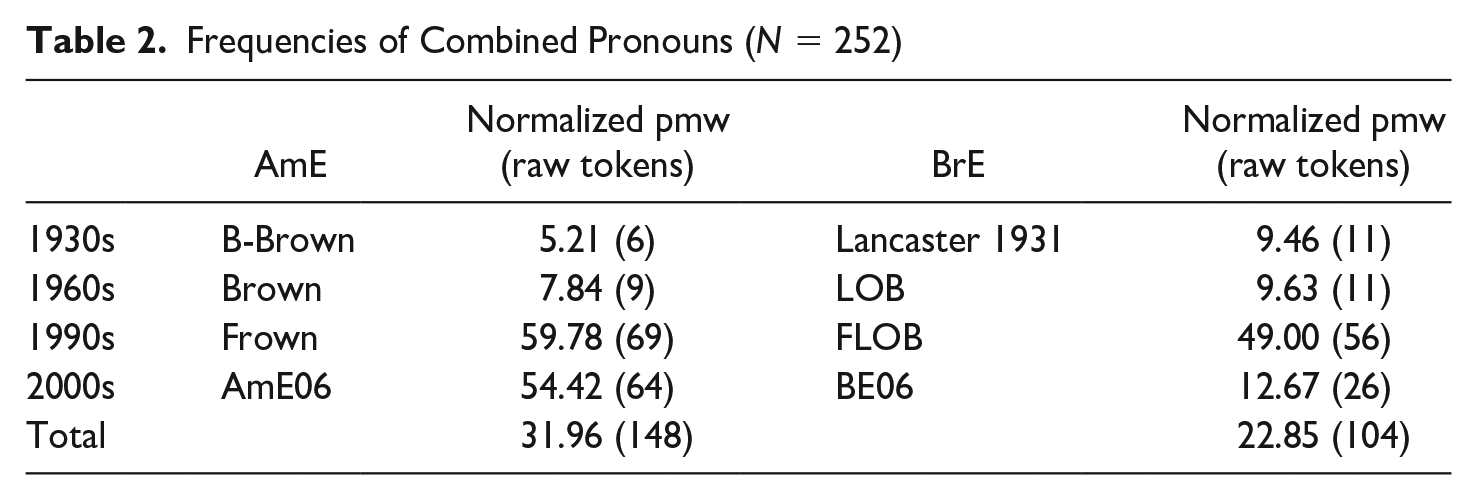
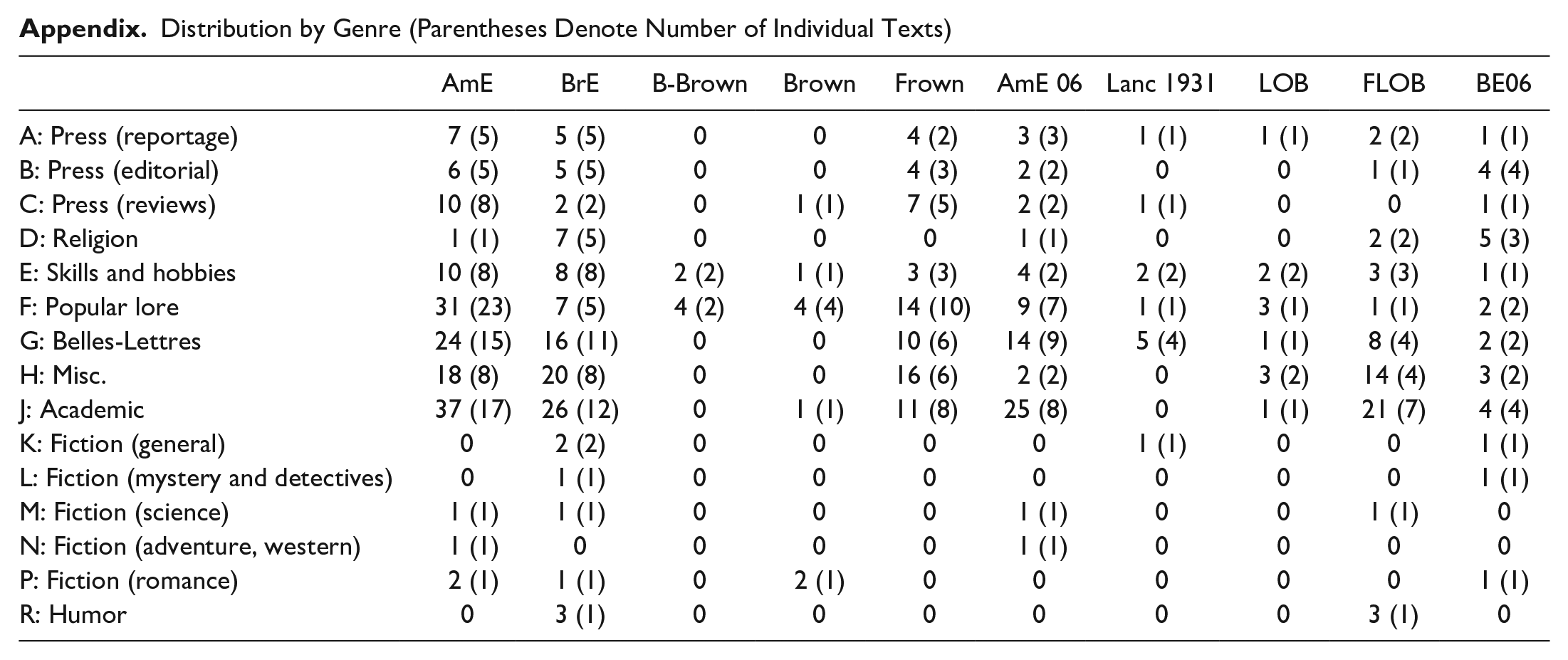
Another finding was that combined pronouns were rarely used in the press sections of the corpora. Press texts accounted for sixteen tokens in AmE and twelve tokens in BrE (a full breakdown of combined pronouns by genre is given in the Appendix). The initial intention for this paper was to focus on the use of combined pronouns in the press-sections of the corpora with a view to comparing them with newspaper style sheets. However, as Table 2 shows, there is not enough data for a fruitful analysis. It is possible that the absence of combined pronouns in the press texts could be a result of the proscription of combined pronouns in newspaper style sheets. Another explanation for the small number of tokens may be that newspaper reports tend to be about actual people rather than humans of unknown gender (although Balhorn [2009] did find some combined pronouns in newspaper texts). Most likely, given that press texts comprise only a small section of each of the LOB and Brown families of corpora, the corpora are too small for the specific study of newspaper texts. Thus, rather than focusing predominantly on the small number of tokens in the press sections, the following analysis takes all the combined pronouns together to determine overarching patterns in their use.
5.1. Diachronic Change
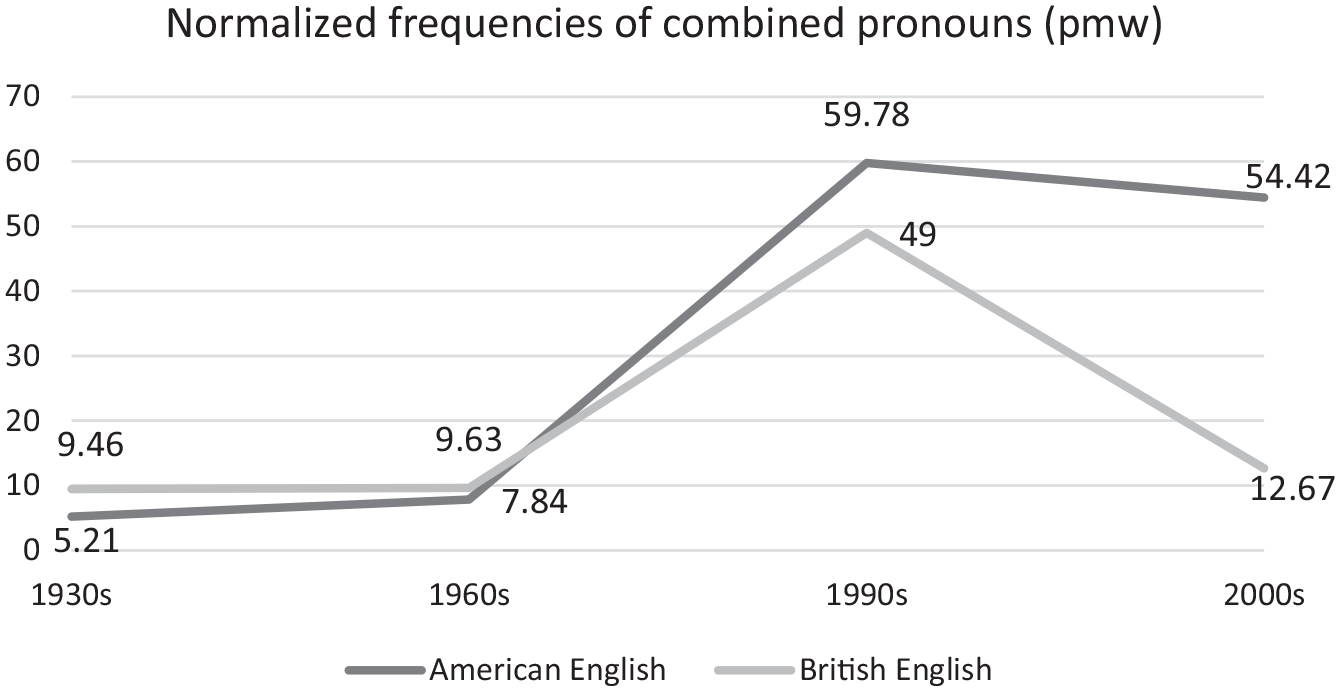
In terms of frequency, both sets of corpora (the Brown family and the LOB family) follow the same pattern of combined pronoun use (Figure 2). The occurrence of combined pronouns is extremely rare in the 1930s (5.21 pmw and 9.46 pmw for AmE and BrE respectively) and the 1960s (7.84 pmw and 9.63 pmw). There is a large increase between the 1960s and the 1990s (59.78 pmw and 49 pmw) which corresponds to a a seven-fold increase in AmE and a five-fold increase in BrE. Finally, and perhaps a little unexpectedly, there is a drop off at the final time point; AmE drops 5.36 hits pmw between the 1990s and early 2000s and BrE drops, more drastically, 36.33 hits pmw. The drop off is even more interesting when we take into account the fact that the gap between the 1990s corpora and the 2000s corpora is smaller than the gaps between the other time points.
Trends in Combined Pronoun Use over Time
Figure 2 clearly shows that something has changed post-1960s. There is also evidence of slight varietal difference—although both AmE and BrE follow the same pattern, the American corpora, which start with lower normalized frequencies, overtake their British counterparts and are more consistent from the 1990s to the 2000s, although there is still a small drop off.
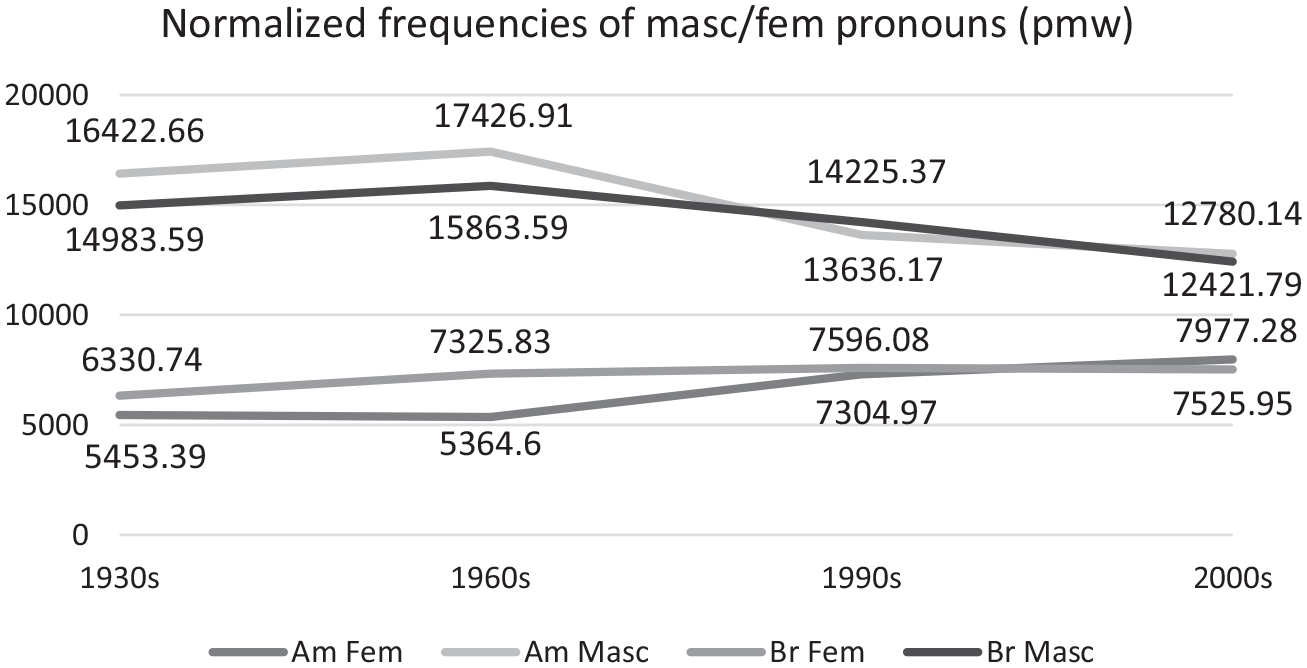
One potential explanation for the trends shown in Figure 2 is that combined pronoun use merely followed wider trends in the rise and fall of third-person pronoun use. To this end, Figure 3 shows the normalized frequencies of all masculine and feminine pronouns in the corpora. The data shows that masculine pronouns were always more frequent than feminine pronouns. Thus, in line with Baker’s (2010) findings about pronoun use in the LOB family (noted in section 3), it seems that men are referred to more than women in all of these corpora (see also Konnelly, this issue, for a detailed analysis of man and woman in a recent American corpus). There is convergence post-1960s, but the gap between male and female pronouns is still large; for the 2000s there is a difference of 4895.84 hits pmw in BrE and 4802.86 hits pmw in AmE.
Masculine and Feminine Pronouns in the Corpora
Overall, however, general pronoun use does not follow the pattern of combined pronoun use shown in Figure 2. There is, therefore, some evidence that the increased use of combined pronouns post-1960s suggests at least some democratization of BrE and AmE. To fully test this claim, however, one would have to determine whether occurrences of generic
Ultimately then, there is evidence that after remaining fairly static between the 1930s and 1960s, combined pronouns underwent some form of shift between the 1960s and the 1990s. Given the limitations of the data, there is no way to tell how the use of combined pronouns developed between 1961 (the date of texts in the 1960s corpora) and 1991 (the date of texts in the 1990s corpora), so it is not possible to determine the exact time point when the use of combined pronouns began to spike. It may be, for example, that combined pronouns grew in use at a steady rate, or perhaps more likely, there were peaks and troughs in their use between the two time points represented by the corpora. Nevertheless, the data does show that there was an increase in combined pronoun use between the 1960s and the 1990s. There is no obvious language-internal (i.e., syntactic) reason for this increase and so the spike in Figure 2 must be attributable to a language-external (i.e., social) factor. It is also important to remember that combined pronouns are not part of the established pronoun paradigm (Figure 1), rather they are somewhat artificial constructs, characterized as cumbersome (see section 3), which are specifically linked to language policy and politics. Indeed, non-sexist language reform, set against the wider social context of second wave feminism, is the most likely language-external factor to account for the patterns in Figure 2. The coining of the term “sexist language” in the late 1960s/early 1970s and the promotion of combined pronouns to combat sexist language and practices drew people’s attention to pronouns, thus bringing them above the level of public consciousness.
To hypothesize about the cause of the decrease in the use of combined pronouns between the 1990s and the 2000s, again, there is no evidence to suggest a language-internal factor is at play. There are two main language-external factors which could potentially explain the drop off. The first relates to complaints, noted above, that combined pronouns are cumbersome and their repeated use across a text is not aesthetically pleasing; thus, people may be inclined to avoid pronouns altogether when making generic references. The second social factor is that people may have become more comfortable using singular
While it is not possible to extract all the tokens of singular
5.2. The Form of Combined Pronouns
One can question whether all combined pronouns are created equal. Looking at the distribution of case forms of combined pronouns in Table 3, it is clear that most begin with references to men. Only five forms put women first—she or he, s/he, her or him, her or his, and her/his—and they account for only 6 (4.05 percent) of the AmE tokens and 14 (13.50 percent) of the BrE tokens; the latter is inflated by what appears to be a slight BrE preference for s/he. Thus, there is an apparent linguistic asymmetry in combined pronouns; men and women are not treated equally as masculine forms tend to occur first, potentially reinforcing (or reflecting) the male-as-default position that underpins the use of generic
Pronoun Types
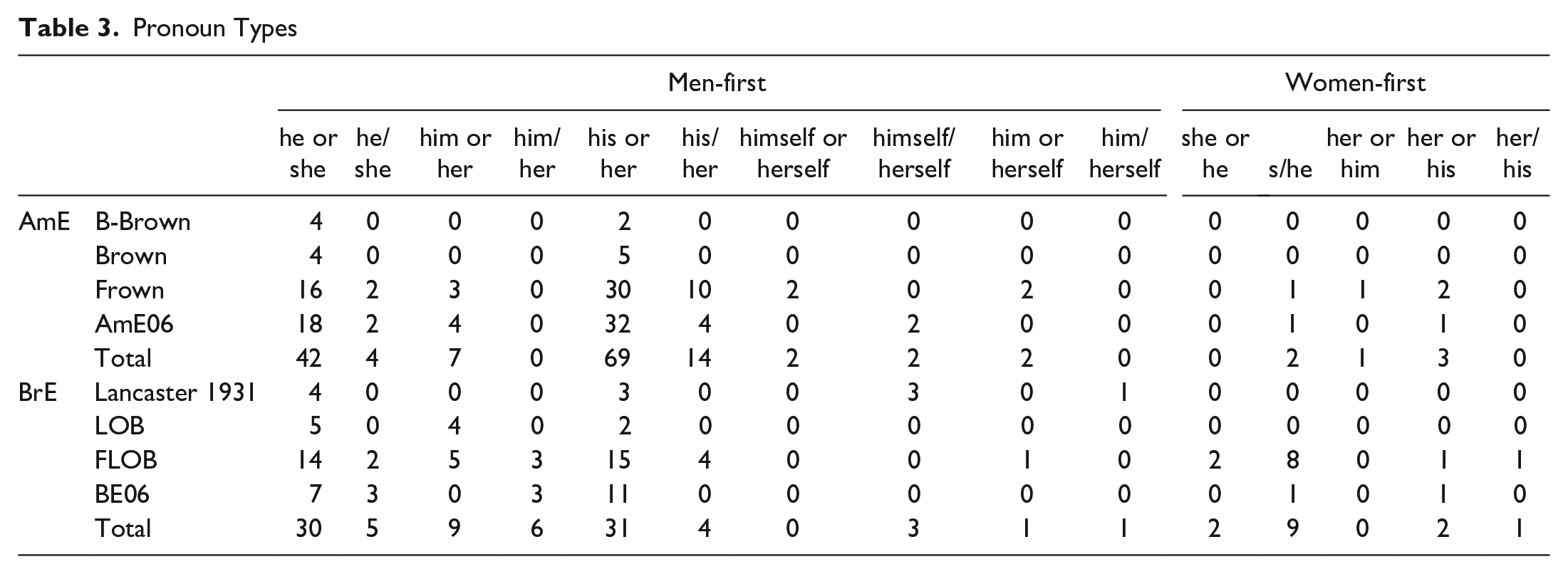
To investigate this further, and as a precursor to the full analysis of antecedents in the section below, the concordance lines for the women-first combined pronouns were analyzed. There were no strongly gender-stereotyped antecedents for any of the woman-first combined pronouns; s/he coindexed with the post-modern reader (BE06_G27) and one text in FLOB—which referred to the new player and the claimant (in terms of the rules of chess)—accounted for all eight occurrences of s/he in BrE in the 1990s. Other antecedents included the first-person narrator (as shown in 5), the television viewer, the craftsperson, each person, and each student.
(5) It then moves to a situation where
(6) Utilitarianism asks
Example (6) shows that one occurrence of she or he, which coindexed with the individual, actually alternated with his or her. While alternating combined pronouns in this way is, arguably, democratic, insofar as both masculine and feminine pronouns occur first an equal amount of time, Madson and Hessling (1999:565) found readers overestimated the use of feminine pronouns when reading texts where pronoun alternation (he one paragraph and she the next) was used. This result emphasizes the salience of feminine pronouns (perhaps due to their relative rarity) and reinforces the male-as-default ideology of a patriarchal society.
One final example also worth mentioning, given in (7), is from AmE in the 2000s. It refers to an individual Justin Bond as s/he and is an example of combined pronouns being used to refer to someone whose identity is outside the gender binary.
(7) Even
There is a layer of complexity here as the pronoun actually refers to a character in the film Shortbus named Justin Bond, not the real-life Justin Bond who portrays said character; nevertheless the pronoun is used for an individual as opposed to a generic referent. However, the acceptability of using s/he to refer to someone who is transgender is highly questionable, and further investigation indicates that v is Bond’s preferred pronoun (Steel 2011). Overall then, close analysis of the antecedents of woman-first combined pronouns has shown no strong preference for (feminine) gender-stereotyped antecedents.
5.3. Antecedent Distribution
The analysis of the antecedents in all eight corpora began with the manual coding of antecedent category and plurality. Following Paterson (2014), as also done by Loureiro-Porto (this issue), the categories I used were definite noun phrases, or NPs (the skeptic, the embryo, your laptop users), indefinite NPs (a student, a young person), quantified NPs (no citizen, any one native speaker), and indefinite pronouns (someone, anyone). To cover the range of antecedent types in these corpora, it was necessary to add a bare NPs category, most of which were plural (Shamans, Club DJs). Thus, different to other epicene pronouns, combined pronouns can take plural antecedents without necessarily referring to more than one person. These antecedents, although rare (N = 5), were included in the analysis because the function of a combined pronoun as a generic reference (as in 8) is not confused by plural antecedents in the same way that singular
(8)
(9)
(10)
Both AmE and BrE follow the same basic pattern (Table 4), with a preference for definite NPs. The antecedent analysis flagged up those cases where multiple tokens of combined pronouns occurred in one text. Details about the number of individual texts are provided in the Appendix; the vast majority of texts (78.45 percent) included only one combined pronoun.
Distribution by Antecedent Type
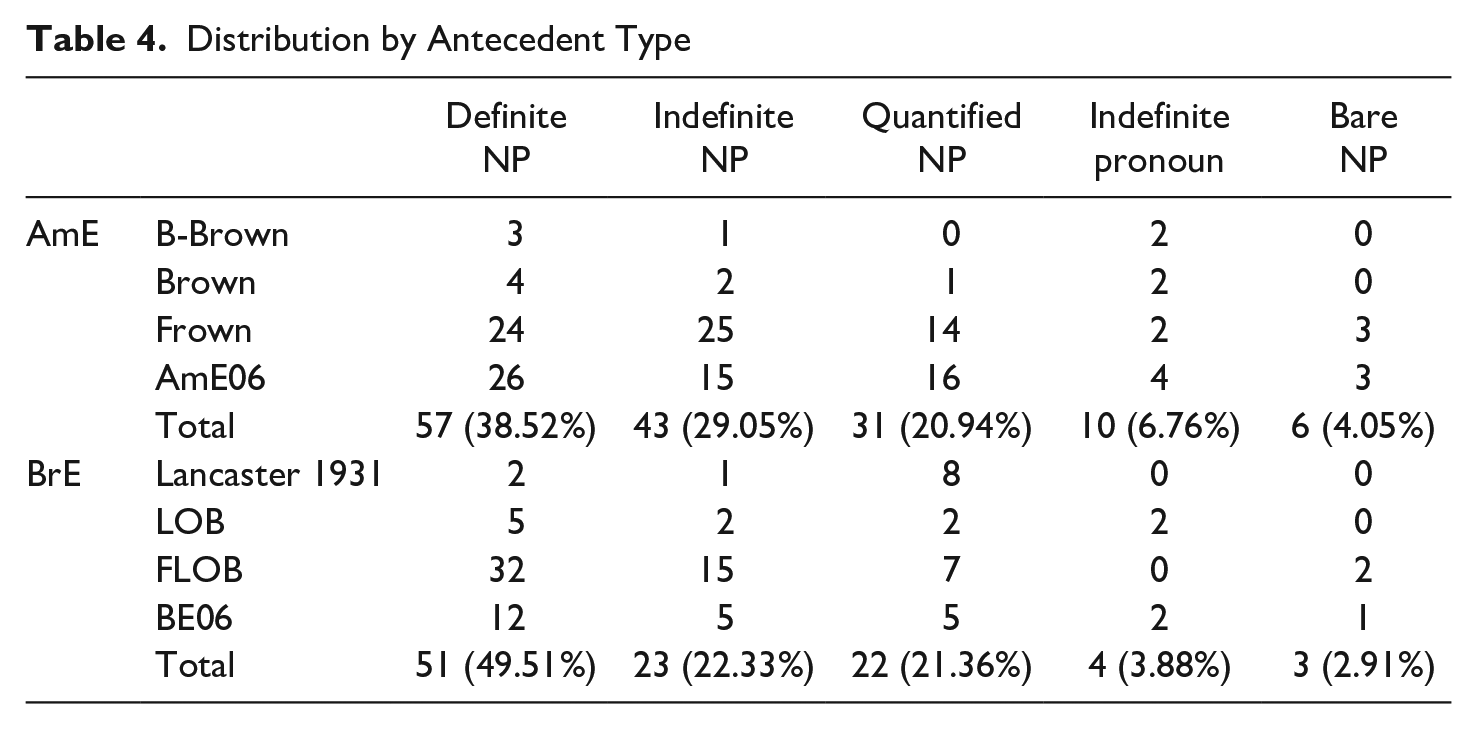
To start with AmE, there were fifty-seven definite NPs, all of which were singular. They occurred in all four corpora across thirty-nine texts, but the total number of tokens is inflated by twelve occurrences of the skeptic in one text (see 11) and there were also four occurrences of the student.
(11) the skeptic withholds his or her response to the other; he or she refuses to acknowledge, for example, pain behavior as expressive. (AmE06_J61)
The forty-three indefinite NPs occurred across all four corpora in thirty-two texts and they were all singular; most antecedents did not repeat but there are three tokens of a student. Quantified NPs showed a clear preference for each (sixteen tokens). Indefinite pronouns occurred in all four corpora. The bare NPs were accounted for by three tokens from Frown and three from AmE06, including (8).
For BrE, the fifty-one definite NPs spanned all corpora, were singular, and occurred in thirty texts. One text (FLOB_J33) accounted for ten tokens, but they did not all refer to the same antecedent (antecedents included the claimant, the new player, and the native speaker). Indefinite NPs referred to a range of antecedents including a child, a student, and a young person. Quantified NPs also occurred with student and spanned all corpora. The negative NPs did not occur in BLOB, but included no child and no student. As such, the initial analysis of antecedents highlighted that a number of combined pronouns referred to children and youth (child, adolescent, student) across a range of texts and corpora. There were very few indefinite pronouns in BrE and they only occurred in two corpora (LOB and BE06). The small number of indefinite pronouns is somewhat surprising, given that they are a common way of signifying generic reference. One explanation comes from my earlier analysis of singular
Finally, there is one example in particular (see 12) where the choice of pronoun changes across a text. In the first instance, when reference is made to plural club DJs, a plural pronoun (they) is used. In the fourth sentence, the pronoun changes to him/her as the conceptual definiteness of the referent increases. However, when the singular DJ is used, the pronoun switches to generic
(12) For a start, club DJs do not speak. Ever. They don’t even have microphones. And you go and ask him/her to play your favourite Top 20 tune at your peril. In fact you go and ask him/her to play anything at your peril. It’s just not done. You actually leave your DJ absolutely alone because he has his headphones clamped to his ear and he’s working out the next seamless mix. (FLOB_R04)
Although this idiosyncratic usage is not representative of the rest of the corpora, it is notable that a singular DJ is perceived as default masculine, while the fact that women can be DJs is only explicitly referred to within the scope of the plural DJs. Thus, the democratization of language that the use of a combined pronoun would suggest is not reflected across the whole text. The reason for this change from him/her to
To establish whether gender stereotyping of an antecedent correlated with particular combined pronouns, each of the bare noun forms of the antecedents were tested against Kennison and Trofe’s (2003) gender-stereotyped nouns (discussed in section 3). As part of their paper, Kennison and Trofe (2003) provide a list of the nouns they tested and details about whether they were masculine- or feminine-stereotyped. Despite there being several antecedents that were (introspectively) potentially gender-stereotyped, such as scientist, candidate, public figure, newscaster, only twenty-four of the antecedents in the present data appeared in Kennison and Trofe’s (2003) list of tested nouns. These are shown in Table 5.
Antecedents Cross-checked with Kennison and Trofe (2003)
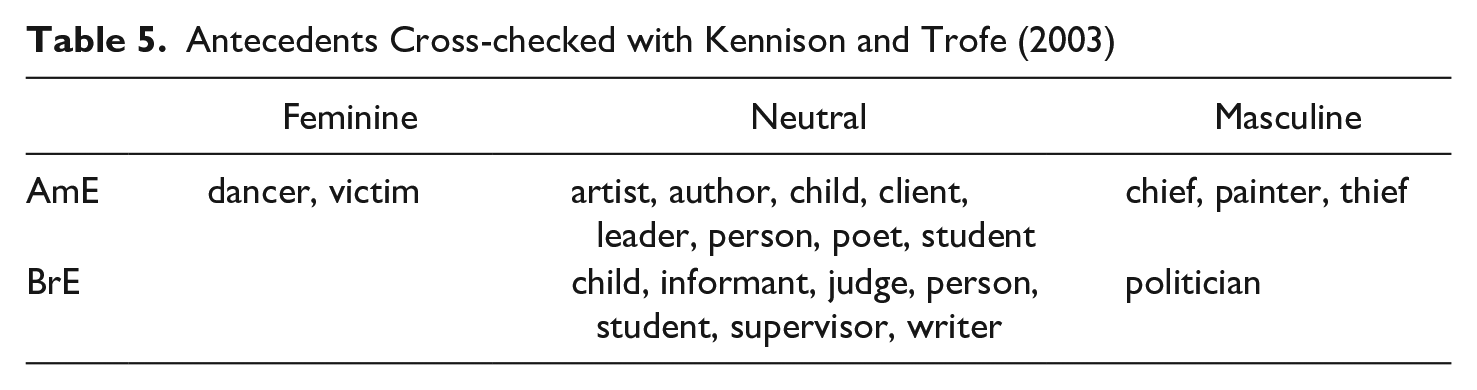
Those antecedents for which stereotyping information was available tended not to be heavily stereotyped either way. Only two of the tested antecedents were feminine-stereotyped and four were masculine-stereotyped. Combined with the fact that stereotyping information was available for so few antecedents, there is not enough data to make any firm conclusions here.
6. Discussion and Conclusions
What can be concluded is that the two families of corpora were comparable in their tokens and relative frequencies of combined pronouns. Both BrE and AmE used combined pronouns at a low but stable rate between the 1930s and the 1960s, followed by a relatively large increase in their use by the 1990s. The two varieties diverge slightly in the 2000s; BrE showed a larger drop in combined pronouns than AmE, with the latter remaining fairly stable. As discussed above, one explanation for the stability across the earliest time points could be due to the fact that combined pronouns (and indeed gender-neutral language more broadly) were not above the level of public consciousness. That is, there was no (politically motivated) campaign for their use, and so their salience (and potential social and/or political power) was low. Clearly, something happened to the prescription and/or wider awareness of combined pronouns between the 1960s and the 1990s. This most likely relates to such forms being promoted as a gender-inclusive alternative to generic
The difference between the two 2000s corpora is perhaps more puzzling. There is evidence that BrE might be more inclined towards singular
To address the research questions directly, there is clearly evidence for diachronic variation in combined pronoun use, with synchronic variation occurring only in the 2000s corpora. The pattern of combined pronoun use provides evidence that non-sexist language reforms had an impact on British and American written English. Less can be said about what factors (syntax and/or semantic) may influence combined pronoun use due to the small number of tokens in the eight corpora. However, while combined pronouns are rare and alternative epicene pronouns—especially singular
Close analysis of the forms taken by combined pronouns showed that the majority situated the masculine pronoun before the feminine pronoun, and thus male-first combined pronouns are arguably less democratic as they uphold a male-as-norm default. A full analysis of the different case forms of combined pronouns was conducted, but the results are not reported here as they did not contribute significantly to the overarching focus on democratization; in both varieties combined pronouns were most likely to occur in nominative case followed by possessives, while accusative case and reflexives were extremely rare (see Table 3). Finally, while the analysis of gender stereotyping presented here was limited, more work could be done in this area. In particular, it would be of interest to compare and contrast the antecedents of combined pronouns with antecedents of generic
To summarize, while it is not possible to apply language policy to people’s spontaneous utterances, it is at least possible to mandate the use of written combined pronouns in official documents, thus increasing the visibility of women in discourse. This, in turn, may lead to wider change in spontaneous uses of language (cf. Farrelly & Seoane 2012 on the duality of democratization, discussed in section 3). However, despite this paper’s focus on combined pronouns, the fact that singular
To date, the vast majority of studies on epicene pronouns (including this one) have focused on L1 English where, despite the promotion of combined pronouns, people’s exposure to singular
While combined pronouns are not entirely democratic, given the limitations of endorsing a binary conceptualization of gender, they are more democratic than generic
Footnotes
Appendix
Distribution by Genre (Parentheses Denote Number of Individual Texts)
| AmE | BrE | B-Brown | Brown | Frown | AmE 06 | Lanc 1931 | LOB | FLOB | BE06 | |
|---|---|---|---|---|---|---|---|---|---|---|
| A: Press (reportage) | 7 (5) | 5 (5) | 0 | 0 | 4 (2) | 3 (3) | 1 (1) | 1 (1) | 2 (2) | 1 (1) |
| B: Press (editorial) | 6 (5) | 5 (5) | 0 | 0 | 4 (3) | 2 (2) | 0 | 0 | 1 (1) | 4 (4) |
| C: Press (reviews) | 10 (8) | 2 (2) | 0 | 1 (1) | 7 (5) | 2 (2) | 1 (1) | 0 | 0 | 1 (1) |
| D: Religion | 1 (1) | 7 (5) | 0 | 0 | 0 | 1 (1) | 0 | 0 | 2 (2) | 5 (3) |
| E: Skills and hobbies | 10 (8) | 8 (8) | 2 (2) | 1 (1) | 3 (3) | 4 (2) | 2 (2) | 2 (2) | 3 (3) | 1 (1) |
| F: Popular lore | 31 (23) | 7 (5) | 4 (2) | 4 (4) | 14 (10) | 9 (7) | 1 (1) | 3 (1) | 1 (1) | 2 (2) |
| G: Belles-Lettres | 24 (15) | 16 (11) | 0 | 0 | 10 (6) | 14 (9) | 5 (4) | 1 (1) | 8 (4) | 2 (2) |
| H: Misc. | 18 (8) | 20 (8) | 0 | 0 | 16 (6) | 2 (2) | 0 | 3 (2) | 14 (4) | 3 (2) |
| J: Academic | 37 (17) | 26 (12) | 0 | 1 (1) | 11 (8) | 25 (8) | 0 | 1 (1) | 21 (7) | 4 (4) |
| K: Fiction (general) | 0 | 2 (2) | 0 | 0 | 0 | 0 | 1 (1) | 0 | 0 | 1 (1) |
| L: Fiction (mystery and detectives) | 0 | 1 (1) | 0 | 0 | 0 | 0 | 0 | 0 | 0 | 1 (1) |
| M: Fiction (science) | 1 (1) | 1 (1) | 0 | 0 | 0 | 1 (1) | 0 | 0 | 1 (1) | 0 |
| N: Fiction (adventure, western) | 1 (1) | 0 | 0 | 0 | 0 | 1 (1) | 0 | 0 | 0 | 0 |
| P: Fiction (romance) | 2 (1) | 1 (1) | 0 | 2 (1) | 0 | 0 | 0 | 0 | 0 | 1 (1) |
| R: Humor | 0 | 3 (1) | 0 | 0 | 0 | 0 | 0 | 0 | 3 (1) | 0 |
Declaration of Conflicting Interests
The author declared no potential conflicts of interest with respect to the research, authorship, and/or publication of this article.
Funding
The author received no financial support for the research, authorship, and/or publication of this article.