



Abstract
The 1919 total solar eclipse was a natural event of great mobilization in Brazil. The national scientific community used the occasion to advance astrophysical knowledge about the Sun and establish its scientific credentials within the international community; the political elite seized the opportunity to project an image of Brazil’s modernity abroad; and a large audience turned to newspapers to engage with the eclipse.
Newspapers provided a wealth of eclipse-related information, updating readers on the arrival of scientists in northeast Brazil, their journeys to Sobral (the second city of the state of Ceará, where Brazilian, American, and British teams were to observe totality), on the logistics involved, and on their different observational agendas, including the British team’s test of Einstein’s prediction of light bending.
In this article, we offer an analysis of the 1919 eclipse coverage across Brazilian newspapers at national, state, regional, and local levels, published respectively at the cities of Rio de Janeiro, Belém do Pará, Camocim, and Sobral, to reveal how much locality shaped the contents and styles of news. The presence of foreign astronomers meant the scientific dimensions of the eclipse took the lead in Sobral’s and Camocim’s newspapers, while religious and social dimensions were also evidenced, with emphasis on the Catholicism of the British astronomers. In the states of Pará and Rio de Janeiro, the social and political appropriations of the eclipse, often with satirical overtones, took pride of place.
Keywords
Introduction
On November 7, 1919, the London newspaper The Times published a short yet emphatic piece under the headline “Revolution in Science. New Theory of the Universe. Newtonian Ideas Overthrown.” It reported that the night before, in one of the Royal Society’s chambers, a joint meeting of the Royal Society of London and Royal Astronomical Society declared that the astronomical observations of the 1919 total solar eclipse, carried out in Sobral, Brazil, and on Príncipe Island in the Gulf of Guinea (then a Portuguese colony) by two teams of British astronomers, demonstrated that during the eclipse, the light from selected stars bent as predicted by Einstein’s theory of gravitation. In the resounding words of the President of the Royal Society, it was “one of the most momentous, if not the most momentous, pronouncements of human thought.” 1 News echoed across European, North American, and Australian newspapers, catapulting Einstein into worldwide fame in the years that followed. However, the response elsewhere was different. In Brazil, the total solar eclipse of 1919 attracted great attention from the press, but by early November the clamor had already faded. Interest had peaked in May, around the time the eclipse was visible in northern Brazil. In these reports, it was the eclipse, more than Einstein or his theory, that made headlines.
While exploring newspapers’ coverage of the 1919 total solar eclipse, historians have tended to emphasize the role of the press in elevating Einstein to celebrity status, detailing Einstein’s nationality, his Jewish identity, public perceptions of general relativity, and both overt criticisms and subtle skepticism, as well as the role of the 1919 observations in proving Einstein right. 2 Examining the criticisms concerning the reliability of data obtained by British astronomers using newspapers, among other sources, Luís Crispino and Daniel Kennefick unreservedly claimed that “it was only the superb quality of the images taken at Sobral with the 4-inch instrument, operated by Crommelin and overhauled by Davidson, that permitted the celebrated decision in favour of Einstein to be made.” 3
Far less attention has been given to newspaper coverage of the eclipse itself, or what we refer to hereafter as the “Eclipse on Paper.” Typically, as in the example just cited, newspapers – particularly Brazilian ones, which covered the event in greater detail as the eclipse’s totality path crossed Brazilian territory – are used to provide almost exclusively information on particular issues related to the British, American, and Brazilian parties, such as the names of their participants, their itineraries, and the types of instruments used, in order to articulate a narrative that almost univocally led to the confirmation of Einstein’s general theory of relativity. 4
However, unlike other historical studies on past eclipse expeditions that highlight the social and cultural dimensions of these events, 5 little attention has been paid to the interplay between science, society, and periodical publication when addressing the 1919 total solar eclipse and the expeditions to observe it by contrast with the interplay between science, society, and periodical publication on Einstein and relativity. This is true irrespective of the national context(s) under consideration. In the case of Brazil, the few studies that explore this dimension either describe the eclipse by focusing on local society’s reaction to the astronomers’ teams and the eclipse itself or, most significantly, discuss the impact of Einstein’s theory of general relativity in Brazil. 6 In this context, newspapers are regarded as having played a seminal role in introducing Einstein’s theory of gravitation to a Brazilian audience. As Crispino and Lima noted, referring to an article published by Andrew C. de la C. Crommelin and Charles R. Davidson in the newspaper Estado do Pará on April 20, 1919: “This text, jointly signed by A. C. C. Crommelin and C. Davidson, provided the introduction to Einstein’s ideas on his theory of relativity in Amazonia.” 7
By conveying scientific and technological knowledge to lay audiences in varied typologies, including informative news, interviews, satirical news, and at times science popularization articles, newspapers are compelling sources not only to follow how scientific ideas and practices were appropriated within Brazilian society, but also to understand how different actors in different localities constructed and appropriated scientific knowledge tailored to their needs and pursuits.
Historians have come a long way since science popularization, as a specific form of science communication, was viewed as a unidirectional process. The traditional conceptual framework, based on an instrumental dichotomy between scientists and lay audiences and a top-down approach to science popularization, has been replaced by a more dynamic conception. This new approach emphasizes the political and cultural agendas of all actors involved in the process of science communication – not only scientists but also audiences and publishers. 8
In parallel, James Secord has also suggested abandoning the distinction between making and communicating science. In his view, questions such as how, why, and by what means knowledge is appropriated lie at the heart of scientific knowledge production itself. 9 Conceiving science communication as a mode of knowledge production brings locality to the forefront of historiographical analysis. The specificities of local sites, actors, and institutions, which have undoubtedly played an active role in shaping circulation as knowledge production, have become a central issue for historians. Accordingly, the emphasis shifts to the processes through which local actors appropriated scientific ideas, practices, and techniques, as discussed at length in Gavroglu and colleagues. 10
In this article, we also broaden the concept of locality as a setting for the appropriation of scientific ideas. Drawing on the concept of “moving localities,” we focus on the diverse dynamics through which science-related topics connected to the 1919 total solar eclipse were interpreted, appropriated, and enlivened by actors (local and nonlocal) and specific frameworks in Brazil as seen through the press. As explored in detail by Raposo and colleagues, some of these actors operated within dynamic and multifaceted layers, where their roles and identities were shaped by, but not limited to, those associated with their places of origin. 11 British, American, and Brazilian astronomers departed from their institutions with a scientific agenda, yet their work extended far beyond the astronomical observation of the eclipse’s totality. By moving through various locations and milieus, their work and identities were reshaped according to the goals and expectations of different localities and their specific uses of science, while still retaining their original queries.
Having these historiographical frameworks in mind, it becomes clear that scientists writing in Brazilian newspapers went beyond strict scientific details – science can never be taken out of context. They adapted their communicating strategies to the production of narratives for the lay readers, taking into attention the particular publication contexts they found themselves in. In this way, newspapers became extra sites of knowledge construction. But readers were also active participants in knowledge-making by communicating directly with other readers when authoring specific pieces, or indirectly, through journalists’ articles. Therefore, newspapers are engaging sources to detail these changes, as they are instances of knowledge production that reveal how different actors and localities constructed scientific knowledge tailored to their needs and pursuits.
In this paper, our analysis is grounded on newspapers from various publication locations, spanning national, state, regional, and local levels. In the first section, we introduce and discuss the criteria behind the different scales of locality listed above, along with the newspapers examined. The second section focuses on newspapers from Sobral, Ceará, the northeastern Brazilian city where the eclipse’s totality was observed, and where teams of professional astronomers gathered. Sobral’s newspapers of local circulation illustrate the multiple ways in which the 1919 solar eclipse became a central event in the city’s social life. In the third section, we shift our attention to regional newspapers, examining one published in Camocim, a coastal city in Ceará, where the astronomers passed on their way to Sobral. With correspondents throughout northwestern Ceará, this newspaper had significant regional influence. At the state level, we focus on the leading newspaper published in Belém do Pará, the capital of the neighboring state of Pará. This is the subject of the fourth section. Our analysis of how the 1919 total solar eclipse was perceived and appropriated in different contexts in Brazil leads us, in the fifth section, to explore a variety of newspapers published in Rio de Janeiro, then the capital of the Brazilian federation.
Other historical studies have utilized newspapers from Sobral, Camocim, Belém do Pará, and Rio de Janeiro. 12 Surprisingly, however, these studies largely overlooked the local context of production of these publications. While they recognized that newspapers from Rio de Janeiro offered, for example, more insight into the central government’s political commitment to making the eclipse observation a scientific success, and those from Sobral provided richer details about the astronomers, observational sites, and public reactions on the day of the eclipse, they overlooked the local dynamics this scientific event generated in various locations, what it meant to the wide array of actors involved, and how local contexts and expectations shaped that collective experience. Yet, newspapers are rich in such insights.
We argue that the perception, understanding, and social uses of the eclipse varied according to the distinct social and cultural contexts in which it was observed or reported. In this way, these local contexts also shaped the work and identities of the different actors involved in observing this significant event. For example, at the local level in Sobral, the British astronomers became more than the elite experts they were in the United Kingdom; they assumed the role of Catholic specialists who actively interacted with local society, using their knowledge and communication skills to explain the scientific issues surrounding the total solar eclipse and the apparent mysteries of Einstein’s counterintuitive theory. Conversely, at the national level in Rio de Janeiro, the eclipse provided an opportunity not so much to explore the new theory of gravitation that the British astronomers aimed to test or the physical nature of the Sun that the Brazilian astronomical team sought to uncover, but rather to reflect on the (mis)fortunes of national politics and social customs.
Eclipse on the Brazilian newspapers
The research on news regarding the 1919 eclipse in Brazilian newspapers was conducted using the digital archive Hemeroteca Digital, available at the Biblioteca Nacional in Rio de Janeiro. 13 Hemeroteca Digital provides access to a large and diverse collection of digitized newspapers, though it does not yet encompass the entirety of newspapers published in Brazil. We surveyed news published between January 1, 1919, and December 31, 1920, as this period was likely to yield more abundant information on the expeditions and their aftermath than on the impact of relativity theory and other Einstein-related issues. Relevant news items published outside these dates were also considered when deemed pertinent. The search involved the keywords “eclipse,” “relativity,” “Einstein,” the names of key travelers (Arthur Stanley Eddington, Edwin Turner Cottingham, Crommelin, and Davidson), and the names of observation sites (Príncipe and Sobral). It included newspapers from the state of Ceará – specifically those from Sobral, where the astronomical teams observed the eclipse, and Camocim, a coastal town visited by foreign astronomers – as well as from the neighboring state of Pará, which was also visited by astronomers, and from Brazil’s capital, Rio de Janeiro (Figure 1a). 14
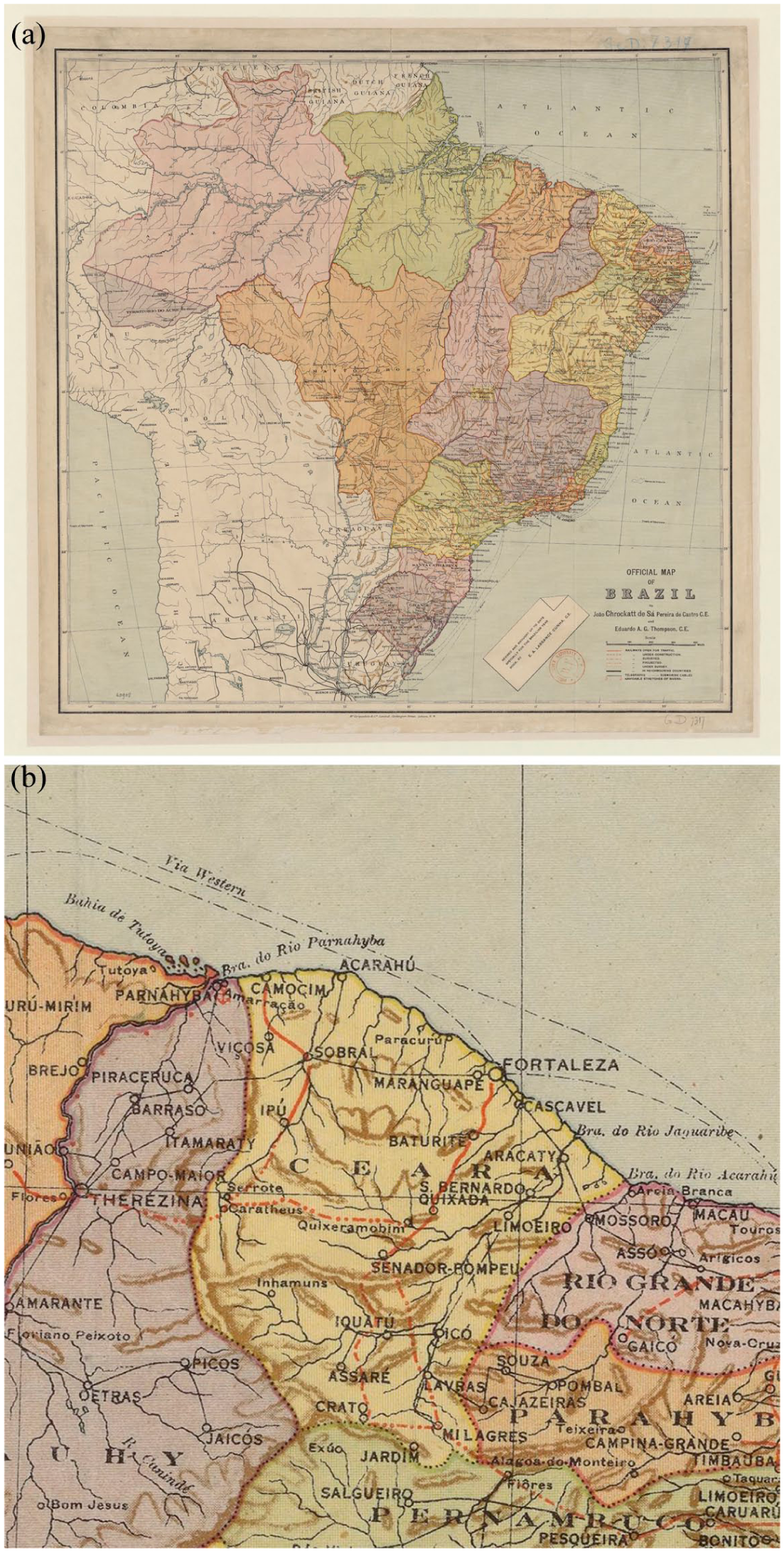
Map of Brazil (a) with a close-up of Ceará state (b). Official map of Brazil, by Joao Chrockatt de Sa, John Pereira de Castro, and Eduardo A.G. Thompson (1917).
By the late 1910s, Sobral was the second most important city of the state of Ceará. With its 30,000–35,000 inhabitants, the city was home to several newspapers, including Correio da Semana, A Lucta, and A Ordem. These publications represented a range of social and political perspectives. Correio da Semana was a traditionalist newspaper run by the Catholic Church in Sobral, while A Lucta was established by opposition leader Deolindo Barreto Lima, a lawyer who was assassinated in Sobral in 1924. The motto of this newspaper, published on its front page, was “Let the case be told as it truly was. A dog is a dog, an ox is an ox. Let the truth be spoken on earth, though the heavens may fall.” A Ordem presented itself as the official press organ of the Republican Conservative Party in Sobral (Partido Republicano Conservador). These newspapers focused primarily on local news, although they occasionally highlighted achievements of Sobral natives who excelled in national politics. This was the case, for example, when Eduardo Saboya celebrated his first anniversary as federal congressman elected by the Republican Conservative Party, an event duly reported in A Ordem. 15
To reach Sobral from outside the state, the easiest route was to take the train from Camocim, a coastal city in Ceará approximately 130 km from Sobral (Figure 1b). Camocim was home to the newspaper Folha do Littoral, described at the time as “the largest newspaper in the entire interior [meaning outside Fortaleza, the state capital of Ceará], and perhaps the one with the best printing facilities in the central region.” 16 Folha do Littoral, which presented itself as the “newspaper of commerce and general information,” had an extensive network of correspondents across the northwest of the state, covering not only the capital, Sobral, and other northern cities such as Granja and Parazinho, but also more distant locations like Ipú and Nova Russas, granting it a significant regional influence. 17
Unfortunately, the Hemeroteca Digital of the Biblioteca Nacional in Rio de Janeiro does not include newspapers from Fortaleza published around 1919. However, state news on the 1919 eclipse can be found in Estado do Pará, published in Belém, the capital of the neighboring state of Pará. This newspaper covered news from across the entire state.
Rio de Janeiro, the federal capital of Brazil, was home to newspapers intended for nationwide circulation. In addition to covering national political affairs centered in Rio de Janeiro, these newspapers reported on events across all states of the Brazilian Federation and abroad. They maintained a network of correspondents, subscribers, and engaged readers across Brazilian cities and towns.
On the eve of the 1919 eclipse, Brazil was experiencing a period of political consolidation and economic growth. While preparing to celebrate the centenary of its independence from Portugal, the federal government of this young Republic – implanted in 1889 – was divided between the political elites of São Paulo and Minas Gerais states. At the state level, regional oligarchies exerted significant influence over politics, often shaping local and state elections. The growing global demand for coffee and the rising export of meat spurred agricultural and livestock expansion in Brazil’s southeastern states, particularly São Paulo and Minas Gerais. Urban areas and local industries also expanded, bolstered by continuous waves of European and Asian immigrants and by restrictions on imported manufactured goods during World War I. 18
Urban, educated readers were avid consumers of newspapers, which were published in large print runs in cities such as Rio de Janeiro, São Paulo, and Belo Horizonte. 19 These readers were, to a large extent, the product of educational policies introduced by the newly established Republican regime. Seeking to promote a secularized society broadly aligned with positivist ideals, 20 these policies primarily benefited the urban middle and upper classes. Despite the construction of new schools and advances in teacher training, inadequate infrastructure and the Catholic Church’s opposition to positivist ideas and policies undermined the Republican project of securing free and universal education. 21 It is therefore not surprising that large sectors of Brazilian society remained outside the reach of formal education at the time the total solar eclipse was observed: in 1920, the illiteracy rate of the Brazilian population stood at around 80%. 22
Those who had the opportunity to study could benefit from a fragile network of technoscientific institutions that emerged in southeastern Brazil around the turn of the twentieth century. The Escola Central was transformed into the Polytechnic School of Rio de Janeiro (1874); a School of Mines was established in Ouro Preto, Minas Gerais (1876); and a School of Engineering opened in São Paulo (1893). In public health, the Instituto Oswaldo Cruz, founded in Rio de Janeiro in 1900, became known for promoting hygienist policies from the coast to Brazil’s interior. São Paulo’s Instituto Butantan, founded in 1901, played a similar role. 23
Many professors at these institutions actively promoted public awareness of science by publishing articles of science popularization. One prominent figure in these publications was Henrique Morize, Director of the National Observatory of Rio de Janeiro, a key figure in the pages that follow. These professors and scientists authored popularization of science articles that appeared not only in specialized journals like the Revista da Sociedade Brasileira de Ciências, launched in 1917, but also in newspapers. In this context, a monthly review significantly entitled Eu Sei Tudo (I Know Everything) was launched in Rio de Janeiro, also in 1917. Comprising abstracts from publications around the world, the magazine included sections explicitly devoted to science popularization under headings such as “Tudo se explica” (Everything is explained) and “A ciência ao alcance de todos” (Science within everyone’s reach). 24
However, access to scientific knowledge was not restricted to literate audiences. Alongside the long-standing practice of reading newspapers and other printed materials aloud in public spaces, a variety of initiatives emerged that did not require the ability to read and were aimed at audiences eager to engage with scientific subjects. One notable example was the Conferências Populares da Glória (People’s Conferences of Glória). Held on Sunday mornings in public schools in Rio de Janeiro’s Glória neighborhood from 1873 until the early 1890s, these public sessions became arenas for debate on issues such as freedom of education, the establishment of universities, and contemporary scientific theories, including Darwinism, as well as topics in botany, physics, and astronomy. 25 An even more popular and far-reaching initiative was the series of radio broadcasts promoted by Rádio Sociedade do Rio de Janeiro, organized by members of the Academia Brasileira de Ciências – originally founded as the Sociedade Brasileira de Ciências – under the presidency of Morize. Beginning in 1923, these broadcasts featured a range of programs explicitly devoted to popularizing scientific knowledge. 26
Beyond educated readers and main cities, multiple readings at pubs, barber shops, or other places where gatherings happened on a daily basis created the conditions for many people to follow the more recent news of Brazil and the world, despite the population’s high illiteracy rate. All together, with the increasing demand for newspapers, professional journalists appeared and shaped the news landscape.
Sobral, a theater for scientists
On May 14, Sobral’s opposition newspaper A Lucta announced the arrival of two teams of scientists in Sobral: the Brazilian team, led by Morize, and the American team – Daniel Wise and Andrew Thomson. 27 A few days earlier, the Catholic newspaper Correio da Semana reported the arrival of British astronomers Crommelin and Davidson, noting proudly that “both are practicing Catholics.” 28
Local newspapers in Sobral highlighted that the city was the ideal theater for scientists’ eclipse-related work. 29 They reported that each of the three teams had distinct observational programs and goals. The Brazilian team from Rio de Janeiro’s National Observatory aimed to photograph the solar corona for astrophysical studies. The American team, from the Carnegie Institution of Washington, focused on studying the potential impact of the eclipse on terrestrial magnetism. 30 The British astronomers from the Greenwich Royal Observatory, as A Ordem reported a few weeks before the eclipse, “came to this city to conduct specialized studies grounded in purely scientific principles advocated by the brilliant scientist Einstein, whose conclusions will now be tested by observing the total eclipse on the 29th of this month.” 31
Of all the teams, the Sobral audience was more familiar with the Brazilian team and its director. A few months before the eclipse, however, Morize was still a stranger to Sobral’s readers. In a letter sent to the editor of A Lucta, published in the newspaper, Morize was described as a somewhat peculiar figure:
He is of French origin, having moved to Brazil when he was five years old, and later graduated in engineering in Rio de Janeiro. He’s taller and thinner than you, which gives him a rather striking appearance. I reckon his favorite outfit is an alpaca tailcoat.
32
In the months leading up to the eclipse, however, Morize spared no effort in raising public awareness of science and the work of scientists among Sobral’s local population. Although Brazilian intelligentsia at the time widely viewed the country as divided into “two Brazils” or “two faces of Brazil” – a cosmopolitan, outward-looking littoral region contrasted with inland areas preserving Brazil’s ancestral purity-, Morize encountered a different reality in Sobral. 33 In the heart of Ceará state, he found an audience eager to learn the latest scientific developments.
Morize’s first journey to Sobral took place in March to assess the preparations for receiving the foreign teams. Local newspapers enthusiastically reported the arrival of the distinguished astronomer, accompanied by his assistant, Domingos Fernandes Costa, from Rio de Janeiro. Most reports highlighted that Morize was married to a woman from Ceará (born in Paracurú), offering their readers a way to connect with the “striking” astronomer. 34 During this first visit, he worked to establish a positive relationship with the local press, even granting an interview to A Ordem. Morize provided information not only about the eclipse but also addressed a critical issue affecting the people of northeast Brazil, the severe drought, which had led to a mass migration from the interior to cities like Sobral, Fortaleza, and even Rio de Janeiro. These local concerns were pressing for the community.
Accordingly, in the interview, he explained the basics of an eclipse and why the 1919 event was so significant, informing Sobral’s readers about the expected arrival of teams from the United States, the United Kingdom, and Argentina.
35
Concerning the drought, he discussed the benefits of creating a weather forecasting network in Ceará. Additionally, he used the opportunity to present scientists as approachable and unpretentious individuals committed to expanding public understanding of science. As the journalist reported,
Dr. Henrique Morize, during the few days he stayed here, won a great number of friends not only for his straightforward and simple treatment, completely devoid of the vanity that is almost always associated with celebrities, but also for his enviable qualities as a fine “causer” [that is, motivator or talkative person].
36
On May 10, Morize returned to Sobral, this time accompanied by his entire crew, which included not only his scientific team but also his wife as well as the wife of one of his collaborators.
37
The “talkative character” was once again in action, promoting science and inspiring enthusiasm among the local population. In the days that followed, he welcomed journalists from A Ordem once more, offering them some of his publications. As the reporter noted, Morize and geologist Teófilo Lee (misrepresented as “Theodorico”), a member of the Brazilian team, explained again the basics of an eclipse in a pleasant and accessible manner. They provided additional insights into the Sun’s physical composition, spectroscopy, and the objectives of the three research teams. Aware of the curiosity sparked by Einstein’s unconventional theory, Morize and Lee explained it in the following terms:
According to Einstein’s recent theory, light possesses mass and possibly weight. If this hypothesis is correct, light would be affected by gravity, causing a ray passing close to the Sun to bend, thereby shifting the apparent position of the emitting star when observed near the Sun compared to when it is farther away.
38
Obviously, one did not need to be an expert in astronomy or physics to enjoy the eclipse. The people of Sobral were eager to take advantage of this rare natural spectacle. Although Sobral had become a theater for scientists, the local population was not content to be merely a passive audience, and neither was this Morize’s intention. All could become actors in the astronomical play that was to take place in the days to come. A few days before the eclipse, Morize published an article in A Ordem, and later in Correio da Semana, in which he highlighted the natural, harmless nature of an eclipse to ease any fear or anxiety among the “less educated.” He mentioned significant natural phenomena to be observed, including temperature drop, changes in animal and plant behavior, and a likely increase in wind. To witness the eclipse safely, he advised readers to “simply look at the Sun through dark or smoky glass.” Finally, Morize emphasized the importance of maintaining silence and refraining from launching flares. 39 Milena Wazeck has noted an ideological divide in how Einstein was received in the German press, with right-wing newspapers disapproving of him and liberal newspapers celebrating his success. 40 In Sobral, however, no such clear ideological distinction existed. From reading Sobral’s newspapers, Einstein’s theory was described neutrally, simply as a hypothesis to be tested in Sobral. Nevertheless, the newspapers in Sobral reflected varied social sensibilities, capturing the diversity of the local society. Correio da Semana offered a remarkable case in point.
Led by the Catholic Church of Sobral, Correio da Semana seized the international impact of the 1919 eclipse to promote the Catholic cause locally. While other local newspapers depended on official communications from the Rio de Janeiro Astronomical Observatory and state and national governments, Correio da Semana profited from its own information channels within the Catholic Church. As readers learned in the first issue of March 1919, the local bishop, José Tupynambá da Frota, received a letter from the director of the Stonyhurst Observatory, informing him that the British government had sent astronomers Crommelin and Davidson to observe the eclipse in Sobral. 41 The director in question, Jesuit astronomer Father Aloysius Cortie, initially planned to join the British team but was unable to obtain a leave of absence from Stonyhurst Observatory in Lancashire. 42 Still, Cortie worked behind the scenes within the Catholic network to support the British astronomers. 43
In Sobral, the British astronomers were well received.
44
Correio da Semana praised both the scientific achievements and the devout Catholic background of the British astronomers. It enthusiastically likened Crommelin to the nineteenth-century Jesuit astronomer Angelo Secchi, known for his studies of the Sun:
Secchi astonished the entire scientific world with his genius, revealing secrets of the “king star” previously impenetrable. Mr. Crommelin, as a modern-day Secchi, has now been entrusted with a delicate and challenging task: measuring light, an unsolved mystery upon which many scientific discoveries depend.
45
Rather than science itself, the editors of Correio da Semana were primarily concerned with the metaphysical and religious implications of astronomical research. Drawing on the example of these devout astronomers, they encouraged readers to emulate such brilliant scientists by contemplating nature’s creator, concluding plainly, “How beautiful it would be if every Sobralense knew how to worship their God!” 46 To the editors, and presumably to the majority of Correio da Semana’s readers in Sobral, science was thus a means to reach God.
The British astronomers, in turn, reciprocated Correio da Semana’s care by choosing it as their preferred communication outlet. They wrote “especially to Correio da Semana” – as the newspaper proudly announced – an article translated by Leocádio Araújo, an expert civil servant working at the Ministry of Agriculture who knew English and accompanied the British astronomers during their stay, acting as an interpreter and helping them whenever necessary (Figure 2). In it, they outlined the British team’s research objectives, explained Einstein’s theory, provided details on the timing of the eclipse, and noted that their mission was part of a larger expedition organized by the JPEC, which included Eddington’s expedition to Príncipe Island. 47 Following the eclipse, the British astronomers returned to the Catholic newspaper to share further details about their observations and preliminary results. They notably emphasized that of the photographs taken, eight were captured using the “best telescope,” loaned by “Father Cortie from the Jesuits’ college, England.” 48 Both editors and astronomers used the Catholic link not only to bridge the gap between foreigners and locals but also to evidence the connections between astronomy and religion, in a clear instantiation of the role of moving localities in shaping the appropriation of knowledge.
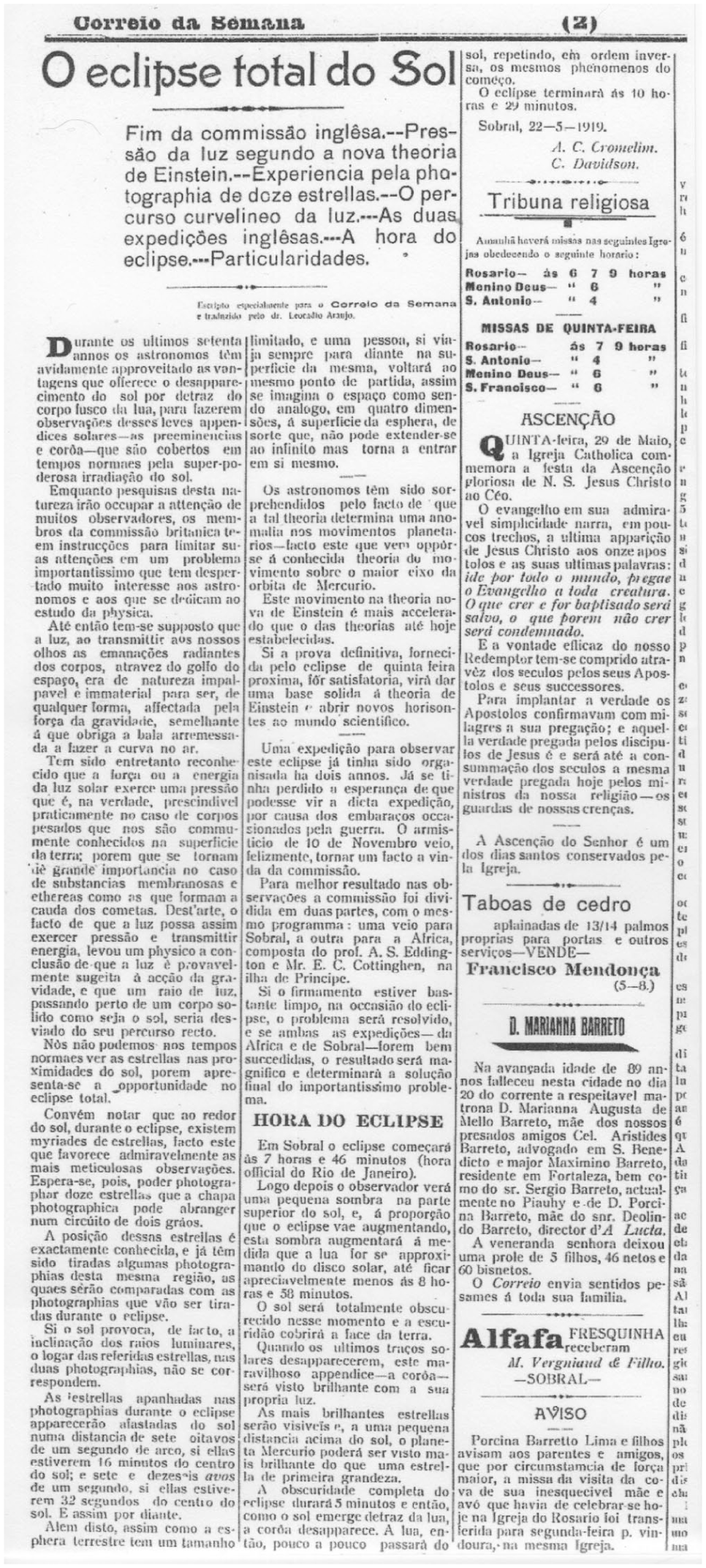
A. C. de la C. Crommelin and C. Davidson’s article “O eclipse total do Sol,” specially written to the Catholic newspaper Correio da Semana, May 24, 1919.
The opposition newspaper A Lucta offered a different perspective, more attuned to its social commitments. Alongside information about the Brazilian and British teams, A Lucta praised not only the scientific credentials of the American scientists but also their contributions during World War I. The newspaper highlighted that their expertise in magnetism had proven invaluable. As A Lucta informed its readers: “Both scientists, due to their strong mathematical knowledge, were selected to work with the genius Thomas Edison during the war, and they studied magnetic variations during the last total eclipse of the Sun on July 28 of last year, providing significant benefits for navigation and surveying.” 49
On May 29, the eclipse finally took place. As newspapers reported, clouds dissipated just before totality, allowing astronomers to capture the desired photographs and physicists to take the necessary measurements. The local population enthusiastically watched the eclipse, although some ladies preferred the shade of the churches over that of the eclipse itself. Businesses closed to allow everyone the chance to witness the eclipse. 50 The Municipal Council set up two small telescopes in a piazza for the public, with the profits intended to fund the construction of a public garden in the town. 51
Camocim’s newspaper, Folha do Littoral, vividly captured the collective excitement sparked by the event:
You could say that Sobral lingered over the eclipse. From early on, the streets were still, with sparse groups gathering in certain spots, preferably in squares, where the Sun was most visible. Many people had been staring intently at the Sun since dawn, using their smoky pieces of glass. It’s curious to wonder where they managed to find so many pieces of glass, as almost everyone seen on the street carried their own little “telescope.” However, it seems that as the eclipse reached its peak, the supply ran out, and the only recourse was to break into windows!
52
But the participation of locals went beyond Sobral. From Nova Russas, a local inhabitant who signed as J.R. reported that during the eclipse swallows circled the church to find a place to rest, chickens prepared to sleep, cold and silence were felt everywhere, and the spectacle of the Sun’s corona was impressive. 53 In sum, taking circulation and communication of science as forms of knowledge production in Secord’s sense, it becomes clear that locals were also active participants in knowledge construction.
Years later, on the day Brazil celebrated its 102nd anniversary of independence from Portugal, a local scholar named António Almeida provided readers of A Ordem with a concise history of Sobral, capping his account with the famous 1919 eclipse, honoring Crommelin, Davidson, Wise, Thomson, and Morize. He closed his brief history by stating, “All these scientists came here to study the great eclipse of the Sun on May 29 of that year.” 54
Probably, while the memory of foreign astronomers faded over time, the name of Morize endured. As the conservative newspaper A Ordem duly reported, Morize secured the establishment of a meteorological station in the city ravaged by devastating droughts. This was his legacy. 55 This was part of a larger project, launched in 1910, to establish Brazil’s first network of weather stations. 56
Camocim, the eclipse, and the astronomical picnic
Sobral was the epicenter of eclipse observation in the state of Ceará. Along with professional astronomers, the city attracted visitors from northern Ceará, including an unnamed correspondent from Folha do Littoral. Given its regional coverage of the state’s northwest, it is unsurprising that this newspaper, published in the coastal city of Camocim, sent a journalist to cover the events surrounding the eclipse. The reporter provided two significant accounts from Sobral. One – just quoted above – detailed the social excitement during the eclipse, the metamorphosis of locals into amateur astronomers with rudimentary “telescopes,” together with the number of photographs taken and the work conducted by the astronomical teams. The other, published days before the eclipse, informed readers about the objectives of the three teams of astronomers present in Sobral. To write this account, the reporter interviewed Morize, who was overseeing the installation of astronomical instruments in the four large tents set up in Praça do Patrocínio, in the town’s center, and worrying about the possibility of cloudy weather during totality. 57
Readers of Folha do Littoral were already familiar with this “eminent scientist,” as he was described in the article. Morize frequently passed Camocim on his way from Rio de Janeiro to Sobral. His first visit took place likely in early March, when he journeyed to Sobral to finalize last-minute arrangements. 58 As he did later in Sobral, Morize used his time in Camocim to establish a fruitful relationship with the local press and society. On his way back to Rio de Janeiro later that month, Morize paid a visit to the newspaper’s headquarters in gratitude for the news of his passage through Camocim. On that occasion, he offered to write an article about the eclipse of May 29, described as being “specially written for the Folha do Litoral” (Figure 3). 59
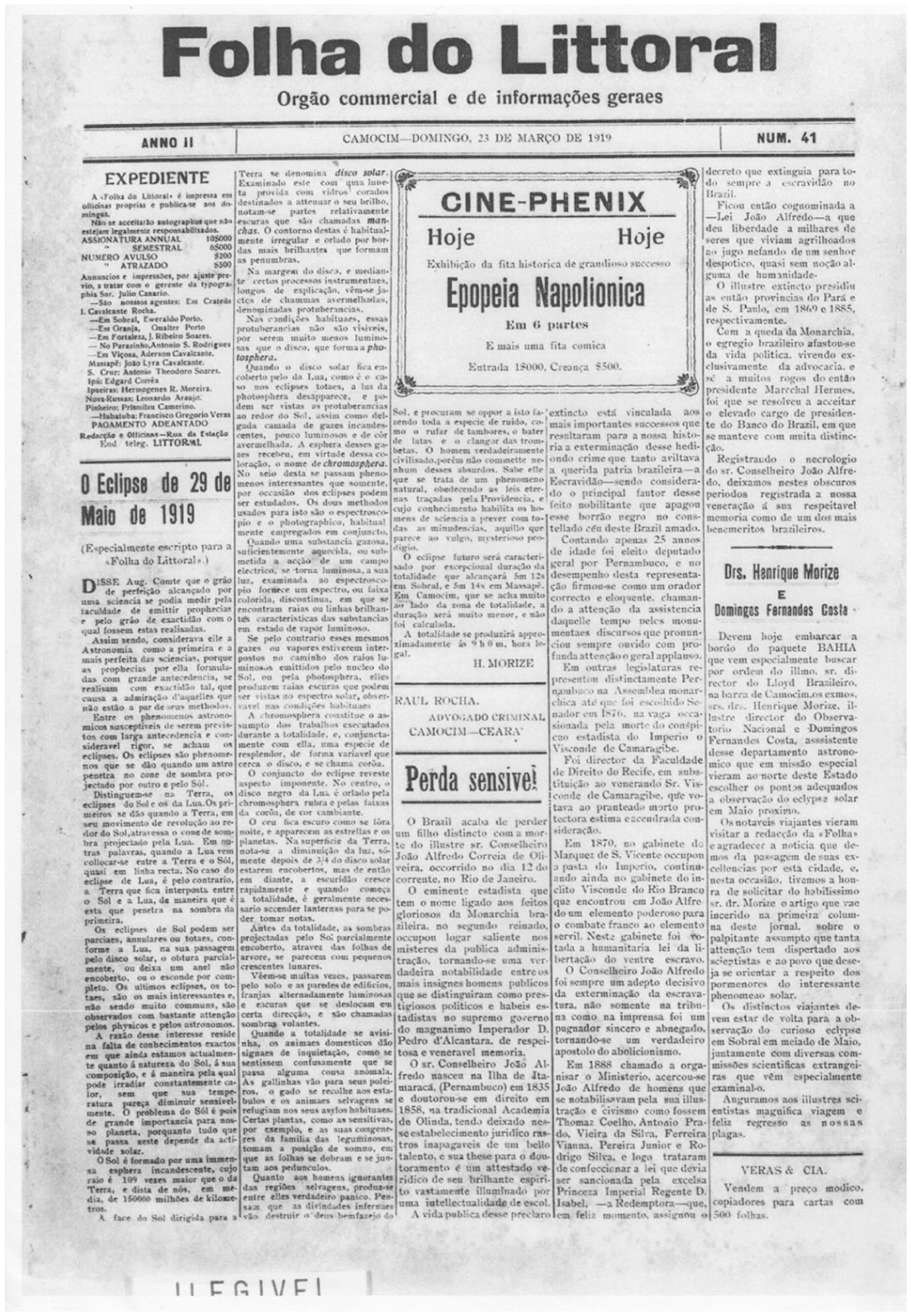
Front page of the March 23, 1919, edition of Folha do Litoral.
The Camocim newspaper did not disappoint its readers. Morize’s article differed significantly from those he published in Sobral’s newspapers. Rather than focusing on the timing and characteristics of the 1919 eclipse, Morize delved into the physical features of the Sun and the spectroscopic and photographic techniques employed during eclipses. Notably absent was any mention of the groundbreaking observational experiments by British astronomers or any reference to Einstein, as these topics were likely unfamiliar to the Camocim audience. Instead, Morize concentrated on the aspects of astrophysics he knew best and deemed most significant, demonstrating how the specificities of local contexts and the agency of moving localities shaped the circulation of scientific knowledge.
Furthermore, Morize emphasized the broader scientific merits of astronomy. He framed it as a discipline exemplifying Auguste Comte’s conception of science as a superior, universal, and law-governed form of knowledge:
Auguste Comte stated that the degree of perfection attained by a scientific discipline could be gauged by its capacity to make predictions with precision. Accordingly, he regarded astronomy as the first and most perfect of the sciences, as its predictions, made well in advance, are realized with such accuracy that they inspire admiration even among those unfamiliar with its methods.
60
Eclipses offered a striking example of this heuristic potential. While this perspective does not necessarily mark Morize as a strict positivist, it is significant in the Brazilian context, where Comte’s ideas had a profound influence in the early twentieth century in the aftermath of the Republican Revolution. 61 For Morize, the study of astronomical phenomena was a vital means to ultimately uncover the fundamental laws governing nature.
Morize was the only member of the astronomical community to engage directly with local society in Camocim. Folha do Littoral reported that he traveled to Sobral accompanied by Wise and Thomson, yet the American scientists did not appear eager to interact with the local population. This contrasts with their apparent engagement in Sobral, at least with individuals affiliated with the newspaper A Lucta. 62 Regarding Crommelin and Davidson, no news about their activities was reported. However, Folha do Littoral published an article authored by the British astronomers a few weeks before the eclipse. The piece had originally been written for a newspaper in Belém do Pará, the capital of the neighboring state of Pará, where the Greenwich Observatory team had stayed prior to their journey to Ceará. 63
In Ceará, as in Rio de Janeiro or São Paulo, the main centers of Brazil’s political and economic life, articles discussing the content and implications of scientific issues were usually authored by scientific practitioners themselves, including Brazilian and British astronomers. As Nelson Werneck Sodré and other scholars have noted, during the late nineteenth and early twentieth centuries, the transformation of newspapers into commercial enterprises fostered a gradual differentiation of journalistic labor. This process was marked by the emergence of specialized roles of editors, reporters, illustrators, and caricaturists, alongside technical innovations, expanded circulation, and growing advertising revenues. 64 Nevertheless, in the specific case of news coverage of the 1919 eclipse expeditions, authorship is rarely identified, making it difficult to determine whether the articles were written by traditional figures, such as politicians, priests, military officers, or intellectuals, who had long used newspapers as instruments of partisan engagement, or by members of the emerging profession of journalists and reporters. An exception is provided by Folha do Littoral, which offers a glimpse into the participation of nonscientific contributors in newspaper discussion of the eclipse. Indeed, Folha do Littoral provided a platform for local figures, among them Colonel Alpheu E. Aboim, who authored an article on the Sun and ancient solar cults, citing Camille Flammarion and other scholars, including the local philosopher Farias Brito. Brito is noted for deriving theological conclusions based on the properties of sunlight, stating that “God is the light.” 65
Aboim, however, was a more worldly character. He spearheaded a secular initiative to “promote a popular festival” in honor of the total solar eclipse. Playing with the solid organizational structure of observational teams, he promoted the formation of the temporary Club Astrológico 29 de Maio (Astrological Club of May 29), with Aboim as its director, and sarcastically rehearsed a parallel event to observe the eclipse. As reported on the front page of the issue of May 25, the club’s whimsical organizational structure was noted to include various military men acting as secretaries, a board of directors overseeing different activities – including an orchestra, a pub, and eclipse observations – as well as speakers, journalists, and members ironically called, interchangeably, astronomers or astrologers. These and other members orchestrated a grand picnic to observe the eclipse, held at a location approximately one kilometer from Camocim. The event’s program was ambitious, offering much more than eclipse observation. It featured music, dancing, social games, a communal lunch, and a photography session to capture club members after the pivotal celestial event, scheduled to occur between 7:00
The picnic was a resounding success, bringing together over 100 participants from Camocim in a joyful and convivial atmosphere. The festivities even included the creation of a commemorative banner, to be presented to the “illustrious scientific commission led by the renowned Brazilian astronomer Dr. Henrique Morize” during his return journey to Rio de Janeiro via Camocim. 67
Some readers of Morize’s writings, published in the Camocim newspaper Folha do Littoral, were undoubtedly among the members of the Club. While Morize likely departed from Rio de Janeiro with a focused agenda of astronomical observation, his visit to the coastal city of Ceará proved to be a pivotal moment for fostering public engagement with science. The residents of Camocim sought to demonstrate that his efforts to communicate and popularize scientific knowledge had not been in vain. They also eagerly received news from other localities. Details of totality observed in Sobral included the mention of the strict silence just interrupted by the clicks of photographic cameras in the Brazilian camp and a stiff drop of temperature. 68 The activities of Camocin’s residents demonstrated that an eclipse has many faces worth being explored.
Belém do Pará, astronomers amid criticism
Belém do Pará, the capital of Pará, a neighboring state of Ceará where the solar eclipse was observed in its totality, was the first city visited by Crommelin and Davidson. They arrived in late March, more than two months ahead of the eclipse. The main newspaper of Pará state, Estado do Pará, informed its readers that the British planned to travel up the Amazon River to Manaus, a city nestled in the heart of the Amazon rainforest, famous for its opera house. 69
In Belém, Crommelin and Davidson quickly realized that Father Cortie’s behind-the-scenes efforts to ensure their success were already yielding positive results. Upon disembarking from the steamboat Anselm, they were welcomed by local authorities and, most notably, by Father Manuel Tavares, a Jesuit confrère of Cortie. 70 Father Tavares paved the way for the British Catholic astronomers, facilitating their access to the state press. Indeed, a month later, Estado do Pará published an article authored by them titled O Próximo Eclipse Total do Sol (“The Next Total Solar Eclipse”).
While it may be somewhat overenthusiastic to claim, as Crispino and Lima did, that Einstein’s ideas on the theory of relativity were introduced in the Amazon region by this article, 71 it offers a fascinating glimpse into the state of eclipse observation in the late 1910s. Crommelin and Davidson noted that recent astrophysical studies used total solar eclipses to investigate the form, structure, and chemical composition of the Sun. While acknowledging that there was still much to learn about the solar corona, they announced that a “new problem” recently attracted great interest in astronomical circles: the possibility that celestial light traveling through space could be affected by the gravitational force exerted by large masses, such as the Sun. If true, light would bend when passing near the Sun.
The proposed method to test this prediction involved photographing the stars in the sky during a total solar eclipse and comparing the photographs with those of the same sky region taken during a regular night. If the positions of the stars appeared displaced as predicted by Einstein, Einstein’s argument that “in addition to the three known dimensions of space—length, width, and height—time serves as a fourth dimension” 72 was confirmed. In this way, as often in newspapers around the world, special and general relativity were conflated.
Despite the warm welcome and the interaction with the press, Crommelin and Davidson encountered a more challenging environment in Belém than they would later find in the friendly town of Sobral. As previously mentioned, in the late 1910s, the north and northeast of Brazil were devastated by a prolonged and relentless drought. Although May was typically a month of rain, climatologist Luiz Rodrigues informed readers of the Rio de Janeiro-based newspaper A Noite that the late 1910s was an exception. 73 This situation created a conflict of interest between scientists, who hoped for clear skies to observe the eclipse, and the impoverished population of Ceará, who looked for cloudy skies and rain.
The drought crisis dominated the pages of national and state newspapers, with political criticism flaring up periodically. When the British astronomers arrived in Belém, their presence and astronomical goals drew sharp criticism from the local intelligentsia. A couple days after their article appeared in Estado do Pará, the newspaper published a critical piece by another member of the local elite, Paulino de Brito, who thereby voiced the locals’ critical assessment of the protagonism given to foreign astronomers. Brito expressed dissatisfaction with scientists focusing on theoretical matters – such as the bending of solar light during a total eclipse – while countless people were suffering and dying due to the drought:
When Drs. Crommelin and Davidson arrive in Sobral, for example, they will find themselves surrounded by desolate scenes in the theater of devastation caused by the drought. For those poor people dying of hunger, it would certainly seem more important for the two illustrious scientists to discover how to make a drop of water fall on the scorched ground than to determine, once and for all, whether the sun’s attraction bends light rays from the nearest stars.
74
In addition to the challenging situation faced by Ceará and other northern and northeastern states, Brito’s criticism was likely fueled by his self-professed inability to grasp the fundamentals of Einstein’s theory. He admitted: “Incomprehensibly more difficult to grasp is Einstein’s conception of the universe, in which ‘time’ is one of the ‘four’ dimensions of ‘space’!” Neither the presence of two foreign astronomers in Pará and Ceará nor Einstein’s theory itself was acceptable or understandable to him.
In this context, the question of Einstein’s nationality came to the fore. While European newspapers sometimes discussed Einstein’s nationality in association with his Jewish identity, these issues did not concern Brazilian newspapers in 1919. To the best of our knowledge, Brito’s article is the sole exception. Seeking to underscore what he perceived as the eccentric nature of Einstein’s theories – and, by extension, their irrelevance to Brazil – Brito concluded his article with a strongly nationalist claim:
Einstein! But isn’t that a German name? If the name is, and the owner of the name is, then so are the theories. In that case, the explanation naturally follows: Time, space, infinity, everything is. . . made in Germany!
75
The engagement of Crommelin and Davidson with local communities in Pará and later in Sobral cannot be separated from this challenging environment, moving from a stressful “theater of devastation” to a welcoming “theater for scientists.” Locals’ reactions to foreign astronomers were shaped by their contexts. In turn, astronomers were undoubtedly aware of the hardships faced by the region and the potential hostility their presence might provoke. Their efforts to connect with local communities were shaped not only by their desire to promote public awareness of science but also by the specific constraints and needs of northern and northeastern Brazil. In both instances, the agency of moving localities was at play.
The eclipse eclipsed by politics and football in Rio de Janeiro
In Rio de Janeiro, although geographically distant from the region where totality was observed, the eclipse still garnered significant attention. The city was home to a diverse array of newspapers, offering readers detailed accounts of science-related topics associated with the eclipse. These included, among others, the scientific initiatives undertaken during the observation of the eclipse in northeast Brazil and the role of the Brazilian government in promoting awareness of science. Recognizing the public’s fascination with the phenomenon, journalists actively cultivated and sustained this interest. In turn, readers actively shaped newspapers as sites of knowledge production in Secord’s sense.
Newspapers spared no effort in keeping their readers informed about the various scientific teams’ travels to Sobral to observe the eclipse. They highlighted the logistical and political efforts involved, projecting an image of Brazil as a modern and scientifically advanced nation. The press closely followed the activities of Morize, who diligently prepared the reception of foreign scientists. As early as March, when Morize first traveled to Sobral, the capital’s newspapers were already updating readers about his journey. 76 Every visit Morize made to the Ministry of Agriculture, Industry, and Commerce, under which the National Observatory operated, was duly reported. 77 Readers eagerly followed the arrival of foreign scientists and their journeys to Sobral, where Brazilian, British, and American teams gathered. 78 When the long-awaited day of the eclipse finally arrived, the newspapers were flooded with reports from Sobral, vividly describing the observations made. 79
To provide timely updates, they relied on a network of correspondents stationed in various Brazilian cities as well as abroad. For instance, the April 22 issue of A Noite featured a front-page report from London, announcing:
The joint commission in charge of studying eclipses, comprising members of the Royal Society and the Royal Astronomical Society, is making the final preparations to send two expeditions abroad to study the total eclipse of the sun that will take place on May 25 [sic, 29], one destined for Brazil and the other for the island of Príncipe.
80
As publications of nationwide circulation, the capital’s newspapers covered eclipse observations not only in Sobral but also in other Brazilian regions. Reports from Rio de Janeiro and São Paulo detailed events such as the visit of São Paulo State President Altino Arantes to the Observatório da Avenida Paulista to observe the phenomenon on May 29. 81 News also arrived later from more distant states, such as Maranhão in northern Brazil. For example, the March 1, 1920, edition of A Noite included a front-page article reporting the observations made at the Collegio Astronomico Camille Flammarion (Camille Flammarion Astronomical Association) (Figure 4). The article identified the observers by names and functions and described the instruments used, from telescopes and photographic cameras to auxiliary instruments, including thermometers, chronometers, metronomes, anemometers, and compasses. Ruben Almeida, director of this amateur association, who happened to be in Rio de Janeiro in early 1920, informed reporters that the association was “dedicated to the study and popularization of astronomy and related sciences, was equipped with instruments for meteorological research, and maintained correspondence with leading similar institutions.” 82
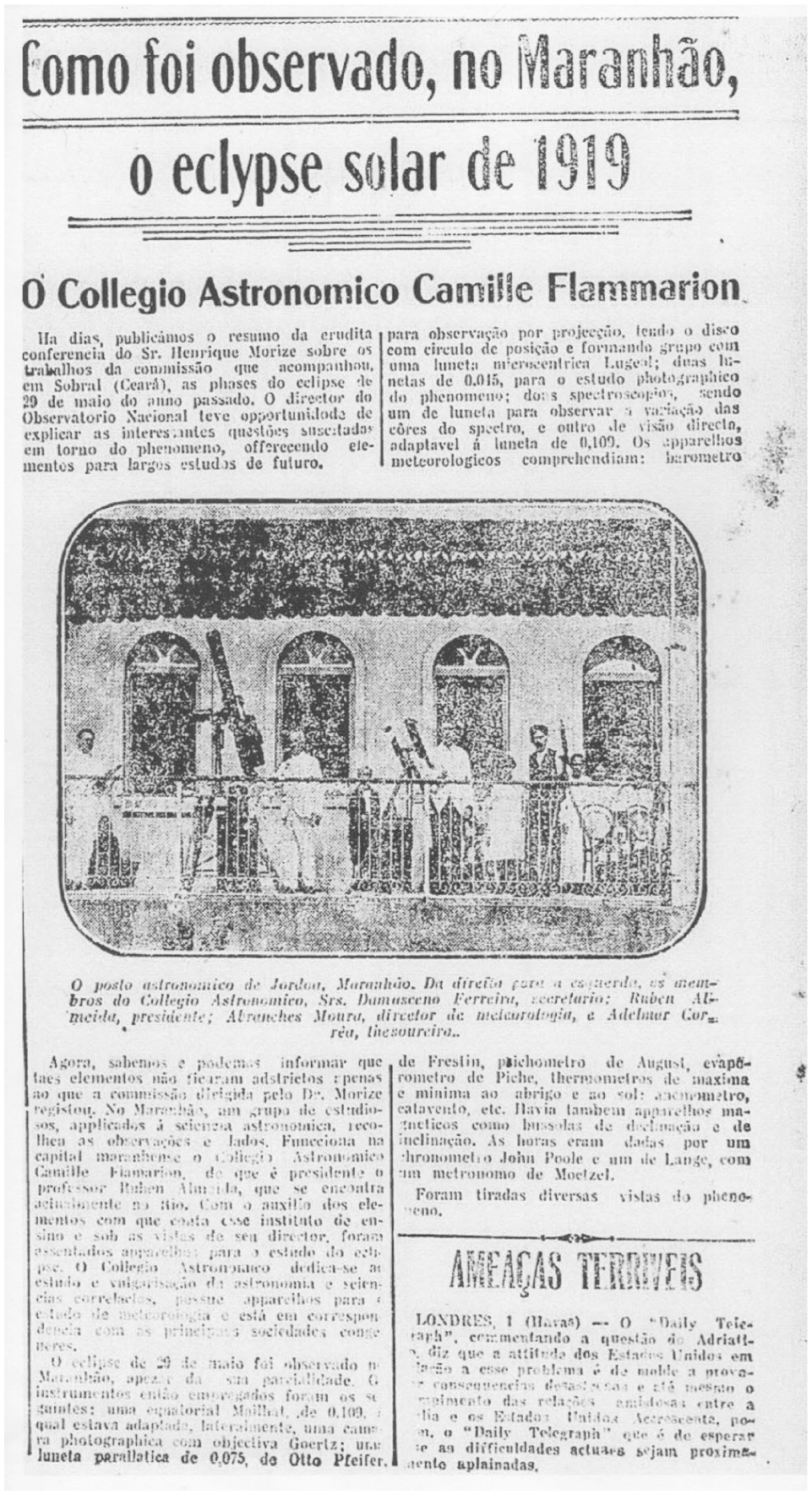
The Collegio Astronomico Camille Flammarion preparing to observe the 1919 solar eclipse in São Luís do Maranhão as illustrated in the front page of the March 1, 1920, edition of A Noite.
From time to time, the readers of Rio de Janeiro’s newspapers were startled by frightening incidents that seemed to jeopardize the success of the scientific event. One such case occurred one month before the eclipse, when an outbreak of yellow fever was reported around Sobral. By that time, the British team was already in Pará, preparing to board a vessel to Ceará on their way to Sobral. Readers closely followed Morize’s maneuvers in the political corridors to mitigate the public health threat. Reports informed readers that, following a plea by Vicente Saboya de Albuquerque, a federal deputy from Ceará and native of Sobral, civil authorities considered relocating the foreign scientists to a more remote location on a nearby mountain, less affected by yellow fever mosquitoes. The plan included transporting them to this location using an automobile – a commodity that did not exist in Sobral at the time. Another proposed measure was to cover certain areas of the house where the foreign guests were staying in Sobral with large textiles to protect against mosquito bites. 83 This precautionary step was ultimately implemented. 84 The prestige of Brazil’s organizational public health capabilities were at stake. As one newspaper remarked, “Imagine the shame and harm to Brazil if one of these scientists were to die from yellow fever!” 85
There was no doubt about the public enthusiasm surrounding the eclipse in Rio de Janeiro. However, compared to the cities in northeast Brazil, where the eclipse was observed in its totality and scientists were physically present, the capital stands out for its much weaker interaction between scientists and the newspaper-reading community. Unlike in Sobral, Camocim, and Belém do Pará, scientists in Rio de Janeiro did not actively engage with the press; there were no interviews given or articles written detailing the nature and features of solar eclipses, their scientific relevance, or the importance of the 1919 total solar eclipse in testing Einstein’s new “theory of gravitation.”
The exception was Morize. A key figure in Rio de Janeiro’s scientific community – director of the National Observatory, professor at the Rio de Janeiro Polytechnic School, and director of the Brazilian Academy of Sciences (Sociedade Brasileira de Ciências) 86 – the newspapers detailed Morize’s actions to turn this scientific opportunity into a significant event on both national and international scales. Yet, unlike their northeastern counterparts, Rio de Janeiro newspapers did not give him sufficient space to elaborate on eclipses and their scientific relevance. The only exception was a conference Morize delivered in February 1920 at the Brazilian Academy of Sciences, where he publicly presented the results of the Brazilian team. 87
In the February 19, 1919, edition, O Imparcial reported that, in a brief interview, Morize mentioned that Brazil’s northern territory would be crossed by a total solar eclipse, which would then continue across the Atlantic to the African continent. However, no additional details were provided, aside from a brief comment on the effects of such phenomena on animal behavior. 88 Later, upon his return from observing the eclipse in Sobral, Morize gave another brief interview as he disembarked from the steamboat Prudente de Morais, which brought the Brazilian team back to Rio de Janeiro. He commented on the difficulties faced during their Atlantic journey and mentioned the success of the astronomical observations by all teams in Sobral. When asked about the British team, he remarked in passing: “The British focused on studies to validate Staenbel’s [sic: Einstein’s] theory, while the Americans concentrated on research in magnetism and electricity.” 89 In transcribing the interview, the journalist mistakenly replaced Einstein’s name with that of the Munich instrument maker Steinheil, who had manufactured one of the equatorial telescopes equipped with photographic equipment used by the Brazilian team to observe and photograph the eclipse. 90 No doubt the journalist was not familiar with Einstein’s name and theory!
Except for Crommelin and Davidson’s article, “O Próximo Eclipse Total do Sol,” originally published in Estado do Pará and reprinted in the May 29 edition of the Rio de Janeiro newspaper Jornal do Commercio, there was little room in Rio de Janeiro’s newspapers for science popularization. 91 In stark contrast to their northeastern Brazilian counterparts, capital newspapers’ publishers and readers seemed uninterested in the eclipse’s scientific aspects.
Readers of the nationwide newspapers published in the capital were deeply engaged with politics, culture, and social entertainment. Rio de Janeiro was the central forum of political disputes in the first half of twentieth-century Brazil, and newspapers naturally capitalized on this dynamic. The eclipse provided an occasion to criticize the former president of Brazil, Marshal Hermes da Fonseca. Fonseca had served as president from 1910 to 1914, a tenure marked by significant social and political tensions. After his presidency, he traveled to Europe, living in Switzerland until 1920. 92 In 1912, President Fonseca sought to bolster his political capital by traveling to Passa Quatro, in the state of Minas Gerais, to observe a total solar eclipse. His large entourage included the U.S. ambassador in Brazil and several government ministers. 93 Nevertheless, poor weather conditions prevented observations. In 1919, the newspaper O Imparcial ironically remarked that the upcoming total solar eclipse would surely be a success, “because Mr. Marshal Hermes will not be waiting for it here, surrounded by diners and political allies.” 94
Brazilian politics and bureaucracy, apparently heavy and somewhat dysfunctional, were a frequent target of criticism in Rio de Janeiro’s newspapers. To prepare for the reception of foreign scientists (British astronomers and American physicists), and to secure the success of his own observational team, Morize requested funding of 50 contos de réis from the President of the Republic, Wenceslau Braz P. Gomes. The president submitted the bill, and the National Congress of Brazil approved the funding. 95 However, delays in transferring public funds to the Brazilian commission responsible for organizing eclipse observations in Sobral created significant challenges. The delay was so severe that it threatened to jeopardize the entire scientific event. As the newspaper A Noite reported in an article with the ironic title “Late and Harmful Bureaucracy. Almost Eclipsed the Observation of the Eclipse. . .,” 96 the situation captured public attention, with readers avidly following this unfolding drama. The newspapers revealed that the Audit Department of the Exchequer had created obstacles to the release of funds. In A Noite, it was noted: “Without the combined efforts of Mr. Pádua Salles, Minister of Agriculture, Mr. Barboza Lima, director of Lloyd [Brasileiro], and Mr. Morize, foreign astronomers might not have been able to observe the eclipse and could have been left merely watching from afar.” 97 It was against this chaotic backdrop that the capital’s newspaper O Malho wryly reported that the head of Brazilian public finances had suggested to Morize to “postpone the eclipse!” 98
When the day of the eclipse arrived, expectations were sky-high in Rio de Janeiro. However, it was not the astronomical phenomenon that seemed to attract the most enthusiasm. On May 29, another event captured the attention of Rio de Janeiro’s newspaper readers: the final of the football Third South American Championship of Nations, held in Rio. On that very same day, the Brazil national team was set to play the final match against Uruguay. On the eve of the game, newspapers claimed that the football match had generated such euphoric excitement that it might well eclipse the interest of Rio’s residents in the eclipse itself. 99 The newspaper A Noite anticipated that “tomorrow’s eclipse will be eclipsed by football.” The astronomical phenomenon seemed particularly fitting for the occasion, as the article noted: “If Brazilians win the football championship, they can proudly say that the Earth cast its perfectly round shadow into space in honor of the winning goal. If we lose, we can claim the Sun hid its face to avoid witnessing such disgrace!” 100 A suggestive drawing of a football eclipsing the Sun was prominently featured on the front page of the newspaper (Figure 5). The Brazilian national team defeated Uruguay, securing the first of many football championships in Brazil’s history.
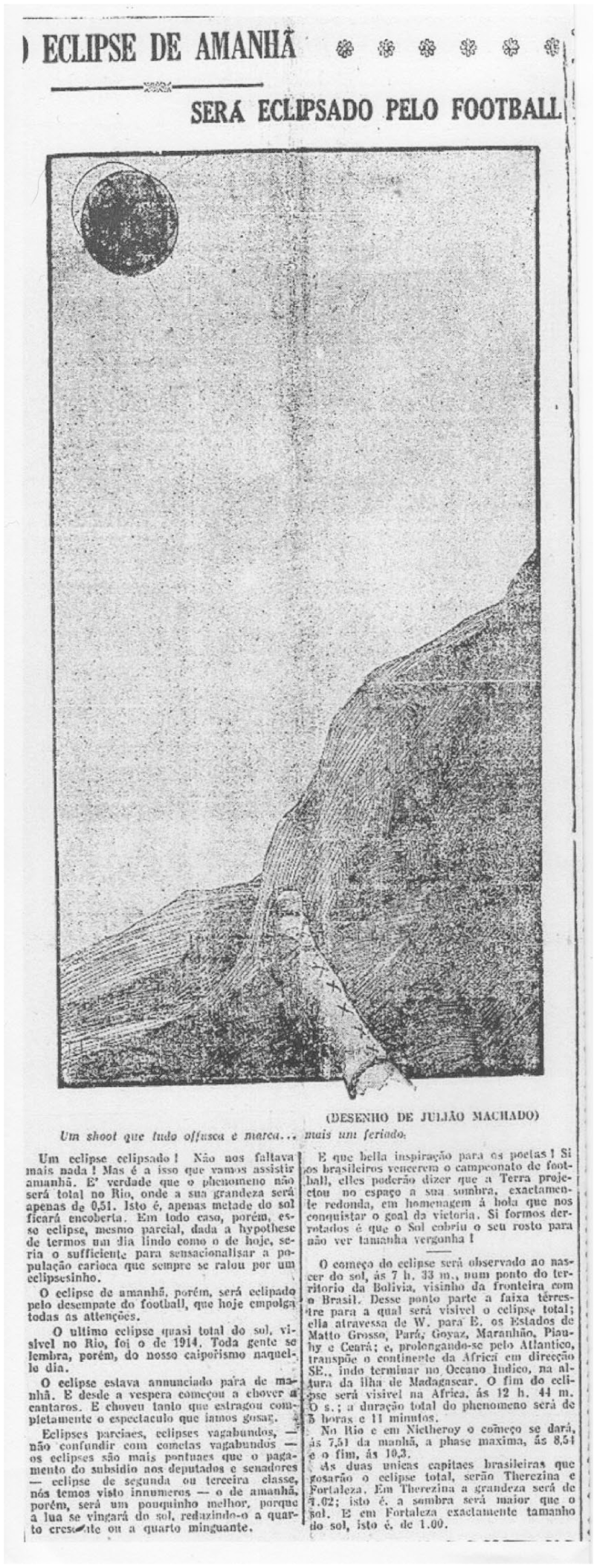
The 1919 eclipse being eclipsed by the final match of the South American Championship of Nations, as illustrated on the front page of the May 28, 1919, edition of A Noite.
This and many other news articles revealed how audiences in various locations and contexts interpreted and engaged with the eclipse in unique ways. For different people in different settings, the 1919 total solar eclipse held different meanings and was appropriated differently.
Concluding remarks
The 1919 total solar eclipse was a matter of great mobilization in Brazil. It rallied not only the scientific community, which regarded the phenomenon as an occasion to advance astrophysical knowledge about the Sun and establish their scientific credentials within the international community, but also the political elite, who seized the opportunity to project an image of Brazil’s modernity abroad. Furthermore, a large audience turned to newspapers to engage with the eclipse. However, the knowledge produced around the eclipse varied greatly across geographical and social spectra.
Scientists, be they Brazilian, American, or British, departed from their institutions with a well-defined observational agenda, but once on the ground, their work extended far beyond observing the eclipse’s totality. They interacted with the local press to raise public awareness of science and the role of scientists among Brazil’s northeastern populations. In turn, local communities perceived the eclipse through diverse lenses, shaped by their expectations, political and social circumstances, and even religious concerns. People in Sobral, Camocim, Belém do Pará, and Rio de Janeiro appropriated the eclipse differently.
At the local, regional, state, and national levels, newspapers provided a wealth of information, updating a wide range of readers on the arrival of scientists in northeast Brazil, their journeys to Sobral, and the logistics involved in observing the eclipse. Readers of local newspapers were particularly inclined to delve into the details of the eclipse, its scientific features, and the significance associated with it. Locality undoubtedly played a crucial role in fostering such scientific curiosity.
Sobral, where the eclipse’s totality was visible under optimal conditions, was the epicenter of activity. It hosted prominent international and national scientists, creating an ideal scenario for engagement among scientists, journalists, local elites, ordinary citizens, and even the subaltern people, who improvised “telescopes” with smoky glass. These diverse groups contributed to knowledge production in Secord’s sense, whether it was testing Einstein’s theory, observing temperature drops and animal behavior during the eclipse, or interpreting the event as a source of religious inspiration.
Sobral’s newspapers spared no effort in engaging foreign and national scientists, inviting them to publish articles or deliver interviews. British astronomers who were practicing Catholics interacted particularly with a local newspaper run by the Catholic Church. This collaboration was built on groundwork laid by Jesuit Cortie. Meanwhile, American physicists appeared to engage more closely with an opposition newspaper.
In Camocim, a coastal city in Ceará where scientists passed en route to Sobral, local interactions with the scientific community were also notable. Locality again proved pivotal. Morize gave interviews and published a detailed article on solar physical features and the spectroscopic and photographic techniques used to study the Sun during eclipses. Unlike his article in Sobral, where he addressed Einstein’s theory tested by the British, Morize’s Camocim publication omitted this topic, likely reflecting the absence of British astronomers, who passed through Camocim quickly and without drawing local interest. Instead, Morize used the eclipse to advocate a positivist understanding of science.
Readers of Morize’s articles and interviews in the regional newspaper engaged with the eclipse in their own way. For many, the total solar eclipse was an occasion to reflect on astrophysical mysteries and gather socially for a widely attended picnic. This event combined astronomical observation with music, dancing, games, communal meals, and other activities. In Camocim, the eclipse was thus appropriated differently, generating unique forms of knowledge.
At the state level, farther from the eclipse’s totality path, interactions with the scientific community were more limited. In Pará, British astronomers published an article in a major state newspaper, explaining the various scientific objectives of the 1919 eclipse observations. However, their reception in Belém do Pará was more challenging than in the welcoming town of Sobral. At the time, the north and northeast of Brazil were suffering from a devastating drought, leading some locals to criticize the presence of foreign scientists investigating an abstract theory instead of engaging with the region’s population and helping them in overcoming severe subsistence hardships.
In Rio de Janeiro, then Brazil’s capital and a hub of political activity, the eclipse became a focal point for political debate. For the local population, the event was less about scientific matters and more about criticizing the government’s poor engagement with science and the inefficiencies of Brazilian politics and bureaucracy. Satirical commentary prevailed in Rio’s national newspapers, overshadowing informative news about science and the popularization of science. The eclipse also provided an opportunity to lampoon social priorities and entertainment.
An analysis of the 1919 eclipse coverage across newspapers at national, state, regional, and local levels reveals how scientists with different agendas and different communities constructed scientific knowledge to suit their own needs and interests. The presence of astronomers and the observation of totality meant the scientific dimension of the eclipse took the lead in Sobral’s and Camocim’s newspapers compared with newspapers from other states, where, in turn, social and political appropriations of the eclipse took pride of place.
Footnotes
Acknowledgements
We thank Cristina Luís and Hugo Soares for their support throughout the development of this project. We also thank the two anonymous reviewers for their insightful comments and valuable suggestions.
Declaration of conflicting interests
The authors declared no potential conflicts of interest with respect to the research, authorship, and/or publication of this article.
Funding
1.
“Revolution in Science. New Theory of the Universe. Newtonian Ideas Overthrown,” The Times, November 7, 1919, p.12.
2.
For example, Lapo Casetti, “Traveling towards Fame: Albert Einstein and the Eddington Eclipse Expedition to Príncipe and Sobral in 1919,” in Michela Graziani, Lapo Casetti, and Salomé Vuelta García (eds.), Nel segno di Magellano tra terra e cielo. Il viaggio nelle arti umanistiche e scientifiche di lingua portoghese e di altre culture europee in un’ottica interculturale (Florence: Firenze University Press, 2021), pp.421–40; Peter Coles, “A Revolution in Science: The Eclipse Expeditions of 1919,” Contemporary Physics 60 (2019): 1–15; Jeffrey Crelinsten, Einstein’s Jury. The Race to Test Relativity (Princeton and Oxford: Princeton University Press, 2006); Luís C. B. Crispino and Daniel Kennefick, “A Hundred Years of the First Experimental Test of General Relativity,” Nature Physics 15 (2019): 416–19; Lewis Elton, “Einstein, General Relativity and the German Press, 1919-1929,” Isis 77 (1986): 95–103; Alistair Sponsel, “Constructing a ‘Revolution in Science’: The Campaign to Promote a Favourable Reception for the 1919 Solar Eclipse Experiments,” British Journal for the History of Science 35 (2002): 439–67; Keith John Treschman, “General Relativity in Australian Newspapers: The 1919 and 1922 Solar Eclipse Expeditions,” Historical Records of Australian Science 26 (2015): 150–63.
3.
Crispino and Kennefick, “A Hundred Years,” 419 (note 2).
4.
Luís C. B. Crispino and Marcelo da Costa Lima, “Expedição norte-americana e iconografia inédita de Sobral,” Revista Brasileira de Ensino de Física 40 (2018): e1601; See also Christina Helena da Motta Barboza, “Ciência e natureza nas expedições astronômicas para o Brasil (1850-1920),” Boletim do Museu Paraense Emílio Goeldi. Ciências Humanas 5 (2010): 285–7; Joyce Mota Rodrigues, “Observar é preciso: a cidade e os ‘ilustres hóspedes’,” Ciência e Cultura 71 (2019): 27–32.
5.
Luís Miguel Carolino and Ana Simões, “The Eclipse, the Astronomer and His Audience: Frederico Oom and the Total Solar Eclipse of 28 May 1900 in Portugal,” Annals of Science 69 (2012): 215–38; Alex Soojung-Kim Pang, Empire and the Sun. Victorian Solar Eclipse Expeditions (Stanford: Stanford University Press, 2002); Pedro Ruiz-Castell, Astronomy and Astrophysics in Spain (1850-1914) (New Castle: Cambridge Scholars Publishing, 2008).
6.
Luís C. B. Crispino and Marcelo da Costa Lima, “A teoria da relatividade de Einstein apresentada para a Amazônia,” Revista Brasileira de Ensino de Física 38 (2016): e4203; Ildeu de Castro Moreira, “O Eclipse solar de 1919. Einstein e a mídia brasileira,” Ciência e Cultura 71 (2019): 32–38; Rodrigues, “Observar é preciso” (note 4).
7.
Crispino and Lima, “A teoria da relatividade” (note 6).
8.
Peter Bowler, “Experts and Publishers: Writing Popular Science in Early Twentieth-Century Britain, Writing Popular History of Science Now,” British Journal for the History of Science 39 (2006): 159–87; Roger Cooter and Stephen Pumphrey, “Separate Spheres and Public Places: Reflections on the History of Science Popularisation and Science in Popular Culture,” History of Science 32 (1994): 237–67; Faidra Papanelopoulou, Agusti Nieto-Galan, and Enrique Perdiguero (eds.), Popularizing Science and Technology in the European Periphery, 1800-2000 (Surrey: Ashgate, 2009); Simon Shapin, “Science and the Public,” in R. C. Olby et al. (eds.), Companion to the History of Modern Science (London and New York: Routledge, 1990), pp.990–1007; Jonathan R. Topham, “Beyond the ‘Common Context’. The Production and Reading of the Bridgewater Treatises,” Isis 89 (1998): 233–62.
9.
James A. Secord, “Knowledge in Transit,” Isis 95 (2004): 654–72.
10.
Kostas Gavroglu et al., “Science and Technology in the European Periphery. Some Historiographical Reflections,” History of Science 46 (2008): 153–75.
11.
Pedro M. O. Raposo et al., “Moving Localities and Creative Circulation: Travels as Knowledge Production in 18th-Century Europe,” Centaurus 54 (2014): 167–88.
12.
Moreira, “O Eclipse solar de 1919” (note 6); Rodrigues, “Observar é preciso” (note 4); Walmir Thomazi Cardoso, “Os eclipses solares totais de 1912 e 1919 no Brasil como indicadores de diferentes culturas do céu,” Cosmovisiones/Cosmovisões 1 (2020): 129–54.
14.
News surveyed between January 1, 1919, and December 31, 1920, amounted to circa 100, distributed in the following way: around 60% were published in Rio de Janeiro newspapers, around 20% appeared in Sobral newspapers, and the rest were published in Camocim (Ceará) newspapers (around 15%) and in the state of Pará (Belém do Pará) (around 5%). Other news was also considered.
15.
“Dr. Eduardo Saboya,” A Ordem, July 11, 1919, p.1.
16.
Eusebio de Souza, “A Imprensa do Ceará em 1918,” Revista Trimestral do Instituto do Ceará 33 (1919): 22–107, 32.
17.
Folha do Littoral, July 8, 1919, p.1.
18.
There are several histories of Brazil in English that offer a sound description of these changes, from E. Bradford Burns, A History of Brazil (New York and London: Columbia University Press, 1970) to Lilia M. Schwartz and Heloisa M. Starling, Brazil: A Biography (New York: Farrar, Straus and Giroux, 2018).
19.
See the classic study of Brazilian newspapers’ press: Nelson Werneck Sodré, A História da Imprensa no Brasil (Rio de Janeiro: Civilização Brasileira, 1966).
20.
The Minister of Public Education in 1890, Benjamin Constant, claimed that “Positive Philosophy is not one of those vague and arbitrary doctrines that metaphysicians have created, basing them on gratuitous and unverifiable hypotheses, which can only have a passing influence; on the contrary, it is a doctrine rationally founded on reasoning, observation and experience, the only sources that can offer our spirit healthy and succulent nourishment, and the essential data for its progressive march, and this essential force with which we see the treasure of its knowledge increasing more and more, gradually rising from the most elementary phenomena to the most complicated phenomena, from the simplest laws to the most transcendent laws.” Quoted in Maristela Carneiro, História da Educação (Curitiba: IESDE Brasil, 2017), p.93.
21.
Maria Lúcia de Arruda Aranha, História da Educação e da Pedagogia. Geral e Brasil (São Paulo: Moderna, 2006), pp.297–301; Carneiro, História da Educação, pp.89–96 (note 20).
22.
Aranha, História da Educação, p.299 (note 21).
23.
Nelson Werneck Sodré, Síntese da História da Cultura Brasileira (Rio de Janeiro: Bertrand Brasil, 2003), p.64.
24.
Luisa Massarani and Ildeu de Castro Moreira, “A divulgação científica no Rio de Janeiro na década de 1920,” in Alda Heizer and Antônio Augusto Passos Videira (eds.), Ciência, civilização e república nos trópicos (Rio de Janeiro: Mauad Editora and Faperj, 2010), pp. 115–135, 124.
25.
Maria Rachel Fróes da Fonseca, “As ‘Conferências Populares da Glória’: A Divulgação do Saber Científico,” História, Ciências, Saúde – Manguinhos 2 (1996): 135–66.
26.
Massarani and de Castro Moreira, “A divulgação científica,” pp.121–3 (note 24).
27.
“O Eclipse de 29,” A Lucta, May 14, 1919, p.2.
28.
“Commissão scientifica,” Correio da Semana, May 10, 1919, pp.1–2. S. James Gates, Jr. and Cathie Pelletier, Proving Einstein Right. The Daring Expeditions Which Changed How We Look at the Universe (New York: PublicAffairs, 2019).
29.
The idea had already been anticipated in a private letter received by the editor of A Lucta in August 1918, where an unidentified correspondent remarked, “Next year in March [sic., May], Sobral will be transformed into a theater for scientists.” “O Eclipse,” A Lucta, August 28, 1918, p.2, emphasis ours.
30.
“O Eclipse de 29,” A Lucta, p.2 (note 27); “Commissões científicas,” Correio da Semana, May 17, 1919, pp.1–2.
31.
“O Eclipse Solar de 29 de Maio,” A Ordem, May 16, 1919, p.1.
32.
“O Eclipse de 29,” A Lucta, p.2 (note 27).
33.
Sodré, Síntese da História, pp.61–2 (note 23).
34.
This was the case of the news “O Eclipse,” A Lucta, March 12, 1919, p.2. Her name was Rosa Ribeiro dos Santos.
35.
Charles Perrine, the director of the Argentine National Observatory and one of the first astronomers to attempt using an eclipse to measure light deflection, intended to observe the phenomenon in Brazil. However, Perrine and his Argentine team were unable to travel to Brazil due to economic constraints. On the important role played by Perrine in the test of Einstein’s theory, see Crelinsten, Einstein’s Jury, pp.57–61 (note 2); Daniel Kennefick, No Shadow of a Doubt. The 1919 Eclipse That Confirmed Einstein’s Theory of Relativity (Princeton and Oxford: Princeton University Press, 2019), pp.29, 97, 113–14; Santiago Paolantonio, “Eclipse de 1912 en Brasil. Primera tentativa de medir la deflexión de la luz y comparar con el valor propuesto por Einstein de 1911,” Revista Brasileira de Ensino de Física 41 (2019): e20190206-1–6-13.
36.
“A Ordem ouve o Dr. Morize,” A Ordem, March 21, 1919, p.1.
37.
“O Eclipse Solar de 29 de Maio,” A Ordem, p.1 (note 31); “Commissão scientifica,” Folha do Littoral, May 11, 1919, p.1.
38.
“O Eclipse Solar de 29 de Maio,” A Ordem, p.1 (note 31).
39.
H. Morize, “Eclipse Solar Total de 29 de Maio de 1919,” A Ordem, May 23, 1919, p.4; H. Morize, “Eclipse Solar Total de 29 de Maio de 1919,” Correio da Semana, May 24, 1919, pp.2–3.
40.
Milena Wazeck, “Einstein in the Daily Press: A Glimpse into the Gehrcke Papers,” in Anne J. Kox and Jean Eisenstaedt (eds.), The Universe of General Relativity (Boston: Birkhäuser, 2005), pp.345–8.
41.
Some days later, A Lucta mentioned that the same letter was received by the bishop. “O Eclipse,” Correio da Semana, March 1, 1919, p.2; “O Eclipse,” A Lucta, p.2 (note 34).
42.
At the December 14, 1918, meeting of the subcommittee of the Joint Permanent Eclipse Committee (JPEC), Cortie announced that he failed to obtain a leave of absence from Stonyhurst College, where he was a schoolteacher, “due to the absence of many of his colleagues in connection to the war”: Minutes of JPEC (December 14, 1918), Royal Astronomical Society, London, UK.
43.
At the meeting of February 14, 1919, a letter from Cortie was read stating that “the Portuguese Provincial, Father Pinto, had requested to superiors in Brazil to welcome the members of the Brazilian expedition.” Minutes of JPEC (February 14, 1919), Royal Astronomical Society, London, UK.
44.
As Correio da Semana reported upon their final return to the United Kingdom, “During the stay of these two well-known scholars in this city and in the capital of the state [of Ceará], they were treated warmly, and our countrymen offered a tribute of well-deserved admiration to the tireless researchers of the noble science of astronomy.” “Drs. Crommelin e Davidson,” Correio da Semana, July 26, 1919, p.2.
45.
“Commissão scientifica,” Correio da Semana, pp.1–2 (note 28).
46.
Ibid., pp.1–2.
47.
A. C. de la C. Crommelin and C. Davidson, “O eclipse total do Sol,” Correio da Semana, May 24, 1919, p.2.
48.
“O Eclipse total do Sol,” Correio da Semana, June 7, 1919, p.2.
49.
“Eclipse de 29,” A Lucta, p.2 (note 27).
50.
“O eclipse,” A Lucta, May 28, 1919, p.2; “O eclipse,” Correio da Semana, May 31, 1919, p.2; “O Eclipse total do Sol,” Correio da Semana, p.2 (note 48); “O eclipse,” A Lucta, June 11, 1919, p.2.
51.
“Maravilhoso espectaculo do eclipse em Sobral. Os trabalhos dos sabios estrangeiros e nacionaes,” A Noite, May 30, 1919, p.1.
52.
“De Sobral. O Eclypse do dia 29,” Folha do Littoral, June 8, 1919, p.1.
53.
“O Eclipse,” A Lucta, June 11, 1919, p.2 (note 50).
54.
António Almeida, “História Resumida de Sobral,” A Ordem, September 7, 1924, p.5.
55.
“O nosso Posto meteorologico e a hora Official,” A Ordem, June 6, 1919, p.2; “Posto meteorologico de Sobral,” A Ordem, July 11, 1919, p.1.
56.
Arquivo Henrique Morize – Inventário Sumário (Rio de Janeiro: Ministério da Ciência e Tecnologia – MCT, Conselho Nacional de Desenvolvimento Científico e Tecnológico – CNPq, Museu de Astronomia e Ciências Afins – MAST, 1995), p.9.
57.
“De Sobral,” Folha do Littoral, May 25, 1919, p.2.
58.
“Dr. Henrique Morize,” Folha do Littoral, March 9, 1919, p.1.
59.
Henrique Morize, “O Eclipse de 29 de Maio de 1919,” Folha do Littoral, March 23, 1919, p.1.
60.
Ibid., p.1.
61.
José Murilo de Carvalho, A Formação das Almas: O Imaginário da República no Brasil (São Paulo: Companhia das Letras, 2017).
62.
“Commissão scientifica,” Folha do Littoral, p.1 (note 37).
63.
Andrew Crommelin and Charles Davidson, “O Próximo Eclipse Total do Norte [sic. Sol],” Folha do Littoral, May 11, 1919, p.1.
64.
Sodré, A História da Imprensa (note 19); Sergio Miceli, Intelectuais à Brasileira (São Paulo: Companhia das Letras, 2001), pp.53–7; Fernanda Rios Petrarca, “O jornalismo no Brasil: a gênese de uma profissão,” in Anais do XII Congresso Brasileiro de Sociologia (Belo Horizonte: UFMG, 2005), <“O Jornalismo no Brasil: a gênese de uma profissão”>  (December 19, 2025).
65.
A. Aboim, “O Astro rei,” Folha do Littoral, May 25, 1919, p.1.
66.
“Club Astrológico 29 de Maio,” Folha do Littoral, May 25, 1919, p.1.
67.
“Pic-nic,” Folha do Littoral, July 1, 1919, p.1.
68.
“De Sobral, o Eclypse do dia 29 (do correspondente),” Folha do Littoral, p.1 (note 52).
69.
“Para observar o eclipse do sol,” Estado do Pará, March 24, 1919, p.2.
70.
Ibid., p.2.
71.
Crispino and Lima, “A teoria da relatividade” (note 6).
72.
A.C. de la C. Crommelin and C. Davidson, “O Próximo Eclipse Total do Sol,” Estado do Pará, April 20, 1919, p.1.
73.
“O eclipse de maio próximo,” A Noite, February 19, 1919, p.2.
74.
Paulino de Brito, “Repercurssões. Novidades scientificas,” Estado do Pará, April 22, 1919, p.1.
75.
Ibid., p.1.
76.
“Dr. Morize chega ao Ceará,” A Noite, March 3, 1919, p.3; “Preparando-se para observar o eclipse,” A Noite, March 18, 1919, p.3; “O porto hontem esteve muito movimentado,” Correio da Manhã, April 3, 1919, p.2.
77.
For example, “O Dr. Morize e o proximo eclipse solar,” A Noite, April 3, 1919, p.3.
78.
For example, “Para observar o eclipse do sol,” A Noite, May 4, 1919, p.2; “Para observar o eclipse,” A Noite, May 5, 1919, p.3; untitled news, Correio da Manhã, May 6, 1919, p.2; “Ceará. Para observar o eclipse solar,” Jornal do Commercio, May 7, 1919, p.2; “Para apreciar o eclipse solar,” A Noite, May 11, 1919, p.3; “O proximo eclipse solar. Facilidades á missão de um astrónomo americano no Brasil,” A Noite, May 20, 1919, p.3.
79.
For example, “No reino dos astros. O eclipse total do sol será visível hoje em todo o paiz,” A Epoca, May 29, 1919, p.1.
80.
“Para estudarem o eclipse total do sol de 25 de maio,” A Noite, April 22, 1919, p.1; “O eclipse solar,” Jornal do Commercio, May 29, 1919, p.2; “Maravilhoso espectaculo do eclipse em Sobral,” A Noite, p.1 (note 51); “O eclipse foi regularmente observado em Sobral,” Correio da Manhã, May 31, 1919, p.2; “O eclipse solar. Como foi observado em Sobral,” Gazeta de Notícias, May 31, 1919, p.5.
81.
“Que foi o eclipse solar de hoje?” A Noite, May 29, 1919; “O eclipse do sol. Os cariocas poderão [observar] apenas parcialmente,” Correio da Manhã, May 29, 1919, p.1; “O eclipse solar de hontem. O Rio apreciou phenomenos de pouca importancia. O que houve nos Estados,” Gazeta de Notícias, May 30, 1919, p.2.
82.
“Como foi observado, no Maranhão, o eclypse solar de 1919. O Collegio Astronomico Camille Flammarion,” A Noite, March 1, 1920, p.1.
83.
“Protecção aos astronomos estrangeiros que vão a Sobral!” A Noite, April 10, 1919, p.1; “Protecção aos astronomos estrangeiros que vão a Sobral. O Dr. Morize na Saúde Pública,” A Noite, April 11, 1919, p.1; “O eclipse solar de maio. Medidas sanitarias preventivas para os astronomos,” Gazeta de Notícias, April 12, 1919, p.2; Untitled news, Jornal do Brasil, May 12, 1919, p.6.
84.
See Luís Miguel Carolino and Ana Simões, “Behind the Scenes. The 1919 Total Solar Eclipse and the Invisible Labor of the Portuguese and Brazilian Observatories,” Centaurus 66 (2024): 189–216.
85.
“Protecção aos astronomos estrangeiros que vão a Sobral!” A Noite, p.1 (note 83).
86.
Antônio Augusto Passos Videira, Henrique Morize e o ideal de ciência pura na República Velha (Rio de Janeiro: Fundação Getúlio Vargas, 2003).
87.
“Ainda o eclipse solar de 1918 [sic. 1919]. O director do Observatorio Nacional fala sobre as conclusões da commissão brasileira,” Correio da Manhã, February 27, 1920, p.4.
88.
“Um eclipse total do sol. O norte do Brasil vae ficar ás escuras durante cinco e meio minutos,” O Imparcial, February 19, 1919, p.4.
89.
“O ‘Prudente de Moraes’ trouxe o Dr. Morize. Impressões do director do Observatório communicadas a ‘A Noite’,” A Noite, July 11, 1919, p.3.
90.
A description of the astronomical and photographic equipment used by the Brazilian team can be found in Henrique Morize, “Resultados obtidos pela comissão brasileira do eclipse de 29 de Maio de 1919,” Revista de Sciencias 4 (1920): 71–4.
91.
“O eclipse solar,” Jornal do Commercio, p.2 (note 80).
92.
Burns, A History of Brazil, pp.248–55 (note 18), Lilia M. Schwartz and Heloisa M. Starling, Brasil: Uma Biografia (Lisboa: Temas e Debates, 2015), pp.334–5.
93.
Roberto Vergara Caffarelli, “O Eclipse Solar de 1912,” Ciência e Cultura 32 (1980): 570–1.
94.
“Um eclipse total do sol. O norte do Brasil vae ficar ás escuras durante cinco e meio minutos,” O Imparcial, p.4 (note 88).
95.
On this process, see Carolino and Simões, “Behind the Scenes” (note 84).
96.
“Burocracia tarda e prejudicial. Quasi eclipsada a observação do eclipse. . .,” A Noite, April 21, 1919, p.3.
97.
Ibid., p.3. As readers learned by reading this piece, the steamboat company Lloyd Brasileiro, in addition to providing sea transport for the scientists, advanced part of the funds needed to continue the preparations.
98.
Malho, Rio de Janeiro – RJ, April 24, 1919, p.22.
99.
Untitled news, A Noite, May 27, 1919, p.2; “O eclipse de amanhã será eclipsado pelo football,” A Noite, May 28, 1919, p.1; “Antes do match. O homem que chegou primeiro,” A Noite, May 29, 1919, p.1.
100.
“O eclipse de amanhã será eclipsado pelo football,” A Noite, p.1 (note 99).