



Abstract
In June 1928, Captain Barnett W. Harris, an amateur naturalist from Indiana, arrived in Zululand to experiment on wild animals with his invention – the mercy bullet. This “bullet”consisted of a hypodermic needle filled with anesthetic drugs that could render an animal unconscious – an early model of what is now known as the tranquilizer gun. The history of this gun typically begins with Colin Murdoch, a New Zealand pharmacist and veterinarian, who patented the invention in 1959. While largely absent in the archives, through tracing popular science publications and press, this article exposes a longer history of animal tranquilizers from an unlikely source. Tracing Harris’s story allows this article to speak to different historical discourses that influenced his rise as a celebrated inventor, and later to his disappearance from the scientific arena. This article argues that debates about pain relief (for both humans and nonhuman animals) and developments in military technology at the turn of the twentieth century resulted in experiments with narcotic bullets, a precursor to this “mercy bullet moment.” While hailed across the press as the man who might transform animal capturing into a humane practice, the workings of Harris’s bullet remained ambiguous. Despite this, he promoted his invention through several lecture series and radio presentations to the American public in the 1930s, where elements of scientific showmanship can be observed. Overall, Harris’s omission from the history of animal tranquilizing demonstrates the multiple contingencies that define a moment of scientific “success” – or, in this case, push some into relative obscurity.
Keywords
Introduction
On May 11th, 1929, a letter titled “Narcotic Bullet” was sent to the Secretary for the Interior of South Africa’s Union Government. 1 This was a letter about weaponry, but not about warfare. It was sent from the Headquarters of the Department of Defense after having received information that the authorities of the National Zoological Gardens in Pretoria had commissioned a certain Captain Barnett Harris to capture wild animals painlessly by the means of a “mercy bullet.” 2 The following information was urgently requested: the success of Harris’s experiments, how the bullet functioned, the nature of the drug used, and its time of action. There is no evidence to suggest that any of this information was received. This article is born out of curiosity about this knowledge gap, which propelled further investigations into Barnett Harris, an amateur naturalist from Indiana. Through this forgotten moment, this article argues that Harris’s mercy bullet challenges the existing narrative about the history of the tranquilizer gun, which traditionally begins with New Zealand pharmacist and veterinarian Colin Murdoch’s patenting of the invention in 1959. 3
However, tracing this history did not reveal one distinctive narrative that could explain why Harris’s contribution had been overlooked. His absence from the historical record signifies the various factors that determine scientific “success.” In tracing the circumstances that allowed his invention to be brought forward and then obscured, this article highlights how Harris’s “mercy bullet moment” intersects with various historiographical discourses linked to the field of science and technology studies.
This article argues that the “rise” of his invention is entangled with the ethical debates about the infliction of pain and unnecessary suffering (for both humans and non-humans) in the realm of warfare and medical practices that resulted in prohibitions of certain types of bullets and the first experiments with narcotic bullets in the early 1900s. These discussions were first brought to the forefront during the St. Petersburg declaration of 1868, which saw the prohibition of explosive bullets, and later the 1899 Hague Peace Convention, which banned the use of expanding bullets (known as dum-dum bullets). 4 The development of anesthesia is, of course, closely linked to this history. The term “anesthesia,” derived from the Greek term anaisthaesia, meaning “insensibility,” describes the loss of sensation to the entire or any part of the body. 5 The history of the tranquilizer gun can also be traced back to the polarizing debates on animal vivisection, which was supposed “to have been relieved of the greater part of its difficulty by the discovery of anesthetic.” 6 Historians have noted that the discussions that took place during the Royal Commission on Vivisection (1875) used anesthetics to address animal suffering, but ultimately still allowed the practice of physiological experimentation. 7 Harris’s supposed discovery of an “anesthetic bullet” for animals shows how the debates of this Commission had an afterlife. Using the terms “anesthetic” and “mercy,” Harris promoted his discovery to Americans concerned about alleviating animal suffering, but also with preserving the moral core of society. 8 News of his invention had reached a global audience through daily press and popular science mediums before he arrived in South Africa to experiment on wild animals in 1928.
Due to Harris’s scant presence in the archive, popular scientific publications are an essential methodological tool for this article. There is no further mention of him in the National Archives of South Africa and only one advertisement for his lecture series can be found in the Redpath Chautauqua Collection of the Iowa Online Repository. 9 Despite the claim that Harris was collecting animals for the Chicago Zoological Society, their archive proved to be another dead end, and any evidence of his relationship to the Field Museum of Chicago is lacking. 10 In stark contrast, Harris is alive across the proliferation of printed media: newspaper articles, radio snippets, and popular scientific and mechanical magazines.
What distinguished twentieth century popular science from its predecessors was not the content, but who did the popularizing. While “men of science” continued to see popular science as a medium for enlightenment and education, communication specialists increasingly took over the role of science popularization, driven by a public demand for news and entertainment. 11 The transformation of the popular press is vital for our understanding of popular science, for it was through this new commercialized mass media that most people “viewed the world, including science.” 12
The historiography of popular science has been plagued with a paradoxical situation due to the difficulties in defining the object of inquiry. Katherine Pandora points out that these issues will continue to be raised because, by moving deeply and broadly into the study of science and popular culture, we inevitably challenge conventional notions of how to conceptualize “science” and what the terms “popularization” and “popular science” even mean. 13 In the United States, popular science had already emerged in the 1820s and 1830s within a culture in which the scientific leadership lacked the kind of central organization or privileged status that characterized British and European science. It was not until the 1840s that a vigorous circle of American scientific practitioners began to mount strategic challenges to the weak structural and societal status of “pure science.” 14 Newspapers, periodicals, books, lyceums, and local networks served as powerful sources for the diffusion of scientific information and represented science as a cultural activity for American communities. 15 Therefore, utilizing print media as a methodological tool has been conceptualized as a prime field for studying both the intellectual dynamics of popular science and the material practices that enable these pursuits, which this article undertakes.
John Burnham famously argued that the “high point of science popularization” in the United States came during the late nineteenth and early twentieth centuries, when “men of science” were passionate about the religion of science and filled with desire to campaign against error and superstition. 16 Fred Nadis concurs and argues that the nineteenth-century public’s interest in science did not deter, even with the rise of consumerism in the twentieth century. 17 Instead, the consumer culture’s cultivation of a public taste for “positive thinking” and technological progress lent a quasi-religious, quasi-scientific cast to American popular culture, which admitted many hybrids. 18 In contrast, Andreas Daum argues that the end of the nineteenth century might mark the end of the massive takeoff of popular science. From the late nineteenth century onward, many countries in the Northern Hemisphere strove to popularize knowledge while attacks were being launched on positivism and the belief in objectivity. Popularization, albeit in new forms, intensified as the modern physical sciences emerged, state bureaucracies expanded, and “big science” began to take shape. Aggressive forms of public advocacy for science were being developed. 19 Harris’s invention initially profited from this existing and ongoing popularization of science and public interest. However, this relationship was not long-lasting.
To make sense of the “fall” of his invention, or rather, its disappearance, this article traces the mismanagement of the tsetse fly problem in Zululand in the late 1920s to consider what factors drove Harris to abandon his experimental trip to South Africa. 20 Historiographies of science in South Africa have moved beyond simple juxtapositions between Western science and local knowledge systems to show the diverse scientific thinking and practices that often existed separately from colonial institutions of power. 21 However, there is a lack of investigations of amateur naturalists such as Harris, who managed to gain authorization from formal institutions for experimentation but did not form part of any elite scientific network. Indeed, the idea that there existed a well-defined group of experts and laypeople is oversimplified. Agustí Nieto-Galan argues that the so-called amateurs, enthusiasts, and science popularizers – as much as the professionals or the experts – are dynamic agents in constructing knowledge boundaries and the making of scientific authority. 22 However, it was the nature of the space that Harris occupied – falling somewhere between scientist and showman – that contributed to his disappearance from the record of animal tranquilizing. Showmanship, broadly conceived, can be understood as one of the features of successful scientific exhibitions of all classes, yet the nature of showmanship as a profession has “always been uneven.” 23 Aided by a proliferation of new digital resources, a revived critical reconsideration of the diverse content and theatrical character of nineteenth and early twentieth shows operating under the term of “popular science” can be observed in recent years. 24 Scientific exhibitions and experimentations by showmen in Britain’s Victorian era have received the most historical attention. 25 Renowned scientists like Louis Pasteur and Michael Faraday have a long history of dedicated studies. 26 Harris, in comparison, was an amateur. While popular science mediums provide evidence for his invention, due to its ambiguous efficacy, it later proves to be characterized by elements of showmanship. This article recognizes that there is no linear relationship between the popularization of science and showmanship. Daum argues that the field of the history of popular science continues to be one characterized by imbalances, and it can only profit from promoting more “heterodoxy and microhistories” and by “appreciating a greater diversity of approaches and by exploring neglected avenues of investigation.” 27
This article begins by providing a brief context of the changing animal-capturing techniques in the late nineteenth century. Next, it traces the paradox of military ethics that allowed for proposals of “pain-free” military technology to be considered in the early twentieth century. It proceeds to analyze the press reports on Harris’s invention and his experimental trip to Zululand in 1928. Upon his return, this article traces how his career took the form of scientific showmanship through promotions of his invention’s success despite the ambiguous evidence of its efficacy. Overall, this article gives density to the untraceable presence of Harris by revealing the circumstances that influenced the making and unmaking of this “mercy bullet moment.”
Changing methods: Mitigating the brutality of animal capture
Carl Hagenbeck would be the ideal interviewee for an investigation into the vast variety of methods used for capturing wild animals. 28 After leaving school in 1859 at the age of fifteen, Hagenbeck devoted his attention to managing his father’s wild animal trading business, operating out of Hamburg, which thrived during the latter half of the nineteenth century. 29 His catchers, who operated in dispersed locations across the Southern Hemisphere, were a group as diverse as their methods: naturalists, explorers, professional commercial hunters, and independent entrepreneurs. 30 Their methods ranged from various forms of traps, particularly effective for hyenas, panthers, and baboons, to pitfalls, especially useful for hippopotami, due to their habit of allowing their young to walk ahead to ensure there is no danger lurking behind. 31 Capturing eland in Northern Rhodesia consisted of having thirty mounted hunters rushing in on all sides. While capturing the adults was deemed a “hopeless task,” the young bucks, with their “ungainly stilt-like legs,” were soon overtaken and secured by hunters who caught hold of their tails. 32 Similarly, in Atbara his catchers’ general method involved chasing the herd until the lagging young could be isolated from their parents and seized. Among giraffes and antelopes, this procedure was attended with little danger. However, in the case of rhinoceros and elephants, for which the demand was much greater, the capture was not so simple, as they would vigorously defend their young and as a rule could not be secured without killing the older ones first. This is echoed by J. R. Sherer, an animal capturer who supplied zoos across South Africa, South America, and India, who described his method:
It is easy to catch a giraffe. You first look for a female with a baby and chase it on horseback and lasso the young, put a bag over its head and take it away. Zebra are caught in the same way. To capture ferocious animals, you have to shoot the mother and catch its young. 33
Methods used to catch animals for most of the nineteenth century portrayed in popular articles and books described the bloody and destructive methods employed with enthusiasm, until the turn of the twentieth century, where a “code of catching” was developed, both as a response to growing criticism as well as the professionalization of the practice. 34 Harris’s invention grew from this desire to find a capturing method that was both efficient and cruelty-free. To understand this new need, it is necessary to look at the evolution of military technology and the changing legislation and perceptions around pain inflicted by weaponry.
The demise of the dum-dum bullet: An evolution of pain and military technology
The march toward civilization produced innumerable paradoxes, perhaps most apparent in the development and barring of armaments. Advances in science and technology in the late nineteenth century resulted in significant military progress before the start of the First World War (1914). In 1888, the British Army adopted the Lee-Metford rifle, also known as the Mark II, which fired a .303 bullet that was lighter, with a longer range, than the previous bullets employed (the Snider and the Martini-Henry). 35 Despite these improvements, this bullet was flawed, as unless the bone or central organs were hit, it seemed to pass straight through the body of the opposition without incapacitating him. 36 The development of the replacement for the Mark II bullet, one that had improved stopping power, was inspired by the types of ammunition used to shoot wild game. The bullet adopted by the British Army in 1896 was known as the Mark III, or the dum-dum bullet. 37 Dum-dum bullets, named after the Dum Dum arsenal near Calcutta where they were first manufactured under the supervision of Captain N. S. Bertie Clay, were bullets that expanded or flattened easily in the human (or animal) body. 38 Significantly, this bullet was not explosive, but expansive. On striking the bone, the bullet spread out, and then tore and splintered everything before it. The bullet “mushroomed inside the victim” and inflicted greater damage than the Mark II. 39 These bullets were adopted by the British to be used in colonial “savage” warfare, and not against any “civilized” enemies, although they were heavily condemned by France and Germany. 40 As justification for their condemnation, experiments with the bullet were carried out by Professor von Bruns of Tübingen, who characterized them as “inhumane” through presenting, at a congress of German surgeons in Berlin on April 16, 1898, photographs, skiagraphs, and limbs of animal cadavers that showcased the wounds caused by the bullet. 41
Expanding bullets were not listed on the program at The Hague Conference of 1899, but were raised by the Swiss and Dutch delegations at the first meeting of the military subcommission. 42 The Swiss delegate, Colonel Künzli, proposed the idea of outlawing the dum-dum bullet as he wondered “whether it would not be well to prohibit projectiles which aggravate wounds and increase the sufferings of the wounded.” 43 Surgeon Major-General J. B. Hamilton and the British delegate, Sir John Ardagh, argued that the demands of colonial warfare warranted this deviation from the standards of European armaments. 44 The fact that the British were considering new warfare for specific “savage” wars stemmed from the widespread opinion about the differing perception of pain according to race. 45 In contrast to the European soldiers, Ardagh argued that the “natives” and “savages” “will go on fighting even when desperately wounded.” 46 Similar sentiments were echoed by Major General Walker, writing to the Secretary to the Government of British India, where he stated that expanding bullets should not be used in “civilized warfare” because, while British soldiers would wait patiently for help, the populations in colonial contexts were not only insensible to their pain, but ignorant to the effects of their wounds. 47 In the end, the prohibition was only rejected by two states, Great Britain and the United States. 48 While Britain abandoned the use of the bullet in 1902, this was arguably due to their fear that it would be used against their own troops. 49 Britain only formally signed the agreement in 1907.
For the British military, the dum-dum bullet was a strategic asset to maintain control over its empire, especially in British India. 50 However, knowledge that the British Army was stockpiling the dum-dum bullets, not simply for “savage” warfare but as a standard issue for all military campaigns, was what triggered the controversy at The Hague. 51 The scrutiny of the dum-dum not only highlights the “involvement of medical science in the design of weapons,” but of the human–animal entanglement that resulted in advances and even pauses in gun technology, as it was experiments on animal cadavers that were used to persuade the delegates that the bullet should be banned. 52 This opposition to the expanding bullets has been lauded as “a significant ‘ethical’ moment in the genealogy of war,” a moment where force was being restrained. 53 Yet, this very discussion at The Hague was not about a specific kind of weapon, but rather determining if certain ways of disabling and dismembering bodies were deemed to be acceptable even in “civilized warfare.” 54 Here, the military paradox is evident, because killing and injuring during war (even of civilians) are not only permitted but are the characteristic acts of warfare, although this is often left out of historic accounts about the methods of military campaigns. 55
Moral debates about the prevention of pain certainly lingered after The Hague and inspired further armament development. In 1912, experiments with “narcotic” or “painless” bullets were taking place in the United States. 56 This news soon spread, advertising the development of a “humane warfare bullet” by Alexander Foster Humphrey, a scientist from Pittsburgh. 57 The committee conducting experiments on his invention consisted of army officers, police officials, and sportsmen – another instance where amateur scientists and enthusiasts were contributing to scientific progress. 58 This narcotic bullet contained a minute particle of morphia, which was carried in tiny wells in the steel jacket of a regulation army bullet (see Figure 1). 59 In stark contrast to the dum-dum bullet’s destructive powers, this caused only a slight flesh wound. These reports advertised the bullet’s efficacy for hunting, self-defense, or even warfare, as a soldier being hit by the bullet would “fight no more that day” and instead simply fall asleep. 60 Furthermore, men who received more serious wounds would suffer no agony once the narcotic was absorbed into their system, and those whose wounds were mortal would sleep away their last hours, thus “doing away with most of the battle-field horror.” 61 It was not long before this bullet was tested on animal bodies. In 1914, it was reported that specimens of the Kodiak bear of Alaska would be captured for the Panama–Pacific Exposition using Humphrey’s narcotic bullets. 62 O. L. Grimes, an attorney and naturalist of Kodiak, ordered 100 rounds of the narcotic cartridges. While the bullet would still be likely to kill an animal, Humphrey claimed that a bullet could be “put through the bear’s ear” to safely render the animal unconscious. 63 However, in the Official Catalogue of Exhibitors for the Panama–Pacific International Exposition, a Kodiak bear is listed only in the sculpture section, indicating that no live bears had been caught to display. 64 While Humphrey’s narcotic bullet would prove to be yet another stage of the military paradox – it certainly played no role in the chemical warfare campaigns of World War II – it was arguably a building block for Harris’s vision. While Humphrey’s bullet was designed to kill (painlessly), Harris wanted to create the impossible: to “shoot animals alive instead of dead.” 65
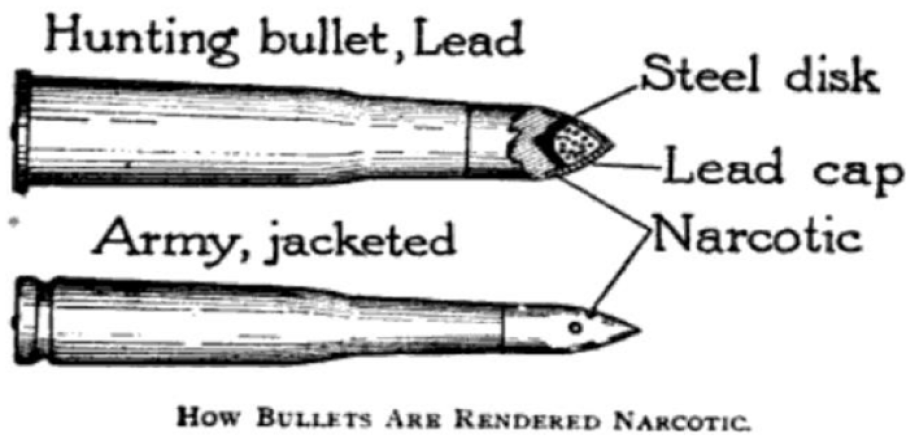
Sketch attached to the article by William P. Kennedy, “Bullet Used as Narcotic,” The Technical World Magazine, March 19, 1913.
Animal bodies and anesthesia: Popularizing the mercy bullet, c. 1927
Captain Barnett Walter Harris was variously described as a “scientist” and a “naturalist,” but also as a “world traveler,” “soldier,” “sportsman,” and “big game hunter.” 66 What we can ascertain was that he was born in Indiana in 1876. His title of “captain” is less obvious, as while Indiana Magazine claimed it was awarded for “meritorious service” during World War I, records show that he returned from France in 1918 as a sergeant in the medical corps and as a captain in the Civilian Conservation Corps. 67 Harris formed part of the active participation of amateurs in emerging specialties such as photography, spectroscopy, and reflection telescopes. 68 He developed a new technique to create “scientific” education films by using two cameras set in positions corresponding to the right and left eye, which were double printed on one film. 69 Using this method, he and his wife, Lucile Berg, recorded the life cycle of the bee, toad, wasp, butterfly, and various forms of aquatic life. In Binghamton, New York, in 1925, Harris captured all phases of a total eclipse for the first time, and duplicated this feat in Sumatra in 1926 (see Figure 2). 70 Despite being frequently described as a big game hunter in the press, Harris aligned himself with the conservationists, claiming to be “heavily against big game hunters: wealthy men who went into Africa for the sole purpose of killing as many as possible for trophies who have already caused some of the most beautiful African animals to disappear from earth.” 71
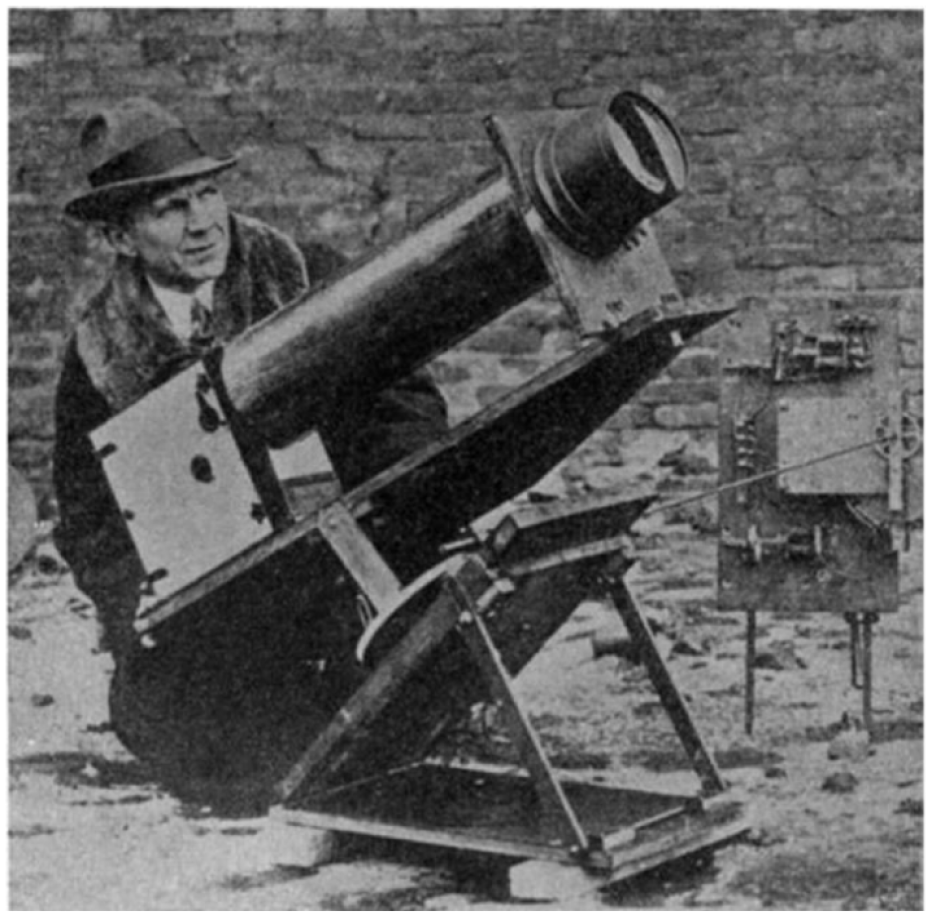
“To take ‘movies’ of sun’s eclipse,” Captain Barnett Harris of the Harvard Eclipse Expedition. Image courtesy of Scientific American, 134(2), 1926, p.109.
Despite his lack of formal training, Harris developed the mercy bullet that was first captured by American journalists early in 1927, and later by popular science and mechanical magazines. 72 With the growth of cheap printing processes, facilitated by technological advances such as rotary systems, the popularity of mass-circulation magazines was a pivotal feature of the emerging American print culture. 73 The rise in the local populace’s interest in science culminated with a change in the style of press reporting. For example, Popular Science (founded in 1872 under the name The Popular Science Monthly) was bought by the Modern Publishing Company and merged with several other scientific magazines in 1915 to interest a broader audience. 74 This change was dramatic, transforming a scholarly journal that included ten to twenty photographs into a magazine that included hundreds of short, easy-reading articles accompanied by illustrations. This print culture drew on the American fascination with industriousness, entrepreneurship, and an enduring “culture of improvement,” which drove the collective discourse of these media sources. 75 These magazines strove to balance extended discussions of science with readability. 76 The “science-in-context” stories sought to show the importance and implications of the latest discoveries and inventions in a broader perspective, as can be witnessed by Harris’s mercy bullet, which was promoted as an invention that would change the capture of wild animals on a global scale.
The New Britain Herald documented his invention, claiming that Harris was a “sportsman and representative of the Chicago Zoological Society.” 77 While Americans were the first to notice, it was not long before the news spread across the water. According to the Illustrated London News, Harris was going to collect specimens for the new zoological park at Riverside, Illinois. 78 He was reputedly set to travel to Borneo to secure orangutans and gorillas – animals easy to shoot but extremely difficult to capture alive. 79 While Harris boldly claimed that inquiries about his bullet came from “practically all countries,” it was certainly widely reported. 80 Images were also included alongside these reports. Scientists utilized visual devices both as tools for investigation and to create new ways of demonstrating ideas and results. The public brandishing of visuals became the primary means to broadcast discoveries and promote the status of science. 81 The predominant images of science as an activity centered upon the persons of the scientists themselves. Martin Kemp describes two main factors behind the production of scientific portraits: firstly, the conviction that the individual is important; secondly, the social desire to establish scientists as persons worthy of portrayal and prosperity. In the same line, “portraits” of machines, instruments, and devices were also promoted as the technological heroes of scientific advance. All such images were loaded with social significance and intended to make a point. 82
In June 1927, descriptions and sketches of Harris’s invention were featured in Popular Mechanics Magazine and Popular Science (see Figures 3 and 4). 83 In contrast to the narcotic bullet, Harris’s “bullet” was equipped with a hypodermic needle filled with chemicals at the base. In a report for the New York Times in 1928, Harris provided further details, claiming that the chemicals were made up of a compound that acted almost instantly on the animal’s nervous system, causing temporary loss of locomotion. 84 A consensus across all sources claimed that when this needle struck an animal, an “anesthetic drug” was released into the animal’s bloodstream. 85 Here, the ambiguity of Harris’s invention begins to surface, which is also linked to the style of reporting that characterized this era. In many cases, journalists copied stories told in popular science periodicals and reprinted them in the daily press. This can be witnessed by tracing Harris’s story, which saw many similarly worded articles promoting his “humane” invention without providing further details of its makeup.
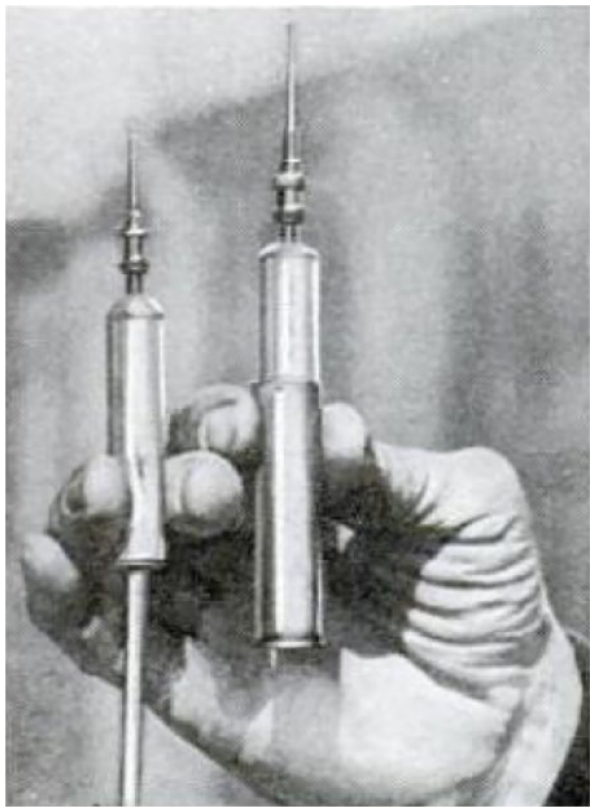
A sketch of Harris’s mercy bullet featured in Popular Science, 1927.
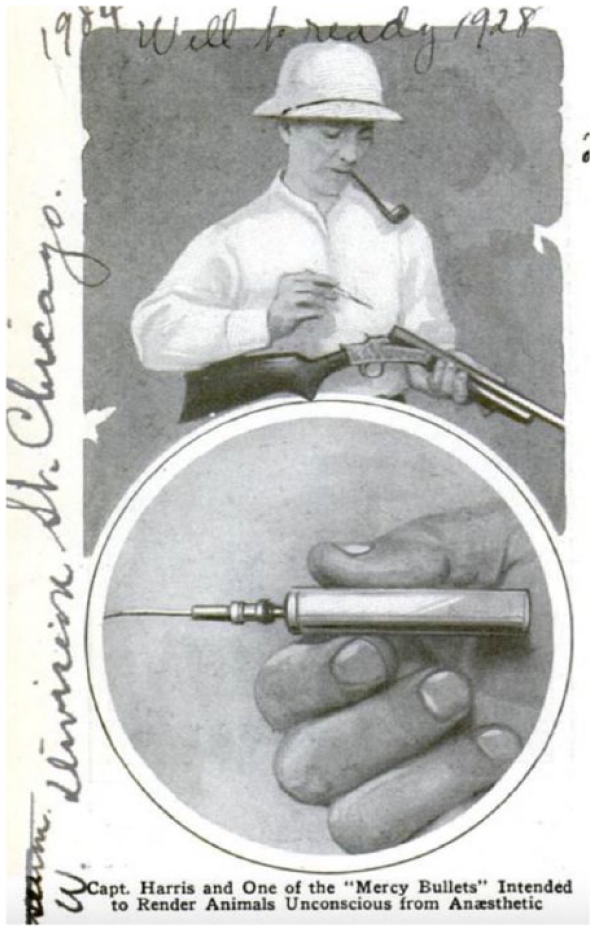
A sketch of Harris’s mercy bullet featured in Popular Mechanics Magazine, 1927.
There are no clear descriptions (from Harris himself or other sources) detailing the exact combination of drugs the mercy bullet contained. In Graham Linscott’s biography on the South African conservationist Ian Player, it is speculated that Harris’s bullet was covered with a “curare substance.” 86 Curare, a drug derived from tree bark and applied to blow-dart tips by South American Indians to paralyze and capture animals, prevents muscle contraction and stops all movement, including breathing. 87 Claude Bernard, known as “the father of modern experimental medicine,” began experimenting with the drug in 1844. While it could prove lethal, in the right quantities, curare’s neuromuscular blocking functions made invasive procedures easier and the drug became a common experimental tool in physiological practice. 88 However, during the nineteenth century, doubts began to spread: what if paralyzed animals could still feel pain, but were unable to express it? 89 The unsettled nature of the science of curare can be witnessed in the division among physiologists during the 1875 Royal Commission on Vivisection. 90 Indeed, after the Cruelty to Animals Act was passed in Britain in 1876, which imposed restrictions on the performance of painful experiments on animals, curare was not considered an anesthetic. 91 It is plausible that Harris’s compound was made up of a combination of sleep-inducing agents, such as barbiturates, which were practically the only drugs used as sedatives and hypnotics between the 1920s and mid-1950s, as well as morphia (as was used by Humphrey), along with a neuromuscular blockade like curare. 92 However, this is speculative, and if it was only curare that Harris used, the showmanship of his invention is already evident in his mislabeled description of his “anesthetic bullet.” Here, the anesthetized animal body was being reimagined again as a measure of scientific and moral progress, as it had been during the 1875 Commission. 93 Through labeling his invention as an “anesthetic,” Harris was building on the historical links between this concept and its prevention of purposeless cruelty. Harris’s invention looked good on paper, but did it work? Through analyzing his expedition to Zululand (1928–9), and the reports that followed, this article turns to answer this question.
A foolproof method? Harris’s experiments in Zululand, c. 1928–1929
Historians have studied the diverse network of scientists that spent time in colonial contexts, drawn by the increasing demand for trained officers and a desire to generate their own research and conduct a wider range of experimentation. However, they have shown that scientists who worked in the colonies were not necessarily particularly talented, and while southern African problems attracted some leading international scientists, others were among the less successful in their profession. Many failed outright in their experiments. 94 Failure in the scientific field was arguably most clearly witnessed in southern African colonies attempts at controlling the tsetse fly problem. This “problem”was the widespread animal trypanosomiasis disease known as nagana, an anglicization of a Zulu term uNakane (meaning depressed or low in spirits), which had been causing devastation to domestic livestock in the Zululand area since the reign of the Zulu chief Mpande (1840–72). 95 This disease, caused by a minute blood parasite known as trypanosome, was transmitted from infected game to livestock by the Glossina (tsetse fly). 96 Significantly, wild animals acted as hosts to the fly while remaining immune to the disease, which transformed them into a new threat for farmers. Efforts to control nagana created a lively debate between big game hunters, who knew the fly through experiencing them in their travels, and European-based bacteriologists, who claimed to know the fly through their training in laboratory science. 97 Harris operated outside the spectrum of scientists as well as big game hunters, allowing this article to explore a unique avenue of scientific emergence in South Africa during the early twentieth century.
On June 11, 1928, an “interesting visitor” was reported to have arrived in Durban. 98 This article, repeating many that had gone before, stated that Harris had been sent by the Chicago Zoological Society and the Field Museum of National History to obtain specimens of African fauna using his mercy bullet. 99 Several sources confirmed that it was the “authorities of the Pretoria Zoo” who had commissioned Harris to capture animals in South Africa. 100 From Durban, Harris was going to Zululand with “full optimism of his invention.” 101 It was further stated that he was “keenly interested” in the rumor that the government proposed to relocate white rhinoceros (Ceratotherium simum) from Zululand to the Kruger National Park, where they had formerly lived – an undertaking in which his invention could play a prominent part. He spent six months experimenting on various animals in the Hluhluwe region before claiming that “he was confident that his invention worked.” 102 Evidence of the success of these experiments can only be found in press sources, and there were experts who doubted his design, such as Albert Le Souëf, an Australian zoologist, who claimed Harris’s method to be “preposterous tommyrot.” 103 He argued that the bullet would likely cause death or severe injury seeing as the hypodermic needle should be inserted just under the skin – an impossible feat if it was projected through the air at a high velocity. 104
Nevertheless, in March 1929, Harris traveled to the Hluhluwe Game Reserve to capture a rhinoceros for the Pretoria Zoo. 105 While this might allude to their trust in his method, the institution had been investigating methods to obtain a rhinoceros for their exhibition for several years and were possibly open to any means available to do so. 106 One month later, Harris successfully used a mercy bullet to tranquilize a black rhinoceros (Diceros bicornis) cow in order to capture her baby. The young rhinoceros was caught, but died in transit before the zoo could receive it, a frequent occurrence in the wild animal trade. 107 While the bullet successfully stunned the female rhinoceros, when Harris returned to load up her baby, the mother appeared and suddenly “tossed him into the bush,” indicating that his bullet “only had a temporary effect.” 108 However, a temporary knock-out effect is arguably the goal for any tranquilizing bullet, which indicates that it worked to some degree, but any further experiments with larger wild animals did not take place.
But, by July 1929, Harris witnessed significant changes to the management of wild animals in Zululand. He became outraged at the fact that the provincial authorities were not only permitting shooting in the very heart of the Hluhluwe Reserve – but were ordering it. 109 He abandoned his trip, claiming to be “[d]isgusted by the wasteful and unnecessary destruction of game by hired gunmen who are not even good shots, the muddled and inefficient handling of problems of the game reserves, and the frittering away with cold indifference of one of its finest assets.” 110
This game extermination order was one of the measures undertaken to combat the nagana problem. The first of such can be traced to October 1896, when a large game hunt was organized. However, in 1897, the numbers of nagana reduced with the onset of the rinderpest epidemic that killed large numbers of cattle and susceptible ungulates, and eradicated trypanosomes from northern South Africa. Around the turn of the twentieth century, many scientists and officials in South Africa and Southern Rhodesia argued that this proved that the disease could and should be controlled through game slaughter. 111 This resulted in a wholesale slaughter of wild animals on numerous occasions, by order of the government, and later fly-trapping exercises (an anti-nagana campaign) carried out by Robert Harris. 112 With no cure or vaccine, there seemed to be no obvious method of managing the disease and little consensus among scientists about the effects of these eradication campaigns. Conservationists, on the other hand, such as James Stevenson-Hamilton, warden of the Kruger National Park, along with Ernest Warren, director of the Natal Museum, heavily criticized the campaigns and expressed fears that the wildlife in the province might never recover. 113
In 1928, the year Harris arrived, the Natal Provincial Council appointed a Game Advisory Committee chaired by C. F. Clarkson to advise on the nagana issue. 114 At a conference held at Hluhluwe on November 19, 1928, ten proposals were formulated to eradicate the problem. Some of these solutions included fencing areas between the reserves and settlements, providing water supplies for game so they need not search outside the reserves, destroying surplus game, and allowing farmers to destroy wandering game. After Clarkson’s recommendations, the Natal Provincial Administration was persuaded to finance a campaign aimed at reducing the number of game in the reserves and then to try to create a buffer zone around the reserves that was free of game and the tsetse fly. 115 This buffer zone on the outside of the Umfolozi Reserve was divided into seven sections, each assigned a white game ranger and ten skilled black hunters. 116 Through this campaign, in just two years – 1929–31 – more than 35,000 animals were killed (not accounting for the amount of game shot by private hunters under permit). 117 Ironically, the absence of game caused hungry tsetse flies to disperse to wider regions than ordinally traveled and led to increased incidence of nagana. 118
By this stage, Harris had already left South Africa in protest against the game slaughtering. Harris’s experiments were cut short and largely overshadowed by the nagana eradication campaigns, which met with little to no success. Perhaps choosing Zululand as the arena to conduct his experiments was a strategic decision for Harris, knowing that the nagana problem had already created a brewing controversy about “what was science and what was not” across southern and east Africa. 119 However, it was his anesthetic bullet’s unclear efficacy, especially for larger game like the rhinoceros, that was the greatest factor in his early exit. 120 Despite this, Harris continued to promote the success of his invention through various media once he returned home, where several methods of scientific showmanship can be observed.
Unsustainable showmanship: Harris’s reported success after the Zululand experiments, 1929–1932
Despite the ambiguity of the working of the mercy bullet in the field, Harris continued to promote his invention upon his return to the United States. For example, he published a three-part special feature series in the New York Times about his “successful” expedition to South Africa. Here, he highlighted the triumph of his experiments on breeds of buck as well as bigger game such as the rhinoceros cow mentioned earlier, including photographic ‘evidence’ (see Figure 5). 121 However, promotions in the press was not the only medium utilized by Harris.
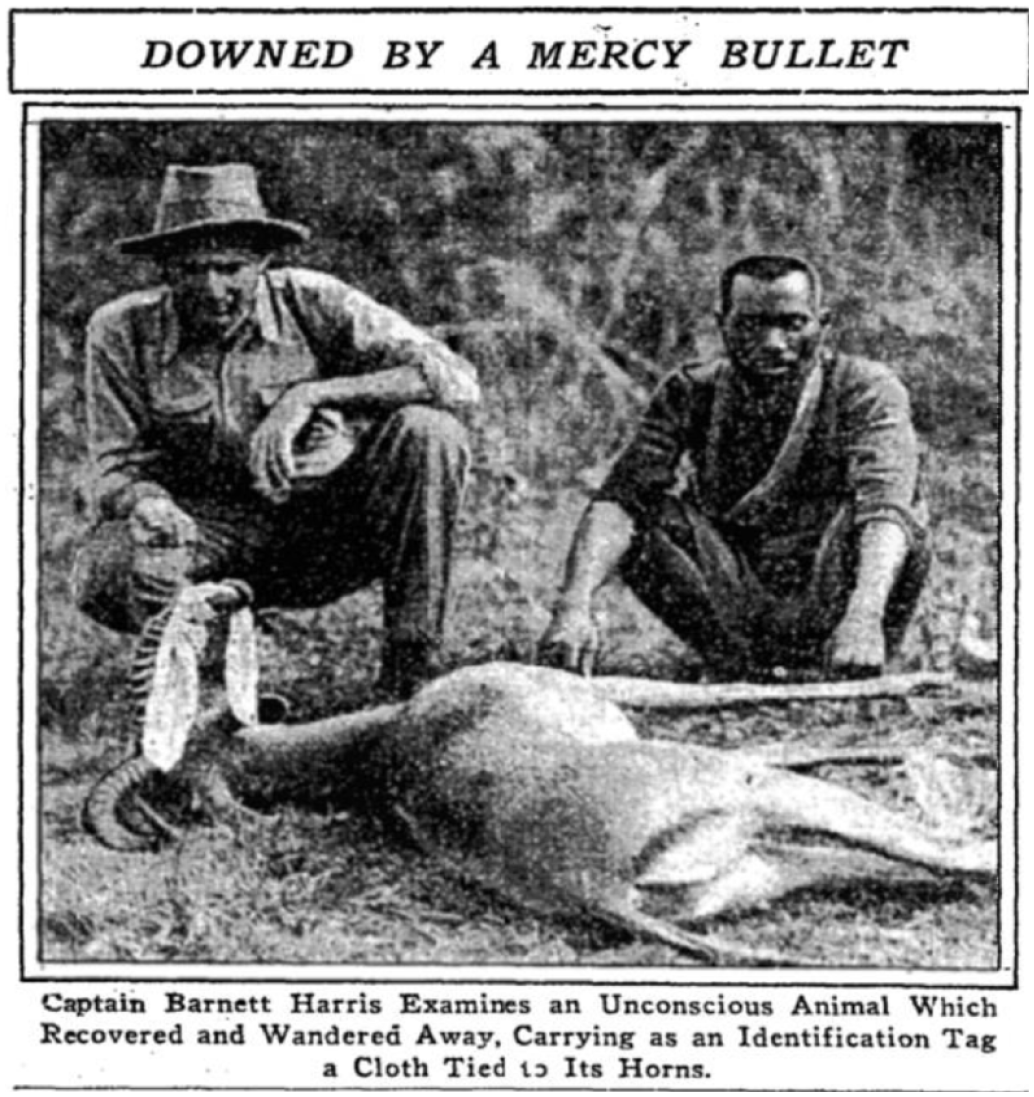
Image courtesy of the New York Times, “Mercy Bullets Tested amid Perils of Jungle,” December 29, 1929.
In 1930, he conducted a demonstration of his bullet to more notable “men of science” at the New York Livestock Exchange. These men included Raymond Garbutt, chief veterinarian of the American Society for the Prevention of Cruelty to Animals, and Dr. Hatcher, of Cornell Medical School. 122 Here, he showed how a sheep could be put to sleep using one of his bullets and that the effects of the drugs wore off entirely. 123 This demonstration (a notable example of scientific showmanship, seen in Figure 6) visually showcased his success only for a brief moment. In 1931, Harris was called upon to assist State Game Officials of Michigan to solve the starving deer problem in the swamps around Alpena. The mercy bullet’s supposed ability to render animals unconscious was the method proposed to capture and transport the deer to other swamp areas, where there would be enough food sources and no danger of over-browsing. However, his bullet was ineffective – while one deer was put to sleep for seventy minutes, it killed two others. This was apparently “all the mercy bullet accomplished over several weeks of experimentation.” 124 While the officials stated that his invention could “become valuable in the future,” it was doubtful whether the state would resort to it again. 125 Despite this startling letdown, Harris continued to promote his invention to the American public in person and over the radio from 1932 to 1933 through a lecture series titled “On the Trail of the Mercy Bullet.” 126 Marcel LaFollette argues that the 1930s saw American radio networks become increasingly focused on entertainment and began pressuring popularizers to emphasize scientific personalities over facts. 127
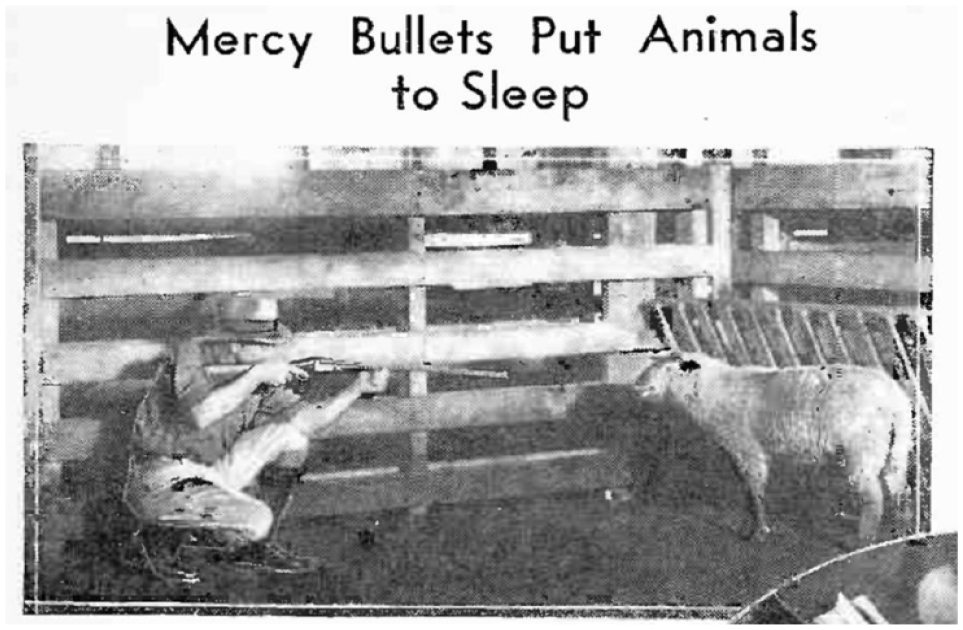
Harris demonstrating the efficacy of his invention at the New York Livestock Exchange in November 1930. Image courtesy of Science and Invention, November 1930.
Popular lecturing that incorporated showmen, including science popularizers, has been explored by historians as a diverse and unruly phenomenon. It was at once “a formative class practice, a market transaction, an instrument of reform and a marker of civic identity.” 128 The lyceum lecture circuit of the antebellum era had spread to the United States from England in 1826 with the purpose of creating local societies that would sponsor lectures, establish libraries, build collections, and improve schools. The duty of the lyceum lecturer was to educate and uplift. 129 While this lecture culture played most prominently into the nineteenth-century American imagination, Harris represents the genre’s evolution in the early twentieth century. During his presentations on the Stout Lyceum program in Wisconsin for 1932 and across the states of Illinois, Indiana, and Kentucky, Harris functioned within the arena of showmanship, among other performing artists who were there to entertain. 130
Angela Ray argues that while the dual function of lyceums was to educate and entertain, the entertainment function grew increasingly prominent in the postwar period as it made room for humorists, vocalists, musicians, and dramatic performers. 131 Harris formed part of diverse programs featuring quartet groups and comedy acts. 132 However, he also shared the auditorium with other scientific showmen such as Dr. Luther S. H. Gable, a supposedly “distinguished scientist who made radium popular.” 133 While many showmen lectured with the help of props, slides, and visual experiments, Harris seemed to rely only on the spoken word to promote the “unpublished inside story of the personality of the man and his work.” 134 Martin Hewitt claims that the spectacle of the platform increasingly inhered in the person delivering the lecture, and a powerful platform presence became almost a prerequisite for lecturing success. 135 Elements of Harris’s platform presence can be witnessed in the descriptions of his “fine sense of humor,” as well as his “novel, thrilling and entertaining” talk of “sensational hunting trips.” He also appealed to a specific type of American morality, as his talk was promoted as an account that would not “offend the most sensitive lover of wild animals.” 136 While his lecture series showcased his invention for a while longer, after his failed attempt in Michigan, there is no evidence to suggest that Harris’s mercy bullet was called upon again. Slowly, he disappeared from popular press reports as well. Harris expressed a belief that with further adjustments of the anesthetic charge of the drug in each hypodermic projectile, his device would “work like a charm.” 137 Here, he was not far from the truth, as it was through the development of effective drugs in the 1950s that both the nagana and tranquilizing problem would be solved.
The eradication of nagana from Zululand rests on the development of synthetic insecticides, most notably DDT and HCH, which were extensively used for aerial and ground spraying campaigns in the early 1950s. 138 The breakthrough needed for the modern-day tranquilizer gun was built on a previous invention of Colin Murdoch. He transformed the medical profession in 1956 through his creation of a disposable plastic syringe which could prevent contamination. 139 Branching from this, he developed a modified tranquilizer gun consisting of interchangeable barrels for different caliber syringe projectiles. Each gun had a dial which could be set to any of thirty-two positions. In contrast to Harris’ hypodermic needle with a glass chamber, the syringes were made of strong, light polycarbonate plastic with a needle threaded onto the front, which allowed for better accuracy. 140 Improvements continued as Murdoch discovered that the anesthetic drugs that were commonly used were causing animals to die from their excessive physiological response to being darted. 141 Expanding from this, Dr. Antonie (Toni) Harthoorn, a British veterinary scientist located in East Africa, started trials with stronger opioids derived from morphine in the early 1960s. 142 He was called upon by Ian Player to assist him and his team in the task of Operation Rhino. 143 They experimented with combinations of tranquilizers and narcotics, models of guns, and time lapses on administering an antidote. 144 Continued testing over the next three years led to the development of M99, an immobilization drug that would become critical to the operation’s success. 145 It contained etorphine, an opioid stronger than morphine that is still one of the mainstays of anesthesia for wildlife-capturing today. 146 Player argued that while their team had achieved immobilization for white rhinos in the 1960s, there had been an American who had once “tried to shoot a black rhino with a mercy bullet covered with a curare substance.” 147 Harris’s bullet certainly did not achieve the efficacy that these later veterinarians mastered. However, what Harris’s mercy bullet reveals is that practices of scientific showmanship by amateurs were hybrid spaces where significant contributions toward scientific development could be showcased. It becomes our job as historians to trace these stories that the scientific arena may have discarded.
Conclusion
By the mid-1960s, Colin Murdoch’s invention of the tranquilizer gun would become widely recognized as the most humane and efficient method of capturing and transporting wild animals. However, despite a thin archival visibility, this article has exposed a longer history of animal tranquilizers from an unlikely source: an amateur naturalist from Indiana, Captain Barnett Harris. Through utilizing popular science media, this article has traced the rise and demise of this inventor, whose “mercy bullet” allowed him to capture the attention of the American public and global scientific arena from 1927 to the early 1930s.
This article argues that the rise of this invention can be traced to the increased brutality in warfare, which saw countries voice concerns about the pain caused by ammunition. This led to the first experiments with narcotic (pain-free) bullets, in 1912, accredited to Alexander Humphrey of Pittsburgh. Drawing from this breakthrough, Harris developed the mercy bullet, an “anesthetic” bullet that could render an animal unconscious for safe capture. Here, Harris drew from the historical link between the “animal body” and “anesthetic” as concepts that promoted a movement away from animal suffering. In 1928, he traveled to Zululand, South Africa, to conduct experiments with this bullet on wild animals.
When it came to the actual workings of the bullet, however, Harris fell short. The approach behind his technique was only formally adopted thanks to the development of efficient opioids and Murdoch’s plastic syringe. In Zululand, specifically, Harris operated outside of the network of colonial scientists, who were failing to eradicate nagana from the area. Harris claimed the game-slaughtering campaigns resulted in his early departure, but this was arguably a useful scapegoat. Despite this, Harris continued promoting his invention to the American public upon his return in 1930, where different elements of scientific showmanship can be observed. His most notable style of showmanship can be witnessed through his lecture and radio series, which were successful despite the inconclusive evidence of his invention’s efficacy. Harris formed part of lyceum programs with other performing artists, where he relied on his platform presence to enthrall the public with his “thrilling” adventures of capturing and “trailing” wild animals.
Overall, our omission of Harris’s contribution to the advancements of animal-capturing techniques reveals the various outliers that determine scientific “success.” Although popular science publications and daily press in the early twentieth century could provide a platform for amateur scientists to reach global audiences, this attention was fleeting. While science was for all, only a few scientists achieved lifelong success. Later, even if these figures had contributed toward knowledge production, they might easily, as Harris did, slip by without historical recognition.
Footnotes
Acknowledgements
Earlier versions of this paper were presented at a seminar hosted by the Department of Historical Studies at the University of Cape Town on April 13, 2022, as well as at the South African Historical Society Conference in July 2022. For archival assistance at the Chicago Field Museum and Chicago Collections Consortium, thanks goes to Rebecca Wilke and Geoff Morse. For comments on earlier versions of this paper, I thank my colleagues who formed part of the History Access cohort for 2022. Thank you to the two anonymous reviewers for their feedback and to the editor, Professor Lissa Roberts, for her time and consideration. Thanks especially to Dr Anandaroop Sen for his guidance.
Declaration of conflicting interests
The author declared no potential conflicts of interest with respect to the research, authorship, and/or publication of this article.
Funding
The author disclosed receipt of the following financial support for the research, authorship, and/or publication of this article: This work was supported by The Oppenheimer Memorial Trust Award for Local Scholarship [22166/01], The University of Cape Town Doctoral Research Scholarship, and the History Access Publication Support for Young Researchers (2022) run by the Department of Historical Studies at the University of Cape Town.
1.
National Archives of South Africa (NASA): UOD 14 Z3/5 1926–1933. The Defense Headquarters to the Secretary for the Interior, May 11, 1929.
2.
His name is incorrectly spelt as “Burnett” Harris in the letter. It is not possible to ascertain which member of the Defense Department sent the letter as the signature is illegible. In May 1929, the Minister of the Interior was Daniël Francois Malan, and the Minister for Defense was Frederic Creswell.
3.
4.
It also prohibited the use of aerial bombardment and shells that dispersed poisonous gas. However, these treaties were unable to substantively stem brutality in war, particularly in colonial warfare, where these prohibitions did not apply. For more on the implications of the Hague Convention, see Nisha Shah, “Ethical Dispositions Designing the Injuries of War,” Critical Studies on Security 7, no. 3 (2019): 210–18, and Scott Keefer, ‘“Explosive Missals’: International Law, Technology and Security in Nineteenth-Century Disarmament Conferences,” War in History 21, no. 4 (2014): 445–64. For the continuities of imperial violence, see Isabell V. Hull, Absolute Destruction: Military Culture and the Practices of War in Imperial Germany (Ithaca, NY: Cornell University Press, 2005), and Priya Satia, “The Defense of Inhumanity: Air Control and the British Idea of Arabia,” American Historical Review 111, no. 1 (2006): 16–51.
5.
Kurt A. Grimm et al. (eds.), Veterinary Anaesthesia and Analgesia, 5th ed. (Iowa City, IA: John Wiley & Sons, 2015), p.3.
6.
7.
See Tarquin Holmes and Carrie Friese, “Making the Anaesthetised Animal into a Boundary Object: An Analysis of the 1875 Royal Commission on Vivisection,” History and Philosophy of the Life Sciences 42, no. 50 (2020): 1–28.
8.
The controversy over vivisection in the United States reached its first apex from roughly 1885–1915. Stephen Hausmann shows that while people undoubtedly cared about the protection of animals, they were also highly concerned about the moral decline of society. See Stephen R. Hausmann, “‘We Must Perform Experiments on Some Living Body’: Antivivisection and American Medicine, 1850–1915,” The Journal of the Gilded Age and Progressive Era 16, no. 3 (2017): 264–83.
9.
10.
Harris is absent from the Field Museum’s Directors Papers, the Department of Zoology’s correspondence, Expedition Files, and Annual Reports located at The Field Museum Archives of Chicago. The only mention was of his wife, Mrs. Barnett Harris, in the 1933 and 1936 Annual Report, outlining her donation of sixty specimens of insects after their southern African expedition. See Field Museum of Natural History (1936), Annual Report of the Director to the Board of Trustees Vol X No 3, (Chicago), pp.350, 383.
11.
Peter Broks, Understanding Popular Science (Berkshire: Open University Press, 2006), p.61.
12.
Ibid., p.34.
13.
Katherine Pandora, “Popular Science in National and Transnational Perspective: Suggestions from the American Context,” Focus Isis 100, no. 2 (2009): 346–358, p.348.
14.
Ibid., p.351.
15.
Ibid., p.355.
16.
Daniel Patrick Thurs, Science Talk: Changing Notions of Science in American Popular Culture (New Brunswick, NJ: Rutgers University Press, 2007), p.12. SeeJohn C. Burnham, How Superstition Won and Science Lost: Popularizing Science and Health in the United States (New Brunswick, NJ: Rutgers University Press, 1987).
17.
Fred Nadis, Wonder Shows: Performing Science, Magic and Religion in America (New Brunswick, NJ: Rutgers University Press, 1957), p.20.
18.
Ibid., p.14.
19.
Andreas W. Daum, “Varieties of Popular Science and the Transformations of Public Knowledge: Some Historical Reflections,” Isis 100, no. 2 (2009): 319–332, p.326.
20.
For this section, this article draws from the work of scholars who have studied the mismanagement of the fly and nagana in the region, including Karen Brown, “From Ubombo to Mkhuzi: Disease, Colonial Science, and the Control of Nagana (Livestock Trypanosomosis) in Zululand, South Africa, c. 1894–1953,” Journal of the History of Medicine and Allied Sciences 63, no. 3 (2008): 285–322; Anthony de V. Minnaar, “Nagana, Big-Game Drives and the Zululand Game Reserves (1890s–1950s),” Contree 25 (1989): 12–21; Shirley Brooks, “National Parks for Natal? Zululand’s Game Reserves and the Shaping of Conservation Management Policy in Natal, 1920s to 1940s,” Journal of Natal and Zulu History 22 (2004): 73–108; and Jane Carruthers, “Influences on Wildlife Management and Conservation Biology in South Africa, c.1900 to c.1940,” South African Historical Journal 58 (2007): 65–90.
21.
See the recent publication of Saul Dubow and William Beinart, which explores an extensive array of diverse scientific practices in southern Africa. William Beinart and Saul Dubow, The Scientific Imagination in South Africa: 1700 to the Present (Cambridge: Cambridge University Press, 2021). For the development of science among English-speaking settlers in the Cape Colony, see Saul Dubow, A Commonwealth of Knowledge: Science, Sensibility and White South Africa, 1820–2000 (Cape Town, South Africa: Double Storey, 2006). For a history of veterinary science, see Daniel Gilfoyle and Karen Brown, Frontiers of Knowledge: Veterinary Science, Environment and the State in South Africa, 1900–1950 (Amsterdam, Netherlands: VMD Verlag, 2010). For the history of conservation science, see Jane Carruthers, National Park Science: A Century of Research in South Africa (Cambridge: Cambridge University Press, 2017).
22.
Agustí Nieto-Galan, Science in the Public Sphere: A History of Lay Knowledge and Expertise, trans. Fiona Kelso (London: Routledge, 2016), p.85.
23.
Joe Kember, John Plunkett, and Jill A. Sullivan, “Introduction,” in Popular Exhibitions, Science and Showmanship, 1840–1910 (New York, NY: Routledge, 2012): 1–18, p.4.
24.
Jeremy Brooker, “A Lecture on Locust Street: Morton, Tyndall, Pepper, and the Construction of Scientific Reputation,” in Carin Berkowitz and Bernard Lightman (eds.), Science Museums in Transition: Cultures of Display in Nineteenth-Century Britain and America (Chicago, IL: The University of Chicago Press, 2007), pp.111-38 and Lukas Rieppel, “Albert Koch’s Hydrarchos Craze: Credibility, Identity, and Authenticity in Nineteenth-Century Natural History,” in Carin Berkowitz and Bernard Lightman (eds.), Science Museums in Transition: Cultures of Display in Nineteenth-Century Britain and America (Chicago, IL: The University of Chicago Press, 2007), pp.139–61.
25.
See Martin Willis (ed.), Staging Science: Scientific Performance on Street, Stage and Screen (London: Palgrave Macmillan, 2016), and Iwan R. Morus, “Worlds of Wonder: Sensation and the Victorian Scientific Performance,” Isis 101, no. 4 (2010): 806–86. For a study on science lectures in nineteenth century Britain, see Diarmid A. Finnegan, “Finding a Scientific Voice: Performing Science, Space and Speech in the 19th Century,” Transactions of the Institute of British Geographers 42, no. 2 (2017): 192–205.
26.
See Gerald Geison, The Private Science of Louis Pasteur (Princeton, NJ: Princeton University Press, 1996), and David Gooding, “‘In Nature’s School’: Faraday as an Experimentalist,” in David Gooding and Frank A. J. L. James (eds.), Faraday Rediscovered: Essays on the Life and Work of Michael Faraday, 1791–1867 (New York, NY: Stockton, 1985), pp.105–36.
27.
Daum, “Varieties of Popular Science,” p.322 (note 19).
28.
Thankfully, we have his memoir: Carl Hagenbeck, Von Tieren und Menschen, trans. into English by Hugh S. R. Elliot and A. G. Thacker (London: Longmans Green & Co, 1912), as well as Nigel Rothfels’ detailed research. See Nigel Rothfels, “Catching Animals,” in Savages and Beasts: The Birth of the Modern Zoo (Baltimore, MD: Johns Hopkins University Press, 2000), pp.44–81, and Nigel Rothfels, “Catching Animals,” in Mary J. Henninger-Voss (ed.), Animals in Human Histories: The Mirror of Nature and Culture (Rochester, NY: Rochester University Press, 2002), pp.182–231.
29.
Hagenbeck, Von Tieren und Menschen, p.8 (note 28).
30.
Rothfels, “Catching Animals” (2002), p.189 (note 28).
31.
Hagenbeck, Von Tieren und Menschen, p.72 (note 28).
32.
Ibid., p.94. (note 28).
33.
“Zoo-Maker on His Job” (editorial), Rand Daily Mail, August 12, 1935.
34.
Rothfels, “Catching Animals” (2000), p.53 (note 28).
35.
See Kim Wagner, “Savage Warfare: violence and the Rule of Colonial Difference in Early British Counterinsurgency,” History Workshop Journal 85, (2018): 217–37, p.223.
36.
Ibid (note 35).
37.
It was first deployed during the Tirah Campaign in 1987. Ibid (note 35).
38.
See Edward Spiers, “The use of the Dum Dum bullet in colonial warfare,” The Journal of Imperial and Commonwealth History, 4, 1, (1975): 3-14, p.4.
39.
Ibid., p.4 (note 38).
40.
Wagner, “Savage Warfare,” p.226 (note 35).
41.
Alex Ogston argued in The British Medical Journal that because von Bruns could not procure original dum-dum bullets, he had used samples from a German manufactory that were not identical. See Alex Ogston, “The Peace Conference and the Dum-Dum Bullet,” The British Medical Journal 2, no. 2013 (1899): 278–81.
42.
Keefer, “Explosive Missals,” p.459 (note 4).
43.
David J. Traven, “The Universal Grammar of the Laws of War: A Theory of Moral Discourse and International Norms,” PhD Dissertation, The Ohio State University, 2013, p.218.
44.
Spiers, “The use of the Dum Dum bullet in colonial warfare,” p.7 (note 38).
45.
See Taline Garibian, “Pain, Medicine and the Monitoring of War Violence: The Case of Rifle Bullets (1868–1918),” Medical History 66, no. 2 (2022): 155–72, p.160.
46.
Spiers, quoting Ardagh, in “The Use of the Dum Dum Bullet in Colonial Warfare,” p.7 (note 38).
47.
Garibian, “Pain, Medicine and the Monitoring of War Violence,” p.161 (note 45).
48.
Traven, “The Universal Grammar of the Laws of War,” p.223 (note 43).
49.
Wagner, “Savage Warfare,” p.226 (note 35).
50.
Traven, “The Universal Grammar of the Laws of War,” p.220 (note 43).
51.
Shah, “Ethical Dispositions Designing the Injuries of War,” p.211 (note 4).
52.
Garibian, “Pain, Medicine and the Monitoring of War Violence,” p.159 (note 45).
53.
Shah, “Ethical Dispositions Designing the Injuries of War,” p.211 (note 4)..
54.
Ibid., p.212 (note 4).
55.
See the landmark text by Elaine Scarry for an analysis on pain and power. Elaine Scarry, The Body in Pain: The Making and Unmaking of the World (Oxford: Oxford University Press, 1985), p.63.
56.
“Local Man Inventor of Narcotic Bullet” (editorial), Pittsburgh Daily Post, March 22, 1912; “May Use Narcotic Bullets” (editorial), The Washington Post, July 21, 1912; “Narcotic Bullets: The Very Latest” (editorial), The Miami Herald, December 18, 1912; “Robbing War of its Terrors by Narcotic Bullets” (editorial), San Angelo Evening Standard, July 16, 1912.
57.
“Invents Narcotic Bullet” (editorial), The Brattleboro Daily Reformer, April 29, 1913; “Testing Narcotic Bullets for the Army” (editorial), The Lakeland Evening Telegram, March 25, 1913; “Painless Bullets” (editorial), Abergavenny Chronicle, January 15, 1915; “Humane Warfare at Last” (editorial), New Zealand Herald, Volume L, Issue 15310, May 24, 1913. He also invented a pain-deadening bayonet that “heals the wounds it makes.” A groove at the end of the blade was said to hold an antiseptic, anesthetic, and gelatin capsule that would release its “healing contents” once plunged into an attacker’s body. See “The Tender Chloroforming, Antiseptic: Bayonet – It Wounds and Heals” (editorial), Popular Science Monthly, August 1917.
58.
“Local Man Inventor of Narcotic Bullet” (editorial), Pittsburgh Daily Post, March 22, 1912.
59.
“Bullet Used as Narcotic,” The Technical World Magazine, March 19, 1913. Similar versions of this article were published in The Review of Reviews, Volume 47, 1913; The Oriental Economic Review, Volume 3, January 3, 1919; The Engineer, May 16, 1913, Volume 115; and American Rifleman, Volume 54, May 22, 1913.
60.
“A Narcotic Bullet” (editorial), Taranaki Herald, Volume LXI, May 13, 1913; “A Narcotic Bullet” (editorial), Lake Country Press, Issue 2497, September 25, 1913.
61.
“Narcotic Bullets,” English Mechanic and World of Science 2513, 97, May 23, 1913.
62.
“Narcotic Bullets” (editorial), Fur-Fish-Game Magazine, January 1914.
63.
Humphrey’s bullet was in fact still intended to be used to kill, as can be seen by his boasting that hunters would benefit from “no fear of a counter stroke” from the big game they were shooting. “Local Man Inventor of Narcotic Bullet” (note 58).
64.
Official Catalogue of Exhibitors Panama-Pacific International Exposition (San Francisco, CA: The Whalgreen Company, 1915), p.5.
65.
“The Mercy Bullet” (editorial), Southern Argus, July 14, 1927.
66.
MSC0150, “On the Trail of the Mercy Bullet” (note 9).
67.
He served in the thirty-third division during World War 1. See Sons of the American Revolution Membership Applications, 1889-1970. Louisville, Kentucky: National Society of the Sons of the American Revolution. Microfilm, 508 rolls. <www.ancestry.com/discoveryui-content/view/839031:2204?tid=&pid=&queryId=8eef2857d8cf746b43fd0a10f95937de&_phsrc=Ent1&_phstart=successSource>. See also the profile written by Hasseltine Hinkle Dooley in “Parke County in 1924,” Indiana Magazine of History 20, no. 4 (1924): 465–69, p.467.
68.
Nieto-Galan, Science in the Public Sphere, p.95 (note 22).
69.
“Projector to Put Life into Movies: Barnett W. Harris, Director Displays Invention to Better Pictures” (editorial), New Britain Daily Herald, August 30, 1922.
70.
He was also the first man to make motion pictures of Niagara Falls while flying over it. “From the Scrapbook of Science—Camera Shots of Scientific Happenings,” Scientific American 134, no. 2 (1926): 108–9.
71.
See the interview published by the New York Times before Harris traveled to South Africa: “Big Game to be Shot but not Harmed,” New York Times, August 12, 1928.
72.
See: “Wants Trophies Alive; Will Use Mercy Bullets” (editorial), San Diego Union, March 9, 1927; “Deathless Shot Bags Game Alive” (editorial), Manchester Evening Herald, March 25, 1927; “‘Mercy Bullet’ Stuns but Does Not Kill” (editorial), Kalamazoo Gazette, March 27 1927; and “Cruelty of Game Hunting at Last Abolished” (editorial), San Antonio Light, April 24, 1927. Magazines include Popular Science, Popular Mechanics, Scientific American, English Mechanic, and World of Science.
73.
See Ioana Literat, “Participatory Innovation: The Culture of Contests in Popular Science Monthly, 1918–1938,” Journalism & Mass Communication Quarterly 90, no. 4 (2013): 776–90.
74.
“September Harvest of Important Books,” New York Times, August 29, 1915.
75.
Literat, “Participatory Innovation,” p.779 (note 73).
76.
Thurs, Science Talk, p.16 (note 16).
77.
“Shot Bags Game Alive” (editorial), New Britain Herald, June 25, 1927.
78.
“Mercy Bullets for Collectors” (editorial), Illustrated London News, March 26, 1927.
79.
An expedition trip to Borneo and Java was mentioned in the press. See “The Mercy Bullet to be Used in Java” (editorial), The Singapore Free Press and Mercantile Advertiser, April 28, 1927. However, in September 1927, British advisers of Kedah, Trengganu, and Kelantan confirmed that Harris had not visited, nor could he be traced. Malaysian Archives: No. B.A.T 334/1927, No 2. S.C 622/46 and No 2 in K. 1236/1927, < > (July 22, 2022).
80.
For news from Australia, see Newcastle Morning Herald and Miners’ Advocate, September 5, 1927, p.3; and “The ‘Mercy Bullet’” (editorial), The World’s News (Sydney), July 2, 1927, p.2. For news from New Zealand, see: “Mercy Bullet,” Waipawa Mail, Volume L, Issue 88, April 19, 1929, p.4. However, more than once these bullets were mislabeled “mercury bullets.” See “Tiggy Touchwood” (editorial), The Capricornian, November 3, 1927, “Did you know this?” (editorial), The World’s News (Sydney), August 27, 1927 and “Black Rock Shooting” (editorial), The Telegraph (Brisbane), December 15, 1927. For news from Malaysia: “Narcotic Bullet” (editorial), Malaya Tribune, November 2, 1928.
81.
Martin Kemp, “Seeing and Picturing: Visual Representation in Twentieth-Century Science,” in John Krige and Dominique Pestre (eds.), Science in the Twentieth Century (Amsterdam, Netherlands: Harwood Academic Publishers, 1997): 361–90, p.362.
82.
Ibid., pp.387–8.
83.
“Mercy Bullets to Subdue Jungle Beasts for Zoo” (editorial), Popular Mechanics Magazine, June 1927, and “The World’s Progress in Science” (editorial), Popular Science Monthly, June 1927.
84.
“Big Game to be Shot, but Not Harmed,” New York Times, August 12, 1928.
85.
Scores of articles make this claim without providing further details of the drug. “Mercy Bullets Will Subdue Jungle Beasts for New Zoo” (editorial), Chicago Tribune, March 9, 1927, and “Mercy Bullet” (editorial), Los Angeles Times, April 10, 1927, among others.
86.
See Graham Linscott, Into the River of Life: A Biography of Ian Player (Cape Town, South Africa: Jonathan Ball Publishers, 2013), p.115.
87.
Richard E. Clutton, “An Anglocentric History of Anaesthetics and Analgesics in the Refinement of Animal Experiments,” Animals 10 (2020): 1–22, p.9.
88.
Ibid., p. 9 (note 87).
89.
Shira Shmuely, “Curare: The Poisoned Arrow that Entered the Laboratory and Sparked a Moral Debate,” Social History of Medicine 3 (2020): 881–97.
90.
91.
Clutton, “An Anglocentric History of Anaesthetics and Analgesics in the Refinement of Animal Experiments,” pp. 11-12 (note 87).
92.
Ether and chloroform are also possibilities as these were commonly administered by veterinarians in the early twentieth century. See Grimm et al., Veterinary Anaesthesia and Analgesia, p.4 (note 5).
93.
Holmes and Friese, “Making the Anaesthetised Animal into a Boundary Object” (note 7).
94.
For example, Alexander Edington, a Scottish medical doctor who was appointed in 1891 to direct the Cape Bacteriological Institute to investigate horse-sickness, and the various other bacteriologists and colonial scientists who attempted to tackle the nagana problem. See William Beinart, Karen Brown, and Daniel Gilfoyle, “Experts and Expertise in Colonial Africa Reconsidered: Science and the Interpretation of Knowledge,” African Affairs 108, no. 432 (2009): 413–33, p.423.
95.
For a detailed account of the complex history of controlling nagana, see Brown, “From Ubombo to Mkhuzi” (note 20).
96.
Glossina pallidipes was the predominant species of the fly in Zululand. Minnaar, “Nagana, Big-Game Drives and the Zululand Game Reserves (1890s–1950s),” p.12 (note 20).
97.
Clapperton Mavhunga has shown how attempts by bacteriologists to install the laboratory experiment as the “true measure” of scientific fact, in place of big game hunting, failed, which had significant ramifications for the emergence of the tsetse fly in southern and east Africa. See Clapperton Mavhunga, “Big Game Hunters, Bacteriologists, and Tsetse Fly Entomology in Colonial South East Africa: The Selous-Austen Debate Revisited, 1905–1940s,” International Committee for the History of Technology 12 (2006): 75–117.
98.
His name was again incorrectly spelt as “Bennet Harris.” See “‘Dope’ Bullets for Game Hunters: Chemicals that Cause Coma” (editorial), Rand Daily Mail, June 11, 1928, and later “The Week in Brief” (editorial), Sunday Times, June 17, 1928, p.38. This occurs on several occasions, across global newspapers, including other versions of his name, such as “Burnet Harris” and “Barret Harris.” Burnett Harris is found in the Rand Daily Mail, Waipawa Mail, the Sydney Evening Newspaper, the Evening News (Sydney), and the Straits Times. Barrett Harris was used in an article found in Illustrated London News (editorial), March 26, 1927.
99.
“‘Dope’ Bullets for Game Hunters” (note 98).
100.
“Mercy Bullet” (note 80); “Painless Hunting” (editorial), The Straits Times, February 25, 1929; “Mercy Bullet” (editorial), Auckland Star, Volume LX, 87, April 13, 1929; “Mercy Bullet” (editorial), Sun (Auckland), May 9, 1929; and “The Mercy Bullet” (editorial), Poverty Bay Herald, April 9, 1929.
101.
“‘Dope’ Bullets” (note 99).
102.
“The Week in Brief” (editorial), The Sunday Times, March 17, 1929.
103.
“Mercy Bullet Called Tommyrot: An Expert’s View,” Evening News (Sydney), March 21, 1929.
104.
Ibid (note 103).
105.
“Experiments with Mercy Bullet: Humane Method of Catching Animals” (editorial), Rand Daily Mail, March 13, 1929.
106.
The zoo only received their first white rhinoceros for exhibition in 1946, despite several attempts made since 1928. NASA: UOD X6/12/33. Rudolph Bigalke, “Pretoria Zoo Has a Baby White Rhinoceros,” Animal Kingdom, the Magazine of the New York Zoological Society, Volume 1, 2, 1947.
107.
“Mercy Bullet Used on its Mother: Captured Baby Rhino Dead” (editorial), Rand Daily Mail, April 4, 1929.
108.
“Tossed by Mother Rhino: Mercy Bullet Has Temporary Effect” (editorial), Rand Daily Mail, March 16, 1929.
109.
“Threat to the Wild Fauna: Wasteful Thinning Out,” Rand Daily Mail, July 16, 1929, p.5.
110.
Ibid. See also “Game in Natal: A Bitter Indictment” (editorial), The Telegraph (Brisbane), October 2, 1929.
111.
Brown, Frontiers of Knowledge, p.202 (note 21).
112.
Ibid., pp. 211–12, and Minnaar, “Nagana, Big-Game Drives and the Zululand Game Reserves (1890s-1950s),” p.17 (note 20).
113.
Carruthers, National Park Science, pp.86, 91–2 (note 21).
114.
Brooks, “National Parks for Natal?” p.87 (note 20).
115.
“Bold Measure with Tsetse: Buffer Zone Being Cleared of Game” (editorial), Rand Daily Mail, October 1, 1929.
116.
Ibid.
117.
Jane Carruthers, ‘“Wilding the farm or farming the wild’? The evolution of scientifc game ranching in South Africa from 1960s to the present,” Transactions of the Royal Society of South Africa 63 no 2, (2008): 160-81, p.164.
118.
Minnaar, “Nagana, Big-Game Drives and the Zululand Game Reserves (1890s–1950s),” p.18 (note 20).
119.
Mavhunga, “Big Game Hunters,” p.76 (note 97).
120.
While the scope of this article does not allow for a detailed consideration of this line of argument, here, one could draw links between the various ways animal bodies were disrupting scientific progress for both Harris and colonial scientists.
121.
“Mercy Bullets Tested Amid Perils of Jungle,” New York Times, December 29, 1929. The romanticism of ‘Great White Hunters’ and animal catchers conquering the ‘perils’ of the African landscape had long been used in imperial discourse to entrench the idea of white masculinity having dominance over African people and animals alike. Harris, too, was represented as such, especially evident in his framing of the Zulu men who accompanied him as trackers who he claimed “respected him as the white Bass,” and were so terrified by the effects of his bullet that they “fled the scene.” Moreover, an advertisement in the Redpath Chautauqua Collection boldly identified him as the “only white man in the world to catch wild animals alive, single handed.”
122.
“Mercy Bullets Put Animals to Sleep,” Science and Invention, November 1930. It was also reported in the Times and Democrat: “Shows Mercy Bullet: Former Army Officer Demonstrates Invention” (editorial), July 26, 1930.
123.
“Mercy Bullets Put Animals to Sleep,” Science and Invention, November 1930.
124.
“The Mercy Bullet” (editorial), Ironwood Daily Globe, April 17, 1931.
125.
Ibid (note 124).
126.
He lectured on the Stout lyceum program in 1932 and also hosted a three-week series over WBBM, a Chicago radio station, during June 1933. Radio Guide, Chicago, week of June 11–17, 1933, Vol. 14(34), p.17.
127.
Marcel Choltkowski LaFollette, Science on the Air: Popularizers and Personalities on Radio and Early Television (Chicago, IL: University of Chicago Press, 2008), p.3.
128.
Tom F. Wright, “Introduction,” in T. F. Wright (ed.), The Cosmopolitan Lyceum: Lecture Culture and The Globe in Nineteenth-Century America (Amherst, MA: University of Massachusetts Press, 2013): 1-19, p.3.
129.
Nadis, Wonder Shows, p.27 (note 17).
130.
“Five Numbers on 1932 Stout Lyceum Course” (editorial), Leader-Telegram, October 4, 1932, p.2; “Get Six Numbers for Stout Lyceum” (editorial), The Dunn Country News, October 6, 1932, p.1; and “Filipinos on Program at Chautauqua” (editorial), Journal Gazette, August 12, 1932, p. 1.
131.
Angela G. Ray, “How Cosmopolitan was the Lyceum, Anyway?” in Wright (ed.), The Cosmopolitan Lyceum: 23–41, p.27.
132.
“Comery Opens Stout Lyceum Course for October” (editorial), Leader-Telegram, October 7, 1932, p.2.
133.
Ibid (note 132).
134.
“Foreign Jurist to Speak Here” (editorial), The South Bend Tribune, October 16, 1932, p.19.
135.
Martin Hewitt, “Beyond Scientific Spectacle: Image and Word in Nineteenth-Century Popular Lecturing,” in Joe Kember, John Plunkett, and Jill A. Sullivan (eds), Popular Exhibitions, Science and Showmanship, 1840-1910 (New York, NY: Routledge, 2012): 79–95, p.87.
136.
“Foreign Jurist to Speak Here,” p.19 (note 134).
137.
“Drugged Bullets Failed to Solve Conservation Plan” (editorial), Seward Daily Gateway, June 19, 1931.
138.
See R. Du Toit, “Trypanosomiasis in Zululand and the Control of Tsetse Flies by Chemical Means,” Onderstepoort Journal of Veterinary Research 26 (1954): 317–87.
139.
Donald Reid, “Colin Murdoch,” NZEDGE Legends, December 20, 1999, .> (February 21, 2022). See also Stephen Pincock, “Obituary Colin Murdoch,” The Lancet, 371, no. 9629, June 14, 2008, p.1994.
140.
See Jon Bridges and David Downs, No. 8 Re-wired: 202 New Zealand Inventions That Changed the World (Auckland, New Zealand: Penguin Group, 2014).
141.
Nielson, “Colin Murdoch” (note 3).
142.
See the comprehensive capturing guide by E. Young (ed.), The Capture and Care of Wild Animals (Cape Town, South Africa: Human and Rousseau, 1973).
143.
This operation aimed to relocate white rhinoceros out of the area since the Umfolozi Reserve could no longer support their growing numbers. See Linscott, Into the River of Life, pp.98–116 (note 86).
144.
Katie McKeown, “Rehoming Rhinos in Southern Africa: Animal Indigeneity and Wildlife Translocations in the 1960s and 1970s,” Critical African Studies 8, no. 2 (2016): 196–215.
145.
Ian Player, The White Rhino Saga (Cape Town, South Africa: Jonathan Ball Publishers, 2013), p.139. McKeown, “Rehoming Rhinos in Southern Africa,” p.200 (note 144).
146.
See Romain Pizzi, Exotic Vetting: What Treating Wild Animals Teaches You about Their Lives (London: Harper Collins, 2022).
147.
Linscott, Into the River of Life, p.115 (note 86).