



Abstract
Michael Faraday’s laboratory experiments have dominated traditional histories of the electrical sciences in 1820s and 1830s Britain. However, as this article demonstrates, in the mining region of Cornwall, Robert Were Fox fashioned a very different approach to the study of electromagnetic phenomena. Here, it was the mine that provided the foremost site of scientific experimentation, with Fox employing these underground locations to measure the Earth’s heat and make claims over the existence of subterranean electrical currents. Yet securing philosophical claims cultivated in mines proved challenging for Fox, with metropolitan audiences, including Faraday, loath to give credit to the results of these underground experiments. This article explores how Fox developed a way of modeling his mine experiments, using clay samples, to communicate knowledge from industrial Cornwall to urban centers of elite science. It argues that the mine was an epistemologically complex venue of scientific activity, at once seeming to provide a way of examining nature directly, without recourse to laboratory contrivance, while simultaneously being a place where knowledge claims were hard to verify without access to these physically challenging locations. In exploring Fox’s work, this study contributes to a growing literature of spatial investigation that takes the vertical as its unit of analysis.
Keywords
A few miles north of mainland Britain’s most westerly point, the pumping house of Botallack Mine sits on a small outcrop of rock, surrounded by sea and vast granite cliffs. Below the entrance to the mine’s shaft, a deep underground network of tunnels stretches out for miles beneath the Atlantic. In 1857, J. R. Leifchild promised tourists visiting Botallack an industrial wonder that united the works of God and man. Botallack was the most westerly part of the world’s leading mining district, extending from the Atlantic coast at St Just, eastwards past Hayle to the city of Truro. Yet this tiny peninsula was, through much of the eighteenth and nineteenth centuries, also home to a rich scientific culture. After introducing his readers to Cornwall’s industrial underworld, Leifchild explained how the metalliferous veins, rich in the copper and tin that mining depended on, had originally formed: it had, Leifchild asserted, been Cornish natural philosopher Robert Were Fox (1789–1877) who had solved the mystery of this phenomenon. By showing “the probability of the circulation of heated water” in underground fissures “and the deposition of quartz and other earthly substances in cool parts, which had been dissolved by the water in hotter parts,” Fox had explained how natural faults filled with metalliferous ore. These fissures, he claimed, made effective conductors of subterranean electric currents, usually moving from east to west in reference to the “position of the magnetic poles at the period when the process was going on.” 1 This in turn increased the depositing of metallic salts within the fissures, forming rich seams of ore. By the 1850s, Fox’s theory of the formation of mineral veins and its implications for the study of terrestrial magnetism had secured significant support from a network of eminent scientific authorities, notably geologist Henry De la Beche (1796–1855), whom Leifchild cited in his popular guide to Cornwall’s mines. Yet securing this work credibility had been an immensely troublesome task involving the careful cultivation of social networks and new methods of experimental replication. Grounded in a series of experiments conducted in mines, Fox’s claims represented a distinctly industrial approach to the study of electromagnetic phenomena at a crucial moment in the formation of the electrical sciences. This article analyzes this industrial context of Fox’s work and, in particular, the mixed epistemological value of the Cornish mine as a site of experiment: here, in this place of industry and labor, the latest knowledge of electricity and magnetism engendered radical new visions of the structure and historical formation of the Earth.
Fox’s vision of a subterranean world in which geological and electromagnetic phenomena were united was quite distinct from, and often opposed to, more accepted work on the electrical sciences typical to metropolitan Britain, most famously that of Michael Faraday (1791–1867) at London’s Royal Institution. With Hans Christian Ørsted’s (1777–1851) discovery in 1820 that the passing of an electric current through a wire caused a nearby located magnetic needle to move, connecting magnetism and electricity, and Faraday’s observation of electromagnetic rotation in 1821 and electromagnetic induction in 1831, the 1820s and 1830s marked an exciting moment of electromagnetic research. Urban audiences eagerly witnessed the latest electrical marvels in lecture theaters, showrooms, and galleries. Above all, Faraday’s ability to transform his carefully contrived experiments from his basement laboratory to the Royal Institution’s lecture theater, apparently replicating natural phenomena without manipulation, was a powerful technique that seemed to let nature speak for itself. As David Gooding has shown, Faraday’s great skill was in moving “discoveries” made in private laboratory experiments to public displays, exhibiting natural phenomena seemingly “free of human ingenuity or artifice.” 2 Fox lacked these laboratory resources. Instead, he examined electromagnetic phenomena deep underground in Cornwall’s mines. Fox did not regard this as a limiting factor to his work: on the contrary, he believed that in this subterranean world he witnessed nature itself, free from human contrivance. Where Faraday measured artificial electrical currents, sustained by batteries, moving through refined copper wire, Fox alleged that he observed naturally occurring currents flowing through Cornwall’s metalliferous veins of copper ore. In employing the mine as an alternate experimental location, Fox asserted that he used the Earth as the subject of a natural experiment; or rather, we might think of his experimental program as mobilizing the planet itself as a “laboratory.” From these experiments, Fox made bold claims that the Earth functioned as a huge magnet, combined with the characteristics of an immense voltaic pile, effectively scaling up Faraday’s electromagnetic rotation arrangement and applying this to the world as a whole. This had originally been an ambition that Faraday shared. In January 1832, Faraday attempted to determine if the River Thames generated a weak electric current as it flowed across the Earth’s magnetic field. After preliminary experiments in a pond in Kensington Gardens, Faraday suspended two metallic plates with 960 feet of copper wire, connected to a galvanometer, from Waterloo Bridge. To his regret, the experimentalist failed to measure any electrical action between the two plates. Fox’s thoughts on these endeavors are unrecorded, but it is likely that he would have been aware of them following Faraday’s reporting of his experiments in his 1832 Bakerian Lecture to the Royal Society. 3 This article explores Fox’s electrical science and provides an alternate history of electromagnetism in the 1820s and 1830s: it emphasizes the diversity of interpretation and experimental framework that characterized mid-nineteenth-century electrical science. More than this, the example of Fox reveals how, in the industrial context of the mine, new knowledge of electromagnetic phenomena, such as the discoveries of Ørsted and Faraday, shaped a reorganization in the ways in which contemporaries thought of the world around them and conceived of nature’s operations.
Faraday’s work has dominated traditional histories of the electrical sciences, but recent studies have nuanced our understanding of the place of these investigations in the context of London’s socially diverse audiences. Iwan Morus has drawn attention to the rival venues of electrical knowledge, notably the Adelaide Gallery of Practical Science and London Electrical Society, where Joseph Saxton (1799–1873) and William Sturgeon (1783–1850) demonstrated electrical wonders to less socially eminent audiences than those of the Royal Institution. 4 This article adds a new dimension to this increasingly complicated interpretation of mid-nineteenth-century British electrical science, not in terms of the social, but the spatial: it takes the mine, as opposed to the laboratory, as the primary site of scientific activity. Historians have already shown the importance of the telegraphic cable industry to the development of nineteenth-century electrical science. Bruce Hunt has explained how, throughout the 1830s and 1840s, Faraday related his theories over electricity and magnetism to cable technology: the phenomenon of “retardation” in submarine and subterranean telegraph lines was particularly valuable in sustaining a receptive “market” of engineers and physicists for his field theory. 5 Likewise, Hunt and Simon Schaffer have both demonstrated the centrality of the cable industry and telegraph engineers in the development of electrical standards, which were crucial for the management of submarine connections. 6 Mines were similar industrial sites in this respect, in that Fox employed them as places to mediate discussions over electromagnetic phenomena. This study of Fox’s experiments contributes to what Wilko Graf von Hardenberg and Martin Mahony have described as a “vertical turn” in the history of science. Rather than interpret space in terms of a flat horizontal, this shift encourages a more complex understanding of the spatiality of past scientific activity in terms of depth; mines, balloons, caves, aircraft, seas, and mountains have all provided historical actors with new ways of thinking about nature, particularly concerning the Earth’s geological, oceanic, and atmospheric structures. 7 Work along this vertical axis was often technically and physically challenging, and involved novel methods of representing nature, such as geological strata maps or, in the case of Alexander von Humboldt (1769–1859), cartographic portrayals of subterranean plant geography. Humboldt’s examination of underground flora resulted from his training at the Freiberg Mining Academy in Saxony, involving four-to-five-hour daily shifts in mines. These experiences shaped his understanding of the Earth in terms of depth and layers relating to the deep history of plant development. 8 For Fox, who met Humboldt while on his Continental honeymoon in 1814 and remained in correspondence until at least 1853, this descent into the Earth resulted in an approach to the study of electromagnetism distinct from those in metropolitan Europe’s, albeit rare, laboratories. 9 Fox’s work encourages us to think about the ways that past scientific work along the vertical axis raised its own distinctive problems of credibility and replication.
Elsewhere, I have explored the links between Fox’s mine-based experiments and his subsequent development of magnetic dipping needles for measuring terrestrial magnetism, as well as his use of local social networks to gain attention for his work from London audiences. 10 Likewise, Simon Naylor has examined how Cornwall’s industry shaped a distinctly Cornish approach to natural philosophy. 11 Now, I want to argue that the use of Cornwall’s mines shaped an unfamiliar approach to the study of electricity and magnetism: these underground locations were of great philosophical value, seeming to offer a direct means of witnessing nature, while also being of dubious credibility to audiences beyond Cornwall’s mining communities. Hjalmar Fors has described how important eighteenth-century mines, particularly the work of assaying ore, were in the emergence of the perception that chemical elements were the fundamental building blocks of nature. 12 In the 1820s and 1830s, mines held similar potential for fashioning new understandings of electromagnetic phenomena. The problem, however, was that knowledge made underground was difficult to verify without access to a mine: unlike other forms of geological knowledge that could be communicated to metropolitan centers with the aid of fossil and stone samples, it was difficult to replicate invisible electromagnetic phenomena beyond the subterranean world. First outlining the industrial origins of Fox’s contributions to natural philosophy, detailing the development of his experimental practices and scientific claims concerning the existence of subterranean electrical currents, this article proceeds to show how, after receiving considerable skepticism in response to his ideas, Fox developed a strategy for refashioning the mine into an accepted site of scientific activity. This consisted of a sustained social networking campaign, combined with the cultivation of a demonstrative method for replicating underground natural phenomena above ground, transferring mine observations to spaces of polite scientific discourse. By appearing to model the formation of mineral veins through electrical action in a small sample of clay, Fox asserted that his understanding of terrestrial electromagnetism explained how Cornwall’s rich seams of tin and copper had originally developed. In particular, Fox’s modeling of subterranean ore formation embodied his own theological understanding of nature as delivering evidence of design: that ore was extractable, yet not so easy to mine so as to be rapidly exhausted, appeared to Fox as proof of divine creation, consistent with his Quaker faith. As Jenny Bulstrode has argued, Fox’s financial investments were intimately bound to his accounts of nature, with his theories over vein formation and subterranean heat intersecting with his capitalist interests. 13 This article concludes by exploring the controversial nature of these clay samples, as well as their role in securing Fox scientific support, including from De la Beche. It was, after all, De la Beche’s 1839 Report on the Geology of Cornwall, Devon, and West Somerset that Leifchild cited in his popular guide to Cornwall’s mines.
Experimentation in the mine
Until the 1850s, Cornwall was the world’s leading producer of copper. As the excavations of Cornish miners delved ever deeper beneath the Earth’s surface, the importance of steam-powered pumping grew urgent to prevent these subterranean regions from flooding. From the 1720s, it was Thomas Newcomen’s (1664–1729) engines that sustained Cornwall’s mining, before the rise of the more efficient machines of James Watt (1736–1819) from 1777. This stimulated a flourishing engineering culture that prioritized the economy of coal consumption and boasted a network of distinguished steam-engine builders, notably Richard Trevithick (1771–1833), Jonathan Hornblower (1717–80), Jonathan Hornblower Jr. (1753–1815), Edward Bull (c.1759–98), and Arthur Wolff (c.1766–1837). 14 Contemporaries attached scientific value to these engineering endeavors, both in promoting geological knowledge of the Earth and through understandings of the relationship between heat, pressure, and work, particularly in terms of the management of high-pressure steam in an engine. The mine entrepreneur John Taylor (1779–1863) put it succinctly when, accounting for Cornwall’s escalation of a steam-engine economy in 1839, he declared that more had “been done by practical experiences than by scientific research.” 15 Arguably, no one better exemplified this than the Falmouth-based natural philosopher Robert Were Fox, who eagerly mobilized the opportunities that Cornwall’s mining industry presented for the study of nature. Fox’s father, Robert Were Fox the elder (1754–1818), was a successful shipbroker, as well as building up a commercial empire that included copper mining, tin smelting, and foundry work. 16 Like his father, Fox junior was a firm Quaker, believing that all natural phenomena were united within a divinely created universe. 17 Fox’s commercial and theological values shaped his study of nature. Fox used his family’s business connections to gain access to the majority of Cornwall’s mines to pursue his scientific interests, particularly concerning the relationship between depth and temperature. Miners had long claimed that, as they descended deep below the surface of the Earth, a perceptible increase in temperature was encountered. Early in 1815, engineer Joel Lean emphasized to Fox the philosophical importance of understanding subterranean heat, persuading him to undertake measurements of underground heat in mines. Throughout 1815, Fox placed thermometers at differing depths in mines throughout Cornwall and recorded their temperatures over time. Collecting observations from Wheal Abraham, Dolcoath, Cook’s Kitchen, Tincroft, and the United Mines, Fox’s initial results suggested an escalation of heat with increased depth. 18 Comparatively, he found the temperature in Dolcoath mine at 130 fathoms to be 63°, 75° at 160 fathoms at the United Mines, and 64° at 80 fathoms in the Ting Tang Mine, rising to 68° at 110 fathoms. Fox believed his findings to be convincing evidence that the Earth’s subterranean regions possessed great heat. 19 Equally important was the ratio of change between depth and temperature, with Fox asserting that with descent at greater depths came slower rates of increase. Down to 59 fathoms he observed an average increase of 1° per 35.4ft, compared to an increase of 1° per 43.8ft until 73 fathoms, and 9° per 64.2ft when deeper than 114 fathoms. 20
As much as Fox’s earliest philosophical inquiries concerned subterranean heat, throughout the 1820s he grew increasingly interested in questions of electromagnetic phenomena. If the Earth was a source of high temperature, then Fox’s next challenge was to explain how this related to the formation of metalliferous veins. At the same time, following Ørsted’s 1820 electromagnetic experiment and Faraday’s 1821 demonstration of electromagnetic rotation, Fox was keen to connect his own work on heat to magnetic and electrical phenomena. It was Fox’s belief that underground heat sustained electrical currents that ran through naturally occurring fissures in the Earth’s crust. As these faults were moistened with saline water, this electrical action caused the deposit of minerals which, over time, accumulated as seams of ore. He further speculated that these subterranean electrical currents moved at right angles to the Earth’s magnetic meridian, in a west-to-east or east-to-west direction. In this sense, Fox likened the Earth’s currents to the motions of a wire around a magnet, as in electromagnetic rotation. Fox was not alone in his re-examination of the planet in relation to post-1820 electromagnetic science. At the Royal Arsenal in Woolwich, Peter Barlow (1776–1862) visualized the magnetic lines emanating from a magnet in his 1824 entry for the Encyclopaedia Metropolitana, which Christopher Hansteen (1784–1873) later found valuable when mapping lines of terrestrial magnetism over the Earth. There were, in the 1820s, interchangeable ways of imagining and representing the natural phenomena of magnets and the globe. 21 To prove his own specific theory, Fox would have to establish the existence of subterranean electrical currents and, as ever, it was to the mine that he looked for experimental evidence.
In March 1830, Fox wrote to his local patron, Charles Lemon (1784–1868), describing how he had measured “the electricity of copper veins with a galvanometer” in Huel Jewel, Dolcoath, and Tresavean mines. Fox had fastened Slips of sheet copper two feet long, & 3 inches wide . . . to different parts of the veins, and an electrical communication was established between two of these & the galvanometer, by copper wire coated with sealing wax. The distance of the copper slips from each other was generally less than 20 or 30 fathoms. – The deviation of the needle was in some cases considerable, its oscillations extending over more than half the circle.
22
In this way, Fox employed mineral veins within a series of electrical circuits. Later that year, the Royal Society published Fox’s description of these experiments in its Philosophical Transactions, before Fox presented his findings in Edinburgh at the British Association for the Advancement of Science (BAAS) meeting of 1834 (Figures 1–3). 27 Fox informed the Royal Society that he had no doubt over “the existence of electricity in metalliferous veins,” which would soon be proven “as universal a fact, as the progressive increase of temperature under the earth’s surface is now admitted to be.” 23 Working for ten-to-eleven-hour shifts, Fox claimed to have, by running electrical circuits through mineral veins, found electrical activity to increase with a greater copper content in a vein. 24 These experiments, nevertheless, received a mixed review. In his 1832 Royal Society Bakerian Lecture, Faraday observed that while “Mr. Fox of Falmouth has obtained some highly important results respecting the electricity of metalliferous veins in the mines of Cornwall,” he remained unconvinced by Fox’s claims to have discovered the existence of naturally occurring subterranean electrical currents. 25 Privately, Faraday wrote to Lemon in 1834, warning that Fox’s theory remained speculative and observed that it was “easy to imagine forces with certain directions as a kind of abstract notion of electricity but that is saying little.” 26 Crucially, Fox had not found the cause of the force he alleged to have detected moving through the Earth’s metalliferous veins. It was, evidently, difficult to verify or account for natural phenomena that could only be witnessed in a mine.
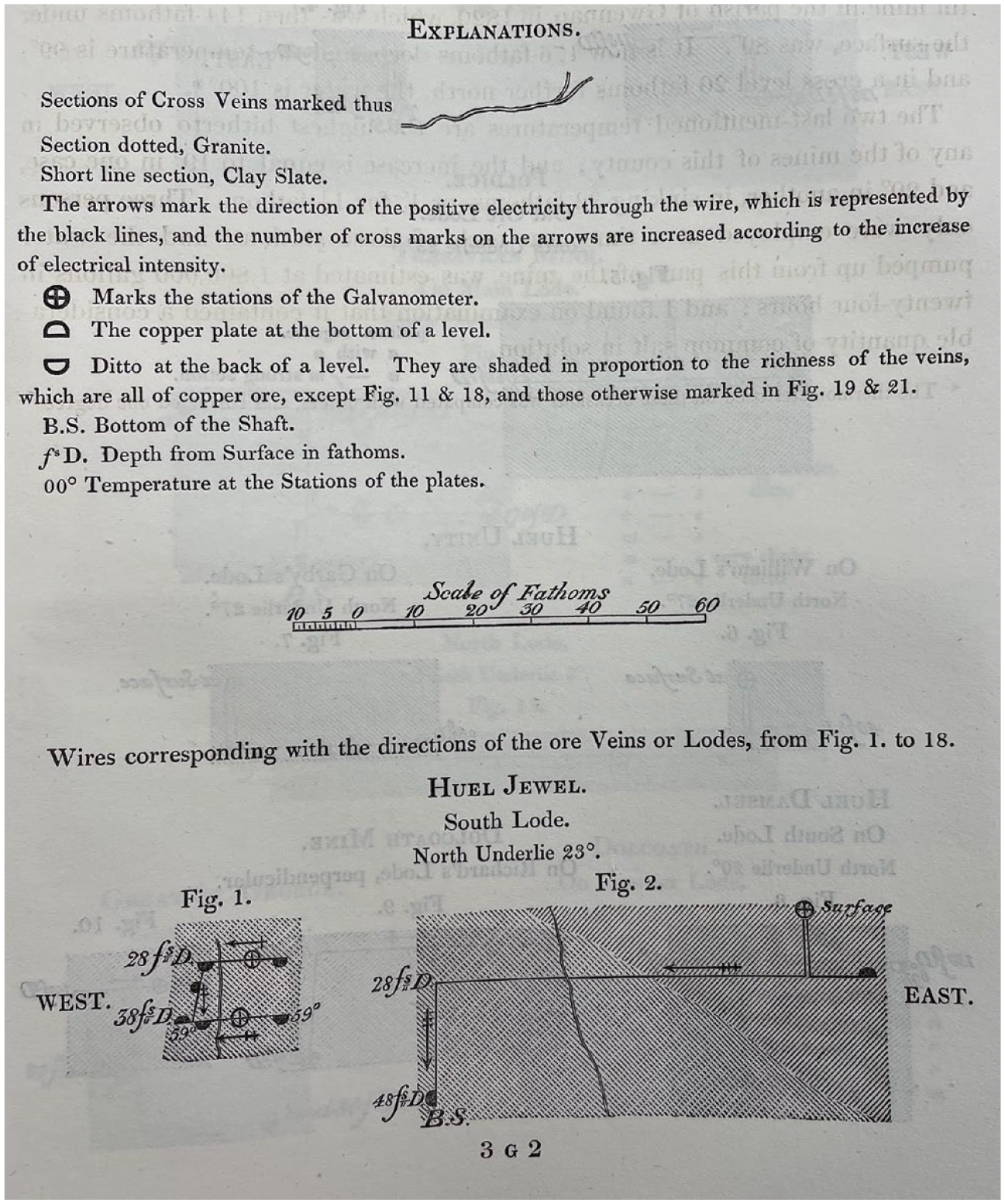
Fox’s depiction of his subterranean mine circuits, using veins, as made in Huel Jewel, along with an explanation of the diagrams. As published in the Philosophical Transactions in 1830 (author’s image, 2023)
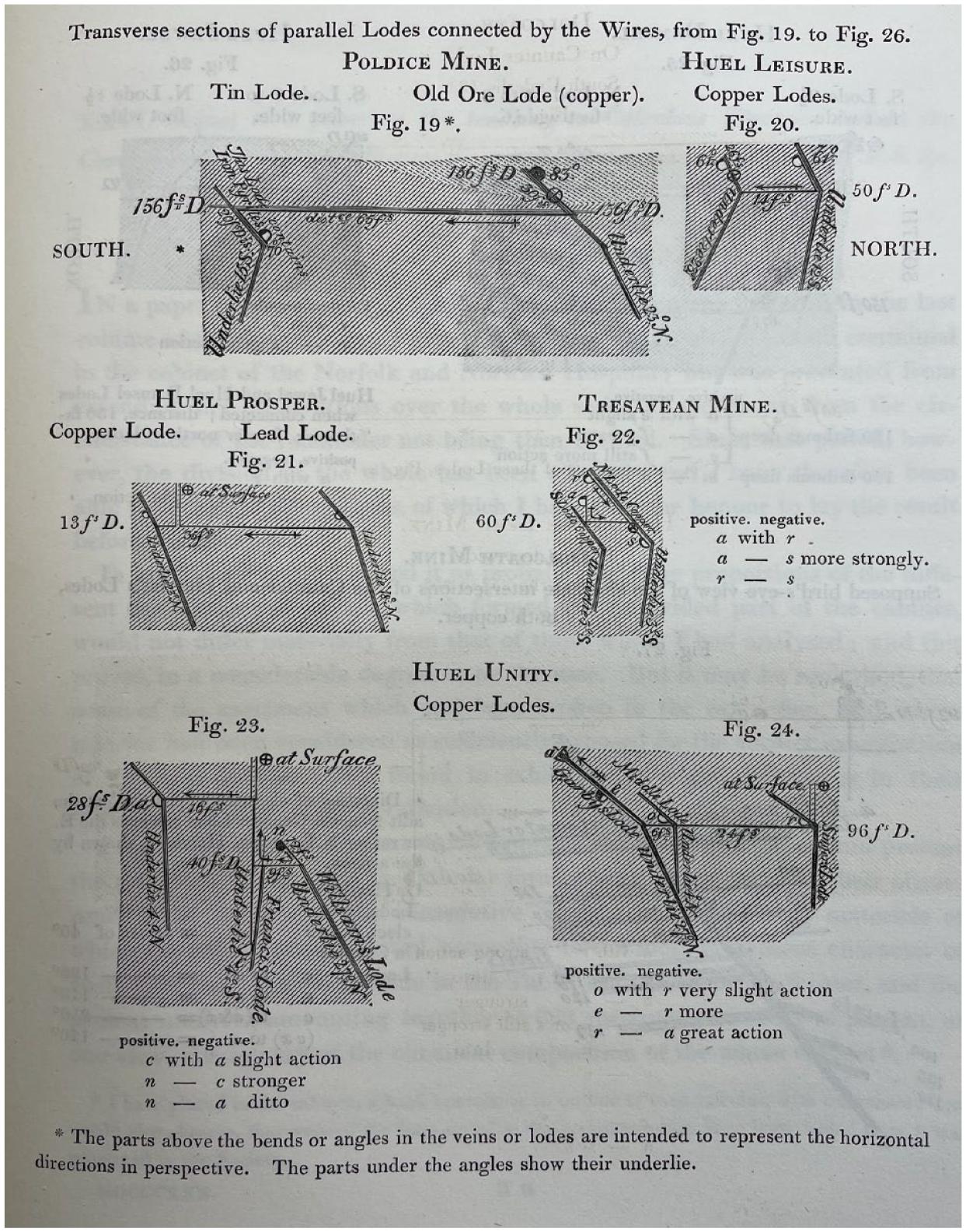
Fox’s depiction of his subterranean mine circuits, using veins, from a series of locations, including Huel Unity, Huel Leisure, and Tresavean Mine. As published in the Philosophical Transactions in 1830 (author’s image, 2023).
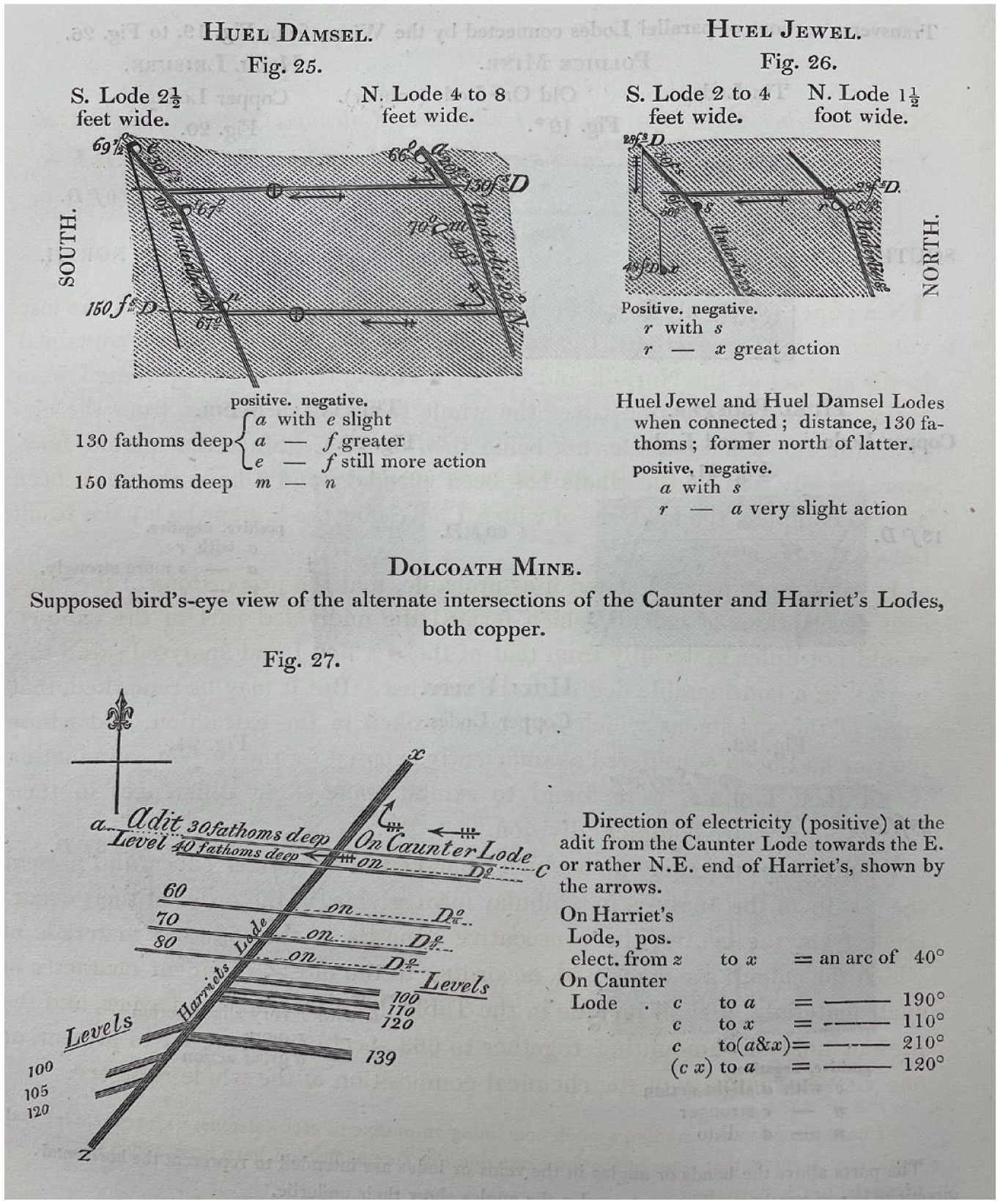
Fox’s depiction of his subterranean mine circuits, using veins, notably as those performed in Dolcoath Mine. As published in the Philosophical Transactions in 1830 (author’s image, 2023).
Faraday was not alone in his reservations over Fox’s claims. In 1832, British mathematician Samuel Christie (1784–1865) had reviewed and rejected Fox’s submission to the Royal Society’s Philosophical Transactions, concerning the relationship between heat and a magnetized needle. Here, Fox again invoked his experiments as evidence of subterranean “thermo-electric currents.” 28 Christie’s report was devastating, asserting that Fox’s style was “so discursive, and the subjects to which the author, in different parts of it refers, so various, that it is difficult to say what is the precise object of the communication.” 29 Fox appeared unaware that, in 1824, Edinburgh’s Royal Society had published David Brewster’s study of how the sun’s rays acted on the planet, effectively converting it into a “vast magnetic apparatus.” 30 It is clear, then, that the mine was an ambiguous experimental site: it was difficult for Fox to build authority with the likes of Christie and Faraday. Mines simultaneously presented invaluable locations in which to scrutinize nature, revealing the inner workings of the Earth, while being difficult places to manage and isolate natural phenomena. When it came to the measurement of subterranean electrical currents, this troubled epistemological character undermined Fox’s claims to have recorded such a phenomenon. Nevertheless, throughout the 1830s and 1840s, he worked to build credibility into his vision of nature in which heat and electricity were united in the formation of mineral veins.
Modeling and the mine
Fox not only experimented in dramatically different physical locations to the lecture theaters and laboratories of Paris and London. His alternate approach to the production of knowledge of electromagnetic phenomena also involved contrasting strategies for securing consensus. Faraday’s techniques for transferring experimentally produced natural phenomena from his laboratory to a lecture theater, and making these appear to exist with minimal human manipulation, were difficult for Fox to emulate, given the distance of Cornwall’s mines to the capital, as well as the limited access that metropolitan audiences had to these industrial sites. Instead, Fox conducted an extensive social networking campaign with Europe’s science elites, particularly those in London, and developed a technique that appeared to model subterranean electrical phenomena above ground: clay samples that seemed to mimic metalliferous vein formation according to Fox’s theory. As well as being physically distant from London, Fox was also something of an outsider to Britain’s traditional science elites, being a Quaker and therefore excluded from an Oxbridge university education. However, throughout the 1820s and 1830s, Fox built himself a reputation with metropolitan audiences, culminating in his election as a Fellow of the Royal Society in 1848. From the start, Fox had benefited from an already influential network of Cornish natural philosophers that was well-established in the capital. Indeed, between 1820 and 1830, it was two Cornishmen, Humphry Davy and Davies Gilbert, who held the presidency of the Royal Society of London, the latter of whom was an early patron of Fox’s. Back in 1805, Davy had himself considered the problem of mineral vein formation during a series of popular lectures on geology. Examining how veins had originally been located, Davy explained how it was the “idea of the Cornish miners that metallic veins are sometimes indicated by the appearance of fires in the night over places in which they are found,” which he agreed had reason, “as the metallic ores are for the most part perfect conductors of electricity, slow discharges from electrified clouds must often take place upon them from such a cause the effect would necessarily be produced.” 31 Davy here combined Cornish folklore and “popular opinion” with philosophical analysis, amusing his audience with accounts of traditional practices of vein prospecting. In sharp contrast to his own geologically informed assertions over where to locate copper and tin in relation to rock type, sixteenth- and seventeenth-century prospectors had employed divining rods to find veins. Davy recalled that the Quaker minister William Cookworthy (1705–80) of Plymouth, a specialist in finding china clay, was the “last person of any credit who professed to be able to discover metals by the divining hazel, and he was a very worthy and useful man and certainly deceived himself without designing to deceive others.” 32 Davy’s careful juxtaposition between superstition and modern geology delivered a clear lesson on the advances made in the science of mining. But his lectures also brought the local knowledge of Cornish miners before London’s gentrified audiences in a manner that Fox would endeavor to replicate in the 1830s.
Fox also shared Davy’s foremost patron, Davies Gilbert. A graduate of Pembroke College Oxford and author of no fewer than thirteen tracts on steam-engine efficiency, Gilbert was elected a Fellow of the Royal Society in 1791 and vice president in 1819. His support helped win Davy presidency of the Royal Society in 1820 and he replaced his protégé in 1827. This sustained Cornish presence at the helm of the Royal Society was invaluable to Fox. Following Faraday and Christie’s skepticism, Fox wrote to Gilbert in January 1837, declaring that he could now prove “the origin of mineral deposits,” which he claimed resulted from the “high solvent power of very hot water existing at the bottom of deep fissures, & to its tendency to ascend with any salts, with which it might have been charged through the upper portions of water in the fissures.” Fox reckoned that circulation had “caused a transference of matter from the lower, towards the upper part of the fissures . . . & as the ascending warm water had its temperature reduced, & its solvent powers accordingly diminished, a deposition of some of the substances contained in it, might gradually have taken place.” “Electrical excitement,” he continued, “may have been produced by great differences of temperature in different parts of veins; – & in many other ways, the phenomena of mineral veins may have been modified by the circulation of water in the fissures at different degrees of temperature.” 33
Back in Cornwall, Fox mobilized his local social connections to press his claims. Nearby aristocratic seats like Penmere House on the edge of Falmouth, which hosted the Fox family and Astronomer Royal George Biddell Airy for dinner in 1845, were places where Fox could socialize with Britain’s leading scientific authorities. The most prominent of these was Lemon’s home, Carclew House, six miles north of Falmouth, where, on October 13th, 1846, the Foxes dined with Sir Roderick and Lady Murchison, with the eminent geologist delivering “a little lecture on geology.” 34 The following year, Lemon hosted the Fox family and Cornish astronomer John Couch Adams, with the Master of Trinity College Cambridge, William Whewell, visiting in 1859. Dinners at Carclew and Penmere presented opportunities for Fox to stake his philosophical claims and win over allies. Likewise, Fox’s own properties at Rosehill and Penjerrick became sites of scientific socializing. Along with experimental displays over luncheons and teas, guests were treated to visits to local mines and Fox’s foundry at Perran. Most importantly, it was the Fox family’s development of a local scientific institution that helped transform Falmouth into a center of natural philosophy. Fox’s children, Anna Maria, Barclay, and Caroline, worked together to found the Cornwall Polytechnic Society, having originally had the idea in 1833. Intended to promote engineering and philosophical interest among “clever workmen,” both Lemon and Gilbert were eager supporters of this enterprise. 35 After securing royal patronage in 1835, the Royal Cornwall Polytechnic Society (RCPS) was able to attract significant natural philosophers to its 1836 exhibition, including William Buckland, the University of Oxford’s premier geologist.
It was one thing to attain prominence with Britain’s scientific elites, but it was an altogether different matter to demonstrate his mine experiments in places of polite social discourse. Fox’s solution was the development of a cunning contrivance that would simultaneously entertain guests and advance his own work: a model to demonstrate how subterranean mineral veins developed that effectively brought phenomena only observable in mines above ground. In November 1837, Fox described this to Gilbert, having recently modeled the formation of mineral veins in an earthenware vessel, divided with a layer of moistened clay to form two cells. In the first cell he placed a piece of copper pyrite that was connected to the second cell by a copper wire running through the dividing clay, which contained a zinc plate in acidulated water. After several months, the liquid evaporated, leaving dry clay. Fox cracked this open to find the sample “divided into two portions, nearly parallel to the sides of the wall, & having rather a conchoidal surface.” Fox found “the divided portions of clay g & h, were, like the metallic bodies, in opposite states of electricity, & one of them, consequently, in a more favourable state than the
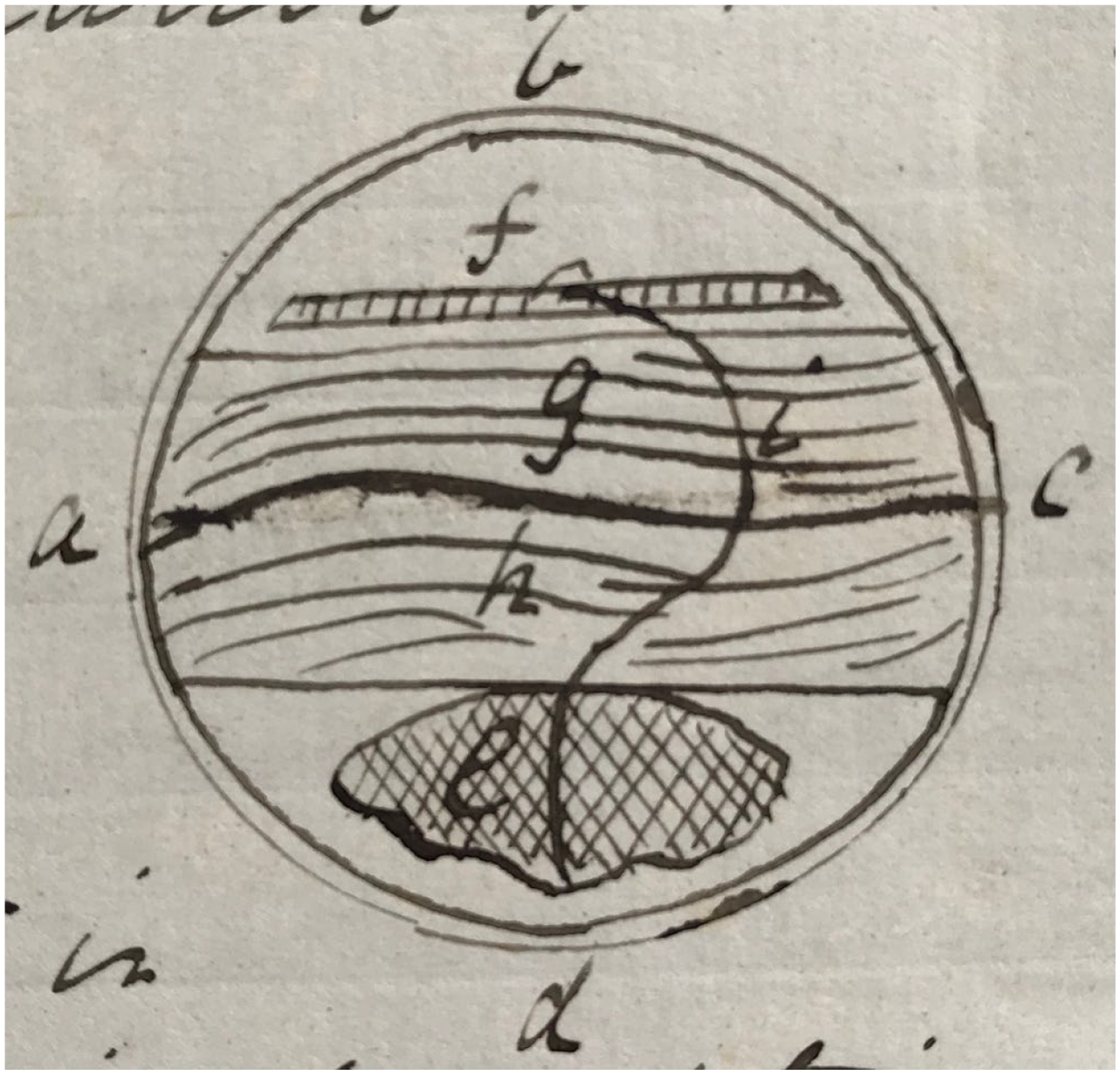
Fox’s depiction of his clay experiment, sent to Gilbert in November 1837 (Author’s image, 2023).
The modeling of metalliferous veins through clay not only provided Fox with what he believed to be verifiable evidence in support of his philosophical work, but a technique for transporting his experimental observations made in Cornwall’s mines beyond their industrial origins to the spaces of polite scientific discussion. On April 7th, 1837, Fox read his latest paper on veins to an august audience over a luncheon at Rosehill, including Lemon and Cornish mining engineer John Enys. Undoubtedly Fox’s most valuable acquaintance, however, was Henry De la Beche, who was a regular guest at Rosehill between 1836 and 1837 while geologically surveying Cornwall as part of his ongoing British Geological Survey. On one occasion following the reading of her father’s paper, Caroline Fox noted that the family and their guests talked for several hours on the subject of mineral veins. De la Beche was won over to Fox’s ideas “of galvanic agency,” wrote Caroline with satisfaction, but he would “not yield the point of the fissures being in constant progression; he says they were all antediluvian.” 39 In other words, electrical currents might have caused ore to have formed in the past, but their contemporary existence remained unconfirmed. Fox’s response was to give a post-luncheon experimental demonstration of his clay samples, which De la Beche found compelling evidence.
The great strength of Fox’s clay specimens was their mobility. As early as 1836, Fox had presented to the RCPS an account of his earliest clay experiments within the broader context of his work on the formation of mineral veins. Here, Fox argued that water, charged with matter, circulated through fissures, and under “chemical, or electrical agency” deposited minerals that crystallized, forming mineral veins. Modeling this electrochemical agency through a series of experiments on granite and killas samples he had taken from a local mine, Fox found that after placing these in boiling water with dissolved salt, killas and granite “were both rendered conductors of voltaic electricity.” Though only feeble conductors, this experiment seemed to confirm “that rocks become conductors of electricity, especially at considerable depths, where the great pressure of the column of water, and the high temperature, combine to introduce moisture into them.” The surfaces of rock or clay, if covered in water with a saline content, became “an efficient source of electrical excitement.” Fox maintained that if “these points be conceded,” it would be “difficult to assign limits to the extent of the development of electrical action.” 40 Following his observation of veins in mines, he described how he had placed ores in saline solutions, separated by walls of clay to form cells and connected by copper wire conveying a voltaic current. By this electrical communication these ores, otherwise isolated, could be made to act on each other. With zinc and iron in one cell and sulfate of copper in another, beautiful crystals of pure copper could be extracted. This communication of metallic crystals by electric agency offered an explanation for how ores became mixed up in the same lodes. The majority of metalliferous veins coincided with the Earth’s magnetic meridians, suggesting they obeyed laws of electrical action. 41 In conclusion, Fox surmised that he had proven that electrical currents decomposed metallic matter, dissolved as salts in water, forming ore deposits through fissures. Admiring the “order and fitness” of these veins, Fox saw evidence of providential design. It was significant that if these minerals were dispersed through strata, “the labour required to obtain them, would have rendered them practically useless.” At the same time, if the deposits were “more concentrated, their rapid exhaustion might entail incalculable injury on future generations.” 42 Were minerals too easy or difficult to extract, they would, Fox resolved, either be fast exhausted or practically useless. Here we see evidence of the way in which Fox’s Quaker theological outlook, as well as his capitalist investments, shaped his understanding of nature and the benevolence of God’s creation.
Fox subsequently took his clay samples to the Bristol BAAS meeting in 1836, and it was there that he was to secure a valuable correspondent for future experiments, the Somerset experimentalist Andrew Crosse (1784–1855). At his family home in Somerset, Fyne Court, Crosse had produced crystals through electrical experiment since 1807. Crosse had, in 1836, finally resolved to make his research public by presenting an account of how he had formed crystalline bodies through the influence of a voltaic current generated from a battery to the BAAS’s Geology and Chemistry Sections. Following Fox’s own paper on the role of electromagnetism in the formation of mineral veins, Crosse’s delivery was in good company. With Fox demonstrating “the agency of a powerful principle in the formation and modification of metalliferous deposits,” Crosse showed “how frequently and how materially this principle had been employed in the construction of some of Nature’s most splendid productions,” including “her most beautiful gems.” Crosse’s BAAS audience was excited “by the intimation that there was no production of the mineral world that would not probably be imitated by the ingenuity of man.” 43 After this success, the Geology Section’s chair introduced Crosse for his second paper of the meeting. Again, Crosse’s experiments were framed in reference to Fox’s research on mineral veins. The two experimentalists kept in touch after the Bristol meeting. That October, Fox replicated Crosse’s arrangement to produce crystals of carbonate of lime from an electric circuit with water. Crystals formed around the copper wire, just below the surface of the solution. Crosse responded to Fox’s account of this enthusiastically, with news that he had recently produced “very good crystals of sulphur from decomposing sulphate of potash – also the same from sulphate of iron,” as well as observing that his “quartz crystals are growing slowly.” 44 Between Falmouth and Taunton, Fox and Crosse’s mineralogical enterprises escalated rapidly. Crosse even planned to “attempt the imitation of volcanic minerals by exposing [stone] to long continued heat & slow cooling.” He was sure that the constructive application of electricity would help this process, with Fox having “put the matter beyond dispute” that electric agency was the cause of mineral formation. 45 Together, the two West Country philosophers appeared to be imitating nature’s finest geological creations. Both were keen to promote their experiments to a broader audience.
Making full use of their mobility, Fox took his clay samples on his 1838 tour of Europe. At the Académie des Sciences in Paris on April 2nd, the Fox family met with Antoine César Becquerel (1788–1878), who had conducted similar experiments for making metallic deposits through electrical action. When “Papa showed him the clay with a vein in it galvanically inserted,” wrote Caroline in her diary, Becquerel “did not doubt the originality of the experiment” and asked for a precise method so that he could replicate the trial himself. 46 Fox then exhibited his specimens in London, touring the city’s leading scientific venues with his modeled mineral veins (Figure 5). Back in Falmouth, Fox wrote to Faraday on September 13th, 1838, with an account of the previous meeting of the RCPS, some eleven months earlier, where he had exhibited his clay specimens in which veins of oxide and copper had been formed by electrical agency. He informed Faraday that he had first moistened the clay with a solution of sulfate of copper and then placed the clay between plates of copper or zinc. Through the moistened clay, Fox then passed a current from a battery. When this voltaic action was conducted between plates positioned horizontally, horizontal veins formed, and when positioned vertically, perpendicular veins were produced. Very “decided cracks or fissures” marked the route of the current as it passed through the moistened clay, producing the copper or oxide veins. Fox declared that these “facts have a decided bearing on very important geological phenomena & it would appear from them that the directions of the laminae of the schistose & other rocks ought to indicate those of the electricity.” 47 Fox hoped this experiment would confirm his claim that electric currents operated beneath the Earth’s surface.
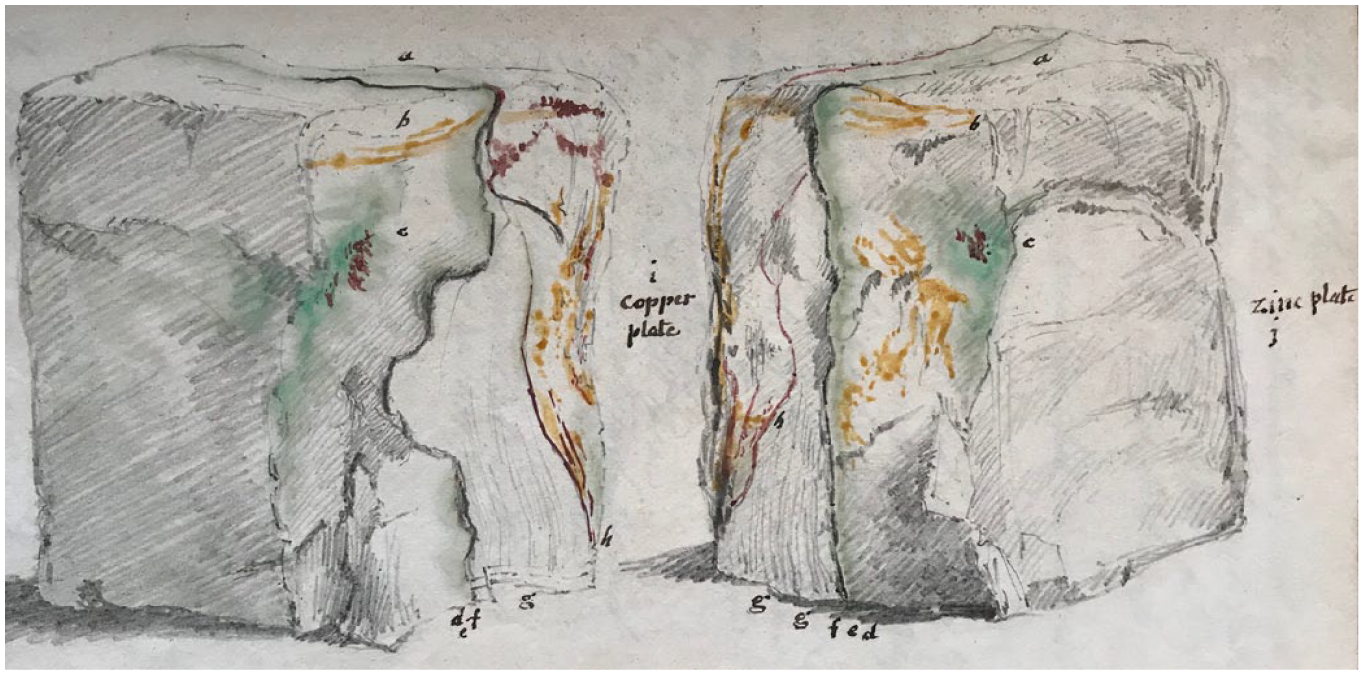
Fox’s watercolor of his clay samples, painted for the RCPS’s annual report, probably in 1838 (Image by Michael Carver, 2023).
Faraday remained a tough critic to appease, but Fox and Crosse had more success with William Sturgeon (1783–1850), founder of the London Electrical Society. The son of a cobbler, Sturgeon served in the Royal Artillery between 1804 and 1820, before working as a shoemaker, and then lecturer in experimental philosophy at the East India Company’s military seminary at Addiscombe. However, he had a tempestuous relationship with London’s scientific establishment, falling out with Davy and having his paper on magnetic electric machines rejected by the Philosophical Transactions. In response, Sturgeon founded his own journal in October 1836, the Annals of Electricity, followed a year later by a new society to promote electrical research beyond London’s social elites. The Electrical Society’s meetings on Saturday evenings in the Adelaide Gallery provided popular electrical demonstrations and experiments, rivaling Faraday’s at the Royal Institution.
48
Crosse’s first communication to Sturgeon’s new society described the manufacture of perfect rhomboidal crystals of selenite. Fox was equally keen to take advantage of Sturgeon’s new Electrical Society and the Annals of Electricity. With memories of his rejection from the Philosophical Transactions in 1832 and Faraday’s ambiguous attitude toward his work, Fox was almost certainly sympathetic to Sturgeon’s anti-establishment sentiments. As much as Fox wanted his work to be acknowledged as reputable at the Royal Society and Royal Institution, he saw the Annals of Electricity as an appropriate place for publication.
49
From the commencement of Sturgeon’s new journal, Fox was in correspondence with the editor, sending him a pamphlet and specimen of his “artificial sulphuret of copper” in the summer of 1837. Sturgeon promised to publish an account of the sample in his journal after exhibiting it at the Electrical Society’s next meeting. In the meantime, Sturgeon explained how he had read Fox’s “theory of the ‘Origin of Mineral Veins’, and am much pleased with it: and as I think that it could be generally read with interest, I shall publish
Clay controversies
Ironically, the greatest challenge to Fox’s use of clay samples to substantiate his claims over the existence of electrical currents was to come from his own experimental assistant, William Jory Henwood (1805–75). After working as a clerk at the Fox family’s foundry at Perran, Henwood became increasingly interested in how subterranean metalliferous veins formed. Working alongside local miners, Henwood developed a considerable knowledge of Cornish mines, becoming Assay Master of Tin to the Duchy of Cornwall in 1832. Impressed, Fox invited Henwood to collaborate in his early mine experiments. As Fox put it, it was “the singular power of exact observation in matters scientific that made Mr. Henwood the leading authority on the subject of metalliferous deposits.” 51 This harmonious relationship did not last long. In December 1836, Henwood submitted his own paper on metalliferous veins to the Annals of Electricity, rejecting Fox’s experimental claims that he had detected naturally occurring “energetic action” in mines. 52 While Henwood admitted that veins with copper could convey electric currents, he observed no trace of electrical activity through the earthy content of lodes and surrounding rock. Recently, Christie had shared in this skepticism, warning “that the wires employed, might by contact with ores, have generated the currents observed.” 53 Henwood agreed with this proposition: were subterranean currents actively forming mineral veins, there would surely be observable evidence of such electrochemical action, but, Henwood surmised, “whoever has descended into the mines has never been struck by the chemical changes going on.” If Fox’s production of sulfate of copper from his clay samples modeled vein formation, then why, Henwood reasoned, was sulfate of copper not abundantly found in mines? 54
In 1837, Sturgeon published Fox’s own contribution to the Annals of Electricity immediately after Henwood’s attack. Here, Fox described his most recent clay experiments with yellow copper and sulfate of copper, in which “the yellow copper ore became beautiful iridescent, resembling the ‘peacock’ copper ore of the miners.” 55 Over time, metallic copper formed in brilliant octahedron crystals on the ore. On testing this set-up with a galvanometer, Fox found a voltaic action at work between the cells. Crosse’s account of his own experiments on rocks and electricity, appearing in the same volume of Sturgeon’s Annals, seemed to support these claims. Yet before the end of 1837, Henwood delivered another challenge to Fox in the Annals, accusing Fox of having produced results that were “but a mere repetition of those published by M. Becquerel in 1834 and which had been communicated to the Academy of Sciences in 1827.” 56 As editor, Sturgeon intervened to settle the dispute. Throughout 1838 he himself replicated the “exceedingly tedious experiment” of producing copper ore through clay, undertaking this “on no other account than that of establishing, or rather, of setting at rest” the truth of Fox’s claims. In February 1839, Sturgeon wrote to Fox reporting that his repetition was a success, developing copper through electrical action; he wanted an account of this trial to “appear before the Electrical Society, and [be] examined publicly at one of the meetings.” 57 On February 19th, Sturgeon exhibited the sample before the Society, with the copper broken up and compared to a piece of mined copper ore in “its primitive condition.” “The two specimens are as different from each other in appearance, as night is from day,” observed Sturgeon. “[T]he galvanized specimen has totally lost the metallic brilliancy which it possessed prior to the experiment.” Instead of a yellow luster, it was now a dull leaden color, traversed by a thin stratum of white matter. Sturgeon offered to “show this beautiful result to the Geological Society” and promised to give an account of the experiment to any London society Fox desired. 58 For Sturgeon, the controversy seemed resolved: despite variations in the specimens, it seemed Fox’s arrangement worked, reverse-engineering the formation of ore from refined copper.
Back in Cornwall, Henwood continued to attack Fox’s theory. Henry Still of St Ives attended the RCPS’s 1837 exhibition, where he witnessed “Fox’s experiments producing mineral veins in clay by galvanism, and causing clay to become stratified.” Writing to De la Beche, Still reported how this occasion had soured: also present was Henwood, who “appeared to be very much annoyed because he was not allowed to show off his opposition to Fox the first day. He vows vengeance.” 59 De la Beche had in fact known of Henwood’s discontent with Fox’s account of vein formation since December 1836, when Henry McLauchlan of St Austell wrote to him with news that “Mr Henwood mentions the lodes at St. Just as being opposed to Fox’s theory.” 60 Henwood’s skepticism of Fox’s claims attracted sympathy. John Enys, for one, took Henwood’s side. Enys had already expressed doubts to De la Beche over Fox’s assertion that subterranean water currents conveyed mineral deposits, observing that with regard to “Fox’s water circulation, I have always considered it impossible to accept.” 61 Enys was still unconvinced in December 1837, observing that “Robert Fox is very sanguine about his laminated clay effecting an important revolution in geological ideas and proving the direction of former electric currents.” 62 Such confidence was, Enys believed, misplaced. Of Henwood’s criticisms, Enys considered them fair, writing to De la Beche in April 1838 that it was “So much the worse for Robert Fox,” who was guilty of “rough statements” regarding speculations on mineral ore formation. 63 In Enys’s opinion, Henwood was the real victim of the dispute, having made himself unpopular among Cornwall’s scientific community and jeopardized his position with the Duchy of Cornwall. Enys lamented that “Poor Henwood is in a great fright at Duchy prospects and with justice. I should be sorry to see him thrown on the world again, though as far as Cornwall is concerned perhaps his presence in another mining district, would be beneficial.” 64 This premonition came to pass: Henwood soon resigned from the Duchy. While some shared Henwood’s doubts over Fox’s theory, his rough manner had undermined his reputation. Henwood continued to make himself unpopular, in stark contrast to Fox, who appeared a paragon of dignity. In May 1841, Cambridge geologist Adam Sedgwick (1785–1873) complained to De la Beche that he was “amazed” at an irritable letter from Henwood and was “truly angry that he has quoted me, and still more sorry that I ever gave him occasion.” 65 Sedgwick had few doubts over Fox’s work and, when he visited Cornwall in 1846, was eager to have a tour of the geological locations that had informed and substantiated Fox’s “theory of veins.” 66
Still, Henwood refused to back down. In January 1842, Lemon reported to Fox that Henwood had renewed his attack at a meeting of the RCPS. After the reading of Fox’s latest paper, Henwood dramatically produced a letter from Fox, dated 1835, in which he detailed how he had known about Becquerel’s experiments. Before the RCPS’s audience, Henwood brandished a second letter, this time from Becquerel himself, reading its contents aloud. Becquerel asserted that Fox’s experiments with clay were “much the same as his own.” Lemon thought this but “a casual expression which proves nothing,” but described to Fox how “Henwood then proceeded to prove that your theory of veins was not original.” However, “as this matter was in no way before us,” an anonymous individual interrupted Henwood and prevented him speaking further. Lemon demanded Henwood stick to the paper in question, requesting he “confine himself to his reply to Fox’s statement.” At this, Henwood “flew at all, & was most offensive.” He turned on Cornish geologist Joseph Carne (1782–1858), accusing him of wanting “to entrap him into divulging a first of his case,” and refused to listen to Carne’s response. “It was impossible to pacify him,” lamented Lemon, who proposed the RCPS take steps against Henwood to prevent a repeat of the scene. 67 Again, the manner of Henwood’s attack on Fox’s work compromised his own standing. He had misjudged the time, place, and audience for a critique of Falmouth’s premier natural philosopher. Between 1836 and 1842, Henwood had done all he could to discredit Fox’s theoretical account of the formation of veins, his experimental skill in detecting subterranean electrical currents, and his claims to produce ore through electrical agency. Fox, however, had a powerful network of scientific authorities to call on for support, including Lemon, Sturgeon, and Gilbert. Likewise, the RCPS was very much Fox’s bastion; it was an institution dependent on his social connections and his family’s philosophical enterprise. Henwood’s dispute with Fox reveals that there were regional divisions surrounding the study of electromagnetic phenomena: controversies over how nature was to be conceptualized were not confined to provincial–metropolitan differences.
Undoubtedly, Fox’s most eminent endorsement came from De la Beche. After receiving Fox’s complaint that “Henwood is industriously attacking my views” in June 1838, De la Beche responded with a move that, for many, settled the controversy in Fox’s favor.
68
In 1839, De la Beche published his Report on the Geology of Cornwall, Devon, and West Somerset, providing a geological overview of south-west England. There were few geological subjects, De la Beche contended, so important, yet so poorly understood, as the formation of mineral veins, but he contended that Fox’s work offered the best understanding of such phenomena. That rock fissures were filled by “electro-chemical agency” appeared to be supported by “the present impression among the Cornish miners . . . that lodes are contemporaneous with the rocks in which they are found.”
69
De la Beche agreed with Fox’s claims that heated water circulated through fissures, vaporizing, and depositing salt and minerals as the water transformed into steam: within a fissure, the circle of rapid currents of ascending hot steam and descending cold water caused the steam to condense as it cooled, leaving behind veins of ore.
70
Furthermore, that Cornwall’s beds of tin and copper ore displayed a clear east-to-west direction suggested magnetic influence. De la Beche declared that, collectively: [The] experiments of Becquerel, Fox, and Cross, have shown that great modifications of a mineral vein . . . may take place by the reaction of a variety of substances on each other, so that the whole may be greatly modified. Every new dislocation has produced new conditions for these changes, and we can readily conceive that these which traverse them at an acute one, more particularly if we consider, with Mr. Fox, that currents of electricity passing around the globe from east to west, have influenced the deposits from substances held in solution in the fissures.
71
It was this assessment of Fox’s theoretical account of subterranean metalliferous deposits that, in 1857, Leifchild invoked in his popular explanation for Cornwall’s mineral wealth.
Conclusion
Fox’s clay samples were intended to communicate experimental knowledge, accessible only in mines, above ground to the venues of polite metropolitan science. Fox was sure that these transportable specimens transformed refined copper back into ore through electrical agency, substantiating his claims that subterranean electrical action was responsible for the formation of metalliferous veins. Yet this alternate approach to the study of electromagnetic phenomena remained of contested value to many established examiners of electricity and magnetism, including Faraday. In August 1854, Astronomer Royal George Biddell Airy addressed the problem of the Earth’s density by measuring the rate of beating pendulums at various depths in a mine. Having performed unsuccessful trials in Dolcoath mine back in 1826 and 1828, Airy sought a re-run at the Harton Colliery, in South Shields. During his preparations for this endeavor, Airy recalled that when in Cornwall in the 1820s he had seen “Fox, and he was possessed with the idea that the vibrations of a pendulum might be influenced by magnetic currents in the rocks about it.” He was unsure what to make of this allegation and so sought Faraday’s advice regarding if such an attraction would affect a swinging pendulum. Airy apologized for troubling Faraday “with what may be foolish questions,” but maintained that there was no higher authority in questions of electricity and magnetism.
72
Faraday’s response was dismissive, asserting that if there were “general electric currents in the earth,” there would be more evidence below ground. Fox’s twenty-five-year-old claim set “the thoughts loose upon many points,” but none were of real value. If the pendulum was not magnetic, then any speculative subterranean currents would not affect it.
73
If part of the pendulum was magnetic, then, theoretically, any currents would interfere with the direction of its oscillations, but not the time it took to complete these vibrations. Faraday suspected that Airy and Fox were confused over magnetic and electric currents: if they meant the force of the Earth, then this would be similar both above and below ground, but if they conceived of some underground electrical force, then this was highly improbable. Faraday advised Airy to check for surrounding rock that may have “any fixed local magnetic force,” but reiterated that this was not a problem for a nonmetallic pendulum. Citing his 1832 Bakerian Lecture on terrestrial magnetism, Faraday explained how a metal pendulum bob would move through the Earth’s lines of magnetic force: The bob moves to & fro about a fixed point; and hence its upper and lower parts move through different spaces in the same time. In these latitudes, where the dip is very great, the consequence is, that moving across the earth’s lines of magnetic force, electric currents tend to be found; and because of the difference between the amount of lines intersected by the upper and lower parts of the bob, are really found, as I have shewn in my old researches, & often obtained since: – so that as the bob swings it will become, virtually, a very feeble electromagnetic with a horizontal magnetic axis.
74
This would not threaten Airy’s pendulum because, as the magnetic specialist Edward Sabine had found, these currents had an equal effect both on the Earth’s surface and interior. 75 Fox’s discussion with Airy had left an impression but, by 1854, Faraday was confident that any theoretical subterranean electric currents were little enough evident to trouble Airy’s experiments. Fox’s clay samples had, evidently, failed to persuade Faraday of the existence of subterranean electrical action.
This enduring skepticism not only reveals the limits of Fox’s campaign to build credibility into his philosophical claims, but also emphasizes the epistemologically complex nature of the mine as a site of experimental inquiry. On the one hand, Cornwall’s mines provided Fox with unique opportunities to observe and measure natural phenomena in previously unexplored regions. Fox’s science might be understood as industrial science, not in the sense of big-corporation enterprise with twentieth-century America, but due to its facilitation through the local mining industry that was, in turn, sustained by steam-powered pumping engines. Nineteenth-century industrialization, in this way, shaped the formation of new frameworks for conducting scientific activity. Nevertheless, Faraday and Airy’s concerns demonstrate how the character of mine-produced knowledge was unstable and difficult to verify, especially in urban centers of science, far removed from mining regions like Cornwall. This suggests that nineteenth-century British electrical science was not just marked by social hierarchies of space, such as those evident when contrasting Royal Institution audiences with those of the Adelaide Gallery, but epistemological hierarchies of space: we might think of Fox’s clay samples as a technique for negotiating such spatial regimes. He believed that the Earth acted as a giant magnet and was committed to proving this by treating the planet as a “laboratory.” Fox hoped that, by going to nature itself, rather than by representing natural phenomena in a laboratory, his philosophical claims would carry authority: while Faraday worked in the controlled, artificial space of the Royal Institution and dealt with refined copper wire, Fox asserted that he experienced naturally occurring electromagnetic phenomena, moving through nature’s copper-rich veins. This was a distinctly Cornish approach to the study of electricity. Yet while Fox’s experiments involved the physically demanding vertical descent into the Earth, the communication of his research, horizontally beyond Cornwall, proved a far greater challenge.
Footnotes
Acknowledgements
Thanks go to the Royal Cornwall Polytechnic Society, Ginny Button, Edward Cartwright, Mike Jenks, Sue Radmore, Henrietta Boex, Lizzie Cook, Lucie Nottingham, the Tanner Trust, Michael and Caroline Carver, Charles and Caroline Fox, Rachel Morin, Carolyn Kennett, Simon Naylor, Crosbie Smith, Hilary Watson, Daniel Belteki, Steve Spencer, Nigel Kirk, and two very generous anonymous readers at Oxford University Press who helped formulate this work. This article is part of the Leverhulme Early Career Research Project “The State of Science: Governing Knowledge of Nature in Victorian Britain,” hosted at the University of Leeds and the Bartlett School of Sustainable Construction at UCL. I would like to thank my colleagues for all their support, especially Graeme Gooday, Ellen Clarke, Josh Hillman, Gregory Radick, Jonathan Topham, D’Maris Coffman, Judy Stephenson, Priti Parikh, and John Kelsey. Finally, as ever, I am grateful to Louise Spencer, Sid Sharma, and Christopher Yabsley for their enduring assistance.
Declaration of Conflicting Interests
The author declared no potential conflicts of interest with respect to the research, authorship, and/or publication of this article.
Funding
The author disclosed receipt of the following financial support for the research, authorship, and/or publication of this article: Leverhulme Early Career Research Project.

1.
John R. Leifchild, Cornwall: Its Mines and Miners. With Sketches of Scenery. Designed as a Popular Introduction to Metallic Mines (London: Longman, Brown, Green Longmans, Roberts, 1857), p.122.
2.
David Gooding, “‘In Nature’s School’: Faraday as an Experimentalist,” in David Gooding and Frank A. J. L. James (eds.), Faraday Rediscovered: Essays on the Life and Work of Michael Faraday, 1791–1867 (Basingstoke: Macmillan Press, 1985), pp.105–35, 105, 107.
3.
Michael Faraday, “The Bakerian Lecture: Experimental Researches in Electricity, Second Series,” Philosophical Transactions of the Royal Society (1832.) 122: 163–94, 175–6, paras 187 and 188.
4.
Iwan Rhys Morus, Frankenstein’s Children: Electricity, Exhibition, and Experiment in Early-Nineteenth-Century London (Princeton, NJ: Princeton University Press, 1998), pp.5–7; Iwan Rhys Morus, “Worlds of Wonder: Sensation and the Victorian Scientific Performance,” Isis 101, no. 4 (2010): 806–16; Iwan Rhys Morus, “Different Experimental Lives: Michael Faraday and William Sturgeon,” History of Science 30, no. 1 (1992): 1–28.
5.
Bruce J. Hunt, “Michael Faraday, Cable Telegraphy, and the Rise of British Field Theory,” History of Technology 13 (1991): 1–19.
6.
Simon Schaffer, “A Manufactory of Ohms: Late Victorian Metrology and Its Instrumentation,” in Susan Cozzens and Robert Bud (eds.), Invisible Connections (Bellingham, WA: SPIE, 1992), pp.23–56; Bruce J. Hunt, “The Ohm Is Where the Art Is: British Telegraph Engineers and the Development of Electrical Standards,” Osiris 9 (1994): 48–63.
7.
Wilko Graf von Hardenberg and Martin Mahony, “Introduction – Up, Down, Round and Round: Verticalities in the History of Science,” Centaurus 62 (2020): 595–611, 596–7.
8.
Patrick Anthony, “Mining as the Working World of Alexander von Humboldt’s Plant Geography and Vertical Cartography,” Isis 109, no. 1 (2018): 28–55, 31–3, 36.
9.
J. H. Collins, A Catalogue of the Works of Robert Were Fox, F.R.S, &c. Chronologically Arranged, with Notes and Extracts, and a Sketch of his Life (Truro: Lake & Lake, 1878), p.3; Staatsbibliothek zu Berlin, “R.W. Fox to Humboldt, 25th June 1853,” Nachl. Alexander von Humboldt, gr. Kasten 11, Nr. 118.
10.
Edward J. Gillin, “The Instruments of Expeditionary Science and the Reworking of Nineteenth-Century Magnetic Experiment,” Notes and Records of the Royal Society 76 (2022): 565–92; on the mine as an experimental site, see Edward J. Gillin, “Cornish Science, Mine Experiments, and Robert Were Fox’s Penjerrick Letters,” Notes and Records of the Royal Society 76 (2022): 49–65; also see Jenny Bulstrode, “Men, Mines, and Machines: Robert Were Fox, the Dip-Circle and the Cornish System” (Part III dissertation, History and Philosophy of Science Department, University of Cambridge, 2013).
11.
On Cornish scientific culture, see Simon Naylor, Regionalizing Science: Placing Knowledge in Victorian England (London: Pickering & Chatto, 2010), pp.30–1.
12.
Hjalmar Fors, “Elements in the Melting Pot: Merging Chemistry, Assaying, and Natural History, ca. 1730–60,” Osiris 29, no. 1 (2014): 230–44.
13.
Bulstrode, “Men, Mines, and Machines,” pp.232, 236 (note 4).
14.
On steam power, see Richard L. Hills, Power from Steam: A History of the Stationary Steam Engine (Cambridge: Cambridge University Press, 1994); D. B. Barton, The Cornish Beam Engine (Truro: D. Bradford Barton Ltd, 1965).
15.
Quoted in, Thomas Lean & Brother, Historical Statement of the Improvements Made in the Duty Performed by the Steam Engines in Cornwall, from the Commencement of the Publication of the Monthly Reports (London: Simpkin, Marshall, and Co., 1839), pp.5–6.
16.
Susan E. Gay, Old Falmouth: The Story of the Town from the Days of Killigrews to the Earliest Part of the 19th Century (London: Headley Brothers, 1903), pp.149–60; for a business history of the Fox family, see Charles Fox, On the Brink: The Story of G. C. Fox and Company: A Quaker Business in Cornwall through Eight Generations (London: Zuleika, 2019), pp.155–77.
17.
See Geoffrey Cantor, Quakers, Jews, and Science: Religious Responses to Modernity and the Sciences in Britain, 1650–1900 (Oxford: Oxford University Press, 2005), pp.203–8.
18.
Robert Were Fox, “On the Temperature of Mines,” in Transactions of the Royal Geological Society of Cornwall, Vol. 2 (Penzance: T. Vigurs, 1822), pp.14–18, 14, 18.
19.
Robert Were Fox, “On the Temperature of Mines,” in Transactions of the Royal Geological Society of Cornwall, Vol. 2 (Penzance: T. Vigurs, 1822), pp.19–28, 19–20, 27.
20.
Robert Were Fox, Report on Some Observations on Subterranean Temperature (London: Richard and John E. Taylor, 1841), pp.314–15.
21.
David Gooding, “‘Magnetic Curves’ and the Magnetic Field: Experimentation and Representation in the History of a Theory,” in Simon Schaffer, David Willoughby Gooding, and Trevor Pinch (eds.), The Uses of Experiment: Studies in the Natural Sciences (Cambridge: Cambridge University Press, 1989), pp.183–223, 185–6, 189.
22.
Letter in author’s possession, “Robert Were Fox to Charles Lemon (30th Mar., 1830),” pp.1–5, 1–2.
23.
Robert Were Fox, “Account of Some Experiments on the Electricity of the Copper Vein in Huel Jewel Mine,” in Report of the Fourth Meeting of the British Association for the Advancement of Science; held at Edinburgh in 1834 (London: John Murray, 1835), pp.572–4.
24.
Robert Were Fox, “On the Electro-Magnetic Properties of Metalliferous Veins in the Mines of Cornwall,” Philosophical Transactions of the Royal Society 120 (1830): 399–414, 399.
25.
Ibid., 400.
26.
Faraday, “The Bakerian Lecture: Experimental Researches in Electricity, Second Series,” 175, para. 187 (note 3).
27.
“Letter 712: Michael Faraday to Charles Lemon (25 Apr., 1834),” in Frank A. J. L. James (ed.), The Correspondence of Michael Faraday, Vol. 2: 1832–December 1840. Letters 525–1333 (London: Institution of Electrical Engineers, 1993), p.178.
28.
Robert Were Fox, “On Certain Irregularities in the Magnetic Needle, Produced by Partial Warmth, and the Relations Which Appear to Subsist between Terrestrial Magnetism and the Geological Structure and Thermo-Electric Currents of the Earth,” Proceedings of the Royal Society 10 (1831–2): 123–5.
29.
Royal Society Library, London (hereafter RS), RR/1/73, Samuel Christie, “Report on Mr Fox’s Paper, 27th June 1832,” p.1.
30.
Ibid., 2–3; the paper was actually published in 1823, see David Brewster, “Observations on the Mean Temperature of the Globe,” Transactions of the Royal Society of Edinburgh 9, no. 1 (1823): 201–25.
31.
Davy, in Robert Siegfried and Robert H. Dott, Jr. (eds.), Humphry Davy on Geology: The 1805 Lectures for the General Audience (Madison, WI: University of Wisconsin Press, 1980), p.106.
32.
Ibid., p.106.
33.
Letter in author’s possession, “Robert Were Fox to Davies Gilbert (38th Jan., 1837),” pp.1–4.
34.
Quoted in Horace N. Pym (ed.), Memoirs of Old Friends: Being Extracts from the Journals and Letters of Caroline Fox of Penjerrick, Cornwall from 1835 to 1871 (London: Smith, Elder, & Co, 1882), p.212.
35.
W. L. Fox, quoted in Alan Pearson, “A Study of the Royal Cornwall Polytechnic Society” (M.A. thesis, University of Exeter, September 1973), p.31.
36.
Letter in author’s possession, “Robert Were Fox to [Davies Gilbert], 20th Nov., 1837,” pp.1–3, 1.
37.
Ibid., p.2.
38.
Ibid., p.3.
39.
Quoted in Pym (ed.), Memoirs of Old Friends, p.3 (note 35).
40.
Robert Were Fox, Observations on Mineral Veins (Falmouth: J. Trathan, 1837), pp.32–3.
41.
Ibid., pp.37–9.
42.
Ibid., p.53.
43.
E. L. Richards, quoted in Cornelia Crosse and Andrew Crosse, Memorials, Scientific and Literary, of Andrew Crosse, the Electrician (Sweden: Timaios Press, 2014, first published in 1857), pp.94–5.
44.
RS, Robert Were Fox Papers, MS/710/29, “Andrew Crosse to Robert Were Fox, 29th Oct., 1836.”
45.
Ibid. On Fox and Crosse’s analogy of crystal formation to the origin of mineral veins, see Morus, Frankenstein’s Children, pp.133–4 (note 5).
46.
Quoted in Pym (ed.), Memoirs of Old Friends, p.26 (note 35).
47.
“Letter 1108: Robert Were Fox to Michael Faraday, 13 Sep., 1838,” in James (ed.), The Correspondence of Michael Faraday, Vol. 2, p.518 (note 28).
48.
49.
Ibid., pp.133–4.
50.
RS, Robert Were Fox Papers, MS/710/111, “William Sturgeon to Robert Were Fox, 4th Jul., 1837.”
51.
(Anon.), “Robert Were Fox, F. R. S.,” The Leisure Hour (London, England), Jan. 1877–Oct. 1903; Mar. 30th, 1878; 1370; pp.197–9, 198.
52.
W. J. Henwood, “On the Electric Currents Observed in Some Metalliferous Veins,” in The Annals of Electricity, Magnetism, & Chemistry; and Guardian of Experimental Science, Vol. I: Oct. 1836–Oct. 1837 (London: Sherwood, Gilbert, and Piper, 1837), pp.124–33, 127.
53.
Christie, quoted in Henwood, “On the Electric Currents Observed in Some Metalliferous Veins,” p.128 (note 53).
54.
Ibid., pp.129–3.
55.
Robert Were Fox, “Experiments Illustrative of the Influence of Voltaic Electricity on Copper Pyrites,” in The Annals of Electricity, Magnetism, & Chemistry; And Guardian of Experimental Science, Vol. I: Oct. 1836–Oct. 1837 (London: Sherwood, Gilbert, and Piper, 1837), pp.133–4, 134.
56.
W. J. Henwood, “On Mr. Fox’s (Alleged) Conversion of Copper Pyrites into Purple, and Vitreous,” in The Annals of Electricity, Magnetism, & Chemistry; and Guardian of Experimental Science, Vol. I: Oct. 1836–Oct. 1837 (London: Sherwood, Gilbert, and Piper, 1837), pp. 225–9, 226.
57.
RS, Robert Were Fox Papers, MS/710/112, “William Sturgeon to Robert Were Fox, 20th Feb., 1839.”
58.
Ibid.
59.
“Letter 1990: Henry Still to Henry De la Beche (15th Oct., 1837),” in T. Sharpe and P. J. McCartney (eds.), The Papers of H. T. De la Beche (1796-1855) in the National Museum of Wales (Cardiff: National Museums & Galleries of Wales, 1998), p.133.
60.
“Letter 942: Henry McLauchlan to Henry De la Beche (14th Dec., 1836),” in ibid., p.72.
61.
“Letter 523: John Samuel Enys to Henry De la Beche [undated],” in ibid., p.46.
62.
“Letter 513: John Samuel Enys to Henry De la Beche (20th Dec., 1837),” in ibid., p.46.
63.
“Letter 514: John Samuel Enys to Henry De la Beche (22nd Apr., 1838),” in ibid., p.46.
64.
“Letter 515: John Samuel Enys to Henry De la Beche (23rd May, 1838),” in ibid., p.46.
65.
“Letter 1880: Adam Sedgwick to Henry De la Beche (19th May, 1841),” in ibid., p.126.
66.
Leifchild, Cornwall, p.102 (note 1).
67.
RS, Robert Were Fox Papers, MS/710/65, “Charles Lemon to Robert Were Fox, 30th Jan., 1842.”
68.
“Letter 601: Robert Were Fox to Henry De la Beche (12th Jun., 1838),” in Sharpe and McCartney (eds.), The Papers of H. T. De la Beche, p.51 (note 60).
69.
Henry T. De la Beche, Report on the Geology of Cornwall, Devon, and West Somerset (London: Longman, Orme, Brown, Green, and Longmans, 1839), p.352.
70.
Ibid., pp.375–7, 322.
71.
Ibid., pp.393–4.
72.
“Letter 2880: George Biddell Airy to Michael Faraday, 19 Aug., 1854,” in Frank A. J. L. James (ed.), The Correspondence of Michael Faraday: Vol. 4, Jan., 1849–Oct., 1855, Letters 2146–3032 (London: Institution of Electrical Engineers, 1996), pp.755–6.
73.
“Letter 2883: Michael Faraday to George Biddell Airy, 21 Aug., 1854,” in James (ed.), The Correspondence of Michael Faraday: Vol. 4, pp.757–9, 757–8 (note 73).
74.
Ibid., p.758.
75.
Ibid., p.759.