



Abstract
In the early twentieth century, the vernacular science periodical emerged as a key medium for building science-literate publics in colonial South Asia. This article argues that the Hindi science monthly Vigyan became a discursive laboratory for experiments with language, literary genres, narrative plots, and settings to create culturally grounded science lessons for Hindi readers in the mid-1910s. I focus on the writings of Prem Vallabh Joshi, a pandit, science graduate, and small town teacher, who experimented with distinct literary genres to create a sensibility for science – an experimental temper – amongst Vigyan’s readers. Through his strategic use of scientific experiments in the “history of” a particular branch of knowledge, detective mysteries, and the genre of the fictionalized dialogue, Joshi inducted colonial readers into experimental culture and global scientific modernity. As a reflexive participant in the ongoing confrontation between “Western” science and Hindu śāstra in colonial society, Joshi staged a fictional encounter between the experimental demonstration of the iconic air-pump and the textual authority of śāstra. This article examines the encounter between sastric commitments and scientific sensibilities and their conjoined mobilization in Vigyan in the era of linguistic nationalism. In this colonial vernacular publishing culture, the serial possibilities of the periodical and the history of science itself became critical resources in the ontological confrontations between experimental science and traditional authority.
Keywords
Introduction
In 1917, far from Boyle’s laboratory where it authorized new matters of fact about air and vacuum, the air-pump found a new witness in British India. 1 A shastri, when confronted with the demonstrative powers of instruments and experiments, acknowledged the truths of imperial physics. 2 This fictional showdown between Hindu śāstra and “Western” science was made possible in Vigyan, a vernacular science monthly in a colonial culture of scientific publishing. 3 A science teacher performed experiments in a laboratory to persuade the shastri, as well as the readers of Vigyan, that the ontology of śāstra had been proven false by modern science. As the space for such literary experiments about scientific experiments and public encounters between sciences old and new, the vernacular science periodical provides a distinctive archive of science in translation for non-English readers in colonial South Asia.
Published monthly from Allahabad since 1915, Vigyan became a key medium of building a science-literate public in Hindi. Although European sciences had been introduced in school and college classrooms from the early nineteenth century, the non-English reader’s introduction to the theories and concepts, material culture, and experimental practices of modern science typically took place on the printed page in vernacular languages. In vernacular publications, authors brought novel inventions, new technologies, and unfamiliar instruments into the cultural imaginary of readers who may have never entered a laboratory or performed experiments in their own lifetimes. This article argues that Vigyan became a discursive laboratory for the literary experiments required for constituting a public for science in Hindi in the 1910s. Its editors and authors innovated with language, literary genres, narrative plots, and settings to stage scientific encounters in multiple contexts, and in the process, created culturally grounded science lessons for Hindi readers.
This article focuses on the literary experiments of one innovative author to examine science’s rendering as vigyan in the eponymous monthly. Prem Vallabh Joshi was a small town teacher, a pandit, a science graduate, and a writer who published sixteen contributions in Vigyan between 1915 and 1919. 4 As in the fictional encounter of the shastri and the air-pump introduced previously, instruments and experiments featured in most of Joshi’s writings. He experimented with literary genres, narrative style, and characters to render modern science familiar to Hindi readers. Through the strategic emplotment of scientific experiments in these narratives, Joshi inducted colonial readers into the culture of experimental science and global scientific modernity. 5
This article examines the encounter between sastric commitments and scientific sensibilities and their conjoined mobilization in Vigyan in the era of linguistic nationalism. My argument proceeds from an overview of the śāstra-science epistemic encounter to a contextualization of Vigyan as a publishing experiment in the Hindi literary milieu. I then turn to Joshi’s experiments with three distinct literary genres to produce a sensibility for science, or an experimental temper amongst Hindi readers. These genres were history, the detective mystery, and the fictionalized dialogue.
The colonial modernity of śāstra and science
The nineteenth-century globalization of the modern sciences that accompanied the expansion of European empires led to a fundamental reordering of the taxonomies and categories of knowledge in several locales including South Asia. The epistemic encounter between Hindu śāstra and “Western” science has been extensively studied. Philology – understood broadly as the science and practice of making sense of texts – became the meeting ground of two communities of experts: European orientalists and traditionally educated Hindu and Muslim elites. At the heart of the colonial episteme was the orientalist quest for the textual foundations of Hindu and Islamic natural, social, and political orders. 6 These highly asymmetrical exchanges between orientalists and South Asian elites transformed the knowledge practices of both groups, leading to new modes of linguistic analysis, textual criticism and a new historicist orientation to texts. In settings such as Sanskrit colleges and colonial-modern universities as well as the colonial bureaucracy, the “modern pandit” acquired new intellectual tools. These included “the norms of historical study, standards of textual criticism, and procedures for editing, translating and publishing traditional literature.” 7 By the end of the nineteenth century, not only pandits but a whole range of Hindu actors – socioreligious reformers, literary modernizers, philosophers as well as practicing scientists – were turning to the sastric archive from these standpoints. 8 Their aim was to identify knowledge in this traditional archive that could be upheld as “scientific” and “universal.” Both pandits and reformers made use of philological strategies to dispute European translations and orientalist interpretations of ancient texts. In some cases, they produced inventive counter-philologies and provided “proof-texts” from the sastric archive to assert that the findings of modern science had already existed in ancient śāstra. 9
From the mid-nineteenth century, private capital, the adoption of lithographic and print technologies, and publishing enterprise led to a massive increase in vernacular-language publications, and scientific and medical publications formed a significant component of this burgeoning market of knowledge-in-print. 10 Indian enthusiasts of European sciences organized themselves into literary societies and debating clubs, with a shared agenda of translating and publishing this knowledge in vernacular languages. 11 They took on the role of translators, authors, publishers, and patrons to produce a steady output of scientific knowledge in a variety of publishing formats, though the trajectory differs by region and language. 12 At the same time, śāstra-based disciplines such as Ayurveda found new publicity and readerships in the nineteenth century, and their practitioners actively deployed elements of “Western” science within systems of traditional practice. 13 As the image of authoritative knowledge in colonial society was transformed, new sciences were often explained “both against and in the language of the old.” 14
Recent scholarship has centered these multilingual archives of science and medicine constituted by these vernacular publications. Scholars have analyzed multiple publishing formats and print genres in which real and fictionalized encounters between colonial subjects and new sciences, ranging from allopathy to eugenics, were staged. 15 Colonial subjects, far from being passive recipients of European knowledge, emerge as readers, interpreters, and active participants in global scientific modernity in this scholarship. This archive has made it possible to move beyond narratives of encounter and confrontation, to study the “braided” nature of the engagement between European and South Asian scientific and medical cultures. 16
Philology, print capital, and vernacular publishing enterprise converged to bring śāstra to bear upon contemporary issues of socioreligious reform in the colonial public sphere from the mid-nineteenth century, in the same decades that European sciences were also being translated and published in vernacular languages. Hindu intellectuals used philology and its tools to claim a deep history of native origins for modern sciences, whether they be eugenics or meteorology. 17 In these projects, origin narratives could be put to many different uses for securing authority and recasting modern futures. By inscribing the origins of these sciences in a glorious Hindu past whose decline and fall was ascribed to medieval Muslim rule, Hindu elites incorporated the sciences in their projects of political and social power. The sciences – thus translated into Hindi and other vernaculars, and their origins emplotted in deep antiquity – were used to support visions of a national future that was anti-Urdu and anti-Muslim, which upheld Brahmanical patriarchy and guaranteed its sexual and social strictures. 18 Vernacular scientific print was thus the medium of new knowledge and traditional ethics, presented in the language of sciences old and new. Science in translation – from Sanskrit śāstra as well as European science – in these publications constituted emerging readerships as science’s vernacular publics. Within such a milieu, what were the possibilities for experiment in the periodical format?
Vigyan, an experiment: Constituting a public for science in Hindi
The vernacular “science periodical” offered new possibilities for discursive engagements with modern science, quite distinct from other publishing formats. As a format dedicated to producing regular, serialized scientific content, Vigyan was a novelty in the Hindi literary sphere. Advertised as the “one and only illustrated scientific monthly in Hindi,” its editors further claimed that it was unlike any other periodical even in other vernaculars. 19
The nineteenth century was the era of the periodical, but the history of scientific publishing in Britain and South Asia is marked by colonial difference. By the time Vigyan appeared in 1915, the “scientific journal” had already been demarcated from other periodical formats in Europe and North America. 20 Science and “popular science” constituted well-established fields in Western cultures of scientific publishing by the early twentieth century, with distinctive formats, stable conventions, and easily distinguishable publics. 21 Scientific publishing in South Asia was a byproduct of colonial modernity. The division between scientific periodicals addressed to men of science and professional scientists, and periodicals targeted for general readerships hewed closely to the racial and linguistic divide between Europeans and South Asians. Initially, European missionaries and educators favored the use of South Asia’s precolonial languages of science – Sanskrit, Arabic, and Persian – for the education of South Asian elites. 22 From the mid-nineteenth century, English was privileged as the language of state scientific institutions and university education, while the vernaculars were promoted as the language of mass education. This division of linguistic labor between English and the vernaculars further consolidated the bifurcation of scientific publishing. The colonial government funded the research of state scientific departments and their publications, in English. As related previously, vernacular scientific publishing was primarily the result of private print capital and publishing enterprise, addressed to Indian readers. These vernacular publics of science were constituted from existing communities of knowledge and by shaping new readerships.
Vigyan emerged in a series of interventions by Hindu intellectuals and “language activists” in north India from the mid-nineteenth century. The constitution of a Hindi science-reading public required a number of related transformations: the expansion of the lexical core of Hindi to communicate the technical vocabulary of European sciences; a regular outflow of scientific knowledge in print to call into being authors and readers of science in Hindi; and the work of editors and authors who would translate science learned in colonial classrooms for Hindi readers. One of the earliest projects undertaken by the Nagari Pracharini Sabha (1893), a prominent society established for promoting the use of Hindi in law courts and education, was a scientific glossary. Vernacular equivalents of European technical terms were regarded as the condition of possibility for producing vernacular scientific discourse, and the glossary was meant to provide Hindi authors with these terms to write on scientific subjects in periodicals and textbooks. 23
Hindi activists recognized that the expansion of a readership for science in north India required the proliferation of scientific publications. While periodicals such as Hindī Pradīp (1877) and Nāgarī Pracāriṇī Patrikā (1896) carried occasional articles on scientific subjects, such articles became a regular feature in Sarasvatī (1900), the premier Hindi literary monthly initiated by the Sabha. 24 In fact, Hindi readers encountered Vigyan within already known models of the periodical format with which they were familiar. In form, size, quality of paper, and typography, Vigyan resembled Sarasvatī; reviewers commented on this similarity. Even the annual price of three rupees for the twelve issues of Vigyan was the same price that had been set for Sarasvatī when it first appeared in 1900. 25
In the following decades, the ambitious program for making scientific knowledge available to Hindi readers gathered greater momentum. In 1913, four Indian teachers at the Muir Central College (1887) in Allahabad established the Vigyan Parishad (Vernacular Scientific Society). From its inception, the Parishad pursued an entire cultural program of producing science in Hindi. Like other such societies founded by Indians since the mid-nineteenth century, the Parishad aimed to translate scientific works, publish essays, textbooks and science periodicals, and organize public lectures. By 1915, it had launched Vigyan and initiated two book-series. 26
The new monthly’s emergence at the cusp of science and literature was manifested in several ways. The four founders of the Parishad were teachers of languages and sciences at Muir College: Ganganath Jha and Hamiduddin were professors of Sanskrit and Arabic, while Ramdas Gaur and Shalagram Bhargava taught chemistry and physics. The first editors, Lala Sitaram and Shridhar Pathak, were well-known literary figures. In Vigyan’s early years, articles were written in a range of literary genres: the science article, short story, dialogue, biography, and even poetry. School teachers and students, pandits and doctors, science masters and science graduates, poets and small-time literati were all among its readers, and many of them also wrote in its pages. 27 Although members of the Parishad paid a membership fee that also covered subscription to Vigyan, the editors and founders did not draw an income for their intellectual labors. For these volunteers in the cause of science in Hindi, Vigyan was a discursive laboratory where “scientific literature” (vaijñānika sāhitya) would be generated.
Articles frequently featured the use and illustration of instruments and introduced Hindi readers to experimental practices. The emphasis on experiments reflected the weight placed on science education in schools. As the founder, Ramdas Gaur, himself a chemistry demonstrator, argued in the very first issue, “The hardworking learner can study literature, history, philosophy, logic, economics, mathematics, geography, politics and ethics even in their home, but without examination (parīkṣā) and experiment (prayoga), it is not only difficult but impossible to study vigyan.” Gaur recognized that this kind of experiment-based science education required funds to create laboratories (prayogaśālā), which existed in few schools in north India. 28 He also lamented the absence of universities where the medium of education was the students’ “mother-tongue.” Under these colonial constraints – the absence of school laboratories, the prevalence of English education, and the lack of education in the vernacular – Gaur called upon all enthusiasts and lovers of Hindi to join Vigyan in “the promotion of science and the spread of education.” 29
Scientific instruments and experiments were thus key ingredients of the material repertoire and the discursive strategies used by Vigyan’s authors to communicate and teach various physical phenomena, scientific concepts, and new theories to readers who would never have seen these objects. These authors explored multiple emplotments of experiments across literary genres and staged them in diverse settings outside the classroom and the laboratory, the classic site of experiments, sometimes even situating experiments inside the home. 30 They used the narrative device of the dialogue to stage experiments being conducted or discussed within various social interactions – in the classic pedagogic dyad of teacher and student, but also between father and son, and between a detective and villagers. By drawing upon culturally embedded literary genres and using astute narrative frames, authors in Vigyan presented Hindi readers with colonial subjects – much like themselves – engaging with the imperial sciences and experimental practices. In this manner, science in Hindi was reproduced each month in the serialized space of the periodical, binding readers, authors, and editors in an experimental collective who also shared the same language, religion, and social milieu. 31
Amongst this experimental collective, commitments to science were shared with allegiance to śāstra and its social and epistemic hierarchies. Aspiring authors, science enthusiasts, recent graduates, and new professionals drew on the resources of sastric tradition as well as their “modern” education to produce scientific content and constitute a public for science in Hindi. These new “science writers” were aware of the potentialities opened up by the serialized circulation of their texts that reached readers who were more predisposed to the authority of śāstra than the novelties of modern science. 32 Authors therefore mobilized several distinct strategies to persuade their readers that a new world, which bridged both śāstra and science, was at hand in these pages. Accordingly, Vigyan was carefully pitched at the cusp of śāstra and modern science. On the one hand, the content was intended to be thoroughly “scientific,” with articles invited on all branches of science. On the other hand, sastric cues were embedded in its very format. For instance, the founders had selected a śloka from the Taittirīya Upaniṣad a that reappeared under the masthead each month, and each issue began with a man.galācaraṇa, an invocatory verse which marked the beginning of Sanskrit sastric texts. The philological quest for origins of the sciences was only one tactic amongst these other narrative possibilities.
In the experimental space of Vigyan where many commitments, voices, and knowledges came together, authors with varying affiliations tactically used a range of genres. They came to deploy history knowingly, alive to its potential as the genre par excellence of modernist imaginings of the nation. They used the possibilities of modernist fiction for educating readers into scientific modernity and its ideological fantasies. Crucially, they made reflexive use of dialogues to stage the encounter of śāstra and science. Each of these tactics – the “history of” a scientific object, science-fictions, and the dialogue – related sastric commitments to colonial scientific modernity in ways that were neither grounded in philology nor quests for origins alone. They afforded, in the ruse of “science popularisation,” new openings for a whole spectrum of aims and commitments.
All of these strategies were exemplarily deployed in the oeuvre of one pandit and “BSc, LT,” Prem Vallabh Joshi, within the first five years of Vigyan’s publication. The following sections in turn consider Joshi’s use of history, fiction, and dialogue.
History as pedagogy: Emplotting the past of the sciences
Among the variety of literary genres and narrative styles to be found within Vigyan, its authors used the genre of the “history of” a particular branch of knowledge with consistent regularity. For a colonial readership which recognized the authority of Western science but was unaware of its specific content, the history of heroic inventions, new discoveries, transformative technologies, and the triumph of successive experiments provided a useful strategy for bringing readers up to date with science’s present. History, and the history of experiments, promised to speed-up the colonial reader’s entry into global scientific modernity.
The very first issue of Vigyan carried an article on the history of electricity by Joshi. In three and a half pages, Joshi led his reader from ancient Greece to the twentieth century. His telegraphic account conveyed a sense of discovery, leading the reader through William Gilbert’s studies of magnetism and electricity, the experiments of Benjamin Franklin and Hans Christian Oersted, Robert Boyle’s observations based on stroking cat fur by a fireside, Otto von Guericke’s findings with the sulphur globe, Stephen Grey’s categorization of conductors and non-conductors, and the reproduction of his experiments in France. Joshi signaled that experiments with new apparatus, such as the Leyden jar, were crucial for the progression of knowledge. He also drew attention to Benjamin Franklin’s macabre feast of electrocuted animals, and noted the spectacular aspect of public experiments. He rendered electricity’s foreign itinerary local and ended by joining Vigyan’s reader to this heroic narrative by recommending an easy experiment with an everyday object. He asked the reader to run an ordinary rubber comb through their hair, to experience for themselves the charge produced by the comb and dry hair, and then absorbed by their own body. 33
In the experimental space of Vigyan, Joshi was exemplary in bringing the idea of experiment into the cultural imagination of Hindi readers. He deployed the historicity of science to make his readers aware of the progressional past of science, explained that progress was driven by experiment, and through the immanence of experiment, he helped them overcome a sense of “lack” and live contemporaneously with science’s present. For example, in an article on the barometer, he drew on everyday objects such as rubber tubes used by children in play to describe experiments to demonstrate air pressure, but only after providing a history of sixteenth-century experiments by Galileo and Torricelli that established the concept of atmospheric pressure. 34 The history of experiment had great pedagogical value for Joshi.
The emplotment of the history of science as the heroic tale of experiment over nature did not follow for all authors in Vigyan. Several writers situated the origins of particular sciences within the sastric corpus. For example, Ramdas Gaur’s history of chemistry began in the Veda. He identified the use of fire in Vedic rituals as “the most ancient, most ordinary, as well as the primary chemical reaction.” In his narrative, the Ṛg Veda was the source of the rasāyanaśāstra and he placed the antecedents of modern chemistry within this history. 35 Another author, a doctor named B. K. Mitra, struggled to resolve the ancient and modern history of chemistry. He acknowledged that modern chemical knowledge had indeed been received from Europe, but insisted that even Europe had received this knowledge from ancient Greece. 36
As previously discussed, the relation between traditional and scientific knowledge and specifically sastric authority and ethics in the modern world came to turn on the historicity and valence of ancient science. 37 Yet claims to an ancient “scientific” past implicitly still conceded the authority of European rationalism and experimentalism. Another pandit, graduate, and teacher in 1890s Lahore, Guru Datta Vidyarthi, reinterpreted a mantra from the Ṛg Veda to assert that “long before Cavendish performed his experiment on the composition of water, or long before oxygen and phlogiston were known to the philosophers of the west, the true philosophy of the composition of water was recorded in the Vedas and perhaps understood by many philosophers of the east.” 38 Commenting on such civilizational priority debates, Gyan Prakash has argued that the dilemma of colonial modernity was that “indigenous thought had to cohabit with Western knowledge in order to exceed it.” 39
The archive of the vernacular science periodical reveals a much more complex and variegated engagement with the historicity of the sciences than the primal origins plot. By the early twentieth century in north India, Hindu engagements with European knowledge included enchantments and inversions, experiments with history as well as recourse to philological origins. In Vigyan, the historicity of the sciences became usable in multiple ways to different authors who shared enthusiasm for scientific modernity and, simultaneously, commitments to śāstra. In the deft execution of accomplished writers such as Joshi, the past of the sciences and the history of experiment itself could become a potent tool even in fictionalized encounters, as we will see next.
Detective mysteries as science lessons
In Vigyan’s early issues, several authors used narratological experiments to introduce natural themes and scientific subjects to Hindi readers. An article in the very first issue joined the genre of the autobiography to the epistolary form, to present an autobiographical letter authored by the mineral coal. 40 These literary experiments also briefly included detective fiction. Joshi was the only author to use the detective genre in the science periodical and published four detective mysteries. 41
Detective stories have been characterized as the exemplary genre of scientific modernity, since they required readers to use principles of rational enquiry emblematic of the “scientific method” in order to make sense of clues embedded within their narrative. 42 Joshi drew on the entertaining potential of the detective mystery to teach scientific concepts and offer scientific explanations of natural phenomena. Detective fiction had emerged as a popular genre not only in Hindi, but also in Bengali and Urdu by the early twentieth century. 43 Fiction monthlies were indeed at their peak in these languages at this time. Within their pages, detective fiction was the leading genre of a commercial literature of entertainment. By the 1910s, Hindi readers were well versed with the suspenseful pleasures of their distinctive narratives – driven by suspense, presented by a narrator, and marked by the “controlled release” of information. Thus readers of Joshi’s detective stories in Vigyan were cued to receive “limited perspective” on gradually unfolding plots, and could be expected to participate by deciphering clues and drawing conclusions. 44 In fact, Joshi’s stories made these expectations explicit, and were prefaced with subtitles that declared them as “scientific mystery” or “scientific story.”
Joshi framed three of his stories in Vigyan as mysteries of the supernatural and situated their narrative beyond conventional urban settings of science, away from museums and classrooms. In these tales, the apprehension of a ghost threatened the restive peace of rural lives in the countryside. Over the course of the story, Joshi staged experiments, presented to the reader through detailed explanations and diagrams, to resolve the mystery and to demonstrate that there was in fact no ghost. These narratives of the defeat of the superstitious beliefs of ignorant villagers and onlookers addressed and constructed Vigyan’s readers simultaneously as science learners and subjects of cultural belief. In following the twists of these tales and delighting in the experimental resolution of ghostly mysteries, readers were educated into the principles of optics and acoustics but also led, in their entertainment, toward a more rational outlook. Here I focus on one of Joshi’s stories, “Reflected Man” (Chāyā Puruṣa, 1915).
A cowherd sits facing a tank near his hilltop village. As the tank fills with water, the cowherd thinks he sees a human form menacingly loom toward him from inside the tank. As the water from the tank gradually recedes, the form too disappears. The villagers collectively observe this astonishing phenomenon and decide that the tank is haunted by a ghost. They stop using the tank. The village cattle, deprived of their source of water, suffer and begin to perish. The villagers organize a “bhūta pūjā,” a ritual where pandits read prayers (mantras) from the Veda, which proves unsuccessful. The ghost in the tank continues to appear. In the course of the story, the human form is shown to be the reflection of the hill above the tank, which appears or recedes depending upon the level of water in the tank. Joshi used this narrative formula – the experimental defeat of superstition, followed by scientific explanations – to great effect in “Reflected Man” and his other stories.
Two characters featured regularly in Joshi’s mysteries. The first, a Captain C. D. Burkitt, CID, was an English policeman of the Criminal Investigation Department. Joshi introduced Burkitt to readers of Vigyan as a detective famous for solving ghost mysteries, who had been invited from abroad to dispel notional ghosts. The other recurring character, the narrator, was significantly an Indian, who played a secondary but active role in the stories. His identity was left tactically and partially unmarked, inviting the identification of the reader. In one story, he is described as part of a police contingent. In “Reflected Man,” the narrator’s occupation was left unspecified but he was invited by Burkitt to accompany him to the haunted tank. In the third ghost story, the narrator was presented as an Indian man of some education, the kind of elite who travels by the railway and reads newspapers. He was even greeted by Burkitt as “Professor.” 45
The apparatus of the experiment in “Reflected Man” was strategically drawn from everyday life. When Burkitt arrives in the village, he observes and evaluates the mysterious form seen by the villagers while he takes a dip in the tank. Joshi then has Burkitt choose a thālī, a common utensil used for eating in rural and urban households in South Asia, to perform an experiment in full view of the villagers. Burkitt sticks a coin to the base of the thālī with some wax. He asks the villagers to move to a distance, from where they cannot see the coin in the plate. As Burkitt fills the plate with water, the coin becomes visible. Burkitt combines his experiment with a lecture, explaining to the villagers the principles of light and vision, reflection and refraction, and the density of air and water, which causes the bending of light at greater angles.
The emergence of the experimental paradigm in seventeenth-century England was based as much on the convergence of new material and social and literary technologies as on the disciplining of the collective witnessing experiments. 46 Medical authors in colonial Bengal at the turn of the twentieth century used “detailed descriptions of do-at-home experiments . . . to disseminate a culture of visually anchored knowledge based upon standardized ways of seeing.” 47 Joshi’s literary experiments in Vigyan were part of this culture of producing visually anchored knowledge and creating a community of experimentalists in scientific and medical publications in the vernacular. Illustration was a crucial strategy in these publications. Joshi embellished his literary narratives with instructive visual aids more akin to an optics textbook than detective fiction. He illustrated terrain and vantage, directed the reader’s eye and attention through arrows, and trained Vigyan’s readers to observe the experiment staged in his stories correctly. Joshi provided an illustration (Figure 1) showing the location of the village with respect to surrounding hills and the tank, so that he could regiment how readers visualized the problem embedded in the story. Further, Joshi even illustrated Burkitt’s experiment (Figure 2) and its quotidian apparatus. For experiments to be familiar, plausible, and acceptable, Joshi combined scientific demonstration, the performance of an experiment, a lecture, and visual aids in this astutely deployed multimodal fictional narrative, rendering audiences, the villagers in the story, and Vigyan’s readers as witnesses.
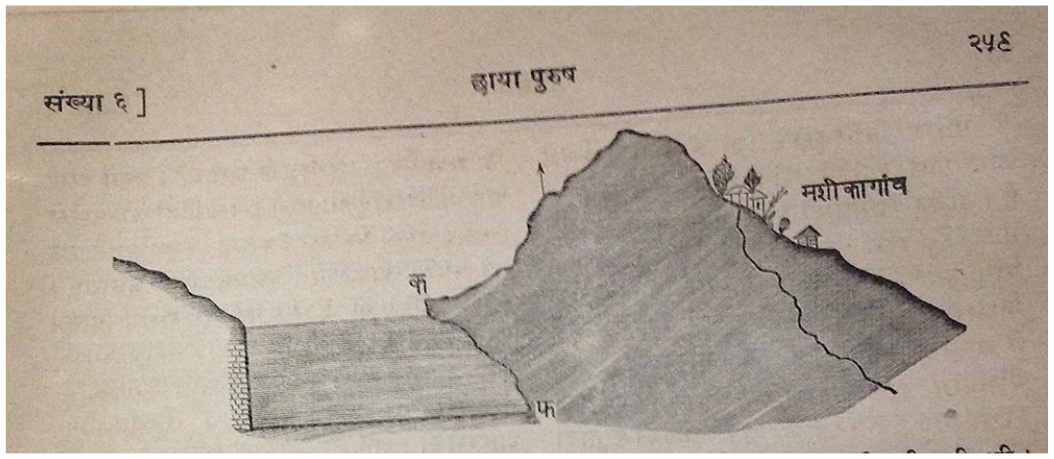
The village, surrounding hills, the cowherd’s vantage and the haunted tank.
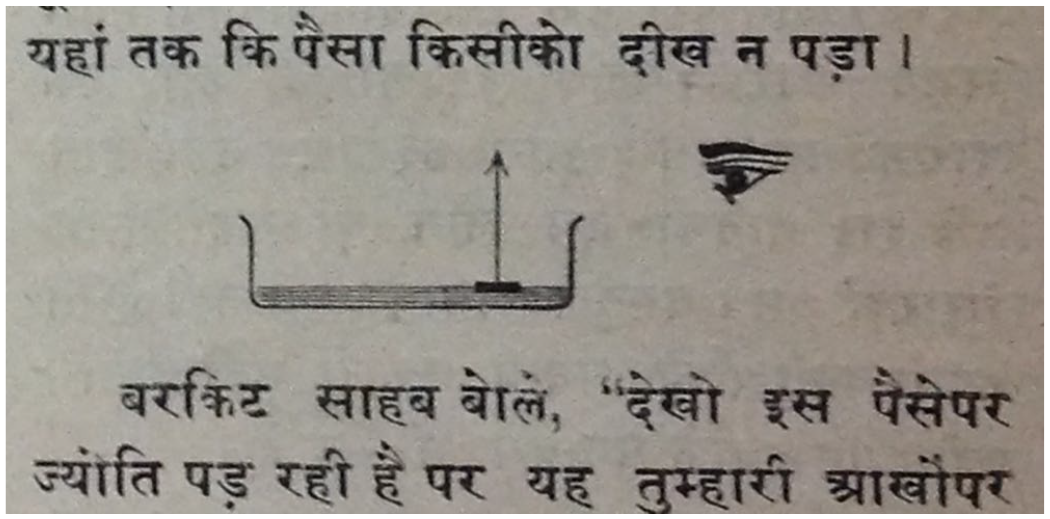
Experiment illustrated – thālī, coin and the witnessing eye.
Through these varied means, Joshi collapsed a number of “ideological fantasies” in his fictional invitations to experiment. In the first instance, his tales were fantasies of good governance, personified by the colonial investigator-administrator. 48 The demonstrations embedded in these stories were only useful if they restored social order. Their success depended on Burkitt’s experiments convincing villagers to return to their everyday tasks, freed from the threat of ghosts. Joshi’s stories are patently fantasies of the revelatory powers of science and of the idea that this power is close to hand: these stories conscript the reader of Vigyan to the world of everyday experiment. In concert with the simple experiments with quotidian objects recommended in his scientific articles on the barometer or electricity as discussed in the previous sections, Joshi’s detective mysteries propelled the reader toward the adventure of experiment. “Reflected Man” notably did not end with Burkitt’s demonstration. The narrator returns to the village on a subsequent visit to find little children performing the thālī experiment as a matter of play. One of them is even delivering a lecture, like Burkitt. In this mimesis of colonial governance-by-experiment, unreason about supernatural superstition is allayed by experiment, witnessing and return to settled, productive life.
Tellingly, in Joshi’s stories, there is only superstition to be defeated, and no adversaries per se who must be refuted and engaged. Although the stories mark the inefficacy of religious rituals in dispelling ghosts, neither Burkitt nor the narrator (whose caste is left unmarked, but whose commitments to śāstra we can infer) offered any direct comment on religious belief or confronted ritual specialists. The fantasies of (social) order and science then relate at many levels.
These fantasies centered on experimental life arguably are designed to construct and inform the desires and aspirations of Vigyan’s readers. Joshi’s characters served as role models to be emulated and aspired to. Burkitt is presented as a model of authority, and his closeness to the Indian narrator is developed over the stories. The persona of the narrator too is developed, as he is transformed into a professor by the final story. These stories represented the promise (and limits) of science education in the colony, personified by the dyad of Burkitt and the narrator. He was the vital interlocutor to Burkitt; colonial science’s partner in dialogue. The figure of the narrator related and joined the rural public of Indian superstition to the knowledgeable, reading publics of Vigyan. Joshi’s Holmes-and-Watson-like characters represented the role Indians could and did play in colonial science. The figure of the reader was embedded in Joshi’s fictions through similarities to the narrator: both were represented as knowledgeable, periodical-reading, consciously self-educated actors, who were predisposed to science, given to experiment, and perhaps, similarly committed to maintaining order.
A fictional shastri: Śāstra and experiment in Vigyan’s discursive laboratory
As the preceding discussion of Joshi’s use of history and detective genres demonstrates, he was a skilled writer, adept at crafting experimental narratives that were at the same time culturally resonant for the Hindi reader. By 1917, Joshi’s literary experiments grew bolder. He brought together his narrative skills, cultural fluency, and the “world history” of science in a new deployment of history and instrumental practice, to render śāstra and experiment contemporary and in dialogue with each other.
Joshi’s most ambitious composition – in its choice of setting, sociology, and subject matter – was a dialogue serialized in Vigyan in 1917. His articles comprised a conversation between three characters on the composition of air. 49 Two of these characters, a student and a teacher, were relatively common and used by other authors in Vigyan. Revealing close attention to the emergence of new professions and the growing cultural authority of science in Indian society, Joshi had chosen a specific kind of teacher – a vijñānācārya. A neologism in the early twentieth century, the term referred to a science teacher, who represented a new figure of authority in the north Indian milieu. In Vigyan, the term was also used to refer to “scientist”-professors such as Prafulla Chandra Ray (1861–1944) and Jagdish Chandra Bose (1858–1937). 50 Joshi’s attentiveness to social transformations underway went still further, demonstrating a keen awareness of the challenge posed by scientific knowledge to existing beliefs and forms of authority. To this standard teacher–student pedagogic dyad, Joshi introduced an unexpected third character in the figure of a shastri. In addition, Joshi’s most experimental authorial choice was the setting he selected for the conversation between the student, the shastri, and the science teacher. He situated the scene of action in the laboratory. Given the fact that laboratories did not appear frequently in Vigyan or in other Indian fiction of this period, Joshi’s choice was truly remarkable.
Dialogical genres – narratives driven by conversational exchange – have long been used as a mode of religious and philosophical exposition in Sanskrit and Hindi to stake didactic, moral, or political arguments. Joshi integrated dialogues between characters in all of his detective mysteries, and used the literary device to stage unlikely conversations, such as the implausibly prolonged pedagogical exchange between uneducated villagers and Captain Burkitt. In the dialogue between the shastri, the student, and the science teacher, Joshi extended the narrative possibilities of the genre to stage a social encounter between historically distinct traditions of knowledge and their competing claims to truth. In a sense, this was an ongoing encounter in colonial classrooms and the psyche of the high-caste Indian science learner, now re-enacted through literary means for the reader of Vigyan.
The confrontation between the shastri and the science teacher hinged on two main points. The first was an ontological contest between the sastric theory of elemental tattva and the modern scientific theory of matter. The second point of contention turned on the properties of air and the existence and (experimental) proof of vacuum, as contrasted with the lack of any such concept in the sastric tradition. Joshi’s awareness of the traditions of experimental practice and his knowledge of śāstra provided him with the resources to mount a captivating contest between the shastri and the teacher.
Joshi’s dialogue focused on the pañcatattva (the five tattva), a fundamental metaphysical concept in the Sanskrit and Buddhist traditions. 51 Pañcatattva appeared in several articles in Vigyan, and, generally speaking, authors placed the concept in an oppositional relationship with modern scientific views on matter. 52 Joshi began by having the student in the dialogue, Mukund, ask the shastri: what is the meaning of the pañcatattva? Joshi’s shastri provided a traditionally thorough account: that the entire physical universe is made up by five tattva; each tattva has a specific guṇa or sensible quality. 53 The shastri listed the tattva and guṇa, and explained with the example of ākāśa (space/ether): the quality of ākāśa is śabda (sound), he told Mukund.
At this juncture, Joshi had his young student disagree with the shastri. Mukund argued that water, air, and earth cannot be tattva, as scientific experiments (prayoga) had demonstrated that these are divisible substances. 54 Joshi had Mukund add that experiments had also shown that sound cannot be a quality of ākāśa because it cannot convey sound vibrations; only air, gases, and solid substances can do so. The shastri was incensed, and blamed “Western culture” for Mukund’s confused ideas. At this stage, Joshi relocated the disagreement in a new space of argument that had no precedent in Vigyan. In order to have the shastri become a witness to experimental practice, Joshi had the shastri ask to see these experiments himself; and he had Mukund take the shastri to a laboratory to meet the science teacher.
In a revealing instance of Joshi’s shrewd understanding of the history of European science, he cannily used the air-pump to stage the ontological clash between the elemental tattva and the modern scientific theory of matter. At the laboratory, each part of the apparatus was explained by the teacher to the shastri, as by Joshi to his readers. Joshi even provided a labeled illustration of the air-pump (Figure 3). At each step in the dialogue, Joshi’s awareness of European historical traditions of experimental culture and his equal knowledge of the sastric tradition provided him with the resources to mount a captivating contest between the shastri and the teacher.
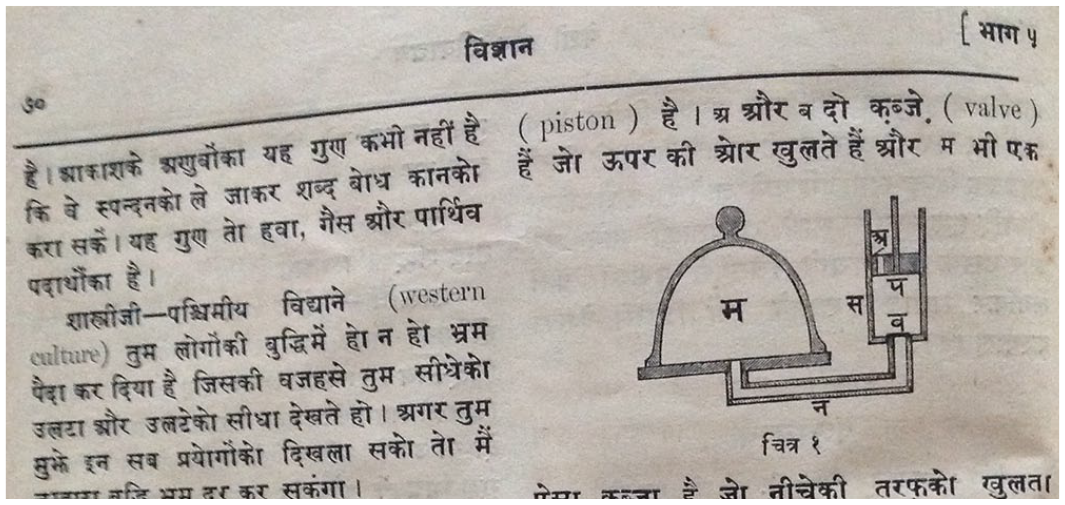
Illustration of the air-pump and its labeled parts in “Pañcatattva” (1917).
The encounter centered on the revelatory apparatus of the air-pump. Joshi had the teacher use the air-pump to remove air from a vessel under which was placed a ringing bell. The experiment disproved that sound is not a guṇa, a property of ākāśa. Joshi used the air-pump again in the dialogue; he had the teacher conduct further experiments to show that, contrary to sastric beliefs, another tattva, vāyu (air), indeed has weight and does not lack form. Joshi drove the contest forward by having the shastri turn tables on the science teacher, observe the experiments and pose questions: why is air not a tattva, and what are its specific properties? Again, Joshi kept the shastri on his “witnessing” toes and had the teacher perform another series of experiments to demonstrate that air is a mixture of gases, present in fixed proportions.
The experimental culture practiced in this fictionalized colonial laboratory and serialized in Vigyan makes the dialogue an exceptional source for the history of science, and its mobilizations in the colonial culture of scientific publishing. Joshi was a skilled writer who had deployed the possibilities of history and fiction to make experiment immanent, quotidian, playful, and desirable. As the dialogue shows, Joshi’s literary experiments went beyond the history of a specific branch of knowledge to engage with the historicity of experimental science (such as in his history of electricity). Joshi countered the sense of colonial “lack” – in the face of Western science with its long history – by re-staging the ongoing debate between traditional religious elites and colonial science in the space of the vernacular science periodical. Vigyan offered Joshi the kind of discursive and experimental space for dialogue between traditions that was not available in other publishing formats such as the textbooks he might have used in his classes. I analyze two examples from the dialogue in detail.
First, Joshi’s dialogue made possible the unlikely historical conjunction of the ether and ākāśa – two concepts that have rarely shared the same discursive space. The shastri, when shown that the air-pump creates a vacuum in the vessel containing the ringing bell, asks: what is it that remains? At this stage, Joshi had the teacher reproduce the current state of knowledge: that vacuums are filled with the ether, which is a medium for heat and light but not sound, and an elastic substance. Such theories of ether had been of central importance to nineteenth-century physics, but their conceptual relevance would soon disappear with Albert Einstein’s theory of special relativity. 55 Lest it seem unremarkable a hundred years on, in 1917 – a moment that was the last gasp of ether – Joshi was speaking the dominant and current language of his times by presenting Hindi readers with the ether theory.
Second, Joshi contrasted two kinds of antiquity – the antiquity of the śāstra and the antiquity of 250-year-old experiments. Throughout the dialogue, Joshi resurrected experiments from the canon of experimental philosophy. From Boyle’s 1660s pneumatic experiments to Priestley’s 1770s experiments with the aquatic plant, Joshi staged the combat between sastric authority and Western science using the most ancient exemplars of Western experimental culture. He presented to Hindi readers the locus classicus of experimental antiquity, in full knowledge of the past and subsequent history of experimental culture. Joshi’s dialogue exemplifies the experimental possibilities of Vigyan. Such innovative narratives in the vernacular science periodical dramatized and telescoped the history of European science to produce a canon for the Hindi science reader, which could serve them as a baseline. Vigyan could bring them up to speed with the past and the present of science, thus empowering their participation in modern experimental life.
If Joshi was quite exceptional, so was his fictional shastri – with few parallels in early twentieth-century Hindi writing. In the first five years of Vigyan’s publication, shastris and pandits wrote alongside medical doctors, science professors, and graduates in its pages, but no author other than Joshi used an analogous figure to represent traditional Hindu authority and to mount public arguments with it in periodical space. Joshi’s shastri is also exceptional when compared with the historical pandits, shastris, and Hindu reformers who confronted colonial science. As previously discussed, such figures have been seen as disputing European science primarily through philological means – by offering inventive readings of Sanskrit texts, by situating the origins of Western sciences in the Vedic canon, and by relocation parallels of Western rationalism or experimentalism in the deep Hindu past. 56 In Joshi’s dialogue, contrary to the historiography of the colonial knowledge encounter, the terms of engagement were decidedly restated. The confrontation was no longer a matter of textual polemics, but one of laboratory demonstration. Joshi’s shastri did not make priority claims for sastric knowledge. He also did not attempt to rehabilitate the pañcatattva within a modern scientific worldview.
In fact, the confrontation and resolution between śāstra and “Western” science took a dialogical, and not philological, route. While the shastri began the dialogue with all the moral certainty of his sastric knowledge, his responses to the teacher and a new means of making knowledge – instruments and experiments in the laboratory – were not reactionary. At various points in the dialogue, Joshi had the shastri offer inputs, interject, question, and even ask the teacher to perform further experiments. His shastri reasoned, believably and fluently, with the resources of his canon and training, as well as with what he learned on the lab-floor.
The focus on the philological quest for origins as the standard Hindu response to science misses the fact that every generation of Hindu intellectuals since the late eighteenth century had to negotiate the ontological challenge posed by scientific “truths” and experimental “facts” to sastric commitments in distinctive ways – often requiring new experiments with media and genre to reconstitute existing communities of knowledge and belief as science’s vernacular publics. In the serially unfolding discursive space of the vernacular science periodical by the early twentieth century, reflexive writers such as Joshi could not only restage the foundational encounter of the colonial episteme but also choreograph its end and resolution on their terms.
Collaboration, cohabitation, and a new publishing program
What did the dialogic encounter of śāstra and experiment achieve? On what grounds were experiments accepted as authoritative and meaningful by the shastri, and by the readers of Vigyan? Did this acceptance of experimental facts ever fully repudiate and circumscribe sastric authority? Did Joshi’s experiment challenge sastric commitments or bring about a different modality of coexistence of their authorities, antiquities, and futures?
In Joshi’s dialogue, experimental methods ultimately cohabited with the authority of śāstra. The dialogue was underpinned by the fantasy of a shastri and Hindi reader who could think with the combined resources of śāstra and experimental science and willingly re-negotiate what he knew, but without ever succumbing to the authority of śāstra. For example, Joshi had the teacher experimentally demonstrate that plants release oxygen by day and carbon dioxide by night, and explain the effect of each gas on human respiration. In response, Joshi had the shastri cite a śloka from the Manusmṛti, the foundational text of the Hindu order, that warned against sleeping under a tree at night. While Joshi’s śāstrī reasoned with the experimental truths he witnessed, he continuously correlated what he learned with what he already knew from śāstra. Joshi discloses here a peculiar modality of the relation between science and śāstra in modernity, where the inference of a scientific fact is calibrated to other truths that remain securely housed in their traditional frames of text, authority, and social relation. Ontological truths, at large, stand reaffirmed by the mere facts and demonstrations of science. The shastri admits science’s authority on the lab-floor, even engages with its possibilities, but the terms of calibrating truth to order remain set and are never unsettled.
This pattern of experimental demonstration followed by cultural resonance is repeated several times in the dialogue. Confronted with scientific explanations of the ākāśa/ether, the shastri expressed his sense of wonder by quoting from the Bhagavadagītā. His exits from the dialogue were marked as cues to proceed to worship and prayer. Cultural accommodation was built into the disposition of the shastri’s interlocutors and Vigyan’s imagined readers, and Joshi framed their responses to be accommodating. At no point in the dialogue did he have the teacher strongly refute the shastri’s authority. Joshi staged moments of tension and disagreement to provide the pretext for further experiments.
The ideological fantasy of the cohabitation of experimental truths with sastric authority also marked the utilitarian route Joshi took to conclude the dialogue – by turning to the use of scientific knowledge for better agricultural yields and national improvement. In the 1910s, this was a project recognizable to most Indians, irrespective of their political affiliation and religious beliefs. Joshi’s dialogue, which had begun by contesting sastric truths using experimental means, ends instead in carefully crafted consensual and collaborative grounds, made possible by the rhetorical claims of the nation. Joshi ended by having the śāstrī praise the findings of modern science and commend the teacher for teaching it, thus contributing to the progress of the nation. The teacher too called upon readers to perform all tasks according to “the laws of science or the laws of nature” for a life of happiness and prosperity.
Still, Joshi’s experimental literary science needed to say more about how the cohabitation of śāstra and science was to be effected and mobilized for the national future. Joshi reflexively brought the dialogue itself to ponder the purpose of print media such as Vigyan and its work of mediation between śāstra and science. At one point in the dialogue, the teacher invites the shastri to collaborate together on a new publishing program. “These days, vigyan (Science) is considered foreign knowledge,” he tells the shastri, “because it is imparted on the basis of European history and European works.” Instead, what was needed for the ethical education of Indian youths was a “a new vigyan, based on the wisdom of eastern philosophers and aided by western scientific experiments.” 57 This new science, based on an understanding of the fundamental methods of Eastern and Western knowledge, would be created by the collaboration of custodians of śāstra and converts to new knowledge such as Joshi himself. This new science would be published in “good books,” and as models of this dialogic cohabitation, Joshi upheld the books of “vijñānācārya” Prafulla Chandra Ray and Brajendra Nath Seal. 58
Conclusion: The vernacular science periodical and colonial cultures of scientific publishing
The colonial vernacular science periodical occupies an unexamined status in global histories of scientific publishing. The history of the proliferation of scientific print media in distinct “national languages” in nineteenth-century Western Europe resulted, by the early twentieth century, in the stable formats of the scientific journal and the media of “popular science.” This multilingual diversity of European scientific publishing is understood as being eclipsed by the twentieth-century domination of English. 59 In contrast, South Asian cultures of scientific publishing were defined by the colonial asymmetries of education, language, and access to science. As this history of science in translation - vigyan in Vigyan-shows, the communication of European sciences and their experimental history to colonial subjects required a range of experiments in print media and literary genres, which were undertaken not in English-language research journals but in the vernacular science periodical. 60
The emergence of the vernacular science periodical in South Asia, its interventions, and the publics it crafted were rooted in complex multilingual epistemological regimes. By situating the history of Vigyan’s experimental collective alongside other periodicals such as Prakṛti (1924, Bengali), Sains (1928–59, Urdu), Current Science (1932–, English), and Science and Culture (1935, English), its own claims to exceptionality can and must be further interrogated. In the context of global scientific publishing, the colonial birth of these vernacular periodicals is explained less as derivative, or delayed expectations of the elite mimesis of Western models. These journals emerged as critical sites where vernacular scientific subjectivity contested the limits of the colonial order of knowledge, which expected and enforced scientific reports and research to appear in a language alien to the masses. Vernacular scientific periodicals provide an archive to critically examine this contestation, which was driven as much by commitments to tradition and śāstra as by the enchantments of experiments and science.
This article has analyzed the oeuvre of a single author from the first five years of Vigyan’s copious archive. Prem Vallabh Joshi’s literary experiments exemplify the discursive possibilities of periodical space. Modernist genres of history and fiction could be deployed to create palpable worlds of experiment, peopled by colonial subjects such as the readers of Vigyan. His acculturations of experiment in vernacular print demonstrate that experimental practice could be subtly imbibed to learn new truths. At the same time, the careful choreography of experiment’s encounter with śāstra was intended to secure the sastric social order, even in the face of new matters of fact. In this colonial vernacular publishing culture, the serialized potential of the periodical and the history of science itself became critical resources in the ontological confrontations between experimental science and traditional authority.
Footnotes
Acknowledgements
Thanks to Bettina Dietz and Jenny Beckman for inviting me to contribute to this special issue, and to the referees for their generous engagement. Simon Schaffer read early drafts and first alerted me to the need to pay close attention to Joshi’s keen awareness of the historicity of experimental culture. Earlier versions were presented at a panel on “Science and its Local Readers in British India” organized by Sarah Qidwai at the History of Science Society’s 2019 meeting, and at Sujit Sivasundaram’s research workshop at Cambridge. Mary Brazelton, Eric Gurevitch, Projit Mukharji, Uponita Mukherjee, Banu Subramaniam and Harish Trivedi provided encouraging feedback. I am very grateful to all these readers, and especially to Minakshi Menon for her insightful comments at HSS. Special thanks to Mudit Trivedi who read multiple drafts with great care and helped me sharpen the ideas and arguments presented here.
Declaration of conflicting interests
The author declared no potential conflicts of interest with respect to the research, authorship, and/or publication of this article.
Funding
The author disclosed receipt of the following financial support for the research, authorship, and/or publication of this article: Research for this article was supported by the Adrian Research Fellowship at Darwin College, Cambridge.

1.
Steven Shapin and Simon Schaffer, Leviathan and the Air-Pump: Hobbes, Boyle, and the Experimental Life (Princeton: Princeton University Press, 1985).
2.
A shastri – I render it phonetically, although it is more accurately transliterated as śāstrī – is a scholar skilled in śāstra, or scientific discourse in disciplines such as grammar, law, mathematics, astronomy, divination, epistemology, and medicine. The ambit of śāstra is wider than “science” and sastric authority extends to natural as well as social orders; see Sheldon Pollock, “The Idea of Śāstra in Traditional India,” in Anna L. Dallapiccola (ed.) Shastric Traditions in Indian Arts, Vol.1 (Stuttgart: Steiner Verlag Weisbaden GMBH, 1989), pp.17–26.
3.
I have also chosen to render Vigyan phonetically, instead of transliterating it as vijñāna – a term with a wide semantic range in Sanskrit, including knowledge, perception, wisdom, and understanding. By the early twentieth century, vigyan appeared as the lexical and conceptual equivalent of “science” in several vernacular languages in South Asia, including Hindi.
4.
A pandit is a Brahmana ritual specialist, well versed in Hindu scriptures and sociologically critical to the performance of religious rites. The term invokes rank, learning, and privilege, and by the nineteenth century, it was used in print as an honorific title. It was prefixed to individual names and was also used collectively for members of the Brahmana caste, regardless of their actual ritual performance. Notably, all shastris are pandits, distinguished by specific forms of learning and training, but not all pandits are shastris. In bylines in Vigyan, the author’s name appeared as “Adhyāpaka (teacher) Pandit Prem Vallabh Joshi, B.Sc., L.T.” Joshi held two degrees, Bachelor of Science and Licentiate in Teaching. He does not figure in literary histories of the period, and he was likely the father of the Hindi author Manohar Shyam Joshi (1933–2006).
5.
The experimental practice of exceptional colonial subjects such as scientists in colonial Bengal is well recognized; see, for example, Priyankar Dey, “Jagadis Chunder Bose and His Spontaneous Machines: Devices, Demonstrations and Discourses of Life,” Journal of the Asiatic Society LIX (2017): 31–82. My aim here is to examine the meaning and power ascribed to experiment amongst lay readers in the colony.
6.
Early colonial knowledge practice was marked by a tense reliance on and enduring suspicion of the custodians of these forms of knowledge. These mutually transformative encounters in several disciplines such as law, language analysis, astronomy, botany, medicine, and sexual science are the subject of extensive scholarship; for some examples, see Rosane Rocher, “British Orientalism in the Eighteenth Century: The Dialectics of Knowledge and Government,” in Carol A. Breckenridge and Peter van der Veer (eds.) Orientalism and the Postcolonial Predicament (Philadelphia: University of Pennsylvania Press, 1993), pp.215–49; Richard Fox Young, “Receding from Antiquity: Hindu Responses to Science and Christianity on the Margins of Empire, 1800–1850,” in R. E. Frykenberg (ed.) Christians and Missionaries in India: Cross-cultural Communication Since 1500 (Grand Rapids, MI: W. B. Eerdmans, 2003), pp.183–222; Thomas Trautmann, Languages and Nations: The Dravidian Proof in Colonial Madras (Berkeley: University of California Press, 2004).
7.
Brian Hatcher, “Sastric Modernity: Mediating Sanskrit Knowledge in Colonial Bengal,” in Kausik Bandyopadhyay (ed.), Modernities in Asian Perspective (Kolkata: Setu Prakashini, 2010), pp.117–51, quote on 132; Michael S. Dodson, Orientalism, Empire, and National Culture: India, 1770–1880 (Basingstoke: Palgrave Macmillan, 2007).
8.
Scholars have drawn attention to Hindu intellectuals’ “search for an archaic science” in Sanskrit textual traditions and their efforts to “identify an original ‘Hindu science’”; Gyan Prakash, Another Reason: Science and the Imagination of Modern India (Princeton: Princeton University Press, 1999), quote on pp.8–9; David Arnold, “A Time for Science: Past and Present in the Reconstruction of Hindu Science, 1860–1920,” in Daud Ali (ed.), Invoking the Past: The Uses of History in South Asia (Oxford: Oxford University Press, 1999), pp.156–77; Banu Subramaniam, “Archaic Modernities: Science, Secularism, and Religion in Modern India,” Social Text 18 (2000): 67–86; Pratik Chakrabarti, “Science, Nationalism and Colonial Contestations: P. C. Ray and His Hindu Chemistry,” Indian Economic and Social History Review 37 (2000): 185–213; Dhruv Raina, “Translating the ‘Exact’ and ‘Positive’ Sciences: Early Twentieth Century Reflections on the Past of the Sciences in India,” Journal of Transcultural Studies 6 (2015): 8–33.
9.
Prakash, Another Reason, 97–8 (note 8); Michael Dodson, “Contesting Translations: Orientalism and the Interpretation of the Vedas,” Modern Intellectual History 4 (2007): 43–59.
10.
No comprehensive survey of the full range of scientific and medical publishing in English or the vernaculars currently exists for South Asia, but see B. K. Sen, “Growth of Scientific Periodicals in India (1788–1900),” Indian Journal of History of Science 73 (2002): S111–S207 and D. P. Bhattacharya et al., “A Survey of Bengali Writings on Science and Technology, 1800–1950,” Indian Journal of History of Science 24 (1989): 8–66.
11.
See the discussion on “the distribution of science’s authority” in Prakash, Another Reason, 52–64 (note 8).
12.
By one estimate, over 2,000 books on scientific subjects were produced in South Asian languages between 1875 and 1896, but the output was probably much larger. V. V. Krishna, “The Emergence of the Indian Scientific Community,” Sociological Bulletin 40 (1991): 89–107.
13.
Projit B. Mukharji, Doctoring Traditions: Ayurveda, Small Technologies and Braided Sciences (Chicago: University of Chicago Press, 2016); Charu Gupta, “Procreation and Pleasure: Writings of a Woman Ayurvedic Practitioner in Colonial North India,” Studies in History 21, no.1 (2005): 17–44; Rachel Berger, Ayurveda Made Modern: Political Histories of Indigenous Medicine in North India, 1900–1955 (New York: Palgrave Macmillan, 2013).
14.
Here I draw on recent scholarship on the late Ottoman and Qing empires, which shows that novel genealogies of science (“Arabic science” or “Chinese science”) were constructed in the process of making sense of “Western” science. See Marwa Elshakry, “When Science Became Western: Historiographical Reflections,” Isis 101 (2010): 98–109, 102, emphasis in original.
15.
For some examples, see Guy Attewell, Refiguring Unani Tibb: Plural Healing in Late Colonial India (Hyderabad: Orient Blackswan, 2007); Projit B. Mukharji, Nationalizing the Body: The Medical Market, Print and Daktari Medicine (London: Anthem Books, 2009); Shinjini Das, Vernacular Medicine in Colonial India: Family, Market and Homeopathy (Cambridge: Cambridge University Press, 2019). For works on north India and Hindi, see Maneesha Lal, “‘The Ignorance of Women is the House of Illness’: Gender, Nationalism and Health Reform in Colonial North India,” in Mary P. Sutphen and Bridie Andrews (eds.), Medicine and Colonial Identity (London: Routledge, 2003), pp.14–40; Madhuri Sharma, Indigenous and Western Medicine in Colonial India (New Delhi: Foundation Books, 2012); Shobna Nijhawan, “Cumin, Capsules, and Colonialism: ‘Real’ and ‘Imagined’ Medical Encounters in the Hindi Literary Sphere,” Asian Medicine 13 (2018): 170–97; Luzia Savary, Evolution, Race and Public Spheres: Vernacular Concepts and Sciences (1860–1930) (London: Routledge, 2019).
16.
See Mukharji, Doctoring Traditions, 20–7 (note 13), for the concept of braided sciences.
17.
On eugenics as santatiśāstra, see Luzia Savary, “Vernacular Eugenics? Santati-Śāstra in Popular Hindi Advisory Literature (1900–1940),” South Asia 37, no. 3 (2014): 381–97; on meteorology as vāyuśāstra, see Charu Singh, “Science, Hindi Print and Agricultural Improvement in Colonial North India” (unpublished PhD thesis, Jawaharlal Nehru University, New Delhi, 2015).
18.
Durba Mitra, Indian Sex Life: Sexuality and the Colonial Origins of Modern Social Thought (Princeton: Princeton University Press, 2020).
19.
Vigyan 1, no. 1 (1915), advertisement on back cover. The bold claim massaged the truth, as “science writing” in Hindi emerged later than its development in Bengali and Urdu; see Pooja Mishra, “Science Education and Science Writing in Hindi in the North West Provinces (1860–1900),” Indian Journal of History of Science, 52.4 (2017): 463–83. Other periodicals dedicated to science for lay readers appeared in the following decades but what set Vigyan apart from other similar efforts is the very endurance of its publishing enterprise; it has continued to be published since 1915. On science in Bengali and Urdu periodicals, see Sthira Bhattacharya, “Telling a Variable Tale: The Many Worlds of Science in Popular Periodicals from Colonial Bengal” (unpublished Master’s thesis, Jawaharlal Nehru University, 2018); S. Irfan Habib and Dhruv Raina, “The Introduction of Scientific Rationality into India: A Study of Master Ramchandra – Urdu Journalist, Mathematician and Educationalist,” Annals of Science 46 (1989): 597–610.
20.
The scientific journal, such as Nature, was epitomized by the scientific paper, comprising original contributions to knowledge produced by credible authors, and authenticated by editors or other experts; see Alex Csiszar, The Scientific Journal: Authorship and the Politics of Knowledge in the Nineteenth Century (Chicago: University of Chicago Press, 2018).
21.
Bernard Lightman, Victorian Popularisers of Science: Designing Nature for New Audiences (Chicago: University of Chicago Press, 2007); Jonathan Topham, “Introduction,” Focus Section: Historicizing “Popular Science,” Isis 100:2 (2009): 310–18.
22.
Dodson, Orientalism, Empire and National Culture (note 7); Ishita Pande, Medicine, Race and Liberalism in British Bengal: Symptoms of Empire (London: Routledge, 2009), pp.65–93.
23.
Charu Singh, “Science in the Vernacular? Translation, Terminology and Lexicography in the Hindi Scientific Glossary (1906),” South Asian History and Culture (forthcoming).
24.
Prakash, Another Reason, 62–3 (note 8).
25.
Sujata S. Mody, The Making of Modern Hindi: Literary Authority in Colonial North India (New Delhi: Oxford University Press, 2018).
26.
The Parishad even proposed to launch an Urdu periodical in its early years, which never materialized.
27.
An advertisement in the monthly’s second year (1916–17) directly appealed to students, and promised those who succeeded in attracting six new subscribers a free subscription for a whole year. Vigyan 3, no. 1 (1916), back cover.
28.
See also Mishra, “Science Education and Science Writing in Hindi” (note 19).
29.
Ramdas Gaur, “Vijñāna śikṣā kī āva śyaktā” [The Need for Science Education], Vigyan 1, no.1 (1915): 2–7, 5, 7. The founders or editors almost never used the language of “popularisation,” quite understandable in a context where there were few Indian scientists.
30.
Similarly in contemporary Bengal of the 1910s, some writers urged science students to build a small laboratory at home. Dey, “Jagadis Chunder Bose and His Spontaneous Machines,” p.69 (note 5).
31.
This experimental collective was overwhelmingly male and high-caste.
32.
“Science writer” was not these actors’ category. Vigyan’s editors at times referred to authors as vijñānasevī and sāhityasevī or those serving the cause of science and literature.
33.
Prem Vallabh Joshi, “Bijlī ke jñāna kā vikāsa aura unnati kā itihāsa” [Development of the Knowledge of Electricity and the History of its Progress], Vigyan 1, no.1 (1915): 19–22.
34.
Prem Vallabh Joshi, “Vāyu bhār mām.pan yantra” [The Barometer], Vigyan 1, no.3 (1915): 104–8.
35.
Ramdas Gaur, “Rasāyana,” Vigyan 2, no.5 (1916): 202–5, 202.
36.
B. K. Mitra, “Rasāyanavidyā kā prācīna itihāsa” [Ancient History of Chemical Knowledge], Vigyan 5, no.3 (1917): 98–101. Other authors also translated selections from the chemist Prafulla Chandra Ray’s landmark History of Hindu Chemistry A History of Hindu Chemistry, From the Earliest Times to the Middle of the Sixteenth Century AD, Vols.I-II (Calcutta: Bengal Chemical & Pharmaceutical Works Ltd., 1909) and published them in Vigyan.
37.
Arnold, “A Time for Science” (note 8); Prakash, Another Reason (note 8); Chakrabarti, “Science, Nationalism and Colonial Contestations” (note 8); Raina, “Translating the ‘Exact’ and ‘Positive’ Sciences” (note 8).
38.
Guru Datta Vidyarthi, “Composition of Water,” in The Works of the Pandit Guru Datta Vidyarthi, MA, with Biographical Sketch (Lahore: Aryan Printing, Publishing & G. Trading Co., 1902), p.177.
39.
Prakash, Another Reason, 98 (note 8).
40.
Gopal Swarup Bhargava, “Koyle kī ātmakathā” [The Autobiography of Coal], Vigyan 1, no.1 (1915): 10–12.
41.
Prem Vallabh Joshi, “Pālanpur kā bhūta” [The Ghost of Palanpur], Vigyan 1, no.2 (1915): 64–8; “Chāyā Puruṣa” [Reflected Man], Vigyan 1, no.6 (1915): 258–62; “Bhūton. kā nagar” [City of Ghosts], Vigyan 4, no.1 (1916): 28–33; “Catur Bairisṭer” [The Clever Barrister], Vigyan 4, no.2 (1916): 73–6. The genre disappeared from Vigyan’s repertoire after these early years.
42.
Carlo Ginzburg, “Morelli, Freud and Sherlock Holmes – Clues and Scientific Method,” History Workshop Journal 9 (1980): 5–36.
43.
Francesca Orsini, “Detective Novels: A Commercial Genre in Nineteenth-century North India,” in Stuart Blackburn and Vasudha Dalmia (eds.), India’s Literary History: Essays on the Nineteenth Century (Delhi: Permanent Black, 2004), pp.435–82; Markus Daechsel, “Zālim Dākū and the Mystery of the Rubber Sea Monster: Urdu Detective Fiction in 1930s Punjab and the Experience of Colonial Modernity,” Journal of the Royal Asiatic Society, 13 (2003): 21–43.
44.
Orsini, “Detective novels,” p.451 (note 43).
45.
Even as the identity of the narrator shifted across these stories, its locus remained the city of Ajmer – the city where Joshi lived and wrote these stories. When Joshi’s final contribution appeared in Vigyan in 1919, he too was listed as “professor.”
46.
Shapin and Schaffer, Leviathan and the Air-Pump. (note 1)
47.
Projit B. Mukharji, “From Physiograms to Cosmograms: Daktar Binodbihari Ray Kabiraj and the Metaphorics of the Ayurvedic Body,” in Sally Shuttleworth, Melissa Dickson and Emilie Taylor-Brown (eds.), Progress and Pathology: Medicine and Culture in the Nineteenth Century (Manchester: Manchester University Press, 2020), pp.217–46, 224. On the conversion of the Hindu subject to a “rational way of seeing” the human body through dissection, see Pande, Medicine, Race and Liberalism, 65–93 (note 22).
48.
On “ideological fantasies,” see John Rieder, Colonialism and the Emergence of Science Fiction (Middleton, CT: Wesleyan University Press, 2012). For ideologies of progress in Bengali science fiction, see Projit B. Mukharji, “Hylozoic Anticolonialism: Archaic Modernity, Internationalism, and Electromagnetism in British Bengal, 1909–1940,” Osiris 34 (2019): 101–20.
49.
Prem Vallabh Joshi, “Pañcatattva” [The five tattva], Vigyan 5, no.2 (1917), 69–72; “Vāyutattva” [The air tattva], Vigyan 5, no.5 (1917): 236–7; “Vāyutattva” [The air tattva], Vigyan, 5, no.6 (1917): 268–73.
50.
In contemporary Bengal, the term “ācārya” was prefixed to their names; see Madhumita Mazumdar, “Science and the Making of a New Nationalist Masculinity in Colonial Bengal,” in Sumi Krishna and Gita Chadha (eds.), Feminists and Science, Vol. 2: Critiques and Changing Perspectives in India (Los Angeles: Sage, 2017), 175–206.
51.
52.
Pandit Chandrashekhar Shastri, “Kyā elimenṭs aura pañcabhūta ek hain?” [Are the elements and the pañcabhūta the same?], Vigyan 10, no.6 (1920): 256–60.
53.
The five tattva are pṛthvī (earth), jal (water), tej (fire), vāyu (air or wind), and ākāśa (space or ether). The guṇa associated with them are odor, taste, color, touch, and sound.
54.
See Sheldon Pollock, “The Theory of Practice and the Practice of Theory in Indian Intellectual History,” Journal of American Oriental Society 105 (1985): 499–519 for the premodern Sanskrit usage of prayoga as the practice or enactment of śāstra.
55.
Iwan Rhys Morus, When Physics Became King (Chicago: University of Chicago Press, 2005).
56.
Prakash, Another Reason (note 8); Dodson, “Contesting Translations” (note 9).
57.
Joshi, “Vāyutattva,” Vigyan 5, no.5 (1917): 236.
58.
See Chakrabarti, “Science, Nationalism and Colonial Contestations” (note 8); Raina, “Translating the ‘Exact’ and ‘Positive’ Sciences” (note 8) for a discussion of these works.
59.
Michael D. Gordin, Scientific Babel: How Science was Done Before and After Global English (Chicago: University of Chicago Press, 2015).
60.
By the 1920s, when Indian scientists were establishing their own periodicals – such as the Indian Journal of Physics (1926) founded by the physicist C. V. Raman – they consolidated the colonial bifurcation of publishing research in English, and publishing “translated science” for mass reading publics in the vernaculars.