




Abstract
Community mobilisation is an essential part of cervical cancer screening programmes to increase demand for screening services. While there are different methods of community mobilisation, in Ethiopia community conversations during traditional coffee ceremonies appear to be a context appropriate and effective method. Linkage of community mobilisation with existing community networks can increase uptake of cervical cancer screening and improve continuous support and care among community members.
Introduction
Cervical cancer in Ethiopia
Cervical cancer is the second most common cancer after breast cancer among women in Ethiopia, affecting around 7600 women annually. 1 With a growing population of > 22 million women of reproductive age (15–49 years) at risk of developing cervical cancer, prevention programmes have become a public health priority. 2 For countries with limited resources, the World Health Organization (WHO) recommends screening by the see-and-treat method. 3 In a single visit, women are screened for precancerous lesions and treated if lesions are detected. Ethiopia published national guidelines in 2015 aiming for single visit screening for all women aged 30–49 years. 2 Before implementation of these guidelines, only 0.4–1.6% of age-eligible women ever received screening. 4 More recent studies reported an uptake of 9.9–20% in selected populations in northern and southern Ethiopia.5–7 This shows an encouraging trend, but is still far away from 80% coverage of the target population.2,3 In this short report, we describe the effect of community conversations through existing community-based networks on the uptake of screening services in Ethiopia.
Tell, see and treat programme
The Ethiopian Female Cancer Initiative (EFCI) was initiated in 2015 by Cordaid and the Female Cancer Foundation (FCF) to enhance the uptake of cervical cancer and breast cancer screening services in Ethiopia. Cordaid and FCF, both Netherlands based non-profit non-governmental organisations, collaborated with the School of Public Health of Addis Ababa University and two local non-profit non-religious organisations: Beza for Generation (B4G) and Mary Joy Development Association (MJDA), which have been active for several years in community capacity building, maternal health and HIV/AIDS programmes in their local communities in Sidama zone, Hawassa and Addis Ababa. Since 2015, cervical cancer screening with a single visit approach was provided in 10 health centres in both regions. Healthcare workers were trained to perform counselling, screening and cryotherapy by certified gynaecologists from Ethiopia. Women were either self-referred following awareness creation and community mobilisation, or referred within health facilities, especially from family planning, maternal health and HIV/AIDS departments.
Materials and Methods
A broad targeted awareness strategy through social mobilisation was an integrated part of the EFCI programme. Community conversation was among the strategies employed to promote and sustain healthy changes of behaviour in individuals and communities. 8 This method allows both literate and illiterate community members to participate on a platform to discuss different aspects of cervical cancer and screening. During community conversations, a trained facilitator from the community was invited to provide relevant information, guide the discussion and built consensus. Already existing community-based structures, such as traditional coffee ceremonies, were found to facilitate community conversations.
Coffee ceremonies are an interactive process among neighbours, particularly women, embedded in the cultural and social framework of communities in Ethiopia. Neighbours invite each other in turns for the traditional coffee ceremony and stay at the ceremony for 1–1.5 h to discuss different topics of common interest. In an HIV/AIDS awareness programme in Ethiopia, participants valued coffee ceremonies as an important part of community conversation activities, increasing interest and concentration in the topics discussed. 9
Trained community workers of both B4G and MJDA applied traditional coffee ceremonies to facilitate conversations on cervical cancer and its prevention and invite women for screening. Other awareness building activities included radio messages, house to house visits, school clubs and mass awareness campaigns at public spaces such as market areas.
Results
The EFCI programme provided screening in 22 health facilities: 10 health centres in rural Sidama zone; nine in urban Addis Ababa; and three in urban Hawassa. The target population of one health centre is approximately 15,000–25,000 people. Within the target population, an estimated 9% are women aged 30–49 years. Not all health centres meet these statistics owing to uneven population distribution among the different catchment areas.
On an average monthly basis, 15 coffee ceremonies were organised in Addis Ababa and 30 in Sidama zone.
Attendance and outcome of cervical cancer screening from November 2015 to December 2017.
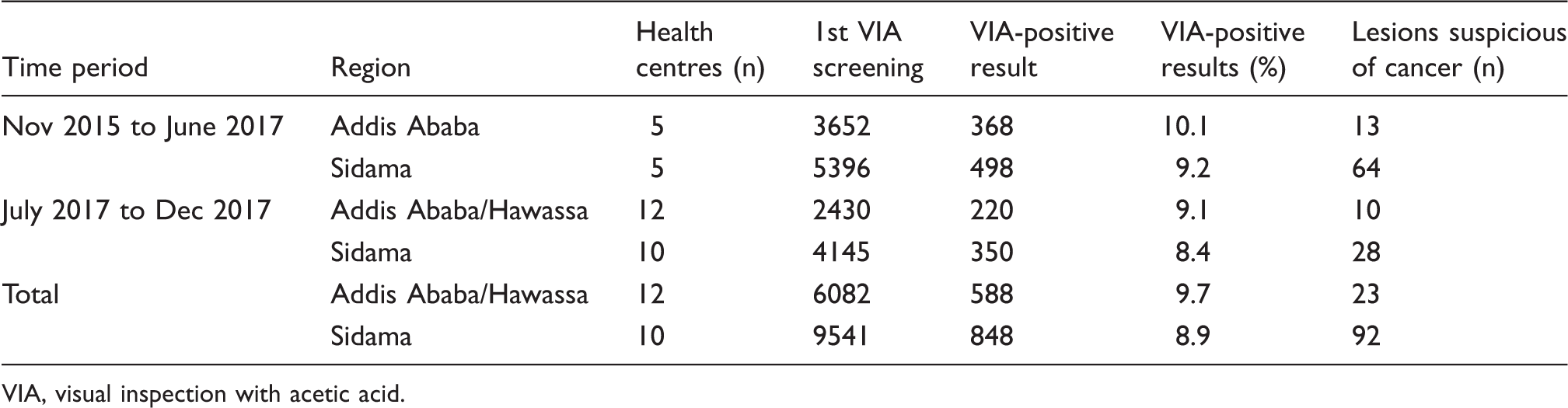
VIA, visual inspection with acetic acid.
Discussion
The EFCI programme demonstrated that existing community-based structures such as traditional coffee ceremonies can successfully contribute to the uptake of cervical cancer screening services in Ethiopia. This positive relationship was seen in both rural and urban settings, although more evident in rural settings. Community mobilisation in urban settings was challenging. Women have access to different sources of information and different service providers, and social cohesion is less strong compared to rural settings.
Through coffee ceremonies, knowledge on cervical cancer and the availability of screening services could be disseminated within the community. This is important as studies have shown a lack of knowledge on cervical cancer among both health workers and the community in different regions of Ethiopia.5–7 Furthermore, coffee ceremonies may contribute building trust with healthcare providers and screening services.
Our findings, however, do not detail the motivation of women to attend screening. The relationship between knowledge and uptake of services is not simple. A study in Kenya showed that targeted health education can positively influence patients’ knowledge of cervical cancer and screening but had limited influence on the uptake of services. 10
For effective cervical cancer prevention in a low-resource setting, several barriers remain. Screening programmes are limited by insufficient capacity of trained healthcare workers and lack of functional equipment. In addition, a national vaccination programme for human papilloma virus (HPV) will need to be implemented alongside cervical cancer screening. Both vaccination and screening should be embedded in routine health activities, through structural behavioural change encouraged by policy makers, health workers and communities. Community conversations through existing community-based structures such as traditional coffee ceremonies might be a very effective context appropriate method to facilitate this change in Ethiopia.
Footnotes
Acknowledgements
The EFCI programme is managed by Cordaid Ethiopia and supported by Pink Ribbon Red Ribbon and Bristol Myers Squibb Foundation.
Declaration of conflicting interests
The author(s) declared the following potential conflicts of interest with respect to the research, authorship, and/or publication of this article: FCF is providing technical support and advice to the EFCI project. FB is the (former) programme manager of MJDA. MH is executive director of B4G.
Funding
The author(s) received no financial support for the research, authorship, and/or publication of this article.