




Abstract
To what degree does parent occupation cause a child’s occupational attainment? We articulate this causal question in the potential outcomes framework. Empirically, we show that adjustment for only two confounding variables substantially reduces the estimated association between parent and child occupation in a U.S. cohort. Methodologically, we highlight complications that arise when the treatment variable (parent occupation) can take many categorical values. A central methodological hurdle is positivity: some occupations (e.g., lawyer) are simply never held by some parents (e.g., those who did not complete college). We show how to overcome this hurdle by reporting summaries within subgroups that focus attention on the causal quantities that can be credibly estimated. Future research should build on the longstanding tradition of descriptive mobility research to answer causal questions.
Introduction
Social mobility scholarship has long emphasized descriptive patterns: how children’s average socioeconomic outcomes vary across those raised in different family circumstances (Blau and Duncan 1967; Chetty et al. 2014; Hout 2015; Long and Ferrie 2013; Song et al. 2020). Yet common research practices suggest the possibility of underlying interest in causal effects. Authors write about the “influence” of social origins, as they would if social origins were a causal input. Researchers measure parent characteristics at a fixed point in the child’s life (e.g., adolescence) instead of a fixed point in the parent’s life (e.g., age 40, Hout 2015 p. 27), as we would if we wanted to capture parent characteristics at the moment when they are most likely to causally shape children’s outcomes. Researchers examine the coefficient on one variable (e.g., parent occupational status) while statistically adjusting for other variables (e.g., race and parent education), as they would if a causal goal was threatened by confounding. Each common practice suggests an underlying causal goal. We consider how research practice might change if causal goals in mobility research were made more explicit.
A causal approach to social mobility changes the research process—from choosing a research question to applying an estimator. Researchers who adopt a causal perspective gain the ability to embrace new and untapped research questions that build on well-studied descriptive patterns. For example, Wodtke et al. (2011) built on descriptive research showing disparities in children’s outcomes across neighborhood conditions and documented substantial causal effects of cumulative exposure to disadvantaged neighborhoods. In doing so, Wodtke et al. (2011) carefully conceptualized the causal treatment as exposure to neighborhood disadvantage over many years. That example illustrates a common issue that arises when adopting a causal perspective: a careful definition of the treatment may lead one beyond the traditional binary of treated and untreated. In the present paper, our treatment (occupation) leads us to move outside the treated versus untreated binary and into a conceptualization in which a treatment has many categorical values. We highlight the challenges and opportunities that arise when taking occupation as a categorical treatment.
Extensive descriptive research has considered the bivariate relationship between parent and child occupation, often using log-linear modeling for contingency tables (Hout 1983; Powers and Xie 2008). But to what degree does parent occupation cause a child’s occupation? To answer the causal question requires us to imagine what would have happened to a given child if their parent had a different occupation. Setting up the problem this way clarifies the limits to the questions that can be addressed by the data: for many children, some parent occupations simply could not happen. A parent who never finished college cannot be employed as a physician, for example. We show how to study the causal effect of parent occupation while recognizing some counterfactuals’ impossibility (or implausibility). We view the causal and common descriptive approaches as valuable and complementary. Descriptive mobility research captures broad patterns linking the outcomes of parents and children. Advances in causal mobility can estimate the precise causal effects of many individual inputs to life chances, such as parent occupation.
Descriptive and Causal Mobility
Much existing work on social mobility is ostensibly descriptive. Descriptive mobility serves an important goal of documenting the association of outcomes across generations. Yet we argue that a causal perspective can reframe common practices and descriptive regularities well-known in mobility research.
A common practice in mobility research is to adjust for “confounding variables,” such as parent education. This common practice stems from the path-analytic tradition, which assumed explicitly causal goals (Sewell et al. 1969) and devoted substantial attention to choosing control variables (Alwin and Hauser 1975). Methodological advances enabled adjustment for covariates in log-linear models for occupational transmission (DiPrete 1990). Many scholars today agree that control variables are essential to avoid omitted variable bias. But we would argue that the notion of omitted variable bias may be ill-defined for descriptive goals: why should one variable be adjusted while another should not? The notion of omitted variable “bias” assumes that there exists some effect that we seek to estimate, which can only be estimated by adjusting for a particular variable. Causal claims offer a set of well-defined effects for which omitted variable bias has a clear definition, and we suggest that many colloquial uses of the concept of omitted variable bias point (at least implicitly) toward a causal goal. Explicit causal reasoning clarifies these choices with formal mathematical logic (Imbens and Rubin 2015; Pearl 2009).
A second common practice in mobility research is to focus on the “effects” of occupational scores and classes. Early descriptive work in this domain distilled occupational variation into hierarchies of prestige (Hodge et al. 1964; Treiman 1977) or status (Duncan 1961a, 1961b; Hauser and Warren 1997). A parallel line of research on social classes took a discrete approach that categorized occupations into classes, whether a small number (Goldthorpe 1980; Wodtke 2016) or many (Weeden and Grusky 2005). Following these descriptive traditions, it would be tempting to ask about the effects of occupational scores and classes: what would happen if all else was constant and parent SEI were different, or if the parent were in a different class? Our causal perspective clarifies that these questions require a hypothetical intervention on occupation itself. If a person’s SEI score changes, their occupational class might also change and vice versa. In both cases, the intervention is fundamentally a change of occupation, and that intervention can only be credibly studied if that occupation is factually observed in the subgroup in question. A causal perspective affirms the value of occupational scores and classes for distilling variation. Yet it also reminds us that the effect of an occupational score and the effect of occupational class are both principally questions about the effect of parent occupation itself.
A causal approach also invites reinterpretation of empirical regularities well-established in descriptive research. One such regularity is that permanent income is more transmissible across generations than year-specific income (Mazumder 2005; Solon 1992). Most explanations of this phenomenon focus on the reduction in measurement error achieved by averaging. A causal interpretation, however, yields a straightforward alternative: a hypothetical intervention to raise parent income by a fixed amount (e.g., $1,000) in any given year might have relatively little effect on the child’s outcome, whereas an intervention to raise parent income by that amount every year over a long course of childhood would be a much larger causal intervention expected to produce a larger effect. By a similar logic, intergenerational transmission is stronger when measures of parent status include fathers, mothers, and extended kin (Beller 2009; Hout 2018; Mare 2011). It is causally unsurprising that transmission is stronger when many family members are included; a hypothetical intervention to change the status of many family members is much larger than an intervention to change the status of only one.
In the examples above, a causal perspective aligns well with longstanding traditions of descriptive research. Yet to make claims about social mobility that are explicitly causal with transparent assumptions requires a change to how we ask research questions. The next section presents our main contribution: an explicitly causal approach to occupational mobility.
Defining Precise Counterfactuals:
Causal Mobility using Potential Outcomes
When Joey was 14 years old, his mother was employed as a secretary. 1 Joey became a manager as an adult. But what if his mother had held a different occupation, such as a housekeeper? Would Joey have then attained a different occupation?
Formally, let (
A precise statement of potential outcomes clarifies the hypothetical intervention we consider in this paper: what if a given child were exposed to a different parent occupation? We are not imagining what would happen to Joey if he were raised in an entirely different family. His mother’s race and education would stay the same even in a counterfactual world where her occupation changed. The focus on a particular input is a central characteristic of causal mobility research: while descriptive studies might compare the outcomes of children whose family backgrounds differ along many dimensions, causal claims about mobility are better suited to focus on the contribution of a single precise input, such as parent occupation.
Importantly, if Joey’s mother were a housekeeper instead of a secretary, many downstream variables would also change. Joey’s family might have less income, and his friends might perceive his mother’s occupation as less prestigious. To the degree that occupation shapes material resources and social standing, the total effect of occupation includes pathways flowing through these downstream variables. However, intervening to change parent occupation would not change variables that causally precede that parent occupation, such as parent educational attainment. Causal claims about social mobility, therefore, require careful reasoning about what would change and what would not if a particular parent input were modified.
Second, we focus on the causal effect of changing the occupation Joey’s mother holds while not changing the occupational structure itself. One could imagine alternative counterfactuals: what if Joey’s mother were a housekeeper, but the median pay of housekeepers rose to equal the median pay of secretaries? This is a very different question, which would be answerable with very different data. For example, we might then compare housekeepers’ outcomes across societal contexts (e.g., time and place) where their typical pay differed. For the purposes of this paper, we focus on the causal effect of interventions that change the occupation held by a particular parent rather than interventions that change the occupational structure. In the discussion, we connect our ideas to some open questions related to the latter type of question.
When studying the causal effect of the occupation a parent holds, three key considerations are essential: what is the hypothetical intervention, how can we learn about counterfactuals in observable data, and for whom can each potential outcome be credibly estimated?
What is the Hypothetical Intervention?
Many inputs may be causally relevant to a child’s occupational attainment, from parent occupation to parent earnings to cultural capital. Each of these inputs could be measured for one parent, two parents, extended kin, or others who play a role in the child’s social origin. To explore all causal inputs would be far beyond the scope of any individual paper. A key task for a causal mobility study is to define a precise and tractable treatment variable.
We illustrate the choice of a hypothetical intervention in the context of our illustration: how parent occupation affects child occupation. One could define the treatment as a pair of variables
Assumptions can simplify the definition of potential outcomes. For illustration, we assume that a child’s occupational attainment depends only on the highest-status occupation of any parent figures at age 14, which we define as the treatment variable
The definition of counterfactuals formally relates to the consistency assumption, i.e., that the outcome we can observe is the outcome that would be realized if a child were assigned to the treatment that was observed. This assumption is most plausible to the degree that it is clear what it would mean to assign the child to that treatment value, which requires that the treatment be defined at a sufficient granularity that it does not obscure variations that might lead to different potential outcomes (Hernán 2016; VanderWeele 2009).
(Consistency)
Examples abound in which the consistency assumption is imperfect. When one parent occupation is used as the treatment, consistency requires that the occupation that might be held by a second parent is irrelevant. Even in cases where there is only one parent, the consistency assumption is imperfect to the degree that treatments are not sufficiently granular. The occupation “professor” may lead to different potential outcomes, for instance, if it corresponds to a tenured senior faculty member at a research university versus if it corresponds to an adjunct faculty member at a community college. To the degree that the granularity of data available to researchers improves in the future, it may become possible to ask more precise causal questions for which the consistency assumption is more credible.
How Can We Learn About Counterfactuals in Observable Data?
Because Joey’s mother was a secretary, the consistency assumption ensures that we observe the potential outcome he would realize if his mother were a secretary. But what about her outcome if she had been a housekeeper? Although this counterfactual outcome cannot be observed for Joey, we may nonetheless be able to learn about it by making additional assumptions. Suppose we could observe Fred, whose mother was a housekeeper. Suppose Fred appears in many ways to match Joey: they both identify as white, and their mothers both hold a high school degree but did not attend college. We might be willing to use Fred’s outcome to learn what would have happened to Joey if his mother had been a housekeeper.
The use of Fred’s observed outcome to learn about Joey’s unobserved potential outcome relies on an assumption of conditional exchangeability.
Under this assumption, whether Joey or Fred’s mother was a housekeeper (
DAGs are uncommon in recent social mobility research, perhaps because the goals of mobility research have often been descriptive. However, the history of DAGs builds directly on linear structural equation models frequently used in classic research on the status attainment process (Blau and Duncan 1967; Sewell et al. 1969). Let us briefly review the basics of DAGs; see Pearl (2009) for a more complete introduction. Two variables, such as parent occupation
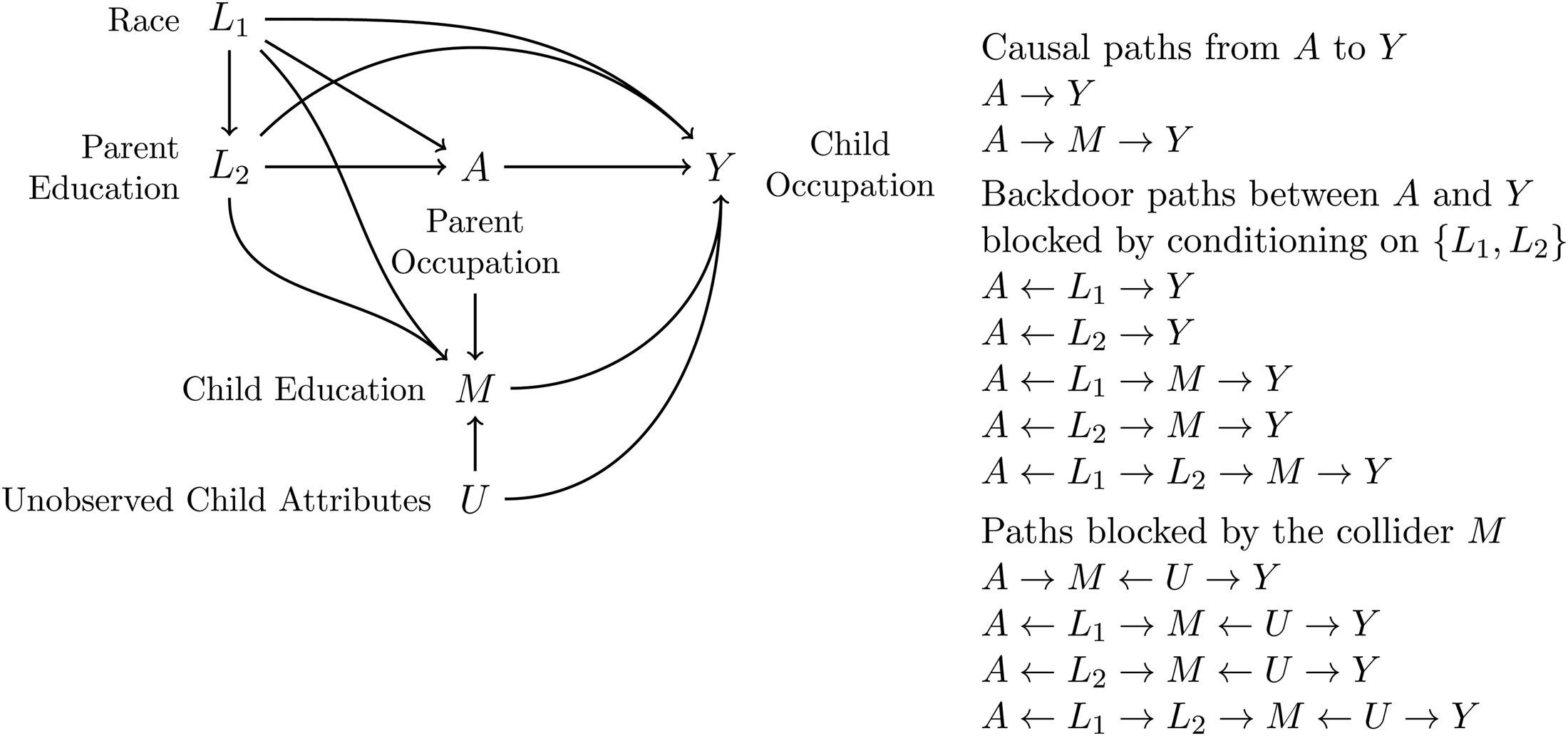
A causal directed acyclic graph (DAG) for occupational mobility. The DAG formalizes our causal theory, which mathematically implies a set of paths that collectively create an association between
The conditional exchangeability assumption holds when we successfully isolate the causal effect of parent occupation
In practice, conditional exchangeability may seldom hold. In our example, there are sure to be many unmeasured variables (e.g., parent ambition) that affect both parent occupation and child occupation. The DAG in Figure 1 assumes for illustration that these variables do not exist. In real applications of estimating the causal effects of parent occupation, there are many pre-treatment variables that researchers should adjust to adequately block confounding. In each case, drawing out the DAG is helpful because it visually depicts possible violations to the exchangeability assumption.
A DAG also offers a formal justification for some research choices that are already common in mobility research. For example, mobility scholars widely agree that when estimating the effect of parent occupation, researchers should not adjust for variables causally downstream from parent occupation, such as a child’s education. The DAG formalizes this intuition: adjusting for that variable would block a causal path that we want to remain open (
For Whom Can Each Potential Outcome Be Credibly Estimated?
Joey’s mother held a high school degree but did not finish college. A hypothetical intervention to change her occupation would not change her educational credentials. Suppose, however, that we wanted to know Joey’s outcome that would be realized if his mother were a lawyer. This is an impossible counterfactual: a person cannot be a lawyer without completing college.
The problem of impossible counterfactuals is both philosophical and practical. Philosophically, while we can write down the potential outcome
On the other hand, some improbable counterfactuals are of great scientific interest. People who achieve unusual occupations against great odds provide special analytical leverage when our goal is to isolate the effect of the occupation as distinct from the effects of other attributes commonly shared by those who hold that occupation. Improbable treatment assignments have been useful in other causal studies, such as when Brand (2023) documented the positive causal effects of college on the outcomes of disadvantaged students who are least likely to attend. In fact, causal studies focused on hypothetical policy interventions may want to especially focus on the marginal units who are factually unlikely to receive treatment but could easily be nudged into treatment under a hypothetical intervention (Zhou and Xie 2019a, 2020). Broadly, counterfactuals that rarely occur may correspond to philosophical impossibilities (e.g., a lawyer with no degree) or to cases with especially strong analytical leverage (e.g., a lawyer with a degree from a socially disadvantaged background). When a treatment has many categorical values, researchers must carefully consider whether unusual treatment assignments correspond to analytical problems or analytical opportunities.
Whether for good or for ill, improbable counterfactuals are common in causal mobility research because the causal inputs (parent attainment) are themselves the result of strong causal stratification processes occurring in the parent generation. Many occupations are not open to parents without a college degree. At the other extreme, there are occupations that parents with college degrees almost never hold (e.g., farm laborers) that are common among parents with low levels of education.
Formally, one would like to study the potential outcome
In our simple illustration, we adopt a straightforward solution to this problem: we conduct analyses separately by four categories of parent education, less than high school, high school, some college, and four-year college degree, under the theory that every occupation open to any college graduate is open to all college graduates. As with the definition of potential outcomes, our solution only partially solves the problem. For example, it would be highly unusual for a college-educated parent to become a lawyer if they never attended law school. We can add more educational categories to avoid that problem, but then data become sparser as the degree of differentiation becomes more detailed. We take the strata of parent education in four categories as a middle ground that retains well-populated strata while avoiding the most extreme cases of impossible counterfactuals.
Aggregate Estimands: Interpretable Summaries by Occupational Scores and Classes
The assumptions for causal inference are most credible when the treatment is highly detailed, such as a specific parent occupation out of hundreds of possible codes. Hundreds of causal estimates, however, would be too many to interpret. A lack of statistical power might also make producing hundreds of precise estimates difficult. Here, we consider how a causal approach interacts with two common strategies that can both simplify estimates for presentation and pool information for statistical efficiency: numeric scores and discrete classes.
Aggregation by Numeric Scores
When we consider what Joey’s outcome would have been if his mother were a housekeeper instead of a secretary, we might instead conceptualize those two occupations as points along some continuum of occupational status. This continuum should capture the aspect(s) of occupations that matter for the particular outcome being studied. If parent occupations with the same median income tend to lead to similar occupational outcomes for children, then one should score occupations by median income. If, instead, parent occupations with the same prestige lead to more similar outcomes for children, then one should score occupations by prestige. No single score is correct for all applications, and the choice of score should be driven by theory: researchers should choose one or more numeric scores that capture the aspect(s) of occupations most relevant to the particular potential outcomes being studied, so that two parent occupations with similar values on the score(s) also have similar values on the potential outcomes for children. For illustration, we score occupations by the Hauser–Warren Socioeconomic Index (HW-SEI). This classic numeric score rates each occupation on a scale between 0 and 100 as a function of occupational education and pay (Hauser and Warren 1997). We chose this score because it shows how a longstanding score can be used for causal analysis. However, there are other scores that could be used to better capture the aspects of parent occupation relevant to children’s occupational opportunities.
When using occupational scores, mobility researchers should consider the magnitude of the intervention and whether it is realistic. Joey’s mother had an HW-SEI score of 30 as a secretary and would have had a score of 14 if she had been a housekeeper. The counterfactual comparison can be conceptualized as moving 16 units down the HW-SEI scale. We might wonder about larger shifts. What if Joey’s mother had an HW-SEI score of 81? In Joey’s case, that intervention is impossible: his mother must be a physician to have that occupational status. And with only a high school degree, Joey’s mother could not be employed as a physician. While occupational scores like HW-SEI are useful for organizing occupations along a continuum, it is essential to remember that the causal treatment is still occupation itself. Some values of any occupational score may correspond to impossible counterfactuals for at least some individuals.
In our illustration, we use the HW-SEI as a tool for partial pooling. Because parent occupations are sparsely populated, we pool their estimates toward a linear function of the HW-SEI score. Our linear assumption could be doubtful if moves across occupations with different HW-SEI scores make an especially large difference among those at the bottom or the top of the distribution. Because we doubt that the true effect of each occupation falls exactly on a line, we also allow occupation-specific deviations from that trend according to a regularized random intercept for each occupation. To the degree that an occupation is well-populated, our specification will allow it to have an estimate that deviates from the global linear trend. This is not the only way to use occupational scores. Still, it strikes a balance between imposing some structure (a linear function of HW-SEI) and allowing flexibility away from that structure (occupation-specific random intercepts). An important area of future research is to consider occupational scores that better capture the variation across occupations that causally impact children’s socioeconomic outcomes rather than scores descriptively related to prestige.
Aggregation by Discrete Classes
Joey’s mom could hold many possible occupations: secretary, teacher’s aide, mail carrier, housekeeper, etc. Instead of arranging these occupations along a numerical continuum, we could collect them in a small set of categorical classes. Many schemas exist to categorize occupations into classes. Some emphasize pay or structural positions in relationships of authority (Erikson and Goldthorpe 1992; Wodtke 2016), while others seek an omnibus summary that is well-associated with many individual outcomes (Weeden and Grusky 2005). As when using occupational scores, researchers using occupational class schemas should choose a categorization such that any two children whose parents work in the same occupational class would have similar potential outcomes regardless of the particular occupation held by their parent within that class. Because individual occupations are sparsely populated, this is often a theory-driven rather than a data-driven choice.
For illustration, we follow the class schema of Erikson et al. (1979), in which secretary is a routine nonmanual occupation while housekeeper is an unskilled manual occupation. We then study the causal effect of occupational class: how Joey’s outcome would differ if his parent were employed in a routine nonmanual versus an unskilled manual occupation. As with scores, researchers should consider the magnitude and plausibility of this intervention.
Impossible (or highly improbable) counterfactuals can exist for occupational classes, similar to those for individual occupations. For example, it is reasonable to ask what would have happened if Joey’s high-school-educated parent had been employed in an unskilled manual occupation. But in a different subgroup of children whose parents hold a college degree, that treatment is nearly impossible: we estimate that only 2% of college-educated parents are employed in unskilled manual occupations (see Figure 2, using the national probability sample data described in the next section). Other counterfactuals are even more implausible. Almost no parents with college degrees are farmers, for example. We can study counterfactual outcomes in the professional class for children of college-educated parents, 81% of whom are in this class. But this same hypothetical treatment value is difficult to study for those whose parents did not complete high school, among whom only 11% are observed in professional class occupations. Many hypothetical changes in parent occupational classes may be practically impossible without changes in parent education.
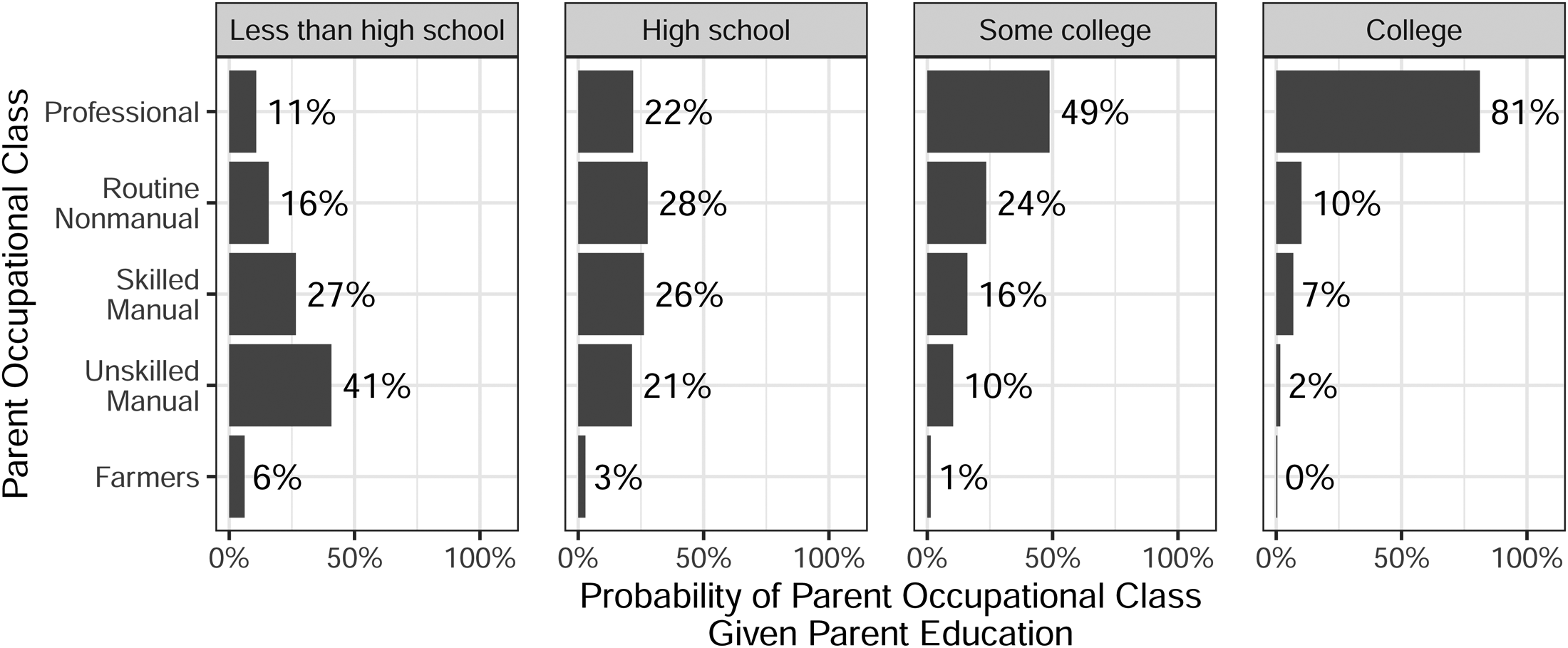
Parent occupational class probabilities by parent education. Data refer to parents in the National Longitudinal Survey of Youth 1979 Cohort (
Second, occupational classes are an effective strategy to the degree that potential outcomes for children are homogeneous within a parent occupational class regardless of the particular values of parent occupation within that class. However, no matter the class schema, there are certain to be some occupation-specific differences in potential outcomes within the class. This imperfection is most consequential when the distribution of occupations within the class differs across population subgroups. For example, Joey’s high-school-educated mother was a secretary. Her occupation is classified as routine non-manual. Suppose another adolescent, Sarah, had a college-educated mother who was an elementary school teacher (a professional class occupation). We might ask what Sarah’s outcome would have been if her mother had also been employed in a routine non-manual occupation. But for Sarah, the counterfactual parent occupation might not be secretary. Only 7% of college-educated parents in routine non-manual occupations are secretaries. It would be much more likely that Sarah’s mother would work in insurance sales, the occupation in which 21% of college-educated routine non-manual employees work. The meaning of “routine non-manual” is more likely to be “secretary” for a parent with a high school degree and more likely to be “insurance sales” for a parent with a college degree. For this reason, researchers must exercise caution when interpreting effect heterogeneity across subgroups when the treatment is a class (a collection of occupations); the treatment “routine non-manual” is not the same treatment for those whose parents have different levels of education.
Empirical Illustration
We illustrate our causal mobility analysis with data from the NLSY 1979 cohort (NLSY79), which began with a probability sample of 12,686 U.S. children ages 14–22 in 1979. Because the cohort study is centered on the children, the range of child birth years (1957 to 1964) is much narrower than the range of parent birth years (Supplemental Material Figure S2). Table 1 reports the sample restrictions that produce our analytic sample of 6,311 children.
Sample Restrictions.
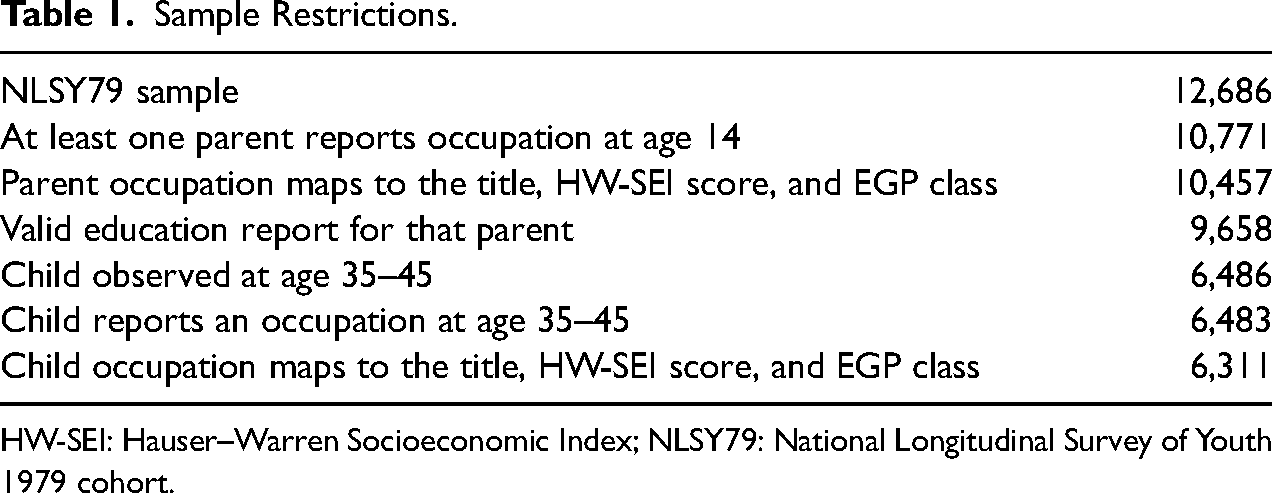
HW-SEI: Hauser–Warren Socioeconomic Index; NLSY79: National Longitudinal Survey of Youth 1979 cohort.
We measure parent occupation by retrospective baseline survey reports for the occupations of the mother and father at age 14. This choice follows other scholarship that advocates for the measurement of parent characteristics at a fixed point in the child’s life when those characteristics may be most causally impactful, rather than at a fixed moment in the parent’s life when children may be of various ages (Hout 2015). The effect of hypothetical interventions may vary depending on when they are experienced during childhood, as has been shown for other interventions (Cunha et al. 2006). Our data only permit an analysis of parent occupation at child age 14. Effects of interventions at other ages are open questions for future research. Yet we suspect that the particular age of measurement may be inconsequential to the degree that a parent holds the same occupation over a child’s developmental period. We measure child occupation in the interview as close as possible to age 40, using slightly younger or older responses as needed to have a valid survey report in a year when the respondent is employed; ages at occupation measurement are summarized in Supplemental Material Figure S3. The choice to measure child occupation at age 40 follows other scholarship showing that the age at which career outcomes are measured is consequential (Haider and Solon 2006) and showing that outcomes at age 40 correspond particularly closely to what scholars may conceptualize as long-term outcomes over a career (Mazumder 2001, 2005). Much of this scholarship has focused on income, however, and the particular age at which occupation is measured may be less consequential to the degree that occupation is more stable than income over the life course.
For parents and children, the NLSY79 codes self-employed respondents into an occupation based on their work tasks; therefore, our data include self-employed respondents among other respondents in each occupation (9% of children). We map parent and child occupations to a common basis using 1990 occupational codes with crosswalks provided by Autor and Dorn (2013).
Our analysis of occupational mobility uses two summary measures: a score and a class. The score is HW-SEI (Hauser and Warren 1997), which we map to each 1990 occupation code using data from IPUMS-USA (Ruggles et al. 2023). We also categorize occupations into discrete classes with a schema based on Erikson et al. (1979). We map each parent and child 1990 occupational code to 2010 occupational codes using a crosswalk provided by Autor (2015). We then map each code to a class using a crosswalk provided by Morgan (2017). Finally, we follow Zhou and Xie (2019b) who coarsen these into six major classes, of which we use five: farmers, unskilled manual, skilled manual, routine non-manual, and professional (called “service” in Zhou and Xie 2019b). Our categorization does not explicitly include small proprietors because self-employed individuals are coded into the other occupations in our data according to their type of work.
We measure two confounding variables in the 1979 survey. Race is coded into Hispanic, non-Hispanic Black, and non-Hispanic non-Black, which we refer to as Hispanic, Black, and white or other. We measure parent education as less than high school, high school, some college, and a four-year college degree. Supplemental Material Table S1 presents descriptive statistics for the confounding variables.
Empirical Results: Occupational Score
An occupational score arranges occupations along a numeric continuum. We use the notation 
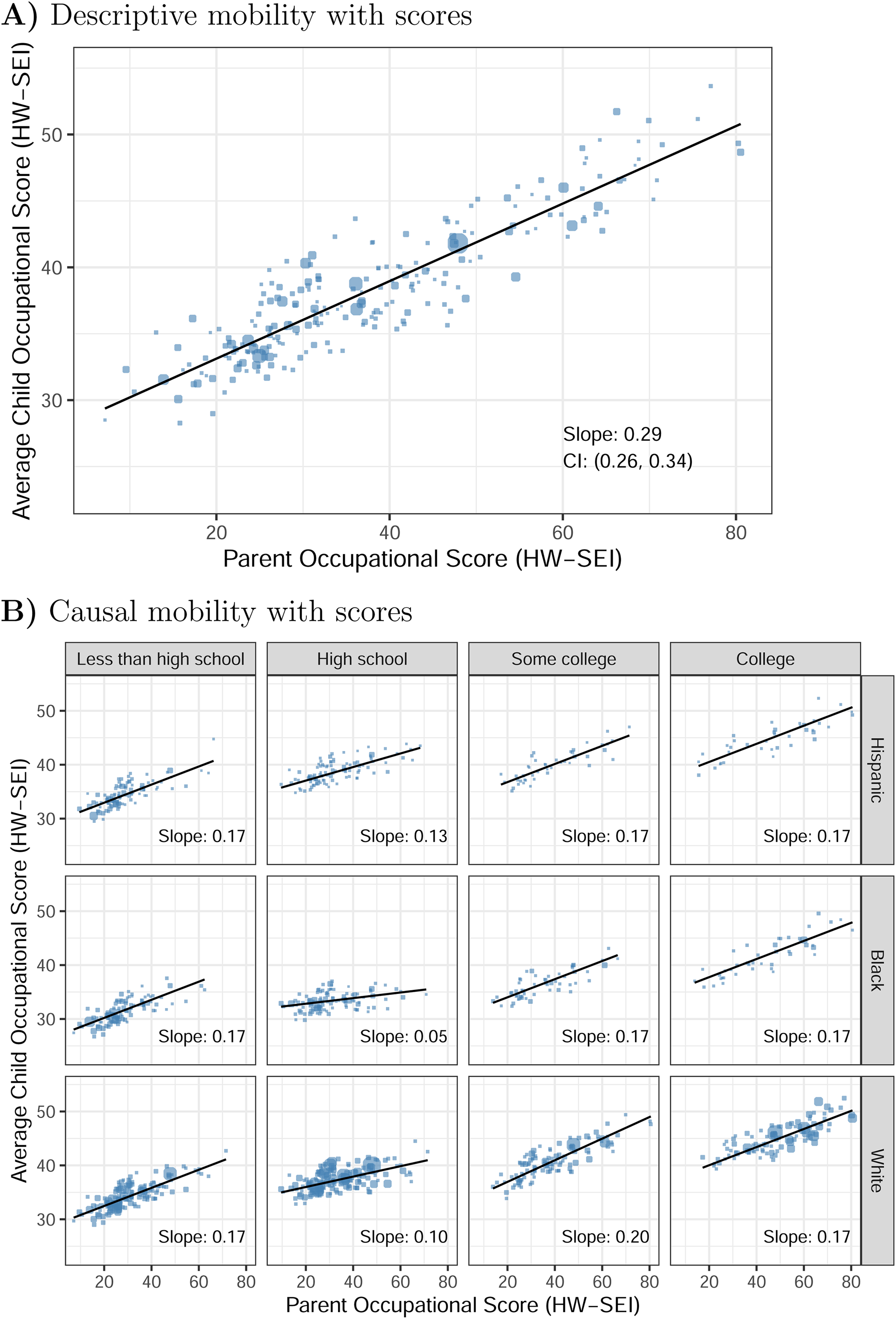
Occupational mobility with scores. Each dot is a parent occupation proportional to its population size. Each
Part of the association between parent and child occupation arises through confounding: college-educated parents tend to have high-status occupations, and parents with college degrees can transmit advantages to children through many pathways other than their own occupation. To estimate the causal effect, we estimate the same relationship within subgroups defined by confounders. Specifically, we estimate a penalized regression model,
Figure 3 Panel B presents the estimated association within confounder subgroups, which can be interpreted as subgroup-specific descriptions or (under our causal assumptions) as subgroup-specific causal estimates. Two results are notable. First, a unit-specific increase in parent HW-SEI causes different changes in child HW-SEI, with subgroup estimates from 0.05 to 0.20. Black children with high school-educated parents have the weakest occupational association with their parents, while white children whose parents had some college have the strongest association. The average slope of 0.14 is about half as large as the unadjusted slope of 0.29, suggesting that about half of the association between parent and child HW-SEI arises from confounding through race and parent education. Second, the set of observations (dots) differs across panels. Some occupations (e.g., welder, HW-SEI = 26) are never observed among college-educated parents, whereas other occupations (e.g., physician, HW-SEI = 81) are never observed among parents who did not complete high school. This serves as an important reminder that there are limits to the range of possible counterfactuals for parent occupation without changing parent education.
Empirical Results: Occupational Class
To summarize how parent occupational class categories relate to child occupational class categories, we next consider a mobility table normalized within parent occupational class (Figure 4 Panel A). In this table, the probability of a child attaining a professional occupation was 51% among those whose parents held a professional occupation but only 27% among those whose parents were farmers.
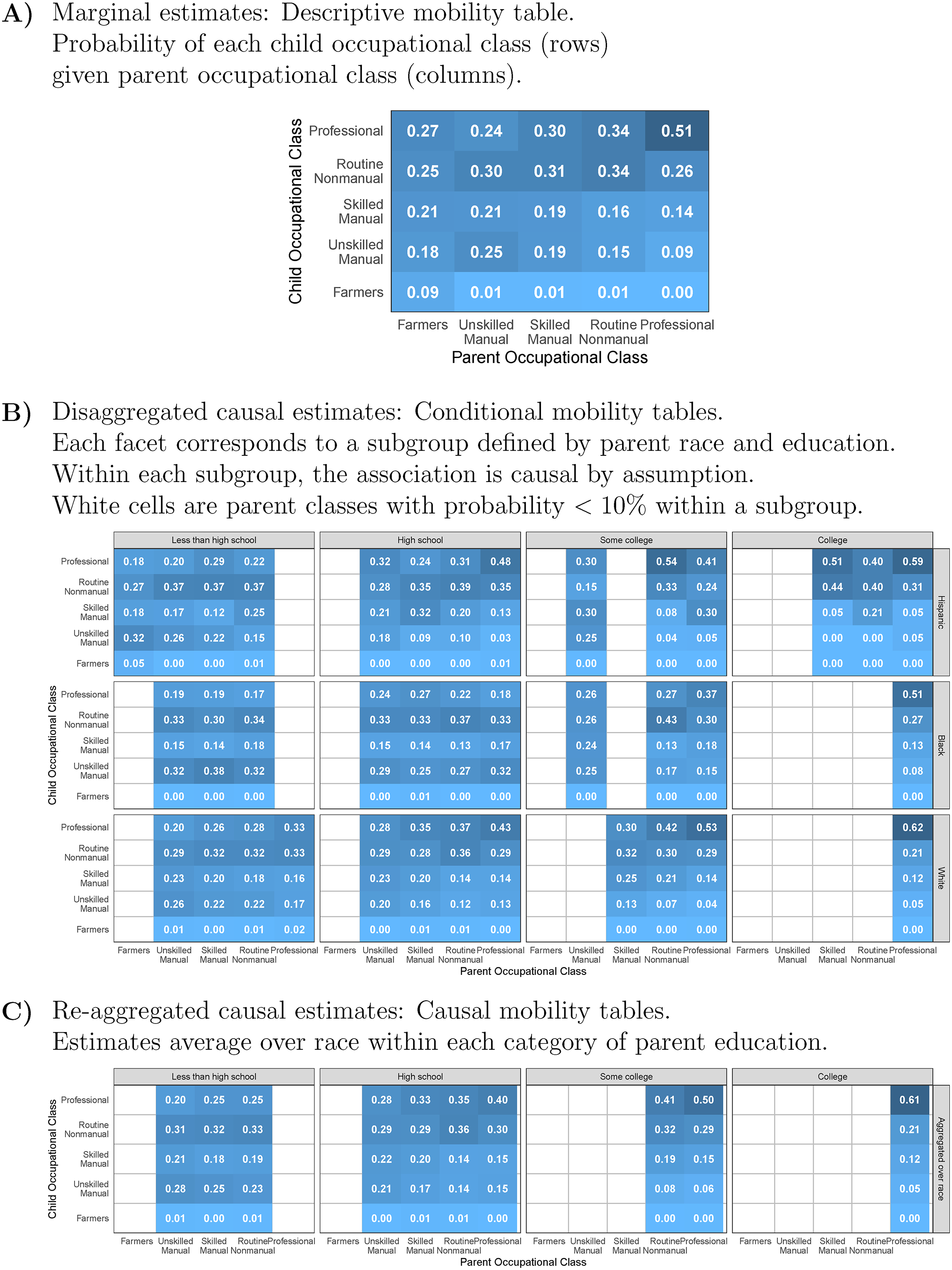
Causal mobility tables: a process of disaggregation and re-aggregation. A descriptive mobility table summarizes a marginal association. To adjust for confounding, we create conditional mobility tables within strata of confounders. The conditional tables are (by assumption) causal and can be re-aggregated into aggregate causal tables.
To make causal estimates under our assumptions, we re-estimate the table within subgroups of each possible value of parent education and race (Figure 4 Panel B). Under our simple causal assumption that these two variables block all confounding, any association between parent and child occupational class within these subgroups corresponds to a causal effect.
The most important result in the conditional mobility tables (Figure 4, Panel B) is the absent estimates, represented by empty white cells. The conditional mobility tables do not report results for any column corresponding to a parent occupational class for less than 10% of respondents in a subgroup. For example, college-educated parents are nearly always employed in professional-class occupations. Among Black and white children whose parent holds a college degree, professional occupations are the only parent occupational class observed for at least 10% of the subgroup. The set of parent occupational classes about which the data support credible inferences differs across the various population subgroups. By redacting cells with very little support, we focus attention on cells where the counterfactual actually occurs with high probability. An important added benefit of redacting these cells is that it avoids reporting estimates for cases that may correspond to reporting error, such as a college-educated worker who incorrectly reports an unskilled manual occupation.
The empty columns in Panel B create a challenge for producing a population-average causal mobility table. If the treatment were binary, it would be common to average the 12 subgroup estimates proportional to their population weights to produce an average treatment effect. With a binary treatment, it might be the case that both treatment values are observed in all 12 subgroups. However, when the treatment has five categories, it is more difficult to observe all five treatment categories in each subgroup. The issue compounds with more than five categories. For example, the only subgroup with estimates for the farmer class is Hispanic children whose parents did not finish high school (upper left of Panel B). One cannot take a population average effect of having a parent who is a farmer; that treatment condition only happens at a meaningful prevalence in one of the subgroups. At another extreme, the professional class is the only class with estimates among college-educated parents of non-Hispanic children (lower right of Panel B). We can make subgroup-average causal effect estimates within some population subgroups, where several parent classes are observed with sufficient frequency to make estimates. But population-average causal effects are undermined by the problem of empty cells.
The discussion above shows that we can make causal effect estimates in each of the 12 subgroups, but we cannot fully re-aggregate them to population-average causal effect estimates. But 12 estimated tables constitutes a large amount of information for a person to process. We, therefore, partially re-aggregate into average causal effects within subgroups defined by parent education. Doing so is possible because the parent classes with estimates are largely the same across racial categories (rows of Panel B) within categories of parent education (columns of Panel B). The causal tables within parent education show the notable differences in children’s life chances depending on the level of schooling their parents completed. Even under a hypothetical intervention to change parent occupational class, children whose parents did not complete high school have a relatively low chance of attaining a professional class occupation: between 20% and 25%. Meanwhile, children whose parents completed college would have a 61% chance of attaining a professional class occupation if you intervened to assign their parent to a professional class occupation. The causal results in Panel C demonstrate that the marginal association between parent and child occupational class (Panel A) largely results from confounding through race and parent education that affects both of these variables.
Discussion
This paper presented a causal approach to occupational mobility that can answer the question: what occupation would a child attain under a hypothetical intervention to set parent occupation to a particular value? We first described the steps to answer such a question. The first step is to precisely define the hypothetical intervention. What occupation would the parent counterfactually hold? A precise statement of that causal question makes obvious the limits of what questions can be credibly answered. Parents who did not finish high school are not observed in extremely high-SEI occupations, or the professional class at all. Highly educated parents are almost never farm laborers. The strong stratification of parent occupation by parent education (and other characteristics and skills) constrains the causal questions about the effects of parent occupation that can be credibly answered.
Applying our framework to occupational mobility for a probability sample of a U.S. cohort, we showed that adjustment for race and parent education yields an association between parent and child occupation substantially smaller than the marginal association. Even though these two variables are likely an incomplete adjustment set, the result nonetheless suggests that the causal effect of parent occupation on child occupation is much weaker than the descriptive intergenerational association. We demonstrated this result using a strategy with numeric occupational scores and a strategy with discrete occupational classes.
A key implication of our approach is the importance of thinking carefully about population subgroups. Not only do patterns of causal mobility differ across subgroups, but some causal questions simply cannot be answered in some subgroups because they involve counterfactuals that seldom or never occur. For example, in Figure 4C we considered the outcomes that children of college-educated parents would realize on average if their parents were assigned to five discrete occupational classes. But only one of these classes—the professional class—was adequately populated in the factual data to produce reliable estimates. A causal approach to social mobility that takes seriously these positivity violations may thus serve as an important reminder that severe social stratification by some variables (e.g., parent education) can render it impossible to study the effects of other variables (e.g., parent occupation) within some subgroups. We argue that these positivity constraints are substantively interesting in their own right and deserve attention in future causal research about social mobility.
Open questions are numerous in causal mobility research. The aspects of family background that may be causally impactful are many: parent education, occupation, income, resources in a network of extended kin, neighborhood environment, and so forth. Causal studies on the effects of each input would shed new light on the precise inputs that are most impactful for children’s life chances. This line of work may especially benefit from searching for heterogeneous effects (Brand et al. 2023; Smith 2022), where the causal impact of one input (e.g., parent occupation) may be contingent on the value of another input (e.g., parent education), building on existing causal research that considers heterogeneity in the status attainment process (Brand 2023).
We focused on what would happen to a child if their parent worked in a different occupation. In these causal questions, the subject of the intervention is a parent. Our approach has not directly addressed a second class of interventions for which the subject is an occupation: what if the pay or prestige associated with a particular occupation changed? One can imagine how the outcome of an elementary school teacher’s child would differ between a society in which elementary teachers have high pay and high social standing compared with a society in which elementary teachers have low pay and low social standing. The answer to such a question might illuminate the possible downstream benefits of policy interventions, such as paying teachers more. To produce evidence on that question would require different data that cover many times and/or places across which the occupational structure differs. Yet many of the considerations taken up in the present paper would still be relevant. Counterfactuals that have yet to exist, such as a world in which teachers are paid as much as CEOs of large corporations, cannot be studied with data. We hope our work on interventions that change parent occupations within the occupational structure spurs new ideas on these related questions about the effects of changes in the occupational structure itself.
Finally, all open questions in causal mobility are possible because of the robust base of descriptive research documenting the associations of status attainment variables across generations. We expect that continued research focused on descriptive mobility will continue to open new doors to causal questions that scholars may never have considered. Abundant new findings may await those who take those descriptive results and explore the analogous causal questions.
Supplemental Material
sj-pdf-1-smr-10.1177_00491241251338412 - Supplemental material for The Causal Effect of Parent Occupation on Child Occupation: A Multivalued Treatment with Positivity Constraints
Supplemental material, sj-pdf-1-smr-10.1177_00491241251338412 for The Causal Effect of Parent Occupation on Child Occupation: A Multivalued Treatment with Positivity Constraints by Ian Lundberg, Daniel Molitor and Jennie E. Brand in Sociological Methods & Research
Footnotes
Acknowledgments
For helpful discussions and feedback relevant to this project, we thank participants from the Conference on New Methods to Measure Intergenerational Mobility at the University of Chicago. The content is solely the responsibility of the authors and does not necessarily represent the official views of the Eunice Kennedy Shriver National Institute of Child Health & Human Development or the National Institutes of Health.
Declaration of Conflicting Interests
The authors declared no potential conflicts of interest with respect to the research, authorship, and/or publication of this article.
Funding
The authors received the following financial support for the research, authorship, and/or publication of this article: The authors benefited from facilities and resources provided by the California Center for Population Research at UCLA (CCPR), which receives core support (P2C-HD041022) from the Eunice Kennedy Shriver National Institute of Child Health and Human Development (NICHD). This material is based upon work supported by the National Science Foundation Graduate Research Fellowship under Grant No. 2139899. Any opinion, findings, and conclusions or recommendations expressed in this material are those of the authors and do not necessarily reflect the views of the National Science Foundation.

Data Availability Statement
A replication package is available on Dataverse at https://doi.org/10.7910/DVN/CWVISP. Data are available from the National Longitudinal Survey of Youth 1979, following steps detailed in the replication package (Lundberg et al., 2024).
Supplemental Material
Supplemental material for this article is available online.
Notes
Author Biographies
References
Supplementary Material
Please find the following supplemental material available below.
For Open Access articles published under a Creative Commons License, all supplemental material carries the same license as the article it is associated with.
For non-Open Access articles published, all supplemental material carries a non-exclusive license, and permission requests for re-use of supplemental material or any part of supplemental material shall be sent directly to the copyright owner as specified in the copyright notice associated with the article.
