



Abstract
We combine empirical experimental research on biased argument processing with a computational theory of group deliberation to overcome the micro–macro problem of sociology and to clarify the role of biased processing in debates around energy. We integrate biased processing into the framework of argument communication theory in which agents exchange arguments about a certain topic and adapt opinions accordingly. Our derived mathematical model fits significantly better to the experimentally observed attitude changes than the neutral argument processing assumption made in previous models. Our approach provides new insight into the relationship between biased processing and opinion polarization. Our analysis reveals a sharp qualitative transition from attitude moderation to polarization at the individual level. At the collective level, we find that weak biased processing significantly accelerates group decision processes, whereas strong biased processing leads to a meta-stable conflictual state of bi-polarization that becomes persistent as the bias increases.
Keywords
Introduction
Social processes can currently be observed around the world in which controversies over various issues are coming to a head. For example, while some members of society are strongly in favor of a political decision-maker, others are strongly opposed to the same political leader (e.g., Trump, Erdogan, Putin, and Lukashenko). The same processes can be identified worldwide for other objects of attitude, such as migration movements, measures to contain the COVID pandemic or climate change and its cause(s). These developments hold potential for danger, as they threaten international but also intranational social cohesion. It is, therefore, all the more important to understand the mechanisms of such processes in detail.
The consideration of micro-processes in the explanation of macro-level processes in social aggregates, 1 such as opinion polarization, had been a central maxim in sociology long before Coleman, who promoted the so-called micro–macro explanation scheme with his appealing, because simplistic and intuitive, diagram (cf. Raub and Voss, 2017). At the same time, the examination of macro-level processes is challenging from a methodological point of view since they reflect a result of a plethora of individual processes of attitude change at the micro-level. Standardized surveys (here also referring to survey experiments) represent a well-established data collection method in social science that allow researchers to measure concepts among analytical units, such as individuals, at particular snapshots in time. However, the knowledge on individuals’ characteristics (e.g., attitudes towards coal power plants or wind power stations) is not enough by itself to anticipate phenomena on the social aggregate’s macro-level that rather occur due to (repeated) interactions between individuals. Wiley (1988) has drawn sociologists’ attention to this so-called micro–macro problem and stressed out the importance of considering human interactions in social theories (see also Alexander, 1987). Interactions can give rise to macro-level phenomena, which are greater than the sum of their parts, the so-called emergent phenomena. 2
Agent-based modelling is a versatile method that allow researchers to overcome the micro–macro problems, since (repeated) interactions between heterogeneous agents are one, not to say the, core element of this method. In Agent-based models (ABMs), researchers define the characteristics of several artificial agents (representing for example individuals) with respect to their behavior and interaction rules as well as the structure of their artificial environment according to their research question. Since agents can also be specified to take their environment’s macro-level information into consideration, ABMs are perfectly compatible with Coleman’s macro–micro–macro research paradigm (Coleman, 1990). A weak point of ABMs, however, is the choice of an appropriate initial distribution of the agents’ properties (e.g., how many oppose coal power stations and how many favor them) as well as of the parameters that govern their behavior and interaction (e.g., how strongly agents are considered to favor interaction with like-minded others) since those may heavily determine the macro level outcome and process of a model (Mäs and Helbing, 2017). This drawback can be overcome by deriving agents’ characteristic distributions as well as the parameter space of behavior and interaction rules from empirical research. Against this background, standardized surveys and ABMs are rather complementary than mutually exclusive research methods whose combination is promising to overcome the micro–macro problem in the examination of macro-level phenomena in Sociology (cf. also Shamon, 2018).
A variety of theoretical models have been developed to understand the mechanism behind the emergence of consensus, polarization and conflict over opinion. Theoretical approaches such as social influence network theory (Friedkin, 1999; Friedkin and Johnsen, 2011) and social feedback theory (Banisch and Olbrich, 2019; Gaisbauer, Olbrich, and Banisch, 2020) put a primary focus on how the structure of social networks impacts the dynamical evolution of attitudes in a group or a population. It is well known from this research that network segregation and community structure favor diversity and polarization. Other computational studies explain (sub)group polarization based on the homophily principle (Lazarsfeld and Merton, 1954; McPherson, Smith-Lovin, and Cook, 2001) by which the propensity of social exchange depends on the similarity of opinions. These models show that preferences for interaction with similar others may lead to a persistent plurality (Carley, 1991; Axelrod, 1997; Hegselmann et al., 2002; Banisch and Araujo, 2010) and polarization (Mäs and Flache, 2013; Banisch and Olbrich, 2021). Also, assumptions about the negative social influence by which opinions that are already far from one another will be driven farther apart in interaction have been included and may account for polarization dynamics (Macy et al., 2003; Mark, 2003; Baldassarri and Bearman, 2007; Flache and Macy, 2011).
All these approaches have in common that they focus in one way or another on social influence processes mediated through a network of social relations, that is on inter-personal mechanisms. In this article, we draw attention to an intra-personal process—namely, biased processing—and show that neither structural faultlines nor homophily or negative influence are necessary for collective polarization. The intra-individual tendency of biased processing alone is sufficient.
Biased processing may resemble homophily at the first sight. However, homophily requires at least two agents for this mechanism to become relevant and, hence, acts in between rather than within individuals. It explains opinion polarization in the case of free-choice social interactions that represent only a subset of all social interactions in our reality, most likely routed in the leisure rather than in the occupational domain. Whenever people are considered as belonging to a social group that is defined by virtue of birth or of an overarching common purpose, such as doing sports in a soccer team or jointly maximizing the profit of one’s employer, group members can be expected to be exposed to a normative influence to engage in a minimum level of communication with other non-similar group members, for example, on controversial issues. At the latest in this point, the cognitive mechanism of biased processing becomes relevant for the explanation of opinion polarization and can be considered as the more fundamental mechanism that applies in the course of any communication.
In order to better understand how biased processing contributes to opinion polarization, we combine a survey experiment on argument persuasion with an ABM of group deliberation. Starting from basic assumptions made in the ABM, we derive a simple cognitive model of opinion revision which is then calibrated with data from the survey experiment. This, in turn, enables an empirically informed refinement of the micro assumptions on which the ABM is drawing. We then characterize the macro-level behavior of the empirically refined ABM with a series of systematic computational experiments. This provides a detailed qualitative picture of the macro-level effects of biased information processing at the level of individuals.
Our theoretical model is based on the argument communication theory (ACT) advanced by (Mäs and Flache, 2013). The main idea is that an opinion is a multi-level construct comprised of an attitude layer and an underlying set of arguments (cf. Banisch and Olbrich, 2021). In repeated interaction agents exchange pro- and con-arguments about an attitude object and adjust their attitudes accordingly. If this process of argument exchange is coupled with homophily at the level of attitudes this gives rise to the formation of two increasingly antagonistic groups at the macro-level which rely on more and more separated argument pools (Sunstein, 2002). As a consequence group opinions become more and more concentrated at the extremes of the opinion scale. ACT has proven very useful to understand the impact of opinion diversity and demographic faultlines in group deliberation processes (Mäs et al., 2013; Feliciani, Flache, and Mäs, 2020) and is also capable to explain how opinions on multiple interrelated topics may align along ideological lines (Banisch and Olbrich, 2021). The theoretical contribution of this paper is to propose and experimentally validate a refined mechanism of argument exchange that incorporates biased information processing and to show that the group-level predictions of ACT are fundamentally affected when these refined micro-assumptions are incorporated.
Biased argument processing—also labeled as biased assimilation (Lord, Ross, and Lepper, 1979; Corner, Whitmarsh, and Xenias, 2012; Kobayashi, 2016), defensive processing (Wood, Rhodes, and Biek, 1995), refutational processing (Liu et al., 2016), or attitude congruence bias (Taber, Cann, and Kucsova, 2009) in the literature—refers to a person’s tendency to inflate the quality of arguments that align with his or her existing attitude on an attitude object whereas the quality of those arguments that speak against a person’s prevailing attitude are downgraded. A number of empirical studies (cf. e.g. Biek, Wood, and Chaiken, 1996; Teel et al., 2006; Corner, Whitmarsh, and Xenias, 2012; Kobayashi, 2016; Shamon et al., 2019) across different topics and samples have shown that biased processing is a robust cognitive mechanism whenever persons are exposed to a set of opposing arguments on attitude objects. In order to integrate this intra-personal tendency of attitude-dependent argument processing, we rely on an empirical study in the context of climate change, and electricity production in particular (Shamon et al., 2019). In this experiment, attitudes towards six different energy technologies (coal power stations, wind turbines, etc.) were measured before and after subjects had been exposed to a balanced set of seven pro- and seven con-arguments. Subjects were asked to rate the persuasiveness of arguments and their judgments reveal a systematic bias towards attitude-coherent arguments.
Our cognitive model assumes that this biased evaluation of arguments affects the probability with which arguments are taken up by an agent to a certain degree
This close alignment of a computational model of information processing and an empirical experiment on argument persuasion is the main methodological contribution of this paper. Starting from the basic assumptions of ACT, we show how an empirical experiment can be transferred into an artificial computer-based miniature enabling a rigorous comparison of the behavior of computational agents and real human subjects. With that, our research contributes to a better understanding of the relation between biased processing and opinion polarization by showing that
the strength of biased processing is crucial to determine whether individual attitudes moderate or become more extreme (attitude polarization) after exposure to a balanced mix of pro- and con-arguments, this strength depends on the topic addressed in the experiments such that polarization can be expected for some but not necessarily for others, at the macro-level, strong biased processing may lead to an initial process of polarization such that moderate groups evolve into two opposing opinion camps. In the absence of other mechanisms (e.g. homophily), this bi-polarized state is resolved in the long run.
Our article hence contributes to solving an empirical puzzle in psychological persuasion research because it allows for a proper examination of the relation between biased processing and opinion polarization when subjects are exposed to a balanced mix of pro- and con-arguments. Two forces counteract one another in such a balanced information setting: (i) there is moderating effect of being exposed to both sides of the opinion spectrum, and (ii) there is a polarizing effect of filtering arguments in favor of existing beliefs. Empirical studies (e.g. Lord, Ross, and Lepper, 1979; Taber and Lodge, 2006; Taber, Cann, and Kucsova, 2009; Druckman and Bolsen, 2011; Corner, Whitmarsh, and Xenias, 2012; Teel et al., 2006; Shamon et al., 2019) repeatedly examined whether or not biased processing of balanced arguments may lead to more extreme attitudes and contribute to polarization tendencies. Empirical evidence is mixed: while some studies find support for attitude polarization as a consequence of exposure to conflicting arguments (Taber and Lodge, 2006; Taber, Cann, and Kucsova, 2009; Lord, Ross, and Lepper, 1979; McHoskey, 1995), other studies report no evidence (e.g. Teel et al., 2006; Druckman and Bolsen, 2011; Corner, Whitmarsh, and Xenias, 2012; Shamon et al., 2019). Unfortunately, it is difficult to say as to why those empirical studies find mixed evidence on the issue, because the conceptual and methodological heterogeneity applied in the studies does not allow to draw systematical conclusions (cf. Shamon et al., 2019: 108). Hence, despite the fact that biased processing has been shown to be a relatively robust cognitive mechanism, empirical evidence on its consequences for attitude change has been ambiguous. Our approach takes into account that biased processing may come in degrees (
Secondly, the close connection of experimental and theoretical model advanced in this article provides a method to assess the strength of biased processing
Third, incorporated into a computational theory of group deliberation, such as ACT, we can bridge from micro-level psychological measurement to macro-level phenomena by studying the implications of biased processing at the collective level of groups or populations. Previous modeling work incorporating biased processing has shown that biased assimilation coupled with homophily may generate patterns of collective polarization if the bias is sufficiently strong (Dandekar, Goel, and Lee, 2013). Dandekar, Goel, and Lee (2013) model biased processing in such a way that it “mathematically reproduces the empirical findings of Lord, Ross, and Lepper (1979)” (Dandekar, Goel, and Lee, 2013: 5793). However, they miss to describe the cognitive process that underlies information processing as well as resulting attitude changes in detail and conclude that homophily alone is not sufficient for polarization (p. 5791). This is in disagreement with one of the main results of ACT (Mäs and Flache, 2013) which demonstrated that homophily alone may explain polarization under positive social influence. However, despite the fact that a direct comparison of these models is challenging (Flache et al., 2017), Mäs and Flache (2013) note that the incorporation of biased processing may “amplify the bi-polarizing effects of argument exchange” (p. 15). We follow this idea and integrate biased processing into the framework of ACT to obtain a clearer picture of its collective level implications with and without homophily. We show that weak biased processing leads to a very efficient process in which a group jointly supports one alternative over the other. Moderate consensus is not stable under biased processing. When biased processing becomes strong, the population quickly evolves into a meta-stable phase of bi-polarization in which two subgroups with strongly support opposing views. This bi-polarization phase becomes exponentially more persistent with an increase in processing bias but will eventually resolve into one-sided consensus as long as the bias remains finite. In the context of our model, we show that in the absence of other mechanisms, attitude polarization at the individual level is a prerequisite for collective bi-polarization. Homophily is not necessary but accelerates the polarization process and stabilizes a conflictual, bi-polarized group situation.
The remainder of this article is structured as follows: We briefly comment on terminological choices in the next section. The balanced argument experiment will be described in the “Experiment” section. “A Cognitive Model of Biased Argument Processing” section describes how biased processing is integrated into the setting of ACT. In the “Theoretical Implications for the Balanced-Argument Treatment” section, we will take the perspective of an individual subject and derive the response function for the expected attitude changes. This is applied to the data from the experiment in the “Experimental Calibration” section. The macro-level implications of biased processing will be studied in the “Collective Deliberation With Biased Processing” section. Finally, the “Concluding Remarks” section summarizes the main contributions of the article, and discusses its limitations as well as future directions.
Terminology
Given that our research design combines psychological research on attitudes with opinion dynamics models a brief note on terminology might be helpful: Throughout this article, we will use the terms attitude and opinion interchangeably. We would like to embrace that attitude is more established in the context of persuasion experiments and opinion is the more typical term in opinion dynamics research. While the main focus of the former is on individual attitude change, the latter is mainly concerned with collective processes modeling groups or large populations. In the context of polarization, this may lead to confusion because the psychological concept of attitude polarization and the sociological theorizing behind opinion polarization relate to rather different phenomena. In the first case, attitude polarization relates to the persuasive effect that the attitude of a single individual becomes more extreme in either direction after an informational treatment. In the second case, opinion polarization refers to a bi-modal distribution of opinions in a population and to the dynamical process by which such a distribution emerges (cf. DiMaggio, Evans, and Bryson, 1996: 693).
For the purposes of the article, we distinguish two qualitatively different patterns of attitude change at the individual level (see Figure 1). Consider that an attitude is measured before (blue point) and after (red point) a treatment. If the attitude is less strong and approaches the neutral point after the treatment, this is called attitude moderation. Conversely, if the initial attitude is reinforced and more extreme after the treatment, this is called attitude polarization. At the collective level, we consider how an initial distribution of opinions in a population (blue) evolves in repeated interactions. As exemplified by the red curves in Figure 1), we differentiate three qualitatively different outcomes that will be relevant in the analysis that follows: moderate consensus (bottom left), extreme consensus (middle), or opinion polarization (left). Our model leads to a process by which an initially moderate population approaches an extreme consensus. If biased processing is strong, we observe a long-lasting intermediate phase of opinion polarization.
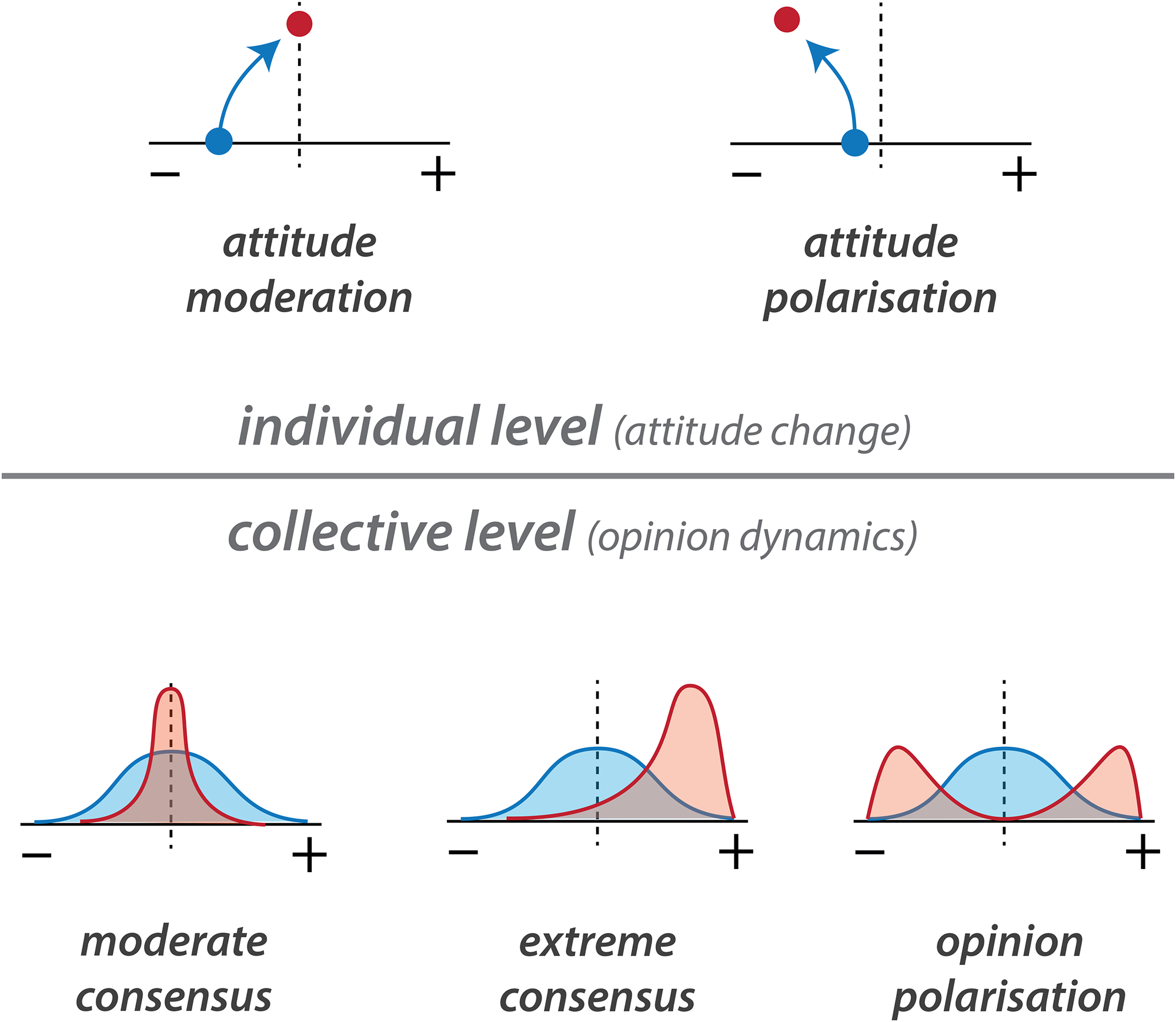
Overview of individual and collective phenomena discussed in the article.
Experiment
In 2017, Shamon et al. (2019) designed an online survey experiment to assess the impact of biased processing of arguments on attitude change regarding different electricity generating technologies. Participants were recruited from a voluntary-opt-in panel of a non-commercial German access panel operator. 3 The external validity of the study’s empirical findings is limited since voluntary-opt-in panels suffer from self-selection bias due to the (non-probabilistic) recruitment process of panel lists. Furthermore, the non-commercial access panel operator did not provide the option of using a quota sampling procedure for the survey experiment. This implies that none of the respondent characteristics in the sample necessarily matches the distribution in the population by design. 4
The analytical sample consists of 1,078 persons who indicated to have a residential address (principal address) in Germany. Respondents’ average age in the analytical sample is 40.8 years (SD =15.7), and 49.3 percent of respondents are female, 49.4 percent are male, and 1.3 percent refused to classify their gender. Furthermore, 77.7 percent of the respondents had received a secondary school leaving certificate and 5.3 percent stated that they are employed in the energy sector.
In the experiment, respondents’ attitudes towards six technologies were measured 5 both before (initial attitudes) and after (posterior attitudes) the presentation of 14 arguments on one of six technologies (Setting 1: coal power stations; Setting 2: gas power stations; Setting 3: wind power stations (onshore); Setting 4: wind power stations (offshore); Setting 5: open-space photovoltaic; Setting 6: biomass power plants). 6
Respondents were randomly assigned to only one of the six settings. The set of arguments was balanced in the sense that it comprised seven arguments speaking in favor (pro-arguments) and seven arguments speaking in disfavor (counter arguments) of the respective technology. Each argument was presented on a separate page of the online questionnaire. In order to prevent response-order effects, the order of the argument blocks (block of pro-arguments followed by a block of counter arguments vs. a block of counter arguments followed by a block of pro-arguments) as well as the order of arguments within each block was randomized.
Respondents were asked to rate each argument’s persuasiveness as well as to state their perceived familiarity with each argument. The research design allowed us to assess not only to what extent initial attitudes affect persuasiveness ratings of arguments but also to what extent respondents’ initial attitudes change after the exposure to the balanced set of 14 arguments.
Respondents’ persuasiveness ratings were registered for each argument on a 9-point scale (0: the argument is not at all persuasive; 8: the argument is very persuasive). Next to the persuasiveness rating scale, respondents could state their perceived familiarity with each of the 14 arguments (0: I am not aware of this argument; 1: I am aware of this argument). This allowed to calculate a balance of argument ratings for each respondent. The balance of argument ratings was calculated by subtracting a respondent’s average persuasiveness rating for the seven counter arguments from the average persuasiveness rating for the seven pro arguments. Hence, a persuasiveness balance ranges from
The experiment provides empirical evidence that persons’ engagement in biased processing depends systematically on their initial attitude. Figure 2 shows for each attitude position and across all technologies a box plot (without outliers) of respondents’ balance of argument ratings. The distribution of respondents’ balance of argument ratings depends on respondents’ initial attitude towards the respective technology that was focused in the 14 arguments (hereinafter referred to as focused attitudes). The majority of respondents with initial negative focused attitudes rated counter arguments as more persuasive than pro arguments and the majority of respondents with initial positive focused attitudes rated pro arguments as more persuasive than counter arguments. This pattern is perfectly in line with theoretical considerations on biased processing according to which persons tend to inflate the quality of those arguments that conform to their initial attitude and deflate the quality of those arguments that do not conform their initial attitude. Among persons with an initial negative as well as persons with an initial positive focused attitude, the persuasiveness balance is biggest in absolute terms at the extreme points of the attitude scale while it is modest among respondents with an initial neutral attitude. Hence, Shamon et al. (2019) conclude that respondents process arguments biasedly and their engagement in biased processing increases with the extremity of their attitudes.
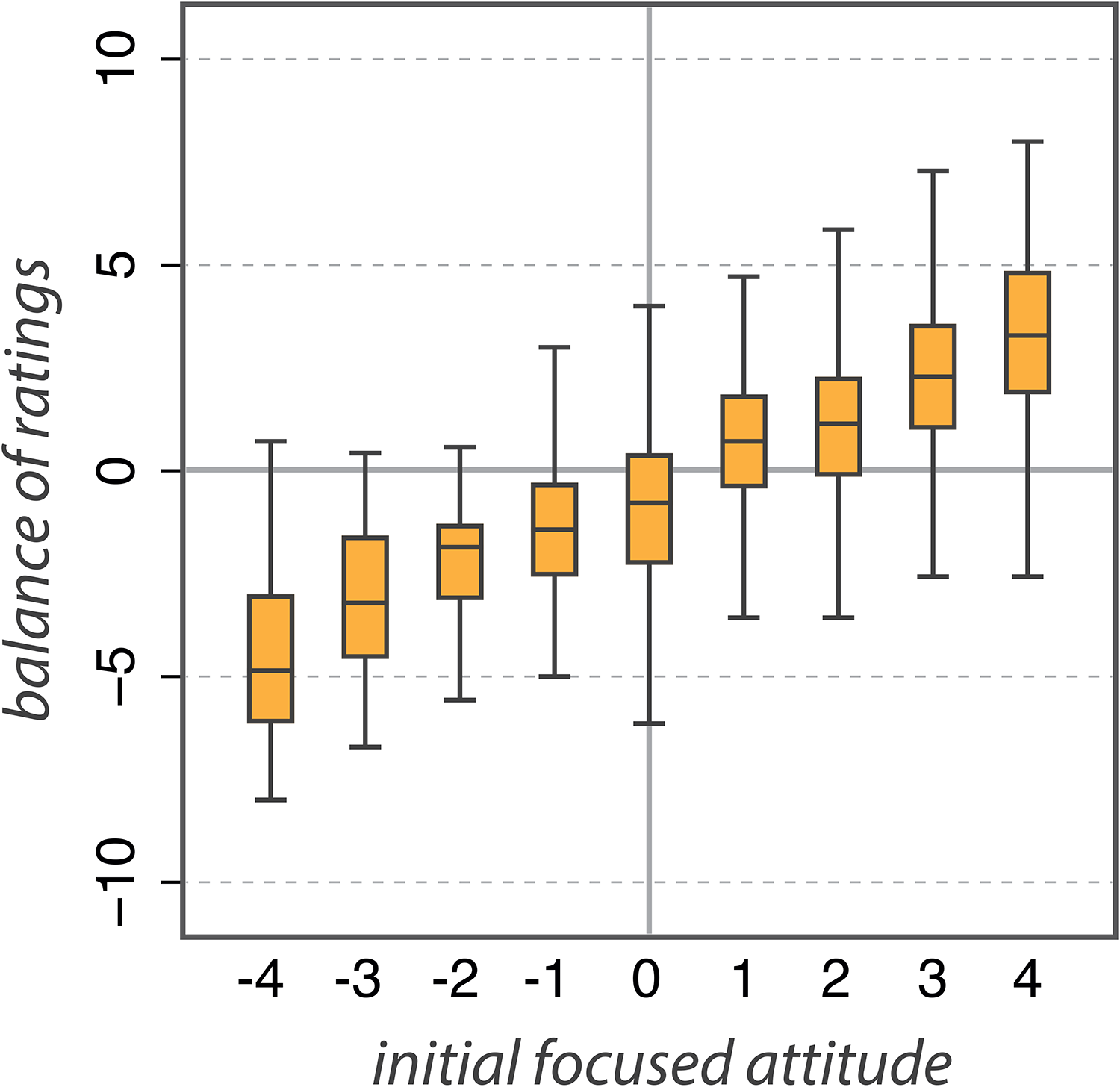
Balance of argument ratings as a function of the initial focused attitude.
While the subjective ratings of argument persuasiveness confirm systematic biases in the evaluation of arguments, it is of great practical concern how the actual attitudes change after exposure to a balanced set of arguments not clearly in favor or against a certain issue. If attitudes become generally more extreme after exposure to balanced information, the use of arguments in a societal debate would likely broaden the gap between supporters and opponents of different energy technologies (cf. Shamon et al., 2019). For this reason, a lot of experimental research has been invested on answering the question whether biased processing implies attitude polarization when subjects are exposed to conflicting arguments but cannot easily be answered on the basis of empirical evidence due to the conceptual and methodological heterogeneity (see the “Introduction” section).
In order to obtain a more nuanced picture of attitude change under conflicting arguments Shamon et al. (2019) suggest to consider dynamics at the individual level by examining transition probabilities conditioned on the initial focused attitude. That is, the patterns of attitude change are considered independently for subjects with a negative, a neutral and a positive initial attitude. Induced attitude changes, in turn, are categorized with respect to polarization (more extreme), persistence (unchanged), and moderation (less extreme). This reveals that both attitude polarization and moderation may occur simultaneously at the individual level and that these effects may average out at the aggregate level of the entire population. While the analysis by Shamon et al. (2019) allows for a more fine-grained understanding of the role of attitude extremity and its impact on biased processing, it still remains puzzling what degree of biased processing is required for the emergence of attitude polarization.
In this article, we bring the analysis of attitude-dependent attitude changes to a higher level of sophistication by deriving a statistical model for the full distribution of conditional attitude change based on cognitive principles. This allows us to vary the strength of biased processing and to determine how well empirically observed attitude changes are matched by a specific value. Starting from the cognitive structure that underlies ACT, we incorporate biased argument adoption and analyze the attitude changes that would be expected under the given experimental conditions (exposure to a balanced set of arguments). We account for the strength of biased processing by a parameter
A Cognitive Model of Biased Argument Processing
Attitude Structure
While the majority of computational opinion models treats the opinion as an atomic unit, argument-based models (Mäs and Flache, 2013; Banisch and Olbrich, 2021) operate with a representation of opinions that takes some degree of cognitive complexity into account. Individuals usually hold concrete or abstract beliefs on attitude objects that imply a positive or negative evaluation of the attitude object and form an important basis for attitudes (Eagly and Chaiken, 1993). The extent to which positive (or negative) connoted beliefs outweigh negative (or positive) beliefs on an attitude object in an individual’s belief system, determines in tendency the valence (positive or negative) and extremity of a person’s attitude. Hence, ignoring this formative structure of attitudes may lead to the fact that essential mechanisms cannot be identified. In ACT, this is, modeled by a set of arguments that support either a positive (pro) or a negative standing (con) towards the issue at question. Agents can either believe and therefore adopt an argument or reject it and the net number of pro- and con-arguments determines the overall attitudinal judgment. That is, an agent’s attitude towards an issue (an electricity production technology in our case) is positive to the extent to which the number of pro-arguments exceeds the number of con-arguments in its belief system. This setting is shown in Figure 3 along with four example argument configurations and the respective attitude.
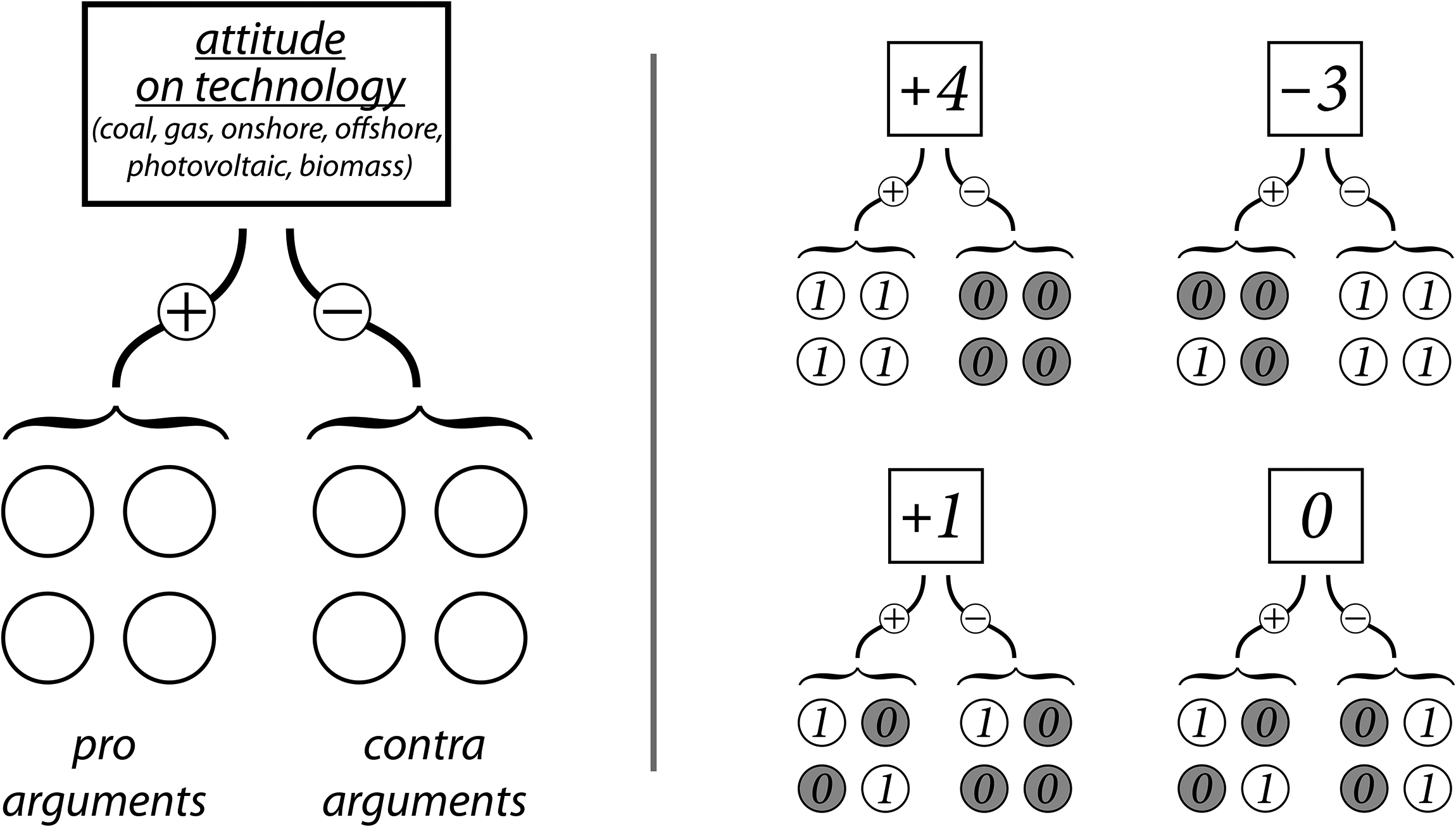
Structure of opinions assumed by agent based models (ACT) (left) and four example configurations (right). Sets of pro- and con-arguments are assumed to underlie the attitudes towards different issues (energy production technologies). Single arguments can either be believed (1) or not (0). The number of pro- and con-arguments that an agent beliefs in determine the attitude towards the focus issue.
Formally, let us denote the number of possible pro- and con-arguments by

Biased Argument Evaluation
The experiment described by Shamon et al. (2019) has revealed a linear relationship between the current attitude and the evaluation of argument persuasiveness (see Figure 2). One explanation for this phenomenon is that persons holding a positive or negative attitude towards an issue are motivated to produce defensive responses to attitude incompatible arguments while they are motivated to produce favorable thoughts on attitude-consistent arguments (Kunda, 1990; Petty and Cacioppo, 1986). This process of biased argument evaluation may be rooted in individuals striving for cognitive coherence (Festinger, 1957; Thagard and Verbeurgt, 1998).
To see this, let us regard the attitude structure described above as a simple cognitive network comprised of beliefs and a single attitude node which are linked by evaluative associations. We can define the coherence of a cognitive configuration made up by a specific argument string


Biased Argument Adoption
If an agent is exposed to a new argument (
We are, however, not rational optimizers of cognitive coherence but largely unconscious processes drive changes in our cognitive system. It would be highly implausible to assume that individuals with a negative attitude will never accept a pro-argument. Biased processing as conceptualized here in terms of a strive for cognitive coherence comes in degrees. To take this into account, we introduce a free parameter

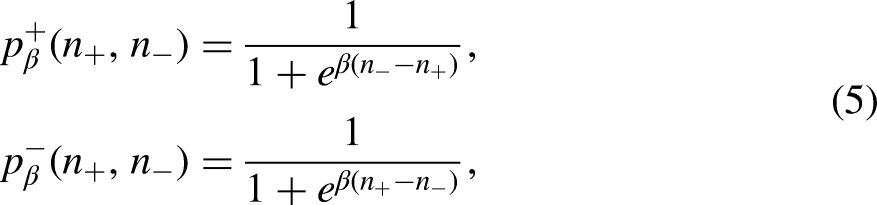
Figure 4 shows the behavior of this probabilistic choice model for the case that an agent is confronted with a con-argument (
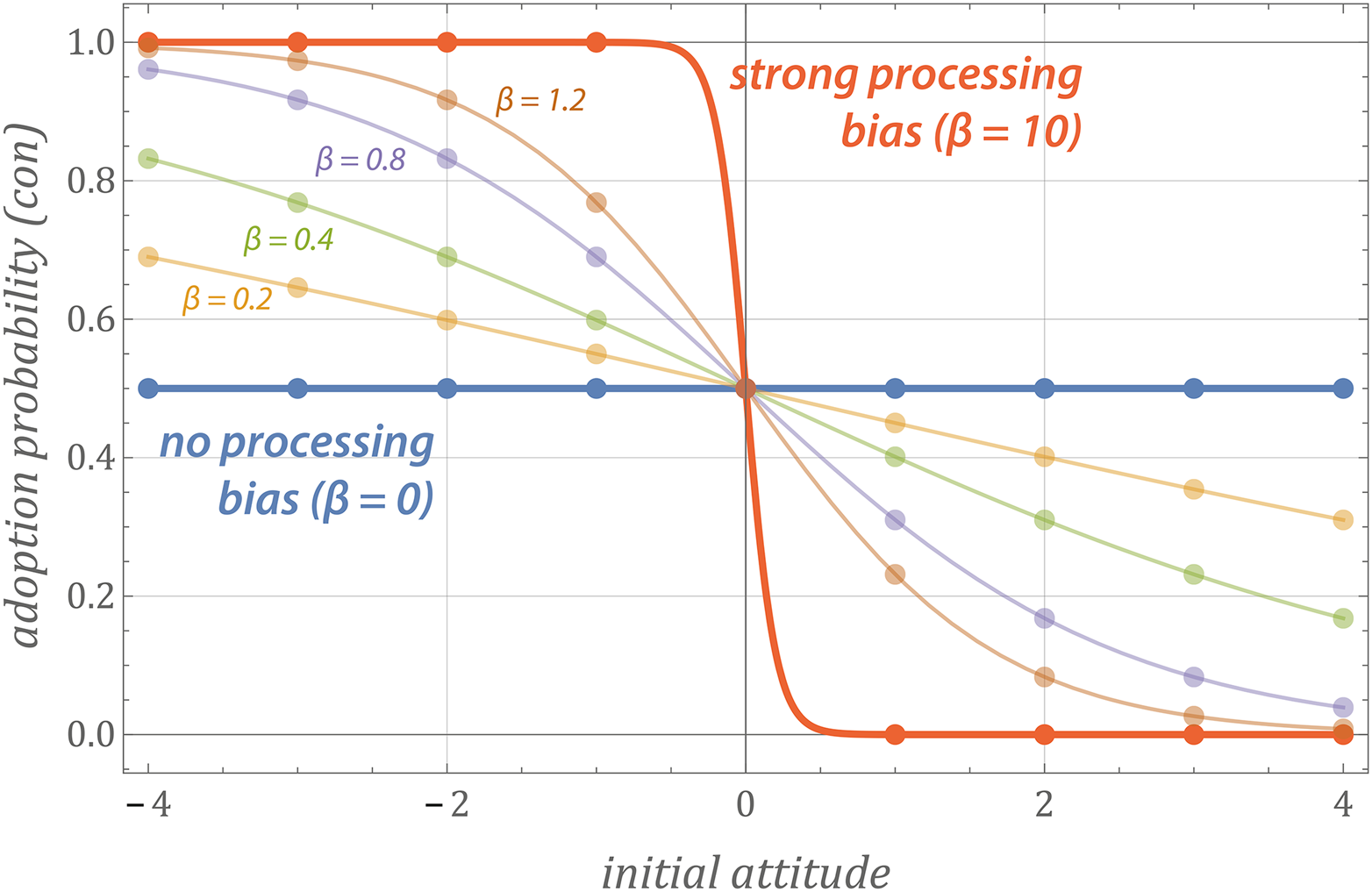
Probability to adopt a con-argument (
Theoretical Implications for the Balanced-Argument Treatment
In this section, we take the perspective of an individual subject. Using the cognitive model of attitude-dependent biased processing described in the previous section, we derive a subject’s expected reactions after exposure to an unbiased set of arguments. This allows a precise characterization of whether attitude polarization or moderation is expected at the individual level by exposure to conflicting arguments as realized in the experiment (see Shamon et al. (2019) and the “Experiment” section).
Expected Attitude Change After Exposure to an Unbiased Set of Arguments
In the experiment (see the “Experiment” section), subjects are confronted with an unbiased set of pro- and con-arguments. Attitudes are measured before and after the treatment and the effect on attitude change is analyzed. In order to relate these experimental findings to the microscopic assumptions about argument exchange in the model, we ask: How would artificial cognitive agents react to the same experimental treatment and what is their expected attitude change? For this purpose, we consider that the opinion structure is comprised of four pro- and con-arguments, respectively (see Figure 3). For further convenience, we shall denote this number by
Let us assume that an agent receives an unbiased set of four pro- and four con-arguments at once. Attitude change may only take place if at least one





Equation (10) characterizes how agents endowed with the cognitive model described in “A cognitive Model of Biased Argument Processing” section would react on average when exposed to an unbiased set of arguments. The artificial treatment for which it has been derived was designed to establish correspondence with the actual treatment in the experiment. We will use this relation to assess the strength of biased processing in the context of energy production technologies in the “Experimental Calibration” section. However, the model also provides more general insight into whether attitude moderation or polarization is expected after exposure to balanced arguments and may hence provide a new perspective on the mixed empirical evidence on that question (Lord, Ross, and Lepper, 1979; Taber and Lodge, 2006; Taber, Cann, and Kucsova, 2009; Druckman and Bolsen, 2011; Corner, Whitmarsh, and Xenias, 2012; Teel et al., 2006; Shamon et al., 2019).
Attitude Moderation Versus Polarization
Figure 5 shows the behavior of the response function (equation [10]) for different values of biased processing
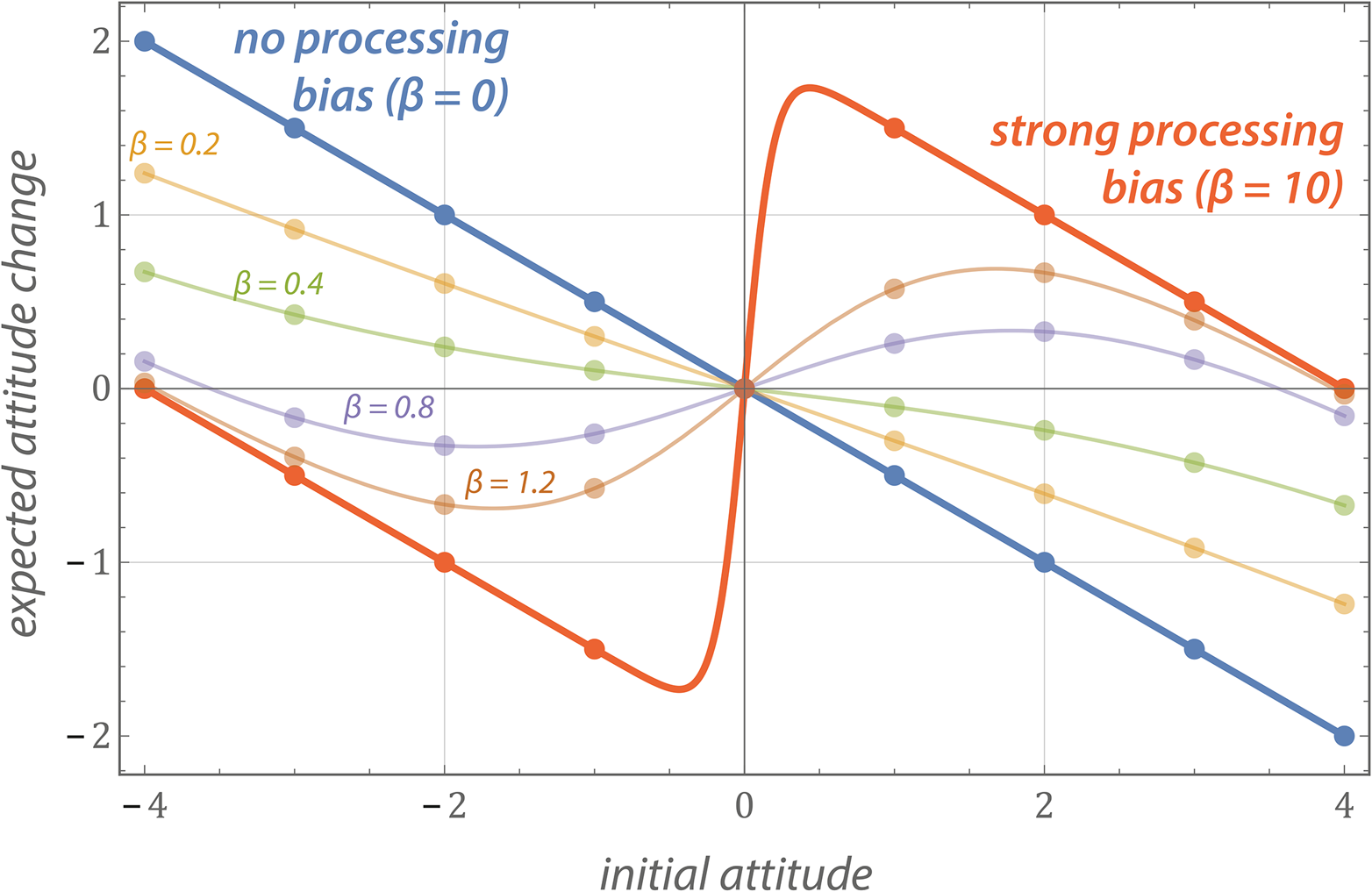
Expected attitude change after exposure to an unbiased set of arguments (
The other limiting case is marked by
This shows that the puzzle of whether attitude polarization or moderation is likely after exposure to balanced arguments becomes a question of how strong the processing bias is for a given topic of interest. increases from
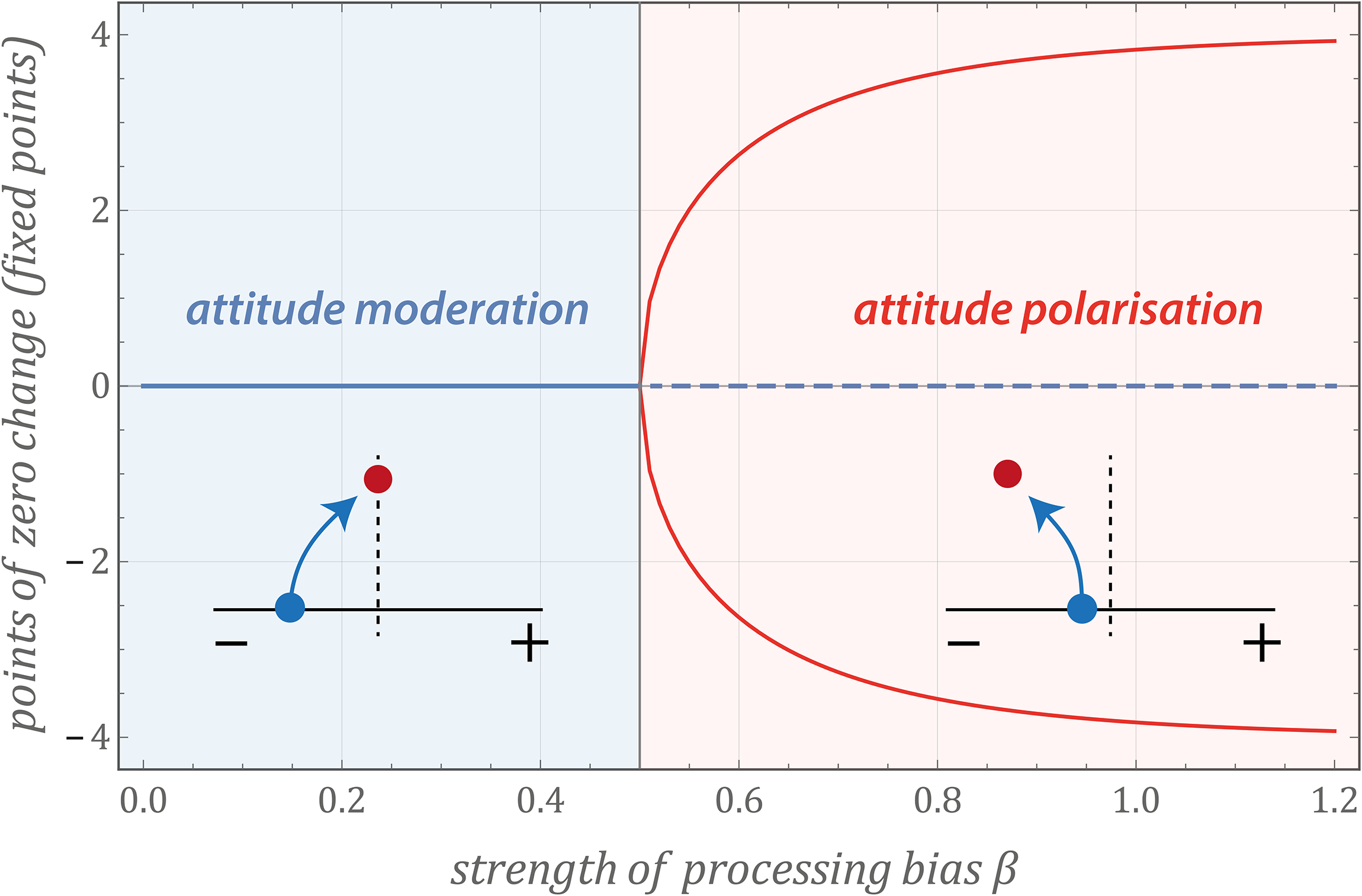
Transition from attitude moderation to attitude polarization as the strength of biased processing (
Experimental Calibration
Overall Assessment
Equation (10) can be viewed as a class of statistical models that predict the expected attitude change after balanced argument exposure given an initial opinion. They are based on the basic assumption of ACT that argument assimilation drives opinion change. Consequently, the free parameter
In order to assess which bias

In order to identify the optimal
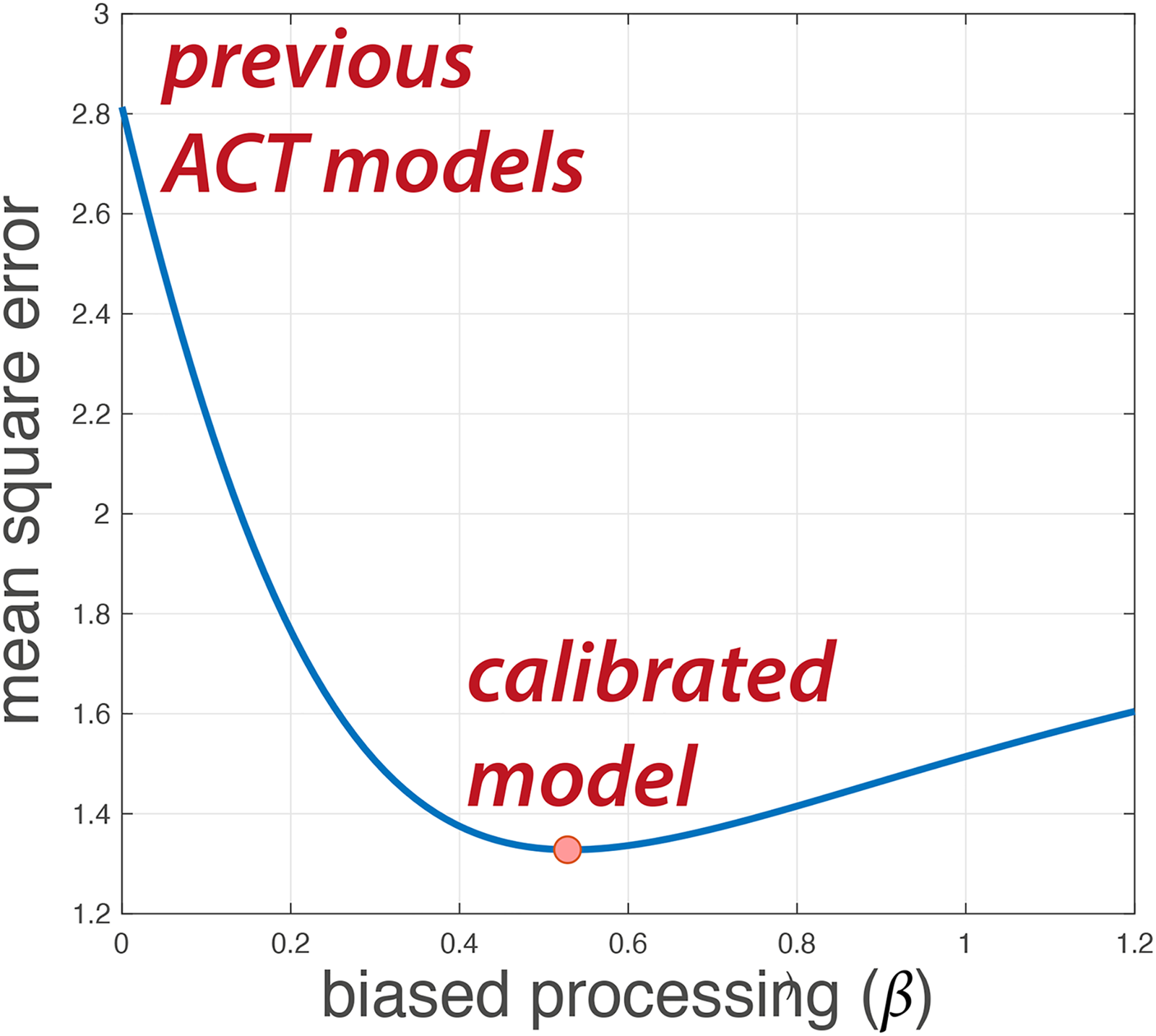
Mean squared error (MSE) between the argument adoption model and the experimental data on attitude change as a function of biased processing strength (
On the whole, we have data on
Differences Across Issues
Our theoretical considerations in the “Theoretical Implications for the Balanced-Argument Treatment” section have revealed a transition from attitude moderation to polarization when the strength of biased processing crosses a critical value
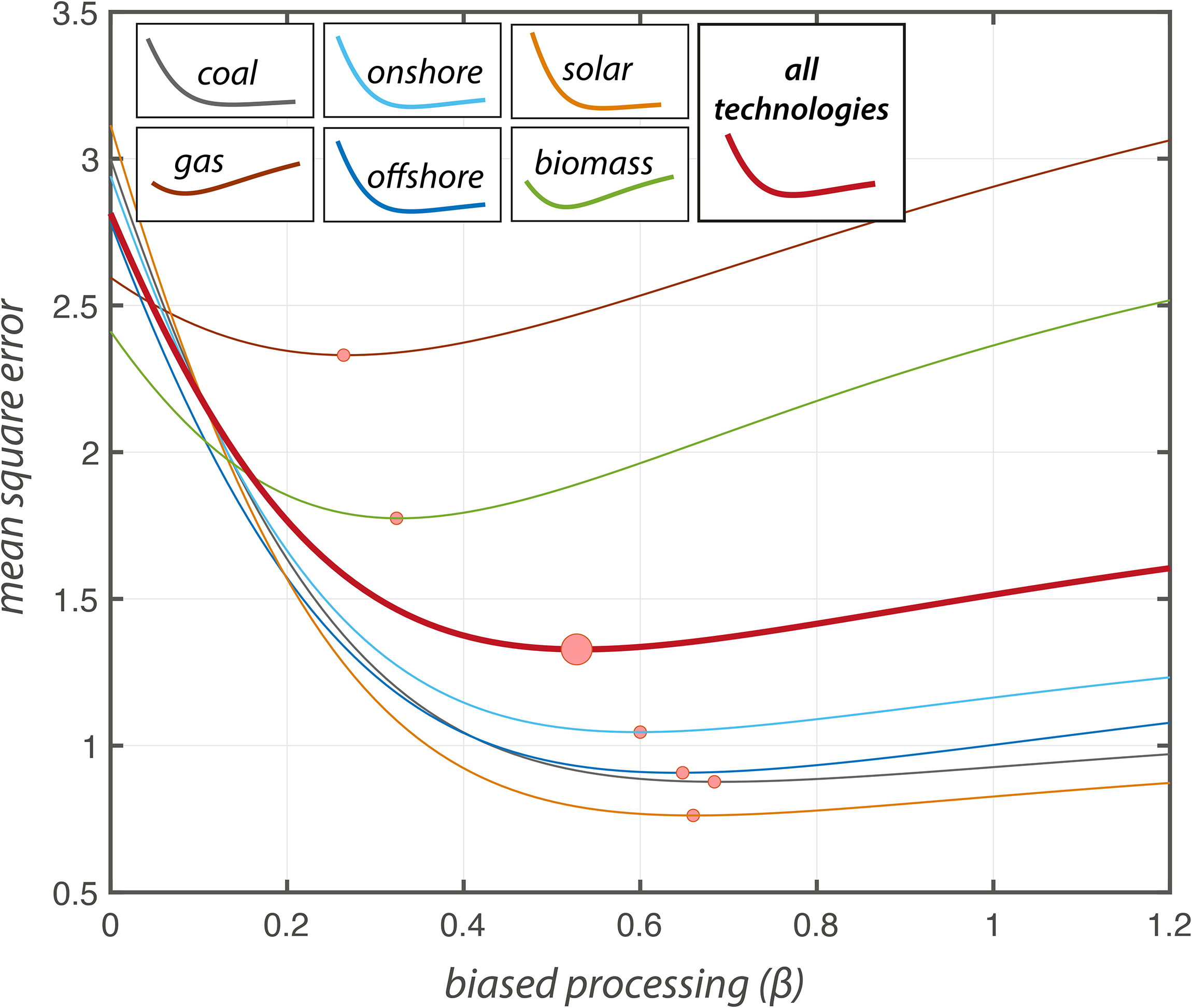
Mean squared error between the argument adoption model and the experimental data on attitude change as a function of biased processing strength (
This comparison reveals, first of all, a similar qualitative trend for all technologies with an optimal fit at non-zero
Notice that the analysis does not inform us about the “best” model to explain the experimental data. We have only identified the best model within the class of models defined by
Collective Deliberation With Biased Processing
Argument communication models describe processes of collective attitude formation as repeated social exchange of arguments. An artificial population of agents is generated with an initial endowment of random argument strings. These agents are connected in a social network from which pairs of neighboring agents are drawn at each time step. One agent acts as a sender
Previous work (Mäs and Flache, 2013) has shown that ACT can explain collective bi-polarization if individuals have a strong tendency to interact with similar others (homophily). In this section, we show that interaction homophily is not necessary for collective bi-polarization. Biased processing alone can lead to persistent collective states in which one group of agents strongly supports a proposition whereas another group strongly opposes it.
Modeling Collective Argument Exchange
In the model all agents are paired at random ( for each pair, the sender the receiver adopts that argument with a probability defined by all agents chosen as a receiver in this round update their opinion based on their new argument string.
After this is done for all pairs of agents, a new round starts with another random pairing of the population.
Figure 9 illustrates the interaction between the sender and the receiver entering the process with a specific argument set. The sender is strongly in favor of an issue (e.g., an energy technology) believing in all four pro-arguments and rejecting all con-arguments (
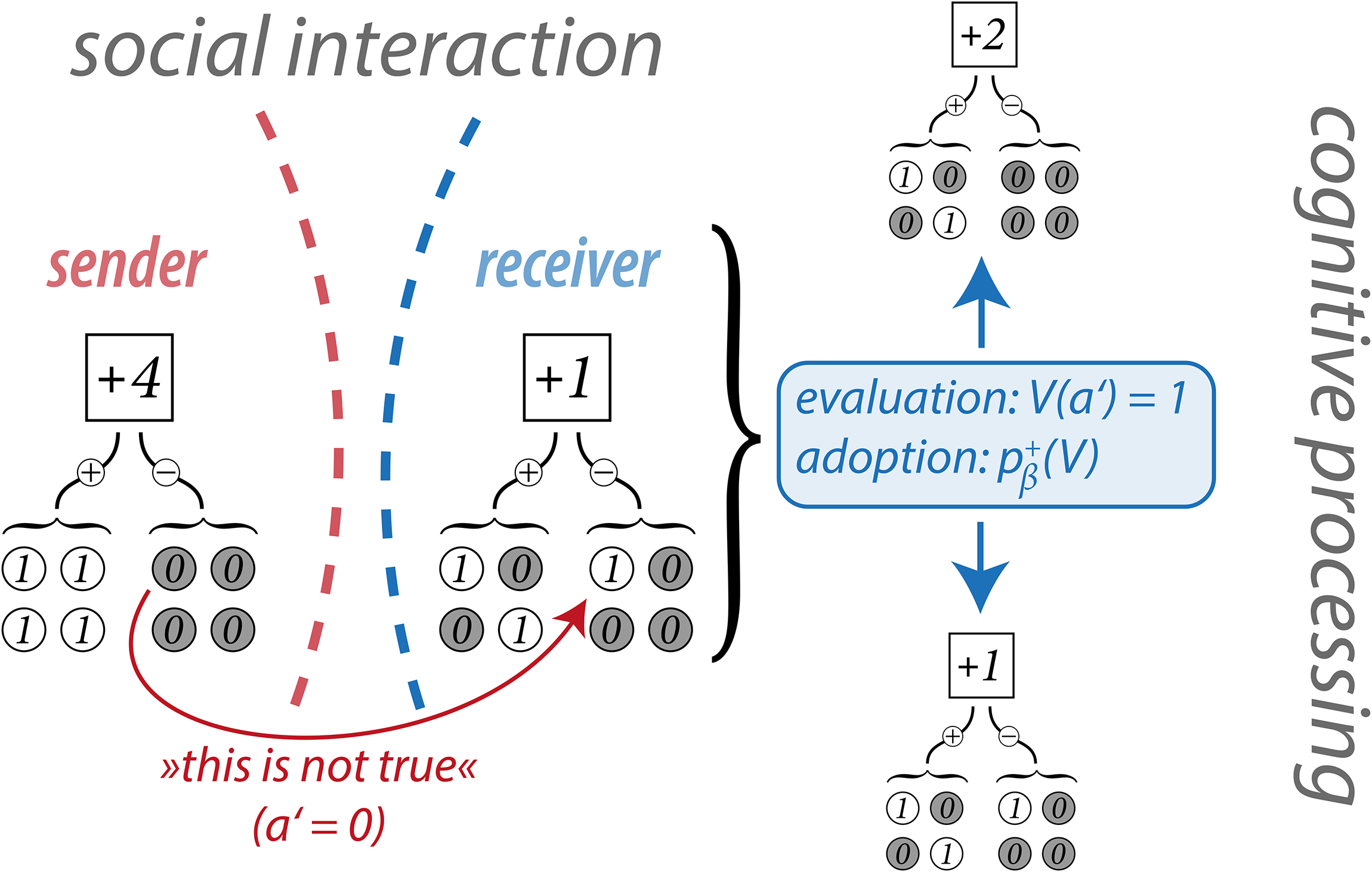
Illustration of the interaction between a sender and a receiver.
Notice that our model deviates in an important aspect from the model by Mäs and Flache (2013). While we assume that agents are aware of all existing arguments but may consider them irrelevant, Mäs and Flache (2013) assume that there are many arguments and agents consider a salient subset of them when they form their opinion. Banisch and Olbrich (2021) have shown that the main effect—bi-polarization in the presence of strong homophily—is not sensitive to these different choices. The guiding principle for model development in this article has been to align as much as possible with the experimental setting which motivated the use of a relatively small set of four pro- and four con-arguments.
Model Phenomenology
The model can give rise to a variety of collective phenomena. In order to provide intuition about its dynamical behavior and to characterize the collective opinion processes that follow from different processing biases, we first look at a series of paradigmatic model realizations. Figure 10 shows four individual realizations of the model with increasing
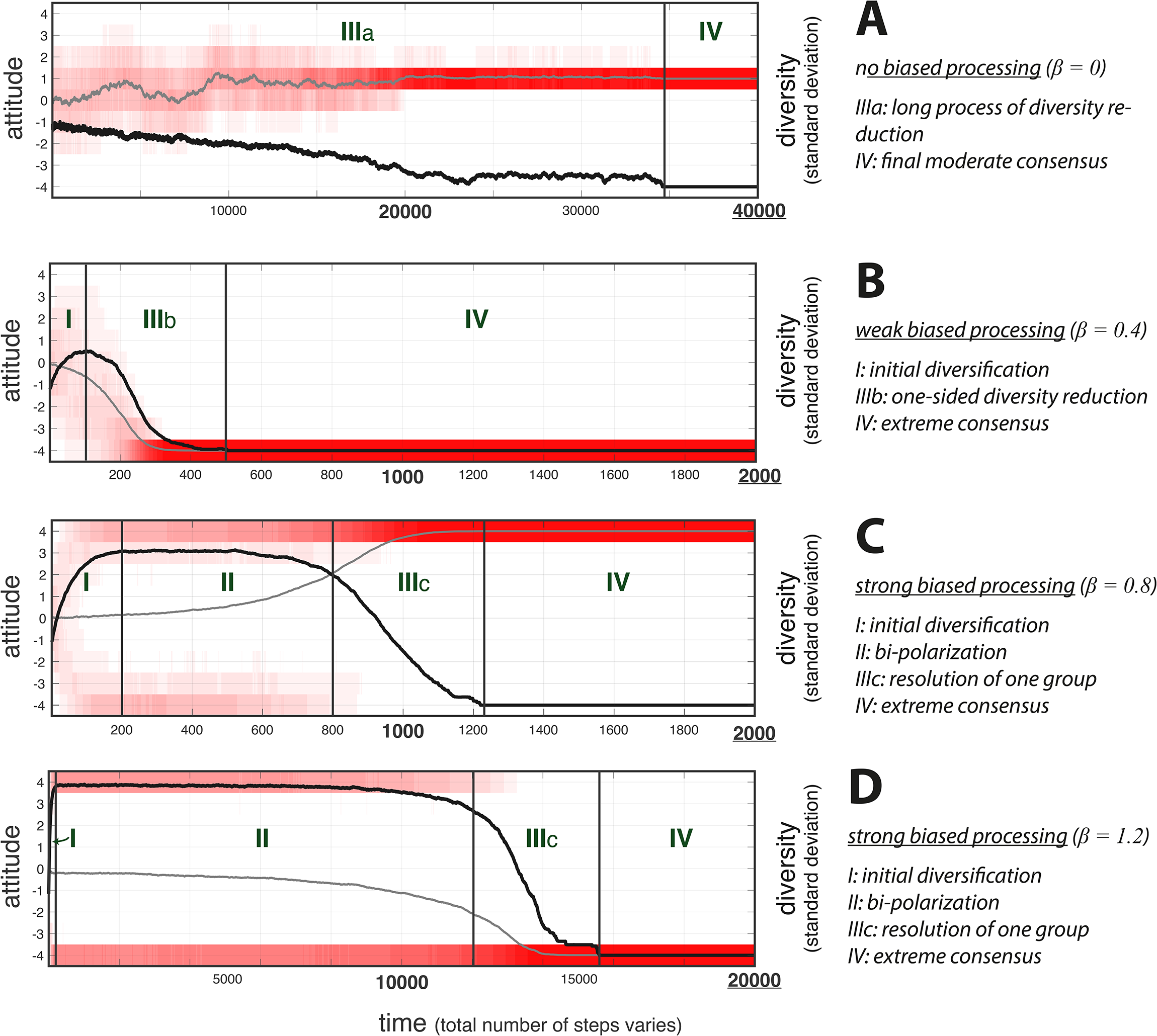
Four paradigmatic model realizations for different levels of biased processing from
Panel A shows the behavior of the model in the absence of biased processing (
Panel B shows the effects of weak biased processing on the argument exchange process (
If biased processing becomes larger (panels C and D) and crosses the critical value of
The phenomenological view that has been provided in this section aimed to convey basic intuition about the collective processes that emerge when biased processing is incorporated into argument communication models. We have found that two remarkable transitions take place as the strength of the bias increases. First, by the incorporation of a small processing bias, moderate consensus is no longer a stable outcome of the ACT models because the system quickly approaches a consensus at the extremes of the attitude scale. From the perspective of a group that faces a decision problem, weak biased processing hence enables a rather efficient group decision process. Second, as biased processing increases, the system may enter a meta-stable collective regime of bi-polarization with two groups of agents one strongly in favor and another one strongly against an issue (e.g., an energy technology). This conflictual state becomes persistent as biased processing increases. Strong biased processing hence leads to a suboptimal group decision process as the group will need an extremely long time to arrive at a shared conclusion. We will provide a more detailed analysis of these two transitions in the following two sections.
First Transition: Weak Biased Processing Leads to Fast Collective Decisions
As shown in Figure 10,
Figure 11 shows the mean convergence time and the respective distribution over 100 runs on a logarithmic scale. Minimal and maximal values are shown by the thin lines. While it takes on average 5,000 steps to convergence for
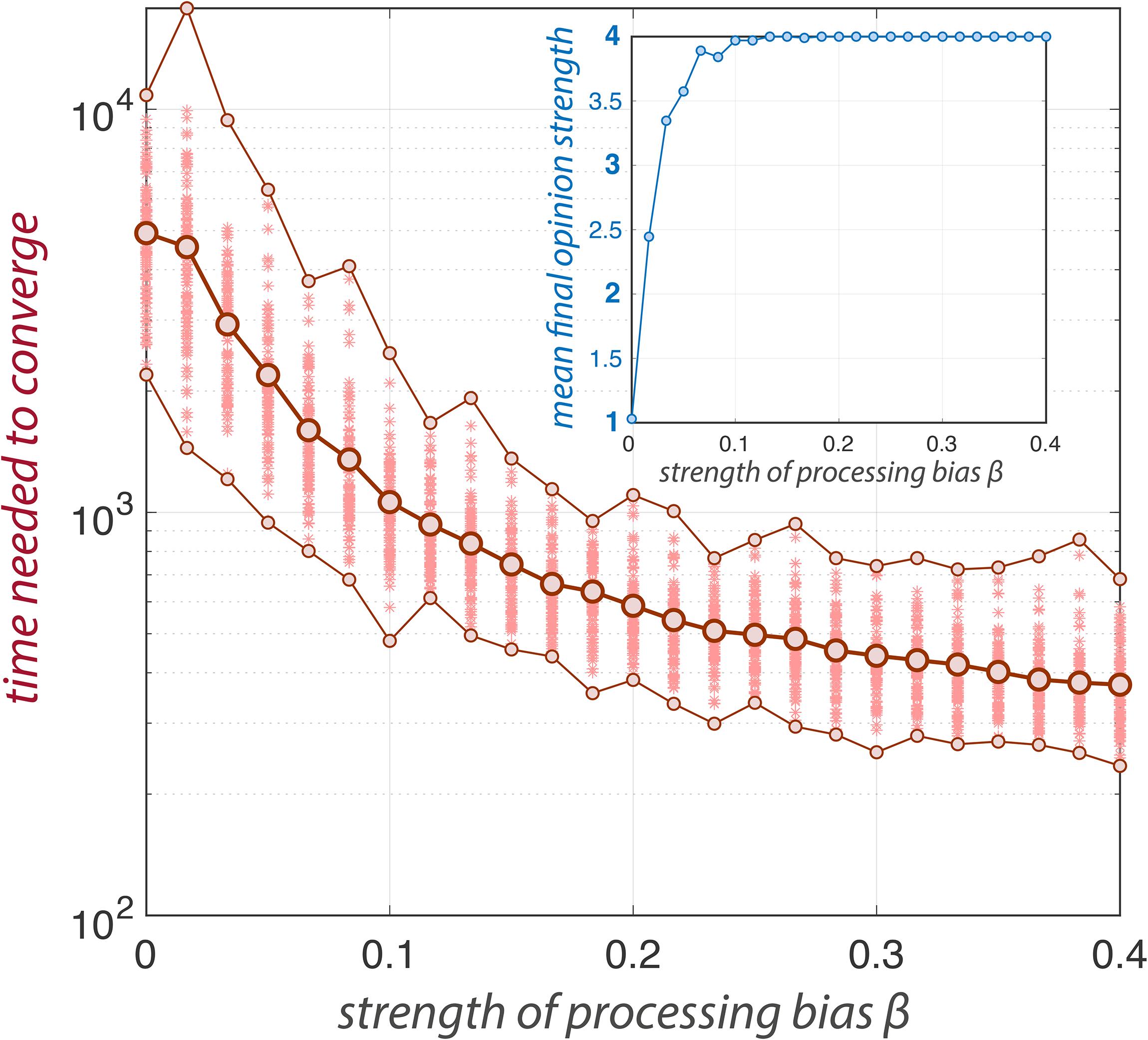
Time to reach a stable consensus profile as a function of
We conclude that the inclusion of biased processing drastically affects the collective-level predictions of the ACT models. Even under very weak processing biases, moderate consensus is no longer a stable outcome of the model. Instead we observe quick convergence to one of the ends of the opinion spectrum where the entire group is strongly in favor or disfavor of the attitude object. Hence, while groups without processing bias may remain in indecision for a long time not clearly favoring one side over the other, even small biases lead to a fast decision process with a clear outcome. This has implications for previous theoretical work using ACT (Mäs et al., 2013; Feliciani, Flache, and Mäs, 2020) and points towards an evolutionary function of biased processing at the group level. We will discuss both points in the concluding part of the article.
Second Transition: Strong Biased Processing Leads to Persistent Intra-Group Conflict
The phenomenological analysis in the “Model Phenomenology” section shows that the biased processing alone may lead to a state of collective bi-polarization that persists over a long period of time. As biased processing increases, the collective behavior of the model undergoes a second transition from a regime of fast collective choice shift to a regime where enduring collective disagreement becomes likely. Considering the initial periods (I) in Figure 10 suggests that the emergence of the disagreement regime rests on whether biased processing is strong enough to sustain attitude polarization at the individual level. That is, we expect that collective opinion polarization becomes possible as
In order to systematically compare sets of model realizations regarding their potential to create collective polarization, we have to identify if a model trajectory has entered phase II in Figure 10. Many measures of opinion polarization have been conceived (see Bramson et al. (2016) for an overview), and we define a conservative heuristic that captures the most important aspects. We say that a system configuration is in phase II if the proportion of agents with extreme opinions on both sides of the opinion spectrum is larger than the proportion of agents with an opinion in between the two extremes. To be precise, we split the opinion interval into three and count the number of agents with opinions
In the computational experiment, we run a series of 100 realizations of
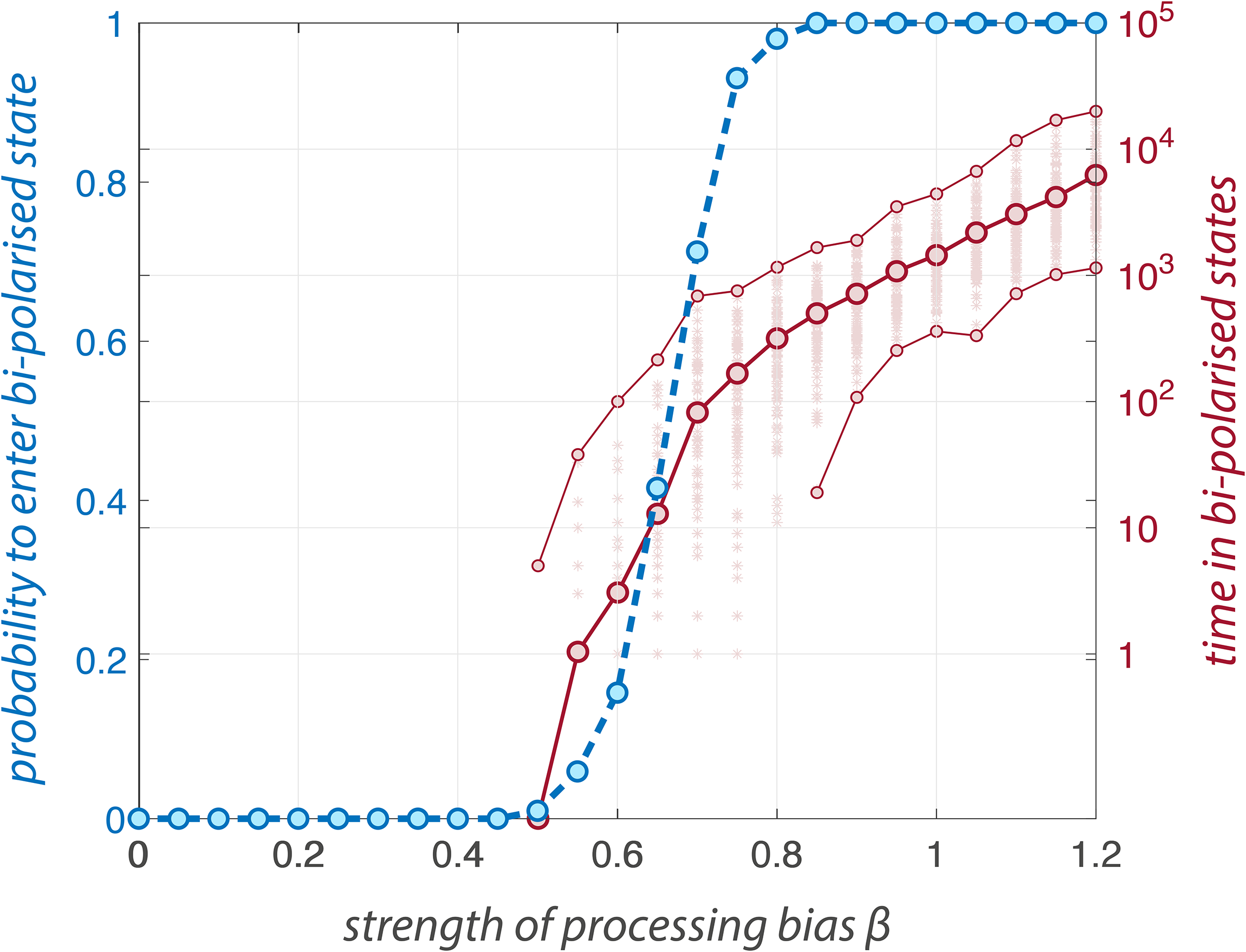
Probability that a system enters a state of collective polarization (dashed blue curve) and the time it remains in such a state (solid red curve) as a function of biased processing
The blue curve shows the relative number of model runs which resulted in at least one temporal configuration that satisfies our polarization conditions. The red curves show the respective number of time steps that a polarized state persisted for all 100 model runs highlighting the mean as well as the minimal and maximal values. Notice the logarithmic scale on the right hand side of Figure 12. The regime
It is worth noting that at this point, a period of persistent bi-polarization is likely to (i) transform the social organization of groups around opinion (homophily), may (ii) lead to the emergence of symbolic leaders promoting group opinion (group identity), and (iii) antagonistic relations across the groups (social polarization). These processes are not integrated into the model, but they would all favor further persistence of collective polarization once such a pattern has emerged. Our model shows that biased processing alone may be sufficient for the formation of camps that strongly support competing opinions.
Influence of Opinion Homophily
One of the most prevailing assumptions in opinion dynamics is that the interaction probability between two agents depends on the similarity of their opinions (Axelrod, 1997; Hegselmann et al., 2002; Deffuant et al., 2000; Banisch and Araujo, 2010). In previous ACT models (Mäs and Flache, 2013; Feliciani, Flache, and Mäs, 2020; Banisch and Olbrich, 2021), this homophily principle is considered the main mechanism responsible for collective bi-polarization. As all previous ACT studies draw on homophily, it is important to understand the interplay of biased processing and homophily within this theoretical framework.
There are different ways to integrate opinion homophily into opinion dynamics models and ACT in particular. First, opinion homophily may by implemented as the tendency to select similar interaction partners (e.g., Carley, 1991; Axelrod, 1997; Mäs and Flache, 2013) or the strength of social influence (Macy et al., 2003; Flache and Macy, 2011). Secondly, this similarity bias may be defined in absolute terms between pairs of opinions (Deffuant et al., 2000; Banisch and Olbrich, 2021) or relative to the entire population such that close partners are selected with a higher probability (Carley, 1991; Mäs and Flache, 2013). While the ACT model of Mäs and Flache (2013) proposes to operationalize homophily in relative terms as biased partner selection assuming that the opinions of all other agents are known, Banisch and Olbrich (2021) follow the tradition of bounded confidence models (Hegselmann et al., 2002; Deffuant et al., 2000) and use a threshold on the opinion difference for a given pair of agents. We adopt the latter approach here and assume that argument exchange takes place only if the opinion distance is below a certain threshold value. 8
To analyze the impact of homophily in the refined ACT model a series of 100 simulations with
In Figure 13, the results are shown for three different values of the similarity threshold. In our model attitude lie on a 9-point scale from
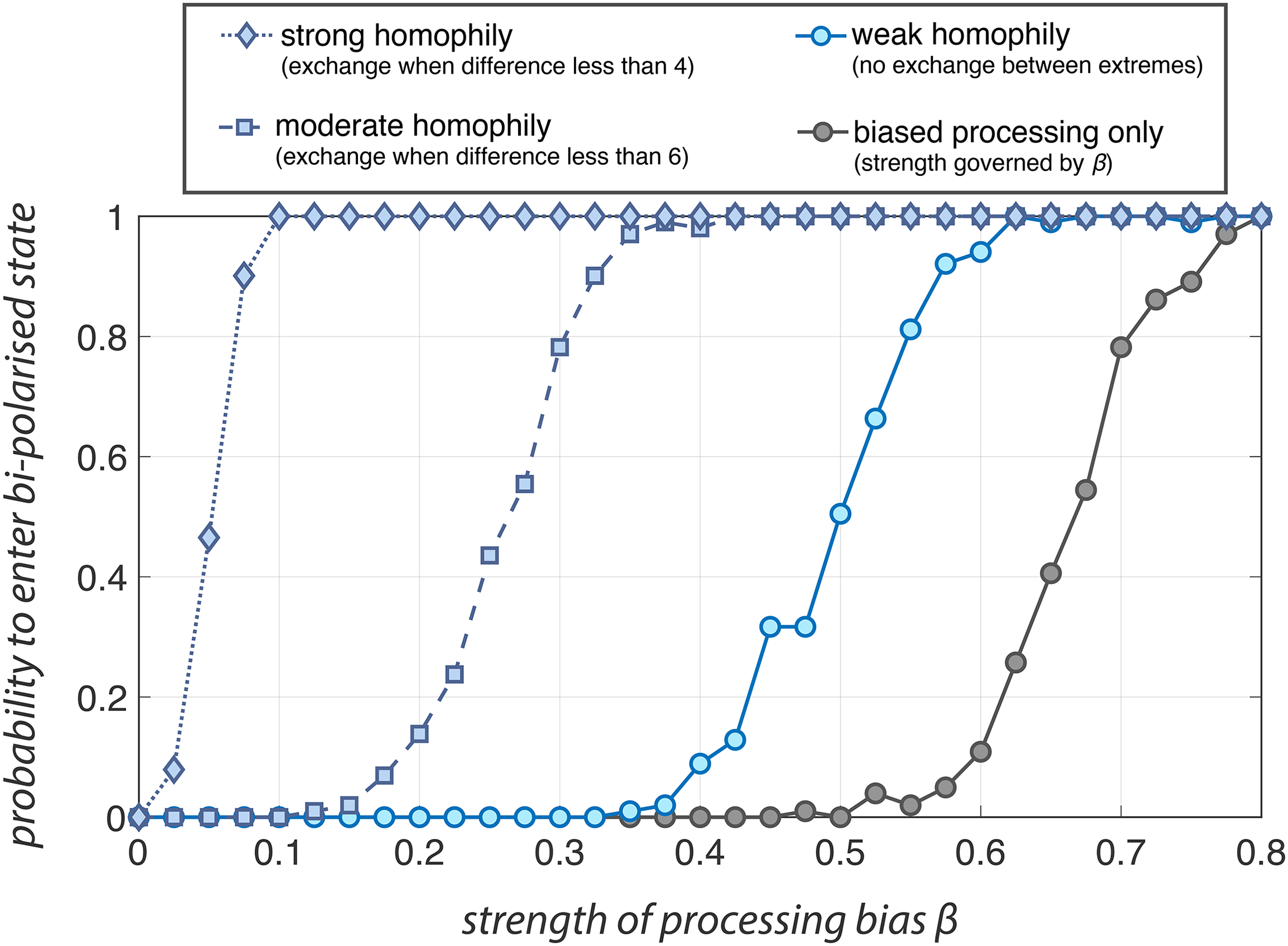
Probability that a system enters a state of collective polarization for different levels of biased processing and different levels of homophily. Results are based on 100 realizations with
The analysis shows that homophily makes polarization the most likely outcome of the collective process at significantly lower levels of biased processing. Notably, group-level polarization can now emerge in the regime of individual-level attitude moderation
From the perspective of previous ACT models approximated by
Concluding Remarks
We conclude this article by a summary and a brief discussion of its main contributions:
The article presents a novel approach to combine an empirical experiment on argument persuasion with a computational theory of collective deliberation to investigate the emergent phenomenon of opinion polarization processes. It demonstrates that the theoretical framework of ACT can not only explain different dynamical phenomena in collective deliberation (Mäs and Flache, 2013; Mäs et al., 2013; Feliciani, Flache, and Mäs, 2020; Banisch and Olbrich, 2021), but also provides a useful cognitive infrastructure to computationally map real experimental treatment. Starting from the theory, we develop a cognitively grounded statistical devise to assess the extent to which biased processing is involved in the experimentally observed attitude changes induced by conflicting but balanced arguments. We find that biased processing is relevant and improves the micro-level validity of argument-based models employed in the theory. With this coherent account bridging from experiments in Social Psychology to sociological models of collective opinion processes our work contributes to the major challenge of grounding social influence models rigorously in experimental data (cf. Flache et al., 2017; Lorenz, Neumann, and Schröder, 2021), and proves ACT a useful candidate for achieving such an empirically more solid connection. Following this program, we are able to clarify the relation between biased processing and attitude polarization at the individual level which has remained puzzling given the diverging empirical evidence through different persuasion experiments (cf. Corner, Whitmarsh, and Xenias, 2012; Shamon et al., 2019). Here, we tackle this question from the point of view of computational agents employed in ACT and analyze how these cognitive agents would change opinions in a virtual experiment that matches closely to the real treatment. The theoretical response function for the expected attitude change derived from that contains the strength of biased processing ( Our empirical results concerning attitudes on electricity generating technologies show that the method advanced in this paper can provide a more refined, domain-specific understanding because it allows to measure the extent to which subjects engage in biased processing. On the entire data set, we find a clear signature of moderate biased processing at the margin of moderation and polarization. The independent analysis of the six groups that received arguments with respect to six different technologies reveals remarkable differences across topics. While the processing bias is in the regime of attitude moderation for gas and biomass, it is significantly higher and in the regime of polarization for coal, wind (onshore and offshore) as well as solar power. One possible explanation for this systematic differences is that beliefs on gas and biomass are less settled compared to the other four technologies and that beliefs regarding the latter are more strongly organized into coherent systems of beliefs (Converse, 1964). The identification of the processing bias The analysis of the collective-level implications of our refined model shows that the incorporation of biased processing has tremendous effects on the predictions of ACT regarding the evolution of opinions within a group or a population. We observe two transitions. First, and somewhat surprisingly, weak biased processing accelerates group decision processes by orders of magnitude. While a group remains in a long period of indecision—not clearly favoring one option over the other—in previous models without bias, weak levels of biased processing quickly lead to a state in which all members jointly support one option. A second transition occurs if biased processing increases. Under strong biased processing the argument model leads to a persistent conflictual state of subgroup polarization. Our study hence shows that biased processing alone is sufficient for the emergence of collective bi-polarization. While the original model by Mäs and Flache (2013) has shown that polarization is possible under positive social influence if homophily is strong enough, our work shows that preferences for interaction with like-minded others are not necessary either. With that our work adds to the growing body of literature on mechanisms that contribute to societal polarization (see Flache et al., 2017; Banisch and Olbrich, 2019: and references therein). Moreover, while empirical plausibility of inter-personal mechanisms of negative influence has been challenged (Takács, Flache, and Mäs, 2016), there is ample empirical evidence for the intra-personal mechanism of biased information processing that is at the core of our model. The experiment analyzed in this article further provides convincing empirical ground for the microscopic validity of this mechanism.
In this article, we concentrated on the effects of biased processing on individual attitude change and the resulting dynamics of collective opinion formation. There are many other social and cognitive mechanisms that are relevant for a better understanding of polarization dynamics which could be included into our model. As opinion homophily is a prevailing assumption in other models (Axelrod, 1997; Hegselmann et al., 2002; Flache et al., 2017) and ACT in particular (Mäs and Flache, 2013; Feliciani, Flache, and Mäs, 2020; Banisch and Olbrich, 2021), we have briefly addressed the interplay of biased processing and homophily, but refrained from incorporating further factors to keep the analysis clear and easy to interpret (see Lorenz, Neumann, and Schröder (2021) for recent work including quite a series of other factors). The incorporation of homophily has been based on a simple threshold model of “bounded confidence” (Hegselmann et al., 2002) and we showed even under the weakest threshold value cutting off interaction between the extremes the transient polarization pattern becomes stable. In this final part of the article, we will discuss other factors that accelerate polarization in the setting of ACT.
In the context of the climate change debate, ample empirical evidence on biased information processing has been gathered in recent years. The experiment on which our analysis is relying (Shamon et al., 2019) addresses the issue at the level of specific arguments providing a specific but at the same time systematic picture of how attitude extremity and direction impact biased processing. Another type of empirical evidence comes from a series of communication studies addressing the impact of selective media exposure in the climate change debate (Feldman, 2011; Hart and Nisbet, 2012; Nisbet, Cooper, and Garrett, 2015; Stroud, 2017; Newman, Nisbet, and Nisbet, 2018). While it is long known that ideological affiliation is an important driver for media choice (Lazarsfeld, Berelson, and Gaudet, 1944), a more refined picture of the interplay of attitudes and media choices has been obtained within the “reinforcing spirals framework” (Slater, 2007; Feldman et al., 2014). This theory posits a reinforcing feedback between selective media choice and biased information processing which over time increases informational fragmentation and opinion polarization. In future work, we will integrate selective exposure into our model to analyze the polarization potential of selective exposure in the presence of biased argument processing. Moreover, the reinforcing spirals model does not yet account for interpersonal influences (Feldman et al., 2014: 606). An operationalization within ACT overcomes this deficiency and provides a cognitive foundation that may proof useful to further disentangle the effects of biased processing, social influence, and selective media exposure.
While biased processing focuses on the perception and processing of information once individuals are exposed to a message, it seems reasonable to assume that people also tend to communicate arguments that are congruent with their opinion. Incorporating “biased argumentation” into our model is rather straightforward and could be based on the procedure that now governs argument adoption (equation [5]). That is, the probability to communicate congruent arguments is biased with a certain strength, say
A promising direction for future research is the incorporation of more cognitive complexity into the model. Issues and arguments are not independent from one another: certain claims may support or attack other arguments to form complex systems of beliefs (Converse, 1964; Dalege et al., 2016; Boutyline and Soter, 2021; Taillandier, Salliou, and Thomopoulos, 2021). The cognitive agent model used in this article has been derived from the principles of cognitive coherence affecting the evaluative part
A series of further interesting questions for model analyzes relates to the incorporation of more agent heterogeneity, the actual tenet of agent-based modeling. First of all, our model assumes that social interaction is completely random. While random mixing might be a plausible assumption in small group discussions, it is no longer plausible for larger populations where social networks typically exhibit considerable degree heterogeneity, local clustering, and community structure (Wasserman and Faust, 1994; Newman, Watts, and Strogatz, 2002; Borgatti et al., 2009). On modular networks with weak ties across cohesive communities we would observe bi-polarization within the subgroups if the bias
A second type of heterogeneity that deserves further analysis is heterogeneity with respect to the strength of biased processing and the underlying networks of cognitive-affective associations. We have tested the effect of drawing individual
Finally, this work inspires new thought about the potential evolutionary origins of biased information processing. Groups often face situations in which cohesive action is needed and where choosing any out of a set of alternatives is better than taking no action at all. We found that a certain level of biased processing is very efficient from the group perspective in this specific sense. For a value close to the critical
All in all, this article shows that biased processing increases the micro-validity of ACT and has a strong impact on its macro-level predictions. Future work has to clarify whether previous conclusions drawing on the theory still hold after our empirical refinement.
Footnotes
Acknowledgments
Thanks to Stefan Westermann for pointing at the bifurcation analysis in the “Theoretical implications for the balanced-argument treatment” section. We also thank three anonymous SMR reviewers for their constructive comments and suggestions. The study was presented at different conferences including the 7th International Conference on Computational Social Science IC2S2 (07/2021), the 41st Congress of the German Sociological Association (09/2022), and the annual meeting of the German Physical Society (09/2022). We thank the participants of these events for their valuable feedback. This project has received funding from the European Union’s Horizon 2020 research and innovation programme under grant agreement No. 732942 (Odycceus—Opinion Dynamics and Cultural Conflict in European Spaces).
Author’s note
Supplementary material for the reproduction of all analyses in this article is available on the Open Science Framework under https://osf.io/5tz6g/. An online version of the ABM and a video presenting the project are available at the first author’s web site (http://universecity.de/demos/ModelExplorer.htmlonline demo and http://universecity.de/files/biasedprocessingandpolarization.webmvideo). Earlier versions of this article have been published in 2021 as an https://papers.ssrn.com/sol3/papers.cfm?abstract˙id=3895117SSRN preprint and as an updated  arXiv preprint.
Declaration of Conflicting Interests
The author(s) declared no potential conflicts of interest with respect to the research, authorship, and/or publication of this article.
Funding
The author(s) disclosed receipt of the following financial support for the research, authorship, and/or publication of this article.