




Abstract
Many sociological theories make critically different macropredictions when their microassumptions are implemented stochastically rather than deterministically. Deviations from individuals’ behavioral patterns described by microtheories can spark cascades that change macrooutcomes, even when deviations are rare and random. With two experiments, we empirically tested whether macrophenomena can be critically shaped by random deviations. Ninety-six percent of participants’ decisions were in line with a deterministic theory of bounded rationality. Despite this impressive microlevel accuracy, the deterministic model failed to predict the observed macrooutcomes. However, a stochastic version of the same microtheory largely improved macropredictions. The stochastic model also correctly predicted the conditions under which deviations mattered. Results also supported the hypothesis that nonrandom deviations can result in fundamentally different macrooutcomes than random deviations. In conclusion, we echo the warning that deterministic microtheories can be misleading. Our findings show that taking into account deviations in sociological theories can improve explanations and predictions.
Keywords
Contemporary sociology has an ambivalent relationship with the concept of randomness. On the one hand, randomness is an integral part of statistical models, where commonly the biggest part of a dependent variable’s variance remains unexplained and is therefore assumed to be random. Sociological theory, on the other hand, has been criticized for often neglecting that at least parts of human behavior deviates from the general patterns that theories describe (Macy and Tsvetkova 2015). This deterministic approach to sociological theory is problematic because a theory “in which individual behavior is completely determined, flawlessly executed, entirely knowable, and perfectly predictable is not only empirically implausible, it can also be highly misleading” (Macy and Tsvetkova 2015:324). Deviations from general behavioral patterns of individuals are of potentially critical importance whenever individuals do not act in isolation but react to each others’ action. In such settings, deviations can lead to behavioral reactions in actors’ social environment, which can, in turn, motivate further behavior changes. Formal models demonstrated that such chains of reaction can have profound impact on the collective level, even though they might have been sparked by a random and rare event on the individual level.
Unlike in sociology, random deviations are basic building blocks of theoretical models in other disciplines that study systems with a micro–macro structure, such as physics (Nicolis et al. 1977), chemistry (Pomeau 1986), biology (Camazine et al. 2001), traffic research (Treiber, Hennecke, and Helbing 2000), cognitive science (Rabinovich et al. 2008), and economics (Binmore and Samuelson 1999; Selten 1975; Harsanyi and Selten 1988). A very prominent example are theories of biological evolution, where random mutations in the genes of individuals generate the biological variation that species need to adapt to changes in their environment. Similarly, the random microscopic motion of particles (temperature) is a key ingredient of models of turbulent fluid flows and the kinetic theory of gases (Nicolis et al. 1977).
A growing body of formal modeling work demonstrates that deviations can also change predictions of theories explaining sociological phenomena such as social norms (Young 2015), conventions (Young 1993), opinion polarization (Mäs, Flache, and Helbing 2010; Pineda, Toral, and Hernandez-Garcia 2009), cultural assimilation (Huckfeldt, Johnson, and Sprague 2004; Klemm et al. 2003), residential segregation (van de Rijt, Siegel, and Macy 2009), social classes (Axtell, Epstein, and Young 2000), collective behavior (Granovetter 1978), and the production of public goods (Kollock 1993). One intriguing finding was, for instance, that Schelling’s famous model of residential segregation predicts higher levels of ethnic segregation when random deviations from Schelling’s deterministic microassumptions are included (van de Rijt et al. 2009). According to Schelling’s original model, even highly tolerant populations segregate because every move of an actor implies that his ethnic group becomes less represented in her old neighborhood and more represented in the new neighborhood. As a consequence, former neighbors of the same ethnic group and new neighbors of the other ethnic group may also decide to move, which can, in turn, motivate further moves. Thus, a single actor’s decision to move can precipitate a cascade of further movings that lead the population to surprisingly high degrees of ethnic segregation. It turned out that random moves can intensify segregation because they can spark moving cascades that would not have occurred in Schelling’s deterministic model.
So far, deviation effects have mainly been investigated from a theoretical perspective. Empirical support for the macroeffects of microdeviations was provided in an laboratory experiment by Goeree, Holt and Palfrey (2007) who found that information cascades are much shorter than a deterministic rational choice model predicts. Information cascades can arise when individuals with limited information make decisions in a sequence. At some point in the sequence, decision makers rationally ignore their private information and only respond to the decisions of those actors who decided earlier. This can lead to a situation where all individuals rationally make the wrong choice (Bikhchandani, Hirshleifer, and Welch 1992). Contrary to this deterministic prediction, Goeree et al. observed that information cascades broke down because participants sometimes responded to their private signal rather than rationally following the herd.
We report here results from two empirical studies testing hypotheses about the effects of microlevel deviations on macrooutcomes. Study 1 had two aims. First, we tested the central notion that deviations matter, studying a social setting where a microtheory that abstracts from deviations makes very different macropredictions than the same microtheory with deviations. Second, we tested whether the theoretical model with deviations accurately identifies the conditions under which deviations matter for macrooutcomes and when macrooutcomes are unaffected by deviations. Study 2 challenged the assumption that deviations are random. On the one hand, the prediction that microdeviations have macroeffects is most surprising when deviations are assumed to occur randomly. On the other hand, we show that sometimes the theoretical assumption that deviations are random leads to very different macropredictions than assumptions about systematic deviations from the prevalent patterns of individual decision-making, even when deviations are rare. Study 2, therefore, empirically tested whether it can be problematic to treat deviations as random phenomena when they actually follow a pattern.
Empirically testing hypotheses about the effects of microlevel deviation on macrooutcomes is challenging for various reasons. First, theories predict that macroeffects of deviations are not immediate. In contrast, deviations trigger off behavioral cascades, processes that may or may not take very long until they translate into macroeffects. This lack of precision makes many predictions immune to empirical falsification. Another problem is that deviations are difficult to quantify, in particular when they might be random and rare. What is more, it is very difficult to determine whether a given action constitutes a deviation or is in line with the general behavior pattern. For instance, a white person leaving a white neighborhood and moving into a black one does deviate from Schelling’s model assumptions. However, a less abstract micromodel that also takes into account actors’ budget constraints might perfectly capture this moving decision. Thus, it often depends on the assumed micromodel whether a given behavior is considered a deviation or not.
Confronted with these methodological challenges, we decided to study microdeviations and their macroeffects in two controlled laboratory experiments. This had two crucial advantages. First, strategically providing participants with limited information about the behavior of others and their social environment, we managed to create a setting where our participants made decisions based on the so-called best-response heuristic, a simple rule of boundedly rational decision-making (e.g., Alós-Ferrer and Netzer 2010; Blume 1993; Fudenberg and Levine 1998; McFadden 1973; McKelvey and Palfrey 1995; Montanari and Saberi 2010; Young 1993). We were also able to unequivocally determine for each observed decision of our participants whether it was a best response or a deviation. It turned out that 96 percent of all observed decisions were best responses. Second, we were able to implement a setting where a deterministic version of the best-response model makes different macropredictions than a version of the same microtheory that adds random deviations. This allowed us to empirically test whether the best-response model with deviations makes more accurate macropredictions than a deterministic version.
Despite the artificial context of our laboratory studies, we contribute to a debate of broad sociological relevance because any theory of social action in the sense of Max Weber (1978) may make different macropredictions, when deviations are included. Whenever individuals do not act in isolation but respond to their social environment, it cannot be excluded that deviations spark behavioral cascades that change macropatterns. This is independent of how complex or simple the micromodel is and does not only apply to the best-response heuristic. In fact, the literature provides multiple examples of prominent deterministic micromodels that were believed to explain given macrooutcomes but actually failed to provide valid explanations when random deviations were included (e.g., Kollock 1993; Klemm et al. 2003; Mäs et al. 2010). Likewise, there are examples where including assumptions about random deviations from individuals’ behavioral patterns (e.g., Mäs et al. 2010; Pineda et al. 2009) provided new solutions to long-standing theoretical puzzles (e.g., Abelson 1964). In the light of these strong theoretical reasons to take into account deviations, it is important to empirically test the notion that deviations matter.
Random behavior is often falsely conceived as a residual component that needs to be stripped away in order to reveal systematic behavior that allows one to explain and predict the behavior of humans and collectives. In contrast to this view, we argue that taking into account deviations in sociological theories will improve explanations and predictions. Even though microlevel deviations might be random and unpredictable, their macroeffects can be systematic and, thus, predictable. Obviously, when individual deviations are random, it is not possible to predict when they occur. However, there is a rich theoretical toolbox that allows one to identify the structural conditions under which deviations have no macroconsequences and when they have the potential to spark behavioral cascades that change macrooutcomes (Foster and Young 1990; Freidlin and Wentzell 2012). Identifying these conditions promises to improve explanations and predictions of collective phenomena.
The remainder of this article is structured as follows. In the following section, we illustrate the effects of deviations in a very simple, stylized example and show how predictions about the conditions under which deviations matter for macropredictions can be derived. The two subsequent sections summarize the hypotheses, the design, and the results of the two empirical studies. We conclude with a summary of the results and an agenda for future research.
A Stylized Example
The notion that microlevel deviations can have profound and systematic effects on the collective level is counterintuitive, in particular when deviations are random and rare. However, the following stylized example illustrates that deviations can have macroeffects even in a setting that is highly simplistic and easy to analyze. To be sure, this example has not been chosen with the motivation to study the impact of deviations on a specific sociological phenomenon, even though very similar settings have been explored to study the emergence and diffusion of norms and conventions (Bicchieri 2005; Cialdini, Reno, and Kallgren 1990; Ehrlich and Levin 2005; Montanari et al. 2010; Opp 2001; Young 1993, 2015). We chose it because it illustrates the main hypotheses that we tested and because it is possible to implement it in a laboratory experiment, which in turn makes it possible to directly test these hypotheses.
Consider the social network shown in Figure 1, a circle network where each of the 20 nodes is connected to the two closest neighbors to the right and to the left. Assume furthermore that all nodes simultaneously choose between two options, labeled “red” and “blue” and that the position on the circle determines the type of the network node. There are two types, which we denote here metaphorically as “cats” and “dogs.” Cats receive
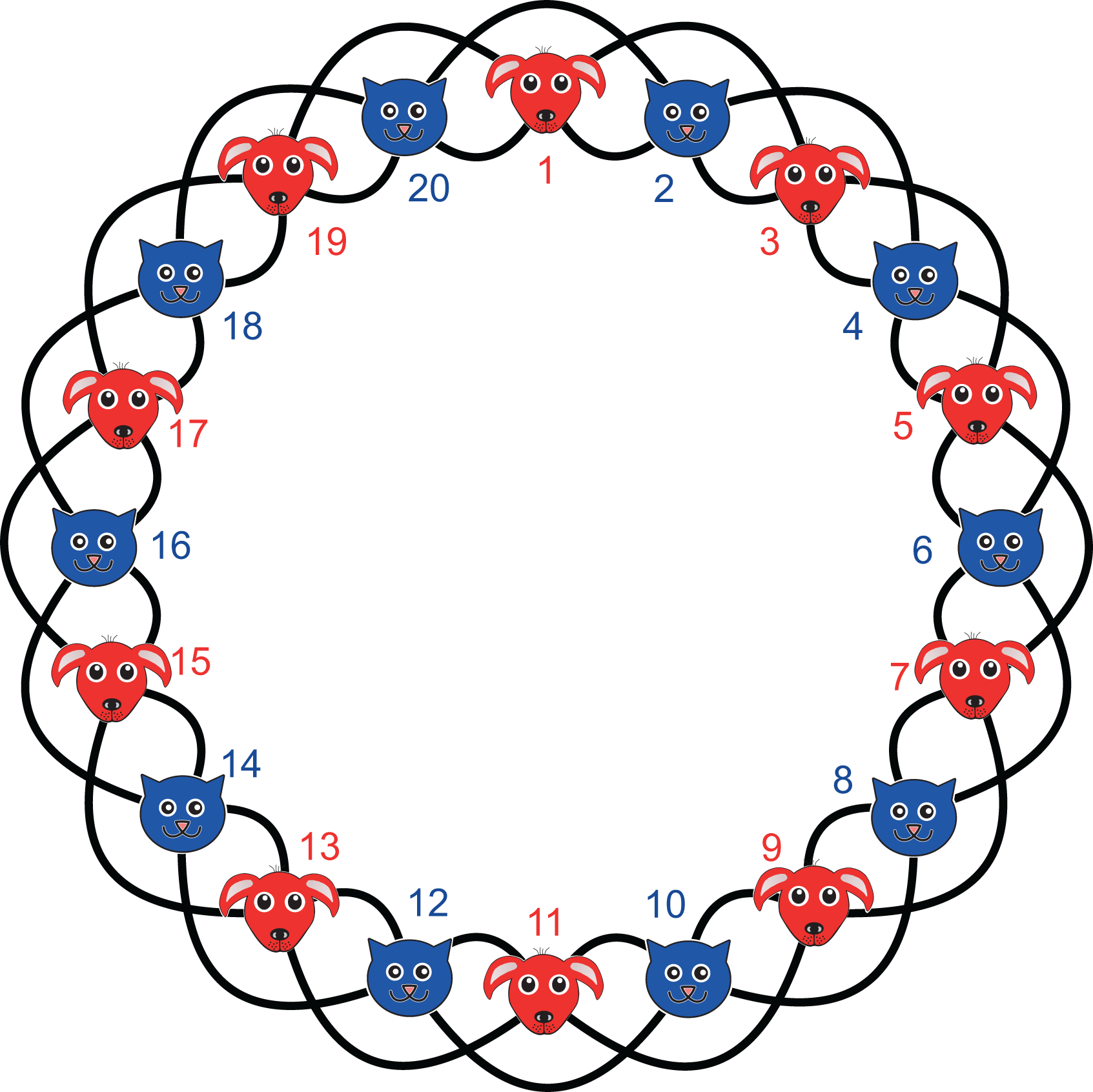
Stylized example.
Assume furthermore that nodes make decisions based on a simple heuristic. When they decide between red and blue for the first time and, thus, cannot condition their choice on the past choices of their network neighbors, they simply choose the option that corresponds to their type (cats: blue; dogs: red). After that, nodes choose the so-called myopic best response, which is a simple heuristic of boundedly rational decision-making (e.g., Alós-Ferrer and Netzer 2010; Blume 1993; Fudenberg et al. 1998; McFadden 1973; McKelvey and Palfrey 1995; Montanari et al. 2010; Young 1993). It assumes that participants choose the color that promises the highest payoff if the four neighbors choose the same color as in the previous round. In other words, actors are not hyperrational maximizers that take into account all possible future consequences of their behavior. Actors are also not perfectly informed about all potentially relevant aspects of the decision problem, such as the network structure and the types of their neighbors. Actors just assume that their neighbors will stick to their previous choices and then choose the color that promises a higher payoff in the present round.
These microassumptions imply that dynamics can reach three Nash equilibria, collective rest points where no individual can increase her payoff by unilaterally changing color. The first equilibrium is called “anomic coexistence” and obtains when all individuals choose the color that corresponds to their type (cats choose blue and dogs choose red, as in Figure 1). In this situation, all actors expect to receive a payoff of
Strikingly, the best-response model makes different prediction about which equilibrium is selected by the dynamics, depending on whether deviations are included or not. First, when all actors deterministically follow the heuristic described above, then every actor chooses in the very first round the color that corresponds to her type. In the second round, all actors realize that they have two neighbors who chose the same color and, thus, expect to receive
Contrary to the deterministic best-response model, however, the stochastic best-response model predicts the emergence of a descriptive norm when

Example for a cascade sparked off by two deviations (
The collective state of a descriptive norm is more robust to deviations than anomic coexistence. Assume, for instance, that the network coordinated on color blue and again actors 20 and 2 happen to deviate from the best-response rule. In the next round, the two actors will switch back to red as they expect to receive
However, deviations do not always spark cascades like those illustrated in Figure 2 and, therefore, do not always alter collective outcomes. For instance, deviations fail to affect collective outcomes when the payoff
Under
This simple example illustrates the two theoretical insights (Macy and Tsvetkova 2015) that our studies put to the test. First, sometimes very few deviations from the otherwise dominant behavioral patterns of individuals can have profound effects on macrooutcomes. In these cases, even a microtheory that perfectly describes the otherwise prevalent behavioral patterns of individuals will make false macropredictions. Second, microdeviations do not always have macroeffects, but it is possible to derive testable hypotheses about the conditions under which they have the potential to spark off cascades that lead the system into another state.
Study 1
Study 1 put two theoretical predictions to the test. First, we tested whether deviations on the microlevel can affect collective outcomes. Second, we tested whether a theoretical model that includes random deviations correctly predicts under what conditions deviations matter and when they do not affect macro-outcomes.
To this end, we conducted a laboratory experiment that implemented the core aspects of the stylized example from the previous section at the Decision Science Laboratory at ETH Zurich (https://www.descil.ethz.ch). That is, we arranged a computer network with the structure shown in Figure 1, assigned participants to the network nodes, and confronted them with the same decision problem as the actors in the example. Furthermore, it was critical to create a setting for the participants that would lead them to decide based on the best-response heuristic, the decision rule that we assumed in the previous section. As the best-response heuristic is intuitive and simple, providing participants with all information needed to make a best response and withholding crucial information necessary to form decisions based on alternative decision rules was sufficient to create a setting where 96 percent of participants’ decisions were best responses. In this setting, we studied the two experimental treatments that we explored in the previous section. Under
Procedures
We invited groups of 20 participants to the laboratory, where they sat in separate cubicles and interacted in a computer network. Every participant of an experimental session was randomly assigned to one of the positions in the circle network shown in Figure 1 and was instructed that per round she would earn one MU for each interaction partner who chose the same color and
During the experiment, we always updated participants about the color choices of their four network neighbors in the previous round, which is the only information needed to identify the best response. We withheld further information, to ensure that it was impossible to apply other typical decision rules such as the imitation of successful others (Judd, Kearns, and Vorobeychik 2010; Kirchkamp and Nagel 2007; McCubbins, Paturi, and Weller 2009; Selten and Apesteguia 2005) or forward-looking rules of expected payoff maximization (Frey, Corten, and Buskens 2012). In particular, participants were not informed about their neighbors’ payoff rules and types, others’ payoffs, the structure of the network, and the number of interaction periods (Hart et al. 2003).
It turned out that most of participants’ decisions were best responses. As we studied only values of the payoff parameter
Participants were recruited from a general pool of student volunteers from ETH Zurich and the University of Zurich that was set up for behavioral experiments where deception of participants is strictly forbidden. For each of the two experimental treatments, we conducted three independent replications with 20 participants per replication. In total, there were 120 participants in study 1. At the very beginning of the experiment, participants were informed about the payoff rules and that, at the end of the experiment, the computer would randomly pick three rounds of the experiment to determine each participant’s payoff. Participants received two Swiss Francs for every MU earned in these three rounds. On average, participants earned 33 Swiss Francs. All experimental sessions were finished within one hour.
Hypotheses
Figure 3 visualizes the hypotheses that follow from the deterministic and the stochastic versions of the best-response model, showing ideal-typical predictions for each of the two experimental treatments. The figure shows only typical predictions of the stochastic model, but in section 1.2 of the Online Supplemental Material, we report results from large-scale simulation experiments, demonstrating the dynamics shown in Figure 3 are indeed typical outcomes of the stochastic model. The color of the markers in Figure 3 shows actors’ color choices in the 150 periods. Squares represent best-response decisions and circles identify deviations. Furthermore, circle size indicates the deviation cost, the difference in payoff for choosing the best response and the payoff the actor actually received when deviating. Bigger circles indicate higher deviation costs.
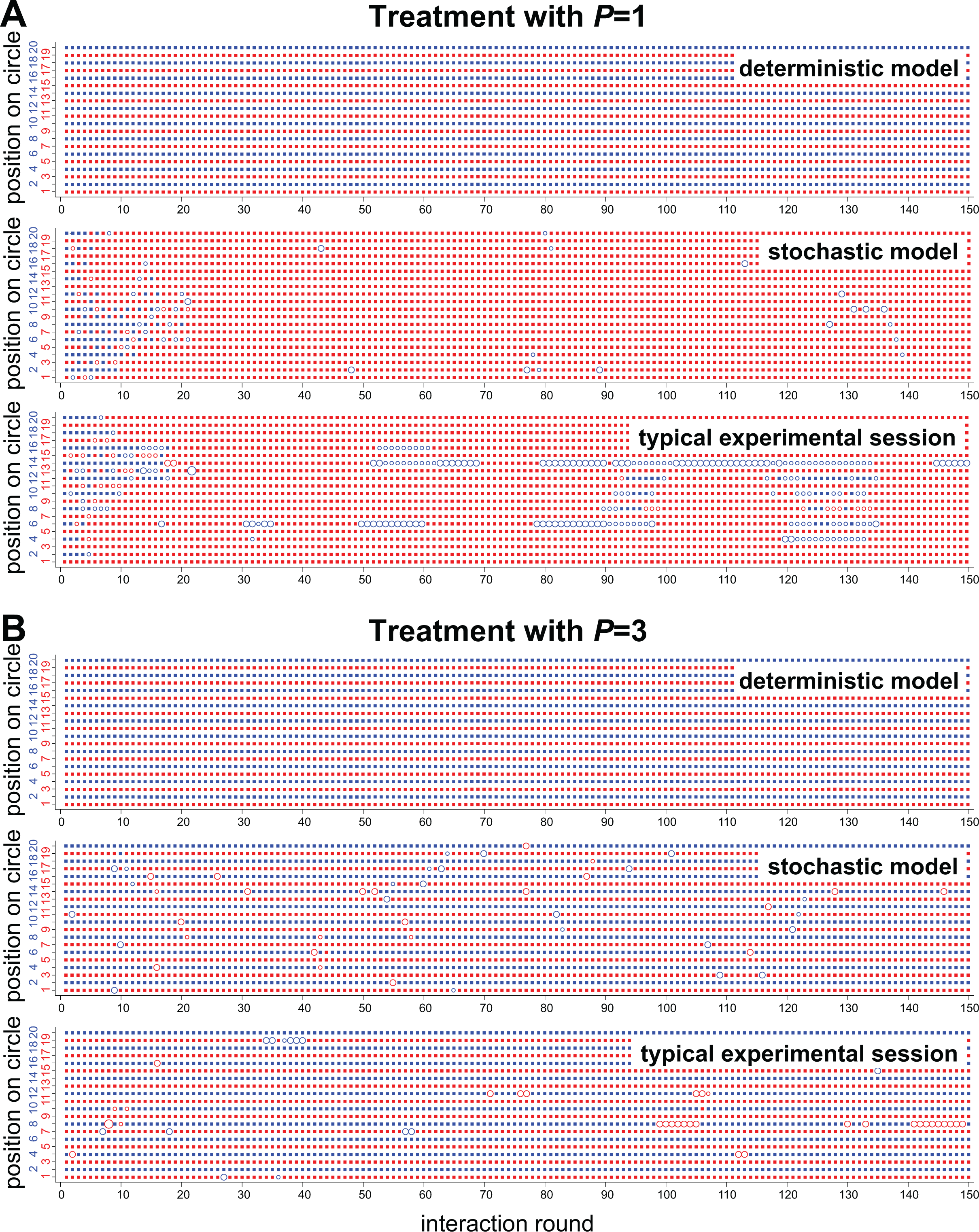
Hypotheses derived from the deterministic and the stochastic version of the best-response model for the two treatments of study 1.
The top graph of each panel visualizes the hypothesis derived from the deterministic best-response model (no deviations). As described in the previous section, the deterministic model predicts that actors will choose the color that corresponds to their type in the first period and will then stick to this color for the remainder of the experiment. Thus, the deterministic model predicts the collective pattern of anomic coexistence.
To generate predictions for the best-response model with random deviations, we adopted the standard logit-response model (Alós-Ferrer and Netzer 2010; Blume 1993; Fudenberg et al. 1998; Montanari et al. 2010; McFadden 1973; McKelvey and Palfrey 1995; Young 1993). This model assumes that there is always a positive chance that agents deviate from the best-response rule and that deviations are more likely when the payoff difference between the two options is small. In other words, this model assumes that deviations occur with a higher probability when they imply small deviation costs. Formally, the probability

where
Supporting the assumption that deviations occur more frequently when they imply smaller costs, Figure 4 shows the share of red and blue choices depending on the deviation costs. The gray line is the estimated logistic function (
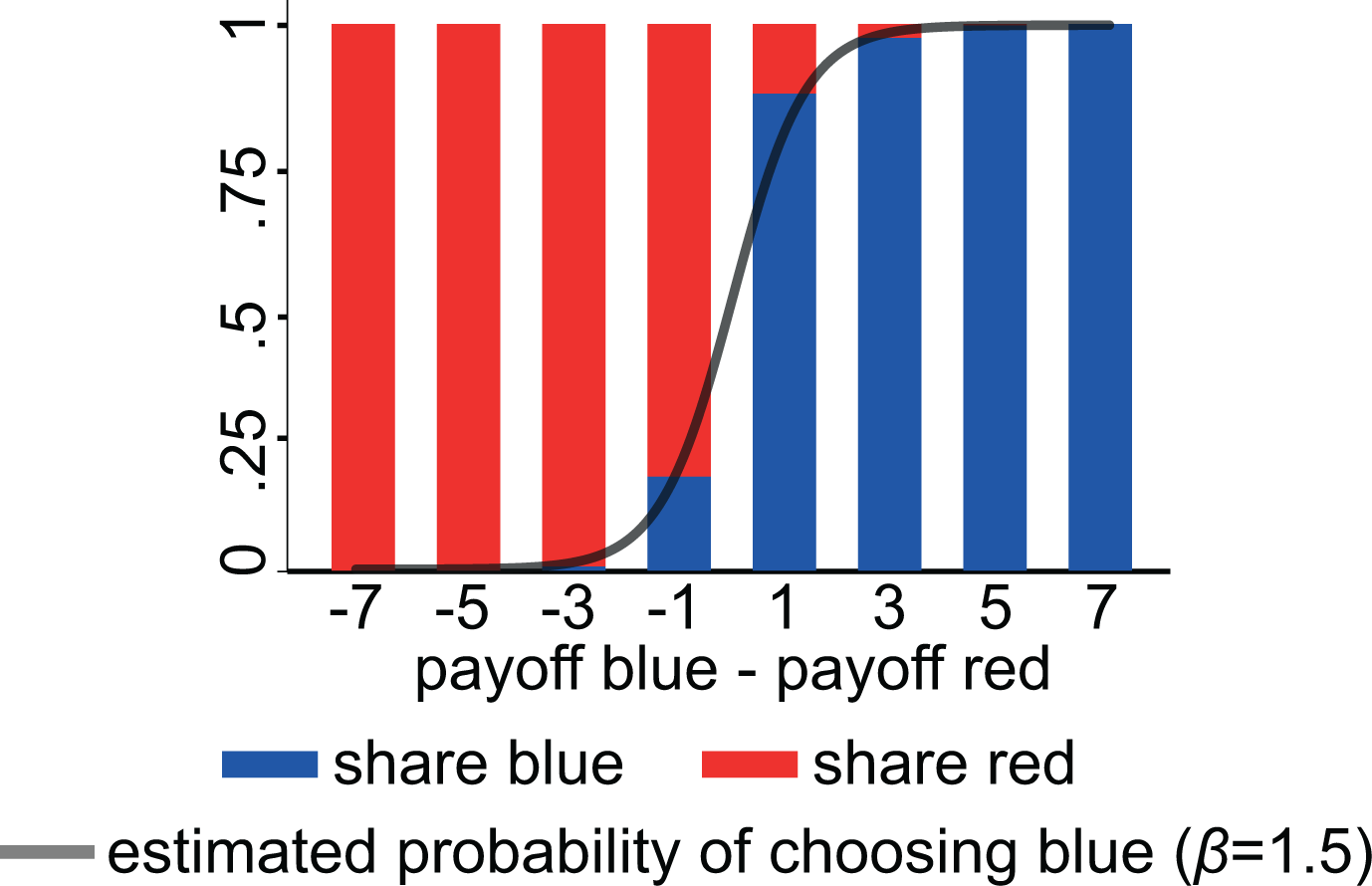
Share of red and blue choices depending on deviation costs (data from both studies).
Figure 3 (center graph of panel A) shows that under
However, deviations do not always spark cascades. The center graph of panel B in Figure 3 shows that under
Several aspects of our experimental design make the hypothesis that a descriptive norm will emerge under
What is more, the hypothesis that a descriptive norm will emerge under
Results
The empirical results of study 1 clearly confirmed the hypotheses derived from the stochastic model. For comparison with the hypotheses derived from the two theoretical models, the bottom graphs of the two panels in Figure 3 show a typical experimental session from the respective treatment. The Online Appendix contains the same graphs for the remaining sessions.
In all three replications with
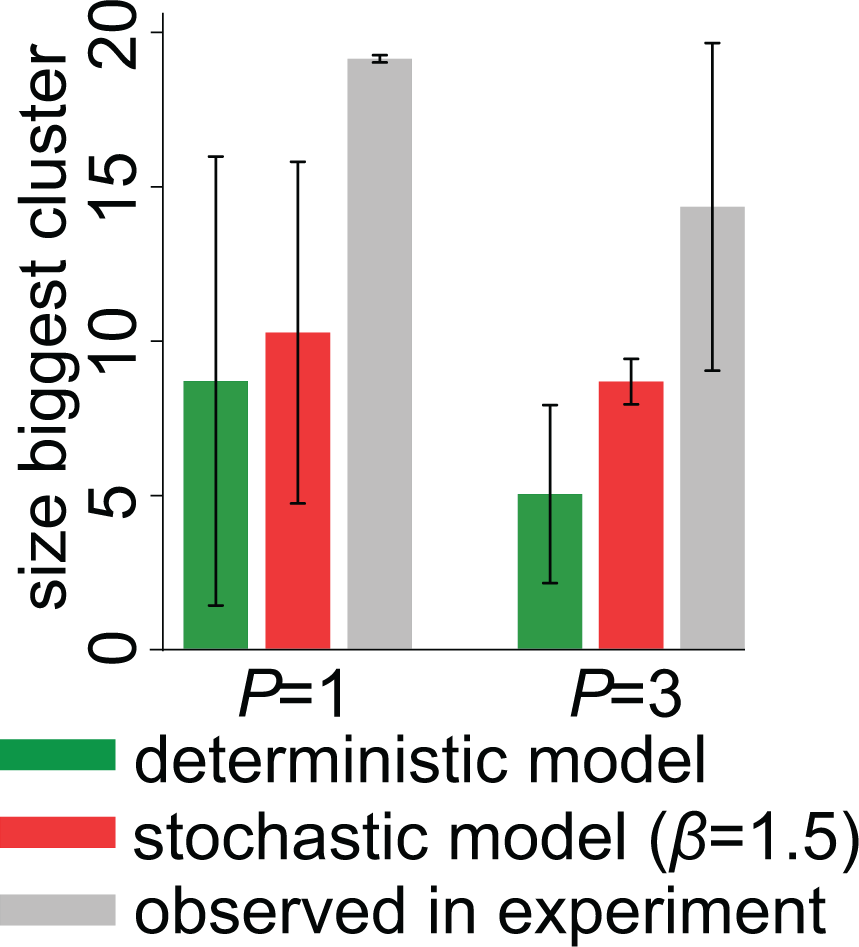
Figure 5 reports the statistical tests of the macropredictions. To quantify which macropattern emerged, we measured the size of the biggest cluster in the network. A cluster was defined as a set of nodes with adjacent positions on the circle that chose the same color at a given point in time. This measure adopts a value of 1 when the system is in a state of anomic coexistence and adopts its maximal value of 20 when a descriptive norm has emerged.
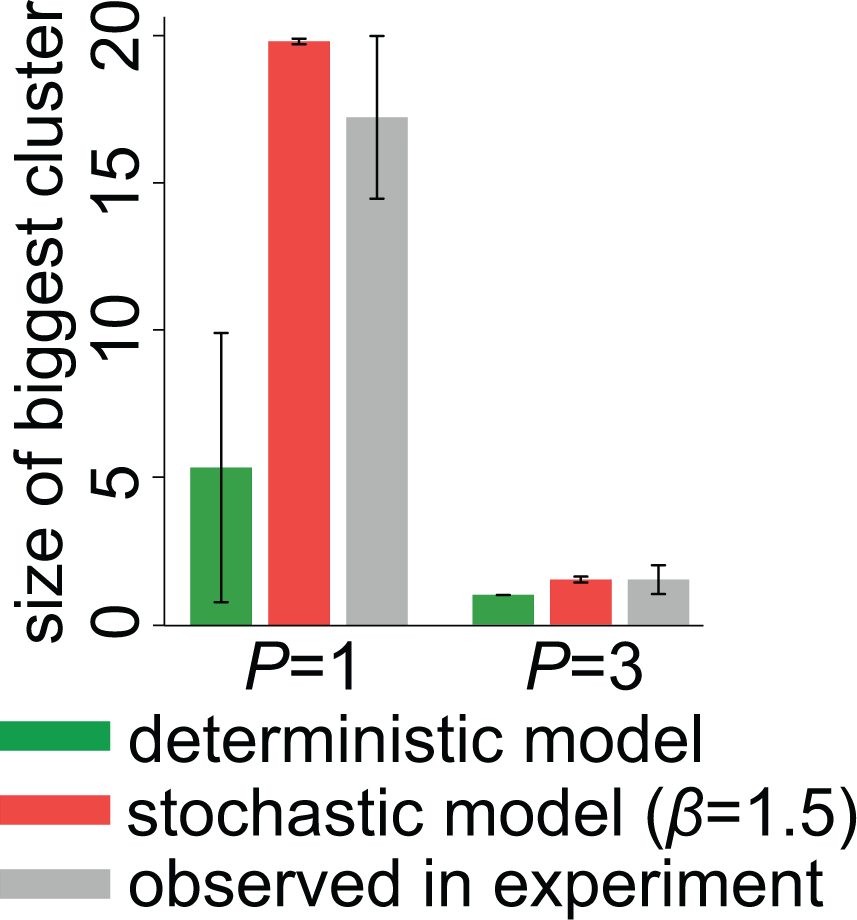
Test of the hypotheses derived from the deterministic and the stochastic model.
The green bars in Figure 5 show the average size of the biggest cluster in the network as predicted by the deterministic best-response model. We have shown in Figure 3 that the deterministic best-response model predicts the pattern of anomic coexistence when all participants initially choose the color of their type. However, when some individuals happen to choose the opposite color in the very first round, then the deterministic best-response model may make slightly different macropredictions. For instance, it is possible that the system happens to start in a collective state of segmented coexistence, which is also an equilibrium (see section 2). To exclude that our statistical test is affected by this, we simulated the deterministic best-response dynamics that follow from the initial color choices observed during the respective sessions of the experiment. The size of the green bars, thus, shows the average size of the biggest cluster in the final 100 rounds of the simulated dynamics. The error bars were obtained with linear multilevel models to control for the nestedness of observations in the three experimental sessions. The red bars show average size of the biggest cluster in the network at the final (150th) round in 1,000 independent simulations with the stochastic model, assuming
Gray bars show the average outcome in the final 100 periods of the experiment. Estimates and 95 percent confidence intervals were obtained with linear multilevel models, controlling for the nestedness of observations in experimental sessions. 2
Figure 5 shows that the experiment confirmed the macrohypothesis derived from the stochastic best-response model for the treatment with
Study 2
Study 1 provided empirical support for the notion that the macropredictions of a microtheory can become more accurate when deviations are taken into account. On the one hand, this finding challenges intuition because we assumed that deviations occur randomly. On the other hand, the assumption that deviations are random might also be problematic, as Figure 6 suggests.
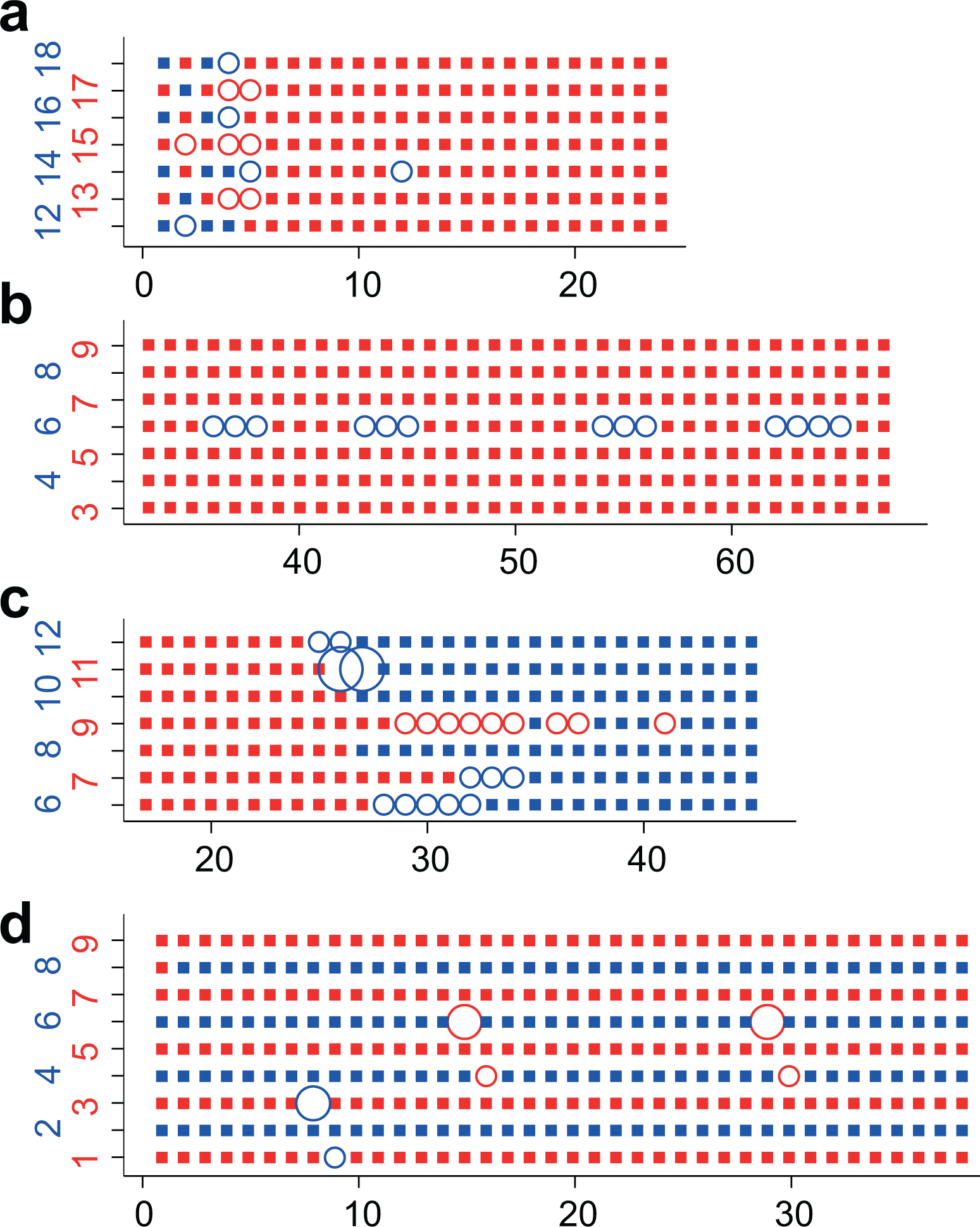
Observed deviation patterns.
Figure 6 shows examples of seemingly systematic deviation patterns that we observed in the two studies. In example a, participant 15 attempted to enforce her preferred color (see Online Appendix Figure S19). Even though blue would have been the best response, this participant kept choosing red, the color of her type. In example b, participant 6 seemed to have attempted to disrupt the descriptive norm that had emerged, systematically deviating several times (see Online Appendix Figure S21). In example c, participant 9 attempted to conserve her preferred color (see Online Appendix Figure S19). Furthermore, example d suggests that participants who observed that a network neighbor changed color might have deviated with an increased probability, generating small deviation chains (see Online Appendix Figure S14).
Study 2 was designed to test the hypothesis that systematic, nonrandom deviations can lead to very different macropatterns than random deviations, even when deviations are rare. In study 1, deviation patterns occurred but did not affect the dynamics to a degree that macrooutcomes differed from the predictions of the micromodel with random deviations, which suggests that adding stochasticity suffices to improve macropredictions even when deviations are not entirely random but follow patterns that are not captured in the microtheory. However, there might be conditions under which systematic deviations generate dynamics that differ from those generated by random deviations. We therefore tested whether it may be misleading to assume that deviations are random if they are actually systematic.
Study 2 differed from study 1 only in one aspect, the structure of the interaction network. In study 1, participants were linked to the two closest neighbors to their left and to their right, which created a mixed network where nodes have two neighbors of the same type and two neighbors of the opposite type. For study 2, however, we linked actors to their two closest neighbors on the circle and the two neighbors with a distance of two, as Figure 7 shows. The resulting network is very similar to the network of study 1, but actors are connected only to actors of the opposite type. Like in study 1, we studied two treatments with different values of parameter
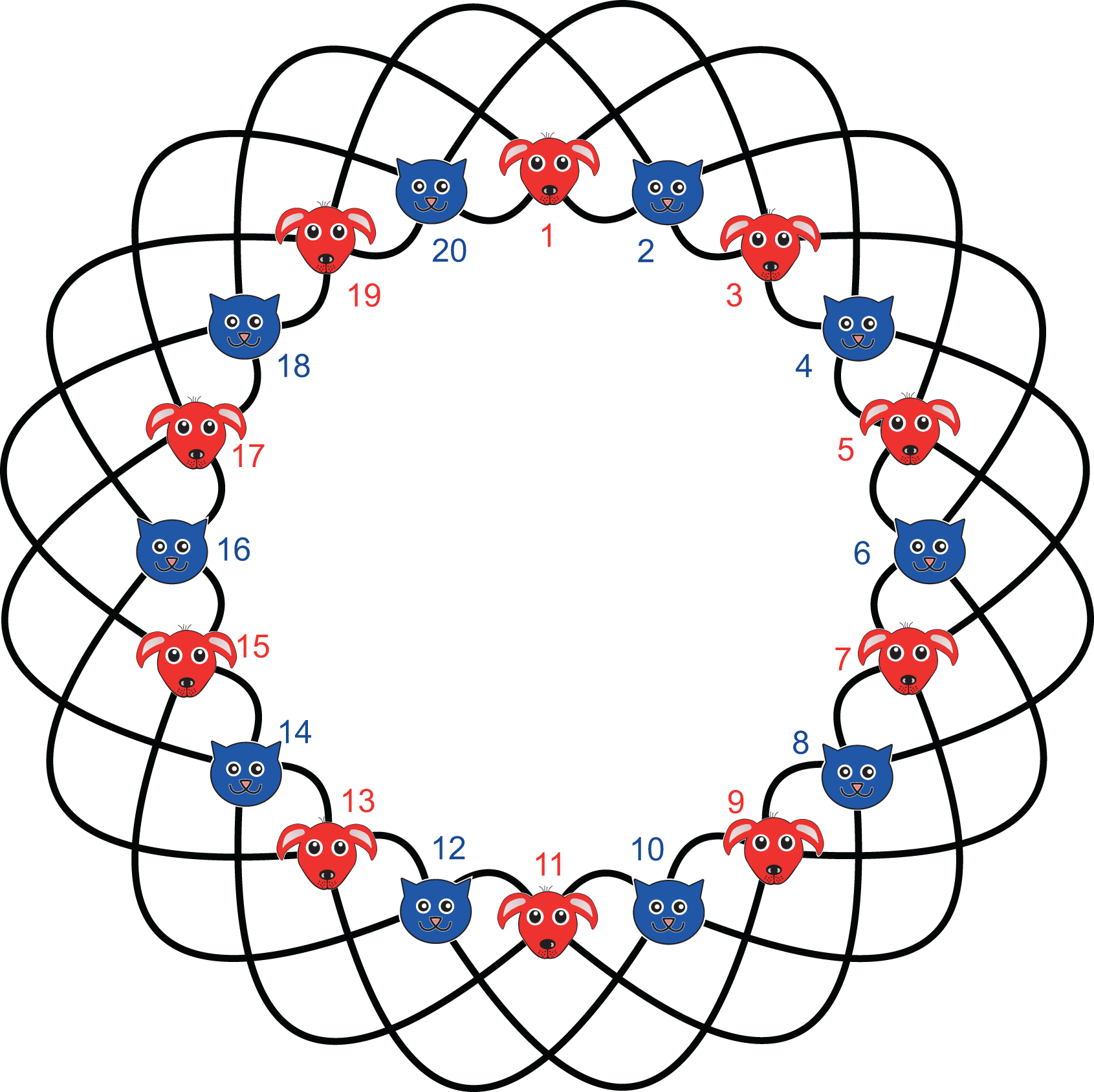
Network used in study 2.
Predictions
Similar to the settings of study 1, coordination on a descriptive norm and segmented coexistence are also rest points in study 2, but there is a third very important stable pattern, which we call “dynamic oscillation.” This is a dynamic pattern where cats and dogs always choose opposite colors but also swap color in every period. This pattern is stable in that switching is always the best response to the choices of one’s interaction partners in the previous round.
The fact that best-response behavior generates dynamic oscillation is important, as it allowed us to study collective outcomes when decision makers deviate systematically from the best-response rule. When a participant applies the best-response rule, she assumes that the interaction partners will stick to their previous choices, an assumption that is obviously false when the system is the dynamic-oscillation phase and color choices alternate every round. As the participants of our experiment were always informed about the past choices of their network neighbors, we expected that they would systematically deviate from the best-response model whenever the system was in a state of dynamic oscillation.
Figure 8 visualizes the predictions of the deterministic and the stochastic (
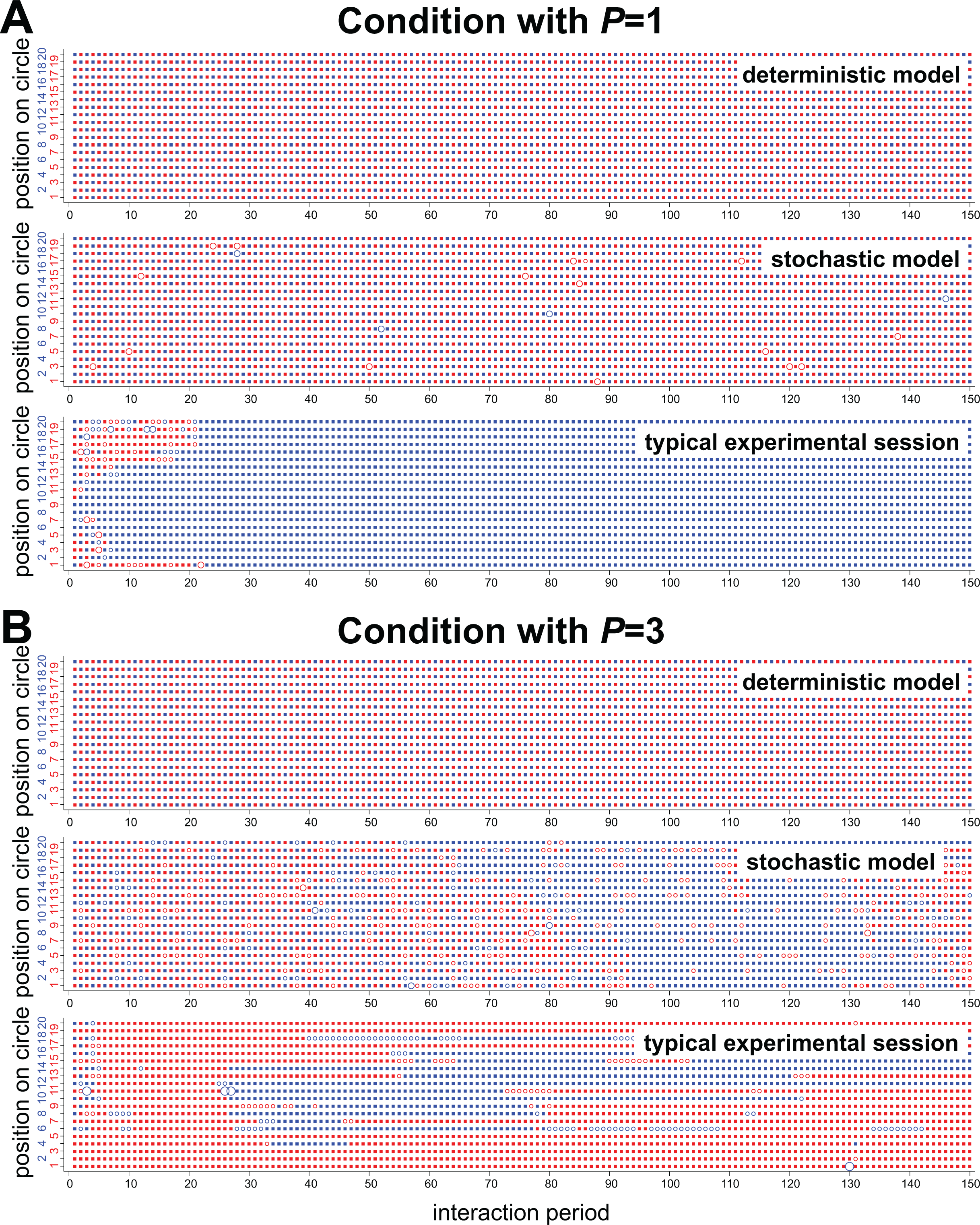
Predictions and typical results for the two experimental treatments of study 2.
However, even though both the deterministic and the stochastic best-response model predict the collective pattern of dynamic oscillation when
In sum, for the treatment with
For the treatment with
Strikingly, also coordination is stochastically unstable when
The recurrent phase transitions that the best-response model with random deviations generates are intriguing. However, if our intuition is correct that participants will deviate systematically from the best-response rule whenever the system is in a state of dynamic oscillation, then the following prediction can be formulated. The system will start in dynamic oscillation, but systematic deviations will drive it into another equilibrium (either coordination or segmented coexistence). But also these equilibria are unstable and the system will keep switching from coordination to segmented coexistence. Phases of dynamic oscillation will be very short, as they lead to systematic deviations.
Results
The two bottom graphs in the two panels of Figure 8 show typical dynamics from the experiment, showing that our experimental results supported our prediction that nonrandom deviations can generate different collective patterns than random deviations. Challenging the predictions of both the deterministic and the stochastic best-response model, participants coordinated quickly on one of the two colors in all three replications for
Likewise, we observed only very short phases of oscillation in the four replications for
Figure 9 reports the same statistical tests as those from study 1, but the result is very different. Unlike in study 1, both best-response models fail to explain the macropatterns observed in the two treatments of the experiment. In addition, the analyses reported in section 1.2 of the Online Supplemental Material show that also a stochastic model with more of less deviations would not have explained the empirically observed dynamics. In a nutshell, the results of study 2 challenged the standard assumption that deviations are random. Systematic deviation has the potential to lead systems into different collective states than random deviations.
Test of the hypotheses derived from the deterministic and the stochastic model.
Discussion
The notion that the behavior of individuals can lead to complex and unexpected macropatterns when individuals do not act in isolation but interact with each other is, in a nutshell, sociology’s contribution to the understanding of human behavior. Formal models of social processes and theories from other disciplines suggest that in these settings, even rare and random deviations can have decisive impact on how microbehavior translates into macropatterns. Under conditions that theoretical methods allow to identify (Foster and Young 1990; Freidlin and Wentzell 2012), deviations may spark cascades that have a substantial impact on collective behavior. To test this notion, we conducted two laboratory experiments.
Our empirical studies support the notion that microdeviations matter for macrooutcomes. We draw three conclusions from our empirical results. First, our findings support the notion that even micromodels that very well capture the prevalent patterns of individual behavior can make false macropredictions. Deviations from the patterns that microtheories describe can spark behavioral cascades that profoundly change collective outcomes. Second, the stochastic model correctly predicted the conditions under which deviations have the potential to alter macrooutcomes, even when deviations are assumed to be random and, thus, unpredictable. Third, when individuals deviate in a systematic way from otherwise prevalent patterns of behavior, the resulting macrooutcomes can differ substantially from those generated by random deviations. In other words, even in settings where deviations are rare, it can be misleading to assume that deviations are random if they actually follow a pattern. Including random deviations may thus fail to improve macropredictions if the modeler failed to take into account an important deviation pattern. Stochasticity improves macropredictions of accurate microtheories, but it does not necessarily fix the predictions of false micromodels.
Future research on the stochastic component of individual behavior is crucial. Two main challenges lie ahead. First, more theoretical and empirical work on the conditions of stochastic instability is needed in order to understand better why and when the stochastic component of individual behavior alters collective dynamics. Crucial methodological tools to analyze the stochastic stability of social systems (Foster and Young 1990; Freidlin and Wentzell 2012) have been developed, and their usefulness has been demonstrated on social processes such as the evolution of conventions and norms (Young 2015, 1993), the spread of innovation (Montanari et al. 2010; Young 2011), the emergence of hierarchies (Axtell et al. 2000), the polarization of opinions (Mäs et al. 2010; Pineda et al. 2009), and residential segregation (van de Rijt et al. 2009). Empirical studies are needed to test whether stochastic models outperform deterministic theories also in these contexts. Our studies have demonstrated that laboratory experiments are a useful approach to testing hypotheses about deviation effects. The core advantage of laboratory studies is that they allow the researcher to measure whether a given action was a deviation or not. An important challenge for future empirical research will be to study deviation effects in the field (an inspirational example is the study by Chadefaux 2016).
Second, far too little is known about the conditions of deviations (Butler, Isoni, and Loomes 2012; Freidlin and Wentzell 2012; Goeree et al. 2005; McKelvey and Palfrey 1995; Loomes 2005; Lim and Neary 2016; Wilcox 2008; Naidu, Hwang, and Bowles 2010; Hwang et al. 2014; Pradelski and Young 2012). Deviations have been argued to have multiple sources including mistakes, misperceptions, inertia, or trial-and-error experiments. These forms of deviations have been incorporated in very different ways into formal models, which can matter for macropredictions. One important assumption, for instance, is that deviations occur with a constant rate (Kandori, Mailath, and Rob 1993; Young 1993), which might be a good model of deviations resulting from mistakes. Deviations resulting from trial-and-error experiments, however, might be better captured by the logit-response model (Alós-Ferrer and Netzer 2010; Blume 1993; Ellison 1993; Young 1998, 2011), as it seems plausible that actors experiment more likely when it involves low costs. Our studies support the logit-response model (see Figure 4), but more research is needed to identify the conditions under which alternative deviation models offer more or less accurate descriptions of real deviations (Mäs and Nax 2016). It is important to point out, however, that from the view of a sociologist interested in macrophenomena, it is certainly not necessary to develop complex deviation theories seeking to predict individual deviations. Study 1 illustrated that often even very simple deviation models, such as the logit-response model, suffice to improve macropredictions. What is needed, however, are theories that point to the conditions under which deviations are more or less likely.
Our experimental design was very much tailored to the best-response heuristic, which is just one of the many candidates for a micromodel. Nevertheless, there is no reason to expect that deviations do not have similar macroeffects when actors apply even simpler or more complex decisions rules. For instance, theoretical models predict deviation effects when actors also use simple reinforcement-learning heuristics (Pradelski and Young 2012) or imitate successful others (Kandori et al. 1993). In fact, cascades can be sparked whenever decision makers are influenced by the behavior of others. One can be certain that deviations are irrelevant for collective outcomes, only when actors act in perfect isolation.
Supplemental Material
Supplemental Material, Online_Appendix_ - Random Deviations Improve Micro–Macro Predictions: An Empirical Test
Supplemental Material, Online_Appendix_ for Random Deviations Improve Micro–Macro Predictions: An Empirical Test by Michael Mäs and Dirk Helbing in Sociological Methods & Research
Footnotes
Acknowledgments
Mäs and Helbing acknowledge support by the European Commission through the ERC Advanced Investigator Grant “Momentum” (Grant 324247). The authors would like to thank Stefan Wehrli and Silvana Jud for helping organize the experiments. For helpful comments, we thank Ryan O. Murphy, Thomas Grund, Vincenz Frey, Andreas Flache, Thomas Chadefaux, Olivia Woolley, Steve Genoud, Chris Snijders, Siegwart Lindenberg, Peter Hedström, Michael Hechter, and, in particular, Heinrich Nax.
Declaration of Conflicting Interests
The author(s) declared no potential conflicts of interest with respect to the research, authorship, and/or publication of this article.
Funding
The author(s) received no financial support for the research, authorship, and/or publication of this article.
Supplemental Material
Supplemental material for this article is available online.
Notes
References
Supplementary Material
Please find the following supplemental material available below.
For Open Access articles published under a Creative Commons License, all supplemental material carries the same license as the article it is associated with.
For non-Open Access articles published, all supplemental material carries a non-exclusive license, and permission requests for re-use of supplemental material or any part of supplemental material shall be sent directly to the copyright owner as specified in the copyright notice associated with the article.
