




Abstract
Emotion is not peripheral, but rather foundational to tourism’s appeal. It shapes imagination and transforms destinations into meaningful experiences. Yet, while the tourism industry increasingly leverages emotional storytelling to inspire action, academic research has not kept pace. This systematic literature review examines how emotion has been theorised, measured and modelled. Despite decades of critique, a limited emotional repertoire persists, with generalised constructs, such as satisfaction, continuing to dominate at the expense of tourism-relevant emotions, such as romance, awe, boredom, amusement and envy. Theoretical integration remains weak, and emotion is typically examined in post-travel contexts, overlooking the pre-travel, acquisition stage where industry campaigns concentrate their emotional appeals and investment. In response, the article advances six propositions that reposition emotion as a core construct in tourism marketing. Together with the Tourism Emotion Framework, these contributions offer a practical and theoretical foundation for designing, measuring and mobilising emotion across the travel journey.
Keywords
Introduction
Emotions exert a profound influence on human life, steering behaviour and shaping thought (P. Ekman et al., 1969; Frijda, 1986). Across cultures, they forge family bonds, sustain friendships and influence choices that define identity (Keltner et al., 2006; Tooby & Cosmides, 2000). In tourism marketing, emotions spark desire, guide decisions and trigger instant judgements, turning destinations into experiences filled with awe, joy and nostalgia. (Eletxigerra et al., 2021; Luo et al., 2025; Marschall, 2012; Sun et al., 2024; Tung & Ritchie, 2011). Destinations that promise emotional depth, joyful escapes or transformative experiences are in high demand (Kirillova et al., 2017; Noy, 2004) and such emotional episodes can catalyse learning, growth and empathy (Sheldon, 2020), producing memories that enhance satisfaction, deepen loyalty and sustain advocacy long after return (H. Barton et al., 2019; S. Zhang et al., 2021). From anticipation to nostalgia, marketing seeks to activate this emotional arc across the entire travel journey: pre-travel, during travel and post-travel (Clawson & Knetsch, 2013; Kirillova et al., 2017; Pearce & Lee, 2005).
Although emotions are foundational to tourism’s appeal, research remains conceptually fragmented and methodologically narrow, often conflating emotion with adjacent constructs and relying on broad measures of valence (Hosany et al., 2021). Yet, despite emotion’s central role in shaping tourist experience, memory and behaviour, multiple critiques highlight conceptual drift, methodological inertia and limited uptake of structured emotion theory (Chen, 2025; Kock et al., 2020). Emotion is frequently conflated with adjacent constructs such as mood, motivation and attitude (J. L. Crompton & Petrick, 2024; Hosany, 2012; Y. Kim et al., 2022; Prayag et al., 2013) and the conditions that elicit emotional responses are often vague or disconnected from specific stimuli along the travel journey (Viglia & Dolnicar, 2020). Buda et al. (2014) highlight that some studies conceptualise emotion as a spatial and discursive force rather than as a discrete psychological mechanism, a perspective that poses challenges for predictive modelling approaches. These conceptual ambiguities spill over into measurement. Tourism research continues to rely on valence-based composites such as satisfaction or pleasure, rather than modelling discrete emotional episodes – a practice that narrows theoretical scope and constrains methodological progress (Barsky, 2002; Dolnicar et al., 2015; Nawijn et al., 2013; Prayag et al., 2019; Scuttari & Pechlaner, 2017). In contrast, psychology and consumer behaviour research regularly employ validated emotion taxonomies and measurement tools that enable causal inference and behavioural prediction (Angie et al., 2011). Evidence from these fields shows that integral affect – emotions tied to the object of judgement – is consistent across people and contexts. Marketing stimuli, facial attractiveness, music, moral violations and environmental threats reliably elicit strong emotional responses (Kahneman et al., 1998; Langlois et al., 2000; Peretz et al., 1998; Pham, 2007; Pham et al., 2001). These findings challenge assumptions that emotion is too subjective to model and show that affective responses can be measured reliably and meaningfully.
Tourism research has been slow to adopt validated emotion measures, often defaulting to general affective terms or sentiment proxies (Dolnicar et al., 2015; Hosany et al., 2020). Many studies rely on broad affective indices, such as the Positive and Negative Affect Schedule (PANAS), which capture overall affective tone rather than discrete emotional states (Ribeiro & Prayag, 2019; Walters et al., 2025; Wang et al., 2022; Watson & Clark, 1999). Recent work has begun examining specific emotions, such as awe, pride, nostalgia and anxiety, across contexts including adventure travel, heritage interpretation, wildlife encounters and virtual tourism (Bigné et al., 2023; Hosany et al., 2022). Nevertheless, as this review shows, a substantial proportion of tourism research depends on broad positive–negative ratings that blur distinctions between affect, mood, and emotion, constraining theoretical precision and limiting explanatory power for tourist behaviour.
Despite repeated calls for more rigorous experimental designs in hospitality and tourism (Dolnicar & Ring, 2014; Line & Runyan, 2012; Lynn & Lynn, 2003; Mattila & Ro, 2008; Namasivayam, 2004), survey-based recall methods continue to dominate, limiting the field’s capacity for causal explanation. Self-report remains the primary tool in tourism marketing research (Hosany et al., 2022; S. Li et al., 2015), yet it is vulnerable to cognitive bias, recall distortion and social desirability effects. These limitations are amplified in retrospective contexts common to tourism (Erevelles, 1998; Ioannidis, 2005; Paulhus & Vazire, 2007). While real-time measurement poses challenges in naturalistic settings, these constraints are far less defensible in marketing contexts, where stimuli such as advertisements, videos and imagery are tightly controlled. Here, emotional responses are not only measurable but deliberately engineered, creating opportunities for more precise and predictive approaches (Byun & Jang, 2015; Lavidge & Steiner, 1961; MacKenzie & Lutz, 1989; Vargas et al., 2017). However, it remains unclear whether these stimuli and data methods are being used to complement self-report approaches, despite recent calls for their adoption (Hosany et al., 2022; S. Li et al., 2015; Tuerlan et al., 2021). This review addresses that gap and extends prior work by examining how emotion measurement in tourism marketing has evolved.
Commercial practice has advanced with greater conceptual and technical precision. Brands such as Tourism Australia, Disney and Apple design campaigns to trigger discrete emotions, and test them using tools like the Facial Action Coding System (FACS), developed by a foundational basic emotion theorist Paul Ekman (P. Ekman & Friesen, 1969; Ewing, 2022; Tourism Australia, 2023). Tourism research is beginning to adopt biometric and facial-expression technologies to assess emotional responses (S. Li et al., 2015; S. Li et al., 2022; Walters et al., 2025). However, these methods typically capture arousal or valence rather than discrete emotions, a limitation noted in prior reviews (S. Li et al., 2015; Moyle et al., 2019). Physiological techniques such as electroencephalography and galvanic skin response (Walters et al., 2025) and facial-expression analysis (P. Ekman, 2016; Scarantino, 2025) provide additional insight but remain constrained by laboratory requirements, small samples and reduced generalisability. Hybrid approaches – for example, triangulating biometrics with self-reports or embedding facial-expression tools in online surveys – can broaden access but introduce noise from variable lighting, camera quality and uncontrolled settings (Krumhuber et al., 2023; Walters et al., 2025). These limitations reinforce the essential role of validated discrete-emotion measures, which remain necessary for identifying specific emotional states, linking them to marketing stimuli and modelling behavioural outcomes in tourism.
This review adopts an evolutionary-functionalist view of emotion and applies Cowen and Keltner’s (2017) taxonomy of 27 distinct emotions to tourism marketing. Building on prior syntheses (Hosany et al., 2021; S. Li et al., 2015; Tuerlan et al., 2021; Volo, 2021), it systematically maps which emotions are well studied, under-explored or overlooked. The review examines how emotion-elicitation theories are applied to marketing contexts, integrates additional theoretical perspectives and analyses emotions as independent, mediating or moderating variables to identify gaps. It also specifies marketing stimuli and behavioural outcomes, such as acquisition versus retention, and considers when emotions are measured across the travel journey (pre-travel, during travel and post-travel). Collectively, these contributions extend prior reviews by providing a stronger foundation for theory development and guiding future research in tourism marketing through three key questions:
Conceptual Development
Perspectives to Emotional Theorising
Four major traditions shape emotion research: evolutionary–functionalist, dimensional, cognitive appraisal and constructionist (see Table 1). This review adopts the evolutionary–functionalist perspective, which views emotions as biologically evolved systems addressing adaptive challenges in survival, reproduction and social coordination (Shiota, 2014). Cognitive appraisal theory, which includes mechanisms such as attribution theory (Weiner & Handel, 1985), also informs tourism research by explaining how evaluations of control and responsibility shape emotional responses (Lazarus, 1991b; C. A. Smith & Ellsworth, 1985). Although these four traditions differ, they unite in assuming that emotions serve functional purposes (P. Ekman, 2016; Frijda, 1986; Scherer, 2005). Table 1 summarises these traditions and their implications for tourism emotion research.
Core Traditions in Emotion Theory.
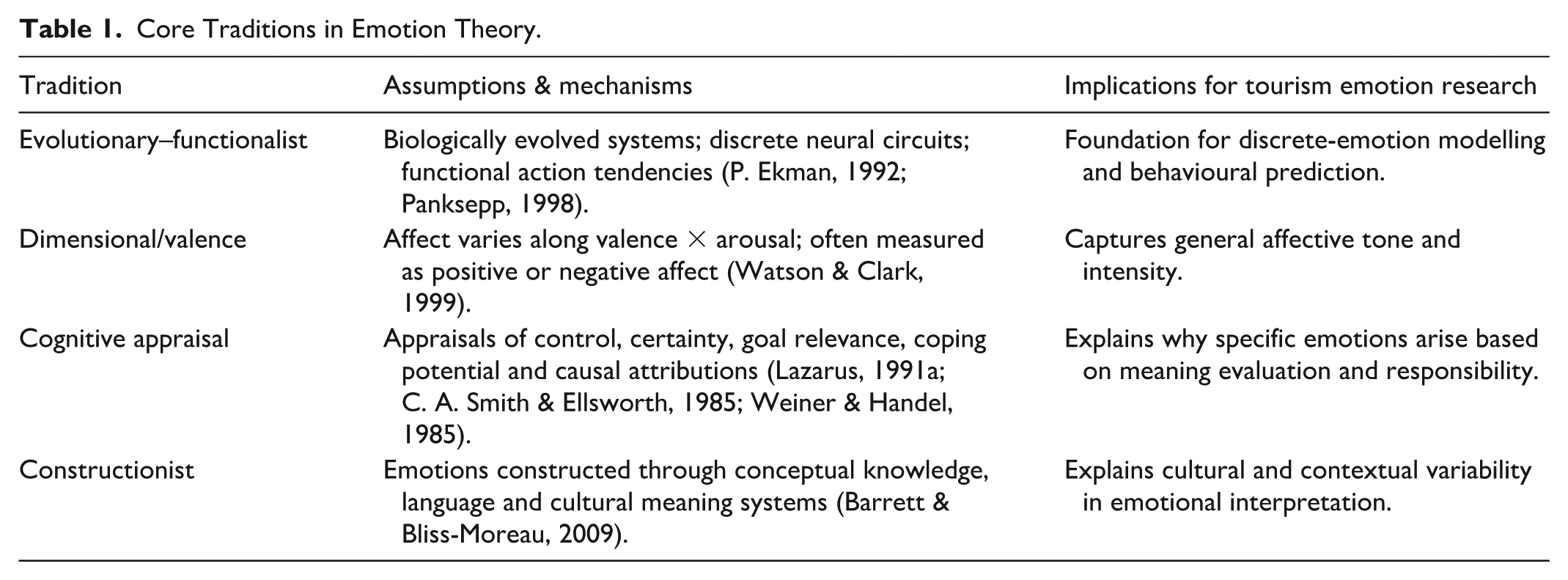
Discrete emotion theory emerges from the evolutionary–functionalist tradition, proposing that emotions such as fear, joy, anger and surprise evolved to meet distinct adaptive challenges and display identifiable appraisals and action tendencies (Kuppens et al., 2006; Panksepp, 1998; Tooby & Cosmides, 2008). This specificity underpins models in consumer psychology and neuroscience, where emotions predict behaviour. (Harmon-Jones et al., 2016; Tuan Pham, 2004). Psychology and marketing increasingly adopt functionally grounded discrete-emotion models (Fredrickson, 1998; Fredrickson & Branigan, 2005; Lerner & Keltner, 2000), yet tourism studies often apply these traditions inconsistently, relying on broad mood constructs and revisiting earlier debates, thereby reflecting a persistent misalignment with contemporary affective science (Bagozzi et al., 1999; Baumgartner et al., 2008; Dolnicar et al., 2015; Hosany et al., 2021).
Expanding From Valence to Discrete and Distinct Emotions
Early tourism research often assessed emotion using broad positive–negative evaluations (Hosany et al., 2021; S. Li et al., 2015; Tuerlan et al., 2021). While these measures linked affect to outcomes such as revisit intention and word-of-mouth, they offered limited precision and overlooked the diversity of the emotional experiences inherent to travel. Discrete emotion approaches, which identify specific emotions and their distinct effects, provide deeper insight into motivational and behavioural responses (Harmon-Jones et al., 2016). Yet adoption in tourism remains uneven, with reviews noting persistent conceptual ambiguity, heterogeneous measurement practices and continued reliance on general affective indicators (Hosany et al., 2021; Volo, 2021). By contrast, psychology and marketing increasingly employ functionally grounded discrete emotion models supported by validated appraisal and lexicon-based taxonomies (Cowen & Keltner, 2017; Fontaine et al., 2007; Lerner et al., 2023; Roseman, 1991; Shaver et al., 1987), enabling causal inference and behavioural prediction (Bagozzi et al., 1999; Fredrickson, 1998; Lerner et al., 2004, 2015; Lerner & Keltner, 2000). Broader adoption of discrete emotion frameworks could therefore yield richer, theory-driven insights into the emotional processes shaping travel experiences and decision-making.
Tourism scholarship has traditionally drawn on P. Ekman’s (1992) basic emotion model, encompassing anger, fear, sadness, happiness, disgust and surprise, as an essential starting point for connecting emotion to tourist behaviour. Earlier still, Izard’s (1971) differential emotions theory expanded the repertoire to include states such as guilt, shame, contempt and interest, reflecting a growing awareness of emotions beyond the basic six. Despite their influence, these frameworks leave gaps: they cannot fully capture the nuanced emotional episodes that shape contemporary travel experiences. To address this limitation, Cowen and Keltner’s (2017) taxonomy of 27 interrelated emotional states offers a finer-grained structure that accommodates emotions long recognised in tourism research – emotions such as boredom, a driver of novelty-seeking (J. Crompton, 2025), and anxiety, increasingly salient in crisis and virtual tourism contexts (M.-H. Huang & Rust, 2024; Yang et al., 2023). Alongside awe (B. Li et al., 2025) and nostalgia (Chi & Chi, 2022), this taxonomy illustrates the broader spectrum of affective experiences that earlier models could not fully represent. Table 2 summarises this progression, comparing Ekman’s basic emotions and Izard’s differential emotions theory with Cowen and Keltner’s taxonomy of 27 distinct emotional states.
Comparison Between Discrete Emotion Frameworks and Distinct Emotions.
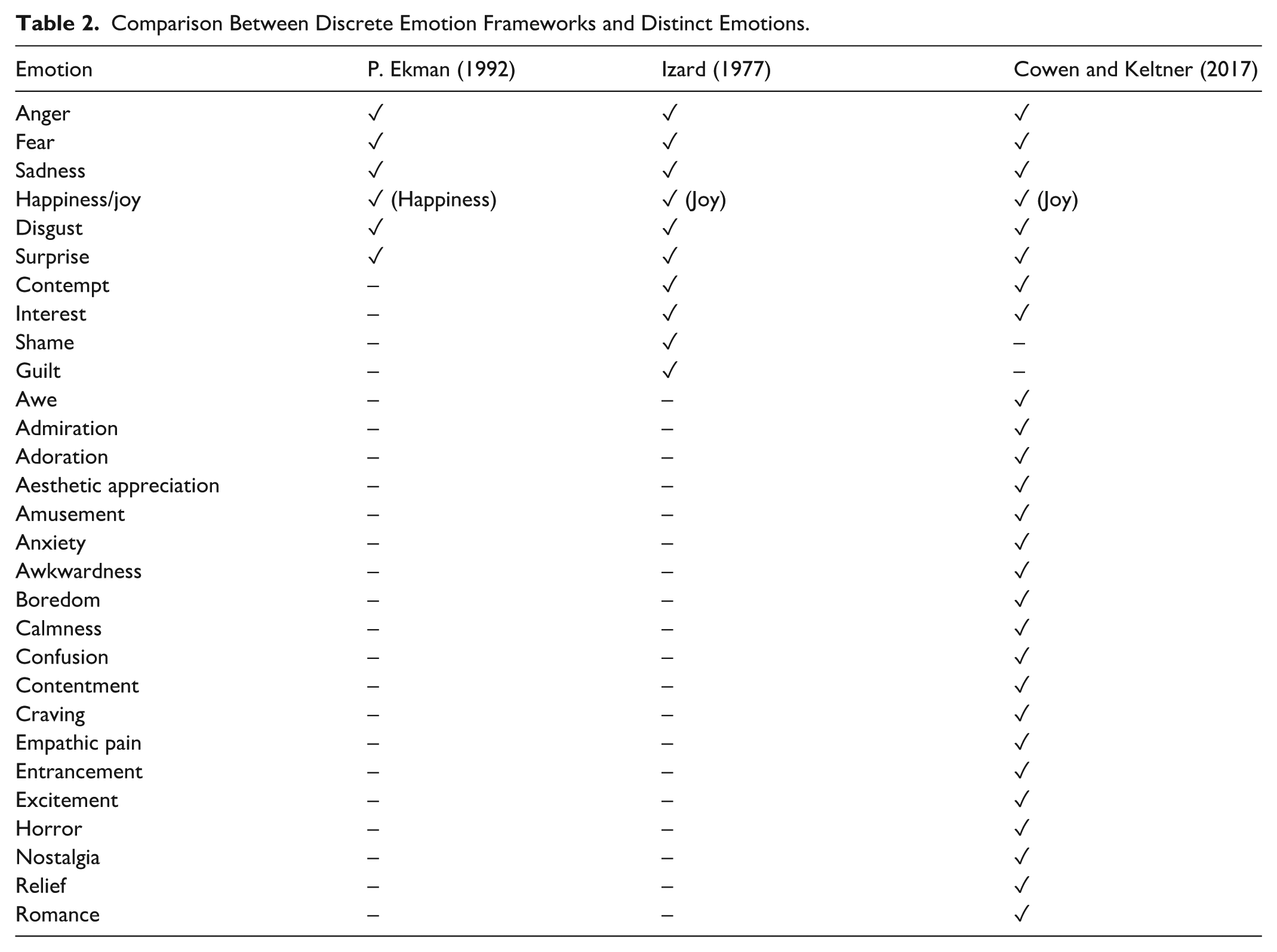
Although Cowen and Keltner use the term ‘distinct’, this review adopts the broader disciplinary convention of referring to these states as discrete emotions to maintain coherence with psychology and marketing. This taxonomy enables scholars to link emotions more precisely to marketing stimuli, experiences and outcomes, advancing the kind of ‘highly useful for the context’ (HUFTC) insights Hosany et al. (2021) have called for in tourism emotion research. Accordingly, this review systematically maps the emotion variables used in tourism marketing research over the past decade, employing Cowen and Keltner’s (2017) taxonomy to examine which emotions have been studied, their frequency and how well the field prioritises those most relevant to tourism, to answer the following research question:
Mid-Range Theory in Tourism Emotion Research
Although emotion is widely recognised as central to tourism marketing, many scholars have noted a lack of clear theoretical framing (Hosany et al., 2020; Mattila & Ro, 2008; Moyle et al., 2019). Too often, emotional responses are described without explaining how they function or are embedded in broader models. This highlights the need for stronger theoretical scaffolding and alignment to transform emotional description into explanatory power, and for clearer frameworks to guide this translation within tourism marketing.
One promising answer lies in mid-range theory, which offers a structured, yet practical bridge between abstract principles and real-world application. Mid-range theory, as introduced by Merton (1949), sits between broad, abstract theories and detailed, real-world problems. It helps researchers translate general ideas into context-specific investigations, offering a practical framework for studying how theory applies in everyday situations. Importantly, it supports research that is not only grounded in theory but is also useful for marketers, helping to translate academic insights into meaningful practice (Maclnnis et al., 1991). By bridging conceptual models and empirical observation, it allows scholars to examine real-world issues with both clarity and relevance (Brodie, 2017; Reibstein et al., 2009). In applied domains such as tourism, where both predictive insight and managerial utility are essential, mid-range models help to translate foundational emotion theory into testable, actionable designs that are both rigorous and applicable. The feeling (affect) as information theory (G. L. Clore et al., 2012; Schwarz & Clore, 1983; Tuan Pham, 2004), for example, shows how emotions act as internal signals that shape perception, judgement and choice. On the other hand, the broaden-and-build theory (Fredrickson, 2001) explains how positive emotions widen attention and encourage exploration – processes particularly relevant in travel settings. The appraisal-tendency framework (Han et al., 2007; Lerner & Keltner, 2000) links discrete emotions to patterned shifts in risk perception, decision-making and evaluation.
In tourism, these foundations are now being adapted into domain-specific, mid-range models. Despite their relevance, the extent to which such models have been adopted in tourism marketing research remains unclear. Therefore, this review uses a diagnostic lens to examine how emotion is positioned within tourism’s theoretical frameworks, whether as an antecedent, mediator or consequence, and to assess the extent to which these structures are embedded in models, and answer the following research question:
Industry Practice and the Emotion: The Evidence Gap
While tourism scholars continue to debate definitions and methods, industry has operationalised emotion with remarkable precision. Brands such as Tourism Australia, Disney and Airbnb design campaigns using discrete emotional targeting, guided by narrative strategy and affective science (P. Ekman, 2016; Ewing, 2022; Tourism Australia, 2023). Tools such as the Facial Action Coding System (FACS), developed by basic emotion theorist Paul Ekman, are now embedded in commercial emotion testing, reflecting the enduring influence of evolutionary-functional models in marketing (Lewinski et al., 2014).
Tourism marketing is uniquely suited to these approaches. Campaigns operate much like controlled experiments: emotional appeals are designed, delivered and measured for effect (Flake & Fried, 2020; Morales et al., 2017). Crucially, the bulk of destination marketing expenditure targets the pre-travel acquisition phase, where emotional resonance shapes desire, preference and intention (Brand, 2024; Tourism Australia, 2023; VisitBritain, 2023). Yet academic research has under-used these conditions, often overlooking the natural alignment between tourism marketing and emotion science (Fong et al., 2016; Moyle et al., 2019). Despite repeated calls for improved experimental design and more precise emotion elicitation (Lynn & Lynn, 2003; Mattila & Ro, 2008; Namasivayam, 2004; Viglia & Dolnicar, 2020), progress remains limited, potentially hampered by methodological constraints.
One major issue is the reliance on broad, valence-based constructs such as pleasure (e.g., S. Li et al., 2022, encompassing enjoyment, aesthetic appeal, and happiness) or memorable experience (e.g., S. Li et al., 2022, including gladness, relaxation, social connexion, and knowledge). This raises concerns about the validity of non-discrete emotion measures and the potential conflation of emotions with other affective constructs. These measures risk conflating emotions with other affective states, undermining validity and precision. Greater conceptual clarity is needed to define and distinguish discrete emotional states.
A further challenge lies in methodological rigour. Improvements in research design and reporting are required before methodological advances can be meaningfully applied. Tourism marketing studies should report how stimuli are manipulated to elicit emotions, include manipulation checks and provide effect sizes and statistical power to ensure robust and replicable findings (Iacobucci et al., 2023). Without these foundations, advanced tools such as electroencephalography (EEG) and galvanic skin response (GSR) cannot be meaningfully triangulated with self-report measures. While these techniques offer valuable, real-time insights into emotional arousal and attention (Hazlett & Hazlett, 1999; S. Li et al., 2015; Walters et al., 2025), without clear theoretical grounding and rigorous reporting, their results could lack validity and precision. As commercial practice already assumes that discrete emotions drive perception, memory and behaviour, there is a pressing need for academic research to match this level of precision. As emotional design becomes central across sectors (Day & Montgomery, 1999; M.-H. Huang & Rust, 2024), tourism risks falling behind. Bridging this gap requires more than advanced tools; it calls for theoretical alignment with the models already guiding practice, and a clearer focus on when and how emotion is measured within the marketing process. Critically, this is not just a call for academic sophistication; it is a call for relevance. Most tourism marketing investment occurs during the pre-travel phase, where acquisition is the primary goal (S. Huang et al., 2021; Tourism Australia, 2023). Yet many scholars have noted that emotion research in tourism often lacks the theoretical framing needed to inform such strategic decisions (Chen, 2025; Hosany et al., 2021). This raises an important question: how can academic research meaningfully assist industry with its real-world need for acquisition-focussed emotional insight? This motivates our final research question:
Comparison of Prior Reviews on Emotion in Tourism Marketing
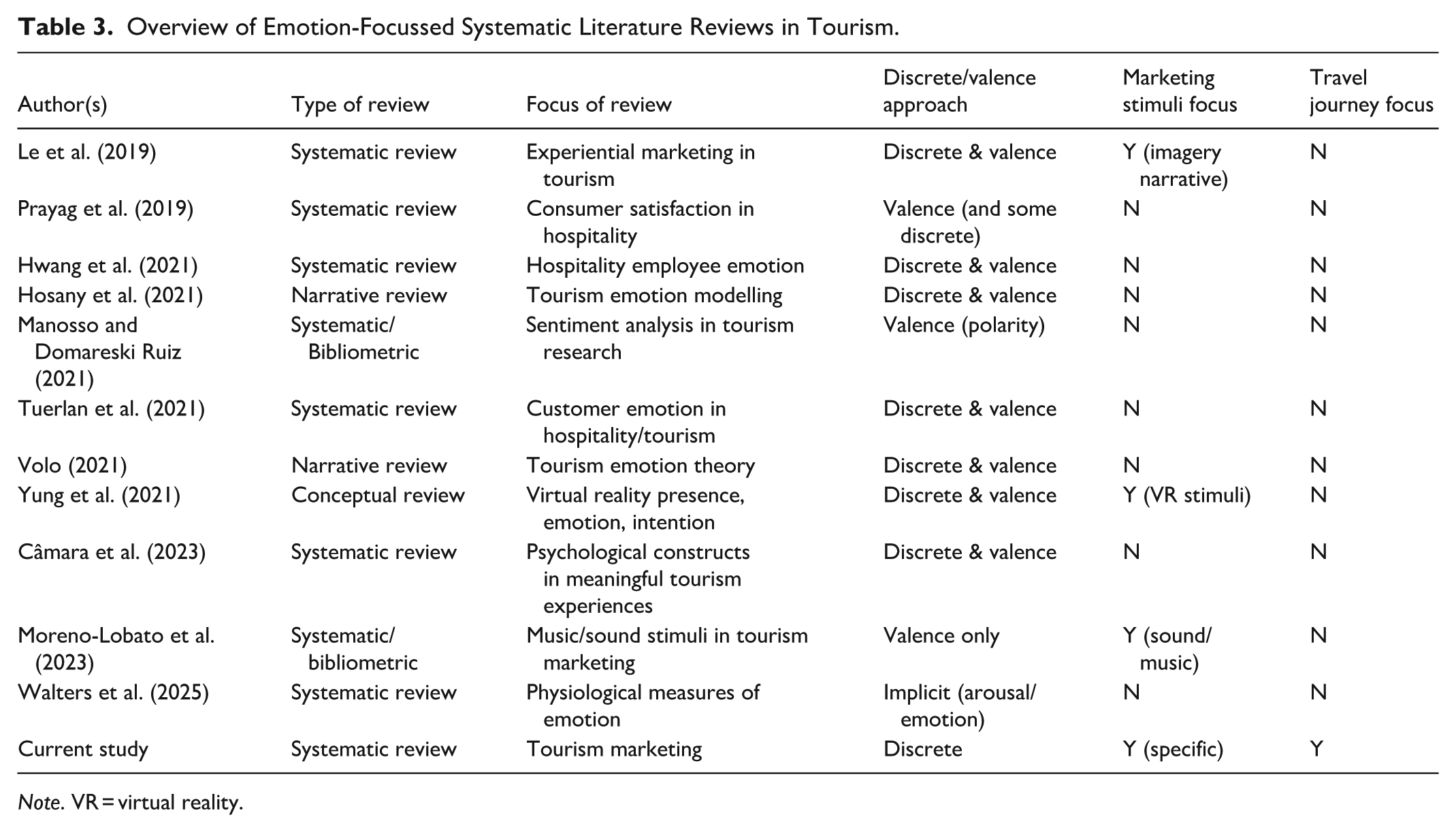
To justify this review, it is essential to clarify the scope of prior syntheses and identify persisting gaps (Paul & Criado, 2020). Existing reviews have explored emotion in tourism and marketing, yet limitations remain regarding their focus, treatment of discrete emotion approaches and coverage of marketing stimuli across the travel journey (see Table 3).
Overview of Emotion-Focussed Systematic Literature Reviews in Tourism.
Note. VR = virtual reality.
First, building on earlier work (Hosany et al., 2021; S. Li et al., 2015; Tuerlan et al., 2021; Volo, 2021), this review systematically maps emotion research in tourism marketing. Previous reviews examined emotions broadly (Chen, 2025; Hosany et al., 2021; Tuerlan et al., 2021; Volo, 2021) or focussed on specific stimuli and experiences (Moreno-Lobato et al., 2023; Yung et al., 2021). The absence of a one-to-one mapping between physiological signals and emotional states is evident in biometric measures (e.g., EDA, facial EMG, heart rate) that capture valence and arousal rather than discrete emotions (S. Li et al., 2015). Walters et al. (2025) confirm this pattern: across 82 studies (2011–2023), dimensional models dominate, with eye tracking (45%) and EDA (26%) most common, while discrete emotion coding (e.g., FACS, FaceReader) appears in only 5% of cases. Although prior reviews report the number of studies using discrete emotions (Hosany et al., 2021; Tuerlan et al., 2021), little attention has been paid to the distribution and relative emphasis on individual emotions. Addressing these gaps, this review applies Cowen and Keltner’s (2017) 27-emotion framework to offer the first fine-grained mapping of discrete emotions in tourism marketing, clarify current knowledge and provide a foundation for future research on emotion-driven tourist behaviour.
Second, while prior reviews acknowledge the use of theory and approaches to emotion elicitation (Hosany et al., 2021; Tuerlan et al., 2021; Volo, 2021), they offer limited insight into how these theories apply to specific marketing phenomena or other relevant emotional frameworks. This review not only considers theories used in previous research but also explores additional perspectives relevant to tourism marketing, highlighting opportunities to advance both research and practice. It further provides a diagnostic view by examining how emotions have been positioned in models, as independent, mediating or moderating variables, revealing alignments or gaps not addressed in earlier reviews.
Third, prior reviews of marketing stimuli and behavioural outcomes have been either too broad or too narrow. For example, Tuerlan et al.’s (2021) research provides a useful foundation, but lacks detail on outcomes, such as approach versus avoidance or variation in emotions across the travel journey – for instance, between booking (i.e., acquisition) and repeat visitation (i.e., retention). Other studies focus on specific stimuli (e.g., imagery or sound), offering limited insight into the full range of experiences that elicit emotions or their timing within the travel journey. Some research (Chen, 2025; Le et al., 2019; Moreno-Lobato et al., 2023) addresses tourism marketing more directly, yet no study integrates stimulus type, travel stage and behavioural outcomes comprehensively. This review addresses these gaps, providing a more complete understanding of emotions in tourism marketing. This review addresses these gaps, providing a more complete understanding of emotions in tourism marketing.
Method
This systematic literature review (SLR) adhered to the PRISMA 2020 guidelines (Page et al., 2021), using a structured, transparent and replicable approach to synthesise the use of discrete emotions in tourism marketing literature (see Appendix 1). A systematic quantitative synthesis was employed (Pickering & Byrne, 2014), guided by a pre-defined review protocol detailing the search strategy, screening procedures and inclusion criteria (Pahlevan-Sharif et al., 2019). This structure enhances analytical rigour and supports the identification of theoretical, methodological and temporal patterns across the literature.
Information Sources, Search Terms and Databases
Following previous SLRs in tourism and marketing, and to ensure the inclusion of multidisciplinary studies, three databases were selected due to their comprehensive coverage of tourism publications: EBSCOhost, Scopus (Elsevier) and ProQuest (Paul & Criado, 2020). This review includes literature from January 2012 to March 2025 and was limited to peer-reviewed articles published in English. Search terms reflected two primary themes. The first focussed on tourism marketing terminology (‘destination brand*’, ‘destination image*’, ‘destination marketing’, ‘destination brand equity’, ‘tourism market*’, ‘tourism advertis*’), acknowledging that ‘tourism marketing’ is not always explicitly used in tourism scholarship. The second included emotion-related terms (‘Emotion*’ OR ‘messag* appeal’) combined with each of the 27 distinct emotions identified by Cowen and Keltner (2017). This strategy ensured comprehensive coverage of studies relevant to the review’s aims. The initial search yielded 2,437 records. After removing 460 duplicates, 1,977 articles underwent title and abstract screening, followed by 1,245 full-text assessments. Articles were retained if they: (1) reported an empirical study; (2) explicitly measured a discrete emotion; and (3) investigated its role in tourism marketing. Studies using only affective valence (e.g., positive/negative) or moods without discrete emotion constructs were excluded. A total of 237 empirical studies met all criteria and were included in the final synthesis (see Figure 1).
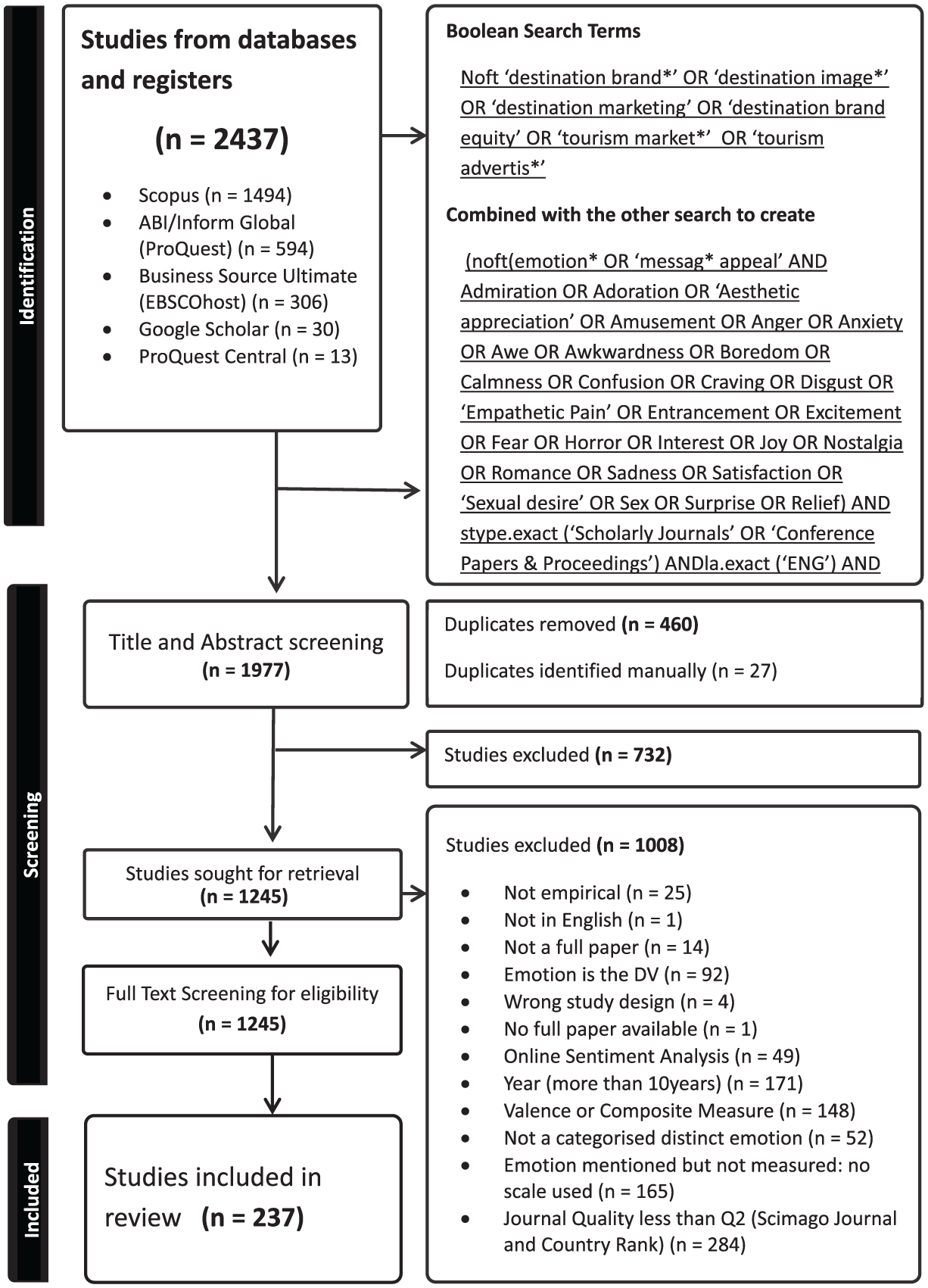
PRISMA flow diagram: records screened, assessed, and retained for 2012 to 2025.
Inclusion and Exclusion Criteria
To ensure relevance and rigour, studies were selected based on three primary inclusion criteria. First, articles had to examine the influence of a discrete emotion (e.g., joy, excitement, nostalgia, satisfaction), positioned as an independent variable, mediator or moderator. Studies that positioned emotion solely as a dependent variable were excluded, as this review focussed on emotion as a mechanism rather than an outcome (cf. Bagozzi et al., 1999; Tuan Pham, 2004). In addition, studies that only referred to general affect, relied on valence-based models or did not use a validated emotion scale were also excluded. Second, the study design had to include emotion elicitation and compare groups or conditions based on a marketing or decision-making outcome. Third, the marketing-related outcome (e.g., intention, attitude, loyalty) needed to be positioned downstream from emotion within the study’s conceptual model.
Further criteria were applied to ensure quality and methodological alignment for the current review. Consistent with other reviews in tourism and business management (B. Barton & Goh, 2025; Cranney et al., 2025; Riedel et al., 2023; Swain, 2025), a Scimago quality-rank criterion was used to exclude studies published in journals ranked below Q2. Following PRISMA-aligned procedures (Pahlevan-Sharif et al., 2019) and exclusion criteria of prior systematic reviews in tourism and business management (B. Barton & Goh, 2025; Cranney et al., 2025; Lyu et al., 2023; Riedel et al., 2023; Swain, 2025), only peer-reviewed journal articles were included, with books and book chapters excluded. The 2012 to 2025 timeframe was selected to capture recent developments over a decade-long timespan and for any observable changes following recommendations from prior related reviews (Hosany et al., 2021; S. Li et al., 2015; Volo, 2021).
In addition, only quantitative or mixed-method studies were included; qualitative studies and conceptual papers without primary data were excluded. Papers were also excluded if they lacked full-text access, relied on sentiment analysis without direct emotion measurement, used unsuitable designs or had been retracted. While some relevant studies may appear in other languages, analysing non-English journals was beyond the expertise of the research team. The methodological diversity of the included studies precluded meta-analysis, which would not be appropriate for the current review.
Full-Text Screening Procedure
A total of 2,437 papers were imported into Covidence (https://www.covidence.org), a platform aligned with PRISMA workflows and commonly used in SLRs (Harrison et al., 2020). After removing 460 duplicates, 1977 studies proceeded to title and abstract screening. Of these, 1,245 full-text articles were assessed for eligibility. After applying the inclusion and exclusion criteria, 1,008 articles were excluded for reasons such as lacking an empirical design, using dimensional or composite emotion measures, treating emotion as a dependent variable or failing to include a distinct emotion as defined by Cowen and Keltner (2017). Notably, 457 of these were excluded due to conceptual, theoretical or measurement issues: 148 for employing valence-based or composite measures, 92 for positioning emotion as the dependent variable, 52 for omitting discrete emotions in measurement and 165 for referencing emotion without empirically assessing it. These exclusions highlight the persistent conflation of emotion with valence-based constructs and the lack of precise measurement across much of the literature. An additional 284 studies were excluded due to journal quality below Q2. This process yielded 237 articles for inclusion in the review.
Data Extraction and Coding
A structured data extraction template was developed by a three-person research team, incorporating both theoretical and practical considerations to ensure consistency and relevance. For each study, data were extracted on the following elements: authors, year of publication, journal and study title; methodology and country of data collection; the discrete emotions measured; research design, mediators and moderators; appraisal positioning, outcome measures, stimuli and the time point at which emotions were measured; the type of analysis used; and the guiding theoretical framework where reported. The extracted data were then analysed to address the study’s three guiding research questions.
To address RQ1, we used Cowen and Keltner’s (2017) 27-emotion taxonomy, which differentiates emotion families more precisely than the broader affective sets often applied in tourism and consumer research. Constructs, such as joy/love or positive surprise from the Destination Emotion Scale (Hosany & Gilbert, 2010) and the Consumption Emotion Set (Richins, 1997), were not excluded, but refined into specific clusters, such as amusement, adoration, contentment, awe and interest. Each cluster has a distinct appraisal profiles. This alignment offers a more detailed interpretive structure, allowing comparison with contemporary emotion-science models while remaining compatible with existing tourism scales, such as destination emotion and consumption emotion.
For RQ2, a thematic coding approach was applied to analyse the theoretical models used in tourism marketing research. This process identified both the types and frequency of theories employed and examined whether emotions were positioned as an independent variable, mediator, or moderator. For RQ3, thematic coding was similarly used to classify when emotions were measured (pre-travel, during travel and post-travel) and to determine whether the associated outcomes reflected customer acquisition or retention.
In relation to the coder process, the lead author deductively coded (using closed coding) all papers according to the coding matrix developed to address RQ1–RQ3. To execute the coding, the systematic literature review software, covidence was used to accuracy and traceability of the coding undertaken by the lead author. During this process, team meetings were held to discuss and refine aspects of the coding process, including the incorporation of identifying studies where multiple discrete emotions were included and studied, thus the framework being amended to allow this data incorporation. An additional discussion and change to the framework was identifying and capturing studies where emotions could be tested in a singular study by having multiple roles (mediator and moderator e.g.,), undertaken via processes such as competing models. At the conclusion of the coding process, an inter-rater reliability assessment of the identified discrete emotions in the studies included in the review was undertaken via a second coder cross coding of the first 30 papers of the review. An assessment of the integrate coder reliability identified that there was 90.3% agreement in the identification of the emotions, at a Kohen’s kappa of 0.88.
Results
Descriptive Results
The final dataset comprised 237 peer-reviewed empirical studies spanning top-tier journals in tourism, services and marketing. This disciplinary spread reflects the increasing integration of emotional constructs in tourism-related consumer behaviour research. A sharp increase in emotion-focussed tourism studies occurred between 2018 and 2021, peaking in 2021 with 45 publications. During this time, certain emotions such as nostalgia, aesthetic appreciation and interest were studied more frequently, while others such as joy and awe appeared more consistently than in previous years. From 2023 onwards, study volume declined, with a moderate rebound in 2024.
Geographically, the sample is dominated by data collected in China (46.03%), followed by studies conducted in European countries (24.22%) and South Korea (9.93%). Other frequently represented locations include Malaysia (7.94%), Australia (4.37%), India (3.97%) and Thailand (3.57%). Notably, the United States, a major outbound and inbound tourism market, remains under-represented, contributing to only 3.97% of the total studies.
Distinct Emotion Usage in Tourism Marketing
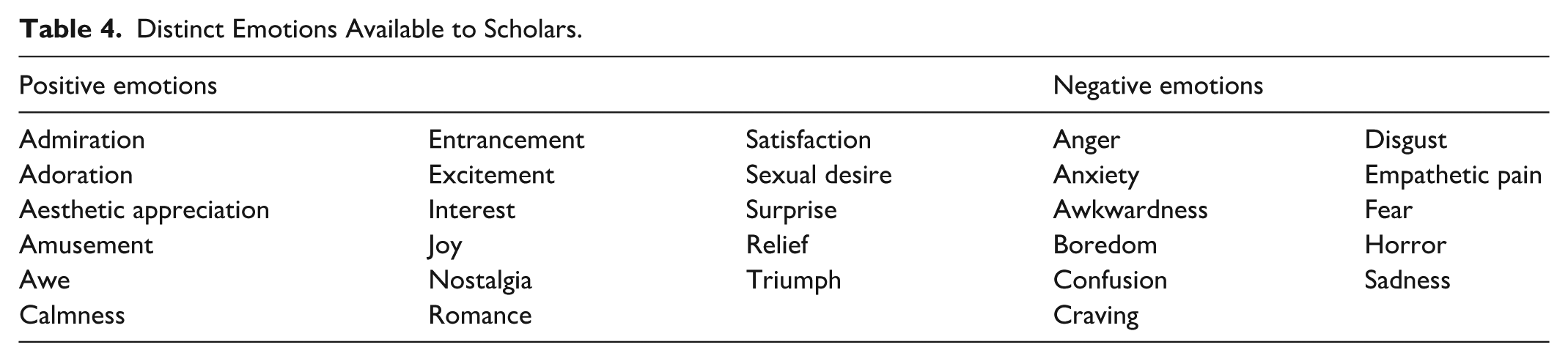
To address RQ1, this review adopted Cowen and Keltner’s (2017) empirically derived taxonomy of 27 distinct emotions as the coding framework during the Boolean phase of data extraction (see Table 4).
Distinct Emotions Available to Scholars.
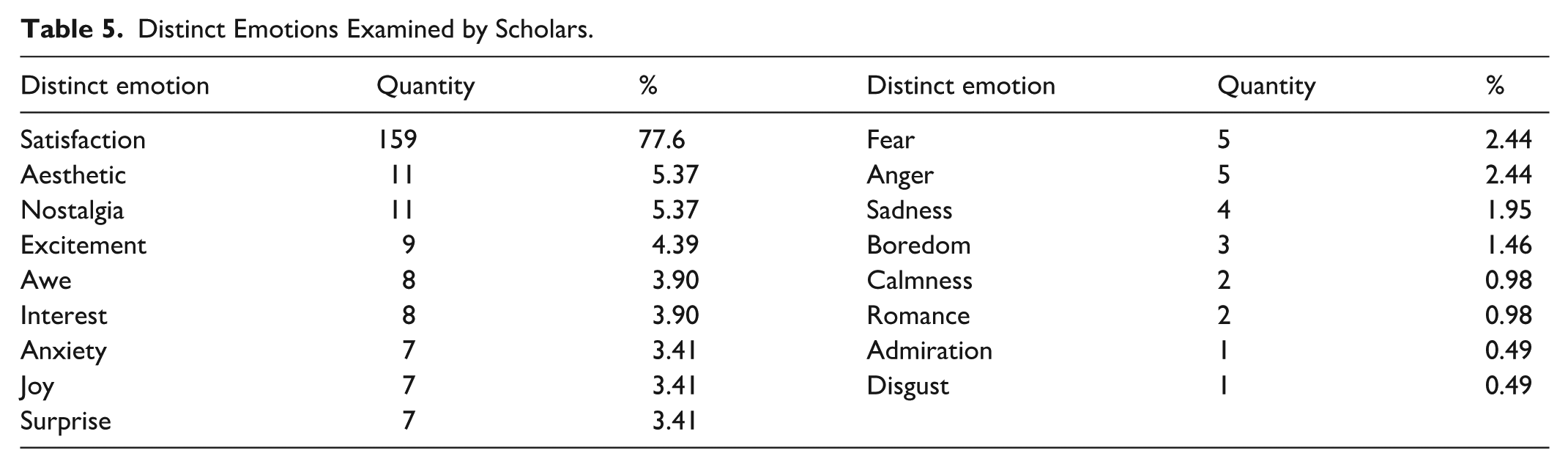
Of these 27 emotions, only 19 have been empirically examined in tourism marketing studies published between 2012 and 2025. However, usage was highly concentrated. Satisfaction accounted for 76.37% of all emotion measurements. Only two additional emotions, aesthetic appreciation (6.33%) and nostalgia (5.91%), were applied in more than 5% of studies. Emotions widely recognised as ‘highly useful to tourism’, including excitement (3.80%), awe (3.38%), joy (3.38%) and romance (0.84%), each appeared in fewer than 4% of studies. Negative and mixed-valence emotions were infrequently examined. Constructs such as fear (2.11%), anger (2.11%), sadness (1.69%), boredom (1.27%), admiration (0.84%) and disgust (0.42%) appeared in fewer than 3% of studies. Overall, positive emotions accounted for 89.47% of all emotion measurements, with negative emotions comprising just 10.53% (see Table 5).
Distinct Emotions Examined by Scholars.
The Role of Emotions and Their Theoretical Foundations
As previously outlined, the positioning of distinct emotions within conceptual models is critical for determining their mediating effects and for understanding causal pathways (related to RQ2). Because this review focuses on emotion as a mechanism within tourism marketing models, studies that positioned emotion solely as a dependent variable were excluded during the coding extraction phase. However, in some studies emotion appeared in multiple roles (e.g., both as mediator and outcome); in such cases, the study was retained and the emotion coded according to its various theoretical positions.
Accordingly, the role of emotions was examined in terms of how they were positioned within conceptual models, as mediators, moderators, independent variables or dependent variables. Next, the theoretical frameworks employed to justify and operationalise these positions were identified and assessed. Table 6 demonstrates that emotions were most frequently employed as mediators, with 74.68% of studies adopting this approach.
Positioning of Emotion in Conceptual Models.
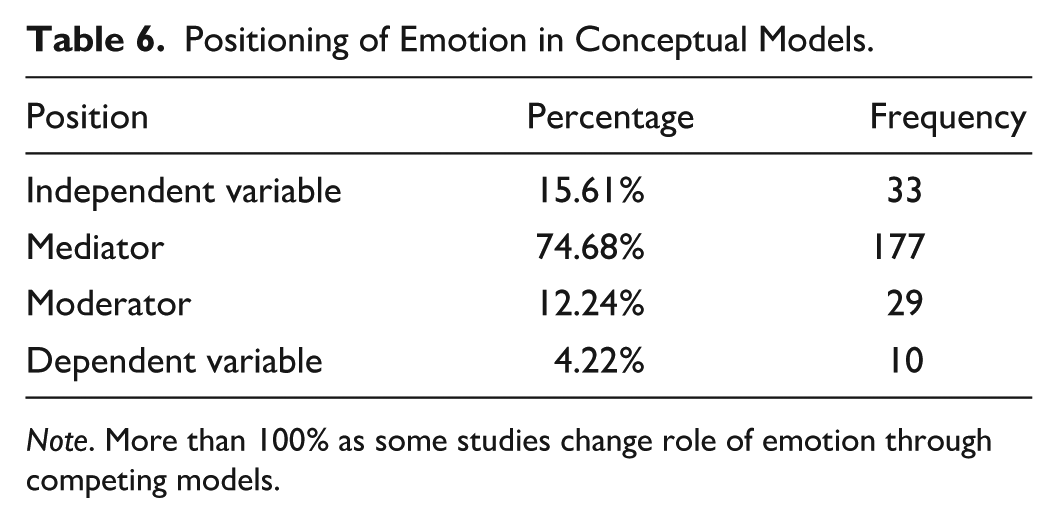
Note. More than 100% as some studies change role of emotion through competing models.
A smaller proportion of studies used emotions as independent variables (15.61%), moderators (12.24%) or dependent variables (4.22%). In some cases, studies employed multiple model positions, resulting in totals exceeding 100%. Notably, nearly one-fifth of studies positioned emotions as either independent or dependent variables, a choice that can limit explanatory power by failing to clarify how the emotion was elicited or how it triggered specific behavioural outcomes.
Further analysis explored whether emotions were positioned as primary appraisals, secondary appraisals, response variables or outcomes within conceptual frameworks. Secondary appraisals account for the majority (56.12%), followed by response variables (32.91%), primary appraisals (21.52%) and outcomes (2.53%). Some studies use emotions in multiple positions, reflecting the diversity of methodological approaches across the dataset. To explore the theoretical underpinnings of these studies (related to RQ2), all 237 empirical articles were thematically coded. Fewer than one-third anchored their investigation of emotion in an identifiable theoretical framework. The theory of planned behaviour was the most commonly applied (n = 11), followed by general emotion theory (n = 8), push and pull motivations (n = 6) and expectancy disconfirmation theory (n = 6). Additional frameworks included cognitive and affective evaluation (n = 6), the stimulus-organism-response (s-o-r) model (n = 4), motivation theory (n = 4), expectation-disconfirmation theory (n = 3), the theory of reasoned action (n = 3) and cognitive appraisal theory (n = 2).
Emotions Across the Travel Journey Timeline
To address RQ3, the three stages of the travel journey timeline were undertaken. Accordingly, and consistent with established literature, studies were coded into three categories – pre-travel, during travel and post-travel – and the emotions at the stage was extracted (Eletxigerra et al., 2021; Tung & Ritchie, 2011). Second, the location and timing of survey administration were evaluated. Third, the specific tourism behaviours and outcomes were classified according to whether they reflected acquisition or retention-focussed marketing objectives. As Figure 2 highlights, most tourism studies measure emotions during travel (49%) or post-travel (51%), with only 11.39% of studies measuring emotions in the pre-travel stage. As a result, many tourism studies focus on the after-effects of a travel experience – that is, satisfaction. It is noteworthy that a smaller proportion of studies (8.86%) examined emotions across multiple phases, explaining why cumulative percentages exceed 100%. Emotion measurement was most frequently concentrated in the post-travel stage, with fewer studies capturing emotional responses during or prior to travel decision-making.
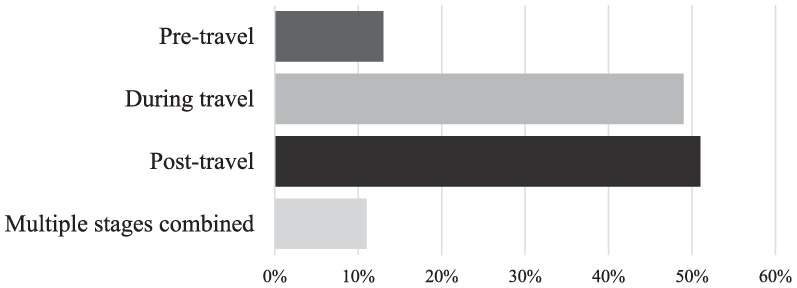
Timepoint survey administered.
Acquisition versus Retention Outcomes
The dependent variables across the reviewed studies were analysed according to their alignment with customer acquisition or retention outcomes. Table 7 shows that the majority of DVs focus on retention-related behaviours, including revisit intention (22.78%), behavioural intention (17.3%), loyalty (13.5%), destination loyalty (12.24%) and destination image (2.95%).
Dependent Variables and Associated Outcomes.
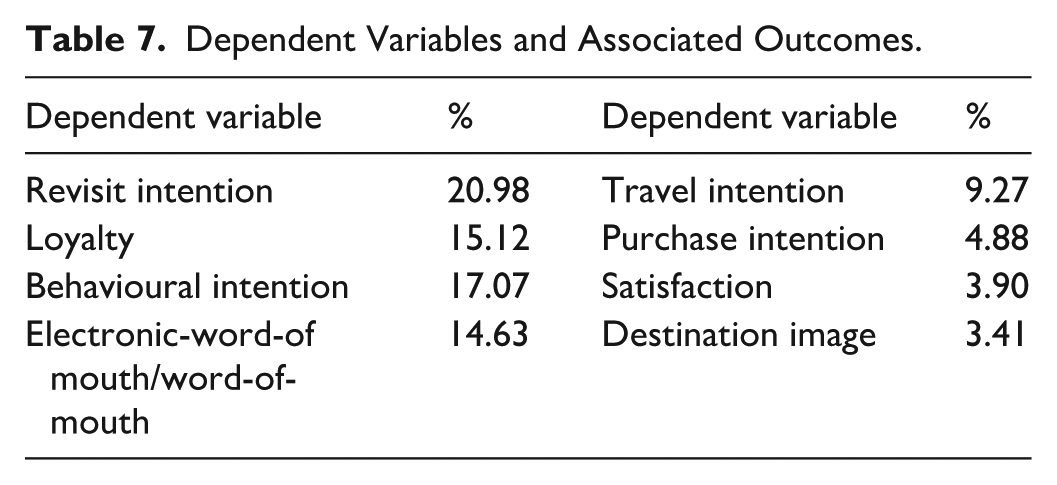
Additional retention constructs, such as brand loyalty (2.11%), intention to recommend (1.27%), intention to complain (0.84%) and affective and cognitive image (0.84%), were also reported. These outcomes were typically measured in post-travel phases and assessed consumer evaluations or repeat behaviours. By comparison, acquisition-related outcomes, such as travel intention (10.13%) and purchase intention (5.06%), were measured less frequently.
Types of Stimuli Employed in Emotion Studies
This review also examined the stimuli used in emotion measurement (related to RQ3). Most studies (82.28%) relied exclusively on respondent-generated memory, meaning no external stimulus was presented at the time of emotion measurement. Instead, participants were asked to recall or reflect on past travel experiences. These memory-based approaches were typically paired with subjective self-report methods; across the full dataset, only 1.27% of studies incorporated objective measures such as physiological or behavioural data. Table 8 outlines, among studies that employed external stimuli (17.72% of the total sample), the most frequently used formats included on-site experiences (8.44%), images (3.38%), videos (2.53%), virtual reality (VR; 1.69%), advertisements (1.69%) and narrative texts (1.69%).
Stimuli Excluding Recall.
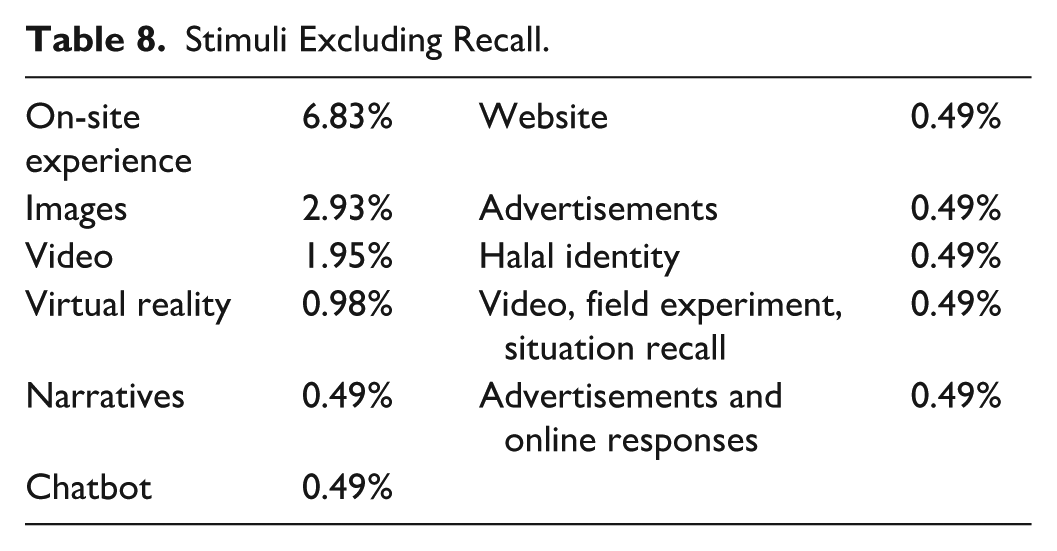
Less commonly used formats included digital interactions (1.27%), such as chatbot conversations or online response simulations, and individual examples such as websites (0.42%), nature and sound stimuli (0.42%) or identity-based content such as halal tourism messaging (0.42%).
Discussion
Before discussing the results and implications, we note that this section draws on both the frequency of studies (as reported in the results) and illustrative examples from the literature. This combined approach demonstrates breadth, showing how often patterns occur, and depth, highlighting studies that exemplify these patterns. Consistent with systematic review practice (Pahlevan-Sharif et al., 2019; Riedel et al., 2023; Swain, 2025), we use cited works to contextualise key points, ensuring transparency regarding patterns, limitations and examples of best practice. This approach provides a more nuanced interpretation of the reviewed literature beyond simple frequency reporting.
Applying this approach, this review reveals five key patterns that signal a need to realign tourism marketing research with emotion across conceptual, methodological and strategic dimensions. First, despite the richness of the 27-emotion taxonomy, only 19 emotions have been studied in tourism marketing, and usage is heavily skewed. Satisfaction alone accounts for over three-quarters of all measures, with only nostalgia and aesthetic appreciation exceeding 5%. Emotions central to tourism, such as awe, joy, excitement and romance, remain under-utilised.
Second, emotion measurement is dominated by positive affect, representing nearly 90% of all cases. Negative or mixed-valence emotions such as fear, boredom and sadness are rarely examined. This imbalance limits understanding of the full emotional texture of travel, including discomfort, tension and reflective moments that often make experiences meaningful (Jordan & Prayag, 2022; Soulard et al., 2023; X. Zhang et al., 2025).
Third, although many studies include emotion in their models, few are grounded in emotion-specific theory. The theory of planned behaviour is most commonly used, yet it typically positions emotion as secondary to cognition. More robust alternatives such as appraisal theory, affect-as-information and broaden-and-build frameworks are available but under-utilised.
Fourth, there is a disconnect between the timing of marketing efforts and the timing of emotion measurement. Marketers often seek to influence pre-travel emotion to shape intention, but most studies measure emotion during or after the experience, usually in the form of satisfaction. Only 12% examine pre-travel emotion, limiting acquisition insights.
Fifth, most studies rely on memory-based recall to assess emotion. Only 17% use stimulus-based methods, such as video, narrative or imagery, at the point of measurement. While recall has value, this dominance may overlook the real-time influence of emotion on attention and action. In contrast, tourism marketers increasingly use real-time emotion tracking to optimise messaging and engagement.
These patterns point to a field in transition. Emotion is important, yet unevenly applied in theory and practice. Rather than a critique, this review offers a call to action. This section introduces the Tourism Emotion Framework (TEF) and six supporting propositions. The goal is to broaden the range of emotions studied, align emotional constructs with stages of the travel journey and guide research towards models that more accurately reflect the role of emotion in tourism behaviour.
Implications for Theory and Practice
The preceding analysis reveals recurring conceptual and methodological limitations in how emotion is treated within tourism marketing research. The following propositions address these gaps by advancing a coherent theoretical agenda. Each builds directly from the systematic review and responds to one or more of the three guiding research questions. Together, they propose a more precise, testable and strategically aligned approach to emotion modelling, grounded in contemporary affective science and tailored to the dynamics of tourism decision-making.
Proposition 1: Let Emotion Theory Guide Construct Selection
Across consumer research and applied psychology, emotion is now understood not as a general mood or retrospective overlay, but as a structured, discrete state that shapes perception, intention and behaviour (Harmon-Jones et al., 2016; Lerner & Keltner, 2000; Tuan Pham, 2004). Despite recognition of emotion’s centrality, tourism marketing research continues to rely on vague constructs such as satisfaction or undifferentiated positive affect, limiting both conceptual clarity and behavioural insight. Calls for rigorous emotion modelling remain unanswered (Dolnicar & Ring, 2014; Hosany, 2012; Kock et al., 2020; Scuttari & Pechlaner, 2017; Volo, 2021). The systematic analysis shows that global affect measures still dominate and theoretical specificity remains rare.
More than 75% of studies continue to default to broad affective summaries. Only 19 of the 27 discrete emotions identified in Cowen and Keltner’s (2017) taxonomy have been examined in tourism research. This narrow emotional repertoire obscures the functional differences between states such as admiration and amusement, or awe and anxiety – differences that shape how travellers attend to, interpret and act upon tourism stimuli. Many under-explored emotions such as awe, pride, guilt or romantic desire are central to tourism’s affective appeal, but remain conceptually under-developed, appearing in less than 5% of studies.
Discrete emotions differ in appraisals and motivational tendencies (Frijda, 1986; Lerner & Keltner, 2000; C. A. Smith & Ellsworth, 1985). This functional differentiation matters: awe may foster humility and accommodation; guilt may prompt reparative action; pride can motivate advocacy. In tourism, where emotional response shapes desire, attachment and memory, failure to model these distinctions results in blunt instruments and missed insight.
In response to RQ1, this proposition calls for broader, more contextually grounded construct selection. Rather than treating emotion as a diffuse variable, tourism research should adopt distinct, state-based constructs that reflect the richness of the tourism experience. Cowen and Keltner’s (2017) taxonomy, grounded in evolutionary-functional theory and validated cross-culturally, offers a coherent, ecologically valid vocabulary that reflects how emotions unfold in real-world contexts. It includes mixed-valence and context-specific states such as nostalgia, horror and adoration, which are experiences that are common in tourism but rarely measured. This taxonomy supports Hosany et al.’s (2021) ‘highly useful for the context’ (HUFTC) approach, which prioritises the emotions most relevant to tourism’s symbolic, experiential and persuasive goals.
Importantly, Cowen and Keltner’s (2017) taxonomy is not the only viable option. Shiota’s (2014) PANACEAS taxonomy, encompassing pride, amusement, nurturant love, awe, contentment, enthusiasm, attachment love and sexual desire, offers an alternative classification of discrete positive emotions grounded in an evolutionary-functionalist perspective. The Discrete Emotions Questionnaire (Harmon-Jones et al., 2016) captures episodic responses such as awe, anger, desire and fear. Hosany and Gilbert’s (2010) Destination Emotion Scale was a foundational step in tourism, introducing joy, love and positive surprise. Yet many studies collapse these items into a single index of ‘positive affect’, flattening nuance and weakening predictive precision (Hosany et al., 2020).
Whether drawn from Cowen and Keltner, the Positive Affect Negative Activation Cognitive Effort Approach Scales, the discrete emotions questionnaire or the differential emotions scale, the emotion vocabulary must be theoretically anchored, psychometrically validated and contextually relevant. However, to truly reflect tourism’s distinct psychological, cultural, and experiential contours, the field must move beyond borrowed instruments and develop its own tourism-specific emotion scales. This will enable researchers to move from descriptive affect to predictive precision, designing studies that capture how emotion shapes tourism decision-making, memory and meaning. This shift not only aligns tourism research with best practices in adjacent disciplines, but also enhances its capacity to generate replicable, actionable insights. Having addressed the need for richer construct selection through discrete emotion taxonomies, the next step is to clarify how these constructs should be embedded within theoretical models that explain and predict behaviour.
Proposition 2: Dual-Path Emotion Modelling Enhances Predictive Precision
Theories are not categorical truths but conceptual lenses – tools that bring coherence to complex phenomena. As Pham (2007) argues, multiple theories can and should coexist when each offers a meaningful lens on the dynamics it seeks to explain. This proposition adopts that pluralistic stance by proposing a dual-path model that operationalises two foundational emotion theories: evolutionary-functionalism and cognitive appraisal. By integrating stimulus-driven emotion states with appraisal-based trait segmentation, the model offers a cohesive framework for understanding how tourism experiences generate, interpret, and act upon emotion. This integration strengthens theoretical grounding and addresses longstanding critiques of the field’s fragmentation and weak explanatory depth (Dolnicar & Ring, 2014; Scuttari & Pechlaner, 2017; Volo, 2021).
This two-stage model enhances predictive capacity. First, discrete emotions such as awe or joy can be elicited through stimulus design, images, narratives or environments calibrated to trigger specific affective responses. These state-based reactions interrupt cognition, redirect attention and shape immediate behaviour. Second, appraisal orientations serve as enduring traits that moderate how stimuli are interpreted. For example, a traveller high in uncertainty tolerance may appraise novelty with curiosity, while another may react with avoidance. This layered model enables segmentation based on emotional sensitivity and cognitive orientation, supporting more precise and resonant design. Researchers can extend this logic by applying appraisal theory to audience profiling. Goals or motives such as escape and relaxation, novelty-seeking, relationship-building and self-development can serve as effective segmentation tools (Pearce & Lee, 2005). At the same time, discrete emotions operate as fast, stimulus-linked cues, while appraisal tendencies influence how individuals evaluate key dimensions such as novelty, control and certainty (Tuan Pham, 2004; Zajonc, 1984).
By identifying both trait-based emotional predispositions and cognitive appraisal patterns, researchers can support more strategic segmentation and enhance model precision (Carrillat et al., 2009; Hosany, 2012; Lerner et al., 2015). Embedding emotion elicitation within appraisal-informed segmentation frameworks allows scholars to link upstream campaign design with downstream effects such as recall, satisfaction and advocacy. This approach also invites new forms of experimental design, manipulating emotional stimuli while testing trait-based interpretation. Rather than choosing between state and trait, emotion and cognition, scholars can now combine them for stronger, theory-aligned design.
Proposition 3: As Tourism Marketing Research Deepens Its Theorisation of Emotions, Its Capacity to Explain and Influence Behaviour Will Strengthen
Tourism marketing research often oscillates between abstract theory and descriptive empiricism. On one side, grand theories that are grounded in cognition, cultural critique or broad sociological paradigms offer expansive explanatory power but provide little operational guidance. On the other, applied studies frequently include emotion without anchoring it in any model that explains how it functions or why it matters. This disconnection has led to a field where emotion is acknowledged as important but rarely modelled with theoretical precision. Fewer than 30% of tourism marketing studies from the past decade position emotion within an identifiable theoretical framework. In many cases, emotion is used descriptively, with no clarity about whether it acts as a cause, a mediator or a consequence of tourist behaviour. This lack of scaffolding limits explanatory insight, weakens construct validity and hinders the development of replicable models.
In response to RQ2, we argue for the adoption of mid-range theory: conceptual frameworks that bridge abstract principles with testable, design-relevant applications. Originally introduced by Merton (1968), mid-range theories explain mechanisms within bounded systems. They are not universal laws, but structured tools, specific for causal modelling, flexible for applied contexts and rigorous for design. In the context of tourism emotion research, mid-range theories illuminate how and why specific emotions shape behaviour, attention and memory. They allow researchers to ask not just what emotions are present, but what they do, how they operate and under what conditions this occurs. It is precisely this level of theorising that enables tourism studies to move beyond sentiment measurement towards predictive, strategically aligned modelling.
A range of mid-range theories from psychology and consumer research offer valuable scaffolding for tourism emotion modelling. Affect-as-information (G. L. G. K. Clore & Garvin, 2001; Tuan Pham, 2004) explains how emotions function as heuristic cues that guide perception and judgement, often outside conscious awareness. Broaden-and-build theory (Fredrickson, 2001) demonstrates how positive emotions such as awe or joy expand attention and foster cognitive flexibility, supporting behaviours such as exploration and openness. The appraisal-tendency framework (Lerner & Keltner, 2000) and the emotion-imbued choice model (Lerner et al., 2015) both highlight how discrete emotions, such as fear, pride or anger, produce emotion-specific effects on depth of processing, risk sensitivity and goal orientation. Cognitive appraisal theory (Lazarus, 1991b; C. A. Smith & Ellsworth, 1985) adds explanatory granularity, mapping how emotions emerge from situational appraisals of novelty, certainty and control.
Recent models also link emotion to specific consumer motivations. Oh and Pham’s (2022) liberating-engagement theory defines fun as a dual-state of hedonic engagement and felt liberation, activated by novelty, social connexion, spontaneity and boundedness, offering insight into emotionally immersive tourism design. While tourism-specific tools such as the Destination Emotion Scale (Hosany & Gilbert, 2010) have advanced discrete emotion measurement, scholars should avoid collapsing joy, love and positive surprise into a single composite of ‘positive affect’, as doing so erases important functional differences between these states.
Emerging tourism-specific mid-range theories further extend these insights. Interaction ritual chain theory (Collins, 2014; Soulard et al., 2021) models how synchronised social rituals generate emotional energy and collective effervescence. The framing theory of social action (Soulard & McGehee, 2023) explores how emotions such as outrage or hope are shaped by narrative context and translated into prosocial action. The Lövheim cube of emotion (Lövheim, 2012; Moyle et al., 2019) introduces a neurochemical mapping of emotional states that may help explain peak affective responses in nature-based or awe-inducing tourism settings. Additional options such as protection motivation theory (Pechmann et al., 2003; Rogers, 1975) further expand the toolkit by modelling how fear, perceived efficacy and coping appraisals shape behavioural responses to risk, a critical mechanism in tourism safety and crisis communication. Finally, social exchange theory (Homans, 1958) and legitimacy theory (Dowling & Pfeffer, 1975) offer interpretive tools for understanding complex moral emotions, such as guilt, discomfort or outrage, arising from perceived inequality, risk or value violation in tourism contexts.
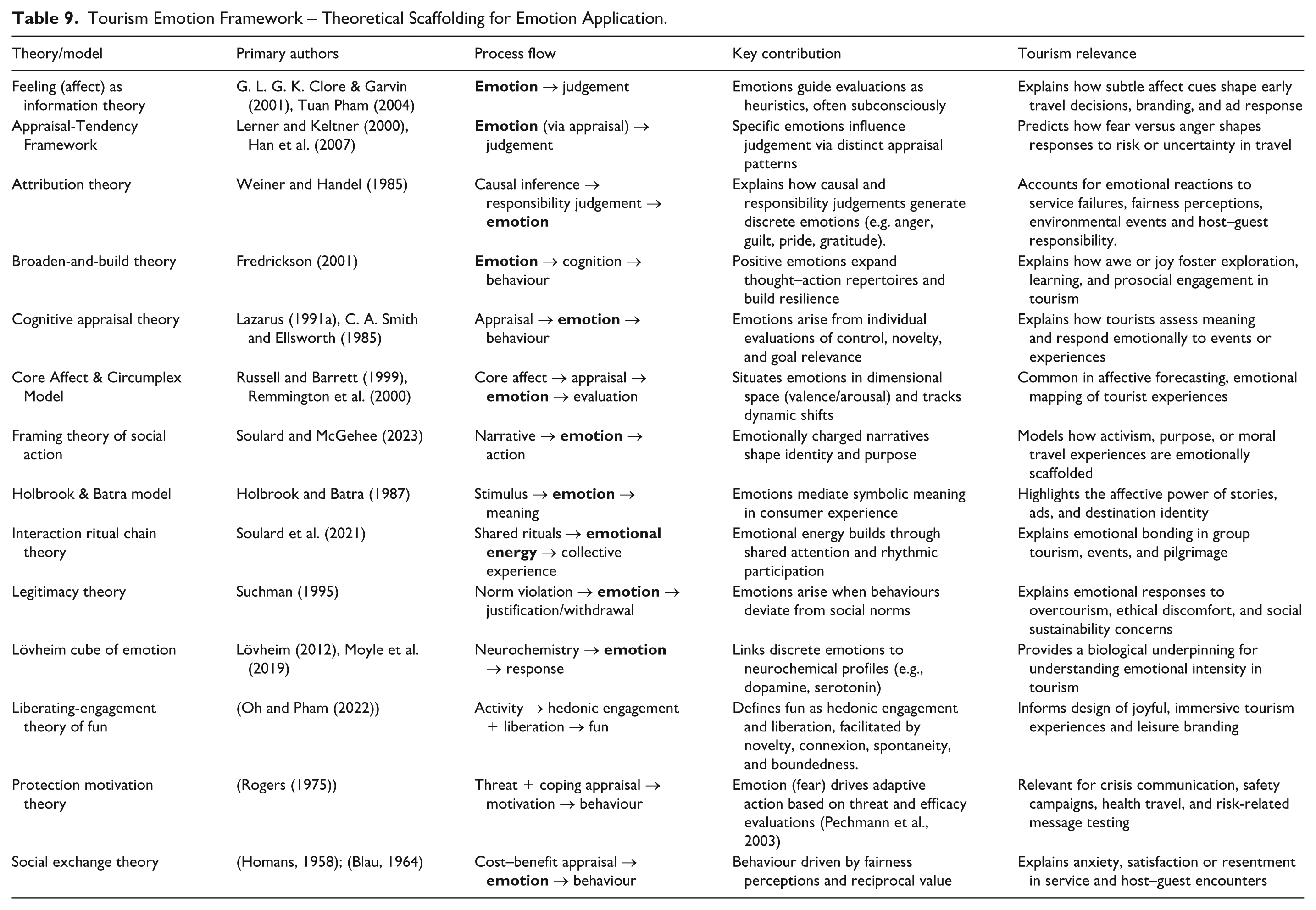
Table 9 outlines key emotion-focussed theories that are adaptable to tourism research. Each model offers a process flow, theoretical contribution and tourism relevance, enabling scholars to match research aims with conceptual precision.
Tourism Emotion Framework – Theoretical Scaffolding for Emotion Application.
Proposition 4: Tourism Research Can Advance by Combining (Brief) Robust Emotion Measurement With the Study of Under-Researched Emotional Experiences
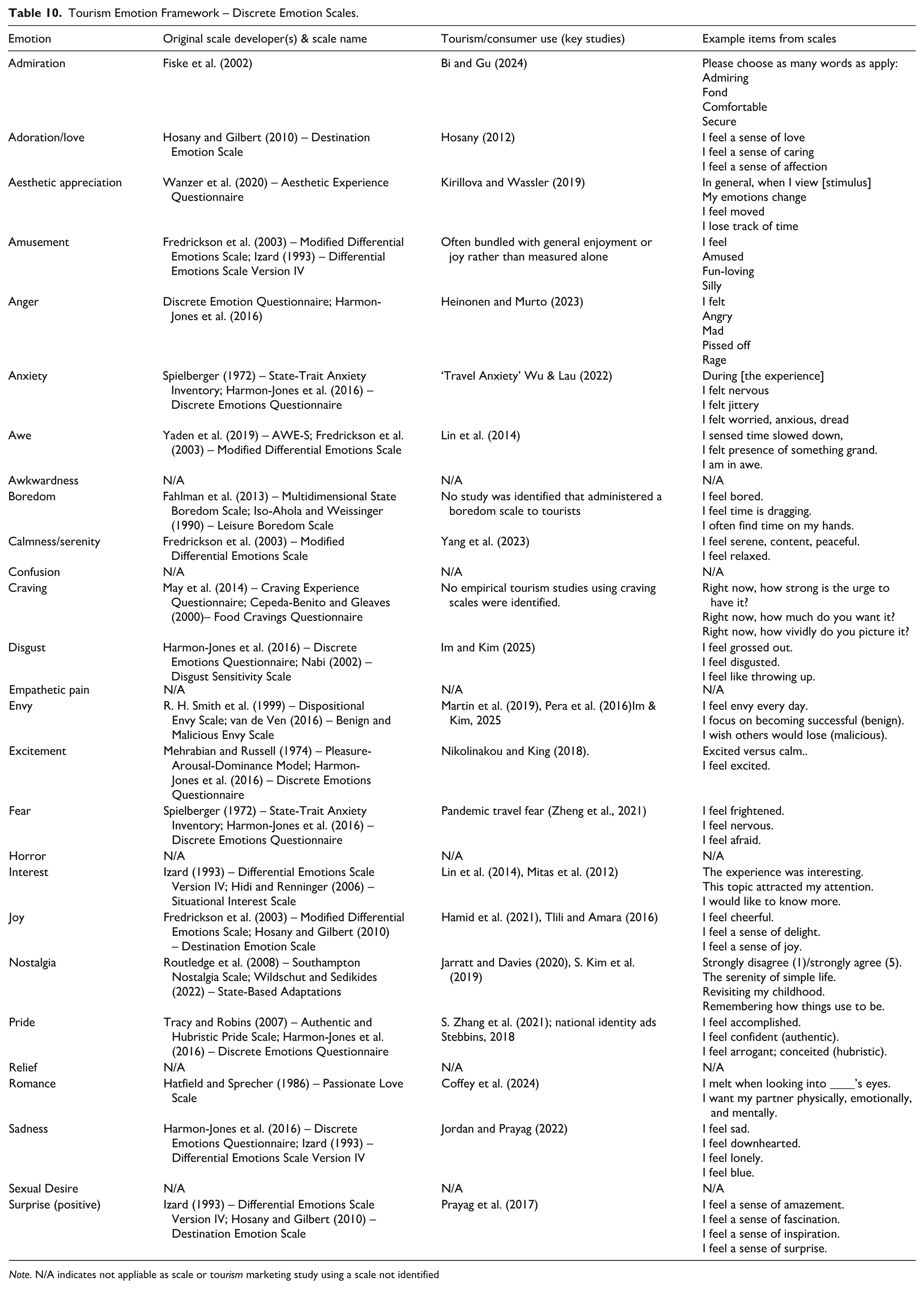
A major contribution of this review is the provision of concrete measurement guidance for tourism marketing research. Prior reviews call for clearer operationalisation but rarely provide direction on which emotions to measure, which validated instruments exist and where new scale development is needed (Hosany et al., 2021; S. Li et al., 2015; Volo, 2021). Table 10 addresses this gap by cataloguing validated scales for Cowen and Keltner’s (2017) 27-emotion taxonomy and identifying areas where tools are absent or underdeveloped.
Tourism Emotion Framework – Discrete Emotion Scales.
Note. N/A indicates not appliable as scale or tourism marketing study using a scale not identified
Evidence suggests that three-item scales optimise structural modelling (Iacobucci, 2009), making scale reduction essential to avoid fatigue and maintain data quality. To advance the field, this review highlights opportunities to create brief, discrete-emotion measures tailored to tourism contexts, drawing on item-reduction methods (Haws et al., 2023) to refine existing scales without compromising psychometric rigour. Several emotions remain empirically under-explored despite theoretical relevance, including confusion, empathetic pain, horror, sexual desire and boredom (J. Crompton, 2025), anxiety (S. Huang et al., 2024; Yang et al., 2023), romance and pride. Table 10 synthesises these insights, offering a measurement-focussed component of the Tourism Emotion Framework and providing researchers with a practical, theoretically anchored foundation for future scale development and refinement.
Beyond measurement, this review underscores the importance of studying under-explored emotions, such as awe, excitement, fear, sadness and disgust, when naturally elicited in contexts such as dark tourism, heritage sites, high-risk adventure or environmental narratives. Ethical safeguards, such as informed consent, content warnings, debriefing and low-intensity stimuli – notably short videos and vignettes – can mitigate risk. Campaigns that evoke awe, nostalgia or fear must be calibrated to motivate travel without triggering disengagement. Understanding these emotional tipping points will help in designing experiences that engage tourists effectively while avoiding unintended negative impacts.
Proposition 5: Enhancing Experimental Methods, Reporting, and Analysis is Key for Robust Emotion Research in Tourism Marketing
Experiments are highly regarded in tourism and marketing (Viglia & Dolnicar, 2020). A key implication from this review is that, combined with the previous considerations, tourism marketing can and should increase and improve the use of experiments in future research.
For example, discrete emotions can be causally examined through controlled video- or image-based designs that mimic pre-travel marketing contexts. For instance, recent studies have manipulated awe, pride and nostalgia in tourism or brand advertisements (Nikolinakou & King, 2018; Septianto et al., 2021; Wang & Lyu, 2019), followed by measures of narrative transportation, perceived self–destination connexion and visit intention. These paradigms exemplify how integral affect – emotion caused by or attached to an object – can be elicited and tested before travel to evaluate campaign effectiveness. Future work considering the limitations identified in the use of theory, the measurement of emotion and the travel journey can utilise this method to improve the standard of proof in relation to our understanding of emotions and the theories that explain them.
When examining integral affect in tourism marketing, combining laboratory and field studies is valuable and should be undertaken where possible. Laboratory experiments isolate the emotional impact of specific advertising stimuli, such as travel advertisements, providing strong internal validity. Field studies complement this by assessing real-world effectiveness through A/B testing (Orazi et al., 2023) or social media analysis. For example, Septianto and Mathmann (2024) show how social media data can measure emotions such as awe and love and their effects on engagement metrics, with lab experiments validating these findings. For on-site tourist experiences, laboratories can simulate aspects of visits using technologies such as virtual reality tours or controlled exposure to natural or cultural stimuli (e.g., Liu & Huang, 2023) to measure emotional responses, while field studies capture genuine reactions at scenic viewpoints, nature walks or interactive activities. Combining these approaches provides a robust understanding of how marketing and real-world experiences shape tourist emotions. This integration balances external validity from real-world contexts with the internal validity of controlled isolation, enabling researchers to rigorously test integral affect by linking emotions directly elicited by tourism stimuli and experiences to desired tourism outcomes.
To strengthen the rigour and application of experiments in tourism marketing utilising emotions, several methodological refinements are recommended in manipulation design, reporting and analysis. First, researchers should avoid ad hoc manipulations (Chester & Lasko, 2021; Flake & Fried, 2020) and instead align them with established studies. When manipulating factors, researchers should clearly describe procedures, explain consistency with prior work using similar stimuli or theories and justify any deviations. Second, future studies should report statistical power and effect sizes using tools such as G*Power to determine appropriate sample sizes. Reporting of measures such as eta-, omega- or epsilon-squared (Iacobucci et al., 2023) enhances transparency, comparability and reliability while reducing Type I and II errors. Third, when analysing emotions as mechanisms or mediators, techniques such as the PROCESS macro (Hayes et al., 2017) can model both mediation and moderation effects (e.g., Model 4 for simple mediation; Model 85 for serial mediation). PROCESS also enables spotlight and floodlight moderation analyses, allowing tourism marketing scholars to examine boundary effects on continuous moderators that influence distinct levels of emotional arousal (Mulcahy et al., 2026; Su & Li, 2024; van Esch et al., 2022). This approach moves beyond less precise methods such as median splits and permits detailed testing of moderated mediation effects.
Alternatively, scholars may adopt the ‘manipulating the mediator’ approach to assess the causal role of emotions as mediators (Highhouse & Brooks, 2021; Pirlott & MacKinnon, 2016). For example, Roy and Naidoo (2025) combined measurement and manipulation of nostalgia, offering a robust framework adaptable to tourism research. Overall, these methodological considerations, alongside advances in theory and measurement, provide a strong foundation for advancing experimental research in tourism marketing.
Proposition 6: Emotion Research Must Be Temporally Aligned With the Strategic Imperatives of Tourism Marketing
Tourism marketing unfolds across the travel journey timeline, from pre-trip inspiration to post-trip memory. However, as outlined in this review, academic research on emotion rarely mirrors this structure. While industry campaigns increasingly foreground pre-travel emotion to evoke curiosity, awe, or excitement, scholarly studies remain disproportionately focussed on post-experience outcomes such as satisfaction, loyalty or revisit intention, often measured long after the emotional response has occurred. To realign academic inquiry with industry strategy, tourism emotion research must become temporally attuned. Studies should integrate discrete emotion theory with stimulus-based designs that correspond to key phases of the travel journey, with particular emphasis on the pre-travel stage, currently the most under-examined and strategically vital point of emotional activation.
This proposition responds directly to
A key implication of this review is the opportunity to reset how industry and academia collaborate on emotion in tourism marketing. At present, the industry relies on a spectrum of emotional indicators. Streamlined metrics such as Net Promoter Score (Müller et al., 2024) offer operational simplicity but provide limited insight into the emotional mechanisms that shape consumer behaviour. Recognising this limitation, the tourism sector has begun to adopt more sophisticated approaches to emotional measurement. For example, Tourism Australia’s $125 million Ruby the Roo campaign incorporated FACS-based emotion testing during pre-launch evaluations, enabling optimisation beyond simple positive–negative affect. These developments signal an industry-wide acknowledgement that discrete emotions, not just overall satisfaction, play a critical role in persuasion, memory formation and experience design.
Building on the measurement advances outlined in Proposition 4, academia now has an opportunity to contribute theoretically grounded, yet practically viable tools for capturing discrete emotional responses. Psychometrically robust emotion scales can be embedded at key touchpoints across the travel journey, enabling moment-to-moment emotional capture without overburdening respondents or disrupting campaign workflows. Mobile applications such as Metricwire provide a pathway for real-time data collection. This evolution should be complemented by improved modelling practices, including the co-development of realistic stimuli that reflect how campaigns are produced and evaluated in real-world settings, as elaborated in Proposition 5.
The consolidated Tourism Emotion Framework (TEF) presented in this review translates these insights into an actionable structure. Spanning validated discrete-emotion measures, mid-range theoretical models, behavioural pathways and guidance on timing across the travel journey, the TEF offers a shared platform for coherent and efficient emotional assessment. Through co-design, joint pilot testing and iterative refinement, industry and academia can leverage this framework to build a sustainable partnership in which emotion measurement is both feasible in practice and capable of generating insights that are theoretically rigorous and commercially valuable.
Conclusion
Emotion is not a peripheral outcome, but a strategic driver in tourism marketing. This review maps current practices and identifies key theoretical and methodological gaps, offering a foundation for future research through six propositions and the Tourism Emotion Framework (TEF). Together, these contributions reframe how scholars can model, measure and mobilise emotion with greater precision and strategic intent, thereby enabling research that captures emotion’s role in acquisition and retention and supports experimental designs more closely aligned with consumer behaviour and industry practice.
Footnotes
Appendix
Coding Framework for Systematic Review.
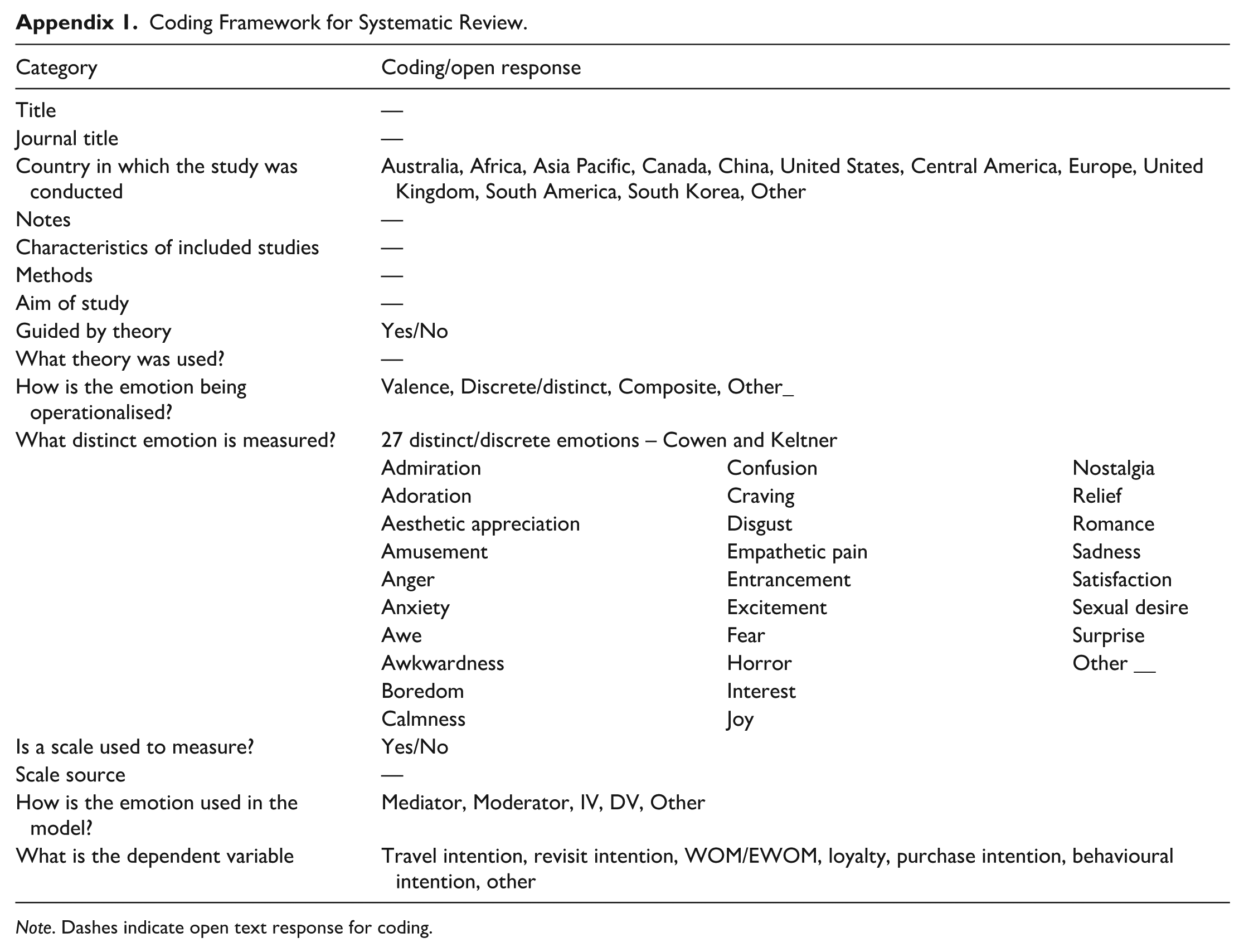
| Category | Coding/open response | ||
|---|---|---|---|
| Title | — | ||
| Journal title | — | ||
| Country in which the study was conducted | Australia, Africa, Asia Pacific, Canada, China, United States, Central America, Europe, United Kingdom, South America, South Korea, Other | ||
| Notes | — | ||
| Characteristics of included studies | — | ||
| Methods | — | ||
| Aim of study | — | ||
| Guided by theory | Yes/No | ||
| What theory was used? | — | ||
| How is the emotion being operationalised? | Valence, Discrete/distinct, Composite, Other_ | ||
| What distinct emotion is measured? | 27 distinct/discrete emotions – Cowen and Keltner | ||
| Admiration | Confusion | Nostalgia | |
| Adoration | Craving | Relief | |
| Aesthetic appreciation | Disgust | Romance | |
| Amusement | Empathetic pain | Sadness | |
| Anger | Entrancement | Satisfaction | |
| Anxiety | Excitement | Sexual desire | |
| Awe | Fear | Surprise | |
| Awkwardness | Horror | Other __ | |
| Boredom | Interest | ||
| Calmness | Joy | ||
| Is a scale used to measure? | Yes/No | ||
| Scale source | — | ||
| How is the emotion used in the model? | Mediator, Moderator, IV, DV, Other | ||
| What is the dependent variable | Travel intention, revisit intention, WOM/EWOM, loyalty, purchase intention, behavioural intention, other | ||
Note. Dashes indicate open text response for coding.
Acknowledgements
The author gratefully acknowledges the guidance and feedback provided in shaping this article to completion.

Ethical Considerations
This article presents a systematic literature review and did not involve human participants or primary data collection. Ethics approval was not required.
Author Contributions
Funding
The authors received no financial support for the research, authorship, and/or publication of this article.
Declaration of Conflicting Interests
The authors declared no potential conflicts of interest with respect to the research, authorship, and/or publication of this article.
Data Availability Statement
No new data were generated or analysed in the course of this study. Covidence coding spreadsheet is available.