




Abstract
Scarcity is a universal phenomenon shaping human behaviour across multiple life domains. Yet, the tourism literature has not developed a coherent theorisation of scarcity. Drawing on interdisciplinary research from marketing and psychology, this article advances conceptual understanding of scarcity in tourism by integrating dominant perspectives on supply-driven scarcity, demand-driven scarcity, and resource scarcity. The paper identifies key gaps and proposes a future research agenda focussed on integrating resource-scarcity perspectives, examining the dynamics of both supply-driven and demand-driven scarcity, and unpacking the interplay between different forms of scarcity. Additional research avenues include investigating the interaction between situational and chronic scarcity, and embedding scarcity more explicitly within grand tourist decision-making models. Our article aims to guide and stimulate further theoretical development and empirical inquiry into how scarcity shapes tourists’ behaviours and responses.
Keywords
Introduction
Scarcity is ubiquitous in all aspects of life (Belk et al., 2023). Ranging from mundane (e.g., lunch or dinner options) to more complex decisions (e.g., destination wedding), everyone faces scarcity, irrespective of income group or socio-economic status (R. W. Hamilton et al., 2019a). Scarcity refers to ‘the real [objective] or perceived [subjective] threat to consumer’s ability to meet their needs and desires due to a lack of, or lack of access to goods, services and resources’ (R. W. Hamilton et al., 2019b, p. 533). Scarcity occurs in multiple ways. Supply-driven scarcity manifests via limited supply for given demand (e.g., only two hotel rooms left; see Gierl & Huettl, 2010; Huang et al., 2020). Demand-driven scarcity arises when demand exceeds available supply (e.g., when 50 diners queue for a table at a restaurant).
Tourists also face resource scarcity, in the form of limited time, money and/or space. The essence of tourism consists of temporary experiences, leading to perceptions of time scarcity (C. Li et al., 2023). Tourists encounter space scarcity when they visit popular, overcrowded sites (Papadopoulou et al., 2023), and likely to face financial scarcity when undertaking expensive experiences with limited budgets. Various forms of scarcity can occur concurrently. For instance, individuals planning a destination wedding may encounter financial scarcity due to substantial costs involved, time scarcity arising from the need to coordinate multiple activities within a short period, or limited hotel room availability for guests. Once at a destination, tourists may adjust their behaviour in response to local conditions, including factors such as queues.
Scarcity is of fundamental relevance for tourism with growing research interest driven by concurrent, but conflicting issues. The growing use of scarcity-based marketing appeals (e.g., Huang et al., 2020; Park et al., 2022) and the influence of social media (H. Liu et al., 2019) have contributed to rising tourist numbers in popular destinations (demand-driven scarcity), leading to overcrowding (space scarcity). In contrast, environmental uncertainties such as cost-of-living crisis trigger financial scarcity, leading to reductions in tourist flows, often initiating substitutions from more expensive holidays abroad, to staycations, or off-peak travel (Meierhans et al., 2025). Research on scarcity in tourism builds on earlier studies examining tourists’ non-participation, whether stemming from limited motivation (see Popp et al., 2024), a preference for staying at home, health-related constraints (Diekmann & Haukeland, 2024), competing life priorities, or just voluntarily (McKercher & Chen, 2015). Barriers to engage in tourism have predominantly been studied through the Leisure Constraints Framework (Crawford et al., 1991; Crawford & Godbey, 1987). The Leisure Constraints Framework consists of three main factors: intrapersonal (e.g., lack of interest, stress, anxiety, or religion); interpersonal (e.g., lack of friends, family) and/or structural constraints (e.g., lack of time, money and information).
Although current frameworks offer important contributions, increasing complexity of barriers to tourism participation (Diekmann & Haukeland, 2024) underscores the urgency of adopting new theoretical lenses (McKercher & Moyle, 2025). Scarcity theorisations provide valuable insights that deepen our understanding beyond traditional notions of constraints. Scarcity affects individuals across socio-economic groups, with humans by nature, aspiring to move out of scarcity into abundance (Daoud, 2018). Scarcity is ubiquitous in tourism, yet the field lacks a clear and coherent conceptualisation. Other disciplines, such as marketing, have made notable progress in advancing understanding of scarcity through conceptual works (e.g., Cannon et al. 2019; R. W. Hamilton et al., 2019a; R. W. Hamilton et al., 2019b; R. W. Hamilton & Hosany, 2023). As research on scarcity and tourism progresses, the aim of our article is to integrate insights from marketing, psychology, and tourism to clarify theoretical perspectives, their implications and propose an agenda to further advance knowledge.
Conceptual papers play a vital role in advancing a discipline, challenge established thinking, help to structure ideas and stimulate new lines of inquiry. They do not construct new theory per se (Cropanzano, 2009), but instead ‘seek to bridge existing theories in interesting ways, link work across disciplines, provide multi-level insights, and broaden the scope of our thinking’ (Gilson & Goldberg, 2015, p. 128). Good conceptual articles connect existing knowledge and provide the foundation for theory building (Rocco et al., 2022). Conceptual research has been overlooked in tourism (Xin et al., 2013). Although there are no definitive templates for developing conceptual papers, we structure our work by drawing on established and emerging guidelines (e.g., Barney, 2020; Gilson & Goldberg, 2015; Hollebeek et al., 2024; Jaakkola, 2020; Kozlenkova et al., 2025; MacInnis, 2011; Vargo & Koskela-Huotari, 2020), analysing foundational articles in tourism (e.g., Buckley, 2023; S. Hosany et al., 2021), and exemplars from disciplines such as marketing (e.g., Garcia-Rada et al., 2025; R. W. Hamilton et al., 2019a; R. W. Hamilton et al., 2019b; R. Hamilton et al., 2021). A synthesis approach (Jaakkola, 2020) was chosen to integrate multiple theories and literatures.
Our article contributes to the literature by advancing the theorisation of scarcity in tourism. Existing work on scarcity, in the form of conceptual papers (e.g., Cannon et al., 2019; R. W. Hamilton & Hosany, 2023) or meta-analysis (e.g., Barton et al., 2022), largely focus on products. Tourism offers experiential services whose defining attributes of perishability, intangibility, inseparability, and heterogeneity, heighten the salience of scarcity within these contexts (Roux et al., 2023). Our conceptual article is timely as we unpack multiple theoretical perspectives, as strongly advocated by Crompton and Petrick (2024), on supply-driven, demand-driven and resource scarcity.
Our paper adds to current knowledge by shifting attention away from investigating constraints, perceived to be ‘restrictive’ or ‘limiting’, regardless of service, or resource availability, priorities (Goldsmith et al., 2020), substitution opportunities (R. W. Hamilton et al., 2014) and longer-term adaptation (R. W. Hamilton et al., 2019a). Although scarcity has some negative implications linked to constraints, it is generally motivational (see R. W. Hamilton & Hosany, 2023). As people respond to scarcity, they increase focus (Mullainathan & Shafir, 2013), engage in self-regulation (Cannon et al., 2019), better planning, prioritisation (Fernbach et al., 2015), expand consideration sets (Van Kerckhove et al., 2020) and become creative (Mehta & Zhu, 2016). Our article identifies conceptual gaps, highlights underexplored dimensions of scarcity and their implications for tourists. We provide a strong foundation by integrating state-of-the-art insights and diverse perspectives on scarcity, proposing a forward-looking agenda to guide future empirical and theoretical developments.
Theoretical Perspectives on Scarcity
What is Scarcity?
Scarcity has its origins in the field of economics. Traditionally, economists study scarcity from a supply/demand perspective, its impact on prices and resource allocation (see for e.g., Becker, 1962 influential work). Prices adjust in accordance with demand/supply imbalances, increasing when demand surpasses supply, and decreasing when supply exceeds demand. Scarcity determines how resources are allocated to different activities based on their value creation potential. Within behavioural economics, a substantive domain focusses on how people do not always make rational choices (e.g., Verhallen, 1982) and decisions are often guided by emotions. Scarcity, or not having enough, typically generates a sense of urgency, elevates perceived value, and increases the likelihood of substitution (R. W. Hamilton et al., 2014).
Scarcity has been studied across other disciplines, including psychology (e.g., Shah et al., 2015), sociology (e.g., A. Booth, 1984), marketing (e.g., R. W. Hamilton et al., 2019b), and public policy (e.g., Aiyar & Venugopal, 2020). Psychologists focus on understanding the cognitive and emotional responses of scarcity cues. As a result, when people perceive scarcity cues, they may respond quicker, using heuristics or mental shortcuts (Cialdini, 2007). Individuals may also face cognitive bandwidth or tunnelling (Mani et al., 2013) as they focus on the scarce resource, failing to prioritise longer-term goals.
In sociology, emphasis is on how scarcity influences social groups, with differing access to products and resources. For example, Kerrane et al. (2021) investigate how mothers stockpiled food for their families, prior to Brexit, in anticipation of shortages through changes in rules and regulations. Studies in marketing identify how scarcity cues can be utilised to target different consumer types (e.g., R. W. Hamilton & Hosany, 2023), and the impact of scarcity in multiple contexts such as gift giving (Lee-Yoon et al., 2020), word of mouth (Paley et al., 2019), happiness (Dias et al., 2022) or movie choice (H. Yang & Zhang, 2022). In public policy, research examines the effect of scarcity on loan decisions (Cook & Sadeghein, 2018), use of heath care premiums (Aiyar & Venugopal, 2020) and farmers’ stress before and post-harvest (Mani et al., 2013).
The topic of scarcity is versatile and lends itself to various methodological approaches. Over the years, a rich body of multi-disciplinary research using surveys (e.g., Y. Li et al., 2021; C. Li et al., 2023), laboratory experiments (e.g., Guo et al., 2025), physiological measures (e.g., X. Xue et al., 2025), qualitative methods (e.g., A. R. S. Hosany & Hamilton, 2023), conceptual papers (e.g., Daoud, 2018) and meta-analysis (e.g., Barton et al., 2022) have informed our understanding of scarcity. Researchers typically differentiate between various perspectives in studying scarcity (e.g., Cannon et al., 2019; Daoud, 2018; Goldsmith et al., 2020; R. W. Hamilton et al., 2019a; R. W. Hamilton et al., 2019b).
Although the body of tourism research on scarcity is growing (e.g., Y. Li et al., 2021; C. Li et al., 2023; L. Su et al., 2024; X. Xue et al., 2025), the literature remains fragmented. Advancing understanding in this area requires both empirical and theoretical work. In the next sections, we examine how scarcity has been and can be theorised within tourism, with the aim of constructing a coherent and insightful narrative for the field. The various perspectives on scarcity serve to unify and enrich academic discourse, with our proposed research agenda highlighting several areas that require further investigation. Figure 1 provides an overview of different scarcity types, theoretical perspectives and tourists’ responses.
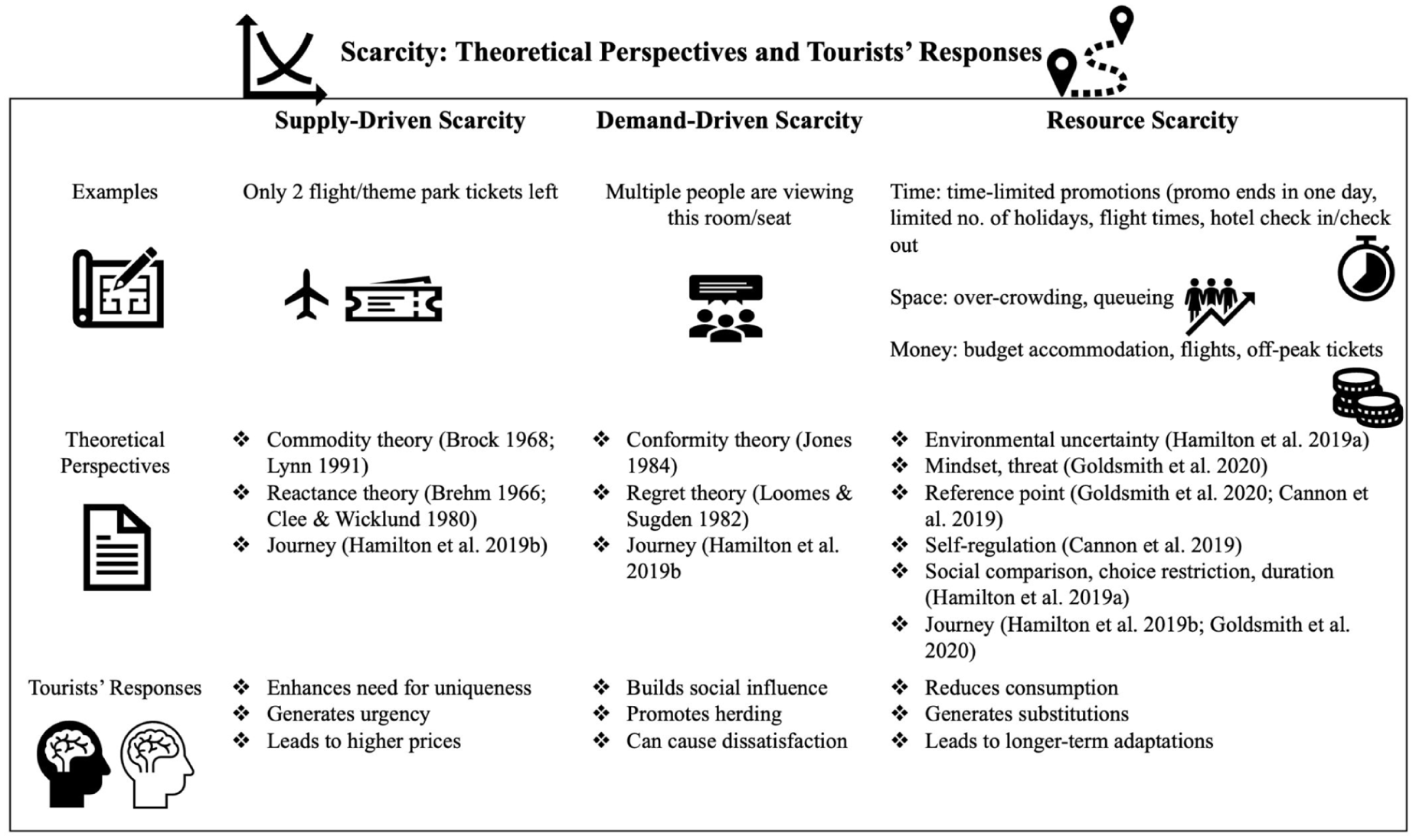
Scarcity: Theoretical perspectives and tourists’ responses.
Supply-Driven and Demand-Driven Scarcity
Scarcity can be supply driven (see Gierl & Huettl, 2010; Huang et al., 2020), e.g., generated by a sudden damage in hotel infrastructure or airline failure, leading to lower room or flight availability. Scarcity can also be demand-driven (see Gierl & Huettl, 2010; Huang et al., 2020), created by excessive demand (e.g., tickets for popular concerts, or visiting a famous attraction). Scarcity can also manifest in the form of insufficient accommodation, exclusive tours, wildlife safaris, cruises, souvenirs, sporting, concerts, or other entertainment venue tickets. Scarcity can be real or perceived (R. W. Hamilton et al., 2019b), strategic or non-strategic within consumer markets (see R. W. Hamilton & Hosany, 2023). Strategically, tourism providers create supply-driven scarcity through time limited promotions, controlling entry via a restricted number of tickets or special permits, generating urgency for consumer acquisition and minimising regret (Gabler et al., 2017). For example, the Inca Trail is highly regulated to preserve historical routes and avoid overcrowding. Ticket availability is controlled and requires months of planning ahead (Croissant, 2024). Tourists also face supply driven scarcity as hotel and flight booking websites dynamically control supply by emphasising limited rooms/seats, often generating perceived scarcity, to incite consumer responses. Where consumers are unable to acquire the desired offerings, they are likely to display anger, frustration and demonstrate competitive behaviours (Kristofferson et al., 2017).
Supply-driven scarcity can also be non-strategic, occurring when natural disasters or other unpredictable events (e.g., floods, earthquakes) damage tourism infrastructure, leading to negative perceptions, disrupted travel plans, and loss of income for the destination (World Tourism Forum, 2025). Tourist destinations generate demand-driven scarcity through their popularity and higher perceived value. Places like Amsterdam, Barcelona and Venice, promote their brands to attract visitors, drive demand and increase prices for hotels, restaurants and attractions. As tourists seek to obtain scarce services, both objectively and subjectively defined, brands increasingly target consumers willing to exert considerable effort in their search for unique experiences. Driven by fear of missing out, tourists often endure long queues to secure tickets or gain access to popular leisure activities. Research indicates that when a preferred option is unavailable, consumers are more likely to choose substitutes from the same brand rather than from a competing brand (Khan & DePaoli, 2024). Taylor Swift’s concerts illustrate this scenario. As the artist created disproportionate demand versus limited seating capacities during the Eras tours, her movie served as a substitute for some groups.
Supply disruptions and demand surges can occur concurrently. Such scenarios are usually driven by external events (e.g., post Covid-19, viral posts on social media), where higher demand than expected and limited supply can lead to crowding. Tourists face crowding at restaurants, theme parks and amusement venues. Allocation mechanisms such as dynamic pricing, queueing (Gössling et al., 2021), gamification during queues, maximum quantity (e.g., tickets) restriction or entrance admission fees are typically used to match demand and supply. Supply-driven and demand-driven scarcity can be understood through commodity theory, reactance theory, conformity theory and regret theory (see Table 1; Barton et al., 2022; Shi et al., 2020 for comprehensive reviews).
Theoretical Perspectives on Supply and Demand-Driven Scarcity.
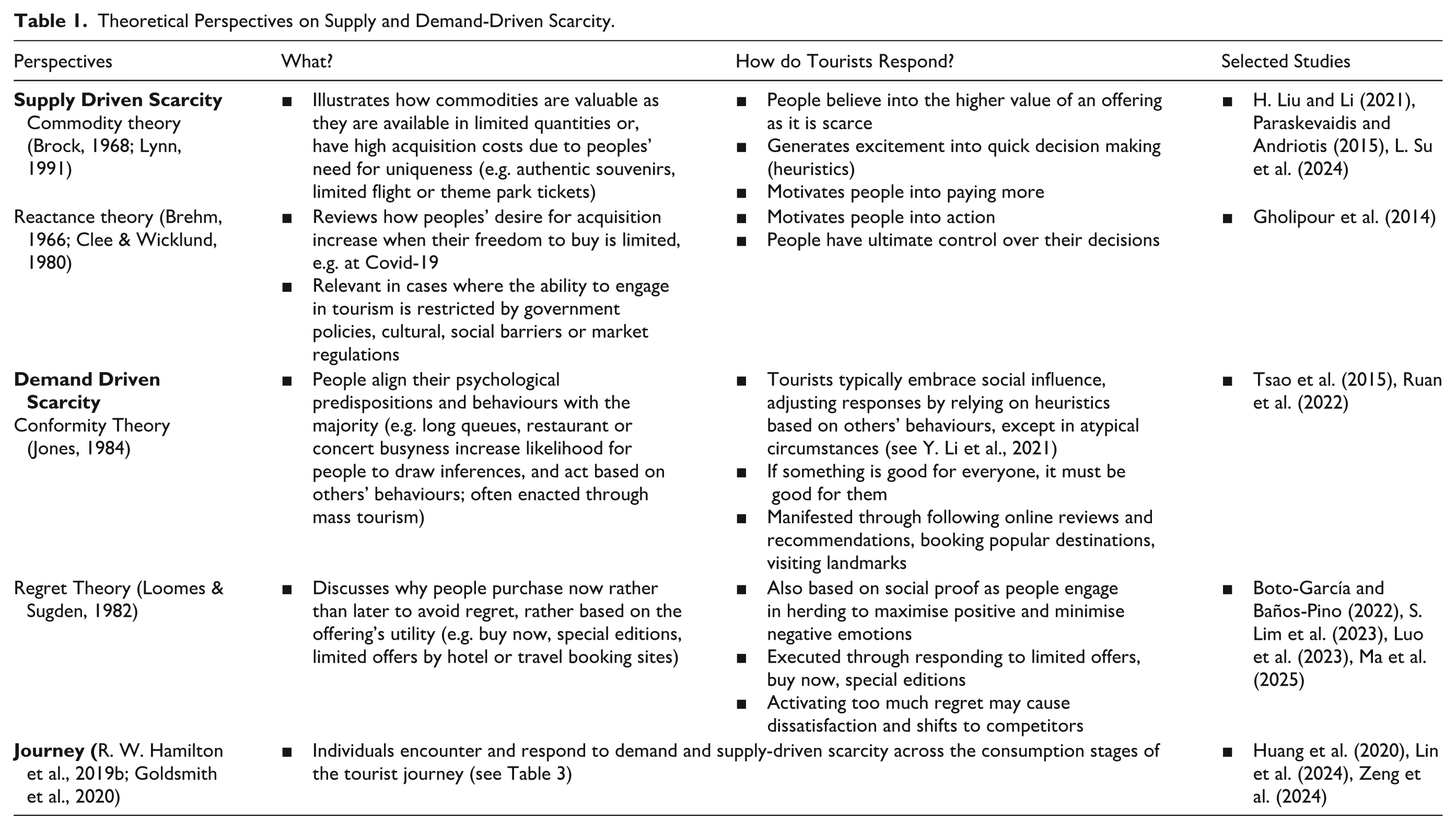
According to commodity theory (Brock, 1968), people value experiences (Barton et al., 2022) as they are available in limited quantities/supply, or have high acquisition costs (see also Lynn, 1991). The ‘scarcity cue’, based on the principles of influence (Cialdini, 2007), persuades people into believing in the higher value of an offering, through distinctiveness, uniqueness and rarity. Limited quantity (e.g., limited flight or theme park tickets) appeal to consumers’ need for uniqueness, generates excitement, incites people to pay higher prices, and motivates them into action through heuristics, that is, mental shortcuts for quick decision making. In cases, people may prefer minority endorsed options (Gong et al., 2021; Wang et al., 2025), indicating their need for uniqueness (see commodity theory – Brock, 1968) Commodity theory is relevant in tourism to understand perceptions of uniqueness and exclusivity of travel experiences (H. Liu & Li, 2021) or the authenticity of souvenirs (Paraskevaidis & Andriotis, 2015; L. Su et al., 2024). L. Su et al. (2024) examine tourists’ purchasing behaviour of souvenir as commodities, with authenticity leading to higher perceived scarcity, value and purchase intention.
Reactance theory (Brehm, 1966) explains how people have a higher intention to purchase, when they perceive limited freedom for acquisition due to supply restrictions. In such instances, unavailability increases motivation, urgency and assumes that people have control over the outcome (Clee & Wicklund, 1980). Reactance theory is commonly applied to understand demand and supply for services restricted by government policies or market regulations (Shi et al., 2020). Lockdowns during Covid for example, generated reactance as people were keen to engage in tourism and leisure (W. M. Lim, 2021). In their study, spanning across over 80 countries, Gholipour et al. (2014) establish there is more outbound tourism in places where personal freedom is low. When freedom is restrained by strict regulations, social and cultural barriers, people travel to places where freedom is unrestrained.
Conformity theory (Jones, 1984) explains demand driven scarcity. People chase for limited services, as they seek to align psychological predispositions and behaviours, to fit with the majority. According to the theory, people embrace ‘social proof’, another of Cialdini’s (2007) six principles of influence. ‘Social proof’ acts as a heuristic, considering that, if everyone is acquiring something, it must be good and will run out of stock soon. Widescale adoption is viewed as implicit understanding, and signal of excellence, value or effectiveness (Cialdini, 2007). Conformity theory is relevant for tourism, given the intangible nature and perceived risks inherent in tourism offerings. Service level cannot be assessed prior to consumption, thus increasing the likelihood for people to draw inferences and minimise perceived risks based on others’ behaviours. For example, long queues, restaurant or concert busyness and marketing messages framed using popularity or ‘social proof’ cues, are likely to increase purchase intention (L. Wu & Lee, 2016). In the pursuit of conformity, tourists rely on the volume and valence of reviews, which exert social influence on decisions such as booking hotels (Tsao et al., 2015) and endorsing green events (Ruan et al., 2022). However, conformity cues are not always effective. In highly visited destinations such as Majorca and the Canary Islands, mass tourism driven by conformity has contributed to rising prices that displace residents, prompting anger, protests, and other adverse responses.
Regret theory (Loomes & Sugden, 1982) posits that people outweigh rational decision-making processes. Individuals engage in herding, following on the actions of others for higher confidence, relief and satisfaction (see S. Lim et al., 2023), to avoid negative emotions like regret or disappointment, in case of missing out due to unavailability. Herding is of particular interest in tourism due to information asymmetries (Banerjee, 1992). Tourists often rely on others’ choices when making decisions, given the difficulty of evaluating services prior to consumption (Boto-García & Baños-Pino, 2022; Luo et al., 2023; Ma et al., 2025). To date, research in tourism studied herding in the context of restaurant choice (Ha et al., 2016), crowdfunding (M. J. Kim & Petrick, 2021) and influence of reviews on accommodation choices (Benítez-Aurioles, 2022; F. Xue et al., 2020). Marketing tactics such as buy now, special editions, limited offers, are often applied to induce fear of missing out and eventual regret, by travel and hotel booking sites. However, tourism providers should be cautious in activating regret as tourists are likely to complain, leave negative reviews, substitute or shift to competitors, leading to reduced loyalty (Lee & Pennington-Gray, 2025).
The principles of ‘social proof’ and ‘scarcity cue’ as heuristics elicit strong responses from tourists. Tourists are more likely to follow the ‘crowd’ and display lower attitudes towards online travel agents (K. Kim et al., 2023), when exposed to a higher prevalence of negative online reviews and ratings. Highly narcistic tourists prefer user generated ads featuring scarcity cues, demonstrating uniqueness and rarity, versus less narcistic tourists who favour ads with social proof (Guo et al., 2025). Travellers are more likely to choose hotel rooms when provided information around limited availability to express exclusivity (Park et al., 2022). In the context of scarcity cues and social proof, message framing is critical in shaping tourists’ thoughts and responses towards desired outcomes.
Resource Scarcity
Resource scarcity refers to the ‘discrepancy between one’s current level of resources and a higher, more desirable reference point’ (Cannon et al., 2019, p. 105). A resource is used in the production, or acquisition of products and services. In this paper, we focus on the quantifiable resources (see also Cannon et al., 2019; R. W. Hamilton et al., 2019b) of time, space and money. We omit non-quantifiable resources such as cognitive capacity (Molden et al., 2012), social (Mead et al., 2011), personal and psychological resources like skills or traits (Brock & Brannon, 1992). Tourists encounter resource scarcity through, for example, limited time promotions (time scarcity), over-crowded venues/queues (space scarcity), or by not having enough money (financial scarcity) to engage in desired experiences.
Tourism research has a strong focus on time scarcity (e.g., Y. Li et al., 2021; C. Li et al., 2023; X. S. Liu et al., 2022; Noone & Lin, 2020). Time is a limited resource which requires compromises between work and leisure. People weigh the opportunity cost of allocating less time for leisure and travel (Chavas et al., 1989). As time is intangible and less fungible compared to resources such as money (Leclerc et al., 1995), that is, it cannot be stored or saved for eventual use, people make cautious decisions around their use of time (McKercher & Prideaux, 2020). The nature of time constraints people face, dictates the extent they engage in slow versus fast tourism (C. Li et al., 2025), their outlook on transit times (McKercher & Tkaczynski, 2023) and willingness to visit landmarks (Ma et al., 2025; Meng et al., 2024).
As tourism experiences are short-lived (e.g., Y. Li et al., 2021), a sense of time (see also Pearce, 2020), along with space scarcity are common. Space scarcity, often manifested in the form of crowding, is based on peoples’ psychological evaluation of high place density, combined with numerous service encounters (Shelby et al., 1989). Prior research investigates crowding in several settings ranging from national parks (B. Moyle & Croy, 2007) through festivals (D. Kim et al., 2016), to cultural heritage sites (Kılıçarslan & Caber, 2018). Space scarcity has negative effects on tourism experiences including health and safety risks, traffic congestion (Yin et al., 2024), declining service levels, discomfort (Ruiz et al., 2021), lower destination attractiveness (Jacobsen et al., 2019) and price sensitivity (Hou & Zhang, 2021).
Finances are key for tourists, dictating the type (e.g., domestic vs. international), number (single vs. multiple destinations) and duration of holidays they can afford (e.g., Nicolau & Más, 2005). Given the intangible, heterogenous nature of tourist experiences, and the resulting salience of demand-driven scarcity, finances impact on tourists’ ability to engage with dynamic pricing and message framing in price promotions. For instance, individuals experiencing financial scarcity may be unable to absorb price surges driven by heightened demand or to avoid queues and overcrowding by paying premiums (Hou & Zhang, 2021). Furthermore, exchange rates affect tourists’ perceptions of price levels and can elicit a sense of financial scarcity (Raghubir et al., 2012). In negotiating financial scarcity, tourists are becoming more sophisticated as they devise creative plans against surge pricing over seasonal attractions. For example, people travel off-peak, seek ‘kids go free’ places, book ahead, swap accommodations with each other without incurring charges, use loyalty points, do ‘house-sitting’ or engage in staycations (Meierhans et al., 2025). Emerging research investigates the impact of longer-term financial scarcity on tourists’ behaviour (e.g., Kock et al., 2025). Resource scarcity can be analysed through multiple theoretical lenses, providing more nuanced and multidimensional insights into its implications for tourism (see Table 2).
Theoretical Perspectives on Resource Scarcity.
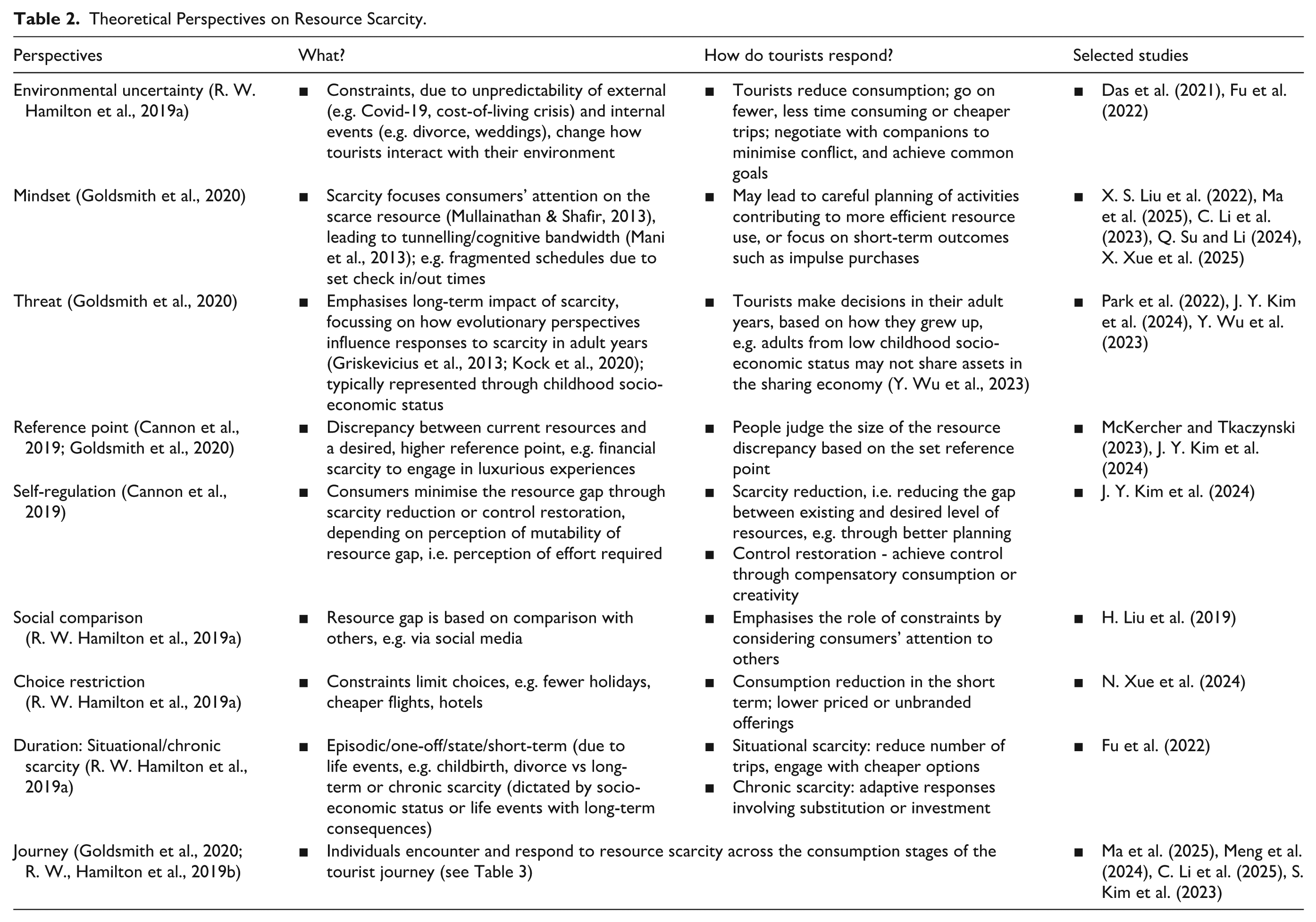
The tourism industry is renowned for its vulnerability to shocks such as economic (cost-of-living), health (Covid-19), humanitarian (wars) crises, terror attacks and natural disasters (e.g., floods, earthquakes). Environmental uncertainty (R. W. Hamilton et al., 2019a) in the form of external (e.g., Covid-19) and internal (e.g., death, divorce, job transitions) events trigger resource scarcity. Notably, the last two major global pandemics (SARS and Covid-19) are well documented for their widespread disruption, reducing tourism demand (Das et al., 2021). Likewise, increasing prices due to cost-of-living crises generate financial scarcity, leading to notable changes in travel choice (Traveldailynews, 2023). Budget-conscious travellers opt for cheap airlines, accommodations, staycations and local travel as they manage tighter budgets.
At the household level, people face scarcity due to life events (A. R. S. Hosany & Hamilton, 2023). For instance, divorce, as a negative life event, reduces disposable income and may create financial scarcity. Positive events such as weddings also generate scarcity, due to high anticipated costs versus limited funds. Often, life events happen concurrently or sequentially, creating higher resource gaps. A critical health diagnosis from one family member generating time scarcity, may occur simultaneously with job loss, from the same or another family member, creating financial scarcity. Internal life events have implications for tourism over the life course. Childbirth and divorce may curtail tourism in the short-term due to financial constraints (Fu et al., 2022).
External or internal events, act as triggers, creating episodic or state scarcity that is, scarcity over either a short (situational), or long term (chronic) period, with consequences for tourism. Scarcity can impact individuals (e.g., X. Xue et al., 2025) and groups (A. R. S. Hosany & Hamilton, 2023). In responding to resource scarcity, groups face tensions due to the conflicting priorities of its individual members. For example, in a family, teenagers may prefer city breaks, compared to younger children choosing beach holidays. As a result, group members negotiate and share duties. During holidays, one parent may engage in activities with the teenagers, while the other looks after younger children (see Epp & Price, 2011).
Research drawing on the perspective of scarcity as a mindset, considers how resource scarcity influences people’s cognitive capacities (Goldsmith et al., 2020). As a result of scarcity, people devote significant cognition to the limited resource, sometimes leading to better, more efficient use of resources (e.g., Fernbach et al., 2015). In their seminal book, Mullainathan and Shafir (2013) discuss how limited time in the form of deadlines, money (e.g., overspent credit card) and space (e.g., suitcase space) can also lead to stress by generating bandwidth tax or tunnelling, to the point of losing track of longer-term objectives (Mani et al., 2013). Resource scarcity can in such cases create a preference for sooner (e.g., impulse purchases, C. Li et al., 2023; X. S. Liu et al., 2022), less favourable outcomes rather than better, but later ones (e.g., Sharma et al., 2023). In tourism, scarcity caused by the opening and closing time of services, are cognitively taxing, not always leading to efficiency, in typical leisurely environments. The influence of scarcity on cognitive resources (mindset) is also reflected in temporal dynamics. At the outset of holidays, when cognitive capacity is relatively abundant, tourists tend to favour economically framed incentives such as price discounts. Alternatively, towards the end, when cognitive resources are more likely to be depleted, individuals can become increasingly responsive to affect-driven promotional cues, such as freebies (Ma et al., 2025).
Time pressure can shape tourists’ cognitive orientation in unfamiliar environments to heighten perceptions of rarity and prompt impulse purchases (C. Li et al., 2023). Cognitive resources, shaped by perceived level of busyness, can influence preference for slow- versus fast-paced travel experiences (C. Li et al., 2025). Time-related metaphors, such as whether a holiday is perceived as approaching the individual or the individual as approaching the holiday, affect cognitive processing and subsequent travel-related judgements (Q. Su & Li, 2024). Interpretations of historical resource scarcity also draw on cognitive resources, influencing individuals’ sustainable consumption intentions (X. Xue et al., 2025). Fragmented schedules due to flight delays, hotel check in, check out times, restaurant and other venue opening hours, can lead to choice of achievable outcomes, in the short, rather than long term (Sharma et al., 2023).
From the threat perspective (Goldsmith et al., 2020), scarcity is understood as a long-term state. This view is grounded in life history theory (Griskevicius et al., 2013), with its roots in evolutionary biology (Stearns, 1992). Life history theory suggests that individuals’ responses to harsh, unpredictable events or external threats in adulthood are shaped more by the conditions experienced during childhood than by their current circumstances. Childhood instead of current socio-economic status [financial scarcity] is pivotal in guiding adult responses during situations of threat (e.g., economic recessions).
Individuals tend to adopt either follow a fast or slow life history strategy. Under the fast history framework, those from lower childhood socio-economic status backgrounds are more likely to develop rapidly, exhibit impulsivity, and engage in risk-taking behaviours, in pursuit of immediate rewards. In contrast, the slow life history strategy is more common among individuals from higher childhood socio-economic status environments, who prioritise long-term goals, invest in somatic efforts such as acquiring knowledge and skills, and generally avoid risks (e.g., Mittal & Griskevicius, 2014). Childhood socio-economic status is commonly measured through adults’ retrospective assessments of their early life, perceptions of family financial stability, neighbourhood conditions, and relative economic standing compared to school peers (e.g., Thompson et al., 2020).
Empirical evidence demonstrates that individuals from low childhood socio-economic status backgrounds display a stronger preference for scarce hotel rooms (Park et al., 2022), have a higher willingness to pay for international flights despite limited incomes and travel restrictions, likely as a means to compensate for perceived resource deficits (J. Y. Kim et al., 2024), and may be less inclined to share possessions due to heightened territoriality (Y. Wu et al., 2023). Applications of evolutionary or threat-based perspectives in tourism research are gaining momentum, with growing recognition of their explanatory value and calls for continued investigation (Kock et al., 2020, 2025).
From the reference (Goldsmith et al., 2020), and self-regulatory perspectives (Cannon et al., 2019), scarcity occurs when resources fall below desired thresholds. Consumers minimise the gap between actual and required level of resources based on their reference points/goals (see Oh et al., 2016) through scarcity reduction or control restoration. During scarcity reduction, people become efficient and reduce the gap between actual and required level of resources (e.g., Fernbach et al., 2015). For instance, a time poor tourist is likely to reduce transit times by minimising travel duration, opting for direct flights (McKercher & Tkaczynski, 2023). During control restoration, individuals bridge the resource gap through other means such as engaging in compensatory consumption. Whether people follow the scarcity reduction or control restoration path, depends on their perception of the mutability of the resource gap (Cannon et al., 2019).
Where an individual perceives the resource gap is highly mutable, that is, they can invest the required level of efforts to minimise the resource gap, they engage in scarcity reduction. Where, consumers consider the resource gap to be immutable, they engage in compensatory consumption in similar or related fields (Cannon et al., 2019). To feel secure, resource scarce consumers may engage in behaviours that enable them to temporarily restore control (e.g., purchasing brands, luxury items), even if they remain constrained for money (Cannon et al., 2019; Rucker & Galinsky, 2008). To restore a sense of control during Covid-19 due to diminished psychological resources, tourists experiencing financial scarcity reported higher travel intentions as a compensatory coping mechanism (J. Y. Kim et al., 2024).
Resource scarcity can also be perceived due to comparison between one’s level of resources and those of a comparable other. For example, posts of tourism experiences on social media instigate comparisons, envy and aspirational tourist consumption (e.g., H. Liu et al., 2019). Social comparison leads to feelings of not having enough and perceptions of scarcity. Similarly, the cost-of-living crisis imposed financial constraints, leading to choice restriction and/or lower consumption (see Meierhans et al., 2025). People in crowded locations facing space scarcity, are less likely to engage in challenging activities due to risk aversion (N. Xue et al., 2024).
The duration of scarcity (R. W. Hamilton et al., 2019a), that is, whether scarcity occurs over the short (situational, state, episodic) and/or long-term (chronic), provides another perspective along which resource constraints can be analysed. Internal or external life events determine whether scarcity is temporary or prolonged (Fu et al., 2022). Experimental studies carried out in labs, priming participants via for example resource scarce, non-resource scarce and/or control group scenarios also act as proxy for situational scarcity, given research participants’ limited exposure to constraints (e.g., C. Li et al., 2025; X. S. Liu et al., 2022). Although people may exhibit similar responses to situational and chronic scarcity, chronic scarcity often proxied via current or childhood socio-economic status, yields more longer lasting effects (Griskevicius et al., 2011; R. W. Hamilton et al., 2019a).
Scarcity Along Consumption Stages of the Tourist Journey
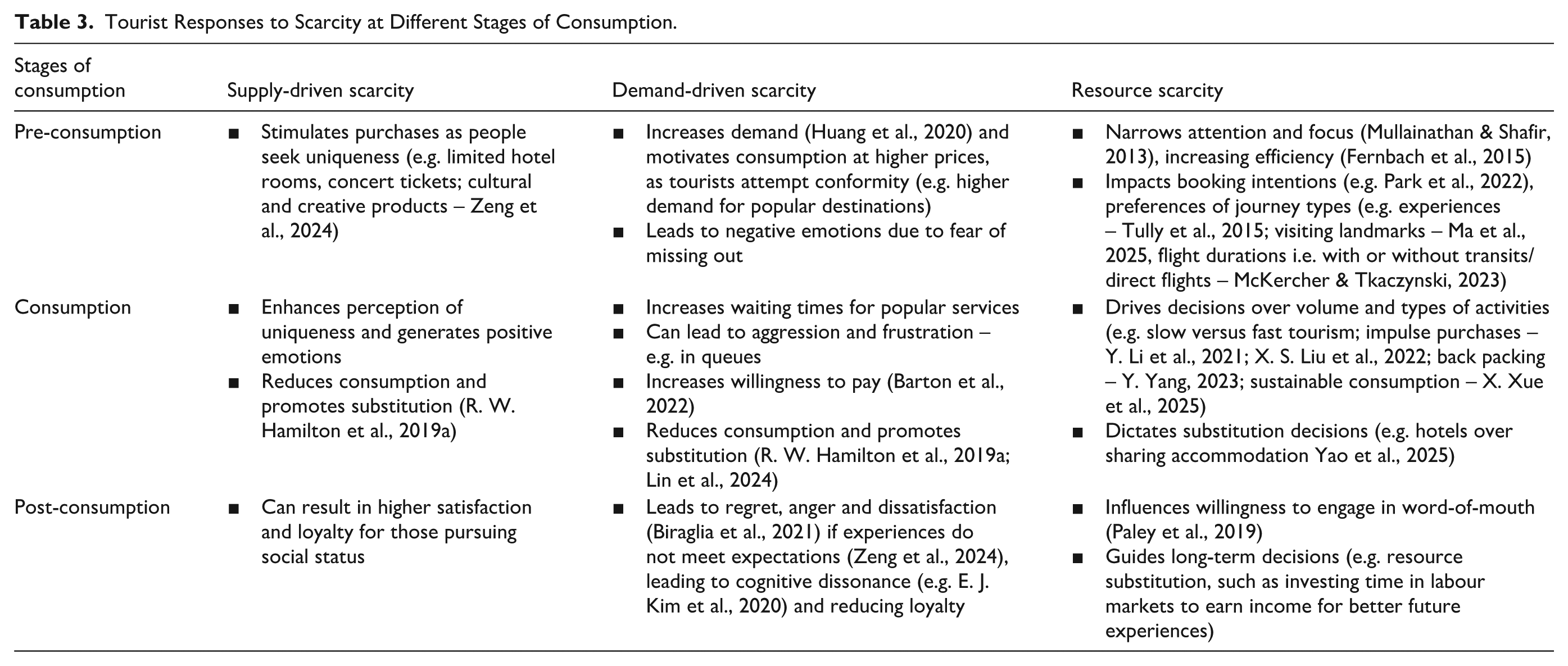
In this paper, we consider the three stages model of pre-consumption, during and post-consumption, drawing on the grand model of customer journey from the marketing literature (e.g., Lemon & Verhoef, 2016). The stages model has been applied to examine scarcity across consumers (R. W. Hamilton et al., 2019b), including impoverished communities (Hill, 2020) and those in relationships (Garcia-Rada et al., 2025). Tourist consumption can also be viewed as temporally structured, encompassing pre-, during, and post- phases (see for e.g., Fang & Pan, 2024; Krey et al., 2023; Yachin, 2018). The pre-stage is typically driven by cognitive assessments of value and perceived risks. The during phase shifts towards experiential consumption, with tourists creating memorable and meaningful encounters. In the post-consumption phase, tourists reflect upon and evaluate their experiences, influencing satisfaction, memory creation, and future behavioural intentions (e.g., Yachin, 2018). Through the stages, scarcity plays a significant role as people respond to multiple forms of supply-driven, demand-driven and resource scarcity (see Table 3).
Tourist Responses to Scarcity at Different Stages of Consumption.
Supply-Driven and Demand-Driven Scarcity Along Consumption Stages of the Tourist Journey
Pre-consumption, supply driven scarcity or supply shocks are more likely to generate positive consumer responses for hedonic, and high visibility offerings (Barton et al., 2022; Ladeira et al., 2023). Limited availability of hotel rooms motivates consumer acquisition as they seek uniqueness (Brock, 1968). Supply (vs. demand) scarcity can encourage intention to consume impulsive, cultural, creative tourism products (Barton et al., 2022; Ladeira et al., 2023; Zeng et al., 2024), due to need for seek uniqueness. Scarcity framed from a demand (e.g., 20 customers are viewing this room now), or supply (e.g., only two rooms left) perspective, influence consumer preferences differently (e.g., Park et al., 2022). Demand-driven scarcity accelerates purchases as consumers attempt to conform (Barton et al., 2022), avoid regret, or fear of missing out. Demand-driven scarcity signals quality, popularity, and positive evaluations (Gierl et al., 2008; Gierl & Huettl, 2010), while reducing perceived risk during online bookings for tourists with a high sense of power (Huang et al., 2020).
Scarcity may also result in substitution and reduced loyalty as people move to the next best option, especially in tourism, where time scarcity is dominant. Tourists may avoid spending excessively long hours in queues at busy attractions due to tight time schedules. The introduction of surge pricing to balance demand and supply may prompt consumers to substitute towards alternative options (Lin et al., 2024). Conformity (Jones, 1984) is especially relevant given the intangible, inseparable nature of tourists’ experiences, where cues from other people serve as low-risk signals to engage in similar behaviours (Barton et al., 2022; Huang et al., 2020). In addition, tourism relies extensively on human expertise making scarcity a complex issue with far-reaching consequences. Service level is variable and fluctuates based on frontline employee performance and/or demand levels. The nature of tourism makes responses to scarcity during consumption context-dependent, driven by urgency (time), exclusivity, and perceived value.
Resource Scarcity Along Consumption Stages of the Tourist Journey
Financial scarcity reduces preference for counter-hedonic consumption such as horror movies (H. Yang & Zhang, 2022) as they increase negative feelings and decrease sense of control. Financial constraints can increase consumers’ preference for material goods versus experiences (Tully et al., 2015). Time scarcity shapes tourists’ preferences for visiting landmarks (Ma et al., 2025; Meng et al., 2024) and limits the transit time they are willing to tolerate. Time scarce tourists may be willing to pay more for direct flights, (McKercher & Tkaczynski, 2023), engaging in resource substitution between money and time (R. W. Hamilton et al., 2019a). Resource scarcity can expand consideration sets (Hill et al., 1998) and increase creativity (Mehta & Zhu, 2016). During the pre-consumption stage, from an emotional perspective, resource scarcity leads to lower self-confidence (Mittal et al., 2020) and well-being (Martin & Hill, 2015; Netemeyer et al., 2018).
Scarcity further dictates how tourists plan and allocate their time to visit. At the beginning of a holiday, people typically have greater resources to draw upon and can engage in activities that demand higher cognitive effort (Ma et al., 2025; Meng et al., 2024). With time, cognitive resources get depleted, resulting in higher reliance on affect and heuristics such as scarcity cue or social proof (Cialdini, 2007). In fact, under high time constraints, tourists are more inclined to make impulse purchases of hedonic rather than utilitarian products and services (X. S. Liu et al., 2022). Additionally, tourists with richer prior travel experience exhibit greater susceptibility to impulse purchases due to elevated confidence levels (Y. Li et al., 2021). Tourism experiences are atypical and limited availability, such as during COVID-19, does not trigger consumer frustration or aggression in the same way as shortages of physical products (see Kristofferson et al., 2017). Instead, people were primarily concerned about their safety (Y. Li et al., 2021), suggesting that scarcity appeals elicit different responses in service contexts.
Moreover, tourists may compromise by selecting lower-priced accommodation (Lin et al., 2024) and maximise their limited time at the destination by renting a car rather than relying on public transport (S. Kim et al., 2023). Regardless of how efficiently they move between activities, the availability of services remains central to determining how scarce time can be optimised for improved experiences. When choosing accommodation, tourists also weigh the effort required to perform essential household tasks, such as cleaning, against the convenience offered by hotels that provide housekeeping and other hospitality services (Yao et al., 2025).
Over time, increases in tourist arrivals driven by herding and conformity contribute to overcrowded venues, hotspots, and local infrastructure. Destinations such as Barcelona, Venice, Bali, and Phuket exemplify this manifestation of space scarcity. Space scarcity is particularly detrimental for rural and nature-based tourism, as people purposefully avoid crowds, seeking peace and relaxation (Marsiglio, 2016). Conversely, financial scarcity can motivate behaviours such as backpacking, using low-cost airlines, and even evading ticket fees to access local attractions (Y. Yang, 2023). Tourism is structured by fixed schedules (e.g., flight times), with implications for time management (Dickinson et al., 2013). Often, availability of services for example, departure and arrival times, check in/check out times and opening/closing hours for tourists’ attractions exacerbate time scarcity.
Advancing Research on Scarcity and Tourism
The theorisation of scarcity has both positive and negative implications for tourists. Supply and demand-driven scarcity create value by drawing attention and generating excitement. Scarcity can lead to favourable responses, including higher desirability, enjoyment, perceptions of exclusivity, higher purchase intentions and willingness to pay (Barton et al., 2022). People enduring supply and demand-driven scarcity expand consideration sets and engage in co-creation with brands (R. W. Hamilton & Hosany, 2023). Scarcity may also reduce consumption as people buy and/or use less, substitute to competitors’ offerings (R. W. Hamilton et al., 2019b; Lin et al., 2024). For example, in choosing a place to stay, tourists substitute between sharing accommodation (e.g., Air BnB), economy, mid-scale and high-end hotels based on perceived benefits. Tourists may prefer shared accommodation because it fosters a sense of community (Tussyadiah, 2015), offers the comforts of home (So et al., 2018), and encourages social interaction (Chi et al., 2021). Substitution leads to changes in habits as individuals engage with new and different services, ultimately developing new, longer-term preferences (R. W. Hamilton et al., 2014).
The social, cultural, political and economic uncertainties (see environmental uncertainty perspective of scarcity; R. W. Hamilton et al., 2019a) impact tourists’ decisions and choices, beyond intra, interpersonal and structural constraints. Natural disasters influence destination choice through limiting supply (supply-driven scarcity), while economic crises can reduce demand/spend on tourism. Conditions of permacrisis highlight the industry’s vulnerability, requiring tourists to adapt and respond to enduring constraints. Typically, when faced with resource scarcity, in the short term, people reduce consumption. As consumers gradually start to cope, they shift their thinking and decision-making. In the longer term, consumers adapt by substituting between resources (R. W. Hamilton et al., 2019a). For example, when faced with money scarcity, tourists are likely to reduce their frequency of travel. If constraints persist in the longer run, people may consider substituting to staycations, as alternatives to holidays abroad.
Tourists can change their itinerary, include or exclude certain trips when at a destination, depending on popularity (demand-driven scarcity), queues (space scarcity), or time-limited (time scarcity) discounts. For example, in response to fatigue caused by over-crowding (space scarcity) due to high demand (demand-driven scarcity), tourists can adapt their behaviours through replacement. They can choose to visit the same place on a different day, or choose to visit an alternative location, confirming the adaptive nature of tourists’ responses (Yin et al., 2024). Crowding stimulates a series of adaptive behaviours (Kyle & Landon, 2021), leading to the adjustment of tourist norms and the restructuring of tourism spaces to minimise and even eliminate its negative impacts (Kuentzel & Heberlein, 1992).
Over the life course, decisions are shaped by life transitions (e.g., job loss, divorce, see Fu et al., 2022; A. R. S. Hosany & Hamilton, 2023). Childhood socio-economic status is another key factor influencing multiple outcomes over the long-term, ranging from room booking (Park et al., 2022) to willingness to share assets in the sharing economy (Y. Wu et al., 2023). Tourists aspire to important leisure goals (e.g., visit the Grand Canyon). Set goals lead to resource discrepancies and differing consumer responses, including viewing resource gaps as potential opportunities to identify new interests and pursuits (see self-regulatory perspective of resource scarcity - Cannon et al., 2019). Leisure goals determine, for example, the extent to which individuals consider transit times as part of travel and seek to minimise them by travelling to closer destinations or choosing faster modes of transportation (McKercher & Prideaux, 2020), substitute time dedicated to work and earn income for recreational activities (Etkin & Memmi, 2021), or perceive idleness as luxurious (Shin & Back, 2020). Goals may create perceptions of busyness (Bellezza et al., 2017), likely to influence inclination towards faster or slower paced holidays (C. Li et al., 2025). Scarcity offers unique perspectives in understanding psychological, dynamic, and market-induced dimensions. To deepen our understanding, we next propose a set of research directions that leverage theoretical perspectives across scarcity types.
Integrating Resource Scarcity Perspectives
Tourists’ financial and time restrictions have primarily been explored as structural constraints within the Leisure Constraints Framework (Crawford et al., 1991; Godbey et al., 2010), alongside research on issues such as overcrowding (e.g., Jacobsen et al., 2019). Limited studies directly address the phenomenon of scarcity. In this article, we examine time, money, and space as key quantifiable resources in tourism. Researchers (e.g., Okhuysen & Bonardi, 2011) argue the merits of utilising multiple theoretical lenses to develop new explanations of a phenomenon. Scarcity perspectives offer promising directions for advancing tourism research. Recognising that resource scarcity may in cases evoke psychological responses, such as discrepancies in social, cognitive, or personal resources, we ground our theorising in prior work on resource scarcity, largely focussing on the implications of measurable or manipulated resources (see Cannon et al., 2019; R. W. Hamilton et al., 2019b). We propose suggestions for moderating/boundary conditions, helping to establish how, and under what circumstances, resource scarcity (typically measured or manipulated as independent variables in experimental research designs) can shape tourists’ responses (outcomes).
One perspective to consider is resource scarcity as a threat (Goldsmith et al., 2020), or from the evolutionary point of view (Kock et al., 2020, 2025). To date, research indicates that evolutionary motives, predominantly executed through the measured construct of childhood socio-economic status. influences a range of behaviours, including how individuals delay gratification (Mittal & Griskevicius, 2014), vary in their need for health coverage (Mittal & Griskevicius, 2016), choose to spend or save (Griskevicius et al., 2013). Research on evolutionary motives within tourism is in its early stages, but gaining momentum as its relevance becomes increasingly recognised (J. Y. Kim et al., 2024; Kock et al., 2020, 2025; Park et al., 2022). Future studies could examine relevance of the evolutionary perspective for fast versus slow holidays, challenging versus relaxing, risky versus non-risky, and how much time tourists are willing to spend during transits or in cultural experiences (e.g., museums).
Another approach is to explore how tourists consider a set goal, target or reference level (Cannon et al., 2019; Goldsmith et al., 2020), for time or money to be spent when they do not possess the required level of resources. To what extent will tourists engage in self-regulation as a resource scarcity perspective (Cannon et al., 2019), to minimise the gap between actual and desired level of resources? An important boundary condition to investigate is how much effort individuals are willing to invest in pursuing tourism experiences under conditions of resource scarcity. Future research should address the circumstances, and extent tourists perceive measurable (e.g., via current income levels, current socio-economic status, time used) or manipulated (e.g., scenarios priming time, money, space restrictions or field experiments) resource gaps to be mutable. Studies should also go beyond portraying constraints negatively, to incorporate a broader conceptualisation of the positive, value creating potential of scarcity. For instance how do tourists perceive a sense of control over their actions? How does resource scarcity influence destination choice, responses to dynamic price fluctuations or loyalty, due to promotion versus prevention orientation (Higgins, 1997, 1998). According to regulatory focus theory, people can be either promotion or prevention focus. Promotion focussed individuals orient behaviours towards advancement, with a desire to pursue growth, while prevention focussed people emphasise avoiding negative outcomes and risks reduction.
The presence of companions such as friends or family influences the choice of tourism activities. For example, tourists are more willing to engage in challenging activities when accompanied by friends but undertake relaxing pursuits in the presence of family (Cheng et al., 2024). Beyond close friends and family, the influence of broader social networks, especially in the age of social media, intensifies social comparison, prompting individuals to evaluate how they are doing relative to others. Typically, individuals contrast themselves with others they perceive as resource-rich, thereby reinforcing perceptions of not having enough (see social comparison perspective: R. W. Hamilton et al., 2019a). For instance, low-income consumers, that is consumers facing chronic scarcity, are not willing to go to malls, despite lower prices, to avoid interactions with higher income shoppers (Jacob et al., 2022). Future studies could investigate how social comparisons due to measured (e.g., income group, socio-economic status, time availability) or manipulated resource discrepancies (e.g., perceived time availability, induced queues) influence tourists’ responses such as destination, hotel, entertainment, restaurant choice, food waste in buffets, purchasing local crafts, dining in local restaurants, staying in eco-lodges, respecting local norms, visiting unethical attractions, avoiding deviant behaviours, or helping with wildlife conservation. Future research could investigate how and under what conditions, different social groups negotiate or resist sharing leisure environments and respect local norms.
As we discuss in this article, multiple forms of resource scarcity occur throughout the stages of consumption. For example, tourists endure time scarcity as they attempt to visit multiple attractions during short stays at destinations. Although time constraints have been widely studied (e.g., Y. Li et al., 2021; C. Li et al., 2023; Noone & Lin, 2020), little attention has been given to intertemporal implications. As per this body of research, where resource scarcity is typically manipulated, people are more likely to choose sooner, but smaller, rather than later, but larger outcomes (e.g., Sharma et al., 2023). Scarcity generally creates a tendency for myopic, impulsive behaviour favouring smaller, short-term gains through cognitive focus on the present. Accordingly, there is a need to further understand if tourists prioritise the present at the expense of the future at different consumption stages of the tourist journey.
As scarcity requires cognitive engagement and elicits immediate focus on the constrained resource, construal level theory (Trope & Liberman, 2010) offers substantial potential for future research. Construal level theory can be applied to understand whether tourists have an abstract versus concrete perception, low versus high future orientation, when faced with resource scarcity. Typically, individuals with high levels of construal think more abstractly and prefer products/services aligned with broader goals and values. In contrast, those with low construal levels adopt a more concrete perspective, favouring options tied to immediate, tangible outcomes. To date, construal level theory has been applied in various tourism contexts (see Scarpi & Raggiotto, 2023 for an overview). From a scarcity perspective, construal level theory helps explain how reminders of resource scarcity influence interests in sustainable products (Goldsmith et al., 2020) and shape pro-environmental behaviours (Gu et al., 2020). Emerging research applies construal level theory in the context of destination image and time scarcity (Q. Su & Li, 2024). Leveraging construal levels as boundary conditions, based on people’s abstract or concrete perceptions, or level of future orientation (low vs. high), can help deepen understanding of how tourists respond to resource scarcity in contexts such as cultural, heritage tourism, and food waste.
Further studies can also examine how and to what extent tourists adjust their habits in response to resource constraints. Do they reduce shift to alternative modes of travel and leisure? Do situational and/or chronic financial scarcity provide opportunities for cheaper, but more sustainable options? How can we encourage local tourism to reduce long distance travel, associated financial and space scarcity attributed to popular destinations? Future research could explore how tourists assess the opportunity costs of their resources through the consumption stages of the tourist journey as they make substitution decisions. Future research can assess the extent situational versus chronic scarcity is more predictive of behaviours in specific contexts. As tourists may face financial scarcity post-travel clearing bills related to their holidays, what tools or strategies do they have in place to pay back expected and unexpected debts? Combining perspectives from mental accounting (Thaler, 1999) may uncover how tourists evaluate, categorise and handle finances in responding to scarcity.
Examining Supply-Driven and Demand-Driven Scarcity
Prior research explores how supply-driven and demand-driven scarcity influence tourist responses (e.g., Song et al., 2019; Zeng et al., 2024), drawing on theories such as commodity theory (Brock, 1968), psychological reactance (Brehm, 1966; Clee & Wicklund, 1980), conformity (Jones, 1984), and regret theory (Loomes & Sugden, 1982). These studies often apply concepts like scarcity cues and social proof (Cialdini, 2007) to explain behavioural outcomes. Future research should apply supply-driven and demand-driven scarcity perspectives in the context of festivals, heritage sites, cultural tourism (e.g., art, museum experiences), adventure and theme parks. Given the importance of strategically aligning demand and supply, and the expanding role of digital technologies, such as social media–driven aspirational tourism, mobile apps, augmented reality, the metaverse, artificial intelligence, and smart tourism platforms, in shaping contemporary travel experiences, further studies are warranted. Research should examine how scarcity cues and social proof can be effectively deployed to engage increasingly experienced and discerning tourists.
Additionally, for a more nuanced profiling of tourists, future research should examine how mediating and moderating psychological mechanisms link supply-driven and demand-driven scarcity to tourists’ responses. Such an investigation should consider how scarcity influences tourists’ need for uniqueness, their desire to avoid regret, their inclination to conform to social groups, and their efforts to restore a sense of freedom. Some of these psychological mechanisms could include the effects of perceived prestige, value or emotions (e.g., enjoyment, disappointment, distress, hope, nostalgia) between supply-driven or demand-driven scarcity and intention to visit.
The intangible, heterogeneous, variable and perishable nature of tourism, make information search, acquisition and processing a significant, effortful, time consuming and costly part of the journey. As a result, tourists rely on heuristics based on scarcity cues or social proof and message framing (e.g., 20 people are viewing this room; only two rooms are left) plays a key role in driving demand (Huang et al., 2020; Park et al., 2022). Future studies can further advance our understanding by integrating message framing and regulatory focus (Higgins, 1997, 1998) in the context of supply-driven and demand-driven scarcity.
Interplay Between Different Forms of Scarcity
Supply-driven, demand-driven and resource scarcity can happen simultaneously. Tourists may face financial scarcity due to high prices driven by excess demand for popular destinations and/or limited flight availability. Emerging research examines some forms of interaction between supply-driven, demand-driven and resource scarcity. For example, Park et al. (2022) show how preference for scarce hotel rooms due to higher demand, is stronger for consumers from low childhood socio-economic status (financial scarcity). Song et al. (2021) examine how social messages have different effects on consumers’ perception of competition and willingness to purchase, when faced with quantity versus time (resource) scarcity.
Future research should investigate the interaction between scarcity types. For example, how do tourists across socio-economic groups facing different levels of chronic scarcity, respond to limited room availability, flight tickets, or seating areas in theatres and restaurants due to resource shortages created by consequential or concurrent external or internal events? How do resource scarce, vulnerable tourists interact with service eco-systems? How do service providers engage with vulnerable groups in designing transformational outcomes and value co-creation? How do responses vary for solo versus group travellers? Tourism experiences are often consumed with travel companions (e.g., friends, family). Additional research should seek to understand how social influences (as per conformity theory), interact with different forms of scarcity as travel companions make consumption sacrifices (e.g., the travel companion is in a hurry, faces financial scarcity, or requires accessible forms of tourism – see also Garcia-Rada et al., 2025).
Interaction Between Situational and Chronic Scarcity
External (e.g., Covid-19) and internal events (life transitions) create multiple forms of state, situational (episodic) and/or chronic scarcity. People respond to situational scarcity based on their chronic level of resources (A. R. S. Hosany & Hamilton, 2023), usually represented through current socio-economic status (e.g., R. W. Hamilton et al., 2019a). Job changes, house moves, child births, weddings, divorce or even death (A. R. S. Hosany & Hamilton, 2023), create uncertain environments, generating situational resource scarcity with important implications for tourism pursuits (Fu et al., 2022). For instance, someone with a lower paying job may not be able to afford expensive holidays; the costs associated with weddings (situational resources), have implications for tourism pursuits. Hence future research should examine how life transitions generate resource scarcity, and influence tourists’ responses based on chronic resources.
For example, what type of experiences are best suited for tourists as they navigate major life events? Do tourists face vulnerabilities as they go through life events and how can such vulnerabilities be integrated within tourism experiences across the stages of the tourist journey? How can Destination Management Organisations attract and cater for tourists going through difficult life stages? As consumers face resource (e.g., financial) scarcity, do they substitute to alternative, more sustainable forms of tourism, depending on their chronic resources? In responding to time scarcity, to what extent tourists are more likely to substitute to other activities? Will tourists be more receptive to new technologies such as the metaverse or artificial intelligence for trip planning, and interaction, or for virtual encounters (Buhalis et al., 2023) throughout the life course? Future studies should consider how planned (vs. unplanned), short- (vs. long-term), positive (vs. negative) events (see A. R. S. Hosany & Hamilton, 2023) influence decisions along stages of the tourist journey based on chronic scarcity.
Scarcity in the Grand Tourist Decision-Making Models
Decision-making is foundational within tourism research and has traditionally been studied through three dominant lenses (McCabe et al., 2016): the normative, prescriptive cognitive, and structured process approaches. Each offers valuable insights into how tourists evaluate alternatives, form preferences, and make choices. A detailed examination of tourist decision-making models lies outside the scope of this article, as prior studies already offered comprehensive assessments of their respective merits (see for instance Jeng & Fesenmaier, 2002; Sirakaya & Woodside, 2005; Smallman & Moore, 2010). The following discussion highlights critical issues pertinent to our arguments around incorporating scarcity within the grand decision-making models. Scarcity can significantly alter preferences, amplify perceived value, and introduce urgency, all of which meaningfully reshape decision-making processes.
The normative approach conceptualises tourists as rational, utility-maximising actors who evaluate alternatives based on costs and benefits (Mansfeld, 1992). Preferences are assumed to be stable, and decisions optimised within constraints. Although budgetary and temporal limits are implicitly recognised, scarcity is not viewed as a dynamic determinant of behaviour. Normative models assume perfect information and stable preferences, overlooking how scarcity can compress timelines, trigger trade-offs, and distort rational calculations.
The prescriptive cognitive approach is commonly represented through the Theory of Planned Behaviour (Ajzen, 1991). The Theory of Planned Behaviour provides a useful framework, summarising factors that influence travel intentions, and predict behaviours. Prescriptive cognitive approaches assume that tourists engage in comprehensive, deliberate cognitive processing prior to making decisions, failing to capture how scarcity may increase desire, and direct attention.
The structured process approach (choice-set) conceptualises tourist decision-making as a sequential, multi-stage process (Crompton, 1992; Um & Crompton, 1992). Decision making begins with the formation of an initial awareness set, with alternative destinations, gradually narrowing in a funnel-like manner, as options are eliminated and a choice made (Sirakaya & Woodside, 2005; Um & Crompton, 1990). Tourists encounter a wide array of options when planning their vacations, which can create choice overload (Thai & Yuksel, 2017). Although, this perspective captures decision-making complexity, it fails to incorporate the relevance of scarcity. For example, time scarcity can constrain information search; scarcity cues in marketing appeals can accelerate commitment in later stages. Choice-set models typically assume linear progression, failing to account for how scarcity can disrupt linear trajectories.
Despite their prominence, the normative, prescriptive cognitive, and structured process approaches largely overlook the role of scarcity in tourists’ decision-making. Evidence, however, suggests that scarcity has a detrimental effect on cognitive functioning (Mullainathan & Shafir, 2013) and directly affects decision-making (Shah et al., 2012, 2015). Foundational tourist decision models should capture how scarcity drives urgency, amplifies value, and introduces preference instability. For a more nuanced understanding, future research should explicitly examine how different forms of scarcity can be integrated within established grand tourist decision-making models.
Limitations and Conclusion
Tourists face several constraints that can be understood through the lens of scarcity. In this conceptual article, we discuss various types of scarcity, theoretical perspectives and their implications for tourists. Tourism constitutes a significant economic sector embedded in communities with diverse stakeholders such as residents, governmental bodies, and service providers including hotels, airports, and transportation firms. The sector is highly vulnerable to external shocks (e.g., health and economic crises), with tourism activity fluctuating along a continuum from zero tourism (e.g., during COVID-19) to under-tourism (e.g., the immediate post–COVID-19 period; see Mihalic, 2020) and over-tourism (e.g., García-Buades et al., 2022). Residents as stakeholders face various types of scarcity, both during periods of under and over tourism.
Phases of under tourism can reduce employment and thereby heighten financial scarcity among residents. Conversely, when tourism exceeds a destination’s carrying capacity (Clark & Nyaupane, 2020, 2025), the externalities associated with over tourism, such as rising prices for housing and basic commodities, can create both monetary and space scarcity for local communities (Baños-Pino et al., 2024). Although tourism offers substantial income-generating potential for host communities (Pang et al., 2024), pricing residents out of local markets can undermine community resilience (Holland et al., 2022). While we acknowledge some implications of scarcity for stakeholders beyond tourists, a full examination of these broader impacts lies outside the scope of this paper.
Our article does not address water scarcity (Gössling et al., 2012; Loehr et al., 2021; B. D. Moyle et al., 2022), constituting a critical and increasingly visible form of resource scarcity in tourism. As there is heavy reliance on water for basic consumption and recreational activities (e.g., spas, swimming pool), changes in water availability or quality can affect both tourists and communities. For example, a water emergency in Italy prompted one of the most popular islands, Capri, to be deprived of water supply, leading to a halt in tourists’ arrival for one weekend (R. Booth, 2024). Water scarcity is highly relevant, however, given that we adopt a tourist-centric focus, an in-depth discussion is beyond the scope of this conceptual article (see Gössling et al., 2012; Loehr et al., 2021; B. D. Moyle et al., 2022 for comprehensive reviews).
Scarcity is a pervasive, multifaceted phenomenon that shapes human behaviour, yet its role in understanding tourists remains under-theorised. Existing research is largely framed through the lenses of leisure constraints or non-participation, with emerging work addressing scarcity directly. Our article moves beyond established frameworks to offer a more nuanced and integrated conceptualisation. Drawing on insights from marketing and psychology, we synthesise supply-driven, demand-driven, and resource scarcity, illustrating how each manifests distinctly for tourists. Our work provides a foundation for advancing scarcity research in tourism. To stimulate further inquiry, we propose a research agenda aimed at fostering deeper conceptual development and more rigorous empirical investigation. We hope this article encourages researchers to examine scarcity as a dynamic, multifaceted construct that enriches our understanding of tourists’ responses.
Footnotes
Acknowledgements
During the preparation of this article, the authors used ChatGPT for minor copy-editing to improve readability. All content was reviewed and revised, and the authors take full responsibility for the final manuscript.

Author Contributions
Funding
The authors received no financial support for the research, authorship, and/or publication of this article.
Declaration of Conflicting Interests
The authors declared no potential conflicts of interest with respect to the research, authorship, and/or publication of this article.