




Abstract
A set of six motive constructs emerged from a review of a half-century of research purporting to determine the motives that guide tourists’ pleasure decisions: curiosity, boredom alleviation, disinhibited play, biophilia, reinforcement of bonds with intimate groups, and ego-enhancement. Frequently, emotions, outcomes, reasons, personalities, and/or actions were confusingly mischaracterized as motives. The theoretical/conceptual physiological and psychological underpinning of each motive construct are described, together with the diagnostic antecedent behaviors that infer a motive is in a state of disequilibrium, and the restorative behaviors in which tourists engage to restore equilibrium. Directions for future research are suggested.
There is a distinction between the how and the what of tourists’ motivation. An earlier review described and critiqued theoretical and conceptual frameworks that emerged in the past half-century of research in tourism motivation (Crompton & Petrick, 2024). Its focus was on the mechanisms that explain how psychological processes transition a motivational state into action. One of its conclusions was that disequilibrium is the unifying theory that explains the motivation process in tourism. However, the authors noted, “Disequilibrium is not a holistic gestalt phenomenon, rather it is motive specific.”
This paper complements the earlier review. It addresses the specific content of the six motive constructs that have emerged from research in the past half-century which trigger action and guide individuals’ destination selection decisions. E. Cohen (1979) in an early paper articulated the rationale for recognizing diverse motive constructs: “The complexity and homogeneity of the field of tourism suggests that there is no point in searching for the theoretical approach… Rather, a pluralistic… research strategy is advocated” (p. 31). The paper’s four objectives are to identify, define, describe, and evaluate the validity of:
• The six motive constructs that constitute the set of potential tourists’ motives.
• The theoretical/conceptual forces that explain each motive’s antecedent behaviors and guide its restorative behaviors.
• The diagnostic antecedent behaviors that indicate a motive is in a state of disequilibrium that has triggered action to rectify it.
• The restorative behaviors in which tourists engage to restore equilibrium.
The paper’s intent is to create a “roadmap” for a future research agenda that will focus on each of these six constructs to “flush out” and confirm or refute the framework and examine whether there are other motive constructs which should be added to these six.
The “motive constructs” are not “truths”; rather they are labels that provide a way of construing the phenomena. They are identified, delineated, and defined by two features. First, through inferences that are posited to explain behaviors which are derived from (i) observing tourists’ diagnostic antecedent behaviors that trigger and activate the motives; and (ii) the restoration behaviors incorporated in the vacation experience that are intended to restore their state of stability (Crompton & Petrick, 2024). The behaviors provide evidence of each motive’s structure/architecture and are overt evidence of a motive’s presence and its arousal. The second feature is identification of the physiological and social-psychological roots that describe the source of disequilibrium and explain the behaviors attributed to it.
The review revealed that researchers frequently used the terms “concept,” and “theory” interchangeably. However, they are substantively different. A concept is a mental representation comprised of basic characteristics that enhance understanding of how motives emerge. It can be broad or narrow in scope but remains an unproven idea. In contrast, a theory is a well-established scientific principle that explains behaviors that is supported by evidence which has been validated by repeated testing through credible experimentation and observation. The explanations that have been offered for how antecedent behaviors trigger a motive and subsequently guide its restoration to equilibrium are a mix of both concepts and theories. However, concepts predominate which is consistent with McCabe’s (2024) conclusion that tourism “has fallen short in relating concepts into a wider theoretical structure” (p. 2).
This process of codifying and harmonizing the constructs and their associated behaviors and explaining how they evolve is central to better understanding tourists’ motives. Motives research in tourism during the past half-century suffered from both the absence of an agreed-upon conceptualization of the motivation process which was addressed in the earlier paper (Crompton & Petrick, 2024) and the failure to delineate what constitutes a motive construct which is addressed herein. Extant conceptualizations of motive constructs are often “fuzzy,” that is, they are frequently interpreted differently by different researchers, resulting in confusing conclusions. This paper aspires to provide researchers with a shared, common meaning of the phenomenon which, presumably, will also assist tourism suppliers to develop more effective strategies for meeting tourists’ needs.
Crompton’s (1979) paper, “Motivations for Pleasure Vacations,” proved to be a foundational article, emerging as one of the most cited articles in the tourism field. With the benefit of hindsight, it is clear his initial taxonomy was tentative and propositional rather than definitive. Unsurprisingly, a half-century of subsequent research has exposed its limitations, providing support for the aphorism that the success of foundational articles should be judged by how thoroughly their authors are replaced in a field’s literature. Given the thousands of authors, and perhaps the hundreds of thousands of respondents and subjects from whom those authors derived their research findings, it is inevitable that multiple additional insights have been reported that amend, enhance, and greatly expand understanding of tourists’ motive constructs and their associated behaviors. As Dolnicar and Ring (2014) note, “Some concepts need to be refined, either because they have changed in nature over time or because their original conceptualization was flawed. Refinement of concepts for these reasons is of great value to a discipline” (p. 45).
This process will continue; it is the nature of science. It is especially dynamic in contexts such as this where the parameters and nature of motives must be elicited from behaviors and theory because, for the most part, they are subconscious drivers. They are a “hidden agenda” in that, typically, tourists have difficulty in overtly formulating, expressing, and articulating their motives, so unveiling them is dependent upon implicit interpretation rather than explicit objectivity. Subjective interpretations of behaviors inevitably differ, so multiple interpretations are likely.
When tourists do articulate their motives, their responses may not be authentic because they fear revealing them would be ego-threatening, result in a loss of prestige, or contravene conventional cultural codes. When the responses are authentic, the responses are often likely to be “overdetermined.” While an individual may cite a single motive as the reason for going on a vacation, rarely is a single motive the sole driver of a decision; rather, it is likely that a constellation of motives is arranged in a hierarchy so multiple motives contribute to the decision, albeit most of them may not be dominant (Crompton & Petrick, 2024).
Motive Mischaracterizations
Many of the studies purporting to explore tourists’ motives, mischaracterized them by confusing them with “emotions,” “outcomes,” and/or “reasons.” These are distinctively different concepts. The semantic confusion and lack of conceptual clarity resulting from these inappropriate imputations has led to an inconsistent operationalization of motive constructs, consequent incoherent and spurious conclusions, and much wasted effort.
Perhaps the most widely cited definition of motives is that offered by H. A. Murray (1938) who described a motive as an internal force that arouses, organizes, directs, and integrates, “a person’s behavior in such a way as to transform in a certain direction an existing unsatisfying situation” (p. 124). It was noted earlier that a motive construct is defined by two distinctive features: underlying physiological and psychological needs or desires that drive tourists’ behavior; and specific antecedent and restorative behaviors associated with a construct. These defining features are not present in the mischaracterized concepts.
Mischaracterization of Emotions as Motives
Motives and emotions are inextricably linked since emotions are often reactions to fulfilled or thwarted motives. Further, the value proposition for tourism is substantially based on emotions. They are ubiquitous and often intense feelings associated with a specific situation or event that linger in the memory (Cohen & Areni, 1991; Hosany et al., 2020). J. B. Langston (1994) coined the term “capitalization” to describe positive emotional benefits that endure above and beyond those that emanate from an event per se. Unfortunately, they are sometimes mischaracterized as motives.
For example, in recent years there has been an upsurge of interest in nostalgia (Abakoumkin & Green, 2021). A comprehensive review of nostalgia research concluded: “Theorists are unanimous in labeling nostalgia an emotion” (Sedikides et al., 2015, p. 207). Nevertheless, in the context of tourism:
Pearce and Lee (2005) included nostalgia as one of their “tourist motivations.” Its two items were “thinking about good times I have had in the past,” and “reflecting on past memories.”
Leong et al. (2023) referred to nostalgia as “a push motive” and stated, “nostalgia is known to be an intrinsic motivation that drives the individual to seek some form of remedy for the need to re-live past experience” (p. 81).
Z. Lin et al. (2024) referred to “heritage travel motivations” (p. 2), failing to recognize that it is an emotion not a motive, and mischaracterized nostalgia dimensions as “‘pull factors’ that, alongside other intrinsic motivations attract people to travel to a heritage site” (p. 2). Beyond the mischaracterization of pull factors as intrinsic motives (Crompton & Petrick, 2024), Lin et al. discussed multiple dimensions of the nostalgia emotion under the mischaracterized headings, “Reminiscing Motives,” Symbolic Motives,” Travel-Based Motives, and “Aspirational Motives.”
J. F. Wang (2023) opined, “Nostalgia is recognized as a significant push motive.”
The mischaracterization of emotions as motives is understandable. Memories of positive emotions such as nostalgia, happiness, warmth, joy, affection, excitement, or whatever, from a prior experience sometimes trigger motive states of disequilibrium and become key drivers in a Thematic-Combination Heuristic search process. Crompton and Petrick (2024) describe this process: The Thematic-Combination Heuristic sequence posits that the source of arousal [disequilibrium] is positive emotions and remembered relationships from previous benefit outcomes emanating from a destination’s attributes, or a vivid memorable image of them. This links the end outcomes an individual seeks with the means to deliver them. It creates arousal (push motives) to visit a familiar destination (p. 17).
Mischaracterization of Outcomes as Motives
Crompton (1979) identified “exploration and evaluation of self” as a motive and defined it as people’s “opportunity for re-evaluating and discovering more about themselves or for acting out self-images and in so doing refining and modifying them” (p. 416). In the subsequent half-century, its acceptance as a motive in tourism research has been pervasive, albeit with different nomenclatures; for example, “self-actualize” (Pearce & Lee, 2005), “self-reflection” (Oh et al., 2016), and “actualization” (Otoo & Kim, 2020).
However, it is mischaracterized. Self-inquiry/self-exploration directed inward to address self-discovery questions such as Who am I? and What is the meaning of my life? is a potential outcome from a tourism experience, along with other outcome benefits reported for educational travel (Stone & Petrick, 2013), family and relationships benefits (Durko & Petrick, 2013), health and wellness benefits (Chen & Petrick, 2013), well-being (Uysal et al., 2016) and more generic outcomes such as peak experiences or fulfillment. Some of these authors explicitly exclude motives from their reviews. For example, Stone and Petrick state: “While motivations are worth considering, pairing motivations of travel with educative outcomes is beyond the scope of this paper” (p.735).
Self-enquiry is not a motive construct that drives behavior because it fails to meet the two required criteria. There are neither specific antecedent nor restorative behaviors that communicate inferences to an “explore self” motive; nor are there any theoretical physiological or psychological theoretical roots that explain the behavior in disequilibrium or arousal terms.
As Neumann (1992) contended “journeys provide the opportunity to acquire experiences that become the basis for discovering and transforming oneself” (p. 182). Self-exploration is an outcome of those experiences, but it is not a motive construct that drives the experiences. For example, some may discover “who they are” through hiking to exhaustion in difficult conditions in the mountains, while for others it may be depositing themselves into an alien culture experiencing isolation and an absence of social support. Self-exploration is a potential collateral beneficial outcome that can come from any or all six of the motive constructs delineated in this study. An empirical investigation of transformative personal experiences among tourists contained divergent perspectives on how the search for self was conceived and approached, but concluded: Transformation is not a motivation. Tourists embarked on the trips for a variety of reasons, but transformation of self was not one of them… When referring to their lives predeparture, participants did not comment on existentially themed experiences (Kirillova et al., 2017, p. 643).
The authors went on to report: A triggering episode strikes as a surprise. All participants reported that triggering moments occurred spontaneously…They were intense emotional responses (p. 645) …After which one’s culturally derived beliefs began to shed and the nakedness of one’s existence was exposed (p. 646).
Their study confirmed that testing self-identity in challenging contexts can be a deeply meaningful experience. The commonality among those reporting the experiences was a conviction of the important role of a vacation in both creating a novel cultural context which triggered the outcome and providing the space to reflect upon it. This reaffirmed Crompton’s (1979) observation that “self-discovery emerged as a result of transposition into a new situation” (p. 417) because being surrounded by unknown people led to the discovery of self-dependence rather than dependence on others. Others have confirmed that it is context rather than a specific motive construct that enhances the probabilities of triggering meaningful self-exploration events: “Cultural shock, disorienting dilemmas and peak episodes emerged as having an important role in the enhancement of existential authenticity…physical performances were an additional key element” (Pung et al., 2020).
Like emotions, memories of positive outcomes may sometimes serve as thema that activate a motive construct (Crompton & Petrick, 2024). The thema may arouse different motives—perhaps boredom alleviation, curiosity, ego-enhancement, or biophilia replenishment—and the restorative behaviors associated with each would be manifested, but if discovery of self emerged, it would be a serendipitous outcome.
Mischaracterization of Reasons as Motives
Reasons are the verbal justifications or explanations for behavior; they are not the sources of disequilibrium that drive it. Sometimes reasons are face-saving rationalizations used to justify a situation which results in a stated objective differing from the motive driving the behavior. Dann (1981) characterized it as the “in-order-to motivation’ being camouflaged by a “because of’ explanation” (p. 203).
Motives that drive individuals to visit a heritage site, for example, may include curiosity, ego-enhancement, and strengthening family bonds. Reasons, on the other hand, provide the verbal logic that leads to the decision to visit the site (to reminisce, to look at where we came from, to show our children how we used to live, to imagine life like it used to be, etc.).
The mischaracterization was illustrated by an investigation of “the motivation for visiting heritage settings” (Poria et al., 2006, p.164). Despite the focus, the authors stated the study “was concerned with the specific reasons for the visit” (p. 166). In a table headed “Motivations for Visiting,” participants’ responses were summarized under three headings, two of which were not associated with motives: “Willingness to feel connected to your heritage” (an emotion); and “Reasons not linked to the heritage on show” (an explanation of the logic of a decision; p. 168).
Derivation of the Six Motive Construct Conceptualization
There have long been different views among psychologists as to how many motives drive behavior. For example, while H. A. Murray (1938) identified 14 needs, his peer, Maslow (1943), initially posited 5. Motive taxonomies developed by psychologists are intended to explain all forms of behavior, whereas tourism is a niche behavior characterized by being discretionary, future oriented, socially influenced, episodic, and repeated often with recurring qualities (Pearce, 1993). Hence, it appears unlikely that all the motives appearing in psychologists’ taxonomies could be activated in the narrower behavioral niche of tourism.
In the early years of empirical research into tourists’ behavior the most prominent motive taxonomies consisted of between one and four constructs (Beard & Ragheb, 1983; Dann, 1977; Iso-Ahola, 1982; MacCannell, 1976; McIntosh, 1977). Iso-Ahola viewed this as a strength because “no long lists of leisure motives are needed to understand leisure motivation” (1989, p. 262). He argued that the small number of motives made it easier for managers to utilize the taxonomy for informing managerial and policy decisions. Adding nuances had the potential to confuse, since the information becomes more decontextualized from the nomenclatures and experiences of daily operations.
For researchers, as the number of motive constructs increases, measuring instruments tend to become lengthy and unwieldy, and it becomes concomitantly more difficult to persuade respondents to thoughtfully engage with them. Hence, researchers invariably seek shorter instruments. However, the quid pro quo is often that a smaller number of motives attenuates the relationships established with the longer instruments. This may be the result of (i) reduced validity either because all constructs are not included, or dimensions of the constructs are not adequately represented; and/or (ii) lower reliability because cross-checks of the consistency of responses are reduced.
The small number of constructs embraced in the early years also reflected lack of knowledge of the full array of tourists’ motive constructs and their associated behaviors revealed by subsequent research. Incorporating only a small number of the full set motives means results are an artifact of inadequate conceptualization. That is, if motives are omitted then variance which should be attributed to the missing constructs is inappropriately distributed among those that are included, making it likely that relationships deemed to be “significant” and “non-significant” would change if a more comprehensive model was specified.
For these reasons, Pearce (2019) criticized the early Dann (1977), Iso-Ahola (1982), and MacCannell (1976) taxonomies noting, “it is critical to have a model which recognizes the multiplicity of motives operating at one time as travel drivers” (p. 31). More granular definition leads to greater range and depth of understanding of tourists’ motives, and how constructs relate to each other; and reduces problems of multicollinearity. A larger number of motives with a greater emphasis on particularization and precision makes it easier to interpret research outcomes and to identify implications.
Recognition of the advantages of more detailed specification led to multiple taxonomies emerging in which the number of motives typically ranges from 12 to 20. However, in some cases the derived “motives” were emotions, outcomes, or reasons; other studies incorporated pull attributes that had been wrongly specified as motives (e.g., Otoo & Kim, 2020; Pearce & Lee, 2005); while some (e.g., Manfredo et al., 1996) constructed motive domains which were so narrowly defined with minimal inter-construct variation and insufficient differentiation that they did not warrant independent status.
Clearly, there are trade-offs between parsimony and particularization/inclusivity. The challenge is to identify the optimal balance before a tipping point is reached where a more granular level of particularization becomes self-defeating that is, more becomes less. The author believes the six-motive taxonomy derived in this paper achieves this balance point, while embracing all the legitimate motives and their associated behaviors that have been identified in the literature.
This taxonomy was informed by Iso-Ahola’s (1982) escape/seeking paradigm of tourism motivation. He proposed there were two motivational forces: (i) avoiding or escaping from everyday routines, problems, and troubles; and (ii) seeking benefit outcomes that will alleviate sources of disequilibrium. He described the two decisions as “motivational forces” and suggested they occurred “simultaneously.”Crompton and Petrick (2024) noted: This was a valuable insight into the disequilibrium process, but subsequent research has demonstrated that regarding escape and seeking as motives is a mischaracterization. The autological quality of escape and seeking, and their concreteness differentiates them from motive constructs. Rather, they are singular, concrete, binary, visible, and unambiguous actions (Bergkvist & Rossiter, 2007). This contrasts with motive constructs which are “hidden,” internal, and abstract, and must be elicited and interpreted based on manifested behaviors believed to be associated with them (p. 5).
When people decide to “escape on vacation” they act to temporarily remove themselves, physically and mentally, from the personal and/or interpersonal problems associated with everyday life in their home environment. Subsequent research has revealed that Iso-Ahola’s seeking force is comprised of an array of motives that provide greater particularization, precision, and more insight and understanding into the range and depth of tourists’ motives.
In a later paper, Iso-Ahola (1989) recognized that the seeking paradigm “can be broken into two components: personal and interpersonal” (p. 260). This proved to be a useful framework for the motives taxonomy shown in Figure 1. Four of them are primarily personal (curiosity, boredom alleviation, disinhibited play, and biophilia replenishment), while two of them are strongly influenced by the relationship between an individual and members of his/her social system (strengthening family/friends’ bonds and ego-enhancement). However, human behaviors never occur in a social vacuum; they are framed within the context of prevailing social values (Cheek & Burch, 1976), so it is recognized that there is a continuing dialectic between the personal and interpersonal forces with each affecting the other.
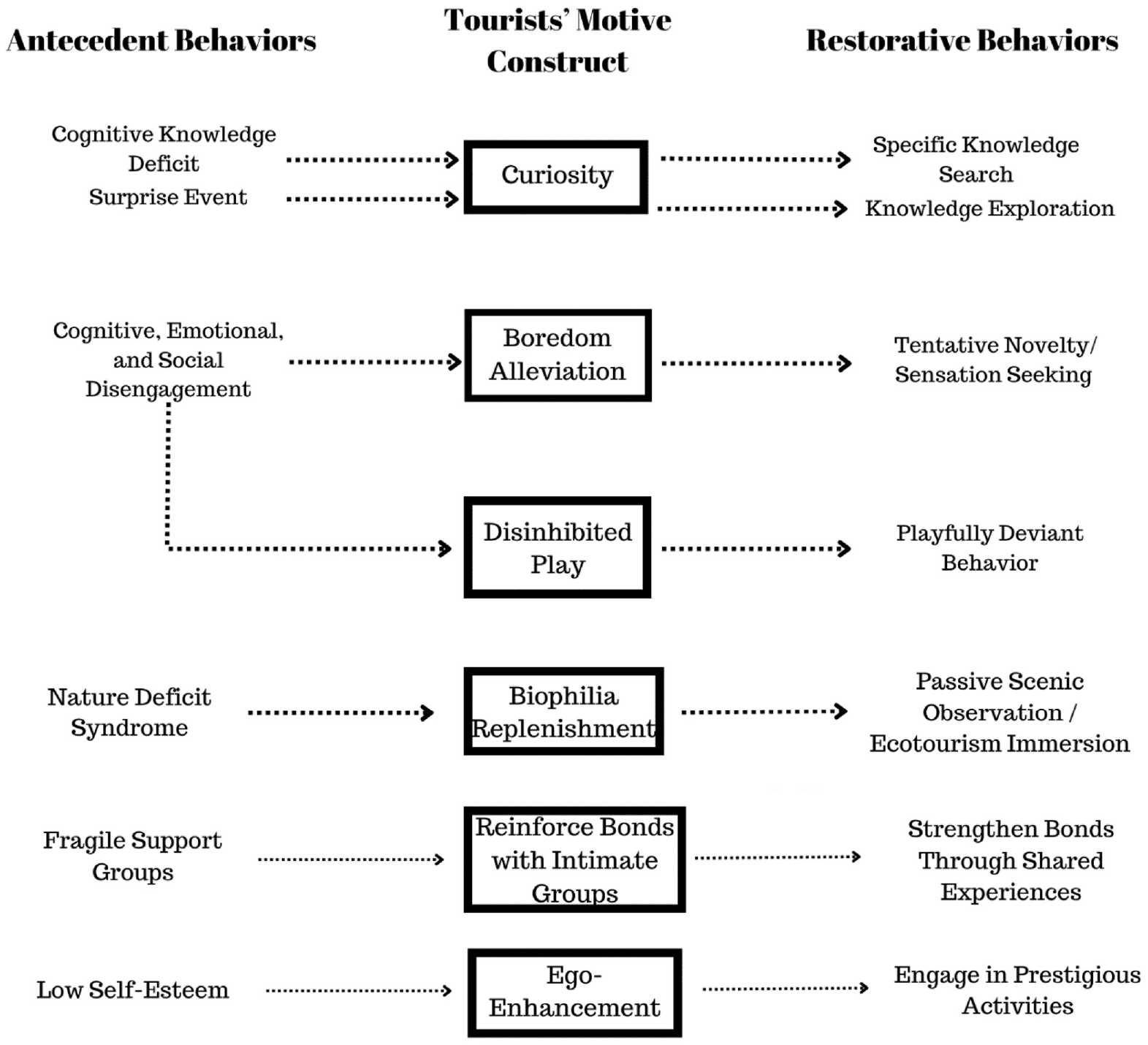
The antecedent and restorative behaviors associated with tourist’s motive constructs.
Figure 1 summarizes the antecedent behaviors that indicate a state of disequilibrium associated with a motive and the restorative behaviors that are triggered by vacations through which tourists seek to restore a state of equilibrium. The specific activities or destinations people select for their restorative behaviors vary according to both the situation and the individual’s personality disposition (Crompton & Petrick, 2024). The following criteria were used to derive the set of motive constructs for pleasure vacations:
There were two contextual criteria for inclusion: (i) The motive was “tourism first,” rather than the expected benefits being personal business or maintenance needs and the travel component being relatively incidental; and (ii) the focus was on pleasure vacations, rather than on a specialist type of facility/service (Crompton & Petrick, 2024).
Each motive is a distinctive separate construct, that is, “a mental construction derived from the general scientific process of observing natural phenomena, inferring the common features of those observations, and constructing a label for the observed commonality or the underlying cause of the commonality” (Encyclopedia Britannica, 2023). The intent is to clearly define and describe the meaning of each motive so it can be effectively and efficiently communicated, understood, shared by others working in the tourists’ motives space, and be operationalized so it can be empirically evaluated. This aspiration cautions against infusing the taxonomy with new semantics or complex models (Pearce, 1993).
There should be distinctive identifiable cognitive and emotional behaviors associated with each motive that (i) alert individuals to the existence of a deficit state associated with the construct (antecedent behaviors), and (ii) guide the goal-directed behaviors that lead to restoration of equilibrium.
Each motive construct has at least one unifying theory that explains its antecedent behaviors and guide its restorative behaviors. This is consistent with the recognition that the complexity and diversity of tourists’ motives requires acceptance of their theoretical pluralism (Crompton & Petrick, 2024). The theories should be universal (i.e., apply to all populations and cross-cultural boundaries). This means they will generally embrace both physiological mechanisms stemming from their innateness, and social-psychological mechanisms reflecting humans’ contemporary environmental contexts.
The intent was to minimize intra-motive construct and behavioral variance, while maximizing inter-motive construct and behavioral variance. The inter-motive gap should be sufficiently substantive to justify it being recognized as an independent motive, rather than a derivative of another construct. The key question was: Is each construct sufficiently different from all other constructs with respect to its theoretical roots, labels, definitions, and measurement that the field benefits from recognizing it as having as separate identity?
It has long been recognized that motives are embedded in gestalt hierarchal configurations. In his foundational article, Crompton (1979) concluded: In most decisions more than one motive is operative. Priorities between alternative destinations are a function of intensity of the particular combination which is dominant in the hierarchy of motives at a particular moment of time. This hierarchy of motives helps to “explain” divergent reaction at different points in time by the same respondent to the same stimulus” (p. 56).
Subsequent research reinforced this early conclusion (e.g., Boztug et al., 2015) enabling Crompton and Petrick (2024) to conclude, “The same people at different times are moved to act by different hierarchies of motive constructs because situational contexts differ” (p. 7). While one motive often is dominant and exerts greatest influence on a vacation decision, invariably there are subordinate motives that also have influence (Reeve, 2018; Witt & Wright, 1992).The motives reinforce each other but their relative dominance varies according to the situation. Hence, there will be some weighted apportionment of their role in the destination selection decision, dictated by the relative strength of their disequilibrium states. Their situational lability means it is not possible to generalize about relationships among them. The lability was aptly summarized by Reeve (2018): Motivation is a dynamic process—always rising and falling—rather than a discrete event or state condition… People always harbor a multitude of different motives at any one point in time. Typically, one motive is strongest and most situationally appropriate, while other motives are relatively subordinate or lie dormant. The strongest motive typically has the greatest influence on our behavior, but each subordinate motive can become dominant as circumstances change and can therefore influence and contribute to the ongoing stream of behavior” (p. 15).
Nevertheless, the motive constructs described in the following narrative treats them as separate entities. This reduces the complexity of the exposition and facilitates an in-depth understanding of their nature, roots, structure, behaviors, and implications. The intent is to provide an overview of each construct by using a standard template that describes the construct; traces the construct’s theoretical/conceptual roots; and identifies the antecedent and restorative behaviors associated with it.
Curiosity
In his influential foundational paper, Crompton (1979) mischaracterized curiosity by interpreting his tourist respondents’ observations as “novelty” and proposing that it was a motive that drove their behavior. He was following the lead of Montgomery (1951, 1952, 1953) in his early animal studies and Berlyne (1950, 1960) who developed the construct of optimal arousal. Both concluded that novel stimuli in the environment aroused curiosity. However, subsequent research has shown they were incorrect in designating search for novelty as a motive and curiosity as a restorative behavior. Rather, novelty is a behavioral response triggered by the desire to alleviate boredom.
Crompton’s mischaracterization was subsequently reinforced by T. H. Lee and Crompton (1992) who conceptualized the purpose of their study as, “to define the construct of novelty in the context of tourism” (p. 733). The instrument they developed to measure novelty comprised four interrelated but distinctive dimensions: thrill, change from routine, boredom alleviation, and surprise. Their study has been cited over 1,000 times. However, two of these dimensions have been subsequently invalidated. First, it was noted earlier that the action of tourists changing their routine and temporarily removing themselves from everyday life in their home environment is tautological. It does not inform understanding of a specific motive since it is inherent in the operationalization of all tourists’ motive constructs. Second, it is now recognized that boredom alleviation is not a dimension of novelty, rather it is an independent motive which is discussed in the following section.
Humans are deeply curious beings. This is exemplified in contemporary life by the amount of time spent seeking and consuming information. Curiosity’s etymological Latin roots characterize it as inquisitive thinking manifested in such activities as exploration, investigation, and learning. The pervasiveness and intensity of curiosity are widely acknowledged, nevertheless, in his seminal review Loewenstein (1994) concluded, “Despite widespread recognition of its importance in many domains of human activity, a century of research and theorizing has left large gaps in our understanding of curiosity” (p. 92). The authors of a subsequent review of the multiple definitions that have been proposed, similarly concluded there is no agreed definition of curiosity. Consequently, they offered a simple “rough and ready formulation,” terming it “a drive state for information” (Kidd & Hayden, 2015, p. 451).
Conceptual/Theoretical Roots
Curiosity has long been recognized as an innate motive that explains human behavior which is present in all cultures and at all stages of development. Berlyne (1950) was emphatic in the centrality of its role stating, “any account of [human] psychology which neglects to mention and explain curiosity must be seriously deficient” (p. 69).
Recognition that animal studies could help in understanding and explaining human curiosity was first recognized by Hebb and Thompson (1954) who noted, “social psychology must be dangerously myopic if it restricts itself to the human literature” (p. 531). The evidence from evolutionary biology that curiosity is innate is overwhelming. Animals sought information because they needed continuous innovation and evolution to survive and reproduce. Indeed, acquiring information is the primary evolutionary purpose of the sense organs, and it has been a major driver of evolution for hundreds of millions of years (Kidd and Hayden (2015).
Berlyne (1950), whose work on arousal was foundational in explaining the psychological roots of motives, nevertheless recognized the existence of a physiological “exploratory drive” in animals (p. 69). The construct’s evolutionary roots are manifested in development psychology where it has long been recognized that children do not have to be taught to be curious. This perhaps explains the rationale of some parents who elect to visit sites on vacation that they believe will be “educationally” advantageous for their children (Durko & Petrick, 2013). Wilson (1984) alludes to the implications of this innateness for tourism: Because species diversity was created prior to humanity, and because we evolved within it, we have never fathomed its limits. As a consequence, the living world is the natural domain of the most restless and paradoxical part of the human spirit. Our sense of wonder grows exponentially: the greater the knowledge, the deeper the mystery and the more we seek knowledge to create new mystery. This catalytic reaction, seemingly an inborn human trait, draws us perpetually forward in a search for new places and new life (p. 10).
Beyond evolutionary biology, a hallmark of human behavior is that people seek to explore and understand their environments, even in the absence of biological drives. Maslow (1970) noted, “Acquiring knowledge and systematizing the universe have been techniques for the achievement of basic safety in the world or, for the intelligent man, expressions of self-actualization” (p. 48).
Berlyne’s (1960) work on optimal arousal was developed around the motive of curiosity. Loewenstein (1994) built on his work by defining curiosity as “a cognitive induced deprivation that arises from the perception of a gap in knowledge and understanding” (p. 93). He suggested “Curiosity arises from the landscape of an individual’s preexisting interests when one’s informational reference point becomes elevated in a particular [behavioral] domain” (p. 93). He posited that a small amount of information serves as a primer for greatly increasing curiosity,
Prospect theory offers an additional theoretical perspective explaining curiosity by pointing out that losses have greater motivational impact than gains of comparable value (Kahneman & Tversky, 1979). In the context of tourists’ motives, it suggests curiosity may be aroused by it being perceived as a loss phenomenon; that is, a search for information may be motivated by an aversiveness to the loss outcome of doing nothing and not possessing information, being stronger than the anticipation of pleasure from obtaining it.
Curiosity’s Antecedent Behaviors
Two antecedent behaviors trigger the curiosity motive among tourists: knowledge deficit, and “surprise exploration,” They are manifestations of Berlyne’s (1960) characterization of specific curiosity which he defined as the drive to seek specific pieces of information. Specific curiosity emanates from cognitive engagement and the “desire for knowledge that motivates individuals to learn new ideas, eliminate information-gaps, and solve intellectual problems” (Litman, 2008, p. 1586). Its emphasis is on the cerebral. Loewenstein (1994) noted high correlations had consistently been reported between the need for cognition and specific curiosity scales and concluded, “Clearly, need for cognition is closely related to specific curiosity.” (p. 83).
This is consistent with the description offered by the philosopher William James, whom Loewenstein (1994) credits as the pioneer of research into curiosity, who proposed that “scientific curiosity” arises from “an inconsistency or a gap in … knowledge, just as the musical brain responds to a discord in what it hears” (James 1890/1950, p. 429).
Curiosity can be triggered not only by responding to a known specific knowledge gap, but also from a sense of moral obligation to pursue an unanticipated cultural opportunity that “ought” to be pursued. Crompton (1979) reported several respondents who were on vacation expressed a feeling that “I ought to see and experience a particular site because I am here” (p. 421). It may be a rare opportunity and if it is not grasped, then educational benefits are lost which, consistent with prospect theory, may subsequently induce feelings of regret, frustration, and deprivation (Litman, 2008).
A different type of knowledge gap triggering specific curiosity is what Berlyne (1950) termed “surprise-exploration” (p. 72), which refers to encountering sudden, unexpected events that are striking, original, or unusual, for example, volcanic eruptions, celestial phenomena, “dark” events, disasters, or climate related catastrophes. E. J. Murray (1965) noted, “to the extent that a stimulus is novel, it arouses curiosity in an animal, a child, or an adult” (p. 76).
Hebb (1955 added an additional conceptual root when he challenged the conventional assumption that curiosity is only aversive. He pointed out this implies people will seek to avoid exposing themselves to curiosity disequilibrium in the first place whereas, in reality, people sometimes intentionally seek situations that they know will make them curious). This explains the behavior of those who engage in “surprise-exploration” behaviors by deliberately selecting destinations they have not previously visited. This was captured by the respondent who stated, “We did not plan an itinerary for the drive along minor roads because part of the adventure of the trip was bumping into things as we went along” (Crompton, 1977, p. 348).
Curiosity’s Restorative Behaviors
The notion that vacations can be used to extend knowledge and education is entrenched in the history of tourism, dating back at least to the Grand Tour when upper-class British families considered an extended educational trip across Europe an essential part of their offspring’s post-college education (L. Turner & Ash, 1976). Thus, it is not surprising that curiosity has been recognized as an essential element in explaining tourism behavior from the early days of tourism research. For example, E. Cohen (1972) suggested, “Tourism as a cultural phenomenon becomes possible only when man develops a generalized interest in things beyond his particular habitat, when contact with and appreciation and enjoyment of strangeness and novelty are valued for their own sake” (p. 166).
Restoring equilibrium stemming from a knowledge gap drives vacations characterized by such themes as heritage, ancestry, or ethnic roots; historical explorations; visiting museums and archival libraries; and pursuit of hobbies. The importance of education was illustrated in two meta-analyses of seniors’ motives and restorative behaviors in which cultural attractions were ranked second in the list assembled by Otoo and Kim (2020) and first by Pauelli and Nijkamp (2016). Its role was captured by the respondent who stated: I think there are tremendous benefits to travel and going to see new places, particularly for children. I really don’t care for history as it is taught in schools; but when I had the opportunity to walk through Williamsburg and almost relive it, then it was really interesting to me. I really want to get my children out there too (Crompton, 1977, p. 360).
The reference to furthering children’s education as a factor in the selection of destinations “as a means of developing a rounded individual” (Crompton, 1979) is cited frequently in studies of tourists’ motives.
An audacious and perhaps optimistic forecast suggested that “The quest for knowledge and understanding enacted through travel, will be a dominant theme of the new century” (Falk et al., 2012 p. 922). The authors’ analyses concluded that for most of the second half of the last century travel consisted largely of passive experiences with a strong hedonistic focus. However, toward the end of that century they believed “western travel and leisure patterns were changing, and tourists were increasingly seeking tourism experiences that intellectually engaged them through immersion in new ideas, spaces, and activities” (p. 910).
In his early paper, (Crompton, 1979) reported “An important motive for some respondents going on a pleasure vacation was to meet new people in different locations” and he termed this “motive,” “Facilitation of Social Interaction” (p. 418). He observed that some sought only, “An opportunity for transitory meetings with others from outside familiar reference groups to exchange views. [However], others were seeking more permanent relationships that would serve to extend their range of social contacts” (p. 418). His respondents reported they believed that interaction with non-familiar people, either fellow tourists or a destination’s residents, was more likely to occur on a pleasure vacation than in the normal course of their lifestyle.
Evidence of interest in “seeking more permanent relationships” has not emerged. It is conspicuously absent from subsequent studies and Crompton’s proposition that it was a motive can be considered disproven. For example, it has no substantive presence in the 14 motives that comprise Pearce’s (2005) career ladder. Critically, no underlying theoretical or conceptual structure has emerged that would explain or suggest that an innate driving force exists to seek enduring relationships among non-familiar groups. Characterizing this interest as a motive was inappropriate; rather it is an element in educational restorative behaviors enacted in response to the curiosity motive.
Ironically, Crompton (1979) failed to grasp the significance of some of his respondents who noted the improbability of establishing enduring relationships with locals when there was little communing with those who served as waitresses or in similar front-line service positions. The temporal and relatively shallow nature of such contacts led Pearce (2005) to conclude that the popular metaphor positioning interactions as a meeting between hosts and guests was inappropriate: Objection to the use of the term host resides in the connotations that there is a family-like personal contract binding the host and guest. Further, there is some future reciprocity by the host and the behavior of caretaking the guest. Contemporary travellers and their service providers, it can reasonably be argued do not fit this mould… It is likely that tourists recall these multiple brief and routine encounters in a generalized or aggregated way, such as forming an overall impression of friendliness and service quality (p. 125).
Meeting new people in different locations is an important component of behavioral responses to curiosity. It recognizes that local people are a complementary dimension to hardware attractions. Together they create the cultural/educational ambiance/experience of a destination. Exit surveys consistently report that tourists seek interactions with local people to learn more about their lifestyles, value systems, traditions, expectations, and aspirations. Typical responses are:
To me a part of a trip is talking with and learning about that area. I enjoy talking to locals, but I do not find it important to interact socially with them (p. 344); [and] What’s important to us is the people we meet. The payoff is not to go and see the Shenandoah Mountains and say I have seen them. So what? They will be there…I get more pleasure from making acquaintances…It means more to me to spend time having a meeting of the minds, than it does to take my camera and shoot it at a mountainside (Crompton, 1977, p. 330).
Most relationships on vacation with non-familiar people are with fellow tourists. Indeed, traveling with others may inhibit opportunities for interacting with local people at the destination, because the built-in availability of companions removes the urge to visit with others outside of the group; the natural tendency is to turn inward rather than outward. For example, Obrador (2012) reported: A summer holiday in Menorca was primarily a home making practice, dominated by familiar networks and obligations. In Menorca, tourists were rarely to be found in a crowd of anonymous strangers. They stayed together with significant others for the majority of the time. Tourists met other people, mostly by the pool, but they rarely left their more immediate social networks (p. 412).
Boredom Alleviation
Boredom is an unpleasant state of disinterest characterized by feeling listless, dissatisfied, indifferent to everything, “blah,” and experiencing sleep disruption; and a sense that time is “dragging,” there is “nothing to do,” “tired of doing the same thing” or “being in the same place,” and all aspects of life are dull and tedious. The dictionary defines it as “the state of being weary and restless through lack of interest” (Merriam-Webster Dictionary, 2023). The word “boredom” appears to have been first coined by Dickens (1853) in his novel Bleak House, where he described boredom as “desolation,” a “malady” and a “monster” (C. C. Burn, 2017, p. 141).
Although it has a long history, it has been pointed out that “boredom is a modern luxury” (Spacks, 1996, p. 6) since when early humans had to spend most of their days securing food and shelter, boredom wasn’t an option. Much of the increased prominence of boredom in recent decades has been attributed to technological progress in automation. While this has greatly increased productivity and safety, automation has also been implicated in increasing boredom across a wide variety of professions (Y. Lin & Westgate, 2024). Its ubiquity leads to the lives of many in urbanized and industrialized modern and post-modern society being privately disappointing and ungratifying.
The above discussion of curiosity reported that Berlyne’s (1960) influential work in developing the concept of optimal arousal centered on “specific curiosity” which stimulated a search to resolve the knowledge gap. However, he also identified an alternative form of curiosity which was triggered by “feelings of boredom” that he termed “diverse curiosity” noting, “Few human impulses are more inexorable than the urge to escape from monotony and boredom to some new form of stimulation” (p. 68).
In contrast to the specificity of behaviors associated with specific curiosity, Berlyne (1960) observed that diverse curiosity stimulated a desire in animals and humans to “seek stimulation regardless of source or content” (p. 26). Thus, a distinguishing characteristic between the two constructs is that boredom is much more amorphous than curiosity because, “There appears to be no specific stimulus causing the aversive emotional state; it is instead defined by a lack of sufficient stimulation” (Boden, 2015, p. 212).
Boredom is sometimes viewed as a latent or hidden emotion because, in contrast to anger or fear, it tends to lurk beneath the surface and is easy to overlook or ignore (Gary, 2022). Nevertheless, in the 60+ years since Berlyne published his work, boredom has been identified as a pervasive “universal experience” from which almost everyone suffers at some point in their lives (Spacks, 1996). Its omnipresence has stimulated substantial efforts by psychologists to better understand the phenomenon. These have resulted in the identification of antecedent and restorative behaviors that are distinctively different from those associated with curiosity, so boredom alleviation is now recognized as a separate motive construct.
Conceptual/Theoretical Roots
C. C. Burn (2017), whose research focuses on animal biology, welfare, and behavior, noted, “The neural mechanisms producing boredom have seemingly not been investigated even in humans” (p. 143). Nevertheless, she reviewed “multiple studies reporting animal behavior that “may be reminiscent of that of a bored human” (p. 142) and noted that a key external trigger for boredom in captive animals are barren environments, which are spatially and/or temporally monotonous. She concludes by noting, “Indeed, the little evidence to date suggests the homology [shared features] may go deeper than mere superficial resemblance (p. 142) … Animal boredom is biologically plausible” (p. 149).
Evidence of the generalizability of boredom to non-human animals suggests there is a physiological root to boredom that presumably extends to humans. It has been noted that “boredom is one of the most understudied negative emotions in psychology” (Y. Lin & Westgate, 2021, p.1), so it is not surprising that the neural mechanisms that create the physiological root remain unknown.
C. C. Burn (2017) notes evolution requires that “to have adaptive value, boredom must have positive evolutionary fitness effects when it can be acted upon” (p. 143). In this regard, she argues boredom motivates animals to explore their environment and learn new things, which facilitates the discovery and identification of environmental resources and dangers. It also prompts exploration and niche diversification, and fosters learning that prevents animals from becoming behaviorally inflexible in the face of likely environmental changes. For example, boredom could help motivate some adolescent animals to leave their natal homes and seek new territory, stimulate omnivores to sample new foods even when familiar food is plentiful, or drive innovative species to experiment and play with new materials when their more immediate needs are fulfilled.
The psychological roots of boredom were first seriously explored by Heidegger. He emphasized the importance of differentiating between existential and situational boredom (Gary, 2022; Heidegger, 1929/1995). Existential boredom is an enduring, persistent personality trait that may be affected by temporary conditions but is not reducible by them. The individual feels a pervasive lack of interest in and difficulty concentrating on current activities. The condition corresponds with the French “ennui,” an existential perception of life’s futility derived from unfulfilled aspirations (Goodstein, 2005).
It can be a chronic and dangerous medical condition; a form of despair, characterized by a disenchantment with life and a struggle to find meaning; and its cure is often unclear It is predictive of maladaptive behavior that may include addiction, aggression, compulsive gambling, depression, drug addiction, impulsivity, sensation seeking, sexual immorality, dangerous driving, and juvenile delinquency (Boden, 2015). Responding to it is the responsibility of the medical field; not those engaged in tourism.
In contrast, situational boredom is a passing state or emotion which ebbs and flows. It has been empirically established as a distinctively different construct from existential boredom (Goldberg et al., 2011). Three characteristics of situational boredom have been identified: (i) Predictable circumstances that are very hard to escape; (ii) an experience that is repeated and repeated until the person undergoing it is utterly “fed up” because the environment lacks meaningful stimuli that engage the mind; and (iii) a situation that seems valueless (Toohey, 2011).
Situational boredom is a function of many people’s lives being comprised of an organized, consistent, predictable routine featuring barren, boring and non-challenging jobs. It can extend to places. All landscapes become mundane, and sometimes boring, over time. Crompton’s (1979) respondents appeared to endorse this perspective as some who resided in what many would consider to be prized living environments reported that familiarity sometimes led to them becoming boring, leading to an urge for a temporary change.
Adaptation level theory reinforces the influence of boredom’s physiological and psychological roots because it explains that people adapt (or get accustomed) to their environments, which leads to boredom (Csikszentmihalyi, 1975; Helson, 1964). It also explains why there’s an optimum time after which a prolonged vacation often becomes mildly monotonous as, “The new always quickly turns into routine and then becomes boredom with the new… and one looks forward to returning home” (Svendsen, 2006, p. 45).
Boredom’s Antecedent Behaviors
Antecedent behaviors are generic across animal species. In their pioneering review of animal studies seeking insights that assisted in understanding and interpreting human behavior, Hebb and Thompson (1954) noted, “the animal will always act so as to produce and optimal level of excitement (p. 552) … the mammal seeks excitement when things are dull…the risky venture may be preferred to the sure thing” (p. 553). When this is not forthcoming similar antecedent behaviors suggesting boredom emerge, that is, too much of the same thing and too little stimulation.
Toohey (2011) described animals’ antecedent behavior, “They sleep more and when they are awake, they harass you for games or walks. If you ignore them, they begin to slope around the house or the yard in disconsolate fashion. They mope, they droop, and they are listless” (p. 83). Similarly, Y. Lin and Westgate (2021) noted that animals in under-stimulated environments, such as cages or zoos, exhibited responses analogous to boredom in humans: “In sum, boredom-like states appear common in animals, and appear to be elicited by the same situational factors that cause boredom in adult humans, with similar behavioral consequences” (p. 19).
Among humans, psychologists have identified two main primary triggers of antecedent behaviors that result in cognitive, emotional, and social disengagement: attention deficits and meaning deficits (Westgate, 2020; Westgate & Wilson, 2018). Their influence is independent, so it is not necessary for both to be present; a deficit in either one is sufficient to cause boredom. Attentional boredom is characterized by difficulty concentrating, mind wandering, and inattention. Meaningless boredom, on the other hand, is caused by deficits stemming from lack of meaning and purpose, and a sense of futility that often leads to feelings of sadness, loneliness, and a strong desire to disengage (Westgate & Wilson, 2018).
Investigators who have explored boredom from both physiological and psychological perspectives report that it is curvilinear in the form of an inverted U-shape. While most attention boredom emanates from things being too easy and routine, it can also occur in overchallenge contexts which are characterized by feelings of agitation accompanied by frustration (Csikszentmihalyi, 1975; Westgate, 2020; Westgate et al., 2017). Both cases will result in a search for restorative behaviors that will restore equilibrium.
Boredom’s Restorative Behaviors
Most boredom is characterized by a dearth of new experiences. In those cases, disequilibrium is restored by behavior that moves people from a low activation state to higher activation through engaging in stimulating activities. The level of stimulation sought varies widely. In some cases, it may be limited to trivial attention distractions such as movies, games, or screen entertainment. Berlyne (1966) termed these behaviors “short-term novelty,” characterized them as being a response to “the desperate craving of a bored person,” and noted they were: “likely to be especially strong after an animal or human subject has spent some hours in an environment that is highly monotonous or devoid of stimulation” (p. 32).
Berlyne contrasted those behaviors with “complete novelty” whereby more substantial behavioral actions are taken, one of which could be a vacation. (Others may include, e.g., moving permanently to a different location or a different job; pursuing a new activity or challenge, e.g., quitting work to return to school; or engaging with a different group of people). However, even within the sub-category of vacations, Pearce (2005) suggested the notion of a variety of stimulation levels applied. He noted, “travel is frequently desultory” and cited research findings that suggested it is common to see “the somewhat empty-headed idling consumer seeking diversion rather than engagement in his or her search for satisfaction” (p. 175).
A vacation’s distinctive appeal is that it offers the excitement and contrast of the unfamiliar in terms of climate, culture, people, traditions, occupations, topography, community amenities and character, or whatever. Studies have confirmed that for an average participant tourism features more novel experiences than daily life (J. H. Kim et al., 2012; Mitas & Bastiaansen, 2018).
Crompton (1979) reported there did not appear to be any single optimum type of environment that alleviated boredom among his respondents, “The critical ingredient was only that the pleasure vacation context should be physically and socially different from the environment in which respondents normally resided” (p. 416). This was consistent with Berlyne’s (1960) contention that boredom stimulated a desire in animals and humans to “seek stimulation regardless of source or content” (p. 26), and his later observation that restorative behavior “seems to be aimed not at obtaining stimulation from a specific object or event but, rather, at obtaining stimulation from any source that can afford an optimum dosage of novelty” (1966, p. 32).
The diverse levels of stimulation sought suggest that restoration behaviors in the context of pleasure vacations can be arrayed along a Tentative Novelty—Sensation Seeking continuum reflecting different levels of intensity of new experiences. This accommodates Berlyne’s (1960) distinction between absolute and relative novelty: “An absolutely novel stimulus would be one with some quality that had never been perceived before, while a relatively novel stimulus or stimulus pattern would possess familiar elements or qualities in a combination or arrangement that had not been met with in the past” (p. 18).
The notion of a continuum was the basis for E. Cohen’s (1972) classic tourist typology which was based on the premise that each tourist seeks an optimal level of novelty that will make a vacation experience enjoyable. He articulated the phenomenon of “tentative novelty” when he observed: “The experience of tourism combines a degree of novelty with a degree of familiarity, the security of old habits with the excitement of change” (p. 167).
A continuum recognizes that “the way tourists view destinations in terms of their potential for offering new sources of stimulation is likely to be influenced by their predispositions” (T. H. Lee & Crompton, 1992, p.737), that is, different personality types have different tolerances (Crompton & Petrick, 2024). The biosocial roots of this spectrum have been identified (Zuckerman, 1994, 2005). Sensation seekers are likely to seek bold, complex, varied, and dramatic experiences, while those at the other end of the continuum want their new experiences to be relatively mild, somewhat familiar, and calm.
Recognition of the tentative end of the continuum was implicit in the observations of early empirical investigations of tourists’ behaviors in which many reported they sought safe novelty/sensation experiences: “The urge for new and adventurous experiences is frequently compromised by the felt need to minimize risks of exposure to novelty which may be threatening” (Crompton, 1979, p. 420). It was used to explain the popularity of package/guided tours because they enable tourists to be transformed to foreign soil in an “environmental bubble” of their native culture, “experiencing the novelty of the macro-environment of a strange place from the security of a familiar micro-environment” (E. Cohen, 1972, p. 166). Gunn (1972) characterized this as “planned adventure,” while Lundberg (1974) graphically portrayed the scenario, “Returning to his room at the end of a day of sight-seeing the tourist welcomes the Hilton rooms which to him represent safety and the familiar” (p. 108). Lundberg (1974) further speculated that hotel room balconies were popular because the insecure traveler could sit on them, safe and secure, while participating vicariously in a strange environment.
At the high intensity end of the continuum T. H. Lee and Crompton (1992) identified a restorative behavioral domain they termed “thrill.” This described adventure seeking, the quest for physical risk, danger, and suggested moderately frightening activities such as bungy jumping, skydiving, and roller coasting. Subsequent research has shown this is too limiting and the essence of this domain is better captured by “sensation-seeking” which is defined as: “The seeking of varied, novel, complex, and intense sensations and experiences, and the willingness to take physical, social, legal, and financial risks for the sake of such experience” (Zuckerman & Aluja, 2014, p. 352). Thrill fits within this definition, but sensation-seeking is more inclusive because it embraces those tourists who crave new, intense experiences that offer a variety of emotional, intellectual, or interpersonal risks and sensations with the languages, climates, cultures, and customs they encounter during their travels. For example: There are “fearless foodies,” people who “seek sensations in bowls of chicken hearts, goat brains and pig blood stew, not because these foods are part of their cultural norms, but because they’re there… And a blogger who calls herself the White Rabbit who set off to “follow the sun” on a 300-day journey during which she carried no money, but tons of chutzpah to convince strangers to let her crash on their couches (Carter, 2019, p. 60).
Disinhibited Play
In his foundational article, Crompton (1979) identified “Regression” as a vacation motive and described it as follows: A pleasure vacation provided an opportunity to do things which were inconceivable within the confines of their usual life styles…[They] were often puerile, irrational, and more reminiscent of adolescent or child behavior than mature adult behavior. The opportunity to engage in this behavior was facilitated by withdrawal from usual role obligations. On vacation, respondents were freed of the mores that inhibit capacity for this type of enjoyment at home (p. 417).
While subsequent research has confirmed the essential characteristics of this construct, it has demonstrated that the term “regression” is an inappropriate descriptor of it for two reasons. First, its meaning in the tourism context is sometimes misunderstood, since it is used in the mental health field to describe behavioral symptoms associated with dementia and other neurodegenerative disorders (Huey, 2020). Second, the analogy with adolescent behavior is inappropriate since disinhibited behavior by tourists is not limited to behavior “more reminiscent of adolescent or child.”
Subsequent research suggests that “disinhibited play “is a more accurate descriptor. Disinhibition was included as a domain in Zuckerman’s sensation-seeking scale which was a measure of restorative behavior responding to feelings of boredom. Zuckerman defined it as: The tendency to show little restraint or self-control and act impulsively without thinking much about consequences. Being disinhibited means one easily takes risks, is prone to addictions, speaks freely, acts boldly, shows strong emotions like aggression, seeks instant gratification, breaks the rules, or misbehaves (Zuckerman & Aluja, 2014, p. 352).
Zuckerman’s scale was designed to explain and measure behaviors primarily characterized by negative disinhibitions related to psychopathology: “risky sexuality, impulsiveness, aggressiveness, antisocial and borderline behavior, as well as alcohol and drug abuse” (Zuckerman & Aluja, 2014, p. 377). However, tourists’ behavior is not of this ilk; rather their disinhibited responses are embedded in hedonism and play, and their most distinctive quality is a lack of instrumentality. Unlike all the other tourism motive constructs, it has no obvious goal or adaptive purpose (Bergen, 2014); rather it is an apparently aimless activity, which has caused some to term it “ludic” (e.g., Lett, 1983; Monterrubio & Valencia, 2019).
The term, disinhibited play, is derived from the work of Huizinga (1950), a Dutch cultural historian. When he published Homo Ludens shortly before he died, the quality of his scholarship established play for the first time as a “legitimate” area of study (Norbeck, 1974). After analyzing multiple theories of both animal and human play behavior, Huizinga defined play as: A free activity standing quite consciously outside “ordinary” life as being “not serious,” but at the same time absorbing the player intensely and utterly. It is an activity connected with no material interest, and no profit can be gained by it (p. 13).
A parsing of this definition effectively defines vacation behaviors whereby individuals relax or remove behavioral constraints; seek freedom from normal roles, usual expectations, interpersonal obligations, and community scrutiny; temporarily suspend social codes and social bearings to engage in playful deviance; suspend regular identities and display their secret selves; and allow inhibitions to fade away. The vacation experience is used to engage in behaviors they cannot experience within their regular structural hierarchical social system (Currie, 1997). In sum, “tourism can liberate tourists from the shackles of their everyday existence” (Dann, 1981, p 192).
Conceptual/Theoretical Roots
The physiological roots of play have long been recognized in both animal and human behavior (Ellis, 1973; Huizinga, 1950). Norbeck (1974), who was a leading anthropologist, in an influential paper reinforced Huizinga’s definition of play, but emphasized its biological roots: “Behavior resting upon a biologically inherited stimulus or proclivity, that is distinguished by a combination of traits: Play is voluntary, somehow pleasurable, distinct temporally from other behavior, and distinct in having a make-believe or transcendental quality” (p. 1). He noted, “Biologists have long observed that the impulse to play is characteristic of the entire class of mammals” (p. 2) and observed that while play is most common among juveniles, it is retained by adults, a characteristic that anthropologists term “pedomorphosis.”
The physiological roots are complemented by scripting theory which postulates that social life is organized and lived under the direction of scripts. Indeed, its pioneers suggest, “it is difficult to conceive of any behavior, except that which is in fact biologically programed that is not scripted” (Simon & Gagnon, 1986, p. 104). Tourists’ behavior is not determined by scripts; rather they elect (or not) to engage in scripted contexts that provide an opportunity to escape from routine life.
Scripting theory is derived from symbolic interactionism which examines social life primarily as a communicative process. In essence scripts guide the entrance, experience, and exit of roles throughout life based on the actors involved and their social relationships (Simon & Gagnon, 1986). A script defines the context, identifies the actors, and plots the behaviors. It establishes sets of implicit rules that determine how individuals behave in social contexts. The theory proscribes, “the reality that people construct depends on their subjective interpretation of the actions and events that are present in the social context” (McWhinney et al., 1995, p. 274).
Tourists are likely to toggle back and forth between the script of their vacation experience which provides liminal license for periodic indulgence in disinhibited play, and their core self-concept. This recognizes this behavior is a temporary, situational phenomenon that does not signal an abandonment of their core values (Coyne, 2023).
Scripting theory’s explanation of disinhibited play is reinforced by social learning theory (Bandura, 1977). In contrast to behavioral theories, based on conditioning and cognition, social learning theory relies on psychological influences such as attention and memory. It emphasizes the importance of observing, modeling, and imitating the behaviors, attitudes, and emotional reactions of others which is done either directly through social interactions with others or indirectly by observing behaviors through media.
In the context of tourism, scripting and social learning theory reflect the more permissive norms for behavior that can be found when on vacation and make it easier to engage in disinhibiting behavior (McWhinney et al., 1995).
Disinhibited Play’s Antecedent Behaviors
Dann (1981) noted, “the difficulty of enacting ‘deviant’, ‘taboo’ or culturally sanctioned desires in the home situation.” He recognized they could be pursued elsewhere “under a series of more anonymous and permissive circumstances” (p. 191). The sense of freedom on a vacation is aided by the higher degree of anonymity that accompanies being away from home.
Awareness of disinhibition behavior is captured by phrases such as: “I’d never do stuff like that at home”; “I don’t have to worry about what other people think”; “I’d get found out at home and the reputation would always stay with me but on holiday it doesn’t matter”; and “You haven’t got people gossiping about you” (Thomas, 2000, p. 214). Other descriptions include: “letting myself go”; and “cutting loose” (Monterrubio & Valencia, 2019, p. 47): Every now and then “things get on top of you”; the familiarity of the regime can be endured, but sometimes “you have to get away from it all”; self-discipline is tolerable, but you have to “let your hair down.” The most conventionalized route which our society provides for all these impulses is the holiday. It is a setting in which constraints can be released if not rejected, identities slip if not disappear, a place where lives are rejuvenated if not changed. The holiday is the archetypical free area, the institutionalized setting for temporary excursions away from the domain of paramount reality (S. Cohen & Taylor, 1976, p. 114).
The lack of restraint, regulation, and disregard for social norms and boundaries provides the “situational” context for disinhibited play: “A comparatively atypical environment to which previously learned norms and constraints might or might not generalize” (Eiser & Ford, 1995, p. 326). While disinhibited behavior (e.g., getting drunk at the pub) can happen at home, for some people it becomes especially associated with the circumstances of being a tourist (Ryan & Kinder, 1996). Vacations provide settings where “situational disinhibition” is deemed acceptable because “the holiday environment is associated with different goals and commitments from those they might form at home” (Eiser & Ford, 1995, p. 326). As a result, people can embrace a different persona when on vacation.
Some have characterized vacations as liminal opportunities, borrowing the term from anthropologists who define it as “detachment of the individual or the group from an established set of cultural conditions” (V. Turner, 1974, p. 231). In a tourism context, activities in liminal spaces “not only stand apart from the rules and regulations of the normal world, but they also explicitly deny or invert those rules and regulations” (Monterrubio & Valencia, 2019, p. 47).
Disinhibited Play’s Restorative Behaviors
Disinhibited play may be described as playfully deviant behavior. It aligns along a continuum ranging from irresponsible to responsible; perspectives on its location on the continuum are likely to vary both among and within cultures and host communities. The challenge for tourists in a host community is to acknowledge and respect the different moral values that assign different significance and standards of morality to behaviors and ways of thinking that are different from their own and demonstrate concern for the consequences of their actions. Location along the continuum is influenced by the life situation of the individual, traveling companions, and situational factors at the host destination.
The influence of the group appears to be especially influential. The lack of various significant others makes easier the self-indulgence required for disinhibited play (Ryan & Kinder, 1996). Further, for it to occur, travel companions also must be willing to disregard norms: “If you go on holiday with friends then it changes. You are just more reserved and careful about what you do and say” (Thomas, 2000, p. 214).
However, it can also work in the other direction whereby peer pressure to conform in breaking norms may be the impetus for an individual to do it. Thus, it appears that the optimum conditions for disinhibited play appear to lie at either end of a familiar-unfamiliar continuum; either in an intimate, familiar environment, with similarly inclined friends, or in an entirely unfamiliar environment conducive to acting with anonymity.
The relatively small amount of research on disinhibition play has focused on two contrasting sub-cultures: Spring break which illustrates the irresponsible pole of the continuum and naturism which is illustrative of the responsible pole.
Spring break is a uniquely North American phenomenon that attracts hundreds of thousands of students to beach settings during March mainly in Florida and Texas. Its original appeal was to get away from college and the “winter blues” in the northern US states. However, it morphed into promoting a permissive script where uninhibited play is the expected norm and these locations became raucous social settings for “situational disinhibition” where irresponsible behaviors including drunkenness, drug use, and sexual promiscuity often are the expected norm (Josiam et al., 1998). The behavior is often impulsive and reckless, frequently showing a disregard for the feelings and well-being of others.
Several studies have reported the irresponsible sanctioned marginal behavior (Ryan & Kinder, 1996). Sönmez et al. (2006) documented the extensive partying, “breaking loose,” getting drunk, “dirty dancing”; watching/participating in contests such as “hot body” or “wet T-shirt”; casual sex; and the perception that “everyone is doing it.” Young people came with the expectation that this would be the environment. Similar findings were reported by Passariello (1983), Eiser and Ford (1995), McWhinney et al. (1995), and Monterrubio and Valencia (2019).
The aberrant behavior of many who engage in spring break, Mardi Gras (Redmon, 2003), Renaissance Festivals (H. Kim & Jamal, 2007), and similar liminal spaces (Diken & Laustsen, 2004; Wickens, 2002) capture media attention, but anecdotal observation suggests that responsible disinhibited play is probably the norm. Its “ordinariness” keeps it under the radar. Responsible disinhibition characterized the upper-class yacht charter tourists reported by Lett (1983) who described their behavior as “those socially accepted and approved activities which seem to deny or ignore the legitimacy of the institutionalized statuses, roles, norms, valves, and rules of everyday, ‘ordinary’ life” (p. 45).
Their activities were “socially acceptable” but added “a quality of reversal” of the individuals’“normal” lives. Their behaviors were a “symbolic expression and an inversion of the central sexual and social ideologies of the tourists’ home culture” (p. 35), and they viewed tourism as an opportunity for expressive experiences. They “begin ‘playing’ at the moment they abandon the restrictions and requirements of everyday life and enter ‘vacation time”” (p. 32) so they can drink “Bloody Marys for breakfast and are unlikely to refrain from commenting upon the delicious decadence and outrageousness of the custom” (p. 42).
The responsible sub-culture that has received most attention is naturism which involves shedding inhibitions, self-consciousness, and clothing for a few days in the company of others. It is a fairly widespread global sub-culture, comprised primarily of middle-aged, white, heterosexual couples. Tourists elect to act in this way perhaps because its negative connotations encourage them to conceal the behavior from others at their normal place of residence, even though it is not “irresponsible.” The sub-culture seeks to disassociate nudity from titillating sexuality. Indeed, some such settings promote themselves as being “family friendly,” emphasizing both the non-sexual and family components of public nudity, and its fundamental premise that nature and its elements are invariably medically beneficial to humans (Andriotis, 2016; Monterrubio & Valencia, 2019).
It has been observed that, “Too little is known about the psychological costs of disinhibiting behavior…this could be an area where investigative research is needed” (Eiser & Ford, 1995, p. 338). For example, is there “buyer’s remorse” whereby personal values that are suspended on vacation come back to haunt people over the long term? There is no evidence of long-term distress, but neither is there evidence that there is none.
Biophilia Replenishment
When tourists are asked to identify primary attractions, nature-related sites are pervasive in their responses. Typically, statistical tools cluster together items such as “viewing scenery,” “being close to nature,” and “learn more about nature” which results in researchers inferring a motive called “nature” (e.g., Pearce & Lee, 2005). The limitation of this approach was the absence of a theoretical genesis explaining why engagement with nature emerged so prominently as a behavior. In recent decades, biophilia has emerged in the scientific literature as the explanation.
Conceptual/Theoretical Roots
In 1865 Fred Olmsted commented on the “power of scenery to affect men” (p. 503) in his report to the Yosemite commissioners: It is a scientific fact that the occasional contemplation of natural scenes of an impressive character… is favorable to the health and vigor of men… The want [lack] of such occasional [exposure]… often results in a class of disorders the characteristic quality of which is mental disability… frequently of mental and nervous excitability, moroseness, melancholy, or irascibility incapacitating the subject (p. 502).
He excoriated the “sordid interests” that “cramp and distort the power of appreciating natural beauty and destroy the love of it which the Almighty has implanted in every human being” (p. 505). Subsequently, he commented on its “tranquilizing and restorative powers.” Noting that these had been recognized “since the days of Aesop” as a means of “unbending the faculties,” since exposure to scenery and natural beauty was “of a quite different character from the objects which are associated with [people’s] bent condition” (Olmsted, 1881, p. 86).
Olmsted’s observations were endorsed almost a century later by Maslow (1970) who reported he had “at least convinced myself that in some individuals there is a truly basic aesthetic need…they are cured by beautiful surroundings they crave activity, and their craving can be satisfied only by beauty” (p. 51).
The embryonic anecdotal observations of Olmsted and others were first characterized as “biophilia” by Fromm (1973) who was a psychologist. He defined it as “the passionate love of life and all that is alive” (p. 365). He posited that while biophilia was “intrinsic to human biology” (p. 407) its emergence as a motive construct was dependent on the environmental and social contexts to which individuals were exposed.
Fromm’s conceptualization and terminology received little visibility, but that changed a decade later when Wilson (1984) published his widely acclaimed treatise, Biophilia. In contrast to Fromm, Wilson adopted an evolutionary perspective, defining biophilia as “our innate tendency to focus upon life and life-like forms” (p. 1). His thesis recognized that human cognitive and emotional evolution occurred almost exclusively in natural settings. Consequently, he rationalized human cognitive and emotional apparatuses were readily attuned to natural stimuli.
Wilson suggested the concept of biophilia compels society “to look to the very roots of motivation and understand why, in what circumstances and on which occasions, we cherish and protect life” (p.134). Kellert (1993), in a collection of essays co-edited with Wilson, subsequently amplified this view: “The human need for nature is linked not just to the material exploitation of the environment but also to the influence of the natural world on our emotional, cognitive, aesthetic, and even spiritual development” (p. 42).
Although they have different phenomenological roots, the views of biophilia proffered by Fromm and Wilson are complementary. Their two perspectives are regarded as the “pillars” of biophilia (Gaekwad et al., 2022). They agree that biophilia has a biological basis, that it is a fundamental human force for developing harmonious relationships between humanity and the biosphere, and that an affiliation for nature is an emotional bond that takes place in certain circumstances.
Substantive literature has emerged to support recognition of the biophilia motive construct (Baxter & Pelletier, 2019; Bratman et al., 2012; Gaekwad et al., 2022; Gullone, 2000; Kahn, 1997; P. C. Lee, 2012). For example, Kahn (1997) observed that across cultures and age groups, key elements in topography for human survival included a preference for savannah-like landscapes, incorporating water, limited tree cover, and natural prominences overlooking an open landscape. Baxter and Pelletier (2019) concluded: It is our overall conclusion that the extant literature supports the claim that human beings have a basic psychological need to feel a secure and pleasant experiential connection to nature in a cognitive, emotional, and physical sense…The resultant lessened contact with nature from living in human-built environments could be costing human beings a necessary nutriment to their overall optimal development and functioning. That is to say, by not recognizing the necessity of periodic experiential immersion in nature, human beings are robbing their basic faculties of the restorative experiences they need in order to develop and function optimally (p. 30).
Biophilia Replenishment’s Antecedent Behaviors
Well-documented social and technological changes in the last three decades have created antecedent behaviors that have triggered a biophilia response. Most prominent among them are: An increasing disconnect with nature since 80% of US residents live in urban areas; Americans spend over 90% of their time indoors, primarily in buildings with a smaller portion in vehicles; daily screen time averages approximately 2 hours for children younger than 8 years old and over 7.5 hours for those aged between 8 and 18; and daily average “total media consumption” among adults is over 10.5 hours. At the same time, park visitation, hunting, fishing, camping, and children’s outdoor play have all declined substantially over recent decades (Frumkin et al., 2017).
These antecedent conditions led Louv (2005, 2011) to coin the catchphrase Nature Deficit Syndrome to capture the contemporary disconnectedness between nature access and contemporary lifestyles. This deficit triggers the need for replenishment. Louv emphasized he was using it metaphorically as a medical diagnostic: “I am not suggesting that this term represents an existing medical diagnosis” (2005, p. 34). His intent was to draw attention to “the human costs of alienation from nature, among them: diminished use of the senses, attention difficulties, and higher rates of physical and emotional illnesses” (p. 34).
His books popularized the body of scientific evidence to that point. In the two decades since he published his first book supportive evidence has grown exponentially. It has linked lack of exposure to nature to an expanding list of different ailments and comorbidities, including diminished use of the senses, attention difficulties, obesity, vitamin D deficiency, higher levels of aggression, increased rates of depression, poor grades, a lower ability to cope with stress, poor attention spans, higher rates of emotional and physical illnesses, and a lower sense of wellbeing (Frumkin et al., 2017).
Biophilia Replenishment’s Restorative Behaviors
The blossoming of scientific interest in the restorative benefits of nature contact for human health and well-being has revealed an extraordinarily broad range of benefits, albeit with varying levels of evidentiary support (Bowler et al., 2010; Hartig et al., 2014; P. James et al., 2016; A. C. Lee & Maheswaran, 2011; Martens & Bauer, 2013; Russell et al., 2013; Seymour, 2016).
In addition to ameliorating the ailments listed above restorative exposure to biophilia settings has been shown to reduce stress; result in better sleep; improve mental health, reduce depression and reduce anxiety; lead to greater happiness, well-being, and life satisfaction; reduce aggression; reduce Attention Deficit Hyperactivity Disorder symptoms; increase prosocial behavior and social connectedness; lower blood pressure; improve postoperative recovery, birth outcomes, congestive heart failure, child development, pain control eyesight, immune function, and general health; and reduce obesity, diabetes, and mortality (Frumkin et al., 2017).
Two complementary theoretical frameworks have been developed to explain the positive well-being and attentional restoration effects of nature contact and attachment. Stress Recovery Theory emphasizes the psychophysiological pathways through which nature restores biophilia equilibrium, whereas Attention Restoration Theory emphasizes the role of nature in relieving mental fatigue. There is some evidence that the two mechanisms may operate concurrently (Li & Sullivan, 2016). They draw heavily on biophilia’s evolutionary roots but also incorporate the complementary psychological roots of biophilia, so they embrace both physiological and cognitive dimensions which were presciently described by Olmsted (1865).
Originally articulated by Ulrich (Ulrich et al., 1991), Stress Recovery Theory postulates that: Landscapes with views of water and/or vegetation and that contain modest depth, complexity, and curvilinearity would have been most beneficial to survival (allowing for the spotting of food sources, predators, etc.). These landscapes, according to Stress Recovery Theory, help moderate and diminish states of arousal and negative thoughts within minutes, through psychophysiological pathways. (Bratman et al., 2012, p. 122)
Attention Restoration Theory (R. Kaplan & Kaplan, 1989) is complementary in that it focuses on the cognitive overload termed, “directed attention fatigue,” that results in lower performance on tasks that require focus and directed attention. Immersion in nature provides biophilia replenishment. Four characteristics of this immersion were identified by S. Kaplan (1995). They essentially paraphrased Olmsted’s (1865) descriptions of the phenomenon and explain why parks, attractive natural landscapes, and viewing animals in their native habitats are so prominent on tourists’ itineraries:
“Physically awayness” to “clear the head” and be exposed to something of “a quite different character” (Olmsted, 1881, p. 86).
Scope. A destination must provide enough to see, experience, and think about so that it fully engages people and causes them to forget about the pressures in their lives.
“Mental awayness” so the setting can effortlessly hold an individual’s intense attention (fascination). It provides a sense of psychological distance from regular activities and routine. In Olmsted’s words, “The attention is aroused, and the mind occupied without purpose…The enjoyment of scenery employs the mind without fatigue and yet exercises it and does not seem to require attention at all” (1865, p. 504).
Compatibility whereby individuals recognize the potential of the setting for facilitating restoration and feel comfortable in it. (Leong et al., 2023).
The extent to which Stress Recovery Theory and Attention Restoration Theory are effective in replenishing biophilia disequilibrium is dependent on the extensity (length of exposure) and the intensity of tourists’ engagement with nature. The intensity ranges on a continuum anchored by Passive Scenic Observation at the minimum end perhaps best characterized as quickly viewing and photographing the scenery; and Ecotourism Immersion at the maximum end which is characterized by four tourist behaviors:
Acting to sustain the protection, growth and prosperity of natural areas and wildlife.
Engaging with, and actively supporting, local residents who depend on wildlife and ecosystem services for their livelihoods.
Supporting the strengthening of local conservation institutions.
Respecting the autonomy, independence, and values of nature (Gunderson, 2014; Nisbett et al., 2009; Stronza et al., 2019).
The operationalization of an intensity continuum of this type remains embryonic. Frumkin et al. (2017) define and articulate the challenge as “the process of estimating or measuring the magnitude, frequency, and duration of exposure to an agent, along with the number and characteristics of the population exposed.” They note that although various approaches have been used, “There is little agreement on how best to define nature contact for research purposes, let alone how to measure it” (p. 075001-5).
Reinforce Bonding With Intimate Groups
Almost every discussion and empirical investigation has recognized enhancing group bonds as a major tourist motive. In the early years of tourism research, it was identified by Mayo and Jarvis (1981) who opined that, “whether a family spends time camping in West Virginia, fishing in Wyoming, or water-skiing in Wisconsin is said to be secondary to the fact that the family spends its vacation time together” (p. 244). A quarter century later, Pearce (2005) confirmed that strengthening relationships “has received considerable attention in tourism research as a main force behind all travel behavior” (p. 78); and he noted it is universal since it holds across cultures.
While early discussions on vacation bonding focused on the family, it was subsequently evident that some sought similar bonding in non-family groups. Hence, discussion of the impact of pleasure vacations on these groups embraces both kin and non-kin who identify themselves and are identified by others as members of a group (Cheek & Burch, 1976). This has resulted in them being generically referenced as “social intimates” or “immediate communities” (Kelly, 1983).
Among those for whom bonding is the primary motive driving a vacation, the social dimension takes precedence over other decisions (Decrop & Snelders, 2004). They first decide with whom they will go on vacation before deciding where to go to engage in the tourist gaze of “different scenes, of landscapes or townscapes which are out of the ordinary” (Urry, 1990, p. 1).
Baumeister and Leary (1995) recognized bonding with intimates was a manifestation of the need to belong. This was termed ‘relatedness” by Ryan and Deci (2017) who defined it as “the desire to feel connected to others—to love and care, and to be loved and cared for” (p. 231). The bonding is characterized by strong mutual feelings of belongingness, affection, affiliation, trust, commitment, and willingness to engage in altruistic actions for the benefit of the group, so each person’s behavior takes some account of its impact on the others (Hinde, 1979).
Intimate groups are comprised of a relatively small number of individuals whom members believe they can rely on for support. It has been found that people seek a limited number of relationships, and that the need to belong is subject to satiation and diminishing returns. That is, the first few close social bonds are the most important, and forming additional bonds beyond those few has decreasingly marginal impact. For example, having two as opposed to no close relationships may make a substantive difference to an individual’s well-being, but the incremental benefit of having eight rather than six is likely to be relatively small (Baumeister & Leary, 1995). The social solidarity and emotional bonding are created and sustained by frequent personal interactions over an extended period, so positive interactions on vacation reinforce their strength and the probability of rewarding future social interactions.
Most frequently, the family is the primary close social group unit because of its centrality to most people’s lives. The family group is defined by those who comprise it. In some cases, it may include not only the nuclear family, but also multiple generations and extended family members. Its primacy reflects characteristics that are not readily available in non-kin groups: privacy; a collective consciousness; permanent relationships; shared traditions; and intense interactions (Schänzel & Smith, 2014). It offers protection from the exigencies created by society and/or other individuals, while also acting as a primary vehicle for an individual’s socialization (Carr, 2011).
Non-kin social groups tend to receive less attention, but they can offer similar “belongingness.” They are likely to be less permanent. When people lose such bonds or find a group membership is no longer compatible with their needs, they can seek new relationships, but it takes time to engage in enough shared experiences to build the desired level of accumulated affection and trust (Baumeister & Leary, 1995).
Vacation time-blocks are relatively rare opportunities when individuals’ routine roles, different schedules, and responsibilities of daily life are suspended Since they may be the only extended periods when intimates spend time together, vacations may be described as a “central social space for the development and expression of primary relationships” (Kelly, 1993, p. 6). Vacations enable all intimates in a group to focus exclusively on companionship that will build their social capital.
Members can purposively plan and organize activities that will enhance interactions, communicating, and interpersonal relationships, and promote a sense of unity and cohesion which is not impeded by the constraints associated with their home environment (Shaw et al., 2008). Socializing in a different setting offers potential for interrelating in different ways that both enhance bonding and frame episodes that provide positive lasting memories which subsequently can be repeatedly re-lived (Lehto et al., 2009).
Conceptual/Theoretical Roots
The need for feeling closely connected to others and of being significant or mattering in their eyes through being a member of social groups has long been recognized both for humans and other species (Ryan & Deci, 2017). There is abundant evidence that natural groups are characteristic of all human beings and that social bonds form easily. Societies differ in the type, number, and permanence of groups, but in every society on earth people aggregate in small primary groups that involve face-to-face, personal interactions. Group behaviors are manifested in members being responded to, respected, and recognized as being important to others, and, conversely, by avoiding rejection, insignificance, and disconnectedness.
A central characteristic of social bonding is that it is centered around shared experiences (Wolf & Tomasello, 2023
The physiological roots are most prominent in the close enduring friendships exhibited by long-lived mammals such as primates, dolphins, and elephants, but they are also found in many other non-human animal classes such as birds and fish. The evolution of animals, including humans, to live in social groups offered multiple benefits including cooperative defense of territories or against predators, reproductive output, food foraging, and infant survival; and health benefits such as stress resistance and longevity, (Busia & Griggio, 2020; Seyfarth & Cheney, 2012). These benefits are consistent with those emanating from strong social networks among humans.
Social groups among animals may be comprised of related or unrelated individuals. Kinship groups have long been recognized among nonhuman animals, but more recently scientists have also identified close social friendship affiliative (nonreproductive) interactive behavior among non-kin animals (Massen et al., 2010), suggesting that natural selection has favored individuals who are motivated to form long-term bonds per se, not only bonds with kin. The enduring friendships are built, at least in part, on the memory of past interactions among individuals and the emotions associated with them. A review of findings relating to the evolutionary origins of friendship concluded: Applying the term “friendship” to animals is not anthropomorphic. To the contrary, many observations and experiments have shown that animals recognize the close social bonds that exist among others. Results suggest that friendship is an implicit organizing concept, or unit of thought, in the minds of some animals. (Seyfarth & Cheney, 2012, p. 171).
Several hormones that are responsible for generating social bonds in animals and humans alike have been identified, reinforcing the contention that these common patterns are part of humans’ evolutionary journey. The major focus of this research addresses the role of the peptide hormones oxytocin and arginine vasopressin; dopamine; opioids, and prolactin and progesteron (Blumenthal & Young, 2023; Massen et al., 2010; Seyfarth & Cheney, 2012). However, the research is embryonic and understanding of “the precise roles [these mechanisms] play in the regulation of interpersonal interactions remain far from complete” (Gangestad & Grebe, 2017, p. 132).
The physiological roots are complemented by the findings of social psychologists who have long recognized humans’ fundamental need for belonging. Maslow (1943), for example, speculated in his hierarchy of needs, that humans’ need for love and belongingness received priority attention immediately after their physiological and safety needs had been satisfied and took precedence over esteem and self-actualization. Contemporary, psychological theoretical roots for social bonding primarily emanate from attachment theory (Bowlby, 1969) and belongingness theory (Baumeister & Leary, 1995).
Bowlby’s (1969) attachment theory emerged as a dominant developmental framework for understanding children’s social bonds with their parents. He was influenced by Freud and regarded the adult’s need for attachment as stemming from the intimate contact the individual had as an infant with his or her mother. It has intuitive appeal in that it clearly connotes affective ties (Atkinson, 1989). Bowlby (1982, cited in Atkinson, 1989) subsequently explicitly confirmed this connotation by characterizing attachment as being “concerned with emotional security; an attachment figure is a person who is counted on to be predictably available, especially in a time of stress” (Atkinson, 1989, p. 86). Its origins in the niche area of the life cycle of mother-child relationships appear to have limited its acceptance beyond this niche. Consequently, its ability to explain vacation behavior is much less intuitively useful than belongingness theory.
Belongingness theory gained traction after the publication of Baumeister and Leary’s (1995) seminal article and is now widely accepted as the most important framework for research on social bonding among adult humans (Ryan & Deci, 2017; Wolf & Tomasello, 2023). They operationalized the need to belong as a need for frequent interaction and persistent caring. They made a convincing case that humans have a pervasive drive to form and maintain at least a minimum quantity of lasting, positive, and significant interpersonal relationships, and argued that this drive explains most, if not all, of humans’ social behavior, cognition, and emotions and thus their physical and mental well-being.
Satisfying this drive requires two conditions: (i) frequent, affectively pleasant interactions with a few other people, which (ii) must take place in the context of a temporally stable and enduring framework of affective concern for each other’s welfare. Thus, interactions with a constantly changing sequence of group members is likely to be less satisfactory than repeated interactions with the same members, and relatedness without frequent contact also will be unsatisfactory (Baumeister & Leary, 1995).
Some approaches to social bonding, especially those based on social identity theory, have suggested that it requires individuals to subsume their interests and values in favor of embracing those of the group. However, a more contemporary perspective is captured by identity fusion theory which emphasizes retention of personal values and interests while cultivating close social ties to fellow group members (Swann & Buhrmester, 2015). This approach has two corollaries. First, those personal interests may inspire others to adopt them and change the behavior of the group. Second, individual members care about other individual members, rather than ceding exclusively to the desires of the group collective.
Social Groups’ Antecedent Behaviors
Dann (1977) suggested that underlying the desire for positive close relationships is a need that humans have an inherent love and affection and the desire to communicate with fellow humans. He pointed out this was challenging for many, and vacations offered a restorative option: [Man] lives in a large town or city, [so]this possibility is often denied him. His commuting and his work account for most of the day, and what little remaining time he has at home is often spent in front of the television. His exhaustion permits only limited conversation with his wife and children, let alone friends and neighbors or relations. Yet the need for social interaction is still present. Hence it can only be fulfilled away from the home environment, i.e., when he is on holiday. A situation of anomie can thus be considered as predisposing him for travel (p. 187).
The sense of anomie and the challenge in establishing intimate relationships that Dann described almost a half-century ago has been exacerbated by the greater participation of females in the work-force, the gig economy, the failure of incomes to keep pace with the cost of living leading to longer working weeks, increasing pressure on children to engage in organized after-school activities, and the contemporary impact of social media. The impacts and behaviors associated with social media were described by the US Surgeon General: Social media convinced us that quantity of connections is what matters. People track, how many followers do I have? How many people are liking or reposting what I put up? What we used to think of as friends became our followers. But followers are not the people who show up for you in the middle of a crisis. They’re not who you can call when you have a relationship breakup and you’re in turmoil and you’re wondering whether you’re worthy as a human being… Today, many people report, “I feel like I’m just invisible”; “If I disappear tomorrow, nobody would even notice, no one would even care” (Murthy, 2024).
He stated, “loneliness is like hunger and thirst, in that it’s a natural signal our body sends us when we’re lacking something we need for survival—in this case social connection.”
Deprivation of stable, positive relationships and a loss of belongingness have been linked to a large array of aversive and pathological ill effects. At the extreme they are a cause of suicide and descent into drugs and alcoholism, but more commonly a loss of close social connections is manifested by a sense of isolation, purposelessness, and disconnection from others; signs of maladjustment or stress manifested in depression, loneliness, neuroticism or anxiety; abnormal and perhaps destructive behaviors; school and college dropout rates; and health problems including dementia and increased risk of cardiovascular disease, diabetes, and stroke (Baumeister & Leary, 1995; Johnson, 2023).
The World Health Organization’s data suggest a lack of close social support is widespread across the life-course and across all global regions and estimates that 25% of adults and 5% to 15% of adolescents experience social isolation. Accordingly, they appointed a Commission on Social Connection charged with documenting the scale of the issue, the severity of its impact, and the existence of promising solutions. It will work for 3 years (2024–2026) and is co-chaired by the US surgeon-general who has reported “the mortality effects of loneliness are equivalent to smoking 15 cigarettes a day” (Johnson, 2023).
In addition to triggering an aversive state of disequilibrium, antecedent behavior leading to a vacation trip may be initiated by an innate sense of awareness of the need for preventive action to sustain existing equilibrium, recognizing that if consistent reinforcement and nurturing of intimate group relationships is not forthcoming then they dissipate. Increased publicity by medical organizations and media of the negative implications of lack of close social support have likely reinforced antecedent pro-active behaviors designed to prevent it. This differentiates strengthening social bonding from other motive constructs which, for the most part, are deficit driven.
Social Groups’ Restorative Behavioral Domains
While a vacation offers an opportunity for intimate groups to foster togetherness, this will not occur if the group is treated as a single homogeneous entity. The social dynamics of a group are complex because it is comprised of individuals seeking experiences together. Consequently, consistent with identity fusion theory (Swann & Buhrmester, 2015), a vacation must be tailored to accommodate the aspirations and expectations of each of the group’s members, recognizing they may seek a diverse collage of experiences. If all are engaged in the planning, anticipation, and recollection of a vacation trip, then it becomes a medium for sharing and a common topic of conversation within the group.
Bonding requires a harmonic balance between connected “group time,” which is likely to center on well-known and familiar activities, recognizable from the home environment or previous vacations and separate “individual time.” If individuals’ experiences are not fulfilling then tensions emerge, intra-group bonding is not likely to occur, and conflict and disharmony may be exacerbated (Larsen, 2013). It is not only a matter of time per se, but how it is spent together, that is, sharing meaningful positive and/or negative (even painful) experiences.
There is a substantial literature on group interactions suggesting leisure contexts facilitate group bonding, especially within family groups (Kelly, 1983), but few of these studies have occurred in pleasure vacation contexts (Schänzel et al., 2005). Thus, Lehto et al. (2009) observed, “a noticeable amount of discussion on family vacation benefits is speculative and lacks empirical evidence” (p. 473); Obrador (2012) commented, “Families form the consumer base of many tourist resorts and attractions and yet tourist research has rarely taken notice of children’s and families’ holiday experience” (p. 402); while more recently Shahvali et al. (2021) commented, “researchers have largely ignored the social and cultural aspects of vacations” (p. 135).
This lack of research interest is surprising since, ostensibly, vacations offer a rare opportunity to strengthen what sociologists term intrinsically durable crescive bonds which “link irreplaceable individuals” and “lock interacting individuals in a continuing relationship” (R. H. Turner, 1970, p. 89); the ubiquity of close groups who engage in pleasure vacations at resorts, attractions, and destinations; and the pervasiveness with which relationship strengthening among tourists is discussed and cited.
The empirical findings that have been reported appear to tentatively confirm the potential of vacations for strengthening bonds. For example, Lehto et al. (2009) concluded family bonds were reawakened and reinforced and that “the results indicate that a family vacation contributes positively to family bonding, communication and solidarity” (p. 473). They reported this success led to commitments to repeat the enjoyable experience. Similar positive results were reported by Shaw et al. (2008) and de Bloom et al. (2011). A more recent study that empirically examined family functioning in a leisure travel setting showed families differed in terms of their style of functioning during vacations but reported that a family vacation provided the opportunity to act out preferred roles and, at the same time the intensified human interaction enhanced cohesion (Shahvali et al., 2021).
Because vacations take people away from economic and mainstream functions of their daily lives, they may provide a context in which emotional tensions and normal roles may be altered or defused, enabling a group to experience or reinforce “an authentic togetherness and an authentic we-relationship… They search [for] the authenticity of, and between, themselves” (N. Wang, 1999, p. 364). However, this requires that all members of the group are prepared to accept a temporary abeyance of normal responsibilities that inhibit such behaviors in the home environment.
This is a particularly challenging pre-condition for family groups to embrace because “Family forms of vacationing cannot be easily set apart from the sphere of the home and the everyday” (Obrador, 2012, p. 409). This has been exacerbated by the internet, cell phone, and other technology advances which have effected a change in how “home” and “away” are defined. For example, White and White (2006) concluded these technologies “challenge the notion that tourists can be seen as entering a state of liminality which frees them from the structures which encumber their everyday lives back home… and have had mixed consequences on tourists’ well-being” (p. 101). Hence, many of the feelings and cultural meanings endemic in the home environment may accompany families on vacations and, indeed, may cultivate, nurture, and preserve the existing “home making practices” (Obrador, 2012, p. 410).
Among family groups, the potential for enhancing authenticity may also be compromised by the ego-enhancement motive of a desire to project a perfect family which is discussed in the following section. If this motive is present, then not only are group members unlikely to use a vacation to unleash their true selves, but also they may perceive the public dimension of a vacation to create additional stress.
Ego-Enhancement
People’s egos are defined by how they perceive themselves; how others accept them and evaluate their status in social groups; how they feel about who they are and what they do; and their sense of value or worth. Long ago, Maslow (1943) included esteem in his needs hierarchy, recognizing people have a deep-rooted need for approval and validation from other members of society. Dann (1977) who coined the term ego-enhancement in the context of tourism, offered a potent analogy for illustrating the importance of a healthy ego stating, “Man has a need for recognition. Analogous to the desire for a bodily tune-up is the need to have one’s ego enhanced or boosted from time to time” (p. 187). When people do not approve or like themselves then ego disequilibrium occurs, and efforts may be launched to enhance it.
Tourism offers a social space for engaging in ego-enhancing activities that not only strengthen bonds with intimate groups, but also enhance individuals’ self-concept and their sense of “mattering.” Self-concept is an individual’s mental picture of who he/she is, and it strongly influences how people feel about themselves. When a group’s reaction to a trip confers prestige, it enables individuals to auto-confer feelings of self-worth on themselves; to derive a feeling of accomplishment (Botha et al., 1999); and to “bask in reflected glory” of behaviors generally considered to be successful (Iso-Ahola, 1983).
In the vacation space, people may define themselves as “a different person” and have that rejuvenated persona validated by feedback from the group. However, despite the long recognition of the roles of ego enhancement, status, and prestige, in tourists’ decisions, it has been noted that in-depth understanding of nature, structure, and implications of this construct is scant (Laing & Crouch, 2005). Indeed, Correia and Moital (2009) note that while “motivation is possibly one of the most researched areas in the field of tourism,” they lament that in-depth study of “the prestige motivation is virtually non-existent” (p. 17).
This likely reflects a reluctance to acknowledge decisions are driven by ego-enhancement, because if there is a perception people are intentionally pursuing activities for that purpose, then it may be interpreted as seeking to elevate themselves over peers and be resented by them. Thus, Crompton (1979) reported his respondents did not perceive themselves as motivated by engaging in ego-enhancing tourism behaviors, but they were readily able to identify this motive in those of other people.
Conceptual/Theoretical Roots
Ego-enhancement is unique among the six tourists’ motive constructs in that it appears to have no evolutionary physiological roots. Its origins stem from psychoanalytic theory which posits the ego is the personality component that is experienced as the “self” or “I.” It is sometimes termed pride, self-respect, or self-regard. Its presence in the human psyche is a function of humanity’s ability to imagine and aspire, and the cultural climate of ambition with which many identify. The lack of these faculties among animals explains why there is a lack of convincing evidence indicating ego has any evolutionary physiological roots or influence on the behavior of other animals.
MacCannell (2002) considered ego to be “the bedrock of every person’s perception of his/her identity” (p. 147) and “the site of authority, mastery, and control” (p. 148) because it is the perception filter through which individuals process information about themselves and their relationships with others. It shapes their self-identity, perceptions of self-worth, and egotistical desires. It serves as a mediator that interprets the external world and from the perspective of a person’s thoughts, beliefs, attitudes, and values. However, Leary (2004) noted the mediation is often biased as people judge events through the narrow window of their own self-interest and, consequently, engage in self-delusion and wishful thinking.
Ego-Enhancement’s Antecedent Behaviors
The behavior that creates disequilibrium is a low sense of self-esteem, self-worth, and self-respect leading people to feel they are unsuccessful, unloved, and leading an unhappy life. It may spring from multiple sources: Lack of social approval or recognition from peer groups or kin; negative feedback from significant others; discrepancies between aspirations and accomplishments; life disruptions; and lack of perceived competence in domains considered important, especially in comparison to those of their peers or to the standards of significant others (Mann et al., 2004).
Ego-Enhancement’s Restorative Behaviors
The restorative response is to engage in activities that are perceived by social groups to be prestigious to improve perceptions of an individual’s status within social groups and networks he/she deems important (Wegener, 1992). Status is defined as “an individual’s standing in the hierarchy of a group based on the prestige, honor, and deference accorded to him or her by other members” (S. M. Burn, 2004, p. 92). Vacations are a vehicle (others could include social and professional accomplishments) that offer opportunities to rise up the status ladder and restore an individual’s depleted ego equilibrium by engaging in activities that will secure the approval, accolades, and validation of their groups.
The emergence of a plethora of social media has extended the potential of prestige to enhance ego by ensuring “travel bragging” activities can be widely disseminated. Further, recognition and ego-enhancement can be attained from feedback in real-time by uploading pictures during the experience that are carefully selected and manicured to portray a desired social image (Lo & McKercher, 2015). This extension has been described as “Social Return.” which can be conceptualized as the amount of positive social feedback social media posts generate (Boley et al., 2018).
Boley et al. (2018) suggest the extension via social media could be classified as “inconspicuous consumption” (Eckhardt et al., 2015). It signals prestige to groups in the same way that conspicuous consumption does, but there is “increased desire for sophistication and subtlety … to further distinguish oneself for a narrow group of peers” (Eckhardt et al., 2015, p. 807).
The primary qualification for an activity to be prestigious is that it should be valued by the social group and perceived by them as being relatively exclusive. Typically, this relates to experiences that are difficult to access, out-of-the-ordinary, or sometimes unique. The premise is that rarity creates value. Without the dimension of exclusivity, travel behaviors are likely to be viewed as conventional and pass unnoticed. As Crompton (1979, p. 417) noted “prestige potential disappears with frequency of exposure” that is, the more the individual or others in his/her community engage in a travel behavior, the less exclusive and, hence, prestigious it becomes. Long ago, this was termed the “Snob Effect” recognizing that some behaviors are motivated not by conformity, but by “the desire of people to be exclusive; to be different; to dissociate themselves from the ‘common herd’” (Leibenstein, 1950, p. 189).
While the exclusivity associated with some experiences derives from destination uniqueness, in other cases prestige may be conferred by the activities of tourists’ knowledge, actions, skills, abilities and attitudinal dispositions (R. W. Riley, 1995). For example, showing others around a destination that an individual has previously visited provides opportunities to display worldly knowledge and superior experience to traveling companions. The mastery of skills that are rare and valued within peer groups may be a form of “conspicuous consumption” which brings forth peer group recognition. (Crompton, 1977; R. W. Riley, 1995; Sørensen, 2003). Conspicuous consumption is sometimes manifested by a suntan which often communicates “I have been somewhere and done something” and may be regarded as a prestigious badge of accomplishment.
Sometimes the exclusivity may be related to the cost of a trip, or to the extent to which a trip signals wealth, that makes it inaccessible to a large majority of people in a social system. For example, Papatheodorou (2001) suggested that the Greek island of Mykonos attracts more tourists than other equally attractive Greek islands because it is more expensive.
In contrast, some tourism behaviors may convey prestige due to the “inconspicuous” nature of the consumption by those who are able to travel inexpensively (O’Reilly, 2006; P. J. Riley, 1988; Sørensen, 2003). They are often budget tourists or backpackers who go “off the beaten track” to locations that may involve “living rough” and are not readily available to “mainstream” tourists (Laing & Crouch, 2005). Thus, traveling to a remote African/Amazonian village to experience the native lifestyle and stay in basic accommodation may be regarded in some circles as prestigious. For example, a study of backpackers reported: Road status is obtained in many ways: paying “local prices,” getting the best deal, traveling off the beaten track, long-term travel, diseases, dangerous experiences, and more. In total, it comprises hardship, experience, competence, cheap travel, along with the ability to communicate it properly (Sørensen, 2003, p. 856).
An additional dimension of exclusivity may be the “bandwagon” effect by which membership in an intimates group is secured or consolidated by engaging in activities its members value (Correia & Moital, 2009). It is related to the “snob effect” but whereas that is driven by a need for differentiation, the bandwagon is driven by a need for group affiliation (Tiefenbacher et al., 2000).
“Travel bragging” and social return may also serve as a stage upon which to present a glowing public image of trip as a saga of success, unity, love, and virtue which would be expected from a “perfect” family (Obrador, 2012). This social construction provides a veneer of objectivity. Over time it has forged an ontology of substantial durability to become “truth through tradition” (Gergen, 1994, p. 49).
It is not intended that such a narrative should mirror reality. Rather, a social artifact is constructed that matches the long-standing historical and cultural expectations society associates with vacations: “Ambivalent holiday experiences are transformed into snapshots of happy moments and familial togetherness; a holiday that perhaps only existed because of the photographic culture” (Haldrup & Larsen, 2003 p. 42).
This sustained pattern of idealized beliefs has created a widely accepted consensus of what the outcome of a close social group’s time together should be. It is “part of the theatre that a family constructs in order to convince itself that it is together and whole” (Hirsch, 1997, p. 7) and in this respect functions similarly to regular family photographs (Obrador, 2012). The social construction is not only for public consumption but the scripted “family gaze” also serves as the family’s institutional memory, long after any negatives from the trip have been forgotten: Much family tourism is fueled by the desire to find a “home” where families imagine themselves as being a real loving family; doing various mundane social activities together as a tight-knit affectionate unit: going for hikes, playing games, barbecuing and so on… tourists reflexively stage and perform sights, objects, and social relations for the camera to produce narratives and lasting memories of blissful family-life… The idealized memory-stories make the fleeting tourist experience a lasting part of their personal and familial narrative (Haldrup & Larsen, 2003 p. 27).
Dann (1977) identified an additional vehicle for ego-enhancement which is auto-conferred rather than socially conferred. It occurs when tourists seek opportunities to boost their egos by acting out an alien personality: A tourist can go to a place where his social position is unknown and where he can feel superior by dint of this lack of knowledge. Additionally, on his return a further boost can be given to his ego in the recounting of his holiday experiences–trip dropping. If he goes to a prestige resort, then he can assume greater status by paying a great deal or by mixing with an exclusive set. If he goes to a corner of the world relatively poorer than his own, then he may obtain satisfaction of his need in lording it over the host community. Only travel provides such an opportunity for self-recognition (p. 187).
The self-delusion characteristic of ego described above by Leary (2004) led MacCannell (2002) to endorse Dann’s observation of this “fantasy role” stating that in some contexts, “[Ego] sustains itself with fantasies of its own superior dignity and power” (p. 149).
Summary and Future Directions
1) In a note to the author, an editor of one of the top three tourism journals proclaimed, “The idea that there is a limited number of motives explaining behavior was left a long time ago.” While this may reflect conventional wisdom in the tourism field, this paper suggests the editor’s conclusion is incorrect. The reason there appears to be so many “motives” is because there has been no operationalization of what constitutes a motive. As a result, emotions, values, outcomes, benefits, personalities, reasons, actions, et al. have been mischaracterized as motives. When motives are accurately defined and operationalized, it is clear the conventional wisdom is wrong and the number of motives driving pleasure vacations is quite small.
This is consistent with findings in the mainline psychology literature where there is wide acceptance of a relatively small, fixed set of constructs that drive behavior, albeit some differences in the composition of those sets resulting from different traditions. For example, Ryan and Deci (2017) suggest that behavior is driven by three supra-motives within which the six motives specified in this paper could be classified; Maslow (1943) suggested there were five motives and later amended this to seven (Maslow, 1970), although his work has been subsequently challenged (Crompton & Petrick, 2024); there is broad acceptance among contemporary personality psychologists that there are five basic dimensions of personality, often referred to as the “Big 5” personality traits, and their valence has a marked impact on the sensitivity to activation of the six motives (John & Srivastava, 1999); while Schwartz (2012) identifies ten motivationally distinct basic types of values (which has many similarities with the motives construct) that people in all cultures recognize.
2) The review confirms that much of the research relating to motive constructs lacks a coherent conceptual/theoretical underpinning’ rather it is characterized by “specific case-boundedness” or what McCabe (2024) termed “theoretical anecdotalism.” In many cases the reported research lacked any conceptual underpinning, while in other cases it received only cursory platitudinous treatment without recourse to evaluating the appropriateness of adapting it from the original context and principles from which the underpinning was drawn. As a result, reported findings have little utility beyond the specific sample from which they are developed because there is no context within which to evaluate their potential generalizability. Investing in further development and explication of the conceptual/theoretical frameworks is critical, because they are central to understanding the motive constructs, for guiding recognition of diagnostic antecedent behaviors, and for directing restorative behaviors.
A striking feature of the conceptualizations/theories underpinning tourists’ motives is that almost all of them were postulated and investigated many decades ago: Curiosity (Berlyne, 1950, 1960; Hebb, 1955; Hebb & Thompson, 1954); boredom alleviation (Berlyne, 1950, 1960; Heidegger, 1929/1995); disinhibited play (Ellis, 1973; Huizinga, 1950; Norbeck, 1974); reinforce bonding with intimate groups (Baumeister & Leary, 1995; Dann, 1977); ego-enhancement (Dann, 1977; Maslow, 1943). Indeed, only the conceptual explanations for biophilia could be termed “relatively contemporary” and to this point that construct has been absent from studies of tourists’ motives, even though multiple studies in other fields have recognized its validity since Wilson (1984) published his treatise.
McCabe (2024) in the broader context of the tourism field notes a reliance on concepts and theories that are many decades old and laments that they have been borrowed from social science disciplines (which this author would extend to include the bioscience disciplines). He points out, “The academy moved away from an early orientation to developing theory in tourism” and alleges, “We lack the confidence in our internally developed theoretical progress.” The evolvement of the six motive constructs in this review is consistent with McCabe’s exhortation to develop explanatory concepts/theories derived from observations and inferences emanating from tourists.
3) The paucity of theoretical architecture is accompanied by failings to accurately conceptualize the characteristics and parameters of the motive constructs, which is a prerequisite to formulating accurate measurements of them. The shallowness discussed in point #2 applies to this issue. Too many studies appear to have relied on implicit acceptance of prevailing conventional wisdom, and the use of technology to produce quick, shallow literature reviews focused on the “bottom line” outcomes suggested by the authors. Many researchers do not appear to have read some of the papers in their literature reviews to evaluate the legitimacy of the cited authors’ reported outcomes or consider such elements as adequacy of the conceptualization, limitations of the sample, validity, and reliability of the data et al. The net outcome is a lack of progress and “more of the same.” This observation is consistent with that articulated by Jafari (Jafari & McCabe, 2024).
4) A motive construct is defined by two distinctive features: underlying physiological and psychological needs or desires that drive tourists’ behavior; and specific diagnostic and restorative behaviors associated with a construct. In many studies that purport to address tourists’ motives these defining features are absent. This accounts for much of the “fuzziness” that pervades motives studies. What researchers termed “motives” often were mischaracterized; they were not motives, they were emotions, outcomes, reasons, personalities, or actions. The mischaracterization contributes to the lack of consensus and the multiple number of constructs that are identified in alternate purported motive taxonomies.
5) The conceptual limitations are exacerbated by empirical limitations. The lack of a common operational definition of what constitutes a motive construct means that much of the reported research on tourism motives does not contribute to building a coherent ‘body of knowledge. One of the conclusions from Dolnicar and Ring (2014) in their review of tourism marketing research was, “more effort should be directed toward …reusing consistently established definitions and conceptualizations of concepts to enable cumulative knowledge development” (p. 45). However, a rigorous definition of what constitutes a motive is a prerequisite to the development of cumulative knowledge.
This review provides a set of six of motive constructs: Four of them are primarily personal: curiosity, boredom alleviation, disinhibited play, biophilia replenishment; two of them, reinforce bonds with intimate groups, and ego-enhancement, are strongly influenced by the relationship of an individual with his/her close social groups. The six motive constructs offer a clear way forward by providing greater validity and reliability in measurement and results that are comparable across studies. and they offer criteria that can be used to propose amendments to these six or propose additional constructures. The derivation of the constructs emanated from five criteria that can be used to propose amendments to these six constructs or propose additional constructures. Without criteria arbitrariness is inevitable. Adherence to them (or some future amended version of them) is central to avoiding the arbitrariness that currently plagues this literature and minimizes the contributions of so many tourists’ motive studies.
6) The parameters and behaviors associated with tourists’ motives must be inferred and interpreted, so conclusions are likely to differ. The positive influence of a half-century of research into tourists’ motives is apparent in that none of the original nine motives that Crompton (1979) proposed in his foundational article are identified in their original form in this review. Similarly, the six motive constructs identified here should be regarded as propositional, as additional insights that further enhance understanding undoubtedly will be forthcoming in future decades.
Indeed, the organic, propositional nature of the motive constructs is illustrated by the amendments this review makes to Crompton and Petrick’s (2024) identification of eight motive constructs. Two of the eight were removed because of the more in-depth analysis in this paper finding neither empirical nor conceptual evidence to support “extending social networks” being designated an independent motive. Evaluation of the “stress relief” construct was conflated as to whether it met the five criteria to qualify as a seventh independent motive construct. It has been pervasively positioned as a motive in the tourism research literature, but the complexity of the issues associated with its theoretical base and its antecedent and restorative behaviors are complex and require a more thorough and lengthy investigation than could be accommodated within the limited scope of this framework paper.
In the introduction, it was stressed that that the intent of the paper is to provide an overview and create a “roadmap” for a research agenda. It is anticipated that future research will focus in depth on each of these six constructs to “flush out” their theoretical bases and empirical validation. A reviewer of his paper suggested that insights from new methods such as big data research, neuroscience, and EMA could usefully contribute to this process.
7) A reviewer of this paper directed the author’s attention to Schwartz’s Theory of Basic Values. A value is defined as “a conception, explicit or implicit, distinctive of an individual or characteristic of a group, of the desirable, which influences the selection from available modes, means and ends of action” (Kluckhohn, 1951, p. 395). There are clear similarities between this definition and Murray’s (1938) definition of a motive.
It appears that value research and motivational research have developed largely independently of each other over the decades, even though both sets of constructs have common features. Indeed, it has been suggested that researchers who are engaged in better understanding values consider abandoning that label in favor of referring to values as “self-attributed motives.” (McClelland et al., 1989, p. 690). Many have proposed that a link exists between values and motivation, but the nature of that relationship is not well-understood and empirical research investigating the link is limited (Parks & Guay, 2009). It is beyond the scope of this paper to expand upon the nature of that relationship, but it appears that both values and motives activate behavior and decision-making. A comparison of the six motive constructs with Schwartz’s ten basic values is shown in Table 1.
Comparison of the Six Motive Constructs With Schwartz’s Ten Basic Values.
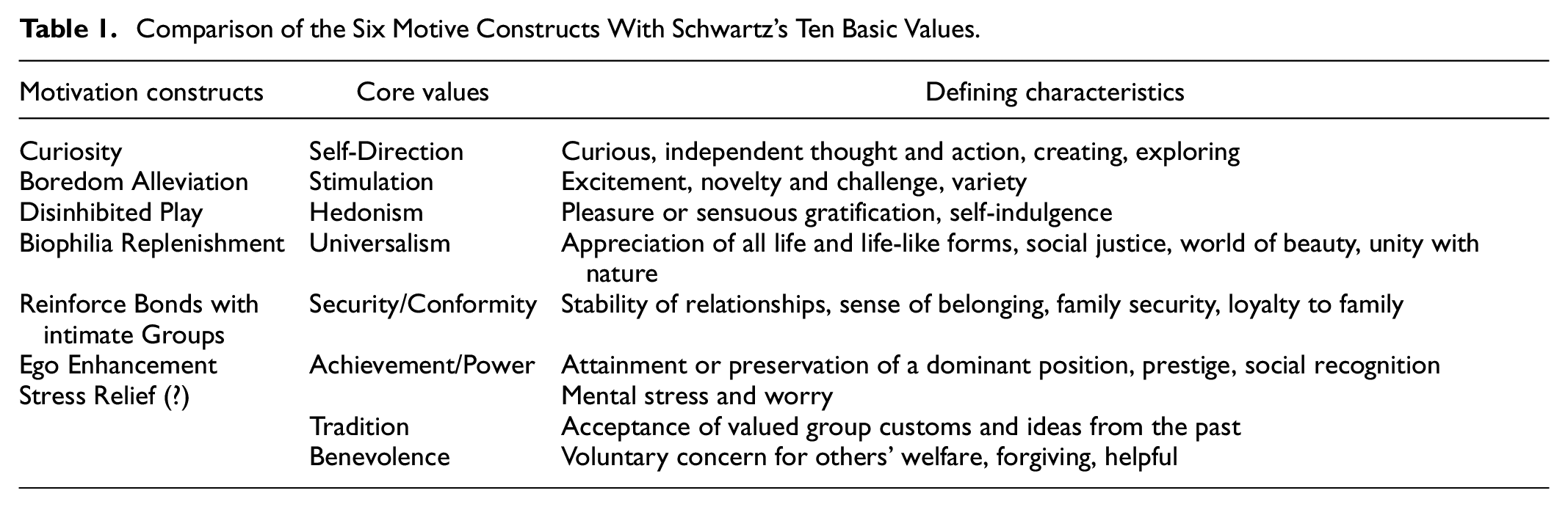
The terminologies and semantics are different, but there are obvious similarities between the two sets of constructs. Tradition and benevolence are not constructs that have emerged in the context of tourism although the nostalgia emotion often is associated with tradition and triggers the Thematic-Combination Heuristic search process (Crompton & Petrick, 2024). The absence of tradition and benevolence from the pleasure vacation set is likely explained by Schwartz’s ten distinct basic types of values being universally manifested in all populations and cultures, whereas the set of tourists’ motives was derived from subsets of populations that go on a pleasure vacation. Nevertheless, the research on values appears to have proceeded along a similar track to that on motives, and it seems likely that there are insights to be gleaned from the structure of values that may be transferrable to better understanding motive constructs.
8) In an earlier complementary review paper that focused on the processes that transition a motivational state into action (Crompton & Petrick, 2024) it was noted that “Valid measures of the behavioral domains, which are the tangible manifestations of motive constructs, are lacking” (p. 21). This review reinforced that conclusion. There is a need to create measures that represent all dimensions of the behaviors associated with each motive, and subsequently to evolve the process so the instruments become short enough to be of practical value. This latter step can only occur after comprehensive measures have been developed in order that the trade-offs in validity and reliability can be derived by comparison to the full instrument.
9) The review suggests that for some people in some situations, the restorative behaviors associated with motives are socially constructed. That is, they reflect long-standing widely held beliefs, but they are actually myths. These “truths” have been repeated so many times that they have become well-entrenched platitudes (McKercher & Prideaux, 2014). They may not exist at all but may merely be a conditioned response; a convenient socially constructed ideal vision of tourists’ motives that has been collectively embraced because of its long association with pleasure vacations. Krosnick (1999) pointed out: “Presenting respondents with survey questions is unlikely to provide any insights of value because people will either respond in the way they feel is socially acceptable, or they create an explanation for an unconscious behavior on the spot to comply with the researcher’s request to answer all questions. It is a phenomenon known as satisficing” (p. 51).
Examples may include the belief that:
• Vacations reduce stress.
• Curiosity is driven by a search for knowledge.
• Vacations alleviate boredom.
• Exposure to nature vacations enhances mental health.
• Vacations free individuals from their routines and enable them to be their authentic selves.
• Family vacations strengthen family bonds.
In many of these cases, the belief may be supported by reality, but it does not seem unreasonable to suggest that in some cases they may be socially conditioned responses. This raises two questions: “Can the difference between reality and social construction be measured?” and “Does it matter?”
10) The effectiveness of vacation behaviors in restoring equilibrium is a function of both extensity (length of the vacation experience) and intensity (depth of the immersion). Developing measures that incorporate both dimensions is the sine qua non of research in both the social and biological sciences (C. C. Burn, 2017; Frumkin et al., 2017). Scales may have the potential to do this. However, the situational specific prioritization of motives and their lability requires that the validity of such measures is dependent on them being completed by respondents “in the moment” through “experience sampling” (Hektner et al., 2007). To this point, this key operational factor has been conspicuous by its absence in motives studies and appears to be a productive area for future research.
11) Crompton and Petrick (2024) noted individuals have hierarchical constellations of personality dispositions as well as of motives:
An individual has a hierarchy of personality dispositions which predispose him/her to the tourism motive constructs that are important and unimportant…Personality traits develop differently from motives…The relative permanency of personality traits determines tolerance levels of an individual to disequilibrium of motive constructs and explains behavioral consistency and stability over time and across situations” (pp. 6–7).
Personality dispositions explain the consistency of patterns of thoughts, feelings, and actions across time and situations. One of the most pervasive concepts in social science is that individuals’ personality structures crystallize by the time they reach adulthood (Inglehart, 2008) as do people’s basic values (Schwartz, 2012) and they change relatively little thereafter. It has been reported that as much as 80% of personality variance is steady across the entire adult lifespan (John & Srivastava, 1999). While personality is a relatively permanent descriptive trait, motives are relatively short-term activating triggers. The personality consistency may install “ceiling” and “floor” levels of tolerance for tourists’ responses to disequilibrium to each of the constructs (Crompton & Petrick, 2024). It contrasts with the temporary aberrations created by disequilibrium in specific situations that characterize motive constructs.
Each person has different threshold bliss, arousal, and vacation decision points for each motive construct (Crompton & Petrick, 2024). The thresholds vary widely both among and within individuals. The differing valences needed to trigger the process thresholds are a function of different personality predispositions. They are likely to explain why two adjacent individuals or households with identical profiles (occupations, incomes, life-cycle stages, proximity to family access, et al.) make different decisions relating to vacations. For example, while one may rarely take vacations, the other takes them frequently; among those who take frequent vacations many may be driven by biophilia replenishment while others opt for disinhibited play.
Conceptually, there is wide acceptance of the complementary roles. It is reasonable to hypothesize that some proportion of the research on tourists’ motives may be more a reflection of people’s personalities, rather than on motive constructs to which it is attributed. However, there appears to have been no efforts among tourism researchers to address this issue. Instrumentation that effectively discriminates between the two different constructs is lacking and, hence, their relative impact on tourists’ decisions remains unknown.
Footnotes
Declaration of Conflicting Interests
The author declared no potential conflicts of interest with respect to the research, authorship, and/or publication of this article.
Funding
The author received no financial support for the research, authorship, and/or publication of this article.
