




Abstract
The growing relevance of transformative tourism experiences calls for further empirical research across different contexts. This study tests a comprehensive conceptual model within international academic tourism, incorporating co-creation theory and experience economy framework. Data were collected through a questionnaire survey (N = 704) and analyzed using structural equation modeling. The results substantiate the proposed conceptual model, revealing a positive influence of activating factors on perceived transformation outcomes. Additionally, transformative tourism experiences confirm a significant impact on place attachment and positive memories, influencing behavioral intentions. Notably, perceived safety influences solely behavioral change, as opposed to personal change, meriting further investigation into this differential effect on transformative tourism experience outcomes. This study enhances understanding of the interrelationships among academic transformative tourism experiences components, namely by exploring the intended achievements’ role. It also elucidates transformative tourism experiences’ impacts on students’ destination perceptions and attitudes. Findings highlight the need for educational and tourism stakeholders to promote stimulating environments and impactful programs that actively engage students, fostering memorable life-changing experiences, place attachment, and loyalty.
Keywords
Introduction
Tourism destinations increasingly focus on designing and managing impactful customer experiences (Lunardo & Ponsignon, 2020) as a competitive advantage (Tussyadiah, 2014), fostering transformative tourism experiences in the era of the experience economy (Pine & Gilmore, 1998). This shift not only aims to create more meaningful travel encounters but also to strengthen emotional connections with destinations (Quintero & Zerva, 2023) and generate lasting memories (Sthapit et al., 2019). Consequently, research exploring experiences that induce meaningful transformations has grown (Amaro et al., 2023b; Brown, 2009; Chirakranont & Sakdiyakorn, 2022; Coghlan & Weiler, 2018; Kirillova et al., 2017a, 2017b, 2017c; G. Lean, 2009; Soulard et al., 2019; Tasci & Godovykh, 2021; Teoh et al., 2021; Y. Zhao & Agyeiwaah, 2023). Nevertheless, despite its growing prominence, transformative tourism experiences require more in-depth understanding and further research (Kirillova et al., 2017a; Nandasena et al., 2022), as a significant portion of the existing literature is primarily theoretical (Tasci & Godovykh, 2021; Y. Zhao & Agyeiwaah, 2023). Quantitative studies, in particular, are encouraged to provide a comprehensive overview, considering two distinct lines of research identified in the literature (Amaro et al., 2023b): transformative experiences as an offering within the experience and transformation economy framework (Pine & Gilmore, 1999, 2019; Pine & H. Gilmore, 2014) versus as inward-oriented experiences analyzed through transformative learning theory or existential philosophy (Y. Zhao & Agyeiwaah, 2023). For any offering to be transformative, individual inner changes must take place (Pine & Gilmore, 2000). Thus, a managerial focus, on understanding how to intentionally design life-changing experiences, is inextricably linked to the consumer emphasis on inward-oriented change. Therefore, Amaro et al. (2023b) propose a conceptual framework that integrates managerial and consumer perspectives to address the fragmented research landscape on transformative tourism experiences. They argue for a comprehensive approach that encompasses both the managerial perspective, which focuses on the creation and offering of transformative experiences within the framework of the experience economy, and the consumer perspective, which views transformative experiences as an inner-oriented product, grounded in transformation theories.
In academic tourism, several studies confirm its efficacy in fostering transformative experiences due to its distinct characteristics (Brown, 2009; Cavender et al., 2020; Grabowski et al., 2017; Young et al., 2017), such as extended stays, interaction with locals, challenges in novel settings and diverse cultural contexts, and confronting disorienting dilemmas (Chwialkowska, 2020).
Despite various terms like educational tourism in the literature, our focus is on international academic tourism, described as student mobility for less than one consecutive year (UNWTO, 2010) in foreign high education institutions (Amaro et al., 2024b; Rodríguez et al., 2012). This growing type of tourism enhances competitiveness and sustainability by diversifying product offerings (McGladdery & Lubbe, 2017; Rodríguez et al., 2012; Tomasi et al., 2020). According to Leal et al. (2019), the presence of international students reduces seasonality, disperses visitor flow, promotes non-traditional routes, and may result in higher average expenditures and family visits, with potential future returns to the study destination.
Yet, the tourist experience in this context requires further research (McGladdery & Lubbe, 2017). At the intersection of study abroad and transformative tourism, various studies have explored the dynamic relationship between travel and personal change. Hunter (2008) discussed transformative learning in international education, focusing on personal growth. Stone and Duffy (2015) conducted a systematic review of transformative learning theory within travel and tourism scholarship. Bell et al. (2016) examined transformative learning during study abroad among U.S. students. Additionally, Walters et al. (2017) investigated the influence of short-term study-abroad experiences on transformative learning. However, these studies and most of the existing research in this domain have focused on transformative learning theory (Brown, 2009; Cavender et al., 2020; Chwialkowska, 2020; Grabowski et al., 2017; Stone et al., 2017; Young et al., 2017).
By addressing these research gaps, this study distinctively enriches the comprehension of the interrelationships among the components of transformative tourism experiences within the expanding sphere of international academic tourism. Firstly, we further elucidate the academic transformative tourism experiences process, adopting a comprehensive approach (Amaro et al., 2023b), with the contribution of the co-creation theory (Prahalad & Ramaswamy, 2004a) and the experience economy framework (Pine & Gilmore, 1999, 2019; Pine & H. Gilmore, 2014). Transformative tourism experiences occur when tourists engage in staged encounters, which have the potential to elicit lasting changes (Pine & H. Gilmore, 2014). As encounters, transformative experiences are intrinsically co-created, as highlighted by Teoh et al. (2021), who view transformations as co-creative experiences. Building upon these conceptual insights, co-creation theory emerges as particularly apt for explaining the dynamic and interactive essence of transformative tourism experiences within academic tourism. Transformative tourism experiences arise from students’ active engagement in learning and leisure contexts, interactions with locals and environments, and cognitive and affective engagement, blending their individual goals, previous experiences, and (more or less) orchestrated experiences at the study destination. Hence, co-creation theory can offer unique insights that transformative learning theory overlooks, such as providing a managerial perspective that explicitly integrates the role of stakeholders and highlights the dynamic aspects of co-created change, emphasizing the interplay between tourists and facilitators, thus providing a comprehensive understanding of transformative tourism experience processes (Teoh et al., 2021). Secondly, empirically extending co-creation theory in the analysis of transformative tourism experiences (Teoh et al., 2021), we propose a causal model that integrates not only interrelationships regarding the transformation process but also the impacts of transformative academic tourism experiences on place attachment, positive memories, and future behavioral intentions, as well as the role of perceived safety in this context. Thirdly, we expand the investigation of transformative tourism experiences by adopting structural equation modeling analysis, considering the paucity of comprehensive quantitative studies on the topic (Tasci & Godovykh, 2021; Y. Zhao & Agyeiwaah, 2023).
Portugal was selected to conduct the study for its recent endeavors to attract international students through a range of legislative, political, and promotional strategies (Sin et al., 2020), having registered considerable growth in international students (Amaro et al., 2024b).
Following this introduction, the paper outlines the theoretical background, conceptual framework and hypothesis development. Subsequently, the methodology and data analysis are described, and the conclusions and implications are discussed.
Theoretical Background
This empirical study draws on the experience economy framework (Pine & Gilmore, 1998, 1999) and the co-creation theory (Prahalad & Ramaswamy, 2004a), as conceptually discussed in the transformative tourism experiences domain (Kirillova et al., 2017c; Teoh et al., 2021). This theoretical background offers a nuanced lens to (a) empirically investigate the interplay between study abroad and transformative tourism experiences, assuming the interplay of consumers, places, and facilitators, as well as (b) test a causal model integrating academic transformative tourism experiences and impacts on students’ destination perceptions and attitudes.
According to the experience economy framework (Pine & Gilmore, 1998, 1999), experiences represent a distinct, evolved economic offering. Transformative experiences can be viewed as an advanced phase within the broader framework of the experience economy. In the realm of transformative experiences, individuals not only participate but actively undergo profound changes. These changes, whether related to personal growth, shift in perception, or newfound insights, exemplify the transformative power that certain tourism experiences can exert on individuals (Pine & Gilmore, 2011). To that end, providers should prioritize the individual needs of each tourist, aiming to tailor experiences to be truly transformative (Pine & H. Gilmore, 2014). This shift entails moving away from creating experiences for the masses and instead focusing on designing experiences that have the potential to be life-changing for each tourist (Chirakranont & Sakdiyakorn, 2022; Kirillova et al., 2017b; Soulard et al., 2019).
Strongly linked with the concept of the experience economy (Binkhorst & Den Dekker, 2009), value co-creation theory highlights consumers’ active role in value creation (Prahalad & Ramaswamy, 2004a), generated when customers actively participate in both the composition and delivery of personalized and sustainable offerings (Prahalad & Ramaswamy, 2004b). In the context of tourism, instead of being passive recipients, tourists co-create their experiences with service providers (Lusch et al., 2007). The co-creation process encompasses a sequence of intentional engagements aimed at enhancing product innovativeness and boosting customer satisfaction (Prahalad & Ramaswamy, 2004a). Researchers have identified the cumulative effect of repeated experiences that ultimately lead to transformation (Tasci & Godovykh, 2021), while others note that transformation may necessitate consumers actively focusing on the process (Kottler, 1998). Alternatively, transformations can occur unexpectedly, stemming from peak experiences or moments of awe (Kirillova et al., 2017b). The three perspectives seem valid in academic tourism, characterized by longer lengths of stay than the majority of trips.
Despite varying conceptualizations, co-creation is broadly viewed through approaches including interaction, co-production, and mental engagement (Campos et al., 2018; Eletxigerra et al., 2022). In response to the debate about whether co-creation is a concept or a theory, our study aligns with viewing co-creation as a theoretical framework applicable to explore the dynamic and participatory nature of academic transformative experiences, based on value co-creation theory (Prahalad & Ramaswamy, 2004a) and subsequent conceptual advances. Service-dominant logic, which views co-creation as inherent in all service exchanges, somewhat blurred boundaries between a theoretical framework and a conceptual lens (Vargo & Lusch, 2008). Recent co-creation perspectives include societal, environmental, and personal value creation beyond the economic sphere (Vargo & Lusch, 2016).
Teoh et al. (2021) conducted a systematic literature review positing that transformative experiences can be co-created through three primary dimensions: experience, experience-consumer, and experience-facilitator. The experience dimension centers on the characteristics of the place, the consumer dimension emphasizes cognition and emotion, while the experience-facilitator dimension revolves around experience providers and their respective facilitators. Drawing on this theoretical background, this study conceptualizes the tourism experience as a collaborative creation between academic tourists and destination actors, leading to a set of outcomes that encapsulate the transformative potential of such interactions (Kirillova et al., 2017c; J. M. Pung et al., 2020; Teoh et al., 2021). Moreover, transformative tourism experiences are analyzed as a series of encounters, with the destination and the diverse stakeholders playing a crucial role in the orchestration of experiences, potentially curating transformative interactions (Amaro et al., 2023a, 2023b; Pine & Gilmore, 1998, 1999).
Transformative Tourism Experiences
Studies on transformative experiences reveal two different lines of research: consumer-oriented and business-oriented (Amaro et al., 2023b). To date, there is a consumer focus within the literature (Teoh et al., 2021). From the managerial viewpoint, the framework of the experience economy (Pine & Gilmore, 1998) stands out. Pine and Gilmore (2014) predict transformations to be the next stage of economic value, succeeding the experience economy. According to Kirillova et al. (2017b), the experience economy has entered its “third generation,” characterized by a tourism experience that has a profound impact on the transformation of a tourist (Boswijk et al., 2013). This derivative transformation economy focuses on providing highly customized experiences capable of transforming consumers (Pine & Gilmore, 2019; Pine & H. Gilmore, 2014). Tourism industry stakeholders are expected to adopt and transcend the three generations of principles of experience economy—staged, co-creative, and transformative experiences—to move beyond generic experiences. The key to impactful tourism lies in prioritizing tourist co-creation and promoting substantial personal transformations (Boswijk et al., 2013; Neuhofer et al., 2020; Soulard et al., 2019). Yet, to effectively facilitate transformative tourism experiences, it is necessary to thoroughly comprehend the accomplishments sought by tourists, the obstacles they face, and the possible remedies (Bettencourt et al., 2022).
From the individual viewpoint, transformative tourism experiences have been studied primarily through the transformative learning theory and existential philosophy (Y. Zhao & Agyeiwaah, 2023). Transformative learning theory involves a learning process that reshapes restrictive mental frameworks into broader, reflective perspectives, thereby encouraging empathy and open-mindedness (Mezirow, 1994, 2003). This means that individuals modify their beliefs through a series of steps including encountering a disorienting dilemma, often perceived as a personal crisis or life challenge (Mezirow, 2000), from engaging in critical self-reflection to taking concrete actions. In turn, existential philosophy explores the process of transformational experiences from an ontological lens, suggesting that individuals change through an epiphanic moment characterized by deep emotions and a sense of surpassing ordinary boundaries (Kirillova et al., 2017a). Transformation tends to occur during a peak moment, frequently emerging after demanding circumstances or when individuals engage with unconventional, non-typical places, individuals, and experiences (Reisinger, 2013). Peak experiences often arise from challenging situations, such as high-adventure travel, intense exposure to natural environments, or from deep cultural immersion and human interaction (Sheldon, 2020). Both transformative learning theory and existential transformation require a significant reassessment of existential values, facilitating new life trajectories (Fleming, 2018; Mezirow, 2018). Thus, any journey has the potential for transformation, provided that specific events or activities trigger changes in one’s self and behavior (Tasci & Godovykh, 2021). These triggers may be decomposed into positive and negative catalysts (Tasci & Godovykh, 2021). The first group, called “novelties and gains,” refers to positive activating factors such as discovering new aspects of the residents’ lifestyle (Brown, 2009), experiencing a new cultural setting (Brown, 2013; Kirillova et al., 2017b; G. Lean, 2009; J. M. Pung et al., 2020), or forming meaningful connections with others (Kirillova et al., 2017b; J. Pung & Chiappa, 2020). The second group, called “toils and pains,” refers to negative catalysts, such as culture shock (G. Lean, 2009) and difficulties encountered at the destination (Coghlan & Weiler, 2018; J. M. Pung et al., 2020).
Transformation is fostered by cognitive and affective stimulations from a noteworthy experience (Tasci & Godovykh, 2021). These stimulations may involve changes in thoughts and feelings, such as confidence, pride, safety, happiness, or surprise (Soulard et al., 2021; Tasci & Godovykh, 2021), or disorientation and isolation (Coghlan & Gooch, 2011).
Once transformation occurs, the resulting change in oneself can be viewed as internal personal changes from both psychological and physical perspectives. Such changes may lead to improvements in self-belief, a sense of peace, and empowerment (Brown, 2009). Transformation may also involve knowledge and social changes, which can have broader societal implications, as suggested by Teoh et al. (2021). Finally, transformative tourism experiences can result in behavioral changes through the transformation process (Coghlan & Weiler, 2018; J. M. Pung et al., 2020; Ulusoy, 2016). These changes can be categorized into three facets: eudemonic tendencies, gregarious tendencies, and regression to basics (Tasci & Godovykh, 2021) which, in turn, contribute to travelers’ hedonic and eudaimonic well-being (Huang et al., 2024).
Conceptual Model
In academic tourism, students often engage in longer stays, exploration of the host country, interactions with locals, and travel with friends, family, or fellow students (Kosmaczewska & Jameson, 2023; Tomasi et al., 2020). These features make academic tourism particularly conducive to transformative experiences (Chwialkowska, 2020; Grabowski et al., 2017), involving facing challenges, leaving comfort zones, and exposure to new environments and cultures (Chwialkowska, 2020). The impact extends beyond the experience itself, as students returning home may exhibit increased community engagement, deeper self-understanding through cross-cultural interactions, and enhanced cultural competency (Biber, 2020; Grabowski et al., 2017). This shift in perspective and worldview can lead to behavioral changes, emphasizing the transformative potential of academic tourism (Brown, 2009; Chwialkowska, 2020; Grabowski et al., 2017).
In an exploratory study (published manuscript; reference suppressed due to anonymity issues), we studied transformative tourism experiences among international academic tourists through a qualitative methodology, to better understand the transformation process, as well as to validate, and adapt assessment instruments for this distinct context. As identified in this preceding research, the role of intended achievements is here examined recognizing these as significant (pre-trip and on-site) purposive factors for fostering transformation. Drawing upon these insights, the co-creation perspective as outlined by Teoh et al. (2021) and the experience economy framework as suggested by Amaro et al. (2023b), our study employs a holistic approach focused on the interactive dynamics among academic tourists, the place, and destination actors. These underpinnings, coupled with recent operationalization efforts on transformative tourism experiences (Soulard et al., 2021; Tasci & Godovykh, 2021), inform the hypothesized interrelationships and the measurement tools for the academic tourism context.
Extending the analysis to the impacts of transformative experiences on students’ destination perceptions and attitudes, the integration of the experience economy framework and co-creation theory also enhances our understanding of academic tourists’ journey from transformative experiences to loyalty, emphasizing the role of co-creative experience in forming attachments to places, and fostering positive memories and loyalty decisions.
Components of Transformative Tourism Experiences
The catalysts of transformative tourism experiences can be broadly classified into two main categories: personal factors and destination factors (Y. Zhao & Agyeiwaah, 2023). These factors can lead to significant personal growth and skill development in the context of academic tourism experiences (Do Amaral et al., 2022; Ürer Erdil et al., 2021).
In their conceptual work, J. M. Pung et al. (2020) point out cultural shock, disorienting dilemmas, and peak episodes as the factors that catalyze transformation. Their model highlights the significance of the destination’s physical interaction and performances in the transformative experience. Regarded as a reaction to stimuli, transformation requires reflection and assimilation of new knowledge and values. Because the process is nonlinear and subjective, not all stimuli lead to transformation, but when they do, transformative tourism experiences significantly affect tourist attitudes, and behaviors. Tasci and Godovykh (2021) map out and empirically test the transformation process beginning with transformative trip experiences that cause cognitive and affective stimulation leading to self-change and, eventually, behavioral change in tourists. Integrating co-creation theory with a dual consumer-managerial perspective, Teoh et al. (2021) conceptually describe the transformative tourism experiences process through the interplay of three dimensions: the experience itself, encompassing landscape, social dynamics, and inherent features; the experience-consumer aspect, including purposive factors, cognition and emotion; and the experience-facilitator element. These interconnected dimensions induce transformative outcomes (psychological, physical, social, or knowledge-based).
Focusing on transformative tourism experiences processes, these studies emphasize the activating role of antecedent factors on transformation, such as cognitive and emotional stimulations, triggers, and even pre-trip and on-site purposive factors that may be relevant in academic tourism. These activating factors precede transformation outcomes, involving internal and behavioral transformation. This complex interplay among experience dimensions, consumer engagement, and facilitator roles aligns with the co-creative nature of transformative tourism experiences, impacting tourist perceptions and attitudes in academic tourism.
The co-creation perspective emphasizes the tourists’ active role in achieving these outcomes through interactions in a new cultural setting and academic environment. The intent to achieve personal growth and cultural understanding is a foundational aspect of transformative experiences as per the experience economy framework. Fulfilling such intentions can result in personal changes and gains in personal empowerment and self-confidence, reflecting the students’ educational and cultural immersion goals (Tasci & Godovykh, 2021).
The transformation triggers, such as meaningful connections and cultural immersion, directly relate to the experience economy’s emphasis on memorable, and engaging experiences (Kirillova et al., 2017b). These interactions can catalyze significant personal transformation, enhancing the students’ worldview, and fostering personal development.
Cognitive and emotional stimulations during the stay are critical components of the co-creation process, as they reflect the students’ active psychological engagement with their environment (Tasci & Godovykh, 2021). This engagement can lead to transformative self-change (Noy, 2004), aligning with both the experience economy framework and co-creation theory.
With academic tourism as the circumstantial tourism environment (Kirillova et al., 2017c), we consider the following activating factors: intended achievements as (pre-trip and on-site) purposive factors (Teoh et al., 2021), and on-site co-created transformative experience triggers and cognitive and affective stimulations (Tasci & Godovykh, 2021). As transformation outcomes, we adopt the distinction between self-change and behavioral change (J. M. Pung et al., 2020; Tasci & Godovykh, 2021). Thus, we posit that these activating factors directly impact transformation outcomes (Tasci & Godovykh, 2021; Teoh et al., 2021; Y. Zhao & Agyeiwaah, 2023).
Specifically, activating factors are expected to prompt students’ self-change. Therefore, the following hypotheses are proposed:
H1a: Intended achievements positively influence self-change.
H1b: Triggers positively influence self-change.
H1c: Cognitive and emotional stimulations positively influence self-change.
There is evidence that factors that foster transformation can lead to behavioral changes, such as increased social engagement or community involvement (Brown, 2009). This aligns with the co-creative aspect of tourists shaping their experience through participation in local cultural and academic activities.
Indeed, the intention to achieve specific educational and personal goals can lead to behavioral transformations during- and post-experience, such as taking new initiatives or seeking new relationships. This aligns with co-creation theory, where the value is jointly created through the student’s active role and the educational offerings and environment.
Furthermore, triggers of transformation, through cultural and social interactions, can also lead to behavioral change that reflects a change in lifestyle or social behaviors, resonating with the experience economy’s staging of experiences that are memorable and engaging (Tasci & Godovykh, 2021).
Cognitive and emotional stimulations are also vital in shaping the tourists’ behaviors during and post-experience. These internal processes can lead to behavioral changes, such as increased solidarity and valuing life’s simple pleasures, supporting both the experience economy framework and co-creation theory.
We thus posit that transformative tourism experiences activating factors directly influence transformation outcomes (Tasci & Godovykh, 2021; Teoh et al., 2021; Y. Zhao & Agyeiwaah, 2023), specifically those related to students’ behavioral change. Hence, the following hypotheses are suggested:
H2a: Intended achievements positively influence behavioral change.
H2b: Triggers positively influence behavioral change.
H2c: Cognitive and emotional stimulations positively influence behavioral change.
Perceived Safety as an Influencing Factor of Transformative Tourism Experiences
Tourists are highly sensitive to safety and security concerns when making travel decisions (Araña & León, 2008). Recent epidemics and natural disasters have further emphasized the need for safety in tourism, especially since the COVID-19 pandemic (Amaro et al., 2023a). Conceptually, tourism safety pertains to balanced and stable tourism activities that are free from threats, loss, or harm during travel (Chauhan, 2007; R. George, 2003). Perceived safety, on the other hand, refers to a person’s subjective view of their own safety and their ability to foresee danger or risk (Chauhan, 2007; Woosnam et al., 2015). It is influenced by various factors such as past experience (Seabra et al., 2013), culture, nationality (R. George, 2003; Kozak et al., 2007), social, political, and other external risk considerations (Seabra et al., 2013), personality traits (Reisinger & Mavondo, 2006), daily exposure to crime and violence (Brunt et al., 2000). It is a deciding factor for travelers (Estrada et al., 2024) and can affect how tourists live their experiences while visiting a tourist destination (Zou & Meng, 2020). The perceived safety can enhance the ability to engage deeply with the environment and take educational and personal risks (Ramrakhiani et al., 2021; Ryoo & Cheung, 2021), leading to transformative outcomes, in an experience that implies being away from home many times in an unknown destination for a long time combined with the academic and socio-cultural challenges.
Perceived safety may have an important role in internal personal changes such as heightened self-belief (Brown, 2009), a sense of tranquility, and empowerment (Yang et al., 2018), as well as potential alterations in one’s identity (McWha et al., 2018). From a broader perspective of knowledge and societal change, it can result in external implications for society, including the acquisition of new activities, or skills (Laing & Frost, 2017).
Furthermore, perceived safety may play a pivotal role in driving behavioral changes. These behavioral shifts encompass the establishment of deep connections and interactions with others (Country et al., 2016; J. Pung & Chiappa, 2020), participation in self-improvement activities (Fu et al., 2015), immersion in a new cultural context (Noy, 2004), and the willingness to face challenges and solve problems (Coghlan & Weiler, 2018).
In a tourism context, this perception of safety is paramount, significantly influencing the quality and depth of the overall experience. Therefore, the following hypotheses are proposed:
H3a: Perceived safety during stay positively influences self-change.
H3b: Perceived safety during stay positively influences behavioral change.
Impacts of Transformative Tourism Experiences on Destination Perceptions and Attitudes
Soulard et al. (2021), who developed a transformative tourism experiences measurement scale, suggest it is necessary to explore the connection between transformation and loyalty toward the destination. Moreover, the timing of when tourists develop memories and place attachments during transformative travel remains undetermined (J. M. Pung et al., 2020). Yet, existing evidence confirms the impact of transformative experience on place attachment and loyalty (Z. F. Zhao & Li, 2022), as well as on the formation of memories (G. Lean, 2009).
These interrelationships should be specifically explored in the tourism academic context since they influence the overall impact and meaning of transformative tourism experiences. The extended engagement and close connections with people and places inherent in academic tourism, even more so than the participation observed in prolonged nature tourism programs (Wolf et al., 2015), are anticipated to deepen the transformative experience. This, in turn, is likely to accentuate place attachment, lasting memories, and loyalty toward the study destination, through both repeat visits and recommendations.
Place attachment, originating from environmental psychology, refers to the intricate meanings assigned by both residents and visitors to their physical surroundings (Dwyer et al., 2019). It encompasses the emotional bond individuals form with a particular environment (Hidalgo & Hernández, 2001). It is also a complex and multidimensional construct that has been measured through various approaches and scales (Lee et al., 2001; D. Wang & Chen, 2015; Wang & Xu, 2015). Its most consensual dimensions include place dependence, indicating a functional connection to a location, and place identity, denoting a symbolic or emotional bond with a place (e.g., Kyle et al., 2003; Prayag & Ryan, 2012). Research has expanded upon these conventional dimensions, introducing affective attachment, which delineates the emotional dimension where individuals cultivate sentiments and attribute significance to a place (Hosany & Gilbert, 2010), and social bonding, which focuses on individuals’ experiences stemming from social interactions within a specific location (Scannell & Gifford, 2010). The importance and relevance of these dimensions vary among individuals and places (Hidalgo & Hernández, 2001). It is, thus, believed that place attachment is a link between people and place based on emotions (feelings), cognition (ideology, knowledge, and beliefs), and practice (actions and behaviors), whose emotional factors come first (Gieryn, 2000).
If transformation fosters tourists’ emotional attachment to the destination (Io & Wan, 2018; Vada et al., 2019; Z. F. Zhao & Li, 2022), as discussed before, academic transformative tourism experiences for its inherent characteristics is expected to facilitate deeper transformations and, consequently, stronger place attachment to the host destination. Specifically, personal change can foster a deeper emotional bond with the place, as tourists may associate their personal growth and empowerment with the study destination. Thus, it is argued that:
H4a: Self-change positively influences place attachment
In turn, memories, which involve recollecting specific events (Pine & Gilmore, 1999), can be shaped by positive or negative experiences with services and products at a destination. Therefore, the significance of memory as an influential factor of experiences has been underscored (e.g., Kahneman, 2011; Larsen, 2007; Oh et al., 2007; Weiler & Walker, 2014; Zatori et al., 2018). As Kahneman (2011) posits, tourism fundamentally revolves around supporting individuals in crafting narratives and collecting memories. Weiler and Walker (2014) enumerate memorability as one of the pivotal elements in enhancing the experiences of guided tours. Loureiro (2014) ascertained that the rural experience economy impacts memory in a positive and significant manner. Zatori et al. (2018) underscored the role of on-site experience as a predictor of memorability. Indeed, memory remains the sole residue once the experience concludes (Larsen, 2007).
Hence, in essence, these memories serve as a mechanism that connects the tourism experience to various outcomes (Oh et al., 2007). Given their potential for life-altering impact, travel experiences have, thus, the potential to generate powerful and positive memories (Loureiro, 2014; Marschall, 2012; Oh et al., 2007; Zatori et al., 2018).
The extended interactions and experiences in academic tourism contribute to the creation of more impactful and enduring memories (G. L. Lean, 2012). Positing that perceived behavioral change can influence powerful and positive recollections, the following hypothesis is formulated:
H4b: Behavioral change positively impacts positive memories.
In the same vein, personal change achieved by academic transformative tourism experiences should impact the students’ positive memories. Thus, we also propose that:
H5: Self-change positively impacts positive memories
Additionally, positive memories are often associated with intense emotions at the time of occurrence (Anderson & Shimizu, 2007; Ballantyne et al., 2011). These memories subsequently influence the level of attachment to a place (Loureiro, 2014; Sthapit et al., 2017; Vada et al., 2019). Impactful memories while studying abroad, in a prolonged immersion in the educational and destination ecosystems (Amaro et al., 2024b; Rodríguez et al., 2012), accentuate place attachment. Therefore, we posit that:
H6: Positive memories positively influence place attachment.
These positive memories are also connected to the intention to revisit, the willingness to recommend the destination or location, and even the act of sharing post-visit experiences with family and friends (Loureiro, 2014; Loureiro et al., 2019; Oh et al., 2007; Sthapit et al., 2017; Tsai, 2016; H. Zhang et al., 2018). Indeed, a positively lived recollection phase may lead to experience outcomes such as increased satisfaction with the overall tourist experience (Ali et al., 2016; Quadri-Felitti & Fiore, 2013) and, in this case, a favorable tourism intention (Kastenholz et al., 2018). Travel experiences can also have the potential to generate future behavioral intentions, such as loyalty (Loureiro et al., 2019). Memorable experiences foster loyalty toward the destination, which may manifest as intentions to revisit or recommend the place to others. An enduring impact of varied accumulated memories of academic tourists on future behavioral intentions (Quintero & Zerva, 2023), including revisiting intentions, in-person recommendations, or sharing via social media, is proposed. Thus, we posit that:
H7: Positive memories positively influence future behavioral intentions.
In turn, place attachment plays a significant role in tourism marketing, as tourists who experience high levels of satisfaction with a destination become attached to it and are more likely to revisit it in the future or recommend it to others (J. F. George & George, 2004; Hosany et al., 2019; Loureiro, 2014; Sthapit et al., 2017; Y. C. Wang et al., 2020; Z. F. Zhao & Li, 2022). A stronger emotional attachment, nurtured over an extended period and consequent close relationships in academic tourism, can enhance the likelihood of future desire to return to or recommend the destination (Quintero & Zerva, 2023). Positing that place attachment, intensified by transformative tourism experiences, directly contributes to loyalty, it is hypothesized that:
H8: Place attachment positively influences future behavioral intentions.
Based on the discussed underpinnings, a research model is proposed (Figure 1) to be tested in the empirical study.
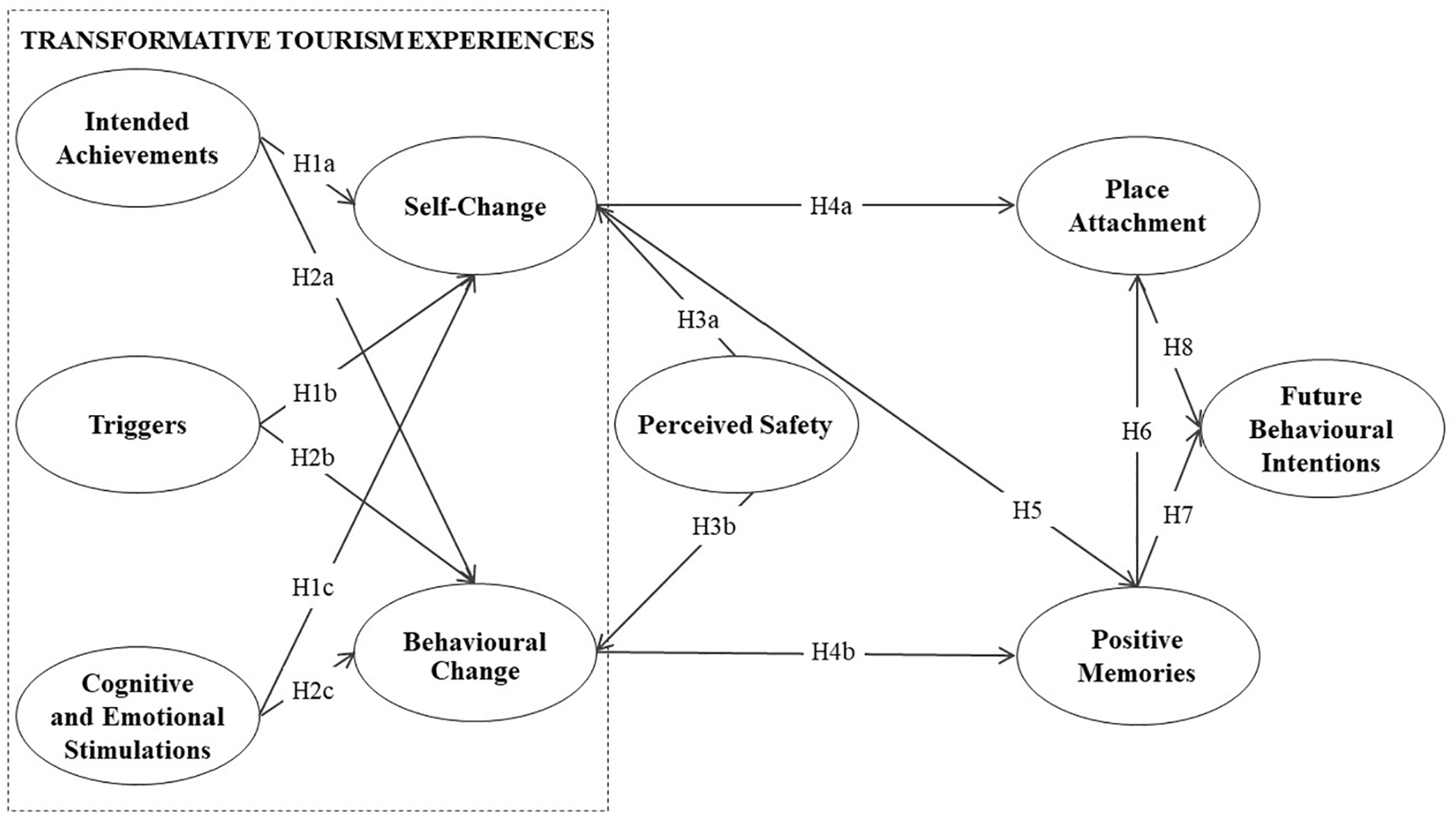
Conceptual model.
Study Context
Portugal, a tourist destination located in Southern Europe, was selected for this study due to its recent remarkable growth in the number of international students in higher education. This growth is largely attributed to a series of initiatives undertaken since 2014, including financial incentives and marketing campaigns focused on promoting Portuguese higher education abroad (Sin et al., 2020). Additionally, Portugal’s reputation for quality education, affordable cost of living, multicultural and friendly environment (www.study-research.pt/pt/), and it is ranking as the seventh safest country in the world in 2023 (Institute for Economics & Peace, 2023) make it an ideal destination for students searching for a safety and welcoming environment. The country’s stable political, economic, and social environment further enhances its attractiveness.
It has also been noted that Portugal is one of the most competitive tourist destinations in the world, experiencing continuous growth in the number of tourists (Santos & Oliveira Moreira, 2021). It is, therefore, understandable how tourism plays a crucial role in the Portuguese economy, representing one of the major drivers of economic activities (OECD, 2020) and has contributed to the internationalization of Portugal’s economy and the strengthening of its reputation and destination image.
Indeed, Portugal is a tourist destination that offers a unique and enriching tourist experience, combining rich history and culture, stunning natural beauty, a vibrant culture, and warm hospitality. The numerous tourism awards given to Portugal’s several regions, cities, and destinations contribute to this country’s enormous international reputation (World Travel Awards, 2023).
Methodology
Questionnaire Design
The questionnaire was designed based on the research model and hypotheses proposed. The constructs of transformative tourism experiences were measured by adapting the Soulard et al. (2021) and Tasci and Godovykh (2021) scales to the academic tourism context, following a qualitative research using in-depth semi-structured interviews with academic tourists (Amaro et al., 2024a). Intended achievements were assessed through a 5-point scale with anchor points ranging from 1 = Strongly disagree to 5 = Strongly agree, consisting of seven items (e.g., “Traveling and living new experiences,”“Experiencing different styles of education and enhancing the value of my degree”). Triggers were measured using a 5-point scale, with anchor points from 1 = Not at all to 5 = Very much, including three items (e.g., “Building meaningful connections and interactions with others,”“Engaging in self-improvement activities”). Cognitive and Affective Stimulations were assessed through a 5-point scale from 1 = Strongly disagree to 5 = Strongly agree, comprising four items (e.g., “During my experience, I felt confident,”“During my experience, I felt happy”). Self-change was evaluated using a 5-point scale, from 1 = Strongly disagree to 5 = Strongly agree, embodying nine items (e.g., “I am feeling more empowered,”“I developed new knowledge or skills for better lifestyles”). Behavioral change was measured on a 5-point scale from 1 = Strongly disagree to 5 = Strongly agree, containing six items reflecting intended behavioral changes post-experience (e.g., “I would like to spend more time off to enjoy life,”“I would like to start to value the simple things in life”).
Constructs considered investigating impacts of transformative tourism experiences were measured using also 5-point scales (1 = Strongly disagree to 5 = Strongly agree). Place attachment was measured using five items adapted from Y. C. Wang et al. (2020). Tourists’ perceived safety at destinations was assessed using ten items based on Xie et al. (2021). Positive memories were measured using three items, based on Pine and Gilmore (1999) and Oh et al. (2007). Behavioral intentions were operationalized using four items, adopted from Loureiro (2014).
The questionnaire started by outlining the research objectives and researcher contact information for inquiries. It also included travel behavior variables, such as activities engaged in by academic tourists in the country and previous visits to Portugal, along with sociodemographic variables (e.g., nationality, gender, age, attended program, place of study) to gain insights into respondent characteristics. It was translated into three languages: Portuguese, English, and Spanish (the main languages used by academic tourists) and complied with all data protection rules. A pre-test was conducted with a sample of sixteen international academic tourists, and six collaborators from international offices of Portuguese higher education institutions (who deal daily with those tourists), and the questionnaire was fine-tuned accordingly.
Sample and Data Collection
The final questionnaire was distributed online by email to academic tourists studying in Portugal during the academic year 2022 to 2023, with the support of the international offices of almost all Portuguese higher education institutions. A total number of 729 questionnaires were collected, of which 704 were validated for analysis. Data were collected from the end of January to April 2023 for academic tourists who attended their studies during the first semester of the academic year (n = 324) and from the end of May to July 2023 for those who attended their studies during the second semester of the academic year (n = 380). To exclude unqualified surveys, certain reverse questions were also included.
Data Analysis Process
Partial least square structural equation modeling (PLS-SEM) was used, more specifically the SmartPLS 4.0 software (Ringle et al., 2022), to analyze the latent constructs and test the hypotheses. PLS-SEM is particularly appropriate in tourism studies for various reasons, including non-normality issues and its suitability for theory development (Ryan, 2020). The validation process of PLS-SEM results consists of two phases, as described by Hair et al. (2021). The first stage involves the examination of the measurement (outer) model, which entails the evaluation of the relationships between the constructs and their corresponding items. Second, the structural (inner) model is assessed by analyzing the hypothesized relationships between the constructs.
Results
Profile of Respondents
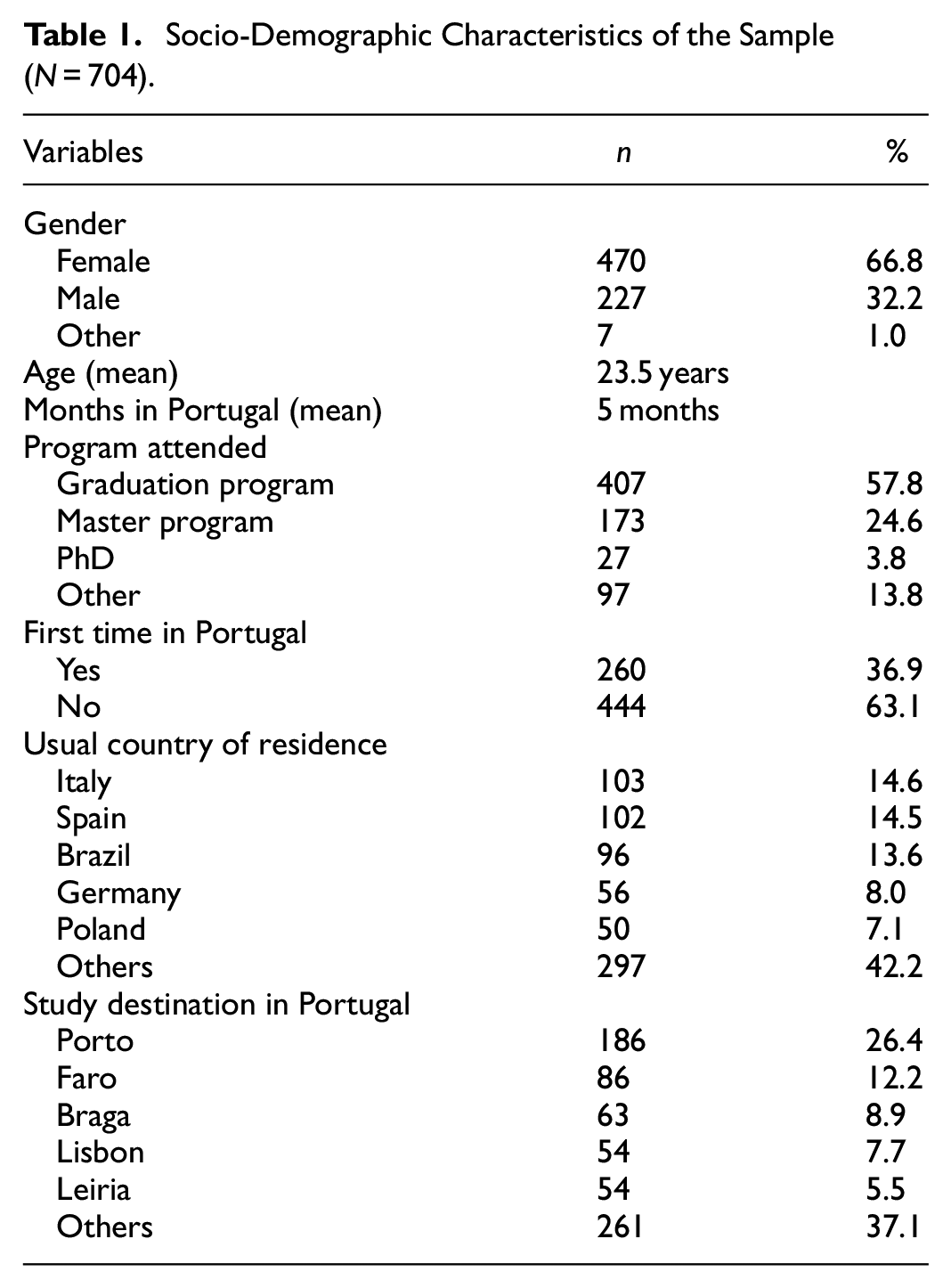
As presented in Table 1, a total of 704 replies were analyzed, with 67% of respondents being women and attending mostly undergraduate programs (58%). Most of these academic tourists were from Italy, Spain, Brazil, Germany and Poland, studying mainly in Porto, Lisbon, and Faro, with an average length of stay of 5 months.
Socio-Demographic Characteristics of the Sample (N = 704).
Measurement Model
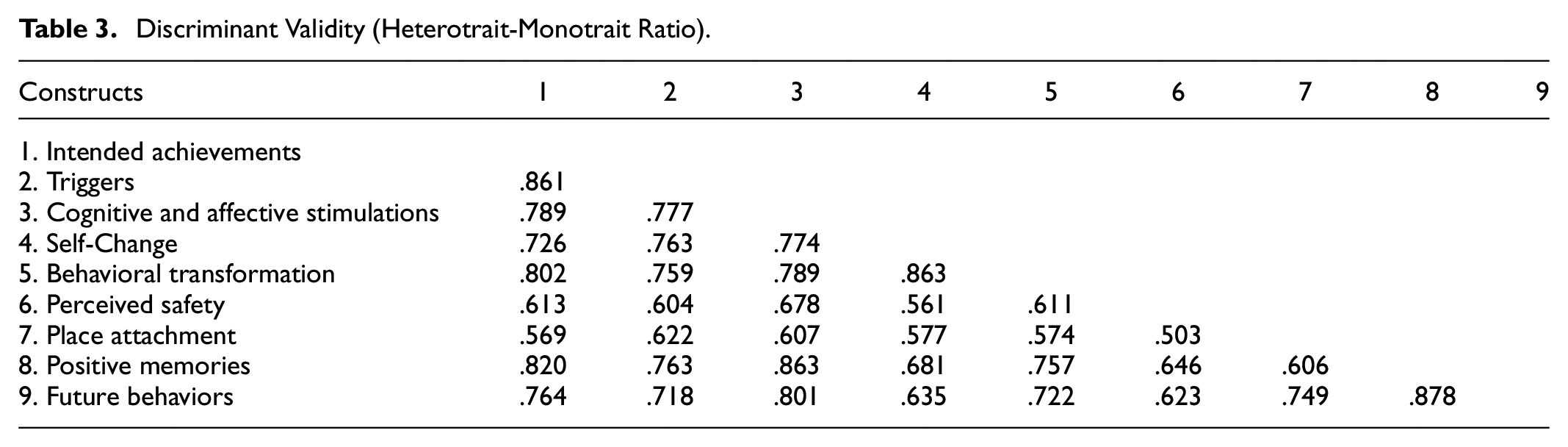
According to the appropriate validation process (Hair et al., 2021), the loadings of items within each construct, the composite reliability (ρC), the reliability coefficient (ρA) and the average variance extracted (AVE) were examined. For reliability and convergent validity to be established, it is recommended that the values of these parameters should surpass 0.7, 0.7, and 0.5, respectively (Hair et al., 2021). The results of the measurement model assessment are displayed in Table 2. After discarding 17 indicators due to their loadings below 0.7, reliability and convergent validity were established. Discriminant validity (Table 3) was then confirmed using the heterotrait–monotrait ratio (HTMT) of correlations with all values lower than 0.9 (Hair et al., 2021). Variance inflation factor (VIF) values ranging from 1.571 to 2.714, well below 3, dismiss common method bias. Common method bias was also discarded by using a full collinearity assessment following Kock’s (2015) procedure.
Measurement Model Assessment.
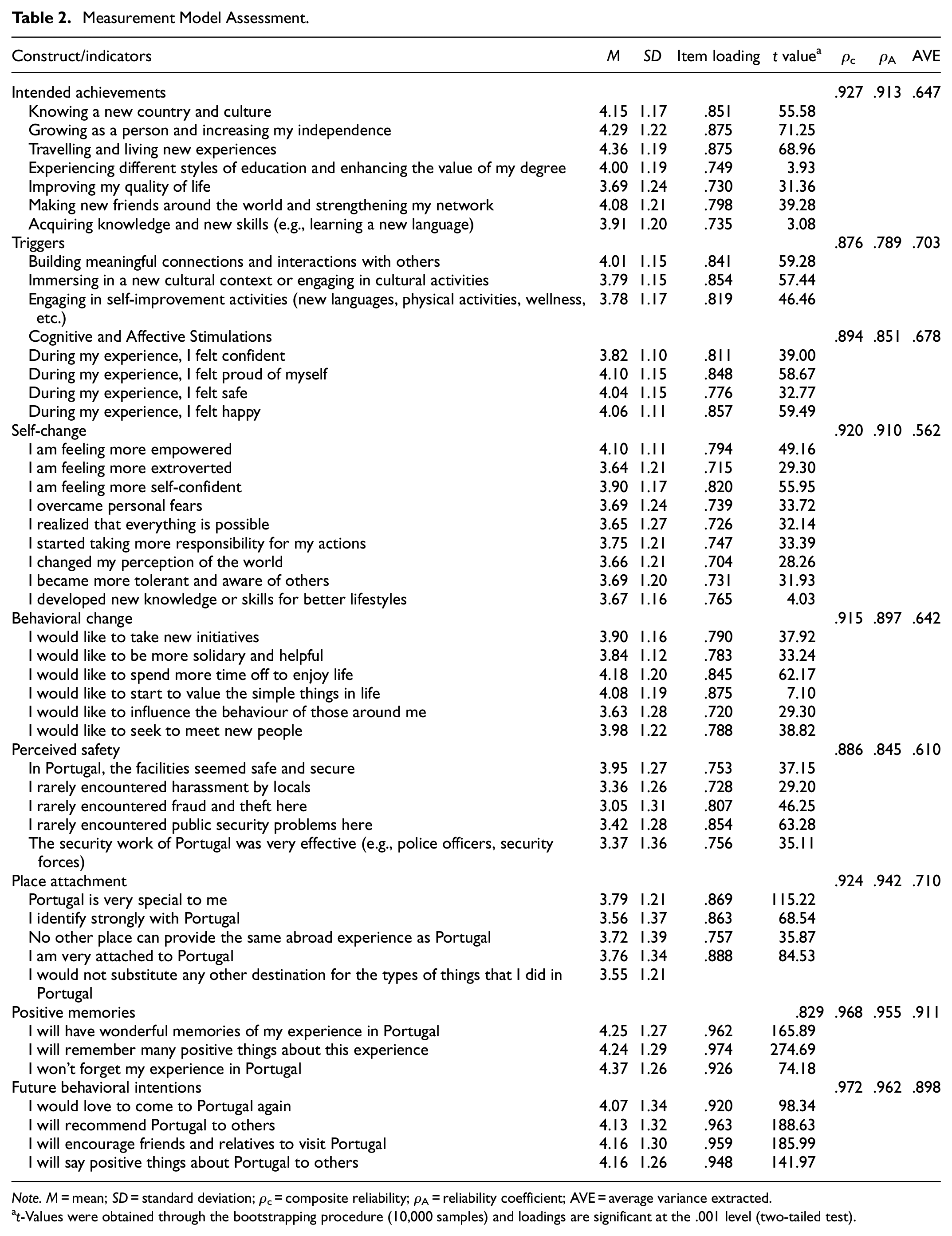
Note. M = mean; SD = standard deviation; ρc = composite reliability; ρA = reliability coefficient; AVE = average variance extracted.
t-Values were obtained through the bootstrapping procedure (10,000 samples) and loadings are significant at the .001 level (two-tailed test).
Discriminant Validity (Heterotrait-Monotrait Ratio).
Structural Model
Once confirmed the reliability and validity of the measurement model, the assessment of the structural model results was conducted. Figure 2 and Table 4 display the results of hypothesis testing, revealing that most of the relationships are positive and significant at the .001 level. Hence, 13 hypotheses were strongly supported. With all the paths significant from activating factors on the outcomes of transformative tourism experiences, the highest impact on self-change comes from cognitive and emotional stimulations (β = .363, p < .001). In turn, the most substantial influence of activating factors on behavioral change emerges from intended achievements (β = .382, p < .001). The stronger significant impact observed in the model is the influence of positive memories on future behavioral intentions (β = .778, p < .001). The second highest is the effect of behavioral change on positive memories (β = .518, p < .001). Only the impact of perceived safety on self-change lacks significant support (β = .059, p < .105). However, the impact of perceived safety on behavioral change is significant, even if the lowest of all significant relationships (β = .104, p < .001).
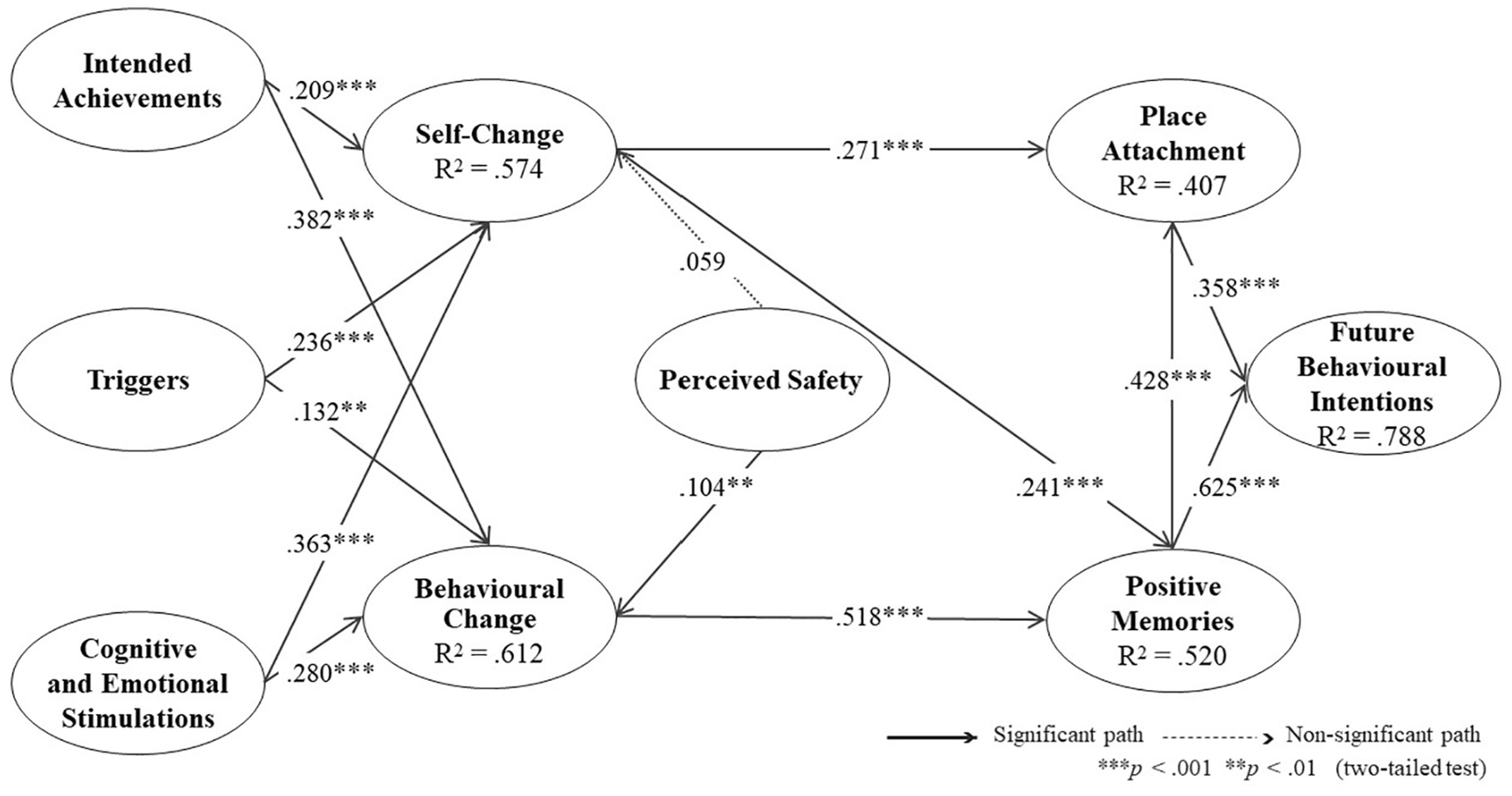
Structural model results.
Structural Model Testing Results.
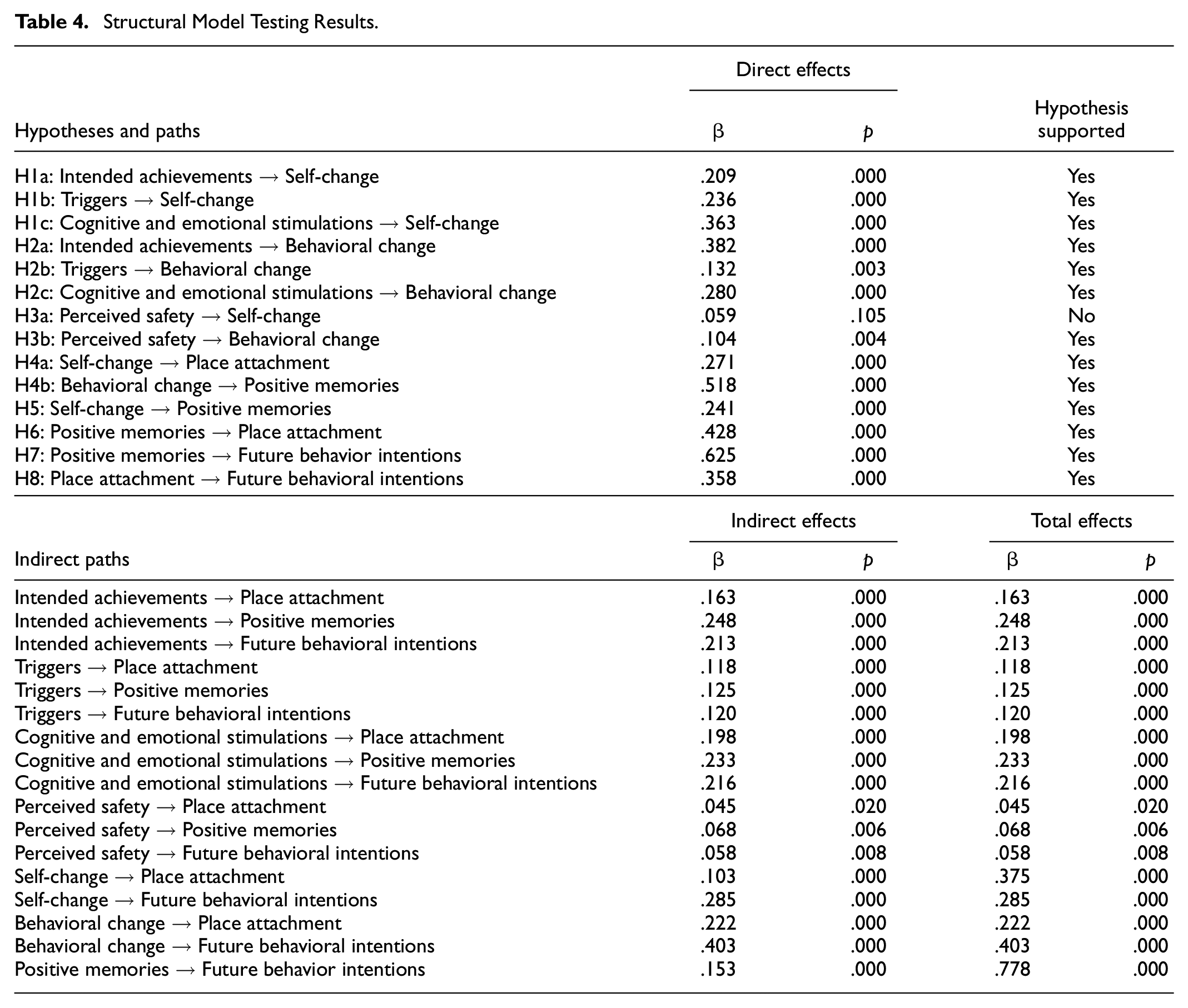
Considering indirect paths (Table 4), the influence of positive memories on future behavioral intentions was confirmed to be the strongest impact of the model, with the highest total effect (β = .778, p < .001). Directly below the aforementioned effect and the impacts of behavioral change on positive memories and of positive memories on place attachment, comes the fourth highest total effect: behavioral change on future behavioral intentions (β = .403, p < .001), with the highest indirect effect registered. The second highest indirect effect is the influence of self-change also on future behavioral intentions (β = .285, p < .001). These findings reveal a noteworthy indirect influence that outcomes of transformative tourism experiences exert on shaping loyalty intentions.
Hereafter, the explanatory power of the model is high, considering the coefficients of determination (R2), ranging from .407 (place attachment) to .788 (future behavioral intentions; Figure 2). The model demonstrated a moderate predictive power, with reasonable ability to predict new observations “out of sample” (Hair et al., 2021). Using the PLS predict procedure and taking behavioral change as the key target construct and the root mean square error (RMSE) as the prediction statistic, all but one indicator in the PLS-SEM analysis yield smaller prediction errors compared to the linear model.
Discussion
Considering the hypotheses formulated, the major findings of this study are as follows. Firstly, all hypotheses regarding the components of transformative tourism experiences are well-supported. The intended achievements, triggers, and cognitive and emotional stimulations not only positively influence self-change but also contribute significantly to behavioral change. Intended achievements are confirmed to result in positive self-change, such as personal empowerment and self-confidence, aligning with students’ educational, and cultural immersion goals (Tasci & Godovykh, 2021). Moreover, the analysis substantiates that intended achievements lead to behavioral change, such as increased social engagement and community involvement (Brown, 2009). This alignment resonates with the co-creative nature of tourists shaping their experiences through participation in local academic and cultural activities. The triggers, such as meaningful connections and cultural immersion, are directly linked to the experience economy’s focus on creating memorable and engaging experiences (Kirillova et al., 2017b). These interactions are validated to catalyze substantial self-change, enriching students’ worldviews and fostering personal development. Furthermore, triggers are also proven to prompt behavioral change, which manifests as shifts in lifestyle or social behaviors, aligning with the experience economy’s emphasis on staging experiences that are both memorable and engaging (Tasci & Godovykh, 2021). Cognitive and emotional stimulations, as evidenced by the students’ active psychological engagement with their environment (Tasci & Godovykh, 2021), are verified to induce transformative self-change. This alignment resonates with both the experience economy framework and co-creation theory. Additionally, these stimulations are confirmed to trigger behavioral change, such as heightened solidarity and an increased appreciation for life’s simple pleasures, thereby reinforcing support for both the experience economy framework and co-creation theory.
Secondly, the positive impact of perceived safety on behavioral change establishes a foundation that enables students to engage in the experience with expectations of personal transformation. This aligns with research showing the importance of safety as a key component of service experiences (Estrada et al., 2024), with tourism destinations prioritizing the integration of safety into high-quality experiences (UNWTO, 2022). Understanding tourist perceptions of safety and their impact on the experience is crucial for tourism stakeholders (Zou & Meng, 2020). This is particularly relevant for academic tourists, who often travel alone to study at educational institutions for extended periods. In this context, the importance of safety must be underscored when considering their behavioral change. However, perceived safety is not significant in triggering students to self-change. Previous research considers risk as a negative transformation influencing factor (Teoh et al., 2021). This merits further exploration of how risk and challenging situations specifically influence personal change, although existing studies may explain the non-significant positive impact. For instance, Noy (2004) reports that backpackers, often young and on extended journeys like academic tourists, pursue adventure and risk by traveling “off the beaten track.” Perhaps precisely due to the perceived risk, these experiences are viewed as highly positive and generative of significant personal change.
Thirdly, self-change has a positive effect on place attachment and on positive memories, as well as behavioral change has a positive effect on positive memories. Findings confirming that self-change strengthens emotional connections with the study destination (Quintero & Zerva, 2023) and cultivates favorable memories (Sthapit et al., 2019) are in line with previous research. Behavioral change resolutions are, in turn, more significantly associated with positive memories (Sthapit et al., 2019).
Place attachment and especially positive memories are confirmed to have a highly significant positive effect on future behavioral intentions. This shows how important it is for destinations and their stakeholders to design and facilitate transformative academic tourism experiences, to develop lasting positive memories that may gradually reinforce the preference for the study destination over others. These results are in line with previous studies. In the study abroad context, Quintero and Zerva (2023) underline that significant experiences at destinations foster deep emotional connections, forming the basis of place attachment. For international students, this entails navigating a complex mix of emotions and adjustments, transitioning from their familiar environments to forging new connections in the host country. Their study highlights how such experiences can disrupt students’ connections with their original home, while also facilitating the development of new emotional bonds with the host destination, essentially creating a new sense of home (Quintero & Zerva, 2023).
Fourthly, findings corroborate previous studies (Oh et al., 2007; Sthapit et al., 2017; Tsai, 2016; Vada et al., 2019; H. Zhang et al., 2018) that positive memories have a positive and significant effect on place attachment and especially on future behavioral intentions (the higher direct and total effect of the model). Within the academic tourism context, leveraging the power of positive memories can help study destinations build a loyal visitor base and encourage repeat visits, which can contribute significantly to their long-term development and competitive advantage in the global education market. Engaging students in memorable transformative tourism experiences not only fosters a stronger connection to the place, but also increases the likelihood that they will recommend the destination to others, thereby improving its reputation and attractiveness.
Fifthly, place attachment had a positive and significant effect on future behavioral intentions, corroborating abundant research (J. F. George & George, 2004; Hosany et al., 2019; Loureiro, 2014; Sthapit et al., 2017; Y. C. Wang et al., 2020; Z. F. Zhao & Li, 2022). Meaningful connections between students and their study destinations enrich the educational journey and turn students into lifelong place ambassadors (De Nisco et al., 2017). Given their youth, these students have also a greater potential for multiple returns throughout their lives, thereby contributing to the destination’s long-term appeal and sustainability.
Conclusions
This study makes significant contributions to both theoretical comprehension and managerial implications of transformative tourism experiences. The model was tested within the unique academic tourism context (Martínez-Roget & Rodríguez, 2021), a type of tourism that is not only conducive to transformations but also with the potential to enhance destination competitiveness and sustainability. The study explores the interrelationships among the components of transformative tourism experiences, the role of perceived safety as an influencing factor, and impacts on perceptions and attitudes toward the study destination.
Theoretical Contributions
The present study makes four main theoretical contributions. Firstly, it operationalizes transformative tourism experiences exploring the causal interrelationships among activating factors and transformation outcomes within academic tourism. Both the co-creation theory (Prahalad & Ramaswamy, 2004a) and the experience economy framework (Pine & Gilmore, 1998, 1999) provide a robust framework for understanding the transformative journey of international academic tourists and how it impacts their perceptions, behaviors, and attachments to the destination. With most of the existing research in the field of academic tourism using transformative learning theory (Brown, 2009; Cavender et al., 2020), this study presents an innovative perspective on the study of academic tourism and transformative experiences, setting itself apart from prior empirical analysis.
Secondly, this study extends the co-creation theory to academic tourism by highlighting the active role of these students in their transformative experiences. The findings underscore that academic tourists actively seek transformation during their experiences, leading to significant personal growth and skill development. Specifically, in empirical research on the transformative tourism experiences’ process, intended achievements—encompassing aspirations such as personal growth, acquiring new skills, experiencing different styles of education, and enhancing social networks—have been largely ignored, with similar aspects studied instead as on-site “transformative trip experience” (e.g., Tasci & Godovykh, 2021). In this study, on-site ‘transformative trip experience’ refers to tourism academic experience as the circumstantial specific environment. We thus propose a conceptual shift by viewing intended achievements as purposive factors (Teoh et al., 2021), considered as critical activating factors for academic tourists’ experience (Holtbrügge & Engelhard, 2016). Unlike leisure travelers, these tourists travel for educational reasons and frequently stay in their study destinations for extended periods. This immersion involves a myriad of activities, challenges, and learning experiences, diverging from the occurrence of singular peak experiences typical of other forms of travel. This study enriches transformative tourism experiences theory by highlighting purposive factors as crucial activating factors in academic tourism, emphasizing goal-driven engagements with the destination and the higher education institution ecosystem for catalyzing transformation. Academic tourists embark on their journeys with specific educational and personal development objectives, inherently predisposing them to experiences that can lead to personal and behavioral change. Moreover, it appears pertinent to examine the role of tourists’ goals in various tourism contexts, like volunteer tourism and pilgrimage, cultural tourism or ecotourism/ nature-based tourism to understand their universal impact on facilitating transformation. For instance, Knollenberg et al. (2014) found that while altruism is the primary motivation among potential volunteer tourists, they also desire personal development, cultural experiences, relationship-building, and escaping daily life. In turn, Magrizos et al. (2021) concluded that the degree of transformation of volunteer tourists is significantly influenced by the authenticity and immersiveness of their experiences, as well as their perceptions of the societal meaningfulness of their actions during the trips. In the context of festivals, Neuhofer et al. (2020) identified contextual and psychological dimensions collectively known as PERMA (positive emotions, engagement, relationships, meaning, and accomplishments), which, along with liminality, are crucial for fostering transformative experiences, personal growth, and self-transcendence. Richardson and Insch (2023) examined existential transformation in nature-based tourism at the pre-trip and en-route stages. They found that a personal state of being is essential for transformative outcomes during the journey and similar prior experiences may trigger post-trip evaluations. Such investigation extends the theoretical framework of transformative tourism experiences, suggesting that understanding travelers’ purposes across different tourism types could offer more profound insights into the transformative experience mechanism. Our contribution fosters a broader comprehension of transformation in tourism, advocating for a nuanced exploration of tourists’ activating goals and their transformative journey.
Thirdly, considering that most studies on transformative tourism experiences remain theoretical (Tasci & Godovykh, 2021; Y. Zhao & Agyeiwaah, 2023), this work contributes to the field by laying the foundation for applied research in both academic tourism and transformative tourism experiences. It does so by designing quantitative research on transformative academic tourism experiences, validating an adapted measurement model of transformative tourism experiences within this specific context. Thus, we propose a comprehensive quantitative approach for measuring academic tourists’ perceptions of transformative tourism experiences, expanding knowledge on both topics.
Lastly, to the best of our knowledge, this study is also the first to test and develop empirically a causal relationship model integrating the impacts of transformative tourism experiences on these inextricably associated perceptions and attitudes toward the study destination. Extending the value co-creation theory, the model explores the relationships among the various components of transformative tourism experiences, as well as discussed effects. It thus expands the value co-creation theory supporting the tourist’s journey from transformative experiences to loyalty, emphasizing students’ active role in co-creating experiences, forming attachments, creating memories, and making loyalty decisions. The study thus leverages the co-creation theory and the experience economy framework to examine transformative tourism experiences in academic tourism, presenting novel perspectives on activating factors like intended achievements and analyzing transformative tourism experiences implications on emotional and behavioral ties toward the destination. Additionally, the study delves into how perceived safety influences self-change and behavioral change. This fills another gap in the existing tourism literature by introducing and empirically examining the interconnected roles of transformative experiences, positive memories, and connection to a destination.
Managerial Implications
Results provide evidence that factors fostering transformation can result in personal change and behavioral change. This study provides insights for tourism and educational stakeholders by highlighting the active role of academic tourists in value creation and the relevance of meaningful transformative programs for academic tourists. Findings are instrumental for educational institutions and destinations to ensure higher competitiveness and sustainability.
Initiatives to be promoted by tourism and educational stakeholders in this context should be grounded in how students specifically valued some intended achievements and triggers (see means reported in Table 2). Respondents highly rated their desire to travel and live new experiences, grow as a person, increase their independence, and get to know a new country and culture. Additionally, building memorable interactions with others, such as local people, travelers, and new friends and immersing in a new cultural context or engaging in cultural activities emerged as the key activities that triggered significant transformations.
For instance, collaborative programs could be coordinated with travel agencies or local organizations. These programs could provide academic tourists with distinctive and meaningful opportunities to engage with local communities, offering cultural immersions like homestays, language exchanges, and volunteer work. These experiences enable participants to understand local culture, traditions, and ways of life. To deepen the cultural connection and encourage cross-cultural communication, language immersion programs could be included.
Moreover, workshops, lectures, or seminars could be organized to promote cross-cultural understanding and offer deeper insights into the region’s culture and history. These workshops could also emphasize sustainable and socially responsible practices, respecting the cultural heritage and rights of local communities to mitigate negative impacts on the environment and the locals. This approach benefits the destinations and encourages academic tourists to become more conscious global citizens, inspiring them to advocate for sustainable practices in their academic and personal lives.
Additionally, to foster transformative experiences, it is essential to provide moments or activities that encourage self-reflection, critical thinking, and profound connections. For instance, participants might be encouraged to maintain a diary, blog, or take part in courses that necessitate cross-cultural immersion or a deep connection with locals.
Lastly, recognizing the impact of perceived safety on the behavioral change of the transformative tourism experiences, tourism and educational stakeholders should prioritize creating safe environments for academic tourists. Yet, as challenges facilitate self-change, ensuring multicultural activities (e.g., team projects) in the academic context can foster the transformative development of their cultural and social skills (Holtbrügge & Engelhard, 2016). Promoting the integration of foreign and local students involves navigating cultural differences, language barriers, and varying educational backgrounds. These controlled challenges can activate self-change.
Limitations and Future Research
This study is not exempt from limitations. The data collection was confined to one country and within one academic year. Future studies should broaden the geographic scope and conduct longitudinal research to track variances across academic years. Moreover, academic travel experiences may heighten the unease felt by students upon their return home or even foster a desire to live abroad, potentially inducing tensions at both personal and societal levels. Further research is needed on these potential downsides. Furthermore, studies examining the effects of transformative travel on host communities remain sparse. Hence, future research may explore how to design transformative tourism experiences programs that may also benefit host communities and encourage meaningful interactions between them and academic tourists. To further understand the long-term behavioral and personal changes that come from such experiences, longitudinal research is also suggested. Future research could also explore the impact of academic tourists’ sociodemographic characteristics on transformative tourism experiences and their impacts, aiding stakeholders and marketers in crafting more personalized impactful experiences. Finally, as researchers are advocating a shift in the focus of tourism research based on happiness, self-actualization, and self-fulfilment after returning home (Chhabra, 2021), examining these aspects in transformative tourism experiences studies is also recommended.
Footnotes
Declaration of Conflicting Interests
The author(s) declared no potential conflicts of interest with respect to the research, authorship, and/or publication of this article.
Funding
The author(s) received no financial support for the research, authorship, and/or publication of this article.
