




Abstract
Integrating Torbiorn’s theory of adjustment and Lazarus’ theory of stress, this study examines the antecedents, consequences, and mitigating factors of international business travel adjustment. Results from two studies, a unique pre (Time 1) and post (Time 2) travel survey conducted before COVID at two airports in North and South America, and data collected post-COVID using an online panel of business travelers illustrate how and why adjustment mediates the travel stress/leisure exploration–trip satisfaction relationship. Our findings guide managers and practitioners to mitigate the negative impact of travel stress by allowing time for leisure exploration while on international business trips. Tourism businesses should continue to explore and design experiences that satisfy the general adjustment needs of the international business travel market.
Keywords
Introduction
With employee wellbeing in focus, another growing trend is to allow employees to tack a few days’ holiday on to a business trip, or to extend their stay by working remotely from a hotel or rental apartment and enjoying the local area. (Georgiadis, 2024)
The Global Business Travel Association (GBTA, 2023) projects that organizations are expected to spend record amounts in 2024 on international business travel, defined as a business (rather than leisure) trip destined for a country other than the home country for less than 90 days, which is the maximum stay rule within 180 days in the Schengen zone. Companies recognize the importance of international business travel since it increases authentic experiences (Unger et al., 2020), work role novelty (Dimitrova, 2020), and one’s global mindset (Andresen & Bergdolt, 2021). Yet, international business travel is an aspect of work that decreases satisfaction due to the stress surrounding the trip (H. S. Chen, 2017; Mäkelä et al., 2021). While the stress mechanism has merit, how it is associated with trip adjustment and, subsequently, trip satisfaction has not been empirically tested in the context of international business travel (Dimitrova et al., 2020; Shaffer et al., 2012). Indeed, international business travel research remains promising, with calls (see e.g., Shin et al., 2024) for its expansion.
International business travel can be challenging. Catastrophic events such as terrorist attacks and airline crashes resulted in longer queues, tighter security, more restrictive carry-on allotments, an increase in physical searches, and less trust in fellow passengers, all of which add to the stress experienced by the traveler (Lamb et al., 2021). Then, the uncertainty in the international business world caused by COVID-19 further exasperated air-travel stress (X. Wang et al., 2023; Zhang et al., 2021) with the tightening of travel budgets and agendas (Georgiadis, 2024; Müller & Wittmer, 2023; Sneader & Singhal, 2021). While international business travelers have felt these increased travel strains, defined as the perceptual, emotional, behavioral, and physical responses made by an individual to the various problems faced during one or more of the travel phases (DeFrank et al., 2000), an empirical investigation of their consequences is lacking in the literature (see Table 1).
Summary of Extant Literature on Business Travel.
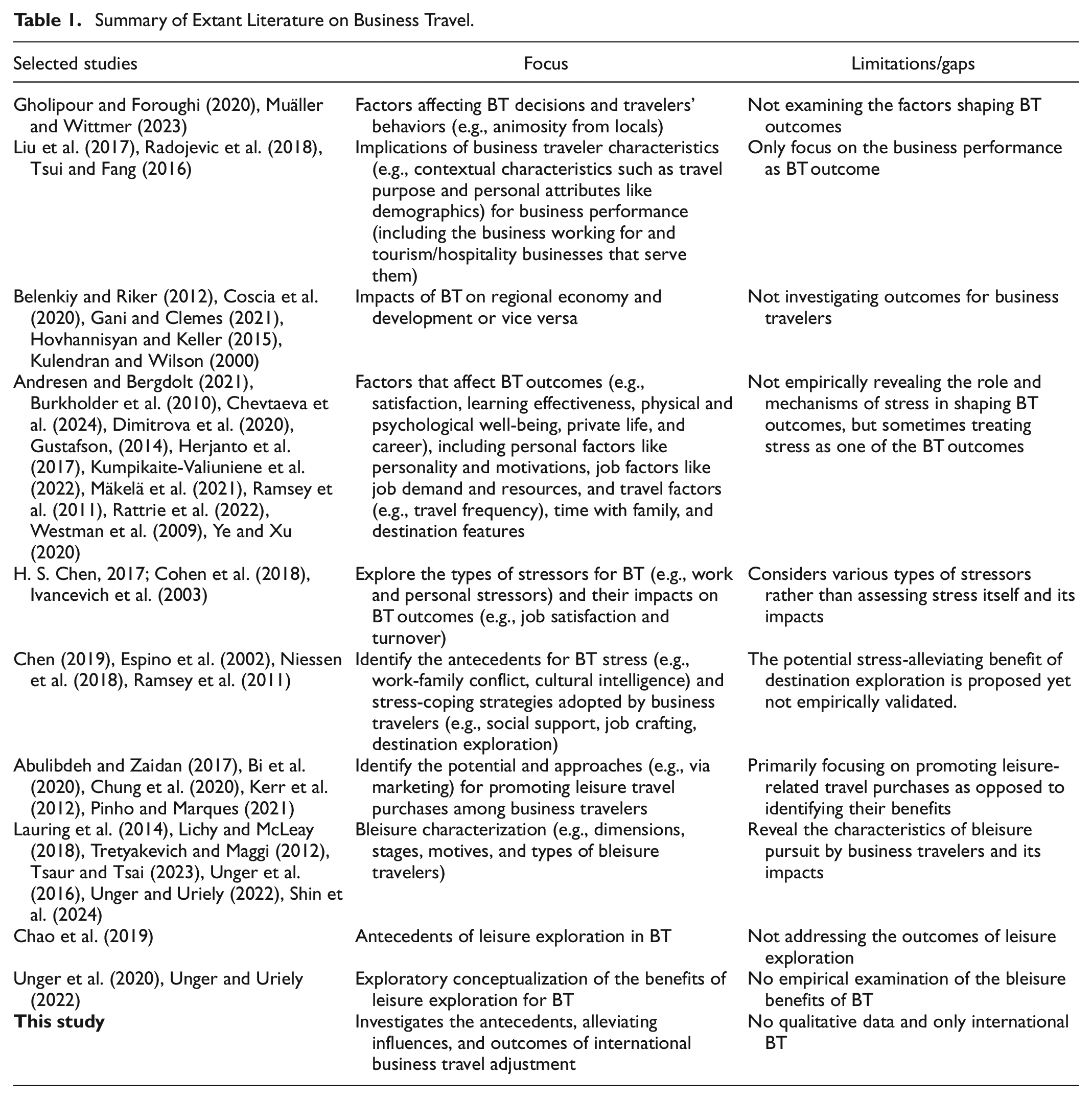
Based on the assumption that trip adjustment is a crucial mechanism underlying the international business travel stress process, the recent trend of bleisure originating in the tourism sector may offer a promising solution to alleviate travel stress. The bleisure term depicts the rising tendency for business travelers to combine their business trips with leisure exploration at the host destination (Walia et al., 2023). For example, the Global Business Travel Association (2023, p. 3) recently reported that “while 53% of North American business travelers took such a trip (bleisure) in the past year, this figure was much lower (37%) six years ago.” Leisure demand from business travelers is essential because it can play a crucial role in determining international business travel decisions and destination choices (Ye & Xu, 2020). Despite the growing demand for bleisure, international business travel still lacks leisure offerings, such as time allotted for exploring the destination (e.g., Shin et al., 2024; Unger et al., 2020).
The role of leisure exploration in facilitating adjustment among international business travelers is still in its infancy. Notwithstanding the popularity of bleisure in industrial practices (Morgan, 2022), research on this topic has been scarce. A paucity of literature has explored the potential leisure demands of the international business traveler market, advocating tourism destinations, and travel businesses to create products accordingly (Chung et al., 2020; Lichy & McLeay, 2018). Recent research also examines the blurring of lines between work and leisure on remote work trips for well-being (Chevtaeva et al., 2024). However, these studies primarily take the tourism industrial perspective about fulfilling the spending potential of this niche market and transforming it into future leisure travelers. Vastly underestimated is assessing the impact of bleisure on international business travelers’ trip satisfaction (Jooss et al., 2021), which can be vital to their job loyalty, job satisfaction, job performance (Dimitrova et al., 2020), and ultimately physical and mental well-being (Georgiadis, 2024). Accordingly, this study investigates the antecedents, alleviating influences, and outcomes of international business travel adjustment.
Our contribution to the travel literature is fourfold. First, unlike prior research, by accessing travelers during and after the actual international business travel at the gates, we avoid the problems associated with retrospective recall of previous experiences and refer to specific events as they are happening. Second, we posit that travel stress is a relevant predictor of adjustment due to the time allotted to traveling for an international business traveler. Third, we propose the decisive mechanism of leisure exploration to facilitate international business travel adjustment and trip satisfaction. Finally, this study advocates the relevance of trip adjustment when identifying the potential inhibitors and facilitators of trip satisfaction.
Theoretical Background and Hypotheses Development
Subjective Adjustment
Subjective adjustment refers to “changes which the individual actively engenders or passively accepts in order to achieve or maintain a state in which he can feel satisfaction” (Torbiörn, 1982, p. 55). The term “subjective” is important because the focus is on the perception of balance rather than actual balance. If an individual does not perceive the lack of balance, they will maintain a state of satisfaction, thus not initiating the adjustment process. Torbiorn’s (1982) theory of adjustment is the principal theory we use to understand subjective adjustment due to its applicability to an international business travel context. It centers on how the individual may respond to the surroundings and their opportunities to achieve satisfaction in the present setting.
Our study focuses on how an individual adjusts while on an international business trip, its consequences, and how the process and outcomes can be aided through leisure exploration (see Figure 1). Since there has been very little empirical research focusing on adjustment in the international business travel context (Collings et al., 2007; Jooss et al., 2021; Kraimer et al., 2022; Shaffer et al., 2016), we will integrate adjustment theory with findings from the expatriate literature.
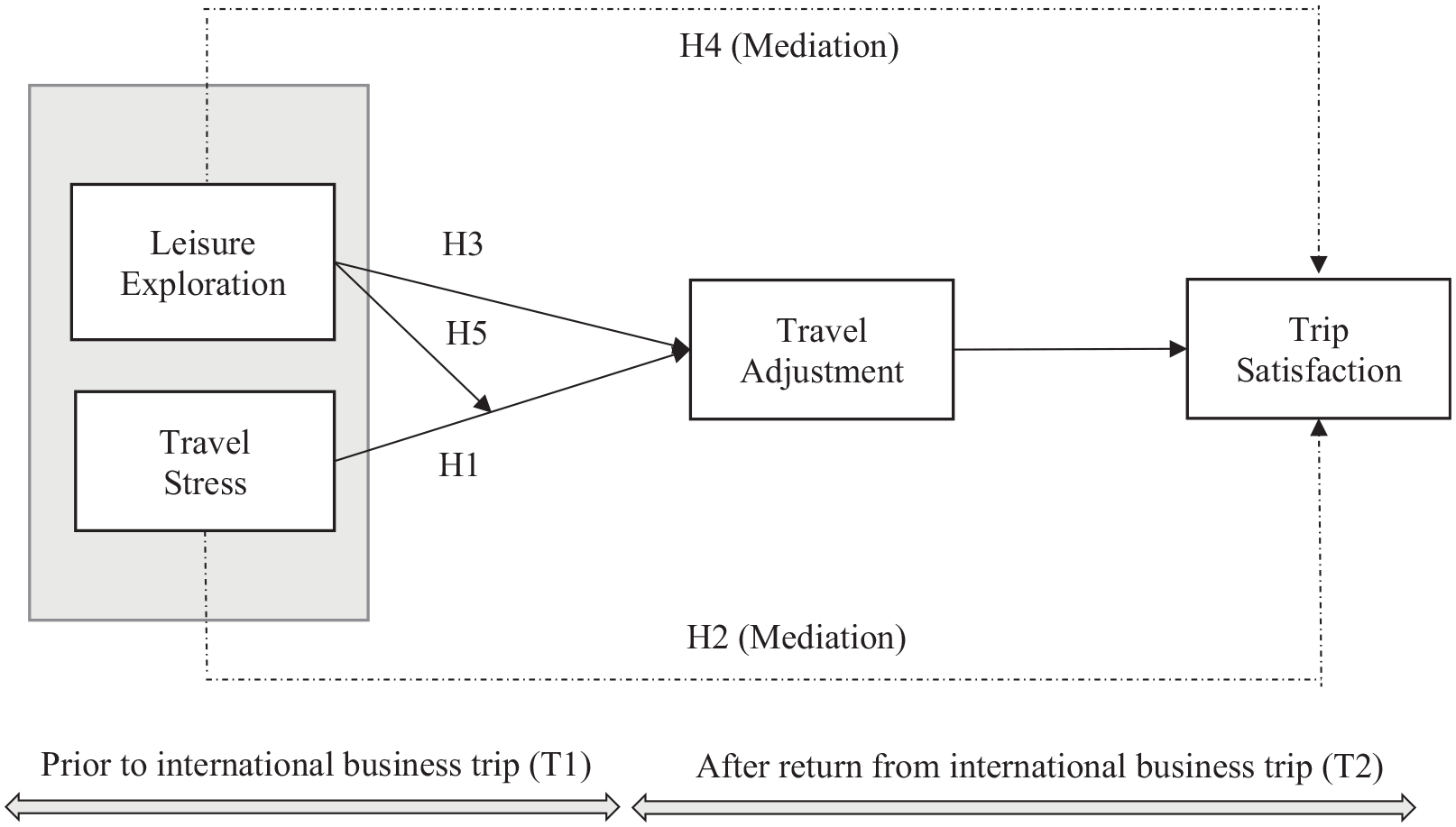
Proposed model.
The dominant model in expatriate adjustment research was developed by Black (1988) and encapsulated three components of adjustment: general, work, and interaction. Black’s (1988) model is also based on uncertainty (tension) reduction, like Torbiorn’s theory. An individual leaves a familiar setting and enters an unfamiliar one, which upsets old routines and creates psychological uncertainty (Black et al., 1991). Like all tension systems, Black et al. (1991) assumed that individuals desire to reduce the uncertainty inherent in the new setting. In summary, an increase in uncertainty increases tension and lowers the ability to adjust to the host environment. We now investigate how stress affects a traveler in an international business travel context.
Following Torbiorn’s theory of adjustment, there are two primary reasons for an increase in tension applicable to the short-term context of international business travel. First, due to the lack of time, travelers will not perform well on international business trips because they do not understand the appropriate behavior in the host environment. The travelers’ perceived applicability of behavior is low, increasing tension and, subsequently, needing to adjust. Second, travelers will not be satisfied with the trip because they recognize that the frame of reference built in their home country does not apply to the new host country. Therefore, as the travelers’ perceived clarity regarding their frame of reference decreases, the tension and need to adjust increases.
When an international business traveler considers each of the factors above, the result will be some amount of stress discernable along a continuum (low stress to high stress). The decreased degree of both applicability and clarity causes more stress and less satisfied travelers. Therefore, we propose that the factors reviewed operate through the stress mechanism.
Integration of Stress and Adjustment Theories
Lazarus’s (1991) theory of stress advocates that for a relationship between a person and the environment to be stressful, the person must first have a stake in the outcome. Second, psychological stress occurs only when a person has made an appraisal that external or internal demands exceed their resources. An individual will only feel stress when both conditions are present. Then, the individual will attempt to change that undesirable situation. Thus, stress implies a process rather than a static understanding. The process of reducing stress can be viewed as an adjustment process.
Torbiorn’s theory of adjustment and Lazarus’ (1991) theory of stress posit that when an individual suffers a strain, an adjustment process is activated to reduce it (Lazarus, 1991; Torbiörn, 1982). Individuals want to adjust because they are in an uncomfortable cognitive state due to a perception of a low degree of applicability or clarity (theory of adjustment) and demands exceeding resources (theory of stress). Integrating these two theories provides a more robust foundation for understanding the context of international business travel better because apart their interpretation only tells part of the story. For instance, utilizing only Torbiorn’s theory of adjustment, the traveler is dissatisfied on the international trip due to a low degree of applicability or clarity (e.g., not performing well or not understanding what should be done). However, by adding Lazarus’ theory of stress, we can see that a low degree of applicability and clarity produces stress in the context of international business travel because demands exceed the resources of the sojourner. In other words, the theory of stress puts boundary conditions on the adjustment process.
The strain triggers that surround international business travel begin when the traveler starts thinking about the trip (Zhang et al., 2021). The anticipated stress can cause actual strain even before the trip starts due to the uncertainty surrounding the trip (Batra, 2021). For example, a salesperson traveling for work may have a substantial bonus if the trip succeeds. Even en route to the airport, the salesperson is contemplating whether “what it will take to get the sale” is clear (theory of adjustment) and whether sufficient resources are available to negotiate the sale (theory of stress). Furthermore, the strain does not end once the sojourner arrives at the destination because ample uncertainty presents itself throughout the trip. These strains are more salient to international business travelers than expatriates, who might be more concerned with housing, schooling for children, and spouse satisfaction (Kraimer et al., 2022).
International Business Travel Stress
Travel strain (we use the terms travel train and travel stress interchangeably) is augmented by the increased pressure of traveling for international business (Batra, 2021). For instance, two travelers on the same flight from Atlanta to Moscow via Paris are both concerned about a late arrival in Paris. However, business travelers are more likely to experience travel strain because they must, for example, attend dinner meetings the following day. In contrast, the leisure traveler may relish the idea of dinner (paid for by the airline) in Paris. “Missing out on sleep, working non-stop on the plane or train, and eating unhealthy foods are all common habits of the business traveler lifestyle” (Miller, 2012, p. 1).
We suggest that the same mechanism underlying stress generally operates in international business travel. That is, an increase in uncertainty due to the international travel context will lead the international business traveler to feel the rise in travel stress. Business travelers will experience stress to the degree that they think they have the resources necessary to circumvent the obstacles involved in international travel. Further, Lazarus’ theory of stress suggests that people who feel an increase in international business travel strain will not be able to adjust as well to their foreign environment because of the perceived lack of mental resources available to process the relevant pieces of information necessary to facilitate effective adjustment (e.g., verbal and non-verbal cues of the host country nationals).
Finally, Torbiorn’s theory of adjustment suggests that travelers who do not understand how to maneuver through the trip process and are uncertain about their frame of reference will also not adjust. The lack of understanding will also increase travel strain due to the lack of perceived resources available to the traveler. Finally, this will be compounded for international business travelers because they “do not have the same time as traditional expatriates to adjust to a new culture” (Collings et al., 2007, p. 208). The time factor is essential because it relates to both experience and adjustment (Takeuchi et al., 2005). In summary, integrating these two theories suggests that travelers who perceive travel stress will have fewer resources to deal with their culture, interact with host country nationals, and adjust to work demands. Thus, we hypothesize:
Mediating Effects of International Business Travel Adjustment
Within the international business travel context, the spillover effect illustrated by stress theory suggests how and why an increase in strain affects trip satisfaction. Limited research has demonstrated that adjusting to a different culture and way of doing business decreases business travel stress (DeFrank et al., 2000) and a host of adverse effects surrounding the international business travel experience. One such effect is job satisfaction. While DeFrank et al. (2000) suggest that stress and job satisfaction result from adjustment, we believe that the strain from international business travel precedes the adjustment process. Mäkelä and Kinnunen (2016) found that job demands (stressors) were positively related to exhaustion but did not influence trip satisfaction. Their non-significant findings on trip satisfaction could be due to omitting adjustment as a mediator.
Also, the tourism literature establishes the relationship between emotional status (e.g., stress) and its impact on trip satisfaction for both international and domestic tourists (Hosany et al., 2017; Prayag et al., 2017). Thus, the underlying mechanism for such a relationship still demands in-depth exploration, whereby adjustment appears as a promising explanatory factor. Specifically, given the context of short-term international business travel, we suggest that travel adjustment will mediate the relationship between travel stress and trip satisfaction.
Leisure Exploration
Drawing on the tourism and adjustment literature, leisure exploration on an international business trip may facilitate travelers’ adjustment, increasing their trip satisfaction and potential willingness for future business trips. This inclination to go on business trips is in jeopardy due to the current affinity towards online videoconferencing (e.g., Zoom and Webex) post-COVID-19. Scholars found that the effective deployment of specific resources is a critical factor for successful adjustment when working abroad (Davies et al., 2019). For example, knowledge of how to fit in the host environment, personal capabilities, and social and organizational support all seem to help (Hippler et al., 2015; Koveshnikov & Wechtler, 2014; Lee & Kartika, 2014; Takeuchi, 2010). Leisure exploration can replenish resources exhausted on international business trips while allowing travelers to gain otherwise unavailable resources.
Resources such as physical energy, intellectual capacity, and emotional stability enable better adjustment to novel work and cultural environments (Wu et al., 2022). Yet those resources are often exhausted while coping with work or travel stressors on an international business trip (Zhang et al., 2021). As a form of non-work life enrichment, leisure exploration can potentially restore these exhausted resources (Vada et al., 2020; Walters et al., 2022). Leisure exploration allows international business travelers to escape from their daily routine and fully immerse themselves in nature or culture (Sheldon, 2020; J. Wang et al., 2020). It restores travelers’ mental and physical resources and protects them from the fatigue of the physical, cognitive, and emotional effort required to undertake the international business trip (Hosany et al., 2021).
The restorative function may emerge before the trip starts while anticipating leisure exploration and could last throughout the trip (Lehto & Lehto, 2019). As such, restoring resources by leisure exploration becomes a sustained source of support, empowering international business travelers to better adjust to the novel business environment. The rejuvenation is expected to be more salient in fast-paced international business trips than its established extent among expatriates, given the former’s limited time for adjustment and its lack of alternative opportunities for resource replenishment (Kempen et al., 2015). Regarding gaining new resources, leisure exploration first serves as an additional source of cross-cultural training to help travelers adapt to a different culture (Almeida-García et al., 2020). Cross-cultural training can significantly improve the effectiveness of international business travel adjustment in all three facets (i.e., general, work, and interaction adjustment) (Takeuchi, 2010).
Studies have emphasized how the diversity of supportive social networks is crucial for the success of adjustment. For example, diverse host country groups, such as hosting colleagues and locals encountered in non-work settings, provide all-around support for adjusting to the novel environment (Bayraktar, 2019). In a similar vein, for international business travelers, given the challenge of required speedy adjustment, the encounters with locals in leisure exploration essentially garner support from a broader social network in the host community (Anantamongkolkul et al., 2019). It can even become a reciprocal cycle whereby social support further empowers international business travelers to connect with local colleagues and gain more social support (Fu & Charoensukmongkol, 2021). Such additional social interactions are not only much-needed social resources for adjustment but are also a way to decrease loneliness on the trip and facilitate the confidence to adjust.
Relaxation or recovery experiences repair the exacerbating effects of work demands for international business travelers (Rattrie et al., 2022). Also, leisure exploration has been established in domestic business travel settings as an essential buffer against the adverse effects of work and life stress (C.-C. Chen et al., 2020; Kawakubo & Oguchi, 2019). Thus, it is reasonable to assume that leisure exploration can ease the adverse effects of strain on international business travel adjustment. Such moderating effects may manifest through the following different potential mechanisms.
First, leisure exploration is an escape from stressful settings (e.g., international air travel and fast-paced work schedules), which should be particularly effective in recovering international business travelers’ exhausted adjustment resources (Sigala, 2020). Such restoration can enhance travelers’ perceived resource sufficiency and make more stress-coping strategies possible (H. S. Chen, 2017; Zhu et al., 2020). For instance, individuals who perceive sufficient coping resources are more likely to optimize their emotional regulatory strategies in the face of stress (Crum et al., 2020). Second, leisure exploration can distract individual attention from stress and buffer its adverse effects (Iwasaki et al., 2005; Zhu et al., 2020). Gustafson (2014) interviewed business travelers and found that fun travel (e.g., exciting destinations) deviates attention from adjustment-hindering travel strains. Lastly, personal growth opportunities from leisure exploration can provide meaning to international business trips and motivate travelers to perceive trip stressors as an investment for growth (Jamieson et al., 2018). For instance, international business travelers may consider authentic foreign cultural encounters in leisure exploration as a rewarding life experience that increases open-mindedness and a sense of a cosmopolitan identity (Cohen & Gössling, 2015).
In summary, longer leisure exploration is likely to restore adjustment resources that support stress-coping flexibility (C.-C. Chen et al., 2020; Packer, 2021), distract from strains (C.-C. Chen et al., 2020), and induce a less harmful conception of international business travel stress by bringing significant growth benefits (Sheldon, 2020). We accordingly propose how leisure exploration can facilitate international business travelers’ adjustment by reducing the adjustment-inhibiting travel stress effect as established in Hypothesis 1.
Methods
Measurement
The study’s main variables were measured using previously validated multi-item scales, with some items reworded to ensure clarity and applicability. The international business travel stress measure was adapted from Bricker’s (2005) three-dimensional scale. Travel anxiety was measured with three items (e.g., “I worry that my flight will be canceled”) and travel anger with three items (e.g., “I want to say mean things when other passengers take up part of my personal space on the plane”). The original airline/airport trust scale was reverse-coded to better align with other travel strains and reduced to three items due to low factor loadings. Participants had to rate their level of agreement or disagreement with the statements on a 7-point scale (0 = completely disagree and 6 = completely agree). In line with previous studies (e.g., Ramsey, 2013) and given satisfactory Cronbach’s α (.71), summated scores for travel stress were used in the primary analysis.
Leisure exploration, adapted from Jeong and Park (2020), was measured by asking, “How much time do/did you have to explore the area?” using a 5-point Likert scale with “none” (1) and “all” (5) as the anchors. International business travel adjustment was measured using 9 items derived from previous research on expatriate adjustment (Black & Stephens, 1989; Torbiörn, 1982). Business travelers must adjust to the food, working conditions, and host country nationals. The wording of the items was slightly different to reflect the different context (e.g., time constraints) of an international business trip versus an expatriate assignment. The scale (1 = not adjusted at all; 7 = very well adjusted) consists of three items, each capturing general adjustment, interaction adjustment, and work adjustment. Finally, we adapted Agho et al.’s (1992) scale to measure trip satisfaction. Participants rated their level of agreement or disagreement with three statements (1 = strongly disagree and 5 = strongly agree). Table 2 provides an overview of the scales, scale items used, and composite reliabilities.
Confirmatory Factor Analysis Results (N = 104).
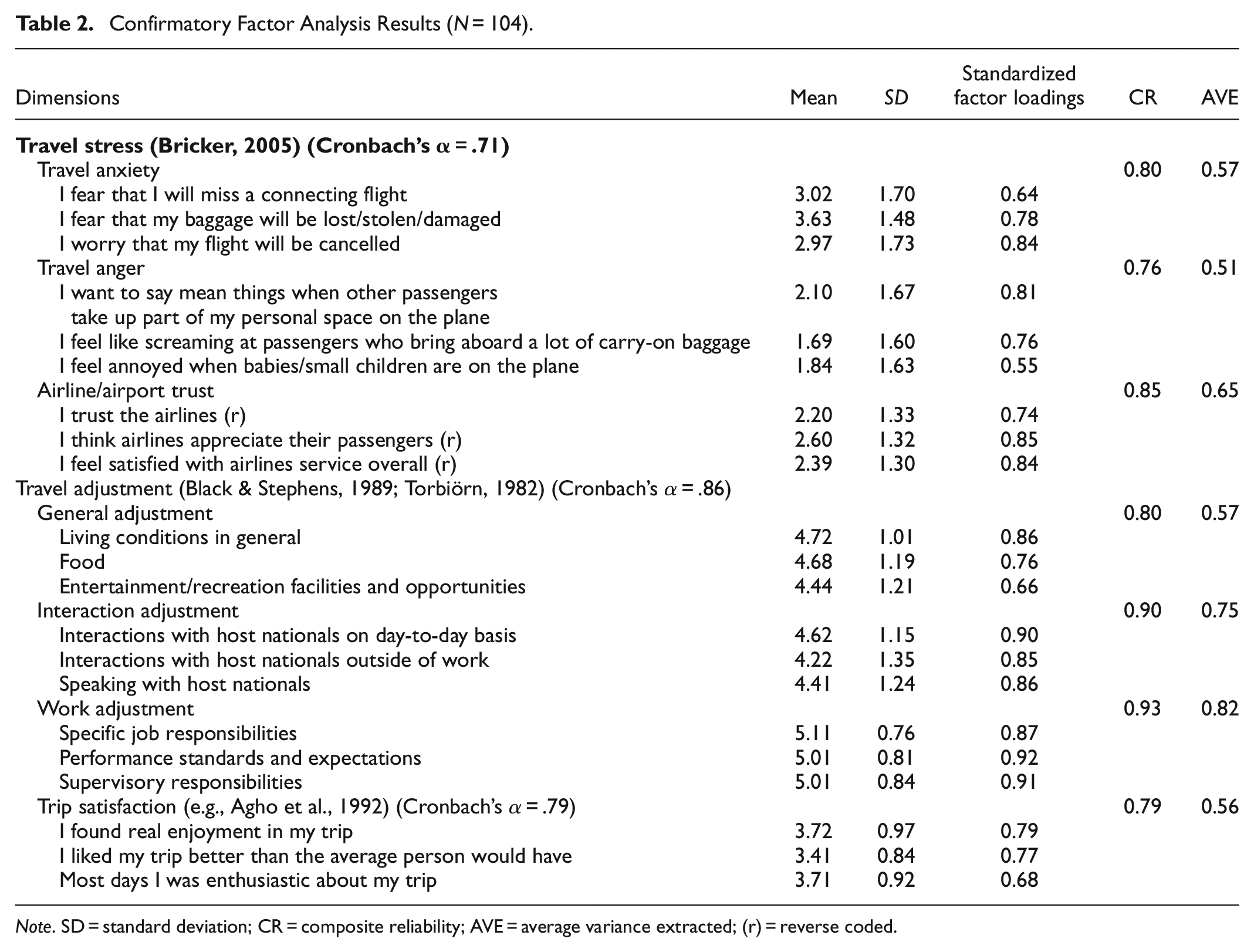
Note. SD = standard deviation; CR = composite reliability; AVE = average variance extracted; (r) = reverse coded.
Since trip satisfaction and travel adjustment can be influenced by elements other than travel stress, we included control variables regarding demographics and trip characteristics. In line with previous adjustment and satisfaction studies (Shaffer et al., 1999), we included controls for gender, age, and nationality. Trip characteristic controls included the number of companions on the trip and the number of trips taken in the prior year. Finally, we included country-level cultural distance (Kogut & Singh, 1988) as a potential alternative explanation (see Table 3 for means, standard deviation, and correlations between the variables). While we initially controlled for the length of the international business trip, it was not statistically significant in any of the hypothesis tests. For instance, in exploring the travel stress–adjustment–trip satisfaction relationship, the statistics for the trip length as a control variable are: B = .001, SE = .001, t = .613, p = .541. Similarly, when examining whether the length of the trip moderates the travel stress–trip adjustment relationship, neither the trip length nor its interaction term with travel stress was statistically significant (Length: B = .0002, SE = .002, t = .147, p = .884; Length × TStress: B = .001, SE = .003, t = .253, p = .801). Thus, given the lack of significant results when included as a control variable, trip length was removed from our analyses to maintain statistical power in the hypotheses tests.
Means, Standard Deviation, Correlations, and Square Roots of AVEs.
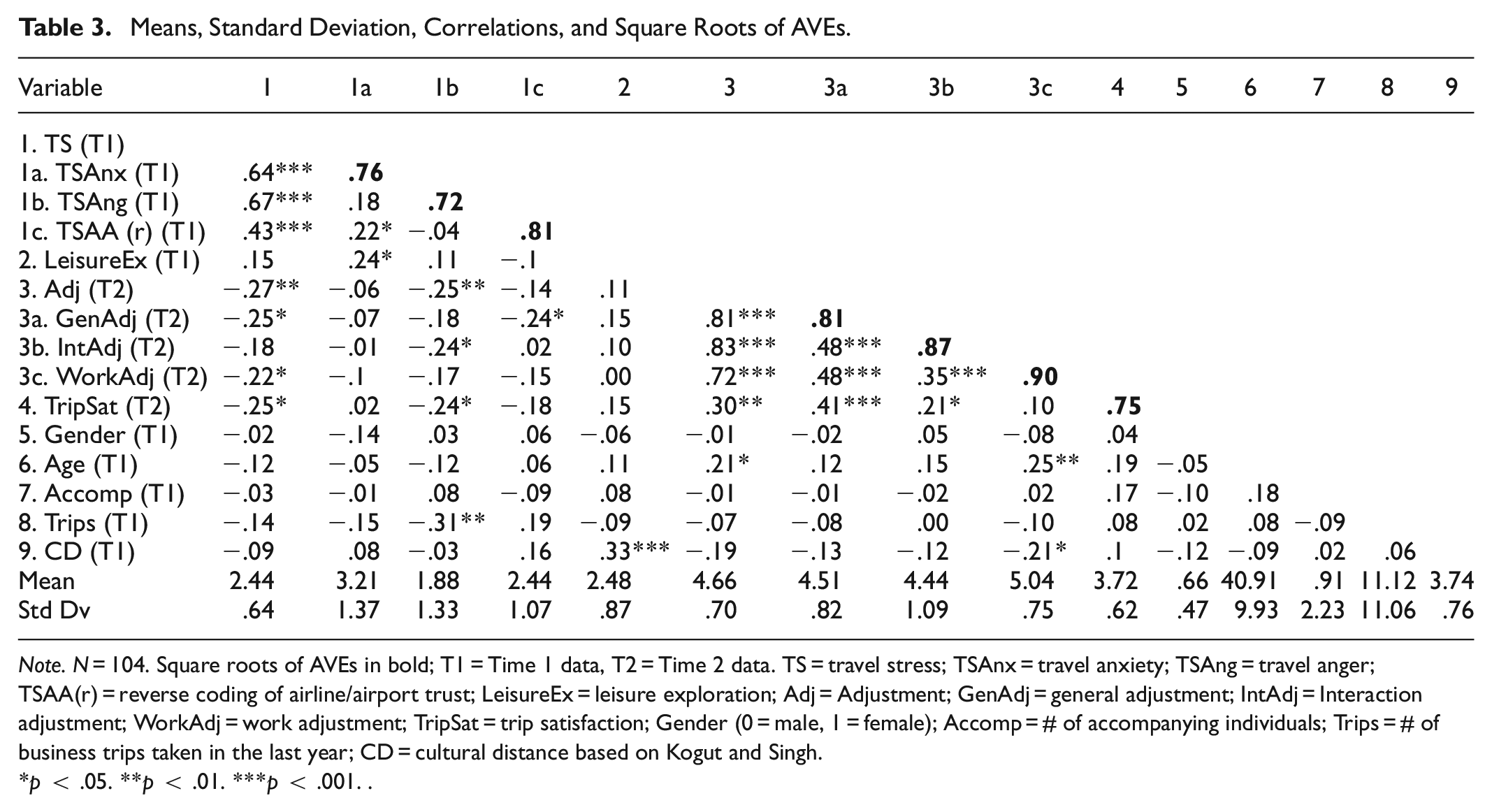
Note. N = 104. Square roots of AVEs in bold; T1 = Time 1 data, T2 = Time 2 data. TS = travel stress; TSAnx = travel anxiety; TSAng = travel anger; TSAA(r) = reverse coding of airline/airport trust; LeisureEx = leisure exploration; Adj = Adjustment; GenAdj = general adjustment; IntAdj = Interaction adjustment; WorkAdj = work adjustment; TripSat = trip satisfaction; Gender (0 = male, 1 = female); Accomp = # of accompanying individuals; Trips = # of business trips taken in the last year; CD = cultural distance based on Kogut and Singh.
p < .05. **p < .01. ***p < .001.
The constructs used in our model are susceptible to common method bias (CMB) due to the cross-sectional nature of our data (Conway & Lance, 2010; Podsakoff et al., 2003). We employ procedural and statistical controls to prevent and detect common method bias (Kock et al., 2021). A priori (procedural control), CMB was minimized as we employed a temporal separation between the collection of the independent, mediating, and dependent variables (Time 1 and Time 2 surveys). Previous studies have shown that this ex-ante technique of a lagged cross-sectional design reduces the likelihood of associated CMB (Podsakoff et al., 2012). Further, the use of different scale properties, the selection of qualified participants, and the unambiguity and short length of the survey aided in reducing the effect of CMB (Podsakoff et al., 2012).
Post hoc (statistical control), we examined the potential effect of CMB using the method factor technique. Results revealed that the model which included the method factor better fit the data χ2 (333) = 446.32, p > .001; RMSEA = 0.06; CFI = 0.96; NNFI = 0.95) than the measurement model without the method factor (χ2 (362) = 524.90, p < .001; RMSEA = 0.06; CFI = 0.95; NNFI = 0.94). However, we did not observe differences in the correlations’ significance level between the models’ variables with or without the CMV factor. In addition, the CMV method factor accounted for 13% of the variance in the data, less than the 25% threshold (Williams et al., 1989). Thus, we conclude that common method bias was not a pervasive problem in the data. The observed relationships represent substantive rather than artificial effects.
Study 1: Time-Lagged Cross-Sectional Survey
Data Collection and Procedure
We designated a business trip between 3 and 90 days versus an expatriate assignment, which is greater than 90 days. The basis for selecting the time parameters is because it is the maximum stay within 180 days in the Schengen zone rule. After 90 days, employees often must apply for a work visa, which changes the nature of the trip and is considered a “short-term assignment.” To test our theoretical model, we used a survey with a lagged cross-sectional design (Filipescu et al., 2013). Travel strain and leisure exploration were collected when participants left for or were currently on an international business trip (Time 1). International business travel adjustment and trip satisfaction were collected after their return (Time 2). Travelers were contacted 3 to 7 days after their return to complete the Time 2 survey. The Time 2 survey was open 3 weeks after the initial follow-up invitation, and frequent reminders were sent.
As part of a nearly 10-year longitudinal project beginning in 2008 to better understand business travel, we selected data from the two primary airports in North and South America. Over 2 weeks, participants were chosen by a five-person research team at the gate-hold area in the International Terminal at Atlanta’s Hartsfield-Jackson International Airport (ATL) and the International Terminal of Guarulhos International Airport (GRU) in São Paulo, Brazil. Only participants on international flights were approached. Both airports are known for their high passenger volume, with ATL being the busiest in North America and GRU being the busiest in South America. Surveying at the gate was deemed especially important to the response rate since travelers would probably resist answering a survey before passing through security. The respondents were approached while sitting at their departure gate and asked to participate in a 15-minute survey focusing on international travel. The only selection limiting criterion was not to approach individuals who appear under the age of 21. Participants could complete the survey in English or Portuguese, and licensed translators were used for back-translation. Since this study focused on international business travelers, we removed responses from leisure travelers. Specifically, if participants indicated they were traveling internationally primarily for business, they were contacted to participate in the Time 2 survey. By excluding leisure travelers, we avoid contamination of our results. To avoid any misunderstanding, the short questionnaire for Time 2 was accompanied by a letter explaining that the research was dealing with international business travel while not mentioning the precise research issues. Time 1 participants were linked to Time 2 by their email addresses.
Sample Size and Profile
Seven hundred and twenty-one international business travelers across the two airports participated in the Time 1 study, of which 649 (90%) were usable. Of those business travelers, 111 participants answered the Time 2 survey questions with 104 usable responses. Thus, the sample size of the overall model is 104 (16%), with 32 participants from ATL and 72 from GRU. Using respondents from two different geographical areas is supported both theoretically and empirically. First, there is an increased emphasis on utilizing more than one participant group to reduce bias and extend the generalizability of findings (G. Chen, 2018). Specifically, this study is not specific to the United States but also describes a worldwide phenomenon. Thus, we targeted the busiest airports on two continents to collect data. Second, empirically, the Welch Two Sample t-tests (fit for comparing two groups of unequal variances) via R (v.4.3.2) (Delacre et al., 2017) reveal no significant differences between respondents from ATL and GRU airports on the core constructs: trip satisfaction (t = −0.54, df = 47.40, p = 0.59); overall adjustment (t = 0.90, df = 61.94, p = 0.37) and its three dimensions (general adjustment: t = 0.62, df = 58.35, p = 0.54; interaction adjustment: t = 0.31, df = 63.92, p = 0.76; work adjustment: t = 1.37, df = 58.32, p = 0.17); travel stress (t = −0.50, df = 50.90, p = 0.62) and its three dimensions (travel anxiety: t = 0.06, df = 55.77, p = 0.95; travel anger: t = −0.08, df = 53.86, p = 0.94; airline/airport trust: t = −1.17, df = 57.21, p = 0.25); and leisure exploration (t = 0.38, df = 53.15, p = 0.71). The assumption of equivalence was confirmed, and our sample was deemed homogenous, allowing us to group responses for the analysis. Bias due to attrition (the effects of non-random sampling on the means) did not seem to obstruct our analysis, as there were no significant differences across the demographic variables and the travel stress measure between those respondents who provided data for Time 1 and Time 2 and those who only responded to the Time 1 survey (Goodman & Blum, 1996). Respondents were predominantly male (66%) and on average 41 years old. The business trips lasted, on average, 19 days and were accompanied by one other individual. On average, participants had been to the global destination of their business travel six times. They had extensive work travel experience, measured by the sum of their business trips in the previous year (11).
Validity and Reliability
We ran a confirmatory factor analysis (CFA) using R (v. 4.3.2) to evaluate the validity and reliability of each construct, including the composite reliability and the average variance extracted (AVE). First, the CFA revealed an adequate fit of the hypothesized model to the data 2 (168) = 229.92, p = .001; RMSEA = 0.06; SRMR = .068; CFI = 0.94; TLI = 0.93), following the cut-off values of RMSEA ≤ .06, SRMR ≤ .08, CFI ≥ .90, TLI ≥ .90 (Busser & Shulga, 2018; Hair et al., 2010; Hu & Bentler, 1999). Second, as shown in Table 2, the hypothesized constructs reflected internal consistency (AVE > .50) (Fornell & Larcker, 1981) and reliability (CRs > .70, Cronbach’s alpha > 0.70) (Bagozzi & Yi, 1988). Besides the standardized factor loadings for all the items (>.5), the internal consistency and reliability provide adequate evidence for convergent validity (Hair et al., 2010). Finally, we established the discriminant validity of the constructs since the square root of the AVE for each construct exceeded the correlation between all pairs of constructs (Fornell & Larcker, 1981), as demonstrated in Table 3. In summary, the measurement model satisfies the reliability and validity criteria. Table 3 further summarizes the correlations of the substantive and control variables.
Results
We adopted robust mediation (robmed) analyses ((Alfons et al., 2022) using R (v. 4.3.2) to test H1–H4, in line with the principles offered by (Preacher & Hayes, 2008). Applications of robmed in tourism are still in their infancy, but the technique has been successfully deployed with validity and rigor in other disciplines (see, e.g., Dhaliwal et al., 2021). The unique advantage of robmed is that it can estimate mediations regardless of violations in the assumptions for regressions (e.g., normality and outliers). It is enabled through an MM-regression estimator along with a fast and robust bootstrap (Alfons et al., 2022). The robust mediation analyses include the variables international business travel stress (IV1), leisure exploration (IV2), and international business travel adjustment (MV), and we control for the covariate of cultural distance. These variables explain 18.95% of the total variance in trip satisfaction. As adding cultural distance does not change the nature or significance of our results, this control variable will not be discussed further. Table 4 provides an overview of the results.
Hypotheses Testing Results.
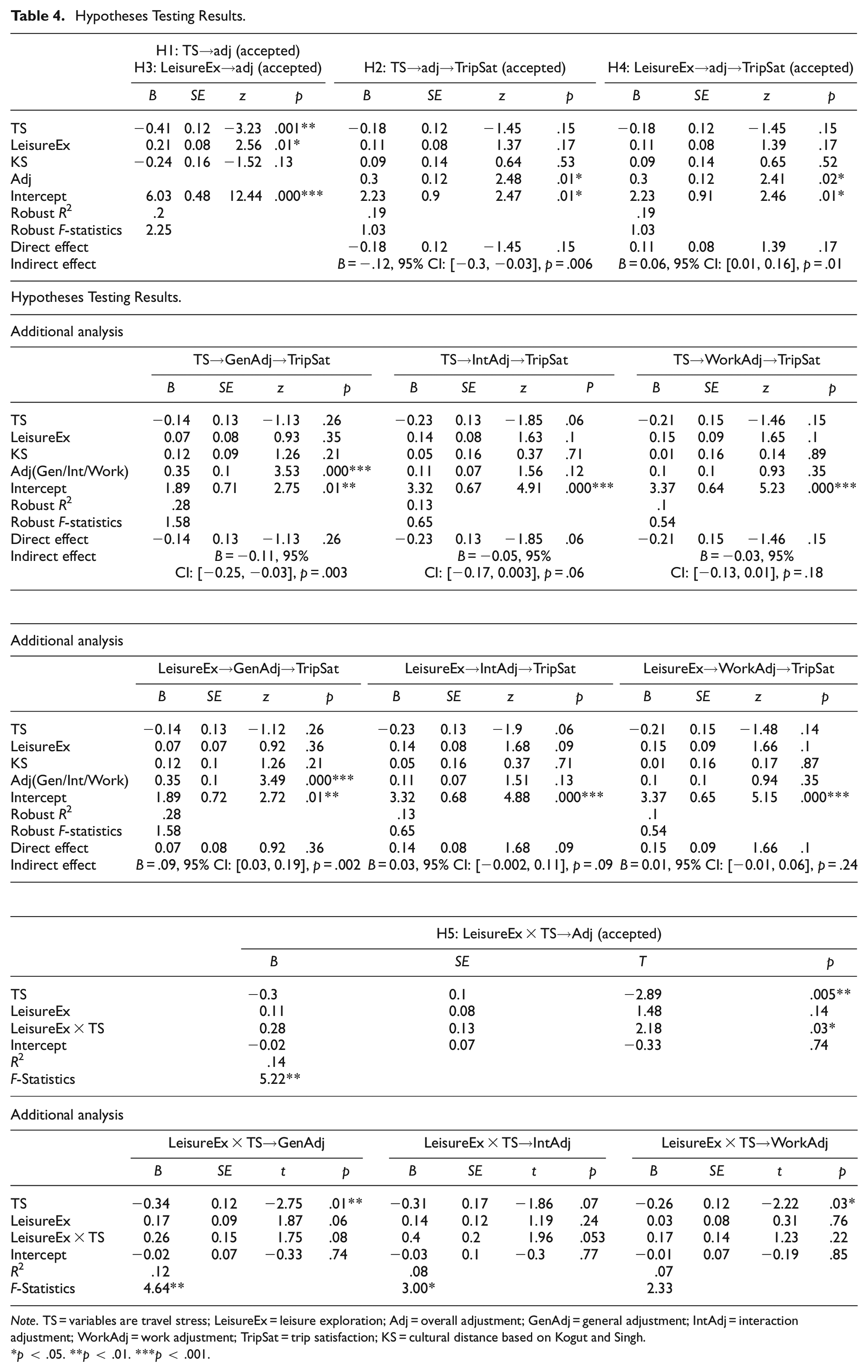
Note. TS = variables are travel stress; LeisureEx = leisure exploration; Adj = overall adjustment; GenAdj = general adjustment; IntAdj = interaction adjustment; WorkAdj = work adjustment; TripSat = trip satisfaction; KS = cultural distance based on Kogut and Singh.
p < .05. **p < .01. ***p < .001.
H1 and H2 examine the effect of international business travel stress (IV) on international business travel adjustment (MV) [H1], as well as its indirect effect on trip satisfaction (DV) via the mediation of international business travel adjustment (MV) [H2]. Results in Table 4 support H1 that international business travel stress negatively affects the degree of international business travel adjustment. International business travel adjustment is also found as a full mediator of the relationship between international business travel stress and trip satisfaction (H2), with travel stress no longer a statistically significant predictor of trip satisfaction after controlling for travel adjustment based on a bootstrapping analysis with 5,000 bootstrap samples (Table 4).
An additional mediation analysis was conducted to identify which of the three international business travel adjustment dimensions underpin the mediation effect. Results in Table 4 showed that general adjustment to the destination living conditions is the primary adjustment component that mediates the strain effect on trip satisfaction. These results indicate that international business travel stress reduces business trip satisfaction primarily due to the jeopardized international business travel adjustment to the destination’s novel living conditions.
Next, we examined whether leisure exploration (IV) facilitates international business travel adjustment (MV) (H3) and fosters trip satisfaction (DV) because of such facilitation (H4). Leisure exploration is identified as a facilitator of international business travel adjustment (Table 4) and supports H3. International business travel adjustment also fully and positively mediates this facilitating effect, which supports H4.
An additional analysis was again conducted to probe the dimension(s) of adjustment to which the full mediation mechanism is primarily attributed. The same adjustment dimension responsible for mediating the stress effect, the general adjustment to the destination living conditions, is also found to fully mediate the leisure exploration effect on trip satisfaction (Table 4). There were no statistically significant mediation effects by the other two adjustment dimensions. These results suggest that the extent to which leisure exploration enhances business trip satisfaction is mainly due to its support for individual adjustment to the novel living setting in a destination.
The proposed leisure exploration moderation of the international business travel stress (IV)–international business travel adjustment (DV) relationship is tested using the interactions package in R, with an interaction term created from the centered IV and moderator. The moderation effect is statistically significant at the p = .05 level (Table 4), supporting H5. The overall moderation model explains 13.55% of the variance in adjustment.
Simple slope tests at low (mean – 1 SD), mean, and high (mean + 1 SD) levels of the moderator leisure exploration in turn demonstrate statistically significant and negative effects from international business travel stress on international business travel adjustment at low (B = −.54, SE = .15, t = −3.75, p < .001) and mean (B = −.30, SE = .11, t = −2.89, p = .005) leisure exploration levels, but not at its high level (B = −.06, SE = .16, t = −.38, p = .702) (see Figure 2). These results together demonstrate that as the extent of leisure exploration increases, the negative influence of international business travel strain on international business travel adjustment is ameliorated and even becomes less relevant at a high level of leisure exploration.
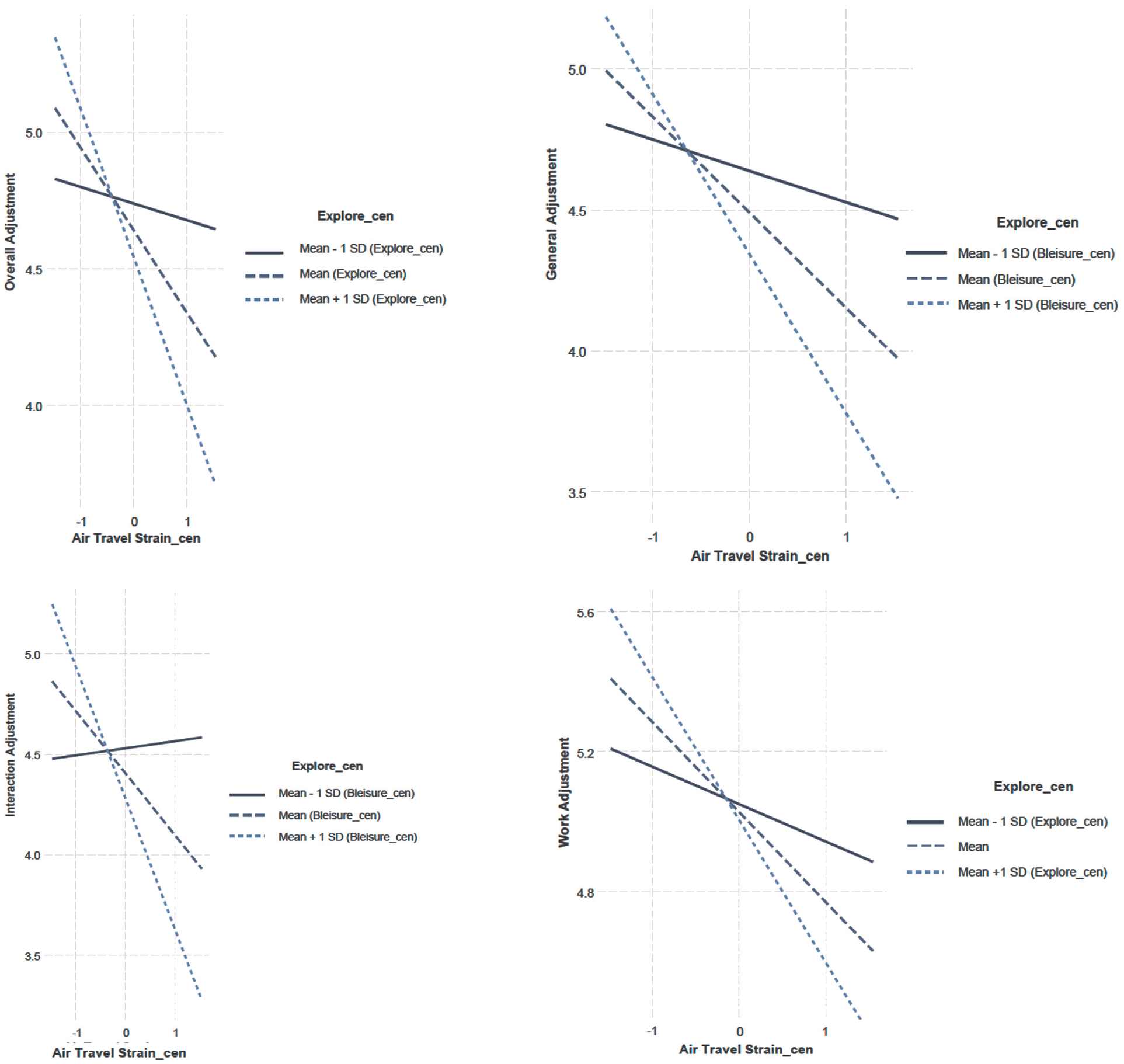
Moderation plots for travel stress effect on adjustment dimensions by leisure exploration.
Further analysis examined the moderation effect separately for three dimensions of adjustment and revealed that leisure exploration marginally buffers the negative effect of international business travel stress. The effect was on travelers’ interaction adjustment when communicating with people in a different culture and the general adjustment of individuals to a destination’s novel living setting (Table 4). The moderation effect alone explains 3.53% of the variance in interaction adjustment and 2.68% in general adjustment. The simple slope tests for post hoc analyses showed similar patterns to the omnibus moderation analysis, as illustrated in Figure 2.
We tested for competing explanatory models, and none of the alternative paths display statistical significance. For example, the model with leisure exploration as a moderator in the trip adjustment—trip satisfaction relationship was not significant (ME = −.16, SE = .10, t = −1.593, p = .114), suggesting the superiority of the proposed model.
Study 2: Online Panel
As data for Study 1 was collected before the COVID-19 pandemic, travel stress and leisure exploration may have changed post-covid. Thus, we conducted a follow-up study of international business travelers to (i) ensure the sustained importance of our focal variables of interest and the basic assumptions of our model and (ii) observe post-COVID-19 international business travel trends invaluable for partitioners. Using an online panel platform (Prolific), we collected an additional data set of 113 fully employed international business travelers in the United States over 21 who have traveled for work outside the country by air in the last year. Respondents passed various screening tests, including (1) domestic versus international business trips, (2) time spent on the trip, and (3) transportation modes. Results of the screening questions were later cross-referenced with open responses given by the participants to ensure high data quality. Additionally, attention filters were employed throughout the survey. One hundred and two participants passed all the qualifiers and comprised our final sample. On average, international business travelers were predominantly male (MGender = 0.73, SD = 8.45), 35 years old (MAge = 35.26, SD = 8.71), and having taken two international business trips in the last year (MTripstaken = 2.0, SD = 1.42). Participants were asked to evaluate their most recent trip regarding travel stress, leisure exploration, travel adjustment, and trip satisfaction using the established scales from Study 1. We added further questions regarding international business travelers’ perceived changes since COVID-19 and included supplementary subjective and objective leisure exploration measures for validation.
Compared to the pre-COVID-19 data, we found no significant differences in self-reported travel stress (MTS-PreCovid = 2.44, SD = 0.64; MTS-PostCovid = 2.36, SD = 0.62, t = −0.99, p > 0.1). When asked specifically about how international business travel has changed since COVID-19, participants responded on a Likert-scale (1 = strongly disagree 5 = strongly agree) that (a) international business travel has become somewhat more stressful (MTravelStress = 3.84, SD = 1.02), (b) that they go on fewer trips (MTrips = 4.14, SD = 0.93), and (c) that they have become somewhat more anxious traveling for business abroad (MTravelAnxiety = 3.62, SD = 1.14). International business travelers somewhat disagreed, however, that they are (d) getting angry more easily with other passengers (MTravelAnger = 2.38, SD = 1.13) or (e) that they can trust airlines or airports less (MTravelTrust = 2.74, SD = 0.933). Thus, in general, changes in travel strain since COVID-19 have been perceived by international business travelers as minimal. As a result, travel stress further significantly influenced travel adjustment (B = −0.3, SE = 0.12, z = −2.54, p = .01), and through full mediation impacted trip satisfaction (IE = −0.07, p = .006, 95% CI [−0.139, −0.013]; DE = −0.09, p = 0.274). Thus, the predictions of international business travel strain relationships are stable beyond the impact of COVID-19.
Interestingly, when comparing the results on leisure exploration between Study 1 (pre-COVID) and our post-COVID-19 data, leisure exploration has increased significantly (MTS-PreCovid = 2.48, SD = 0.87; MTS-PostCovid = 2.73, SD = 0.79, t = 2.16, p < .05). Thus, while international business travel strain remained constant, leisure exploration has increased. This may be explainable by the overall reduced number of international business trips (e.g., based on travelers’ statements and comparison of pre- and post-COVID-19 data) taken post-COVID-19 or highlighting companies’ recognized importance of counteracting travel stressors through added leisure exploration opportunities. Additionally, companies may prefer fewer but longer international business trips to account for potential interruptions due to country-specific COVID-19 measures. Thus, international business travelers may be allowed an extra time buffer abroad, which they could have used for leisure explorations. The added leisure exploration may be vital for international business travelers due to the restrictions and the reduced general international leisure trips individuals could take during COVID-19.
We also checked if our basic model assumptions were held for leisure exploration relationships. Leisure exploration was a significant predictor of international business travel adjustment (B = 0.3, SE = 0.14, z = 2.03, p = .043), and international business travel adjustment mediated the effect of leisure exploration on trip satisfaction (IE = 0.07, p = .042, 95% CI [0.005, 0.159]; DE = −0.03, p = 0.703). Leisure exploration did not significantly moderate the relationship to trip satisfaction post-COVID-19 (albeit results were in the correct direction). Conclusively, our effects found in Study 1 are mainly stable beyond the impact of COVID-19.
Post hoc Analysis
Finally, we further triangulated evidence by comparing responses on the leisure exploration scale to respondents’ reported actual time spent exploring and the percentage of time spent on business versus leisure activities. We also created a leisure exploration ratio (time spent exploring/time spent on an overall business trip) and used an established 3-item, 7-point Likert-type scale on the importance of leisure exploration (C.-C. Chen et al., 2016; C.-C. Chen & Yoon, 2019). The items referred to: (1) Leisure exploration in a business trip is important to me, (2) Leisure exploration in a business trip makes me happy, and (3) Leisure exploration in a business trip is an enrichment for me. Overall, the 3-item leisure exploration scale significantly and strongly correlated with the measure used in Study 1 (correlation between r = 0.33–0.65, p < .001). Thus, we conclude that the parsimonious single-item scale used in Study 1 demonstrates convergent validity with both objective and subjective perceptions (multi-items) of leisure exploration as employed in Study 2. Recent studies (e.g., Demeter et al., 2023) have also shown the merits, reliability, and validity of single-item measures in tourism research.
Discussions and Implications
In this study, we propose and demonstrate the buffering mechanism of leisure exploration. Overall, our results identified that international business travel strain and leisure exploration impact trip satisfaction through international business travel adjustment. Our main findings are that (a) international business travel strain reduces adjustment, (b) leisure exploration increases adjustment, (c) leisure exploration reduces the negative effects of travel strain on adjustment, and (d) general adjustment is the primary mechanism that translates international business travel strain and leisure exploration into international business trip satisfaction.
Our findings linking travel strain, travel adjustment, and trip satisfaction (H1, H2) extends prior work on the expatriate context, suggesting that adjustment has significant consequences for the international business travel experience. Yet the results indicate that only general adjustment significantly affects trip satisfaction. A traveler’s ability to adjust to the culture in general (e.g., accommodation and food) on a short-term trip may give a sojourner the most joy. The lack of significance for the effects of travel strain on interaction and work adjustment, plus the insignificant effects from interaction and work adjustment on trip satisfaction, suggest that they play a lesser role in satisfaction on short-term international assignments than it does in long-term-oriented expatriate assignments. One explanation is that the traveler does not find it essential to adapt their frame of reference regarding host country nationals or work settings, given the brief period. Consequently, they may not realize their lack of applicability and will not feel strain and initiate the adjustment process.
An alternative explanation is grounded in stress theory, which explains the reduced general adjustment as international business travel stress increases (H1) based on their shared demand for specific resources. The resources demanded for general adjustment overlap with those consumed by coping with travel stress. For instance, adjustment to the novel environment of an international destination would require the cognitive capacity to process and store new information about the destination constantly. Also, in response to travel stressors (e.g., airport security, flight punctuality, and behaviors of other travelers), travelers must continuously search for and process information related to their trip (cognitive demand). These demands for mental resources from air travel strain may, therefore, have an extensive effect on general adjustment.
The confirmed positive role of leisure exploration as a facilitator of international business trip satisfaction (H3-5) further supports the joint explanatory power of adjustment and stress theories. Leisure exploration supports international business travelers with added resources (e.g., an improved understanding of the destination and acquired social support) or restored resources (e.g., energy, cognitive capacity, and positive mood), which allow them to adapt their frame of reference better to fit the novel setting (H3). This consequently enhances their trip satisfaction due to the reduced tension felt by the inadequate international business travel adjustment (H4). It further suggests that the restored resources by leisure exploration supply the consumed resources by general adjustment (Qiu et al., 2021). The reduction of the travel stress–travel adjustment relationship by leisure exploration (H5) can also be explained by restoring one’s resources with leisure exploration. Longer leisure exploration improves stress-coping resources (e.g., energy, cognitive capability, and positive mood) that effectively buffer stress (C.-C. Chen et al., 2016; Jamieson et al., 2018). With adequately restored stress-coping resources from leisure exploration, those stressors encountered in international business travel consequently cast less influence on trip adjustment (Rattrie et al., 2022).
Practical Implications
Our findings have important practical implications for international business travel and leisure management. A human resource manager will likely base most of their interventions on improving the traveler’s ability to adjust to the interaction and work environment. This may be done by training the individual in what tasks are to be performed and how to communicate with the host country’s nationals. The results from our study suggest this is only part of the story; there is a need to focus on the general adjustment aspects of a short-term international business trip. For instance, securing a charming hotel and recommending good restaurants may fare better at the end of the trip when the traveler is discerning whether it was a satisfactory trip.
A Financial Times reporter wrote, “Covid has exposed a great unspoken truth about business travel: a lot of it was done for reasons that had nothing to do with business” (Clark, 2021). She noted that many business travelers wanted to “experience new places” to connect with customers and colleagues. Our study further emphasizes the paramount importance of bleisure. Businesses should mix the work aspect of the trip with opportunities for leisure exploration. We have shown how turning a regular business trip into a bleisure experience can improve the employees’ trip adjustment and reduce damage from travel strain, both of which matter to employees’ trip satisfaction and potentially their future international business travel intentions and job satisfaction. Such benefits of bleisure become salient with more leisure exploration provided. Due to the increased complexity of international travel, it is more imperative than ever for businesses to evolve international business travel into bleisure. This will satisfy their employees with international business travel assignments, incentivize their international business travel engagement, and prevent their burnout from frequent international business trips.
This solution also benefits the tourism industry, which has been keen to explore and design experiences that satisfy the unexploited needs of the promising bleisure market. We suggest that tourism businesses follow the adjustment mechanism in their experience design for the optimized satisfaction of their international business travel customers. Besides ensuring enough leisure exploration, tourism businesses can also consider offering travel stress-relieving services (e.g., seamless delivery of the entire international business trip with worry-free guidance at each travel stage and via a single mobile app).
Limitations and Areas for Future Research
The findings must be interpreted considering some limitations associated with the study. First, the small number of Time 2 participants may raise concerns over the stability of the results. While we started with ample participants, the attempt to reduce the limitations of a cross-sectional dataset by matching travelers during and after the trip proved quite costly regarding matched pairs. However, Shen et al. (2011) suggest not discarding studies with small sample size if they offer intriguing new insights and contexts. Due to the believed importance of the findings, we provided theoretical, empirical, and practical reasons why we combined the datasets to reduce bias and enhance generalizability. Future studies should attempt to recruit more participants to increase the robustness of the results. The importance of the study must be brought to the forefront of the sample recruitment staging so that the participant understands the value of participating in the follow-up survey.
Another limitation is that participants were traveling through the United States or Brazil. This limits the generalizability of our findings because we cannot assume that travelers based in a foreign land heading to or from the United States or Brazil will behave the same way as the travelers in this study. For example, a Pakistani traveling to or from India will likely have different expectations regarding trip satisfaction than business travelers in our study. Specifically, trip satisfaction may have a different meaning for travelers who do not interact with business people from the United States or Brazil (Punnett, 2004). Future studies could survey international business travelers at other primary airports in, for example, Europe, Asia, and Africa.
In addition, future research could compare domestic versus international business travel. It would be valuable to know if the increased uncertainty of a domestic trip increases travel strain. Even if results showed increased stress, leisure exploration might moderate the relationship on an international trip differently than on a domestic trip. For instance, it seems reasonable that an individual traveling for business to Barbados would be more excited about the trip than the traveler going to a less exotic place domestically. If this is the case, even if the traveler is experiencing more travel strain, the perceived adjustment may not be affected because the traveler does not put a high value on adjusting.
Meta-analysis results show that spousal adjustment and support are among the most critical predictors of expatriate adjustment (Shah et al., 2022). Future research should attempt to understand how the spouse of the business traveler and their family affect the level of perceived strain and adjustment. Social support is essential on the trip (Bayraktar, 2019) We did attempt to control for this effect by asking, “How many people were accompanying you on this trip?” The number of people accompanying on the trip did not significantly correlate with any of the test variables in the study. Yet future research could explore other types of support (e.g., having a translator or a driver) that may be valuable on an international business trip.
Finally, the international business travel strain level before and after COVID-19 was similar. We also found that mediation relationships held over the same periods. Yet, leisure exploration did not significantly reduce the international business travel strain-adjustment relationship in the post-COVID-19 study. Future research could help determine if the time frame (i.e., post-COVID-19) or the type (e.g., outdoors or cultural) of leisure exploration matters. Understanding how bleisure interacts with strain is essential for international business travelers and tourism.
Footnotes
Declaration of Conflicting Interests
The author(s) declared no potential conflicts of interest with respect to the research, authorship, and/or publication of this article.
Funding
The author(s) received no financial support for the research, authorship, and/or publication of this article.
