




Abstract
Drawing on the cognitive micro-foundations of institutional theory, attention-based view, stakeholder salience framework, and threat-rigidity hypothesis, this study fills key gaps in our understanding of how tourism firms allocate their slack resources to social and environmental issues during crises. Our model was tested using survey data collected from the managers of tourism firms in Egypt and the UK after the last wave of the Covid-19 pandemic. Structural equation modeling-based results indicated that normative pressures, threats, and issue urgency are significant determinants of socially responsible slack allocation. Urgency mediated all institutional pressures with slack allocation. Multigroup analyses revealed variations in institutional receptivity, issue interpretation, and slack allocation among Egyptian and British managers. This study contributes to micro-foundational and cross-cultural research on corporate social responsiveness and resource management. Our findings guide tourism firms in making optimal socially responsible investments and help policymakers set sustainable tourism strategies aligned with crises and businesses’ capabilities.
Keywords
Introduction
Tourism firms have long been criticized for their symbolic engagement in corporate social responsibility (CSR), scrutiny that was paramount during the Covid-19 pandemic and subsequent cost-of-living crisis (Masiero et al., 2023; Whitfield & Dioko, 2012). CSR is indeed “a discretionary allocation of corporate resources to improving social welfare, enhancing relationships with key stakeholders” (Barnett, 2007, p. 801). As such, “resource allocation” is a fundamental aspect of CSR. However, only recently Berbekova et al. (2024) and others (e.g., Bausch et al., 2021; Sigala, 2020) have emphasized that destination sustainability cannot be achieved without unpacking how tourism firms substantively respond (i.e., allocate resources) to social/environmental issues. The questions around resource allocation processes either strategically or in the CSR context are far more important for tourism firms, which naturally suffer from resource scarcity and vulnerability to any disruptions (Jiang et al., 2022). Tourism managers need resource allocation decision-making models to answer these questions to help them tackle the resource scarcity problem (He & Harris, 2020) and the decision problem of how resources are effectively allocated to social and environmental issues characterized by volatility (Johar et al., 2022).
Although there is a wealth of tourism studies investigating reasons and barriers to CSR, they remain under-theorized and lack process models that can explain how tourism firms substantively respond to the demands of CSR (Chan et al., 2020; Gao et al., 2024). Furthermore, tourism literature has predominantly focused on managers’ attitudes, personal characteristics, and value identification in predicting firm engagement in CSR, rather than taking a strategic approach (Kuokkanen & Sun, 2024). Despite the essence of resource management to corporate strategy (Bower, 2017), the resource allocation process has not garnered attention in the tourism literature. These problematic gaps have hindered a full comprehension of why tourism firms respond differently to social and environmental issues (Abaeian et al., 2019; Whitfield & Dioko, 2012). To address this research problem, we develop a conceptual model that explains what makes tourism firms more likely to substantively respond (hereafter interchangeably, allocate slack resources) to social/environmental issues. We focus on slack resources because their inefficient use, whether through underutilization or overutilization, threatens tourism firms’ operational efficiency, competitiveness, and sustainability (Essuman et al., 2022).
Our conceptual model, depicted in Figure 1, is premised on the cognitive micro-foundations of institutional theory (Campbell, 2007). Since its founding, institutional theory has focused on why firms strive for isomorphism (i.e., similarity) in responding to institutional pressures through a tripartite of coercive, normative, and mimetic processes (DiMaggio & Powell, 1983). Nonetheless, because institutions and issues vary so much across fields, scholarly attention quickly turned to the heterogeneity of firm responses (Durand et al., 2019). This research stream is called ‘neo-institutional theory’ or the cognitive micro-foundations of institutional theory, which proposes that institutional pressures affect corporate social responsiveness through the cognitive intervention of managers who cause divergence in firm responses (Schilke, 2018). To explain how managers allocate their attention and subsequently determine firm responses to social/environmental issues, micro-institutional research has been drawn on the attention-based view of the firm (Ocasio, 1997).
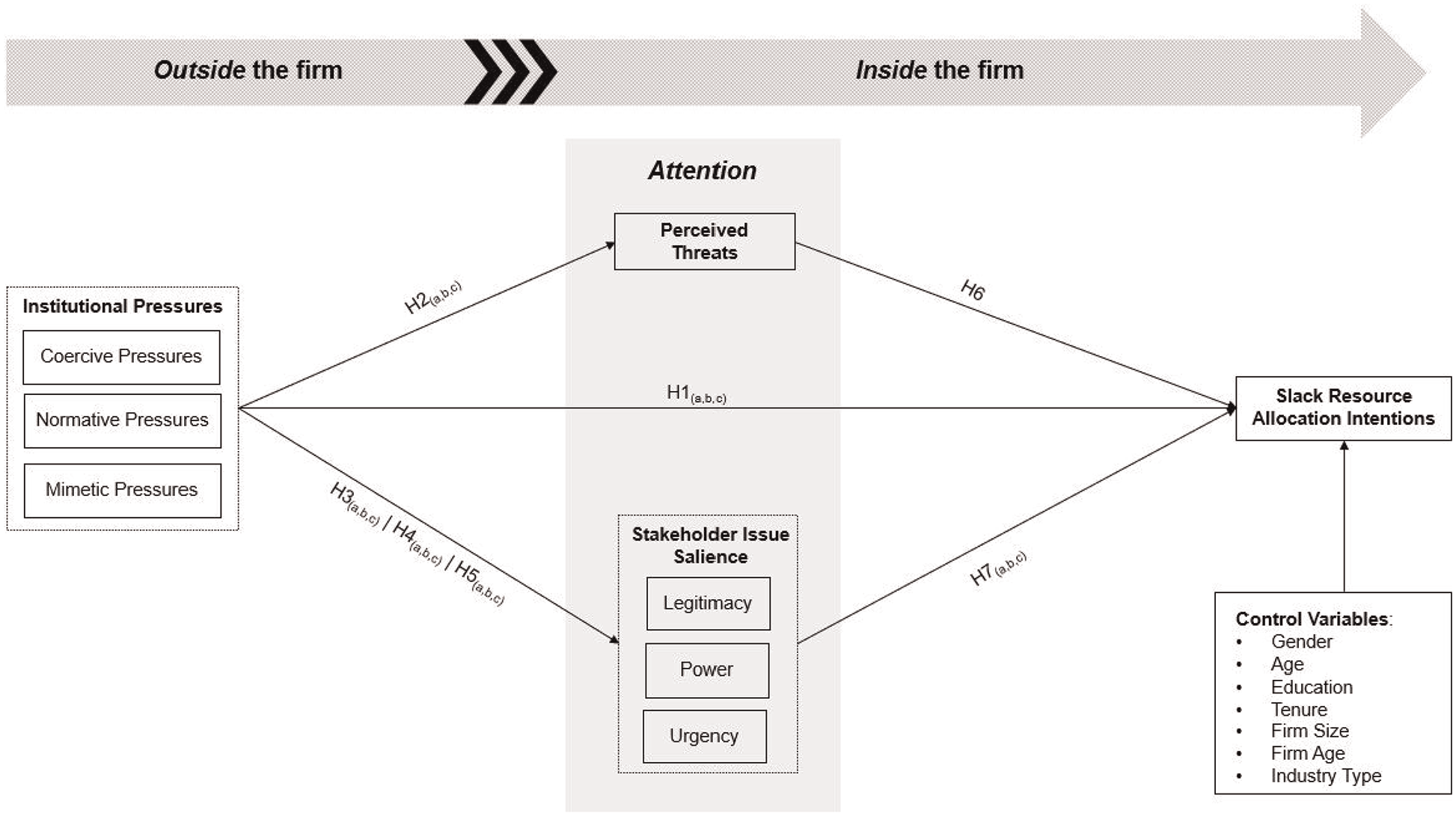
Conceptual model.
Micro-institutional research views “managerial attention as a function not only of objective external influences but also of how decision makers conceptualize their firm and its relationship to society” (Durand et al., 2019, p. 304). However, the attention-based view is a complementary theory and does not explicitly specify the elements based on which managers allocate their attention to the issues raised by the institutional environment (Cho & Hambrick, 2006). Thus, we borrow insights from the threat-rigidity hypothesis (Staw et al., 1981) and stakeholder salience framework (Mitchell et al., 1997) and suggest that managers allocate their attention and subsequently slack resources to social and environmental issues based on whether these issues bring threats to the firm and are advocated by legitimate, powerful, and/or urgent stakeholders. As such, threats, legitimacy, power, and urgency are the cognitive micro-foundations that explain heterogeneity in firm responsiveness to institutionalized social and environmental issues. The co-occurrence of these micro-processes is hypothesized to determine managerial attention and subsequent firm response.
Given that our model’s variables are sensitive to national contexts (Matten & Moon, 2008; Vanacker et al., 2017) and due to the scarcity of cross-cultural tourism research (Gao et al., 2024; Ibrahim et al., 2023), we tested our hypotheses using a sample of tourism firms from Egypt and the UK, representing both Middle Eastern and Western European perspectives, respectively. Egypt’s emerging economy is characterized by significant governmental influence over business interactions and a collectivistic culture with high levels of power distance and uncertainty avoidance. Conversely, the UK’s developed economy, supported by strong institutions and corporate governance, is characterized by an individualistic culture with lower levels of power distance and uncertainty avoidance (Hofstede Insights, 2023; Ibrahim et al., 2023). Our study, contextualized in the period following the final wave of the Covid-19 pandemic in both countries, aims to answer these important, yet underexplored, questions: (a) Do institutional pressures influence tourism firms’ allocation of slack resources to social and environmental issues in the aftermath of a systematic crisis? (b) If so, through which mediating mechanisms? (c) To what extent do these effects vary between the Middle East and Western Europe?
This research offers three main theoretical contributions. First, it advances the cognitive micro-foundations of institutional theory within the context of corporate social responsiveness and resource allocation decision-making (Bundy et al., 2013; Durand et al., 2019). We respond to recent calls for unpacking how and why tourism firms respond (make resource allocations) to institutionalized social and environmental issues (Berbekova et al., 2024; Buchanan et al., 2023). Our findings demonstrate that issue threats and urgency are effective attention-based mechanisms (i.e., cognitive micro-foundations) through which tourism managers allocate their attention and subsequently firm resources to these issues. Second, our pandemic-contextualized examination answers scholarly calls for understanding how tourism firms make socially responsible investments during crises (Bausch et al., 2021; Jiang et al., 2022). Third, our cross-cultural perspective introduces novel insights from the Middle East and North Africa (MENA) and departs from tourism literature’s over-emphasis on Western and Anglo-American contexts (Ibrahim et al., 2023). Practically, our findings will guide tourism managers toward making socially responsible resource allocations aligned with the firm’s actual needs and external environmental conditions. Furthermore, tourism policymakers receive actionable recommendations for fostering effective collaborations with tourism firms to promote the substantive implementation of sustainability practices in their destinations.
Theoretical Background
The purpose of this research is to examine why and how tourism firms respond (allocate slack resources) to social (e.g., diversity, equity, inclusion, and employee health and safety) and environmental (e.g., destination degradation and climate change) issues arising from the institutional environment. Social and environmental issues are normally combined because of their overlapping nature that reflects corporate sustainability (Buchanan et al., 2023). Our research questions are pertinent in the context of tourism firms due to their unique characteristics: (a) mainly micro, small, or medium size, (b) limited, or even scarce, resources, (c) vulnerability to any disruptions/crises, and (d) reliance on local communities’ cultural and natural resources without which they cannot exist (Zheng et al., 2022). Due to resource constraints, tourism managers are very cautious of socially responsible investments and struggle to find an acceptable answer before mobilizing resources (Choi & Lee, 2018).
We bridge the research streams of corporate social responsiveness and resource allocation decision-making that are often treated independently. In our research, slack resource allocation is a substantive response to social and environmental issues arising from the institutional environment (Barnett, 2007). Research on either corporate social responsiveness or resource allocation has strongly advocated theoretical integration to unpack the issue’s complexity and address the multiple-criteria nature of the resource allocation problem (Delmas & Toffel, 2008; Gibson et al., 2021). Scholars in these areas have long called for multidisciplinary analysis that applies ideas rooted in institutional, organizational, stakeholder, and cognitive theories to provide a clear picture of firm responsiveness (Bansal & Roth, 2000; Busenbark et al., 2017). For example, Jones (1991) took a multi-theoretical approach to examine how multiple elements of moral issues influence managerial ethical decision-making. Our theorization rests primarily on the cognitive micro-foundations of institutional theory because traditional accounts of institutional theory have been criticized for their inability to explain heterogeneity in firm responsiveness to homogeneous institutional pressures (Delmas & Toffel, 2008).
The micro-foundations of institutional theory suggest that individuals (managers) use cognitive representations, such as categories, schemas, labels, templates, or logics to decide on ways of responding to institutional pressures and acting in acceptable ways (Schilke, 2018). These cognitive representations or micro-foundations are sensemaking processes that frame institutional pressures and subsequently determine firm responses/resource allocations (Cornelissen et al., 2015). Micro-institutional research is often tied to the attention-based view of the firm (Ocasio, 1997), which is a cognitive theory holding that although the institutional environment places constraints on tourism firms’ resource allocation actions, managers still have the latitude to choose how responsive they want to be to these institutional pressures (Durand et al., 2019). Dutton and Ashford (1993, p. 404) suggested that “management’s allocation of attention to an issue is a necessary precursor to their taking substantive action on an issue.” The question then is based on which attributes managers allocate attention to issues over others. Yet, there are no available indicators of managerial attention in survey-based management research (Essuman et al., 2022). Thus, the attention-based literature suggests scholars should draw insights from complementary perspectives that explicitly delineate these attributes/processes (Bundy et al., 2013; Durand et al., 2019).
We do so by integrating insights from the threat-rigidity hypothesis (Staw et al., 1981) and stakeholder salience framework (Mitchell et al., 1997), which are indeed attention-based theories that help unpack how managers allocate their attention to issues (Durand et al., 2019). As depicted in Figure 1, threats and stakeholder issue salience act as attention-based mechanisms linking institutional pressures with slack allocation. Accordingly, we hypothesize that managers allocate their attention and subsequently slack resources to social and environmental issues based on the four attributes of threats, legitimacy, power, and/or urgency. These attributes are the cognitive micro-foundations–that is, information-filtering or sensemaking processes—that determine tourism firms’ response (resource allocation) to institutionalized social and environmental issues.
Among other potential cognitive labels, we chose these four attributes, in particular, because they are dynamic and can fully capture the evolving changes in how tourism firms make sense of and react to institutionalized issues (Bundy et al., 2013). We decided to include multiple attention-based mechanisms for three reasons. First, tourism firms operate in unique contexts that (re)direct them to divide their attention and resources across multiple sets of demands (Zheng et al., 2022). Second, the use of multiple attention indicators ensures balance and reduces selection bias (Lorentz et al., 2021). Third, resource allocations are not simple decisions; instead, they go carefully through a rational multistep process (Bower, 2017). In sum, our multi-theoretical approach provides a more robust and holistic explanation of firms’ resource allocation to institutionalized social/environmental issues (Bansal & Roth, 2000). In the sections below, we explain the variables depicted in our conceptual model and provide the theoretical rationale for our hypotheses.
Slack Resource Allocation Intentions
From a cognitive viewpoint, resource allocation refers to the “process where corporate managers determine where to allocate [resources] based on a variety of criteria” (Busenbark et al., 2017, p. 2431). Organizational slack is “the pool of [underutilized] resources in a [firm] that is in excess of the minimum necessary to sustain routine operations” (Vanacker et al., 2017, p. 1305). In tourism, examples of slack resources include extra room capacity in hotels, additional transportation options for tour operators, or a surplus of well-trained staff during non-peak hours in restaurants (Zheng et al., 2022). Although slack takes a variety of forms (for an overview, see George [2005]), we focus on the discretionary type for two reasons. First, it is unabsorbed, uncommitted, currently available, and visible to managers who decide to mobilize resources in support of their attention to social and environmental issues (Essuman et al., 2022). Second, it fits with the voluntary nature of social and environmental initiatives that cannot be afforded by tourism firms without the presence of discretionary slack resources, particularly in times of uncertainty, such as the Covid-19 pandemic (Choi & Lee, 2018).
Although tourism managers struggle to establish optimized resource allocation processes and face the dilemma of whether slack resources should be consumed for CSR purposes (Chin et al., 2013; Vanacker et al., 2017), there remains a paucity of tourism research on the decision-making process of slack resource allocation (Chen et al., 2023; Zheng et al., 2022). Sheldon and Park’s (2011) study is one of the few tourism studies that investigated resource allocation to CSR and did so by asking the managers of tour operators to rate the priority of multiple CSR activities for resource allocations. However, they did not explain the processes underlying why and how these resources are allocated to CSR issues. Although Sheldon and Park (2011), and subsequently Whitfield and Dioko (2012), demonstrated that resource allocation determines tourism firms’ CSR engagement, this process remains black-boxed in the tourism literature. This is problematic because resource (mis)allocation is at the essence of strategy and fundamental to the failure or success of firm performance (Bower, 2017). Next, we explain the determinants of slack resource allocation (see Figure 1).
Institutional Pressures
Tourism firms are linked to a plethora of institutions that engender diverse factors and issues, which, in turn, shape the entire industry (de Grosbois & Fennell, 2022). Central to institutional theory is the principle of isomorphism, by which organizations face institutionalization in a tripartite of coercive, normative, and mimetic processes (DiMaggio & Powell, 1983). Coercive pressures are applied by government agencies and industry associations in the firm’s business environment (Eid & Agag, 2020). They present as codified rules, laws, and other regulatory vehicles which set the norms of acceptable behavior in society (Aresu et al., 2023). Normative pressures permeate professional/trade associations that set best practices, standards, and codes of conduct for legitimate organizational practices in particular industries (DiMaggio & Powell, 1983). Customers, suppliers, and other key actors tend to exert pressure on these trade associations to foster firms’ socially responsible behavior (Matten & Moon, 2008). Tourism trade associations are either stand-alone or nested within national organizations, and are important in lobbying social and environmental issues. For example, the Association of British Travel Agents and the Global Sustainable Tourism Council provide funds for tourism businesses to support animal welfare activities (Font et al., 2019). Mimetic pressures emerge when firms face higher levels of risk and uncertainty resulting from ambiguous goals and disruptive changes in the business climate (DiMaggio & Powell, 1983). Firms respond to this uncertainty by modeling leading industry peers who have successfully managed these disruptions. Thus, institutions can be assumed to influence crises and managers’ interactions with crises (Bundy et al., 2017).
Institutional theory has been criticized for its inability to explain why homogeneous institutional forces lead to heterogeneity in issue responsiveness between firms within an industry (Schilke, 2018). An emerging micro-institutional inquiry has attributed this heterogeneity to managers’ attention to institutionalized issues (Aresu et al., 2023). This cognitive stream draws on the principle of actorhood, which prescribes managers as actors whose preferences and reactions clearly alter firm responsiveness to institutionalized issues (Durand et al., 2019). As theorized by Campbell (2007), managers’ cognitive perceptions of institutional pressures are important determinants of corporate social responsiveness. Hence, it seems logical that slack allocation to institutionalized social and environmental issues depends upon managers’ attention and interpretation.
Attention
Due to the vastness of information that managers receive and the scarcity of resources they have in tourism firms, they need perceptual filters to select important issues deserving firm resource allocations (Bundy et al., 2013). Derived from this selectiveness logic, Ocasio’s (1997, p. 189) attention-based view of the firm conceptualized organizational attention as a cognitive process that encompasses “the noticing, encoding, interpreting, and focusing of time and effort by organizational decision-makers on both issues and answers.” The attention-based view is suitable for the cognitive viewpoint of resource allocation, which is based on two logics: (a) firms allocate resources discriminately and (b) spreading resources to meet all requests is impossible (Bower, 2017). Yet, with few exceptions (e.g., Torres & Augusto, 2021), tourism research lacks conceptualizations and empirics of how managers allocate their attention and firm resources to external issues. The attention-based view is also useful in the Covid-19 pandemic context to explain how managers ensured timely responsiveness to external issues (Lorentz et al., 2021). Crisis management research further posits that managers are responsible for perceiving the saliency of crises faced by their firms, and determining how they reestablish their socially responsible investment processes (Bundy et al., 2017). Although the attention-based view suggests that managers use schemas or cognitive templates to help them direct their attention to external issues (Lorentz et al., 2021), there are no available indicators of managerial attention in existing survey-based research (Essuman et al., 2022). In our study, managerial attention is captured by two cognitive mechanisms—perceived threats and stakeholder issue salience—drawn from the threat-rigidity hypothesis and stakeholder salience framework (Mitchell et al., 1997; Staw et al., 1981). Each mechanism is explained below.
Perceived Threats
To unravel the complexity of institutionalized issues, organizational members utilize interpretive schemes (or frames of reference) to construct shared meanings of these issues and suggest potential courses of action (Nadkarni & Herrmann, 2010). Among the numerous perceptual filters used by managers, our conceptualization focuses on threats and stakeholder salience. Issues labeled as “threats” involve losses and bring harmful and uncontrollable consequences to the vital interests of the firm and its members (Sharma, 2000). Threat-rigidity hypothesis suggests that threats are employed by managers as effective cognitive filters in attending to certain issues, their ignorance of which might pose risks to the firm (Staw et al., 1981). Likewise, attention-based tourism research views threats as significant drivers of managerial attention in the face of exogenous shocks (Torres & Augusto, 2021). We focus on threat detection, rather than opportunity, for three reasons. First, threat-rigidity studies have identified that more significant responses and actions occur after detecting threats than opportunities (Nadkarni & Herrmann, 2010). Second, risks, failures, and other adverse events are assumed to concretely change organizational resource allocation patterns (McMullen et al., 2009). Third, our threat-focused approach soundly aligns with the study’s data-collection timeline after the Covid-19 pandemic.
Stakeholder Issue Salience
From a managerial perspective, a salient issue carries meaning and creates a legitimate context for initiating change within the firm (Bundy et al., 2013). According to Song and Kang (2019), tourism firms should set their CSR resource allocation strategies in light of stakeholder expectations and issues. Using the stakeholder salience lens (Mitchell et al., 1997), we propose that issues derive their salience from the salience of the stakeholders advocating them. Tourism firms are interconnected with multiple stakeholders, including, but not limited to, customers, employees, host communities, destination marketing organizations, and tourist attraction administrators (Masiero et al., 2023). The salience of a stakeholder group is determined by “the degree to which managers give priority to competing stakeholder claims” (Mitchell et al.,1997, p. 854). Accordingly, stakeholder issue salience denotes “the degree to which a stakeholder issue resonates with and is prioritized by management” (Bundy et al., 2013, p. 353). Stakeholder issue salience is dynamic and evolves over time. For instance, issues around equity, diversity, inclusion, and gender inequality have become far more ubiquitous as a consequence of the #blacklivesmatter and #metoo movements. Owing to this dynamism, managers are those who perceptually determine an issue’s level of salience (Wood et al., 2021).
Mitchell et al.’s (1997, p. 854) legitimacy, power, and urgency typology “explains to whom and to which issues managers actually pay attention.”Legitimacy denotes the extent that stakeholder claims are “desirable, proper, or appropriate within some socially constructed system of norms, values, beliefs, and definitions” (Suchman, 1995, p. 574). An example of a legitimate issue is tourists’ growing interest in sustainability (Masiero et al., 2023). Power reflects a stakeholder’s ability to control the firm’s resources and managerial choices (Mitchell et al., 1997). For example, as customers are central to a firm’s revenue generation, they have the greatest saliency and control over the continuation or cessation of the business (Chen et al., 2023). Urgency captures “the degree to which stakeholder claims call for immediate attention,” characterized by high levels of time sensitivity and criticality (Mitchell et al., 1997, p. 867). Urgent issues are communicated to the firm through various tactics, such as boycotts, protests, and media campaigns (Odziemkowska & Henisz, 2021). Yet, extant tourism research lacks an in-depth examination of the antecedents and outcomes of stakeholder salience attributes (Lin, 2021).
Hypotheses Development
Our hypothesized model, depicted in Figure 1, follows an outside-inside approach. It mirrors the trajectory of social and environmental issues that originate from the institutional environment and penetrate the firm’s sphere, thereby influencing its managers’ attention and subsequent action, or lack thereof. Our model, built on the overarching micro-foundational and cross-cultural themes, manifests multiple factors because managers’ socially responsible investment decisions are the “results of attending to different aspects of the decision environment” (Barnett, 2008, p. 609). Our hypotheses are discussed below.
Institutional Pressures and Slack Resource Allocation Intentions: A Direct Pathway
According to institutional theory, national institutions intervene directly in facilitating or constraining managers’ leeway in slack resource allocation (Vanacker et al., 2017). For example, the #blacklivesmatter movement pushed Fortune’s hospitality companies to revise their practices and allocate resources to diversity and inclusion policies in the workplace (Manoharan et al., 2021). In the events industry, coercive, normative, and mimetic pressures were found to have varying effects on event exhibitors’ adoption of green innovation (Qin et al., 2024). Firms often conform to coercive pressures to safeguard their legitimacy, avoid sanctions for noncompliance, and/or secure their resource access (Bansal & Roth, 2000). Normative pressures were found to exert the strongest effects on restaurants’ food waste separation due to the growing consumer demand for green products (Ng & Sia, 2023). Similarly, hotels were found to be more likely to disclose their carbon footprint when they face increased normative pressures from hotel industry-specific carbon disclosure standards (de Grosbois & Fennell, 2022). A cross-cultural study further found that mimetic pressures enhance the innovative behavior of hotel employees (Eid & Agag, 2020). Despite the potential heterogeneity in the effects of different institutional pressures, the majority of tourism studies still deal with institutional pressures as a monolithic construct (Ng & Sia, 2023). Consequently, we anticipate that:
The Effects of Institutional Pressures on Perceived Threats and Stakeholder Issue Salience
From the attention-based view, institutional environment plays a cognitive role by offering references for individuals on how they perceive specific issues (Essuman et al., 2022). Tourism research indicates that individuals’ perceptions of risks or opportunities associated with intended behavior depend on how they evaluate institutional pressures that define the consequences of tourism firms’ actions (Abou-Shouk et al., 2016). For example, de Grosbois and Fennell (2022) observed that hotels’ actual carbon disclosures differ based on managers’ cost-benefit analysis of these disclosures. It has also been posited that institutions serve as informational conduits that socially govern firm–stakeholder interactions (Chen et al., 2023), and shape how managers perceive the saliency of issues raised by stakeholders (Buchanan et al., 2023). For example, customers’ decisions to book cruise vacations were found to be reliant on information provided by cruise associations about the standardized socially responsible practices adopted by cruise companies (Ahn et al., 2021). Furthermore, Qin et al. (2024) found that coercive, normative, and mimetic pressures differently shape event exhibitors’ knowledge and understanding of stakeholder demands on green innovation. Accordingly, we posit:
The Effects of Perceived Threats and Stakeholder Issue Salience on Slack Resource Allocation Intentions
The attention-based view emphasizes a strong association between issue labeling and firm responsiveness (Litrico & David, 2017). Supporting our proposal, the threat-rigidity hypothesis positions threats as significant predictors of organization-level phenomena (Staw et al., 1981). Tourism firms were found to allocate more unabsorbed slack when they perceive greater negative impacts from potential risks (Zheng et al., 2022). A central tenet of the stakeholder salience framework is that managers distribute the firm’s limited attention and resources based on stakeholders’ importance and prioritization (Wood et al., 2021). As observed by Gibson et al. (2021), when risk-averse customers notice breaches in a firm’s governance (e.g., an unsafe workplace), they view the firm as illegitimate and so reduce their purchases and damage the firm’s public image. Céspedes-Lorente et al. (2003) found that Spanish hotels adopt varying socially responsible responses based on stakeholder power and perceived impacts on hotels’ financial performance. The managers of hospitality and tourism businesses interviewed by Alonso et al. (2022) expressed that heightened uncertainties about recovery from the Covid-19 pandemic have led them to allocate their limited resources to the most urgent issues, such as employee health and government-imposed distancing rules.
Consequently, we foresee that classifying a social/environmental issue as a threat or recognizing it as a legitimate, powerful, or urgent concern will significantly affect managerial inclinations to allocate slack resources for it:
Institutional Pressures and Slack Resource Allocation Intentions: An Indirect Pathway
According to the attention-based view, “issues that succeed in getting managers’ attention are more likely to elicit action” (Milliken et al., 1998, p. 582). We hypothesize that if an issue represents a threat to the firm or is demanded by legitimate, powerful, and/or urgent stakeholders, “the firm will respond in a material manner by committing substantial resources, time, energy, and effort to the issue” (Bundy et al., 2013, p. 364). The work of Essuman et al. (2022) demonstrated the mediating role of managerial attention in the relationship between institutional pressures and firm slack allocation to operational resilience. Chan and Hawkins (2012) also found that institutional pressures do not trigger the adoption of environmental management systems without persuading the hotel’s top management team to allocate internal resources to such investments. As noted by Amato and Amato (2011), quality-of-life issues that gain popularity among market-oriented stakeholders are likely to attract managerial attention and organizational resource allocation. Similarly, socially responsible investments by tour operators were also found to be driven by governmental pressures and conflicting stakeholder interests (Masiero et al., 2023). Moreover, the influence of legal penalties on hotels’ adoption of green supply chains was observed to be mediated by stakeholders’ power (Chang & Ma, 2015).
Consequently, we posit that threat, legitimacy, power, and urgency perceptions of a social/environmental issue can operate as parallel mechanisms that link coercive, normative, and mimetic pressures with slack resource allocations. Stated formally, we hypothesize:
The Role of Home Country
CSR and resource management literatures indicate that the micro-foundational theme should not overlook the cross-cultural perspective because managers’ decisions of socially responsible resource allocations are crucially influenced by cultural norms (Ibrahim et al., 2023). According to Song and Kang (2019), the home country should be a core unit for analyzing how tourism firms allocate resources to social and environmental issues. This investigation, therefore, compares two distinct national settings—Egypt and the UK—to ascertain whether, and to what extent, our hypotheses vary across these unique settings. We chose these two countries because Egypt represents low-resource settings that suffer from underdeveloped financial and capital markets, whereas the UK represents high-resource settings that provide accessibility to external finance and human capital (Ibrahim et al., 2023). Consequently, while slack can be a costly-to-build resource in Egypt, it is an easy-to-acquire resource in the UK (Essuman et al., 2022). The noticeable cultural differences between both countries are suggested to cause divergence in managers’ attention to and investment in social and environmental issues (Miao et al., 2011). For example, Abreu and Barlow (2013) found that while British managers adopt a rule-based approach to CSR, Brazilian managers follow a relation-based approach that is more concerned about image and brand differentiation. In the tourism setting, both CSR and crisis management vary across countries as a result of their divergent national business systems and cultural norms (Ou et al., 2021).
Attention is viewed as “a context-specific interpretation” (Barreto & Patient, 2013, p. 688), implying that managerial behaviors vis-à-vis issues vary depending on the contextual conditions that govern managers’ allocation of time, effort, and other resources (Barnett, 2008). In other words, a manager’s attention to and behavior toward CSR issues is contingent on his/her predisposed cultural values and biases, which vary across countries (Litrico & David, 2017). For Barr and Glynn (2004), one’s home country shapes his/her issue diagnosis and whether he/she labels a certain issue as representing threats or opportunities. In a sample of festival organizers in Ghana, Adongo and Kim (2018) found that cultural context determines the salience of stakeholders and the magnitude of resources they receive. Hotel managers interviewed by Miao et al. (2011) perceived the salience of cross-cultural issues differently based on the unique fabric of institutions and stakeholders in the hotel’s host country. Combined, these lines of argumentation lead us to predict variations in the magnitude and direction of our model paths (see Figure 1) across the surveyed Egyptian and British managers.
Grounding our assumptions in micro-foundational, cross-cultural themes will enable us to comprehensively capture the institutional and organizational realities of tourism firms’ socially responsible investments (Cornelissen et al., 2015).
Methods
Research Context
Responding to calls for more cross-cultural management research (e.g., Li & Haleblian, 2022; Odziemkowska & Henisz, 2021), our empirical investigation took place in Egypt and the UK—two highly distinct settings in several aspects. In terms of national culture, while Egypt is a collectivistic nation exhibiting higher degrees of power distance and uncertainty avoidance, the UK is an individualistic nation characterized by lower levels of power distance and uncertainty avoidance (Hofstede Insights, 2023). Egypt’s emerging economy is dominated by the public sector and strictly controlled by the government, resulting in the presence of institutional voids (Ibrahim et al., 2023). Conversely, the UK boasts a fiercely independent and developed economy, shaped by robust corporate governance and market-based mechanisms that facilitate well-diversified business interactions (Matten & Moon, 2008). While Egyptian firms care more about the government and host community, their British counterparts place a greater emphasis on customers and shareholders (Ibrahim et al., 2023).
Despite these noticeable differences, the tourism industry is a key contributor to the gross domestic product in both countries. In 2019, Egyptian tourism revenues amounted to USD 34.1 billion, then dropped to USD 17.2 billion in 2020 due to the pandemic, and subsequently rebounded to USD 22.3 billion in 2021 (World Travel and Tourism Council, 2022). Likewise, British tourism revenues stood at GBP 234.5 billion in 2019, but fell to GBP 93.8 billion in 2020, before recovering to GBP 131.5 billion in 2021 (Statista, 2022). Recently, the UK and Egypt hosted the COP26 and COP27 forums successively, and consequently, elevated expectations have been placed on both countries for substantive commitment to social sustainability agendas and climate-friendly policies within their respective regions.
Sample and Procedure
The study’s population is the managers of tourism firms located in Egypt and the UK. To develop our sampling framework and recruit a more diverse sample, we initially extracted an email list of companies registered on the official tourism websites in Egypt (Egyptian Hotel Association and Egyptian Travel Agents Association), and the UK (Visit England, Visit Wales, Visit Scotland, and Visit Northern Ireland). We then applied stratified random sampling to these datasets to ensure sample representativeness. The questionnaire was designed in English and then back-translated into Arabic following Brislin’s (1970) well-established procedures for maintaining linguistic equivalence. We sent both drafts to a panel of academics familiar with literature and practitioners in both countries. Based on their feedback, minor revisions were made to the survey items and instructions. In each country, these fine-tuned questionnaires were pretested on a pilot sample of different-sized firms from various sectors to check whether the questions were properly understood and completable within the allotted time (6–8 min). The final survey was then distributed online in both countries simultaneously after the last wave of the Covid-19 pandemic (July 1, 2021–October 31, 2021).
To reduce response bias risk, the e-mailed cover letter explained the study’s purpose. It also defined and gave examples of stakeholders, and social-environmental issues (e.g., local community development, heritage conservation, waste management, and pollution control). Our survey questions did not focus on specific issues because of the overlapping nature of social and environmental issues that are often addressed by tourism firms in a collective way (Buchanan et al., 2023). The issues investigated are widely recognized as important sustainability issues for hospitality and tourism businesses (Ruiz-Ortega et al., 2021). To frame our data within the context of the Covid-19 pandemic, we instructed respondents to rate their agreement with each statement based on what their firm experienced between the start of the pandemic and the moment they completed the survey, following the suggestions of Simsek et al. (2007). We used this time-boundaries approach for two reasons. First, time is extremely pertinent for the issue, given that particular issues gain and lose salience over time (Barnett, 2008). Second, according to the backward-looking referents’ perspective, managers allocate resources based on current and past performance (Cyert & March, 1963).
To maximize the response rate, three follow-ups were sent over the four-month data collection period (Dillman, 2000). The final completed dataset was 442 (Egypt = 214; UK = 228) after excluding the responses of divisional managers with no decision-making authority and checking data quality, as reported below in the Preliminary Analyses section. The sample size of each group exceeded the threshold of 10 to 15 observations per construct required for testing structural equation models (Schumacker & Lomax, 2004).
Measures
The surveyed managers subjectively assessed our model variables using a scale ranging from 1 “strongly disagree” to 5 “strongly agree.” (Full items appear in Table 2 with an Arabic-translated version available in Supplemental Material A.)
Institutional Pressures
The coercive, normative, and mimetic facets of institutional pressures were each measured with three items borrowed from Colwell and Joshi (2013).
Perceived Threats
Using Sharma’s (2000) three-item measure, managers were asked to rate the threats associated with their responsiveness to social and environmental issues.
Stakeholder Issue Salience
We modified Agle et al.’s (1999) legitimacy, power, and urgency scale for guiding managers to gauge the salience of social and environmental issues based on the salience of the stakeholders who raise them.
Slack Resource Allocation Intentions
The four-item measure of discretionary slack developed by Atuahene-Gima et al. (2005) was adapted to capture managers’ tendency to make slack resource allocations for social and environmental issues.
Control Variables
In line with theory and anecdotal evidence (e.g., Barnett, 2008; Li & Haleblian, 2022; Nadkarni & Herrmann, 2010), we included variables at both managerial and firm levels to tease out potential explanations beyond our model antecedents. The demographic characteristics (gender, age, and education) of managers were controlled due to their potential effects on how managers perceive social and environmental issues (Cheah et al., 2011). We controlled for job tenure, given that an individual’s experience influences his/her confidence and, consequently, his/her attention to, and interpretation of, strategic issues (Cheah et al., 2011). Firm size and age were also controlled because investments in CSR were found to differ between large and small-medium firms, as well as between older and younger firms (D’Amato & Falivena, 2020). Due to the sensitivity of firm responsiveness and resource management to industry characteristics (Busenbark et al., 2017; Litrico & David, 2017), we further controlled for industry type.
Analytic Approach
We used SPSS v.28 for initial data entry and calculation of means, standard deviations, and correlations for all measures. (Pearson’s correlations are tabulated in Online Supplementary B and C.) We then used AMOS v.28 (Arbuckle, 2006) to conduct structural equation modeling (SEM) with maximum-likelihood estimation, as well as multigroup invariance analysis (Hair et al., 2019). We chose this method for its ability to simultaneously estimate the relationships among latent variables and their observed indicators (Bagozzi & Yi, 2012), as well as its popularity in survey-based management research and tourism research (Assaker & Hallak, 2013).
Results
Sample Characteristics
As reported in Table 1, whereas the British sample exhibited equal gender distribution, the Egyptian sample was male-dominated. This is not surprising because the Egyptian tourism industry is significantly male-dominated, with women making up only 4.8% of the Egyptian tourism labor force (World Tourism Organization, 2020). Regarding age, nearly 60% of British respondents exceeded 50 years, while Egyptian respondents were younger with approximately 70% aged between 30 and 49 years. Overall, both subsamples were well-educated. While job tenure showed an approximately equal distribution in Egypt, nearly 60% of British respondents stayed in their jobs for more than 5 years. Interestingly, slightly over half of the British sample (54.8%) were micro-businesses employing 1 to 5 employees, whereas the majority of responses in Egypt (79.4%) were small-and-medium businesses (≥50 employees).
Respondents’ Demographic Profile and Firms’ Characteristics.
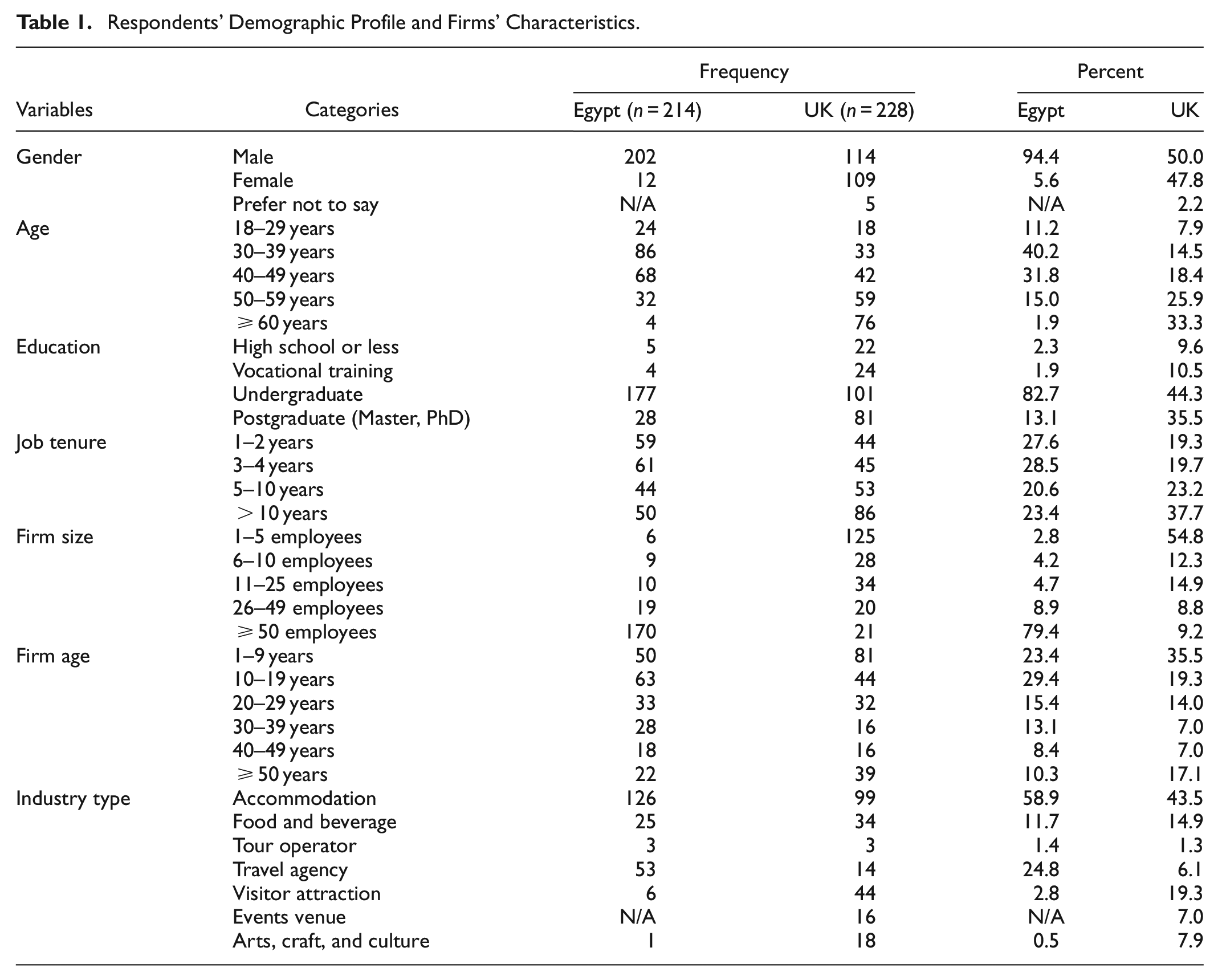
Regarding industry type, both samples were skewed to the accommodation sector, which represented roughly half the pooled dataset. While the Egyptian sample had more travel agencies, the British sample had more event venues and visitor attractions. There may be three reasons for these results (Abou-Shouk et al., 2016). First, the prevalent business model of tour operators in Egypt is a travel agency working for foreign tour operators in exchange for an agreed commission. Second, most Egyptian event venues are nested within large hotels, rather than being stand-alone businesses. Third, most Egyptian visitor attractions are governmental entities, and so have stricter data disclosure restriction policies.
Preliminary Analyses
Before hypothesis testing, several data quality checks were performed. First, outliers, missing and unengaged responses were checked. Second, sample adequacy was verified and established after conducting both the Kaiser-Meyer-Olkin test and Bartlett’s test of sphericity (Hair et al., 2019). The results were 0.83 (χ2 = 663.54, df = 28, p < .001) in Egypt, 0.74 (χ2 = 541.17, df = 28, p < .001) in the UK, and 0.82 (χ2 = 1,358.28, df = 28, p < .001) in the pooled sample. Third, normal distribution was established by finding that skewness and kurtosis did not exceed the absolute values of 3 and 8, respectively (Kline, 2011). Fourth, nonresponse bias was checked using the extrapolation technique, wherein early and late respondents were compared (Armstrong & Overton, 1977). We found no significant differences between both groups on all model variables. Next, multicollinearity was checked by calculating the variance inflation factor (VIF) for all model variables and found to be within an accepted range (VIFEG = [1.01–2.55]; VIFUK = [1.06–2.87]; VIFpooled = [1.02–2.55]) (Kline, 2011). Last, common method bias (CMB) was navigated by applying Harman’s single-factor test (Podsakoff et al., 2003). Given that a single factor accounted for 46.53%, 37.53%, and 45.61% of the variance in the Egyptian, British, and pooled samples respectively, CMB was not considered a significant concern.
Measurement Model
Following SEM research, confirmatory factor analysis (CFA) was conducted to test the reliability and validity of the measurement model (Hair et al., 2019; Xu & Tracey, 2017). Our model achieved satisfactory fit with the data (χ2(222) = 518.96; p < .001; TLI = 0.93; CFI = 0.94; RMSEA = 0.05; SRMR = 0.05; Hu & Bentler [1999]). As presented in Table 2, Cronbach’s alpha values were above, or close to, the .60 cut-off for all measurement scales (Worthington & Whittaker, 2006). All standardized factor loadings (see Table 2) were statistically significant and loaded on their designated factors with no significant cross-loadings, showing convergent validity. One exception, however, was the fourth item of slack allocation, which was subsequently dropped from the measurement model.
Factor Loadings in Measurement Model.
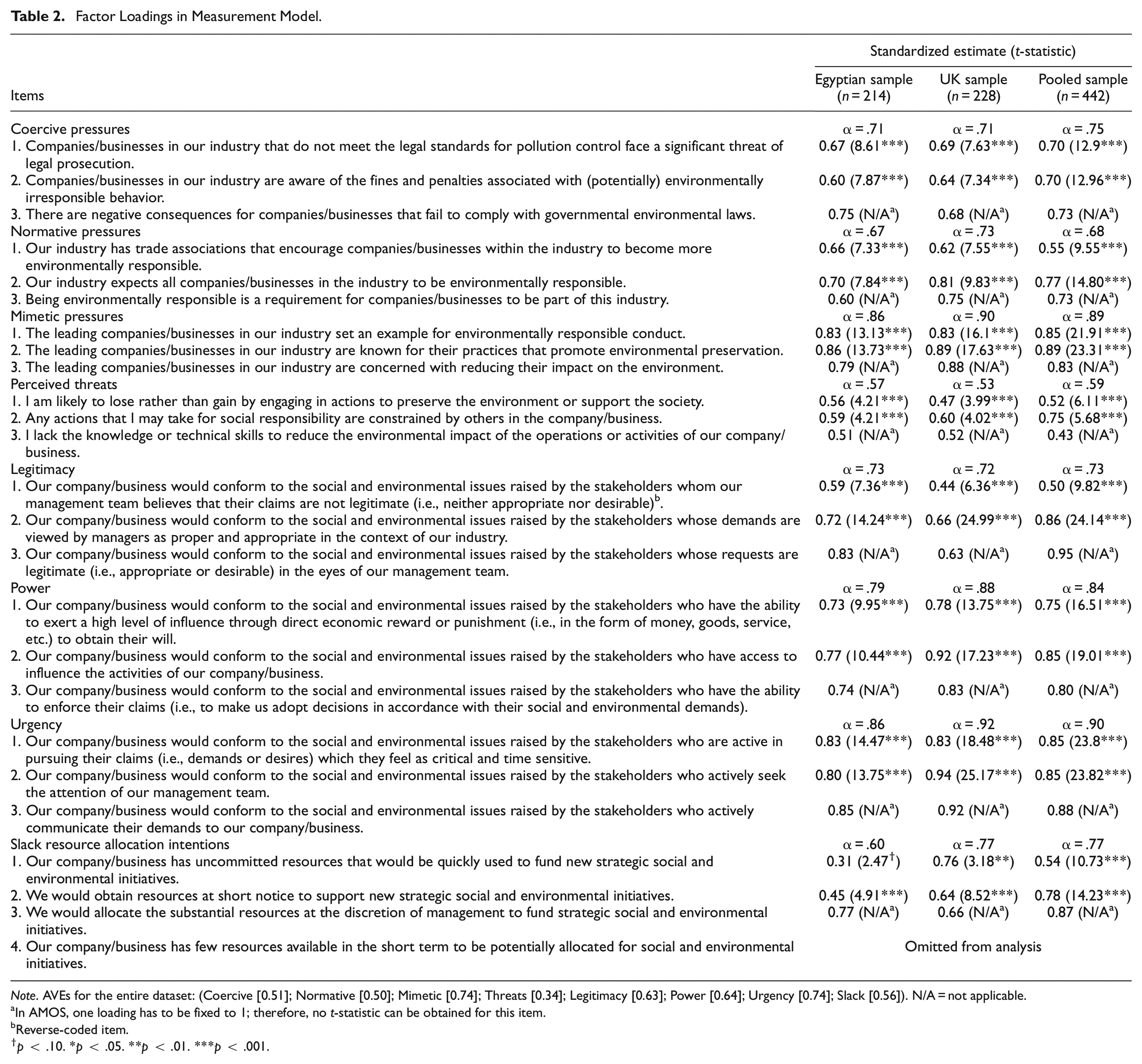
Note. AVEs for the entire dataset: (Coercive [0.51]; Normative [0.50]; Mimetic [0.74]; Threats [0.34]; Legitimacy [0.63]; Power [0.64]; Urgency [0.74]; Slack [0.56]). N/A = not applicable.
In AMOS, one loading has to be fixed to 1; therefore, no t-statistic can be obtained for this item.
Reverse-coded item.
p < .10. *p < .05. **p < .01. ***p < .001.
The convergent validity of each construct was further tested by calculating its average variance extracted (AVE; Fornell & Larcker [1981]), which was found to exceed the 0.50 threshold for all variables in the entire dataset, with the exception of perceived threats. Although threats’ AVE is not ideal, we consider it acceptable for three reasons. First, its discriminant validity was proved using both Fornell-Larcker and Heterotrait-Monotrait (HTMT) criteria (Bacq & Alt, 2018). Second, its three items are heterogeneous, as they capture three different issue attributes, namely emotional associations, loss considerations, and issue controllability (Bagozzi & Yi, 2012). Third, issue interpretation literature has reported that “no one model of issue evolution can fully capture the complexities associated with ongoing societal debates” (Litrico & David, 2017, p. 21).
As presented in Table 3, discriminant validity was tested using the two measures of Fornell-Larcker and HTMT. While threats and slack passed the Fornell-Larcker criterion, other variables belonging to higher-order constructs did not. To confirm that this result was solely attributed to the higher-order phenomenon, we performed two supplemental analyses. First, we carried out the HTMT test for all model variables and established the distinct nature of these first-order variables vis-à-vis others. Second, the Fornell-Larcker criterion was met upon inclusion of second-order constructs (see Online Supplementary D for tabulated results). In aggregate, these results demonstrate acceptable psychometric properties of the model’s variables.
Discriminant Validity: Fornell-Larcker Criterion and Heterotrait-Monotrait (HTMT) Ratio.
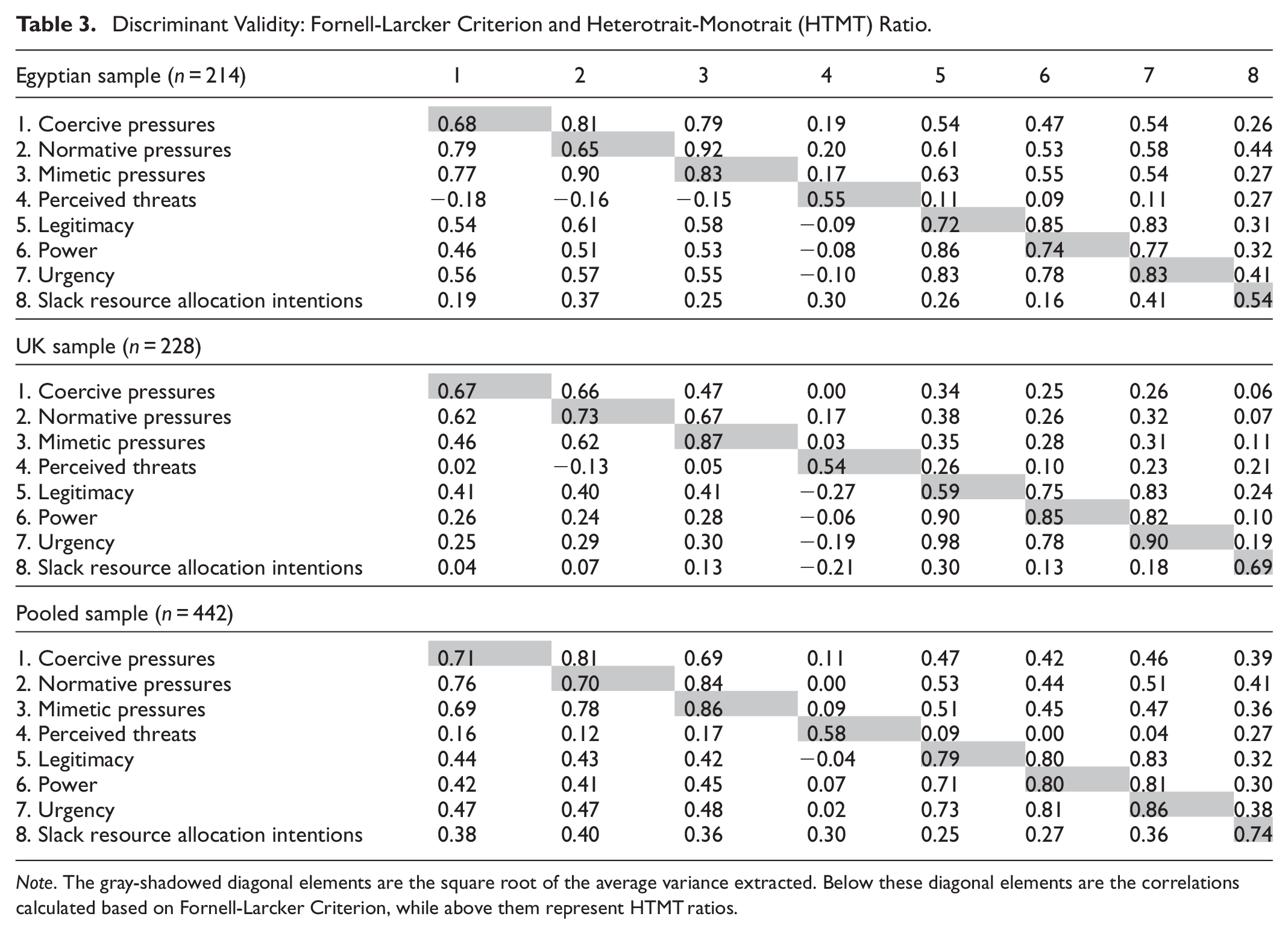
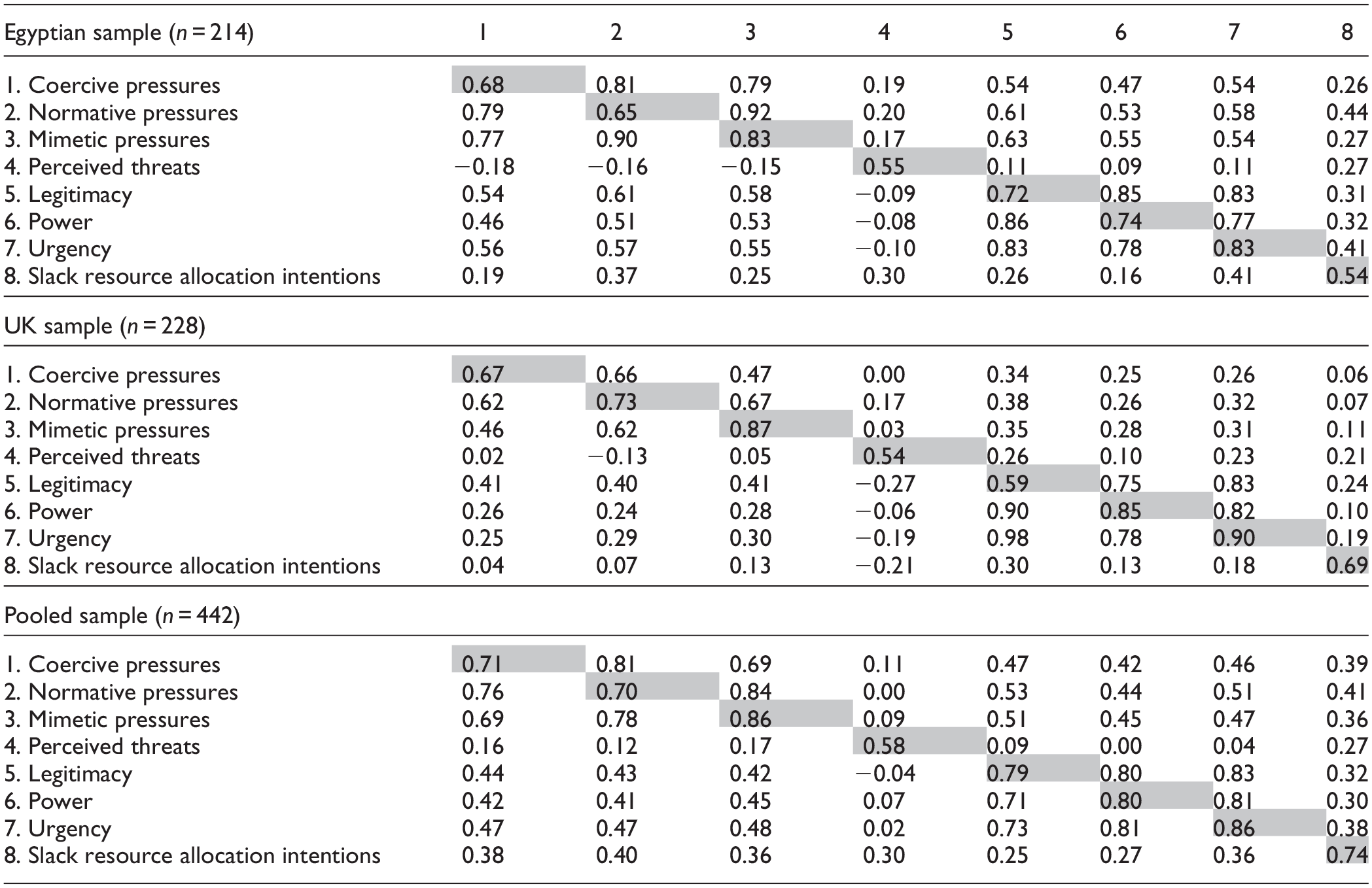
Note. The gray-shadowed diagonal elements are the square root of the average variance extracted. Below these diagonal elements are the correlations calculated based on Fornell-Larcker Criterion, while above them represent HTMT ratios.
Measurement Invariance
Before testing our hypotheses on the pooled dataset, a multigroup analysis (MGA) was performed to establish measurement invariance across Egyptian and British managers. Following Xu and Tracey (2017), we constructed a baseline or configural model that sets an equal number of factors across groups. We then compared this model with metric and scalar models. While the former embedded the invariant factor patterns, the latter restricted the intercepts to being equal across groups. As applied by Kamath et al. (2023), we conducted a multigroup CFA to test the measurement invariance that was assessed based on the cut-offs of ΔCFI ≤ 0.010 and ΔRMSEA ≤ 0.015. As Table 4 shows, our model met both configural and metric tests, achieving partial measurement invariance that was sufficient for the hypothesized model to be tested on the entire dataset (per Ting et al. [2019]).
Test of Measurement Invariance across Egyptian and British Groups.

p<0.001
Structural Model
The results of the structural model are presented in Table 5 and abridged in Figure 2. The goodness-of-fit results (χ2 = 37.57; df = 15; χ2/df = 2.50; TLI = 0.94; CFI = 0.98; RMSEA = 0.058; SRMR = 0.038) indicated an acceptable fit of the proposed theoretical model to the underlying data. As Table 5 displays, we found support for some of the hypothesized relationships. Slack allocation intentions were found to be positively predicted by normative pressures (β = .14; p < .05), threats (β = .12; p < .01), and issue urgency (β = .20; p < .01), lending credence to H1b, H6, and H7c respectively. Conversely, neither other institutional pressures (coercive [β = .01; p = .75], mimetic [β = .01; p = .83]) nor other issue salience attributes (legitimacy [β = .03; p = .53], power [β = −.07; p = .22]) significantly preceded slack allocation intentions, providing no evidence for H1(a,c) and H7(a,b) respectively.
Structural Model Paths.
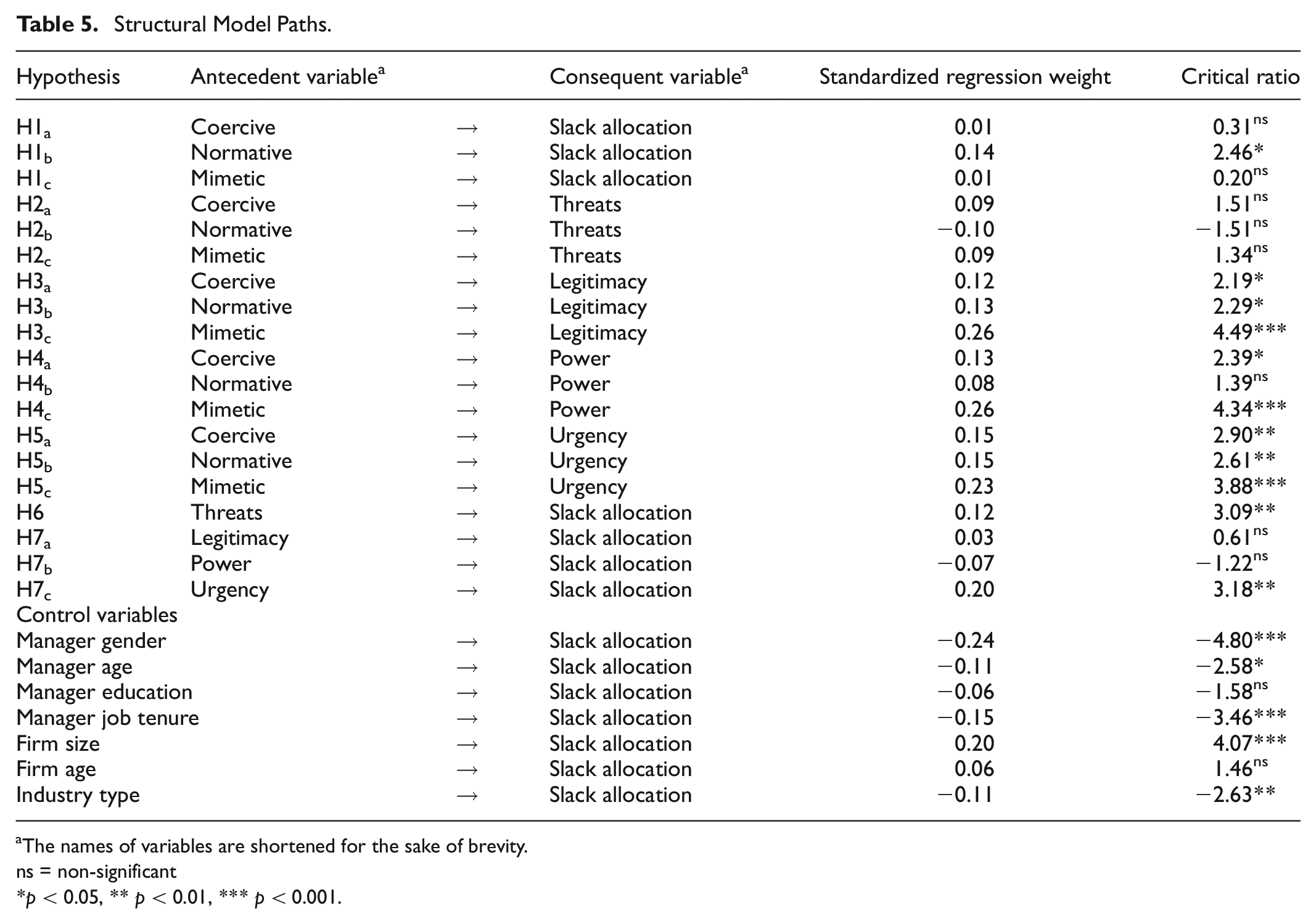
The names of variables are shortened for the sake of brevity.
ns = non-significant
p<0.05, ** p<0.01, *** p<0.001
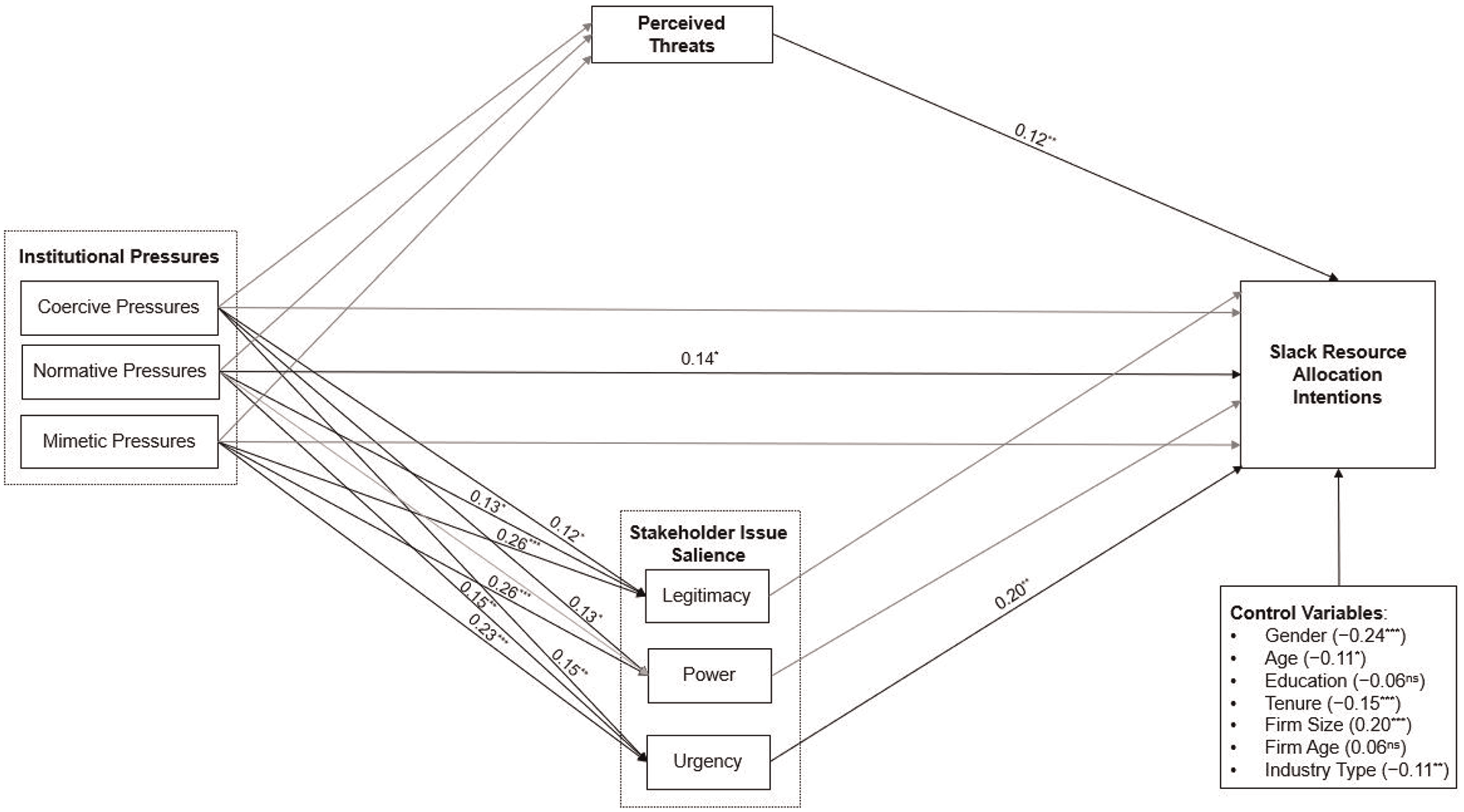
Structural model results.
The non-significant results of coercive (β = .09; p = .13), normative (β = −.10; p = .13), and mimetic (β = .09; p = .17) pressures on perceived threats did not confirm H2(a,b,c). In contrast, each type of institutional pressure was positively associated with each component of stakeholder issue salience, with the sole exception of H4b (Normative → Power [β = .08; p = .16]). Supportive of H3(a,b,c), issue legitimacy was observed to be positively influenced by coercive (β = .12; p < .05), normative (β = .13; p < .05), and mimetic (β = .26; p < .001) pressures. Likewise, and as predicted by H5(a,b,c), issue urgency was found to be preceded by coercive (β = .15; p < .01), normative (β = .15; p < .01), and mimetic (β = .23; p < .001) pressures. However, the pattern changed in the case of issue power, which was only associated with coercive (β = .13; p < .05), and mimetic (β = .26; p < .001) pressures, confirming H4(a,c). Albeit not hypothesized, we tested whether stakeholder issue salience affects perceived threats, and we did not find support for any relationship, except for the urgency-threats path in the UK sample only (β = −.19, p < .10). As the majority of the British sample belongs to the micro-small business category, this result seems consistent with Sampaio et al. (2012), who observed that the managers of British tourism firms view environmental management as time-consuming and incompatible with the small size of their businesses.
The inclusion of control variables brings some novel insights. We found female managers to be more likely to make socially responsible slack allocations than males (β = −.24; p < .001). One possible reason for this is that while male managers are more likely to be interested in utilitarian approaches and career opportunities, female managers place more importance on social orientation, benevolence, and warmth (Figueroa-Domecq et al., 2020). We found that manager age has a negative impact (β = −.11; p < .05) on socially responsible slack allocation, supporting the view that the younger generations of managers are more inclined to act responsibly (Doh et al., 2017). We also found that smaller firms embrace frugality in their slack allocation (β = .20; p < .001). This finding is consistent with Abdel-Maksoud et al. (2016), who observed that larger hotels are more likely to apply eco-control systems due to better resource availability and the ability to offset their cost. Our results concerning industry type (β = −.11; p < .01) indicate that hospitality firms show greater allocation tendencies than their travel counterparts, replicating previous research findings (Sheldon & Park, 2011). However, the results do not support the role of managerial education and firm age in socially responsible slack allocation, running inconsistently with previous CSR research (D’Amato & Falivena, 2020).
Mediation Analysis
As presented in Table 6, the significance of the four mediators that bridge institutional pressures into slack resource allocation intentions was tested by performing 5,000 bootstraps and 95% confidence intervals (Hayes, 2018; Tang & Zhang, 2024). Consistent with H8a, we found evidence of threats’ full mediation in the association between coercive pressures and slack allocation (β = .012; p < .10; CI = [0.00,0.03]). In contrast, both normative (β = −.013; p = .11; CI = [−0.03,0.00]) and mimetic (β = .01; p = .12; CI = [−0.00,0.03]) pressures failed to influence slack allocation via threat perceptions, rejecting H8(b,c). Interestingly, issue urgency channeled all coercive (β = .034; p < .01; CI = [0.01,0.07]), normative (β = .033; p < .01; CI = [0.01,0.07]), and mimetic pressures (β = .043; p < .01; CI = [0.01,0.08]) into slack allocation, accepting H9(g-i). Conversely, both legitimacy and power failed to play such roles, thus rejecting H9(a-f).
Mediation Effects.
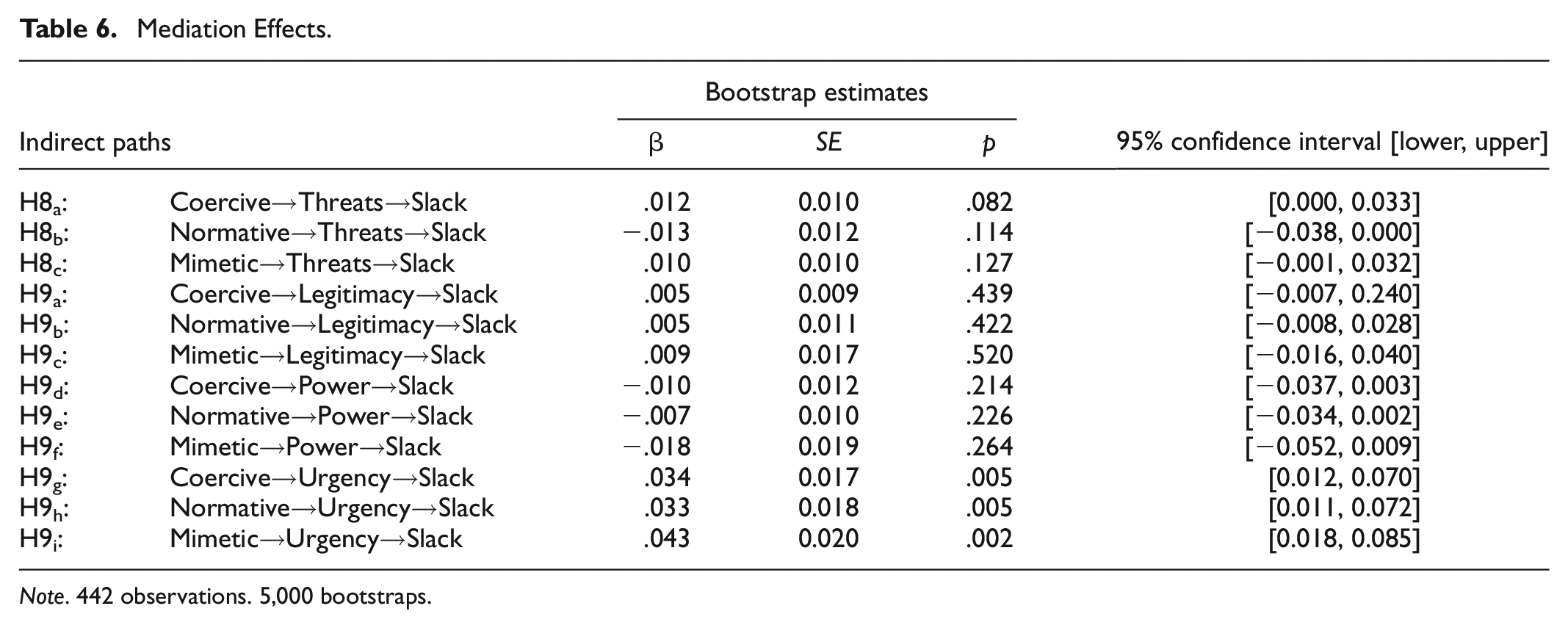
Note. 442 observations. 5,000 bootstraps.
Home Country-Based MGA
To test whether our hypotheses differ across Egyptian and British managers, we conducted a structural invariance test by building a baseline (unconstrained) model, where all factor loadings were set to be equivalent across the two groups. The baseline model exhibited an acceptable goodness-of-fit (χ2 = 41.58; df = 30; χ2/df = 1.38; TLI = 0.96; CFI = 0.99; RMSEA = 0.03; SRMR = 0.04). In a stepwise fashion, we compared the paths of the baseline model that were allowed to vary freely to 19 equally constrained models (Kamath et al., 2023). The comparison showed that both groups vary at the model level (Δχ2(22) = 38.15, p < 0.05). Specifically, cross-national variations were evident in three paths: Normative → Slack (Δχ2(1) = 4.51, p < .05), Mimetic → Legitimacy (Δχ2(1) = 4.78, p < .05), and Threats → Slack (Δχ2(1) = 11.35, p < .01), lending support to H10(b,i,p). By contrast, other relationships (H10[a,c-h,j-o,q-s]) were rejected due to their virtual similarity across both countries, as detailed in Table 7.
Results of Path Differences between Egyptian and British Managers.
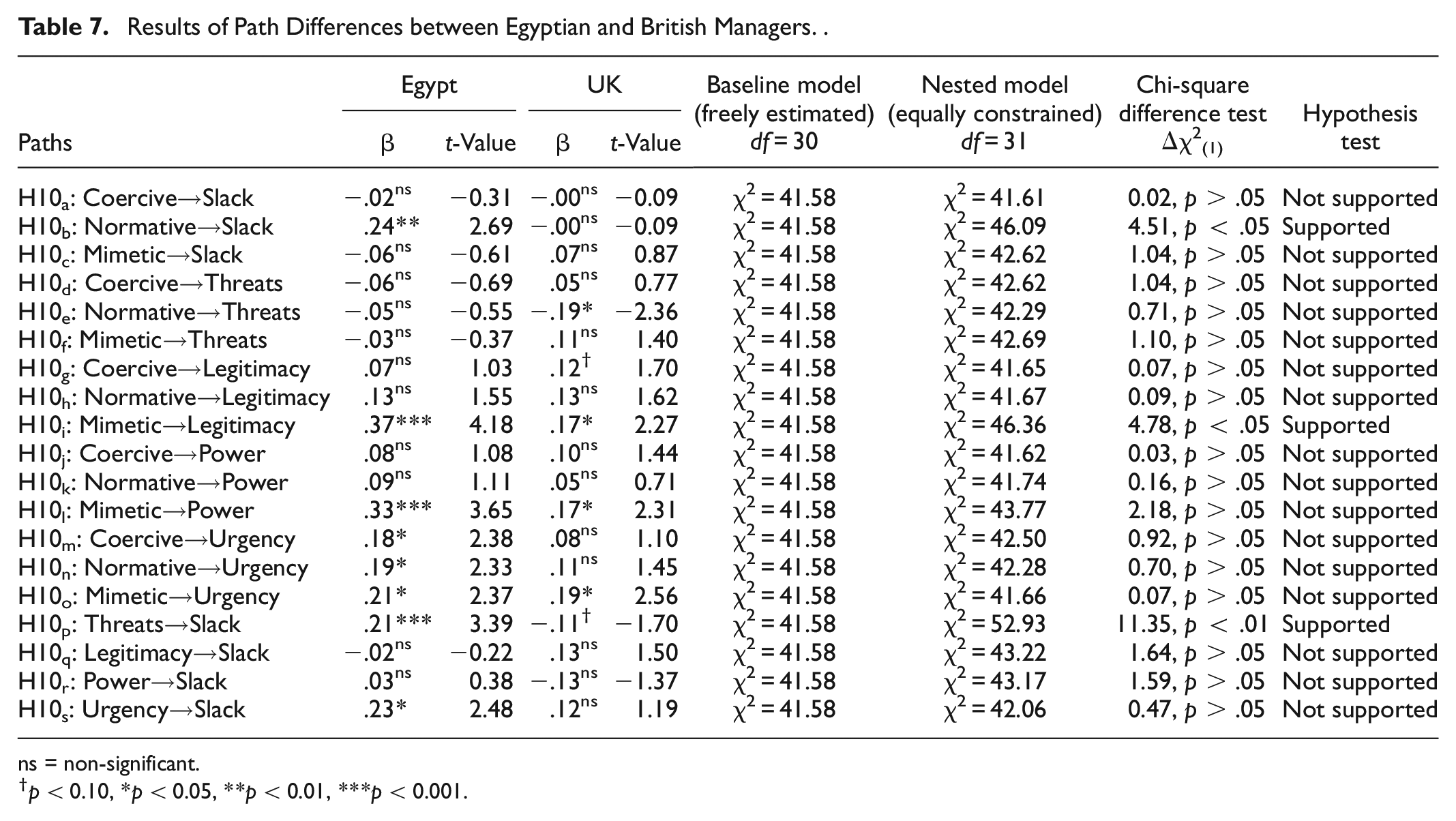
ns = non-significant.†p<0.10, *p<0.05, **p<0.01, ***p<0.001
Discussion
This study critically examined the underexplored area of slack resource allocation decision-making within the framework of corporate social responsiveness, contextualized within crises and the tourism sector. We sought to unpack: Why and how do tourism firms make socially and environmentally responsible slack allocations in the aftermath of a systematic crisis? To address this overarching question and answer the growing calls for studies that incorporate micro-foundational and cross-cultural analyses (e.g., Chen et al., 2023; Song & Kang, 2019), we developed, and empirically tested, an attention-based model using data from tourism firms in Egypt and the UK.
Our findings demonstrate that normative pressures determine slack resource allocation to social and environmental issues, validating Vanacker et al.’s (2017) prediction that certain institutional pressures exert stronger effects on resource allocations than others. This result could be attributed to the collectively powerful role of tourism trade associations in influencing government regulations in favor of the interests of their affiliated businesses (McKercher, 2022). We observed that threats fully mediate the relationship between coercive pressures and slack allocation, lending support to the threat-rigidity hypothesis that threats are significant predictors of managerial attention and corporate resource allocation (Staw et al., 1981). Notably, issue urgency was found to serve as an effective conduit for all institutional pressures to impact slack allocations. These results support the attention-based view of stakeholder salience that managers often engage in favoritism and focus on a single dimension of stakeholders’ requests for socially responsible behavior (Céspedes-Lorente et al., 2003; Wangrow et al., 2015). We further support the notion that institutions can influence how stakeholders perceive social and environmental issues and subsequently direct managers’ attention to specific issues and particular institutional sources (Campbell, 2007; Chen et al., 2023).
Although other relationships lack statistical significance, they do bring critical theoretical insights to tourism crisis management literature, situated within the Covid-19 pandemic, as explained further below. Multigroup analyses revealed remarkable cross-cultural variations in institutional receptivity, issue interpretation/attention, and slack resource allocation among Egyptian and British managers. Taken together, our findings offer several theoretical and practical implications and open up promising avenues for future research.
Theoretical Contributions
This research makes three main theoretical contributions. First, we advance the cognitive micro-foundations of institutional theory and demonstrate how they unpack tourism firms’ social responsiveness and resource allocation decision-making. Our findings suggest that threats and urgency are the cognitive micro-foundations of allocating slack resources to institutionalized social and environmental issues. We support the selectiveness principle of the attention-based view (Ocasio, 1997) and establish the validity of integrating the threat-rigidity hypothesis and stakeholder salience framework into micro-institutional theorization. Altogether, these findings contribute to the tourism literature by filling these key gaps: (a) the scarcity of research on the resource allocation decision-making process either generally (Zheng et al., 2022) or in the CSR context (Masiero et al., 2023), (b) the limited CSR research adopting strategic and manager-oriented approaches (Gao et al., 2024), (c) an emphasis on examining either the moderating effect or consequences of slack resources rather than their allocation determinants (Zheng et al., 2022), (d) the mixed findings of institutional pressures’ effects on firm performance (Ng & Sia, 2023), and (e) the blurred distinction between institutions and stakeholders and the ignorance of the notion that while institutions act as sources of social/environmental issues, stakeholders are those who facilitate/impede managers’ attention to these issues (Cajaiba-Santana et al., 2020).
Furthermore, stakeholder theory is to date the most commonly applied theory in tourism CSR literature (Gao et al., 2024), despite its limitations in explaining the allocation of managerial attention to stakeholder issues (Lin, 2021). Even those who started shifting to the stakeholder salience framework either focused only on legitimacy (Abaeian et al., 2019) or applied qualitative methods (Damian et al., 2023). However, our results did not support the role of legitimacy but rather urgency, which is as yet overlooked in tourism research. In sum, our model, premised on the micro-cognitive foundations of institutional theory, draws a much clearer picture of how tourism firms allocate attention and resources to CSR issues.
Second, we add to crisis management research in the context of corporate social responsiveness and resource allocation decision-making by restricting our investigation to the period following the onset of the Covid-19 pandemic. We answer persistent calls for the development of decision-making models for resource allocation under crisis conditions (Bundy et al., 2017; Zheng et al., 2022). Extant tourism literature overlooks the importance of contextualizing firm responsiveness and investment choices within crises (Sigala, 2020). We demonstrate the urgency’s mediating role in directing all institutional pressures toward slack allocation, as well as the role of threats in transforming coercive pressures into slack allocation. These findings validate the proposition that because crises bring risks, uncertainties, and financial strains, tourism firms only attend to urgent social and environmental issues (He & Harris, 2020). Failure to support the hypothesized effects of mimetic pressures, legitimacy, and power on slack allocation could be attributed to the time-dependent nature of CSR and resource allocation decision-making during crises (Ou et al., 2021).
Third, we contribute to cross-cultural tourism research, which is yet limited and biased toward Western and Anglo-American contexts (Ibrahim et al., 2023; Song & Kang, 2019). Our multi-group analyses support the notion that resource allocation processes are contingent upon national context (Li & Haleblian, 2022). For instance, the coercive pressures → slack allocation path was found to be significant only in the Egyptian sample. This finding supports the belief that local governments in developing countries, with their central-planning economy paradigm, exert significant pressures on tourism firms’ allocation of critical resources to socially responsible initiatives (He et al., 2020). Furthermore, the direct effects of mimetic pressures on legitimacy were found to be stronger in the Egyptian sample than in the British counterpart. This finding could be attributed to increased competition between Egyptian and foreign travel agents after the Egyptian government’s permission for foreign tour operators to establish their own travel agents in Egypt (Abou-Shouk et al., 2016).
We discovered that threat perceptions positively impact Egyptian managers’ slack allocation intentions, but negatively impact those of British managers. This ± effect of threats may be explained in two ways. First, actors with different cultural backgrounds vary in their framing of “socially relevant yet complex issues” (Litrico & David, 2017, p. 987). For example, Sallivan and Nonaka (1988) found that while Japanese managers labeled strategic issues as threats, their American counterparts applied opportunistic labeling. Second, the threat-rigidity hypothesis (Staw et al., 1981) holds the dual nature of threats, implying that when managers find themselves in times of uncertainty and resource scarcity, they consume resources based on whether these allocations will increase or decrease the firm’s functionality. Another interesting cross-national finding is that issue urgency plays the same role in Egypt and the UK. While this finding is inconsistent with Chen et al.’s (2023) contention that urgency effects vary by national culture, it supports Mitchell et al.’s (1997) early assumptions that crises (e.g., Covid-19) entail a sense of urgency, which, in turn, attracts managerial attention and corporate resources. In sum, the empirical observations and plausible explanations presented here encapsulate the material existence of issues in time and space (Barnett, 2008).
Practical Implications
Our findings are practically relevant for tourism firms and policymakers. Coming out of the crisis, organizational leaders are advised to have more oversight of their socially responsible investments. Tools, such as benchmarking and accountability procedures, might help tourism managers make socially responsible slack allocations. Based on our results, tourism firms could establish realistic resource allocation benchmarks that classify social and environmental issues based on their normatively institutionalized status, threats, and urgency, ultimately helping managers identify the most salient issues. Using feedback loops, tourism firms should keep track of managerial decisions related to these issues and distribute accountability for collective duties (Raub & Martin-Rios, 2019). In the age of artificial intelligence, the managers of tourism firms are advised to start leveraging machine-learning algorithms that are effective in processing issues-related data and analyzing patterns, and therefore making resource allocation decisions that are optimal, less biased, and more balanced (Johar et al., 2022). Tourism firms should follow in the footsteps of major corporations and focus on long-term CSR investments that are more appealing to be included in the portfolios of responsible investors. Finally, and where possible, tourism firms should diversify their sources of income, thereby expanding the slack base that can insulate them from any internal or external shocks.
Local governments are urged to support tourism firms with a package of financial incentives, given that most belong to the micro-small, and medium-enterprise categories that represent the backbone of national and global economies. The non-significant coercive pressures–slack allocation relationship signals the need to adopt co-regulation processes where lawmakers and tourism firms jointly discuss the importance of social and environmental issues and propose more appropriate instruments to achieve destination-level sustainable tourism objectives. Furthermore, an effective monitoring system should be established by local authorities to ensure tourism firms’ compliance with relevant regulations. Tourism trade associations (e.g., Egyptian Tourism Federation and Institute of Hospitality [UK]) are recommended to frequently update the most pressing social/environmental issues the industry faces and develop a cohesive set of best practices that act as references for effective resource allocations (McKercher, 2022). Our findings also prompt destination management organizations to implement local stakeholder-focused programs to achieve destination-wide consensus upon the salient social and environmental issues, thereby leading to industrywide compliance.
Limitations and Future Research Directions
The study has some limitations that warrant further investigation. First, future research is recommended to use a mixed-methods design that employs both qualitative and quantitative approaches, including experimental and/or longitudinal methodologies, to further unpack the complexity of the resource allocation problem. Second, subsequent studies might investigate how other factors (e.g., media coverage, organizational values, and individual beliefs) influence managerial attention and organizational resource allocation to strategic issues. It would be interesting for future studies to show how our conceptualizations and findings may be impacted by different types of social and environmental issues. Third, while we focused on reactive social and environmental strategies, the proactive models, as well as other forms (e.g., recoverable, and potential) of organizational slack are worthy of further investigation. Next, wider national comparative studies are necessary to develop more indigenous theories that account for local conditions (Song & Kang, 2019). Finally, our model represents only a first step toward understanding the little-investigated problem of resource allocation; therefore, more research is needed even in different disciplines such as entrepreneurship, innovation, and marketing.
Conclusion
Situated within the Covid-19 context, our attention-based model for socially and environmentally responsible slack allocation advances a fine-grained understanding of how corporate social responsiveness varies while navigating diverse institutional, stakeholder, cognitive, and national contexts. The findings shed light on the need to develop locally sensitive theories and rethink global ones that have been challenged in the private enterprise economy during and after the pandemic. Our practical implications might serve as the ingredients of an optimal resource allocation recipe for managers. It is vital for tourism firms to continue charting and reviewing their strategies in line with changing needs and possible future scenarios. Policymakers should better connect with businesses to tackle grand societal challenges, such as poverty, inequality, and climate change, which pose threats to the continued existence of humankind globally.
Supplemental Material
sj-docx-1-jtr-10.1177_00472875241260333 – Supplemental material for Redirecting Slack Resources to Social and Environmental Issues: A Cross-Cultural Analysis of Tourism Firms Post-Crisis
Supplemental material, sj-docx-1-jtr-10.1177_00472875241260333 for Redirecting Slack Resources to Social and Environmental Issues: A Cross-Cultural Analysis of Tourism Firms Post-Crisis by Mohamed Nageh Ibrahim, Manuel Alector Ribeiro and Albert Nsom Kimbu in Journal of Travel Research
Footnotes
Declaration of Conflicting Interests
The author(s) declared no potential conflicts of interest with respect to the research, authorship, and/or publication of this article.
Funding
The author(s) disclosed receipt of the following financial support for the research, authorship, and/or publication of this article: The researcher, Mohamed Nageh Ibrahim, is funded by a full scholarship [Bureau ID: MM27/19] from the Egyptian Ministry of Higher Education and Scientific Research represented by the Egyptian Bureau for Cultural and Educational Affairs in London. This work is also partially financed by Portuguese Funds provided by FCT –Foundation for Science and Technology (Portugal) through project UIDB/04020/2020 and with DOI 10.54499/UIDB/04020/2020 ( ).
).
Supplemental Material
Supplemental material for this article is available online.
Author Biographies
References
Supplementary Material
Please find the following supplemental material available below.
For Open Access articles published under a Creative Commons License, all supplemental material carries the same license as the article it is associated with.
For non-Open Access articles published, all supplemental material carries a non-exclusive license, and permission requests for re-use of supplemental material or any part of supplemental material shall be sent directly to the copyright owner as specified in the copyright notice associated with the article.
