




Abstract
This study aims to examine how and when different framings of sustainability performance communication influence travelers’ behavioral intentions. Specifically, it examines (1) the effectiveness of sustainability performance communication framing in shaping traveler’s behavioral intentions, (2) the mediating role of perceived commitment to sustainability, and (3) the moderating effect of the level of sustainability performance communicated. The findings of the four experiments conducted revealed that communicating sustainability performance is more effective than not reporting it in determining travelers’ behavioral intentions. Furthermore, an enhancement framing is more effective when communicating sustainability performance than a reduction framing. We also found that tourism provider’s commitment to sustainability explains the impact of sustainability performance communication framing on behavioral intentions. Furthermore, we found that communicating a moderate level of sustainability performance in enhancement framing and a high level in reduction framing is effective. The study provides implications for theory and practice in developing effective sustainability communication.
Keywords
Introduction
Tourism service providers (hereafter “tourism providers”) are increasingly investing in sustainability initiatives to meet the growing demand for sustainable services, comply with regulations, and improve brand reputation (Passafaro, 2020). They are engaging in various sustainability initiatives including establishing sustainability departments, appointing sustainability officers, and implementing sustainability management systems (Balaji et al., 2019;Y. H. Kim et al., 2019; Lesar et al., 2023). However, many tourism providers find it challenging to realize their sustainability vision and strategy into performance (Scheyvens & Hughes, 2019). Moreover, travelers are increasingly becoming skeptical about the authenticity of sustainability initiatives (Kapoor et al., 2022). According to a recent study, about 56% of travelers doubt the sustainability claims of tourism providers (Cho & Taylor, 2020). Given this, tourism providers have recently started to assess and share the performance of their sustainability initiatives on different channels (e.g., social media and websites) with stakeholders (Guix & Font, 2020). For example, the Fairmont hotel chain publishes an online sustainability report about its various sustainability initiatives and their performance (Fairmont, 2022). However, a key concern is that sustainability reporting often focuses on data collection and reporting rather than providing a clear message to encourage travelers to engage in sustainable consumption (Uyar et al., 2020). Despite the potential of sustainability performance communication (Golob et al., 2023), there is limited research on its role in promoting sustainable consumption behaviors among travelers.
Sustainability performance communication provides travelers with objective information about tourism providers’ sustainability initiatives in areas such as water, energy, and waste management. It also includes information about the goals and progress in implementing these initiatives (Opferkuch et al., 2021; WTTC, 2017). For example, in its ESG (Environmental, Social, and Governance) report, Hilton Hotels reported a 1.4% reduction in water consumption in 2015 compared to 2014 (Hilton, 2020), and Abu Dhabi Airports disclosed an 8% increase in recycled water use in 2018 compared with 2017 levels (Falconer, 2019). These examples demonstrate the different focus on enhancement or reduction initiatives within sustainability performance communication. Enhancement initiatives (e.g., increased green energy usage) aim to enhance positive environmental impacts (e.g., preservation and improvement), stimulate economic growth, and promote social well-being (Lange & Dewitte, 2019; UNEPFI, 2017). In contrast, reduction initiatives (e.g., decreased water usage) focus on minimizing negative environmental impacts (e.g., reducing depletion and degradation), lowering operational costs, and promoting responsible resource management (Mak & Chang, 2019). Thus, depending on the specific type of sustainability initiative, sustainability performance can be communicated with enhancement framing (e.g., a 25% increase in renewable energy use in 2022 compared to 2021) or with reduction framing (e.g., a 25% decrease in energy consumption in 2022 compared to 2021). As previous research indicates that the effectiveness of sustainability communication depends on how it is framed (Kapoor et al., 2022), we propose that sustainability performance communication framed as enhancement or reduction will influence travelers’ decision-making. However, the effectiveness of these sustainability performance communication framing and the process by which they influence travelers’ behaviors remains to be explored.
In this study, we propose that travelers’ perceptions of a tourism provider’s commitment to sustainability—referred to as perceived commitment to sustainability—can facilitate a better understanding of the effectiveness of sustainability performance communication. Perceived commitment to sustainability refers to travelers’ evaluation of a tourism provider’s efforts and interest in promoting sustainability practices and contributing positively to the social and economic aspects of communities within which they operate (Jones et al., 2016; Kapoor et al., 2022). This perception helps travelers better understand the credibility and impact of the tourism provider’s sustainability initiatives on the environment (Uyar et al., 2021). Furthermore, this research proposes that the level of sustainability performance communicated serves as a boundary condition in the relationship between sustainability performance communication and travelers’ behavioral intentions. Because tourism providers may have different levels of sustainability commitment, it is important to recognize that sustainability performance levels also differ. For example, Marriott Hotels reported a low to moderate level of sustainability performance in its communication by targeting a 15% reduction in water use by 2025 compared to 2016 (Marriott, 2022). In contrast, the Four Seasons Resort in the Maldives exemplified a high level of sustainability performance in its communication by sourcing 90% of its food from local and sustainable sources (Four Seasons, n.d). Previous research suggests that different levels of service quality (Tarí et al., 2017) and hotel services and attributes (Albayrak & Caber, 2015) significantly influence travelers’ evaluation of the tourism provider. Thus, we expect that different levels of sustainability performance will influence the effectiveness of sustainability performance communication framing on travelers’ behavioral intentions.
This study seeks to address the abovementioned gaps by investigating how and when sustainability performance communication impacts travelers’ behavioral intentions. More specifically, it addresses four research questions:
Research Question 1: What is the effect of sustainability performance communication on travelers’ behavioral intentions toward the tourism provider?
Research Question 2: How does enhancement and reduction framing in sustainability performance communication affect travelers’ behavioral intentions toward the tourism provider?
Research Question 3: What role does perceived commitment to sustainability play in explaining the relationship between sustainability performance communication and travelers’ behavioral intentions toward the tourism provider?
Research Question 4: What are the effects of different levels of sustainability performance on the relationship between sustainable performance communication and travelers’ behavioral intentions toward the tourism provider?
Understanding the effectiveness of sustainability performance communication is crucial, as doing so enables tourism providers to tailor their sustainability communication strategies. By understanding which framing approach (i.e., enhancement vs. reduction) and performance levels (i.e., low, medium, or high) elicit a more favorable response from travelers, tourism providers can strategically influence travelers’ decision-making and promote sustainable consumption. This will also help tourism providers to achieve sustainability goals, which will encourage further investments in sustainability initiatives. The present study contributes to the literature on sustainability communication (Kapoor et al., 2021; Tölkes, 2018), sustainability performance management (Oriade et al., 2021), sustainability labeling (Cho & Taylor, 2020), and sustainability reporting (Guix et al., 2019) in a tourism context (see Web Appendix A for detailed theoretical contributions).
We adopt a multi-theoretical perspective to address the complexity of sustainability communication (Tölkes, 2018). We use mindset theory (Dweck et al., 1995) to examine the effectiveness of sustainability performance communication on travelers’ behavioral intentions. Furthermore, we draw on framing theory (Tversky & Kahneman, 1989), the elaboration likelihood model (ELM, Petty & Cacioppo, 1986), and the numerosity effect (Wilcox & Prokopec, 2019) to support the relationships between sustainability performance communication framing, performance levels, perceived commitment to sustainability, and travelers’ behavioral intentions. The rationale for adopting a multi-theoretical perspective arises from the inherent complexity of sustainability, which frequently encompasses multiple issues (Ibrahim et al., 2023). Moreover, comprehending sustainability communication is often challenging for travelers (Tölkes, 2018). Consequently, communicating a tourism provider’s initiatives and their environmental impacts becomes a complex task. Employing a multi-theoretical approach affords an enhanced in-depth understanding of the intricate process by which travelers evaluate sustainability initiatives and how information pertaining to sustainability performance influences their decision-making. However, it is important to note that our study primarily focuses on “environmental” sustainability, without exploring the “social” or “economic” dimensions. Therefore, readers should exercise caution in extending the findings of this study to these other pillars of sustainability. We discuss this in the limitations and future research directions later at the end of the manuscript. Despite these caveats, the present study contributes significantly to the existing body of literature, providing valuable insights into the effectiveness of sustainability performance communication in shaping travelers’ behavioral intentions.
Theoretical Background
Sustainability Performance Management and Communication
Sustainability performance management constitutes a systematic approach encompassing sustainability’s environmental, social, and economic dimensions (Schaltegger & Wagner, 2006). It addresses the interaction between the business, environment, and society, while operationalizing, measuring, and communicating progress toward achieving sustainability goals and objectives (Schaltegger & Wagner, 2006). Consequently, sustainability performance management involves a set of tools, processes, and systems that tourism providers can employ to identify, measure, and evaluate their sustainability performance and report their outcomes to various stakeholders, including travelers (de Villiers et al., 2016). Sustainability performance management has gained considerable importance in the tourism industry, as travelers and other stakeholders are showing an increased interest in understanding how tourism providers address environmental problems (Guix & Font, 2020). Furthermore, as regulatory authorities demand that businesses report publicly the sustainability initiatives and their performance, sustainability performance management has assumed a prominent role among them and various stakeholders. The Global Reporting Initiative (GRI)—a widely recognized framework—facilitates tourism providers’ disclosure of sustainability performance information (Guix et al., 2019). For example, Hilton Hotels utilizes the GRI framework to communicate the environmental, social, and economic impacts of its sustainability initiatives (Aksoy et al., 2019).
Effective communication of sustainability performance is crucial to sustainability performance management (Garay et al., 2017). Sustainability performance communication pertains to how tourism providers convey information to stakeholders including travelers about the tourism providers’ sustainability initiatives and the efforts and actions taken toward achieving the sustainability goals (Guix et al., 2018). Typically, this communication provides objective information about the performance of various sustainability initiatives compared to the previous year or a baseline year (Hahn & Kühnen, 2013; UNEPFI, 2017). Sustainability performance is measured either internally or by an external third party and is shared with stakeholders including travelers through various channels such as social media, websites, or press releases. For example, Marriott’s 2015 sustainability performance communication on its website highlighted efforts to reduce energy and water consumption by 13% and 10%, respectively, compared to a 2007 baseline (Marriott, 2015). Similarly, Hilton Hotels announced on Twitter that it increased procurement of sustainable seafood by 25% in 2020 compared to the 2015 baseline (Hilton Newsroom, 2020). Because social media has emerged as a prevalent communication channel (Balaji et al., 2021), the present study focuses on the effectiveness of communicating sustainability performance via social media on travelers’ behavioral intentions.
Emphasis Framing in Sustainability Performance Communication
Framing theory suggests that the way information is presented within a message influences audience perception (Tversky & Kahneman, 1989). There are two types of framing effects. First, valence framing—which refers to whether a sustainability message is framed positively (i.e., in terms of perceived gains) or negatively (i.e., in terms of perceived losses)—has been shown to impact travelers’ behavioral intentions toward the tourism provider (Zhang et al., 2021). In other words, valence framing involves how framing the same sustainability information positively or negatively influences travelers’ preferences differently. Second, emphasis framing refers to the strategic emphasis on specific sustainability initiatives undertaken by tourism providers in their communication practices (Laker et al., 2018). Essentially, it directs travelers’ attention toward specific sustainability initiatives, thereby making it more easily processed and influencing their perceptions and choices regarding the tourism provider (Palmeira et al., 2016). Although valence framing provides valuable insights into understanding how travelers’ preferences change when sustainability information is conveyed in a positive or negative tone, it may have limited understanding of the effectiveness of different sustainability initiatives, such as enhancement or reduction, which are examined in the present study.
Depending on the specific contexts and environmental challenges they face, tourism providers may engage in different sustainability initiatives (de Grosbois, 2012). Factors such as partnership with other institutions, geographic location, regulatory requirements, cost-benefit analysis, and consumer demand may determine tourism providers prioritizing certain initiatives in their sustainability strategy over others (Raub & Martin-Rios, 2019). For example, ITC Hotels focuses on “promoting sustainable resource production” by emphasizing the utilization of renewable energy and water resources in its sustainability initiatives (ITC Hotels, 2022). In contrast, Walt Disney World Resort is committed to “reducing resource consumption” through environmental stewardship initiatives, which include reducing emissions, conserving water, and decreasing waste (Walt Disney Resort, 2022).
As a result, sustainability performance communication can be presented as either enhancement framing or reduction framing messages, depending on the focus of the sustainability initiative. This type of framing a sustainability communication where the performance of different sustainability initiatives is reported is known as emphasis framing. Unlike valence framing, which uses a positive or negative tone to communicate a sustainability initiative, emphasis framing reports the performance information of different sustainability initiatives (Nelson & Kinder, 1996). Through emphasis framing, tourism providers can strategically decide which sustainability initiatives to communicate to have a greater impact on travelers’ behaviors. Furthermore, by highlighting certain sustainability initiatives, such as enhancement or reduction, tourism providers can influence travelers’ decision-making and promote sustainable consumption (Palmeira et al., 2016).
Enhancement and Reduction Framing—Sustainability Performance Communication
Enhancement framing emphasizes a tourism provider’s initiatives to promote sustainable resource production and increase the positive environmental impacts of its operations (Mak & Chang, 2019). Enhancement framing showcases a tourism provider’s commitment and responsibility toward sustainability by highlighting environmentally responsible initiatives, including renewable energy adoption, water recycling, and proper waste management, all of which contribute to improved environmental outcomes (Melissen et al., 2016). By promoting higher renewable energy and recycled water use, enhancement initiatives support the preservation of the environment (environmental), improve quality of life (social well-being), and foster innovation and energy security (economic growth) (Amin et al., 2022; Kennedy & Linnenluecke, 2022). For instance, GF Victoria Hotel’s enhancement framing message conveyed that 90% of its total energy consumption was derived from renewable sources (GF Hoteles, 2018). Likewise, Sandymount Hotel communicated that it successfully recycled 95% of its waste and obtained 26% of its energy from renewable sources (Sandymount Hotel, 2018).
Reduction framing focuses on a tourism provider’s efforts to minimize resource consumption and decrease the negative environmental impacts of its operations (Mak & Chang, 2019). The goal of reduction framing is to demonstrate the provider’s accountability and achievements in minimizing the adverse impact of its operations and services on the environment (Chan et al., 2020). By reducing resource consumption, reduction initiatives decrease pressure on ecosystems and biodiversity (environmental), fair distribution and access to resources (social equity), and cost savings and market competitiveness (economic efficiency) (Hickel, 2019; Shrivastava, 1995). For example, the Sydney Opera House reported a 16% reduction in energy use compared to the baseline year (Sydney Opera House, 2020). Similarly, Universal Orlando Resort revealed a savings of 2.6 million kilowatt-hours of energy in 2016 compared to the previous year (Region Admin, 2018).
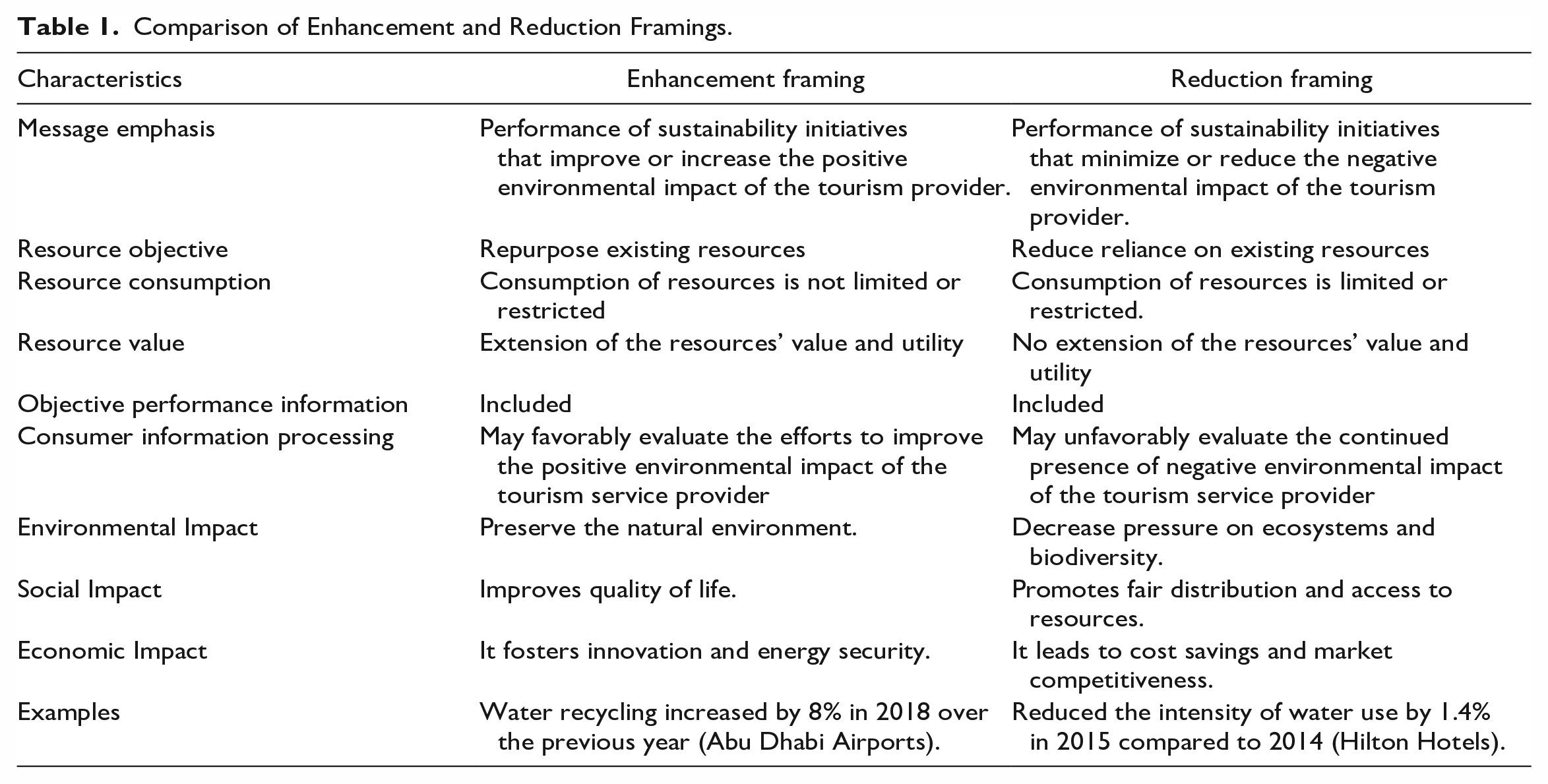
Though both enhancement and reduction framing focus on sustainability initiatives that benefit the environment, the approach by which they achieve sustainability objectives and goals differs. Enhancement framing emphasizes creating new resources from existing ones, such as recycled water, thus transforming the linear consumption economy into a circular, sustainable one (Rodríguez et al., 2020). Conversely, reduction framing focuses on minimizing resource consumption, such as water conservation and energy saving (Sørensen & Grindsted, 2021). Unlike enhancement framing, which increases the value and utility of resources, reduction framing promotes environmental sustainability by limiting resource use without enhancing its value (Melissen et al., 2016). Because enhancement and reduction framing highlight distinct sustainability initiatives, travelers’ perceptions and subsequent decision-making may differ (shown in Table 1 are the differences between enhancement and reduction framing).
Comparison of Enhancement and Reduction Framings.
Mindset Theory
Mindset theory posits that an individual’s response to a situation depends on his/her perception of it as fixed or malleable (Dweck et al., 1995). People have different approaches to problem-solving and decision-making, and these mindsets shape their attitudes and behaviors (Murphy & Dweck, 2016). We adopted the two most researched mindsets—entity and incremental. In an entity mindset, human traits are considered fixed, whereas an incremental mindset allows for continuous change in traits and behavior (Dweck et al., 1995). Recent studies show that mindsets are not fixed traits and can be activated by external influences, such as environment, context, and communication (Streicher et al., 2021).
We propose that sustainability performance communication could activate a specific mindset depending on its framing. This subsequently influences travelers’ perceptions of a tourism provider’s commitment to sustainability and behavioral intentions. Sustainability communication can stimulate travelers’ mindsets by providing cues aligning with incremental or entity mindsets. The framing of sustainability communication can convey cues of progress, development, equity, security, improvement, and preservation depending on whether it is framed as an enhancement or a reduction (Chi et al., 2021; Wong et al., 2020). Consequently, the specific framing used in sustainability performance communication may trigger different mindsets depending on the cues it conveys to travelers. Furthermore, the reported level of sustainability performance may also stimulate specific consumer mindsets by offering cues about a tourism provider’s efforts in addressing environmental impacts. Past studies have shown that different levels of perception of threat and distance activate entity or incremental mindsets (Nenkov, 2012; Septianto & Chiew, 2021). The preceding discussion posits that mindset theory offers an appropriate lens for understanding travelers’ evaluation of sustainability performance communication. Although previous studies have explored mindset theory in various contexts (Büttner et al., 2013; Streicher et al., 2021), limited research has explored its application within the effectiveness of sustainability performance communication.
Hypothesis Development
The conceptual framework of the study is shown in Figure 1. As shown in Figure 1, we propose that communicating sustainability performance increases travelers’ behavioral intentions toward tourism providers, more so than when unreported. Furthermore, enhancement framing is more effective than reduction framing in impacting travelers’ behavioral intentions. The underlying mechanism is the perceived commitment to sustainability, but the performance level serves as the boundary condition in this relationship.
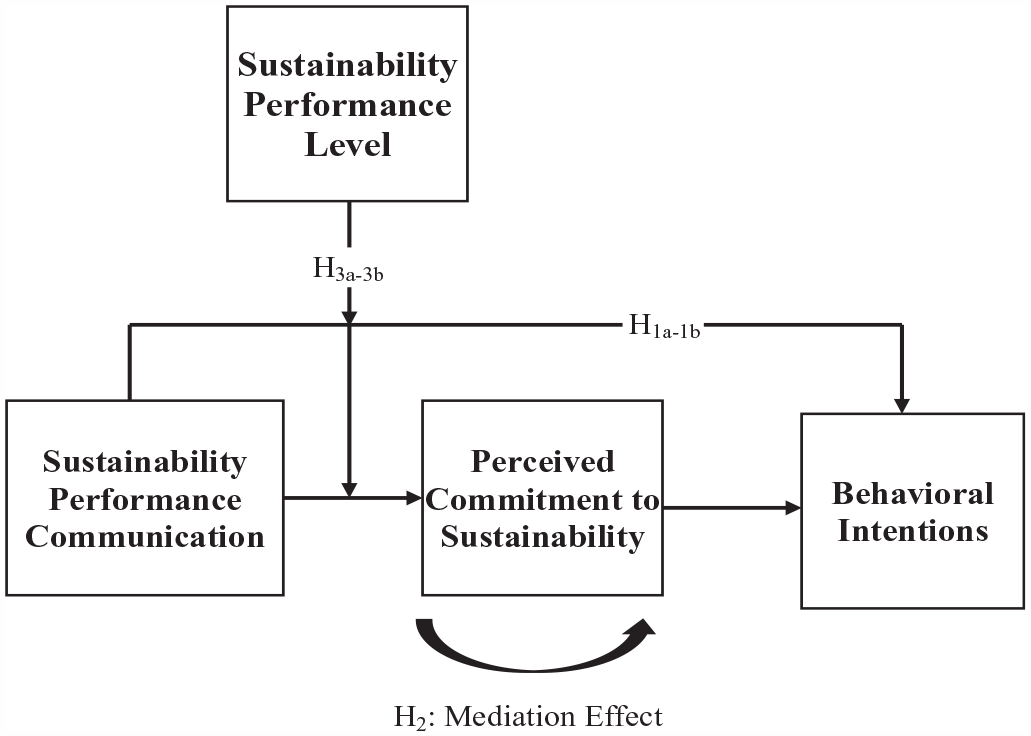
Conceptual framework of the study.
We employ framing theory (Tversky & Kahneman, 1989) to understand how sustainability performance communications framed as enhancement or reduction influence travelers’ behavioral intentions. To delve deeper into psychological mechanism, we turn to mindset theory (Dweck et al., 1995), which elucidates why travelers respond the way they do to different sustainability performance communication framings. These two theories synergistically provide a more robust framework (Su & Li, 2022) for examining the effectiveness of different frames—enhancement and reduction—in sustainability performance communication. Building on this integrated framework, we incorporate the Elaboration Likelihood Model (ELM) (Petty & Cacioppo, 1986) to shed light on how travelers receive and process these sustainability messages. Furthermore, we use the numerosity effect (Wilcox & Prokopec, 2019) to understand how different levels of sustainability performance communication impact travelers’ behavioral intentions. The inclusion of ELM and the numerosity effect strengthens our multi-theoretical approach to offer a comprehensive understanding of how and when sustainability performance communication influences travelers’ outcomes (Mayer & Sparrowe, 2013; Zhang et al., 2021).
Direct Effect of Sustainability Performance Communication
The abstract nature of sustainability often challenges crafting effective sustainability performance communication for travelers (Tölkes, 2018). This is further exacerbated by the intangible characteristics of tourism services (S. Park & Tussyadiah, 2017). Consequently, to mitigate risk and uncertainty, travelers often seek objective information about the tourism providers’ sustainability initiatives and the efforts carried out in implementing these initiatives (Vo et al., 2019). Sustainability performance communication addresses these challenges by presenting objective data about tourism providers’ sustainability initiatives and their outcomes. This allows travelers to understand a tourism provider’s environmental responsibility achievements (Golob et al., 2023). Furthermore, it can dispel skepticism toward the tourism provider by presenting clear, objective information about the results of their sustainability initiatives (Castellani & Sala, 2010).
According to the ELM (Petty & Cacioppo, 1986), objective performance information in sustainability communication increases arousal and stimulates elaboration. This prompts travelers to engage actively with sustainability communication resulting in higher recall and understanding of the tourism providers’ sustainability initiatives and performance information processing (White & Willness, 2009). Additionally, including objective performance information in sustainability communication can reduce misinterpretations and doubts about the efforts and commitment of the tourism provider in achieving sustainability goals (Buhalis & Michopoulou, 2011; Chi et al., 2021). This is consistent with prior research which suggests that travelers tend to favor precise, objective information as it reduces risk and increases trust (Balaji et al., 2021). The above discussion leads to the following hypothesis:
Regarding the effectiveness of sustainability performance communication, we propose that enhancement framing has a greater impact on travelers’ behavioral intentions than reduction framing. Although there is no direct empirical support for this, research on mindset theory (Dweck et al., 1995) offers indirect evidence for the role of mindset malleability in influencing an individual’s responses. For instance, Karwowski et al. (2020) demonstrated the malleability of individual mindsets, with stronger (vs. weaker) fixed beliefs arising when contemplating more (vs. less) prominent creators. Conversely, growth mindsets are activated when focusing on less (vs. more) prominent creators. Additionally, recent studies showed that subtle external influences can change an individual’s mindset (Karwowski et al., 2022; Sisk et al., 2018).
Building on these arguments, we posit that, when travelers encounter sustainability performance communications framed as an enhancement (e.g., using 30% more recycled water), they perceive tourism providers’ initiatives as innovative solutions to environmental issues. These initiatives are seen as positively contributing to the environment by creating new resources (Chan et al., 2020). Such initiatives, being rare and challenging, necessitate additional commitment (e.g., upfront investment, infrastructural changes, augmented risk) (Jones et al., 2016), thus leading travelers to regard them as particularly worthy. Furthermore, because enhancement framing centers on preserving and maintaining existing resources without limiting their use, it fosters an active entity mindset. 1 It also directs travelers’ attention to the positive aspects of sustainability initiatives (Mathur et al., 2016), which results in a favorable evaluation of the tourism provider. In contrast, travelers may evaluate a reduction framing of sustainability performance communication (e.g., 30% less fossil fuel usage) as conventional tourism practices (Kularatne et al., 2019). Reduction framing may activate a growth mindset 2 by emphasizing the potential for continuous improvement (Kularatne et al., 2019). By focusing on addressing environmental problems and reducing adverse consequences, reduction framing fosters favorable attitudes toward tourism providers and encourages sustainable consumption.
We propose that reduction framing may leave travelers less satisfied than enhancement framing because of the presence of negative environmental attributes. Travelers may feel that the tourism provider has not fully achieved sustainability and can do more to achieve sustainability (Mathur et al., 2016). Previous research has highlighted travelers’ heightened concern about negative attributes, as such features tend to violate the expectations of sustainable tourism providers (Yang et al., 2021). Moreover, previous research has revealed that sustainability communication focusing on reduced environmental resource use can produce unfavorable outcomes (White & Willness, 2009). By implying consumption constraints (e.g., less water use), reduction framing may lead travelers to presume potential environmental trade-offs and unfulfilled service quality expectations (Skard et al., 2021). Kularatne et al. (2019) corroborated the foregoing phenomena by demonstrating that decreased water usage adversely impacted technical efficiency, resulting in reduced guest comfort and demand. The above discussion leads to the following hypothesis:
Mediating Effect of Perceived Commitment to Sustainability
Perceived commitment to sustainability refers to the extent to which travelers believe that a tourism provider is genuinely committed to implementing environmentally responsible practices (Kapoor et al., 2021). Given the diverse levels of commitment tourism providers exhibit, spanning from superficial public communications to genuine efforts in implementing sustainable strategies, this perception is crucial (Gao et al., 2016). Previous research has investigated the impact of message framing on travelers’ perceived commitment to sustainability (Kapoor et al., 2022) and its subsequent effect on behavioral intentions (Han et al., 2020; Kapoor et al., 2021). In the present study, we propose that perceived commitment to sustainability mediates the effect of sustainability performance communication on travelers’ behavioral intentions.
Mindset theory offers some insight into the foregoing relationship by suggesting that different message framings activate distinct mindsets, thus influencing travelers’ perceptions and responses to sustainability performance communication. Previous research demonstrates that an individual’s entity versus incremental beliefs impact evaluations of commitment, performance, and achievements (e.g., Canning et al., 2020; Lee et al., 2021). When a specific mindset is stimulated, travelers tend to engage in more diagnostic judgments about tourism providers (Wong et al., 2020). We propose that the specific mindset activated by enhancement or reduction framing influences travelers’ decision-making toward the tourism provider. The relationship is further supported by the ELM (Petty & Cacioppo, 1986). This is because ELM suggests that sustainability performance communication, with its objective and rational information, may serve as a central cue, stimulating cognitions associated with sustainability initiatives and the tourism provider (Line et al., 2016). The above discussion leads to the following hypothesis:
Moderating Effect of Sustainability Performance Level
Sustainability performance level is defined as the magnitude of reported sustainability performance (Cho & Taylor, 2020). Based on the proportional change in sustainability performance over a specific period, it can be categorized as low, medium, or high. For example, the 90% use of renewable energy over the past few years reported by GF Victoria Hotel may indicate a high level of sustainability performance. The 1.4% reduction in water use reported by Hilton Hotels in 2015 over 2014 may reflect a low sustainability performance level (Cho & Taylor, 2020). Although reporting different levels of sustainability performance serves multiple functions for travelers (e.g., cognitive effort, credibility), little is known about how the sustainability performance level interacts with sustainability performance communication framing in affecting travelers’ behavioral intentions.
Previous research has shown that the numerosity effect (Wilcox & Prokopec, 2019) impacts consumer judgment and decision-making in relation to the level of objective information presented in an advertisement or message (Wertenbroch et al., 2007). Literature on “the higher, the better” heuristic has suggested that larger numbers are suggestive of a higher quality of a product or brand (Kyung et al., 2017). However, other work has demonstrated that larger numbers are not necessarily better, as the relationship follows a nonlinear path—with consumers evaluating larger numbers less favorably (Schley & Peters, 2014). This inconsistency infers that additional empiricism is needed to enhance understanding of how sustainability performance levels affect travelers’ behavioral intentions.
Communicating a higher level of sustainability performance in enhancement framing is likely to result in a more favorable evaluation of the tourism provider. However, when the communicated sustainability performance level is very high (e.g., 80% more renewable energy use in 2021 than in 2020), we propose that it may well reverse the travelers’ favorable evaluation of the tourism provider vis-à-vis a moderate level of sustainability performance. Previous work has found that an entity mindset is more likely to be motivated by moderately difficult, rather than extremely difficult, challenges (Wentzel et al., 2010). This is because the entity mindset may draw travelers’ attention to the presence of high levels of sustainability performance in enhancement framing, potentially causing skepticism and negative perceptions. Travelers may perceive such significant improvements in sustainability as unrealistic, thereby negatively affecting their overall perception of the tourism provider. Thus, we expect that enhancement framing that reports a moderate level of sustainability performance may be more effective in influencing travelers’ decision-making than one reporting a low or high level of sustainability performance.
When reduction framing includes a high level of sustainability performance (e.g., 80% reduction in fuel consumption in 2021 compared to 2020), travelers’ attention may be directed to the tourism provider’s success in mitigating negative environmental impacts. Although a high level of sustainability performance in reduction framing may indicate that the negative environmental impact (e.g., fuel consumption) remains, the incremental mindset triggered by this type of message framing directs attention to the sustainability efforts; as such, travelers will likely tend to believe further improvement is possible (Murphy & Dweck, 2016). In addition, because a high level of negative environmental impacts has been reduced (i.e., through reduction framing), the remaining comportment would be minor and likely resolved in a relatively minimal amount of time. Therefore, a high level of sustainability performance in reduction framing may result in a positive evaluation of the tourism provider. In contrast, a low or medium level of sustainability performance in reduction framing may be less favorably evaluated. This is because travelers’ attention is drawn to the significant presence of the negative environmental impact. Furthermore, proportional inferences suggest that travelers may believe that the less the negative environmental impact, the higher the tourism providers’ commitment to sustainability. Thus, the following hypotheses are presented:
Methodology
Four studies were conducted to test the hypotheses. Study 1a utilized social media users on Facebook as the unit of analysis, to examine the effectiveness of sustainability performance communication. This choice allowed us to assess the ecological validity of our theoretical framework in a real-world, natural setting where a diverse range of individuals including travelers interacted and assessed the sustainability performance communication message. Study 1b, 2, and 3, however, shifted the unit of analysis to travelers, which directly aligns with our primary research question—understanding how sustainability performance communication framing influences travelers’ behavioral intention. This shift in the unit of analysis establishes internal validity and ensures the robustness of the study findings. Study 1b replicated the social media experiment (Study 1a) in an online controlled experiment. Study 2 investigated the mediating role of perceived commitment to sustainability. The boundary condition of sustainability performance level was examined in Study 3. An overview of the studies is presented in Figure 2.
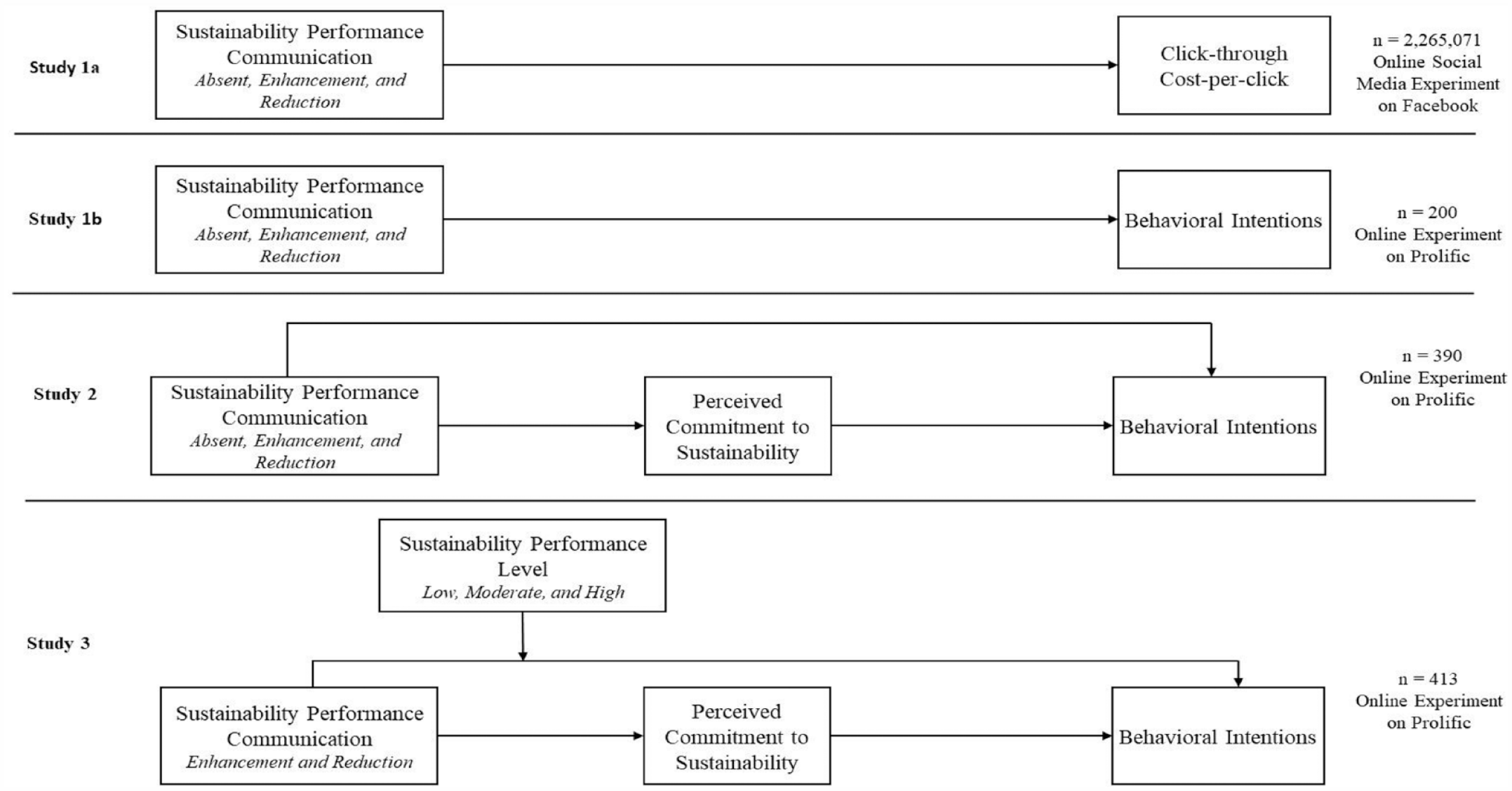
Overview of studies.
Study 1a. Effectiveness of Sustainability Performance Communication (Field Experiment)
An online field experiment was conducted using the Facebook advertising platform to assess the effectiveness of sustainability performance communication (i.e., absent vs. reduction vs. enhancement) on social media users’ click behavior. Click behavior goes beyond stated intentions that are affected by self-response biases (Dolnicar et al., 2017).
Method
A one-factor (i.e., sustainability performance communication framing: absent vs. reduction vs. enhancement) between-subjects experiment was conducted in an eco-friendly hotel context. We launched a real-time advertising campaign using Facebook Ad Manager, which runs advertisements simultaneously on Facebook, Messenger, and Instagram.
The stimuli were developed based on advertisements that actual tourism providers had posted on Facebook. The three ads focused on the “Hotel Orchid” (i.e., a fictitious brand name to avoid familiarity bias)—including information about the hotel and its sustainability initiatives—and invited travelers to stay at the hotel. In the absent condition, the stimuli stated that Hotel Orchid practices responsible use of energy. No information about sustainability performance was provided. The enhancement framing condition mentioned that Hotel Orchid had adopted sustainable energy systems, thus enabling it to employ 25% more renewable energy in 2019 compared to 2018. The reduction framing condition indicated that Hotel Orchid had adopted sustainable energy systems, which allowed it to reduce energy consumption by 25% in 2019 over 2018 (see Web Appendix D for the stimuli). Respondents clicking on “Learn more” in the stimulus were redirected to a separate web page explaining the purpose of the study. We used both images and text in the stimuli to increase realism. The three social media messages were similar in length.
We created the Facebook campaign with the following settings: Split test on campaign length (i.e., 7 days), age (i.e., 18–65 years old), location (i.e., India—because the linked account and credit card were from India), language (i.e., English), and devices (i.e., tablet, desktop, mobile). These settings held all elements constant, except for the sustainability message in the advertisement. Participants recorded their responses to the advertisements; click-through and cost-per-click were used as the outcomes (Orazi & Johnston, 2020).
Click-through—the number of Facebook users who clicked on the advertisement after it was displayed to them—is considered a proxy for advertisement persuasiveness (Orazi & Johnston, 2020). Cost-per-click is the ratio of money spent in one experimental condition to the total number of clicks generated by that condition. We also used Bayesian A/B testing to determine statistically which condition was more effective (Orazi & Johnston, 2020).
The stimuli were pre-tested with 100 U.S. participants from Prolific Academic. Participants in the enhancement framing condition reported that the message included information about the increased use of renewable energy (M = 5.80, SD = 1.15) in comparison to those in the reduction framing condition (M = 4.61, SD = 2.07, t66 = 2.95, p < .01) or the absent condition (M = 4.32, SD = 1.77, t64 = 4.04, p < .01). Additionally, participants in the reduction framing condition reported that the message included information on reduced energy consumption (M = 5.61, SD = 1.41) compared to those in the enhancement framing condition (M = 4.86, SD = 1.55, t67 = 2.09, p < .05) or the absent condition (M = 4.06, SD = 1.80, t62 = 3.81, p < .01).
The 7-day Facebook campaign reached 2,265,071 users (i.e., 67.2% males, 89.6% aged between 18 and 24 years old). The frequency cap was set so that each Facebook user was assigned to only one condition over the study period.
Results
The reach was similar across the three conditions (Reachabsent = 770,413; Reachenhancement = 718,721, Reachreduction = 775,937). Based on the click-through metric, the enhancement framing condition (click-throughs = 216) resulted in a significantly larger number of clicks than did the absent (click-throughs = 140, χ2(2) =1488076.09, p < .01) or the reduction framing (click-throughs = 157, χ2(2) =1493553.09, p < .01) condition. Moreover, the reduction framing condition (click-throughs = 157) led to more click-throughs than did the absent condition (click-throughs = 140, χ2(2) =1545463.06, p < .01).
Cost-per-click—which served as a managerially relevant cost-efficiency indicator—was lowest at ₹7.14 ($0.10) in the enhancement framing condition versus ₹9.79 ($0.13) in the reduction framing condition and ₹11.21 ($0.15) in the absent condition (see Web Appendix E for the results of the Facebook field experiment.)
The Bayesian A/B testing revealed that the enhancement framing condition (i.e., 100%) had a higher long-term probability of outperforming the absent condition (i.e., 0%, p < .05). Similarly, the reduction framing condition (i.e., 79.18%) had a higher long-term probability of outperforming the absent condition (i.e., 20.82%). Finally, the enhancement framing condition (i.e., 99.98%) had a higher long-term probability of outperforming the reduction framing condition (i.e., .02%). Presented in Figure 3 is the posterior simulation of the difference across the three conditions.
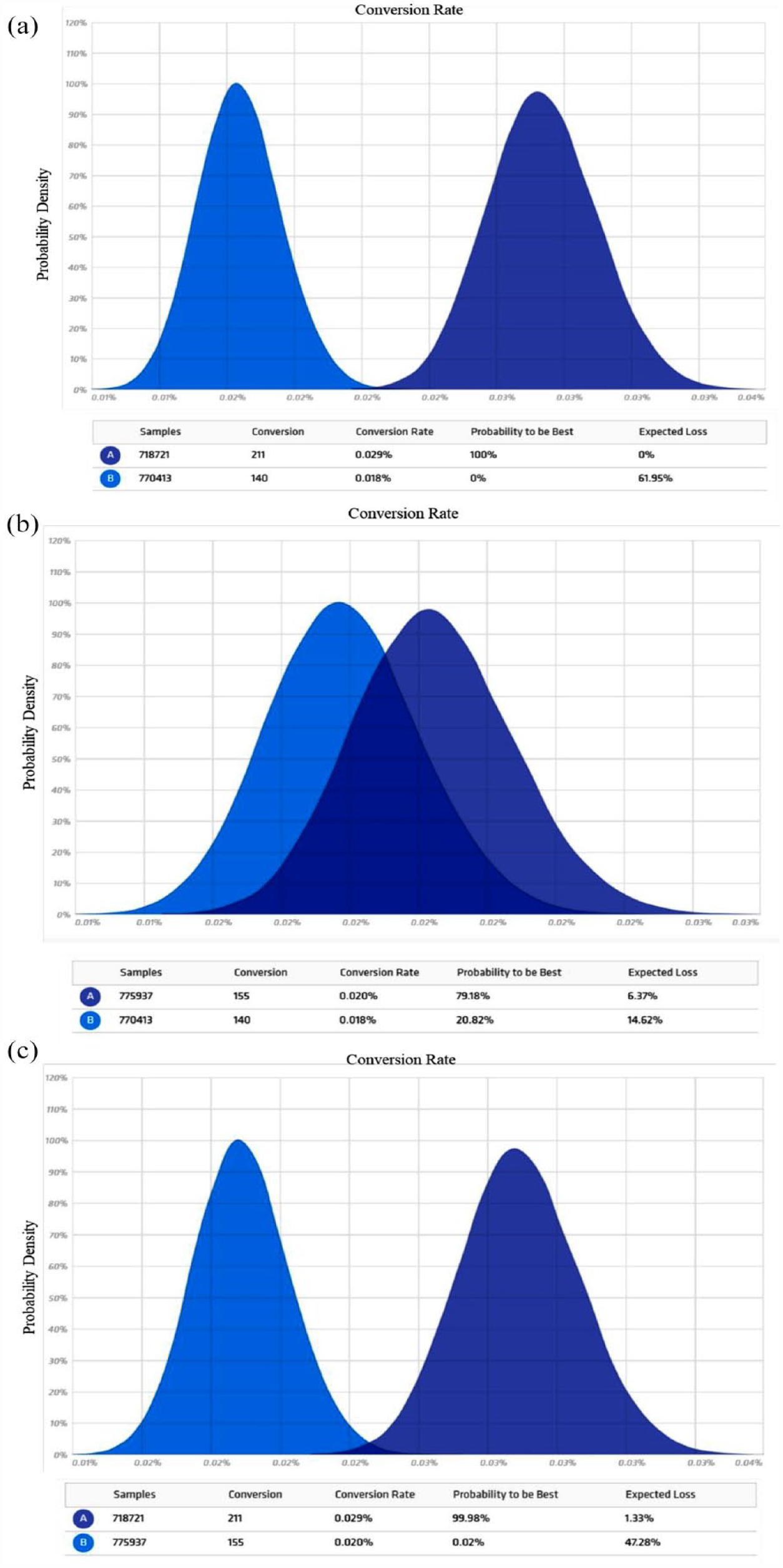
(a) Posterior simulation of difference (A-Enhancement, B-Absent). (b) posterior simulation of difference (A-Reduction, B-Absent), and (c) posterior simulation of difference (A-Enhancement, B-Reduction).
Discussion
Study 1a demonstrated that communicating sustainability performance resulted in higher click-through behavior than when sustainability performance was not reported (H1a). In addition, enhancement framing was more effective than reduction framing in predicting social media users’ click-through behaviors (H1b). The study findings provided strong evidence of external validity for the effectiveness of sustainability performance communication. Additional studies, though, are required to confirm the internal validity of the effectiveness of sustainability performance communication. This led to the next three experimental investigations.
Study 1b. Effectiveness of Sustainability Performance Communication (Replication)
Study 1b was an online controlled experiment conducted to replicate the main effect of sustainability performance communication observed in Study 1a. Rather than using social media users’ behaviors, it centered on travelers’ behavioral intentions.
Method
A one-factor (i.e., sustainability performance communication: absent vs. enhancement framing vs. reduction framing) between-subjects experiment was conducted in an eco-friendly hotel context. Instagram was chosen as the study context, as it is more conducive to promoting tourism-related information than other social media platforms (Balaji et al., 2021).
After obtaining informed consent, participants were instructed to imagine that they were planning a trip and searching for hotels when they saw an Instagram post on “Hotel Orchid” (i.e., a fictitious brand name to avoid familiarity bias). They were then randomly assigned to one of the three sustainability performance communication conditions (i.e., absent, enhancement, or reduction) (see Web Appendix F for the stimuli).
After reviewing the stimuli, participants responded to questions on behavioral intentions (i.e., two items adapted from D.-H. Park et al., 2007; r = .89), environmental concern (i.e., five items adapted from Y. Kim & Choi, 2005; α = .89), perceived realism of the stimuli (i.e., a one-item scale that asked participants whether the stimuli that s/he saw looked similar to the kind of advertisements they typically viewed on social media), and demographic information (i.e., age, gender, education, annual income, and travel behaviors) (see Web Appendix G for measures).
The stimuli were pre-tested with 30 U.S. participants recruited from Prolific Academic. Participants in the enhancement framing condition reported that the message included information about increased water repurposing (M = 5.89, SD = 0.92) in comparison to those in the reduction framing condition (M = 3.50, SD = 1.71, t17 = 3.71, p < .01) or the absent condition (M = 2.36, SD = 1.28, t18 = 6.87, p < .01). Participants in the reduction framing condition noted that the message included information on reduced water usage (M = 6.00, SD = 1.05) compared to those in the enhancement framing condition (M = 3.78, SD = 1.85, t17 = 3.25, p < .01) or the absent condition (M = 2.09, SD = 1.04, t19 = 8.52, p < .01).
A total of 200 U.S. Prolific panel members were recruited for the study (i.e., 49% were females; Mage = 37.6 years old; 45% were college graduates; 38.5% had an annual income between $20,001 and $60,000; 16% had stayed at an eco-friendly hotel in 2019). In 2019, 75% of participants had traveled one to three times; 90.5% had spent up to 7 days per trip; and 60.5% had traveled for leisure.
Results
The stimuli were perceived as realistic (M = 5.14, SD = 1.22) and did not differ across the conditions (p’s >.10). An ANOVA with sustainability performance communication as the fixed factor; behavioral intentions as the dependent variable; and age, gender, income, education, and environmental concern as covariates was conducted. Results revealed a significant main effect of sustainability performance communication (F2,192 = 7.64, p < .01). The findings showed that when compared to the absent condition (M = 3.82, SD = 1.40), enhancement framing (M = 4.65, SD = 1.28, t129 = 3.52, p < .01) and reduction framing (M = 4.28, SD = 1.22, t128 = 1.97, p < .05) resulted in higher behavioral intentions. This supported H1a. In addition, enhancement framing led to greater behavioral intentions than did reduction framing (t137 = 1.75, p < .05). This finding supported H1b.
Among the control variables, only environmental concern (F1,192 = 19.10, p < .01) had a significant effect. When the control variables were removed, the main effect of sustainability performance communication remained significant (F2,197 = 6.58, p < .01).
Discussion
Study 1b provided further support for the effect of communicating sustainability performance on travelers’ behavioral intentions. Specifically, we found that, compared to the control and reduction framing conditions, enhancement framing increased travelers’ behavioral intentions toward the tourism provider.
Study 2. Mediating Effect of Perceived Commitment to Sustainability
Study 2 was an online controlled experiment. It investigated the mediating role of perceived commitment to sustainability (H2).
Method
A one-factor (i.e., sustainability performance communication: absent vs. enhancement framing vs. reduction framing) between-subjects design was conducted in an eco-friendly hotel context. The stimuli used in Study 2 were similar to those in Study 1a with two major changes. First, instead of using Facebook in Study 1a, we used Instagram to obtain the generalizability of the study findings across social media platforms. The framing of the message was the same as in Study 1a (see Web Appendix H for the stimuli). Second, along with behavioral intentions (r = .88), perceived realism, environmental concern (α = .88), and demographic information, participants answered questions on tourism provider’s perceived commitment to sustainability (i.e., four items adapted from Sparks et al., 2013; α = .89).
Stimuli were pre-tested with 150 U.S. participants recruited from Prolific Academic. The manipulations worked as intended. Participants in the enhancement framing condition indicated that the message contained more information about the increased use of renewable energy (M = 6.27, SD = 0.91) compared to those in the reduction framing condition (M = 3.44, SD = 2.27, t97 = 8.21, p < .01) or the absent condition (M = 2.18, SD = 1.57, t100 = 16.08, p < .01). Participants in the reduction framing condition reported that the message contained more information about reduced energy consumption (M = 6.46, SD = 0.82) in comparison to participants in the enhancement framing condition (M = 3.59, SD = 2.09, t97 = 8.88, p < .01) or in the absent condition (M = 2.37, SD = 1.77, t97 = 14.52, p < .01).
Overall, 400 U.S. participants recruited from Prolific Academic were randomly assigned to one of the three sustainability performance communication conditions. Ten participants were excluded because of missing information or an incorrect answer to an attention check question. The final sample had 390 respondents (i.e., 47.2% were females; Mage = 36.4 years old; 48.2% were college graduates; 43.6% had an annual income between $20,001 and $60,000; 22.1% had stayed at an eco-friendly hotel). In 2019, 74.6% of participants had traveled one to three times; 86.1% had spent up to 7 days per trip; and 71.7% had traveled for leisure. The stimuli were perceived as realistic (M = 4.95, SD = 1.37) and did not differ across conditions (p’s >.05).
Results
An ANOVA revealed a significant main effect of sustainability performance communication (Mcontrol = 3.66, SD = 1.51vs. Mreduction = 4.16, SD = 1.43 vs. Menhacement = 4.46, SD = 1.19; F2,382 = 14.33, p < .01) on behavioral intentions. Among the control variables, environmental concern, gender, and income had a significant effect on behavioral intentions. When the control variables were excluded, the main effect of sustainability performance communication remained significant (F2,387 = 11.35, p < .01).
Post-hoc analysis revealed that, when compared to the absent condition, enhancement framing (t260 = 4.78, p < .01) and reduction framing (t260 = 2.78, p < .01) led to higher behavioral intentions toward the tourism provider. This provided support for H1a. Moreover, enhancement framing resulted in higher behavioral intentions compared to reduction framing (t254 = 1.82, p < .05). Accordingly, H1b received support.
The results of another ANOVA revealed a significant main effect of sustainability performance communication on the perceived commitment to sustainability (F2,387 = 21.78, p < .01). Findings showed that compared to the absent condition (M = 5.04, SD = 0.91), enhancement framing (M = 5.72, SD = 0.81, t260 = 6.35, p < .01) and reduction framing (M = 5.52, SD = 0.85, t260 = 4.40, p < .01) led to a higher perceived commitment to sustainability. In addition, enhancement framing resulted in a higher perception that the Hotel Orchid was more committed to sustainability than did the reduction framing condition (t254 = 1.93, p < .05).
The mediating role of perceived commitment to sustainability was tested using SPSS PROCESS Macro (Model 4) with 10,000 bootstrapping resamples (Hayes, 2013). Because the independent variable was multi-categorical with three levels, we performed a subgroup analysis. Results of the mediation analysis revealed that perceived commitment to sustainability mediated the effect of sustainability performance communication (i.e., absent vs. enhancement) on behavioral intentions, as the 95% confidence interval of the indirect effect did not include zero (indirect = 0.46, S.E. = 0.09, 95% CI [0.28, −0.64]). Similarly, perceived commitment to sustainability mediated the effect of sustainability performance communication on behavioral intentions when comparing the absent versus reduction framing conditions (indirect = 0.38, S.E. = 0.09, 95% CI [0.20, −0.58]), as well as when comparing the enhancement versus reduction framing conditions (indirect = 0.14, S.E. = 0.07, 95% CI [0.002, −0.30]) on behavioral intentions. These findings collectively provided support for H2.
Discussion
Study 2 showed that perceived commitment to sustainability mediated the relationship between sustainability performance communication and travelers’ behavioral intentions. Furthermore, we found that perceived commitment to sustainability is higher for enhancement framing than for reduction framing.
Study 3. Moderating Effect of Sustainability Performance Level
Study 3 examined the moderating role of sustainability performance level in the relationship between sustainability performance communication (i.e., enhancement vs. reduction) and travelers’ behavioral intentions (H3).
Method
The research design of Study 3 was similar to that of Study 2 with three major changes. First, we carried out a 2 (sustainability performance communication framing: enhancement vs. reduction) ×3 (sustainability performance level: low vs. medium vs. high) between-subjects design. Second, the sustainability performance level was manipulated as low, medium, and high (see Web Appendix I for the stimuli). The sustainability performance levels were identified based on the findings of a pre-test with 25 students enrolled in a business management program at an English-speaking business school in China. We asked respondents to indicate the objective percentage increase representing the level of improvement in sustainability performance within the past year, considering different levels including low, moderate, and high. Based on the results of the pre-test, we used a 5% change in sustainability performance over the past year as a low level of performance, a 25% change a medium level, and a 60% change a high level of performance. Third, along with behavioral intentions (r = .81), perceived commitment to sustainability (α = .88), perceived realism, and demographic information, participants answered manipulation check questions for sustainability message framing and performance level.
A total of 425 U.S. participants were recruited from Prolific Academic. Twelve participants were excluded, as they failed to answer the attention check question correctly. Thus, 413 responses were included in the analysis (57.9% were females; Mage = 32.3 years old; 40% were college graduates; 43.5% had an annual income between $20,001 and $60,000; 16.5% had stayed at an eco-friendly hotel). In 2019, 78.2% of participants had traveled one to three times; 88.1% had spent up to 7 days per trip; 60.5% had traveled for leisure.
The manipulations worked as intended. Participants in the enhancement framing condition (M = 6.10, SD = 1.12) reported that the hotel’s sustainability communication contained more information on the increase in the usage of renewable energy than those in the reduction framing condition (M = 4.91, SD = 1.96, t411 = 7.62, p < .01). Furthermore, participants in the 60% level condition noted that the sustainability performance level was high (M = 6.11, SD = 0.87). In the 25% level condition, participants indicated that the sustainability performance was moderate (M = 5.04, SD = 1.16, p < .05), and those in the 5% condition evaluated the sustainability performance level as low (M = 3.26, SD = 1.57, p < .01). The stimuli also were perceived as realistic (M = 5.26, SD = 1.15) and did not differ across the conditions (p’s >.05).
Results
An ANOVA found a significant main effect of sustainability performance communication (F1,403 = 5.13, p < .05). Specifically, enhancement framing (M = 4.39, SD = 1.28) resulted in higher behavioral intentions than did reduction framing (M = 4.14, SD = 1.26). These findings confirmed H1b. Sustainability performance level had a significant effect on behavioral intentions (M5% = 3.79, SD = 1.15; M25% = 4.51, SD = 1.25; M60% = 4.54, SD = 1.29, F2,403 = 17.58, p < .01). Moreover, we found a significant interaction effect between sustainability performance communication framing and sustainability performance level (F2,403 = 11.31, p < .01) on behavioral intentions (see Figure 4 for the interaction plot). When enhancement framing was used, participants indicated higher behavioral intentions if the message reported a medium level of sustainability performance (25%, M = 4.87, SD = 1.25) than when it mentioned a low level (5%, M = 4.03, SD = 1.17, t141 = 4.11, p < .01) or a high level (60%, M = 4.28, SD = 1.30, t137 = 2.68, p < .01) of sustainability performance. No significant difference was observed between low and high sustainability performance levels for the enhancement framing message (t140 = 1.22, p = .11). These findings thus supported H3a.
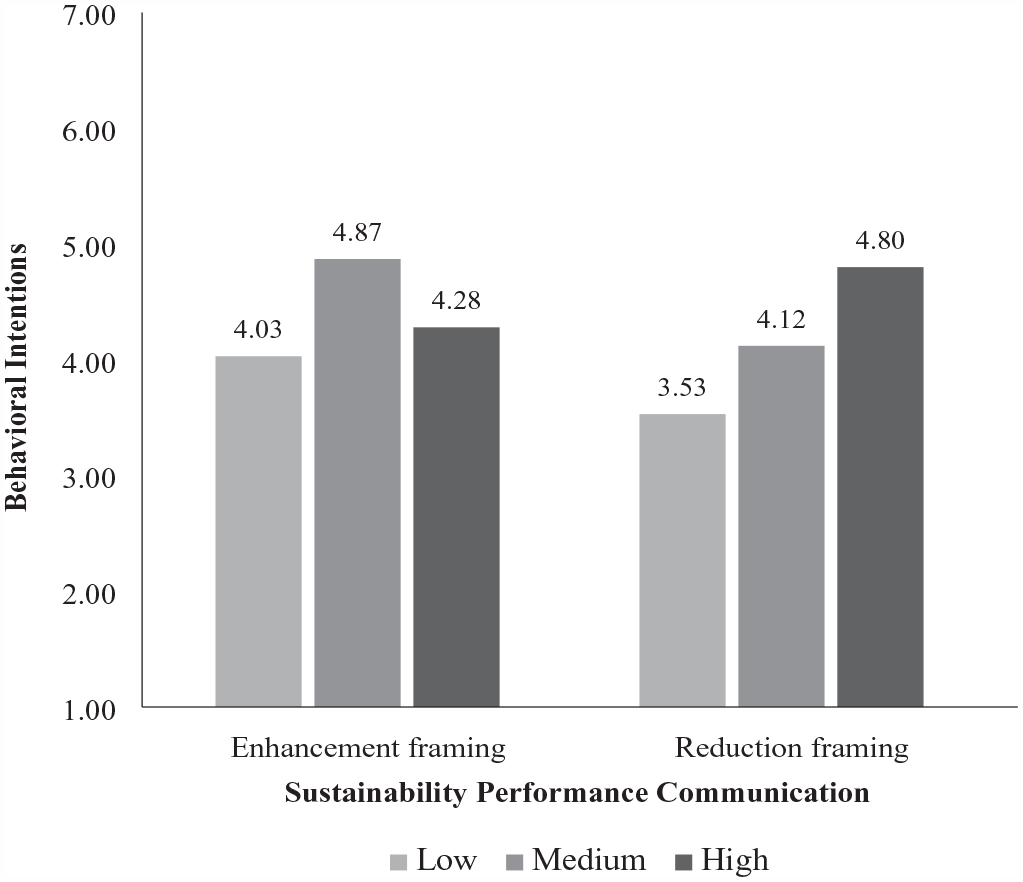
Study 3 interaction plot of sustainability performance communication and sustainability performance levels.
For reduction framing, a high level of sustainability performance (60%, M = 4.80, SD = 1.23) resulted in higher behavioral intentions than did a medium level (25%, M = 4.12, SD = 1.15, t129 = 3.25, p < .01) or a low level (5%, M = 3.53, SD = 1.08, t135 = 6.39, p < .01) of sustainability performance. Furthermore, a medium level of sustainability performance was associated with higher behavioral intentions than did a low level of sustainability performance (5%, t132 = 3.04, p < .01). These results lent support to H3b.
A post-hoc analysis was conducted to test the moderated mediation of sustainability performance level and perceived commitment to sustainability in the relationship between sustainability performance communication framing and behavioral intentions. We used the SPSS PROCESS macro (Model 8) with 10,000 bootstrapped resamples (Hayes, 2013). The results supported a moderated mediation model, as the 95% confidence interval of the moderated mediation index did not include zero (IMM = −0.11, S.E. = 0.04, 95% CI [−0.21, −0.02]). These findings suggested that sustainability performance level moderated the mediating effect of perceived commitment to sustainability in the relationship between sustainability performance communication (i.e., enhancement vs. reduction) and behavioral intentions.
Discussion
Study 3 demonstrated that the effect of sustainability performance communication framing (i.e., enhancement vs. reduction) on travelers’ behavioral intentions was contingent on tourism providers’ sustainability performance level. Specifically, we found that enhancement framing with a medium performance level was more effective in determining travelers’ behavioral intentions. However, for reduction framing, a high level of sustainability performance led to higher behavioral intentions toward the tourism provider.
Conclusion
Tourism providers are increasingly communicating about the performance of their sustainability initiatives in response to travelers’ growing sustainability concerns (Guix et al., 2018; Opferkuch et al., 2021). The present study addressed these phenomena by investigating how and when sustainability performance communication influences travelers’ behavioral intentions toward tourism providers. Four studies conducted provided consistent results and demonstrated the effectiveness of sustainability performance communication in influencing travelers’ behavioral intentions (H1a: Study 1a, 1b, and 2). Furthermore, we revealed that enhancement framing of sustainability performance communication is more likely to influence travelers’ behavioral intentions than reduction framing (H1b: Study 1a, 1b, 2, and 3). Perceived commitment to sustainability explains the relationship between sustainability performance communication and behavioral intentions (H2: Study 2 and 3). Our findings also indicated that sustainability performance level is the boundary condition. Specifically, a high level of sustainability performance in reduction framing and a medium level of sustainability performance in enhancement framing are effective in influencing travelers’ behavioral intentions (H3a and H3b: Study 3).
Theoretical Implications
Our research contributes to the tourism literature in several ways. First, with the tourism industry increasingly prioritizing sustainability, there is a growing interest in developing effective sustainability communication strategies. However, the extant understanding of how travelers process and respond to sustainability information remains limited (Tölkes, 2018). We advance knowledge in this area by examining the effectiveness of sustainability performance communication and its impact on travelers’ decision-making processes. Second, extant research has highlighted that sustainability communication often lacks the necessary information and persuasiveness to change travelers’ behaviors toward sustainable consumption (Tölkes, 2020). For informed decision-making, travelers prefer accurate and specific information about sustainability initiatives (Kapoor et al., 2022). Furthermore, recent studies have revealed that labels disclosing sustainability information to customers can improve brand attitude and reduce ambiguity (Cho & Taylor, 2020). Despite the foregoing work, research on the effectiveness of sustainability performance communication remains limited. Our study addressed this gap by demonstrating that providing performance information in sustainability communication more effectively influences travelers’ behavioral intentions compared with when such information is not provided.
Third, previous work has found that the way in which sustainability information is framed can impact how travelers process it. However, existing literature on message framing has been mainly limited to valence framing (Balaji et al., 2021; Hardeman et al., 2017; Kapoor et al., 2021). We broaden the scope of this research area by examining the effectiveness of emphasis framing in sustainability communication, significantly expanding the literature on emphasis framing. Depending on the type of sustainability initiative, sustainability communication can emphasize either reduction or enhancement efforts. In this study, we investigated emphasis framing in the form of enhancement and reduction framing in sustainability performance communication. Fourth, the study contributes to the literature on mindset theory (Dweck et al., 1995). Previous studies have revealed that a traveler’s response to a given situation depends on his/her view of it as being fixed or malleable (Japutra & Hossain, 2021; Oppewal et al., 2015). Building on research in psychology (Karwowski et al., 2020), we offer additional evidence supporting the malleability of these traits. Our study suggests that enhancement or reduction framing activates a traveler’s entity or incremental mindset, which may influence his/her decision-making.
Fifth, the persuasion process of sustainability communication has received little attention in previous research (Tölkes, 2018). We demonstrate that perceived commitment to sustainability is a key underlying mechanism explaining the relationship between sustainability performance communication and behavioral intentions toward a tourism provider. Because sustainability performance communication reveals information about a tourism provider’s commitment to sustainability in a clear and transparent manner, it may influence travelers’ behavioral intentions. Sixth, our research advances the nascent literature on the numerosity effect (Wertenbroch et al., 2007; Wilcox & Prokopec, 2019). It does so by examining the role of sustainability performance level in travelers’ evaluation of sustainability communication. We found that for reduction framing, a high level of sustainability performance is more effective in affecting travelers’ behavioral intentions than a medium or low level. For enhancement framing, however, communicating a medium level of performance information is more likely to influence efficaciously travelers’ behavioral intentions than a high or low level. Accordingly, our study contributes to an enhanced understanding of travelers’ evaluation of sustainability performance communication.
Finally, this study investigated sustainability communication using a multi-theory approach (Mayer & Sparrowe, 2013). We used mindset theory, along with framing theory, ELM, and the numerosity effect, to augment comprehension of how and when sustainability performance communication influences travelers’ behavioral intentions. Our multi-theoretical approach responds to the call for multi-theoretical integration to develop a comprehensive understanding of tourism phenomena (Hosany et al., 2022; Mellahi et al., 2016).
Managerial Implications
Our research findings suggest that to communicate sustainability performance effectively, tourism providers should clearly and objectively report the progress that they have made in addressing environmental issues. Such information can be presented in comparison to a previous year or with respect to a baseline year. For example, stating that “our hotel has reduced waste generation by 30% in 2021 compared to 2020” would be more persuasive than merely asserting that “our hotel is committed to sustainability.”
For communicating information about sustainability performance, tourism providers could employ approaches or techniques to measure the environmental impact of their sustainability initiatives. The metrics could be based on resource use derived from water, energy, fuel, or waste billing statements. Alternatively, tourism providers might utilize global reporting standards, such as GRI or the European Charter for Sustainable Tourism (Castellani & Sala, 2010; Kılıç et al., 2021), to assess the environmental impact of its specific sustainability initiatives. This effort enables a tourism provider to develop a compelling sustainability communication that includes objective information about its efforts to achieve sustainability. This not only enhances the credibility and transparency of the tourism provider’s sustainability initiatives, but it also affords its benchmarking performance against industry standards.
Our research suggests that, when tourism providers communicate their sustainability performance to travelers, they should focus on highlighting enhancement sustainability initiatives (e.g., a 20% increase in the use of renewable energy, 20% greater usage of renewable water). These initiatives are especially appealing to travelers as they focus on the progress made by the tourism provider in addressing sustainability issues. In contrast, reduction framing focuses on reducing negative environmental impacts, which may be perceived as less effective than enhancing the positive impacts. Additionally, enhancement framing can create a positive image of a tourism provider, evoking perceptions that the provider is an environmentally responsible company; this may well attract and retain travelers. However, tourism providers should be mindful of the level (i.e., low, medium, or high) of sustainability performance that they report. This is because the level can impact how travelers make decisions about the provider.
For effective communication of enhancement framing, we recommend reporting a medium level of sustainability performance; for reduction framing, though, indicating a high level of reduction in sustainability performance is suggested. The foregoing implies that tourism providers should carefully select the baseline year when reporting enhancement framing or reduction framing by choosing one that demonstrates the firm’s historical performance and aligns with its overall sustainability strategy. This is an important part of the overall sustainability strategy of the company, as it helps effectively communicate the provider’s sustainability performance to travelers and shows the commitment to sustainability.
Limitations and Future Research Directions
Our study has certain limitations that indicate future research avenues. First, we examined the effectiveness of sustainability performance communication in the context of a limited number of natural resources (e.g., energy, water). Future work should replicate our findings by focusing on other natural resources or sustainability issues (e.g., waste management, food waste).
Second, traveler responses to sustainability communication depend on their interpretation of the context (Line et al., 2016). Our study examined the impact of sustainability performance communication on travelers’ behavioral intentions, thus focusing on the “environmental” aspect. We did not, though, explore socio-cultural or economic dimensions of sustainability. Because sustainability involves environmental, social, and economic elements, scholars should investigate sustainability performance communication by considering this multidimensional approach to augment understanding of its impact on travelers’ behaviors and decision-making.
Third, we used an experimental design to test the effectiveness of sustainability performance communication. Future research can supplement our findings by undertaking secondary data analysis or a qualitative study to gain a better understanding of sustainability communication. Moreover, the field study involved Indian participants, but the online experiments included U.S. participants. Although Indian and U.S. samples revealed similar outcomes here, click-through rates and social media engagement may differ across countries. Given the recommendation to use diverse samples (Stoner et al., 2023), future studies could replicate the study in other contexts.
Fourth, we examined the underlying mechanism of perceived commitment to sustainability. Researchers might consider alternative explanations (e.g., message authenticity, message credibility, argument quality) for the effectiveness of sustainability performance communication. Finally, we utilized percentages (e.g., 25% reduction) to indicate sustainability performance levels. Future research might investigate the influence of absolute values (e.g., 2.6 million kWh energy savings) on travelers’ behavioral outcomes. Although sustainability performance levels of 5%, 25%, and 60% were obtained in a pre-test, travelers may consider different levels as being low, moderate, or high. Therefore, the current work can serve as a starting point by demonstrating the varying effects of sustainability performance levels on behavioral intentions. As such, future scholars could explore alternative or continuous levels of performance.
Supplemental Material
sj-docx-1-jtr-10.1177_00472875231206548 – Supplemental material for Assessing the Effectiveness of Environmental Sustainability Performance Communication in Tourism: Mediation and Moderation Effects
Supplemental material, sj-docx-1-jtr-10.1177_00472875231206548 for Assessing the Effectiveness of Environmental Sustainability Performance Communication in Tourism: Mediation and Moderation Effects by Jishnu Bhattacharyya, M. S. Balaji and Yangyang Jiang in Journal of Travel Research
Footnotes
Declaration of Conflicting Interests
The author(s) declared no potential conflicts of interest with respect to the research, authorship, and/or publication of this article.
Funding
The author(s) disclosed receipt of the following financial support for the research, authorship, and/or publication of this article: This research is supported by the Zhejiang Soft Science Programme (Grant No. 2022C35053) funded by the Science Technology Department of Zhejiang Province, China and research grant provided by Rennes School of Business, France.

Supplemental Material
Supplemental material for this article is available online.
Notes
Author Biographies
References
Supplementary Material
Please find the following supplemental material available below.
For Open Access articles published under a Creative Commons License, all supplemental material carries the same license as the article it is associated with.
For non-Open Access articles published, all supplemental material carries a non-exclusive license, and permission requests for re-use of supplemental material or any part of supplemental material shall be sent directly to the copyright owner as specified in the copyright notice associated with the article.
