




Abstract
Understanding how tourists respond to and comply with scams sheds light on tourist self-protection. In this study, a quasi-experimental design was employed to examine external (scam-operation) and internal (personal) factors of scam compliance. Twelve (3 × 4) scenarios were developed from real-world tourist scam cases and presented in the form of videos in an online tourist survey to elicit and observe decisions. A total of 609 participants from Australia and China completed the task, and the data were analyzed through multiple statistical techniques. The results suggested that the external factors of scam compliance did not exert a significant impact. Three internal factors, sensation-seeking, travel experiences, and risk perception, are stronger predictors of scam compliance. This study offers theoretical insights into tourist behavior, and contributes to new understandings of the antecedents of scam compliance.
Introduction
Tourist scams are a universal phenomenon that can cause tourist dissatisfaction, loss to legitimate businesses, and managerial burdens for destination managers (D. Xu & Murphy, 2022). Although explicit reports of tourist scams are missing, tourist scams frequently appear in reporting of consumer scams. According to Better Business Bureau (2021), travel-related scams were listed in the top 10 riskiest scams impacting North American consumers in both 2019 and 2020. Understanding the targets of scams, especially their way of thinking and behaviors, is one critical research direction that could improve tourist self-protection. The more that is known about how tourists make decisions to comply with or avoid deceptive schemes, the more useful suggestions can be made to help protect themselves. Nevertheless, the knowledge about tourist scam victims is insufficient, and thus further investigation is needed (D. Xu et al., 2021).
The research on everyday scams and fraud has summarized several factors that affect the cognition and behavior of victims and near-victims (Fischer et al., 2013; Lacey et al., 2020; Modic & Lea, 2013; Stajano & Wilson, 2011). Scam compliance, a term indicating the degree to which the targets of a scam comply with the deceptive scheme, was adopted in the present study. There are two main categories of factors contributing to scam compliance (Lacey et al., 2020), namely offending traits (external factors) and behavioral influences (internal factors). The former refers to various scam strategies that assist in the persuasion of the targeted populations, and the latter can be understood as the internal factors of the scam targets, such as their preferences for risk-taking, their way of thinking, and their emotional state.
However, before applying these findings to tourist self-protection, a re-examination of these factors in tourist scam incidents is necessary. The context of tourism, to a certain extent, influences the vulnerability and thereby the reactions of the scam targets (tourists), as they are exposed to a less familiar environment that is often culturally different from their own and is socially interactive (E. Cohen, 1984; McCabe, 2002). In this regard, there are possibilities that the effect and the power of scam compliance factors may be altered. Such effect can be reinforced due to tourists’ lack of skills or being mindless in social interactions (J. Li & Pearce, 2016), or tourists may not easily comply with scamming schemes because they act out of caution or emotion (Hamby et al., 2022; Kubilay et al., 2023). Therefore, a re-examination is useful in providing further insights. Moreover, there is a need to jointly consider how both internal and external factors affect scam compliance.
Methodologically, this investigation adopted a quasi-experimental design. A growing interest in using experimental methods to further the understanding of tourist behaviors and that of tourism phenomena is evident (Mattila et al., 2021; Pattison et al., 2019; Sun et al., 2020; Viglia & Dolnicar, 2020). Experimental methods are ideal for inferring causal relationships. Moreover, well-developed experimental research can be more accurate in studying human behaviors and eliciting and observing real-world decisions compared to measurement of recalled items (by self-administered surveys) by reducing the cognitive biases of the participants. Specifically, a lab experiment replicating tourist episodes is an ideal method to address the challenge of the pandemic by simulating real-world encounters and enabling participation across geo-boundaries. The investigation utilized a mixed design, which combines the advantages of within-subject and between-subject designs (Viglia & Abrate, 2014).
In short, the present study aims to re-examine the factors associated with scam compliance in tourist scam scenarios, and investigate the heuristic cues and strategies employed in responding to tourist scams. A mixed-design quasi-experiment was conducted, and 609 participants from Australia and China were recruited (307 and 302 respectively). The representations of three factors that contribute to scam compliance were manipulated in the experiment, and tourist decision-making was recorded and analyzed.
Literature Review and Research Hypotheses
Tourist Scams
Tourist scams are defined as “a number of essentially unethical or deceptive practices that aim to eventually gain financial advantage from tourists, where the scammers intentionally misguide and confuse the targeted individuals to extract assets” (D. Xu et al., 2021, p. 2). The impact of tourist scams is generally negative (Ma et al., 2022; Ouyang et al., 2020). The reputation of destinations can be compromised (Tarlow, 2014), and multiple stakeholders can be affected (March, 2008). Specifically, if tourists frequently encounter scams at a travel destination, they suffer from the loss of assets in these incidents, and the residents may also be stigmatized as “dishonest hosts.” Consequently, legitimate businesses within the destination may be subjected to such stigmatization, and the reputation of the destination may be blemished (Huang & Pearce, 2019; Pearce, 2011).
Tourist scams are a threat to tourism development, and while relatively inconspicuous (Harris & Pressey, 2021), they are often prevalent across travel destinations. Previous studies suggested that tourist scams can be integrated into many social scenarios that tourists frequently encounter, such as purchasing fake products (Bukrapue, 2015; J. Li & Pearce, 2016), receiving overcharged services (Harris, 2012; Harris & Pressey, 2021; Zhang, Heung, & Yan, 2009), social interactions with locals that involve blackmailing (Pearce, 2011; D. Xu et al., 2021), and religious encounters incorporating forced selling (Huang & Pearce, 2019). The variability of tourist scams complicates research on this phenomenon (D. Xu et al., 2022).
A recent taxonomy of tourist scams by D. Xu et al. (2022) provided insights into identifying and categorizing the underlying schemes on which tourist scams are based. This work involved the strategic selection of 26 tourist scam cases, and used multidimensional scaling to help determine four attributes that differentiate scamming schemes:
(1) Deception types—a high value indicates simulation (presenting a passable but inauthentic object or reality), whilst a low value indicates dissimulation (hiding the truth by obscuring and erasing it);
(2) Interpersonal trust—a higher value indicates more exploitation of interpersonal trust;
(3) Victim culpability—a higher value indicates that the victims are more culpable for being scammed; and
(4) Prevalence—a higher value indicates the prevalence of this scam across destinations.
Scam Prevention and Victim Protection
An important goal in scam research is to strategize prevention. In criminology, the well-developed routine activity theory explains the conditions of crime occurrence, which sheds light on anti-scam strategies. A crime can be committed if there is a motivated offender, a suitable target, and the absence of a capable guardian (Akers, 2013; L. E. Cohen & Felson, 1979). A critical implication for scam research is that effective crime prevention can be achieved by; sanctioning the offenders, increasing guardians, or reducing easy targets.
Sanctioning has its limitations when applied to governing scams and fraud. Cressey (1953) suggested that the commitment of fraud is a convergence of pressure, opportunity, and rationalization. Pressure refers to a financial problem that is legitimately unsolvable, functioning as the motivation for fraudsters. Wells (2018) further argued that simply punishing fraudsters is not an effective deterrent, because sanctioning can only escalate pressure, and may not stop fraudsters from rationalizing their deceptive actions. A more proactive approach is to address the weaknesses of the targets, which includes deploying guardians and reducing easy targets.
Researchers have advocated for third-party protection to improve tourist safety, and for law enforcement agencies to take responsibility (Pizam et al., 1997). Tarlow (2000, 2014) developed the theoretical base for tourism safety and security and summarized a list of solutions to enhancing destination third-party protection against various hazards. Despite adequate research in this stream, researchers of tourist scams (e.g., Bukrapue, 2015; J. Li & Pearce, 2016) suggest that insufficient guardianship is responsible for the occurrence of scams. Although deploying guardians can be an effective method, the implementation, especially when it comes to scams, may be deficient.
Similar to the above, a pathway toward safety places an emphasis on ethical tourism operations. The tourism industry should follow certain ethical guidelines or standards (Spencer & Tarlow, 2021), and scamming is one typical example where such standards are violated. However, improving the ethics of tourism operations is a task beyond merely emphasizing a healthy code of conduct. Scam occurrence is also correlated with certain structural conflicts, such as a buyer’s-market structure (Jia et al., 2006), unregulated business models (Y. Chen et al., 2011; King et al., 2006; March, 2008), and underpayment of tourism employees (Yan, 2020; Zhang, Yan, & Li, 2009). Tackling these systemic issues can thereby improve business ethics (Y. Xu & McGehee, 2017) but requires significant effort and investment.
Finally, another approach—reducing easy targets—can be achieved by educating tourists about self-protection and techniques to identify scams from the beginning of a scam scenario. This idea resonates with that of addressing the weaknesses of scam targets, and requires an understanding of which ways of thinking, and what factors, contribute to becoming an “easy target.” The body of literature on tourist scams does not seem to address these issues, but scholars from the field of general scams and fraud provide valuable insights.
Hypotheses Development
Although there is no unified construct of the term, scam compliance generally refers to the degree to which targets of a scam comply with the deceptive scheme, a mental and behavioral process that leads to the consequence of being scammed (Lacey et al., 2020; Modic, 2012). The “easy targets” that were mentioned in the above section can be scam victims who have a higher inclination to comply. Lea et al. (2009) argued that scam compliance is a result of a series of cognitive errors (a sequence of unwise decisions), and Modic (2012) suggested that a lack of self-control and impulsivity can be a major driver. However, due to the limited amount of research, a holistic model or theory of scam compliance is lacking.
Most scam compliance studies focused on exploring its antecedents. Theoretically, understanding what factors lead to compliance can help further knowledge construction. For example, trust is a scam compliance contributor, and was adopted by D. Xu et al. (2022) to differentiate tourist scam schemes. Pragmatically, antecedent-focused studies can enhance the development of prevention and protection. Lacey et al. (2020) summarized two main categories of antecedents, including offending traits (external factors, e.g., scam strategies) and behavioral influences (internal factors, e.g., victim responses). In the present study, we synthesized the factors of both categories, with considerations of their integration into tourist scams, to propose and test hypotheses.
External Factors—Social Influence
The work of Stajano and Wilson (2011) noted seven principles that scammers apply to exploit victims, and this work offers insights for conceptualizing the external factors of scam compliance. They described the herd principle as “even suspicious marks will let their guard down when everyone next to them appears to share the same risks. Safety in numbers? Not if they’re all conspiring against you (p. 13).” The principle depicts a common scamming scheme where some associates of a scammer would pretend to be fellow tourists and encourage real tourists to fall into the trap. This often elicits a pursuit of behavioral consistency—a tendency to align with the social practices of peers or previous conduct by oneself (Fischer et al., 2013; Langenderfer & Shimp, 2001). More specifically, the fake social identity of peer tourists may increase the credibility of their claims and their role of being satisfied participants in the scheme may inspire others to follow. Some tourist shopping or street gambling scams may embrace this strategy (D. Xu et al., 2021).
Hypothesis 1: If a scam incorporates the strategy of social influence, it increases tourists’ scam compliance
External Factors—Authority
Cialdini (2001) suggested that the appearance of authority symbols would stimulate people to respond, with an inclination to trust and obey the information from the authority (Lea et al., 2009; Modic, 2012). Scammers utilize this trait for persuasion as they can easily elicit and thereafter exploit the implicit compliance patterns from scam targets (Stajano & Wilson, 2011). In tourist scams, there are multiple ways to demonstrate “authority,” such as presenting the fake identity of experts or counterfeit certificates from officials. It can be assumed that the appearance of authority is critical to improving scam compliance.
Hypothesis 2: If a scam incorporates the strategy of authority, it increases tourists’ scam compliance
External Factors—Greed and Scarcity Incentive
Greed and scarcity connect to a type of human desire (Stajano & Wilson, 2011). Scammers often provide incentives to improve the perceived value of an offer and thus increase the likelihood of compliance in scam targets (Fischer et al., 2013). Specifically, greed refers to the decreased cost or increased value of an offer, such as a discount on product prices or a complementary incentive; scarcity refers to the urgency or uniqueness of an offer and is usually revealed by limited availability and/or time urgency. Scam studies suggested that greed and scarcity incentives are a frequently used strategy (Langenderfer & Shimp, 2001; Stajano & Wilson, 2011). The research into impulse buying by tourists also reported that a high perceived product value (Chung et al., 2017) and time scarcity (C. Li et al., 2021; Sohn & Lee, 2017) encourage consumers to purchase. In a tourist scam scenario greed and scarcity may increase the likelihood of compliance.
Hypothesis 3: If a scam incorporates the strategy of greed and scarcity incentive, it increases tourists’ scam compliance
Internal Factors—Travel Experiences
Tourists’ past travel experiences are always a critical factor shaping their present and future ways of thinking and behaviors (Pearce, 2005). Tourists may reflect and learn from their previous travels, which enables their skill development (Stone & Petrick, 2013) and enhances their decision-making abilities (Falk et al., 2012). It was found that experienced tourists are more risk averse (Smed, 2014). It is reasonable to assume that, if tourists have more travel experiences, they may have participated in or witnessed more tourist scam incidents. As their risk aversion increases, they are more likely to avoid falling into a potential trap.
Hypothesis 4: More travel experiences decrease the likelihood that tourists comply with scams
Internal Factors—Sensation Seeking
Sensation seeking is a personality trait that sheds light on tourist decision-making and behavioral patterns. Sensation seeking can be defined as “a trait defined by the need for varied, novel and complex sensations and experiences and the willingness to take physical and social risks for the sake of such experience” (Zuckerman, 2014, p. 10). The concept of sensation seeking highlights the desire for novelty and risk-taking. Pizam et al. (2004) argued that tourists who have a high tendency for sensation-seeking prefer active and less comfortable vacations, higher-energy and outdoor activities, and self-organized planning. Lepp and Gibson (2008) indicated that these tourists are likely to visit riskier regions. Since some scam offers can be appealing and novel to tourists, and also involve a certain level of uncertainty and risk, high sensation-seeking tourists may show a higher likelihood of compliance.
Hypothesis 5: A higher tendency for sensation-seeking increases the likelihood that tourists comply with scams
Internal Factors—Risk Perception
The perception of risk has long been a topic in tourism research and is defined as “the subjective understanding of outcome severity weighted by outcome probability” of a potential risk event (Wolff et al., 2019, p. 3). Scholars have identified various types of risks and examined their impact on tourist decision-making (Fuchs & Reichel, 2006; Sharifpour et al., 2014; Sönmez & Graefe, 1998). Discussing the classification of tourism-related risks is beyond the goal of the present study, but here it is more important to propose specific risk types that can affect tourist scam compliance.
On the one hand, some types of perceived risk may decrease the likelihood of scam compliance. First, it was suggested that the quality of experience is a critical factor in the consumption and usage of a tourism product (Park & Tussyadiah, 2017). When tourists sense low quality in experience quality, they may turn away and seek alternatives (Dayour et al., 2019). Similarly in scam incidents, when experiential risk is perceived by tourists, tourists may resist the deceptive schemes. Second, the perception of financial risk acts against compliance; unexpected expenses or requests for unreasonable amounts of money can influence one’s decision-making (Deng & Ritchie, 2018) and discourage tourists from complying with a scheme (Yu et al., 2022). Lastly, tourists tend to avoid overly time-consuming tasks (Fuchs & Reichel, 2006). Therefore, if they believe an episode is a waste of time, it is likely that they may disregard such an incident and move on to another.
Hypothesis 6a: A higher risk perception associated with experience quality decreases the likelihood that tourists comply with scams
Hypothesis 6b: A higher financial risk perception decreases the likelihood that tourists comply with scams
Hypothesis 6c: A higher time risk perception decreases the likelihood that tourists comply with scams
On the other hand, some risk types may have a positive correlation with compliance. One may be more likely to comply when his or her physical wellbeing is perceived to be at risk. Extortion against tourists is an example where they may capitulate to perpetrators’ requests to secure their own safety (E. Cohen, 1987). Moreover, social risks and psychological risks—the possibility of a travel episode affecting others’ opinions of, or one’s own self-image and self-reflection—may have a similar correlation (Fuchs & Reichel, 2006; Roehl & Fesenmaier, 1992). In scam incidents, these two risks often arise with the implementation of the social influence technique.
Hypothesis 6d: A higher physical risk perception increases the likelihood that tourists comply with scams
Hypothesis 6e: A higher social risk perception increases the likelihood that tourists comply with scams
Hypothesis 6f: A higher psychological risk perception increases the likelihood that tourists comply with scams
Internal Factors—Travel Motivation
Travel motivation has been a fundamental aspect of tourist studies as it accounts for why tourists behave in various ways (Hsu & Huang, 2008). In scam and fraud research, the victims’ motivations can be a critical factor that contributes to compliance likelihood. For instance, the motivation for a romantic relationship can predict the victimization of dating fraud (Whitty, 2013, 2018), whereas a strong motivation to receive rewards often leads individuals to comply with mass marketing scams (Langenderfer & Shimp, 2001). These motivations are reward-oriented, and therefore it is reasonable to assume that similar travel motivations may have a relation with tourist scam compliance. Scholars proposed several theories and models to understand travel motivations (Crompton, 1979; Mannell & Iso-Ahola, 1987; Plog, 2001). Pearce’s (2005) travel career pattern summarizes 14 dimensions of push motives in leisure travel, which are all reward-oriented from the perspective of tourists. Considering the complexity of how travel motivation may connect to scam victimization (D. Xu et al., 2021) and the lack of studies in this vein, we are unable to predetermine what specific motivations in the work of Pearce (2005) may correlate with scam compliance. Therefore, it is assumed that participants’ motivation patterns may have a relationship with scam compliance, and examinations will be conducted to indicate which, if any, dimensions explicitly predict the likelihood of compliance with tourist scams.
Hypothesis 7: There is a relationship between tourists’ motivation and scam compliance
Methodology
A quasi-experimental design was adopted in the current study through an online questionnaire survey. The questionnaire included two sections; the quasi-experiment and further self-report enquires. The data acquired from the first section were applied in examining hypotheses 1 to 3 while the data from the second section were used for testing hypotheses 4 to 8.
Stimuli
The stimuli in the quasi-experiment were animated vignette videos, 9 of which represented scam conditions, and 3 represented a non-scam condition. All videos were designed and produced based on 3 scenarios developed from real-world episodes in the tourism context. Here, “scenario” refers to the narrative base (scam case) of the stimuli videos, and “condition” refers to the manipulation of the external factors from our experiment design. Having multiple scenarios instead of one is owing to the diversity of scam cases.
Selecting Scenarios
The tourist scam taxonomy of D. Xu et al. (2022) was used for selecting scenarios. The three top-ranked cases in the prevalence dimension were selected the as the scenarios, which are dual menu, zero fare tour, and monk street gifting. The reasons for using prevalence as the selection criterion were three-fold. First, investigating more prevalent scenarios brings a higher practical value; the study results may benefit more destination managers with an in-depth understanding and thus contribute to effective regulations. Second, these cases are typical scenarios that are encountered during traveling, and thus can be more realistic to the participants. Third, using prevalent cases can improve the realness and accuracy in developing the stimuli videos for the experiment. Prevalent cases are more often documented and discussed by tourists online, therefore we can collect sufficient information to produce the videos.
The dual menu case refers to the application of the dual pricing strategy in a restaurant setting. In some tourism destinations, restaurants have two menus; one serves the local people, and the other serves tourists. The tourists-only menu presents food at a higher price. The zero-fare tour case is at its core a deceptive low-price strategy. Commonly, fraudulent travel agencies offer zero or a very low fares for a tour and deceive tourists into believing the tour will be full of sightseeing, but such tours often end up with intensive shopping and aggressive selling. The monk gifting scam is a variation of a donation scam. Scammers often dress in monk outfits and give tourists Buddhist prayer beads in exchange for a “donation.”
The dual menu was further constructed as a non-scam script, whilst the other two were used for scam scripts. For two reasons we set up a non-scam script. First, it reduces suggestive biases. Following human research ethic guidelines, experiment content must be revealed to the participants prior to their participation. If participants were informed that they will watch scam videos only, their answers may be biased. Second, the data of the non-scam scenarios help exclude the effect of scam perception. Specifically, by comparing the responses between the non-scam and the scam situations, we can isolate the impact of scam perception—whether the subjective belief of oneself facing a scamming incident can affect tourists’ decisions. The participants may not comply with the presented incidents because they assume these incidents are scams no matter what scenario is presented.
Choosing the dual menu as the non-scam scenario was owing to the legitimacy of the dual-pricing strategy in some business practices (Khandeparkar et al., 2020; Lovelock & Hayes, 2020). The dual-pricing strategy refers to differences in charges for the same services or products to two different market segments (Sharifi-Tehrani et al., 2013). Despite the potential in causing consumer perceptions of unfairness (Khandeparkar et al., 2020), it can be a legitimate strategy if the charge difference is clearly displayed. However, when the dual pricing strategy is revealed in a clear and timely manner, consumers may deem it to be a scam. In the experiment, the dual pricing notice is presented at the beginning of the videos, which enables it to be perceived as a non-scam case.
Manipulation
Four conditions were designed for each scenario, including one control condition and three experimental conditions (in total, three control and nine experimental conditions). In the control condition, the three external factors were presented at a minimum level, whilst the experimental conditions incorporated the factors of authority, greed and scarcity incentive, and social influences respectively.
Furthermore, in the work of D. Xu et al. (2021), the practice of scamming can be deconstructed into the elements of materials (things, technologies, tangible physical entities, and the stuff of which objects are made), competencies (skills, knowledge and techniques employed in performing tourist scams) and meanings (symbolic meanings, idea, and aspirations in performing tourist scams). To recreate the narratives for each scenario, we specifically focused on the materials and competencies. Tourist-generated content, both textual description and visual representations (pictures and videos), was collected to inform the design. We used keyword searching in Google, TripAdvisor (www.tripadvisor.com), Travelscams (www.travelscams.org), YouTube (www.youtube.com), and C-Trip (www.ctrip.com), and eventually retrieved articles, comments, and videos depicting the three scenarios (Table 1).
A Summary of Scenarios × Conditions.
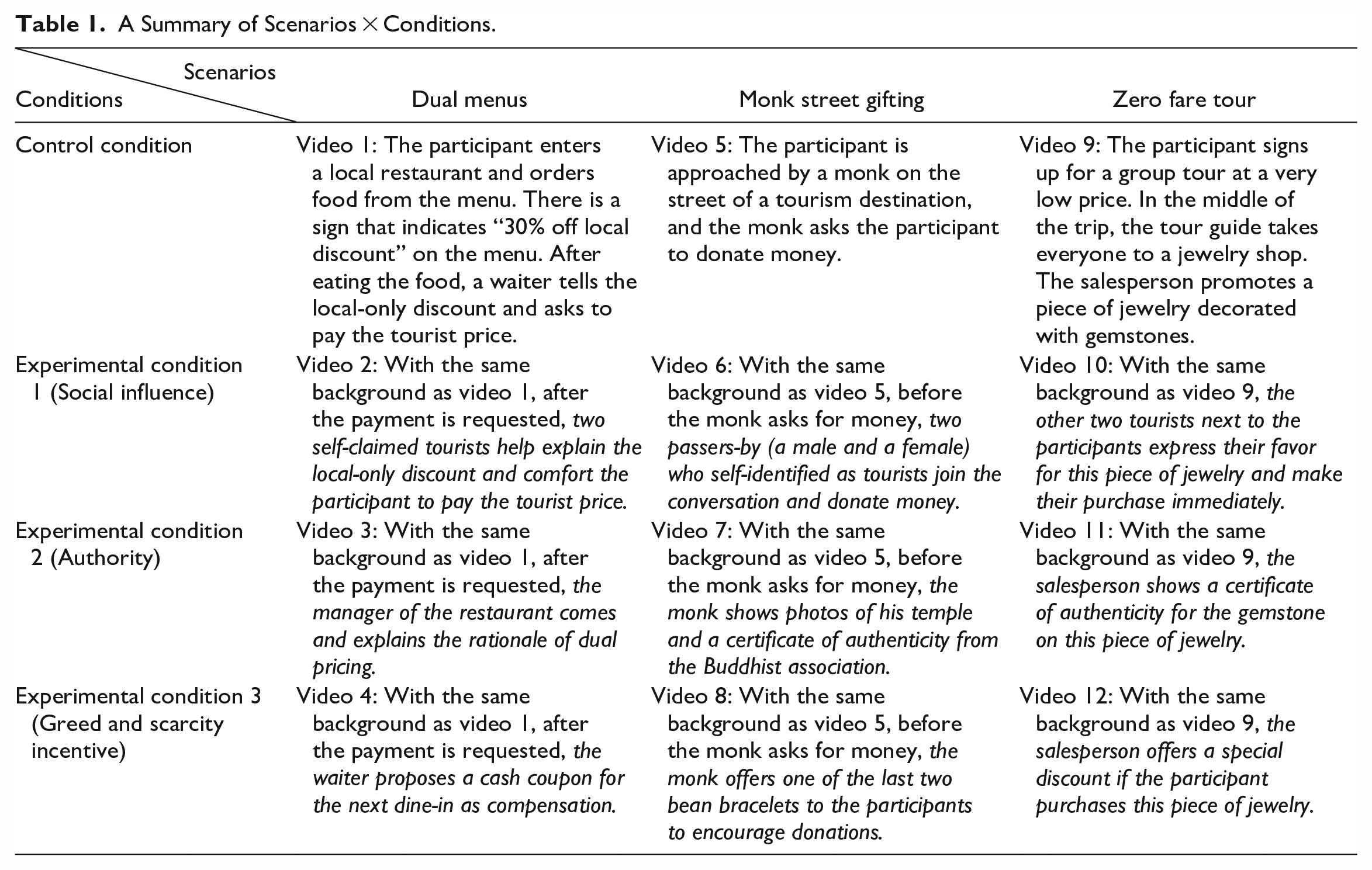
Some representations were set deliberately to remain consistent across all videos. The animated personae of scammers are all represented by characters of the same gender across all scenarios. The animated personae who exert social influence are all represented by two characters (one male and one female). Thailand was chosen as the location where all videos are based, and the reasons were two-fold. First, it is a tourism destination where scams quite often occur (Thailand Police, 2017), and second it is a popular overseas destination for both Chinese and Australian tourists (Tourism Research Australia, 2019; Xianlue, 2019).
The amount of money that was implicated in these scenarios was determined by a two-step method. We first collected relevant scam cases in Mandarin Chinese that mentioned the amount of financial losses. This is because online scam descriptions in Simplified Chinese are mostly posted by Chinese tourists, which assures the realness of the simulation. Based on the collection, we determined the amount of money in the three scenarios for Chinese participants. Second, we calculated the amount of money for Australian participants by the Purchasing Power Parity between China and Australia (OECD, 2021). The alignment through Purchasing Power Parity ensured participants from the two countries can perceive the equivalent or at least a similar level of potential loss associated with the amount of money in the animated videos.
Creating Animated Drawings
All drawings were firstly done by an independent illustrator and thereafter made into videos by a video-maker. Having one, rather than multiple illustrators, as well as video-makers, minimized representational differences that might result from differences in drawing and video-making styles and illustration abilities.
The illustrator followed four guidelines in drawings.
First, the drawings only represented the narrative that we designed.
Second, the drawings should not present details that were not required by the scripts.
Third, the styles across different drawings were kept consistent, including the size of drawing papers and the color schemes.
Fourth, the features of the characters were kept consistent.
Making Videos
The videos were made following four guidelines.
First, videos for the three control groups were made first. Based on these videos, those for the experimental groups were produced.
Second, within one scenario, the length of the experimental videos remains the same (plus or minus 5 s would be acceptable).
Third, the consistency of the video effects was considered.
Fourth, no sound was embedded in the videos.
Eventually, 24 videos were made to illustrate the 12 conditions × scenarios in both Mandarin Chinese and English. Details of video creation can be seen in the Supplemental File, Appendix A. Links to the videos can be seen in the Supplemental File, Appendix B.
Quasi-Experiment Procedures
Several techniques were employed in the procedure to cope with ethical challenges and reduce potential experimental effects. First, viewing three videos (each represents one scenario), a participant also experienced three different conditions, which reduces the learning effect. Second, to alleviate the order effect, we applied the reduced Latin Square Design of order 3. The three scenarios were displayed in three orders, which allowed each scenario to be equally shown in different positions. Prior to their participation, the respondents were given a brief introduction. They were informed that three animated videos will be shown to them, and that these three videos may be about either scam or non-scam cases. After viewing each video, they were asked to answer further questions related to the video. They decided whether to comply with the requests from the animated figures for payment, and afterward completed a scale of perceived risk. They were also required to answer an open-ended question to explain each decision made. After viewing all three videos, additional questions centering around their travel experiences, travel motivation, and sensation-seeking were presented. Importantly, even-number randomization was applied in the survey flow, which allowed a nearly equal number of respondents for each testing group. The procedures of the experiment are demonstrated in Figure 1.
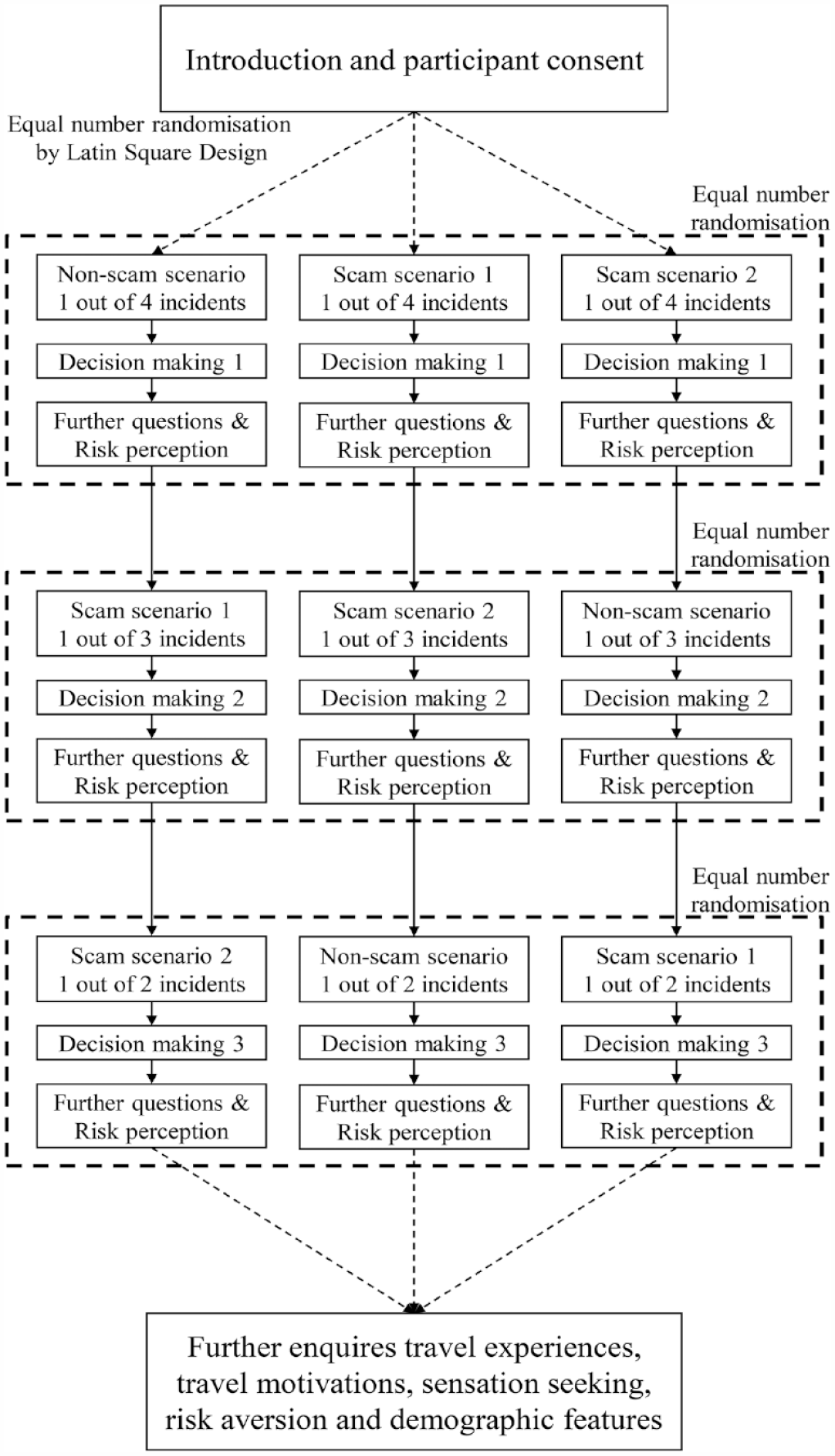
Quasi-experiment procedure.
Measurement
Scam compliance was measured by the decisions that participants made after viewing videos. They were asked whether or not they would follow the instructions of the animated figures (e.g., do you willingly pay the bill?) by choosing one of three options: Yes, Not sure, and No. The idea of setting three, rather than binary (yes or no) options, aligns with a typology in scam research where participants are often categorized as victims, near-victims or non-victims in a scam encounter (Lea et al., 2009).
We used developed scales as measurements for the internal factors of scam compliance. The 6-item scale measuring perceived risk was adopted from the work of Fuchs and Reichel (2006). Sensation seeking was measured by the 8-item brief sensation-seeking scale (BSSS) of Hoyle et al. (2002). Travel experiences were measured by the number of international trips and domestic trips that participants have gone on since 2017. Travel motivation was measured by a revised scale from Pearce (2005) original travel career scale which includes 74 items. To keep the current survey questionnaire succinct, only the items with the highest factor loadings in each dimension of the original scale measurement were used. All measurements were made on a 5-point-Likert format.
Pilot Test
A pilot test with 45 participants was carried out in April 2021. The purpose was to estimate the average completion time, examine the quality of variable manipulations, assess the equivalence of the questionnaire content across different languages, and identify any other potential problems before the official launch. Among the 135 responses made (45 × 3), respondents’ decision-making showed significant differences between scam and non-scam scenarios (χ2 = 36.349, sig < .001)—43 out of 45 (95.556%) selected either Yes or Not sure in the non-scam scenario, and 51 out of 90 (56.667%) selected in the two scam scenarios. However, there was no significant difference across the four conditions (χ2 = 2.106, sig = .910) in respondents’ decision-making. We then examined the answers to the open-ended question explicating why the decisions were made and found that the manipulations of scenarios and conditions were effective. Participants can correctly identify that the non-scam scenario as a legit one whereas the scam scenarios were perceived suspicious and deceptive. Revisions were made to improve the accuracy of wording and the survey flow.
Sampling and Distribution
Chinese and Australian residents who were above 18 years old and had travel experiences since 2017 were the target study population, as these two countries represent Eastern and Western cultures in the Asia-Pacific region. Considering the prevalence of tourist scams within this region, exploring how people from the two countries respond engenders higher practical value. Moreover, the reason to target people who had travel experiences since 2017 is because the tourist-generated content that helped design the incidents was from 2017 to date. Based on an online travel scam collection website (www.travelscams.org), tourist scams are more popular in China than in Australia. Thus, Chinese residents who have at least one inter-province domestic trip were eligible potential respondents, whereas Australian residents who had at least one international trip were valid.
The distribution of the survey to online consumer panels was conducted through two professional survey companies. Qualtrics handled the distribution in Australia, and Sojump completed the distribution in China. The use of online questionnaire surveys is a growing trend for data collection (Zou et al., 2021), and can improve response rates (Denscombe, 2009) and data quality (Rada & Domínguez-álvarez, 2014; Shin et al., 2012). The two companies work with diverse panel partners to ensure the representativeness of the sampled respondents.
GPower 3.1 was used to predetermine the sample size. The calculation was based on the χ2 test. For each 2 × 3 crosstab χ2 test, a total sample size of 172 respondents is needed (effect size w = 0.3, α level = 0.05, p-value = .95, df = 2), and for each 4 × 3 crosstab χ2 test, a total sample size of 232 respondents is needed (effect size w = 0.3, α level = 0.05, p-value = .95, df = 6). We thus targeted 600 participants (300 from each country), and eventually recruited 609 participants in May 2021. Moreover, the two companies imposed age distribution and gender ratios that align with the 2019 national outbound tourist statistics of the two countries (Australian Bureau of Statistics, 2020; Mastercard, 2020), and the profile of the samples is seen in Table 2.
Respondent Profile.
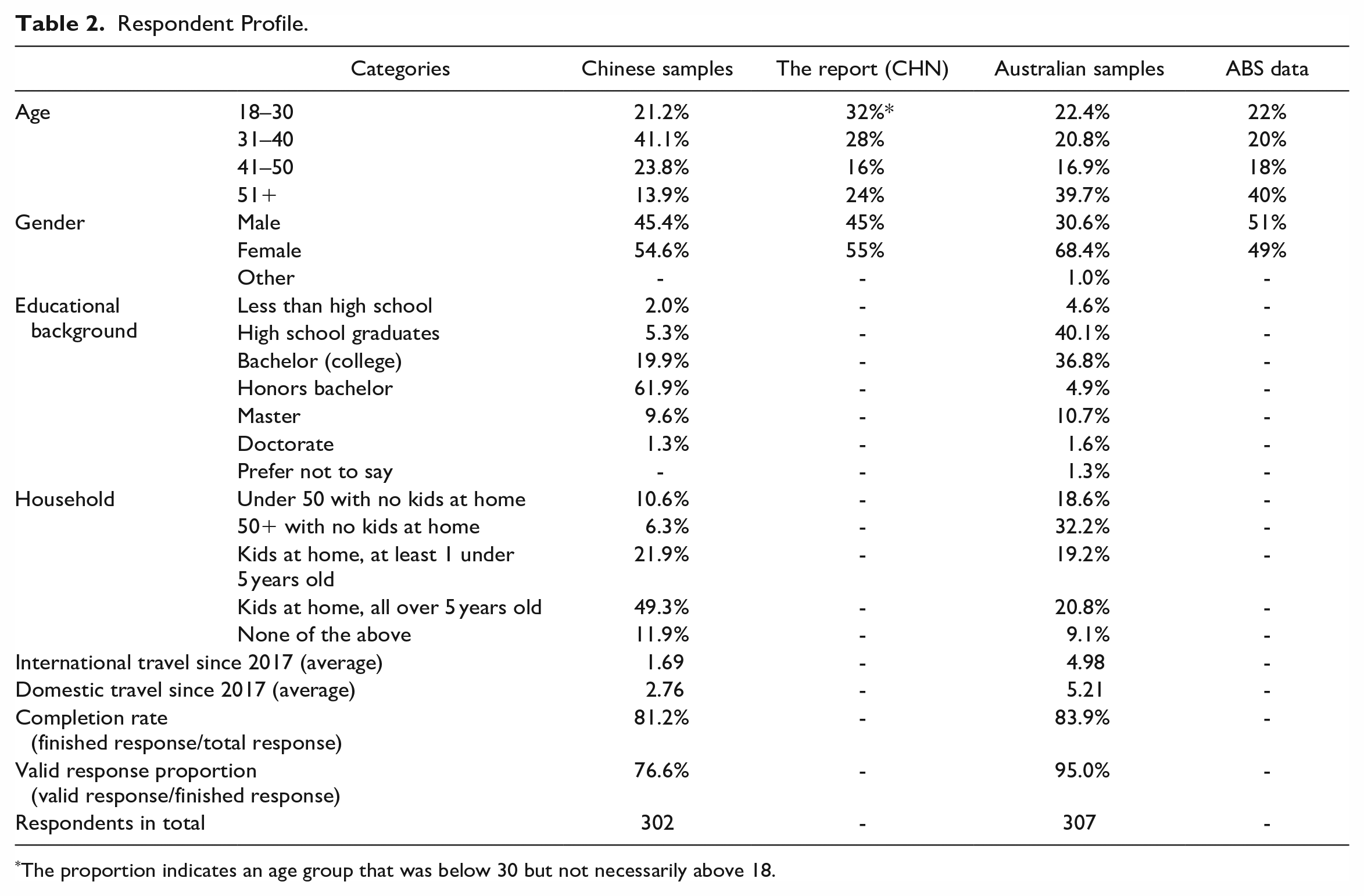
The proportion indicates an age group that was below 30 but not necessarily above 18.
A participant removal process was conducted after data collection. Commonly, participants who failed to follow the experiment procedure and pay no attention to the task, can be removed (Meyvis et al., 2018). First, geo-check and bot detection were used to exclude fraudulent responses. Second, a respondent de-duplication check was conducted, removing those who had the same or related respondent ID and IP addresses. Third, a data quality check was conducted. We removed speedsters who finished the survey in less than 1/3 of the average completion length of the pilot test, respondents who did not completely watch the videos, and respondents who provided straight-line answers.
Data Processing
Several statistical techniques were applied to the dataset, including logistic regression, two-way and three-way crosstab χ2 test. The data were analyzed in SPSS 27.0, and a descriptive account of the data is provided in Supplemental Appendix C.
Findings
Logistic Regression
To assist with result interpretation, we determined the reference categories of the nominal and dummy variables by the experiment manipulation. The Non-scam category and the Control category were set as reference for the variables of Scenarios and Conditions. The No category was set as reference for the dummy variable Past Experience with the Incident. Variable inflation factor (VIF) is a common indicator to detect multicollinearity. As a general rule of thumb for logistic regressions, a VIF < 2.5 is preferable (Allison, 2001; Midi et al., 2010). A test of multicollinearity was conducted prior to performing the regression, and all variables are below this threshold (Supplemental Appendix D).
Furthermore, since the dependent variable has three categories (Yes, Not sure, and No), ordinal logistic regression can be an ideal solution. However, its performance requires meeting the assumption of parallel lines, which was rejected by the data of the present study (sig < .001). Therefore, stepwise nominal logistic regression was performed (Supplemental Appendix E). The final model examined all the hypotheses, and its parameter estimates results are presented in Table 3. Independent variables, including condition, scenario, risk perception, sensation-seeking, and travel motivation all show significant effects on decision-making.
Logistic Regression Parameter Estimates.
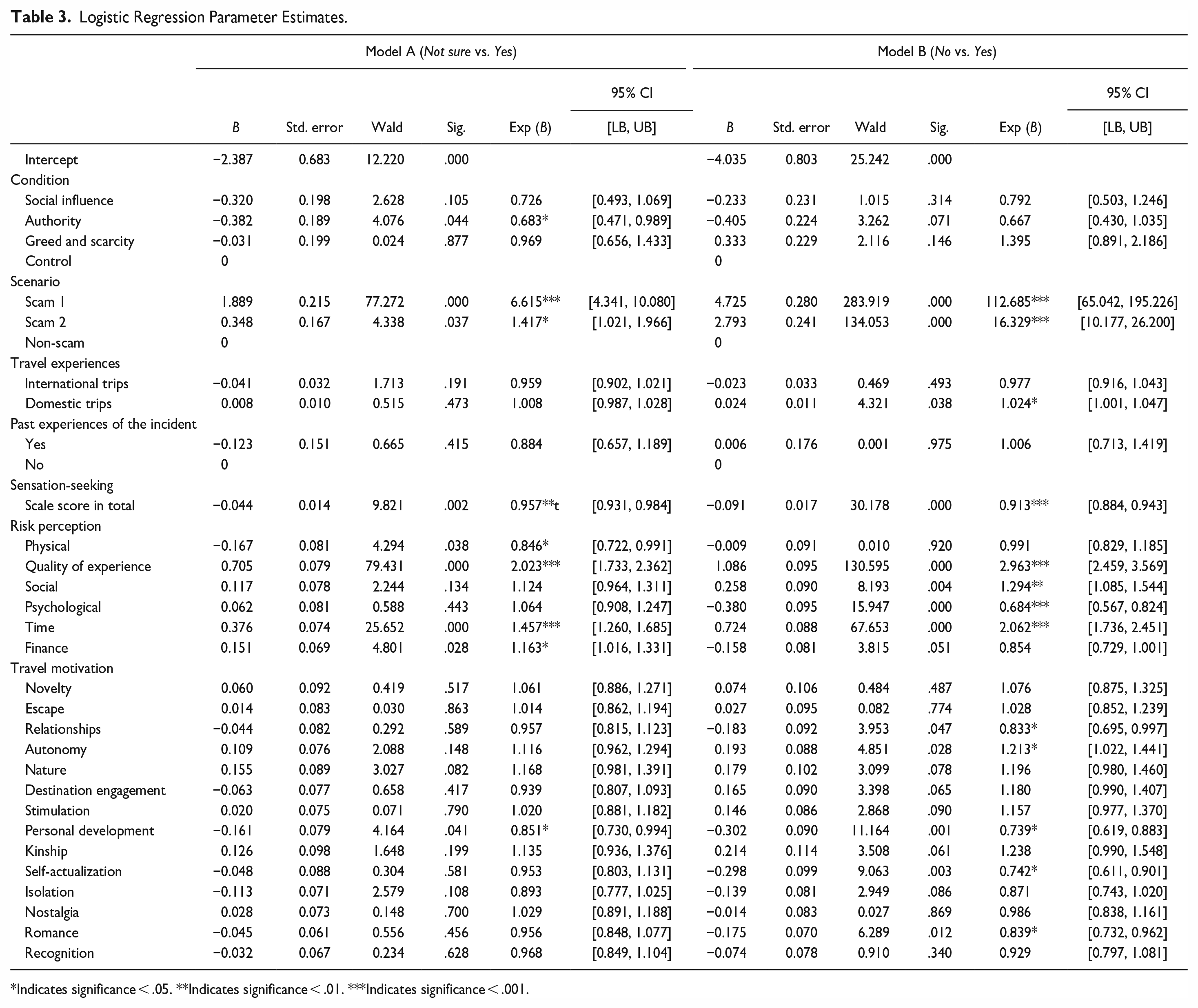
Indicates significance < .05. **Indicates significance < .01. ***Indicates significance < .001.
Specifically, two sub-models were generated with the same reference category of Yes; model A is a comparison between Not sure and Yes, and model B is that between No and Yes. Several factors exert significant impacts across the two models. First, both scam 1 and 2 scenarios are more likely to elicit Not sure and No answers. Compared to Yes, respondents are 6.615 times more likely to choose Not sure and 112.685 times more likely to choose No in scam 1 compared to the non-scam scenarios. In scam 2, these two odds ratio numbers are 1.417 and 16.329 respectively. Second, sensation-seeking is positively linked to compliance in both models. Respondents are 1.045 times (1/0.957) more likely to select Yes than Not sure, and 1.095 times (1/0.913) more likely to select Yes than No with single-unit growth in sensation-seeking. Third, the risks of quality of experience and time show robust effects in both models. The former increases the likelihood of selecting Not sure by 2.023 times and No by 2.963, and the latter has similar effects on Not sure by a 1.457-time increase and No by a 2.062-time increase. Lastly, a higher score on the motivation for personal development is linked to a higher likelihood of compliance. Respondents are more likely to select Yes than Not sure and No by 1.175 (1/0.851) and 1.353 (1/0.739) times respectively.
Some factors exert significant impacts only in model A. First, the authority condition encourages a 1.464 (1/0.683) times higher likelihood of compliance. Second, the risk related to physical wellbeing increases the likelihood of compliance by 1.182 (1/0.846) times, whilst financial risk increases the selection of Not sure by 1.163 times. Third, a higher motivation rating for isolation (odds ratio = 0.865) can increase the possibility of selecting Yes rather than Not sure.
Some factors, conversely, only show significant effect in model B. First, more experiences in domestic travel are linked to a 1.024 times higher chance of selecting No than Yes. Social risk increases the likelihood of selecting No by 1.294 times, whereas psychological risk increases that of selecting Yes by 1.462 (1/0.684) times. Several dimensions of travel motivation also show significance in model B. Those who are higher in autonomy are 1.213 times more likely to choose No. On the contrary, those who are higher in relationships (odds ratio = 0.833), self-actualization (odds ratio = 0.742), and romance (odds ratio = 0.839) and more likely to choose Yes.
Additionally, we also separated the dataset according to the sampled countries to provide more generalizable results and implications (Supplemental Appendix F presents the full results of the regression analysis). The regression results are largely similar, but some important differences deserve to be interpreted (Table 4 presents the differences). First, although scenarios (scam 1/2 compared to non-scam) can cause significant impacts among participants of both countries, Chinese participants have a lower odds ratio in selecting Not sure and No than Australian participants, indicating that the Chinese samples are more likely to comply with scamming schemes. Second, the significance of the influence of sensation-seeking varies between the sample countries. Australian respondents were significantly more affected by sensation-seeking than the Chinese.
Differences in Logistic Regression Results Between the Two Sample Countries.
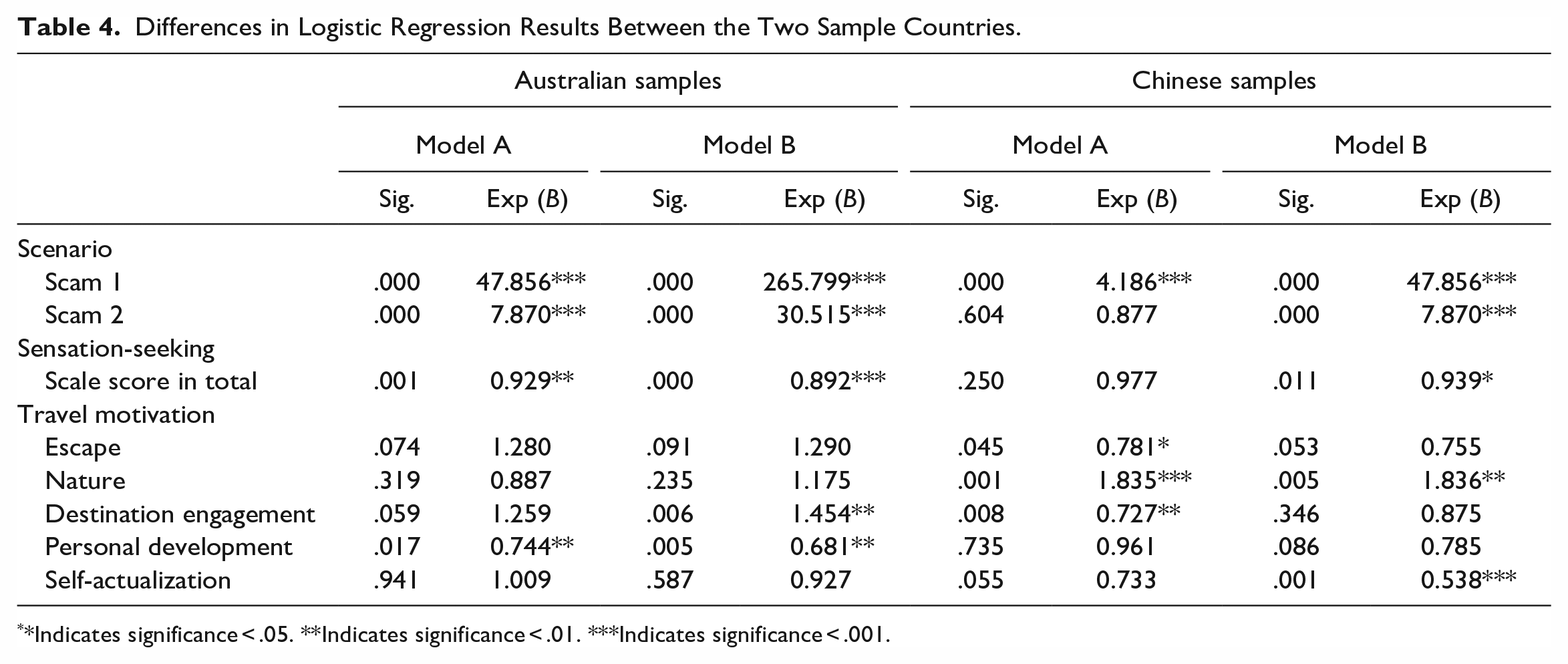
*Indicates significance < .05. **Indicates significance < .01. ***Indicates significance < .001.
Lastly, some dimensions of travel motivations show different effects. Chinese participants with a higher score on escape and self-actualization are more likely to choose Yes. However, such effects were not seen in the Australian sample. Destination engagement showed opposite effects in the two samples—a higher willingness to engage at a destination leads to a higher likelihood of compliance in the Australian sample, but not in the Chinese sample. Moreover, seeking more personal development significantly reduces the likelihood of choosing Not sure and No for the Australian participants, whilst no significant effect was detected among the Chinese participants. Nature motivation exerts a converse effect; the more eager to experience nature, the more likelihood of selecting Not sure and No among the Chinese sample, but not the Australian.
Crosstab χ2 Tests
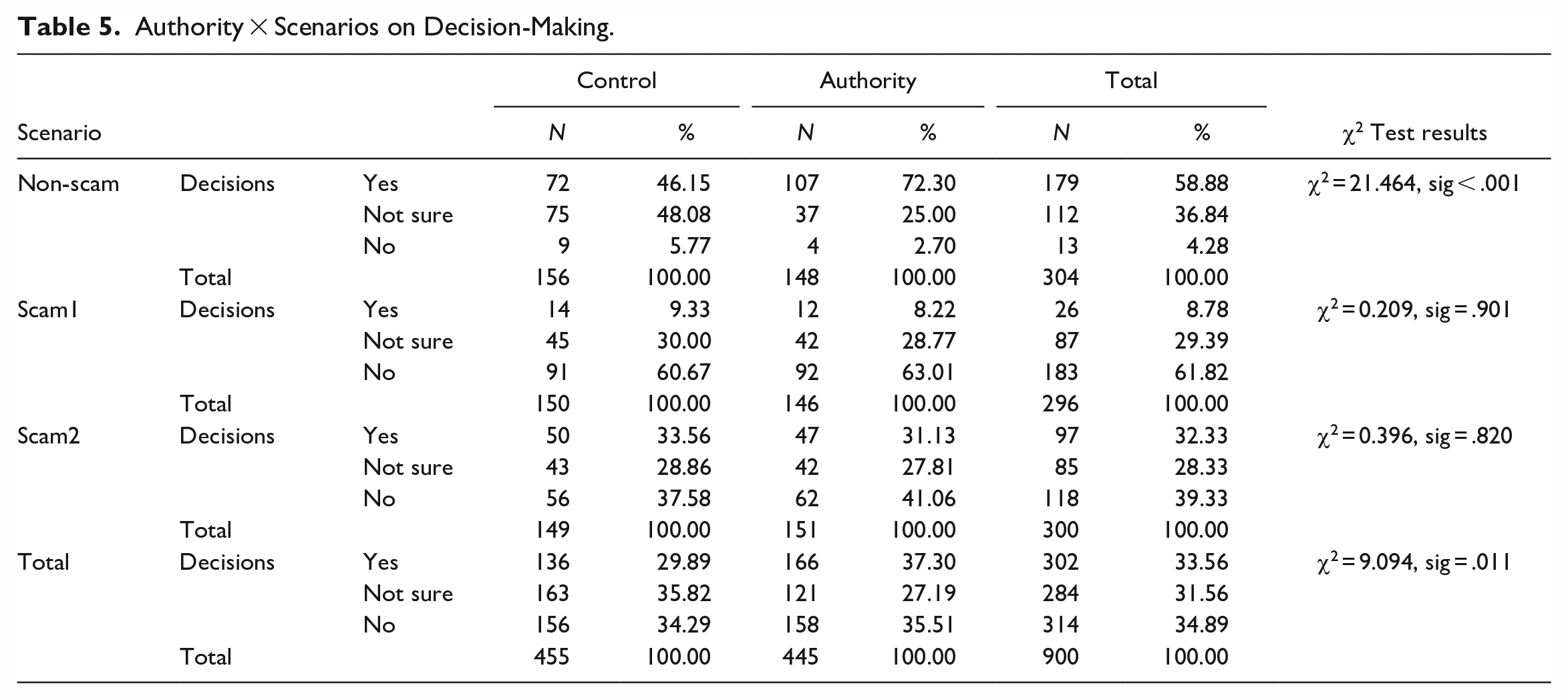
A series of crosstab χ2 tests were conducted to specifically examine the effect of the three external factors on scam compliance. The three-way crosstab χ2 tests (social influence/authority/greed and scarcity × decisions × scenarios) indicate that neither social influence (χ2social influence = 4.165, sig = .125; χ2NS = 3.266, sig = .195; χ2S1 = 4.158, sig = .125; χ2S2 = 1.042, sig = .594), nor greed and scarcity (χ2greed and scarcity = 5.721, sig = .057; χ2NS = 3.766, sig = 0.152; χ2S1 = 2.025, sig = .363; χ2S2 = 1.583, sig = .453) exert a significant impact on decision-making, regardless of which scenario. Authority does have an impact on decision-making (Table 5, χ2authority = 9.094, sig = .011), which aligns with the logistic regression result. However, such impact is only manifested in the non-scam scenario (Table 5, an increase from 46.2% to 72.3%, adjusted residual = 4.6). In the two scam scenarios, it does not elicit a higher possibility of compliance (χ2NS = 21.464, sig < .001; χ2S1 = 0.209, sig = .901; χ2S2 = 0.396, sig = .820). Thus, from these findings we can infer that people can distinguish scams from non-scams and correctly respond to the different scenarios.
Authority × Scenarios on Decision-Making.
Discussion and Conclusion
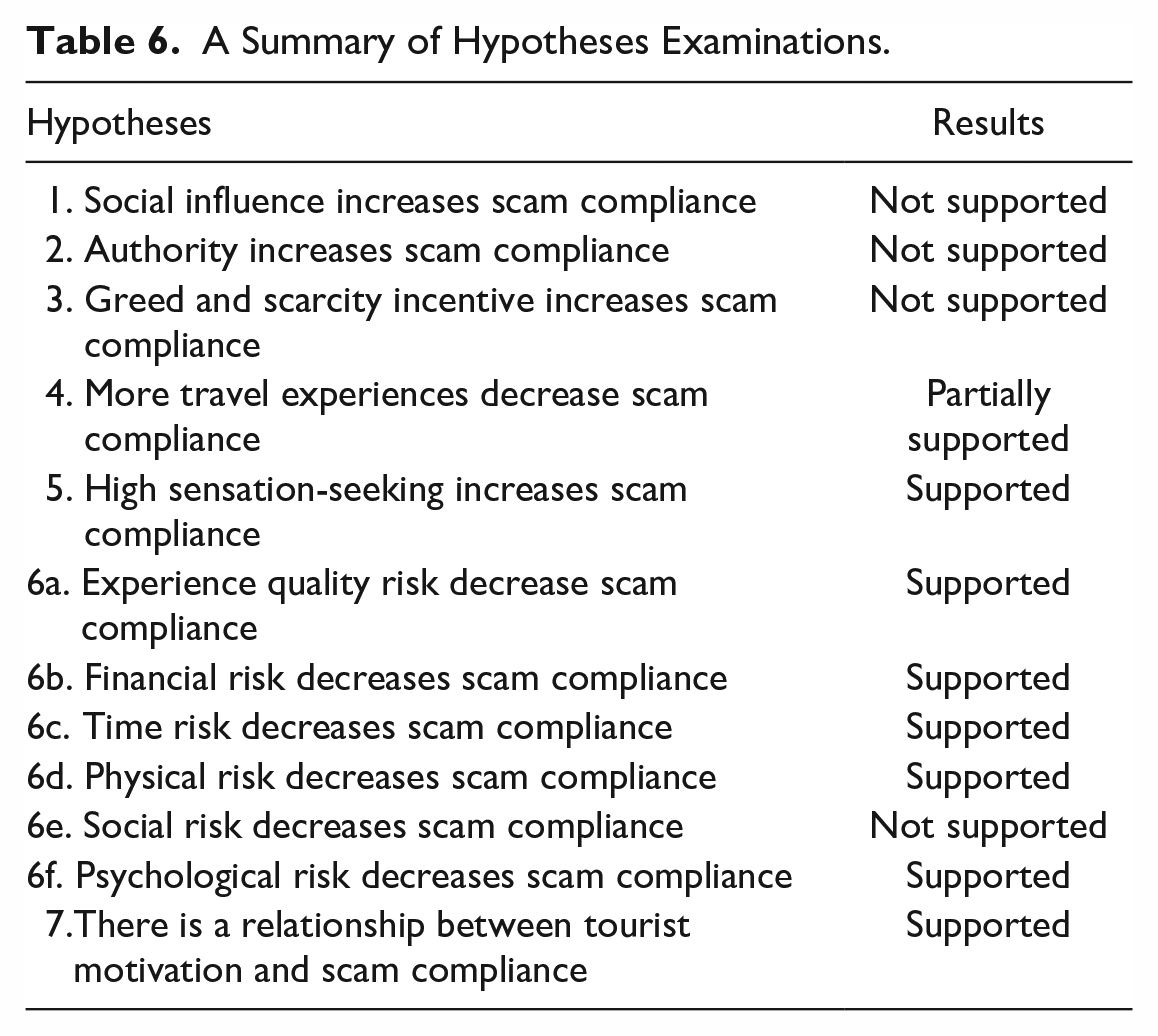
This study was guided by the objective of examining the factors of scam compliance in the tourism context. Through simulating real-world tourist incidents in a quasi-experiment, tourist decision-making in scam encounters was observed. By employing nominal logistic regression, and a three-way crosstab χ2 test, the results of the study are presented in Table 6.
A Summary of Hypotheses Examinations.
Theoretical Implications
The results indicated that the scamming techniques of social influence, authority, and greed and scarcity incentive did not significantly increase the likelihood of scam compliance in the tourism context. Although much research in the daily consumption setting purported that scams often incorporate social influence, authority, and greed and scarcity incentive techniques (Duffield & Grabosky, 2001; Langenderfer & Shimp, 2001; Lea et al., 2009; Shadel & Pak, 2007), these factors were not significantly effective on the respondents in the present study. Despite a laboratory experiment, we argue that the tourism context may be the reason for such differences. In general, people may be more cautious in a travel destination than in their usual environment. Yet a question remains—why do tourist scammers seem quite successful in making the deceptive tricks work?
A possible explanation could point toward targetship development, which means that scammers first filter potentially gullible tourists then perform the deception. Previous studies that contested a strong influence of compliance factors were mainly conducted by working closely with the victim population (Lea et al., 2009; Modic, 2012). These scamming techniques may be effective on certain populations, and scammers know how to identify the gullible targets. This idea shares similarities to the model of scam vulnerability by Langenderfer and Shimp (2001), which suggests that some personality traits can moderate individuals’ focus in evaluating a scam offer and thus their compliance tendencies. Although the present study was not designed to specifically detect such moderation mechanisms, it is necessary to highlight this possibility for future investigation. Scammers might take advantage of such moderation mechanisms to identify specific targets. D. Xu et al. (2021) noted that tourist scammers develop targetship skills to carefully identify gullible tourists, and this selection can be a result of exploiting the moderation mechanisms. If tourist scammers are competent socializers and can tell a potential target’s sensation-seeking tendency from observing their sayings and doings, these scammers may only approach sensation-seeker tourists because they are more gullible to scamming schemes. Thus, future research on tourist scams can work on studying the moderation effect of the internal factors on the external factors of scam compliance; it may provide strong pragmatic implications to customize protection strategies.
Moreover, although our main findings are distinct from many previous studies, these arguments align with more recent attempts in consumer research. Fischer et al. (2013) found that social influence is ineffective in triggering scam compliance, and Wood et al. (2018) likewise provided evidence for the ineffectiveness of scarcity and authority techniques. DeLiema et al. (2023)’s examination of people who engaged in scam solicitation also found the decay of influence from scam compliance factors. Six out of 15 factors in their work were significantly effective, and only two were external factors. On the one hand, it is possible that since our experimental stimuli were based on prevalent tourist scams that were discussed on the internet, the detection and protection strategies have been largely circulated, which may decrease scam compliance as observed. On the other hand, another potential explanation, as Wood et al. (2018) argued that the implementation of persuasive tactics may not be a critical cause of victimization, but rather the perception of these persuasive tactics. In line with these potential causes, some alternative thinking for future work must be noted. First, the internal factors can potentially moderate the efficacy of the external factors of scam compliance. It is important to investigate how tourist scammers segments tourists into gullible targets. Second, the combination of two or even more scamming techniques may be more powerful in causing such perception. In real-world situations, scammers may integrate more than one technique into their actions. Examinations of the interactive effect may offer further implications.
An interesting finding is the insignificant relationship between past scam experiences and compliance, which challenges that of consumer fraud research on state dependence. This term describes the impact of prior victimizations on future re-victimizations. Voices are raised supporting how state dependence increases re-victimization likelihood (Titus & Gover, 2001) or vice versa (O’Connor et al., 2021). However, our results found the middle ground, showing no significant relationship. Furthermore, we found past domestic travel experiences as a predictor of scam compliance. The more domestic travel experience one has, the higher likelihood that one would reject a scamming offer. In general, although these findings cannot support the claim that past scam experiences can help one escape from future victimization, we generally believe that tourists can learn from past experiences (Falk et al., 2012). The state dependence effect may not be strong in the tourism context.
As an important consideration in tourist research, some dimensions of travel motivations were found to be associated with tourist scam compliance. An interesting and more theoretically important observation pertains to the differences between Chinese and Australians in how different travel motivations (escape, nature, destination engagement, personal development, and self-actualization) affect scam compliance. Pragmatically, this suggests that gullible tourist segments are different between the two countries, and thus reminders and education plans should be customized. Theoretically, there are several potential causes of the different effects between the two datasets, and the first can be cultural differences. There exists an individualism-collectivism difference between Chinese tourists and Westerners (G. Chen & Huang, 2017). Western tourists who underscore personal development can be more individualistic meaning they may be more impulsive decision-makers (Kacen & Lee, 2002), and ultimately more likely to be compliant. Second, regarding the effects of escape, destination engagement, and self-actualization on Chinese participants, a possible explanation is the progressive escapism in current China. China’s working class are experiencing collective anxiety due to fierce social competitions, which caused problems such as loneliness and a structural desire of escape from everyday life routine (Yin et al., 2023). These then may lead people to act irrationally (Shen & Wang, 2019), and in the traveling context, a higher likelihood of compliance to scams can be a negative outcome. Third, the pursuit of nature is the primary motivation among Chinese tourists (Fu et al., 2017). As Chinese culture emphasizes human-nature harmony—a “oneness” relationship between humans and the nature, it encourages one to acquire wisdom and inspiration through simplicity (Fu et al., 2017). Such simplicity may affect how they behave in an encounter with scams and more likely to deny scamming offers.
Pragmatic Implications
Beyond that, self-actualization, personal development, relationship development, and romance were positively associated with compliance in general, whereas autonomy was negatively associated with compliance. The implications are largely pragmatic. Travel motivation is often associated with and widely used in market segmentation (Bieger & Laesser, 2002; Dolnicar, 2008). Some useful communication and managerial implications can be made. For tourists from scam-vulnerable markets, reminders and education can be provided. The backpacker market, for example, is strongly associated with the motivation of self-actualization and personal development (Pearce et al., 2009; Pearce & Foster, 2007). Therefore, backpacker tourists may be at a greater scam risk.
A higher tendency of sensation-seeking was found to be associated with scam compliance. Sensation-seeking is defined by capturing the intensity and novelty of experiences (Galloway et al., 2008; Pizam et al., 2004). Since scamming schemes are often under a touristic activity cover, sensation seekers may be intrigued and thereafter become easy targets. An implication from this piece of findings is to deploy scam protection toward sensation-seekers or reduce the sensation-seeking tendencies of the general public. The former demands the careful identification of this personality group, which may be associated with certain tourism markets, such as sex tourism (Paat et al., 2020). The latter then pinpoints the communicative techniques in constructing tourist self-protection materials or warning signs. Furthermore, the present study found that sensation-seeking has a more profound impact on Australians than on Chinese. Compared to Westerners, sensation-seeking is known to be less influential on Chinese (Lu et al., 2017). Therefore, the aforementioned practical implications are more applicable when it comes to the Australian, and perhaps the Western tourist market.
The present study also found that the various dimensions of risk perception are associated with scam compliance in different ways. First, the dimensions of experience quality and of time are two major contributors to scam avoidance, and social risk and financial risk can also encourage tourists to reject scamming offers. More specifically, people may not walk into a scam because they suspect potential deterioration of experience, or a waste of time and/or money. In some cases, tourists reject scamming offers also because they believe that taking such an offer may damage their social image. These findings pose strong implications for tourist protection. While communicating with tourists about self-protection, emphasizing these four risk dimensions may better deter scam victimization. Second, an increase in physical risk and psychological risk is associated with scam compliance. It indicates that scammers may exploit these two risk dimensions in persuading tourists to fall for deception. Anti-scam communication needs to provide information on the measures in enhancing the self-protection of physical well-being, and to unveil how scammers may take advantage of victims’ self-blame.
Beyond the implications centering around the hypotheses, some other implications can be noted. First, the compliance rate (the percentages of Yes answers) to scam scenarios in the experiment serves as a record of tourist response to scams. Specifically, 10.67% of respondents complied with the counterfeit selling scam in the zero-fee tour scheme, and 32.84% of respondents complied with the monk donation scam. Second, the scenarios have a strong impact on decision-making. D. Xu et al. (2022) has differentiated the monk donation scam from the zero-fee tour. Except for their similarity of being prevalent, the former is predominantly a simulation deception incorporating interpersonal trust, whereas the latter is a dissimulation deception that is less likely to rely on interpersonal trust. These variances may explain the influence of scenarios, and future research is encouraged to present evidence to our propositions. Additionally, the results indicate that the general population is capable of distinguishing scams from non-scams and acting accordingly. Exploring and examining the internal scam compliance factors is still important, as it helps identify vulnerable tourists. However, compared to Australians, Chinese are apparently more prone to compliance in a scam scenario than in a non-scam scenario. This generates managerial implications for destination managers to improve Chinese-specific anti-scam communication. For the Chinese tourism administration, enhancing tourists’ self-protection awareness is then necessary.
Limitations and Future Research
The study suffers from several limitations. First, there are many factors contributing to scam compliance—for example, Lacey et al. (2020) identified 10 factors from the literature—and the present study only examined those that the body of literature suggested as being relatively stronger. Thus, future work is encouraged to include other factors for analysis. Second, due to the deceptive and unethical nature of scamming incidents, observing tourist decisions and behaviors in such a laboratory environment is more feasible than in the field. However, we acknowledge the discrepancies between video stimuli and real-world scam cases. Third, the scam taxonomy of D. Xu et al. (2022) is a rather complex attempt to categorize deceptive schemes. We only employed three prevalent scams from the categorization system to construct the present study. It is possible that less common scams can yield different results. Notably, this study does not serve the purpose of re-examining the taxonomy, and future research is encouraged in this stream. Fourth, we acknowledge that setting a third nation (Thailand) other than the sample countries (China and Australia) may bring in further noise factor such as the cultural proximity between the three countries etc. Furthermore, as the present study only acquired samples from these two countries, and only used one stimulated destination. It is important to conduct further studies to cross-validate the findings. We encourage future studies to overcome these challenges. Lastly, we must acknowledge that the Covid-19 pandemic has changed the tourism industry dramatically, and tourist scams may have evolved accordingly. The present research was carried out at time of lockdowns and travel restrictions. As governments are easing these control measures, researchers may explore new variants of scams of examine the findings through alternative methods.
Supplemental Material
sj-docx-1-jtr-10.1177_00472875231206542 – Supplemental material for Falling for Tourist Scams: An Examination of Scam Compliance Factors
Supplemental material, sj-docx-1-jtr-10.1177_00472875231206542 for Falling for Tourist Scams: An Examination of Scam Compliance Factors by Ding Xu, Laurie Murphy and Tingzhen Chen in Journal of Travel Research
Footnotes
Acknowledgements
We would like to acknowledge the intellectual input from Professor Philip L. Pearce, as the inspiration and early conceptualization of this research.
Declaration of Conflicting Interests
The author(s) declared no potential conflicts of interest with respect to the research, authorship, and/or publication of this article.
Funding
The author(s) received no financial support for the research, authorship, and/or publication of this article.

Supplemental Material
Supplemental material for this article is available online.
Author Biographies
References
Supplementary Material
Please find the following supplemental material available below.
For Open Access articles published under a Creative Commons License, all supplemental material carries the same license as the article it is associated with.
For non-Open Access articles published, all supplemental material carries a non-exclusive license, and permission requests for re-use of supplemental material or any part of supplemental material shall be sent directly to the copyright owner as specified in the copyright notice associated with the article.
