




Abstract
Research taking into account the everyday nature of tourism destinations and its impact upon authenticity and attendees’ resulting extraordinary experiences is limited. Drawing upon a 3-year ethnography (including fieldnotes, photos/videos, artifact material) and interviews with festival attendees, we explore the interrelationships between authenticity and extraordinary experiences in the context of Primavera Sound music festival. Our emergent thematic categories—the festival’s indie music character, its urban and quotidian configuration, and the instrumental orientation of the festival experience—suggest the festival is firmly positioned within the structures of the indie music industry, while also being located within the confines of day-to-day urban life. Attendees seek to achieve a sense of spatial authenticity by engaging with the features of tourism destinations. We contribute to discussions about authenticity and extraordinary experiences by unpacking the everyday nature of tourism destinations, demonstrating that not all music festivals need to be “extraordinary” muddy camping events.
Introduction
Prior research has dealt extensively with notions of authenticity in tourism research (Bryce et al., 2017; Chhabra, 2005; Kim & Jamal, 2007; Rickly-Boyd, 2013; Unger et al., 2020; Wang, 1999). A central premise of those lines of research is that the concept of authenticity and the subsequent nature of tourist experiences is very much related to a temporary escape from the limits and structures of everyday life (Kim & Jamal, 2007; Szmigin et al., 2017). For instance, previous studies have most commonly theorized festivals as liminal sites which facilitate the formation of communitas and often lead to extraordinary experiences (Kozinets, 2002; Szmigin et al., 2017; Wu et al., 2020).
In line with the Turnerian school of thought (Turner, 1969), such efforts largely perceive authenticity (in objective, constructive and/or existential terms), as a platform for recovering from the alienation that is inherent within the structures of everyday life (Xue et al., 2014; Yi et al., 2017). However, a growing number of recent inquiries argue for the development of a broader understanding of the authenticity concept (Canavan & McCamley, 2021; Rickly-Boyd, 2012), one which also takes into account the potential for everyday touristic experiences (Knudsen et al., 2016; Rickly-Boyd, 2013; Vidon et al., 2018) and accounts for both their ordinary and non-ordinary nature (Goolaup & Nunkoo, 2023).
More specifically, prior work suggests that individuals often seek out their authentic selves in tourism destinations which are distinct from their everyday existence (Vidon, 2019; Wang, 1999), thus enabling participation in extraordinary experiences which provide a sense of escape and personal freedom from their everyday lives (Szmigin et al., 2017, p. 10). Although “the search for authenticity may be timeless, driven by the existential alienation inherent in the human condition” (Canavan & McCamley, 2021, p. 8), prior studies do not capture adequately how authenticity is negotiated by individuals when extraordinary experiences do not necessarily always provide an escape from everyday life (Goolaup & Nunkoo, 2023). As such, we argue that a more nuanced understanding of the concept of authenticity, which further emphasizes the subjective nature of extraordinary experiences (Vidon & Rickly, 2018) in diverse tourism destinations, is needed.
Drawing upon a 3-year ethnography undertaken at the Primavera Sound festival and interviews with festival attendees, our study explores how the festival experience becomes meaningful by being grounded into everyday life and the indie music field. Our three core thematic categories illustrate how our informants seek a spatial sense of authenticity by engaging with the mundane features of everyday life in tourism destinations. Our study contributes to recent work on authenticity and extraordinary experiences by exemplifying that attendees do not necessarily disengage from all aspects of everyday life and social structures when attending music festivals. Instead, music fans embrace the socio-historical grounding of their festival practices and the everyday nature of tourism destinations while experiencing Primavera Sound as an extraordinary experience. We argue that extraordinary experiences can also emerge and become meaningful for attendees when music festivals take place in seemingly “non-extraordinary,” urban contexts positioned within the realm of everyday life.
Next, we provide a brief overview of prior literature in authenticity and extraordinary experiences in tourism research and beyond, we then discuss the research context and methods of the study, and move on to present the findings of the study. We conclude by offering theoretical and practical implications, stating the limitations of the study, and providing future research directions.
Literature Review
Authenticity in Tourism Research
Prior work most commonly understands authenticity as the means for tourists to address their own alienation; by allowing them to transcend the social norms, constraints and structures that are omnipresent in their everyday lives (see Vidon, 2019). In other words, tourism authenticity is often associated with the notion of escape from everyday life and the alienated nature of one’s state of being (Kozinets, 2002). According to Rickly-Boyd (2012), tourism experiences have thus been perceived as being liminal in nature and removed from everyday institutions and the quotidian. To these ends, Wang (1999) identified various types of authenticity (i.e., objective, constructive and existential) in the literature which facilitate the transition toward liminal tourist experiences (Turner, 1973).
In his classic work on the various typologies of tourist experience, Cohen (1979) identifies existential quest for meaning as one of the main modes of such experiences, wherein individuals embark on a spiritual “journey” from the mundane reality of their everyday life to the “holy grail” of authentic existence. Existential authenticity targets individuals’ authentic selves via “personal or intersubjective feelings activated by the liminal process of tourist activities” (Wang, 1999, p. 351). In phenomenological terms, authenticity, then, is often positioned within the psyche of the individual subject (Rickly-Boyd, 2012) and seems to be enacted in a liminal space where societal constraints and the pace of everyday life are largely suspended and any sense of an inauthentic way of being or alienation is diminished (Higgins & Hamilton, 2020; Kim & Jamal, 2007; Vidon et al., 2018).
Existential authenticity suggests that individuals seek to immerse themselves into new experiences which help them develop “an authentic sense of self rather than being lost in public roles” (Kim & Jamal, 2007, p. 184). Authentic tourist experiences have therefore often come to represent individuals’ efforts to recover themselves from the alienation imposed on them by modern society within the sphere of everyday life (Unger et al., 2020; Wang, 1999; Xue et al., 2014). As Rickly-Boyd (2013, p. 413) notes, “the more individuals are absorbed into their everyday, the more alienated they become […] and thus seek, through tourism, to re-establish their social connections.” Contemporary theorizations of tourist experiences therefore tend to be grounded within the premise of distinguishing tourism from everyday life (Uriely, 2005). This is something which is often exemplified in spatial terms; specific places orchestrate and shape the construction of existential authenticity (Szmigin et al., 2017; Unger et al., 2020).
Recent studies in the discipline illustrate how tourist experiences bear the potential to lead to a spatio-temporal suspension of everyday norms and logics (Higgins & Hamilton, 2020; Szmigin et al., 2017; Wu et al., 2020). However, such a spatio-temporal suspension is not necessarily disconnected from social structures. For instance, in the context of pilgrimage tourism, Higgins and Hamilton (2020) note that communitas can be achieved within everyday structural frames, disconnected from liminal experiences. Similarly, Goolaup and Nunkoo (2023, p. 9) argue that food tourism experiences often include “elements that are not completely unfamiliar or totally different from the unknown but are representative of the ordinariness.” These studies suggest that everyday life practices inform tourism experiences (Larsen, 2008). In other words, the complex and multi-faceted nature of everyday life further demonstrates that (existential) authenticity and subsequent extraordinary tourist experiences might also be grounded within everyday practices (Heller, 1984; Obrador, 2012).
Increasingly, tourism research underlines the need for further work which addresses the complex and multi-faceted processes (e.g., social, cultural, and political) through which tourist experiences become meaningful. This entails exploration of the social processes through which authenticity is validated and considered to be genuine, original, real and/or trustworthy (Cohen & Cohen, 2012). For instance, Vidon (2019) argues that individuals are ipso facto shaped by, and mediated through, society. This process normally involves the social construction of their thinking and the language they use to communicate with others. To these ends, authenticity has come to denote individuals’ unattainable desire to break free from the constraints of everyday life via extraordinary experiences, even if it is practically impossible to fully escape the social world (Knudsen et al., 2016). Such a sense of authenticity is inherently a subjective affair and might incorporate various meanings and experiences (Vidon & Rickly, 2018).
Knudsen et al. (2016) further argue that although authenticity cannot be a regular part of our everyday lives, it constitutes a constant motivation for seeking to escape the mundane nature of our daily existence. Similarly, Vidon and Rickly (2018) find that nature tourists search for a (re)union with their “whole” selves and are thus attempting to overcome or transcend their everyday lives. In the context of music festivals, Szmigin et al. (2017) illustrate how socio-spatial authenticity can emerge through individuals’ relationships with, and extraordinary experiences within, commercial festival settings. However, as Xue et al. (2014, p. 187) suggest, future studies are needed to generate novel insights into “the nexus between human experiences and the various forms of tourism structures that characterize modern day society.”
In this paper, music festivals provide a useful research context to explore the above claims and further delineate the relationship between authenticity and extraordinary experience in specific tourism destinations. Next, we delve deeper into prior research on these events, to highlight the variety of ways in which they have been predominantly theorized in tourism research and beyond.
Music Festivals and Extraordinary Experiences
Festivals are typically repeated events which are held at a particular point in time and often revolve around a specific theme (Wilson et al., 2017) but much existing research, in tourism studies and beyond, still perceives them primarily as liminal spaces where attendees are liberated from the restrictions and conventions of everyday life. This allows attendees to construct self-transformational experiences which could potentially lead to more authentic ways of being (Kim & Jamal, 2007) in line with existential conceptions of authenticity (Wang, 1999).
Marketing and tourism studies frequently draw upon Turner’s (1973) and Abrahams’s (1986) dichotomies of structure/antistructure and ordinary/extraordinary to theorize the escapist nature of festivals as standing outside the confines of everyday life and leading to the suspension of social norms, rules, and constraints (Kozinets, 2002; Rickly-Boyd, 2012). More specifically, music festivals are often thought to acquire an “extraordinary” status for attendees which aims to transport them into a parallel idyllic universe disconnected from the present (Goulding & Saren, 2016; Ulusoy, 2016). The resulting festival experience has come to be perceived as hedonic, positive, emotionally charged, intense, transformative and memorable, or “extraordinary” (cf. Arnould & Price, 1993). As Szmigin et al. (2017, p. 10) note, “the everyday world is represented as a site of task and goal-orientated instrumental activities, while the festival is a place of expressive activities which are invested with symbolic value and personal meaning.”
In other words, prior work predominantly follows an idealistic approach to tourist and/or consumption experiences in [music] festivals, which is largely attributed to their “extraordinary” ethos, and has the potential to facilitate various types of authenticity (Wang, 1999). However, recent theorizations move away from traditional conceptualizations of extraordinary experiences (in music festivals and beyond) by stressing the interplay between the structural (ordinary) and antistructural (extraordinary) dimensions of such experiences (Goolaup & Nunkoo, 2023; Husemann et al., 2016; Skandalis et al., 2019; Tumbat & Belk, 2011). In fact, some of these studies illustrate how extraordinary experiences achieve a meaningful status for individuals whilst being positioned within the structures of everyday life. Goolaup and Nunkoo (2023), for instance, emphasize that extraordinary experiences might also be perceived as entailing a positive co-existence between the ordinary and non-ordinary.
To these ends, we further argue that music festivals belong to a broader spatial network of music spaces (e.g., venues, concert halls) which constitute integral parts of “scenes” or “fields” (Daskalopoulou & Skandalis, 2022). Music festivals can therefore be perceived as field-configuring events which stand in-between structure and antistructure (Turner, 1969). As such they are firmly positioned within everyday life and the structural logics of the popular music industry, recognizing that individuals also search for tourist experiences which are grounded in specific socio-historic contexts (Thomas et al., 2018). This socio-historic context could include a festival’s association with the field within which it is embedded, its linkage with specific geographical localities, as well as emerging spatio-temporal meanings in situ.
Music festivals often take the form of “staged events” (Urry, 1990) wherein attendees do not necessarily seek some form of existential authenticity (Wang, 1999; Yi et al., 2017), but rather spatially engage with dominant music institutions and everyday life (Xue et al., 2014). Hence, we argue that there is a lack of knowledge of the variety of ways in which authenticity is achieved in the context of extraordinary tourist experiences when the latter are not necessarily positioned solely as offering an escape from everyday life.
Research Context and Methods
In this paper, we focus on Primavera Sound, an international indie music event that is held every year 1 in the Spanish city of Barcelona. The festival features both promising and renowned independent artists and bands from across the world, which perform on various stages of different sizes and characteristics (Primavera Sound, 2020). Although the Primavera Sound festival is a seemingly extraordinary experiential setting and space outside of attendees’ everyday lives, it is firmly connected to, and embedded within, social structures of the everyday and the indie music industry; and thus constitutes a research context par excellence for the purposes of our study.
The festival site, Parc del Forum, was developed in 2004 as part of the city’s ongoing program of urban renewal. Its location within an urban context distinguishes it from other major music festivals (e.g., Coachella, California, and Glastonbury, U.K.), which tend to be located in more remote locations disconnected from urban life. The line-up consists of bands and solo artists from the field of indie music, which was initially associated with independent modes of music production and distribution yet is now firmly established as a popular music genre (Hesmondhalgh, 1999).
We followed an interpretive approach which involved the collection of ethnographic data drawn from informal interactions with festival attendees, fieldnotes, photographs, video recordings and artifact material. In addition, the first-named author carried out interviews on-site with 25 festival attendees. These took place with individuals or in small groups of two/three festival attendees and ranged from 10 to 45 min in length. Semi-structured one-to-one interviews were also conducted off-site with 15 informants who had attended the festival at least once over the 3-year study period, with the majority having visited the festival repeatedly. The off-site interviews were more in-depth, lasting approximately 60 to 90 min. Ethnographic data collection and interviews took place across various editions of the festival (2013–2016) aiming to provide a longitudinal dimension to the study. Ethnographic fieldwork was also informed by the lead author’s participation in the 2017 to 2019 and 2022 festivals. Information regarding the variety of data sources is provided in Table 1.
Summary of Data Collection.
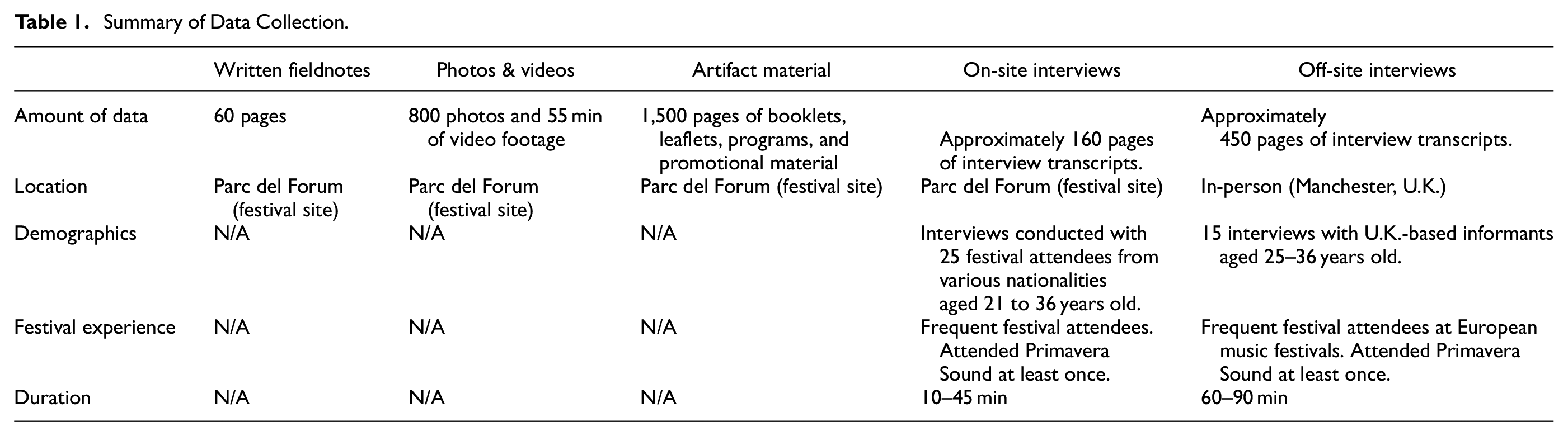
Our written fieldnotes, as well as the informal interactions in situ and artifact material (e.g., the festival website, the festival program) enabled us to build our understanding of the festival context and experience from an emic point of view (Weber, 2001). As per Van Maanen (1988), these fieldnotes provide a realist account of the contours of the festival experience. The lead author aimed to document specific details of various behaviors, practices, norms; as well as the socio-cultural context in which these occurred (e.g., the festival setting).
Interviews were utilized to understand more deeply attendees’ festival experiences. The focus of the on-site interviews was on the context of the festival and involved engaging in the real-life experiences of attendees within it. The off-site interviews commenced with a grand tour question (Fox et al., 2010) centered on informants’ experiences of festivals more broadly. We adopted a long semi-structured interviewing style (McCracken, 1988) which revolved around unpacking informants’ Primavera Sound experiences and their interest in music and music festivals, more broadly. Further lines of questioning allowed us to follow up particular lines of inquiry and enhanced our understanding of the cultural context emerging from the on-site ethnographic data collection.
Informants for the on-site interviews were recruited by drawing on convenience sampling techniques at the festival; while off-site interviewees were approached using both snowballing and purposeful approaches. Interviews were recorded and subsequently transcribed, with anonymization taking place to protect the confidentiality of informants. On-site interviewees were from various countries, including Spain, the U.K., the U.S. and Greece, which reflected the global make-up of the festival’s attendees; while off-site participants were all from the U.K. Informants were aged between 21 and 36. The majority of interviews were carried out in English, with the exception of three on-site ones, which took place in Greek given the first author’s fluency in this language.
We adopted inductive processes of analyzing qualitative data in interpretive social science research (Crotty, 1998; Spiggle, 1994). This process entailed examining our data in comparison with relevant literature. Typically, it involved the authors coding material separately, writing notes and moving back and forth between emergent data and relevant literature (Spiggle, 1994). We then compared our analyses to reach a common shared interpretation which is presented below. More specifically, we adopted the six-stage approach for the analysis of qualitative data (Braun & Clarke, 2006) which involves familiarization with qualitative data; initial interpretation; identification of initial themes; review of thematic categories; definition and naming of emergent themes; and, finally, creation of the analytical narrative.
Initial themes revolved around the nature of the festival experience, the importance of the urban context in which the festival takes place, the strong musical character of Primavera Sound, and the pre-festival expectations and festival behavior and practices of attendees. As we developed emergent themes, we approached them as aspects of the overall “story” of our analysis and interpretation of the connection between authenticity and alienation and interrelated thematic categories.
By drawing on numerous data sources, we were able to safeguard the reliability and trustworthiness of our emergent findings (Higgins & Hamilton, 2020). More specifically, we aimed to include examples of various data extracts within the following section in order to further illustrate this. We recognize that in order to communicate our ethnographic narrative in a more consistent manner, our findings include more data extracts from our off-site interviews, wherein our informants provided a more nuanced and developed discussion of the emerging themes.
Findings
Our emergent findings highlight that festival attendees construct a sense of spatial authenticity by grounding their extraordinary experiences into the structures of everyday life and the confines of the indie music field. Attendees do not necessarily aim to enter into an escapist and/or liminal state but rather, they embrace the fact that their festival practices are located within a specific socio-historic context (Thomas et al., 2018; Xue et al., 2014). Our findings identify spatial authenticity as revolving around: (i) the spatialization of the festival’s indie music character; (ii) its urban and quotidian configuration; and (iii) the instrumental orientation of the festival experience. This serves to position the festival within the structures of the indie music field and the sphere of the everyday (Cohen & Cohen, 2012). More specifically, our thematic categories illustrate how the Primavera Sound festival is experienced as a phenomenon that is embedded within a broader system of indie cultural life while also located within the frames of everyday urban living.
Next, we present these three emergent thematic categories and then provide theoretical and practical implications, including avenues for further research.
The Spatialization of the Festival’s Indie Music Character
The Primavera Sound festival exhibits a strong focus on music and the logics of the indie music field (Hesmondhalgh, 1999), something which is evidenced through its eclectic line-up, symbolic meanings, and esthetic principles in situ.
The Festival’s Eclectic Line-Up
Unlike most other international popular music festivals, which have been perceived as tourism destinations that primarily aim to accommodate attendees’ escapist fantasies (Anderton, 2011; Szmigin et al., 2017), the festival promotes itself as combining a focus on new artists from the independent scene while offering the chance to see already established and “popular” ones (Primavera Sound, 2020), a point that was frequently mentioned in discussions with participants as one of its strongest elements. This is evidenced below: “I really enjoy the new bands that they promote. It’s a good festival to come and meet new bands […] So, for me it’s the perfect time of the year to come and enjoy some good music, bands that I don’t know and that I discover here. Also, to come and see big bands, right? Blur, Jesus and Mary Chain, James Blake…big bands…and yeah the new bands, they also have a scene to play at.” (Sandro, on-site interview)
Having attended the festival regularly for 5 years, Sandro knows he can rely on the organizers to provide an appropriate indie-music oriented experience which combines old and new, shaping and expanding his taste and musical knowledge through the exploration of new artists. However, unlike the participants in prior studies, he does not seek to emphasize the escapist dimensions of music (Kerrigan et al., 2014). Nevertheless, we also noted that some informants struggled to define the nature of the festival, beyond the strong musical line-up: “I definitely think that there’s something about Primavera, it does have a character, definitely more so in the past, I remember feeling like a part of something special and feeling quite cool the first time I went […] you definitely felt like you were a part of something special and exclusive.” (Michael, off-site interview)
Michael refers to the unique setup of the festival as a motivating factor for his participation. By stating that the festival has “a character” and that he feels “a part of something special and exclusive,” Michael implies that festival participation offers continuity to attendees’ membership and participation within the indie music field (Daskalopoulou & Skandalis, 2019). Below, Rowan talks about the related performative “identity work” within the festival setting, which he has witnessed amongst fellow festival attendees: “I think it’s a part of the identity and a part of being seen, they want to be seen at a festival which is a hip festival; where you see the bands that you like, and you can sort of go out and be seen. There is this element of showing off, and then you take your pictures and put them on Instagram, and ‘that’s me at Primavera Sound, looking cool,’ and there’s just this cool band playing in the background.” (Rowan, off-site interview)
As evidenced in Rowan’s excerpt, there was the need for some attendees, which he termed “hipsters,” to “be seen” and evidence their attendance on social media; in contrast with those who foregrounded the festival’s musical character. This seems to enable a sense of spatial authenticity which revolves around the “cool” and “hip” positioning of the festival within the indie music industry and motivates individuals to attend (Knudsen et al., 2016). In other words, the festival is consumed as a tourist destination because it conveys a superior music status and character (Urry, 1990).
The creation of symbolic meanings in situ. The festival’s musical ethos was also noted through a variety of symbolic meanings in situ that further align it with the logics of the indie music field. Such meanings are initially manifested through attendees’ profiles and identities within the festival and are associated with the contours of the festival experience (Cohen & Cohen, 2012). Below, Dennis elaborates on this: “It’s got explicit links to Pitchfork and ATP
2
, so they’re kind of entities or institutions which cater for the middle-class, high cultural capital, and I’m not sure if hipsters are a part of that, it’s probably wider than this, hipsters are quite specific, it’s very white – it’s white hipsters at Primavera, white middle-class, Western hipsters, in their late 20s, average age must be 28-29.″ (Dennis, off-site interview)
His quote emphasizes the “hipster” identity of festival attendees which revolves around “white middle-class” individuals with “high cultural capital” often linked with how the field of indie music is constituted. Symbolic meanings and attendees’ profiles were also evident across various festival objects such as the festival pass that takes the form of a wrist bracelet (Figure 1). This comes in different colors and styles and distinguishes participants’ access and affiliation, ranging from regular and VIP status for indie music fans that attend the festival and have basic and exclusive benefits accordingly, to press and professional affiliation for indie music industry professionals and artists.
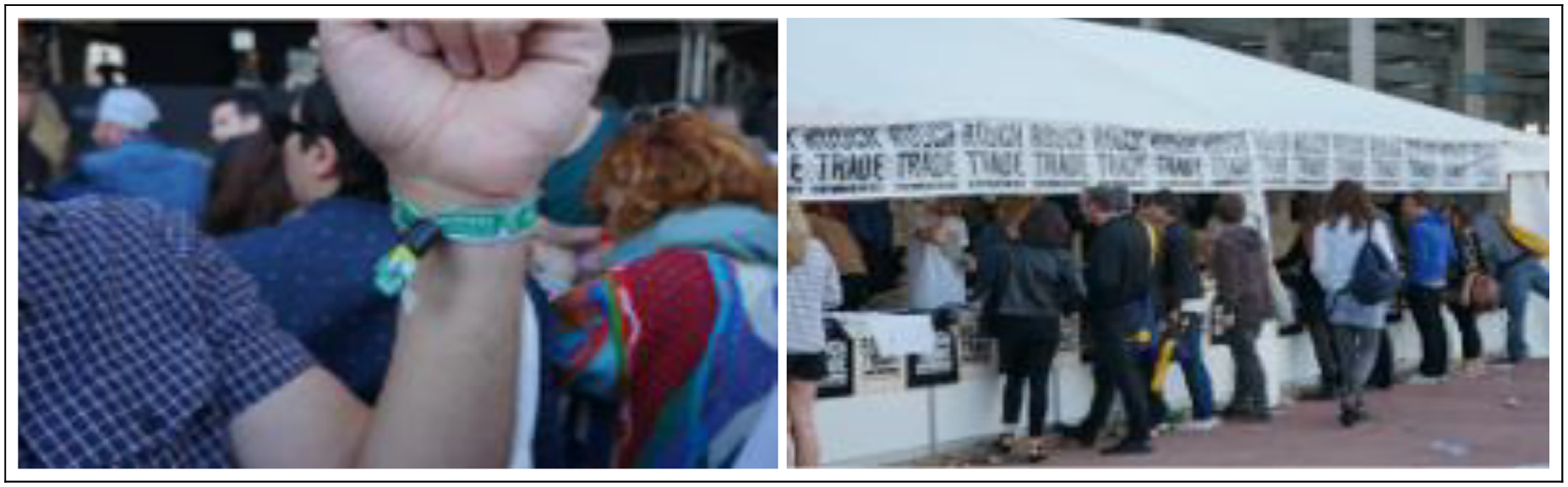
Indie music aesthetics.
These different levels give participants access to a diverse range of in-festival places. For example, those with press and professional status, including artists, can gain admittance to locations such as specially designed bars, shops, lounges and backstage areas where regular and VIP members are not permitted to enter. Objects such as the bracelet, festival booklet and goodie bag therefore serve to differentiate the festival experience and the symbolic status of festival attendees within the field of indie music (Coskuner-Balli & Thompson, 2013).
The Festival’s Aesthetic Principles
In addition, there were a variety of aesthetic principles evident in the clothing of attendees, which were sometimes referred to pejoratively as “hipster dress,” and these fashions signposted attendees’ membership of the broader indie culture and community (Chaney & Goulding, 2016). Such norms were also apparent within the festival space through the various kiosks from which participants could buy a wide range of objects that were culturally branded as indie, such as the Rough Trade record label stall in Figure 1. This focus on indie culture was further exemplified through the omnipresence of commercial sponsorship around the festival site, such as “Pitchfork,”“ATP” and branded festival stages aligned with the indie music industry. This point was mentioned by almost all informants and often led to a different type of atmosphere that lacked a strong social and raucous dimension associated with escapist experiences (Goulding et al., 2009; Ulusoy, 2016). More mainstream commercialization within the festival space is further evident in the following excerpt: “It was different to all festivals I’ve been to before…. I remember watching The Walkmen first time we went there, and there was this huge yacht pulling just next to the harbor. Overlooking it was quite surreal… I guess the commercialization of it was noticeable, like the fact that each stage was named, like the Adidas Stage, the Ray Ban Stage, everything like that.” (Tony, off-site interview)
According to Tony, the musical character of the festival contrasts with evidence of the world continuing as normal outside the site (e.g., the yacht) and the commercial elements on display within, “the Adidas Stage,”“the Ray Ban Stage.” The festival authentication process seems to emerge through subjective experiences of authenticity (Wang, 1999) in situ, whether it is through the musical line-up or through a variety of festival objects and aesthetics (e.g., patterns of dress). These elements, which are aligned with the structures of the indie music field (Tribe & Mkono, 2017), hinder the development of liminal experiences (Kozinets, 2002) and give rise to a fantasy of authenticity (Knudsen et al., 2016).
The Urban and Quotidian Configuration of the Festival Site
At the Primavera Sound festival, music and tourism practices are mixed together, having as their common denominator the actual setting of the festival, thus leading to a more holistic festival experience which is largely shaped by the urban and quotidian nature of the festival site.
The Urban Positioning of the Festival Site
The festival takes place in a wide-open, and somewhat surreal, urban complex which has undergone significant development over recent years, and which has good connections to the center of Barcelona and surrounding areas. Figure 2 illustrates the extensive vistas apparent at the site, which is punctuated by an urban skyline with artificial grass in the foreground. Richard elaborates further on the urban character of the festival:
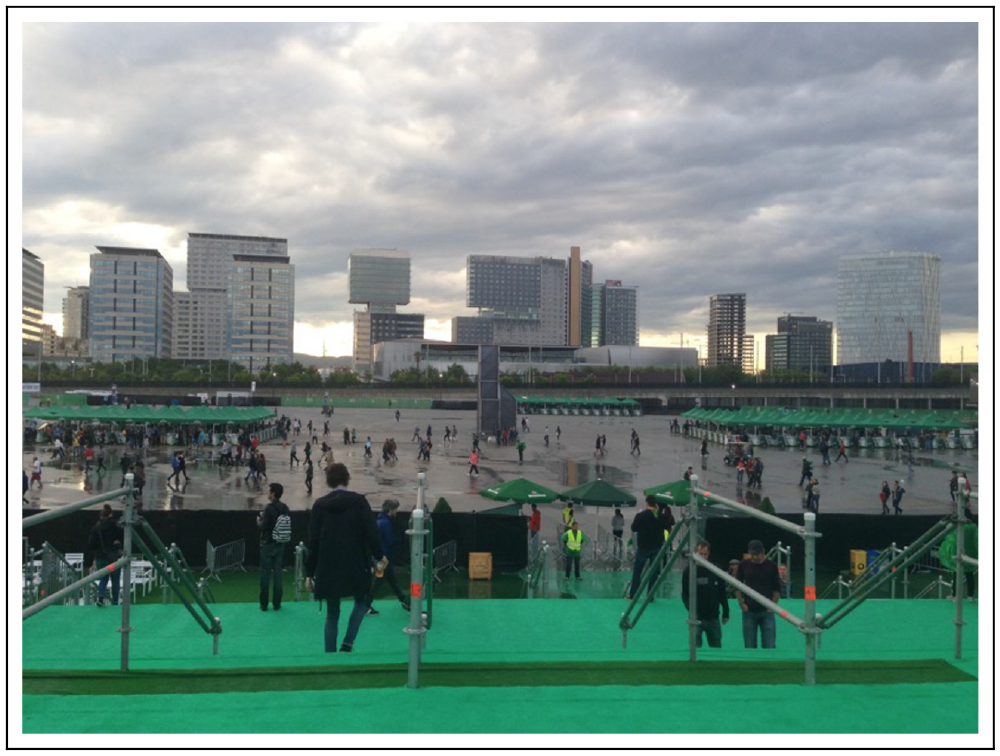
The urban gaze of the festival.
“It’s hard to compare it to others because it’s not a camping festival, it’s a city one, quite a large one, it’s kind of weird […] it’s still an outdoor festival but you don’t camp there so it’s kind of weird, whereas at Glastonbury you’re sealed in and that’s it for a week.” (Richard, off-site interview)
References to camping, which tend to characterize this type of music festival, unlike those of other arts genres (e.g., books, classical music) were common to most interview participants. The urban dimensions of the festival create physical, historical and socio-cultural boundaries which, in contradistinction to prior research (Szmigin et al., 2017), foreground the mundane and ordinary nature of the festival space, albeit one within a major international tourism destination. This is further exemplified in the Supplemental Video Material, which can be accessed below, and provides a more visual appreciation of walking practices across the festival site.
Many festival attendees stated that the main reason they decided to attend the festival was not only its status as one of the major indie music festivals worldwide but also its urban location and quotidian ethos, as Mickey notes: “In general, I hate festivals […] if it’s bad weather and everything is muddy, and you have to stay in your tent […] I have had this experience once or twice in my life and I said to myself, never go to a festival again, but, a big exception as I told you before, is Primavera because it’s connected to the city, I can go back at home in a minute, I take a bus and I’m home.” (Mickey, on-site interview)
As Mickey illustrates, the built and natural environment of the Primavera Sound festival plays a major role in defining attendees’ participation choices, shaping their subsequent in-festival experience. Mickey’s references to “home,” and the implied downtime comforts that the urban character of Primavera allows, provide a stark contrast to more traditional festival experiences, which take place predominantly in either suburban locations (e.g., Reading, U.K.) or natural settings (e.g., Green Man, U.K.; EJEKT, Greece; Primavera NOS, Portugal). This is further evidenced in our fieldnotes below: “It’s interesting how you can see the links with the outside world; visually by seeing the city, the buildings, skyscrapers, the city roads […] you can only see the industrial gaze.” (Fieldnote extract)
The Industrial Aspects of the Festival Site
The industrial context of the Primavera Sound festival is further recognized as a unique feature by Michael, who discusses the “non-conventional” nature of the festival space: “It’s very interesting, when you first turn up there it feels like you’re going to a conference […] one of the first buildings you see when you arrive, when you walk in down the gradual slope, and you see that thing called The Forum, it looks like a lecture theatre […] I think for what it is, it’s a good site. It’s interesting because it’s mostly concrete, and when you go to other festivals you’re used to fields I suppose, and I like the site very much, and it speaks to my kind of age where I don’t want to get muddy. It’s not like somewhere where you have to swim back in the mud to your tent, and wait to dry.” (Michael, off-site interview)
Michael discusses the industrial aesthetics of the festival setup, which aligns with its urban positioning, its conference-like feel, the omnipresent concrete and the striking difference from other popular festivals, which are most commonly surrounded by greenery and positioned distant from urban environments. Michael also refers to the convenience of the urban and industrial nature of the festival space for its overall experience, “speaks to my kind of age,”“don’t want to get muddy.” Bill further emphasizes these aspects of the Primavera Sound festival: “The fact that they have an auditorium where you can sit down, it’s a bit different to standing in a muddy field. The fact that you can go there and live in an apartment instead of camping, and go there and hang out in nice bars, have tapas and stuff, it’s a lot different.” (Bill, on-site interview)
His quote makes reference to one of the areas within the festival site (the auditorium) to identify some of the striking differences between rural/suburban and urban festivals such as Primavera, “different to standing in a muddy field.”
The Quotidian Nature of the Festival
However, Bill also focuses on other aspects of his festival experience which are associated with conventional tourism practices: indeed, the festival’s setting informed the rituals which were universally adopted by our interview participants. Sarah narrates her everyday routine before arriving at the festival space: “We would go out in the morning around 10 or 11, and then spent 5 or 6 hours sight-seeing, have a walk around to have some food and drinks, and head back to the festival, and stay there until 3, and then again [the same].Trying to make the most of it. It was great, it was a nice mix of doing festival stuff and being kind of rowdy as well as enjoying the city.” (Sarah, off-site interview)
Sarah suggests that the urban gaze of the festival (Urry, 1990) enables attendees not only to position their festival experience within the confines of the everyday, “stayed in the apartment,”“have a walk around,” but also to perceive it more holistically as transcending the boundaries of the festival space, “enjoying the city.” While there were differences in participants’ experiences of the festival, linked to their mode of attendance (e.g., as part a couple or with a large group of friends), there were clear commonalities apparent in relation to the broad structure of their routines and rituals, as further evidenced below: “Get up late after not enough sleep, rally the troops, make sure everyone was still up for doing that again, go out, have some breakfast, then probably go and do some sightseeing, see some attractions, have a look around, come back, get changed and then go back on the metro to the festival site. There was always a good atmosphere getting to the festival site, you get there about 5, 6pm, and they are all on the yellow line, all of the trams full of festival attendees, they sort of spill out at Parc del Forum and you have to deal with everyone trying to sell you booze and drugs, there’s that sense of camaraderie, it’s good.” (Rowan, off-site interview)
Rowan’s extract refers to a sense of affinity, both within and outside his friendship group. The shared experiences of participants inform the creation of a constructive sense of spatial authenticity (Wang, 1999) as recalled by Mary: “We’d probably get up about 9 or 10, go for lunch somewhere nice. I usually planned ahead and got it figured out from the guidebooks, so we do all the touristy stuff. Then we’d probably have tea [i.e. dinner] out as well, and then head to festival after tea usually, so it’s either touristy stuff or if it was sunny we’d be on the beach all day.” (Mary, off-site interview)
As Mary notes, the broader festival experience encompasses a series of everyday activities, “go for lunch,”“have tea,” which, instead of leading to a suspension of everyday life (Turner, 1973) largely incorporate a mixture of routine spatial practices and behaviors.
The Instrumental Orientation of the Festival Experience
As established in our first theme, the musical ethos of Primavera was central to attendees’ experiences. However, the overall orientation of the festival experience went beyond this, and the particular nature of how this was enacted distinguished it from other music festivals.
A Pluralistic Tourist Experience
Our emergent findings emphasize that the urban character of the festival setting seems to lead to a more pluralistic tourist experience (Uriely, 2005) due to its urban location and its connection with the city of Barcelona. This is elaborated on by Bill: “The fact that there’s a 20 minute tram ride to where you’re staying, it feels like there’s not a lot of pressure on being there, whereas if you go to somewhere like Glastonbury or Reading, once you’re there, you’re there, and you’re surrounded by people for days, and it could be quite an intense experience. And a lot of Spanish and European people are more relaxed, it’s friendlier, people can get drunk but it doesn’t feel intimidating, so I think it’s a much safer festival in that respect… everyone is having a great time during the day, chilling on the beach or walking around, and being able to walk to the festival site is great. It’s amazing how they’ve managed to have that so close to the city center.” (Bill, off-site interview)
Bill illustrates how the festival experience expands beyond the confines of Parc del Forum and gives rise to a wider experience since it is positioned close to the city center and other tourist attractions. In other words, he expresses his appreciation for the everyday and quotidian nature of his festival experience (Rickly-Boyd, 2012). Below, Rick details his broader urban-oriented experiences in the city of Barcelona: “Then I think at the time that we went, there were loads of other stuff going on in Barcelona, there was a big Occupy movement at the top of the Ramblas, and Barcelona won Champion’s League [soccer tournament] on Saturday night, so it was just a huge party in the city for the whole weekend while we were there. So even though we were absolutely knackered from the festival itself, when we got back into town we got a couple of hours sleep in the morning, and then got up and went into the city anyway, or went to the beach, and carried on partying until the festival was over, and then we had a couple days after when we just chilled out at the beach.” (Rick, off-site interview)
For Rick, the festival experience is magnified and extended outside the confines of its specific setting. He refers to a number of activities taking place in Barcelona which were largely disconnected from the festival itself, “Barcelona won Champion’s League,”“big Occupy movement,” but which added to the meaningfulness of his overall festival experience.
The Idiosyncratic Nature of the Festival Experience
In addition, our data also enabled us to delve deeper into the idiosyncrasies of the festival experience and the types of hedonic reactions and social interactions which emerge in situ (Goulding et al., 2009). One of our interviewees, Tim, further discusses these: “At Primavera, I might have been a bit unlucky, but I didn’t get this peace and love thing. I didn’t get the thing where people just come up and chat with you, didn’t get the people talking to you. There’s a bit of dancing, but at Glastonbury everyone dances and hugs and holds hands, and asks if you want some of their drink or whatever.” (Tim, off-site interview)
Tim notes the lack of a typical carnivalesque atmosphere (Rickly-Boyd, 2012) within the confines of the Primavera Sound festival; an aspect which often enables attendees to depart from the constraints that are inherent in day-to-day life and realize an authentic sense of self (Kim & Jamal, 2007; Wang, 1999). In contrast to Bill (earlier), Primavera did not meet Tim’s expectations. He and other participants referred to points of difference with other popular music festivals, illustrating how the carefully-managed nature of Primavera removes the potential for a strong antistructural and transcendental status which is usually associated with such events (Ulusoy, 2016). This is further illustrated by Beth: “You go there at 3pm and stay there till 6 in the morning, it goes through the night, and you’ve got to stand up the whole time so it’s hard work, you can’t go back to your tent but would have to trek back to wherever you staying, so it’s not like a usual festival, it shouldn’t really be called festival. It’s good, the range of bands is great, but it feels like hard work for a festival.” (Beth, off-site interview)
For Beth, the urban orientation of the festival, “you can’t go back to your tent,” along with its industrial esthetics, “you’ve got to stand up the whole time,” provide a markedly distinct festival experience which hinders the creation of a relaxed and more laissez-faire attitude, “it feels like hard work for a festival.” In general, the idiosyncratic nature of Primavera with its more structural elements can also be interpreted negatively by festival attendees, contrasting sharply with their expectations around usual festival practices and experiences.
The Musical Orientation of the Experience
Our findings highlight the mundane nature of the festival experience. This lack of total immersion has the potential to convert the festival experience into an extraordinary affair (Turner, 1973) and suspend social norms and constraints (Vidon et al., 2018), and also allows participants to focus on the quality of the music itself (this in-concert music experience is evidenced in Figure 3 below). Lea further compares Primavera with other popular music festivals she had attended in the U.K.:
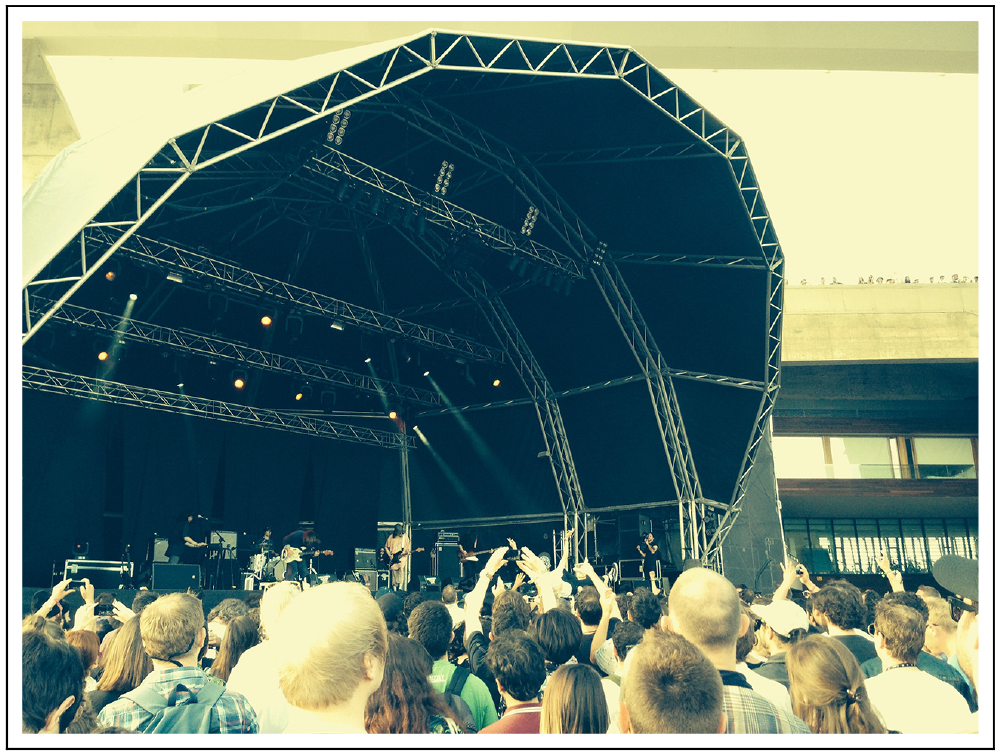
The in-concert music experience.
“British festivals are not exactly for music enthusiasts, they rather cater for people who want to have a weekend away, and that’s fine, but I would definitely avoid some British festivals because I know they are a trap […] But that crowd doesn’t go to Primavera because firstly it’s quite expensive, and I don’t think they would necessarily be attracted to the line-up.” (Lea, off-site interview)
Her quote suggests that the characteristic orientation of popular music festivals might detract from a focus on music. This seems to convert attendees’ experiences into an instrumental affair focused on getting the most out of their engagement with music within the confines of the festival, with participants underlining the well-planned nature of the site and the program: “It’s really well laid out, it’s easy to find stages, it’s only three main ones so you can’t get lost.” (Mary, off site interview) “It’s really well organized compared to some festivals that you get over here [in the U.K.]. It used to really annoy me [at other festivals] when you get clashes and so there’s two bands that you want to see playing at the same time, whereas at Primavera it was always very well spread and staggered so you could catch anything you wanted to.” (Steven, off-site interview)
Mary and Steven illustrate how attendees experience Primavera, valuing the emphasis on music which seems to override all other considerations. Given the variety of bands that perform and the tightly scheduled timetable across the duration of the festival; most of the attendees hurry from one stage to another when a performance is over, so that they will be on time to attend their next chosen performance taking place on another stage. As part of our ethnographic ensemble, we have noticed and experienced the anxiety of moving from one stage to another to see the next band perform. In festival terms, this is translated as the constant movement of people through the pre-designed festival paths, as evidenced in the previously cited Supplemental Video file. Attendees purposefully striding across the festival site might be parallelized as the embodied experience of alienation (Vidon & Rickly, 2018) in space, whereby festival attendees actually turn into busy individuals absorbed within the daily staged music routine of the festival. In an instrumental manner, they seek to experience the pleasures of participating in an endless, ongoing aesthetic gaze of music performances, across the duration of the festival, and across the diversity of the festival’s musical spaces that are at hand (Featherstone, 1998).
Conclusions
The aim of this paper was to explore the everyday nature of tourism destinations and the interrelationships between authenticity and extraordinary experiences in the context of popular music festivals, via an ethnographic approach. Drawing upon the Primavera Sound indie music festival, our findings highlight that authenticity is realized even when individuals continue to engage with the structures of everyday life. We suggest that a sense of spatial authenticity is achieved while engaging with mundane features, that is by embracing tourism experiences which are dictated by everyday life and social structures.
More specifically, our findings emphasize that spatial authenticity emerges through three interlinked themes: (i) the spatialization of the indie musical character of the festival; (ii) the urban and quotidian configuration of the festival site; and (iii) the instrumental orientation of the festival experience. These themes are depicted in Figure 4, which integrates how social structures (e.g., the indie music field, urban daily life) are central to the broader festival experience of attendees. Our theoretical framework identifies the existence of a different type of extraordinary experience which is positioned within everyday frames and unfolds through a spatial authentication process (Cohen & Cohen, 2012).
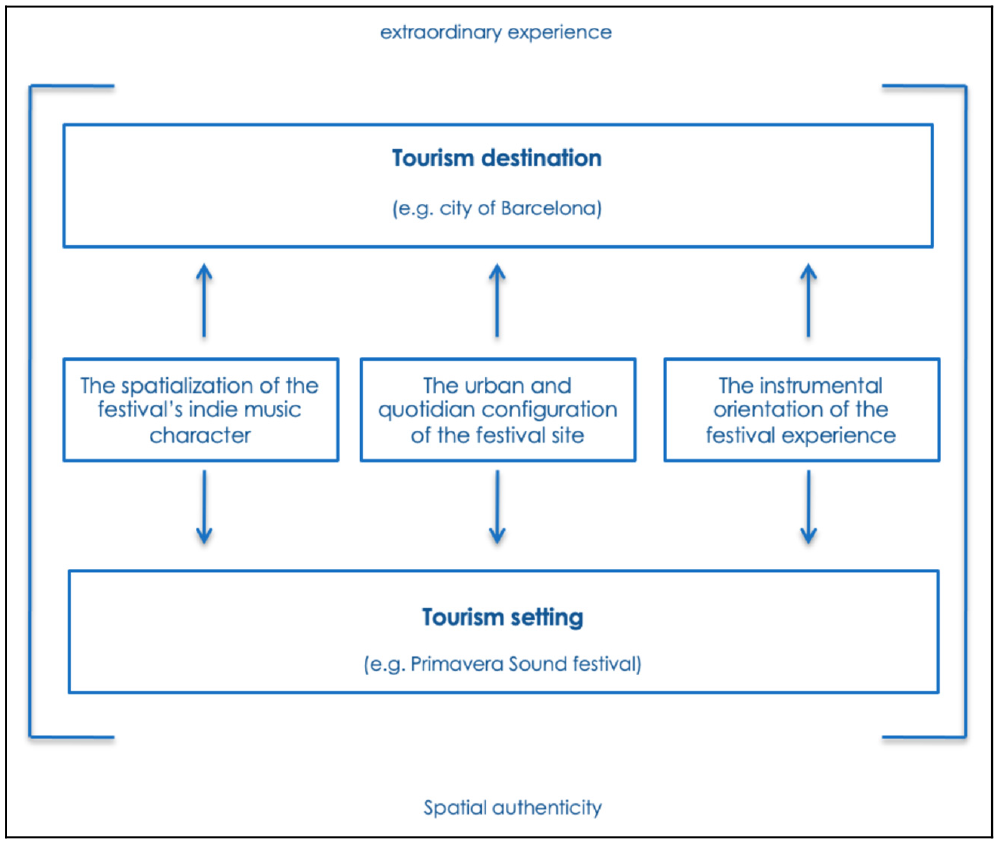
Spatial authenticity and extraordinary experience.
Our findings suggest that we need to develop a more nuanced understanding of the variety of ways through which individuals construct various forms of spatial authenticity which bear the potential to lead to different types of extraordinary experiences. More specifically, we suggest the need to develop more detailed understandings of their interrelationships and interconnections within various contexts which are somewhat absent from the literature. This is due to well-established theorizations that perceive and understand tourism as the opposite of everyday life (cf. Uriely, 2005) and which are often exemplified in practice. For instance, Szmigin et al. (2017, p. 10) note that music festivals are promoted by organizers and perceived by audiences as “non-mundane places apart from ordinary life, where everyday conventions and demands are momentarily suspended.”
Although previous research notes that festival attendees and/or music fans are able to “escape” the “normal” through music (Goulding & Saren, 2016; Goulding et al., 2009; Ulusoy, 2016), disengage (temporarily) from the “real” world and immerse themselves in their own “reality” (Hietanen & Rokka, 2015; Kerrigan et al., 2014); we stress that the opposite is true in the context of our study. For our informants, the festival experience instead becomes meaningful (Cohen & Cohen, 2012) by them embracing features of the everyday; that is by being situated inside both the structures of daily life, as well as the broader logics of the field of indie music. To these ends, we note that festival attendees do not necessarily escape from the ordinary and immerse themselves in the festival as a “different person” (Chaney & Goulding, 2016), thus achieving a sense of existential authenticity (Wang, 1999).
Our study also identifies the socio-spatial significance of the Primavera Sound festival. Prior research notes that authenticity unfolds via individuals’ relationships with place and the variety of ways through which it fosters the creation of communitas (Higgins & Hamilton, 2020; Rickly-Boyd, 2013; Szmigin et al., 2017). In the context of music festivals, socio-spatial authenticity has been largely associated with the distinction between festival settings and the everyday world outside them, whereby “the everyday world is represented as a site of task and goal-orientated instrumental activities, while the festival is a place of expressive activities which are invested with symbolic value and personal meaning” (Szmigin et al., 2017, p. 10).
However, our findings illustrate how the festival setting turns into a place of lasting engagement with music via attendees’ immersion into instrumental and goal-oriented activities, which are not solely pleasure-oriented (Higgins & Hamilton, 2020). As such, our study indicates that festival attendees do not necessarily seek to escape everyday life, but rather, they construct a sense of spatial authenticity which revolves around their relationship and engagement with place.
In terms of implications for music festival organizers and destination marketing organizations, our study emphasizes that not every experience needs to be “extraordinary” to be meaningful. Instead, we note that music festival experiences can also be authentic and/or meaningful for tourists when establishing explicit links with the everyday urban life (of the tourism destination) and social structures. The changing demographic of festival-goers, with older and more affluent attendees becoming more evident than hitherto (Anderton, 2018; Delaney, 2007; Hunter-Tilney, 2018), further demonstrates the need for organizers to cater to those who prefer a festival experience which is less immersive and more accommodating.
Outside the context of music festivals, we suggest that destination marketers might also attempt to engage more with the mundane and everyday nature of tourism destinations in their experiential design and marketing communication strategies to further accentuate the “everyday” uniqueness of specific destinations. Recounting the potted life-stories of local residents, including their routines, cultural preferences and favored haunts, may be useful in bringing destinations to life; enabling potential visitors to seek out and value the commonplace, alongside the more high-profile attractions that are typically associated with a given destination. Although some tourism scholars acknowledge the importance of the everyday in urban contexts (e.g., Frisch et al., 2019), the marketing of these aspects is not yet widespread, with some notable exceptions, for example Copenhagen’s “localhoods” (Larsen, 2019). In the context of festival tourism, we contend that organizers should further consider the role of everyday life, specific locales, and a strong thematic focus in the delivery of authentic experiences.
We further argue that the omnipresence of the everyday in tourist experiences can be seen in various contexts, such as the rapid rise of accommodation sharing platforms (e.g., Airbnb, couchsurfing) which arguably more easily provide (some) tourists with the possibility of a quotidian “insider” experience of the city and the opportunity to familiarize themselves with “local” life (Paulauskaite et al., 2017). As such, we suggest that practitioners might benefit from renewed attention to the mundane and everyday nature of seemingly “extraordinary” tourist experiences and their connections with authenticity.
Turning to the study’s limitations, we acknowledge that undertaking an interpretive study within a single tourism context limits its scope. The fact that data collection occurred prior to the Covid-19 pandemic also raises questions regarding its applicability in the light of changing tourist and attendee behaviors. Interestingly, however, and based on observations of the 2022 edition of the festival, the pandemic appears to have had no lasting impact on its operations and popularity. With no restrictions (e.g., Covid testing, mandatory face masks, indicated social distancing) evident, and a record attendance recorded (Primavera Sound, 2022), the ethos and functioning of Primavera Sound have continued apparently unchanged.
Finally, we argue that future research should explore further the role of spatial authenticity, not only in seemingly extraordinary settings, such as music festivals, but also in more mundane spaces which might inform individuals’ everyday lives (e.g., food and craft markets). Also, future research might look to explore the role of spatial authenticity in contexts like religious pilgrimage, wherein the liminal and escapist aspects of extraordinary tourist experiences are increasingly being scrutinized.
Footnotes
Declaration of Conflicting Interests
The author(s) declared no potential conflicts of interest with respect to the research, authorship, and/or publication of this article.
Funding
The author(s) received no financial support for the research, authorship, and/or publication of this article.

Supplemental Material
Supplemental material for this article is available online.