




Abstract
Popular culture tourism encompasses a range of expressive practices that attract fans traveling to destinations associated with their fandom pursuit. However, scholarship on this multifaceted phenomenon is today over-fragmented and obscured by separate disciplinary agendas and priorities. We argue that the scope and breadth of popular culture tourism calls for its interdisciplinary treatment as a distinct field. Through a scoping literature review, this paper identifies the foundational elements of its conceptual and ontological roots, extracting key insights and discursive themes that can help establish a comprehensive perspective on the study and management of popular culture tourism. Our inquiry builds common ground that can shed light on the complexity of popular culture expressions and enable their strategic role as a destination placemaking tool. Thematic areas of convergence resulting in the emergent configuration of the field are delineated, and primary research questions for the comprehensive study of popular culture tourism are outlined.
Keywords
Introduction
Culture offers an inexhaustible source of various characteristics and favorite pursuits that influence travelers and host destinations. Often, the different ways we view cultural qualities, patterns, and signs in tourism scholarship may lead to confounding related phenomena. One such perplexing phenomenon is the emergence of popular culture as a driver of tourism (Connell, 2012; Reichenberger, 2021). Popular culture is a vexed concept often misconstrued as modern “pop vanity” that means, more or less, “bread and circuses” bringing profitable entertainment for the masses, and it is usually confused with cultural tourism and associated activities such as heritage, arts, and recreation. All these comprise interrelated but quite distinct loci of practice and foci of scholarship, which need to be clarified and uncluttered in tourism scholarship, similar to what was argued by Connell (2012) on film tourism scholarship. Thus, misconceptions should be resolved by adding conceptual clarity; this can be based on a comprehensive view of popular culture, borrowed from anthropologists, as “what people do in everyday life” (Fedorak, 2018). From this standpoint, it is essential to elaborate on the ontology of popular culture intersecting with tourism, and the subsequent configuration of popular culture tourism as a complex but distinct phenomenon (Lundberg & Ziakas, 2018a).
In particular, the intersection of popular culture and tourism encompasses different cultural forms (e.g., film, television, literature, music, fashion, sports) that create a range of opportunities for destinations to enrich, differentiate, and strengthen their brand (Connell, 2012; Geraghty et al., 2019; Reijnders, 2011). Tourism gains can be achieved because popular culture has the capacity to attract fans traveling to destinations associated with their fandom pursuit (Balli et al., 2013; Connell, 2005; Kim & Long, 2012). Understanding popular culture as “everyday life” reveals the constitution of a rich and diverse tapestry of global expressive practices and lifestyles to draw upon for the purpose of tourism development. This situates popular culture as an important driver of tourism, and this intersection represents a complex, multilayered phenomenon for tourism research linked to media, mobilities, globalization, identity, experience, and authenticity (Buchmann et al., 2010; Connell et al., 2021; Lundberg & Ziakas, 2018; Reijnders, 2011; Tzanelli, 2013, 2021). Consequently, it is not surprising that popular culture has become a destination commodification apparatus of multiple global fandoms, which are being marketed to foster tourism-related benefits for those destinations connected with them, such as Lord of the Rings and The Hobbit in New Zealand and Game of Thrones in Northern Ireland and Croatia or K-pop in South Korea (Buchmann, 2010; Buchmann et al., 2010; Kim & Nam, 2016; Šegota, 2018).
Nevertheless, the rapid development of popular culture-induced tourism brings also to the fore its innate fragmentation, which is currently being escalated as disciplinary foci studying different facets of popular culture place boundaries between them according to their own agendas and priorities (Connell, 2012; Lundberg & Ziakas, 2018a). This obscures the common ground, shared among different forms of popular culture upon which a comprehensive approach can be taken capable of identifying interconnections and joint interests (but, at the same time, also appreciating their distinctiveness). On the other hand, the obscurity of the nature and varieties of popular culture intermingling with tourism, and their subsequent fragmentation, make imperative the need to study from an integrated perspective the relationship between popular culture and tourism. In practice, comprehensive approaches may address the challenge of how to effectively incorporate popular culture into the overall destination product and service mix that can help overcome unsustainable growth (e.g., over-tourism or constellation of global business interests that may control development). Put otherwise, we need to know how to better link the global with the local and ensure equity, while appropriating world fan cultures in tourism placemaking and safeguarding their authenticity. Additional challenges that can be addressed through a comprehensive perspective include the swift obsolescence of individual popular culture forms, lack of collaboration with creative and allied industries, and over-reliance on certain forms (e.g., film, music, or sport tourism); these challenges have been exacerbated by the COVID-19 pandemic. The matter thus for destinations is to create a flexible popular culture platform for achieving sustainable product diversification and forging of partnerships among various up-to-now disjointed stakeholders. Building robust conceptual foundations that settle conventional misreadings and misperceptions about popular culture will eventually enable the development of holistic, sustainable tourism approaches and strategies. To this end, we argue that the scope and breadth of popular culture tourism necessitates its treatment as a distinct field.
Therefore, the purpose of this paper is to demarcate the conceptual foundations of popular culture tourism as a distinct field of inquiry, establish its ontological base, and delineate a comprehensive perspective to its study and management. In doing so, the paper outlines the state of play of this emerging area, advancing the discourse on its ontology of genres (or forms) and destination approaches. Our comprehensive perspective provides a fresh understanding of this multidisciplinary concept and unpacks its constituting elements as an emergent field holding its own distinctive position in relation to other cognate forms of tourism (e.g., cultural tourism, film tourism, sport tourism, literary tourism, etc.). More broadly, this paper contributes to progressing tourism inquiries toward envisaging holistic, integrative, and sustainable destination placemaking.
Conceptual Roots and Ontogenesis of Popular Culture Tourism
The phenomenon of traveling to visit places associated with popular culture is not new. Fascination of people with cultural imaginaries, symbols, and sites, dates back to antiquity those derived from either mythology and tradition or artistic activity. Such examples in ancient history are Olympia, the Colosseum in Rome, Arabian Nights, or Lapland, while modernity gave rise to destinations such as the film-inspired Casablanca, Woodstock, and Rio De Janeiro Carnival. What is rather new is the oversupply of commoditized cultural idols and artifacts, and the multiple ways in which, and intensity with which, people are connected with them. The expansive growth of the creative industries, the mass-consumption of popular culture, and the development of fan cultures as well as media convergence and digitalization, have all been important drivers in the process of shaping popular culture tourism as a distinct phenomenon (Lundberg & Ziakas, 2018a). Importantly, within an increasingly competitive tourism industry, popular culture tourism represents opportunities for the uniqueness of tourism experiences and destinations. Consequently, destinations are constantly intensifying their efforts to create associations with popular culture and capitalize upon them. These developments have brought attention to the need to re-conceptualize the essence of popular culture and its intersection with tourism as it progresses through the global mediatization of place and culture, as well as the ways systems of tourismification develop in co-creative styles with fan communities (Tzanelli, 2018a). Thus, tracing the ontogenesis of popular culture tourism is not only of conceptual value but also of practical use in terms of revealing tourismification processes and practices.
Academic work on popular culture tourism is a novel, rapidly evolving area drawing upon perspectives from multiple disciplines, including tourism analysis, cultural studies, sociology, fandom research, geography, political economy, business, media studies, and information technology (cf. Beeton, 2010). In the literature, we can find focal elements in major book publications that paved the way for popular culture tourism scholarship. Film-related travel, mediatization, fandom, and heritage are dominant thematic areas within this literature. Film-induced tourism was defined by Beeton (2005), and later the relationship between a destination’s cinematic representation and its tourism imagery were analyzed in books by Leotta (2012) and Frost and Laing (2017). The instrumental role of media is recognized to such a degree that this form of travel is also called media tourism (Månsson et al., 2020). It has the capacity to spark tourists’ imagination (Reijnders, 2011; van Es et al., 2020), invigorate kinship links and (re)shape fandom cultures (Booth, 2018; Linden & Linden, 2017), and (re)construct the heritage of fan activities and destinations (Agarwal & Shaw, 2017; Robinson & Silverman, 2015; Tzanelli, 2013). The fragmentation of different expressive practices in popular culture was explicitly addressed by Lundberg and Ziakas (2018a), in the Routledge Handbook of Popular Culture and Tourism, who made a clarion call for the comprehensive treatment and study of the popular culture tourism field. A parallel interdisciplinary framework is the concept of “contents tourism,” which was developed and defined by the Japanese government as “travel behavior motivated fully or partially by narratives, characters, locations, and other creative elements of popular culture forms including film, television dramas, manga, anime, novels and computer games” (Seaton et al., 2017; Yamamura & Seaton, 2020). Contents tourism highlights the multiuse of the same contents in a media mix enriched by different popular formats. It also sheds light on how and why particular creative elements resonate with fans and how their fascination with both fictional and non-fictional narratives inspires travel-pilgrimage to actual places, which are regarded as “sacred sites” by fans. The subsequent mixed consequences of popular culture tourism on destinations have been brought into focus by Tzanelli (2018a) who warns about the negative aspects of “development” and the need to employ a more critical perspective in the shaping of popular culture tourism.
The above discourse illustrates the rich but highly fragmented mosaic of popular culture tourism and the conceptual problematics underpinning its ontogenesis, primarily rooted in expressive culture and the role of global media. Expressive culture involves the social production of aesthetic forms and embodied performances in everyday life such as the arts, visual media, and physical activity, which are disseminated globally through mass communication channels. To make clear our perspective and departing point of analysis, we propose the following definition of popular culture tourism: “travel behavior induced by a spectrum of popular culture forms ranging from arts to sport and leisure; it is consumed by global fan cultures, to some degree commercial, easily accessible through media, and related to leisure with a locus on the everyday life.” Based on this definition, we suggest that popular culture tourism primarily comprises the genres of film/on-screen, literature, music, fashion, video games, and sport/recreation as shown in Figure 1. Apparently, all genres are viewed as part of expressive culture with the capacity to drive travel behavior, whilst there might be more hybrid variations or other forms of expression. Our conceptualization emphasizes the most prevalent ones, which serve as a common base for configuring or fusing heterogeneous practices of popular culture. There are three major parameters that play a defining and instrumental role in the constitution of popular culture tourism: leisure, heritage, and events. Specifically, expressive cultural practices and attendant media-induced travel behavior are enacted within the realm of leisure involving neo-tribal fandoms that exemplify serious travel careers; these practices are being celebrated and propagated by the communal staging of events and the creation of their own heritage that in turn enriches the living heritage of fan communities and destinations. This makes up the core of our comprehensive perspective, which is elaborated on and analyzed thoroughly in the rest of the article, in line with reviewing pertinent literature, so as to substantiate its value.
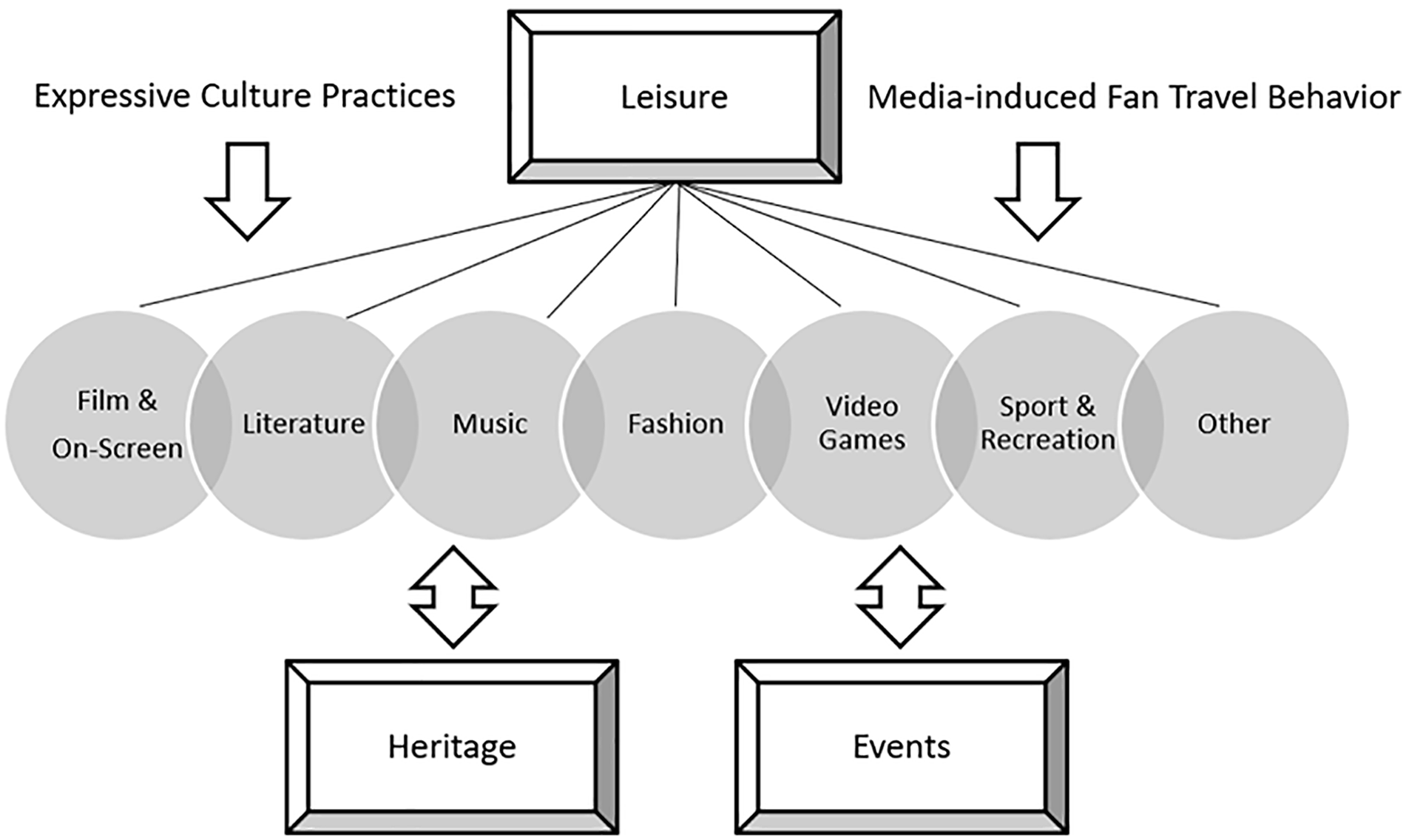
Genres of popular culture tourism.
To resolve a common misperception, it is important to clarify the relationship between popular culture tourism and cultural or heritage tourism. Both are often confounded as if they were the same phenomenon. Whereas cultural or heritage tourism can be part of popular culture tourism, the main point of differentiation is the magnitude and appeal to global audiences and neo-tribal fandoms that are accelerated by mediatization, commoditization, and globalization processes. Otherwise put, cultural tourism is mainly about the local culture of destinations, while popular culture is about global (fan) cultures and their ramifications across different locales. In this context, elitist characterizations of popular culture (high art vs. low art) should be rejected; instead, scholarship should embrace diverse forms of symbolic expression and performance spanning across common forms of popular culture. These cultural expressions hold meaning and convey messages about the performers and the audience, which reveal different dimensions of who we are as a society. Based on such a comprehensive understanding of popular culture, tourism suppliers and destinations can better configure compound products and services that enhance collaboration among popular culture stakeholders, places, destination management organizations, and tourism businesses, while enhancing the overall experience of tourists and fans. This also distinguishes popular culture and its tourism manifestations from the term media tourism, which is often used to describe this form of tourism, but it eventually adds confusion to the core phenomenon. As media are today ubiquitous in tourism as in other domains of life, they cannot be taken as a separate form of tourism. Instead, the concept of popular culture captures the core activity, form and inclusive range of everyday expressive practices intersecting with tourism.
Nevertheless, to study popular culture tourism in a unified manner is a challenge in itself due to its high compartmentalization and tendency of different disciplines to place boundaries across expressive cultural practices, behaviors, and resultant epiphenomena. For this reason, we developed a conceptual framework to structure our approach based on a scoping review of the emerging literature. 1 This review also makes up the structure of the main body of this paper, which integrates different notions and perspectives so as to ground a comprehensive perspective on popular culture tourism. In Figure 2, the conceptual approach is depicted. It distinguishes as main realms of inquiry the supply and demand of creative genres, media and fandom, and sport/recreation travel cultures. These three realms may not only help us better understand tourismification processes of popular culture, but also learn how to create linkages among seemingly disparate forms of tourism integrated in the product/service mix of destinations.
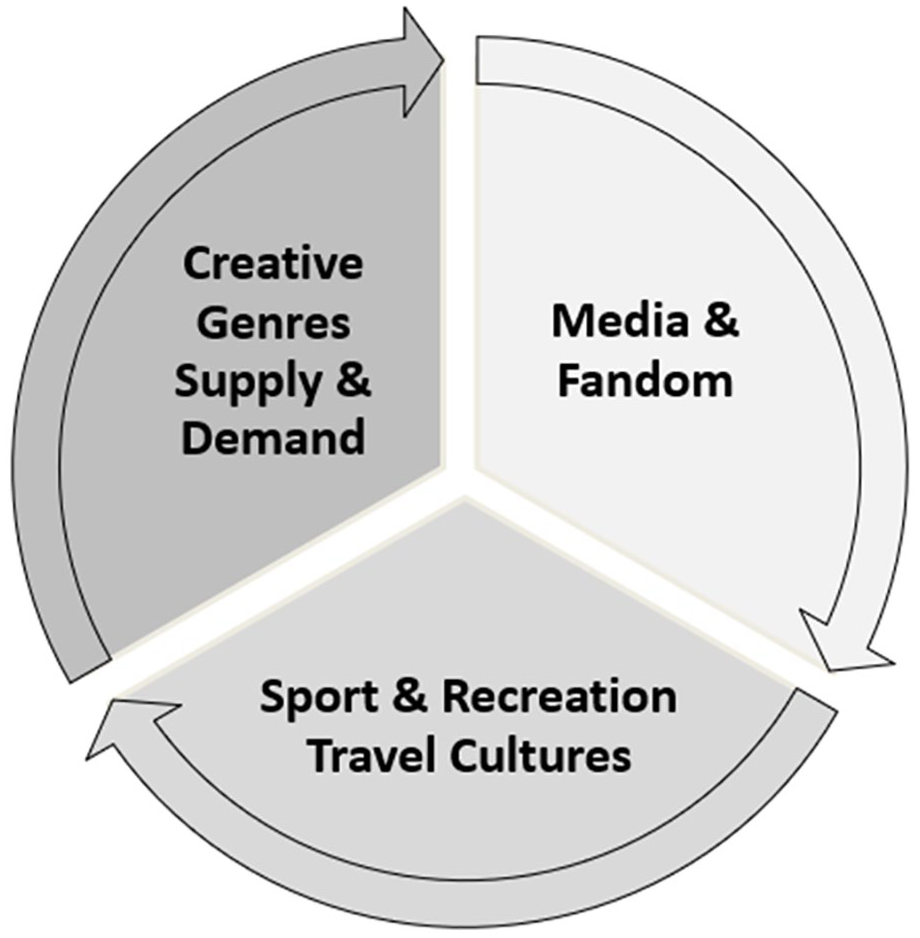
Conceptual approach.
Creative Genres Supply and Demand
Notions and Elements of Destination Marketing, Management, and Placemaking
In exploring the ontogenesis of popular culture tourism, it has to be recognized that research on film-induced tourism, defined by Beeton (2005), plays a particularly prominent role (Beeton, 2010; Nakayama, 2021). The idea that on-screen media may impact the image of a place, create attractiveness, and be used to trigger demand through marketing activities is evident from the considerable literature on this particular genre of popular culture, although film-induced tourism is not always related to marketing activities (Hudson & Ritchie, 2006a).
The power of visuals in tourism is evidenced by research on film- and TV-induced tourism which offer insights regarding how on-screen media acts as a display window or “guidebook” influencing the formation of images places and destinations (Busby & Haines, 2013; Camprubi, 2020; Frost & Laing, 2017; Hao & Ryan, 2013; Hudson et al., 2010; Kim et al., 2007; Leotta, 2012; Shani et al., 2009; Soliman, 2011). This, in turn, creates opportunities for destinations to increase demand through triggering tourist visits, develop marketing activities and brand strategies, and transform their supply of tourism offerings (Balli et al., 2013; Bandam & Kumar, 2021; Busby & Klug, 2001; Connell, 2005; Croy, 2010; Farayi & Bolivia, 2018; Hao & Ryan, 2013; Horrigan, 2009; Hudson & Ritchie, 2006; Sargent, 1998; Volo & Irimiás, 2016). For example, landscapes, attractions, cultural sites, events, and monuments are often selected as film settings or shooting locations, which in turn can be used as a marketing tool for promoting a tourist destination (Vagionis & Loumioti, 2011).
Destination image and authenticity
The overall image of a destination represents associations and information about a place, and the image formation process is therefore linked to marketing activities. However, beliefs and impressions about a place are not only derived from marketing messages but also from imagination and peoples’ exposure to and interest in cultural expressions in different genres. This, in turn, relates to authenticity in popular culture tourism as an element of marketing where objective authenticity is what is perceived by the tourist, while constructive and existential authenticity is of special interest (S. Li, et al., 2017; Rittichainuwat et al., 2018; Zhang & Xie, 2019). Tourists attach authenticity based on their emotional interaction with cultural expressions (Matheson, 2008) or apply their own imagination and interpretation to co-create tourist experiences by performing different acts, adjusting their behavior in order to fulfill their needs and expectations irrespective of what might be presented as authentic by, for instance, a tour guide (Banyai, 2010; Frost & Laing, 2015; Patkin, 2015). This merging of different aspects of authenticity from real and fictional sources substantially influences tourist motivation (Buchmann et al., 2010). Research suggests that in creating marketing messages, popular culture tourists should be encouraged to take an active role in constructing authenticity, as especially existential authenticity influences their loyalty (S. Li, et al., 2017; Teng, 2021).
Importantly, managing and marketing tourist destinations induced by popular culture phenomena is not exclusive to a particular creative genre such as film. Other examples show how image formation can be influenced by video games (Dubois et al., 2021), or tapping into the appeal of literature (Hoppen et al., 2014) or music (Lashua et al., 2014) to leverage marketing and branding strategies. Similarly, sporting and other events (broadcast or on-site) are often deemed to be valuable marketing tools that create an advantage for destinations looking to build a strong brand and reputation (Hede, 2005; Hinch, 2006; Kim & Chalip, 2010; Smith, 2006), while at the same time potentially creating conflicts caused by certain definitions of an image for a destination (Lemarié & Domann, 2019). It is also important to consider composite effects on image formation between genres and different forms of media such that they may work together or in contradictory directions, thus further complicating any destination promotion initiative.
Impacts
Another major element of the supply and demand of creative genres is the notion of positive effects. The impact of popular culture tourism, especially its economic aspect, is almost an equally salient trend in the literature, as manifested by the many studies on destination image and marketing (Nakayama, 2021). Economic impact studies are mostly linked to on-screen, sport and gaming (i.e., gambling) tourism. On-screen tourism can impact the economy (S. Li, et al., 2017), increase tourist visits (Balli et al., 2013; Du et al., 2020; O’Connor & Kim, 2014; Tkalec et al., 2017), boost tourism expenditures (Gibson et al., 2003; Hu & Cole, 2016; Rudkin & Sharma, 2020), and offer opportunities for longevity of popular culture tourism through diversification (Wright et al., 2021). However, research has called into question the viability of popular culture tourism for sustainable tourism planning and development (Heitmann, 2010) and found that sustained effects can only be gained in certain circumstances, for example, where film is incorporated into destination management and is used to shape awareness, motivation, image, and expectations (Croy, 2011).
In both early and more recent research on gaming tourism, results show the critical element of national versus local interests related to economic benefits (Felsenstein & Freeman, 1998), as well as challenges in rural communities (Long, 1996; Park & Stokowski, 2011). Critical analysis related to impacts also acknowledges that gaming tourism may constitute a serious threat to sustainable development (Greenwood & Dwyer, 2017). Nonetheless, discussion of environmental and social aspects of popular culture tourism is scant in published literature so far, although research on carbon footprints, triple-bottom-line sustainability, and social conflicts related to sport tourism (Cooper, 2020; Cooper & Alderman, 2020; Sakellari, 2014; Schmudde, 2015), and sense of community and healthier lifestyles related to cultural and sporting events (Lockstone-Binney et al., 2020), recognize these critical aspects of popular culture tourism impacts.
Another aspect of the impact of popular culture tourism that highlights an important perspective regarding the conceptual roots of this type of tourism is the effect on residents and their quality of life in host communities. Again, the positive economic impacts are at the forefront, while in some cases positive sociocultural effects are also found in local communities (Yoon et al., 2015), or with residents even taking an active role in the creation of a sense of place (Zhang et al., 2016). In gaming studies as well, negative effects on local communities, such as residents feeling alienated in the process of developing political and economic projects of casino gambling (Alipour & Vughaingmeh, 2009), are documented. Consideration of quality of life in local communities is important in tourism development, planning, and policymaking (Stokowski & Park, 2012), while at the same time the challenge is that not all locals respond to popular tourism impacts with uniform perceptions and attitudes (Kim & Park, 2021). Specifically, calls for more research on perceived impact point out the need to address the issue of the need to improve local conditions in host communities, incorporating multiple stakeholder perspectives as well as policy and regulation (Nakayama, 2021).
Placemaking
As indicated above, the conceptual roots and ontogenesis of popular culture tourism rely heavily on notions of image creation with both positive and negative impacts expected, realized, and tackled. One essential element of these perspectives is the link between popular culture tourism and placemaking. Places are a meld of imagined and material spaces where sometimes mythical elements are used to develop and sustain tourism and regenerate places (Brocken, 2016; Lashua et al., 2014; Schiavone & Reijnders, 2022). This transformative power of popular culture tourism is evidenced in studies where cities have turned to cultural industries, sports, leisure and events to reinvent themselves and rebuild communities (Aitchison & Evans, 2003; Bramham & Wagg, 2009), while also pointing at both the potentials and the challenges of parallel narratives regarding tourism destinations (Gyimóthy, 2018), as well as the need to carefully consider the appropriateness of exploiting the potential of popular culture tourism in destinations (Larson et al., 2013).
Placemaking is a multifaceted approach to planning, design, and management of places in order to improve environments and quality of life (Sofield et al., 2017). Benefits of tourism are often omitted in placemaking projects (Sofield et al., 2017), and elements of the placemaking process related to creativity, resources, and meanings as proposed in a model of creative placemaking (Richards, 2020), may be neglected. The model not only is regarded as “link[ing] local resources of the space of place with the global space of flows” (Richards, 2020, p. 9), but also points to the need for programing within the placemaking process. The preparation and implementation phase of this process is exemplified with a number of cases including distinctive popular culture such as festivals, music, media art, street art, and literature (Richards, 2020).
Specifically, in terms of planning and development for placemaking, on-screen tourism relies on collaborative strategies to lever the qualities of dramaturgy, mediatization, and branding (Lundberg et al., 2018), and consultation with a diverse set of local stakeholders, early local stakeholder involvement, as well as long-term planning that is integrated with a more widely framed development strategy (Lundberg & Lindström, 2020; Thelen et al., 2020). Different genres may have various influences on the transformation of place under certain conditions. For instance, art tourism may be a placemaking vehicle for urban life, but only if touring art publics also are offered (Franklin, 2018). Or, music tourism can contribute to the cultural economy and cultural networks (Gibson & Connell, 2007), and youth culture such as breakdancing can be an opportunity for the tourism industry and creative placemaking (Zuma & Rooijackers, 2020). This, however, requires entrepreneurs to engage in the process of placemaking, since they may consider themselves to be placemakers, and consider who benefits from a specific development strategy (Nieuwland & Lavanga, 2021).
Furthermore, as management is an aspect of placemaking, policy becomes important. In the case of Hallyu-related tourism, “the new wave of Korean-generated popular culture products” (Kim & Nam, 2016, p. 525), the South Korean government did not have a dedicated policy, which negatively influenced their ability to conduct market research and long-term trend analysis as well as hampered collaboration with key tourism agencies (Kim & Nam, 2016). In contrast, the German government and the FIFA 2006 organizing committee deliberately used the event as a strategy to improve the nation’s image abroad (Grix, 2012). Another sport event that had an impact on the policy sphere of placemaking was the London Olympic Games. The event seems to have facilitated the development of the tourism policymaking system even though it was not clear if the adjustment of the policy system structure would remain afterward (Weed et al., 2011).
Notions and Elements of Tourist Behavior
Tourists’ consumption of popular culture tourism is a complex process to unveil, as it relates to media, real and fictional spaces, and tangible and intangible dimensions of tourist experiences as well as social and psychological aspects of tourists’ behavior and fan communities. The co-creative aspect of experiences and spaces is highlighted in popular culture tourism as tourism consumption is here intertwined with media where convergence of media is also of particular importance in explaining what drives popular culture tourism demand (Månsson, 2011). In turn, the fictional or hyper-real aspect of a popular culture tourism experience has antecedents related to media factors including media type and storyline, audience involvement, novelty and prestige, behind-the-scenes and re-enactment opportunities, intimacy and memory, cognitive and affective image, as these elements influence experience outcomes such as satisfaction and intention (Carl et al., 2007; Fu et al., 2016; Kim, 2011, 2012a; Kim & Assaker, 2014).
Experiences
Popular culture tourism experiences are multifaceted, as reality and fiction blend into a hybrid experience which may increase satisfaction and enhance the experience (Carl et al., 2007), for instance, emotions and bonding with a tour guide (Buchmann, 2010). Sentiments and emotions are created and may reveal important assets for destinations relevant for branding strategies (Otay Demir et al., 2022). Importantly, the design and management of popular culture experiences is at times more controlled by the visitor as opposed to a provider. For example, literature tourism research has found that tourists prefer using the texts themselves as a source of information to design and plan a trip rather than organized attractions and official tourist information, as well as using travel to strengthen their relationship with the text, thus emphasizing the importance of imagination in popular culture tourism experiences (MacLeod et al., 2018).
The co-creative aspect as well as that of the everydayness of popular culture tourism is visible in the creative tourism literature where experiences include gastronomy, art, gardening, and painting (Richards & Wilson, 2006; Suhartanto et al., 2020; Tan et al., 2013). Here, creative tourist experiences are realized from activities that are constructed from inner reflection and outer interaction, and in turn evoke self, social, cultural, or environmental consciousness/awareness (Tan et al., 2013, 2014). Although in creative tourism, the focus is on local people and culture without specific consideration of global consumer cultures such as fandoms, these ideas inform our understanding of popular culture tourism experiences in particular, as they differentiate between the behavior of these tourists and general tourists. Thus, the motives of these special-interest tourists are essential to consider, especially as they have a direct effect on destination loyalty but also a moderating role on the effect on loyalty from experience quality, value, and satisfaction (Suhartanto et al., 2020).
Emotional and social dimensions
Furthermore, consumption of a popular culture tourism experience cannot be fully understood unless emotional aspects are considered. Embodied consumption where perception, imagination, understanding, and emotion combine into a multi-sensory experience, such as in literary tourism (Jiang & Yu, 2020), is an important element of popular culture tourism behavior. Studies often refer to memory and embodied experiences such as in how remembered stories can influence travel decisions (Reijnders, 2016), or how music has the power to create embodied practices through memories, shared identities, and social space (Bolderman & Reijnders, 2017), or memories of backdrops in film locations (Kim, Kim & King, 2019). In film tourism, emotional bonding and embodied interaction with place and others is a significant element (Buchmann, 2010; Buchmann et al., 2010). Also, other on-screen media, such as TV soap operas, motivate popular culture tourists through promoting identification, empathy, emotional connection, and parasocial interaction (Kim & Long, 2012). The importance of commitment, as a psychological attitude and quality of emotional bonding, in reducing perceived constraints and creating motivation to participate in pop star activities has received attention in a leisure-oriented study of pop star fans. Results show that self-expansion (e.g., new experiences and personal development) is significant for the commitment of fans despite perceived constraints (e.g., health, limited on-line access), and the more they have participated in pop star activities (e.g., events), the more likely they are to participate also in the future (Lee, Bai, et al., 2019; Lee, Busser, et al., 2019).
The behavior of popular culture tourists relates to the idea of neo-tribalism (Maffesoli, 1996), perhaps in particular to the suggestion that individuals are “provisional members of overlapping groups” (Dawes, 2016, p. 736) and that a person’s roles in different groups become the sources of their identity in a society formed by ambiance, feelings, and emotions (Dawes, 2016). Hence, the emotional and social aspects of popular culture tourists as consumers also relate to the concept of serious leisure (Gibson et al., 2002). From this perspective, tourists might go to places they might not otherwise have visited, participate in new activities, and feel happier, as evidenced from studies of Pokemón GO players (Williams, 2021; Williams & Slak-Valek, 2019). Game content can even be used to stimulate game fans to become fans of local places, and new cultures can invigorate local heritage (Yamamura, 2015), as in when anime tourists are seeking visits to new places and interaction with local people, which in turn positively influences their destination loyalty (Ono et al., 2020).
Attachment
An important element of popular culture tourist behavior is the development of attachment to a destination, as it is essential in building destination loyalty. For example, studies of film tourism and Korean pop culture have found that celebrity involvement influences the level of place attachment through image formation (Chen, 2018; Lee et al., 2015) and also that celebrity involvement is a crucial mediator of the impact of authenticity on destination loyalty (Teng, 2021). Another example is how imagination stimulated by music can influence peoples’ attachment to destinations irrespective of whether they have visited them before (Chen et al., 2019), or when young people choose to follow their favorite DJ to destinations across the world (Sellars, 1998). Through celebrity tourism, even cemeteries are commodified and associated with spectacle and events (e.g., movie screenings and guided tours) in which visitors celebrate through co-created experiences (Soligo & Dickens, 2020). By using self-expansion theory, study results show why fans engage with groups and how destination visits, satisfaction, and loyalty are affected. Accordingly, fans with a high degree of self-expansion motivation perceive the country of origin of their favorite pop star as an extension of their pop star relationship (Lee, Bai, et al., 2019). Interestingly regarding attachment to place, popular culture phenomena may be even more important than the desire to visit the home country of a diaspora, as a study of travel to India by members of the Hindustani diaspora in the Netherlands has shown. This research demonstrates that the travel induced by consumption of Bollywood movies was influenced by a desire to visit places portrayed in the movies rather than by a search for “home” (Nanjangud & Reijnders, 2022).
Motivation
Segmentation based on psychological factors such as attitude and motivation as well as different levels of future intention is standard practice and highly visible in scholarly work on consumer behavior, and thus is also relevant for segmenting popular culture tourists. Since popular culture tourist experiences vary considerably depending on their connection to a popular culture phenomenon, the varying levels of involvement, motivation, media use, and value fulfillment serve as a defining basis of segmentation (Lee et al., 2017; Park et al., 2002). Furthermore, segmenting on-screen tourists on the basis of motives exemplifies that nostalgia is an essential segmentation variable (Kim & Kim, 2018), and that both objective and existential authenticity is critical for the strongly motivated segment, but not for a segment where, for instance, a film location was visited incidentally (Rittichainuwat et al., 2018).
More specifically, popular culture tourists’ motives and their relation to travel intentions is a common theme in studies of on-screen and sport tourism. While it is clear that films create destination awareness and add value to the destination experience (Oviedo-García et al., 2016; Rittichainuwat & Rattanaphinanchai, 2015), individual preferences are central for creating primary motivation and intention to travel (Rittichainuwat & Rattanaphinanchai, 2015). Film tourism experiences can positively influence tourist engagement and increase the likelihood that they will revisit the destination or recommend it to others (Teng, 2021), and music festivals can create far reaching benefits to destinations as music tourism develops (Kruger & Saayman, 2019).
More broadly, studies have suggested a wide range of motives in popular culture-induced tourism. A main element in building motivation and understanding travel intention is psychological and emotional involvement with popular culture phenomena (Kim & Kim, 2018a), especially considering developments in the online space (Lexhagen et al., 2013). On-screen consumption creates involvement which, in turn, has a positive impact on intention to recommend or visit a destination (Fu et al., 2016). In effect, nostalgia is a significant driver of involvement (Kim, 2011; Kim, Kim & Petrick, 2019), as characters, narratives, aesthetics, cultures, and traditions create motivation to visit a destination or attraction (Oh & Kim, 2020). Importantly for our understanding of popular culture tourism experiences and behavior, emotional involvement is more salient than perceived value as a direct effect on intention to travel to a location (Kim & Kim, 2018a), while at the same time experiences vary, depending on levels of psychological connection (Lee et al., 2017).
Overall, travel motives that emerge from interests in popular culture phenomena can act as primary or secondary motives affecting travel intention, satisfaction with a destination experience (Connell & Meyer, 2009), and loyalty (Kulczycki & Hyatt, 2005). Even in films with negative plots, the imagery of landscapes has a positive impact on intention to visit (Loureiro & de Araujo, 2015). The wide set of specific popular culture phenomena in studies focusing on motivation offer a rich set of motivational factors such as nostalgia, fantasy, novelty, new knowledge and skills, leisure creativity, nature and escape, entertainment, emotional contagion, and group affiliation (Daniels & Norman, 2005; Falcão et al., 2017; Kim & Kim, 2018; Oviedo-García et al., 2016; Podoshen, 2013; Remoaldo et al., 2020). Traveling fans, as exemplified by sports fans, are motivated not only by individual or psychological needs but also by social, economic, and cultural factors. Motives can relate to feelings and thoughts as well as entertainment, theater, spectacle, excitement, arousal, escapism, and drama, but also interaction and association with communities, tribal identity, and self-esteem. These motives are moderated by factors such as demographic attributes, expectations about the experience, and the facilities or surrounding context. In this regard, attachment is shown to be a strong stimulus for fan travel (Smith & Stewart, 2007).
Media and Fandom
Media and fan studies is an interdisciplinary domain centered around the social sciences and humanities with its origin in the early 1990s. Its main influencing disciplines are literary theory, communication and cultural studies, psychology, ethnography, anthropology, television, film, and internet studies, and it contributes to theoretical foundations for fan productivity (fan-created works) and audience responses. It encompasses research on fan community and culture and their activities such as media/celebrity/sport/games fandoms in Western and non-Western contexts (Bacon-Smith, 1991; Gray et al., 2007; Jenkins, 1992; Sandvoss, 2015). Research on tourism in the media and fandom field is well documented, as can be illustrated below. However, the term used within this field to describe travel activities is, for example, fannish practices (travel behavior being one of many practices), fan productivity, or audience response (Hills, 2015; Sandvoss, 2013).
Research on popular culture in media and fandom studies centers primarily around the media product, the fan/tourist, and in some instances the destination or place/space. Main notions of research linking the media product to the fan/tourist revolve around mythmaking, pilgrimage, nostalgia, fandom, and relationship to celebrities. For example, mythmaking in literature and film was explored by Buchmann (2006) in the case of “Erewhon” and “Edoras,” in which these phenomena were used for the promotion of mythical tourism in New Zealand, incorporating existing images and physical features to strengthen the real-world experience of the place. Mythmaking has also been investigated in film tourism from a destination placemaking perspective in the case of Ireland and the movies “The Quiet Man” and “Star Wars: The Force Awakens.” Central to the mythmaking and the landscape were the re-birth or spiritual homecoming of an estranged hero that can be symbolized by the peripheral and wild landscape of western Ireland (O’Boyle, 2019).
The term secular pilgrimage has been used in several media and fan studies, particularly in the context of literary tourism. It has been used to describe a modern form of pilgrimage centered around a reader/fan’s need to experience the places featured by/in their favorite author/book. These fictional destinations, also known as “secondary worlds” (“primary world” being the real place), allow the fan to connect physically to their revered objects by exploring the environments and landscapes that have shaped authors and their work (Philips, 2011). Fans’ desire for connection requires imaginative and performative work on the part of the tourist, resulting in the construction of the “secondary world” using imagination during the visit. This was demonstrated in Orr’s (2018) study on three Jane Austen-linked fan spaces: Chawton Cottage, Lyme Park, and Austen-themed literary walks. The study pinpointed the critical issue of authenticity in literary spaces in which the imaginative and performative efforts of visitors are central for the experience of the destination. MacLeod et al. (2018) propose that these literary tourists use the texts as source material for the construction of the “primary” and “secondary worlds” rather than traditional tourist information. Literary tourists’ search for collective experiences and desire for closeness were described in two separate studies on famous authors’ graves. Brown’s (2016) study on Jean-Paul Sartre’s and Simone de Beauvoir’s graves in Paris evidenced that literary tourists visit these sites to acknowledge the influence of the authors on their lives as well as a need for closeness that can be compared to religious pilgrimage. Furthermore, Soligo and Dickens (2020) exploration of Hollywood celebrity cemeteries showed that this form of modern pilgrimage is focused on shared experiences with other visitors.
As already discussed, the role of imagination is pivotal in popular culture tourism, as it involves the creation, dissemination, and consumption of media signs and symbolic imaginaries. Similarly, imagination and fantasy are at the center of research in media and fandom research, linking the media product to the fan/tourist. One core concept—“Places of the Imagination”—encompasses the representation of landscapes in popular culture resulting in travel. It also describes the way that tourists appropriate said landscape and their long-term effects on the place (Reijnders, 2011). The role of imagination in the shaping of popular culture places was also explored by Jiang and Yu (2020) in the case of the birthplace of the famous Chinese classical writer Water Margin. Using content analysis of personal interviews and online blogs, they showed that literature enables a “preconstruction” of the multisensory experience of tourism destinations/attractions. In the same vein, the important role of imagination in the experience of literary places was identified by MacLeod et al. (2018). Jiang and Xu’s (2016) study on the literary tourism attraction, the San Mao Teahouse, examined imagination in relation to geographical consumption. Their observations and in-depth interviews showcased that text, reality, and imagination are the cornerstones of geographical consumption in that readers decode text (and its geography) and recreate a fictional reality using their imagination. This is then followed by an imaginative process linking the fictional place (“secondary world”) to the real (“primary world”). These interlaced fantasized images of fictional spaces with real places have also been studied in the context of animated films in Japan (Nishijima, 2020). Imagination in the case of animated, or Anime film content tourism, is particularly noteworthy, as this cultural expression is suggested to be more fantasy-oriented compared to many other types of films (Tung et al., 2019).
Another important element of research in the media and fandom field, linking the fan/tourist, media product, and place/destination, is authenticity, as also shown with reviewing above the supply and demand of creative genres. For example, Banyai’s (2010) study of authenticity in the case of Dracula and the Bran Castle in Romania, using interviews with tour guides at the castle and tourists’ travel blogs, showed that tourists’ search for authenticity is centered around Count Dracula whilst tour guides find authenticity in communicating the true history of the place. The complex construct of authenticity linked to tourists’ motivation and its effect on destinations and their stakeholders has also been under study in the context of on-screen tourism (Karpovich, 2010). Authenticity, and its connection to destination loyalty, has been explored in a number of studies. For example, Li et al.’s (2021) study of the dual images of Dubrovnik in the wake of the TV show “Game of Thrones” showed that there is a positive relationship between the perception of authenticity and loyalty in the case of the film location (Dubrovnik—“primary world”); however, it was an insignificant relationship in the case of the story’s setting (King’s Landing—“secondary world”). Furthermore, in line with the aforementioned, Teng and Chen’s (2020) research on the role of celebrity attachment confirms that it acts as a key mediator in the relationship between authenticity and film tourists’ destination choice. The conceptual framework for the study of authenticity—theoplacity—has been employed in several studies attempting to understand different dimensions of authenticity (Buchmann et al., 2010; Rittichainuwat et al., 2018). For instance, the object-related dimensions of authenticity of “the other”—objective authenticity and constructive authenticity—have been explored in literary tourism in the case of the Wang Zengqi Water Region Folk-Custom Theme Park, in China. The study showed that these authenticity dimensions are likely to influence the development of an attraction merging factual and fictional elements. This means that the construction processes of such sites should incorporate the fans/tourists’ continuing and ever-changing interpretations as well as consumption of the place (Jia, 2009).
Sport and Recreation Travel Cultures
Mainstream sport and physical activity, even in their most widespread expressions, are not explicitly viewed through the prism of popular culture. This is despite the massive appeal to numerous aficionados and attendant configuration of different physical cultures that induce repeated travel. Sport, instead, is studied in isolation from cultural sectors as if it were not part of culture. While this insulation helps enhance sport and physical activity as academic subjects, it inhibits forging synergies and alliances between sport and allied practices of culture. Many of the aspects of sport mobilities and popular culture are discussed in the sport tourism literature (Weed & Bull, 2003), dealing with active participation in sport and recreation (Gibson et al., 2019), sport events’ visitation and impacts (Shipway & Fyall, 2012), as well as veneration of sport heritage sites or relived past experiences (Gammon & Ramshaw, 2007).
Active Sport Tourism
Studies in active sport tourism often use the serious leisure perspective to examine the identity and social worlds of participants throughout the trajectories of their travel-careers (Buning & Gibson, 2016; Getz & McConnell, 2011). Such serious tourism behavior is attributed to the nature of sport that is viewed as conducive to authenticity due to the somatic performance and uncertainty of outcome (Hinch & Higham, 2005). Another key attribute of participation in sport is its capacity to enhance social capital and kinship links among participants (Larsen & Bærenholdt, 2019; Zhou & Kaplanidou, 2018). As such, socio-cultural dimensions of popular sports and recreational pursuits primarily foster repeated travel to destinations, thereby strengthening their role as tourism attractions.
The use of space is central in the socio-cultural practices of active sport tourists. Geffroy (2017) offered a conceptual framework of the ways they engage with space that identified three dimensions of active sport tourism: playful game-like practices enacted within global space resulting in shared imaginaries and large-scale mobilities; a kinesthetic play, grounded in freedom, sensations, and materiality of places; and media practices that support the other dimensions of play while being fully integrated into the experience of sport tourism. These dimensions contribute to shaping sport tourist cultures, which are playful, mediatized, and incorporated into daily spheres of activity. In effect, such cultures can be used for creative tourism placemaking. For example, the evolution of breakdancing from underground to mainstream urban culture engenders opportunities for the tourism industry to embrace this global youth culture in destination development (Zuma & Rooijackers, 2020). Likewise, traditional nomadic sporting experiences provide an opportunity for tourists to appreciate culture and history, sacredness, and authentic offerings (Wong et al., 2020). Place branding can also take advantage of fan cultures including professional league games (Chiu et al., 2017), individual sports such as surfing (Lemarié & Domann, 2019) or skiing (Dannevig et al., 2021), adventure sports, and natured-based outdoor recreation in national parks and protected areas (Marques et al., 2017) such as equestrian tourism (Schmudde, 2015) or freshwater game-angling (Mordue, 2013). A common byproduct in appropriating physical popular cultures for placemaking is the tensions between maintaining a sport’s integrity and promoting its expansion through tourism.
Event Sport Tourism
The realm of sport events provides a burgeoning literature on fan cultures and tourism placemaking. Major strands include legacy research examining the impacts of mega-events (Brittain et al., 2017; Mangan & Dyreson, 2009; Preuss, 2015) and the leveraging perspective that seeks to optimize strategic outcomes from events (Chalip, 2004, 2006; O’Brien & Chalip, 2008). The influence of culture on tourist behavior is widely recognized (Chalip, 2010; Risitano et al., 2017; Roche, 2017). The creation of eventscapes in which identity can be fostered (Brown et al., 2015) has received attention from different angles such as serious leisure (Lee et al., 2016), interaction rituals (Sterchele, 2020), gender (Fullagar & Pavlidis, 2012), or atmospheres (Tzanelli, 2018b). A common theme concerns the frictions between local identities and globalization. For example, Evans and Norcliffe (2016) examined the English Premier League football fandom in Liverpool and how football spaces in the city are socially and economically produced by fans who work to both globalize and glocalize the football culture of the city. It is thus shown that Liverpool’s reliance on a tourist-based economy with sport as its focus alters the relationships between local and distant supporters, their clubs, and other fans. It has been shown that local community identity and social networks are strengthened by the symbols and metaphoric discourse that event spaces embody performatively (Ziakas & Costa, 2010, 2012).
The Olympic Games, due to its massive global appeal, attracted the most scholarly interest to the extent of viewing Olympic tourism as a distinct phenomenon (Weed, 2008) that extends to a variety of areas such as cultural policy (Garcia, 2012), cultural tourism rejuvenation (Boukas et al., 2012, 2013), and Olympic ceremonial design (Traganou, 2016). Leveraging research on the Olympics departed from the legacy discourse attempting to find strategies and tactics for maximizing business (O’Brien, 2006) and social (VanWynsberghe et al., 2012) outcomes, based on the liminality and sense of community created within event spaces. As leveraging is a contested terrain of negotiation among different groups of stakeholders, Ziakas (2015) called for the need to enable equal distribution of benefits. Leveraging has also been applied to non-mega (Taks et al., 2015) and small-scale sport events at the regional level (O’Brien, 2007). A diachronic challenge of leveraging is the lack of synergy between events and the host destination, which can be cultivated, for example, through techniques of bundling, cross-promotions or co-branding (Chalip & McGuirty, 2004).
To enable synergy, a paradigm shift has occurred making necessary a holistic approach (Ziakas, 2014) to leveraging event portfolios (Antchak et al., 2019). In this regard, a host destination needs to create an annual program of multiple periodic events if it is to optimally leverage tourism benefits (Gibson et al., 2012; Pereira et al., 2015; Salgado-Barandela et al., 2021; Ziakas, 2020). The value of an event portfolio lies in becoming a permanent living space for the enactment of multiple identities, fan cultures, and expressive practices. This requires balance and coordination of event programing, popular culture elements, and destination servicescape. It also refocuses attention to small-scale event sport tourism operating within the existing resource capacity of a destination, which can provide a range of home-grown events at less cost, while attracting core and complementary markets such as visiting fans attending league games (Gibson et al., 2003) and participatory events with amateur athletes (Ziakas & Boukas, 2016) alongside their entourage of travel companions (Kennelly et al., 2019). In all, portfolio management constitutes a platform for creating synergies, networks, and complementarities among an array of events and destination assets (Ziakas & Getz, 2020, 2021).
Heritage Sport Tourism
Sport heritage as a tourist attraction is multifaceted and includes a variety of veneration sites or occasions for visiting fans such as museums, halls of fame, events, and venues of historic importance (Ashton, 2012; Hinch & Ramshaw, 2014; Pinson, 2017; Ramshaw et al., 2019). Such travel, also known as nostalgia sport tourism, is linked to past social experiences of fans who want to relive them (Cho et al., 2014; Fairley & Gammon, 2005). This indicates that new sport experiences and events constantly construct a living heritage that embodies the values, lifestyles, and identities of fans (Derom & Ramshaw, 2016; Fairley et al., 2018; Ramshaw, 2010). Again, as highlighted with the supply/demand of creative genres, media, and fandom, the notion of secular pilgrimage is particularly relevant here (Gladstone, 2013). Pilgrimage journeys to sport heritage sites render affective and spiritual significance for fans who get involved in acts of devotion, ritual, and worship. For example, as shown in the Melbourne Cup horserace, the event’s traditions (i.e., sweepstakes, ceasing work for the duration of the race, and champagne breakfasts) serve as consumerist rituals that spiritually reinforce the Australian identity of individual attendees (Cusack & Digance, 2009). Norman and Cusack (2012) argue that Olympic tourism is a quasi-religious pilgrimage that moves participants closer to, and through, a spectacle event upholding certain socio-cultural ideals of the wider Western culture and identity, embodied in the Olympics. Furthermore, destinations may feature sport celebrities and facilities connected with iconic events or victories that have been sacralized. Therefore, sport heritage travel may combine different fandom expressions that epitomize seminal aspects of history and tradition.
Hybrid Travel Cultures
Considering mainstream sport as popular culture sheds light on its convergence with other expressive practices, resulting in hybrid forms. Yet, there is scant research from this perspective. What is known is that the genres of festival and ritual provide a flexible terrain to combine a range of performance elements and their fan travel cultures. For example, the Extreme Sports Week, an annual festival at Voss, Norway brings together sports and forms of cultural expression concentrating mainly on new trends in advanced sports activities and street culture music, combined with local food traditions (Mykletun, 2009). Likewise, the Bleach Festival held in Coolangatta, Queensland, combines a celebration of art, music, and surf culture, designed as a fringe-style event augmented by ancillary activities, which helps to achieve tourism development and local artist engagement (Mackellar, 2014). The annual Water Carnival in a small town in Texas blends synchronized swimming with theatrical performances in a locally staged show (Ziakas & Costa, 2010, 2012). The Olympic Games represent the most prominent example of amalgamating ceremonial, sporting, festival, artistic, and heritage performances within a celebratory context of Olympic ideals.
What is missing from the literature is an understanding of processes and best strategies on how hybridity of performance forms, expressive practices, and travel cultures is engendered. Recently, Ziakas, Lundberg, et al. (2022) studied the convergence of sport and cinema in a participatory free-diving event that commemorates the film “Big Blue” (1988) by Luc Besson. The event is held on the Greek island of Amorgos where most of the film was shot, introducing the island as a tourist destination to the world. International free-divers participate in the event, which includes celebratory elements tied to the film and the sport’s subculture. The convergence of sport and art creates a polysemic context of fandom that combines active, event, and heritage sport tourism and film tourism. Fandom is thus expressed, performed, and experienced through a spectrum of popular culture performances, media, and signs that intensify the experience of participants. Similar conjunctions of expressive practices merit considerable research attention, as this can foster hybridity within popular culture, engendering new forms of amplified fan travel activity and allegiance. We need to know the best means to enable hybridity of expressive practices and travel cultures.
Synopsis: Configuring the Field of Popular Culture Tourism
As shown in the foregoing analysis, popular culture tourism is a multidisciplinary domain encompassing “studies of everyday life” that examine mainstream cultural activities and pursuits. Thus, it offers a way to re-visit established notions of tourism as a contrast to everyday life. Although emergent literature is composed of quite disparate realms, as exemplified in our discussion, there are conjoint elements and themes that configure a dynamic field epitomizing a distinct, multifaceted phenomenon. In sum, based on our definition of popular culture tourism, Figure 3 presents the foundational elements that distinguish the ontological base of this phenomenon from contiguous (and narrower) spheres of tourism activity. These elements include engagement with a broad range of popular expressive practices or everyday leisure pursuits, which are global and mediatized, thereby creating mainstream fandom cultures with global appeal and media-induced travel behavior.
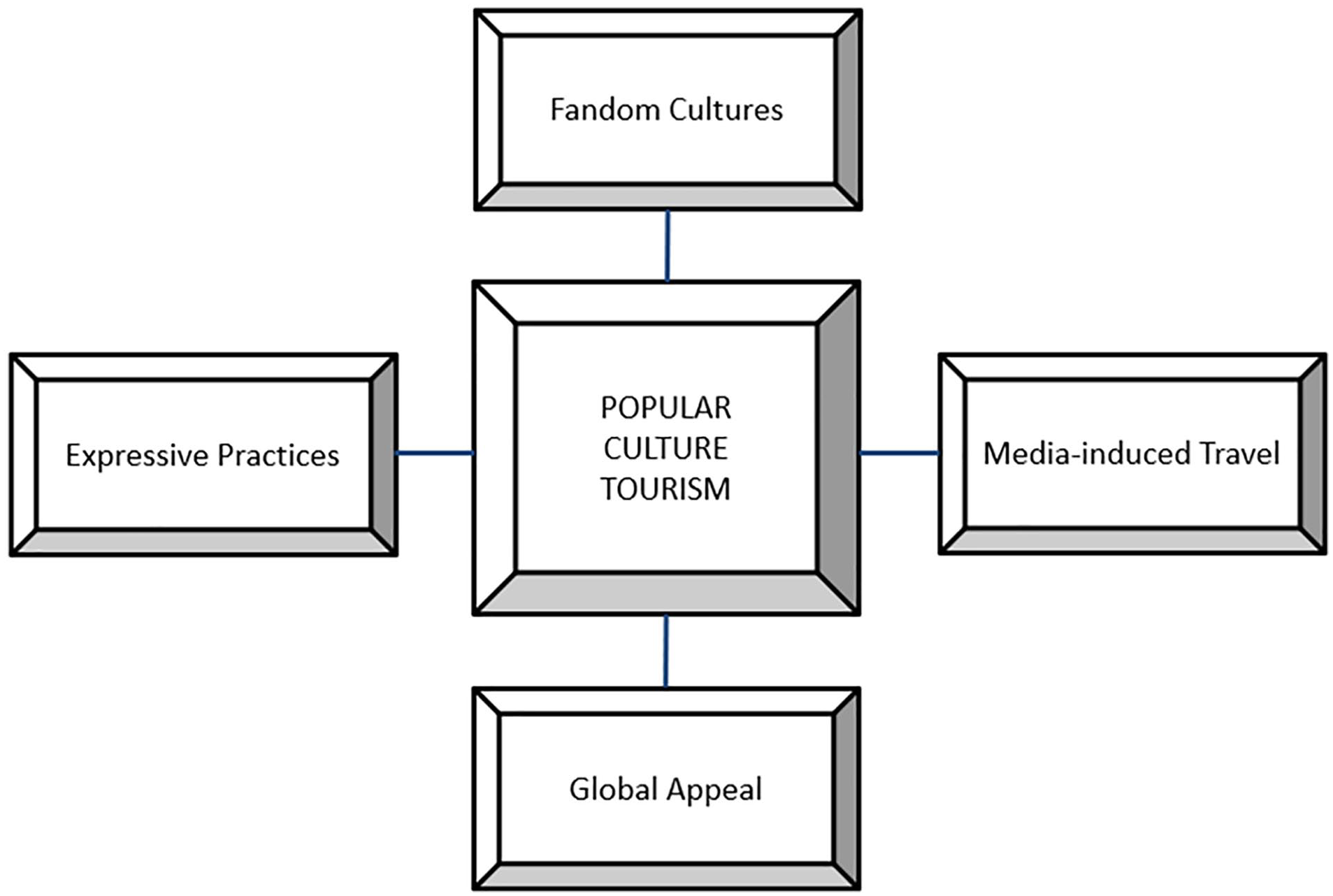
Ontological base of popular culture tourism.
Given the breadth of disciplinary perspectives, we suggest as a priority for moving forward the imperative for synthesis of popular culture expressions, their ramifications, and tourismification processes. This necessitates the employment of more critical approaches to expose the inherent intricacies and controversies of popular culture tourism. For example, Ziakas, Lundberg, et al. (2022) developed a comprehensive dramatological framework to examine how the enactment of collective embodied performances fostered shared meaning through the instantiation of symbolic action and enabled the co-creation of the aforementioned free-diving event in Amorgos. Along these lines, Ziakas (2021) set forth the notion of “civic dramaturgy” as a comprehensive analytic for better understanding collective meaning creation in tourism settings, including all expressions of popular culture and appreciating their common ground. Likewise, the concept of “interscopic fan travelscape” has been introduced to explain how blends of popular culture create composite tourist settings and hybrid travel cultures (Ziakas, Tzanelli, et al., 2022). In all, processes of tourism hybridization, communal dramaturgy, fandom embodiment, instantiation of symbols, and associated metaphoric discourse are not sufficiently addressed in the literature, especially in regard to the means that synergize an intertextuality of conceptual continuity among different forms of expressive culture to amplify shared meaning and prompt collective action. Accordingly, reconceptualization of constitutive expressive phenomena is needed. For instance, Tzanelli (2018a, 2021) put forward the perspective of “cinematic tourism” (as opposed to film-tourism) to denote variations of artistic and political movement based on the mobilities paradigm. Specifically, cinema in artistic terms refers to a technological and fan complex orchestrating sound, image-based, and imaginative movement. On the political level, cinema metaphorically refers to ecologically delineated social movements. On these grounds, for Tzanelli, “cinematic tourism” is a process of inscription of movement on a surface or ideational body (Tzanelli, 2018a, 2021). By focusing on movement, this perspective contradicts conventional views of film-tourism as a fixed construct. Following this suggestion, a focus on movement can divulge opportunities for synergy among different expressive practices (e.g., art and sport) and further develop a comprehensive take on popular culture tourism.
Our objective is to demarcate the conceptual foundations of popular culture tourism and establish its ontological foundations. Accordingly, Table 1 lists the key themes underlying the rich tapestry of insight and discourse that compose a fertile ontology, and identifies points of convergence in the conceptual framework of this paper for the comprehensive study of popular culture tourism. To this end, primary research questions are listed.
Realms of Popular Culture Tourism and Principal Themes.
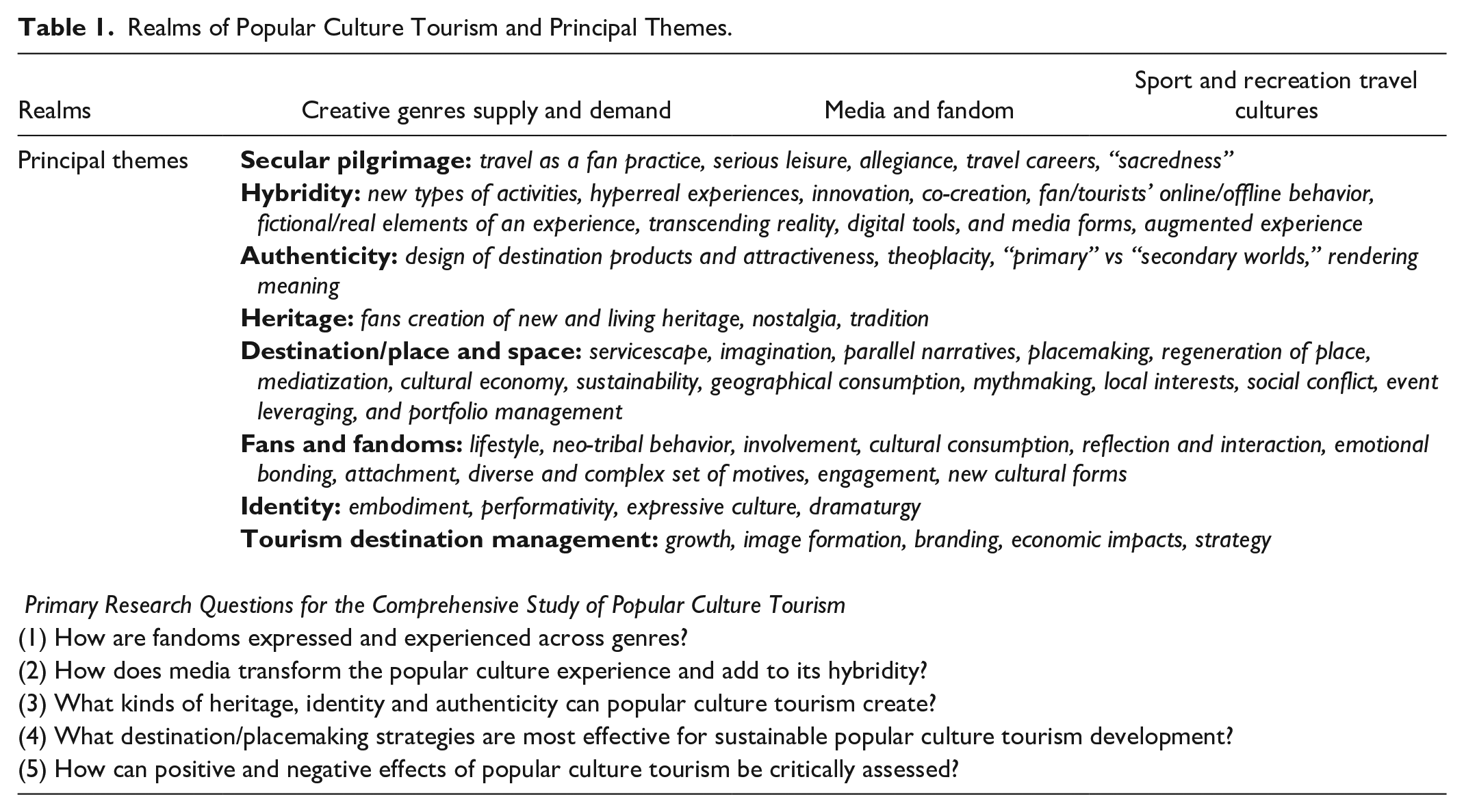
Arguably, the comprehensive and more critical treatment of popular culture tourism will substantially contribute to its salubrious configuration and shed light on how it can be better used as a destination placemaking tool by creatively and innovatively embracing a mixture of products/services that stem from expressive culture. So, destination management can be loaded with increased capacities to leverage popular culture in integrated models of destination development and portfolio management that enhance adaptability, sustainability, and resilience. This can enable the strategic role of popular culture tourism and overcome the isolated employment of some forms as dispensable components in destination development policies. The outlined principal themes that constitute this emerging field need to be further explored and thoroughly synthesized in future research.
Conclusions and Future Direction
The positioning of popular culture tourism as an integrated field of scholarship and practice is a response to the incessant compartmentalization of culture in the tourism realm. It provides a platform for envisioning new models that create synergies among different popular culture expressions, as well as destination products and services. Building a common ground for the comprehensive study of popular culture tourism can shed light on the complexity of popular culture expressions, their texts, performances, and identities, as they are intersecting with commercial sectors such as film, music, sport, and gaming. This paper established the ontological foundations and demarcated the immanent scholarship areas that build a firm conceptual ground for the systematic, thorough, and critical study of popular culture tourism. We highlighted the fact that the field of popular culture tourism is not only concerned with the relationship between the visited place and the visitors, but also with the relationships of members of global fandoms beyond their travel related behavior or intentions as well as relationships between fans and different popular culture expressions.
It is clear that the evolving outlook of popular culture tourism is based on rapid globalization and technological advancements, and therefore, boldly acknowledges the blurring of cultural differences without building on, or reproducing, dichotomies such as us/them. This also applies to differences in form, values, and modes of expression that individual genres enable so as to appreciate their interchanges and organic convergence through the cross-fertilization and hybridization of culture. It thus points to the need to transcend conventional disciplinary boundaries that perpetuate divisions and dichotomies among genres and sub-sectors of popular culture. This calls for interdisciplinary and transdisciplinary approaches with the mandate to bridge cross-sectoral gaps and amplify benefits for destinations, thereby facilitating the sustainable growth of popular culture tourism.
Although the current scholarship deals with a variety of perspectives regarding the supply and demand of popular culture genres, some important areas related to technology development and the online space have received little attention in the literature—for instance, how video games act as virtual tours which motivate gamers to visit these places, or how tourism amenities may be themed after video games as well as how gaming conferences draw big crowds to different parts of the world. Another example is the global success of the mobile phone game Pokémon Go, where people move around in physical space based on network interaction. The literature even suggests that the future of popular culture tourism lies in virtual, hybrid, or augmented reality experiences. Specifically, “more immersive, interactional, personalized, meaningful, and engaging experiences are required that allow for community building that does not remain spatially and temporally restricted but extends beyond the space and place of the respective activity” (Reichenberger, 2021, p. 237).
The future of popular culture tourism may also hold the potential to address some of the challenges that this sector of tourism is facing, as popular culture fandoms can be leveraged to focus increased attention on civic, political, and societal challenges based on a connection between some fandoms and activism. One example is the appreciation of natural environments in Lord of the Rings, which can potentially be leveraged for promoting sustainable tourism, thus using popular culture to induce change in real life (Reichenberger, 2021). At the same time, popular culture tourism should become more sustainable in itself. To this end, critical investigations and insights are needed to uncover practices and processes that enable or constrain the delivery of tourism products/services linked to popular culture in accordance with the triple-bottom-line of sustainable development. Likewise, future studies should focus on how global fandoms are interpreted, appropriated, reshaped, and packaged at the local level by host destinations. In all, critical future studies on popular culture tourism should allow us to further our understanding of the interactions of global fan cultures and local destinations via comprehensive approaches that aim to achieve equality and minimize exploitation.
Footnotes
Declaration of Conflicting Interests
The author(s) declared no potential conflicts of interest with respect to the research, authorship, and/or publication of this article.
Funding
The author(s) received no financial support for the research, authorship, and/or publication of this article.
