




Abstract
Virtual reality (VR) is considered an important technological development to impact the tourism industry. Hotels are constantly attempting to overcome the challenges they face in the presentation of their facilities in the virtual environment. This research has made one of the first attempts to understand VR’s ability to influence tourism consumers’ attitudes and behavioral intentions during the prepurchase phase and postpurchase phase of their purchase journey across three hotel preview styles, namely, (1) VR immersive headsets, (2) 360° VR tour, and (3) a static image website. Through a lab-based experiment with 270-participants, study 1 outlined the positive role of VR on learning about the hotel and visit intentions. Through a questionnaire with 409 actual tourism consumers following a hotel stay, study 2 detailed that VR plays a significant role in managing tourism consumers’ expectations through providing an authentic experience and stimulating the development of detailed mental imagery prior to their visit.
Keywords
Introduction
The significant developments in virtual reality (VR) technology in recent years is a fascinating prospect for the hotel industry. VR has been cited as one of the most important technological developments to impact travel and tourism (Tussyadiah et al. 2018). Numerous travel firms, including Virgin, Disney, Emirates, and hotel brands such as Marriot and Hyatt Regency have introduced VR to enable consumers to “experience before they buy” (Rodgers 2020), potentially heralding numerous benefits to these brands before consumers engage with them in the real world.
With the advent of the COVID-19 global pandemic, 2020 has been a catastrophe for the tourism industry (Ziady 2020), bringing tremendous financial challenges. Losses are projected to be in the billions in some countries, with hotels being one of the hardest-hit industries (Mensah 2020). As such, the hotel industry, perhaps now more than ever, needs more clarity on the value that new technologies can add to their marketing efforts as they face tremendous budgetary constraints. Further research is therefore needed in order to support marketers as they consider their marketing investment options.
VR technology could potentially be an investment worth considering as it has the unique capability to create a three-dimensional (3D) virtual world. Within this virtual world, marketers have the potential to combine visual (sight), auditory (sound), tactile (touch), and vestibular (movement) sensory information while also enabling gustatory (taste) and olfactory (smell) cues (Williams and Hobson 1995). Although not all VR experiences will draw on each type of sensory information, the possibility exists. Such an interactive and sensory-rich environment enables consumers to experience activities before purchase. A virtual reality environment can be considered a digital space in which an individual’s actions or movements are tracked, surroundings digitally composed and displayed to the individual to evoke their senses in line with their actions or movements (Fox, Arena, and Bailenson 2009). Thus, a virtual reality environment should provide consumers with an alternative world by enabling consumers to block out stimuli from the physical world to allow them to fully immerse themselves in the virtual world (Bogicevic et al. 2019). Accordingly, through the use of VR, consumers can “travel” to destinations anywhere in the world using VR applications (utilizing 360° VR tours) or wearing VR devices (M. J. Kim, Lee, and Jung 2020).
Researchers have been intrigued by the possibilities VR offers tourism marketers for decades (see Williams and Hobson 1995; Cheong 1995; Dewailly 1999). However, during the early introduction of VR, software capabilities hindered the realistic representation of reality, while the cumbersome hardware devices did not lend themselves to mass consumer adoption. More recently, however, following technological advancements, VR now represents a far more realistic presentation of reality, while VR devices have become far more accessible in consumer markets. Researchers have sought an understanding of the enjoyment of using VR in tourism (Guttentag 2010), the acceptance of VR in tourism (Y. C. Huang et al. 2016), and attitude changes due to VR in tourism (Tussyadiah et al. 2018; Kim et al. 2020). Despite the growing interest in VR among academics and practitioners, research has been primarily conceptual (Moorhouse et al. 2018; Saren et al. 2013), and thus, limited empirical work exists to date (see M. J. Kim, Lee, and Jung 2020; Bogicevic et al. 2019; Wei, Qi, and Zhang 2019; Tussyadiah et al. 2018).
Tourism encapsulates numerous different services, including transportation, accommodation, attractions, cultural heritage, and events, which all influence tourist experiences (Lugosi and Walls 2013). During travel planning, tourism consumers attribute importance to the type of experience (e.g., camping, spa, city experiences), geographical location, and importantly the perceived hotel experiences that can influence their overall tourism experience (H. Han, Kim, and Hyun 2011). Thus, hotels aim to communicate the best possible experiences to tourism consumers at each point of their purchase decision-making journey to provide them with information to make an informed decision. As such, VR experiences could become an integral part of many hotel providers’ communications with the intention that consumers will use the technology during travel planning decision making to help them imagine experiences they would have at the hotel (Israel, Zerres, and Tscheulin 2019).
Despite ongoing discourse concerning VR’s ability to influence consumers during travel planning, questions remain over the value of VR during the consumer purchase journey. For example, although marketers may consider investing in new technologies such as VR in order to encourage consumers to purchase, is such investment in VR warranted? Would investment be better served by optimizing existing assets such as websites? If investment in VR is warranted, what are the expected outcomes? These are pertinent questions faced by marketers in an industry that is confronted by tremendous and unprecedented financial constraints. Additionally, the existing literature fails to understand how interactive sensory VR stimuli influence consumer decision making in tourism compared to less interactive stimuli (Bogicevic et al. 2019). As such, this study has two primary objectives. First, we seek to support marketers in their decision making by examining the prepurchase and postpurchase phases of a hotel booking and the factors that influence positive consumer outcomes when VR is part of the experience. We define prepurchase and postpurchase phases in line with Lemon and Verhoef (2016). Prepurchase behaviors involve need recognition, consideration, and search, which in the context of this study is viewing preview stimuli of a hotel. Postpurchase behaviors involve consumption and usage, which in the context of this study is staying at a hotel. We operationalize study 1 through the lens of presence theory (Slater and Usoh 1993) by empirically examining the sensory VR environment in inducing mental imagery and fostering authenticity as drivers of an immersive experience and subsequent future hotel bookings during the prepurchase phase of the consumer decision-making journey. Second, in study 2, we empirically examine the effects of the VR sensory information and mental imagery on satisfaction with the hotel appearance at the postpurchase phase of the consumer purchase journey, providing insight into the expectations developed from the VR experiences and the website experience with the actual physical world representation of the hotel. We tackle these objectives by drawing comparisons between virtual environments with varying degrees of interactivity, immersiveness, and media richness in both studies: namely, a VR headset experience (highest level), a 360° interactive VR tour (medium level), and a static image website (lowest level). Doing so aims to help marketers’ decision making by understanding these various formats’ capabilities to foster positive consumer outcomes.
Literature Review
Virtual Reality and Tourism
VR is the “use of a computer-generated 3D environment (e.g., virtual environment) that one can navigate and interact with, resulting in real-time simulation of 1 or more of the user’s five senses” (Guttentag 2010, p. 638). VR is singled out with the capacity to enhance learning and enjoyment by providing tourism consumers with rich media information about a destination (Griffin et al. 2017). Prior research has conceptualized VR technology as having the capability to enhance consumers’ immersion in the experience through making information more attractive, thus subsequently encouraging the consumer to live the real physical experience (Tussyadiah et al. 2018). Given that VR provides a complete pictorial representation of a hotel or destination, it is believed to reduce consumers’ perceived anxiety toward their booking by familiarizing themselves with unfamiliar places (Lee and Oh 2007). Thus, VR enables marketers to connect with potential tourism consumers through offering rich media experiences that enable prospective visitors to immerse themselves in a tourism destination (e.g., hotel, tourist attraction, or city) within the comfort of their own homes prior to making a decision on whether to visit (Y. C. Huang et al. 2016; Stanley 2017).
However, scholars continue to debate what constitutes VR as both synthetic and 360° content has been subject to scientific inquiry over recent years (Beck et al. 2018). The level of invasiveness has been used to differentiate the types of VR, whereby nonwearable devices are seen as less invasive than wearable devices (Carrozzino and Bergamasco 2010). Beck et al. (2018, p. 591) outline that “Virtual Reality, in a tourism context, creates a virtual environment by the provision of synthetic or 360-degree real-life captured content with a capable non-, semi or fully immersive VR system, enabling virtual touristic experiences that stimulate the visual sense and potentially additional other senses.” VR headsets are considered fully immersive systems, as they enable complete isolation from the physical real world. It involves an individual wearing a headset (such as Oculus, HTC Vive, and Samsung Gear VR) over their eyes to view a virtual world; in this world, they can physically move around and interact with the environment as they would in the physical real world (Flavian, Ibanez-Sanchez, and Orus- 2019). Conversely, in both semi- and nonimmersive virtual realities, the individual maintains contact with the physical real world. Semi-immersive systems consist of a large computer monitor or multiple computer monitors surrounding the individual involving 360° content and accompanied by 3D surround sound. In semi-immersive VR, individuals view a 360° virtual environment on a screen, requiring no technology attached to the individual (Beck et al. 2018). In this experience, consumers can drag and manipulate their view through touch and click or tap on information points. Nonimmersive systems (which are also referred to as desktop-based VR) are the most common, simplest, and easiest way of providing and accessing VR (Dorner et al. 2013). In nonimmersive VR, a 3D space is simulated and an individual can interact with the virtual world via a keyboard, mouse, or any other peripheral devices (Liu et al. 2016; Dorner et al. 2013).
A review of the current body of literature on VR outlines authenticity, mental imagery, and presence as central to VR. The subsequent sections discuss these in more detail.
Virtual Reality Authenticity
In tourism, authenticity was introduced as a key tourist motivation over two decades ago in the early 1970s (see MacCannell 1973, 1976) and has remained an active topic of research among tourism and marketing scholars to date (e.g., Novello and Fernandez 2016; Meng and Choi 2016; M. J. Kim, Lee, and Jung 2020). It has been defined as the extent to which individuals perceive novel, real, exceptional, and unique experiences to be genuine, original, or true (Gilmore and Pine 2007; M. J. Kim, Lee, and Jung 2020). Authenticity in the experience context is therefore a construct that is subjective in nature, is based on an individual’s own perceptions and expectations, and thus, varies between individual consumers (Muñoz, Wood, and Solomon 2006).
With regard to VR, Guttentag (2010) outlines that tourism consumers’ knowledge of the authenticity of VR tourism is a key variable in their overall approval of using VR for an actual touristic experience. Thus, those consumers who have the knowledge and physical experience of a touristic destination can compare the authenticity of the VR experience to the actual experience. In a related study, Dueholm and Smed (2014) outline that the level of perceived authenticity of VR can strengthen the experience at visitor attractions. Moreover, M. J. Kim, Lee, and Jung (2020) detail that perceived authentic VR tourism experiences positively influence consumers’ cognitive and affective responses.
Furthermore, and in the context of computer game players, a perceived authentic environment along with sensory interactions result in higher levels of immersion and entertainment (Pietschmann, Valtin, and Ohler 2012). Similarly, Mura, Tavakoli, and Sharif (2017) conceptualize that VR enables tourists to imagine a realistic experience through a perceived authentic environment with sensory involvements as potential important elements of experiencing authenticity.
Presence Theory and Immersion
The persuasiveness of VR experiences is also centered on presence theory (Tussyadiah, Wang and Jia 2017). Presence in this context is considered as the psychological state in which individuals become lost in a computer-mediated environment, the degree to which individuals feel they are somewhere other than the real physical environment (Slater and Usoh 1993). Thus, the level of presence is dependent on the degree to which an individual feels they have shifted from a physical environment to becoming present in an alternate virtual environment (Wei, Qi, and Zhang 2019). Given that VR environments enable sensory and motor engagements (e.g., haptic feedback to facilitate navigation; moving your body and head to change the point of view), they allow consumers to develop mental imagery of mediated environments (e.g., hotel resorts and cities) and therefore enhance the feeling of embodiment. T. Kim and Biocca (1997) distinguish presence as encompassing two dimensions (1) arrival (i.e., the feeling of being present in a mediated environment) and (2) departure (i.e., the feeling of separation away from the physical environment). This line of thought suggests that consumers feel a presence in a computer-mediated environment only when they disregard the technology and immerse themselves in the computer-mediated environment and become absorbed in a virtual space. This study, therefore, takes the perspective that presence is the immersion in the computer-mediated virtual environment separated from the physical world.
The immersion in the technology has been outlined as a critical factor in influencing attitudes and behaviors in a virtual environment (Faiola et al. 2013). Immersion refers to the degree to which the real physical environment is omitted and the extent to which an individual is surrounded by a variety of sensory modalities (Beck et al. 2018). Sherman and Craig (2003) describe immersion as a state of being deeply involved in an experience. Presence and immersion are often used synonymously within the literature (see Tussyadiah et al. 2018; Flavian, Ibanez-Sanchez, and Orus 2019; Kim and Hall 2019). Parallels can be drawn between Kim and Biocca’s (1997) notion of “departure,” that is, the separation from the physical environment as an explanation of presence and Beck et al.’s (2019) notion of omitting the physical real world as an explanation of immersion. Thus, in the context of this study, we define immersion as the omission of the real physical world and the deep involvement in an experience.
The extant literature outlines that interaction leads to immersive experiences (Mollen and Wilson 2010; Wei, Qi, and Zhang 2019; McLean and Wilson 2019). Further to this, media richness, vividness and control all enhance immersion, which results in favorable attitudes and behavior toward websites, their products, and experiences (Rose et al. 2012; Tussyadiah, Jung, and tom Dieck 2017; McLean and Wilson 2019). In the context of destination marketing, immersion results in a positive image of the virtual destination (Hyun and O’Keefe 2012) and a higher likelihood of visiting the physical destination (S. Han and Kai 2015).
Sensory Information and Mental Imagery
The sensory information presented in VR can help to develop mental imagery in the mind of a consumer, which is established in the absence of true stimuli (Kosslyn 1976). Such mental imagery can be aroused by one sense or multiple senses, including visual, haptic, gustatory, or olfactory cues (Miller and Stoica 2004). Kosslyn and Ochsner (1994) found that mental imagery is important for information processing, reasoning, and learning. The consumption vision theoretical perspective of mental imagery outlines the creative sense-making process that consumers draw on to predict the future through developing clear and specific images of them experiencing the product and the consequences of the experience (Phillips, Olson, and Baumgartner 1995). Thus, consumption visions are stories developed from consumers’ mental imagery that involve a character (the consumer themselves), a plot (the series of images the consumer imagines), and the environment (the setting in which future events take place) (Phillips, Olson, and Baumgartner 1995). Green and Brock (2000) refer to this same form of mental imagery as narrative transportation, which also involves the creation of stories via the mental cognitive processing of future events. Additionally, Escalas (2004) refers to this view as mental simulation, which involves the development of hypothetical scenarios of future events. The idea of a consumption vision is that mental imagery is beyond a simple set of images imagined by the consumer. Instead, it entails a conscious representation of the self-experiencing consumption in the future, encompassing both cognitive processing of mental imagery (Debevec and Romeo 1992) and the quality of mental imagery (Walters, Sparks, and Herington 2007). Accordingly, in the context of this study, in line with Walters, Sparks, and Herington (2007) and Bogicevic et al. (2019), we adopt the consumption vision viewpoint in which mental imagery is considered a visual response to destination information that encompasses two dimensions: (1) cognitive processing of mental imagery and (2) the quality of mental imagery information. As such, these dimensions help to predict future experiences. Cognitive processing of mental imagery encompasses the number of images developed in the mind of the consumer, along with their cognitive involvement in the imagined imagery (Yoo and Kim 2014). The quality of mental imagery information refers to the clarity and sharpness of the mental images, which is similar to the notion of vividness (McLean and Wilson 2019).
The extant literature outlines that mental imagery explains the influence of a website’s display on behavioral intentions such as purchase and revisit (Yoo and Kim 2014; Lee and Gretzel 2012). A related study by Lee and Gretzel (2012) found that among the sensory stimuli (images, audio, narratives, and interactions) presented on a tourist destination website, only images had the capability to induce mental imagery and thus enhance attitudes and behaviors toward the website. Although the positive effects of mental imagery have been outlined in the web environment, little attention has been given to the VR environment. While space is represented in virtual environments, it is still perceived at an abstract level; thus, individuals still employ mental imagery processing to better imagine and understand the virtual environment (Saunders et al. 2011). Accordingly, this research proposes mental imagery as a key variable in understanding immersion in virtual experiences.
However, despite the propensity of the VR in developing immersive experiences in the tourism domain, we lack understanding of the role of authentic experiences and mental imagery across varying types of interactive virtual environment previews (i.e., hotel’s website; hotel’s 360° VR tours and immersive VR headset previews) in influencing immersion in the experience, learning and visit intention at the prepurchase stage of the customer decision-making process and subsequently the influence on satisfaction with the hotel appearance at the postpurchase stage. The following section outlines our hypotheses development, while Figure 1 presents a pictorial representation of our hypotheses.
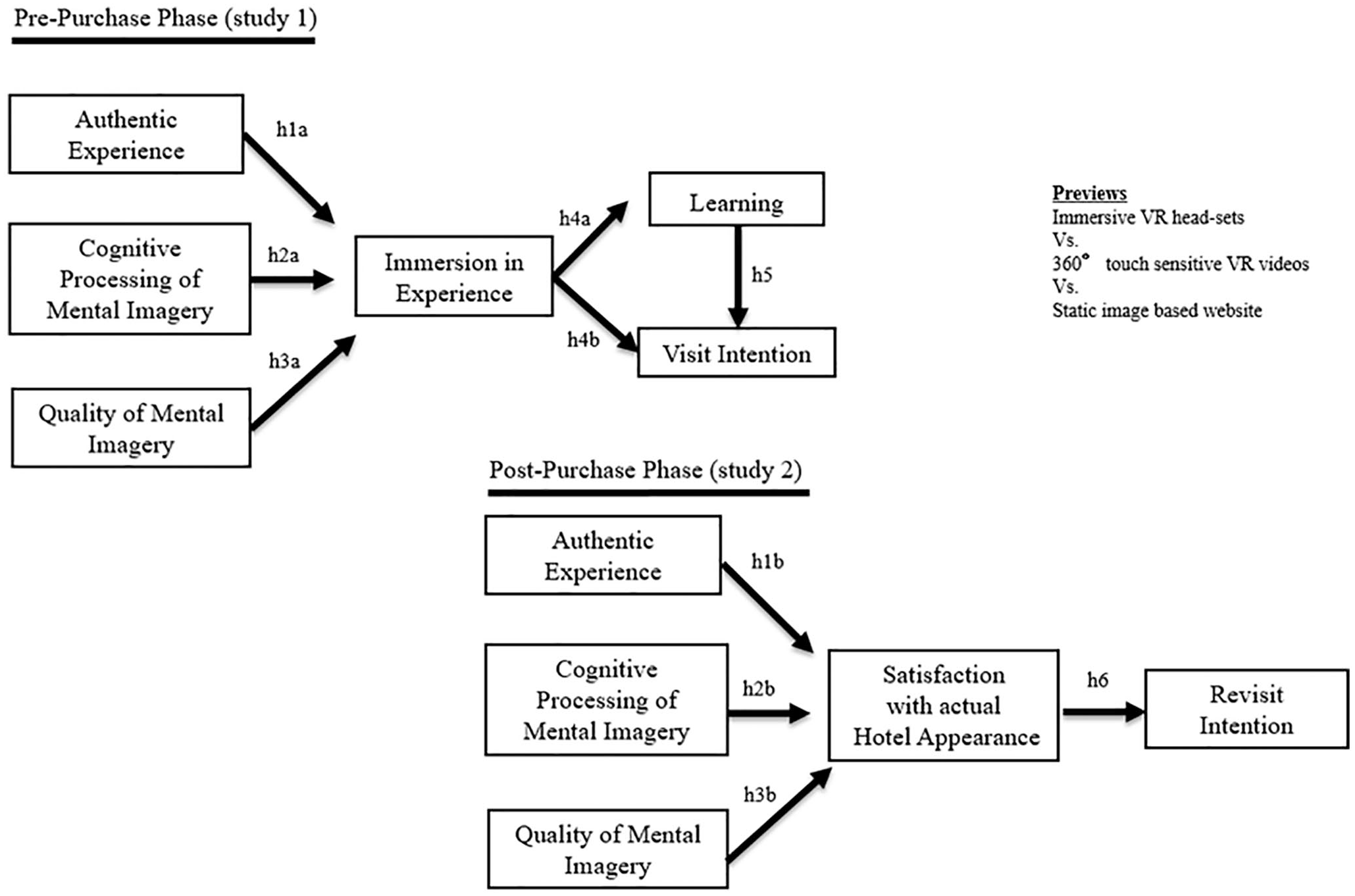
Hypothesized Models.
Hypotheses Development
This research focuses on three different preview styles for the presentation of hotel information, namely, VR through immersive VR headsets, 360° VR tours, and a static image website. Each offers differing levels of interactivity, media richness, and immersiveness. In the context of this study, Interactivity refers to the level at which an individual can alter the visuospatial perspective of information within the virtual environment (Lurie and Mason 2007). Thus, a virtual environment can include static images that provide a single visuospatial perspective and interactive features that respond to an individual’s actions on input. Previous research concerning interactivity has found significant differences between two-dimensional versus three-dimensional product displays on consumer decision making (Kang et al. 2020). Media richness refers to the range of different media and sensory stimuli presented through the technology. Thus, a VR experience can include various media elements such as videos, auditory information, images, and overlaid text. In contrast, a website may only include static images and text. Research demonstrates that media can differ in terms of its richness and its effects on individuals; for example, one study found that consumers rely more on stimulus-based sensory information when media richness is high versus memory-based information when media richness is low (Maity, Dass, and Kumar 2018). Lastly, immersiveness refers to the depth of omission from the real world enabled by the device. An experience that incorporates the use of a headset would be considered more immersive than a website as the use of a headset provides less distraction from the outside world due to covering the eyes and immersing an individual in the experience. In a comparison of virtual reality (with the use of a headset) and augmented reality (with the use of a mobile phone), K.-T. Huang et al. (2019) found that VR provided higher levels of presence when compared to an AR environment. Accordingly, this research categorizes immersive VR tethered headsets to preview a hotel’s environment as the highest level of interactivity (the highest visuospatial perspective), immersiveness and media richness, followed by the less interactive, less immersive and less media-rich 360° VR tour (midlevel visuospatial perspective) and the least interactive, immersive, and media-rich static image website (lowest visuospatial perspective). Given the differences in interactivity, immersiveness, and media richness within each preview style, we anticipate differences in the authenticity of the experience, cognitive processing of mental imagery, and quality of mental imagery on immersion in the experience.
Interactive virtual environments, including computer games, 360° video-tours, or virtual reality, have been outlined as having the ability to enhance the realistic representation of the real world to offer an authentic experience (Tussyadiah et al. 2018). Accordingly, such high-level interactive, immersive, and media-rich virtual environments may influence the extent to which visual representations replace substantive information search and substitute the real world (Burke 1996). Additionally, realistic interactive and rich stimuli have influenced immersion in the virtual environment within online shopping websites (Kim et al. 2014; Argyriou 2012). Given that VR provides a more interactive, rich, and complete pictorial representation of a hotel or destination, it is likely that the authenticity of the experience through the technology will provide a more immersive experience during the prepurchase stage of consumer decision making in comparison to less interactive and media-rich technologies. Additionally, because of the rich media through VR enabling consumers to familiarize themselves with an unfamiliar venue (Lee and Oh 2007), providing consumers with the ability to explore the venue in great detail prior to visit (Stanley 2017) will likely influence a tourism consumer’s satisfaction with the hotel’s appearance during the postpurchase phase of their journey owing to the accurate and authentic representation of the hotel’s appearance meeting consumers’ expectations. Thus, we hypothesize:
Hypothesis 1: The authenticity of the experience in the VR preview of the hotel will (a) elicit higher levels of immersion in the experience during the prepurchase phase and (b) elicit higher levels of satisfaction with the hotel appearance in the postpurchase phase compared to the 360° VR tour and the static image website.
Prior literature suggests that consumers draw on mental imagery from sensory information to develop clear and specific images of them experiencing products or services and the consequences of them (Phillips, Olson, and Baumgartner 1995). The consumption vision perspective of mental imagery is beyond a simple set of images imagined by the consumer. Instead, the consumption vision is a conscious representation of the self-experiencing consumption in the future, encompassing cognitive processing of mental imagery (Debevec and Romeo 1992) and the quality of mental imagery (Walters, Sparks, and Herington 2007). The development of a consumption vision through a virtual environment and the elimination of external physical environment stimuli has been associated with immersion in an experience. Given the ability to develop a consumption vision through a thought-provoking and vivid interactive virtual environment, we posit that cognitive processing of mental imagery as well as the quality of mental imagery will influence immersion in the experience prior to booking and satisfaction with the hotel’s appearance following a visit. Thus, we hypothesize:
Hypothesis 2: Cognitive processing of mental imagery from the VR preview of the hotel will (a) elicit higher levels of immersion in the experience during the prepurchase phase and (b) elicit higher levels of satisfaction with the hotel appearance in the postpurchase phase compared to the 360° VR tour and the static image website.
Hypothesis 3: The quality of the mental imagery from the VR preview of the hotel will (a) elicit higher levels of immersion in the experience during the prepurchase phase and (b) elicit higher levels of satisfaction with the hotel appearance in the postpurchase phase compared to the 360° VR tour and the static image website.
For decades, scholars have outlined that digital presentations of experiences and products in tourism provide indirect experiences with destinations irrespective of a consumer’s physical location (Jafari 1982). As VR allows tourism consumers to transport themselves into the virtual world, the intensified sense of presence encountered could shed light on how VR stimuli influence behaviors and behavioral intentions (Bogicevic et al. 2019). Prior research has illustrated that presence in highly immersive online environments influence cognitive behaviors (Martin, Mortimer, and Andrews 2015), influence fantasizing about the real-world experience (K. Song, Fiore, and Park 2007), influence value (Israel, Zerres, and Tscheulin 2019), learning (Jung et al. 2016; Van Noort, Voorveld, and Van Reijmersdal 2012), and visit intentions (Tussyadiah et al. 2018; Chung et al. 2018). Thus, following this line of thought, this research suggests that presence in highly immersive VR environments encompassing rich media that provides an authentic preview and stimulates mental imagery will influence a tourism consumer’s learning of the hotel and its facilities (i.e., understand what the hotel has to offer) as well as the intention to visit the hotel. Thus, we hypothesize:
Hypothesis 4: Immersion in the experience of the VR preview of the hotel will (a) elicit higher levels of learning and (b) elicit higher levels of visit intention during the prepurchase phase compared to the 360° VR tour and the static image website.
Hypothesis 5: Learning derived from the VR preview of the hotel will elicit higher levels of visit intention during the prepurchase phase compared to the 360° VR tour and a static image website.
Satisfaction is seen as a central concept in consumer behavior literature and plays an important role in the postpurchase phase during the consumer decision-making process (Puccinelli et al. 2009). In the consumer behavior literature, satisfaction is known to act as a robust predictor of intentions (Oliver and Burke 1999; Bhattacherjee 2001). In the context of retailing, Reichheld and Schefter (2000) indicate that satisfaction leads consumers to re-consume. Additionally, the relationship between satisfaction with a tourist destination and behavioral intention to visit has been supported in previous literature (Phillips, Asperin, and Wolfe 2013; Ryu and Han 2010). Given that VR can be considered as a substitute for an actual touristic experience offering tourism consumers rich media experiences that enables prospective visitors to immerse themselves in a tourism destination prior to their visit (Y. C. Huang et al. 2016; Stanley 2017), it is expected those using higher interactive previews of the hotel are more likely to revisit the hotel because of their satisfaction with the hotel appearance meeting their pre-travel expectations. Thus, we hypothesize:
Hypothesis 6: Satisfaction with the hotel appearance in the postpurchase phase will influence revisit intentions greater for those using the VR preview of the hotel during the prepurchase phase compared to 360° VR tour and the static image website.
Methodology
In order to test the hypotheses outlined in Figure 1, we developed two studies based on a four-star hotel in the United Kingdom that offers 75 bedrooms with en-suite facilities, two restaurants, a spa, and large gardens. In study 1, we tested the prepurchase phase to establish whether higher interactive, immersive, and media-rich virtual environments in the form of VR elicit higher levels of immersion in the experience-driven by mental imagery and authenticity of the hotel preview in comparison to a 360° VR tour and a static image website (hypotheses 1a, 2a, and 3a). Subsequently, study 1 assessed the proposed relationship between VR, resulting in higher levels of learning and visit intention following immersion in the experience (hypotheses 4a, 4b, and 5). In study 2, we tested the postpurchase phase to establish the influence of the mental imagery developed and authenticity conveyed from the hotel preview styles on actual satisfaction with the hotel appearance. Testing such a relationship sheds light on the value of the varying virtual environment hotel previews (immersive VR headsets, 360° VR tour, and a static image website) on meeting tourism consumers’ expectations (hypotheses 1b, 2b, and 3b). Lastly, study 2 examined whether those using higher interactive previews of the hotel are more likely to revisit the hotel owing to their satisfaction with the hotel appearance meeting their pretravel expectations (hypothesis 6). The following sections detail the specific methodologic approaches and results of each study.
Study 1
Experiment Design and Procedure
This study employed a between-subjects lab experiment with three treatment modalities: (1) immersive VR head-sets, (2) a 360° VR tour, and (3) a static image website. The VR conditions were created with the software Matterport. The Matterport software transforms real-world spaces into an immersive 3D digital space to create interactive 3D models of a venue. In the context of this study, the Matterport software created a 3D digital model of the hotel. The immersive VR headset preview involved participants wearing a headset over their eyes to view the hotel in the virtual world. In this world, they could physically move around and interact with the environment as they would in the real physical world (e.g., walk, turn head, point to touch information points). The 360° VR tour enabled participants to view the virtual environment of the hotel on a 28-inch computer screen, requiring no technology attached to the individual. The experience was not time-bound, and thus participants could move through the tour at their own pace, drag and manipulate their view, and click on information points. Lastly, the static image website offered participants images of the hotel and its facilities to browse; a brief text description of the image was also provided (e.g., “A deluxe garden view room”). The same Matterport experience was used in both VR conditions with the aforementioned different functionality available in the immersive VR head-set experience (e.g., walk, turn head, point to touch information points) versus the 360° VR tour (e.g., drag, manipulate, tap and move with a finger or mouse). The images for the website experience were professional still images taken from the Matterport experience to enable consistent content across the three previews.
In total, 270 participants took part in the study, who were evenly split across each treatment. Participants were recruited from a large University, and with the support of a research agency, 40% of participants were male and 60% female. In return for their time, participants received a monetary reward. Participants ranged in age between 18 and 67 years with a mean age of 25 years. Additionally, participants were proficient with technology, 100% actively use websites, 64% had used 360° VR tour, and 26% had used immersive VR headsets including Oculus, PlayStation VR, and Samsung Gear. One hundred percent of participants reported that they use the virtual environment in some form (e.g., browsing websites, search engines, watch videos, interact with 360° VR tours, or use immersive VR) when booking a hotel. In addition, 87% of participants go on vacation each year, while 72% go on vacation more than once.
Participants were given the following scenario: You have decided to go on vacation to the UK with your partner and plan to spend three nights at a hotel. Preview the hotel and its facilities to help you decide on whether you would stay at the hotel. Participants were assigned to one of the three preview conditions: (1) viewing the hotel through the VR headset, (2) viewing the hotel through a 360° VR tour, and (3) viewing the hotel through images of the hotel displayed on a website. The Oculus Go VR headset was used with participants in the VR headset preview condition with the Matterport virtual environment modeling software. The Oculus VR headset is capable of head and motion tracking to offer a life-like movement experience. Prior to previewing the hotel through the Oculus VR headset, the researcher demonstrated how to use the device and its controls. To eliminate any researcher bias, participants assigned to the 360° VR tour were also given a demonstration on how to control the video (also created in Matterport) as well as a demonstration on how to browse through the images on the static image website for participants assigned to the condition. Following the demonstration, participants were given time to explore their preview. The researchers did not interfere with the preview, leaving the participant in the room. We did not restrict how long they could spend to allow them to replicate what they would do in a true-life setting. Following the experiment, participants were asked to complete a questionnaire to enable us to test the hypotheses in Figure 1. The questionnaire consisted of demographic questions, key variables of interest, and control variables.
Measures
All of our measures were previously tested scales derived from the literature and adapted to suit the context of this study. A 7-point Likert-type scale was used to measure authentic experience, cognitive processing of mental imagery, immersion in the experience, learning, and visit intention. A 7-point semantic differential scale was used to measure the quality of mental imagery. Table 1 outlines the items used in study 1, along with the original source of the scale and their corresponding Cronbach’s alpha coefficient in the assessment of the reliability of the scale. Additionally, participants reported that the scenario provided was realistic. We measured this on a 7-point Likert-type scale (1 = very unrealistic; 7 = very realistic), and the check found that participants believed the scenario to be a realistic activity that they would complete (M = 5.92, t = 26.15, p < .001).
Measurement Scales.
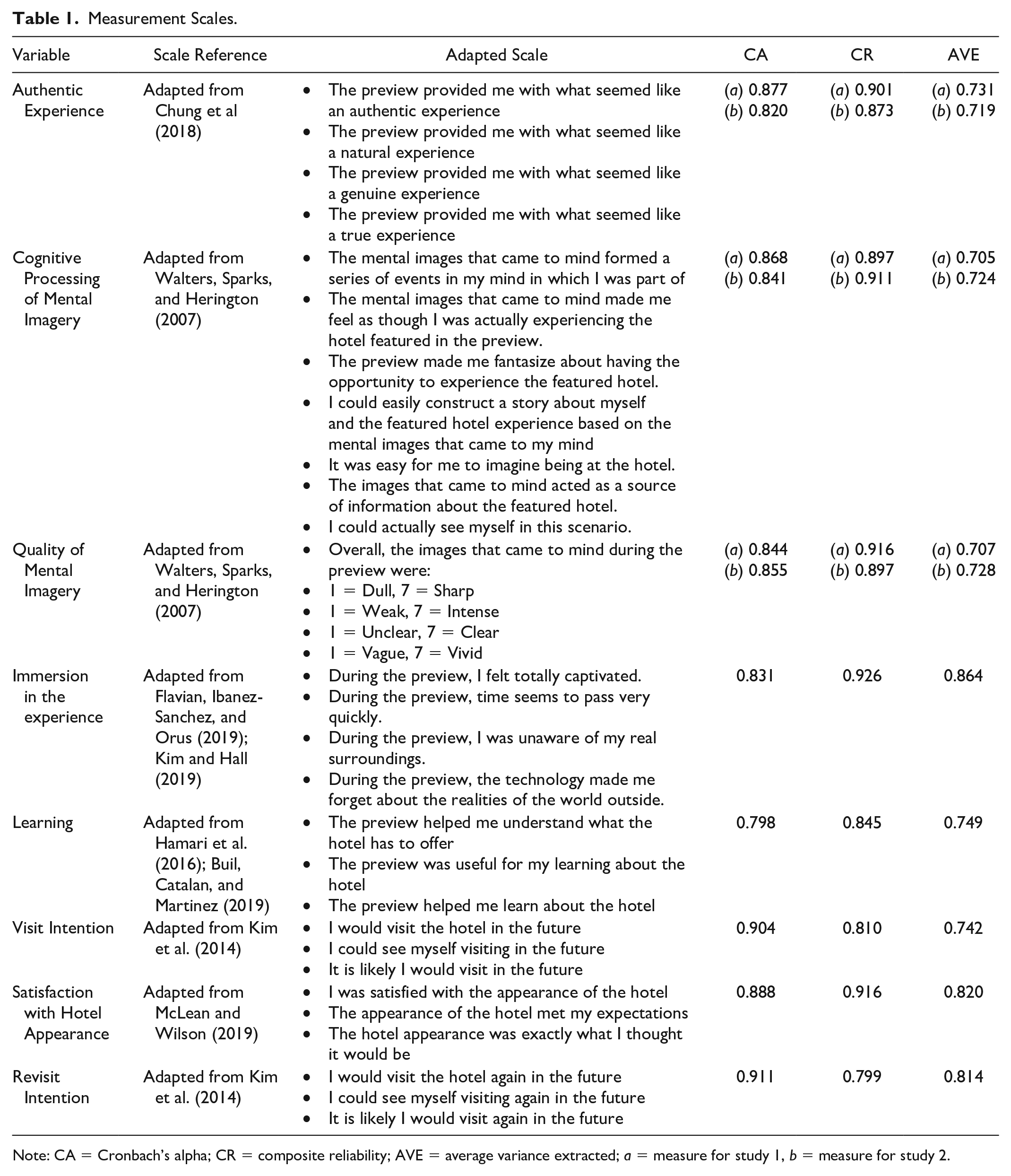
Note: CA = Cronbach’s alpha; CR = composite reliability; AVE = average variance extracted; a = measure for study 1, b = measure for study 2.
Manipulation Check
In line with Bogicevic et al. (2019), in order to produce reliable results, we conducted a manipulation check on the level of interactivity. We asked participants to rate the perceived interactivity of the hotel preview as a manipulation check on a 7-point Likert-type scale, derived from Kalyanaraman and Sundar (2006), to assess the extent to which the hotel preview was interactive. An analysis of variance (ANOVA) outlined that participants’ perceptions of interactivity differed across each of the preview conditions: F(2, 267) = 68.04, p < .05. In more detail, the VR headset preview (m = 6.55) was perceived as having higher levels of interactivity compared to the 360° VR tour (m = 5.59, t = 3.09, p < .05) and higher levels of interactivity compared to the static image website (m = 4.03, t = 3.77, p < .001). Lastly, the 360° VR tour was seen as having higher levels of interactivity than the static image preview (m = 4.03, t = 6.84, p < .001). These findings confirm our conceptualization of interactivity in relation to immersive VR headsets, 360° VR tour, and static image websites.
Data Analysis
To test the research hypotheses (i.e., hypotheses 1a, 2a, 3a, 4a, 4b, and 5), we conducted structural equation modeling (SEM). The statistical software package SPSS was used to prepare the data for SEM. SPSS was also used to calculate descriptive statistics, scale reliabilities, compare between groups, and manipulation checks. The first stage of covariance-based SEM in AMOS graphics is to calculate the measurement model through a confirmatory factor analysis (CFA), followed by the structural model using multigroup analysis.
Results
The CFA revealed goodness of fit: χ2(424) = 846.195, ρ = 0.001, χ2/df = 1.99; root mean square error of approximation (RMSEA) = 0.043, root mean square residual (RMR) = 0.011, standardized root mean square residual (SRMR) = 0.042, comparative fit index (CFI) = 0.977, normed fit index (NFI) = 0.981. In line with the fit statistics, the regression loadings ranged between 0.38 and 0.78 and were statistically significant. Additionally, the composite reliability was above the 0.70 threshold for each of the latent variables, and the average variance extracted (AVE) was above the value of 0.50. The AVE values were also greater than the square of their correlations, providing support for discriminant validity. Additionally, to assess multicollinearity, a variance inflation factor (VIF) analysis was conducted. The results displayed that no variable was above the critical value of 3.0 (Hair 2010). Thus, it can be concluded that multicollinearity was not violated.
Moreover, to avoid inaccurate conclusions, a common method bias (CMB) test was calculated (Podsakoff et al. 2003). A common latent factor (CLF) was presented with each item of all variables in the model. The CLF produced a value of 0.319. To calculate the common method variance, 0.319 was squared, resulting in the value 0.101 (10.1%). Accordingly, those values below 50% (Ranaweera and Jayawardhena 2014) are considered to satisfy the unlikelihood of CMB.
Following the goodness of fit of the CFA and subsequently meeting the required criteria of convergent and discriminant validity, the structural equation models were calculated. Before estimating the structural model, we assessed the model fit. The structural model presented goodness of fit: χ2(36) = 106.1, p < .05, χ2/df = 2.9 RMSEA = 0.049 SRMR = 0.018, RMR = 0.014, CFI = 0.961, NFI = 0.966, GFI = 0.959. Multigroup analysis in AMOS Graphics was used to test the hypotheses. This method allows for comparisons between paths within the structural models across the three conditions (immersive VR headset, 360° VR tour, and a static image website). Before assessing the individual paths, the model comparison output in AMOS Graphics provides a chi-square difference test, which illustrates if differences exist between the entire models. The results indicate p < .05. Thus, we can conclude differences exist. Table 2 outlines the results of the multigroup analysis.
Multigroup Analysis: Prepurchase Phase.
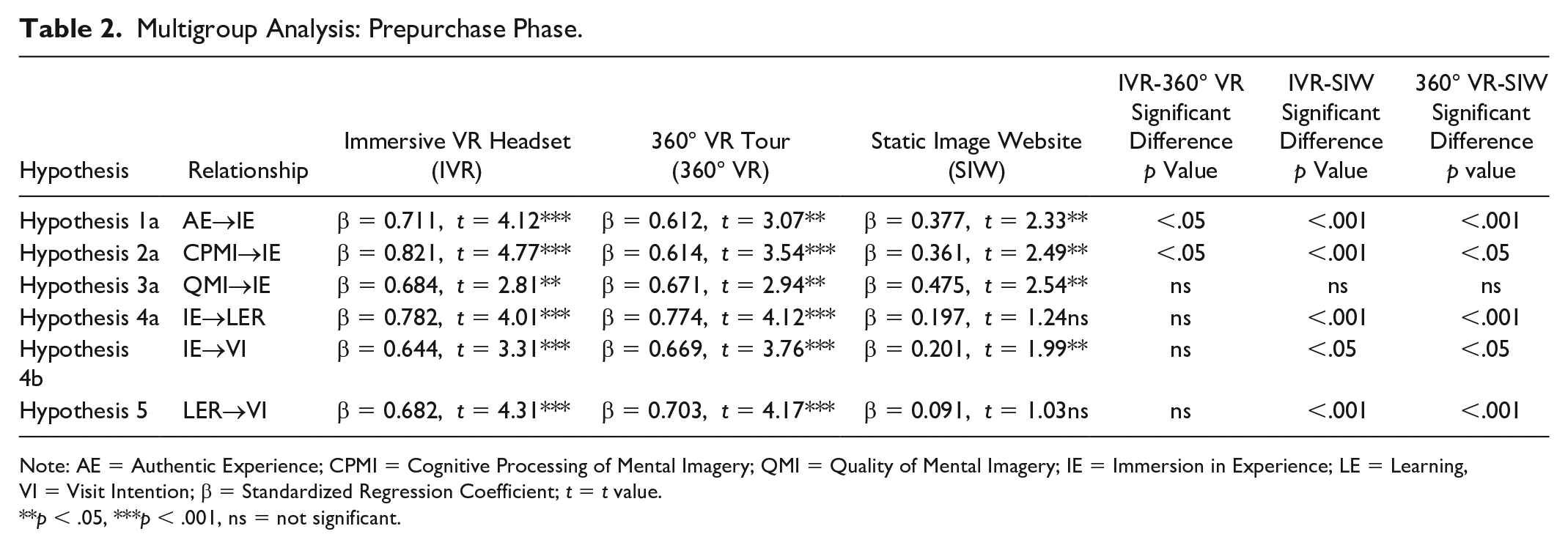
Note: AE = Authentic Experience; CPMI = Cognitive Processing of Mental Imagery; QMI = Quality of Mental Imagery; IE = Immersion in Experience; LE = Learning, VI = Visit Intention; β = Standardized Regression Coefficient; t = t value.
p < .05, ***p < .001, ns = not significant.
The results (outlined in Table 2) illustrate interesting findings. In relation to hypothesis 1a, we find that the relationship between the authenticity of the experience and immersion in the experience was more significant in the Immersive VR headset preview (βIVR = 0.711, t = 4.12***, β360°VR = 0.612, t = 3.07**; p < .05; βSIW = 0.377, t = 2.33**), thus providing support for hypothesis 1a. Therefore, we can conclude that the complete transportation to a virtual world provides a more authentic hotel experience than both the 360° VR tour and the static image website, resulting in further immersion in the experience.
Moreover, with regard to hypothesis 2a, cognitive processing of mental imagery was more significant in both VR previews (immersive VR headset and the 360° VR tour) in comparison to the static image website, but no differences were found between the two different VR conditions (βIVR = 0.821, t = 4.77***, β360°VR = 0.614, t = 3.54***; p = ns; βSIW = 0.377, t = 2.33**; IVR – SWI p < .001; 360° VR – SWI p < .001). Thus, both VR conditions, despite their different levels of interactivity, seem to produce the same level of cognitive processing of mental imagery (IVR mean = 6.61; 360° VR mean = 6.42) and have the same positive effect on immersion in the experience. In contrast, both VR conditions result in higher levels of immersion in the experience than their less interactive counterpart, the static image website. However, in relation to hypothesis 3a, we found no significant difference on the quality of the mental imagery that comes to mind during the experience (IVR mean = 6.45; 360° VR mean = 6.51; SWI mean = 6.37) and its effect on immersion in the experience across each of the previews (βIVR = 0.821, t = 4.77***, β360°VR = 0.614, t = 3.54***; p = ns; βSIW = 0.377, t = 2.33**; IVR – SWI p < .001; 360° VR – SWI p < .001). Thus, hypothesis 3a was rejected. This finding illustrates that each preview in their own right may provide vivid and clear mental images in the mind of the consumer. The static image website may allow individuals to create clear images drawing on their own imagination, whereas the VR conditions may aid consumers in the clarity of their mental images but without enhancing the quality of the images and thus the feeling of immersion in the experience.
Hypothesis 4a outlined that those immersed in the experience through the VR headset preview would learn more about the hotel compared with those in the 360° VR tour preview and the static image website preview. However, the results found only partial support for this hypothesis as no significant difference was found between the Immersive VR headset preview and the 360° VR tour preview (βIVR = 0.782, t = 4.01***, β360°VR = 0.774, t = 4.12***; p = ns). Despite this, significant differences were found between both VR conditions and the static image website (βSIW = 0.197, t = 1.24ns; IVR – SWI p < .001; 360° VR – SWI p < .001). Thus, results pertain that immersion in the experience through both a VR headset preview and a 360° VR tour preview results in higher levels of learning about the hotel and its facilities than that of a less interactive static image website. Thus the presence of “being there” in the VR conditions enables consumers to take on more information to learn about the hotel. Subsequently, we find partial support for hypothesis 5 again. Learning about the hotel facilities in both VR conditions results in consumers being more likely to visit the hotel compared to those who have viewed the static image website (βIVR = 0.682, t = 4.31***, β360°VR = 0.703, t = 4.17***; p = ns; βSIW = 0.091, t = 1.03ns; IVR – SWI p < .001; 360° VR – SWI p < .001). Therefore, the learning that VR affords has a more positive effect over those less interactive virtual environments.
With regard to hypothesis 4b, while we find the positive effect of immersion in the experience influencing visit intentions, similarly to hypothesis 4a, we find there is no significant difference between both VR conditions (immersive VR headset condition and the 360° VR tour preview (βIVR = 0.644, t = 3.31***, β360°VR = 0.669, t = 4.12***; p = ns). However, both VR conditions illustrate a more significant effect in relation to immersion in the experience on visit intentions in contrast to the static image website preview. Thus, we can conclude partial support for hypothesis 4b, given the significant effects in the more interactive VR conditions in comparison to the static image preview (βSIW = 0.201, t = 1.99**; IVR – SWI p < .05; 360° VR – SWI p < .05). We discuss these results in combination with study 2 in more detail in our Discussion section.
Study 2
Design and Procedure
In study 2, we deployed a questionnaire with a set of hotel guests following their real-world stay with a hotel in the United Kingdom. The purpose of this study was to identify whether consumers’ prepurchase expectations developed from the primary preview method the consumer chose as their source of information prior to visiting the hotel (e.g., website, 360° VR tour, or VR headset) aligned with their expectations with the hotel appearance after having stayed at the hotel. Through this study, we assessed the participant’s mental imagery of the hotel and the authenticity conveyed from the hotel preview styles they viewed during their booking. We then analyzed this on their satisfaction with the hotel appearance and the subsequent likelihood of returning following their stay. Participants were invited to take part in the questionnaire following their room check-out at the hotel’s front reception desk. Reception staff provided guests with information on the purpose of the questionnaire and provided guests with a tablet device to complete the questionnaire. Respondents were rewarded with a discount voucher for the hotel’s bar and restaurant. To assess mental imagery and authenticity, the same scales were utilized from study 1. In total, 494 responses were collected, with 409 valid responses following screening and the removal of responses with missing values. Only those who had made their booking within 12 weeks of staying were invited to take part. Twenty-five percent booked 9–12 weeks prior to visit, 37% booked 5–8 weeks prior to visit, and 38% booked 1–4 weeks prior to visit. We conducted preliminary analysis through a one-way ANOVA to identify if any differences existed across these different booking times; the results demonstrated no significant differences; F(2, 406) = 1.49, p < .188. Overall, 67% of respondents were female, and 33% male. The average length of stay was for two nights. Participants ranged in age from 21 to 69 years; the average mean age was 38 years. Participants were asked to select which hotel preview was their main source of information which informed their decision to book their stay: (1) Immersive VR headset preview, (2) 360° VR tour preview, or (3) Images of the hotel (on hotel website or travel provider website). Fifty-eight respondents used their headset for the VR preview as their primary source of information, 231 respondents used the 360° VR tour, and 120 respondents reported only using images on the hotel website or travel provider website. During the questionnaire, participants were provided with an explanation of the preview style. Once selecting an option, participants were then shown a static image of a VR headset view, or a static image of a 360° VR tour view, or a screenshot of the website to confirm they used the specific preview during their decision making when booking a stay at the hotel.
Measures and Manipulation Check
We used the same scale items as in study 1 to measure authentic experience, cognitive processing of mental imagery, and quality of mental imagery. We adapted a scale from McLean and Wilson (2019) to measure satisfaction with the hotel appearance and used Kim et al.’s (2020) revisit intention measure both on a 7-point Likert-type scale. As detailed in Table 1, Cronbach’s alpha coefficient outlined the reliability of the scales, with each scale above the critical value of 0.7.
In line with study 1, we again conducted a manipulation check with regard to the level of interactivity. The ANOVA outlines that participants perceived the level of interactivity as different across each of the preview conditions; F(2, 406) = 86.03, p < .05. Thus, similarly to study 1, this test confirms our conceptualization of interactivity in relation to immersive VR headsets, 360° VR tour, and static image websites.
Data Analysis
To test the research hypotheses (hypotheses 1b, 2b, 3b, and 6), we followed the same data analysis steps as study 1 with the use of structural equation modeling (SEM).
The CFA outlined goodness of fit: χ2(372) = 798.445, ρ = 0.001, χ2/df = 2.14; RMSEA = 0.044, RMR = 0.014, SRMR = 0.041, CFI = 0.981, NFI = 0.974. Along with the well-fitting model, the regression loadings ranged between 0.31 and 0.74 and were statistically significant. Moreover, as indicated in Table 1, the composite reliability scores were above the critical value of 0.7, while each variable’s average variance extracted (AVE) was above the value of 0.5 and greater than the square of their correlations, offering support for discriminant validity. More so, a variance inflation factor analysis (VIF) was conducted in the assessment of multicollinearity; the results further indicated that no value was above 3.0, thus allowing the conclusion of no violation. Lastly, common method bias (CMB) was assessed through a common latent factor (CLF). The results indicated a 14% common method variance. Thus, we can conclude the unlikelihood of common method bias.
The structural model outlined goodness of fit: χ2(18) = 54.151, p < .05, χ2/df = 3.01 RMSEA = 0.051 SRMR = 0.019, RMR = 0.021, CFI = 0.954, NFI = 0.949, GFI = 0.951. The same process of multigroup analysis was used as in study 1. This method allows for comparisons between paths within the structural models across the three preview conditions (immersive VR headset, 360° VR tour, and a static image website) participants used prior to their stay at the hotel. The chi-square difference test outlined differences between each model (in each preview condition) p < .05. Table 3 outlines the results of the multigroup analysis.
Multi-group Analysis: Post Purchase Phase.
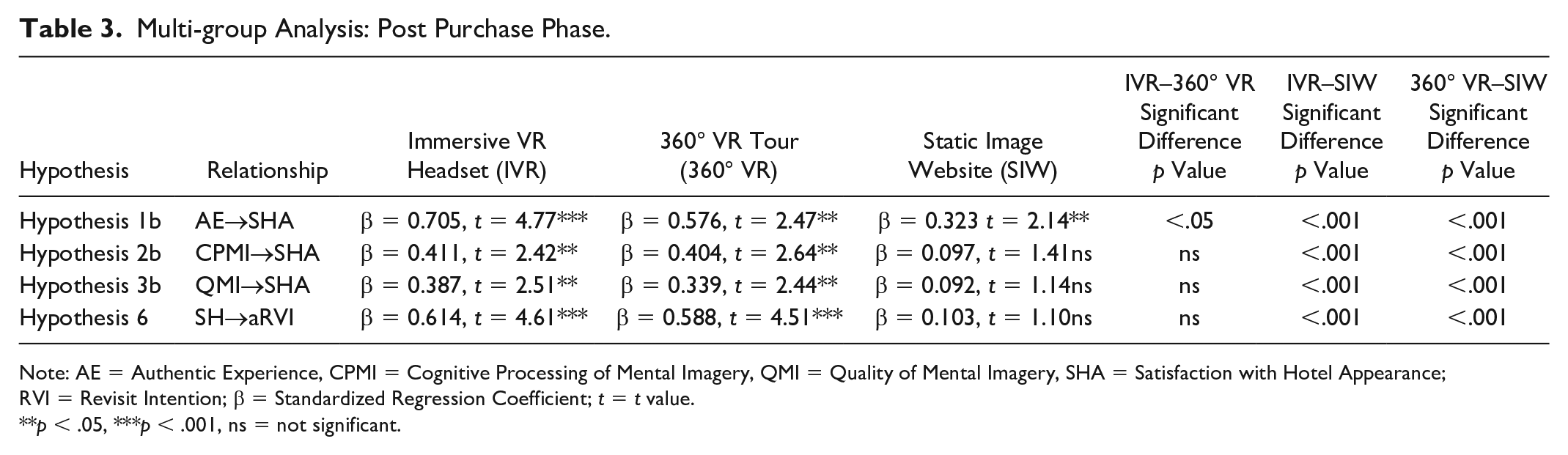
Note: AE = Authentic Experience, CPMI = Cognitive Processing of Mental Imagery, QMI = Quality of Mental Imagery, SHA = Satisfaction with Hotel Appearance; RVI = Revisit Intention; β = Standardized Regression Coefficient; t = t value.
p < .05, ***p < .001, ns = not significant.
The results detailed in Table 3 outline support and partial support for the hypotheses in the postpurchase phase of Figure 1. In relation to hypothesis 1b, we found that the relationship between the authenticity of the experience and satisfaction with the hotel appearance was more significant in the Immersive VR headset preview (βIVR = 0.705, t = 4.77***, β360°VR = 0.576, t = 2.47**; p < .05; βSIW = 0.323, t = 2.14**; p < .001), thus providing support for hypothesis 1b. Therefore, we can conclude that the complete transportation and immersion in the virtual world provides a more authentic hotel experience than both the 360° VR tour and the static image website, resulting in increased satisfaction with the hotel appearance following their visit. Thus, those consumers using an immersive VR headset preview are more likely to have their prior expectations met than those viewing other previews of the hotel.
Moreover, regarding hypothesis 2b, cognitive processing of mental imagery was more significant in both VR previews (immersive VR headset and 360° VR tour) in comparison to the static image website but no differences were found between the two different VR conditions (βIVR = 0.411, t = 2.42**, β360°VR = 0.404, t = 2.64**; p = ns; βSIW = 0.097, t = 1.41ns; IVR – SWI p < .001; 360°VR – SWI p < .001). Therefore, despite the different levels of interactivity, both VR conditions seemed to produce the same level of cognitive processing of mental imagery (IVR mean = 6.23; 360°VR mean = 6.01) and have the same positive effect on satisfaction with the hotel appearance. In contrast, both VR conditions result in higher levels of satisfaction with the appearance than the less interactive static image website, thus offering partial support for hypothesis 2b. A similar result was found in relation to the quality of the mental imagery on satisfaction with the hotel appearance (βIVR = 0.387, t = 2.51**, β360°VR = 0.339, t = 2.44**; p = ns; βSIW = 0.092, t = 1.14ns; IVR – SWI p < .001; 360°VR – SWI p < .001), Illustrating partial support for hypothesis 3b. Thus, the content from the VR previews helps to develop a clearer and more cognitively involved experience, enabling consumers to mentally picture the hotel and themselves at the hotel, which creates a realistic expectation in the mind of the consumer and thus satisfaction with the hotel appearance.
Hypothesis 6 outlined that those viewing the hotel through the higher interactive VR headset preview would be more likely to revisit the hotel because of their satisfaction with the hotel appearance meeting their pre-travel expectations. The results indicate partial support for this hypothesis as no significant difference was found between the Immersive VR headset preview and the 360° VR tour preview (βIVR = 0.614, t = 4.61***, β360°VR = 0.588, t = 4.51***; p = ns), however, significant differences were found between both VR conditions and the static image website (βSIW = 0.103, t = 1.10ns; IVR – SWI p < .001; 360°VR – SWI p < .001). Additionally, we found that individuals in the VR previews were more satisfied with the hotel appearance than those who used the static image website (IVR mean = 6.39; 360° VR mean = 6.47; SWI mean = 4.87). Thus, in both VR previews (Immersive VR headsets, 360° VR tour preview), because of the authentic, clearer, and more involved mental imagery developed of the hotel and subsequent satisfaction with the appearance, consumers become more likely to visit in the future than those who used the less interactive stimuli. This finding further emphasizes that the VR previews provide a closer representation of a venue and thus helps to meet and manage customer expectations. As such, expectations are adequately met, and this spills over to influence them to visit again in the future.
The following section draws on the results of study 1 and study 2 and presents a series of theoretical and practical implications from this research.
Discussion
With the advent of Covid-19, operators in the travel and tourism industry face extraordinary challenges with shrinking consumer confidence (CCI 2020). It is now a world where managers encounter several unknowns with regard to investment in new technologies and the capabilities of these technologies to positively influence the pre- and postpurchase stages of the consumer decision-making process. While VR has been previously studied in tourism, this study has made one of the first attempts to understand VR’s ability to influence consumers’ behavior during the prepurchase phase and postpurchase phase of a hotel booking journey in comparison to other preview styles. A limited number of hotel brands such as Marriot and Hyatt Regency have recently introduced VR experiences that enable consumers to view 360° VR tours of the hotel or resort’s facilities prior to visiting; however, little is known regarding the benefits of these VR experiences. The findings of study 1 and study 2 suggest that VR can provide advantageous outcomes for both hotels and tourism consumers through creating multisensory experiences that offer an authentic representation of a venue’s facilities in the virtual environment. This research outlines that VR plays a vital role in stimulating mental imagery that provides a clear and vivid cognitively involved experience that immerses consumers in a hotel’s environment. The results pertain that there are minimal differences between immersive VR headset previews and 360° VR tour previews on the tested variables. Meanwhile, significant differences are found between both VR previews and a static image website. Accordingly, hotel providers should consider investing in the use of virtual reality as a preview style to showcase their facilities to positively influence consumers at both the prepurchase stage and postpurchase stage of their journey. The following sections will provide a detailed account of our theoretical and practical implications.
Theoretical Implications
This study aimed to compare the authentic experience, the development of mental imagery, and immersion in the experience induced by VR on learning and visit intentions in comparison to less interactive, immersive, and media-rich preview styles during the prepurchase phase of the consumer purchase journey. Additionally, we assess the authenticity of the experience and developed mental imagery on satisfaction with the actual hotel appearance and subsequent revisit intention at the postpurchase phase of the consumer purchase journey. While prior research (Wei, Qi, and Zhang 2019; M. J. Kim, Lee, and Jung 2020) has investigated the influence of VR on visiting a destination through cognitive and affective responses, we take an alternative approach through studying the realism of the experience via the authenticity as well as the mental imagery (cognitive processing and quality) induced by the highly interactive and sensory-filled virtual reality. More so, the extant literature has failed to draw comparisons between different preview styles across the different stages of the consumer purchase journey.
Our results affirmed our conceptualization of immersive VR headsets offering the highest level of interactivity, followed by the 360° VR tour and, subsequently, the static image website. Prior literature within the virtual environment outlined that a more interactive experience results in higher levels of immersion and satisfaction with the experience (Song and Zinkhan 2008). Additionally, prior research outlined that interactive product presentations (J. H. Schlosser 2003), dynamic presentation formats (Kim et al. 2014), and control features (Oh and Sundar 2015) lead to more authentic experiences. However, the results illustrate that only a small number of differences exist between immersive VR headsets (highest level of interactivity) and the 360° VR tour (less interactive). For example, we found that the authenticity of the experience has a stronger influence on immersion in the experience (prepurchase phase) and satisfaction in the hotel appearance (postpurchase phase) in VR headsets compared to both other previews. Thus, while positive effects were found in both other preview styles (360° VR tour and static image website), such effects were stronger in the immersive VR preview. Therefore, building on previous studies that have found authentic experiences to result in immersion (Mura, Tavakoli, and Sharif 2017; Muñoz Morcillo et al. 2017), this research outlines the authentic experience delivered in a highly interactive and immersive sensory VR headset preview provides an even greater illusion of transporting tourism consumers to the hotel and the feeling of presence in the virtual environment than in other preview styles. Accordingly, supporting previous conceptualizations, VR provides a more complete pictorial representation of a hotel and has the capability to enhance consumers’ immersion in the experience through making information more realistic to the tourism consumer while also developing realistic expectations that are met following a stay at the hotel. In contrast to 360° VR tours, Immersive VR headsets detach individuals from the physical world and embed them in a different virtual world where they can move their bodies and directly interact with the new environment. Immersive VR headsets omit interruptions from the physical real world, providing consumers the feeling of “being present” in an alternative world. The ability to leave the physical-real world behind and avoid interruptions enhances the authenticity of the experience and increased immersion, explaining the difference found between VR headsets and 360° VR tours. Additionally, drawing parallels with immersion in computer games (Pietschmann, Valtin, and Ohler 2012), the increased sensory information in the highly interactive virtual reality environment may also explain the greater realistic takeaways that meet customer expectations, elicit higher levels of immersion, and a heightened sense of presence in the experience.
Moreover, previous research found that 3D visualizations of online products resulted in more intense mental imagery (Overmars and Poels 2015). Our research finds mixed results with regard to mental imagery. On the one hand, cognitive processing of mental imagery has a greater significant effect on immersion in the VR headset preview than both other previews (360° VR tour and static image website). Thus, the hyperrealistic immersive virtual environment elicits higher levels of mental imagery and subsequently increases the sense of being there and the feeling of shifting into an alternate environment. However, although we find an increased effect of cognitive processing of mental imagery, we find no differences exist across all preview styles with regard to the quality of the mental imagery in both the prepurchase and postpurchase stage on immersion and satisfaction with the hotel appearance. Therefore, while VR stimulates increased thinking and development of mental imagery, the technology does not influence the quality of the imagery. Thus, because of the increased cognitive processing of the VR stimuli, consumers feel more present in the environment, but due to the vivid and clear images presented across all three conditions, no significant differences are found on immersion with regard to mental image quality. Given that the quality of mental imagery is conceptually related to the vividness of images, the findings in this study challenge those in previous studies (e.g., Van Kerrebroeck, Brengman, and Willems 2017) that VR is perceived as more vivid than other presentation styles.
Furthermore, the results pertain there is no significant difference between the VR immersive headset preview and the 360° VR tour preview on satisfaction with the hotel appearance in the postpurchase phase. Despite this, significant differences were found between both VR previews (VR immersive headset preview and the 360° VR tour preview) and the static image website preview. The mental imagery developed through the higher interactive VR previews stimulates similar mental imagery prior to a visit, which meets tourism consumers’ expectations of the hotel than a less interactive virtual environment (static image website). Hence, the mental imagery in the VR previews results in satisfaction with the hotel’s appearance compared to the static image website, which has no significant effect.
Similarly, while we find that VR headsets offer the highest level of interactivity and immersiveness across the three previews, we find no differences between the effects of immersion on learning and visit intentions between each VR preview. However, both VR preview styles have a significant difference on the effects of immersion in comparison to the static image website preview. Prior research suggests that the persuasiveness of VR is centered on presence theory (Tussyadiah, Wang and Jia 2017). Thus, it is the degree to which an individual feels like they have departed their original environment and arrived in another (Kim and Biocca 1997). Hence, this complete immersion in a virtual environment is a critical factor in influencing behaviors and behavioral intentions. The findings detail that the immersion in the experience across both VR previews results in an increased likelihood to visit a hotel, encouraging the tourist to live the real physical experience. Prior research illustrates that presence in highly immersive virtual environments can also stimulate learning (Jung et al. 2016; Van Noort, Voorveld, and Van Reijmersdal 2012). Building on this, we find that sensory virtual reality environments that allow tourism consumers to transport themselves into an immersive virtual world provide stimuli that enhances learning about the hotel and its facilities. In comparison, the low interactive static image website had no significant effect on tourism consumers learning about the hotel. Thus, providing consumers with VR environments that offer sensory-rich information provides a more complete representation of the hotel to allow them to learn about the hotel’s features and facilities. In addition, the learning drawn from the VR spills over to further influence visit intentions.
Given that VR provides a more precise and sensory-rich representation of a hotel, the technology can aid marketers to manage tourism consumers’ expectations by enabling them to familiarize themselves with the venue prior to visiting. Hence, enabling tourism consumers to immerse themselves in rich media experiences through VR in the comfort of their own home prior to their trip allows marketers to provide previews that meet tourism consumers’ expectations and subsequently result in an increased likelihood of visiting again in the future in comparison to those previewing the hotel’s facilities via a static image website. Therefore, VR plays a critical role in the postpurchase phase of the consumer purchase journey in influencing both satisfaction with the hotel appearance (driven by the authentic experience and mental imagery) and further revisit intention in comparison to the nonsignificant effect of satisfaction with the hotel appearance on revisit intentions in the static image website preview.
Overall, while some nonsignificant differences were found between the VR immersive headset preview and the 360° VR tour preview, both VR previews resulted in more significant effects across all tested variables in comparison to a static image website. While both VR previews are different in their levels of interactivity, immersiveness, and media richness (as affirmed by prior literature and the findings of this research), the ability to manipulate the environment, obtain complete control, interact with tactile sensation, and interact with numerous points of sensory information are similar across both preview styles, possibly explaining the limited difference found between both preview styles. As authenticity of the experience was higher in the VR headset preview and resulted in greater effects on immersion and satisfaction, a plausible explanation is due to the complete immersion and transportation to an alternative world. In comparison, the 360° VR tour preview still enables individuals to interact and see the physical real world and thus be subject to real-world interruptions. Similarly, the complete absorption in the VR headset preview may also explain the increased influence on cognitive processing of mental imagery (ability to imagine and fantasize) and its effect on immersion in the experience. Despite these observations, both VR conditions provide a highly interactive environment with important sensory information. VR immersive headsets offer the added ability to leave and completely block out the physical, real world and arrive with presence in a sensory-rich virtual reality world and physically move around. Importantly, VR appears to address a gap that is often found between prior customer expectations and their actual experience (see Parasuraman, Berry, and Zeithaml 1991). The results pertain that those using either VR preview are more satisfied with the hotel appearance than those using the image website preview. Hence, VR acts as a useful technology to aid marketers in managing customer expectations by providing a realistic account of a venue’s (hotel’s) facilities. Accordingly, this research takes a step forward in our theoretical understanding of VR in positively influencing outcomes in both the prepurchase phase and postpurchase phase of a tourism consumer’s purchase journey.
Practical Implications
This research has numerous practical implications for hotel managers. The research outlines the importance of VR previews during the prepurchase and postpurchase phase of a tourism consumers’ purchase decision journey. The results indicate to managers that VR previews (both Immersive VR headset previews and 360° VR tour previews) enable consumers to develop clearer and more involved mental imagery to help them imagine themselves experiencing the hotel. Additionally, both VR previews provide consumers with a more authentic experience in comparison to the experience sought from images on a hotel provider’s website. The in-depth sensory-rich information provided to tourism consumers while interacting with VR previews provides a heightened immersion in their activity. Such focus and immersion in the hotel’s stimuli result in increased knowledge of the hotel and its facilities and, importantly, an increased likelihood of visiting the hotel. Thus, it is important that hotel providers consider investing in VR previews to display on their website. Managers should note that while we see some more positive effects in the VR immersive headset preview in comparison to a 360° VR tour preview, we see significant differences across all variables (immersion, visit intention, learning, satisfaction, and revisit intention) at both prepurchase and postpurchase phases in both VR previews in comparison to the static image website preview. Thus, the implementation of VR in some form provides fruitful results. Given the minimal difference found between VR headset experiences and 360° VR tour experiences, hotel providers ought to consider the more accessible 360° VR tour to showcase their hotel and facilities. Accordingly, hotel providers should consider the development of VR experiences in 3D modeling platforms such as Matterport which enables viewing through either a desktop computer in the form of a 360° VR tour or via a VR headset. Such platforms enable one investment that meets the needs of VR headset users and those who favor 360° VR tours. Given that hotel managers are continually seeking to improve interaction and engagement on their websites (Bogicevic et al. 2019), and world events have brought new constraints to both consumers and operators, VR provides a highly interactive experience that offers hotel managers the ability to provide a realistic representation of their hotel and its facilities utilizing sensory information such as tactile sensation.
Moreover, as VR is able to familiarize consumers with unfamiliar places, and hence able to showcase an unknown hotel and its facilities to a tourism consumer prior to their visit, this study found that during the postpurchase phase of a travel consumer’s decision-making journey, the authentic experience from the VR and the mental imagery elicited from the VR positively influences tourism consumers’ actual satisfaction with the hotel appearance in comparison to the nonsignificant effect of the static image website preview. Consequently, hotel providers are able to manage their customers’ expectations of the hotel appearance through a more realistic representation of the hotel and its facilities with VR previews (both immersive headset VR previews and 360° VR tour previews). Thus, the match between customer expectations and the final product (the hotel) results in an increased likelihood of visiting the hotel again in the future. Hence, VR offers hotel providers a tool to manage customer expectations, meet expectations, and in turn, increase the likelihood of driving repeat business.
Limitations and Future Research
While this study has taken steps forward in our understanding of VR during the prepurchase and postpurchase phase of tourism consumers’ purchase journey, there are a number of limitations in our research that offer avenues for future research. Firstly, this study was limited to one 4-star hotel based in the United Kingdom. In order to produce more generalizable results, it would be fruitful to test our model and findings in other settings and with other hotels’ previews, which display different colors, designs, and formats. We also note that while we asked participants their primary source of information in their decision to book the hotel in study 2, there could be a compounding effect from those guests who used multiple previews; future research should explore this in more detail. Second, the hotel in this study has guests who mainly stay for 2–5 days. It would be interesting to examine those hotels that are booked for longer durations to identify if any differences exist.
Third, study 1 examined three types of previews, (1) VR immersive headset preview, (2) 360° VR tour preview, and (3) a static image website preview in a controlled lab setting. It would be beneficial to compare actual consumer use in a field setting. Fourth, while we assessed the development of mental imagery, we did not test individual-level differences in participants’ proneness to imagine and develop mental imagery. Future research could assess this potential moderating factor.
Fifth, the need to wear a VR headset in the VR immersive headset preview versus the freedom of no technology attached to the body in the 360° VR tour preview may have played a role in the limited significant differences between both conditions. Thus, it would be advantageous in the development of our theoretical and practical understanding of VR for future research to assess this factor. Sixth, while we studied the authentic experience from the VR previews, future research could dive deeper into the sensory modalities to manipulate haptic and auditory information to identify if the manipulation has an influence on the development of mental imagery and the feeling of being present in the virtual environment.
Seventh, while we found a significant influence between satisfaction with the hotel appearance and revisit intention when guests had used a VR preview, no significant influence was found when guests used a static image website. This may be due to guests not being in a planning mood or due to variety-seeking behavior. Future research should control for these contexts to further enhance our understanding. Eighth, it would be insightful for future research to assess the relationship between satisfaction with the hotel appearance and intentions to recommend.
Ninth, our data collection was prior to the global Covid-19 pandemic. Thus, while we do not expect any differences in relation to the hypotheses tested in this research, we do not directly claim or assess the benefits of a VR preview experience as a replacement for taking a vacation. Future research could explore this avenue and assess the role of VR on a number of pertinent variables such as consumer well-being and brand reputation. Lastly, given VR induces immersion in the experience, increases learning, and heightens booking intentions, it would be interesting for future research to explore the influence of VR in increasing bookings directly with the hotel rather than through online travel intermediaries.
Footnotes
Declaration of Conflicting Interests
The author(s) declared no potential conflicts of interest with respect to the research, authorship, and/or publication of this article.
Funding
The author(s) received no financial support for the research, authorship, and/or publication of this article.
