




Abstract
The purpose of this research is twofold: firstly, we aim to understand the role of virtual reality (VR) in influencing tourism consumers’ attitudes toward a tourist destination and, secondly, understand the influence of different levels of sensory information presented through VR experiences on the development of mental imagery, attitudes toward the destination, and visit intention. We tackle this through a multistudy experimental approach. First, in study 1, we demonstrate that VR plays a positive role in enhancing previously held consumer attitudes toward a tourist destination. Second, we affirm that VR has a greater positive effect on attitudes toward a destination in comparison to a less immersive technology (i.e., website). Third, in study 2, we find that different levels of sensory information in VR experiences result in significant differences with regard to the developed mental imagery, sense of presence in the experience, attitudes toward the destination and visit intentions.
Keywords
Introduction
Technological innovations continue to have a tremendous impact on the tourism sector and destination promotion (Wei, Qi, and Zhang 2019). Virtual reality (hereafter VR) has been outlined as one of the most important technological developments to influence the tourism sector owing to its ability to engage consumers and to market tourism destinations and sell tourism services (Tussyadiah et al. 2018; Bogicevic et al. 2019). The use of VR has spread across multiple tourism industries with the presence of VR in hotel experiences, destination branding, museum experiences, theme parks, adventure activities, and cultural heritage sites (see Bogicevic et al. 2019; Wei, Qi, and Zhang 2019; Griffin et al. 2017; Jung et al. 2018; Jung et al. 2016; Rainoldi et al. 2018; Li and Chen 2019). The application of VR in each of these industries is based on the premise that the technology can transform experiences and positively influence behavior (Zeng et al. 2020). The augmented reality and VR market is forecast to grow to a $160 billion market by 2023 (Statista 2020). However, despite the widespread growth of VR across various tourism industries and the elucidation of its impact on transforming the tourism experience, there has been limited empirical research on the influence of VR on consumer attitudes and the effects of the varying multisensory information that can be delivered through VR. In light of the COVID-19 global pandemic, tourist boards, now more than ever, need to develop new ways for consumers to experience destinations to encourage their visit. The pandemic has sprung unprecedented change, which presents significant challenges for the tourism sector. Accordingly, as the sector works to recover and adapt to the “new normal,” tourism marketers are responsible for developing the correct strategy to ensure their destination remains attractive. As vacations become safer, some consumers may require encouragement to travel again. Thus, VR enables tourism marketers to communicate intangible tourism experiences to travelers through immersive sensory experiences that may influence the consumer’s likelihood of visiting the destination.
VR technology can create a three-dimensional (3D) virtual version of the real world (Williams and Hobson 1995), which can enable tourism consumers to experience a destination prior to a visit (Israel, Zerres, and Tscheulin 2019). According to Egger and Neuburger (2020), a multitude of definitions in relation to VR exist, thus contributing to numerous discrepancies. Beck, Rainoldi, and Egger (2019) note that many tourism studies on VR fail to capture the tourism context within their definition. Accordingly, this study defines VR in tourism based on Beck, Rainoldi, and Egger’s (2019) interpretation, in which they define VR in tourism as “the provision of synthetic or 360-degree real life captured content with a capable non-, semi-, or fully immersive VR system, enabling virtual touristic experiences that stimulate the visual sense and potentially additional other senses of the user for the purpose of planning, management, marketing, information exchange, entertainment, education, accessibility or heritage preservation, either prior to, during or after travel” (Beck, Rainoldi, and Egger 2019, p. 591).
A VR environment can be considered a digital space in which an individual’s actions or movements are tracked, and surroundings digitally composed and displayed to the individual to evoke their senses in line with their actions or movements (Fox, Arena, and Bailenson 2009). Hence, a VR environment ought to provide consumers with a substitute world through enabling consumers to block out information from the “real” world to allow them to fully immerse in the virtual world (Bogicevic et al. 2019). VR can enable a sense of presence that refers to the state in which an individual feels like “actually being there” in a computer-mediated environment (Ijsselsteijn and Riva 2003), or the degree to which an individual feels “physically” present in the virtual environment (Steuer 1992). Thus, the individual feels like he or she has shifted from the physical world to becoming immersed in an alternative virtual world (Wei, Qi, and Zhang 2019). The extant literature details that the sense of presence experienced through VR could have a positive effect on consumer experiences (De Gauquier et al. 2018), enable consumers to obtain highly interactive sensory information to aid hotel booking decisions (Bogicevic et al. 2019), and influence consumers’ intention to recommend a destination (Wei, Qi, and Zhang 2019). The inclusion of interactive sensory information in VR experiences could influence consumer attitudes toward a destination and thus could play an important role in destination branding and promotion (Beck and Egger 2018).
Despite the growing interest in VR by both tourism consumers and tourism marketers, both rely somewhat on the presentation of destinations through a computer-mediated website displaying basic nondynamic images of the destination or venue (Israel, Zerres, and Tscheulin 2019). While basic nondynamic images can present vivid nonverbal information to tourism consumers, VR has the capability to provide extensive verbal and nonverbal sensory information including visual, haptic, gustatory, auditory, or olfactory cues (Miller and Stoica 2004). Thus, VR provides a fundamentally different experience to consuming destination information in comparison to basic nonverbal previews owing to the sensory and media-rich content (Wei, Qi, and Zhang 2019). However, despite VR’s capability in presenting such sensory-rich information, VR experiences can differ significantly in their level of sensory information. For example, some experiences provide tourism consumers with what can be considered a high-level sensory VR experience with interactive visual displays, haptic technology (which involves a tactile sensation in the form of a small vibration to provide the user feedback), text information, and audio information. Conversely, others can provide a lower sensory VR experience with the absence of haptic technology and text, and to an even lesser extent, an interactive visual experience with no audio, text, or tactile sensation. Such variations in a VR preview experience merit further research to enhance our understanding on the influence of the technology in destination promotion (Bogicevic et al. 2019).
Accordingly, the purpose of this research is twofold: first, we aim to understand the role of VR in influencing tourism consumers’ attitudes toward a tourist destination; second, responding to calls for research (e.g., Bogicevic et al. 2018; Beck, Rainoldi, and Egger 2019), we aim to understand the influence of different levels of sensory information presented through VR on the development of mental imagery, sense of presence, attitudes toward the destination, and visit intention. Specifically, we tackle this through a multistudy experimental approach. In study 1, we conduct a lab-based experiment with 224 participants to assess the effect VR has on attitudes toward a tourism destination comparing them with previously held attitudes toward the destination prior to VR and attitudes developed from a website preview experience of the destination. In study 2, we conduct a second lab-based experiment with 303 participants to assess the effects of the different levels of sensory information displayed through VR on developing mental imagery, sense of presence, attitudes toward the destination, and visit intention across three different VR experiences (high-level sensory VR experience; midlevel sensory VR experience; and low-level sensory VR experience). The VR experiences in study 2 were specifically developed for this study enabling the manipulation of sensory information. The VR experiences permitted participants to explore sightseeing spots in Egypt and immerse themselves in the Egyptian temples, pyramids, museums in Cairo, the Great Sphinx, Alexandria, Luxor, and Aswan. Hence, this research advances our theoretical understanding of VR, the role of the sensory information inherent within VR, and its application in tourism. By uncovering the role of the sensory information in VR, this research also provides practical implications for the use of VR in attracting tourism consumers to travel destinations.
Literature Review
VR and Tourism Marketing
VR is considered an interactive computer-generated environment that simulates the physical world with real-life scenarios and enables individuals to interact with objects and feel a sense of presence (Diemer et al. 2015; Tussyadiah et al. 2018; M. J. Kim and Hall 2019). Early tourism literature on VR focused on 3D virtual worlds through the use of avatars (e.g., Second Life) as virtual reality. However, this practice of VR is greatly different from the VR available today through the use of 360° interactive VR video tours and immersive VR headsets. In today’s VR, the virtual environment is modified in real time based on the user’s interactions and movement, which enables the individual to develop vivid mental images of the environment, increasing the illusion of “being there” and fully immersed in the virtual world (Tussyadiah et al. 2018). A highly immersive form of VR is experienced through wearable immersive headset devices such as the Oculus Quest, Google Cardboard, HTC Vive, and Samsung Gear VR. Through wearing VR headset devices, a tourism consumer can experience the virtual environment as though they are an actual part of the experience and immersed within it (Wei, Qi, and Zhang 2019). Alternatively, without the need to wear a piece of technology, the introduction of 360° interactive VR video experiences has enabled marketers to offer consumers a less immersive VR experience (Beck, Rainoldi, and Egger 2019; Bogicevic et al. 2019). Beck, Rainoldi, and Egger (2019) illustrate that 360° interactive VR videos provide a nonimmersive experience, while VR headsets provide fully immersive experiences as consumers are completely isolated from the physical real world without interruptions. While different forms of VR experiences exist, the current study focuses on fully immersive VR headset experiences.
The application of fully immersive VR experiences in tourism has amplified in both practice and research in recent years (Zeng et al. 2020). According to Egger and Neuburger (2020), VR is developed based on the desire of individuals to be able to leave their real-world environment at will. A comparison can be drawn with the premise of going on vacation or traveling in general where individuals have the desire to leave their familiar environment temporarily. Beck, Rainoldi, and Egger (2019) conducted a review of 27 papers on VR in tourism distinguishing between the aforementioned non-, semi-, and fully immersive VR systems. VR has been outlined as enabling marketers to communicate with consumers to promote destinations (González-Rodríguez, Díaz-Fernández, and Pino-Mejías 2020), enhance consumer involvement (Flavián, Ibáñez-Sánchez, and Orús 2019), offer lifelike authentic experiences (M. J. Kim, Lee, and Jung 2020; Deng, Unnava, and Lee 2019), provide enjoyable experiences (Israel, Zerres, and Tscheulin 2019), and influence consumer attitudes and behaviors (Li and Chen 2019). Accordingly, from a marketing perspective, VR has the potential to influence tourism consumers across the customer journey as defined by Lemon and Verhoef (2016) (i.e., prepurchase–purchase–postpurchase). For example, VR can be used to communicate inspirational content to consumers at the pretravel (prepurchase) phase to entice consumers to visit a destination, considered a “try before you buy experience” (Tussyadiah et al. 2017; Huang et al. 2016). More so, VR technology can also be beneficial during the consumption “on-trip” (purchase) phase, for example, to experience heritage or tourism sites that are not accessible owing to restrictions, danger, or no longer physically in existence (Beck and Egger 2018). Lastly, in the posttravel phase, VR can be used to repeat the travel experience where tourists can draw on their memory of their experience (Egger and Neuburger 2020). In turn, scholars have explored the benefits of VR in tourism (Moorhouse, tom Dieck, and Jung 2018; Bonetti, Warnaby, and Quinn 2018), the role of VR in enhancing touristic experiences (Flavián, Ibáñez-Sánchez, and Orús 2019; Beck, Rainoldi, and Egger 2019; Jung et al. 2018; Tussyadiah et al. 2018; Wei, Qi, and Zhang 2019), and facilitating immersive experiences (Guttentag 2010; tom Dieck et al. 2018). Further research has confirmed that VR enables a sense of presence in the virtual environment (Bogicevic et al. 2019; Wei, Qi, and Zhang 2019; Tussyadiah et al. 2018), while other studies emphasize that such presence could influence visit intentions (Disztinger, Schlogl, and Groth 2017; Kim et al. 2020; Li and Chen 2019). Additionally, recent research suggests that VR can enable a high level of mental imagery of a destination and could increase travel intentions (Zeng et al. 2020). An overview of recent research on VR in tourism since 2018 can be seen in Supplemental Table S1.
Presence in VR
The persuasiveness and effectiveness of VR is most often attributed to presence theory (Tussyadiah et al. 2018). In the context of technology, the literature defines “the sense of presence” as the psychological state in which an individual feels completely immersed and the feeling of “actually being there” in a computer-mediated environment (Ijsselsteijn and Riva 2003), or the degree to which the individual feels “physically” present in the virtual environment (Steuer 1992; Schubert, Friedmann, and Regenbrecht 2001; Slater and Usoh 1993). Thus, the level of presence a tourism consumer experiences through VR is dependent on the extent to which the consumer feels he or she has shifted from the physical world to becoming present in an alternative virtual world (Wei, Qi, and Zhang 2019). T. Kim and Biocca (1997) distinguish presence as incorporating two key dimensions, “arrival” (the feeling of being present in a mediated environment) and “departure” (the feeling of separation away from the physical environment). The sense of presence in technology has been outlined as a critical factor in influencing attitudes and behaviors in a virtual environment (Bogicevic et al. 2019; Faiola et al. 2013). The extant literature outlines that technology with higher levels of interactivity leads to increased levels of presence in the experience (Mollen and Wilson 2010; Tussyadiah et al. 2018). In destination marketing, previous studies have detailed that the sense of presence results in a positive perception of a destination (Hyun and O’Keefe 2012) and an increased likelihood to visit the destination (Han and Kai 2015). However, despite the capability of VR in stimulating presence, we lack understanding of VR’s influence on customer attitudes and the potential of the technology to change attitudes toward a destination. Tussyadiah et al. (2018) assessed presence on attitude change through nonimmersive VR; however, this was assessed through an attitude change scale rather than assessing attitudes prior to and post a VR experience to assess any change. In contrast, this study takes the latter approach within a fully immersive VR experience. More so, while previous research has explored the benefits of VR (e.g., Moorhouse, tom Dieck, and Jung 2018) and its role in enhancing touristic experiences (e.g., Wei, Qi, and Zhang 2019) as well as a sense of presence in the virtual environment (Bogicevic et al. 2019), we have limited understanding on the role of VR in comparison to other less immersive technology (e.g., a website) in influencing customer attitudes toward destinations. Hence, given that the persuasiveness and effectiveness of VR is attributed to the feeling of presence, this study suggests that VR is capable of positively influencing customer attitudes toward a destination. Thus, we hypothesize:
Hypothesis 1a: Following a VR experience, tourism consumers will have a more positive attitude toward the tourist destination than prior to the VR experience.
Hypothesis 1b: Tourism consumers will have a more positive attitude toward the tourist destination in the VR experience in comparison to a website experience.
Sensory Information in VR
As previously alluded to, VR enables tourism marketers to present tourism consumers with an array of sensory information. Given today’s increased competition between tourism destinations, Lee, Gretzel, and Law (2010) outline the importance of developing sensory appeals that can influence consumer attitudes. In recent years, marketing scholars have been interested in the role of sensory experiences in decision making; in turn, the term “sensory marketing” was coined (Schmitt 1999). Accordingly, Krishna (2012, p. 332) defines sensory marketing as “marketing that engages the consumers’ senses and affects their perception, judgement and behaviour.” Thus, consumer experiences derive from the stimulation of senses, which are relied on for comprehending their environment (Ackerman, Nocera, and Bargh 2010). Psychology scholars outline that cognitive mental processing is grounded in sensory experiences (see: Meier et al. 2012; Barsalou et al. 2008; Niedenthal et al. 2005); hence, from a sensory marketing viewpoint, people perceive the world through their senses, including visual, haptic, auditory, gustatory, or olfactory cues (Miller and Stoica 2004). Much of the work on sensory research in consumer psychology has focused on visual sensory information (see Krishna 2012); however, the works of Meert, Pandelaere, and Patrick (2014) extend this and find other aforementioned sensory information, including haptic and auditory information, to influence consumer attitudes and behaviors. Haptic technology produces a tactile sensation (also known as forced-feedback) in the form of a small vibration to provide a user feedback that something has been activated (Banter 2010); for example, in the context of this study, a tactile sensation may involve an individual selecting an information point or using navigational controls in the VR experience and receiving a feedback vibration. Accordingly, in the digital environment, scholars find that haptic technology can provide a sense of presence and immerse consumers in their experience, while auditory information can significantly influence our decision making (Pagani, Racat, and Hofacker 2019; Meyers-Levy, Bublitz, and Peracchio 2009).
In the context of destination websites, Lee, Gretzel, and Law (2010) find that rich sensory text descriptions (e.g., lush green; amazingly sweet) rather than functional text (e.g., describing distances, numbers, sizes) positively provoke mental imagery and, in turn, positively influence attitudes toward a tourism destination. Additionally, Lv et al. (2020) and Lee and Gretzel (2012) demonstrate that text appeals to consumers’ senses during hotel bookings. In turn, Lee, Gretzel, and Law (2010) outline that sensory information such as text, pictures, graphics, sound, and motion can influence consumers’ attitudes and behaviors. Relatedly, Gretzel and Fesenmaier (2003) detail that sensory marketing cues applied to tourism websites help marketers convey experiences and help consumers form expectations of a destination. Through a combination of sensory attributes, marketers are able to develop experiences that are capable of influencing consumers’ thoughts, feelings, and decisions (Krishna and Schwarz 2014; Krishna 2012). Given that VR can immerse consumers in the highest level of computer-mediated sensory information in comparison to other technologies (Bogicevic et al. 2019), it is understandable that VR develops a greater sense of presence in comparison to websites because of its ability to block out interruptions from the physical world (Tussyadiah et al. 2018). Additionally, Hopf et al (2020) outline that sensory cues relating to odor and tactile sensation can influence the sense of presence in VR tourism experiences by making the virtual world seem as realistic as possible.
Mental imagery and the consumption vision
Developed in the absence of real stimuli, sensory information can help to construct mental imagery in the mind of the consumer (Kosslyn 1976). Such mental imagery can be aroused by one or multiple senses (Miller and Stoica 2004). According to Kosslyn and Ochsner (1994), mental imagery is important to help consumers process information, reason, and learn. Phillips et al. (1995) propose the consumption vision theoretical perspective of mental imagery. The consumption vision refers to the sense-making process that consumers rely on to develop clear and vivid images of themselves experiencing a product or the outcomes of a service experience. Green and Brock (2000) outline this process of mental imagery as a narrative transportation, which encompasses the development of stories from the mental cognitive processing of potential future events. The essence of the consumption vision is that mental imagery does not simply relate to a set of images imagined by the consumer but entails a conscious representation of the consumer experiencing consumption drawing on both cognitive processing of the mental imagery (Debevec and Romeo 1992) and the quality of the mental imagery (Walters, Sparks, and Herington 2007). Therefore, in the context of this study, we draw on the work of Walters, Sparks, and Herington (2007) and take the consumption vision viewpoint that mental imagery is a simulation response to sensory destination information stimuli that incorporates two dimensions: (1) cognitive processing of mental imagery and (2) the quality of mental imagery information to forecast future experiences. Cognitive processing of mental imagery refers to the quantity of images developed in the consumer’s mind as well as their cognitive involvement in the imagined imagery (Yoo and Kim 2014). On the other hand, the quality of the mental imagery relates to the clarity of the mental images, conceptually related to the concept of vividness (McLean and Wilson 2019). Lee, Gretzel, and Law (2010) note that auditory information did not influence the development of mental imagery in their study on destination websites; however, the authors note this may be due to solely measuring one dimension of mental imagery (cognitive processing of mental imagery) and, thus, future research should assess additional aspects of mental imagery.
The current body of literature explains that sensory-induced mental imagery is capable of influencing consumer attitudes and behaviors. For example, Yoo and Kim (2014) found that mental imagery explains the effects of product presentation through a website on purchase and revisit intentions. In a related study, Lee and Gretzel (2012) found that the visual stimuli from a tourist destination website induced mental imagery that enhanced positive attitudes and behaviors toward the website. While the effects of sensory information through websites in influencing the development of mental imagery have been explored, limited attention has been paid to the more immersive and sensory-rich VR environment.
Jiang et al. (2014) and Bogicevic et al. (2019) outline that multiple visuospatial perspectives provide higher levels of information and have a greater influence on positive product evaluations (e.g., the evaluation of a hotel). Elder and Krishna (2012) find that manipulations of visuospatial perspectives can result in increased mental imagery and immersion. More so, Bogicevic et al. (2019) outline the conceptual similarity of this in terms of the notion that VR is a more interactive medium than other technology such as websites, hence offering more visuospatial perspectives and increased immersive sensory information. Consequently, VR could be considered as inducive of mental imagery, with increased cognitive processing of information and more vivid mental imagery, thus enhancing the sense of presence (Van Kerrebroeck, Brengman, and Willems 2017). Based on this, while VR has the propensity to provide tourism consumers with high levels of sensory information during their preview experience, in practice, VR experiences vary in their level of sensory information presented to consumers. Thus, we seek further understanding on the role of sensory information within VR and therefore hypothesize:
Hypothesis 2: (a) Cognitive processing of mental imagery and (b) the quality of mental imagery will elicit a greater sense of presence in a higher sensory-rich VR experience compared to a lower sensory-rich VR experience.
Hypothesis 3: The influence of the sense of presence on (a) stimulating positive attitudes toward the destination and (b) visit intention will be greater in a higher sensory-rich VR experience compared to a lower sensory-rich VR experience.
Moreover, attitude is a common concept in the consumer behavior and social psychology literature. Ajzen and Fishbein’s (1977) work is generally accepted when it states that attitude predicts behavior, although the degree of influence between attitude and behavior can vary depending on the context (Ajzen and Fishbein 1977; Smith and Swinyard 1983). More so, based on the theory of reasoned action (TRA), which outlines an attitude–intention–behavior process (Fishbein and Ajzen 1975), the relationship between attitude and real behavior is meditated by an individual’s intentions. The relationship between attitudes toward a tourism destination and the behavioral intention to visit has been assessed and supported in previous tourism studies (see Phillips, Asperin, and Wolfe 2013; Ryu and Han 2010; Tussyadiah et al. 2018). Tussyadiah et al. (2018) found that attitudes toward a tourism destination as a result of a VR experience were a positive predictor of visit intention. Additionally, previous research has outlined that increased sensory information can have a positive effect on consumers’ attitudes and behaviors (Meert, Pandelaere, and Patrick 2014; Lee, Gretzel, and Law 2010; Krishna and Schwarz 2014). Given the results of previous research regarding the potential influence of VR on purchase intentions and the high level of sensory information VR experiences can provide, we postulate that VR experiences with higher levels of sensory information will strengthen the influence of attitudes toward the destination on visit intentions. Thus, we hypothesize:
Hypothesis 4: The influence of attitudes toward the destination on visit intentions will be greater in a higher sensory-rich VR experience compared to a lower sensory-rich VR experience.
Figure 1 provides a pictorial representation of hypotheses 2a through to 4. The subsequent sections will outline our multiple-study approach to test our hypotheses.
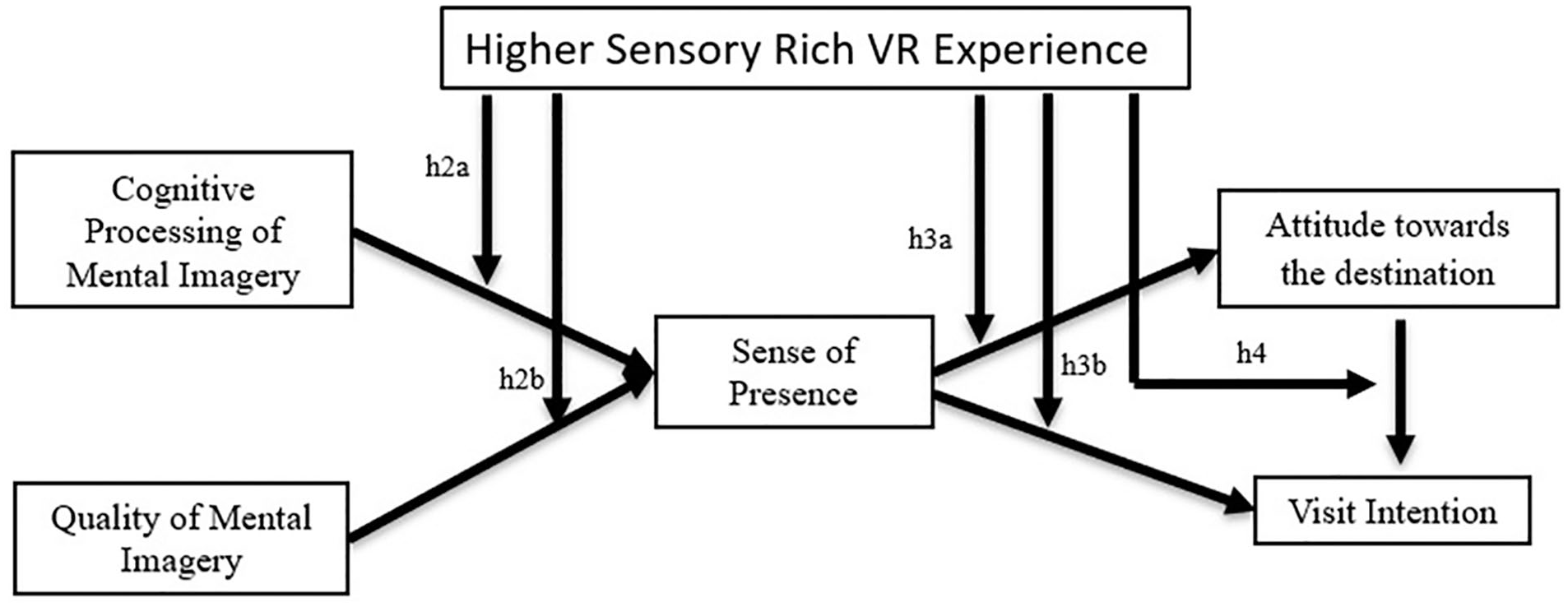
Hypothesized model. The hypothesized model represents study 2. The model is assessed and compared across each condition (high-level sensory VR experience, midlevel sensory VR experience, and low-level sensory VR experience). A higher sensory-rich VR experience is hypothesized to generate greater positive effects in each hypothesis.
Methods and Results
In order to test our hypotheses, we conducted two studies in the United Kingdom. In study 1, we tested hypotheses 1a and 1b. In this study, we assessed participants’ attitudes toward a tourist destination prior to the VR experience, after being exposed to the VR experience and in comparison to those assigned to a less immersive experience. In study 2, we tested the hypothesized model as illustrated in Figure 1. Study 2 enabled us to advance our knowledge on the influence of different levels of sensory information (visual, haptic, auditory, and text) during a VR experience on the relationship between mental imagery and the sense of presence (hypotheses 2 and 2b), and the influence of the sense of presence on attitudes toward the destination and visit intention (hypotheses 3a, 3b, and 4). The following sections provide a detailed account of the specific methodological approach of both studies.
Study 1: Attitudes toward the Destination and VR
This study involved a lab-based experiment in the United Kingdom with 204 participants and tested their attitudes toward a tourist destination prior to the introduction of stimuli (either VR experience or website experience) and subsequently tested participants’ attitudes following the stimuli. A readily available VR tourist destination preview experience was downloaded from the Oculus Store to the Oculus Go headset device. The experience provided 360° visual views of the destination (Egypt); the experience enabled tactile sensation during navigation and during the selection of information points through the use of the Oculus Go controller. No audio was provided during the VR experience. The experience enabled participants to explore sightseeing spots and immerse themselves in the Egyptian temples, pyramids, museums in Cairo, Alexandria, Luxor, and Aswan. The VR can capture head movements and directions, with navigation enabled through pointing the Oculus controller at arrows on the screen. Similarly, in the website view, participants could see static images of the same destination on a mocked-up website and could scroll through the images (38 images in total) on a Dell PC computer. In keeping consistence with the VR experience, the images had a heading detailing the location of the image and a short text description of the image. Participants were given the following short scenario: “You and your friend are considering going travelling. You have yet to decide where you would like to go and are currently considering your options. You are keen on learning about the destination country and its culture.” Prior to the launch of the experiment, we conducted a pilot test (n = 14); this enabled us to appropriately test the experiment (including the equipment) and the logic of the questionnaire along with the face validity of the items in the questionnaire, measuring their corresponding variables. We encountered no logic or face validity issues.
Of the 204 participants, 57% were female; they ranged in age from 18 to 48 years (Mage = 24 years). Participants had good or above computer skills from answering a 5-point Likert-type scale question on rating their computing skills (Mskills = 4.3; SD 0.3). Overall, 29% of the participants had experienced immersive VR through a headset device. Participants were recruited with the aid of a market research agency and a research assistant. In any contact with potential respondents, the market research agency communicated that the topic of the research was on travel and tourism and that the participants should have good computer skills. The research assistant set up the room, welcomed participants, completed ethics consent forms, and provided a technology demonstration on how to use either the VR Oculus headset and controller or the website. Accordingly, in return for their time, participants received a monetary reward. Prior to being exposed to a VR or website destination preview experience, all 204 participants were asked to rate their attitudes toward the test destination in this study, namely, Egypt. Following this, participants were then told they were either going to view a VR preview or a website preview of Egypt. Participants were split between preview conditions evenly (102 assigned to the VR preview; 102 assigned to the website preview). In the VR preview, participants were instructed to fix the Oculus VR headset over their eyes. Prior to experiencing the destination through the VR headset, participants received the aforementioned demonstration on how to use the device and its controller. Following the short demonstration by the research assistant, participants were given time to explore the VR preview experience. Similarly, ensuring there was no researcher bias, participants in the website preview experience also received a short demonstration on how to look through the images on the website and were then given time to explore the website preview experience. The length of time participants could explore either experience was not restricted, to replicate a true-life experience. On average, respondents spent Mtimespent-VR = 7 minutes 32 seconds (SD 1.03 minutes) on the VR experience and Mtimespent-website = 5 minutes 55 seconds (SD 0.57 minutes) on the website experience. Subsequently, on exiting the experience, participants were asked to complete a short questionnaire. The questionnaire comprised questions on demographic variables and consumer attitudes.
Measures
Each of our measures were drawn from the literature and altered to suit the context of this study. The same 7-point semantic differential scale was used to measure attitudes toward the destination prior to VR, following VR and attitudes toward the website. Table 1 provides details of all the scale items used to measure their corresponding variables in both studies 1 and 2. The table provides the original source of the scale and the associated Cronbach’s alpha coefficient in the assessment of the scale’s reliability, composite reliability, and average variance extracted. More so, we assessed how realistic the scenario was to each of the participants. This was measured on a 7-point Likert-type scale (ranging from 1 = very unrealistic; 7 = very realistic); the check illustrated that the scenario was a realistic situation for them (Mrealistic = 6.35, t = 22.24, p < .001).
Measurement Scales.
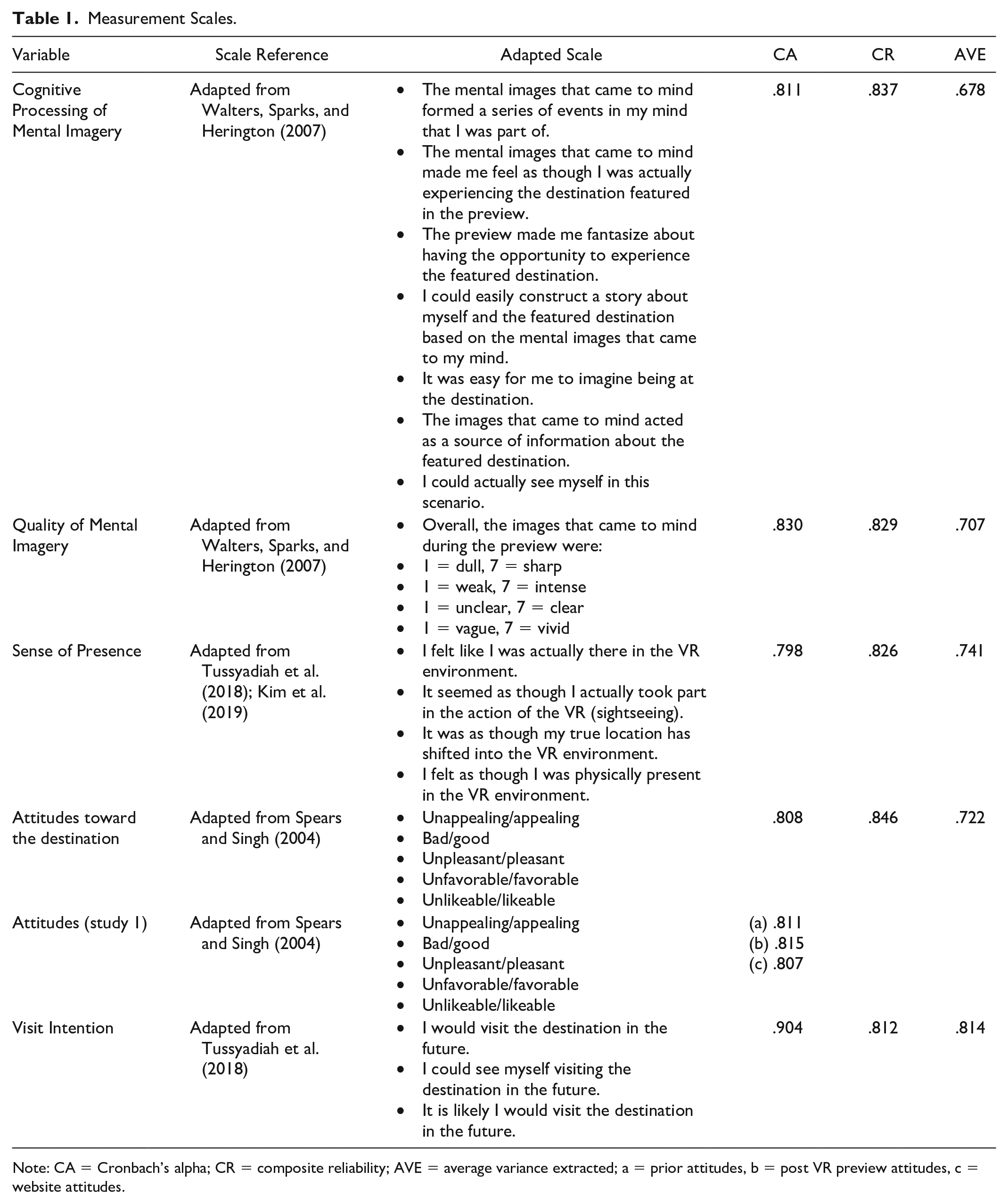
Note: CA = Cronbach’s alpha; CR = composite reliability; AVE = average variance extracted; a = prior attitudes, b = post VR preview attitudes, c = website attitudes.
Data analysis
To test hypothesis 1a, we conducted a paired samples t-test in SPSS. We first conducted a paired samples t-test to examine any attitude change between prior attitudes toward the destination and attitudes following the VR experience (hypothesis 1a). The results affirmed the positive effects of the VR experience on attitudes toward the destination: Mprior_attitude = 4.35 (SD = 0.502), MVR_attitude = 6.05 (SD = 0.340), t (203) = 10.430, p < .001, eta-squared = .65. Thus, the results support hypothesis 1a, asserting that following a VR preview experience of a tourist destination, consumers will have more positive attitudes toward the tourist destination than before the VR experience. Interestingly, we can also see that the website preview experience has no significant effect on influencing tourism consumers’ previously held attitudes toward the destination. A paired samples t-test was conducted between prior attitudes toward the destination and attitudes following the website preview experience and revealed no significant differences, Mprior_attitude = 4.35 (SD = 0.502), Mwebsite_attitude = 4.40 (SD = 0.480), t (203) = 1.57, p = .272.
Moreover, in assessment of hypothesis 1b, we conducted an independent samples t-test to assess consumer attitudes toward the destination between those participants viewing the VR preview and those viewing the website preview. The results indicate the positive effects of the VR preview on attitudes toward the destination: Mwebsite = 4.40 (SD = 0.480), MVR_attitude = 6.05 (SD = 0.340), t (202) = 12.550 p < .001, eta squared = .44. Hence, the result supports hypothesis 1b, acknowledging that participants have more positive attitudes toward the tourist destination in the VR preview in comparison to a less immersive website preview.
Study 2: Sensory Experiences in VR
In this study, we conducted a between-subjects lab-based experiment in the United Kingdom with three treatment modalities: (1) high-level sensory VR experience, (2) midlevel sensory VR experience, and (3) low-level sensory VR experience. We define a high-level sensory VR experience as one that includes visual, tactile sensation, text, and auditory information. A midlevel sensory VR experience as one that includes visual, tactile sensation and text information and finally a low-level sensory VR experience as one that includes visual and tactile sensation.
A total of 303 participants took part in study 2. The participants were evenly split into each treatment modality (101 × 3). Participants in the study were again recruited with the aid of the same market research agency and research assistant as study 1. Overall, 57% of participants were female and 43% male; all participants ranged in age from 18 to 43 years (Mage = 27). Similar to study 1, participants had good or above computer skills from answering a 5-point Likert-type scale question on “rate your computing skills” (Mskills = 4.1, SD 0.4). In total, 25% of participants had experienced immersive VR through a headset device either on PlayStation’s VR headset, Google Cardboard, HTC Vive, Oculus Go, and Rift. Overall, 96% of all respondents use websites to examine tourist destinations, and 75% of the sample considered themselves regular travelers, whereas 17% regarded themselves as occasional travelers and 8% rarely travel.
Participants were given the same scenario as study 1 (“You and your friend are considering going travelling. You have yet to decide where you would like to go and are currently considering your options. You are keen on learning about the destination country and its culture.”). We again selected Egypt as the tourism destination. In this study, we developed a VR experience through Google’s AR/VR Tour-Creator and Google’s Poly. Similar to study 1, the preview experience enabled participants to explore sightseeing spots and immerse themselves in the Egyptian temples, pyramids, museums in Cairo, the Great Sphinx, Alexandria, Luxor, and Aswan. However, in this study we were able to manipulate the sensory information provided in the preview experiences. In line with the aforementioned treatment modalities, we replicated three exact VR experiences with different levels of sensory information (high, mid, low). In the high-level sensory treatment modality, participants were able to view a 360° virtual environment, select information hotspots to read text and listen to audio, and select navigation controls (arrows on the screen). Haptic technology provided participants with a tactile sensation through small vibration feedback when selecting information points and using the navigation control. The text provided written information about the destination providing details on the current view of the participant. The audio provided similar information to the text, with some additional details on the destination based on the current viewpoint of the participant in the VR experience. The midlevel VR experience offered all of the same sensory information with the exception of audio, while the low-level VR experience offered the same sensory information with the exception of audio and text.
In line with study 1, we conducted a pilot test (n = 14) to assess the logic of the questionnaire along with the face validity of the items in the questionnaire measuring their corresponding variables. We encountered no logic or face validity issues. We also used the same immersive Oculus VR headset, enabling head and motion tracking. Prior to the destination preview, each participant was given a demonstration on how to fix the Oculus device over their eyes and how to use the controller’s functionality. Following the demonstration, participants were given time to explore the VR preview experience. Again, in line with study 1, we did not restrict the length of time participants could spend to enable them to replicate a true-life experience. On average, participants spent Mtimespent-highlevel = 10 minutes 55 seconds (SD 1.01 minutes) in the high-level sensory VR experience, Mtimespent-midlevel = 7 minutes 57 seconds (SD 0.55 minutes) in the midlevel sensory VR experience, and Mtimespent-lowlevel = 6 minutes 1 second (SD 1.01 minutes) in the low-level sensory VR experience. Immediately following the experience, participants were asked to complete a questionnaire to test the relationships outlined in Figure 1.
Measures
Each of the measures used in study 2 were derived from previously tested scales available in the extant literature. A 7-point Likert-type scale was used to measure cognitive processing of mental imagery, sense of presence, and intentions to visit the destination. A 7-point semantic differential scale was used to measure the quality of mental imagery and attitudes toward the destination. Following the same procedure as study 1, participants reported the scenario as a realistic activity on a 7-point Likert-type scale (Mrealistic = 6.05, SD 0.5, t = 24.24, p < .001).
Data Analysis
In the assessment of the hypotheses illustrated in Figure 1 (hypotheses 2a, 2b, 3a, 3b, and 4), we utilized structural equation modeling (SEM) in AMOS Graphics. Data were prepared in the statistical software package SPSS 24 for SEM. We used SPSS to calculate descriptive statistics, composite reliabilities, scale reliabilities, and manipulation checks. SEM involves two key parts: first, the stage of covariance-based modeling is to calculate the measurement model which is tested through conducting a confirmatory factor analysis (CFA), followed by the calculation of the structural model. In the assessment of the hypotheses in Figure 1, we used multigroup analysis within AMOS graphics to develop three models to compare each path between the different levels of sensory information (high, mid, and low).
Results
The CFA revealed goodness of fit: χ2(431) = 955.133, ρ = .001, χ2/df = 2.21; root mean square error of approximation (RMSEA) = 0.044, root mean square residual (RMR) = 0.014, standardized root mean square residual (SRMR) = 0.041, comparative fit index (CFI) = 0.985, normed fit index (NFI) = 0.991. Along with the good fit statistics, the regression coefficients ranged from 0.32 to 0.75 and were statistically significant. The average variance extracted (AVE) was calculated to assess the convergent validity, where all the values exceeded the recommended value of 0.5 (Hair, Black, and Babin 2010), while construct reliabilities were higher than 0.70, demonstrating adequate convergent validity for all constructs. The AVE scores also exceeded the square of their correlations, affirming support for discriminant validity. Moreover, multicollinearity was assessed through a variance inflation factor (VIF) analysis. Accordingly, the results detailed that no variable exceeded the critical value of 3.0 (Hair, Black, and Babin 2010); hence, multicollinearity was not violated.
Lastly, to avoid inaccurate understandings from the data, it is important to assess the data for common method bias (CMB; Podsakoff et al. 2003). In AMOS Graphics, we presented a common latent factor (CLF) with all items from each of the variables in the model. The CLF presented a value of 0.423. To calculate the common method variance (CMV), 0.423 was squared, presenting the value of 0.178 (17.8%). According to Ranaweera and Jayawardhena (2014), values falling below 50% satisfy the improbability of CMB.
Moreover, following the preliminary tests on scale reliability, composite reliability, common method bias, convergent and discriminant validity, as well as the goodness of fit reported from the CFA, the structural models were calculated. Prior to estimating the structural model, we tested the model fit. The structural model illustrated goodness of fit: χ2(15) = 44.646, p < .05, χ2/df = 2.9 RMSEA = 0.048, SRMR = 0.020, RMR = 0.018, GFI = 0.974, CFI = 0.965, NFI = 0.960. The multigroup analysis function in AMOS Graphics was utilized to test the hypotheses. Multigroup analysis enables comparisons between each path within the structural models across the three modalities (high-level sensory information, midlevel sensory information, and low-level sensory information). Prior to analyzing the individual paths, the structural-model comparison output in AMOS presents a chi-square difference test; this test details if differences exist between each of the models overall. The results specify p < .05; hence, differences exist. The findings of the multigroup analysis are detailed in Table 2.
Results of the AMOS Multigroup Analysis.
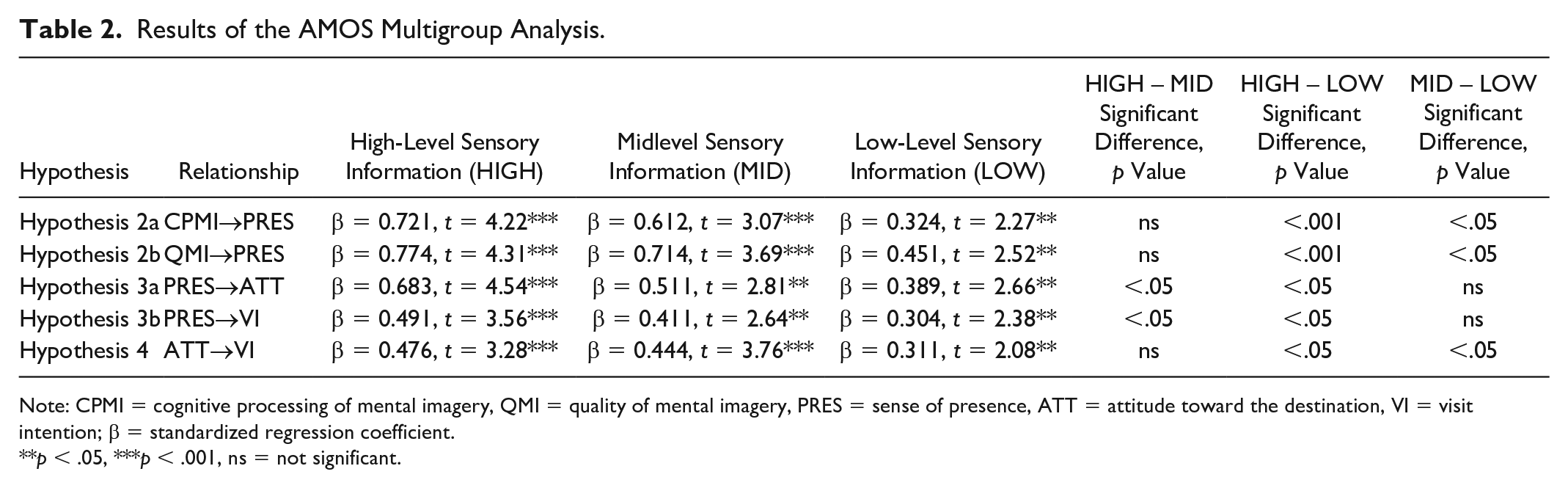
Note: CPMI = cognitive processing of mental imagery, QMI = quality of mental imagery, PRES = sense of presence, ATT = attitude toward the destination, VI = visit intention; β = standardized regression coefficient.
p < .05, ***p < .001, ns = not significant.
The results presented in Table 3 indicate interesting findings. While the results support our hypotheses, varying degrees of significant differences are found between each of the treatment modalities. As such, we find that there can be significant differences between the combination of high-, mid-, and low-level sensory information. However, our results indicate that high- or midlevel sensory information has a stronger positive effect on all variables in comparison to low-level sensory information during a VR preview experience of a tourist destination.
With regard to hypothesis 2a, we find that the influence of cognitive processing of mental imagery on the sense of presence in the VR experience was greater in the high-level and midlevel sensory experiences in comparison to the low-level sensory experience, but no significant differences were found between the high-level and midlevel experiences (βhigh = 0.721, t = 4.22***, βmid = 0.612, t = 3.07***; p = ns; βlow = 0.324, t = 2.27**; high – low p < .001; mid – low p < .05). Hence, given that the high-level sensory experience and midlevel sensory experience resulted in a significant effect we can conclude support for hypothesis 2a. More so, it can be seen through a comparison of mean scores that the high-level sensory experience results in the development of greater mental imagery (cognitive processing of mental imagery: Mhigh = 6.7; Mmid = 5.8; Mlow = 4.8; quality mental imagery: Mhigh = 6.5; Mmid = 5.4; Mlow = 4.7). Thus, this indicates the importance of increased sensory cues in influencing the development of mental imagery. In particular, we can draw on the important role of auditory sensory information given this distinguishes a high-level sensory experience from a midlevel sensory experience.
Similarly, in relation to hypothesis 2b, we find that the relationship between the quality of mental imagery and the sense of presence is greater in both high- and midlevel sensory experiences in comparison to the low-level experience, while no differences were found between the high-level and midlevel experiences (βhigh = 0.774, t = 4.31***, βmid = 0.714, t = 3.69***; p = ns; βlow = 0.451, t = 2.52**; high – low p < .001; mid – low p < .05). Thus, while all VR experiences induce mental imagery, those experiences with greater sensory information result in a deeper sense of presence within the VR experience. Therefore, the more sensory cues, the more tourism consumers feel the sense of “being there,” hence, that they have left the physical world and arrived in a new virtual world (i.e., the destination). Additionally, given that text distinguishes a midlevel and low-level sensory VR experience, the use of text becomes an important sensory cue in enhancing the sense of presence in the VR experience.
Furthermore, in relation to hypothesis 3a, the results demonstrate that the influence of the sense of presence on attitudes toward the destination was greater in the high-level sensory VR experience than both the midlevel and low-level experiences (βhigh = 0.683, t = 4.54***, βmid = 0.511, t = 2.81***; p < .05; βlow = 0.389, t = 2.66**; p < .05). We found that, in this instance, there was no significant difference between the midlevel sensory experience and the low-level sensory experience. Similar results were found with regard to hypothesis 3b as the sense of presence in the high-level sensory VR experience had a greater positive effect on visit intentions than both the midlevel and the low-level experiences (βhigh = 0.491, t = 3.56***, βmid = 0.411, t = 2.64***; p < .05; βlow = 0.304, t = 2.38**; high – low p < .05). Again, no significant differences were found between the midlevel and low-level sensory VR experiences. Thus, the greater sensory cues encompassing a combination of visual, tactile sensation, audio, and text in VR experiences results in increased positive attitudes and visit intentions. Given that auditory information distinguishes a high-level sensory environment to a midlevel sensory environment, auditory content can be considered an important sensory information cue in influencing attitudes and behavioral intentions in the virtual environment.
Lastly, in assessment of hypothesis 4, the results suggest that tourism consumers’ attitudes toward the destination have a greater influence on visit intentions in both the high- and midlevel sensory VR experiences in comparison to the low-level sensory VR experience (βhigh = 0.476, t = 3.28***, βmid = 0.444, t = 3.76***; p = ns; βlow = 0.311, t = 2.08**; high – low p < .05; mid – low p < .05). Hence, the attitudes tourism consumers develop in higher sensory VR environments, beyond visual information and tactile sensation, result in increased behavioral intentions to visit the tourist destination.
The subsequent section draws on the results of both studies and discusses the theoretical and practical implications.
Discussion
VR has been widely adopted within the travel and tourism sector and has been cited as one of the most important technologies to enhance and impact tourism experiences in recent years (Wei, Qi, and Zhang 2019). While prior research has demonstrated the role of VR in enhancing experiences, engaging consumers, marketing tourism destinations and selling tourism services (see Bogicevic et al. 2019; Wei, Qi, and Zhang 2019; Griffin et al. 2017; Jung et al. 2018; Jung et al. 2016; Rainoldi et al. 2018; Li and Chen 2019; Tussyadiah et al. 2018; Zeng et al. 2020; M. J. Kim and Hall 2019), the current body of research has limited understanding on the role of VR in enhancing customer attitudes toward a destination and the role of the varying degrees of sensory information that can be delivered through the technology. Given the challenges facing the tourism sector due to the global Covid-19 pandemic, obtaining a thorough understanding of VR technology and the sensory information marketers are able to deliver may aid tourism marketers to generate destination appeal and entice consumers to travel again. Accordingly, this research takes the initial steps in enhancing our understanding through three key implications. First, we demonstrate that VR plays a positive role in enhancing previously held consumer attitudes toward a tourist destination. Second, we affirm that VR has a greater positive effect on attitudes toward a destination in comparison to a less immersive technology (i.e., a website). Third, we find that different levels of sensory information in VR experiences result in significant differences with regard to the developed mental imagery, sense of presence in the experience, attitudes toward the destination, and visit intentions.
Theoretical Implications
VR has been hailed for its capability to deliver immersive tourism experiences (Zeng et al. 2020). The extant literature outlines that technology with higher levels of media richness leads to an increased sense of presence in the experience (Mollen and Wilson 2010; Faiola et al. 2013; Tussyadiah et al. 2018). Prior research surmise that VR can immerse consumers in the highest level of computer-mediated sensory information in comparison to other technologies (Bogicevic et al. 2019). Thus, building on the work of Faiola et al. (2013), Tussyadiah et al. (2018), and Bogicevic et al. (2019) and in support of previous conceptualizations, this study finds that the immersive VR experience can positively influence tourism consumers’ previously held attitudes toward a destination. The immersive experience consumers encounter in VR enables tourism marketers to transport a consumer to a virtual world to experience a destination without interruption from the physical real world. Such immersive experiences enable individuals to learn about the destination through the variety of sensory information and thus enhance attitudes toward the destination. More so, not only can VR enhance previously held attitudes but it has a greater positive influence on attitudes in comparison to other less interactive and less immersive preview styles (e.g., a website), as the results indicate that the website experience in this study was unable to positively enhance previously held consumer attitudes. Thus, the inherent interactive, immersive, and sensory-rich attributes of VR have a positive effect on enhancing tourism consumers’ attitudes toward a destination.
While VR has been outlined as a technology capable of delivering multiple sensory cues beyond that of any other technology in the virtual environment (Tussyadiah et al. 2018), research to date has not examined the effects of varying sensory cues in VR. This research reveals that the greater combination of sensory cues (including visual, tactile sensation, auditory, and text) results in clearer and more thought-provoking mental imagery, subsequently enhancing the sense of presence in the experience. Prior research (see Meier et al. 2012; Barsalou et al. 2008; Niedenthal et al. 2005) outlines that cognitive mental processing is grounded in sensory experiences. As such, this research affirms that the greater number of sensory cues fostered by VR experiences, that appeal to consumers’ multiple senses, stimulates consumers’ thinking, and enables them to imagine a rich experience, transporting them into an alternate virtual world while blocking out any other competing stimuli from the physical, real world. In line with Phillips et al.’s (1995) consumption vision, we find that increased levels of sensory stimuli in tourist destination experiences enable consumers to develop a more vivid image of themselves experiencing the destination; therefore, the quality and quantity of the mental imagery become greater when increased levels of sensory information are introduced. Given that auditory information distinguishes a high-level sensory environment to a midlevel sensory environment in this research, in contrast to Lee, Gretzel, and Law’s (2010) work on destination websites, the auditory content can be considered an important sensory information cue in influencing attitudes and behavioral intentions in the VR environment. The influence of the auditory sensory information may be due to the immersive nature of VR in comparison to a website experience and the ability to shield from external distractions in VR. Additionally, in this research the auditory cues provided additional information about the destination in the experience, in comparison to Lee, Gretzel, and Law (2010), who assessed background sounds such as ocean waves.
Moreover, Tussyadiah et al. (2018) outline that the sense of presence in VR is capable of influencing attitudes and behavior. Building on that, we find that the varying levels of sensory information cues in VR destination experiences have different levels of effect on tourism consumers’ attitudes toward the destination and visit intentions. Most work on VR has only focused on the visual cues afforded by VR despite the capability of the technology to deliver consumers multiple immersive sensory experiences and despite the prior knowledge from the digital environment that both auditory and tactile sensations are capable of influencing customer experiences (Pagani, Racat, and Hofacker 2019; Meyers-Levy, Bublitz, and Peracchio 2009). Thus, the introduction of auditory and text information in addition to 360° visual and tactile sensation information in VR experiences enhances the development of clear, vivid, and thought-provoking mental imagery, the feeling of presence, and the subsequent effect on enhancing consumers’ attitudes and visit intentions.
As previously alluded to, Krishna (2012) defines sensory marketing as an activity that engages consumers’ senses and affects their perception, judgment, and behavior. This research affirms that introducing different levels of sensory stimuli in a VR destination experience engages consumers’ senses, their attitudes, and behavioral intentions with different levels of significance. Thus, this research advances our theoretical knowledge of the sensory information in VR and its application in tourism and concludes that increased sensory cues during a VR experience (encompassing, visuals, tactile sensations, text, and auditory information) results in increased mental imagery, a deeper sense of presence, increased positive attitudes toward the destination, and increased visit intentions.
Practical Implications
This research outlines a number of practical implications for destination tourism marketers and tourism boards. In study 1, we detail the capability of VR to enhance consumers’ previously held attitudes toward a destination. This is particularly important for tourism marketers who are attempting to attract tourists to a specific destination. The use of VR to showcase a destination country will enhance consumer attitudes toward the destination, while study 2 details the positive influence of VR on consumers’ visit intentions. Hence, the use of pop-up VR stations in shopping malls or other entertainment venues would be an advantageous marketing strategy for those individuals who do not have access to relevant hardware headset devices, while also providing VR experiences to download from relevant stores such as the Oculus store for consumers to use on their own devices within the comfort of their own home.
More so, study 1 also sheds light on the difference between immersive VR experiences and a traditional website experience. Managers should note that an immersive VR experience plays a greater role in positively enhancing consumer attitudes in comparison to a website experience. The results of this study indicate that the website experience was unable to positively enhance previously held consumer attitudes; conversely, the VR experience fosters a significant positive effect. Thus, while websites offer tourism marketers an ample communication tool to preview a tourist destination, VR experiences play a more important role in positively influencing consumer attitudes. Accordingly, integrating VR experiences as part of a tourism marketer’s arsenal will likely provide fruitful results.
Furthermore, tourism marketers are encouraged to work closely with VR developers to ensure multiple sensory information cues are integrated into the VR experience. Managers should note that the results of this research affirm that greater sensory information cues lead to a more intense sense of presence in the virtual world, making consumers feel like they have arrived at the tourism destination, which subsequently enhances attitudes toward the destination and increases the likelihood of visiting. Thus, tourism marketers should consider the combination of visual, haptic and auditory cues encompassing 360° visuals, tactile sensation (i.e., to locate points of interest and navigation within the VR experience), overlaid text information, and audio information about the destination. A combination of such sensory information will enable consumers to develop a clearer consumption vision (mental imagery) of them experiencing the destination.
More so, given that the findings of this research detailed that high- and midlevel sensory VR experiences always outperformed low-level sensory VR experiences, tourism marketers should ensure that their VR experiences entail visuals, tactile sensation, and text as a minimum requirement. Auditory information differentiated a high-level sensory experience from a midlevel sensory experience in our study. Thus, while visuals, tactile sensation, and text provide positive results, the use of auditory information further enhances positive attitudes toward the destination and increased visit intentions. Additionally, managers should note that individuals spend more time in a VR experience that provides auditory sensory information, indicating a more engaging experience.
Lastly, as this study illustrates that the use of higher-level sensory information results in positive outcomes, tourism marketers are encouraged to continually test the use of multiple sensory information cues to establish the optimal experience for tourism consumers and to avoid cognitive information overload. Such testing will continue to shed light on the most pertinent sensory cues for each individual context.
Limitations and Future Research
This study has taken the initial steps to develop our understanding on the role of VR in shaping tourism consumers’ attitudes and the effects of sensory information on tourism VR experiences. However, a number of limitations exist in our study that provide avenues for future research. First, in study 1 we only assessed one VR experience downloadable from the Oculus store; future research should assess consumer attitudes toward other VR tourist destination experiences to enhance the generalizability of our results. Second, in study 2, we tested 360° visuals, tactile sensation (i.e., to locate points of interest and navigation within the VR experience), overlaid text information, and audio information; future research could test additional video and image visuals within the VR experience as added information cues. Third, in study 2, while we tested auditory sensory information, the audio provided further information on points of interest; future research could assess different types of audio information such as ongoing commentary or music to further our understanding of auditory sensory information in destination VR experiences. Fourth, we conducted two lab-based experiments; future research could conduct real-world experiments with ordinary consumers to affirm and strengthen our findings. Fifth, we used the Oculus Go VR headset, which has its own set of limitations as with any other VR headset; thus, it would be beneficial to assess VR destination experiences in other VR headset devices that may offer a slightly different experience to rule out biases due to the hardware and software used in this study. Sixth, it would be interesting to assess the effects of VR across different travelers (i.e., frequent travelers, occasional travelers, etc.) to identify if VR experiences influence such groups differently. Seventh, it would be interesting to understand if previous experience or knowledge of the destination has an influence on the development of mental imagery, sense of presence, attitudes, and behaviors. Lastly, our results indicate that increased sensory cues in VR experiences result in positive attitudes and behavioral intentions; however, given the large body of literature on cognitive information overload, future research should further explore the effects of multiple sensory information points on information overload and consumer cognitive processing fatigue.
Supplemental Material
sj-docx-1-jtr-10.1177_00472875211037745 – Supplemental material for Examining Tourism Consumers’ Attitudes and the Role of Sensory Information in Virtual Reality Experiences of a Tourist Destination
Supplemental material, sj-docx-1-jtr-10.1177_00472875211037745 for Examining Tourism Consumers’ Attitudes and the Role of Sensory Information in Virtual Reality Experiences of a Tourist Destination by Mansour Alyahya and Graeme McLean in Journal of Travel Research
Footnotes
Declaration of Conflicting Interests
The author(s) declared no potential conflicts of interest with respect to the research, authorship, and/or publication of this article.
Funding
The author(s) disclosed receipt of the following financial support for the research, authorship, and/or publication of this article: The authors would like to thank and express appreciation to the Deanship of Scientific Research at King Faisal University, Saudi Arabia, for the financial support under Raed Track (Grant No 207004)

Supplemental Material
Supplemental material is available on the webpage with the online version of the article.
Author Biographies
References
Supplementary Material
Please find the following supplemental material available below.
For Open Access articles published under a Creative Commons License, all supplemental material carries the same license as the article it is associated with.
For non-Open Access articles published, all supplemental material carries a non-exclusive license, and permission requests for re-use of supplemental material or any part of supplemental material shall be sent directly to the copyright owner as specified in the copyright notice associated with the article.
