



Abstract
Is it beneficial for municipalities to cooperate or compete with one another to attract visitors? The myopic rationality of game theory favors competition for short-term gains, whereas the nonmyopic theory of moves suggests that cooperation in this regard might be more farsighted, consensual, inclusive, and sustainable. To understand why popular cities switched to cooperation when faced with the crisis of overtourism, even though the players’ preferences about the outcomes did not change, we analyzed the case study of Amsterdam. The results indicate that the theories are appropriate in different situations. Thus, the theory of moves’ rules—alternating choices, thinking ahead in making choices—are more appropriate to finding a solution that would be stable in the future, not just one that is myopically stable in the present. We conclude that cooperation remains a more beneficial approach to managing tourism even in periods of undertourism. Policy directions are provided.
Keywords
Introduction
Can game theory help cities devise strategies for dealing with overtourism? Can game theory help cities deal with the age-old question of whether they benefit most from cooperating with one another to attract tourists or whether competition is a better strategy? This article addresses these questions.
Intermunicipal cooperation refers to partnerships between two or more municipal authorities that voluntarily come to the conclusion that cooperation with each other on specific policy issues, rather than competition, will further their common goals and interests more effectively (Bafarasat 2016; Bel and Warner 2015; Citroni, Lippi, and Profeti 2013; Harrison and Growe 2014; Jacobsen and Kiland 2017). Economies of scale are a major motivator for intermunicipal cooperation, because they reduce the cost of services and the size and distribution of the population (Ladd 1992; Oates 1972), and make it easier to agree on operational efficiency, cost savings, and financial gains (da Cruz and Marques 2012; Dollery and Byrnes 2006; Kurki, Pietilä, and Katko 2016; Lobina and Hall 2008; Mattisson 2016). Thus, economies of scale improve efficiency and service quality, promote the coordination of regional development, and reduce inconsistencies (Agranoff and McGuire 2003; Bovaird 2014; Ling 2002; Pollitt 2003; Silvestre, Marques, and Gomes 2018). It is a major factor in services such as water and sewage, garbage, transportation and physical infrastructures, health (hospitals), education (schools), firefighting, and emergencies (Dijkgraaf and Gradus 2013; Hulst et al. 2009; Kurki, Pietilä, and Katko 2016; Silvestre, Marques, and Gomes 2018).
Whereas economics-based intermunicipal cooperation yields tangible benefits that are relatively simple to define, measure, and justify, its results with regard to issues that are not based on cost efficiency are not as clear (Dollery and Byrnes 2006; Kurki, Pietilä, and Katko 2016; Mattisson 2016). Such issues are more complicated to define and measure because of their wicked nature (Rittel and Webber 1973; Veeneman and Mulley 2018). Indeed, they often prompt municipalities to compete with each other to attract residents and visitors (Bel and Warner 2016; Kearns and Paddison 2000). Examples include joint industrial parks (Millward and Dickey 1994; Razin 2016), housing (Bafarasat 2016; Basolo and Hastings 2003; Kang and Groetelaers 2018), social welfare and social resilience (Beeri and Yuval 2015; Jacobsen and Kiland 2017), as well as tourism (Amore, Falk, and Adie 2020; Dodds and Butler 2019; Goodwin 2017, 2019; Lin, Liu, and Song 2015; Nolan and Séraphin 2019; Oklevik et al. 2019; Séraphin et al. 2019). Thus, it is quite possible that municipalities compete on selected issues, while at the same time cooperate on other issues in a given policy area.
Recently, scholars have investigated the move of neighboring municipalities to stop competing with one another (Gerritsma 2019; Kang and Groetelaers 2018; Peeters et al. 2018; Razin 2016) on selected policy issues. One area in which this change is evident is tourism. A growing number of municipalities have decided to stop competing and start cooperating to reduce overtourism and the damage it causes to the urban socio-environmental ecosystem (Amore, Falk, and Adie 2020; Goodwin 2017; Lin, Liu, and Song 2015; Oklevik et al. 2019; Séraphin et al. 2019; Vlès 2012). Examples include iconic cities such as Amsterdam (Gerritsma 2019), Barcelona (Goodwin 2019), Berlin (Novy 2018), New York (Dodds and Butler 2019), London (Smith 2019), Paris (Hamper 2016), Prague (Rončák 2019), Venice (Nolan and Séraphin 2019), and many others (Peeters et al. 2018; Stanchev 2018). However, this trend is limited. Other cities that are experiencing overtourism are maintaining their competitive stance, reflecting the more limited interests of local stakeholders about tourism as benefitting the city’s economy. Thus, municipalities in similar circumstances are divided about competing with their neighbors on various issues or cooperating with them (Basolo and Hastings 2003; Kantor 2006; Peeters et al. 2018; Vlès 2015). What factors prompted these choices? How can municipalities that for decades have benefited from competition at the expense of their neighbors succeed in convincing these neighbors to trust their sincere intentions to cooperate? Are there specific strategies that municipalities can adopt to determine answers to these questions?
To address these questions, we utilize insights from two complementary game-based theories—standard game theory and the theory of moves (Brams 1994). Although based on similar ideas, the two theories interpret the concept of rational choice differently. Each has its own set of rules, leading to contradictory predictions about the rational choices that different municipalities make to manage their tourism. Standard game theory predicts that players will compete for short-term gains, while the theory of moves posits that cities will adopt the farsighted, consensual, inclusive, and sustainable approach of cooperation. Thus, we posit that the decision about whether to compete or cooperate with neighboring municipalities depends on the kind of rationality underlying the real-life policy-making process of each municipality. When dealing with tourism, short-term rationality promotes competition, whereas long-term rationality drives cooperation. Therefore, we maintain that we must combine these two forms of game theory to explore the intricate dynamics of real-life tourism management in a more holistic way.
We tested these conjectures using the case study of Amsterdam. Our integrated analytical framework enriches the branches of the decision tree that help trace intermunicipal policy-making, providing additional analytical tools with which to evaluate the implications of the potential moves. Thus, it can provide municipalities and regulators with tools to promote voluntary intermunicipal cooperation on overtourism that will benefit the environment without damaging the profits derived from the tourism industry.
Literature Review
Joining Hands beyond Municipal Jurisdictions to Tackle Wicked Problems
Intermunicipal cooperation that focuses on intricate, wicked, multidimensional policy problems are difficult to define and monitor. It has fluid measures for success or failure, solutions that may take time to take effect and may have vague, intangible results that affect many areas, making them difficult to recognize and justify (Rittel and Webber 1973; Veeneman and Mulley 2018). Frequently, cooperation of this sort is motivated by decisions to promote a particular service or focus on a local policy problem that affects various municipal jurisdictions, creates spatial interdependencies (Hodges 2012), and cannot be solved by the municipality alone (Dollery and Byrnes 2006; Jacobsen and Kiland 2017). The commonality of the issue prompts the municipalities to adjust the supply of and demand for the service with their surrounding partners, promoting cooperation in space (Harrison 2006; Kang and Groetelaers 2018; Kantor 2006) that bridges and reconciles diverse interests. This form of cooperation requires creative and multidisciplinary strategies using complementary resources to tackle problems. It also risks the interests of various stakeholders within and between municipalities (Becken and Simmons 2019; Gerritsma 2019; Goodwin 2017; Vlès 2015). Thus, finding a solution to such problems involves a slow, deliberative process that requires endurance that is difficult to maintain.
This form of intermunicipal cooperation is effective and beneficial in many ways, beyond economic considerations (Bel and Warner 2015, 2016; Burger et al. 2014; Citroni, Lippi, and Profeti 2013; Dollery and Byrnes 2006). It leverages the aptitudes and resources of the participating cities, including their expertise, professionalism, experience, skills and abilities, knowledge and access to information and statistics (Bovaird 2014; Edelenbos and Teisman 2011; Lobina and Hall 2008; Vlès 2015), innovative and smart solutions (Ivars-Baidal, García Hernández, and Mendoza de Miguel 2019; Schmidt 2014; Williams, Rodriguez, and Makkonen 2020), shared spatial coordination planning efforts, manpower quotas, and financing (Agranoff 1998; Jacobsen and Kiland 2017), enriching ideas for creating tailor-made solutions and methods of implementing them together. Utilizing this approach allows them to create solutions that they might not be able to afford otherwise, share the risks involved, and avoid the inflexible, top–down hierarchies that are often difficult to navigate and modify (Kang and Groetelaers 2018). This mechanism seems to be better suited to sustainable development, because of its mutual interdependency that necessitates the search for a better balance between diverse stakeholders within the local communities and between the neighboring municipalities to maintain the political consensus (Becken and Simmons 2019; da Cruz and Marques 2012; Vlès 2015). It gradually establishes a common understanding on values and norms, and a vision of the operational direction of common goals (Kang and Groetelaers 2018). Therefore, confidence-building measures, the development of bridging social capital that brings neighboring communities closer (Beeri and Yuval 2015; Putnam 2000), and expanded relationships and exchanges between key officials are fundamental conditions in such intermunicipal cooperation (Bafarasat 2016; Kantor 2008). Maintaining such successful partnerships requires robust, trusting relationships, strong commitment, and reciprocity (Davies 2009; Jacobsen and Kiland 2017; Lobina and Hall 2008; Schultz et al. 2015). These features not only make the solution possible but also promote its effectiveness and efficiency in the long term. Successful cooperation is achieved through slow, deliberative, incremental improvement through trial and error. It faces many difficulties along with small wins and long periods of time during which the partners may look at other alternatives and even withdraw from the cooperative arrangement. Indeed, cooperation involves a team learning process (Behn 2014; Jacobsen and Kiland 2017).
Although intermunicipal cooperation is gaining popularity throughout Western countries (Bel and Warner 2015; Dollery and Byrnes 2006; Hulst et al. 2009), research has pointed out several weaknesses. Political barriers often hinder intermunicipal collaboration because it may rob some stakeholders of their authority and autonomy (Bjørnholt and Salomonsen 2015). Backlashes arise particularly around election periods when parties promote their concerns for local issues (Gerritsma 2019; Razin 2016; Vis 2018). Municipal councils may object to and demand withdrawal from existing arrangements (Jacobsen and Kiland 2017), entrenching local sentiments. Differences in the political, demographic, and economic makeup of the community and in its leaders’ attitudes are another barrier. Resistant movements on the local level may provoke disputes about suggested solutions (Gerritsma 2019). More generally, this pattern of cooperation has been criticized on the grounds that it structurally restricts channels of political participation (Dollery and Byrnes 2006; Hulst et al. 2009; Mattisson 2016).
Nevertheless, municipalities continue to cooperate because they regard this approach as superior to the other three options: (1) privatization, (2) amalgamation, and (3) going it alone. Privatization is irrelevant because the issue is not short-term economic gains. Most municipalities regard amalgamation as an unpalatable, radical choice. Finally, dealing with the problem alone is often not effective or possible (Jacobsen and Kiland 2017; Kang and Groetelaers 2018). However, usually it takes a major crisis or a common external threat to prompt municipalities to consider working together (Jacobsen and Kiland 2017; Kang and Groetelaers 2018; Kotter 2008; Mattisson 2016).
Thus, the urgency of the issue and the perception of intermunicipal cooperation as the best method for dealing with it create strong pressure on politicians and administrative leaders to succeed. Such success depends on their willingness to make the effort to promote cooperation with their neighbors and their skill at maintaining this cooperation (Jacobsen and Kiland 2017). Thus, the role of political leadership in aligning the stakeholders’ interests in these cases cannot be underestimated (Bafarasat 2016; Harrison 2006; Rodríguez-Pose 2008; Spicer 2014). Whatever its weaknesses, empirical research has documented that the benefits of working together outweigh going it alone or competing with other cities (Bel and Warner 2015, 2016; Jacobsen and Kiland 2017; Kang and Groetelaers 2018).
Despite this evidence, other municipalities have not embraced this solution. Whether because of the difficulties and complications involved or other considerations, they choose to compete with their neighboring cities, often to the resentment of their own residents and while depriving these neighboring municipalities of the possibility to develop (Basolo and Hastings 2003; Kantor 2006; Vlès 2015). The global phenomenon of overtourism is a prime example of how intermunicipal cooperation can promote economic prosperity for all concerned while also securing far-reaching, intangible results.
Helpful or Harmful? The Janus-Faced Nature of (Over)tourism
In the last 20 years, there has been an exponential growth in tourism worldwide. This increase from 438 million travelers in the 1990s to 1,461 million in 2019 (UNWTO 2020) has endangered many attractive destinations. Researchers have talked about the problems of dealing with success, loving places to death, oversaturated or overcrowded destinations, and visits to endangered places (Dodds and Butler 2019; Gerritsma 2019; Milano, Cheer, and Novelli 2019; Peeters et al. 2018; Séraphin et al. 2018; World Travel and Tourism Council 2017). Thus, many destinations worldwide are flooded with swarms of visitors exceeding their capacity, depleting their resources and changing the public space fundamentally and permanently (Goodwin 2019; Smith 2019). It took several decades for the tourism industry to exhibit its Janus-faced character (Sanchez and Adams 2008).
Beginning in the early 1960s and more intensively from the 1990s, major international cities enjoyed huge socioeconomic prosperity (Genç and Duman 2019; Gerritsma 2019; Hall 2008). The tourism industry supports millions of jobs worldwide (1 in 10 jobs in 2019, WTTC), brings in foreign investment (Dodds and Butler 2019), contributes to infrastructure development and significant export revenues, and generates a major portion of the global GDP ($8.9 trillion, 10.3% in 2019, WTTC). Initially reveling in their enormous success in attracting tourists, these destinations began to realize that the negative aspects of tourism were overshadowing its benefits (Oklevik et al. 2019; Séraphin et al. 2018). Although the social interactions that stimulate personal excitement have a positive influence on the tourism experience (Hou and Zhang 2020), overtourism scars the most popular places by overloading their infrastructure, and increasing physical damage, congestion, and the cost of living and housing. As a result, local residents are displaced and replaced by elite groups or unregulated holiday apartments. There are more facilities that cater to visitors and fewer for local residents who also have less purchasing power. There is an erosion in local identity, a lack of public intimacy, and feelings of alienation among local residents. Tourists may bring more litter, drunkenness, drug abuse, noise, and vandalism, along with serious crime and water and air pollution (Coldwell 2017; Dodds and Butler 2019; Genç and Duman 2019; Goodwin 2019; Hamper 2016; Milano, Cheer, and Novelli 2019; Singh 2018; Mou et al. 2020; Nolan and Séraphin 2019; Novy 2018; Peeters et al. 2018; Rončák 2019; Séraphin et al. 2018, Séraphin et al. 2019; Smith 2019; Stanchev 2018; Zhang, et al. 2020). Thus, interactions between culturally different groups do not necessarily contribute to good relationships between visitors and residents (Boukamba, Oi, and Sano 2020; Stylidis 2020). Residents who are very concerned about the negative impact of tourism may turn against it. These feelings also hurt their positive attachment to their sense of place (Lalicic and Garaus 2020). Thus, overtourism harms the quality of life and the enjoyment of the experience of the place, to the resentment of both residents and visitors (Gerritsma 2019; Goodwin 2017; Ivars-Baidal, García Hernández, and Mendoza de Miguel 2019; Milano, Cheer, and Novelli 2019; Séraphin 2019; Singh 2018; UNWTO 2018).
This situation triggers conflicts between various stakeholders and sparks debates on the adequacy of traditional strategies of tourism management to cope effectively with this complex, multidisciplinary issue (Oklevik et al. 2019). Clearly, if not managed carefully, overtourism causes considerable damage (Coldwell 2017; Dodds and Butler 2019; Mou et al. 2020; Vlès 2015) and poses unavoidable challenges to the cities’ management of the physical, ecological, social, economic, and political aspects of popular destinations (Dissart, Dehez, and Marsat 2015; Z. Liu 2003). Indeed, many major cities have recently begun to rethink their tourism management strategy far beyond the limited perspectives of their destination marketing organizations’ attitudes.
In an effort to strike a balance between profit and resilience, cities have struggled to develop new strategic approaches to attracting tourists, maintaining the urban ecosystem and meeting the growing demands of the local residents regarding their well-being and quality of life (Ridderstaat, Croes, and Nijkamp 2016). Various combinations have been tried. Municipalities have built new infrastructure and facilities to expand the capacity of existing services, run mass transportation 24 hours a day and connected it to targeted locations, supplemented the availability of accommodations, imposed limitations to restrict the blurring boundaries between residential neighborhoods and tourist areas, balanced supply and demand through taxes and tourist tickets, and monitored the number of visitors using technological smart solutions such as through smartphone location software and information and communication technologies to disperse tourists to various areas throughout the day (Brown, Kappes, and Marks 2013; Goodwin 2017; Ivars-Baidal, García Hernández, and Mendoza de Miguel 2019; Manning and Powers 1984; Peeters et al. 2018; Smith 2019; Vlès 2012; Williams, Rodriguez, and Makkonen 2020). Cities have also tried to create new visitor attractions (Mateo and Eldridge 2018; Seijas and Gelders 2019; Straw 2018) that function year-round and across geographically spread-out sites inside and outside the city (Gerritsma 2019; Goodwin 2019; Smith 2019). They have sometimes tried to slow tourism by dropping destinations from advertising materials and tourism booklets, while promoting neighboring sites (Gerritsma 2019; Séraphin, Sheeran, and Pilato 2018; Stanchev 2018; Vlès 2015). In order to succeed, these activities must be accompanied by continued deliberative communication with engaged visitors, residents, businesses, and other stakeholders to create experiences that benefit all, defuse conflicts and tensions, and promote the coexistence of visitors to and residents of the city (Becken and Simmons 2019; Ward and Berno 2011).
The multidimensional nature of overtourism underscores the need to reconsider the role that tourism plays in cities beyond being an important sector in their economy (Ivars-Baidal, García Hernández, and Mendoza de Miguel 2019). It also emphasizes the importance of the role played by municipal authorities as elected entities in responsibly identifying, representing, and incorporating multiple views, and the interests and goals of diverse stakeholders in the local arena when establishing policy to tackle overtourism, without neglecting the multiple voices of local residents and communities (Goodwin 2917, 2019; Jordan, Lesar, and Spencer 2021; Litvin, Smith, and McEwen 2020; Peeters et al. 2018; Vlès 2015). Nevertheless, critical policy solutions to cope with overtourism appear to be beyond the jurisdiction of a single municipality and, hence, cannot be planned or implemented by any municipality alone but rather require horizontal cooperation. Indeed, intermunicipal relations have become crucial in dealing with overtourism in the last decade, forcing municipal authorities to embrace a broader perspective that is less inner directed and self-regulating (Vlès 2015), and requiring interdependent cooperation between neighboring municipalities. Maneuvering in such complicated situations means adopting holistic and interdisciplinary perspectives (Eckert et al. 2019) of both the diverse interests of distinct stakeholders as well as multidimensional policy disciplines (Becken and Simmons 2019; Rončák 2019). In this case, it highlights the crucial advantages of the intermunicipal working together paradigm (Ivars-Baidal, García Hernández, and Mendoza de Miguel 2019). In fact, intermunicipal cooperation appears to be the best format for maximizing the benefits of joint and complementary efforts (Vlès 2012). The intermunicipal management of tourism is the only approach that provides the professional knowledge and resources needed for the flexibility to redirect visitors, facilities, and events all year long, co-manage infrastructures such as transportation, and share the cost of developing and operating expensive smart tourism tools (Goodwin 2019; Guiver and Stanford 2014; Ivars-Baidal, García Hernández, and Mendoza de Miguel 2019; Vlès 2015).
However, while increasing numbers of municipalities are adopting this form of managing tourism, this journey is slow and limited. It leaves behind others that are postponing the decision or simply choosing not to do so (Dodds and Butler 2019; Goodwin 2019; Peeters et al. 2018; UNWTO 2018; Vlès 2012). Although the European policy encourages and provides support for intermunicipal cooperation in tourism as in other policy issues, the overtourism crisis itself seems to be the trigger that has pressured municipalities to cooperate (Vlès 2015). Still, most destinations are managed based on the growth of visitors paradigm, without considering other equally important policy goals (Peeters et al. 2018). Clearly, there is no easy approach to identifying and implementing effective management solutions that requires shared responsibilities. Over the last decade, managing visitor pressure in urban settings has taken center stage in many iconic city councils and regional government political agendas (Gerritsma 2019; Goodwin 2017; Peeters et al. 2018). One example is Amsterdam, where the city has taken major steps to deal with the problems of overtourism without driving away visitors to it.
Overtourism in Amsterdam: A Real-Life Case Study of “The City in Balance”
For many years Amsterdam tried to increase the number of visitors to it, particularly after the 2008 global financial crisis to help the city’s economy recover (Gerritsma 2019; Lalicic and Garaus 2020). In 2014, Amsterdam successfully competed with the 10 top popular sites in Europe. Tourism accounted for about 11% (69,200) of the jobs in the city, and an increasing number of shops and services focused only on tourists (Peeters et al. 2018). These results exceeded the expectations of the city’s most ambitious targets.
However, the peak of the rapid growth of 2013 around the canals’ four-hundredth-anniversary festival marked a watershed. From that point on, the negative aspects of overtourism undermined the enthusiasm about the economic benefits of the tourism sector, which up until that point had paid little attention to the perspective of residents in the policy-making process (Gerritsma 2019). These developments inevitably forced the municipal government to take a different approach (Oklevik 2019). Thus, in 2014, Amsterdam created its “City in Balance” policy program, known today as the “Amsterdam Approach” for tourism management. This approach involved as many stakeholders as possible to address the complex challenges jeopardizing and threatening the quality of life of its residents and visitors (Andereck and Nyaupane 2011; Gerritsma 2019; Lalicic and Garaus 2020).
In 2018, strategies of tourism management were a major campaign issue in the municipal elections. Soon after the new local council was established, A New Spring, A New Sound program declared that Amsterdam was primarily a place to live and work in a just, free, sustainable, connected, and democratic urban environment. Far from the long-standing traditional belief that adjusting the city for visitors automatically had a positive influence on the local residents as well, the program assigned tourism a secondary place in favor of making the city more successful, sustainable, and inclusive (Lalicic and Garaus 2020). Changes made included limiting and taxing Airbnb home shares and shutting down bars, coffeehouses, and other entertainment venues in overly busy areas of the city. The Red Light district received special attention, with relevant measures including Project 1012 to reduce crime related to prostitution and curb mass tourism (City of Amsterdam 2020; Quest, Hardingham-Gill, and Appiah 2019; Schuetze 2018). A major campaign launched by the city targeted young visitors, reminding them that public urination and littering in the streets would incur hefty fines of €140 (http://wavemaker.nl/my-product/iamsterdam-enjoyrespect/). The campaign has been conducted mostly online on sites where visitors book flights and accommodations or check the weather, on Facebook and Instagram and geotagging technology (which uses GPS to show a cellphone visitor’s location), and on ads throughout the city. They were accompanied by the increased presence of on-the-spot enforcement workers (Schuetze 2018).
The inclusive approach was not limited to the inner-city stakeholders. To achieve the goal of spreading out tourists throughout the region, in 2015 the city’s tourism department expanded the City Card program to include sites that were up to a one-hour distance from Amsterdam (Stanchev 2018). Amsterdam came to realize its dependency on its neighboring cities to solve its own problem. As its former mayor stated (DutchNews.nl in 2016): Amsterdam is appealing to other Dutch cities to absorb some of the tourists who come to the Dutch capital, the Parool said on Wednesday. . . . The city’s marketing department has already made moves to encourage tourists to stay in Haarlem, Zandvoort and Muiden and is now focusing on Rotterdam, The Hague and Utrecht, the paper said. . . . “This will help reduce the pressure. It could be our salvation,” the city’s mayor, Eberhard van der Laan, said in an interview.
In order to lure tourists to venture beyond Amsterdam, the city provided free public transport lines to these cities (DutchNews.nl 2016). Clearly, such intermunicipal, interdependent cooperation required careful mutual planning and implementation policies, activities that could be created only based on mutual political agreement underpinned with trust, reciprocity, and collective benefits (Bel and Warner 2016; Schultz et al. 2015; Vlès 2015).
Why would Amsterdam adopt this approach? We maintain that while game theory explains why Amsterdam has historically competed with its neighbors, the theory of moves explains how it arrived at the decision to cooperate with neighboring cities rather than compete with them.
A Game-Based Analysis of the Case Study: Myopic Noncooperation Games versus Nonmyopic Cooperative Games
Game theory consists of 78 distinct games of two people with a strict ordinal 2×2 payoff matrix (Brams and Ismail 2018; Rapoport, Guyer, and Gordon 1978), split into two different patterns—21 cooperative games, in which players share nonconflictual common interests, and 57 noncooperative games associated with conflicting relations between the players (Brams 2001). Whereas the cooperative pattern reflects the intermunicipal cooperation based on economies of scale, the noncooperative pattern reflects the competition between municipalities. Hence Amsterdam’s tourism policy case clearly falls within the first group.
As Figure 1 illustrates, the form of noncooperative 2×2 games contains four strict order payoff matrixes (outcomes). Municipalities create their policy preferences based on the payoff matrix, and make rational choices that maximize their interests. According to standard game theory, the outcome of the game is determined by the intersection of the strategies chosen simultaneously and independently by both municipalities, assuming complete information of their own and each other’s alternative strategies and the associated payoffs.
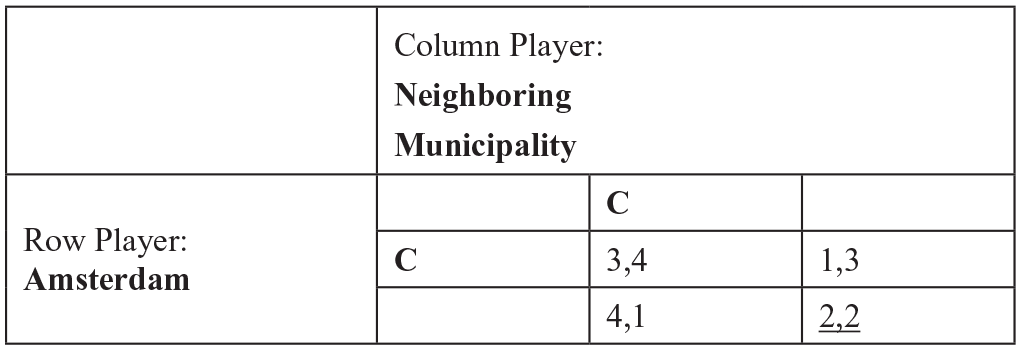
Original game (game 28).
Figure 1 illustrates the rules applied to the strategic form of standard game theory. As the figure indicates, game 28 adequately models the tourism-related intermunicipal relations between Amsterdam and its surrounding municipalities. In the game, Amsterdam is the row player, and the column player is a neighboring municipality (or a coalition of surrounding municipalities sharing common interests on tourism). Both players—Amsterdam and its neighbor—choose, independently, between two strategies: to cooperate (
Amsterdam wanted to attract tourists to the city without incurring the costs of overtourism. To do so, it had to choose between two alternative strategies, competition or cooperation, with its neighbors. Thus, apart from regulations and special projects it could create and impose, Amsterdam needed to spread its visitors across the region. The neighboring municipality had the same goals, albeit not to the same extent as Amsterdam. These goals must be accomplished by the strategic choice made separately by each player to compete or cooperate. Thus, the following payoff ordering is consistent with the empirical evidence of the preferences of the players (see above).
Assume Amsterdam’s ranking to be
Similarly, when faced with the choice of competing (
For the neighboring municipality, the outcomes are assumed to be as follows:
Based on these preferences and according to game theory rules, Amsterdam is better off choosing competition (
However, this is not the case for the neighboring municipality. Thus, if Amsterdam decides to cooperate (
This outcome (2,2) is a Nash equilibrium (the underscored outcome in Figure 1). Once chosen, neither player would have an incentive to unilaterally depart from this choice because changing to a different strategy would worsen the switcher’s payoff, given that the other player does not change his or her strategy (Brams 1994; Mor 2007). Hence, (2,2) is considered a stable solution of this game when applying the standard game theory rules anchored in myopic rationality, in which players make choices independently. Note that this noncooperative outcome (
This game has substantial explanatory power for the case studied here, for several reasons. First, the game realistically reflects the power relations between the popular city and its neighbors in real-life tourism management. It empowers only the stronger and more popular player in the region, Amsterdam, with a dominant strategy, leaving the weaker, less attractive municipality vulnerable and subject to Amsterdam’s good will. Furthermore, this neighboring city has minimal negotiating power if Amsterdam decides to compete. Second, this result accurately mirrors the Nash equilibrium competition that has served as the status quo between municipalities for many decades. Such competition has perpetuated noncooperative relations saturated with mistrust. This status quo makes it difficult for either side to break the pattern and choose to cooperate, even though doing so would benefit them both (3,4). Thus, the game’s outcome explains why, until recently, popular cities around the world have chosen to compete to attract as many visitors as they could. Given myopic considerations about short-term economic prosperity, it is the rational choice. A competitive strategy grants the iconic city better results in any case. Moreover, being associated with a Nash equilibrium, the (2,2) result also explains the difficulties of most popular cities to abandon their competitive strategy even when faced with the damaging consequences of overtourism. As Figure 1 illustrates, choosing another strategy can lead to worse outcomes if the other party does not cooperate. Clearly, cooperation demands a major investment of multiple resources and a great deal of trust between the players. Third, this outcome appears to accurately reflect the myopic rationality that has underpinned the tourism policy of major cities for many decades. Having adopted competition as its dominant strategy, Amsterdam left its neighbors no other rational choice than to compete with it. Ironically, it appears that the more the myopic strategy of competition succeeded for Amsterdam, the deeper the damage caused to the city in the long term.
Nevertheless, in the face of overtourism, Amsterdam adopted what would appear to be a nonrational choice according to game theory’s rules. It decided to cooperate with its neighbors. Given that game theory does not seem adequate for modeling and explaining the reasoning behind this choice, we must look for a complementary theory to explain it. We contend that the answer lies in the theory of moves.
First to Compete, First to Cooperate: Replacing Game Theory’s Myopic Rationality with the Nonmyopic, Calculated Consequences of the Theory of Moves
The theory of moves (Brams 1994) suggests a different approach to solving the same games by using an alternative nonmyopic rationality. The theory reflects the fact that in real life, players do not choose strategies simultaneously and play one game only or one game at a time, as standard game theory assumes. Rather, it assumes that the game begins with an initial state—a status quo that lasts until it appears to be no longer beneficial for at least one player. At that point, the dissatisfied player considers moving to a new position. In our case study, Amsterdam arrived at that point when it came to believe that economic profit alone could not be its single goal. It had to be harmonized with the entire urban ecosystem. Thus, in 2014 Amsterdam decided to extricate itself from the long-standing status quo.
The theory of moves also assumes that rational players look ahead and plan their departure from the status quo. They bear in mind that after switching their strategy unilaterally, in our case, from competition to cooperation, there will be different payoffs for both players. The decision whether to respond with a countermove is now in the hands of the second player. If the second player decides not to respond, it actually determines the outcome of the game at the point to which the first player moved. Otherwise, the second player moves forward by switching its own strategy. This series of possible moves and countermoves end when the player considering the next move decides to stop the game at the given stage, or when the sequential moves complete a cycle and the players return to the original outcome. Motivated by farsighted calculations of where play will terminate, after a finite series of sequential moves and countermoves within the original game, if the game started in any of the four outcomes of the original game, a rational player will choose to move only if it leads safely to a better outcome than the status quo (Brams 1994, 2011). Thus, by postulating different rules, the theory of moves tolerates nonmyopic players—municipalities in our example—that consider a broader horizon. They do not limit themselves to the immediate consequences of extricating themselves from the Nash equilibrium (Mor 2007), but rather calculate the long-term implications of a rational departure from the initial state, which is the conflicting solution of the original game, Hence, farsighted municipalities will engage in deliberate moves and countermoves, carrying out backward induction until they reach the survivor—the last surviving state where the game stops and stabilizes in a nonmyopic equilibrium. This outcome grants each player at least the second-best payoff (Brams 2001; Brams and Ismail 2018).
Let us apply the rules of the theory of moves to game 28 described above, with all of the factors remaining identical. Figures 2 and 3 illustrates all of the possible moves and countermoves that Amsterdam and its neighbor can consider when departing from the (2,2) outcome of game 28. Figure 2 contains a horizontal series of moves in the form of a decision tree that Amsterdam must consider when deciding to extricate itself from the status quo (2,2). The first column of the figure represents the initial state from which the players begin their sequential moves (2,2). Since players can move the game forward only by changing their strategy, Amsterdam is the only player that has a strong incentive to change its strategy from noncooperative (

The theory of moves’ nonmyopic equilibrium calculations: Amsterdam.

The theory of moves’ nonmyopic equilibrium calculations: neighboring municipality.
The neighbor’s decision tree is short and simple. Unlike Amsterdam, it has no incentive to move first (see Figure 3), because switching its strategy moves the game to the (4,1) outcome where it obtains its worst payoff (1). In addition, doing so gives Amsterdam its best (4) outcome. Hence, the neighbor has a strong rational incentive to not move the game ahead but rather to stop it at this point. Therefore, it is rational for both players that Amsterdam makes the first move to (1,3), from which the neighbor moves to survivor (3,4), where the game stops.
At this new solution of the game, if each player separately analyzes the sequence of moves that would be triggered by its own departure from this outcome (CC), it appears that that defection does not pay because it will bring the game back to its initial state (2,2). This conclusion stabilizes the cooperation outcome (CC) (3,4) as nonmyopic equilibrium. Once chosen, neither player would have an incentive to switch to a different strategy if the other player does not switch (Brams 1994). This outcome is also the Pareto-superior outcome of the game, which benefits both parties better than the status quo from which they decided to depart (2,2). These features sequentially and deliberately establish the intermunicipal negotiation toward cooperation as in the joint, although asymmetric, interests of both municipalities.
In fact, the theory of moves’ approach substitutes the static, simultaneous, myopic nature of standard game theory with a sequential, dynamic, farsighted one. By enabling both players to consider in advance the long-term implications of the entire path of the sequential moves (Brams 1994; Mor 2007), the theory of moves realistically traces the progression of the strategic negotiation steps that characterize the policy making process in general as well as between municipalities seeking to co-create policy on different issues (Bafarasat 2016; Basolo and Hastings 2003; Gerritsma 2019; Jacobsen and Kiland 2017; Kang and Groetelaers 2018; Millward and Dickey 1994; Razin 2016). Thus, the sequential mechanism suggested by the theory of moves seems to be an insightfully explanation of Amsterdam’s decision to move from competition to cooperation in 2014. It provides a rational foundation for the reasons, consequences, and utilities derived from replacing myopic thinking with the nonmyopic view that cooperation was in the long-term interests of both players.
Did Amsterdam really engage in such nonmyopic rational reasoning or is our explanation simply a theoretical maneuver to explain its change of strategy? What does the move that Amsterdam made from (2,2) to an inferior outcome (1,3) mean in terms of its real-life tourism policy-making process? And finally, is it possible to interpret nonmyopic equilibrium as a set of conditions for deterring the defection of players from their new-found cooperation? Could a drastic change in the situation, such as undertourism in the face of the global pandemic, prompt a return to their previous competition?
Discussion: Does Sharing Mean Caring? Wrecked by Its Own Success, Saved by Its Neighbors
Although based on the same configuration of the original game, standard game theory and the theory of moves interpret the concept of rational choice differently. Each postulates its own set of rules, leading to contradictory predictions about the rational choices that different municipalities make to manage their tourism. Competition reflects concerns about tourism as benefiting the economic interests of the city, in accordance with the more limited interests of local stakeholders. This focus prioritizes immediate, tangible, visible, short-term economic results. In contrast, cooperation frames the tourism policy within a more sustainable context, striving to balance the multidisciplinary nature of the urban ecosystem. Therefore, the policy-making process involves a stepwise multiple negotiation process that is a more holistic, consensual, and inclusive management of tourism that addresses concerns both within and between the cities. Since agreeing to cooperate does not release municipalities from responsibility for their own policies and decisions, they must still convince their vast array of stakeholders about the need to make compromises (Evertsson and Rosengren 2015).
The theory of moves’ stepwise rationality reflects cases in which the municipal administration overcame the temptation of the short-term economic benefits of competing with its neighbors and, through moves and countermoves, decided to focus on long-term results. Evidently, such intermunicipal cooperation comes about only when cities face a massive crisis (Gerritsma 2019; Jacobsen and Kiland 2017; Kang and Groetelaers 2018; Kotter 2008; Mattisson 2016). Only under such conditions will they be able to create the broad-based consensus among municipal stakeholders to pursue this new policy. They can obtain this consensus through ongoing public involvement, active participation and keen public debate (Dollery and Byrnes 2006; Kang and Groetelaers 2018; Kantor 2006). Therefore, the local administration and the politicians’ leadership play a key role in bringing about this change (Dollery and Byrnes 2006; Hulst et al. 2009; Mattisson 2016; Moore 2013).
Note that switching to intermunicipal cooperation required the local administration to realize that the alarming trend of overtourism was gradually affecting more and more urban areas. Its decision was not based on empirical evidence alone. Indeed, the opposite is the case. Most tourist destinations around the world and most of their promotional departments are still trying to increase the number of visitors (Dodds and Butler 2019). Whether or not competition for tourists is simply a habit, few municipalities have been motivated to consider cooperative tourism management as a means of dealing with the many problems that overtourism brings in its wake.
Based on our discussion, we conclude that both game theory and the theory of moves are essential to fully understand the complicated dynamics of the real-life policy making designed to benefit the city the most. However, once one side decides to switch, the asymmetrical consequences of overtourism affecting the potential neighboring participants make it almost impossible to establish and maintain a well-functioning collaboration (Jacobsen and Kiland 2017). Thus, unlike in the past, now popular cities realize that they have become more dependent on their less attractive neighbors to maintain their successful tourism policy. How can popular cities convince their neighbors to trust their sincere intentions to cooperate for the long term and reassure them that they will not leave the alliance?
Indeed, despite the potential economic prosperity promised to the neighbors by agreeing to cooperate, they may rationally suspect that the popular city would be tempted at some point to unilaterally defect from the intermunicipal cooperation arrangement. Such a decision could be sparked by a major crisis such as the undertourism that has occurred during the COVID-19 crisis. The defection of the popular city might leave the neighboring municipalities deserted. They would be left with ghost accommodations, high unemployment rates, and empty entertainment businesses and stores.
This empirical evidence is supported by the stakeholders’ argument that those who have the most power determine the outcome of the game. Relatively weak stakeholders tend to prefer a noncooperative attitude (Ackermann and Eden 2011; Boaventura et al. 2019; Reinwald and Kraemmergaard 2012). However, if they have the prospect of achieving extra value through a mutual plan, they tend to be more willing to act cooperatively (Blokhuis et al. 2012).
Brams’s theory of moves (1994) recognizes this extra value as a gesture of rationality within a magnanimity game (pp. 67–85), in which the settings of 12 games (with game 28 among them) allow the row player (Amsterdam) to offer a gesture of cooperation. The reason for the gesture is not altruistic but based on a strategic, rational choice designed to lead to the nonmyopic equilibrium of (3,4).
Clearly, Amsterdam has a stronger interest to cooperate, thus, moving first to cooperation (see game 28 in Figures 1 and 2)—from (2,2) to (1,3)—which is its worst position. Using rational magnanimity to build trust, Amsterdam asks its neighbors’ help with absorbing tourists while making unilateral investments in various areas. This inferior positioning makes it unprofitable for Amsterdam to defect, while luring its neighbors into eventually moving to mutual cooperation (4,3). This move is evident in Amsterdam’s rational transition from the (
Demonstrating the magnanimity game through empirical situations taken from fields such as crime (mugger-victim) or wars (victor-vanquished), Brams (1994) concludes that “sacrifice may be rational not because it doesn’t hurt the sacrificer but because it heads off action by the other player that hurts both players even more” (p. 84).
Applying the magnanimity approach to Amsterdam’s case study may help us understand that sacrifice is indeed rational, but it is so because it motivates action by the other player that helps both players even more. By investing resources in the other municipality, Amsterdam—the contributor—helps itself to prevent the damage caused by the overtourism crisis. Thus, contributing is vital for the contributor. The magnanimity of the attractive city helps save itself from its over-success by handing some of the leftover fruits of its success to its neighbors. Thus, in order for Amsterdam to care for itself, it must share with and care for its neighbors. Obviously, in times of trouble Amsterdam is the only player that has an incentive to switch from cooperation to competition.
Conclusions: Practical Developments and Policy Recommendations
Different municipalities face different subsets of managerial problems attributed to overtourism. As they formulate their tourism policy, municipalities prioritize the problems that should be dealt with, and design the strategies to cope with them. Each player rationally selects its own targets, prioritizes its tourism policy issues, and plays the game to maximize what its policy makers regard as its own interests. In some cases, and at certain times, municipalities believe that competition will achieve the best outcomes. At other times and with regard to other issues, they may decide to cooperate with their neighboring municipalities to obtain the most benefit.
Using game theory and the theory of moves as analytical tools can help us understand the complexity of dealing with overtourism. Each of the theories is appropriate in different situations, depending on the rules of play and the degree to which the players look ahead in making choices. While game theory forecasts competition as the popular city’s dominant strategy for managing intermunicipal tourism, the theory of moves suggests when and how a crisis might prompt a popular city to consider cooperating with its neighbors. Obviously, the fruits of voluntary intermunicipal cooperation are expected only in the long run, and are difficult to define, measure, or even forecast. Moreover, to achieve this nonmyopic balance successfully, the neighboring municipalities must trust one another enough to agree to depend on one another (Schultz et al. 2015).
Moreover, most of the problems caused by overtourism could be tackled domestically or through regional cooperation. For instance, the destination city has many methods for dealing with problems such as an overflow of visitors, too many Airbnb apartments, too many tourist-based businesses, or traffic congestion in residential neighborhoods caused by tour buses. Examples include stopping the advertising of the destination, taxing tourists, raising tickets prices, limiting the number of cruise ships and conventions, and limiting the permissible number of Airbnb units and certain businesses. These methods would likely reduce the number of visitors.
However, the city might prefer not to lose visitors but rather to spread them out throughout the year and the city’s spaces. Doing so would require the city to invest in planning and coordinating attractions and events in the nearby region. To achieve this goal, it needs the cooperation of its municipal neighbors. Thus, while the solution to the problems of overtourism is in the hands of the local authority alone, the question is whether it provides the best outcome the city can achieve. Is it better for the city to try to deal with these issues on its own or to engage in regional planning that, by definition, offers better opportunities to manage and control the tourists for longer periods in the region? Many of the problems attributed to overtourism involve the issue of approaching the problem alone or jointly. Often, it is the anticipated quality of the solution offered to the problem in question that encourages intermunicipal cooperation.
Therefore, regulatory efforts should encourage popular cities to adopt more balanced and sustainable approaches to promoting tourism using some of the ideas we presented. Emphasizing the long-term benefits and offering support and incentives such as subsidies, financial or digital information, or even new ideas should promote the development of trusting, reciprocal relations between municipalities and tip the odds of choosing sustainable, long-term cooperation. Beyond providing financial support, regulators should develop new innovative ideas that they share with the surrounding communities, rather than imposing regulations from the top down.
Our framework can easily be applied to other case studies. Insights from real-world cases can provide additional information to help trace the nuanced patterns of intermunicipal tourism management. Clearly, there are certain necessary conditions in game 28. This model requires a powerful, attractive, famous destination pitted against a weaker, less attractive neighboring municipality (or a coalition of municipalities that share the same interests and strategies) for competition to be the dominant strategy of the stronger city in the game. In addition, the power structure between the players is necessary for the steps predicted by the theory of moves’ nonmyopic equilibrium in this particular game. As such, this game might not be applicable to other types of city-to-city relationships, for instance, when two neighboring destinations are equally powerful and attractive. Similarly, this game may not be useful for analyzing the short- vs. long-term strategies of two or more cities competing for international convention tourism (Crouch, Del Chiappa, and Perdue 2019). The determination as to which game is best at modeling each situation requires delving deep into the small details. Nevertheless, our overall contention that the changes in the kinds of benefits for a city occur as a function of the changes in its strategy (from competition to city-to-city cooperation) remains the same.
The analysis of Amsterdam using standard game theory and the theory of moves is an initial step that will potentially encourage replicative research on other interesting, famous, or problematic destinations. Doing so will help confirm the potential contribution of the game theoretic analytical tools for tackling tourism more holistically.
The World Travel Market Ministerial Summit in London in 2017 noted that overtourism that threatens a destination is indicative of a tourist destination that is poorly managed (UNWTO 2018). We expand on this argument with two insights. The first is related to the critical framing of the main goal of the tourism policy—whether myopic, individualistic, tangible, and unidimensional or, alternatively, farsighted, consensual, inclusive, and sustainable. The framing will result in different strategic behaviors that have different results. The second suggests that the conclusions about dealing with overtourism may hold for dealing with undertourism as well.
Although undertourism should be studied separately, the twofold game-based analytical framework we suggested can shed light on the optimal tourism strategies for municipalities. According to the game-based theories discussed here, it is a crisis that prompted the move from competition to cooperation. Given that undertourism is sometimes regarded as a crisis, would not it be rational for municipalities to go back to competing for the few tourists available?
It seems that local administrations seeking short-term profits, whether for political reelection purposes or other reasons, would probably favor competition. The more attractive city would experience moderate success owing to restrictions on the number of visitors. However, the neighboring city would suffer a loss. Indeed, such a situation might poison the relationship between the two cities, making it difficult to return to cooperation once the situation returns to normal.
However, if the administration of the popular city were farsighted, it would continue its cooperation with its neighboring municipalities. Given that there are fewer visitors, such cooperation would help both communities, particularly if they could devise creative programs. For example, they could offer a sequential package deal where one set of visitors stays in each place near the core attractive destination and then switches with each other on a schedule controlled by a coordination committee. Thus, more visitors can simultaneously visit the region for longer periods, being offered distinct alterative attractions and events carefully planned and spread all over. This trend might be supported in the future by self-driving vehicles to transfer visitors and by the electric small airplanes launched recently, opening the door to a kind of flying car or taxi that can transfer a small number of travelers shorter and more specific distances (Wichter 2019). Accommodations might be in small hotels, while large hotels might be converted into mixed-use buildings that can be used by various groups and for various reasons (Evans, Liddiard, and Steadman 2019; Kim, Seo, and Hyun 2012; X. Liu et al. 2018; Woo and Cho 2018). Several stories could be used for tourists, and the rest converted to residential use such as retirement homes and assisted living facilities. There could also be more rooms for smaller classes for schools or universities that need additional space, cultural events, and the like.
Such an approach could also provide tourists with unexpected direct contact with the local culture, giving them new ways to experience a place and bringing together residents and visitors. Intermunicipal cooperation is critical for such an approach because of the different sociodemographic tradeoffs that are beyond the municipality’s jurisdiction. For example, these new facilities must be close enough for schoolchildren or the elderly but still provide easy access for tourists to the sites they want to see. Nevertheless, surrounding municipalities profit from the adjustment and proximity of amenities that are more evenly spread out and properly balanced, rather than concentrated mainly in one municipality. In so doing, destinations can provide residents and travelers with a satisfactory quality of life and valuable experiences for both of them without overusing natural resources (Butler 1999). However, future research on the implications of undertourism will need to take this development into account.
Footnotes
Acknowledgements
We would like to thank Prof. Steven Brams for his invaluable comments.
Declaration of Conflicting Interests
The author declared no potential conflicts of interest with respect to the research, authorship, and/or publication of this article.
Funding
The author received no financial support for the research, authorship, and/or publication of this article.
