




Abstract
To better understand engagement behaviors in online hospitality brand communities, the purpose of this research was to understand hotel customers’ online engagement behaviors, associated cocreated nontransactional values, and the underlying drivers. Netnography analysis and qualitative surveys along with multiorder categorization analysis were used. The netnography results indicate that hotel customer engagement behaviors cocreate five types of value. Importantly, these values accrue in different levels to not only the customer, but also to other customers and to the firm. Analyses of a subsequent qualitative survey data validated the four factors driving these engagement behaviors and, importantly, found that the motivational drivers vary by type of engagement. A conceptual framework of value cocreation via customer engagement is proposed.
Keywords
Introduction
We have a great resource in the community. Folks on this site are likely some of the most loyal customers. They have a wealth of knowledge to be tapped.
The COVID-19 pandemic has clearly illustrated the importance of customer online engagement for relationship building, knowledge value creation, and innovation. Along with the exponential growth of online communications and interactions in the pandemic age, being able to effectively interact with customers in online platforms to better understand their changing needs and to work collaboratively with customers to create innovative products and services has been and will be key to success for hospitality and tourism businesses in a mid–post-COVID-19 world. Increasingly, customer value needs to be measured by both the transactional values created by purchases and by nontransactional values such as relationship and knowledge value for innovation. While creating transactional value helps achieve firms’ short-term financial targets, creating nontransactional value is critical to building long-term relationships with customers, achieving sustainable cash flow, and for driving innovation knowledge (V. Kumar and Reinartz 2016). More and more firms are focusing on customer engagement by promoting customers’ nontransactional participation in firm value chains (Brodie et al. 2011).
Of particular importance, the emergence of Internet-based systems has promoted customer engagement via social media and online communities (Cabiddu, De Carlo, and Piccoli 2014), thereby encouraging and supporting various nontransactional behaviors and values. A critical managerial question is how to successfully design online engagement platforms to attract and motivate brand customers’ engagement behaviors for long-term nontransactional value cocreation (So, Li, and Kim 2020). As a first step in answering this question, managers need to understand the various types of engagement, the nontransactional values created by these engagements, and how to promote customer engagement.
In both service management and, more specifically, hospitality and tourism management, there has been a dramatic growth in customer engagement research (So, Li, and Kim 2020). However, several key research gaps still exist. First, conceptual research examining the definition, dimensions, and nomological network of customer engagement behaviors is needed for effective theory building (So, Li, and Kim 2020). Second, most hospitality and tourism research has focused heavily on only one type of engagement behavior, customer sharing of service and travel experiences via online review websites such as TripAdvisor (e.g., Casaló, Flavián, and Guinalíu 2010; Xiang et al. 2017). One significant limitation of examining engagement in online review sites is that it only captures the one-way interactions between reviewers and service providers.
Online brand communities, which refer to online communities created by a specific brand and comprised of brand customers who engage in repeated interactions with the brand and other community members (Kim, Lee, and Hiemstra 2004), provide an alternative venue for studying a broader scope of dynamic engagement processes including consumer to business (C-to-B) and consumer to consumer (C-to-C) interactions. In particular, the hedonic and highly interactive nature of hospitality and tourism services allows hospitality brand customers to actively interact with other customers before, during, and after their service experiences especially in online environments (Shin, Perdue, and Pandelaere 2019). Online brand communities provide an ideal platform for research examining multiway and dynamic customer engagement processes.
In addition, while customers engage cooperative processes of value cocreation that provide unique value not only for themselves, but also for both other customers and hospitality firms (Füller, Matzler, and Hoppe 2008), the existing value cocreation research has focused almost exclusively on experience values created by customers codesigning their own service experiences (e.g., Grissemann and Stokburger-Sauer 2012; Lei et al. 2020; Mathis et al. 2016). Given that value cocreation is a critical strategy for the hospitality and tourism firms (Chathoth et al. 2013), it is important to understand how other types of nontransactional value are cocreated and how they impact not only the specific customer but also other customers and the hospitality firm (Füller, Matzler, and Hoppe 2008; Shin, Perdue, and Pandelaere 2019). Lastly, while existing research has examined drivers for customer online engagement behaviors (e.g., Baldus, Voorhees, and Calantone 2015; Walsh, Gwinner, and Swanson 2004), it has largely assumed that the drivers for engagement were the same regardless of the type of engagement. It is important to test this assumption and determine if engagement drivers vary by type of engagement. Further research needs to identify the dimensions and beneficiaries of customer engagement in terms of cocreated value and the underlying driver structures.
To fill these research gaps, this research, first, conducted a netnography anslysis to examine the nature of customer engagement in online hotel brand communities and the resulting types of cocreated nontransactional value and the underlying behavioral drivers. Second, this analysis also examined how different types of cocreated value accrue to the customer submitting content, to other customers, and to the hospitality firm. The resulting conceptualization of online brand community nontransactional values was validated via a qualitative survey of highly involved community members.
Literature Review
Online Brand Community
Breidbach, Brodie, and Hollebeek (2014) defined engagement platforms as physical or virtual touch points where actors interact with each other to cocreate value. The advent of information technology has promoted the emergence of various types of online engagement platforms operated by travelers, travel organizations, hospitality firms, etc. Ramaswamy and Ozcan (2016) defined digitalized platforms of brand engagement as interactive online platforms entailing brand customers, company employees, partners, and other stakeholders. In particular, online communities are an important platform for customer engagement in hospitality and tourism because of their highly interactive and dynamic nature, including previous brand customers, prospective brand customers, and service providers without restrictions of time and distance (Chathoth et al. 2016; Wang, Yu, and Fesenmaier 2002). Online community members are likely to be loyal brand customers with extended engagement over time, creating strong relationships both between the brand firm and its customers and among brand customers. Members’ investments of resources on online brand platforms lead to value cocreation (Ramaswamy and Ozcan 2016).
The historical focus of online community research in hospitality and tourism has been on activity or destination communities (e.g., Casaló, Flavián, and Guinalíu 2010; Wang and Fesenmaier 2004). Wang, Yu, and Fesenmaier (2002) proposed a theoretical foundation for online destination communities by examining core characteristics (e.g., place, symbol, and virtual) and fundamental member needs (e.g., functional needs, psychological needs, and social needs). They proposed that online travel communities function as a tool for relationship building, new service development, and revenue provision. Wang and Fesenmaier (2004) emphasized the importance of hedonic needs as an additional construct; community members engage in the community for their own enjoyment and entertainment purposes. There has also been extensive research examining online tourist information search behaviors on social media platforms and subsequent use of the information for travel decision making (e.g., Munar and Jacobsen 2014; Zeng and Gerritsen 2014).
Online brand communities are a form of social media, a group of Internet-based applications that allow peer-to-peer online communications in a virtual environment including social networking sites, review sites, and Internet forums (Zeng and Gerritsen 2014). Beyond the obvious organizational differences, online brand communities are different from online review communities (e.g., online travel agency [OTA] websites) in terms of primary purpose and ownership, community member drivers, engagement behaviors, and contexts (Casaló, Flavián, and Guinalíu 2010). Most importantly, online brand communities are a form of social group (Brodie et al. 2013). According to social identity theory (Ashforth and Mael 1989) and social capital theory (Seibert, Kraimer, and Liden 2001), customers join a specific social group, such as an online brand community, to establish a social identity and to build a social network through which they realize social capital. In other words, they build a sense of community and fellowship by sharing similar brand interests with other members. Moreover, the active engagement behaviors of online brand community members originate from brand factors; online brand community members are likely to have stronger brand affection, enabling them not only to share service experiences but also to discuss, analyze, criticize, and potentially improve current services as well as share insights for potential new services (Brodie et al. 2013).
Online brand communities have received growing scholarly attention in marketing and consumer behavior. Most of this attention has focused on conceptual and qualitative analysis of customer engagement in online brand communities (e.g., Brodie et al. 2013; Madupu and Cooley 2010). In addition, a body of research has empirically examined the behavioral drivers and outcomes of brand community engagement. The antecedents of brand community engagement include self-esteem, brand community identification, brand experience, and external rewards (e.g., Kaur et al. 2020; J. Kumar and Kumar 2020; Touni et al. 2020). The outcomes of engagement include brand-related outcomes (e.g., brand satisfaction, brand trust, brand loyalty, and revisit intentions), organizational outcomes (e.g., enhanced customer relationships and value cocreation), and personal outcomes (e.g., connection, emotional bonds, and commitment) (Brodie et al. 2013; Hollebeek, Juric, and Tang 2017; Jung, Kim, and Kim 2014).
Online Customer Engagement
The concept of customer engagement has recently evolved as an important research topic (Bowden 2009; Verhoef, Reinartz, and Krafft 2010). As an indicator of its importance, the Marketing Science Institute’s research priorities for 2014–2016 heavily focused on the question, “How should customer engagement be conceptualized, defined, and measured?”
Bowden (2009) explained the basic nature of customer engagement focusing on its psychological aspects. Subsequently, numerous articles have proposed various definitions and constructs (e.g., Brodie et al. 2011; van Doorn et al. 2010). However, most of these papers were conceptual analyses; there is still a lack of empirical research on engagement dimensions and constructs. A key issue has been whether to define customer engagement in terms of behavioral or psychological dimensions. For example, van Doorn et al. (2010) defined customer engagement as behavioral manifestations that go beyond purchase. On the other hand, Brodie et al. (2011) proposed customer engagement as a psychological state occurring within dynamic processes. In addition, most research broadly examined customer engagement; further research needs to focus on the unique nature of customer engagement in the context of online brand communities.
Various customer engagement research efforts have focused on identifying its different dimensions, most notably cognitive, emotional, and behavioral dimensions (e.g., Dessart, Veloutsou, and Morgan-Thomas 2015; Fang, Zhang, and Li 2020). However, recent research and managerial emphasis has shifted to identifying behavioral dimensions (Brodie et al. 2019) on the argument that behavioral manifestations of customer engagement function as an indicator of psychological engagement (van Doorn et al. 2010). For example, while enthusiasm and interaction were originally suggested as psychological dimensions of engagement (So, King, and Sparks 2014), interactions with a brand enable customers to be more enthusiastic. Importantly, however, psychological engagement does not necessarily predict behavioral engagement; even if customers are psychologically engaged in a brand, that may not directly create significant behavioral benefits to the brand. As a possible attitude–behavior gap (Boulstridge and Carrigan 2000), customer psychological engagement does not always correlate with behavioral engagement. Thus, this research focuses on behavioral aspects of customer engagement as a more direct indicator of the implicit and explicit meanings of engagement (Harmeling et al. 2017).
Previous research in services management has identified different typologies of customer engagement behaviors. For example, Pansari and Kumar (2017) proposed incentivized referrals, social media conversations, and feedback or suggestion sharing. Jaakkola and Alexander (2014) proposed four types of customer engagement behaviors in a rail service context: augmenting behaviors, codeveloping behaviors, influencing behaviors, and mobilizing behaviors. Lastly, Hollebeek, Juric, and Tang (2017) developed an eight-component typology of brand community engagement practices: greeting, regulating, assisting, appreciating, empathizing, mingling, celebrating, and ranking. This research extends these earlier typologies in two ways. First, this research examines customer engagement behaviors in a hospitality online brand community. Second, this research describes and conceptualizes customer engagement behaviors in terms of their nontransactional values and the primary beneficiaries of each value.
Despite the existing hospitality and tourism research on experience sharing in online review websites (e.g., Casaló, Flavián, and Guinalíu 2010; Xiang et al. 2017), there is limited research on broader customer engagement. So, King, and Sparks (2014) initially conceptualized customer engagement by developing a scale to measure five dimensions of customer engagement in a broader consumption context, including identification, enthusiasm, attention, absorption, and interaction. Adopting the scale by So, King, and Sparks (2014), So et al. (2016) found that customer engagement can be a strong contributor to establishing truly committed loyal customers. Chathoth et al. (2013) proposed the concept of higher-order customer engagement and emphasized its managerial importance to enhance value cocreation at various managerial stages. More recently, Harrigan et al. (2017) refined the scale and tested its nomological framework by examining the effect of customer engagement on behavioral intentions of loyalty. Importantly, this previous research did not examine engagement in an online brand community environment that is fundamentally different on at least two key dimensions. Online brand communities allow extended engagement over time, which facilitates relationships not only between the customer and the firm but also between customers. Second, online brand communities support and facilitate extended conversations allowing firms to probe and question community members (Cabiddu, De Carlo, and Piccoli 2014).
Another key issue is to understand what drives customer engagement behaviors. Walsh, Gwinner, and Swanson (2004) identified three drivers for engaging in brand activities: helping (e.g., sharing information for helping others), obligation (e.g., feeling obligated to diffuse information), and pleasure (e.g., getting pleasure out of transmitting information). More recently, Baldus, Voorhees, and Calantone (2015) quantitatively identified 11 drivers of online brand community engagement (e.g., brand influence, brand passion, connecting, helping, like-minded discussion, hedonic rewards, utilitarian rewards, seeking assistance, self-expression, up-to-date information, and validation). A critical limitation of this existing research is their focus on engagement in general; it has assumed that the drivers for engagement are the same regardless of the type of engagement. However, different types of online engagement behaviors can be associated with different drivers (Huang et al. 2007). Thus, research is needed to test this assumption—Do engagement drivers vary by type of engagement?
Value Cocreation
Customer value can be understood as a dual concept. First, the values perceived by customers is defined as an overall assessment of the utility on what is given (e.g., costs they spend) and received (e.g., perceived benefits accrued from an offering). Second, the values created for the firm by customers consisting of transactional value and nontransactional value. Although transactional value is mainly created by customer purchasing behaviors (i.e., margin, profit, etc.), nontransactional value is cocreated by customer engagement (nonpurchasing) behaviors (V. Kumar and Pansari 2016; Rather, Hollebeek, and Rasoolimanesh 2021). Historically, the focus of marketing research has been on how to promote transactional value. Most research has examined important transactional concepts, such as frequency and level of purchasing, product purchase intentions, and brand loyalty (i.e., V. Kumar et al. 2010; Pansari and Kumar 2017). Beginning in 2010, another stream of research has identified the importance of customer nontransactional value and argued that capturing only transactional value may create lost opportunities for building customer relationships and sustainable cash flow (V. Kumar and Reinartz 2016; Verhoef, Reinartz, and Krafft 2010). However, nontransactional value has received relatively little academic attention since most research has focused on transactional value created by customer transactions (i.e., purchase intention, brand loyalty, etc.) (i.e., Pansari and Kumar 2017; Verhoef, Reinartz, and Krafft 2010).
Value cocreation refers to customers’ active participation or involvement in a firm’s nontransactional value chains (Vargo and Lusch 2004). According to service-dominant logic (SDL), customers are active value cocreators who intensely engage in service value chains. Unlike goods-dominant logic (GDL) that explains value-in-exchange processes where value is created by firms and distributed to customers who have a passive role in service coproduction, SDL is tied to value-in-use processes where nontransactional value is cocreated by customers who can integrate and apply their resources and competencies (e.g., knowledge, skills, and expertise) (Chathoth et al. 2013; Ordanini and Pasini 2008).
Value cocreation has broad theoretical dimensions. Moreover, its theoretical and empirical linkages with other constructs is a key area of services research. Chathoth et al. (2013) marks the first attempt to examine the relationship between value cocreation and coproduction in hospitality and tourism. Jaakkola and Alexander (2014) found that customer engagement can cocreate nontransactional value at various interaction points including before, during, and after services, that is, during service creation and design processes, service delivery and consumption processes, and service evaluation and feedback/suggestion processes (Prebensen, Vittersø, and Dahl 2013). For example, tourists cocreate value when they engage in the actual service delivery processes, often including self-service engagement (Shin and Perdue 2019). Lei et al. (2020) examined that hospitality customers can have more personalized service experiences by cocreating services with hotel staff via mobile communications. In particular, customers cocreate nontransactional value when they engage in service design and evaluation processes by providing feedback or suggestions about service products in online communities. This study focuses on nontransactional value cocreated before and after service experiences in online brand communities.
Importantly, multiple beneficiaries exist in the value cocreation process; a customer’s engagement can benefit that customer, other customers, and the service firm. Thus, value beneficiaries indicate stakeholders who accrue benefits from various customer engagement behaviors. The existing hospitality and tourism research has focused heavily on value cocreation processes by examining tourists’ involvement in designing their own service experiences during the pretravel or travel stages (e.g., Grissemann and Stokburger-Sauer 2012; Mathis et al. 2016) or by analyzing their participation in service delivery processes (Buonincontri et al. 2017). For this type of value cocreation, the main beneficiary is the tourists themselves who engage in the service design. Only recently, Shin, Perdue, and Pandelaere (2019) focused on brands as a main beneficiary of customer engagement by analyzing how customers cocreate nontransactional “knowledge” value for hotel firms in service evaluation and creation processes. More systematic identifications of value beneficiaries of engagement behaviors will help better understand the nature of value cocreation.
While there has been very little research systematically examining how engagement behaviors in online brand communities lead to value cocreation (Romero and Molina 2011), a growing number of studies have identified several types of nontransactional value cocreated by customer engagement behaviors. Hollebeek, Juric, and Tang (2017) recently proposed five types of nontransactional value created from virtual brand community engagement practices: purposive value referring to utilitarian (instrumental) outcomes, self-discovery value indicating self-exploration and learning, interpersonal connectivity value explaining social supports and companionship, entertainment value representing enjoyment, and social enhancement value indicating one’s acceptance or approval within a community. In addition, customer influence value indicating the influence of customer activities on others’ decision making, knowledge value that can be a knowledge source of innovation, and relational value indicating customer relationship building with others were proposed by previous research (V. Kumar and Pansari 2016; V. Kumar and Reinartz 2016; Jaakkola and Alexander 2014). However, the conceptual validity of these proposed value dimensions is not fully established; empirical evidence is needed (V. Kumar and Reinartz 2016). Empirical analysis to delineate and categorize engagement behaviors and value cocreation is very limited (V. Kumar and Pansari 2016). Further research is needed to investigate the nature of customer engagement and the types of resulting nontransactional value in terms of multiple beneficiaries in online brand communities both overall and specifically in hospitality and tourism management venues (Dessart, Veloutsou, and Morgan-Thomas 2015; Romero and Molina 2011). Moreover, research is needed to identify the cocreated value not only for the customer but also for other customers and for the firms.
Summary of Literature Review
The review of literature on online brand community, customer engagement, and value cocreation shows the importance of customer nontransactional value cocreated by customer engagement in online brand communities. Specifically, further research needs to analyze dynamic engagement processes in online brand communities since most previous research exclusively focused on online review platforms. Second, while most previous studies focus on types, frequencies, and levels of customer engagement, there has been scarce empirical knowledge on how resulting nontransactional values are created by engagement behaviors. In addition, the unique nature and dimensions of customer engagement behaviors and associated underlying drivers need to be explored in the context of online brand communities because existing research has focused on broader psychological aspects of engagement. Lastly, further research needs to identify the types of nontransactional values cocreated by online engagement. Importantly, given that value cocreation is extended to include values created not only for the community member but also other community members and the brand, the primary beneficiaries of those values need to be investigated to further develop the conceptual framework of value cocreation.
Given together, the purpose of this research is a better understanding of customer engagement and cocreated nontransactional values in a hotel online brand community. This research will help successfully design online engagement platforms to attract and encourage brand customers’ engagement behaviors for long-term nontransactional value cocreation in hospitality and tourism.
Methodology
Netnography and Qualitative Survey
For this study, qualitative methodologies, including a netnography analysis of an online hospitality brand community and a subsequent qualitative validation survey of key community members were used. Netnography, initially developed by Kozinets (2002, 2019), is a qualitative methodology that adapts ethnographic processes to study customer experiences in online communities. For its advantages of gaining deeper and novel insights into online community members’ knowledge and behaviors in a natural and unobtrusive way (Kozinets 2019), netnographies have been increasingly used in online business research (e.g., Füller, Jawecki, and Mühlbacher 2007; Wu and Pearce 2014). Importantly, netnography methodologies provide unprecedented opportunities to understand tourist and customer experiences in online hospitality and tourism settings; tourists are very active in sharing user-generated content and experiences (Mkono and Markwell 2014). For validation purposes, the netnography was followed by an online qualitative survey with 14 active community members. As suggested by Mkono and Markwell (2014), netnography analyses are best when coupled with other techniques to validate interpretation of the netnography results. The survey served to support the interpretation and credibility of the netnography results.
Research Setting and Observations
The subjects for this research were members of the “Marriott Bonvoy Insiders Community” created by Marriott hotel corporation in 2008. This online brand community is built specifically for Marriott brand international customers to share service ideas, ask questions, and give recommendations. The community provides open platforms for content sharing in multiple categories including blog posts, documents, discussions, questions, polls, and videos. The dynamic C-to-C interactions and active knowledge sharing between users provided the data for the netnography analysis. Prior to the analysis, the first author registered as a member in March 2018 to interact with community members and was immersed in reading hundreds of subsequent community postings. This is a widely adopted approach in auto-netnography (or online auto-ethnography), which can provide more nuanced insights into online communications by capturing researchers’ own experiences in online platforms via self-reflections or observations (Coombes and Jones 2020; Kozinets 2018, 2019).
The netnography process followed the four stages established by Kozinets (2002, 2019): entrée, data collection, analysis, and interpretation. Member communications from January 1 to July 31 in 2019 comprised the study data. As an initial data set, 354 discussion threads including 1,754 posts and corresponding comments (34,255 words) were analyzed. These data were processed using QSR NVivo software and thematic analysis (Leech and Onwuegbuzie 2011). Following axial coding processes (Shin, Perdue, and Kang 2019), codes were developed by two coders who manually reviewed each discussion thread. After review and discussions by the two coders, the codes were transformed into second-order categorical labels and themes. After successive readings between coders, the coding results were compared and discussed. The interpretations of labels and themes were modified to reach agreement. Next, the materials were sorted into those categories; important and recurrent phrases, patterns, and relationships were then examined to identify meaningful patterns and processes. For example, community members’ evaluations of new hotel promotions or programs were coded as “Policy Evaluation” and their suggestions of new hotel service ideas were coded as “Service Idea Creation.” As a second level, these codes were further categorized as “C-to-B Innovation Value.” In addition, discussion threads to organize information (e.g., updating a list, creating a new discussion, and correcting wrong information) were coded as “Creating and updating threads” and threads to provide technical suggestions about personal information and security of other members were coded as “Technical suggestion.” As a second level, these codes were categorized as “Functional Value.” Following this approach, five dimensions of engagement behaviors in terms of five types of cocreated nontransactional value were identified.
The original quotations are provided in the presentation of findings to correctly represent the uploaded content and keep the original meanings. In common with other netnography analyses (Wu and Pearce 2014), the community members’ permission to code and assess their uploaded postings was not obtained since it was assumed that contributors in this open platform willingly shared their postings for public consumption. However, any content elements that could potentially identify personal information (e.g., members’ names, IDs and nicknames) were hidden in the presentation of findings.
A written survey with 14 active community members was then conducted to validate interpretation of the data and to further understand members’ behavioral drivers for engaging in the community. Active community members were targeted for two reasons: First, active members who have recently and actively engaged in community activities seemed better suited to discussing the range and types of nontransactional values created by the community. Second, active members were considered more likely to join the survey. As will be discussed later in the study limitations section, the Marriott Bonvoy Community managers would not grant permission for a broader member survey.
To select members who were actively and currently engaged in community activities, each member’s level of recent engagement behavior and levels of interactions with other community members were considered. Based on the frequency of each member’s postings in the last three months, the 35 actively engaging community members were identified. A survey recruitment message was privately sent to these individuals via the community messenger system; 14 members agreed to participate in the survey which included 11 questions. The questions were developed based on the netnography results; the purpose of each question was to validate the primary focus and behavioral drivers for the identified engagement behaviors (e.g., Engagement behaviors for C-to-B innovation value: Have you created service ideas or made suggestions for service development on the community? If yes, why?).
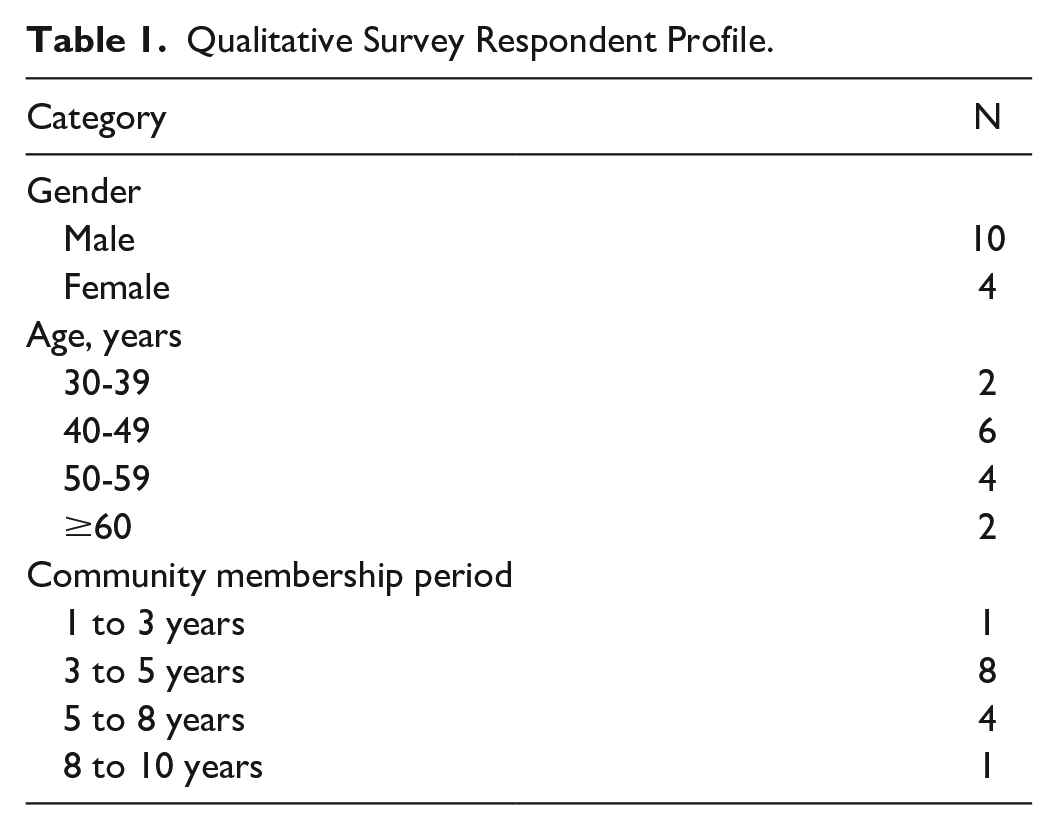
The profile of the survey participants is provided in Table 1. The survey answer texts resulted in 126 response comments, comprising 5,458 words. The data were analyzed in the same manner as the netnography analysis. Using QSR NVivo software and (Leech and Onwuegbuzie 2011), thematic analysis based on axial coding was conducted to identify the nontransactional values and behavioral drivers for the five dimensions of engagement behaviors. For example, drivers for influencing changes and differences for other members and the hotel brand were coded as “Making changes.” These results were then compared to the netnography analysis results as a validation check. The identified patterns and processes of engagement from the netnography and the survey data analyses resulted in the development of the proposed customer engagement framework.
Qualitative Survey Respondent Profile.
Results
Figure 1 shows the study results as a proposed conceptual framework of nontransactional values cocreated as a result of customer engagement in an online brand community. The figure also reflects the types of customer engagement behaviors that result in the different types of value, the primary driving forces for those behaviors and the different primary beneficiaries. The arrows in the figure propose that engagement drivers lead to engagement behaviors, which result in the five types of cocreated nontransactional value.
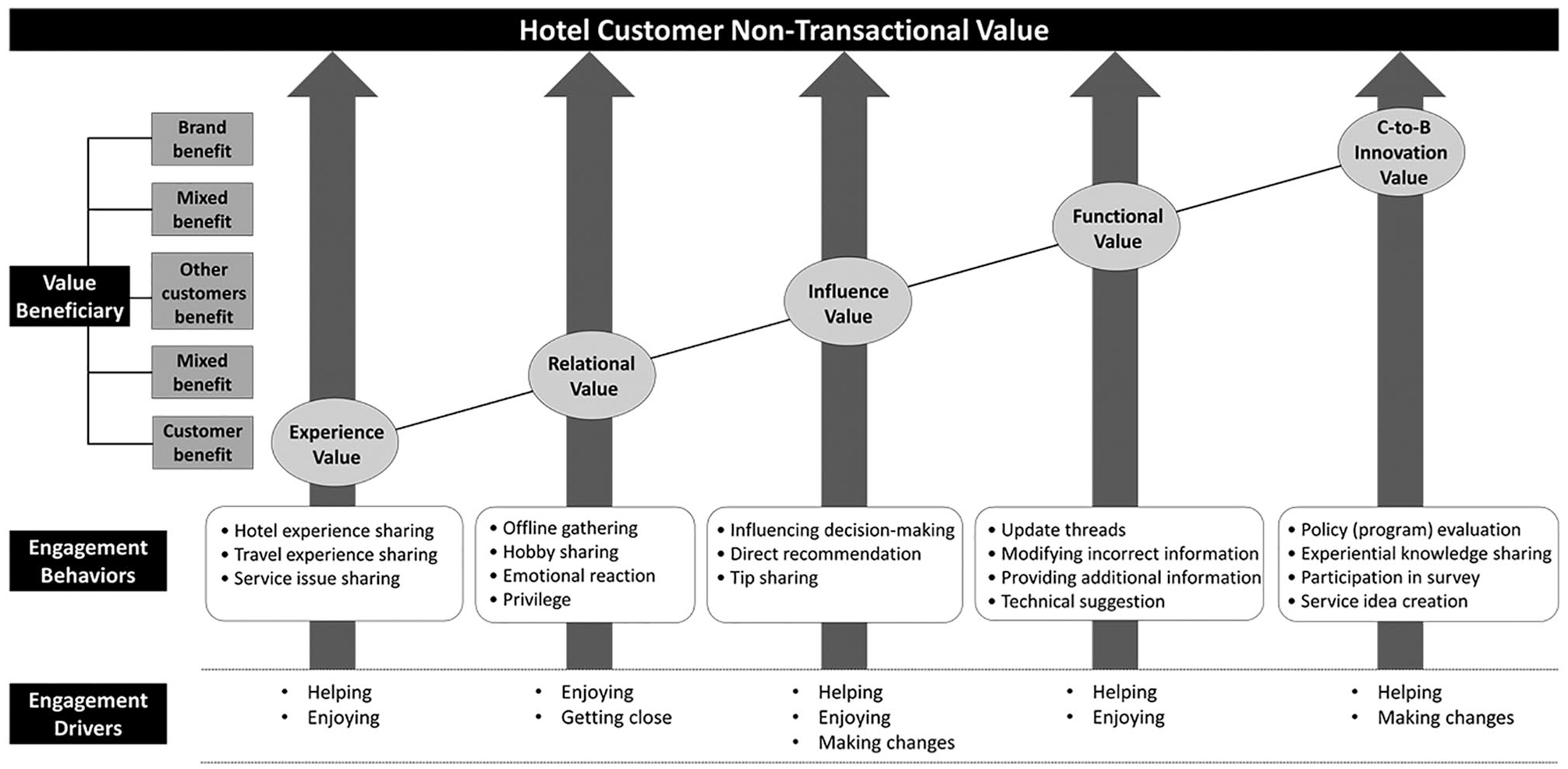
Cocreated value via customer engagement behaviors and drivers.
Five types of nontransactional value are cocreated from online community member engagement behaviors. Experience value refers to the value cocreated by sharing service experiences or service issues. Relational value refers to the relational bonds developed by C-to-C interactions. Influence value represents member information provided to help other members make travel decisions and efforts to influence prospective customers’ decision making. Functional value refers to the value cocreated by customers’ voluntary and helpful behaviors to benefit the operation of the brand community. C-to-B innovation value refers to the knowledge value cocreated by members evaluating hotel programs or policies and/or proposing new service ideas for the hotel brand.
The five types of value can be understood in terms of primary beneficiaries, such as (1) those that primarily benefit the customers themselves (experience value), (2) benefit other customers (influence value), (3) benefit the brand (C-to-B innovation value), and (4) mixed benefit (relational and functional value). Experience value mostly benefits the community members engaging in experience sharing behaviors; they share their experiences to relive their experiences and satisfy their desire to share information. Relational value benefits both the engaged member and other community members. Influence value mostly benefits other community members by helping their decision making. Functional value benefits both other members and the hotel brand; other community members get assistance from the helpful behaviors, and the hotel brand can efficiently operate the community with the engagement behaviors. Lastly, C-to-B innovation values mostly benefit the hotel brand; critical service ideas and knowledge can be employed for service innovation. Analysis of the subsequent survey data identified four key drivers for member engagement, including helping, enjoying, making changes, and getting close.
Conceptually, the analysis also revealed that customer value is cocreated not in a sequential process but in an interactive and dynamic way, which is consistent both with the findings reported by Brodie et al. (2011) and the “community” perspective of the venue. That is, customer engagement behaviors can cocreate multiple types of value, and each value is highly connected with other values. For example, influence value can be correlated with experience value; customer engagement behaviors sharing hotel experiences can cocreate influence value when the information influences subsequent prospective customers’ decision-making behaviors. Thus, the study results identify multiple dimensions of cocreated value resulting from customer engagement behaviors over time as opposed to dividing engagement behaviors according to specific cocreated value.
Dimensions of Cocreated Value
This section provides greater detail of the member engagement behaviors within each of the value dimensions identified in Figure 1.
Engagement behaviors for experience value
Similar with experience-sharing behaviors in online review platforms (Xiang et al. 2017), experience value is cocreated by members sharing not only experiences about hotels but also about destinations and overall brand service issues. The main beneficiary of experience value is the community members who satisfy their desire to share their experiences. Specific types of experience engagement behaviors are delineated as follows:
Hotel and destination experience sharing
One of the main categories of community engagement behaviors are comments that share hotel service experiences. While most reviews found on Online Travel Agency (OTA) platforms are comparably simple and concise (Stringam and Gerdes 2010), hotel reviews posted in the online brand community are more complex, very specific, and concrete. Moreover, many reviews include photos taken by the members.
Last week my Wife and I stayed at the St. Pancras, London Hotel. I used Marriott rewards points to book the room and then paid 160 Pounds to upgrade our room to a Chambers Suite. This upgrade was worth it as we had one of the best hotel experiences in a long time. . .
Additionally, many members share not only hotel service experiences but also post general travel experiences, including destination activities and attractions. Thus, online hotel brand communities function as a comprehensive travel platform for experience sharing. Importantly, they not only share their experiences but also request further information from other members to satisfy their own desire for information.
Bali was my 1st choice to celebrate my anniversary. Please post pics and let us know how your stay was. Soooo….envious. : We were in Bali a few years ago and I thought I would share with you a couple of activities that we really enjoyed. I highly recommend a bike tour “Halo Biking.”
Service issue sharing
Community members also commonly share personal service issues concerning the Marriott Bonvoy loyalty program, hotel policies, and other general hotel service issues. As an initial step to finding a solution for an issue, members often check whether other members experience the same issues.
Anyone else still waiting on their Elite Night Credits for 3k spend to hit their Marriott Bonvoy account? Curious if anyone else is experiencing a similar issue. Thanks! : I am also having this problem. I have contacted both Chase and Marriott Rewards customer service and am still waiting to hear back. Have you asked community managers yet?
Engagement behaviors for relational value
Online community members interact with each other to build social capital (Seibert, Kraimer, and Liden 2001). In this regard, relational value is cocreated by having (un)official gatherings, sharing their private hobbies, emotionally reacting to each other, and providing special privileges to each other. Given the C-to-C nature of relationship building, relational value benefits both community members engaging in the relational behaviors and other community members.
Offline gathering
Community members have various types of actual meet-ups. For example, two or three members have a small gathering when one member finds out another is staying close by at the same time. Some community members create threads (e.g., “2019 Upcoming Stays”) where they share their travel plans and organize gatherings. In addition, official large gatherings are often organized by active members.
Hey XXX our hotels are only 1.5 miles apart in Lake Buena Vista, and there happens to be a bar at your Delta Hotel, soooooo, maybe we can coordinate for a drink….. : OK, I’m booked for Friday and Saturday departing on Sunday. My wife will be joining me. Looking forward to actually meeting you.
Hobby sharing
Sharing a hobby is a way to create a bond among community members. Although most community members focus on sharing travel-related hobbies, some members also share other hobbies. This aspect indicates that the online hotel brand community can become a platform for community members to get to know each other not only as hotel guests but also as ordinary people.
Anyone else collect hotel pens? Next week I’ll add coffee cups. The week after that, who knows, maybe note pads. Living the dream. : Pens and toiletries are to be used, and I do take them with me. I’ve been seeing more and more cooking photos lately, so why not? And yes, you can post your grilling photos in here too.
Emotional reaction
Community members empathize with other members when they share either positive or negative service experiences. This behavior results from the empathic ability of community members who are familiar with similar hotel experiences. These emotional and empathic communications can create an emotional bond among members.
It’s great to hear such a nice story. Congratulations on your marriage and may your future be filled with many happy travel experiences with your spouse. I am really sorry to read of your loss. Hopefully, you will deserve better next time.
Privilege
While community members do not personally know each other, they provide some privileges to other community members. For example, they introduce other community members who are planning to stay in a hotel to acquaintances who work at the hotel.
If you are thinking of going PM me and I will give my friend the GM a heads up for you.
Engagement behaviors for influence value
Influence value is cocreated by community members’ engagement behaviors making specific and direct recommendations or providing specific tips to other community members. These behaviors can potentially affect other members’ hotel or destination decision-making and problem-solving processes (Dessart, Veloutsou, and Morgan-Thomas 2015). The main beneficiary of influence value is other community members who can use the recommendations or tips for their decision making.
Influencing decision-making
Community members often make specific and direct recommendations to other members. Obviously, these posts can influence prospective customers’ decision-making behaviors.
This is a hotel you really must experience, it’s not central London but seriously, it’s a destination in itself, and keeps what I rate as the very best hotel concierge lounge in the world. I definitely recommend it! Just make sure you stay in the Chambers side of the hotel. : Fantastic! Ok next time in London, I am staying here. I would say you just made up my mind. Thanks! XXX. Great post.
Specific tip sharing
Specific tips and advice are shared among community members. Unlike service issue sharing for experience value, they share useful tips to address issues or problems associated with hotel services.
Has anyone booked a Marriott advance reservation and then found out the hotel price is significantly lower a week before there trip? Has anyone been able to get Marriott to match the price? : I regularly check back to see if any room rates are better than my original reservation. If there’s a noticeably better rate on the same room type, I just make a new reservation at the lower rate, then cancel the original reservation.
Engagement behaviors for functional value
Functional value is cocreated by community members’ volunteer behaviors. While Assiouras et al. (2019) argued that value cocreation leads to customer functional behaviors, this research found the opposite; customer engagement behaviors cocreate functional value. These volunteer engagement behaviors can help other community members resolve their issues and assist the operation of the online brand community.
Creating and updating threads
Community members often spontaneously create an information thread to organize information (e.g., updating a list, creating a new discussion, and correcting wrong information, etc.) for the purpose of effective information collection and sharing. Further, these threads are frequently updated by other members’ contents. Their willingness to volunteer to create and update threads substantively help brand community managers to operate the community.
Here’s a map I’ve compiled using the latest status/points changes of all reward hotels by category. Please indicate any errors or missing properties and I’ll update.
Some community members volunteer to share the latest hotel news with other members. This shows that the C-to-C marketing communication can be a useful and cost-effective way to deliver hotel information to a large number of customers by supplementing traditional hotel B-to-C marketing communications.
Brand Change Effective On May 9, 2018. The W New York will be transitioning to The Maxwell New York City on May 9, 2018 and will no longer be affiliated with the W brand.
Technical suggestion
Some community members voice concern about other members’ issues associated with personal information and security while engaging in community activities. In this case, they make a technical suggestion for other members.
You are posting dates for future travel. . . so maybe change user name or don’t post such specific dates. Just a suggestion, safe travels but careful with the level of personal info! : Thanks! Very good suggestion about not posting specific dates of future family travel. I’ve edited accordingly.
Provision of additional information
Community members also help others get correct information by pointing out relevant posts in the community message board. This additional provision of information results in better and more efficient communications among community members.
There are a few others that feel the same has happened but thought it will catch up soon enough so we are being patient. Here’s the other posts that might help you.
Engagement behaviors for customer to business (C-to-B) innovation value
Most previous research has conceptually proposed the innovation value of customer engagement behaviors (e.g., Chathoth et al. 2013; V. Kumar and Reinartz 2016). In this study, such values were empirically identified as C-to-B innovation values. C-to-B innovation value primarily benefits the hotel brand by cocreating critical knowledge for service innovation.
Policy (program) evaluation
The online brand community becomes an open platform for community members to evaluate hotel policies. Further, community members sometimes try to take collective action to meaningfully impact hotel policies and programs. Their willingness to engage in a united action implies that online brand communities can be a collective forum for innovation.
I think that whether it’s called a resort fee or destination fee is moot. By separating or categorizing resort vs. destination might lend a shred of justification to one or the other. Fact is, NONE of these fees are justified. They are 100% revenue fabrication. : I agree, but we have complaining about these resort/destination fees for some time. How do we get a United Front and have this discussion in front of Marriott Executives?
Community members also frequently evaluate new promotions or programs introduced by Marriott and post their opinions into the community message board. Based on the community members’ reaction, Marriott can effectively evaluate how their customers perceive new service programs. This is an important knowledge source for successful adoption and implementation of new hotel services.
Email received that Marriott properties are no longer approved for official government travel due to the cancellation policy. It seems like it could be a considerable loss. Not just because of the loss of official travel but folks might pick another approved chain for leisure travel as well.
Members also provide specific and actionable information of how hotels can improve. While the feasibility of the suggested actions is not guaranteed, hotels can refer to this knowledge as they evaluate alternative service improvements.
Marriott should let people change their choice of SNA’s to one of the other options available as their original choice was made on seriously misleading information. Marriott should use this forum for qualitative research insights!
Sometimes community members have different opinions about hotel policies. These different perspectives often lead to a lively discussion among community members. This suggests that online hospitality brand communities can become an important forum for hotels to understand variance in how customers perceive their policies or services.
Sorry guys, but this is clearly shown in the T&Cs of the choice benefit when you are selecting from the choice benefit page. I don’t think it’s fair to say this is “messy Marriott”. : I beg to disagree. That last statement in the terms and conditions makes absolutely no sense.
Service idea creation
Unlike idea creation by crowdsourcing users (Poetz and Schreier 2012), community members can create new service innovation ideas without financial benefits. Once the new idea is posted, other community members often provide opinions about the idea or suggest their own ideas as well.
I was wondering if there is an easy way to get a hotel’s name and address in the local language that can be printed out to provide to a taxi (or others). This would be a nice feature to offer on the main website or on the mobile app.
Interestingly, a gaming element (e.g., competition) can be applied to promote community member participation in providing their ideas or opinions.
While Marriott hotels are in lots of locations they are not everywhere. Where should Marriott open a Future Hotel? Maybe we can have a competition on who can find the best location.
Polls
Community members create and participate in polls. The poll subjects vary, including customer service experiences, policy or program evaluation, personal preferences, online community management, etc. The results of polls can be a systemic knowledge source to better understand how hotel customers perceive hotel services.
Mobile check in waste of time or hidden gem? I see no reason to check in the day prior with the app. – Checking in on mobile app adds value – Checking in on mobile app is a waste of time
They also share their additional opinions about the poll subjects, providing detailed and rich information beyond that acquired from the poll.
It would help more if mobile check-in meant you could bypass the counter altogether and go directly to your room and unlock the door with the app. The way it’s setup at Marriott doesn’t save a lot of time.
Underlying Behavioral Drivers
Based on the netnography results, key motivational drivers for the different types of engagement were identified. A survey of active community members was created to validate the types of engagement and these underlying drivers. The drivers vary by type of engagement. The different driver structures validate the proposed types of engagement behaviors in terms of five cocreated value.
Enjoying driver for engagement behaviors cocreating experience, relational, influence, and functional value
Enjoyment was the main driver for engaging in online brand community behavior. Community members stated that they share their service experiences and helpful information simply because they enjoy doing so.
It’s fun to share knowledge so we can have great travel experiences.
They meet each other or volunteer to create and update the online brand community message board content because they like to do so. This suggests that hedonic orientation is a strong driver for cocreating relational and functional value.
Yes, it’s good to meet up with people I correspond with on Insiders. Most enjoyable! I have and in fact been a steward for 3 months a while back. The more I can do the happier I am.
Helping driver for engagement behaviors cocreating experience, influence, functional, and C-to-B innovation value
Helping others was another common driver for engagement behaviors. This finding reconfirms the study by Walsh, Gwinner, and Swanson (2004). Specifically, respondents stated that they need to pay back other members’ contributions by sharing their own experiences and knowledge. This suggests that community members engage in various activities for mutual benefits; they share their experiences and knowledge to help others avoid or resolve potential issues.
I have learned about various places and properties from other members and so share my experiences as a way of paying back (or forward) their assistance. I want others to see how I travel, and in return hope to see how others travel. Those issues that have gone unresolved so people will get a heads up on potential problems and those issues that were resolved and how so that if someone comes across that problem they’ll know how best to resolve it.
Community members’ helping drivers were oriented not only to other members but also to themselves. They said they interact with others to enhance their destination experiences and to make their stays more valuable. This represents that experience and knowledge sharing is derived from both altruistic and extrinsic needs.
It often leads to discussion that has influenced or informed my stay experience as well as places I have traveled to. I’ve also used those tips from others to make my stays more valuable.
Making change driver for engagement behaviors cocreating influence and C-to-B innovation value
Respondents mentioned that they update information when they believe their contents will be critically considered by other members. In other words, they engage in activities with the expectation of making changes and differences for other members. This driver can be the basis of engagement behaviors for influence value.
I believe, for me, it is to feel like I am making a difference to people that may be similar to myself. It is the idea that people will take my advice more seriously because I am among others that are taking it serious.
C-to-B innovation value is also promoted by community members who share important knowledge with the aim of informing the hotel brand of serious issues and influencing change. However, if they think their contents are not critically considered by the hotel management, they are less likely to share their insights with the hotel company.
I think I make suggestions to Marriott in my posts because they do occasionally change the scheme. I think we can influence change when Marriott decides its time to make them. It’s a way to alert Marriott corporate of the issue. Very little of anything we say ever reaches the ears of Marriott management. I know nothing I might suggest to Marriott will ever be implemented.
Getting close driver for engagement behaviors cocreating relational value
Community members build social identity or social capital by engaging in community activities (Seibert, Kraimer, and Liden 2001). As like-minded individuals, the opportunity to create social bonds with other members is a common driver to engage.
We all have a common interest in travel and even more specifically in Marriott. We’ve already taken the first steps toward friendship. It just made sense to organize a place for anyone interested to come and meet.
Some community members even define themselves as a family or friends. This indicates that online brand communities become a social place for building personal relationships with each other.
They were very helpful to me when my wife had a serious illness a number of years ago. We get to know those who post often and do get close. We are a family. I was saddened when one of the Insiders I previously met passed away. Even though I considered him my friend, we had only met in person once.
Conclusions
Historically, customer management has focused on promoting customer transactions (Dorsch and Carlson 1996); most research examined the short-term impact of transactions on firm profitability. Beginning in the late 1990s, many hospitality and tourism firms evolved to a far greater focus on customer relationship management wherein firms work to establish positive, long-term relationships with their customers by ensuring their satisfaction and loyalty (e.g., Bose 2002; Mithas, Krishnan, and Fornell 2005). More recently, as customer management has progressed with the development of information technology, management strategy has further evolved from relationship management to customer engagement management, promoting customers’ active participation in firm value chains (Brodie et al. 2011; Lei, Wang, and Law 2019). This transition to customer online engagement management has been further accelerated by the COVID-19 pandemic and the resulting need for online interactions, relationship building, innovation via customer knowledge, and adaptation. This research views customer engagement management as the key paradigm of hospitality and tourism brand marketing.
Theoretical Implications
This research has six key theoretical implications. First, as suggested by So, Li, and Kim (2020), this study articulates the hotel customer engagement and value cocreation process in an online brand community context. Nambisan and Baron (2009) initially provided a comprehensive framework explaining the relationship among engagement behavior characteristics (e.g., product content, member identity, and human interactivity), perceived benefits of the engagement behaviors (e.g., learning, social integrative, personal integrative, and hedonic), and customer participation in product support for value cocreation. However, this framework did not focus on the different types of nontransactional value cocreated by various engagement behaviors. Given the importance of better understanding the multidimensionality of customer engagement and the subsequent nontransactional values (Harmeling et al. 2017), this study conducted an analysis of a hotel online brand community by adopting a mixed-methods approach to propose a model for classifying online brand community engagement behaviors, associated drivers, and nontransactional value cocreation.
Although customer engagement and value cocreation have received growing scholarly attention, the existing research tends to be either conceptual papers that do not include data (e.g., Pansari and Kumar 2017; van Doorn et al. 2010) or quantitative papers based on survey research (e.g., Assiouras et al. 2019; Baldus, Voorhees, and Calantone 2015). While Chathoth et al. (2013) made a distinct contribution to the theory of value cocreation by conceptually examining value cocreation and its relationship with coproduction and customer engagement in hospitality and tourism contexts, this study employs qualitative methodologies to classify member engagement behaviors and nontransactional values in a hospitality online brand community context. In addition, while most research focuses on experience cocreation during service delivery processes (e.g., Lei et al. 2020; Shin and Perdue 2019), this study focuses on value cocreation before and after service experiences, which contributes to better understanding value cocreation processes in extensive service processes. Lastly, unlike most existing hospitality and tourism research that focuses on a single type of C-to-B engagement–experience sharing in online review OTA communities (e.g., Trip Advisor, Expedia, etc.) (Casaló, Flavián, and Guinalíu 2010; Xiang et al. 2017), this study focuses on the broad range of hotel brand community members’ engagement behaviors including both C-to-C and C-to-B interactions from the service ecosystem perspective. As a result, this study provides empirical insights into broad customer engagement behaviors, nontransactional value cocreation, and the underlying behavioral drivers.
Second, this study proposes a conceptual model, which can serve as a tool to future research. The identified dimensions of customer engagement behaviors are not only different from existing models of engagement behaviors but also more comprehensive. While limited previous research exists to understand how customer engagement behaviors are associated with nontransactional value (e.g., Jaakkola and Alexander 2014; van Doorn et al. 2010), this study proposes a more comprehensive classification of both engagement behaviors and nontransactional values. The proposed framework of customer engagement behaviors expands on previous research and adds further evidence to the conceptual heterogeneity of customer engagement behaviors. In addition, this study contributes to the theoretical development of this literature by identifying different beneficiaries of cocreated value. While most value cocreation research only focused on benefits to the customers who engage in cocreation behaviors (e.g., Buonincontri et al. 2017; Grissemann and Stokburger-Sauer 2012), the three different groups of beneficiaries provide more nuanced insights into the value cocreation process.
Third, this study supports the role of online brand communities as a knowledge source for open innovation by identifying C-to-B innovation value. Open innovation refers to an external innovation process based on engaging external stakeholders for knowledge cocreation (Chesbrough 2006). With the transformation of the tourism business environment resulting from the COVID-19 pandemic, traditional marketing and internal innovation processes are insufficient to assess and understand rapidly changing customer needs. Given that more C-to-C and C-to-B online interactions and communications are being created in the pandemic age, tacit knowledge created by customer online engagement can be managerially employed to efficiently identify both current service improvements and new service developments (Füller, Matzler, and Hoppe 2008). In this sense, the study findings can be the basis of establishing successful open innovation strategies.
Fourth, this study confirmed that online hotel brand communities can also function as travel communities with overall travel information associated with destination, accommodations, and attractions being shared by members. Further, experience value is associated with influence value; experience sharing via C-to-C interactions provides meaningful information for potential travelers as the user-generated content influences prospective travelers’ decision making. This supports Harmeling’s et al. (2017) point that customers’ persuasion capital in engagement behaviors influences other potential customers. By empirically identifying how community members’ engagement behaviors influence other members, this study argues that online brand communities can be an influential platform impacting travel purchase or planning decisions (Romero and Molina 2011). Thus, experience value and influence value benefit both community members creating contents and other community members seeing and reacting to the contents. In addition, this indicates that online brand communities can be a significant distribution channel. Importantly, the cocreation of influence value well represents the unique nature of online brand communities where community members trust each other as they share a common interest in a brand.
Fifth, while previous studies have focused on customer C-to-B relationships (e.g., Habibi, Laroche, and Richard 2014), this study found that hospitality and tourism brand communities can also become a virtual place for building meaningful C-to-C relationships. While a key goal of (C-to-B) customer relationship management is to build and maintain a base of committed customers who are profitable to a firm (Zeithaml, Bitner, and Gremler 2012, p. 149), this study found that meaningful C-to-C relational bonds among community members can be beneficial for each other. Given that close brand community members are likely to develop stronger brand loyalty, share critical brand information with others, and attract other members into the community, further tourism research needs to examine C-to-C relationship-building processes in online brand communities. Specifically, C-to-C relationship building in online brand communities may lead to the formation of actual relationships in offline contexts. This finding provides empirical evidence that online engagement can evolve into offline interactions (Vivek, Beatty, and Morgan 2012).
Lastly, this study contributes a preliminary understanding of the various drivers for customer engagement behavior. The identified dimensions of engagement drivers reconfirm the existing research (e.g., Baldus, Voorhees, and Calantone 2015; Walsh, Gwinner, and Swanson 2004) and identify further driving forces of engagement behaviors. Importantly, while the existing research mostly examined generic customer engagement, this research helps to better understand how each driver is related to different types of engagement behavior. While further research is obviously needed, the underlying driving forces confirmed the structure of the engagement behaviors and proposed categorization of nontransactional values. The study results confirm the importance of helping and pleasure (enjoying) engagement (Walsh, Gwinner, and Swanson 2004). Although the primary driver for experience and influence value cocreation is helping others, community members are also helping themselves; in a quid quo pro frame, they share their experiences and knowledge to ultimately enhance their own service experiences. In addition, making changes is a key underlying reason for both influence and C-to-B innovation engagement behavior, supporting the important role of customer empowerment in value cocreation processes; empowered members are likely to share their innovative knowledge. Community members like to get closer to other members as they are like-minded people, demonstrating that brand interest is an antecedent for members to make friends via engagement behaviors (van Doorn et al. 2010).
Practical Implications
Online brand communities have dramatically increased the opportunities for tourism firms to engage with their customers. Moreover, in addition to firm–customer engagements, online brand communities also dramatically grow opportunities for engagement between the firm’s customers. Effective management of online brand communities can cocreate both transactional and nontransactional values (Hoyer et al. 2010). Specifically, the identification of experience and influence values indicates that tourism brand communities may be used as a distribution channel. Community members who share similar brand interest are likely to trust each other when they search for travel information. To promote booking behaviors, community managers may provide direct links on brand community websites to access a central reservation website. In addition, community managers may involve in C-to-C information sharing to provide additional information about subject hotels and their booking information.
The COVID-19 pandemic has dramatically impacted the tourism industry. Hospitality and tourism firms have been challenged to effectively interact with customers, to better understand their changing needs, and to work collaboratively with customers to create innovative products and services especially in online platforms and social media communities. In the postpandemic era, customer online engagement management will be increasingly important for building meaningful C-to-B and C-to-C relationships with brand customers. In addition, external knowledge creation via an online brand community is an attractive tool for service innovation offsetting slow, often costly, and ineffective internal R&D processes for new service development (Romero and Molina 2011). The critical challenge is to effectively build engagement platforms that also serve as innovation knowledge sources. Building such platforms requires an understanding of the various types of engagement that occur in such communities, the nontransactional values created by these engagements, and the underlying engagement behavior drivers.
This study proposes that tourism firms can use online brand communities as a platform for open innovation by cocreating C-to-B innovation value (Hoyer et al. 2010). For effective open innovation, community managers need to respond to members’ suggestions and react to their contributions so that community members are empowered to share their insights (Shin, Perdue, and Kang 2019). Following crowd sourcing strategies adopted by global brands’ online communities (e.g., Starbucks, Dell, and Samsung), tourism firms need to consider providing their customers with social rewards for sharing creative ideas to encourage idea and critical knowledge sharing. It is important to identify influential community members and encourage their active engagement for knowledge sharing. Since they are highly engaged loyal members, listening to them and managing their knowledge is a crucial step for open innovation.
Lastly, tourism firms need to help cocreate relational and functional value in the online brand communities. For example, hotels can provide meeting places for the community member gatherings and participate in the gatherings as well. This will help create not only C-to-C bonds but also B-to-C bonds. In terms of promoting functional value, nominating community members for their exemplary functional behaviors may be worthwhile. For example, hotel firms can make periodic evaluations of community member engagement behaviors (e.g., the number of postings and the number of replies) to select highly active and cooperative members for awards and benefits. This will substantively help the hotel brand to operate their communities with active engagements of community members.
Limitations and Future Research
Several future research directions are identified by acknowledging this study’s limitations. First, as previously noted, the Marriott Bonvoy Community managers would not grant permission for a broad survey of community members. Further research with a broader sample of brand community members is needed to fully validate the proposed conceptual model. As Kozinets et al. (2010) state, the underlying processes of behavioral engagement are complex, particularly when attempting to understand various types of engagement behavior. Future research needs to explore differences between those who frequently and actively engage in community activities as compared to those who passively engage in community activities. Additionally, studying multiple online brand communities will enhance the external validity and generalizability of the proposed framework. Although this study focuses on customer perspectives toward value cocreation and engagement behaviors, future research may focus on managerial perspectives of value cocreation. Following Lei, Wang, and Law (2019), understanding how brand managers employ and design online platforms for value cocreation and service innovation will provide further explanation of the resulting nontransactional values.
Second, to complement this qualitative study, future quantitative analysis of the proposed framework is needed. This study focused on an analysis of online communications via netnography and a small qualitative survey. Further quantitative research with a larger, more diverse sample is needed. More specifically, future research may consider developing a multi-dimensional measure of customer engagement according to the five proposed nontransactional values. While overall customer value consists of transactional value and nontransactional value (V. Kumar and Reinartz 2016), there has been a lack of metrics for nontransactional values. A validated measure of customer engagement behaviors resulting in the various nontransactional value is needed.
Third, this research proposes that different types of cocreated value may differentially benefit the member submitting content, other members, and the online brand firm. While experience values primarily benefit the commenting member, relational values benefit the commenting member and other members, influence values primarily benefit other members, functional values primarily benefit other members and the brand firm, and, finally, that C-to-B innovation values primarily benefit the brand firm. This is a substantive and potentially important proposition that clearly requires further research.
Lastly, along with the development of online platforms and social media, future research needs to adopt advanced netnography approaches (e.g., humanistic netnography, symbolic netnography, and digital netnography) to better examine online communications (Kozinets 2018, 2019). For example, analytical techniques and statistical data analyses can be used to detect patterns of a large volume of social media data in digital netnography (Kozinets 2018). Future hospitality and tourism research need to conduct advanced netnography analyses for social media and online community data.
Footnotes
Declaration of Conflicting Interests
The author(s) declared no potential conflicts of interest with respect to the research, authorship, and/or publication of this article.
Funding
The author(s) received no financial support for the research, authorship, and/or publication of this article.
