




Abstract
Residents’ voluntary word-of-mouth (WOM), especially positive WOM, is scarcely investigated. Since different human–place relationship factors influence residents’ WOM, further understanding of how residents evaluate the place affects their voluntary behaviors is essential. Using PLS-based structural equation modeling, this study investigates the linkages between residents’ self-congruity, place satisfaction, engagement, expectations, and WOM. Results based on 313 residents of Ljubljana (Slovenia) and Pula (Croatia) suggest that (1) place satisfaction and place expectations only directly affect one-to-one positive WOM; (2) actual and ideal self-congruities affect place satisfaction, engagement, and expectations; (3) place engagement has a substantial direct impact on both one-to-many and many-to-many WOM; and that (4) actual and ideal social self-congruities have a direct influence on many-to-many WOM. In general, this study adds to the literature by detailing how different WOMs are motivated by various factors via different psychological mechanisms.
Introduction
With the emergence of new technologies, particularly social media, online chats, forums, and virtual realities, residents’ engagement in tourism development is gaining increasing research focus because of their voluntary word-of-mouth (WOM) behaviors (Simpson and Siguaw 2008; Papadimitriou 2015). Internet and mobile technologies offer tourists various possibilities to visualize the destination before they decide to travel. Still, many travelers prefer WOM rather than technologically enhanced marketing campaigns targeted at particular market segments. Thus, WOM, especially electronic WOM, induces new ways of spreading the benefits of a tourist destination. Hence, many authors (Chen, Dwyer, and Firth 2014b, 2015, 2018; Chen and Šegota 2015; Jeuring and Haartsen 2017; Wassler and Hung 2017) called for rethinking the role of residents in promoting a tourism destination via their positive WOM (pWOM), mainly because customer-to-customer communication in a tourism context is playing an increasingly important role in affecting potential tourists’ destination choices.
Residents of a tourism destination take multiple roles—from suppliers to consumers and brand ambassadors (Šegota, Mihalič, and Kuščer 2017). In the development of a tourism destination, residents’ role has been investigated extensively (for a review, see Gursoy et al. 2018; Hadinejad et al. 2019). However, their perceptions of tourism impacts and support for tourism development have been the focus of the research. It was suggested that the more positively residents perceive the impacts of tourism, the more supportive they will be of its development (Andereck and Vogt 2000; Perdue, Long, and Allen 1990; Sharpley 2014). Hence, residents were primarily observed through the lenses of tourism planning and development, majorly neglecting their role as stakeholders in expressing their support to local tourism development and directly communicating to potential tourists (Eshuis and Edwards 2013; Wassler and Hung 2017). On the other hand, residents’ behaviors related to the tourism destination, such as WOM, complement and support tourism marketing efforts (Andersson and Ekman 2009; Chen and Dwyer 2018; Xiong, King, and Piehler 2013). In the rise of social media, many observed that destinations struggle to keep up with effective tourism marketing communication (Hays, Page, and Buhalis 2013; Šegota 2018), even more so when it comes to residents (Jeuring and Haartsen 2017). Neglecting residents in their roles of promoting the destination was shown to have negative consequences for destination marketing efforts (Braun, Kavaratzis, and Zenker 2013; Zenker, Braun, and Petersen 2017).
Exploring residents’ proactive role in tourism development through their WOM, especially pWOM, behaviors in its nature reflect a collaboration approach, which is essential in sustainably moving the tourism industry forward (Graci 2013; Robinson 1999). Residents as a stakeholder group have interests in the tourism industry and contribute to this industry if well integrated (Aas, Ladkin, and Fletcher 2005). Residents assess their residential place’s functional benefits, which build into the self–place consistency (Wassler, Wang, and K. Hung 2019). Residents’ certain citizenship behaviors, such as WOM under different circumstances, illustrate their responsibilities related to the place as a tourism destination. These narratives further contribute to building the destination’s identity, cultivating its image to potential tourists (Kastenholz 2004). In return, a perceived and established destination image may further drive the self–place matching process, that is, self-congruity, suggesting a dynamic reciprocal effect. In this sense, encouraging residents to participate actively and contribute to conversations and communications about their residential place becomes crucial in maintaining a relatively stable identity/image of a tourism destination fostering sustainable tourism and place development.
The question of how residents talk about the place they live in has been studied in recent studies, many of which were based on attachment theory (e.g., Chen, Dwyer, and Firth 2014b, 2015, 2018). It was demonstrated that place attachment is a multidimensional construct, whereas each dimension affects different types of WOM (Chen, Dwyer, and Firth 2014b, 2015). However, residents’ WOM also reflects their recognition of the place, which extends to how residents match various dimensions of self with the place (Chen and Šegota 2015). Self-congruity is one of the most widely used concepts in the marketing literature linked to the study of brand-building behavior (Aguirre-Rodriguez, Bosnjak, and Sirgy 2012; Mulyanegara and Tsarenko 2009; Sirgy and Su 2000). In reference to that, understanding the motivation of residents’ voluntary WOM behaviors related to the place should be informed by the match between individuals and their place of residence.
Considering the above, this article investigates how residents’ evaluation of the place affects their WOM, especially pWOM, subconsciously. This study seeks to conceptualize and identify the human–place relationship’s main factors influencing residents’ WOM intentions. While existing literature reveals that different factors influence different types of WOM, researchers have not systematically examined residents’ self-congruity as an important element influencing their WOM behavior. Therefore, this study assumes self-congruity as a critical construct affecting residents’ place satisfaction, place engagement, and place expectations. It further influences their WOM. Theoretically, we hope that our findings will support the literature’s standpoint that different WOM are motivated by various factors via different psychological mechanisms. Managerially, we hope that the findings can be of use to practitioners who wish to understand the drivers and mechanisms behind residents’ destination ambassadorship.
The Typology of Word-of-Mouth
Word-of-mouth (WOM) has emerged in the marketing literature as an essential concept defined as a behavioral outcome of customers’ identity with an organization. For example, Baloglu (2002) and Petrick (2004) find that the more customers identify with an organization, the more likely they will advocate or promote the organization to others through WOM communication. Moreover, WOM communication is highly effective compared to advertising when organizations and businesses share information with a target audience (Baggio et al. 2009). At the same time, WOM is also shown to be one of the most important information sources among consumers and tourists (Browning, So, and Sparks 2013; Levy and Gvili 2015; Tham, Croy, and Mair 2013). Thus, WOM is considered the most powerful communication tool in the new information age (Simpson and Siguaw 2008), which is likely to significantly affect tourism destination brands (Hanlan and Kelly 2004; Baloglu and McCleary 1999; Beerli and Martin 2004).
WOM is defined as “a communication opposed to those through mass-media channels that pass product knowledge from producers/providers to consumers” (Litvin, Goldsmith, and Pan 2008, p. 459). It includes both personal and virtual interactions. However, several scholars argue that the typology of WOM needs to go beyond a differentiation of the so-called online and offline interactions (e.g., Chen, Dwyer, and Firth 2014b, 2015; Tham, Croy, and Mair 2013). More specifically, support for broadening the typology of WOM (and eWOM) is grounded in the thinking that different factors via different psychological mechanisms motivate the nature and context of communication. A tourist may engage in a discussion forum to recommend the destination based on place memory and place expectations (Chen, Dwyer, and Firth 2015) rather than the extent of his or her identification with the place. At the same time, place satisfaction and place identification may motivate an individual to speak positively or negatively of the destination in verbal, person-to-person communication (Simpson and Siguaw 2008).
According to these possible linkages, several typologies of WOM have been proposed. This study adopts Chen, Dwyer, and Firth’s (2015) conceptualization that focuses on a typology based on the scenarios of how and why WOM is being initiated. Hence, authors differentiate between three types of WOM: one-to-one, one-to-many, and many-to-many. One-to-one WOM refers to WOM generated by one person and communicated to another person in private, such as conversations with family or friends via emails, instant messaging, telephone, in person, etc. Early research (Ahearne, Bhattacharya, and Gruen 2005; Engel, Blackwell, and Miniard 1995; Simpson and Siguaw 2008) finds that one-to-one WOM is influenced by place satisfaction and place salient identity. The link represents an explicit self-definition related to places in one’s social identity based on self-congruity (Chen, Dwyer, and Firth 2014a). One-to-many WOM could be defined as WOM generated by one individual to share with others without identifying the audience, for example, WOM in public speech, blogs, social networks websites, and other online media. Tourism studies (Chen, Dwyer, and Firth 2014b, 2015; Choo, Park, and Petrick 2011) have found that place memory and place expectations mainly motivate people to engage in this type of WOM. Many-to-many WOM, different from the previous two types of WOM, refers to those WOM behaviors in open group discussions or themed online communities, where conversations occur with almost no focus on participants’ identities. Creators and receivers of this type of WOM do not necessarily recognize anyone in the discussion, and the emphasis is purely on information exchange, rooted in one’s engagement with the place (Chen, Dwyer, and Firth 2015; Tham, Croy, and Mair 2013) and identification (Hung and Petrick 2012; So et al. 2018). The three different types collectively reflect the different natures of how and why WOM is created and communicated, which is linked to different dimensions of the human–place relationship. In the resident context, it is crucial to understand how different WOM, especially pWOM, behaviors are motivated and influenced in understanding residents’ role in destination development. This study focuses on the pWOM (pWOM) since different factors often drive negative WOM from those for pWOM, such as service failure (Richins 1983).
Dimensions of Human–Place Relationship and WOM
Scholars have identified several human–place relationship factors to influence residents’ WOM, especially pWOM, behavior. These factors include place satisfaction, salient identity, resident’s engagement with the place, and place expectations (Chen, Dwyer, and Firth 2015, 2018; Palmer, Koenig-Lewis, and Medi Jones 2013; Simpson and Siguaw 2008; So et al. 2018). Place satisfaction is often defined as individuals’ subjective evaluation of a place’s benefits (Chen, Dwyer, and Firth 2014b). One’s salient identity related to place is the dimension of identified self in place attachment (Chen, Dwyer, and Firth 2014a). On the other hand, place expectation refers to another dimension of place attachment reflecting attachment through future expected individual–place experience (Chen, Dwyer, and Firth 2014a). Place engagement summarizes the affective and cognitive experiences of individual–place interactions (Bornioli, Parkhurst, and Morgan 2018). However, there is minimal empirical evidence that clarifies the connection between different WOM types and factors underlying the human–place relationship. Such understanding is essential for both academics and practitioners interested in tourism marketing because of the increasingly important role of residents in tourism destination branding activities (Jeuring and Haartsen 2017; Wassler and Hung 2017). Therefore, the conceptualization of linkages between key dimensions of human–place relationship and WOM as the outcome of residents’ destination brand-building behavior is needed. This will be presented in the following section.
Resident Self-Congruity and Its Impact on the Evaluation of the Place
The impact of self-congruity on behaviors such as purchase intentions and motivation has been extensively investigated in the marketing literature (Sirgy 1985; Sirgy, Grewal, and Mangleburg 2004; Sirgy et al. 1991; Sirgy and Su 2000). According to the self-congruity theory (Sirgy 1986; Sirgy et al. 2008), people tend to purchase and use goods and services consistent with their self-image. Further, in social identity theory, people tend to classify themselves and others into various social categories, which enables the individual to locate or define himself or herself in the social environment, to a salient group classification (Stryker and Serpe 1994; Tajfel and Turner 1986; Turner and Reynolds 2001). Thus, they may reinforce their identity and their view of themselves (self-concept). Sirgy (1986) argues that behavioral motivation is a positive function of self-congruity. He also suggests that the evaluative outcome, including attitude and behavioral intention, are the two purchase motivation indicators. The literature on place attachment reveals that various human–place relationship components largely influence residents’ evaluation of the place. Salient identity was indicated as well (Chen and Šegota 2015; Jeuring and Haartsen 2017; Simpson and Siguaw 2008). Simpson and Siguaw (2008) and Sirgy (2014) suggest that salience identity has many affinities with self-congruity. Moreover, the authors suggest that a place may secure emotional and cognitive attachments to a destination. As such, the place may become a part of the self-concept (Simpson and Siguaw 2008; Sirgy 2014). The self-concept has been extensively researched in the marketing and tourism literature, but most of these studies focus on the tourist–destination congruity and majorly neglect the resident–destination congruity. Moreover, drawing from existing studies in tourism, the literature suggests that the self-congruity affects place satisfaction (Bekk, Sporrle, and Kruse 2016; Ekinci and Riley 2003; Murphy, Benckendorff, and Moscardo 2007), place expectations (Hosany 2012; Sirgy 2014; Xu and Pratt 2018), and place engagement (Ekinci, Sirakaya-Turk, and Preciado 2013; Liu et al. 2012; Xu and Pratt 2018).
In the existing self-congruity literature, scholars support four different types of congruity—actual, ideal, social, and ideal social (e.g., Kim and Hyun 2013; Sirgy 1985, 1986, 2014). The first two congruities are related to brands reinforcing consumer needs to behave in ways helping them in maintaining internal consistency (e.g., how I see myself). On the other hand, social and ideal social congruities help maintain external consistency (e.g., how I think others see me) (Mulyanegara and Tsarenko 2009; Sirgy 1985). Transferred to the context of the resident–place relationship, for the actual self-congruity, the most important is the fit between how residents see themselves (e.g., how one thinks of oneself who he or she is) and the image of a place. On the other hand, ideal self-congruity reflects a match between how residents would like to see themselves and the image of a place. Similarly, for ideal social self-congruity, it is the “ideal” of how residents would like to be seen by others and match this to a place at the core of this “self” dimension. On the other side, social self-congruity is based on a fit between how one believes others see him or her in association with the place image (Hosany and Martin 2012; Sirgy 2014, 1985). The linkage between self-congruity and (dis)satisfaction has been identified and discussed in depth in tourism literature (Boksberger et al. 2011; Chon 1992). Therefore, an individual who perceives a more significant match between his or her place of residence and four different dimensions of self will be more satisfied, more engaged, and will have higher expectations of the place.
Specifically, from Sirgy’s (1986) study, the results suggest that actual self-congruity and ideal self-congruity may not differ between their effects on behavioral motivation, although the motives they drive are different. Sirgy and Su (2000) further conceptualize the various self-concept motives driven by different self-congruity aspects: (1) actual self-congruity drives self-consistency motive; (2) ideal self-congruity indicates self-esteem motive; (3) social self-congruity drives social consistency motive; and (4) ideal social self-congruity indicates social approval motive. These propositions imply that different aspects of self-congruity may illustrate the variation in their impact on different behaviors since these may be motivated for different reasons. Furthermore, many scholars value the place itself in constructing human–place relationships, which may derive the variation indicated above. Shumaker and Taylor (1983) suggest that the physical amenities of the place as landscape attributes can satisfy specific needs. Ryden (1993, p. 38) asserts the physical nature of the place to be “grounded in those aspects of the environment which we appreciate through the senses and through movement: color, texture, slope, quality of light, the feel of the wind, the sounds, and scents carried by that wind.” Further, Shields (1991) claims that the nature of the physical space strongly affects the nature of the created place. From an empirical study, Stedman (2003) finds that the social construction of a sense of place has weaker effects on place satisfaction and place attachment than the physical environment’s contribution to the sense of place. On this basis, we hypothesize the following:
Hypothesis 1: Actual self-congruity has an impact on place satisfaction, place engagement, and place expectations.
Hypothesis 2: Ideal self-congruity has impacts on place satisfaction, place engagement, and place expectations.
Hypothesis 3: Social self-congruity has an impact on place satisfaction, place engagement, and place expectations.
Hypothesis 4: Ideal social self-congruity has impacts on place satisfaction, place engagement, and place expectations.
The Effect of Self-Congruity on Residents’ WOM Behavior
Despite limited empirical evidence directly supporting the association between residents’ WOM and self-congruity, research suggests that the higher the congruity, people are inclined to talk more positively about the place and recommend it to others (Ekinci and Riley 2003; Hung and Petrick 2011; Sirgy 2014). Residents have varied interests in the place of residence, and thus they take on multiple roles (Šegota, Mihalič, and Kuščer 2017). Most of the time, residents are supportive of tourism in their community, and they embrace tourism as necessary, if not the most critical factor affecting the community’s economic, social, and cultural growth (Besculides, Lee, and Mccormick 2002; Perdue, Long, and Kang 1999; Prayag et al. 2012). Hence, their advocacy of the place as a tourism destination is essential from the standpoint of their active participation in the development of the destination brand, which is seen as more trustworthy and authentic than market-sources promotion.
Furthermore, a more congruent individual is likely to evaluate the place more positively, leading toward destination advocacy through pWOM (Chen and Šegota 2015; Jeuring and Haartsen 2017; Wassler and Hung 2017). Again, there is limited evidence on how different types of self-congruity affect when and how people share information about a place. As stated earlier, the reasoning for limited evidence could be attributed to studies being predominately interested in the recommendation of the place as a general outcome of the self-congruity (Xu and Pratt 2018), rather than examining how and when people recommend the place when establishing a match with the destination.
Nevertheless, the four self-congruities can be distinguished by their reflections in self-concept motives (Sirgy and Su 2000). For instance, self-congruity drives self-consistency and self-esteem, while social self-congruity leads to social consistency and social approval. This is consistent with social identity theory: once a social identity (related to a place) is formed, one would promote and protect this place’s interests to build and maintain a consistent self-image and self-esteem (Tajfel and Turner 1986). For instance, drawing on signaling theory and social identity theory, Ahn, Ekinci, and Li (2013) established the linkage between self-brand connection and WOM. Following this logic, this article hypothesizes the following:
Hypothesis 5: Actual self-congruity has (either direct or indirect) impacts on different types of WOM, especially pWOM.
Hypothesis 6: Ideal self-congruity has (either direct or indirect) impacts on different types of WOM, especially pWOM.
On the other hand, many-to-many pWOM is distinguished from the other WOM types for its social exchange capacity, allowing people to engage in social interaction and compare themselves with others (Festinger 1954). For instance, an individual participates in online forum discussions to exchange information and opinions and build social ties that further contribute a sense of belonging. Many-to-many WOM is hence a socially embedded process. Based on the social exchange theory (Blau 2017; Emerson 1976), social motives such as social self-congruity and ideal social self-congruity may drive social exchange (Alexandrov, Lilly, and Babakus 2013) in the format of information exchange such as participation in online forums. Therefore, the hypotheses linking social self-congruity, ideal social self-congruity, and many-to-many WOM are proposed as follows:
Hypothesis 7: Social self-congruity has an (either direct or indirect) impact on many-to-many pWOM.
Hypothesis 8: Ideal social self-congruity has an (either direct or indirect) impact on many-to-many pWOM.
The Effect of Place Satisfaction, Place Engagement, and Place Expectations on Residents’ WOM Behavior
Place-related constructs and their effects on WOM have been extensively discussed (Chen, Dwyer, and Firth 2014b, 2015, 2018). For instance, Chen, Dwyer, and Firth (2018) argue that place attachment dimensions, including place expectation, directly impact general (or one-to-one) pWOM. On the other hand, place satisfaction was found to have indirect rather than direct effects on various pWOM (Chen, Dwyer, and Firth 2014b, 2018). In the consumer behavior literature, consumers’ engagement was found to impact eWOM behaviors within social networking sites, such as sharing useful product information and experience (Chu and Kim 2011). The impact of customer engagement on online reviews was also explored in consumer studies (e.g., Thakur 2018). Therefore, in line with the extensive literature, we hypothesize the following:
Hypothesis 9: Place satisfaction, place engagement, and place expectations predict different types of WOM, especially pWOM.
Data and Methods
Measurement Instrument
To test the hypotheses, we used a quantitative method, which included a survey questionnaire to measure residents’ engagement in destination brand-building behaviors concerning the constructs of interest. The survey instrument was developed based on the measurement items generated from the literature. Respondents were asked to indicate their congruity with the city using a 7-point Likert-type scale (1 = strongly disagree, 7 = strongly agree) and their place satisfaction, place engagement, place expectations, and WOM activities.
To measure self-congruity, we adapted eight items from Ahn, Ekinci, and Li (2013) and Sirgy and Su (2000) to measure the four different self-congruity types. To assess residents’ place satisfaction, place engagement, and place expectations, we used the measurement items from the scale proposed by Chen, Dwyer, and Firth (2014a) and validated by Chen, Dwyer, and Firth (2014b, 2015). We used the typology of pWOM proposed by Chen, Dwyer, and Firth (2015), and we adapted a total of 13 items reflecting three different types of WOM from Chen, Dwyer, and Firth (2014b), Cronan and Al-Rafee (2008), Hsu et al. (2007), Morhart, Herzog, and Tomczak (2009), and Picazo-Vela et al. (2010). A three-item reflective scale of one-to-one pWOM was derived from Morhart, Herzog, and Tomczak’s (2009) work, which Arnett, German, and Hunt (2003) originally developed, and further applied and found its validity in the resident’s context (Chen, Dwyer, and Firth 2014b; Chen and Dwyer 2018). One-to-many WOM was measured based on Chen, Dwyer, and Firth’s (2018) four-item reflective scale, applied initially to measure knowledge-sharing behaviors on Web 2.0 (Lu et al. 2010). Despite its “online WOM” focus, this measurement captured the essence of one-to-many WOM according to its definition and was found highly reliable and valid in the resident’s context. Further, a six-item reflective scale was adopted from Chen, Dwyer, and Firth’s (2018) study to measure many-to-many WOM. This measurement was initially used for measuring the intention of online review (Picazo-Vela et al. 2010). Both one-to-many and many-to-many WOMs were measured as a general WOM rather than highlighting positive or negative directions, but many-to-many WOM measurement implies a more positive response, for example, measuring people’s defense to negative comments online.
All measurements are reflective, and their sources and details are illustrated in Table 1. Scales applied in this study are illustrated in Table 3.
Measurement Used in This Study.

Study Sites Description and Data Collection
The study was conducted in two cities—in Ljubljana (Slovenia) and Pula (Croatia).
The city of Ljubljana is the cultural, political, educational, and economic capital of Slovenia and home to more than 281,000 inhabitants. The city is well known for its green and sustainable efforts that have been awarded numerous national and international titles and recognitions. In addition, the city has been praised for its online communication with residents, as it has developed a highly interactive website where residents can post suggestions, comments, and requests and see how these are being answered and resolved. In the context of tourism, Ljubljana is an urban destination that had seen the year 2018 being its record-breaking year—having exceeded more than one million tourist arrivals and more than two million overnight stays (SiStat 2020). Tourism in the capital has a highly seasonal character, as most of the arrivals and overnight stays happen in July and August.
The city of Pula is considered a cultural, political, educational, and economic capital of the Croatian region of Istria. It is home to 57,000 inhabitants, and it is considered the best city in Croatia in terms of online communication with its residents since 2015. The city has developed an elaborate online communication platform where residents can actively participate in decision making on various budgeting issues. In the context of tourism, despite being a seaside city, Pula places a considerable emphasis on developing cultural tourism. The year 2018 had been record-breaking for Pula as well, as it exceeded two million overnight stays (Istra.hr 2020). However, just like many Croatian seaside towns, Pula records most of the visitations and overnight stays in July and August, which testifies its highly seasonal tourism character.
We decided to collect the data in both cities owing to the following reasons: though seemingly diverse, both cities exhibit many similarities. The cities share similar historical development, from being established as Roman settlements with historical records dating back to the middle of the first century BC to present-day economical, political, social, and cultural regional or national capitals. Also, visitations and overnight stays are very similar, with most visitations and overnights being recorded in the summer months despite Pula being located at the Croatian seaside and Ljubljana being situated in continental Slovenia. Moreover, both cities primarily develop cultural tourism, despite Ljubljana being praised as a green tourism destination and Pula being primarily developed as a sun-and-sea tourism destination. Lastly, both cities have worked effortlessly on developing and improving online communication with their residents—the efforts that have received national recognition and rewards.
The data were collected using an online questionnaire, which has been translated into local languages (i.e., Slovenian and Croatian, respectively). The cross-sectional data were collected simultaneously in both cities for four weeks, from January 12 to February 10 2017. To access potential respondents, we used the methods of convenience and snowball sampling. Respondents were approached online via different social networks, specifically on micro-blogging sites specifically designed for residents to share their concerns and praises of the cities they live in. The online survey outcomes are 313 completed questionnaires, among them 215 residents of Ljubljana and 98 residents of Pula.
Sample Characteristics
In total, 313 valid questionnaires were obtained and included in the data analysis. The demographics of the sample are illustrated in Table 2. Of the 313 participants, 68.7% lived in Ljubljana, Slovenia, while 31.3% lived in Pula, Croatia. Further, 62.6% of the sample were female. Around three-fifths of the participants were employed, while a quarter were university students. The average age of the sample was 36.65 years.
Descriptive Statistics of Demographics.

Data Analysis
This study applied a partial least squares (PLS)–based structural equation modeling (SEM) to test the proposed hypotheses. The PLS-based approach was appropriate for several reasons. Firstly, the PLS technique does not require data to be normally distributed (Chin 1998; Hair, Ringle, and Sarstedt 2011; Henseler, Ringle, and Sinkovics 2009) and thus is robust to a great extent. Second, the PLS-based approach is superior to covariance-based SEM for complex model testing (Matzler et al. 2016). This is because PLS-SEM performs better in maximizing explained variance in the dependent constructs and evaluating the data quality based on measurement model characteristics, and the constructs’ measurement properties are less restrictive with PLS-SEM (Hair, Ringle, and Sarstedt 2011). The structural measurement model in this study encompassed many paths with considerable complexity. Specifically, there were 10 latent variables and 35 items on a sample size of 313. This complex model was suitable for a PLS-based SEM approach, and thus this study used the software SmartPLS (version 3.2.7) to perform its analyses. The researchers ran a standard PLS algorithm (1,000 iterations and a stop criterion of 10–7) as suggested by Hair, Ringle, and Sarstedt (2011) and assessed the estimates’ significance level based on 1,000 bootstraps.
Measuring the Effects of Human–Place Relationship Dimensions on WOM
Confirmatory Factor Analysis
Cronbach’s alpha (α), composite reliability (CR), and average variance extracted (AVE) were calculated. All items loaded highly on their respective latent constructs (.586–.991), all instances of Cronbach’s α were higher than .86, and all CR scores were higher than .90 (Henseler, Ringle, and Sinkovics 2009).
The results indicated acceptable reliability (see Table 3).
Assessment of the Reliability and Validity of the Measurement Model.

Note: SD = standard deviation; CR = composite reliability; AVE = average variance extracted.
Discriminant validity was evaluated by comparing the square root of AVE for each construct with the correlations between pairs of latent variables (Fornell and Larcker 1981). All correlation coefficients were smaller than the AVE square roots, illustrated in Table 4.
Testing Discriminant Validity.

Note: ASC = actual self-congruity; SSC = social self-congruity; ISC = ideal self-congruity; ISSC = ideal social self-congruity; PS = place satisfaction; PEN = place engagement; PEX = place expectation; O2O = one-to-one pWOM; O2M = one-to-many WOM; M2M = many-to-many WOM. The square root of AVE is shown on the diagonal of the matrix in bold; interconstruct correlation is shown off the diagonal.
Results of the Structural Model Testing
The PLS-based SEM approach uses f2 effect sizes to indicate the model fit of a structural model, focusing on the endogenous variables (Chen and Dwyer 2018; Hair et al. 2012; Henseler, Ringle, and Sinkovics 2009). This is an entirely different approach compared to the covariance-based SEM approach. Each endogenous variable’s effect is tested by comparing the full structural model to the model lacking this predicting construct. The value f2 reflects the changes in the adjusted R2 of the unexplained variance of an endogenous variable (Matzler et al. 2016) and is compared to 0.02/0.15/0.35 to determine a weak/moderate/strong effect (Cohen 1988).
The results of f2 sizes are listed in Table 5 for each endogenous variable. For each endogenous variable, except the two social self-congruities, we found at least one weak effect on a specific construct in the structural model, justifying their inclusion in the structural model testing (Chin 1998; Cohen 1992; Hair et al. 2016).
f2 Effect Sizes for Endogenous Variables.

Note: ASC = actual self-congruity; SSC = social self-congruity; ISC = ideal self-congruity; ISSC = ideal social self-congruity; PS = place satisfaction; PEN = place engagement; PEX = place expectation. Superscript letters w, m, and s indicate a weak, moderate, and strong effect, respectively.
The structural model’s significance levels were calculated on 1,000 bootstrap samples, and t statistics were calculated (MacKinnon et al. 2002). These statistics are illustrated in Table 6.
Model Testing for Estimates, t Statistics, and 95% Bias-Corrected Confidence Intervals.

Note: BC CI = bias-corrected confidence interval; ASC = actual self-congruity; SSC = social self-congruity; ISC = ideal self-congruity; ISSC = ideal social self-congruity; PS = place satisfaction; PEN = place engagement; PEX = place expectation; O2O = one-to-one pWOM; O2M = one-to-many WOM; M2M = many-to-many WOM; ns = nonsignificant.
p < 0.1, **p < 0.01, ***p < 0.001.
According to the results, actual self-congruity was found to have direct impacts on place satisfaction (coefficientγ= 0.229, p < 0.1), place engagement (γ= 0.256, p < 0.1), place expectations (γ= 0.411, p < 0.01), and many-to-many WOM (γ= 0.162, p < 0.1). Results support the first hypothesis authors have set (hypothesis 1): Actual self-congruity has an impact on place satisfaction, place engagement, and place expectations. Ideal self-congruity was found to have similar direct impacts on place satisfaction (γ= 0.430, p < 0.001), place engagement (γ= 0.244, p < 0.1), and place expectations (γ= 0.377, p < 0.01), thus supporting hypothesis 2. However, no direct impacts of ideal self-congruity on any type of WOM were found. Neither social nor ideal social self-congruity was found to directly or indirectly impact any of the dependent variables, except the significant effect of ideal social self-congruity on many-to-many WOM (γ= 0.270, p < 0.1), supporting hypothesis 8. Therefore, hypotheses 3, 4, and 7 were not supported.
Direct impacts on three types of WOM show systematic differences among the three-place constructs. Place satisfaction (γ= 0.267, p < 0.01) and place expectations (γ= 0.355, p < 0.001) were found to directly impact one-to-one pWOM but to have no significant impact on the other two types of WOM. Place engagement, on the other hand, has significant direct impacts on one-to-many WOM (γ= 0.210, p < 0.01) and many-to-many WOM (γ= 0.215, p < 0.01). Therefore, hypothesis 9 was supported.
As for the indirect impacts, actual self-congruity was found to indirectly impact both one-to-one pWOM (γ= 0.234, p < 0.01) and one-to-many WOM (γ= 0.083, p < 0. 1) thus, confirming the hypothesis 5, whereas ideal self-congruity was found to have strong indirect impact on only one-to-one pWOM (γ= 0.274, p < 0.001), supporting hypothesis 6. In Figure 1, we illustrate the significant relationships found from the model testing.
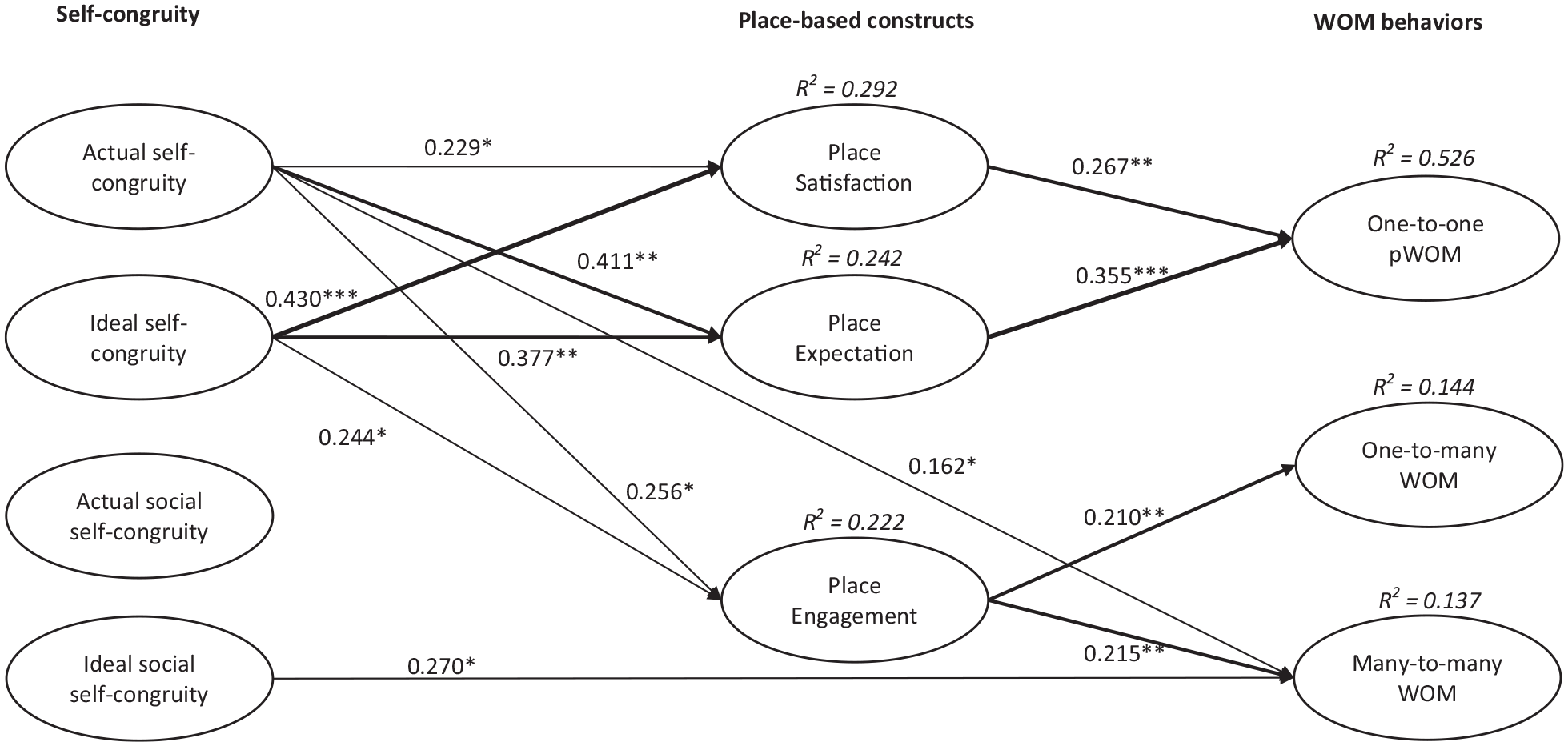
Structural model.
Post Hoc Multigroup Analysis
The study’s population was then divided into two groups by the location of data collection: the Slovenian capital of Ljubljana and the city of Pula in Croatia. To test whether the structural model differed in each group, a multigroup analysis was conducted to calculate 95% bias-corrected bootstrap intervals to compare Ljubljana and Pula sub-samples (Dibbern and Chin 2005; Sarstedt, Henseler, and Ringle 2011). The calculation is based on a 1,000-bootstrap run, and the results show no significant difference between the two subsamples. This result suggests that the model structure does not differ in these two locations.
Similar multigroup analyses were conducted on gender, whether the respondent was locally born, whether the respondent feels a sense of belonging, whether the respondent would choose another place to live, and attitude toward tourism. Parametric test and Welch-Satterthwait test based on PLS-SEM were run to illustrate any significant differences in the relationship testing between groups (Sarstedt, Henseler, and Ringle 2011). Only two significant group differences were found in gender. One was on the relationship from actual self-congruity to place expectation (Parametric test: t = 2.137, p = 0.033; Welch-Satterthwait test: t = 2.606, p = 0.010), where this relationship is significant for the male subgroup (γ= 0.718, p < 0.001). The other was on the relationship from ideal self-congruity to place expectation (Parametric test: t = 1.705, p = 0.089; Welch-Satterthwait test: t = 1.750, p = 0.082), where this relationship is significant for the female subgroup (γ= 0.640, p < 0.01). This result shows interesting gender differences in the impacts of actual and ideal self-congruities on how residents see the place’s future.
Discussion and Conclusions
An emerging issue in tourism literature is understanding mechanisms that initiate residents’ voluntary destination brand-building behavior, that is, WOM, especially pWOM, that relate to different physiological mechanisms and factors of the human–place relationship. However, empirical research on this has been very scarce. From the theoretical perspective, this empirical research on the links between four factors of human–place relationship (i.e., self-congruity, place satisfaction, place engagement, and place expectations) and three different types of WOM (one-to-one, one-to-many, and many-to-many) serves as an essential step toward better understanding the context of the engagement of residents in branding and development of tourism destinations.
From the empirical study results, both actual and ideal self-congruities directly impact all three place-related constructs: place expectations, place engagement, and place satisfaction. How a resident sees himself or herself individually does direct how one evaluates and sees the place. This result can be interpreted using both self-congruity theory and social identity theory. Accordingly, people tend to purchase and use goods and services consistent with their self-image and classify themselves and others into various social categories, enabling them to locate or define themselves in the social environment. Self-congruity, in this sense, reflects the social identification process, the perception of oneness with or belongingness to some human aggregate. Therefore, the results connect these two theories and suggest that individuals tend to choose behaviors congruent with salient aspects of their identities or ideal selves and support the institutions (places in this case) embodying those identities (Ashforth and Mael 1989; Stryker and Serpe 1994). This result is further in line with previous research (Ahn, Ekinci, and Li 2013) conducted on how tourists evaluate and see the place.
However, interestingly how one sees himself or herself from a social perspective was found to have no significant influence on how one evaluates and sees the place in the empirical study. This variation suggests that the place concept is more personal rather than influenced by the society in this study sample. In previous literature, the sense of place is argued not intrinsic to the physical setting itself but resides in a relatively strong “social construction” (Greider and Garkovich 1994; Hufford 1992; Tuan 1977). For instance, Eisenhauer, Krannich, and Blahna (2000, p. 422) wrote, “in essence, people confer meaning on the environment in ways that reflect their social and cultural experiences.” This study suggests that besides social influences on building a sense of place, the meaning people confer to places can be individual. Revisiting the literature reviewed earlier, Stedman (2003) finds that the social construction of a sense of place has weaker effects on place satisfaction and place attachment, whose view aligns with this study’s finding. This result suggests that one’s evaluation of and attachment to a place is more individually formed and developed than being influenced by social pressure or social proof. This further provides evidence to support Sirgy and Su’s (2000) conceptualization that different self-congruity aspects drive the various self-concept motives. In line with this, actual and ideal self-congruities have different effects on self-driven motives than the social self-congruity dimensions. That is because self-consistency and self-esteem motives are more personal and individual, regardless of the social condition, while social consistency and social approval motives are related mainly to how the social circumstances are depicted. Place engagement (memory) and place expectations are two dimensions of one’s attachment to a place from an individual perspective and thus should be affected by how people see themselves individually rather than socially.
The study also found that the ideal social self-congruity directly impacts many-to-many WOM. This suggests that the more individual wishes other to see himself or herself as residents of a place, the more this individual would like to join in social conversation and discussion to either advocate or defend the place. This finding is in line with propositions in social exchange theory (Blau 2017; Emerson 1976). Ideal social self-congruity—the “ideal” of how residents would like to be seen by others and matching this to a place—is an important motive for building social ties and see the benefits. This unique type of self-congruity is found in this study directly related to one’s willingness to participate in group discussion (many-to-many WOM) and defend the place against negative comments. This result suggests the function of ideal social self-congruity for social exchange and a sense of belonging. In a different word, ideal social self-congruity implies an intention for self-society consistency and social approval (Sirgy and Su 2000), which further drives social knowledge exchange embedded in many-to-many WOM behaviors.
One’s WOM behavior in a personal setting is found to be affected by one’s evaluation of a place’s current state, as well as one’s expectation of the future of the place. This finding is consistent with the findings from previous studies (Chen, Dwyer, and Firth 2014b, 2015, 2018; Chen and Dwyer 2018). However, residents’ place engagement was found to have no influence on one-to-one pWOM but had significant effects on one-to-many and many-to-many WOM. The effects of place expectation, on the other hand, were found to be rather opposite. One’s actual self-congruity was found to indirectly influence one-to-one and one-to-many WOM and directly influence many-to-many WOM. This is consistent with the propositions from previous research on the impact of self-congruity on loyal behaviors (Sirgy et al. 2008).
The results of the post hoc multigroup analysis have two implications. First, there is no significant difference in the model testing between the two subsamples, that is, Ljubljana, Slovenia, and Pula, Croatia. This suggests that the two locations are similar enough in understanding residents’ psychology and behaviors related to places owing to their similarities and shared history. On the other hand, the male respondents show a significant connection between their actual self-congruity and place expectations, suggesting that how males see themselves impacts how they see the future of the place. As for the female respondents’ case, how they would like to see themselves impacts how they see the place in the future. This variation in the results illustrates different psychology between genders.
Theoretical Implications, Limitations, and Future Research Avenues
In our view, the ability to understand mechanisms that initiate residents’ voluntary citizenship behavior, that is, WOM, that relate to different physiological mechanisms and factors of the human–place relationship presents new opportunities for tourism and marketing research. From the theoretical perspective, the possibility of linking different factors of the human–place relationship with different types of WOM can assist in answering existing research questions on resident engagement in tourism planning and development. For example, this study indicates that residents need to be perceived as internal stakeholders within the tourism destinations they live in. Moreover, they wish to have a voice in and an opinion on the community’s development (Šegota 2018), but they also can influence external stakeholders such as potential tourists or experienced visitors. This is well out of control of the destination managers or city councils. Accepting that they might be one of the most important destination brand advocates and that the success of destination branding strategies depends on commitment and mobilization of internal stakeholders (Sartori, Mottironi, and Corigliano 2012), we see it as an opportunity for the tourism marketing literature to obtain a greater focus on the resident–place relationship.
From a broader view, active participation in conversations and communication enables residents to think and act as citizens of a tourism destination, strengthen their social responsibilities, and motivate them in collaborations. These are essential for sustainable tourism development from a resident psychological point of view. Based on a locally recognized identity of the place and its community, self-congruent residents are motivated to maintain and protect the destination’s current identity and image via ongoing information and knowledge sharing. This knowledge builds into a stable and robust destination image that, in return, facilitates a high level of self-congruity. From a long-term view, a strong sense of place can be fostered. This study’s findings connect citizenship behavior literature with residents in the tourism context and enable and suggest a further application of social responsibility literature in this context. On the other hand, this study implies the vital role of residents in sustainable tourism development for any destination. This is not limited to residents’ direct support for sustainable tourism (e.g., Choi and Sirakaya 2005; Lee 2013), but instead emphasizes the significance of residents as internal stakeholders in sustaining a place for its development from a social point of view.
The study was informed by the direct measurement of self-congruity, limiting the possibility of examining different personality attributes usually found in self-congruity studies. The reliability and validity of the measurement instrument indicate sound model properties with the measurements we suggest for measuring resident congruence; however, it would be worth investigating whether different congruence measurement scales would bring different results. Could the potential mobilization of residents in how and when they talk about their place be attributed to different personality attributes, such as openness, sincerity, cheerfulness, confidence etc.?
An additional dimension that should be addressed in the future is recognizing that higher satisfaction and greater identification with the place might result in more pWOM. This is inevitably perceived as a more trustworthy and authentic information source by (prospect) tourists. Resident self-congruity can, in turn, mobilize people to talk about the place they live in, rather than the recommendation of the place just being a general outcome of the congruence. Scholars should find ways to spur the benefits of these effects.
The research using cross-sectional data collected online excludes any potential respondents that only exhibit behavior in the offline setting and who, presumably, may be as equally engaging and vocal as those in the online setting. We acknowledge that that is one major limitation of this study, as our data collection was heavily influenced by convenient and snowballing sampling methods and excluded all potential respondents that did not have access to the Internet. The steps we have taken in data collection, in turn, do not enable the results to be generalized as the sample is not representative of the population, is young compared to study site populations, and may be skewed owing to a self-selection bias found in online surveys such as ours. Moreover, this study sample includes more residents from Ljubljana (68%) than from Pula (32%). The unbalanced samples may be found in cross-sectional studies where data were collected from multiple study sites. Our study’s two locations are similar enough in understanding residents’ psychology and behaviors related to places owing to their similarities and shared history. Furthermore, regardless of the difference in size, they were shown not to exhibit a significant difference in model testing. However, future studies using the same approach of collecting the data from multiple locations might want to have balanced samples in size to avoid any potential differences in model testing. The cross-cultural studies are very welcoming as they shed light on how different residents are evaluating the place they live in.
Additionally, this study sample was predominately female (62%), which warrants cautiousness when generalizing the data. However, the findings suggest that there are differences in WOM between genders, which might be worthy of further exploration to understand better why women are more inclined to connect their ideal selves with future expectations of the place, while for men, the connection is made with how they see themselves momentarily. This study also focuses on pWOM under a one-to-one communication context, based on the logical continuity in connecting positive individual–place relationship and positive behavioral outcomes. Undoubtedly, negative WOM could significantly damage destination image, tourism development, and the local community’s integrity (Jeuring and Haartsen 2017; Smith and Vogt 1995). However, different from motives such as involvement, self-enhancement, or other constructs implying self–place relationships, negative WOM is often motivated by other factors such as anxiety and vengeance (Sundaram, Mitra, and Webster 1998). Therefore, this study mainly emphasizes on one-to-one pWOM because all antecedent constructs fit in the framework of motivating pWOM, and pWOM illustrates an important behavioral outcome for residents’ citizenship behaviors.
In conclusion, in the past few years, we have been witnessing a rise in residents’ wanting to have their voice recognized and adopted in the tourism development of the destinations they live in. The current status of residents calls for a crucial expansion, with DMOs recognizing residents as internal stakeholders who could become an integral part of destination-branding strategies. A better understanding of their engagement in the latter is needed, with this study pioneering findings that it is primarily influenced by the way they evaluate the place and form different relationships with it.
Supplemental Material
sj-pdf-1-jtr-10.1177_00472875211008237 – Supplemental material for The Impact of Self-Congruity and Evaluation of the Place on WOM: Perspectives of Tourism Destination Residents
Supplemental material, sj-pdf-1-jtr-10.1177_00472875211008237 for The Impact of Self-Congruity and Evaluation of the Place on WOM: Perspectives of Tourism Destination Residents by Tina Šegota, Ning (Chris) Chen and Tea Golja in Journal of Travel Research
Footnotes
Declaration of Conflicting Interests
The author(s) declared no potential conflicts of interest with respect to the research, authorship, and/or publication of this article.
Funding
The author(s) received no financial support for the research, authorship, and/or publication of this article.

Supplemental Material
Supplemental material for this article is available online.
Author Biographies
References
Supplementary Material
Please find the following supplemental material available below.
For Open Access articles published under a Creative Commons License, all supplemental material carries the same license as the article it is associated with.
For non-Open Access articles published, all supplemental material carries a non-exclusive license, and permission requests for re-use of supplemental material or any part of supplemental material shall be sent directly to the copyright owner as specified in the copyright notice associated with the article.
