




Abstract
This article examines how technical communicators, specifically concerned with the overlap between design, community, and security logics, can better understand how certain ideals around security, surveillance and safety can reinforce or resist narratives about state-sponsored protections. We use the public and political controversy surrounding the Atlanta Public Safety Training Center (Cop City) as a backdrop for engaging the questions regarding technical communicators potential for intervening into unjust security logics that impact the environment and marginalized communities.
Introduction
In the aftermath of the state-sanctioned murder of George Floyd—a tragedy that kicked off the summer of Black Lives Matter protests and grassroots community-driven resistance to over-policing, police brutality, and the general apathy for the continued, centuries-long trauma experienced by Black communities at the hands of law enforcement—activists revealed that the Target Corporation had developed years-long, close ties with law enforcement, supporting and funding trainings, security technology, and surveillance programs in major cities. Highlighting the company's unusual collaboration with police, Waldman and Etter (2021) note that “For decades, Target fostered partnerships with law enforcement unlike those of any other U.S. corporation. It became one of the most influential corporate donors to law enforcement agencies and police foundations, supplying money for cutting-edge technology and equipment” (para. 7). As noted in a Slate news story a Target store located across the street from a police precinct in Minneapolis was damaged during the 2020 uprising (Mak, 2020). That particular Target store was not only located in close proximity to the police precinct. This store had also “long been associated with police surveillance and MPD's [Minneapolis Police Department] treatment of black and low-income residents of the city” (Mak, 2020). In fact, it was found that monetary donations from Target had helped to establish video surveillance of the public spaces surrounding the Target store. “In 2004, the company made a $300,000 donation to the city to install CCTV throughout the downtown area. Target also established the ‘SafeZone’ program that same year to help the police department with surveillance logistics” (Mak, 2020). The Target Corporation's development and support of forensics labs, “safe city” programs, and partnerships with law enforcement perpetuated the socio racial policing of marginalized communities across the nation. As Waldman and Etter (2021) reported: When it developed a network of forensics labs, it made them available to police across the U.S. Starting in the early 2000s, Target developed a program, called Safe City, that poured money into police and sheriff's departments to install neighborhood surveillance systems and fund equipment. In Minneapolis, Target worked with the City Attorney's Office to have petty criminals banished from the downtown business district through what are called geographic restriction orders. Eight out of 10 people expelled were Black or American Indian, according to an analysis of city data (para. 7).
Technical communicators and designers, as disciplinary fields, are equipped to examine the logics of security by engaging our expertise in rhetorical analysis, human-centered design, and advocacy via narrative. As we’ve argued for nearly a decade now, “technical communicators must be aware of the ways that the texts and technologies that they create and critique reinforce certain ideologies and question how communication shaped by certain ideologies affect individuals” (Jones, 2016, p. 345). Technical communicators understand that technologies and texts—all texts—are political and imbued with sociopolitical orientations that have the capability to do good and to do harm (Jones & Williams, 2018; Winner, 1980). Tham (2025), in recounting the flawed and biased design of bathroom soap dispensers, notes that “discriminative examples of design against people of color and members of multiply-marginalized communities have been reported in facial recognition apps, wearable fitness trackers, heart-rate monitors, and other technologies with much more dire consequences than soap dispensers. Since the emergence of the profession and growth of the field, TPC scholars have continually and consistently highlighted ethical concerns in technological design” (p. 211). As technical communicators continue to unapologetically concern themselves with the impact of policies, technologies, and texts on lived experience, we call for an understanding of how security and safety infrastructures (as sociotechnical systems) impact and affect communities, in particular, systemically marginalized communities. This examination of security logics is aligned with progress toward more just and inclusive societies. Approaching security logics and safety technologies as key components embedded in our sociotechnical environments provides a more humanistic orientation for seeing the relationship between security logics, communities, and sociopolitical and economic implications of security technologies, processes, and procedures on people. Moreover, we ask critical questions about the application of security logics and technologies in our communities. We question what becomes the trade-off for state-sponsored security infrastructures (technological, human, and otherwise) and the experiences of marginalized communities and populations? We assert that this overarching question should inform technical communicators and designer's work in security, technologies, and surveillance, first, through a recognition of how narratives justify the deployment of harmful sociotechnical systems. We posit that, given the role of technical communicators as advocates, technical communicators recognize and identify how security logics are rhetorically constructed and also acknowledge the impact of security logics in rhetorically, and ultimately, materially shaping environments and communities. And, if necessary, technical communicators must challenge the normalization of surveillance technologies as well as the discourses that support or justify these technologies by examining its biases and impacts on marginalized communities.
In this article, we investigate how technical communicators, specifically concerned with the overlap between design, community, and security logics, can better understand how certain ideals around security, surveillance and safety can be reinforced (or resisted) via narratives about state-sponsored protections. We assert that the first action of technical communicators must be to recognize narratives embedded in discourse about the sociotechnical security systems. Recognizing oppressive practices is the initial step in building coalitions for actions to redress harm, as made clear by Walton et al. (2019). In this article, we use the public and political controversy surrounding the Atlanta Public Safety Training Center as a backdrop for engaging the considerations presented above. In short, the development of the Atlanta Public Safety Training Center, colloquially known as “Cop City,” has ignited significant debate and concern in regard to sociotechnical security and surveillance technologies and approaches. Cop City, as currently conceived, is an 85-acre law enforcement training facility that has been vigorously opposed by climate activists, abolitionists, anti-surveillance activists, and racial justice groups. It's clear that “Cop City represents the use of advanced technology in the professionalization of policing” (Sewall, et al.). As opponents argue, not only will Cop City and the technologies that it will utilize increase surveillance and over-policing in a largely African American city, but Cop City will also destroy one of Atlanta's largest greenspaces and watersheds, the Weelaunee Forest (Rose, 2024). By first locating, identifying, and recognizing the narratives that prop up pushes for oppressive security and surveillance, we encourage technical communicators to ask how, as rhetorically-grounded designers and engaged advocates, can contextualize and resist the normalization of surveillance and problematic security logics embedded in built environments and designed to be ever-prevalent in our lives through political and public policy, policing, and technological design and advancement?
Cop City in Context: Tracing a History of Policing, Land Use, and Resistance
To understand the controversy surrounding the Weelaunee Forest in the present, we must reckon with events of the past, specifically the consequences of 1793. Following the Revolutionary war, Anglo-American colonizers invaded Georgia due to its favorable cotton growing conditions and the invention of the cotton gin, which increased the demand for cotton. The Muscogee (Creek) people, who had occupied and farmed this land for hundreds of years, quickly adapted to this new cotton-based economy much to the irritation of Anglo-American colonizers. The colonizers sought to claim the land for themselves and viewed the Creek Indians as barriers to “progress.” As a result, pressure mounted on the Federal government to forcibly relocate all American Indian tribes to territories west of the Mississippi River, a chapter in the larger history of American Indian genocide known as “The Trail of Tears.” Today, the area known as the Weelaunee Forest includes a 3,500-acre greenspace that connects the Old Atlanta Prison Farm to nearby natural areas, including Constitution Lakes, Lake Charlotte, and Intrenchment Creek Park (see Figure 1).
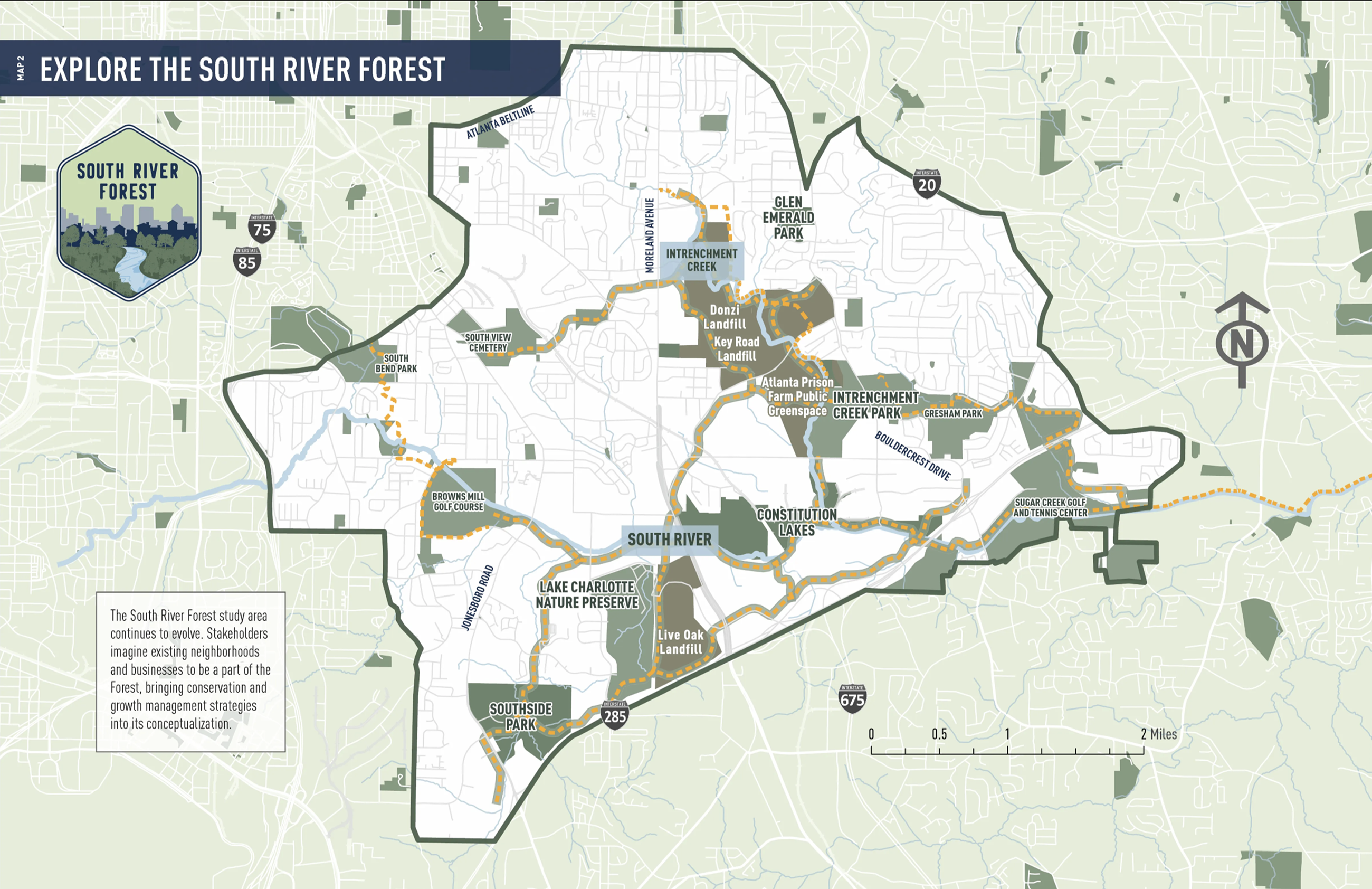
The Atlanta Regional Commission's map expands the Weelaunee Forest (Also Named South River Forest) broadly across Southeast Atlanta and Southwest DeKalb County—East and West of Moreland Ave and Inside of I-285.
In January 2013, the DeKalb County government acquired approximately 136 acres of forest through a donation from the Arthur M. Blank Foundation to create Intrenchment Creek Park for public use. This land was given under the condition that it would remain as part of a park in perpetuity. This forested area was adjacent to the Old Atlanta Prison Farm, an abandoned, city-owned facility that had frequently been used by industrial polluters for illegal dumping, artists for graffiti, and the police for target practice (Keenan, 2021). This history of mixed use set the stage for discussions about repurposing the site for public safety initiatives. The Atlanta Police Foundation (2017) published its “Vision Safe Atlanta—Public Safety Action Plan,” a proposal that stressed the need for a new infrastructure in the form of a public safety training facility. As a result, Cop City “was proposed in 2020 after the George Floyd uprising” (Case, 2024). Then, in September 2021, the Atlanta City Council would approve a plan to build a training facility for police and firefighters on 85 acres of the more than 300-acre site known as the Old Atlanta Prison Farm. The remaining land would be preserved as greenspace, including a public park. Funded primarily by the Atlanta Police Foundation (APF), the $90 million facility would provide space for officers to practice firearms training, explosives detonation, and other tactical exercises, while firefighters would use it to simulate entering burning buildings to combat fires (Keenan, 2021). The project's supporters argued that the city's current training facilities were in poor condition, officer morale was low, and the Old Atlanta Prison Farm—located in unincorporated DeKalb County but owned by Atlanta—was the only viable location for the new center. However, a diverse coalition opposed the plan, dubbing it “Cop City” and its location in “one of its most heterogenous Black communities” (Sewall, et al.). Amid growing scrutiny of policing, many critics objected to not only the high cost but also the potential environmental consequences, such as increased flooding and air pollution in surrounding predominantly Black and brown communities. Moreover, opponents also highlighted that the land was already intended for a different purpose—the Weelaunee Forest greenspace, one of the “four lungs of Atlanta” (City of Atlanta Department of Planning, 2017, p. 345). In November 2021, organizers affiliated with the Defend the Atlanta Forest movement built encampments and occupied the Weelaunee Forest, where they not only established a community but also shared resources designed to resist Cop City. In the year that follows, the Atlanta Police Department (APD) in coordination with the Georgia State Police and National Guard initiates a series of raids that will lead not only in several arrests but also the death of environment activist Manuel “Tortuguita” Terán (Lumpkin, 2023).
We want to highlight some important points from this history. First, Atlanta is “a settler city, shaped through Indigenous dispossession, slavery and the plantation economy, and uneven racial urban development” (Gordon et al., 2024, p. 582). Second, Atlanta merely stands as a representative of a larger movement of cities across the United States to build large training facilities for the purposes of militarizing law enforcement under the guise of combat readiness. We can only understand these institutions as armories that serve as the extension of the state's willingness to use violence against its own citizens. Thus, it is imperative that technical communicators, who are interested in institutional critique, be concerned about how the state uses violence against its citizens because communication practices play a crucial role in legitimizing, obscuring, or resisting state power. State violence, whether through policing, incarceration, or surveillance, is often justified and mediated through technical communication, including reports, policies, training materials, and public messaging (including via news media). Technical communication can resist playing a role in making state violence seem routine or necessary, by disrupting those logics and making evident how seemingly innocuous narratives can be fed to the public through discursive practices.
Security Logics and Rhetorically Constructed Ideals of Safety and Protection
As asserted above, security logics are discursively and rhetorically constructed. As such the rhetorically constructed narratives about security logics as it relates to the Atlanta's Cop City project can be identified as impacting the justifications for the sociotechnical and material, built environments of the project. As technical communicators, we now look to identify those narratives.
The role of narrative in technical communication scholarship has long been acknowledged (Baniya & Chen, 2021; Berkenkotter, 2008; Bridgeford, 2002; Jones, 2016; Moore et al., 2021; Perkins & Blyler, 1999; Small, 2017; Van Ittersum, 2014; Vealey & Gerding, 2021; Walton & Jones, 2013). In particular, Jones (2016) argues that narratives are akin to “found things,” embedded in genres that we are often familiar with and doing important rhetorical work that brings human actors to the fore. Jones reveals how narratives embedded in texts (like listserv messages, facebook posts, and public media communications) and discourse (via personnel meetings and informal chats) all work toward a specific rhetorical goal. Though Jones's (2016) study highlights how narratives created and nurtured by an advocacy group worked toward a justice-oriented goal, we reveal in this article how narratives forward an oppressive goal. As Jones and Williams (2018) make clear, critical technical communication is not just focused on technologies themselves, but all communication related to those technologies, stating that “the ways in which technologies are deployed and the communication surrounding those technologies are not neutral or apolitical, just as technical communication itself (as a field) is not apolitical or neutral”(p. 374). Here, we draw on Walton, Moore, and Jones's 4R process for engaging in coalitional action, where the 4Rs represent iteratively recognizing, revealing, rejecting, and replacing oppressive practices. Further, and to this end, as asserted by Walton et al. (2019), and reiterated by Vealey and Gerding’s (2021) introduction in Technical Communication's special issue on The Work of Storytelling in Technical Communication, we maintain that as technical communicators “we must first strive to recognize and then reveal injustice” (Walton Moore & Jones, p. 133; Vealey & Gerding, p. 3) before taking action. The work of this article is to make evident the first two steps of recognition and revelation of narratives related to the Cop City project. As such, we identified and located dominant narratives about the justification of the deployment of sociotechnical security systems and technologies and we work to reveal how these narratives uphold harmful ideologies. Below, we consider three dominant narratives deployed in support of and resisted by the communities and constituencies involved in the controversy about the construction of Atlanta's Cop City. Many of these narratives can be found in news reports and other public discourse. These narratives are grounded in three ideological claims made about (a) individual freedom, (b) the legitimacy of security measures, and (c) an articulated ultimate goal for a safe and inclusive society.
Narratives About Individual Freedom
Security logics can sometimes rely on the premise that the public relinquish some personal and individual freedoms in exchange for their right to protection and safety provided by the state. As Donohue (2005) noted in regard to terrorism and counterterrorism, “Counterterrorist debates frequently revolve upon the idea that a balance must be struck between security and freedom. Those who defend measures that erode individual rights argue that in order to be safe, citizens within the state must be willing to sacrifice some degree of liberty” (p. 69) This is also particularly true in regard to policing and mass surveillance and issues of privacy and data protection. Consider for a moment that technologies like facial recognition programs, license plate readers, and geolocating security measures are often integrated subtly into our daily lives, tracking where we go and who we are with. Further, with internet technologies, digital consumer technologies, and social media applications often scrap large amounts of data from our online interactions. These types of surveillance technologies problematize individual citizens’ expectations of personal privacy and protection of their data (digital or otherwise). As Čas et al. (2017) argued in reference to debates about security, privacy, and personal freedoms, “In the dominant political discourse, citizens are expected to accept the concentration on this specific framing of security and to support the implementation of new surveillance measures and technologies, even though such measures result in intrusions into privacy or infringements of other fundamental rights” (p. 4). In relation to Cop City, it has been noted that Atlanta has imposed a “public safety through a ‘broken door’ model rather than a public health framework” that leans heavily on policing that “view[s] public safety narrowly, prioritizing law enforcement control to prevent injury” (Sewall, et al.)
Debates about the tensions between individual freedoms and security logics have come to the fore surrounding surveillance and monitoring of Cop City protestors. The Guardian revealed that Cop City protestors have been subject to digital and physical surveillance by the APD. “The surveillance in Georgia has included following people in cars, blasting sirens outside bedroom windows and shining headlights into houses at night, the Guardian has learned. While no arrests have been made, residents said they’re at a loss as to what legal protections of privacy and freedom from harassment are available to them” (Pratt, 2024). Further, residents and legal experts argue that their rights to privacy and right to protest are being actively and purposely challenged by the APD, strategically choosing obvious physical surveillance tactics to scare off protestors. One informant was quoted by The Guardian as stating, “Police want to be seen because the purpose of the surveillance is to intimidate and expose dissenting voices. Police are using the coercive power of surveillance to silence protest and dissent” (Pratt, 2024). Questionable surveillance techniques deployed by those who claim to “protect and serve” push us to consider how, exactly, can security be fairly balanced with individual freedoms when rights to privacy and the right to protest is framed as a security threat by those in power.
Narratives About the Legitimacy of Technologies Deployed in Service of State-Sponsored Security Measures
Security logics can rely on the perceived legitimacy of the claims made about the type of security needed and the technologies deployed to further that security. In the wake of the racial unrest of 2020 that was ignited in response to police bias, police brutality, and state-sanctioned murder, pro-law enforcement individuals and groups, as well as some impacted communities, argued for the utilization of police-worn body cameras, police anti-bias training, and police de-escalation trainings. The use of cameras and surveillance (paired with other security procedures), were seen as a way to reform police and revise policing procedures without dismantling and defunding the institution of policing and law enforcement and simultaneously protecting individual freedoms. Further, some saw this “reform” approach to policing as a way to improve relationships between law enforcement and the communities they policed. This narrative was also deployed by those in favor of the Cop City project, with claims that the facility, with its technologically enhanced infrastructure that included classrooms, mock urban training courses, and high-speed chase driving courses, would provide law enforcement with the tools and technologies that they needed in order to learn de-escalation techniques in real-world simulations. In fact, “boosters of the project, like Atlanta Mayor Andre Dickens, have framed it as necessary to improve police anti-bias and de-escalation training and officer morale” (Lartey, 2023). However, we understand this argumentation as problematic given debates about using technology in a way that constituted over-reach. In regard to Cop City, one such tension revolved around the use of social media to monitor the public and to monitor individuals and groups that proponents of Cop City saw as a threat to the building and development of the law enforcement complex. While it is true that social media monitoring may help police allocate officers to maintain public safety, Atlanta police's surveillance far exceeds any such need in many cases, instead serving to keep tabs on citizens the department views as political opponents. For instance, one monitored group hosted a “community conversation” about education, neighborhood safety, health, and the Stop Cop City movement. An intelligence report about the evening noted that the group had hosted prior canvassing efforts and other peaceful events. (Reynolds & Guillermo, 2024)
Narratives About Inclusion and Safe Societies
State-sponsored security must make arguments about who needs security, from whom, and who will provide the security. Marx (2015), drawing from Bauman and Lyon (2012) points out that, “Security and surveillance illustrates aspects of the fluidity of contemporary society” (p. 15). And further, Marx notes that as societies shift and change along political, economic, geographic, and other orientations, the fluidity impacts are emphasized “with respect to who is threatened and who does the threatening” or even perceptions of who is threatened and who is threatening (Marx, p. 15). Moreover, historically, we see racialized, sociopolitical shifts in arguments that justify security measures (or the lack thereof) for disparate groups. For instance, Rossdale (2024) examined how the Black Panther Party (BPP) revealed, through their activism, community engagement, and community protection measures, the ways that security logics and politics around security are inherently violent, especially in relation to marginalized communities. Rossdale (2024) stated unequivocally that “the Party did important work to show how security politics is dependent on racial violence” (p. 634). As the BPP took up legal arms to protect and patrol their communities, their actions posed a threat to established law enforcement institutions that had brutalized and overpoliced Black communities for over a century. Rossdale (2024) furthered that “The [BPP] patrols also caused panic among the political and economic establishment. The offence here was not only that Black people were taking action to defend themselves with weapons, but that they were doing so both legally and with explicit references to the constitution” (p. 638). Ultimately, largely due to the BPP taking up arms in self-defense and implementing community security patrols, the Mulford Act, making it illegal to carry a loaded weapon in public, was passed in California. To this end, it becomes clear that certain communities are protected while others are not justifiably deemed to need security and protection. In this way, security and security logics is underscored as a political endeavor. “Today we know that ‘security’ is just another word for extinction and genocide. Every discourse of securing implies that there is a ground to be secured, a ‘home’, a way of being that is threatened or that requires saving, sustaining and being located within a temporality and spatiality. It is precisely this security that is denied in an anti-Black world” (Chandler & Chipato, 2021, p. 65).
In regard to Cop City, we see the same anti-Blackness take hold in the disregard for the largely Black, marginalized communities in the geographic proximity of the site of the Cop City complex. In addition to destruction of the watershed, an organic environmental protection for the surrounding communities, nearby populations are concerned that Cop City will increase targeted policing of marginalized groups and worsen over-policing of already vulnerable communities through the militarization of police forces.
1
“Protesters counter that the project represents a
Implications: Our Roles in Deconstructing Security Narratives
Given that security narratives often serve to uphold systems of inequality and exclusion, technical communicators have a critical role in recognizing, revealing, and deconstructing and interrupting these narratives, especially as they intersect with issues of environmental racism. As we noted early, we draw on Walton et al.’s (2019) 4Rs process (recognize, reveal, reject, and replace) for building coalitional action in technical communication. Above, we’ve work to recognize and reveal. So, what happens after the recognize and reveal work of uncovering problematic narratives? As Walton et al. (2019) suggest, technical communicators must then reject and replace oppressive practices and discourse. We believe technical communicators must do this through intervention by: (a) considering the ways in which infrastructure reinforce security logics, resisting them, and developing alternatives; (b) attending to the normalization of surveillance by examining not only its biases but also impacts on marginalized communities; and (c) advocating for counternarratives that imagine safety beyond punitive and carceral frameworks. If we were to do this work, we would play a transformative role in reshaping public policy and design practices. We could further contribute to creating community-centered, justice-driven models of safety that prioritize care, environmental sustainability, and collective well-being over exclusion and control.
Technical communicators must also inquire what are the infrastructures that reinforce security logics and develop strategies for resisting them. One question we might consider is how does the destruction of the Weelaunee Forest reinforce environmental racism and dispossession? As Walker and Derickson (2023) articulated, “[Urban] planning has operated within White supremacist institutions and norms and played a constitutive role in producing [racist] outcomes” (p. 460). One often overlooked element of environmental racism is the connection between housing and displacement. Cop City is simply another chapter in the continuous displacement of poor people of color within Atlanta. Nearly 30 years ago, roughly 30,000 people were displaced as part of the “olympification” of Atlanta or what housing advocate Anita Beaty deemed “a dry run, a dress rehearsal for the developers and the elites to take over the city, to take over the planning, housing construction—to eliminate public housing” (Littlefield, 2016). We simply cannot ignore how concerns about infrastructure, safety, and blight, as justifications for Cop City's existence, echo past urban renewal practices in the mid-20th century, when predominantly Black neighborhoods were displaced under the guise of public good, economic development, and safety. Cop City's construction extends the trend of disinvesting, dispossessing, and demolishing communities of color while prioritizing the needs of law enforcement and wealthy, white interests, who increasingly rely upon these kinds of infrastructure to surveil and punish poor communities of color. As Rea (2024) emphasized, we must engage with urban planning documents by contextualizing them within larger historical frames that help citizens better understand that space is never neutral. This work should involve explaining the legal and ethical implications of expanding the surveillance state, particularly in areas that are historically marginalized. Ironically, by historicizing the surveillance state and examining its disproportionate effects on certain communities—often fostering feelings of constant surveillance, vulnerability, and distrust—law enforcement agencies and other public officials can better understand the roots of these tensions, ultimately paving the way for more constructive relationships with law enforcement. Additionally, technical communicators’ focus on urban planning can bolster arguments about how environmental racism shapes built environments. Communities of color often lack or have little access to green spaces or public infrastructure that promotes well-being. Reducing their access to green spaces, while subjecting them to more intensive policing and surveillance is not simply unjust, it is inhumane. We can make a meaningful intervention.
Second, technical communicators must challenge the normalization of surveillance by examining its biases and impacts on marginalized communities. This includes challenging narratives in technical documents, public discourse, and other types of texts. The APF has argued in their documents that the training center “will reimagine law enforcement training, catapulting APD and Atlanta Fire Rescue to the vanguard of major urban law enforcement agencies” by improving morale, retention, recruitment, and training (Atlanta Police Foundation, n.d.). However, framing the training center as a necessary resource for improving law enforcement morale, effectiveness, and community safety, allows APF to normalize the expansion of the security state. This framing is designed to shift public perception, making security appear natural and essential rather than an unnatural mechanism of oppression. We would even argue that siting the center in a natural environment further strengthens the naturalization of the security state. The gradual cultural shift toward routine surveillance as part of infrastructure should be alarming to us. On the one hand, the proposed training center fosters a culture within law enforcement that frames surveillance as a regular part of policing rather than ephemeral; on the other hand, the more citizens are exposed to these extensions of the security state, the more they come to naturalize them and see them as an inevitable part of law enforcement. We might also question how might the integration and normalization of the training center within the natural environment lead to the expansion of the security state into surrounding neighborhoods, potentially expanding its scope and scale beyond the training environment. As technical communicators, we see our role as advocating for alternative approaches to community safety. This could be as simple as writing policy briefs advocating for the redistribution of “public safety” funds from policing to social services; or creating speculative design projects that envision abolitionist cities with infrastructures designed for care rather than control.
Finally, once technical communicators have done the work that must precede action, then technical communicators can look to efforts like the No Boston Olympics and Stop LAPD Spying Coalition to align with community-led coalitional action. No Boston Olympics was an organized effort that successfully raised issues of displacement, surveillance, and public debt created by the potential siting of the 2024 Olympics in Boston. Stop LAPD Spying Coalition is a community-based initiative dedicated toward ending the expansion of surveillance networks and predictive policing. Both these groups emphasized participatory methods, transparency, and counternarratives by creating accessible reports, visual materials, and public events that translated technical information—such as budget projections and land use plans—into compelling arguments about democratic accountability and public harm. No Boston Olympics activists successfully reframed both the International Olympic Committee and United States Olympic Committee's narratives around risk and cost by not only highlighting ballooning public debt but also highlighting disruption to everyday life. A good example of the kind of documentation technical communicators can create is a widely shared flyer that emphasized how mega-events often serve as a pretext for cities to introduce new or expanded surveillance technologies—systems that typically remain in place long after the event has ended (No Boston Olympics, n.d.). This reframing cast the potential Boston Olympics as less of a dream and more of a threat to democracy. Additionally, rather than leaving technical planning documents to officials and consultants, No Boston Olympics activists translated complex materials (like bid books and budgets) into accessible formats for public understanding. Their efforts facilitated local residents’ ability to evaluate and critique large-scale urban planning decisions—challenging the idea that only experts or officials could weigh in.
The Stop LAPD Spying Coalition rejects reformist frameworks and historicizes surveillance as racialized violence rooted in white supremacy and anti-Blackness. Rather than calling for improvements to surveillance systems, they highlight that these systems are working exactly as they were designed—to maintain control over marginalized populations. They ask an inconvenient question not entertained by forces pushing the expansion of surveillance networks—What does safety mean beyond policing? What kinds of community infrastructure would keep people safe without surveillance and criminalization? For example, their zines and popular education materials equip communities with the counter logics required to refuse and reimagine ideas of safety. They also help them to make sense of how the state appropriates the language of equity, inclusion, and safety to justify surveillance programs (e.g., Police reformers have said surveillance bureaucracy creates a “seat at the table.”) (Stop LAPD Spying, 2021). The technical communication work done by both of these groups are not just informational—they are acts of refusal, resistance, and imagination that show how technical communication can be mobilized to challenge dominant visions of safety.
Technical communicators must first recognize and reveal harmful narratives and then advocate for counternarratives that imagine safety beyond punitive and carceral frameworks. Militarized policing does not equate to safety. Scholars across academic disciplines have researched and engaged in either police abolition or reimagining policing altogether. This includes but is not limited to critical criminology, law, political science, urban studies, sociology, and ethnic studies. More technical communication scholars are engaging with social justice frameworks across contexts and across varied genres (not just traditional approaches to technical communication that seek to locate our work in technical reports or design technologies). Rethinking security logics and exploring alternative carceral frameworks expands the field's commitment to social justice through dismantling oppressive institutions and also upholds a more expansive view of what our field can be and can enact in the world around us. If technical communication can be a tool for advocating for the construction of the Atlanta Public Safety Training Center, it can also be a tool to advocate for transformative and restorative justice. As technical communicators, we can help document and disseminate best practices for community-based crisis response teams, mental health interventions, and conflict resolution initiatives that do not rely on police. We can also align with abolitionist movements and facilitate participatory design sessions that bring communities together to articulate their own visions of safety. These sessions could also produce neighborhood safety guides, alternative emergency response protocols, or training modules for community intervention teams. We can help to create a world in which contact with law enforcement is unnecessary and rare.
Conclusion
This article contributes to technical and professional communication's expanding call for social justice advocacy by demonstrating the role that technical communicators can play in shaping and reshaping discourse around state security projects like Cop City and mass surveillance. Grappling with tensions regarding how narratives of and about technologies (and texts) that we engage with, read and distribute, help create, use, and write documentation for is a necessary reflective exercise that technical communicators must consider. As the field moves more quickly toward justice-centered approaches for design, technology development and innovation, accessibility, and inclusive practices, we see the need for critical engagement in how we do work, research, and implement strategies and where we place boundaries around what technical communication is or is not. Gonzales (2022) insists that technical communicators “should recognize how our involvement in contemporary technical communication practice—whether it takes place in a community, behind a screen, or both—will undoubtedly impact what we design and distribute, and we should work continuously to ensure that our impact avoids harm as much as possible (p. 23). As such, Gonzales makes a case for interdependent and intersectional research design. In alignment with Gonzales, we ask: what would an interdependent and intersectional engagement with and critique of security logics entail? Because both interdependence and intersectionality are lenses with which to understand how power, privilege and embodiment work together, we suggest that an interdependent and intersectional orientation for critique and analysis necessarily requires that we ask the hard questions. As Haas and Eble (2018) contend we must “interrogate how we may be complicit in, implicated by, and/or transgress the oppressive colonial and capitalistic influences and effects of globalization” (p. 4). Security logics, framed as a sociotechnical, colonial, and capitalistic endeavor, are not exempt from critique. In the spirit of this critical interrogation, we pose the following considerations as we think forward: How can dominant narratives about technological security logics reinscribe oppression, offloading harm onto marginalized groups? How can we identify and subvert security logics that coalesce power in the hands of few at the expense of many? Perhaps, we can ask if certain technologies deployed in service of security logics actually represent technologies of disenfranchisement (Jones & Williams, 2018) rather than safety? We seek to encourage approaches to technical communication and security logics that aim to help us see that all humankind is inherently connected and accountable to each other. Further, we are accountable to our environment and the care of our environment. How can technical communicators re-envision the design of security logics that “center empathy, creativity, iterative learning, and improvement in pursuit of environmental justice” (Sackey, 2024, p. 52)? We look for intersectional and interdependent approaches that firmly attend to the most marginalized and those most in need of safety and security—protections that the state has historically denied marginalized groups for centuries. Finally, we argue that inclusive, interdependent, and intersectional security and protection as a goal and policy is not radical, but rather essential for the survival of all.
Footnotes

Funding
The authors received no financial support for the research, authorship, and/or publication of this article.
Declaration of Conflicting Interests
The authors declared no potential conflicts of interest with respect to the research, authorship, and/or publication of this article.