



Abstract
This article examines the intersection of technical and professional communication (TPC) and open educational resources (OER) through a social justice lens, critiquing TPC's slow adoption of OER despite its transformative potential. The article highlights how OER addresses accessibility, affordability, and representation challenges in education, showcases successful OER implementations, and outlines strategies for transformative change. It argues that OER empowers educators to tackle inequities directly and calls for greater scholarly focus and adoption of OER to advance equity and inclusion within TPC.
Keywords
Introduction
Technical and professional communication (TPC) scholarship experienced a scholarly turn toward social justice that Jones, Moore, and Walton (Jones et al., 2016; Walton et al., 2019) cite as beginning with Rude's foundational piece that grouped the field into four threads of work, including one on social action (2009). Since Rude's piece was published, increasing scholarly publications have emerged with foci on social justice issues such as race and technology (Jones & Walton, 2018; Savage & Mattson, 2011; Savage & Matveeva, 2011), decolonialization (Agboka, 2021; Haas, 2012); queer rhetorics (Cox, 2019; Edenfield et al., 2019); accessibility and disability (Bennett, 2022; Oswal & Melonçon, 2014; Walters, 2010); human-centered design (Jones, 2016a); advocacy (Jones, 2016b); ethics (Phelps, 2022; Walwema et al., 2022); and equality (Colton & Holmes, 2018).
Despite the turn to social justice in TPC scholarship, the field has been much slower to enact social justice in our curriculum. Agboka and Dorpenyo's (2022) study explored social justice curricula and courses in TPC programs after the scholarly social justice turn, and their findings indicated that the efforts we see in our scholarship are not yet reflected in our curriculum in a significant way. That is to say, there just are not very many TPC instructors or programs incorporating social justice into their curriculum yet. As they note, a social justice turn in TPC curriculum is necessary to prepare our students “to both engage in the public sphere and enact change” as they encounter social justice issues the world is currently facing (Agboka & Dorpenyo, 2022, p. 57). In addition to enacting social justice in our curriculum through assignments and course units such as Shelton's corporate diversity project (2020), we should also look to the direct issues faced by our students, and perhaps the most obvious of those needs is the exceedingly high cost of education made only heavier by the predatory nature of commercial textbook revision cycles and newer opt-out automatic textbook billing programs. Furthermore, our students are also in need of better accessibility, more diversity, and better representation in their course materials.
Open educational resources (OER), while certainly present in our TPC programs as evidenced by the many resources available for use, are a largely underutilized tool in TPC's efforts toward social justice in our curriculum and instructional design. Therefore, this article makes a case for more scholarship on OER in TPC by engaging Colton and Holmes theory of active equality (2018) with OER scholars Hodgkinson-Williams and Trotter's framework of transformative responses to social justice issues (2018) in TPC curriculum and instructional design.
Existing OER in TPC
The increasing cost of tuition and traditional textbooks has led to a growing reliance on alternative course materials such as textbook rentals, used textbooks, low-cost digital textbooks, library resources, and OER. In response to this shift, initiatives at the state, institutional, departmental, and faculty levels have been developed to create and adopt OER, contributing to the movement for affordable education. Open educational resources, as defined by specialist David Wiley, are free educational materials and textbooks that grant five key permissions: retain, reuse, revise, remix, and redistribute (n.d.). They are usually created and published by independent scholars, such as The Process of Research Writing by Krause (2007), often in collaboration with instructional designers and librarians, and they most commonly carry Creative Commons licensing like the Attribution-Noncommercial-Share Alike 3.0 (Creative Commons, n.d.) license carried by Krause's open textbook. In addition to the OER released by independent scholars, there are also many OER available from established open publishers in the United States. OpenStax (with Rice University) has developed, peer-reviewed, and published resources specializing in STEM (science, technology, engineering, and mathematics) fields; the University of North Georgia Press has done similar work with more of a humanities and social sciences focus. In addition, state-level affordability initiatives have organized and published OER with an increasing emphasis on equity-minded practices, such as the criminal justice textbooks and resources currently in progress by Open Oregon Educational Resources under federal grant funding (Hofer, 2021) and the Remixing Open Textbooks through an Equity Lens (ROTEL) Project in Massachusetts, which is also funded by a federal grant (About, n.d.).
There has been a recent increase in the use of OER in TPC courses, particularly at the introductory level. Informal outreach by the authors of Open Technical Communication (Tijerina et al., 2020) showed that the internationally award-winning (OE Global, 2022) open textbook has been adopted in over 40 institutions across the United States as well as a few in other countries such as Saudi Arabia and Vietnam, and these are only adoptions that the authors know of from form requests for access to an accompanying quiz bank—it has likely been adopted at many other institutions as word-of-mouth spreads its availability. Other OER for introductory TPC courses are also gaining traction as more instructors and researchers in the field explore their options. Portland State University's OER Guide for WR227 Instructors (Read et al., n.d.) provides a thorough review of open textbooks in the field as well as a comprehensive collection of nontextbook OER such as ancillary materials. They compared six commonly used comprehensive open textbooks for introductory technical writing service courses, noting significantly varied topic coverage with few universal topics covered in all six open textbooks (Read et al., n.d.), and that variety and range of topics in just those six open textbooks suggests an array of OER available for varying needs in TPC courses, particularly the introductory service course.
Despite all evidence of increasing use of OER, scholarly activity in OER and TPC is extremely limited with only a handful of publications from a handful of scholars. Furthermore, the few publications available have little-to-no mention of the affordances that OER can bring to the social justice efforts in TPC.
Social Justice in TPC and OER
In the following sections, I’ll demonstrate that TPC scholars have drawn on frameworks that should make OER a natural point of interest, including definitions of social justice in TPC and social-justice-oriented definitions of OER.
Definitions of Social Justice in TPC
Jones and Walton's definition of social justice in the context of TPC “investigates how communication broadly defined can amplify the agency of oppressed people—those who are materially, socially, politically, and/or economically under-resourced.” They further emphasized the importance of looking beyond the theory of social justice to “[take] action to redress inequities” (2018, p. 242). Jones then built on the use of the term “oppressed” as one that “encompasses those who are disenfranchised, marginalized, othered, and silenced in systemic ways” (2016b, p. 347). Building on the same definition, Walton, Moore and Jones (2019) identified two core characteristics of social justice: that it is both collective—oppressive structures work together and social justice tackles those structures collectively—and active—using theory to inform action.
Technical and professional communication is inextricably linked to design as evidenced by the multitude of scholars engaging in the two fields simultaneously (Rose, 2016; Tham, 2021, 2022c; Walton, 2016). Walton (2016) connects the two by calling for the application of Buchanan's (2001) first principle of design to the field of TPC: human dignity and human rights. Buchanan asserted that design “is an ongoing search for what can be done to support and strengthen the dignity of human beings as they act out their lives in varied social, economic, political, and cultural circumstances” (2001, p. 37). Walton then extends the foundation to TPC and suggests “supporting human dignity and human rights as the first principle of communication and the foundational concern of TPC: to be clear, not the only principle informing TPC; not always the most prominent; and certainly not enacted in the same way across organizations, communities, and cultures—but the most foundational” (2016, p. 411). This fundamental responsibility of technical communicators and designers to prioritize humans is similarly cited by Rose (2016) in her discussion of human-centered design and advocacy. Furthermore, the need for design to support human dignity and human rights is fundamental to Costanza-Chock's (2020) work with design justice, which “center[s] the voices of those who are directly impacted by the outcomes of the design process” and “work[s] towards sustainable, community-led and controlled outcomes.” Their work uses Collin'’s (2002) conceptual model of oppression, the matrix of domination, to also emphasize the collective nature of social justice, similar to Walton, Moore and Jones (2019), particularly in the context of design work. They define design justice as “a framework for analysis of how design distributes benefits and burdens between various groups of people. Design justice focuses explicitly on the ways that design reproduces and/or challenges the matrix of domination” (Costanza-Chock, 2020), further emphasizing the importance of human rights in design work.
Social-Justice-Oriented Definitions of OER
The history and fundamental purpose of OER in formal education are inherently driven by social justice interests, and those interests are reflected in some of the core definitions in OER scholarship. Lambert's work defines open education as an inherently social justice–oriented practice, specifying that OER are developed “by and for the benefit and empowerment of non-privileged learners who may be under-represented in education systems or marginalised in their global context” (2018, p. 239). Since the UNESCO (2002) report on open courseware for higher education, which is considered to be the start of the modern/digital era of open education, OER has evolved over the years to deviate into more pedagogical focuses. However, in recent years, open education scholars are continuously defining and realigning OER work with social justice efforts (Bali et al., 2020; Buck & Valentino, 2018; Farrow, 2021; Lambert & Czerniewicz, 2020; Ochieng & Gyasi, 2021). Lambert's (2018) work on social justice in open education also provides a framework for enacting redistributive, recognitive, and representational justice through OER work. Their framework can also be extended to provide a solid foundation for OER's application to the social justice efforts in TPC.
As noted above, the social justice roots of OER have continued to develop and evolve along two primary paths: one of more modern social justice interests and another of more pedagogical interest. Often, these two paths of OER intersect as shown in Pedagogy Opened: Innovative Theory and Practice (Tijerina, 2024a), a recent edited collection focused on open and OER-enabled pedagogy through an equity lens. As noted in the preface to Pedagogy Opened, defining most categories of open education is not an easy task because of the “social construction of openness” (Chtena, 2019). However, for the purposes of the equity-aligned collection, they defined open pedagogy, a branch of open education: [W]e view open pedagogy as teaching and learning practices and environments that promote equity, collaboration, and innovation and invite students to create and share knowledge with future publics, often in association with the use of open educational resources (OER). And open pedagogy does not stand on its own in higher education pedagogy: “constructivist pedagogy, connected learning, and critical digital pedagogy are all recognizable pedagogical strands that overlap with Open Pedagogy” (DeRosa & Jhangiani, n.d.) (Tijerina, 2024b).
Several of the works included in Pedagogy Opened are prime examples of how OER and other open educational practices (OEP) are powerful tools for furthering social justice efforts (Amaya et al., 2024; Bernd et al., 2024; Ferrier & Graybeal, 2024; Goldoni & Mormino, 2024; Kaye & Wilson, 2024) that TPC should be engaging with.
Current Literature on TPC, OER, and Social Justice
Open educational resource comes from a long history of open education practices rooted in social justice purposes. According to Lambert (2018), open education has worked through Open Universities to provide education to marginalized learners since long before what's now considered a “new chapter” or modern, digital age of open education. They state that the rise of digital learning prompted new people and new focuses in open education and that the 2002 UNESCO declaration on open courseware (UNESCO, 2002) marked the start of the digital era of open education. Despite open education's long history in higher education, however, the OER activity in TPC has been very limited and largely unexplored. Therefore, in the following sections, I review the existing literature on TPC and OER and their connections to social justice scholarly and pedagogical interests.
Social Justice in TPC Scholarship
Walton, Moore and Jones (2019) cite the beginning of the social justice turn in TPC scholarship with Rude's (2009) work identifying social action as a thread of TPC work, which “la[id] the groundwork” for social justice in TPC scholarship. Since then, scholarship has been increasingly centered on social justice topics in TPC practice, research, and curriculum. As Walton et al. (2019) put it, social justice is now considered fundamental to effective technical communication. Here, I’ll summarize the significant strides TPC has made in its social justice scholarship before establishing similar priorities in OER scholarship.
As previously discussed, Jones and Walton's definition of social justice in the context of TPC “investigates how communication broadly defined can amplify the agency of oppressed people—those who are materially, socially, politically, and/or economically under-resourced” (2018). Their work emphasizes that social justice is both collective and active. Social justice is collective because structures of oppression work together, and therefore, we must enact justice on those structures collectively in order to be effective. Social justice is active because we cannot simply theorize about social justice—theory is important, but it should be used to inform action in order for social justice to occur. Walwema, Colton and Holmes (2022) “describe all social actions as ethically motivated, the enactment of a kind of ethics…that motivates scholarship and workplace practices aimed at remedying a situation that seems unethical, immoral, or unjust” and emphasize a need for social justice work in TPC to “[connect] ethical values to specific forms of action.” In the literature, we see much action taken on design-oriented subtopics of TPC, including usability (Acharya, 2022); human-centered design (Jones, 2016a; Rose, 2016); and design thinking (Tham, 2021). We also see action taken in subtopics of social justice, including ableism and accessibility (Bennett, 2022; Colton & Holmes, 2018; Walters, 2010); decolonialization (Agboka, 2014); race and technology (Haas, 2012); DIY and tactical technical communication (Kimball, 2006); diversity (Bay, 2022; Cardinal, 2022; Savage & Mattson, 2011); feminist rhetoric (Frost, 2016); and advocacy (Jones, 2016b). Through the use of OER as a tool and asset to these efforts in TPC, we can begin to take additional action to enact justice for our students in addition to teaching them to enact justice themselves.
Scholarship on social justice in TPC has been diverse and expansive, starting from a higher level of looking at the field as a whole and social justice in general and spanning down to specific subsections of TPC and specific areas of social justice work. As Walton and Agboka (2021) provided technical communicators with a roadmap for ensuring their work is socially just, Phelps (2022) discussed ethics in TPC research after the social justice turn and implications for institutional review boards. Still, despite the field's increasing scholarly emphasis on social justice, Leydens (2012) identified sources of resistance to the topic in TPC research, and Agboka and Dorpenyo (2022) recently reported a lagging effort toward social justice work in TPC curriculum.
Though Agboka and Dorpenyo (2022) found that TPC curriculum has been slow to adopt a social justice emphasis, there is some work in that direction, focusing on embedding social justice into the content taught in TPC classes. Baniya et al. (2022) studied social justice and intercultural frameworks in TPC service learning, concluding with recommendations to train instructors on social justice pedagogies for service learning and to “develop localized frameworks,” noting that the institutional contexts related to service learning in TPC vary, so it's important to localize efforts and definitions. Savage and Mattson (2011) studied perceptions of “student diversity, faculty diversity, curricular diversity, and institutional advocacy for diversity” in TPC programs, while Bay (2022) incorporated diversity, equity, and inclusion into the TPC service course curriculum. Turner and Hicks (2012) called for a framing of teaching digital literacy and writing as social justice work. Finally, Banville, Kalodner-Martin, Gresbrink, Jordan, Listhartke, and Gray proposed an ideal social justice TPC course with emphases on topics such as user experience, surveillance, and assessment (2023). These studies all show that social justice work is being done in TPC curriculum, but scholarly publication of that work is very limited, as found by Agboka and Dorpenyo (2022).
Design is an important partner to technical communication, and similarly, instructional design is essential to successful OER work. Therefore, it's important to also consider the social justice efforts of TPC's design work before exploring OER's social justice emphasis. Tham's (2022b) edited collection Keywords in Design Thinking: A Lexical Primer for Technical Communicators and Designers offers “keywords” that help establish an explicit connection between TPC and design as well as between social justice and design thinking. O’Brien states that social justice “has changed the way the field studies and creates” (2022, p. 140), citing user experience and human-centered design as indications of that shift. Sullivan emphasizes the importance of inclusion and inclusive design in order to ensure ethical design, or design ethics (Sullivan, 2022, p. 80). Still further, keywords such as equity (Kumari, 2022); inclusion (Moeggenberg, 2022); participatory design (Weaver, 2022); social design (Lane, 2022); user-centered design (Tham, 2022a); and wicked problems (Garskie, 2022) all work to collectively establish social justice as a priority in TPC and design thinking.
Recently cited by TPC scholars working with social justice topics (Banville et al., 2023; Lane & Moore, 2023), Costanza-Chock's design justice urges us to further consider ways that design “reproduces and/or challenges the matrix of domination” (2020). They provide 10 principles of design justice from the Design Justice Network (2018). While arguably all 10 of these principles can be applied to OER work, several of them directly overlap with open education's many purposes and interpretations. The following are two examples of this overlap.
One of the core purposes and practices in OER work is that they are typically developed by the “average” instructor, often in collaboration with instructional designers and librarians. The nature of OER creates an environment that is open to anyone with the desire and expertise to create.
The “open” in OER is, by definition, shared openly. Open educational resources are licensed and shared openly, usually under either a Creative Commons license or in the public domain. Furthermore, OER generally also includes avenues for the communities that use them to provide feedback and contribute to their sustainability and quality.
Social Justice in OER Scholarship
As noted earlier, the origins and core mission of OER in formal education are deeply rooted in social justice, creating a natural connection to TPC. According to Lambert (2018), open education has historically aimed to support underserved learners; the UNESCO (2002) declaration, which marks the beginning of the modern/digital era, emphasizes OER's “intended benefit for excluded learners in developing countries” (Lambert, 2018). While the focus of OER has shifted in recent years to incorporate instructional design and pedagogy, open education scholars continue to define and align OER initiatives with social justice concerns (Bali et al., 2020; Buck & Valentino, 2018; Farrow, 2021; Lambert & Czerniewicz, 2020; Ochieng & Gyasi, 2021). Recognizing the applicability of open education beyond its original social justice agenda, Lambert proposed a new definition of open education that maintains a focus on social justice but leaves room for “secondary benefits.” Open education is the development of free digitally enabled learning materials and experiences primarily by and for the benefit and empowerment of nonprivileged learners who may be underrepresented in education systems or marginalized in their global context. Success of social justice–aligned programs can be measured not by any particular technical feature or format but instead by the extent to which they enact redistributive justice, recognitive justice, and/or representational justice (Lambert, 2018).
Around the same time, Hodgkinson-Williams and Trotter (2018) developed a framework for aligning OER and OEP to social justice issues. In their framework, economic, cultural, and political dimensions of open education can address specific injustices with affirmative responses (using remedial reforms) and transformative responses (addressing the root cause). I will use their framework in the next section to demonstrate how TPC can practice Colton and Holmes (2018) active equality through transformative responses.
Research on the impact of OER on student success, in general, is hard to ensure validity because there are so many elements of the rhetorical situation that impacts student success. However, there have been a few studies that help identify open education as a social justice–aligned practice (Colvard et al., 2018; Cox et al., 2020; Jenkins et al., 2020). In particular, Colvard, Watson and Park (2018) were able to gather data on students pre- and post-OER adoption and then disaggregate it based on Pell Grant eligibility, White or non-White ethnic origin, and full- or part-time registration. They found that while the impact of OER was neutral among students overall (which is a common finding in studies on OER and student success), there were statistically significant positive impacts on student success for Pell Grant recipients, non-White students, and part-time students when compared to the opposite for each. Their groundbreaking research suggests that while OER use does not have a huge impact on student success in general, it does have an impact on the student success of underrepresented students, further emphasizing the social justice benefits of OER.
Open Educational Resources as Active Equality in TPC
The inherently social justice–oriented purpose of OER as explored in the previous section overlaps with the TPC field's turn toward social justice. Open educational resource scholars have established social justice–grounded definitions of OER (Hodgkinson-Williams & Trotter, 2018; Lambert, 2018; Tijerina, 2024b), and Colvard, Watson and Park's (2018) study showed promising results of the effect of OER use on the success of low-income and minority students. Still yet, TPC's minimal activity in OER scholarship and development has contributed to a missed opportunity to call on OER in support of the social justice efforts in TPC. In this section, I will establish OER as an asset to the social justice efforts in TPC by engaging Colton and Holmes theory of active equality (2018).
Colton and Holmes (2018) discuss TPC's current social justice efforts as primarily forms of “passive equality” (May, 2010), which they describe as “systems of political organization, wherein humans are viewed as receivers of equality distributed by an organization or a state rather than as active enactors of equality” (Colton & Holmes, 2018, p. 5). They present that passive equality is a necessary form of political engagement for social justice, but that viewing it as the sole option for social justice work is severely limiting as it does not offer opportunities for individuals to enact social justice on their own. In response, Colton and Holmes present a theory of “active equality” for social justice in TPC derived from Rancière (1992, 1995, 1999) “as a supplement to the dominance of liberal passive equality frameworks” (Colton & Holmes, 2018, p. 6). Active equality, in contrast to passive equality, essentially offers technical communicators the agency to enact social justice as individuals outside the confines of political or otherwise overarching institutions.
I argue here that OER work and other extensions of open education offer an avenue for TPC scholars and educators to engage in Colton and Holmes (2018) active equality. To clarify, passive equality with regard to affordability and ethics of course materials is also essential and is happening at varying levels. An example of this is the work SPARC, a nonprofit advocacy organization dedicated to openness and equity, has been doing to advocate against inclusive access opt-out automatic billing models in higher education on a basis that they are unethical and limit students’ opportunities to choose how they pay for their course materials (InclusiveAccess.Org, n.d.). SPARC's advocacy helped influence the 2024 negotiated rulemaking process in the U.S. Department of Education, in which the Department “proposed to eliminate a provision that allows institutions to automatically bill students for books and supplies and, instead, require that institutions get authorization from students before applying their financial aid to such charges” (SPARC, 2024). This is just one example of where passive equality efforts such as advocacy, lobbying, and activism are still essential to social justice efforts. However, passive equality is still limiting in that it requires the individuals to rely on and wait for the institution to do the right thing and make the changes needed. Rather, in an active equality framework, the affordances of OER offer individual scholars and educators the agency to enact their own social justice at the course or program level. On a basic affordability level, one example is at Kennesaw State University (KSU), where a team of faculty developed the freely available and openly licensed Open Technical Communication (Tijerina et al., 2020) textbook in response to the high and rising cost of the popular TPC textbook they previously used (Mike Markel's Technical Communication, now in its 13th edition and listed as a new paperback on Amazon for $172.99). Kennesaw State University eventually adopted the Open Technical Communication textbook across all sections of its introductory technical communication service course, and in doing so, saves its students thousands of dollars collectively every year. The passive response to KSU's issue of the high textbook cost would have been to advocate for the publisher to lower the cost of the textbook or to continue offering older editions at lower costs, which may or may not have worked. Even if that advocacy did work, it is unlikely that the savings would have been as significant as the results of developing the Open Technical Communication textbook, which is freely available to the public.
Active equality can be enacted with OER work in a variety of ways for TPC social justice, and OER scholars Hodgkinson-Williams and Trotter (2018) proposed a framework for addressing social justice issues with OER using affirmative responses (using remedial reforms) and transformative responses (addressing the root cause) that provide an avenue for TPC to enact their active equality efforts. Affirmative responses to justice issues related to course materials are often more obvious than transformative, but they are also less likely to offer a long-lasting response to the issue presented. Affirmative responses have a place in social justice in TPC; however, rather than relying on the affirmative as our primary responses, we should strive for transformative responses that push us to consider how we can impact not only the immediate issue but also its inevitable reoccurrence.
In the examples provided in Table 1, I will apply Hodgkinson-Williams and Trotter's (2018) framework to briefly show some of the ways that OER can be an asset to TPC's social justice efforts by supporting transformative responses to social justice issues in TPC pedagogy.
Examples of Social Justice Issues with Affirmative and Transformative Responses.
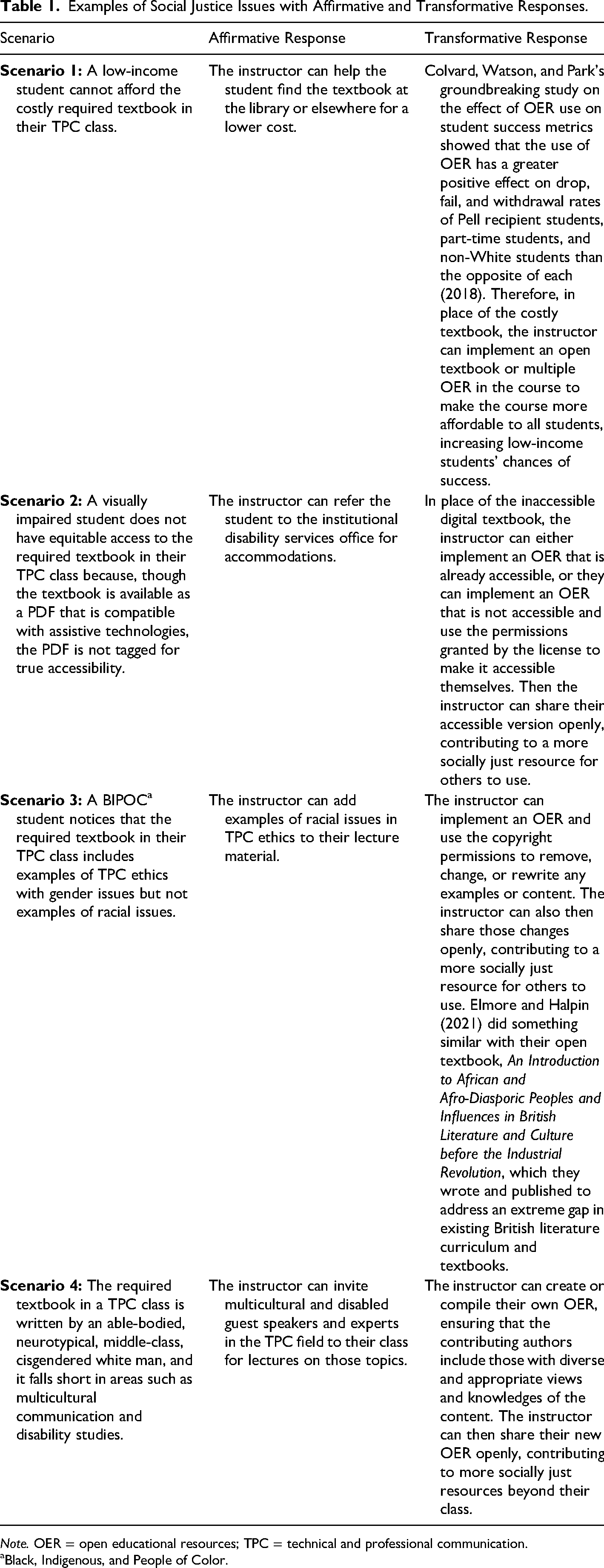
Note. OER = open educational resources; TPC = technical and professional communication.
Black, Indigenous, and People of Color.
Hodgkinson-Williams and Trotter's (2018) framework provides a solid avenue for using OER to solve a multitude of social justice issues, but in particular, we can use it to implement Tham's (2021) and Tham and Verhulsdonck's (2023) ideas on design thinking, makerspaces, and smart learning to solve social justice issues in TPC, specifically with OER and open pedagogy. Tham (2021) makes an explicit connection between design thinking and the “Maker Movement” to open source, including OER, due to its “long-established culture of sharing” that “revolutionizes the way we create and disseminate knowledge.” Open pedagogy, considered by many in the OER community to be the logical next step in OER work, also has clear connections to these ideas. Through the use of open licensing of course materials (OER), open pedagogy allows for deeper student connection to course content as they take a more active role in their learning. Open pedagogy also enables students to make and share their own work beyond the course, enabling a more valuable and applicable learning experience. This empowering of student voices and knowledge through open pedagogy is also an application of Costanza-Chock's sixth principle of design justice: “We believe that everyone is an expert based on their own lived experience, and that we all have unique and brilliant contributions to bring to a design process” (2020). Open pedagogy offers students the agency to share their interest, expertise, and voice in course materials and development.
OER and open pedagogy also connect well to Tham and Verhulsdonck's (2023) idea of smart learning as environments that enable learning from both formal and community sources, such as OER developed by educators (formal) and OER developed and shared by students and others outside of academia via YouTube, blogs, and other sources (community), and that they “create opportunities for role-switching between teachers and learners…to foster more authentic, social learning,” such as the space for student agency and making that open pedagogy creates. One example of such a project is Miceli's CORE 101 Open Pedagogy Project (2020) in which their students have created openly licensed informational websites on introductory science topics, which they then use in their classes as material. Another cluster of examples are Bernd, Rose and Caprette's (2024) open pedagogy assignments in theater and history courses in which students created and openly shared a variety of open learning objects, including assessments, activities, and content.
Given Colton and Holmes (2018) call for active equality in social justice efforts for TPC; Hodgkinson-Williams and Trotter's (2018) practical strategies for using OER to implement transformative responses to social justice, which is an act of active equality; and the overlaps of open pedagogy with Tham's (2021) and Tham and Verhulsdonck's (2023) work with design thinking and makerspaces; it stands to reason that TPC is severely underutilizing the tools that open education can offer us in our efforts toward social justice in our curriculum and pedagogy.
Barriers to OER Work and a Path Forward
The transformative responses in all four of the scenarios presented in the last section—and likely in many cases of OER use—require a great deal of work on the instructor implementing them. Indeed, the level of often unpaid work involved in OER creation, adoption, and sustainability is one of many significant barriers to OER use.
Open education scholarship outside the TPC field indicates several significant barriers to OER implementation across higher education institutions. One of the primary obstacles is the limited awareness and understanding of OER among faculty (Baas et al., 2019; Walton, 2020), with some research showing that many instructors have either never heard of OER or possess very little knowledge about it (Walton, 2020). This lack of awareness often leads to misconceptions, such as assuming that “open” necessarily means “digital” (Fischer et al., 2021). Additionally, faculty frequently express concerns about compensation for their time and copyright issues related to their materials (Martin & Kimmons, 2021; Nagashima & Hrach, 2021).
Other significant barriers include insufficient preparation and technical skills needed to implement OER effectively (Baas et al., 2019; Elf et al., 2015; Fischer et al., 2021) and a lack of institutional support (Murphy, 2013; Walton, 2020). The absence of recognition for non-peer-reviewed OER work in tenure and promotion portfolios also serves as a deterrent to faculty engagement (Martin & Kimmons, 2021), despite increasing advocacy for such work to be considered a form of scholarship (Coolidge et al., n.d.).
Bearing the many known barriers to OER work in mind, a logical first step in expanding that work in TPC is to explore those barriers and work to overcome or eliminate them. For example, I suspect that a study exploring a common assumption that OER materials are not kept current or updated regularly would likely reveal that they can actually be kept about as current as or even more so than publisher materials are, given publishers’ long textbook revision cycles when awarded the resources to do so. Many common concerns about OER in TPC and other writing studies were addressed and debunked in my response to a publisher representative's email that professed inaccuracies about OER in writing courses (Tijerina, 2023).
Conclusion
The core focus that both TPC and OER place on social justice creates a natural path for overlap and collaboration between the two scholarly fields. As demonstrated in the examples previously, frameworks such as Hodgkinson-Williams and Trotter's (2018) affirmative and transformative responses can offer TPC an avenue for using OER and the affordances they offer to address social justice issues in the classroom and in our curriculum. However, this scholarly overlap that carries so much potential for furthering our still-lagging efforts toward social justice in our programs (Agboka & Dorpenyo, 2022) has not yet been well-established; the scholarship on OER in TPC has been extremely limited and from only a handful of scholars (Arnett, 2018; Arnett et al., 2016; Covey, 2021; Covey et al., 2021; Tijerina, 2023; Tijerina & Arnett, 2023).
Indeed, TPC has been slow to engage in social justice in our curriculum when compared to the rapid growth of scholarship on social justice in the field (Agboka & Dorpenyo, 2022). Engaging with the affordances of OER, namely the open licensing of them, would open our teaching materials up to change, customization, and continuous improvement. With those opportunities, TPC can start to engage in Colton and Holmes (2018) theory of active equality by addressing the lack of social justice topics in their curriculum themselves and by enacting social justice for their students directly as well. Active equality can be enacted with OER work in a variety of ways for TPC's social justice, and Hodgkinson-Williams and Trotter's (2018) framework of affirmative and transformative responses to social justice issues with OER is helpful in determining ways to make lasting change in our curriculum and design with the help of OER. And, if we start by exploring the many cited barriers to OER work and working to overcome or eliminate those barriers, we can take steps toward expanding interest in OER work for our field. Doing this work and publishing on it will move our field forward toward Agboka and Dorpenyo's (2022) social justice turn in TPC curriculum.
Footnotes
Acknowledgments
This article is based on the exigency for my doctoral dissertation research, and I am deeply grateful to my dissertation committee members: Dr. Steve Holmes (chair), Dr. Jason Tham, and Dr. Tamara Powell. Your guidance, expertise, and thoughtful feedback were invaluable throughout the research and writing process. Dr. Holmes, your mentorship and encouragement were especially instrumental in shaping this work. I sincerely thank each of you for your support and dedication.
Author Contribution
This article was written entirely by Dr. Tiffani K. Tijerina.
Declaration of Conflicting Interests
The author declared no potential conflicts of interest with respect to the research, authorship, and/or publication of this article.
Ethical Approval
This article does not contain any studies with human or animal participants.
Funding
The author disclosed receipt of the following financial support for the research, authorship, and/or publication of this article: This research is supported by an OER Research Fellowship through the Open Education Group.
Informed Consent
There are no human participants in this article and informed consent is not required.
