



Abstract
The Soviet occupation of Polish Lwów between September 1939 and July 1941 is investigated in light of some unpublished British diplomatic reports contained in dossier F.O. (Foreign Office). 371, file 116 in the National Archives, London and produced from first-hand experience of conditions in the occupied lands. The missions, primarily to secure the safe exit of British and Jewish subjects, contain information contributing to an understanding of the radical changes brought about in that territory, its impromptu incorporation into the Ukrainian SSR, the beginnings of mass deportations both to Siberian GULags and kolkhoz farms in Kazakhstan, and the steady eradication of private ownership.
Keywords
My mother, Teresa Halikowska, always told us she was born in the worst place in the whole world at the moment of her birth, April 1940. She was born a Pole in the Soviet Union, one of the very last generation of Poles to be born in Lwów. The historian Timothy Snyder (2010) baptised that place as ‘The Bloodlands’, while poets from that city penned poems entitled ‘Cataclysm’ (Kataklizm), describing how ‘the outside world becomes an evil Theater of Delusion. Delusions led astray by madness and dreams also turned to ashes today’ (Świat zewnętrzny się staje złym Teatrem Ułudy . . . lecz majaków obłędem zwiedziony na manowce i snów także dziś) (Wierne Płomienie, 1943). Teresa’s birth was registered prospectively in Latin in a Liber Natorum, transferred after the war to the Civil Registry Office (Urzędu Stanu Cywilnego, ul. Kłopotowskiego) in the Warsaw neighbourhood of Praga Północ. However, her official certificate is in Cyrillic and issued by the ‘People’s Commissariat of Internal Affairs of the USSR’ (Figure 1). Her own mother, Marysia, died after postnatal complications 17 days following the birth, and Teresa was raised by an aunt, Ciocia Hala, while Teresa’s father, who had lost an arm during a hospital bombing in the first days of the war, worked and lived with Teresa’s elder sister in his own flat, before seeking employment, first in Brody and then in Tarnopol between 1942 and 1944. Her father was forced by circumstance to remarry a young nurse, Teresa’s new step-mother, Jadwiga Guz, in 1942. It was Jadwiga who took Teresa across the border to Przemyśl, along with her own daughter, Ewa, in July 1944, where there were relatives, as if to pre-empt the state-organised forced population transfers (known as ewakuacja and Repatriacja) of 1945–1946 and which saw as many as 1.5 million Poles (the so-called Zabużanie, those behind the River Bug) moved from the Kresy Wschodnie (eastern borderlands) to the Ziemie Odzyskane (recovered lands) vacated by 3.2 million departing and expelled Germans in the West (Ciesielski, 1999; Kochanowski, 2001; Makarczuk, 2001; Ochman, 2009). 1 Although her experience of it was brief, Teresa demonstrated a lifelong interest in the city of her birth and, like the poet Adam Zagajewski (Bishop, 2009; Kaminsky, 2021), nostalgia for a world she never knew. While an increasing number of private diaries have come to light, aided by the activities of specific non-governmental organisations (NGOs), popular Polish historiography has preferred to dwell on the last ‘golden’ years of Polish Lwów (Włodarkiewicz, 2003); anthologies entitled FOTO RETRO (Majewski and Łoziński, 2017) are rose-tinted and unadulterated by war, while Koper and Stańczyk (2022) seek how to ‘deliver the magic of the city (. . .) to the generation of today’ (przełożyć magię miasto (. . .) łczesnego pokolenia).
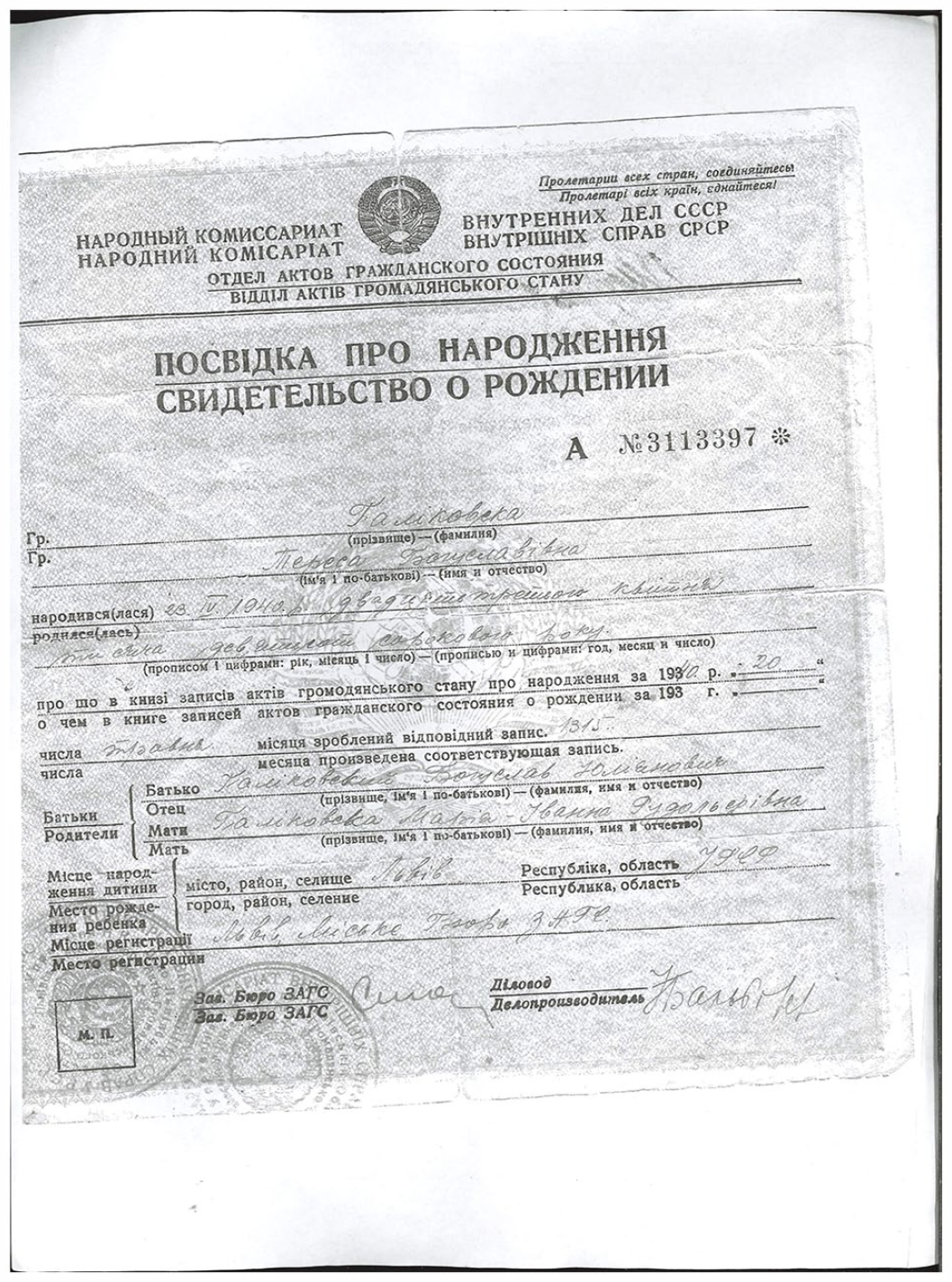
Teresa Halikowska’s Soviet birth certificate.
What about the trauma of that first messy transition to Soviet rule, which began when the Soviet army moved into western Ukraine on 17 September 1939? 2 The Soviets established a line of demarcation with Germany to the west a week later, the so-called Curzon line, although the Battle for Lwów (Obrona Lwowa) was highly contested until the Polish capitulation on 22 September with as many as 484 German casualties (failed attempts to reach the centre of the city from the suburb of Zboiska on 12–14 September) and 488 Soviet casualties (an attempt to take the city from the suburb of Łyczaków on 19 September) (Kirkien, 1944; Mękarski, 2016: 202–203; Urban, 4). The terms of the surrender ultimately were not respected; Polish officers were escorted to Tarnopol, where they were sent to various prisoner-of-war camps in the USSR, mostly to the infamous Starobielsk. Most of them, including General Franciszek Sikorski himself, would be murdered in what became known as the Katyń Massacre in 1940 (Leinwand, 1991).
Soviet rule of the city, as it turned out, was only temporary: it was brought abruptly to an end with the German invasion of the USSR (Unternehmen Barbarossa), which put the Germans back in charge of the city on 30 June 1941, inaugurating another era in the city which has been diligently exhumed via different media, including analyses of stories from newspapers produced in the city (Hryciuk, 1992), a series of primary source publications from the Yad Vashem in Tel Aviv, and films like Agnieszka Holland’s In Darkness (W ciemności), 2011.
Historians are still collecting and working through the sources relating to this episode. Christoph Mick (2015) has assembled an ‘Index’ of 18 pages in tabular form listing the names, professions and occurrences of key Lwówian protagonists of the war years. Edward Kessler’s (2010) Wartime Diary (1942–1944) was only published in 2010; Ben Zion Redner’s (2015) A Jewish Policeman in Lwów: an early account, 1941-3 in 2015; Tadeusz Zaderecki’s (2018) Lwów under the swastika: the destruction of the Jewish community through the eyes of a Polish writer was only translated and published in 2018. There are a number of manuscript Pamiętniki (diaries), which are yet to see publication. Some like that of Tadeusz Tomaszewski, which runs from 5 August 1940 until 1944, or Jan Rogowski’s, which is entitled W Czerwonym Lwowie: Wspomnienia z czasów wojny (In Red Lwów: Recollections from wartime) are handwritten manuscripts. Tomaszewski’s diary, entitled Zapiski z okresu wojny we Lwowie (Notes from a time of war) has been uploaded to
While Christoph Mick (2015) blazed trails into a range of Russian archives, 5 it was in Jan Tomasz Gross’s oft-cited Revolution from Abroad. The Soviet Conquest of Poland’s Western Ukraine and Western Belorussia (Princeton, Gross, 2002 [1988]: 342), based on a partial analysis of the 30,000 depositions of Polish citizens who experienced the Soviet occupation and on numerous other reports of the Polish Foreign Ministry and its British equivalent, that I first discovered reference to a British diplomatic report by J.W. Russell: ‘Memorandum on conditions in Soviet-occupied areas of Polish Ukraine’. Gross attributed it to the Sikorski Archives in Kensington Row in London (www.pism.org.uk). After an extensive search there with the help of archivist Jadwiga Kowalska, we could only locate another report in Polish, initialised rather than signed (a J.H.R.), written from Moscow a year later. 6
The National Archives in Kew (www.nationalarchives.gov.uk), earlier the P.R.O., proved a better place to look, as in Britain, unlike other continental European countries, there is no independent Foreign Office Archive. 7 J.W. Russell, who was John Russell, Third Secretary to Her Majesty’s Embassy in Moscow, went on a mission to Lwów between 19 January and 2 February 1940 with John Trant, acting First Secretary at the British Embassy in Moscow (later Consul-General), for the purpose of evacuating British and Palestinian citizens from Soviet Poland, ‘stranded there’. The conditions were described as ‘most trying and difficult’, and Trant apparently (from two sources, that of Russell and another British diplomat, John Le Rougetel, who introduces Russell’s report and was put in charge of the embassy after Ambassador Seeds was recalled at the end of 1939) 8 was to submit his own report, although I have not located it. There is a further and earlier report by Russell entitled ‘Conditions in the Soviet Bukovina’, dated December 1940, which speaks of passage through Lwów, which was presented by the British ambassador in Moscow, Sir Stafford Cripps, from April 1940 to Mr Anthony Eden (working again in the Foreign Office) on 27 January 1941 (three-and-a-half pages) (Communiqué N 828 / 114 / 38, Sir Stafford Cripps to Mr. Eden: received 6 March 1941). 9 The two files, or reports, are kept in the British National Archives, dossier F.O 371, file 116 entitled ‘Political: Central Poland’, which contains Papers PP1886 to PP5460 (not well-numbered). This dossier was off limits until 1971, and there is a mix of typewritten and handwritten scripts inside. The dossier also contains two reports by Thomas Preston ‘during visits to Soviet Russia’, primarily the Baltic states, from the British embassy in Angora (Ankara), dated 27 October 1940, and from the Consulate General in Istanbul (11 February 1941). 10 It is interesting to note that Russell continues to use the Polish name for the city, Lwów, rather than adopt the Soviet Lvov, as if recognising its incorporation as a fait accompli, but his nomenclature is elsewhere questionable: he continues to refer to (Habsburg) Czernowitz, for example, which had become Cernauţi in 1920, and is happier speaking of Soviet expansion in the name of Russia.
This is not the case, however, with some valuable newspaper clippings also inside dossier F.O. 371: the in-origin five articles published by the Briton Paul Greve in a variety of different local Western newspapers, English, Irish and American in March and April 1940, often under the sobriquet ‘The Man from Lvov’. 11 Seeking in vain an exit visa in Lwów from the Soviet authorities (cf. O’Connor, 1968: 261), it was only with Messrs. Trant and Russell’s visit that an escape across the Rumanian border via Śniatyn in January 1940 was arranged for a small party. Greve went with his Polish wife. British Consular officials were waiting to assist the party on the other side of the Prut River, which constituted the border (Greve, 1940c; Greve 1940d).
Gross’s work has been criticised for its lack of concern with change over time (Urbaniak, 1991); while valuable retrospective analyses such as that provided by Jacob Gerstenfeld-Maltiel can divide the 22-month reign of the Bolsheviks in three ways: an initial phase during winter and spring 1939/1940, the ‘hatching of the new form: the impetuous remodelling of the economy from individual capitalism into an extreme state economy’, and a subsequent phase of ‘stabilisation and higher control’ lasting from the summer of 1940 until June 1941 (which Poles sometimes called the ‘gentler course’). Russell divides his ‘snapshot’ report made in situ into the following thematic sections, which I present here in abridgement, sometimes quoting:
§ 1. General: A reiteration of the hatred and contempt that erstwhile Polish citizens feel for the ‘heavy-fisted foreign conqueror’, 12 contempt for the ‘lack of organisation shown by the civil authorities and for the slovenly and undisciplined appearance of the military’.
§ 2. Ukrainian Nationalism. Even the Ukrainian patriots, whose nationalist and separatist ambitions were momentarily revived by the prospect of Russian aid in throwing off the Polish yoke, are now bitterly disappointed. While the Poles suppressed their language and closed their churches, under the Russians it is hard even to get bread.
The Ukrainians had no love for the Poles; they have neither love nor respect for the Russians. The latter are pushing for a general adoption of the Ukrainian language for all official purposes, but this ‘sop’ is not successful: Ukrainian students openly show distaste for compulsory lectures on the glory of the Soviet Union and the history of the Communist party, and refuse to join the Komsomol or Union of Communist Youth.
Industry is at a standstill, while life has become extremely expensive. All the places of entertainment are closed. The Poles are convinced there will be a great Allied drive in the spring aimed at liberating south-eastern Poland. 13
§ 3. The peasants were initially seduced by the idea of seizing their wealthy proprietors’ estates, and now work for themselves. But as it became obvious the profits would go to the State, they became less gratified and see collectivisation as a bogey-man. Inflation, annulment of the zloty, has hit them hard. 14
§4. Townspeople. Their savings have gone, the price of living has soared to fantastic heights, and the small trader has had his shop either closed or else taken over by the Soviet authorities. 15
§ 5. Shops. ‘At least 90% of the shops in the town are closed (. . .) the streets present an endless vista of shuttered windows’. In front of the few stores remaining open there are perpetually long queues. No shop selling clothes, shoes, furs or bedding. Only few restaurants, from midday to 3. General curfew from 10 o’clock. While we were there Kozel, 16 the smartest establishment in Lwow was closed. A few bookshops were open, but assumed ‘barren and melancholy characteristics that such establishments bear in Moscow. Windows were filled with empty dustcovers that had adorned German and other foreign novels as recently as last October, in short bookshops had become ‘whited sepulchres typical of Soviet culture’.
§ 6. Queues. Now there is waiting long hours for bread, and people do not accept this necessity with good grace. Nor do they appreciate the queue-jumping habits of the Soviet military.
Fights are a common occurrence outside the food-shops. I myself witnessed an incident on 24 January, where four militiamen were trying to control a food queue. Their manner of doing so was ‘rough in the extreme . . . as I was going by, [one] had just knocked an elderly peasant woman to the ground and was beating her with the butt of his rifle. She got up, drew a large bottle of vodka from her string bag, and smashed it between his eyes to the cheers of the waiting public’ (Figure 2).
§ 7. Police. Militiamen replaced the disbanded former Polish police, replacing them with ‘a gang of cut-throats recruited from amongst the Ukrainian Communists, many of whom were doing time for political offences’. At first equipped only with red armbands and rifles, they now got a new uniform: the blue cloth of the former Polish police, embellished with Soviet trimmings. They are assisted by a sprinkling of regular police from Kiev.
§ 8. Polish Army. The Polish Army was disbanded shortly after the arrival of the Russians. None were incorporated into the Red Army, although a number of the rank and file were deported into Siberia. There was no ‘regular recruiting’ but there was a registration of men of military age at the end of 1939. Those who were unwise enough to report for registration were promptly sent to concentration camps in the USSR. 17
The civilian population appeared to have no great love for the Polish army, which they say was composed of privates and colonels in equal proportion. The former were prepared to fight to the bitter and inevitable end, the latter were occupied with making their private arrangements to cross the Romanian frontier at the earliest opportunity in a bid for freedom. 18 (First-hand accounts (Gerstenfeld-Maltie, 1993: 6) report how the Polish officer class saw itself as the victims of treason, recklessness and incompetence, and recounts how ambulances were commandeered by officers trying to flee Poland, whilst the wounded inside them were summarily deposited by the side of the road to fend for themselves).
§ 9. Red Army. The Polish inhabitants of Lwów are more contemptuous than hostile towards the Soviet soldier. 19 They seem to have been of uniformly good behaviour, not looting or resorting to violence. What murder and looting did take place seems to have been the work of Polish troops and Ukrainian peasants. The first Red Army troops were well-disciplined and equipped. But with the ‘Finnish incident’ 20 they were removed and replaced by a sorry-rabble of second-line units. They were greatly inferior to their predecessors both in quality and numbers, almost entirely infantry. Air force, artillery, tanks and armoured cars have virtually disappeared: during the fortnight in Lwów Russell only saw three men in air-force uniform, and one tank.
Russell shares a few comic stories, although he considers them (inappropriately, in SHS’s estimation, Greuelmärchen, or horror stories) regarding the Soviet soldiers. In a public park where schoolchildren were skiing, a soldier exclaimed ‘My God, the Finns!’ breaking ranks to run off, and was followed by the remainder of his detachment. The low standard of culture of the Russian officers is derided by the Poles, who on their first descent on the well-stocked milliners’ shops bought enormous quantities of silk night dresses, thinking they could be evening-dresses, and thus attired appeared at the opera.
§ 10. War Damage. Russell reports how traces of German bombardment could still be seen, a row of three houses in one of the main streets was completely demolished, the roof of the Central Station badly damaged, the Roman Catholic Cathedral given a large hole in the roof, the Ukrainian church in Kopernicka ulica completely demolished, and there were direct hits on the two towers of the big church by the railway. 21 The Germans, Russell surmises, thought the Poles were using the churches for artillery observation or machine-gun posts.
§ 11. The Church. Up till the present date, the Church has suffered more materially than spiritually. Although bitterly cold, the services are still well-attended. Confiscated ecclesiastical properties and worsening financial circumstances of the congregations hit Church finances. Monks and nuns have given up wearing habits in the streets. If Bolsheviks start making martyrs, the Church will capitalise on its spiritual force. In memory of the time when the Turks (Russell means the Mongols in 1241) were driven back from the gates of Cracow many church spires show cross rising above vanquished crescent. The faithful hope no hammer and sickle will be added to the ‘heathen trophy’.
§12. Decay. Russell starts by explaining that superficially the town retains many of the characteristics of the civilised European city it was until recently. The people are comparatively well-dressed, paint on housing has not yet started to peel, there are a good number of foreign cars on the streets. He cannot however deny the ‘welter of confusion and squalor introduced by the Soviet regime’. Snow has not been cleared from the streets. The British delegation stayed for three ‘frozen unhappy weeks’ in the Hotel Bristol. 22 After one unfortunate experiment with the hotel food, Russell fell back on his own resources, living entirely on tinned food. There was no heating, and burst radiators occurred when the temperatures rose above zero releasing floods of dirty water. Everything in the hotel was covered with a thick coating of grease. The Hotel Bristol had previously been one of the three ‘smartest hotels in the town’. 23
The decline in living conditions only set in some 3 months after the arrival of the Red Army. 24 A secretary from the Italian embassy in Moscow went down to Lwów in mid-November and found that life there was still normal and even agreeable, 25 but two members of the American embassy spent the latter part of December and most of January in Lwów, and were amazed at the speed things were going downhill. By the time Russell got there ‘the retreat from European standards of living had become a rout’. 26
§ 13. Housing. Conditions were aggravated by ‘the sudden increase in the population of the town. The influx of Soviet troops and civilian officials and the steady flow of refugees from all over Poland has produced ‘an acute housing shortage’. 27 There is a regulation that two people must share a room. The former owners of the town houses now live in the garrets and cellars once occupied by servants, the rest taken by Russian officials. Rents have been reassessed by Moscow so that there is a maximum and minimum rent for each room, but there is big variation depending on the tenant’s ‘value to the state’, Polish aristocrats paying the maximum. 28 The złoty has no more value, 29 people have to raise the money as best they can ‘either by selling jewelry or by accepting menial work at starvation wages’.
§ 14. Prices. Sugar used to cost 1.50 zl/kg, now costs 5 roubles, but is only to be had at this price if the buyer waits whole day in a queue: on the black market it is 30 roubles/kg. Butter used to cost 3 zl/kg is now unobtainable at official price but can be had in small quantities on the black market for 50 roubles/kg Firewood has risen from 7 zl to an official price of 60 roubles, but can only be had on the black market for 250 roubles. Potatoes have risen from 2 groschen to 6 roubles per kg. Soap, tea and coffee ‘are virtually unobtainable’.
§ 15. Discontent. Rising prices have contributed greatly to the general discontent, which frequently finds open expression. A peasant who had come to sell his produce was being moved on by police: he spoke in Ukrainian. He shouted at passersby: ‘They came to bring us liberty and have brought us handcuffs’.
§ 16. Communists. Even the local Communists are disillusioned by developments. The Salonkommunisten or ‘parlour pinks’ did not receive the rewards to which they thought themselves entitled. According to information Russell thinks reliable, 16 leading Communists, including one member of the Western Ukrainian National Deputation which went to Moscow in November, were arrested on 25 January for Trotskyism, sabotage – all the usual crimes. Meanwhile other sources reveal how power was handed down to political prisoners of a Communist background who had been put in charge of local government, but whose lack of experience sowed chaos. Meanwhile, Soviet agitators urged peasants to take revenge on erstwhile landlords (cf. Snyder, 2010: 125-126).
§ 17. Sabotage. Although the people were discontented (price rises, shortages) ‘there does not appear to be any form of organised resistance or sabotage’. There was only one isolated act of an oil well near Borislav that was ‘fired’.
§ 18. Arrests. There was a generalised fear that the nets were ‘closing in’. Until mid-January 1940, only Polish landowners and industrialists were arrested wholesale. This may have been due to disorganisation among the police, to the Soviet authorities’ desire to present a face of benevolence, or the fact that hitherto local officials were mainly occupied in buying hats, shoes and watches and generally feathering their own nests. (Actually, Russell would not have known of the 4 December 1939 decision of the Soviet Politburo to get the NKVD to expel certain groups of Polish citizens deemed to pose a danger to the new order, specifically military veterans, civil servants, policemen, and their families. Grzegorz Hryciuk’s (2007) research has established that the February deportations (wywózki Pl.) were to see 139,794 deported, with some 8.513 sentenced to death, and a typical sentence being eight years in the GULag). 30
§ 19. Officialdom. Mostly imported from Moscow and Kiev. No Poles were allowed to retain any but the lowest positions. Soviet authorities took over municipal administration, with local Ukrainians occupying subordinate positions. Local NKVD and militia ‘showed hitherto a remarkable combination of ignorance, incompetence and unpleasantness’. Both Trant and Russell dealt with one Volkov, who was ‘nervous, hysterical, illiterate, obtuse, and violently ill-mannered’. On one occasion he called two militiamen to eject Russell from his office, but Russell responded by locking the door on the inside. Volkov admitted to being incompetent, and not used to dealing with foreigners. Volkov’s political boss was a Ukrainian from Kiev called Eremenko – Russell dealt with him over reclaiming furniture from the former British Consulate and he proved obliging, polite and comparatively efficient. 31
§ 20. Appointments. Former directors have been removed and replaced by individuals more politically attuned to the Soviets but in most cases ill-equipped by mentality or training for their new position. The proprietor of a restaurant, Stadtmüller, was dispossessed and offered a cloak-room attendee job, the occupant of that post having just been appointed manager of the restaurant. Junior employees in the banks, usually young Communist Ukrainian Jews, were on the ascendant.
§ 21. Jews. A large proportion of Lwów was Jewish. 32 Russell reports that they did not suffer on racial grounds under the Bolsheviks, but reveals his own anti-semitism when he writes sardonically that ‘their acquisitive instincts are sadly offended by Soviet principles’, as well as other comments below. While despising the ‘barbarian illiteracy’ of the Soviets, Russell concludes that they are nonetheless ‘better than the Nazis’. One of the hoteliers at the Hotel Bristol observed: Der eine tötet ohne weiteres die Fische. Die anderen lassen langsam das Wasser heraus [One simply kills the fish, the other lets the water slowly run out].
§ 22. ‘Black Bourse’. Jews were doing a fine trade in foreign exchange, which commanded a ‘fantastic price’. At the official exchange rate, 1 dollar was worth 6 roubles. The black market rate at the time Russell was writing stood at 1:25. In January 1940, the ‘black’ rate touched 330:1. This was powered by high demand for large-denomination notes by those chancing over the ‘green border’ (grüne Grenze), constituted by the Carpathian mountains, to Hungary or Romania. The market took place behind the Hotel Bristol at a place where five or six thoroughfares converged, and which Russell describes in terms Goebbels would have approved: ‘swarms with a scrofulous crowd of kaftaned, bearded and side-curled Jews conjuring up images of the ghetto in some medieval German city’.
§ 23. Currency. Very small confidence in the Soviet currency, which it is feared will be called in and all notes over 50 roubles recalled. Thus townspeople will not accept them, many peasants coming into town fear it even more, and demand goods in exchange. This barter technique has increased even further the shortage of fruit, vegetables and meat in the town.
§ 24. Concessions. A decree was published in local papers on 27 January 1940 that new elections were to be held in March to replace the present temporary National Assembly. The decree was followed the next day by an order published in Polish newspapers like Czervony Sztandar, providing for the reopening of the provision shops and for the re-establishment of Sunday as a regular holiday. 33 Russell thinks this concession would be rescinded as soon as the elections were over.
§ 25. Germans. Russell points out that a separate memorandum was submitted to the military attaché of this (British) embassy regarding the presence of German troops in western Ukraine. The refugees gathered in Lwów reported coming under systematic machine-gun fire as they made their way from Warsaw. Russell intimates that he was ‘far from reassured’ by BBC reports that a deal was being struck between the Germans and Soviets trading the Ukrainian oil-fields in return for military help against the Finns, or that a condominium was to be established in western Ukraine. These broadcasts were being received even though authorities declared it illegal to listen to foreign news services. However, there was a German Repatriations Committee at work in Lwów staffed by German military officers. If you could attest one German grandparent, you would be readily repatriated to Germany; 4000 families are said to have gone from Lwów alone. A second commission working on return to German-occupied Poland was due to arrive on 5 February. 34 Also there were German military engineers at work on the railways, especially the Przemyśl-Lwów-Śniatyn-Czernowitz section.
§ 26. Railways. This contains a discussion about the changes to the railway gauge, the Soviets preferring the broad-gauge, ‘thus enabling both Soviet and European rolling-stock to be used on the same stretch of line’. This is reported to have been done between Lwów and Przemyśl. There were rumours that the Lwów-Kolomea-Czernowitz line was reserved for military transport only. This report was, however, discredited when on 19 January a party of 30 American refugees (including Paul Greve) was evacuated via that route. One explanation offered was that this line was being used to transport goods that were originally intended to be sent by water up the Danube, but that the river was frozen.
However the British diplomats were concerned that ‘all railway transport in the Western Ukraine or indeed throughout the Soviet Union is badly disorganised’. 35 The train Russell travelled down to Lwów on was 34 hours late, and when he returned with Mr. Trant the party was 28 hours late on reaching Moscow. The ‘normal’ time for this trip was 46 hours. The former Romanian consul spent ‘one month in his sleeper outside the station waiting for an engine to take him to Romania’. 36
§ 27. Conclusion.
Russell’s report ends stating that the only conclusion to ‘be drawn from all this confusion, hatred and discontent is that, given the opportunity, the whole of the Western Ukraine will rise as one man. The Ukrainians have suffered various forms of oppression in the last few centuries but they never yet reached those depths of abject servility in which the Russians have grovelled since the days of Ivan the Terrible. The Russians only have one achievement to their credit here, but that is something which has rarely been known before. They have united Poles and Ukrainians in their hatred of a common enemy’.
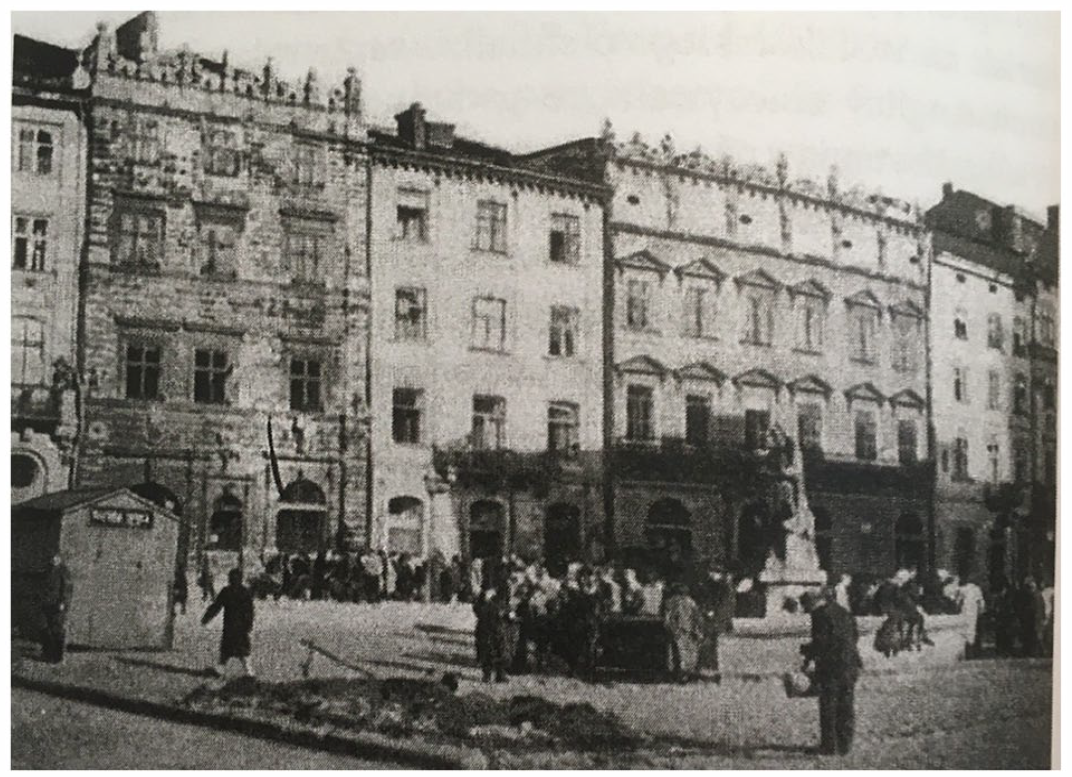
The Rynek, Lwów, in 1941 showing queuing for food under the Soviets. Photo by Mękarski (2016: 180). See also Hryciuk (2000).
Russell’s report can be qualified and supplemented from another report written from the British Consulate in Cernauţi (historically, Czernowitz), 280 km southeast from Lwów, on 1 February 1940 and signed by R.D. Macrae Esq. (F.O. 371, file 116). Other sources inform and confirm that he was British Consul in Bucharest (Whitaker 1939: 999). ernauţi had been handed to the Kingdom of Romania after 2 years of political uncertainty following the conclusion of World War 1 (Livezeanu, 2018: ch. 2). However, unlike Polish Lwów, which was invaded immediately after the Molotov-Ribbentrop Pact, the northern Bukovina (along with Bessarabia) (Dear and Foot, 2005: 169; Solonari, 2019) only fell to the Soviets in June 1940 after the Rumanians agreed not to contest the invasion, and as what Gafenco (1944) called la confrontation des projets balkaniques started to rear its head. The third paragraph of Macrae’s report highlights the ‘very serious’ food situation in Lwów. According to a party of Jews, referred to as ‘Palestinian subjects’ seeking repatriation, and who passed through Cernauţi from Lwów a few days prior to Macrae’s report, ‘bread is only sometimes available, and people live mostly on potatoes and cabbages’. Furthermore, ‘owing to the great scarcity of supplies, anyone who has any spare clothes, boots or shoes to dispose of can obtain very high prices for them [..] it is almost impossible to have shoes or boots repaired, the leather is all requisitioned’.
There is a second report from Cernauţi dated 6 May 1940, just a month before the province was annexed by the Soviets. It gathered information from former employees of the British embassy in Warsaw who arrived in Cernauţi on 3 May and who had passed through Lwów, reporting how the food situation ‘has improved slightly, while at the state shops it is sometimes possible to buy textile goods’.
The third paragraph reports on morale there, how people ‘feared deportation at the worst and of remaining indefinitely in Lwów under Soviet rule at the best’. The British diplomats reported how refugees, including Jews from western Poland, were pushing to register for return to territory under German occupation for a variety of reasons, many not well thought-through or ill advised. A German commission was reported to be at Przemyśl ‘examining the cases of those who wish to return; it appears to accept principally engineers and doctors’. Gerstenfeld-Maltiel (1993: 28-32) describes the necessary process of getting a Russian passport as a means of securing a worthwhile protection against the deportations of May 1940 and then 28–30 June, ‘the great deportation-action’ when nobody slept and many sought to hide in attics, or under the floors. It was hard, the passport-office was out to catch refugees or those who had not reason to find themselves in Lwów or could not prove they belonged there before 1 September 1939. Agencies like the Biuro Pomocy Biezencom i Bezrobotnym (Bureau for Refugees and the Unemployed), which were set up in September 1939 by the Communist authorities under the leadership of Romek Janicki, were forced to close in the spring of 1940 after being swamped and under duress from NKVD security officers to hand over personal information for the purposes of organising the deportations to Kazakhstan and Siberia (Powell, 2016: 143-144).
Polish sources, both memoirs and diaries, add detail to the picture here presented, and in many ways qualify the somewhat benign image presented by the British, particularly the emotional register of those trapped in the limbo of uncertainty. ‘Lvov was then living in a state of nerves bordering on hysteria’, Herling writes (in Kott 1990, 236-244). The emigré novelist Herminia Naglerowa wrote that after 2 weeks of Soviet occupation, Lwów was ‘drab, filthy, intimidated, starving. They transformed our brave and beautiful city in a trice. People stopped smiling, fell silent, they screamed with terror in the night. But they were calling to the deaf and intimidated’ (‘H. Naglerova to J. Wittlin, 16 January 1953’, in Taylor-Terlecka, 2022 & 2023). Thus, for example, Aleksander (Chwat) Wat (1988) describes being arrested by the NKVD in broad daylight on 23 January 1940 along with Stern, Peiper, Parnicki, Broniewski and others (Shore, 2006: 165-169). He describes ‘a city besieged by fear’, all the worse for this being one of the ‘loveliest’ and ‘merry’ cities: ‘a bit more like the Vienna of operetta, the Vienna of joie de vivre, like some of the Italian cities’ (Shore, 2006: 104). Wat writes of the February deportation of Polish citizens, a coordinated akcija across Ukraine and Bielorussia, which began on 9–10 February, and saw whole families deported with their belongings. It ‘was terrible; people froze to death in the train cars; women were giving birth; dead children were thrown from the train’ (Kosicki 2011; Sword, 1994; Wat, 1988: 111). He writes of a Lwów ‘mobbed with refugees, fugitives from Warsaw, colleagues of mine. People had nowhere to live, nothing to live on, terrible hardship’. He writes of how the ‘struggle for existence coming before anything else’, the lies he was forced to tell ‘in cafés, conversations, union meetings’. Herling-Grudziński (1990), in his essay Godzina Cieni (The Shadow Hour) describes the ‘scaffolding of banners, slogans, models and portraits’. He describes the intellectuals’ haunt in The Scotch Coffee House [Szkocka] on Fredry 9, and the rush to get a housing authorisation via enrolment in one of the writers’ unions (in Kott, 236-244). Other writers like Leo Lipski (1957) in his short story ‘The Return’ (Powrót), describe being held by the NKVD in the Brygydki prison, as Aleksander Wat was also.
Only Jacob Gerstenfeld-Maltiel’s account stands out for portraying the initial period of Soviet run Lvov as somewhat rosy. This was not only the bustle of a neglected provincial city now swollen by refugees, and the services that had to rise to cater for them: Gerstenfeld-Maltiel (1993: 12) suggests the effect that ‘life was boiling, bubbling, preparing itself to take on a new and unknown form’, and that night-clubs, entertainments initially were booming. It also manifested itself in the attitudes of officials who ‘made intense endeavours’ in his opinion ‘to win over the population not by compulsion, but rather by a liberal approach [ . . ] According to the orders of the authorities, all shops had to stay open as before the war and sell everything they used to sell’ (Gerstenfeld-Maltiel, 1993: §4). Maltiel’s account of the black market is not one of paucity, but rather a place where ‘everything in any quantity could be bought, from a length of English fabric, French silk stockings, to diamonds and gold’; see Figure 3 (Gerstenfeld-Maltiel, 1993: 14). This is decidedly not the picture Russell presents from the end of January 1940, and harks back to the Warsaw refugee’s first days in his home city after his escape on ‘the Refugee trail’ and his successfully reuniting with his parents. It is probable that the Soviet days are tinted somewhat benignly, as constituted by relatively innocuous disturbances to daily life, when compared with the terrible repeatedly near-death ordeals he experienced at the hands of the Nazis.
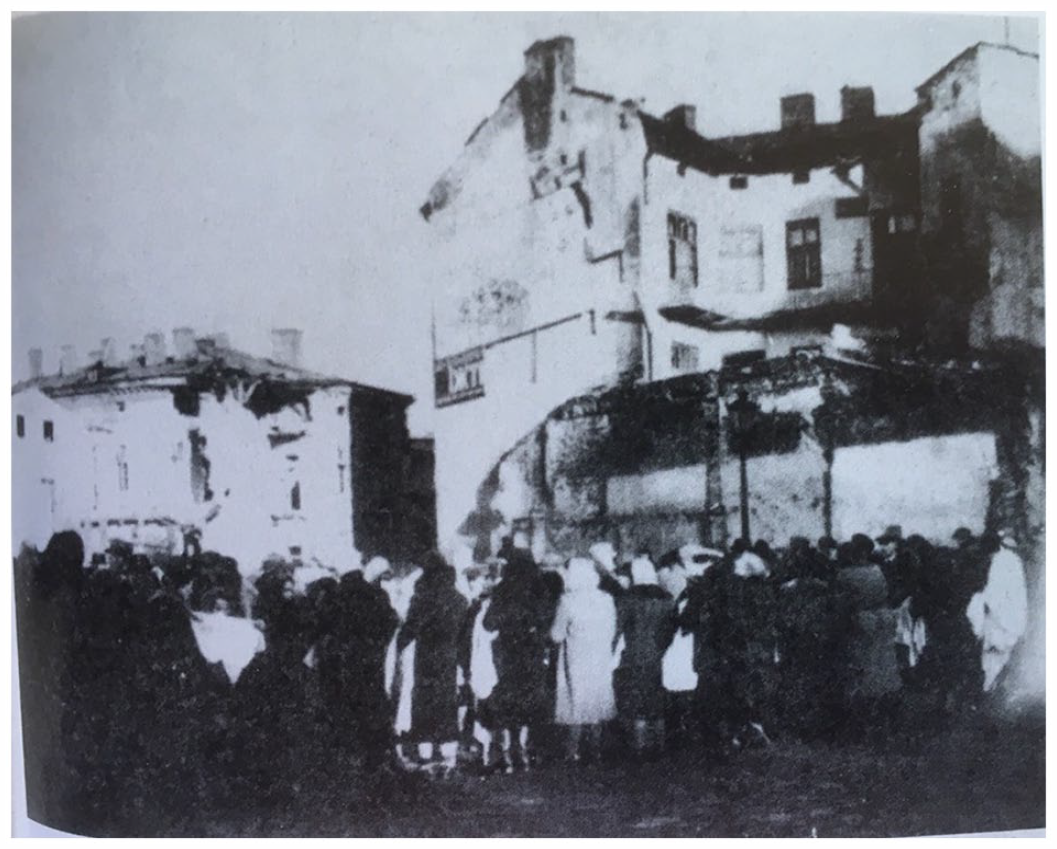
‘Paryż’ on Plac Krakowski, Lwów, in 1940. An informal black market where my great-grandmother sold the family jewellery to survive (Riedl, 2002).
Paul Greve’s articles offer a solid counterpoint to the diplomatic reports; indeed he praised the diplomatic embassy from Moscow for not departing till the contingent of displaced Brits were dispatched to Śniatyn and Rumania. Greve had lived many years in Poland, but survived only 4 months under Soviet rule. Many of his articles were preceded by publicity the day prior to stimulating the British public’s interest with questions like ‘What is the truth about the Red Army?’, or ‘How has Stalin set about Sovietising his share of the land that was Poland?’ Greve (1940b); Greve (1940l), which Greve elsewhere describes as a ‘protectorate’.
The picture presented by Greve for the period up until January 1940 is undisputably grim. Food has run short, queuing is de rigeur for the barest essentials of life, and workers’ committees have ‘wrecked thriving industries’ by mismanagement and endless conferences. One factory worker told Greve: ‘They came to liberate us, and all they have done is to put us into chains’. Trains are described as running days late (although Greve later notices in Śniatyn a plaque in gold lettering reminding people that Russian railway-workers would not brook any delays), the phone service hardly functioned, and only Soviet-sponsored newspapers circulated (Greve, 1940a, 23.3.1940). 37
In ‘Lvov’s Suicide Christmas’, Greve describes how, in the build-up to the Christian festival, some efforts were made to cheer up the drab realities of living under the ‘Bolshevik heel’. Thus a few shops contrived to make and display Christmas fare, including wine, nuts, fruit, even small Christmas trees. But rapid depreciation had spiralled the rouble exchange from 150 to 940 to the pound sterling, with the consequence that peasants would no longer sell. As Gerstenfeld-Maltiel (1993: 19) explains, peasants had been the primary speculators caught short with lots of cash when the złoty was banned, had hence become very untrusting, and bread was only to be had from the New Year in official shops. Thereafter the scene was desolate: whole streets were shuttered and barred when, on 20 December, within 24 hours of its announcement, Polish money ceased to be legal tender, while hotels and restaurants were gradually closed. 38
In ‘Miracle in the Snow’ (Greve 1940j), Greve explains how Russians were billeted on the local population, nobody was allowed more than 15 square yards. All residential property was nationalised, and each homeowner was only allowed to retain a single room within it and as much furniture as was sufficient for it. All the rest was confiscated. Local people became timorous and would not answer their door. People were completely unclear about their salaries, the highest was 450 roubles, equal to 10 shillings. Radios now needed complicated licences that had previously been acquired at the front doorstep from the postman. At the railway station only two counters were open, and people queued all day (Greve 1940h).
Greve made concerted efforts to leave, although it was almost impossible: there was no office for issuing exit permits (Greve, 1940c). Greve lobbied the much-feared OGPU, who were in ‘many ways childish, completely lacking capacity for organization’. 39 He went to their office every day for 2 months. Phone calls outside of town had to be booked 5 days in advance at the General Post Office. Fortunately, the diplomatic contingent came to rescue them. They were sent to Śniatyn by train, forced to wait a night on a bench before being relieved of all roubles and złoty, and allowed to exit with only £1 per person. Clothing seams were carefully inspected (cf. O’Connor, 1968: 37-39).
Greve (1940i) gives a full and detailed description of Soviet military forces. He was impressed with their frontlines, a completely mechanised army ‘right down to the soup-kitchens’. The only horses he saw were riding in lorries. But in contrast with the modern tanks and machine guns, all the rifles ‘were of the same type and pattern as those used by the Czarist armies of 1914-8’. Machine guns were relatively few. On 6–7 November 1939, the anniversary of the Bolshevik Revolution was celebrated in Lwów with the staging of a grand military parade. Overhead, airplanes droned, flying so low ‘as to the touch the roofs of the houses’.
The military men addressed each other as Tovarich (comrade). Privates were not used to saluting officers in the streets, nor offer them their seats in trams or trains. While the first-line soldiers had ‘serviceable-looking long-sleeved waistcoats, well padded’, the second-line had half-boots and puttees. Education was rare, they could scarcely read Latin characters, although their arrogance was immense. Stories circulated of soldiers buying face-cream in the shops thinking they could eat it, or officers buying out all the silk nightdresses at the department stores, dressing up their wives with them for a night out at the opera. Civilian suits and coats were also bought up, among rumours that officers were to use these clothes to slip across the border into Hungary, and Rumania. Ultimately tailors were officially forbidden from accepting orders for suits on behalf of Red Army members (Figure 4).
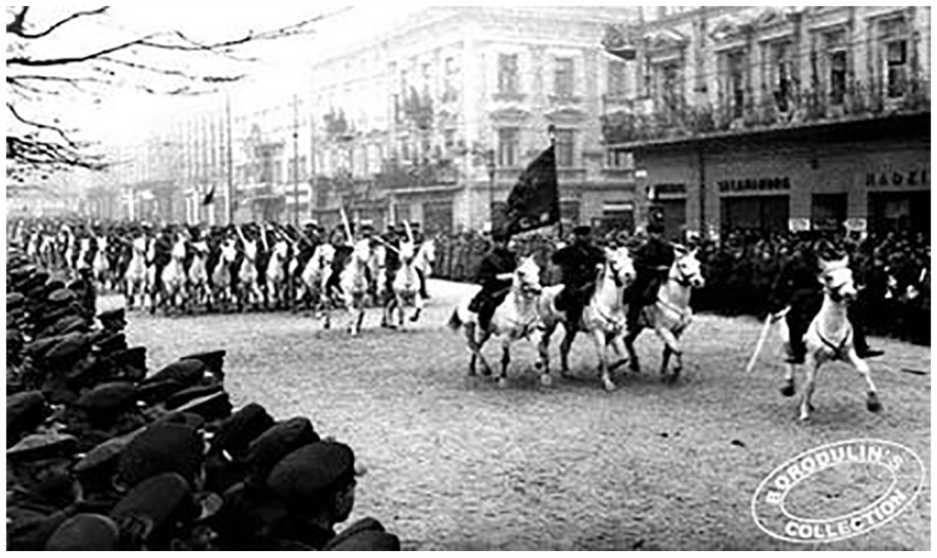
Red Army cavalry entering Lwów, 1939 (Borodulin, 2008).
Greve (1940e) wrote a further story on ‘How Russians exploit their colony’. He describes the industrial wealth of the area, much of which was in the hands of foreign companies, and how Working Mens’ Councils took over. Production, however, was hampered by the ‘utter incapability of the Soviet authorities to organise properly even those raw material derived from local sources. Tanneries that had for years been exporting on a large scale could not get hides, so leather disappeared from the market altogether’. Soap became ‘only a memory’, replaced by an ‘evil-smelling, blackish-brown mass, which felt gritty and would not lather even in hot water’. Things were not aided by delegates from Kiev and other Soviet towns arriving and carrying away in their lorries whatever tools they could lay their hands on.
Again, however, Greve’s line advocating Soviet incompetence and slackness is not necessarily the one transmitted by insiders with first-hand experience of working within the system, like Gerstenfeld-Maltiel. Although complaining of the severity of punishments, Gerstenfeld-Maltiel (1993: 44-45) reports how working hours were extended from one day to the next, how latecomers to work were punished (the ‘progul’ law of 1940 drafted by Malenkov), how workers were compulsorily transferred, and another law prohibiting arbitrary leaving of work and other laws sustaining the quality of production.
In ‘A Blast of Red Propaganda’ (Evening Standard, 7 March, Greve, 1940a: 13), Greve described the huge loudspeakers rigged up on every street corner, busy day and night, mostly talk and speeches, although the sound quality was of such bad reproduction, that only the occasional word could be understood. 40 Everywhere, immense pictures of Stalin were hung up (Herling describes an artist friend in Białystok, where he lodged for a few days, working on one such), sometimes occupying two storeys of a building. Lenin came ‘a rather poor second’ and Marx and Engels only very occasionally. 41 Stalin was given names: the Great, the Wise, Omnipotent, the Initiator of the Liberation of western Ukraine. 42 A new monument was erected in the main square of Lvov. On a stepped pyramid, 5 figures stood around a central column crowned with 20 red flags. Figures represented a mother and her child, an artisan, a scientist, a peasant and soldier to symbolise the main supports of the Communist system. Stalin’s ‘Constitution’ was printed on stelae in gold lettering. At night, a hidden light among the flags waving in the wind created a fountain effect.
Meanwhile, all local papers were suppressed, even left-oriented ones. The Czerwony Sztandar (Red Standard), sponsored by the Soviet authorities, instead came out in Polish as from 5 October 1939. The well-known Jewish writer Pesach Stark, later Julian Stryjkowski, for a time wrote for this paper. Greve points out that another one came out in Ukrainian entitled, Ukraine liberated. 43 But the former, particularly, hardly amounted to printed news, just the ‘crude exaltation of Communist rule’ and speeches made by the ‘big men’ in Moscow 5–7 days preceding. In that sense, Czerwony Sztandar was a precursor of the ‘reptile press’ (prasa gadzinowa), the 50 or so newspapers brought out from 1941 to 1944 under the strict supervision of the Press Affairs Office of the Reich’s General Government (Hryciuk, 1992). Pravda and Izvestia contained more information. Greve was amused that they quoted the British Daily Worker communicating that protest meetings were being held in all parts of Britain (Bernacki, 2007; Czop, 2004; Greve, 1940a).
Paragraph 126 of the Constitution clearly stipulated that ‘no citizen may be arrested without an order of the judge or without the decision of a Court of Law’. But every day, usually at night, people were being arrested, as Greve (1940a) adds ‘almost certainly without any orders of a judge or court’. The prisons like the Brygydki were quickly overflowing and became as notorious as the Lubianka in Moscow. 44 Prisoners were not allowed any defence, nor could they receive visitors other than a fresh set of clean linen once a fortnight. Families of the interned were reassured by the slips of paper organising this laundry business that their loved ones were still alive.
Elections were held for the National Assembly on 22 October 1939, although there is considerable confusion in our accounts as to the exact date and purpose. Urbaniak (1991: 124), probably mistakenly, prefers 29 October. Russell mentions the elections slated for March 1940, which chose the delegates to the Soviet of the Union, and the Soviet of Nationalities, as well as to the Republican Supreme Soviet (Gross, 2002 [1988): 108-9). Maltiel thinks they took place in the winter, and were decided by a huge impromptu throng of workers who met to take a break from ‘everyday monotony’ rather than, as the Soviet news agency immediately reported, demonstrate their intention of annexing ‘those parts of the Ukrainian nation torn from their roots’. Gerstenfeld-Maltiel (1993: §7) reports that a resolution was sent the very next day to the Supreme Soviet of the USSR, and was a fait accompli; 13 million citizens were declared to be Soviet citizens from one moment to the next.
Greve (1940k) reports that the question on the ballot paper was whether Lvov and its direct hinterland should remain independent or become part of the USSR (one of the four principal items on the agenda for the October 1939 elections). Papers announced the names of different candidates, although on the day of voting, only one name was to be found on the ballot paper. 45 Greve’s friend had not heard of the candidate, and wanting to complain, but thought twice about doing so when he saw the procedure necessitated entering a menacingly closed, guarded room (Greve, 1940a).
Gerstenfeld-Maltiel (1993: §14) is much fuller than say Urban (2006 [1980]: 5) on the preparations for the elections for the National Assembly. They were well-announced some 4 or 5 weeks prior, in newspapers, at the workplace and in universities. Meetings were organised in almost every tenement to ‘prepare housewives for the noble duty of voting’ and where the Constitution was read out and discussed, as we have heard. In addition, regional meetings were organised in parts of the city for a greater number of participants. Agitators visited every flat in the vicinity, pressing inhabitants to ‘honour’ the meeting with their presence ‘making more or less subtle threats to people reluctant to go’. Approaching the day of elections, shops were filled with food and beverages, buffets were prepared in the polling stations. Apparently, ‘electoral sausage’ (kiełbasa wyborcza) became a term of reference. Ballot boxes were brought to hospitals and the bed-ridden, soldiers were decommissioned for the day. In all fact, enormous efforts were laid on to justify the proclamation that 99.25 percent of the population (Gross, 2002 [1988] reports 92.83%) had participated.
Otherwise, British diplomatic and newspaper reports can of course only go so far in both describing and explaining the realities of the 21 months of Soviet occupation of the city of Lwów. Survivors’ testimony, often written at great emotional cost, as more experiential and gestated over a longer time period, must be considered more valuable although relying rather more on impressions than concrete dates. One must turn to historical works, for example, to understand that the referendum on self-annexation to the Ukrainian SSR took place on 22–23 October 1939, and that (contrary to Maltiel’s recollections) the territory was officially declared a part of USSR only on 27 October. 46
Greve ended his series of articles at Śniatyn on the Rumanian railway border crossing, with somewhat clichéd exaltation: ‘I learned that freedom is priceless’. The 4 hours of recorded Holocaust testimony by Wilek Loew similarly end with the first breath of freedom: ‘On 23 April we were liberated [from Dachau] by the First Army, I think. At that point in time I was liberated, I was a free man’. And Krystyna Mihulka, about to board a ship taking her family away from the Soviet Union to an uncertain future in Africa, wrote: ‘Would we be able to pass on to the ship? What if we were not allowed to leave? The next few steps towards freedom felt like the longest steps of my life’ (Mihulka and Goddu, 2017: ch. 16). For those who remained in Lwów, now Lvov, freedom was arguably not returned and then only partly with repatriation to Poland in 1945–1946, until the successful bid of the Ukraine SSR for independence in August 1991.