



Abstract
This article argues that the study of literary Europeanism should be extended to the discourse of wider textual Europeanism, understood here as a digital Europeanism that examines digital texts, in the widest sense, contextualised within the norms of digital culture. The texts emanating on the platform Twitter from two explicitly pro-European/pro-European Union accounts, one German-language and one largely (non-native) anglophone – @PulseofEurope and @mycountryeurope – were examined from 9 May 2021 to 9 November 2021. In evidence was a type of textual Europeanism that indeed owes a degree of coherence to the norms of digital culture. This was seen in relation to referentiality, that is, the use of already existing and circulating cultural materials for one’s own cultural production. This was evident in commented and uncommented retweets, social TV practices and the Europeanisation of Internet memes. The creation of a sense of communality – the way in which meanings can be stabilised, options for action generated and resources made accessible via a collectively supported frame of reference – is also in evidence and to be seen in the distinct discursive creation of an authoritarian ‘other’. This ‘other’ consists of a temporal ‘other’ – a small number of tweets relating to authoritarianisms of the past; an inner-European Union ‘other’ – tweets relating to movements towards authoritarianism within the European Union, especially in Hungary and Poland; and an external European Union other – tweets relating to authoritarianism on the European Union’s borders, especially in Belarus and Russia.
Introduction
The term ‘Digital Europe’ has taken on the character of a buzz word within the past few years as the European Commission has sought to extend and enhance digitalisation within the European Union (EU). Indeed, extensive and important work has been carried out here as the ‘Digital Europe’ programme has sought to finance projects in relation to areas such as Artificial Intelligence and cybersecurity. ‘Europe’, in the guise of the EU, has looked to involve itself directly in the digital world, but the digital sphere and ubiquitous texts produced here have also influenced Europe and perceptions of Europe. Indeed, the digital has also transformed our relationship to texts in general, as text may now be produced on various platforms and apps by a variety of diverse people and circulated online at great speed. The digital has, thus, transformed the communicative context, and this has also influenced communications and discourse relating to Europe; as a material reality, as an evolving institution in the EU and as a set of ideas, intertwined with democracy.
This article argues that the study of literary Europeanism should be extended to the discourse of wider textual Europeanism, understood here specifically as a digital Europeanism which examines digital texts, in the widest sense, contextualised within the norms of digital culture (Stalder, 2019). The texts emanating on the platform Twitter from two explicitly pro-European/pro-EU accounts, one German-language and one largely non-native anglophone – @PulseofEurope and @mycountryeurope – were examined from 9 May 2021 to 9 November 2021; preceding the brutal Russian invasion of Ukraine, which has dominated the content of both accounts since the war began in February 2022. Indeed, both accounts now appear quite prescient in assessing and clearly communicating a threat to democracy from Russia and Belarus, especially the @mycountryeurope account. In evidence in these Twitter feeds was a type of textual Europeanism that owes a degree of coherence to the norms of digital culture. This was seen in relation to referentiality, that is, the use of already existing and circulating cultural materials for one’s own cultural production. This was evident in commented and uncommented retweets, social TV practices and the Europeanisation of Internet memes. The creation of a sense of communality – the way in which meanings can be stabilised, options for action generated and resources made accessible via a collectively supported frame of reference – is also in evidence and to be seen in the distinct discursive creation of an authoritarian ‘other’. This ‘other’ consists of a temporal ‘other’ – a small number of tweets relating to authoritarianisms of the past; an inner-EU ‘other’ – tweets relating to movements towards authoritarianism within the EU, especially in Hungary and Poland; and an external EU other – tweets relating to authoritarianism on the EU’s borders, especially in Belarus and Russia. Interestingly perhaps, Brexit does not feature as an important topic in the feed of either account – with one directly related Brexit tweet from each account, during this 6-month period – suggesting a lack of interest, by 2021, in the United Kingdom’s self-obsessed disengagement from the EU.
Theoretical and methodological approach
Europeanism
Ostrowski (2021: 2) critiques the study of Europeanism as being marked by ‘an excessive ahistoricism and a narrow reductionism’; not least when conceptualised solely in what are actually social democratic terms (see, for example, McCormick, 2010). Defining Europeanism very openly ‘as a commitment to the political, economic, and cultural consolidation of the European continent’ (Ostrowski, 2021: 1), he sees Europeanisms as having had ‘many competing tendencies to “naturalise” the borders of “Europe” in completely different ways’, seeing both restrictive and expansive Europeanisms as having retained ideational currency during differing historical periods (Ostrowski, 2021: 5). The author sees, however, the ‘core six’ original members of the EU in the context of the Cold War as having constituted a distinct type of Europeanism marked by: (1) Christian and social democratic forms of post–World War II ‘right-left economic bargaining’; (2) ‘electoral-parliamentary democratic politics’; and (3) a ‘shared post-Enlightenment (Christian) confessional-secularist cohabitation’ (Ostrowski, 2021: 6). Thus the ‘European core’, institutionalised in this manner by the original six members of the EU, became ‘not just a geographical label but also a political, economic and cultural signifier’ (Ostrowski, 2021: 6).
This was still, however, it must be emphasised, a Europeanism oriented institutionally towards ‘methodological nationalism and statism’ (Ostrowski, 2021: 7), even if, in Delanty’s (2008: 223) terms, the EU has undoubtedly also been a project of ‘normative transnationalism’ establishing the ‘preconditions for European cosmopolitanism’. Indeed, for Delanty and Rumford (2005: 22f) Europeanism is to be seen in relation to cosmopolitanism as a political idea, rather than a European ‘people’, a European society, a European supra-state or indeed a European sense of heritage. According to the same authors, European identity is constituted as a form of (post-)national self-conception, expressed within a framework of national identity but also goes beyond that (Delanty and Rumford, 2005: 23). Ostrowski (2021: 9) underscores in addition the importance of the ‘other’ in the construction of all Europeanisms, which he sees as linked to an idea of European ‘cultural distinctness’, which does not of course always take a benign form: one aspect that has remained ideologically unwavering is the clear sense of European cultural ‘distinctness’ – which some Europeanisms raise to the level of blatant claims of superiority – compared impressionistically to the ‘backwardness’ (Russia, Africa), ‘incompatibility’ (Turkey, Asia), or ‘vulgarity’ (Anglo-America) of Europe’s constitutive others.
The critique of a chauvinistic euro-centrism within Europeanism is also analogous with Appadurai’s criticism of an imperialistic euro-centric orientation within ideas of cosmopolitanism.
Parts of Europe’s special mix of confidence, ethnocentrism and world-adventure comes surely out of the modern debt to the missionizing logic of Western Christendom [. . .] and to the Roman vision of the world, which centres on law, technology and military force as key elements of the relevant past. [. . .] For cosmopolitanism is ultimately a matter of ideas and what Europe exported in its imperial projects was the playing out on a global terrain of its own demons, divisions and unresolved anxieties (Appadurai, 2012: 29f).
The Europeanism at the centre of this article is essentially a discursive ‘core-Europeanism’ oriented towards ideas of democracy and freedom of expression. This is a Europeanism generally seen as geographically expansive. The creation of ‘cultural distinction’ does take place via othering and is, at times, ‘external’ to the EU (as an institution), at other times ‘internal’; the dominating ‘other’ may always be seen, however, in terms of an anti-democratic authoritarianism which is constantly viewed, often implicitly, as outside of this ‘core-Europeanism’. It is, indeed, a form of what Ostrowski (2021: 9) describes as the ‘backwardness’ discourse. Europeanism appears here as a form of normative-philosophical cosmopolitanism, as an ‘expansive form of solidarity’ ‘attuned to democratic principles and human interests’ but ‘without the restriction of territorial borders’ (Cheah, 2006: 19). But the cosmopolitan Europeanism at the centre of this article is not just a philosophical idea but remains, in the Twitter discourse, also ‘a practice, a cultural form’ ‘a “way of being in the world”’ (Sluga and Horne, 2010: 370); a series of ‘behaviours, [and] social habits’ (Jacob, 2006: 4) and a ‘narrative act’ (Robertson, 2012: 183), distinctly entangled with the idea of a normative democratic transnationalism.
Digital culture
The Europeanism analysed here is also a type of digital Europeanism; the discursive ‘commitment to the economic, political and cultural consolidation of the European continent’ (Ostrowski, 2021: 1) but expressed in a specifically digital context, and within the norms of digital culture. Stalder (2019: 10) understands the ‘Kultur der Digitalität’ (culture of digitality), as denoted essentially by the ‘enorme Vervielfältigung der kulturellen Möglichkeiten’ (enormous multiplication of cultural possibilities), marked by very specific forms of culture, exchange and expression. Three of these central forms he calls: Referentialität (referentiality), Gemeinschaftlichkeit (communality) and Algorithmizität (algorithmicity) (Stalder, 2019: 13). Referentiality refers to the usage of cultural materials that are already existing and in circulation for one’s own cultural production; with communality the author refers to the way in which meanings can be stabilised, options for action generated and resources made accessible via a collectively supported frame of reference; while algorithmicity refers to the automated decision-making process via which enormous amounts of potential data are streamlined and made accessible in accordance with the online users’ behaviour (Stalder, 2019: 13).
Twitter and the hermeneutic reading of tweets
Founded in the United States in 2006, the online platform Twitter had acquired 313 million monthly active users by 2016, including large and active populations of users outside of the English-speaking world, such as in Japan, India, Indonesia and Brazil (Burgess and Baym, 2020: 3). Indeed, as a social platform it has garnered a rather elite reputation. Burgess and Baym (2020: 4) suggest that ‘many journalists, academics, and politicians are virtually dependent on it as a social listening, professional dialogue, and public relations tool’. Despite the existence of several well-known far-right tweeters, American-centred research suggests the platform attracts, in the United States at least, a disproportionate amount of liberal, young and well-educated individuals who generally vote for the Democratic Party (Wojcik and Hughes, 2019). Twitter is a medium that reflects societal discourse in live-mode and has gained attention from researchers focussing on the relationship between the Internet and society (Cardoso et al., 2013: 219). Since the platform is relatively new, research on Twitter is also a relatively new phenomenon, with various orientations, such as, for example, research on the platform’s relationship to media agenda-setting (e.g. Vastermann, 2018 and Abdi-Herrle, 2018), Twitter’s influence on electoral politics (e.g. Galdieri et al., 2018 and Kamps, 2020), its interconnections with street protests (e.g. Gerbaudo, 2012 and Dang-Anh, 2019) and Twitter as a performance space for the creation of an online persona (e.g. De Kosnik and Feldman, 2019 and Burrough, 2016).
Quantitative and mathematics-based data analytical methods have become the dominant methodologies used in relation to analysis of online text production, with methodologies often ‘harvesting’ a very large amount of data. Bright (2018), for example, uses data analytical methods to track interactions between party political Twitter accounts, drawing on a repository of 1.4 million tweets. Such quantitative methods can tell us many important and useful things, but also generally exclude closer analysis of language, content, narrative and the wider creation of meaning. For this reason, hermeneutic approaches to digital technologies and the data they produce have been adapted, developed and discussed (see Capurro, 2010; Dang-Anh, 2019 and Romele, 2020). The sheer vastness, and indeed fluidity, of digital text online may also be seen as a methodological problem, and the often unsystematic nature of the dispersal of online ‘Diskursfragmente’ (discourse fragments) forces the researcher to develop their own systematisation and strategies (Sommer, 2020: 426). In reaction to the dominant ‘quantitative bias’ of digital research, Gerbaudo (2016: 96) has developed the idea of ‘data hermeneutics’ in order to answer the qualitative questions of ‘cultural meaning and social motivations’. Rather than focussing on the mathematical form of social media conversations, data hermeneutics centres on the ‘symbolic analysis of the meaning structures of online conversations, in light of connected social discourses and motivations’ (Gerbaudo, 2016: 99). The methods enacted are oriented towards a literary studies perspective, with the ‘aim of interpreting, reconstructing and explaining the overarching narratives that underpin social media conversations’ through the use of ‘close reading’, the ‘deep analytical engagement with a text’ that examines ‘language, tone, imagery, and rhetorical figures’ (Gerbaudo, 2016: 99). Thus, data hermeneutics finds ‘ways to read data as text, that is as a partly coherent and discrete web of meaning’ (Gerbaudo, 2016: 102). Data hermeneutics also provides clear and logical suggestions in relation to data sampling (top sampling, random sampling and zoom-in sampling), the processes of coding and categorisation, and the creation of different types of data-sets according to specific research requirements (Gerbaudo, 2016: 102–107).
Increasingly researchers have also seen tweets – short texts published on the Twitter platform, often in relation to images, films or other short textual expressions – as a distinct form of text requiring a hermeneutic approach. Indeed, a blog post in 2014 on the Guardian website already suggested that Twitter has given birth to a new literature genre: twitterature (Armitstead, 2014). Hui (2019: 1) has argued that tweets may be placed within the continuous literary-historical context of the aphorism, ‘the shortest of genres’; ‘a basic unit of intelligible thought, this microform has persisted across world cultures and histories, from Confucius to Twitter’. Hui (2019: 5) defines the aphorism as ‘a short saying that requires interpretation’. He sees tweets as the ‘digital descendent of the analog aphorism’ and Twitter as ‘the largest archive of the present the world has ever seen’ (Hui, 2019: 177, 178). Indeed, there is little to no consensus regarding what, exactly, an aphorism, as a literary genre, may be defined as (Spicker, 1997: 2, 2004: 6–8). Morson (2003: 411) believes that aphorisms retain a degree of mystery and should not consist of ‘solving puzzles’ but in ‘deepening questions’; Maddocks (2001: 175) emphasises the importance of the ‘balancing act between irony and moral condemnation’ in an aphorism, while Crosbie and Guhin (2019: 383), from a sociological perspective, suggest that aphorisms are ‘often used to “stand in” for more complex arguments’. Indeed, tweets can potentially do all of these things, depending on the individual tweet itself. In his study of the aphorisms of Franz Kafka, Gray (1987: 37) suggests that the specific type of aphorism he examines takes root ‘not as an expressive form placed in the service of traditional values; nor does it undertake the dogmatic presentation of new values; rather it strives to imbue static, rigid values and truths with fluidity and flexibility’. While the tweets examined here are at times textually complex, often utilising the words and images of other accounts, it is in the Gray (1987: 37) sense of the aphorism where many of the tweets may be situated; earnest, argumentative but undogmatic short texts that look for more fluidity and flexibility in relation to values and truths, specifically in their creation of an ‘us’ and a ‘them’.
Empirical study and argumentation
Digital Europeanism
Engagement with the literary discourse on Europe has been one distinct strand in the study of Europeanism. For example, Lützeler (1998, 2007, 2019) has written on the Europe of writers and the ‘literary discourse on Europe’ (Lützeler, 2019: 240), while Passerini (1999, 2009), drawing on a wide variety of texts, has examined interconnections between the discourses of love and Europe. The engagement with Europe-oriented essays has undoubtedly dominated the literary studies engagement with the topic, especially but not only in the German-language context (Király, 2019: 3–4; and Biendarra and Eigler, 2020). The possibilities of text creation and publication have of course been extended vastly with digitalisation; it is now possible to write and send text for others to read in an instant, while readerships may also be vast and directly interactive. As we have already seen, the argument has been proffered that tweets may be viewed as texts to be examined within a wider literary history of aphorisms (Hui, 2019). It is here argued that the study of literary Europeanism should be extended to the discourse of wider textual Europeanism, understood here as a digital Europeanism which examines texts in relation to the norms of digital culture.
The tweets from two explicitly pro-European/pro-EU Twitter accounts, one German-language and one anglophone account – @PulseofEurope and @mycountryeurope – were examined for this article from 9 May 2021 to 9 November 2021. The dates symbolically frame a European context: 9 May is official Europe Day, whereas 9 November marks an important date for the German, and thus also the European, collective memory, this being the date of Reichspogramnacht in 1938 and also the day upon which the Berlin Wall was opened in 1989. While @PulseofEurope may be seen perhaps as somewhat ‘typical’ and, to a certain extent, ‘representative’ of German-language pro-European discourse, while also retaining a substantial reach and a degree of influence, the @mycountryeurope account is pointedly transnational and cannot be easily tied to a specific ‘national’ culture. According to the ‘Frequently Asked Questions’ section of the MyCountryEurope website, the project ‘was founded in March 2014 by five young European students in the wake of the Crimean crisis’ and ‘the current staff is entirely comprised of volunteers and counts people from over fifteen different European countries’ (@mycountryeurope). Thus, it may be seen as an idealistic project conducted through English, engaged in by members of the ‘Erasmus generation’ who have lived and often studied in other European countries but the account retains a clear eye towards what is happening in eastern Europe and, thus, represents a geographical contrast with @PulseofEurope, while also having a wide reach and a substantial potential influence. Both organisations may be seen as idealistic and voluntarily run media projects, even if Pulse of Europe also maintains a ‘street presence’. Both @PulseofEurope and @mycountryeurope also run Instagram and Facebook accounts that, largely, post the same content as posted on Twitter. It was decided to concentrate on Twitter, the most public and open platform. It must also be noted that multiplatform posting also suggests greater reach and a more substantial prospective influence of the discourse examined.
The posts were read together so as to pay attention to ‘the links between the message and the broader discourses that act as a background and source of meaning for a given message’ (Gerbaudo, 2016: 106). In evidence was a type of textual (in the widest sense) Europeanism that owed a degree of coherence to the norms of digital culture, as outlined by Stalder (2019: 13). Referentiality – the use of already existing and circulating cultural materials for one’s own cultural production – was evident in a number of ways: (1) The large number of commented retweeting of other accounts’ tweets (the tweeting of someone else’s tweets, presaged by one’s own short text), and also retweeting without comments – both practices also often with links to digital articles referring to European topics. (2) Added to this was the engagement in what Bruns (2020: 92) calls ‘“social tv” practises’ and what Burgess and Baym (2020: 72) call ‘“second screen” television watching’; the creation of a specific Twitter discourse, sometimes structured around an organising hashtag, which reacts to a specific televised event. These events were generally ‘lighter’ and (popular) cultural trans-European events, such as Eurovision, the European Football Championships Final and, to a lesser extent, the Summer Olympics, and were couched in European terms. The @PulseofEurope account also engaged in this in the time surrounding the debates between Chancellor candidates preceding the federal election in an attempt to consciously ‘Europeanise’ discourse. (3) There were also occasional attempts to ‘Europeanise’ memes circulating within online discourse. Shifman (2016: 201) defines the Internet meme as a ‘group of digital items sharing common characteristics of content, form or stance, which were created with awareness of each other, and were circulated, imitated and transformed via the Internet by many users’. Thus, memes may contain various elements and, while initially circulated for humorous intent, do not necessarily contain humour.
The sense of communality (Gemeinschaftlichkeit) – the way in which meanings can be stabilised, options for action generated and resources made accessible via a collectively supported frame of reference (Stalder, 2019: 13) – is seen in the creation of a distinct authoritarian ‘other’. This other creates a collective and, often implicit, sense of what Europe is, who it includes and what it excludes. The creation of this ‘other’ also suggests a ‘fluidity and flexibility’ in relation to ‘rigid values and truths’ (Gray, 1987: 37); one of the marks of the aphorism as literary from. This ‘other’ consists of a temporal ‘other’ – a small number of tweets relating to authoritarianisms of the past; an inner-EU ‘other’ – tweets relating to movements towards authoritarianism within the EU, especially in Hungary and Poland; and an external EU other – tweets relating to authoritarianism on the EU’s borders, especially in Belarus and Russia. The tweets highlight authoritarianisms and emphasise the importance of democratic freedoms and rights.
These digital textual communications are situated within the third pillar of digital culture, namely the wider context of Twitter’s algorithmicity – the automated decision-making process via which data are streamlined and made accessible in accordance with the online users’ behaviour (Stalder, 2019: 13). While the detailed wider analysis of algorithmicity is beyond the scope of this article, it is nevertheless necessary to keep the algorithmic process in mind in relation to the ‘discursive work the term performs’ (Gillespie, 2016: 18). Indeed, for the makers of algorithms, the term refers very pragmatically and specifically to the ‘logical series of steps for organising and acting on a body of data to quickly achieve a desired outcome’ (Gillespie, 2016: 19). As Stark and Stegmann (2020: 9f) note, however, ‘algorithmic systems of intermediaries’ retain a ‘decisive influence on which information reaches users by means of three general functions’: (1) In a process known as ‘filtering’, algorithms select content that is relevant for the user, excluding other content as non-relevant. Relevant here means, it should be noted, in relation to the specific user’s dominant interests, not relevant to society as a whole. (2) By ‘sorting’, algorithmic systems rank the selected content in such a way that the most relevant content for users appears at the top, in the case of Twitter at the top of the Twitter feed. (3) Via ‘personalisation’ algorithmic systems customise content to the interests and preferences of each user. Thus, while individual information bubbles that constitute an individual’s Twitter feed cannot of course be fully reconstructed, in our context we may assume that the majority who subscribe to the selected Twitter accounts receive a specific and individualised digital Europeanist informational world created specifically for each user, incorporating other pro-EU and pro-democracy content and largely excludes anti-EU/Eurosceptic content.
While the digital content analysed suggests that the tweeters would like their democratic version of ‘core’ Europeanism to inhabit much more of the materiality of the European continent then it actually does, the tweets often do not actually successfully dislodge themselves from everyday forms of nationalism. The Twitter feeds analysed may thus also be seen as marked by a form of ‘banal nationalism’ (Billig, 1995: 114); a taken-for-granted and ‘mindlessly remembered’ form of everyday linguistic national usage, which retains reality-creating properties by implicitly promoting the division of the world into ‘national’ units. This banal nationalism is most clearly seen in the daily ‘Good Night Europe’ tweets from the @mycountryeurope Twitter account; every evening a different image from a different nation-state – sometimes from within the EU, sometimes outside the EU, including both Turkey and Russia (Figures 1 and 2) – is posted and contextualised in terms of the nation-state, as well as the European continent, cementing the idea, thus, of a Europe of nation-states and of the ‘normality’ of a conceptual, everyday nationalism as a structuring form for the perception of reality.
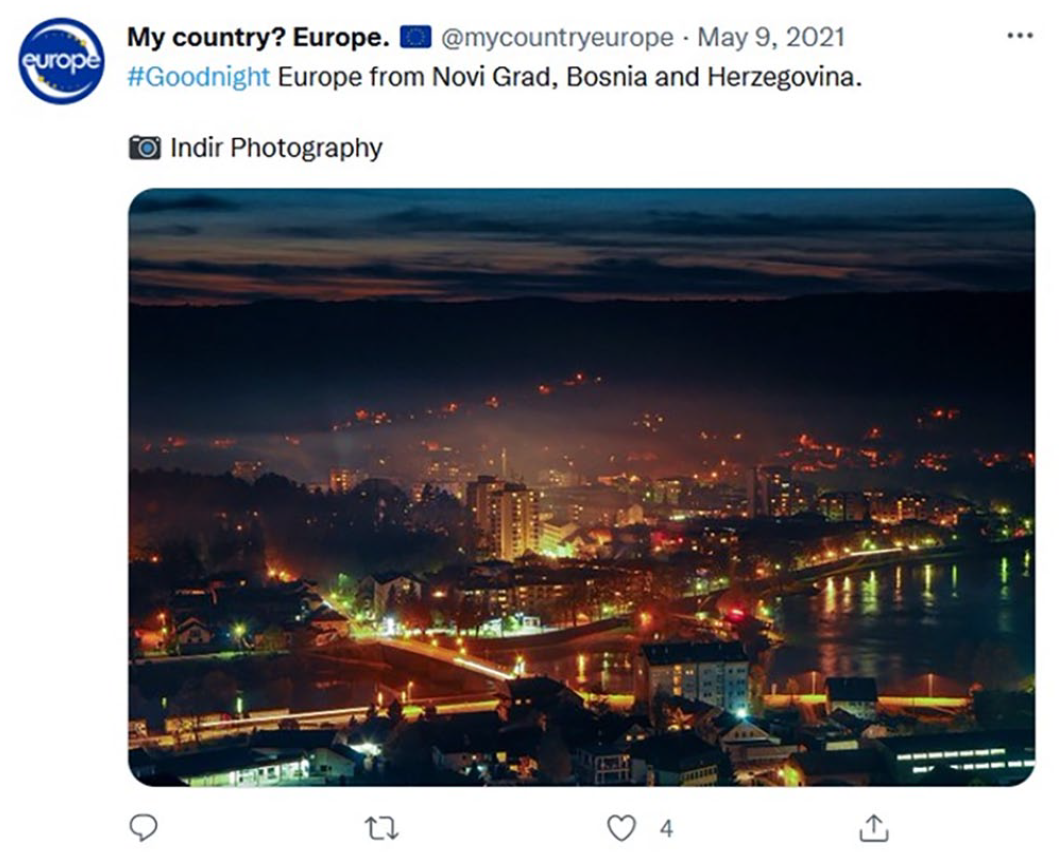
Screenshot from @mycountryeurope 9 May 2021.
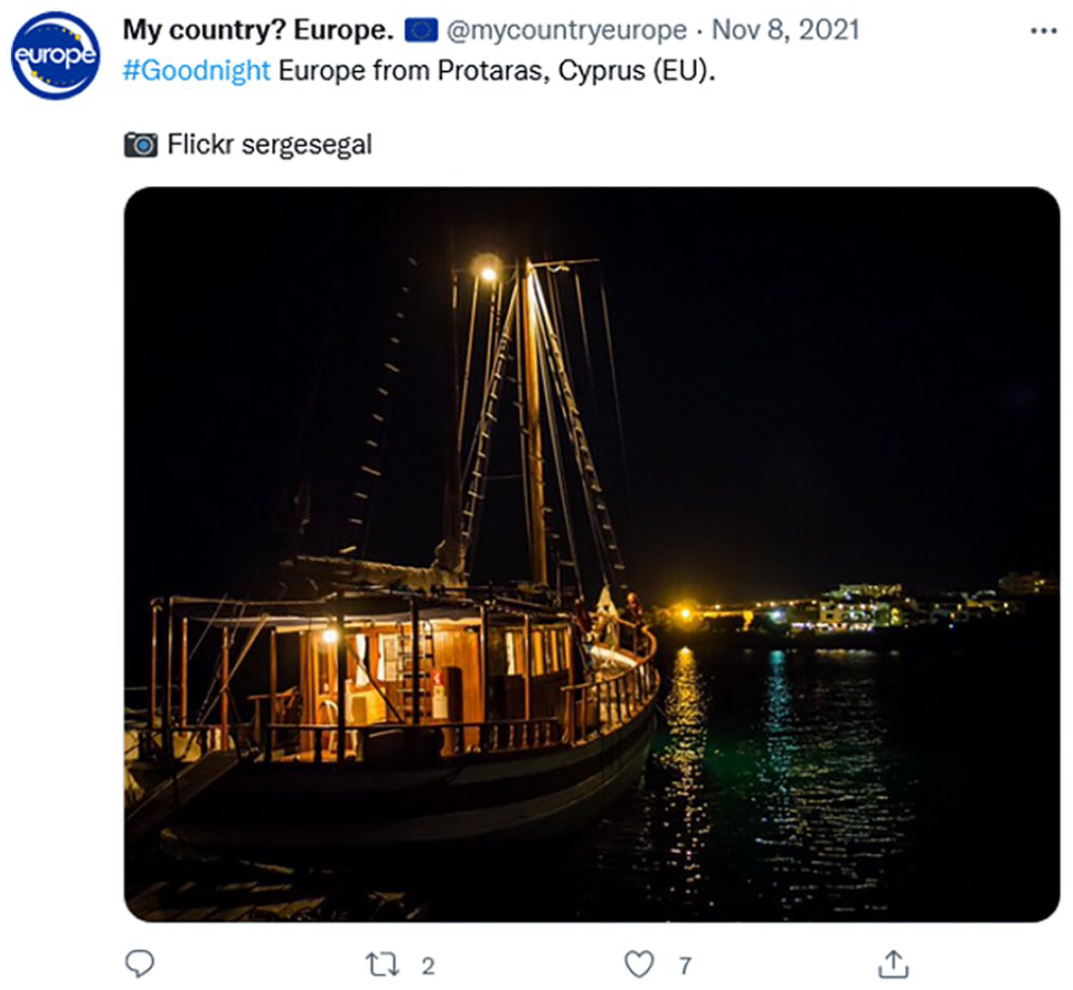
Screenshot from @mycountryeurope 8 November 2021.
Referentiality
@PulseofEurope
The @PulseofEurope Twitter account has, as of May 2022, circa 25,300 followers, and is thus the largest Twitter account examined here. Therefore, with retweets and the ‘favouriting’ of tweets, a single tweet could easily achieve views of more than 100,000 and, with luck and a degree of virality, a single tweet could potentially be viewed by millions of people. Pulse of Europe also runs Instagram, Facebook and YouTube accounts, with its Facebook community being its largest account with more than 120,000 followers. Pulse of Europe is, of course, not just a social media project but is essentially an independent citizens’ lobby group, formed in Frankfurt am Main in 2016 and reacting to Brexit and the Trump presidency. The group initially organised demonstrations to protest in favour of the EU, of a European consciousness and of democracy in general. Criticised for being vague in its goals and intentions (https://www.dw.com/de/pulse-of-europe-was-bringen-die-demos/a-38388415), by March 2017 Pulse of Europe had branches in 60 cities throughout the continent and was regularly bringing 30,000 people onto the streets on a Sunday afternoon, often clad in the blue and yellow of the EU, to demonstrate in favour of the EU (Kern, 2017). While 2017 was definitely the highpoint in terms of numbers on the street, Pulse of Europe continues to have a strong online presence and still organises occasional Europe-oriented demonstrations.
Pulse of Europe’s sense of self-understanding is important here and is definitely mirrored in its Twitter content. According to its website (pulseofeurope.eu), its members ‘wollen einen Beitrag dazu leisten, dass es auch in der Zukunft ein vereintes, demokratisches Europa gibt – ein Europa, in dem die Achtung der Menschenwürde, die Rechtsstaatlichkeit, freiheitliches Denken und Handeln, Toleranz und Respekt selbstverständliche Grundlagen des Gemeinwesens sind’ (want to contribute to ensuring that there will continue to be a united, democratic Europe in the future – a Europe in which respect for human dignity, the rule of law, free thought and action, tolerance and respect are self-evident foundations of the community). Pulse of Europe (pulseofeurope.eu) emphasises that it is an independent citizens’ movement, which is non-partisan and not connected to interest groups, religious movements, or political parties. On the section of the website (pulseofeurope.eu) dedicated to its aims, it is written: Wir sind überzeugt, dass die Mehrzahl der Menschen an die europäische Idee glaubt und sie nicht nationalistischen und protektionistischen Tendenzen opfern möchte. Wir stellen uns den destruktiven und zerstörerischen Stimmen entgegen, weil wir an die Reformierbarkeit und Weiterentwicklung der Europäischen Union glauben. (We are convinced that the majority of people believe in the European idea and do not want to sacrifice it to nationalist and protectionist tendencies. We oppose destructive voices because we believe that the EU can be reformed and further developed.)
Thus, while looking to defend the rule of law and liberal democracy and remaining open to reforming and changing (unspecified) aspects of the EU, Pulse of Europe situates itself against both nationalism and (presumably economic) protectionism. Radical ideas concerning the restructuring of society and/or a critique of existing inequalities are nowhere here to be found, and the movement remains conservative in that it wishes to conserve and maintain cosmopolitan European democracy. Pulse of Europe finances itself solely via donations, according to its website.
During the studied period, the @PulseofEurope account tweeted 479 times. Of these tweets, 404 may be categorised as retweets or commented retweets. The 75 remaining tweets either tweeted an article or an image with a comment or tweeted a promotional image and/or a text for a Pulse of Europe event. Thus, references to other people’s words played a very important role in the Twitter account during this period, not least, as mentioned, in commented retweets. Social TV practices are also present, if at times less marked than other accounts. The account tweeted about the Eurovision Song Contest on 22 May, sharing an article from the Süddeutsche Zeitung and tweeting that ‘Heute Abend feiert ganz Europa #Eurovision. Eine Einstimmung!’ (Tonight all of Europe is celebrating #Eurovision. A warm up!) including also the hashtags #EuropaAllesWasUnsVerbindet and #EuropäischeÖffentlichkeit (#EuropeEverythingThatConnectsUs and #EuropeanPublic). The account tweeted about the European Football Championship final on 12 July – with the hashtag #Euro2020 and #ItsComingRome – as well as the Olympics on 24 July, tweeting about how the EU acquired, if counted collectively, the most medals at the last Olympic games in 2016. While these tweets may be seen as part of a wider discourse linked to what is happening on television, interaction from followers was negligible. In September, preceding the Federal election in Germany on 26 September, the account began a campaign to attempt to influence the content of the television debates between the Chancellor candidates from the Christian Democrat, Social Democratic and Green party, based around the hashtag #DenkEuropaMit (#ThinkOfEuropeToo). From 6 September until 28 September 22 tweets appeared from the @PulseofEurope account with this hashtag, while the hashtag was taken up by other accounts as well. On 11 until 13 September a long thread of 31 tweets was brought together by the Pulse of Europe account – tweets which had been tweeted by journalists and politicians – which all pointed out how the topic of Europe was largely absent from the television debate. This online campaign reached its pinnacle on 23 September when @PulseOfEurope retweeted a specially created Internet meme – created by the @HelloEuromat account – of an EU elephant (Figure 3); the elephant in the sitting room which everyone sees, but nobody comments on. Thus, the account is very much intertwined with the Internet culture of referentiality.
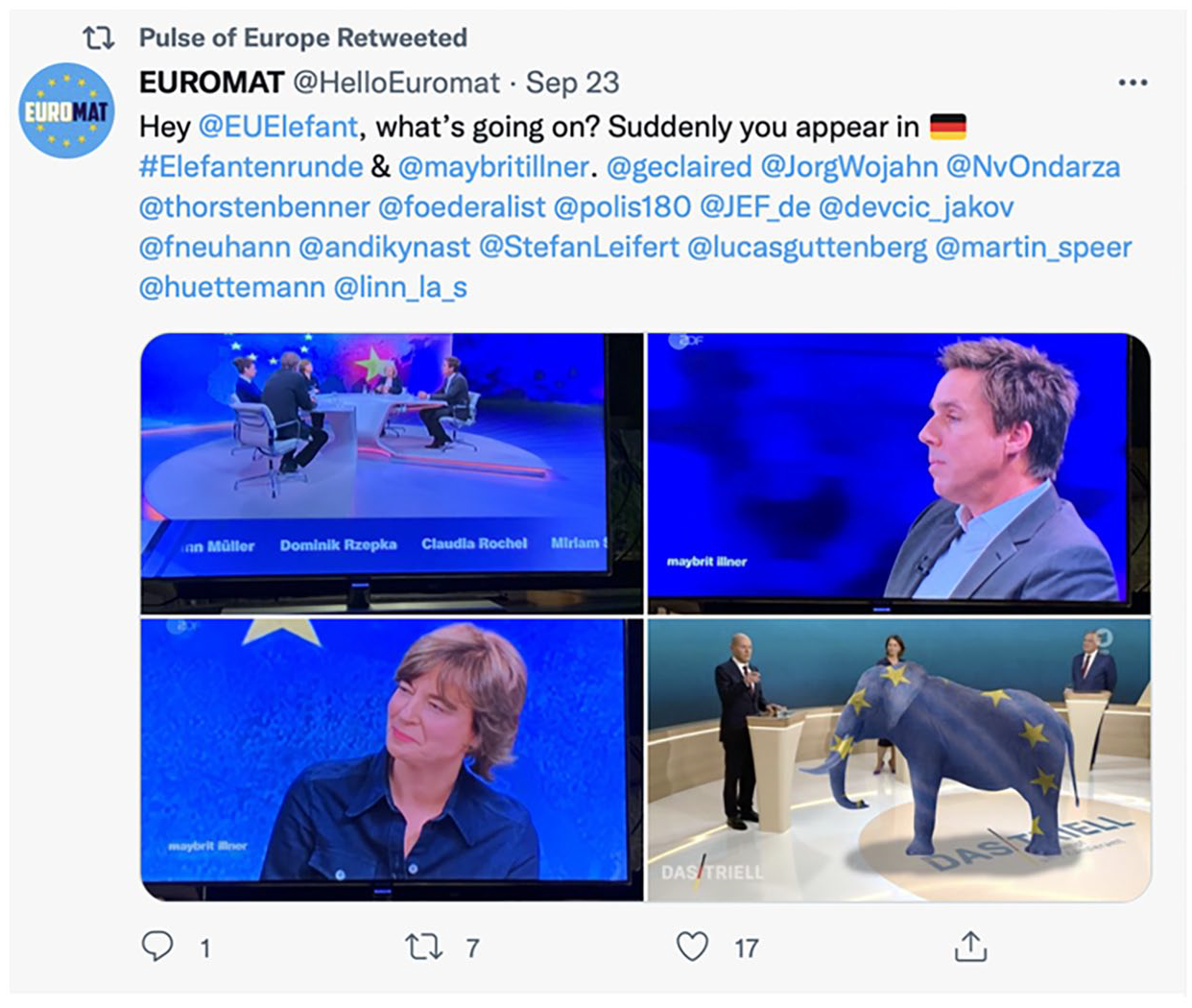
Screenshot of retweet of the @HelloEuroMat account 23 September 2021, with the EU elephant.
@mycountryeurope
During the examined time period, the @mycountryeurope account tweeted 630 times and is thus the most prolific of the accounts analysed. In May 2022 it had circa 4500 Twitter followers. It also runs Instagram and Facebook accounts, with generally the same content, having circa 14,000 Instagram followers and more than 140,000 Facebook followers. On their Twitter biography (https://twitter.com/mycountryeurope), they tell us: ‘We are a non-profit social media project. We provide information, analysis, memes, and entertainment on European matters every day. Our goal? Making Europeans’. On the project’s website (www.mycountryeurope.com) it is stated that they are ‘not supported or funded by any institution or third party’, while they ask for donations and advertise their ‘pro-European merchandise’ on their ‘e-store’. The website also asks for content, saying this can be shared via its website or its social media channels.
Of the tweets, 152 during this period may be seen as retweets or commented retweets. The account also retains the aforementioned ‘Good Night Europe’ series of tweets in which an image is tweeted, from across the continent, but framed in terms of the nation-state. Social TV practices/second screen TV watching play a substantial role on the account at certain times. Thus on 22 May the accounts tweeted 41 times in relation to the Eurovision Song Contest, using the hashtag #Eurovision, often utilising memes, generally looking to be humorous, reacting to each act as they played and looking for interactions. Thus, for example, the very first tweet uses a well-known Internet meme from the Lords of the Rings film – ‘So it begins’ – as well as #Eurovision and #Eurovision2021 and the account even hashtags itself ‘#mycountryeurope’ (Figures 4 to 7). A further tweet, using a love emoji, states: ‘Better than the #Olympics #eurovision [sic]’. Several tweets react jokingly (but not insultingly) to many of the songs using memes and gifs, while the account also tweeted a gif drawn from the comedy series Mr. Bean, with Bean looking anxiously at his watch in the time between the performances and the voting. One of the final tweets has an image of the points total given to Spain, the United Kingdom and Germany and asks: ‘Why is it always you three?’
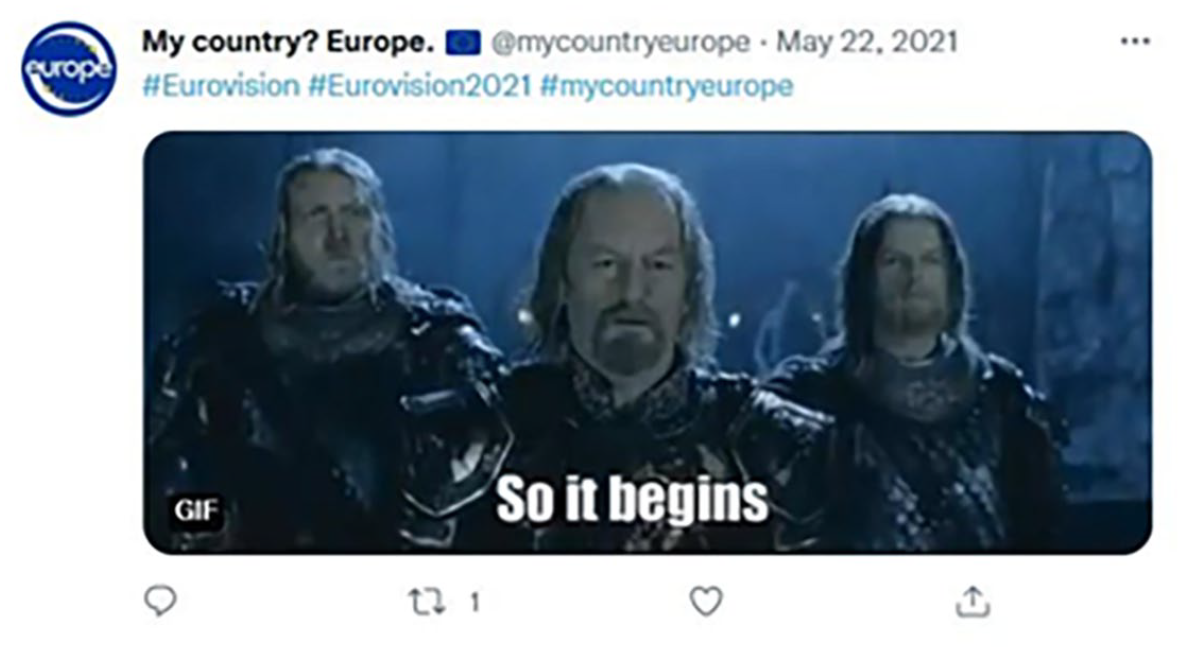
Tweets from Eurovision night, 22 May 2021.

Tweets from Eurovision night, 22 May 2021.
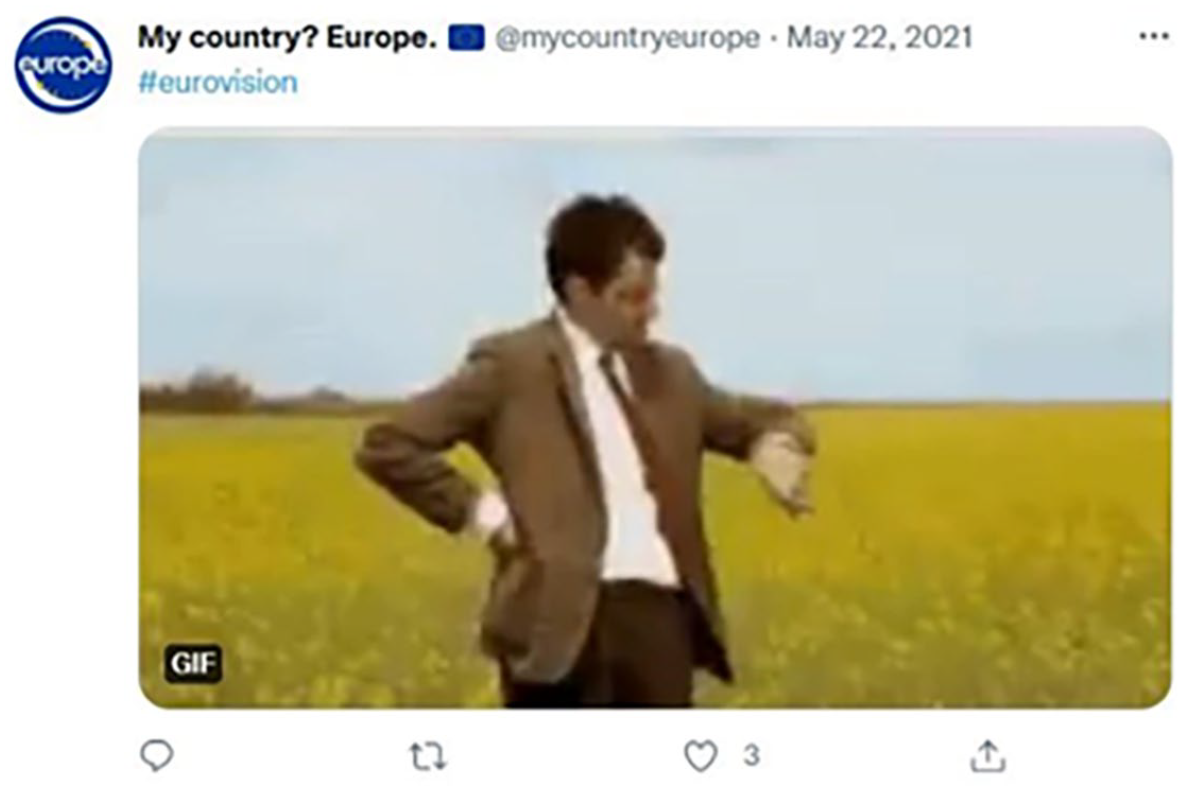
Tweets from Eurovision night, 22 May 2021.
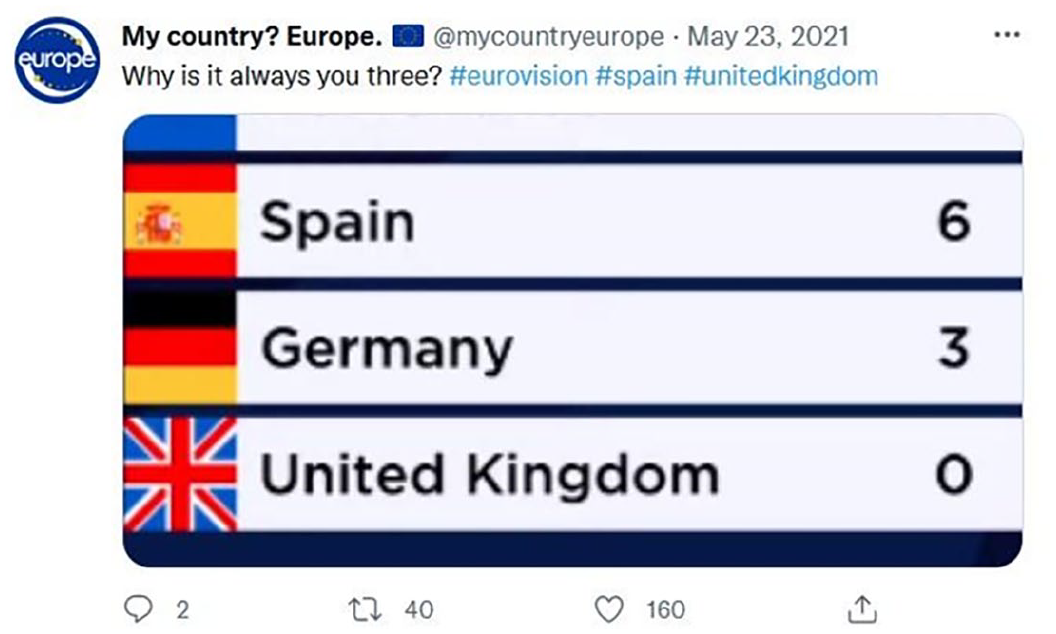
Tweets from Eurovision night, 22 May 2021.
11 July 2021 is also another evening in which social TV practices were engaged in by the account, with @mycountryeurope tweeting 12 interactive tweets concerning the European Football Championships Final between England and Italy. Twitter also has a quiz/question and answer function, and this evening’s tweeting began with a quiz asking: ‘Who are you siding with’ and with 83.1 percent siding with Italy, 5.6 percent with England and 11.3 percent with the referee! An adjoining tweet is more earnest and states: This tournament is special not only because [sic] football’s relevance in European culture but also for the extra year of wait due to the pandemic. It has gone forward because Europeans went the extra mile to make it happen. It has united the continent around football.
Gemeinschaftlichkeit/Communality
The construction of a sense of communality is achieved in both Twitter accounts via the creation of a multifaceted conception of an ‘other’, seen in the continuous dichotomy of the EU/democracy/unity = self, with authoritarianism/not-democracy/division = other and/or ‘not-self’. This ‘othering’ is seen in three different strands: (1) in historical forms of authoritarianism; the contemporary EU contrasted with ‘past Europe’, (2) creeping authoritarianism within the EU; democracy contrasted with ‘not-democracy’/ authoritarianism and (3) authoritarianism on the EU’s border; democracy contrasted here with authoritarianism/‘not democracy’. While the logic of the othering varies, in accordance with Gray’s (1987: 37) view of the aphorism as looking ‘to imbue static, rigid values and truths with fluidity and flexibility’, the identification of Europe and the EU with democracy and freedom is a constant.
Brons’ (2015) differentiation between ‘crude’ and ‘sophisticated’ othering is central here. Othering is (Brons, 2015: 70) the simultaneous construction of the self or in-group and the other or out-group in mutual and unequal opposition through identification of some desirable characteristic that the self/in-group has and the other/out-group lacks and/or some undesirable characteristic that the other/out-group has and the self/in-group lacks.
For Brons (2015: 71) this essentially constitutes ‘crude othering’, while ‘sophisticated othering’ is based on a ‘relatively neutral difference’ that is oriented towards the Hegelian idea of the other as the ‘not-self’ (Brons, 2015: 69) rather than an (implicit) inferior/superior dichotomy. There is a difference here also, thus, between the (crude) construction of ‘self-other distantiation’ and the (sophisticated) ‘self-other identification’ (Brons, 2015: 70). Thus, a more ‘sophisticated’ othering also finds elements of the self in the other, the ‘not-self’.
@PulseOfEurope
The creation of historical otherness plays only a modest role in the @PulseOfEurope account and may basically be seen in one commented retweet and four retweets from 13 August 2021: the sixtieth anniversary of the building of the Berlin Wall. According to the first tweet, and quoting directly from a text the account shared, the fall of the Berlin Wall ‘nährte die Hoffnung, dass militärisch gesicherte Grenzen der Vergangenheit angehören würden’ (nourished the hope that militarily controlled borders would belong to the past). According to a tweet from an account belonging to European Commission president Ursula von der Leyen which the Pulse of Europe account retweeted, the Berlin Wall ‘stand für ein geteiltes Europa’ (stood for a divided Europe), whereas the fall of the wall, its ‘Überwindung’ (overcoming), is a reminder, the account writes, of what has been achieved: the EU ‘vereint, in Europa’ (united, in Europe). Thus, the past here is depicted in the terms of a crude other, as marked by the undesirable characteristic of division and military control, while the present is represented by unity and the EU.
A total of 68 tweets, spread evenly throughout the period studied, deal with increasing authoritarianism within the EU, principally in Hungary and Poland, and to a lesser extent Slovenia. The account retweeted one tweet concerning Brexit during this period: a 8 July tweet also referencing issues with democracy in the United Kingdom. A sense of a community of values within the EU is created; often indeed explicitly using the hashtag #EUValues. The Hungarian and Polish governments and states are placed outside of this communality or at least at the very edge – although often represented solely in the figure of Hungarian Prime Minister Viktor Orbán and the Polish ruling party, the Law and Justice Party (PiS) – thus requiring action from the EU institutions. Therefore, a difference is created between ‘un-European’ and undemocratic politicians and the inherently European Hungarian and Polish peoples, the othering veering between a ‘crude’ and ‘sophisticated’ othering, of clear distantiation and one of identification.
A tweet from 19 May tells us that Viktor Orbán is behaving ‘destruktiv und torpediert #EUBeschlüsse per Veto. Was ist los mit ihm – auch im eigenen Land?’ (‘destructively and has torpedoed the #EUResolutions via veto. What is wrong with him – also in his own country?’). The tweet ends by saying that the EU ‘muß Kante zeigen’ (has to take a firm stand; or more literally has to ‘show an edge’). A tweet from 16 June tells its readers that education regarding lesbian, gay, bisexual and transgender/transsexual information in Hungarian schools has been forbidden and ‘wieder geht es gegen die Freiheit: #Orban muss gestoppt werden’ (again it is going against freedom: #Orban has to be stopped) ending with the hashtags ‘#LoveisLove #LGBT #EURuleofLaw #PulseofEurope’. This tweet needs also to be seen within the context of the Pulse of Europe account’s Pride Month activities, which included the creation of a (mash-up) EU-LGTBQIA flag and a tweet from 3 June asking its followers to photograph themselves with this flag and to post their photos (Figure 8). Tweets with this – what it later calls ‘Pride of Europe’ – flag may be seen throughout June. A clear connection is created, thus, between the EU and LGTBQIA rights, and those not adhering to those rights are situated here outside of this communality, simultaneously strengthening this connection as a strand of communality. A tweet from 24 June relating to freedoms (and citing Rosa Luxemberg) states that ‘Genau diese will #Orban beschneiden’ (these are exactly what Orban wants to trim); a 24 June tweet states that ‘Die @EU_Commission geht nun entschlossener gegen die autoritäre Politik von #Orban vor. Gut so!’ (the EU Commission is going more determinedly against the authoritarian politics of #Orban. Good!) ending with hashtags ‘#PoEWatchesEU #LGBTQI #PrideofEurope #EURuleofLaw #PulseofEurope’, while a tweet from 7 July writes that ‘das antieuropäische Verhalten von #Orban hat Konsequenzen’ (the anti-European behaviour of #Orban has consequences). In a tweet from 5 July, in relation to an EU-wide communications campaign from Viktor Orbán, the account tweets that the ‘#EU sollte stärker kommunizieren, anstatt Feld [sic] den Rechten zu überlassen’ (the EU should communicate more strongly, instead of leaving field for the right). An earlier tweet from 26 June creates a clear distinction between Viktor Orbán and the Hungarian people, which it states are very European: ‘Ungarn ist sehr (EU Flag). Orban das genaue Gegenteil: Er demontiert #EUValues, arbeitet gegen #UnitedinDiversity, #Pride & #EURuleofLaw’ (Hungary is very (EU flag). Orban the exact opposite: He is disassembling #EUValues, is working against #UnitedinDiversity, #Pride & #EURuleofLaw). References to Hungary and Viktor Orbán end in this period on 19 October, when @PulseOfEurope tweets an article describing what it frames as the good news that Hungarians have decided upon an electoral challenger to Viktor Orbán.
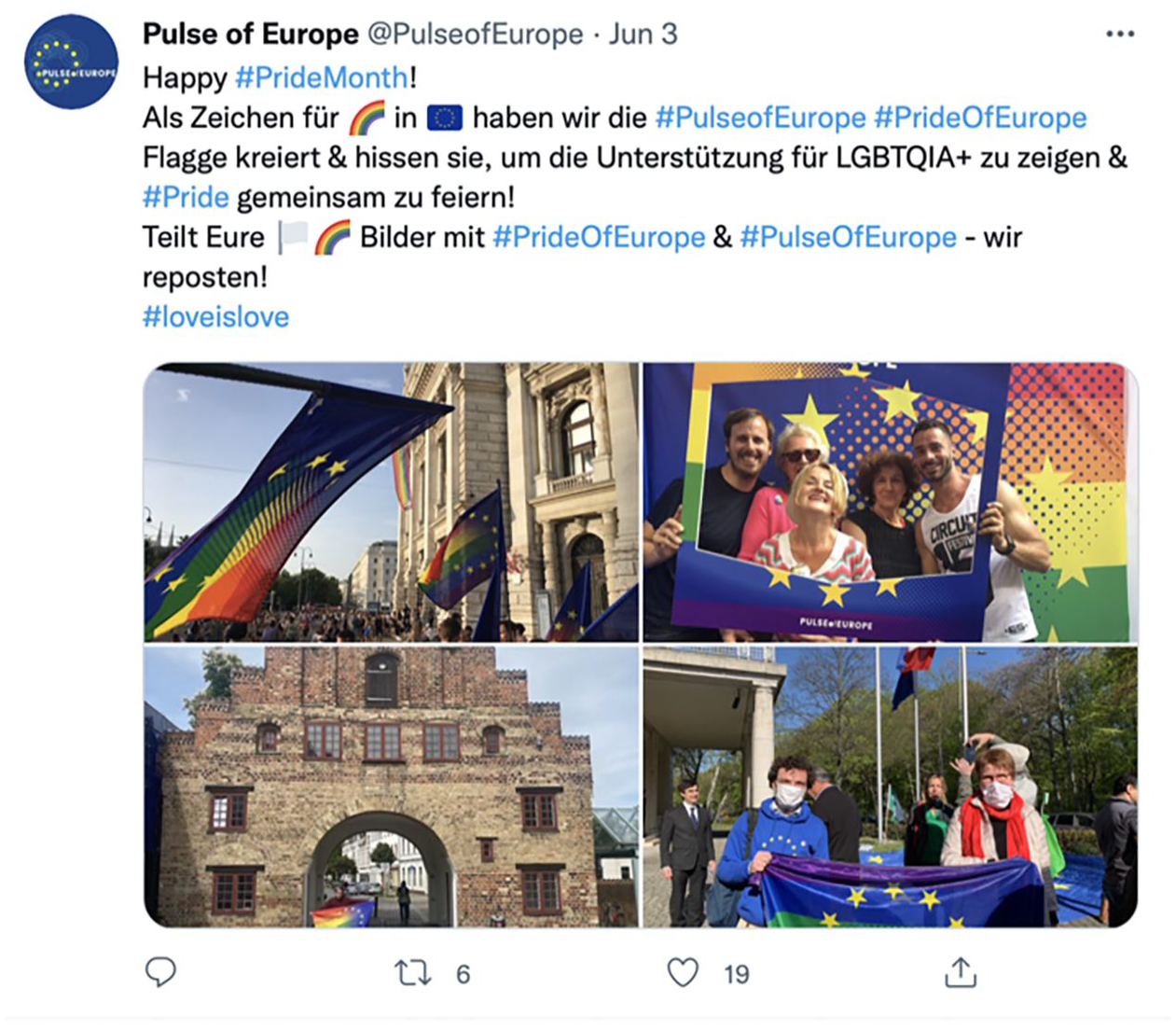
Screenshot of @PulseofEurope tweet from 3 June 2021.
Similar tweets appear during this period in relation to Slovenia, where the situation regarding democracy and press freedom is described as ‘Besorgniserregend’ (worrying) in a tweet from 18 June. But Slovenia is also perceived in terms of Hungary and a tweet from 1 July suggests that Slovenian Prime Minister Janez Janša is seen as ‘#Orban [sic] light’ and ‘die EU sollte wachsam sein’ (the EU should be vigilant). Indeed, Poland and the Polish government is also grouped together with Hungary and seen, in at least two tweets from 8 June and 19 October, as part of a ‘Vetokratie’ (vetocracy) due to these states’ willingness to veto EU decisions. The Polish government’s attempts to override EU law is a constant topic, and this is again explicitly framed in terms of EU values and the rule of law. On 15 July, the account tweets that ‘Rechtsfragen sind Machtfragen. Aktuell findet eine existenzielle Auseinandersetzung zwischen Instanzen der #EU und #Polen statt. Es geht um viel’ (legal questions are questions of power. At the moment there is an existential battle between EU authorities and Poland. The stakes are high), ending the tweet with the hashtags: ‘#Polexit #RuleofLaw #EURuleofLaw #EUValues #Pulse of Europe’. The hashtag #EUValues is a constant feature in relation to tweets concerning the Polish legal situation. A difference is also clearly made between the Polish ruling Law and Justice Party (PiS) and the Polish people, journalists and especially demonstrators on the streets of Poland in a tweet from 11 August, while a tweet from 4 September states that the Polish people have #EUValues in their hearts, but the tweet is still very supportive of EU sanctions against Poland (Figure 9). Three tweets from 8 and 10 October again make a clear distinction between the Polish government and the Polish people, while a tweet from 12 October states that the Polish government’s goal is not to leave the EU, but to change the EU from within which is ‘viel gefährlicher als ein Polexit’ (more dangerous than a Polexit). A retweet from a Belgian politician on 27 October restates that the EU is a union of values and ‘not a cash machine’. Thus, we see here again a mix of distantiation from the Polish government, but a clear identification with the Polish people.
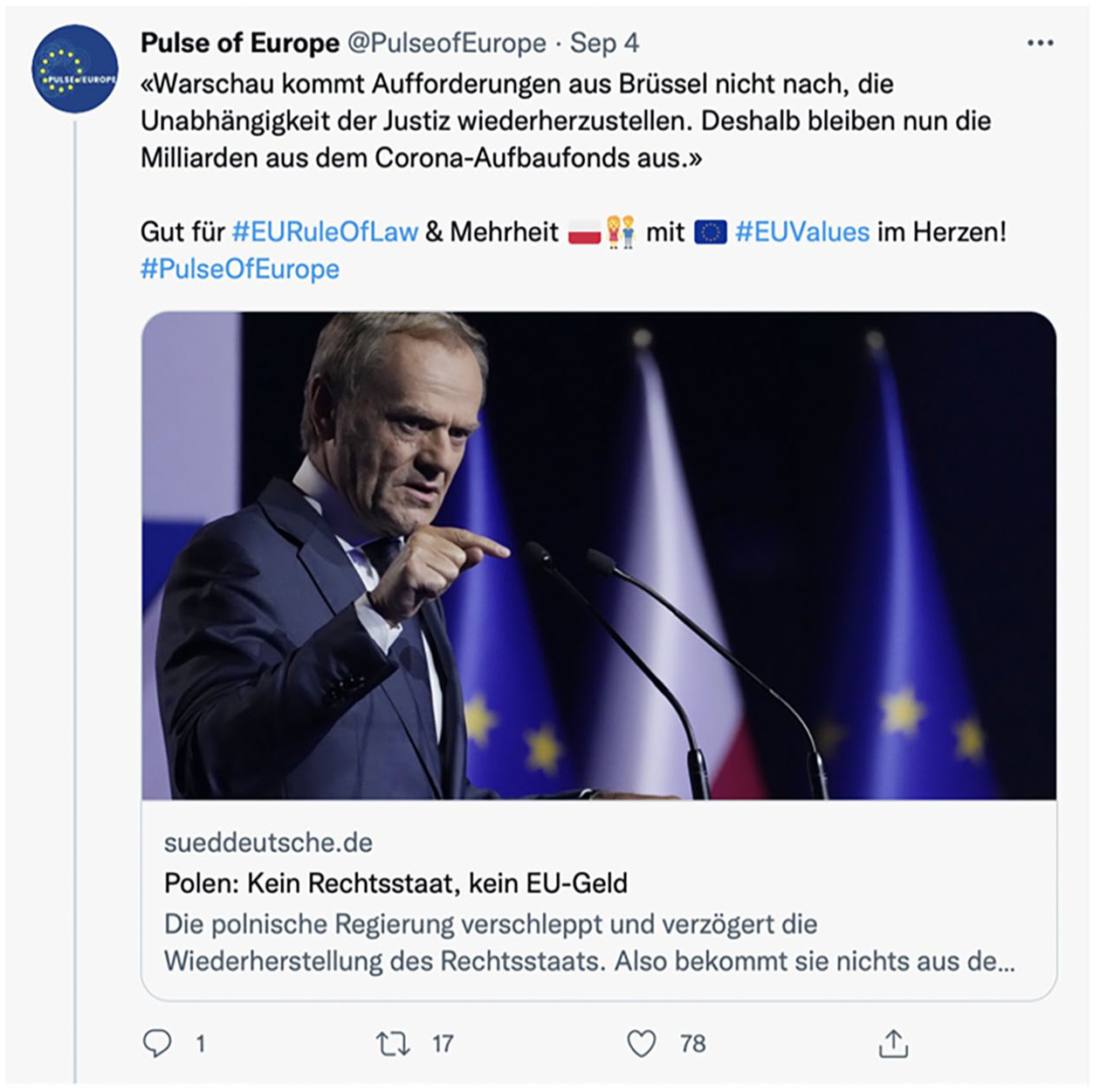
Screenshot of @PulseofEurope tweet from 4 September 2021.
A relatively small number of tweets situate Belarus and Russia as an external authoritarian other; there is no sense communicated, however, of the possibility of the incoming Russian invasion of Ukraine in February 2022. Belarus is depicted as a totalitarian state, against which the EU has to act. Thus, distantiation is here clearly evident. A tweet from 4 August details the murder of an opposition figure in Belarus, to which the account states: ‘Die internationale Staatengemeinschaft darf hier nicht schweigen!’ (the international community of states cannot here be silent) ending with the hashtags ‘#DefendDemocracy #PulseofEurope’. A further tweet from 4 August states that Lukaschenko is turning Belarus into a ‘Schurkenstaat’ (a rogue state) and ‘die EU muss alle Sanktionsmöglichkeiten gegen das Regime nutzen’ (the EU has to use all possible sanctions against the regime). A total of nine tweets chart the build-up of refugees from, chiefly, Iraq on the Belarussian-Polish border. The first tweet from 8 November explains how the Belarussian regime has enticed people from Iraq to fly, via specially organised charter flights, to the Belarussian-Polish border with promises of a new life in the EU. The account tweets that the EU ‘muß Flüge per Sanktionen stoppen’ (has to stop the flights via sanctions) and help the people, ending with the hashtags ‘#EUSolidarity #PulseofEurope’. Thus, Belarus is situated as an authoritarian regime against which the EU has to act.
Russia is positioned in a similar way in relation to the EU, not least in three tweets from 22 July, there is also criticism of Germany’s position in relation to the Nord Stream 2 pipeline. In the account’s first tweet from this date, it is stated: ‘Die Einigung bei #Nordstream2 ist nicht gut für #Europa, gar nicht gut für #Polen und schlecht für die #Ukraine. Sie wird erpressbar durch #Russland. Leider keine #EUSolidarität von #Deutschland. #PulseofEurope’ (the #Nordstream2 agreement is not good for #Europe, not good at all for #Poland and bad for the #Ukraine. It will become susceptible to blackmail by #Russia. Unfortunately no #EUsolidarity from #Germany. #Pulse of Europe). Russia, therefore, is depicted as an external threat to the EU, and Germany is seen as complicit in this threat. Yet, the othering of Russia also retains identification elements and support for Russian democrats is also present in the account. According to a tweet from the account from 20 August, dedicated to Alexei Navalny on the anniversary of his poisoning, Navalny in Russia ‘hatte sich gegen #Korruption eingesetzt, die die Gier der Wenigen über das Wohl der Allgemeinheit stellt und Demokratie unterminiert. Er ist in unmenschlicher Haft’ (had campaigned against #corruption, which puts the greed of the few above the public good and undermines democracy. He is in inhumane confinement). The tweet ends with the hashtags ‘#FreeNawalny #DefendDemocracy #PulseofEurope’. Thus, elements of the self still remain in the depiction of Russia, and a complete distantiation is not evident.
@mycountryeurope
Historical othering also does not play an extensive role in the Twitter feed of the @mycountryeurope account during the period examined. Only five tweets could really be categorised as historically based. Authoritarianism, mass murder and militarism are present in the temporal distantiation which does take place. A commented retweet from 7 June tells us that the last Soviet soldier ‘who liberated Auschwitz has passed away. Rest in Peace’, while a retweet from a Lithuanian account on 15 June commemorates, however, the Soviet invasion of Lithuania in 1940, part of the Nazi-Soviet Pact of 1939. The historical elements otherwise are less temporally distant. A commented retweet from 11 July tells us that ‘Bosnia commemorates 26th anniversary [sic] of Srebrenica massacre’, while a retweet of the EU politician Josep Borrell Fontelles tells us that the ‘Srebrenica genocide’ was one of the ‘darkest pages of Europe’s modern history’. A commented retweet and link to an article from 8 August, informs the accounts’ followers about the Russian-Georgian War of 2008.
A total of 24 tweets during this period deal with rising authoritarianism within the EU itself; 12 tweets engage principally with Hungary, 10 with Poland, while two tweets cover both countries. These tweets situate Hungary and Poland outside of EU norms, with Viktor Orbán personally mentioned on several occasions. Otherwise, a difference was not made between the Hungarian/Polish state and the Hungarian/Polish people, meaning the othering here held elements of a distinct distantiation. During the period examined the account tweeted once on the topic of Brexit. A pithy tweet from the 18 May tells us: ‘People who campaigned for Brexit and got Brexit done can’t find the benefits of Brexit. Yes, that’s the British government’.
A tweet from 19 May states that EU foreign ministers have called for a ceasefire between Israel and Hamas in a draft declaration and have ‘boosted humanitarian aid for Gaza’, ending the tweet by telling its readers, however, that ‘Hungary, Israel’s closest ally in the EU, has blocked the declaration, as part of Orbán’s new “eastern opening” foreign policy’. Thus, Hungary and its prime minister Viktor Orbán are depicted as – although inside the EU – acting outside of the Union’s interests and are placed outside of EU geo-political norms. This is restated with the adaptation of a well-known yes/no meme from 10 June, with Viktor Orbán’s head superimposed onto the image (Figure 10). Orbán is now saying no to a liberal ‘George-Soros-founded university’ and yes to the EU’s ‘first Chinese university campus’; a reference to the way in which the Orbán government forced the Central European University out of Budapest, while accepting at a similar time a Chinese-financed campus. Hungary is again here placed outside of liberal-democratic EU norms and seen as more interested in authoritarian-backed institutions.
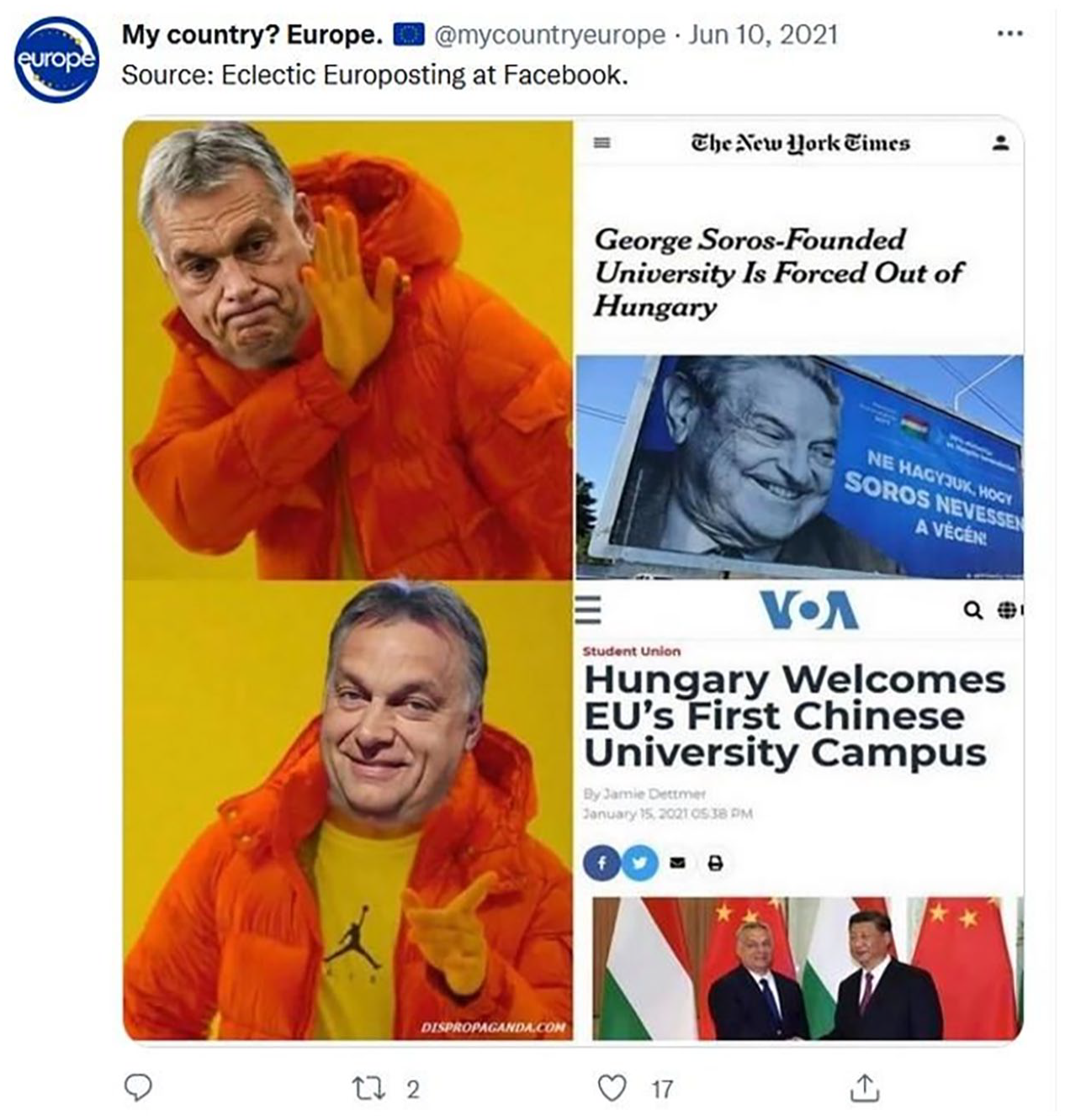
Screenshot of @mycountryeurope tweet from 10 June 2021.
A series of tweets place the Hungarian state outside of EU norms in relation to sexual identity and sexual politics. A tweet from 17 June, linked to an article, tells its readers that: ‘Hungarian bill [sic] to introduce a ban on the portrayal of the homosexual and trans identity to the underaged, putting LGBT people on the same footing as paedophiles’. Several tweets reference attempts to light up the Allianz Arena in Munich with the rainbow colours during the German-Hungarian soccer match; ‘protest against anti-lgbt [sic] laws recently sponsored by Orbán’s government in Hungary’ as a tweet from 23 June tells us. Tweets from 24 June again detail new Hungarian laws that ban in schools any content that ‘propagates or portrays divergence from self-identity corresponding to sex at birth, sex-change or homosexuality’. A commented retweet of a 7 July Fidesz (the Hungarian ruling party of Viktor Orbán) video states that the party has adopted completely ‘Russia’s discourse against LGBT people’. A tweet from 8 July tells us that the ‘European Commission has ratified Parliament’s decision to withhold Hungary’s Covid recovery fund’, while a retweet of a German Green MEP from 15 July states that the ‘European Commission is opening 3 infringement cases against Hungary and Poland on breaches of fundamental human rights of the LGBTGI community’ which is an ‘important step’. A tweet from 1 October tells us that Orbán has blacklisted some critical international journalists in Hungary, while a tweet of an article from 8 October declares ‘LGBTIQ rights: Hungary and Poland veto EU children’s strategy’. Thus, it is clear from the Twitter feed of @mycountryeurope that lesbian, gay, bisexual, transgender, queer and intersex (LGBTQI) rights are to be seen as inherent to the EU and Hungary’s (and Poland’s) movement against these rights place it outside of EU norms, necessitating clear action on the part of the EU, and a clear distantiation is evident here in terms of othering.
Poland, as we have already seen, features in a tweet together with Hungary in relation to its increased discrimination against LGBTQI rights. The main orientation on the Twitter feed relates, however, to the Polish constitutional law position. A tweet containing a detailed article from 20 May tells its readers: ‘Polish students to be told EU is an “unlawful” entity. History and education as a whole [sic] will endure a nationalistic turn’. The comment on a tweeted article from 15 July states that the: ‘Polish constitutional court rules national law has primacy over EU laws. This decision challenges the principle that has driven integration by norms in the EU’. A retweet from 2 September informs us that the European Commission has blocked the Covid Recovery Plan in Poland due to ‘#RuleOfLaw’ concerns, a tweet from 22 October tells us that EU leaders see ‘no way out of Polish rule of law crisis’, while tweets from 27 and 29 October detail the extensive EU fine that the Polish state must pay due to its judicial reforms. Thus, the judicial manoeuvring of the Polish state has placed it outside of sovereignty-sharing EU norms, meaning direct action by the EU in relation to Poland has become necessary and Poland is also clearly seen here in terms of distantiation, as part of a democracy-authoritarianism dichotomy.
During the period studied, 29 tweets were published dealing with Belarus and eleven tweets were published concerning Russia by @mycountryeurope, while two were published concerning both states. Belarus and Russia are depicted as authoritarian, dictatorial states again very much in the manner of a distantiation; the lack of free and democratic structures in Belarus and Russia emphasises the communality of these structures in the EU itself, also implicitly creating a sense of online communality (notwithstanding the already creeping authoritarianism of EU member Hungary and Poland).
The first Belarusian-themed tweet, from 13 May, tells us of the EU preparing a ‘4th round of sanctions against senior Belarus officials’: marking the necessity of EU action against Belarus. Following the commandeering of a Ryan Air flight from Greece to Lithuania which had been flying over Belarus and the arrest of the Belarussian opposition figure Roman Protasevich, the account retweeted a number of tweets from European politicians. These include, from 23 May, a tweet from Lithuanian president Gitanas Nauséda which references a ‘state-sponsored terrorist act’ and the need to view Belarussian airspace as ‘unsafe’, and Polish MEP Radek Sikorski who states that ‘if we don’t make this tin-horned dictator regret it, what hope is there of restraining bigger scoundrels?’ A tweeted article from 29 May also comes with the comment that ‘Belarus will get billions in aid from the EU . . . . Once they transition to a democracy’. An eight tweet thread from 31 May sets out ‘the project’s view on the highjacking of an EU flight to kidnap a journalist in Belarus’. The account believes that with this act Lukaschenko has firmly placed Belarus outside the confines of what can be called a civilised state in the 21st century. He has thrown a gauntlet in challenge [sic] to everything the EU stands for in Europe and in the world.
It calls for the EU to act in a ‘bold, decisive and radical’ manner, as there ‘must not be any room for countries run by criminals (. . .) on our continent’. Thus, the account situates Belarus and its dictator Alexander Lukaschenko as an uncivilised, undemocratic other in contrast to the EU’s democracy, which must act. Belarus is also very much seen as dancing to Russia’s, and Vladimir Putin’s, tune. This is very evident in a tweet from 2 June entitled ‘The state of things in Belarus’, which depicts a cartoon of Lukaschenko as a dog eating an aeroplane, held on a leash by Putin (Figure 11). (The account emphasises that this is ‘Not OC’ or original content.) A tweet from 3 August tells us of a Belarussian opposition leader Vitaly Shishov in Ukraine, tweets from 6 and 9 August provide details of a Belarussian Olympic sprinter Krystsina Tsimanouskaya who sought political asylum during the games in Japan, while a tweet from 7 September communicates the fact that an opposition leader Maria Kolesnikova leader in Belarus has received a prison sentence of 11 years. A tweet from 7 November details how Russia and Belarus are set to integrate their gas and financial markets but will remain, however, ‘independent for now’.
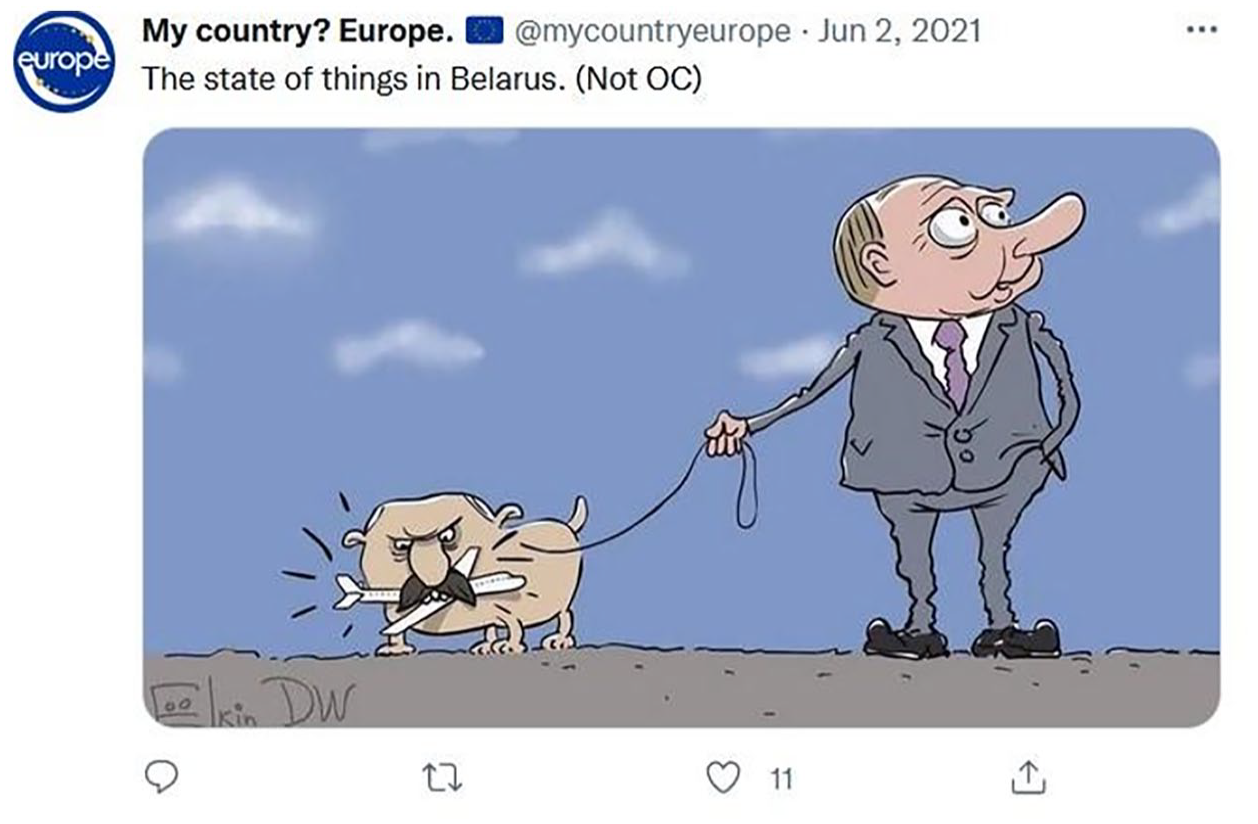
Screenshot of @mycountryeurope tweet from 2 June 2021.
Russia is depicted in a similar manner – an authoritarian space ‘foreign’ to European democracy in an othering based on a distinct distantiation. But Russia is also represented as menacing, militaristic and a potential threat. Indeed, the account’s depiction now appears especially prescient following Russia’s brutal invasion of Ukraine in February 2022. On 5 June the account retweeted a tweet from the BBC journalist Steve Rosenberg, namely, a detail from an interview with Vladimir Putin. A moderator had asked Putin if he would commandeer an aeroplane, to arrest a political opponent, to which Putin replied: ‘I’m not going to tell you’. For Rosenberg ‘short answers are the most enlightening’. A tweet from 8 June reports how Russia feels provoked by the Ukrainian football team wearing a map of Ukraine – including Crimea – on their jerseys. On 14 June the account tweeted an article dealing with a NATO meeting and how NATO is to change its strategy ‘to respond to China (a challenge) and Russia (a threat)’. A 25 June tweet reports how France and Germany have cancelled plans for an EU summit with Russia after EU opposition (hinting here also, perhaps, at a sense of Franco-German complicity in relation to Russia). A retweet from 14 July shows Ukrainian politicians in parliament in Kyiv making fun of what is called Vladimir Putin’s ‘absurd essay’ on the ‘Historical Unity of Russians and Ukrainians’, while a tweet from 20 July tells us ominously that ‘Russia has transferred 21,000 troops to Crimea and is building a military town’. A tweet from 13 September provides details of regional elections in Russia, while on 20 September it is tweeted that ‘Pro-Putin United Russia retains parliamentary majority amid fraud allegations’. A tweet from 7 November, as already mentioned, details Russia and Belarus’ increased integration. Thus, Russia is wholly depicted as authoritarian and anti-democratic in clear and stark contrast to democracy and to the EU (although this has of course also to be relativised, as already seen regarding Hungary and Poland). Russia is in addition seen as a menacing potential military threat and also, thus, as an implicit other to the EU’s peacefulness.
Conclusion
This article argued that the study of literary Europeanism should be extended to the discourse of wider textual Europeanism, understood here as a digital Europeanism, which examines digital texts, in the widest sense, contextualised within the norms of digital culture. The texts emanating on the platform Twitter from @PulseofEurope and @mycountryeurope were examined from 9 May 2021 to 9 November 2021. In evidence was a type of textual Europeanism that owes a degree of coherence to the norms of digital culture. This was seen in relation to referentiality, that is, the use of already existing and circulating cultural materials for one’s own cultural production. This was evident in commented and uncommented retweets, social TV practices and the Europeanisation of Internet memes. The creation of a sense of communality – the way in which meanings can be stabilised, options for action generated and resources made accessible via a collectively supported frame of reference – is also in evidence and to be seen in the distinct discursive creation of an authoritarian ‘other’. This ‘other’ consists of a temporal ‘other’ – a small number of tweets relating to authoritarianisms of the past; an inner-EU ‘other’ – tweets relating to movements towards authoritarianism within the EU, especially in Hungary and Poland; and an external EU other – tweets relating to authoritarianism on the EU’s borders, especially in Belarus and Russia.
It is clear that there is a lot of scope of further investigations into Digital Europeanism, examining further platforms upon which texts, images, videos, memes and gifs circulate, such as Facebook, Instagram and TikTok, and also in a further variety of languages. Indeed, examinations of further kinds of Europeanism, such as far-right Europeanism, would also be fruitful and would yield interesting and probably very important results. While the study of literary Europeanism has been worthy, not least in a historical context, and has shed light on the growth and development of the European idea, there is an urgent need to extend the forms and genres of wider textual Europeanism. This would have at its centre the examination of the evolving nature of the discourse on Europe and the European idea; something that is alive and well, that may be instantly created and interacted with.
Footnotes
Acknowledgements
This article is based on research conducted as part of the ReDICo (Researching Digital Interculturality Co-operatively) Project, financed by the German Federal Ministry for Education and Research (BMBF).
Declaration of conflicting interests
The author declared no potential conflicts of interest with respect to the research, authorship and/or publication of this article.