




Abstract
Television is a public mediator of what constitutes ‘crises’ in Europe. Audio-visual archives and researchers are facing new complexities and ‘information bubbles’ when telling stories and reusing televised materials. I reflect on these practices, among others, via a comparative case analysis of the EUscreen portal offering access to thousands of items of European audio-visual heritage. I question how practices of selection and curation can support comparative interpretations of such representations. This approach aims to understand and support (1) interpretations of digitized/digital audio-visual sources in the era of information overload; (2) user interaction with digital search technologies – especially researchers as platform users; and (3) contextualization for reuse of audio-visual texts. Support for cultural memory research is crucial as television’s audio-visual heritage can help us to recognize which cultural practices result in the production of specific texts in European societies, representing conditions of the multiple crises that European citizens are experiencing today.
Keywords
In your generation, it’s like the space shuttle blows up every day . . . how can you care about anything, when you know everything? (Chappelle, 2017)
In The Age of Spin (2017), comedian Dave Chappelle deftly summarizes the struggle that media users are constantly negotiating today: the disorienting effect of the profusion of, often disruptive, media events on different platforms, from television to online and social media. Part of understanding crises means examining mediated representations of (past) disruptive events, as these are crucial in the formation of cultural memory formation and in understanding Europe’s past, present and future. Such research, however, is complicated because media users are facing enormous challenges in interpreting media representations. We are witnessing a major change in how the public domain is constituted as a so-called post-truth society (Schlesinger, 2017). Appeals to emotion are increasingly important in shaping opinion (Newman, 2017), and stories garner attention through affect and circulation (Nakamura, 2013). In this ‘new global symbolic space’, in the words of Ingrid Volkmer (2006: 1), modern societies are faced with ‘a constant presence of crises and conflicts’, as represented by a continuous stream of media events (Dayan and Katz, 1992; Couldry et al., 2009; Couldry and Hepp, 2017) and ‘disaster marathons’ (Katz and Liebes, 2007; Wang and Louis-Charles, 2017) – a non-stop presence amplified in the present day on numerous screens and platforms.
In this context, I reflect on the audio-visual representation of disruptive events – mediated moments of crisis, disaster and conflict, such as ‘breaking news’ narratives – which are contextualized and recirculated in Europe’s audio-visual archives. This includes official cultural heritage institutions as well as online ‘living’ archives (Rhodes, 2014). Specifically, I question how practices of selection and curation can support comparative interpretations of such representations. The overloaded and fast-changing information landscape affects the formation of cultural memory in Western and Central Europe. In this post-scarcity culture (Hoskins, 2014) and age of abundance (Fickers, 2012), media users are continuously negotiating a torrent of media events. For both audio-visual archives and researchers, this has given rise to new complexities and ‘information bubbles’ when they are telling stories and reusing archival materials. I reflect on these practices, among others via a comparative case analysis of EUscreen, a free online portal that offers access to thousands of items of European audio-visual heritage. This approach offers contextualization for the (creative) reuse of audio-visual texts, and supports interpretations of digitized and digital audio-visual sources, as well as user interactions with digital search technologies – in this instance, by media and culture researchers as platform users – in the era of information overload.
Crises, remediated
In April 2013, then-President of the European Commission, Jóse Manuel Barroso pushed the need for ‘a new narrative for Europe’, arguing that ‘we have to continue . . . to write the book of the present and of the future’ (Barroso, 2013). Since 2013, a ‘perfect storm’ of events, including Brexit, the migrant ‘crisis’, the Russian invasion of Ukraine and terrorist attacks in Paris, Brussels, London and Barcelona, among others, has added complexity to narratives for cultural memory formation in Europe. Ongoing disruptions are formed and remediated in a proliferation of ‘breaking news’ narratives and ‘disaster marathons’ (Katz and Liebes, 2007). Research and discussion of Europe’s crises should also include reflection on the media representation of (past) disruptive events, as these are crucial for the formation of cultural memory and the development of understanding Europe’s past, present and future. This is especially so, as Castells (2017) has demonstrated, in light of the fact that historical political events, their processes and decisions – including those that made the construction and development of the EU possible – have created the conditions for the multiple crises that European citizens are experiencing today.
The European Communication Research and Education Association (ECREA) Television Studies conference ‘The Future of European Television: Between Transnationalism and Euroscepticism’, in Málaga, Spain, in November 2017, discussed political developments, challenges and risks impacting European audio-visual research. In particular, the conference considered how to approach television’s past, present and future in Europe, in the face of recent changes and Euroscepticism. In recent years, television in Europe has become more and more transnational; this is demonstrated, for instance, by the increasing number of European co-productions. These tendencies are challenged by developments in the political climate of anti-Europeanism and neo-nationalism in Europe. At the same time as the continent of Europe is experiencing times of crisis and change, the medium of television is also experiencing deep transformations. This calls for new strategies in academic research (ECREA Television Studies Thematic Section International Conference, 2017).
Since the ‘archival turn’ (Robertson, 2011), enormous amounts of audio-visual material have been digitized in Europe. This greatly increased access to (historical) television, film and radio material has provided new opportunities for the reuse of footage, and has sparked academic interest in the role of the media in representing events (De Groot, 2009; Nicholas et al., 2008; Rosenstone, 2006; Cannadine, 2004) and in television as a form of cultural memory, meaning the mediation of present and past in socio-cultural contexts (Erll, 2011; see also Barker, 2017; Arrow, 2011; Hanna, 2009; Wheatley, 2007; Ebbrecht, 2007; Macdonald, 2006; Hoskins, 2004; Edgerton and Rollins, 2001). Much of the debate has concentrated on whether television is able to ‘do history’ properly (Winston, 2010; White, 1988; MacArthur, 1980). More recent work (Hagedoorn, 2017; 2015; Gray and Bell, 2013; Holdsworth, 2011) strives to understand what kind of cultural memory is (co-)created. An emergent body of work on the production and creative industries acknowledges the importance of analysing production cultures and conditions, and the interpretative practices of professionals (Mayer, 2016; Hagedoorn and Agterberg 2016; Lotz, 2009; Holt and Perren, 2009). Such research is even more pertinent today, given the fact that authority in the formation of cultural memory (Assmann, 2010) is increasingly taken away from historians, and taken over, first, by the media as an agent of social and cultural change (Hjarvard, 2008); second, by media professionals as industrial actors (Caldwell, 2009; Mayer et al., 2009); and, finally, by users of cultural heritage institutions as historical actors (Jensen 2016; Robertsen, 2011).
In these contexts, deeper insights are needed in order to understand disruptive events told with televisual sources, because contextualization is lacking. Such events are not only told with the users’ attention ‘scattered’ across different media, but are often shocking and unexpected, making it difficult to grasp the story (Jiménez-Martínez, 2016; Hagedoorn and Sauer, 2019). Furthermore, digital and digitized sources are especially fragmented and complex, and the context that gives these data meaning is often unknown (Dutch National Research Agenda, 2015).
The ‘scattering’ of audio-visual culture across media platforms on the one hand provides a training ground for users and viewers, as they are becoming more and more used to collecting and assembling information from platforms or databases into logical narratives for themselves. They are becoming information ‘hunters and gatherers’ (Jenkins, 2006) in what Van Dijck et al. (2018) have dubbed the ‘platform society’. On the other hand, current research has indicated how these skills, as well as awareness of how such skills contribute to interpretation during learning and research, could be better supported (Hagedoorn and Sauer, 2019). Contextualization and deeper understanding of practices and conditions for interpreting media events can play an important role in supporting more reliable interpretations. This is especially the case these days, since steadily growing audio-visual data has amplified over the last few years. Such support is also much needed in the face of contemporary democratic crises, such as data manipulation and ‘filter bubbles’ (Pariser, 2011), fake news and hyper-targeted advertising (see e.g. Waterson, 2018).
Europe’s digital audio-visual memory: representing disruptive events
A ‘media event’ (Dayan and Katz, 1992) is an event with a specific narrative that gives the event its meaning. For Dayan and Katz, ‘media events’ are not only ceremonial and planned mediated events. In contemporary societies, media events are increasingly recognized as disruptive and cross-medial. In the collaborative study News in Public Memory, Ingrid Volkmer thoughtfully outlines how this mediatization process works: One could argue that nations live not only on ‘media time’ . . . but in new, varied, multi-directional flow-frameworks of time/space coordinates: spectacular political affairs take place in global media prime time, are formatted as ‘breaking news’, and are delivered into living rooms around the world via a network of about 400 satellites, instantaneously and continuously demanding actions and reactions. Industrial nations, developing as well as transnational nations, governments and individuals live in a new global symbolic space, which refines former notions of ‘distance’ and ‘proximity’ by a constant presence of crises and conflicts, associated by a never-ending stream of ‘contest-’, ‘conquest-,’ and ‘coronation-’type media events (Dayan and Katz, 1992). (Volkmer, 2006: 1)
A ‘disruptive’ media event is recognized or narrativized in terms of more or less acute disruption (Sauer and Hagedoorn, 2017). It is usually narrativized as unforeseen and part of a discourse characterized as catastrophic (Chun, 2011). It is an event that is disruptive in terms of content – it contains crisis narratives – but it can also literally interrupt broadcasting. This can in some cases lead to broadcasting marathons, such as those reporting on terrorist attacks or natural disasters. Disruptive media events may be characterized as unplanned and are generally perceived as events that intrude on planned flows of media broadcasting, due to their scale or perceived importance as news. However, this conceptualization needs to be understood in today’s mediated landscape as more flexible, dynamic and cross-medial, rather than purely prescriptive and thus limiting. Instead, operationalizing the concept of ‘media events’ entails ‘meeting the call for more research on disruptive media events in a hybrid media landscape’ (Ustad Figenschou and Thorbjørnsrud, 2017: 943; see also Shahaf and Ferrari, 2019). Such events are sometimes also referred to as conflictual (Hepp and Couldry, 2010: 1–20) or as catastrophes in media discourses. Disruptive events can also blur the distinction between what is perceived as a crisis or as a catastrophe: There are certainly phenomena which seem to annihilate the distinctions between them [crisis and catastrophe] – a flood, for instance, which has elements of both the crisis (duration) and the catastrophe (it takes many lives), or an assassination which, although it may be experienced as a catastrophe, is a political action which must be attributed to a subject. (Doane, 1990: 252)
Contemporary disruptive or conflictual media events are often cross-medial, referring to or involving other television broadcasts, online news broadcasts, radio bulletins, newspaper articles, social or online media attention, and remediation in the digital age. 1
As a case study, I now home in on the televisual representation and contextualization of disruptive events in Europe on the EUscreen portal, including the representation and discourses of the impact of such events on citizens and societies. I also reflect on the portal’s opportunities for European comparative research.
EUscreen: exploring Europe’s cultural heritage on the small screen
The EUscreen portal (www.euscreen.eu) was built by a consortium of European audio-visual archives, public broadcasters and academic and technical partners, and it provides access to approximately 60,000 televisual items. 2 It has been funded in the past by several European Commission grants (VideoActive; EUscreen; EUscreenXL) and the EUscreen network is ongoing as a foundation. The EUscreen collection comprises thousands of media items (videos, photographs, audio files and documents) selected by professional documentalists and researchers. The project’s present day consortium brings together audio-visual archives, broadcasters and research institutions from 22 European countries. 3 Its key materials are selected clips from informative, historical and documentary television programmes – including those that incorporate previously broadcast television materials or archival (film or newsreel) footage – with structured metadata.
Although audio-visual heritage is a primary resource for understanding political and socio-cultural developments in Europe, and is key to cultural memory formation, initiatives to digitize audio-visual content in Europe are often fragmented. As a result, existing digital material is not easily searchable and findable, particularly beyond national contexts (Müller et al., 2014). For EUscreen, as well as other European archives and heritage institutions, participatory cultures (Delwiche and Jacobs Henderson, 2013) are therefore both a challenge and a chance for the contextualization of the materials of cultural memory.
A major strength of this portal is that it can offer diverse perspectives and starting points for European comparative research. It offers such opportunities, first, as an actual archive of European linked data – consisting of materials connected to Europe as well as linking various European perspectives in a single database – and, second, on the level of the critical perspectives with which the archive is approached, including critical digital humanities perspectives. As a database of linked digitized audio-visual heritage, it offers access to content from the different providers across Europe within one common platform. The portal offers access to content from a range of genres and languages, connected to various historical topics. 4 This topic list – which is not easily found by the user – pre-structures the selection of items for the portal, and this selection is further constrained by item availability across individual content providers, including rights issues for online reuse. For this reason, most of the material on EUscreen consists of informative or factual content, since drama is usually too costly for online reuse, given the many rights holders. A portion of the collection is open access, although all items can be shared and embedded (but not downloaded) online and on social media platforms. The portal can help to answer research questions related to European comparative research by means of the inter-operable metadata: short descriptions (offered by the official content provider) in the English language; extended descriptions in the local or English language (when available); search and research support for users in making their own collections and bookmarks using the MyEUscreen tool; and, importantly, content contextualization (see Oomen and Tzouvaras, 2012).
When using the portal to study cultural themes across countries in Europe, I wish to gain comparative insights into transnational events and tendencies, such as trends, patterns and repetitions. Therefore, example research questions might include: how does a particular news item or topic ‘travel’ or ‘spread’ across Europe? How is it covered, to what extent, in which country, and by whom? Which perspectives are chosen? What patterns are visible? I am interested in television as a public mediator and negotiator of what constitutes ‘crises’ in Europe, and how EUscreen’s selection and curation related to this theme might offer further insight into which cultural practices result in the production of specific representations and perspectives in European societies.
A model for comparative analysis of disruptive events
Disruptive media events, such as narratives of disaster, terror and war – including narratives driven by the fear of such events, for example of nuclear war – are difficult to interpret due to an inability to grasp the full complexity of the story, and due to information being ‘scattered’ across multiple media platforms. This leads to problems for media scholars who wish to analyse how different political, economic or cultural meanings are constructed around such events. 5 Offering media researchers opportunities to analyse such narratives through comparison, in a transnational and linked data context, can support interpretative work. Comparative textual analysis is the primary mode through which we can analyse the construction of historical, political and socio-cultural meanings of disruptive events represented in audio-visual sources on the EUscreen portal. 6 Specific attention is paid to opportunities for comparative research and audio-visual textual analysis. I argue that comparative textual analysis of disruptive events through audio-visual and cross-media sources can ultimately provide insight into the processes which construct and manipulate meaning around disruptive events, on one or more of the following five levels: (1) inter-medial; (2) multi-platform and/or linked data; (3) cross-cultural; (4) historical; and (5) event narrative (see Table 1).
Model for comparative research into media event narratives.
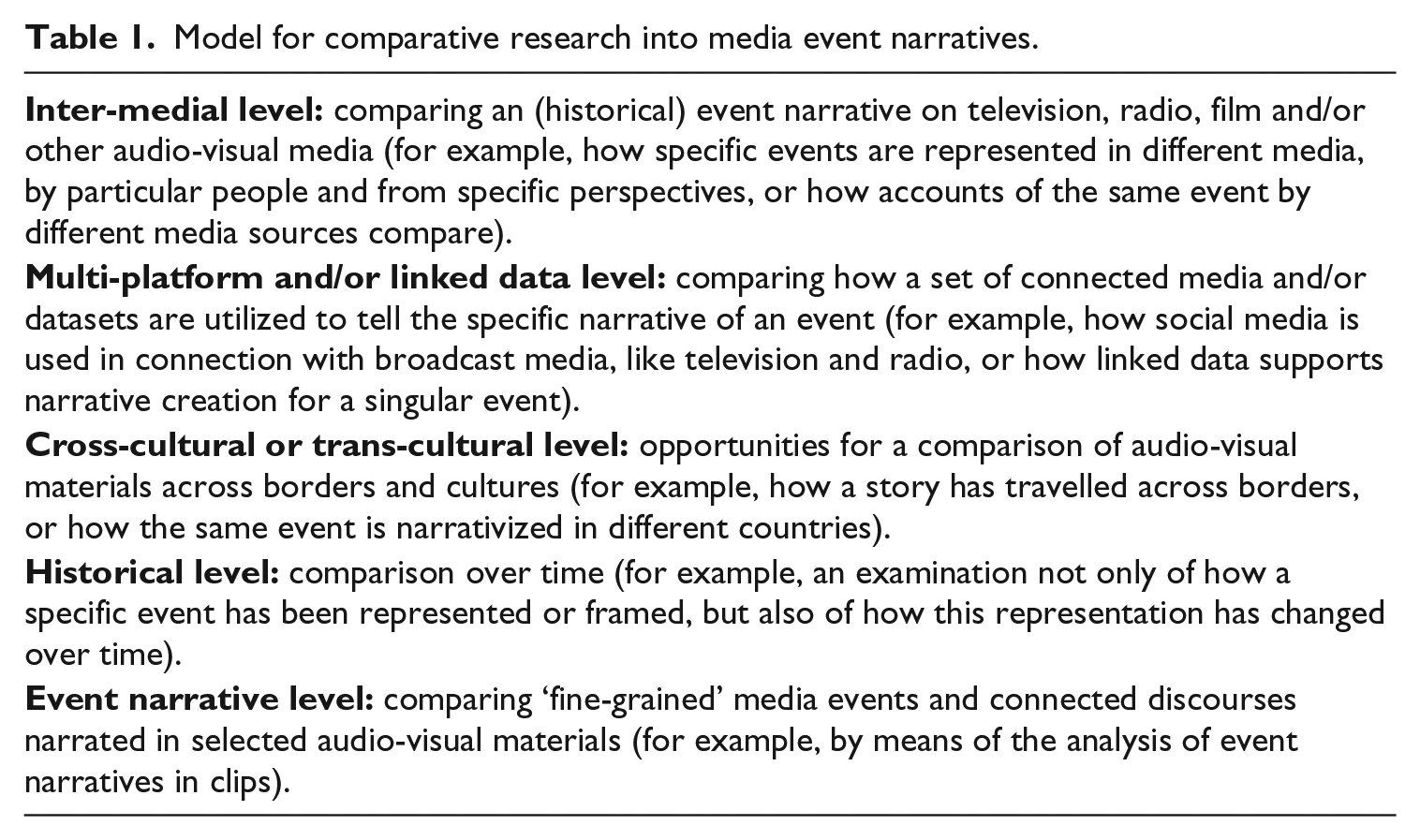
Such comparative research can provide further insight into the different perspectives that have defined the course and framing of media events, including their real, or possibly future, consequences for modern European societies, and it can subsequently help to develop a research model for a larger future cultural study. 7
Inter-medial level
On the EUscreen portal, we can distinguish long-term disruptive events from short-term ones, which differ in terms of timeframe, the nature of the disruption and duration; the former can actually consist of a succession of the latter (Hagedoorn and Sauer, 2019). The collection offers opportunities to reflect on television’s ability to represent, promote or investigate various elements of conflict and crisis across Europe before, during and after the event period. The materials provide opportunities to delve deeper into and compare the role of television as a mediator of long-continuing disruptions, competitions or rivalries in different countries in Europe. It therefore gives particular departure points for investigating television as a social, cultural, technological and economic system, to portray conflicts and crises through specific international and national representations, and even personal interpretations, across Europe. EUscreen’s main aim is to bring together clips that provide an insight into the social, cultural, political and economic events that shaped the twentieth and twenty-first centuries. Comparative analysis of the portal is therefore television-centric. In moderation, EUscreen also facilitates the use of photos, audio, images and documents. However, in terms of my specific research question, this portion of the collection is too limited to yield sufficient material for an analysis of disruptive events on television as directly compared to their representation in other audio-visual media (e.g. radio, film, web) available on the portal.
Multi-platform and/or linked data
EUscreen offers access to content from multiple archival databases within one common platform as linked data – linking different European perspectives and audio-visual sources. While existing methods of metadata enrichment often focus on persons, places and concepts (De Boer et al., 2017: 10), an event can be identified in audio-visual content (e.g. through the analysis of clips) and in annotated descriptions of items, for instance by searching for location, time and action in the structured metadata. In an audio-visual archive, and on the EUscreen portal as a ‘hub’ providing access to multiple European audio-visual archives, a disruptive media event can be searched for by keeping in mind the notion of disruption. 8 The metadata could use terms that suggest disruption – for example words in the item’s description such as ‘crisis’, ‘conflict’, ‘catastrophe’, ‘unexpected’, ‘interrupt’ or ‘breaking news’, or other examples of ‘crisis language’. It is important to note that retrieved search results require further filtering by the researcher, as results found may not directly correspond to the search at hand. 9 The event can also be visualized in terms of how it punctuates programmed broadcasts, for instance by comparing TV guide information. This entails juxtaposing (meta)data with broadcast information (when was something broadcast, versus what was programmed; is it a news or current events programme that was unscheduled?). Furthermore, the event could dominate several media platforms simultaneously (news and current events radio, television, newspapers, etc.), over a shorter or longer period of time. Importantly, television programme content can offer historical reflections on disruptive events and their consequences for society at times separate from the actual event (Sauer and Hagedoorn, 2017).
Cross-cultural level
EUscreen triggers research questions and provides departure points for an investigation of television as a social, cultural, technological and economic system used to portray conflicts and crises through specific representations in Europe. Archival footage, for instance, can give further insight into how opposing views on world territorial and economic division led to the start of the Cold War. 10 These materials mediate the Cold War conflict as a long-term disruptive event, and indicate how the event is expressed through military alliances, defence collaboration and strategic weapon positioning. Archival items reveal the significance of technological forms of competition as a profound articulation of this state of conflict between East and West. In particular, documentary or news items investigate the nuclear arms race and the space race, sometimes even exposing governments’ covert dealings when looking back on the event. The Catalan documentary, Space: 50th Anniversary of the Soviet Union’s Sputnik launch (TVC, 2007) documents the history of the space race; Professor of Space Telecommunications Joan Olmos talks about the space race and how, 50 years ago, the USSR launched the first satellite in history, gaining an advantage over the United States during the Cold War. The EUscreen collection also underscores the significance of propaganda tools and espionage practices as an expression of the disruptive event across Europe. The Danish programme A State of Equilibrium (DR, 2004) features a discussion between Lieutenant General Kjeld Hillingsø and Frank Esmann in the Mauermuseum – the ‘Wall Museum’ – at Checkpoint Charlie in Berlin, on the role of objective truth in preventing the Cold War from developing into ‘a hot one’. The programme explores how spies were responsible for ensuring the balance between the atomic world powers. In turn, for instance in the serials Cambridge Spies (BBC, 2003) and the TV adaptation of Alan Bennett’s play, A Question of Attribution (BBC, 1991), the collection also pays attention to how espionage and the disruptive events of the Cold War has been an inspiration for television drama and fiction (Hagedoorn, 2009b).
The collection also features audio-visual materials relevant to the pre-history of television. For instance, a film reel of the Dutch Polygoon news, features a news report entitled ‘The Disaster of Catalonia’ (NISV, 1939), about the Spanish Civil War drawing to a close, as thousands of republican soldiers crossed the border in the region between France and Spain and French authorities created a refugee camp for Spanish soldiers in Les Perthus, guarded by French soldiers. In contrast, some television programmes do not only look back or provide reflection on past events, but even project forward into the future. In 1993, the Belgian broadcaster RTBF transmitted the discussion programme The Future of the European Monetary System: A Wholesome Crisis?, which reflected on the future possibility of a disruptive event. In the programme, Roberto Denis discusses the economic situation of Europe with Philippe Maystadt, then Belgian Minister of Finance and President of EcoFin, and Yves Clarisse, a Reuters journalist. In the same year, the programme Debate on the Economic Crisis (RTBF, 1993) features discussions on the economic crisis and ‘the’ solution for the EU to ‘get out’ of it, in a debate between Jean Gandois, President of Cockerill Sambre, and Philippe Lemaitre, a journalist from Le Monde. Such informative and explanatory formats often make use of an interview with an expert commentator, such as a political personality, a Commissioner, etc., to shed light on European issues for the future. The Hungarian programme The Expansion of the EU and the Future of the Community (NAVA, 2007) focuses on the 2004 expansion of the European Union and, in this context, the future of the community. This was the largest expansion in the history of the European Union: on 1 May 2004 ten new member countries were admitted to the Union, mostly from Central and Eastern Europe. In the information space offered and structured by the portal, there is also room for such perspectives on crises in Europe from broader international contexts. In the documentary Japan and the Euro Crisis (DW, 2011), for instance, reporter Nobu Sunaga from the Japanese news agency Jiji-Press shows how the financial crisis in Europe is being closely followed with mounting concern in Japan.
Historical level
As we have already seen, comparative analyses can also produce specific insights into the impact of disruptive events in a certain country in Europe on a historical level, which in this context entails opportunities for comparisons over time. Another example of such a mediated comparison, but in contrast from a specific national perspective, is the Italian news programme Ambiente Italia (Environmental Italy) (RAI, 2011), which covers natural disasters and their consequences at different points in time: for example, one report, ‘Green thread’, explores the floods in Lunigiana and Cinque Terre in 2011, and ‘Celebration of Earth Hour’ revisits photographs of the tsunami in Italy in 1908. Furthermore, television programmes also provide contextualization by showcasing the smaller or bigger consequences of crises in different European countries over time. The documentary Boating Industry: Waiting for Calm Seas (TVC, 1991) provides an assessment of the sports-boating industry in Catalonia just as Europe is about to become a single market. Workers in the boating industry recommend joining forces in order to face this challenge in the crisis-ridden year of 1991, which primarily hit the boating accessories industry (see Figure 1). A similar narrative appears in the Catalan county news item, ‘Barcelona: Revival of Tapas Restaurants’ (TVC, 2011), where, according to a study on eating habits in Spain, it is revealed that the Spanish financial crisis has caused people to cut back on eating out. However, as a form of counter-culture in response to the crisis, going out for appetizers has increased by 5 per cent: having tapas has become popular, and even renowned chefs have diversified their cuisine to cater to this trend. Who knew that boats and tapas could teach you more about European crises!
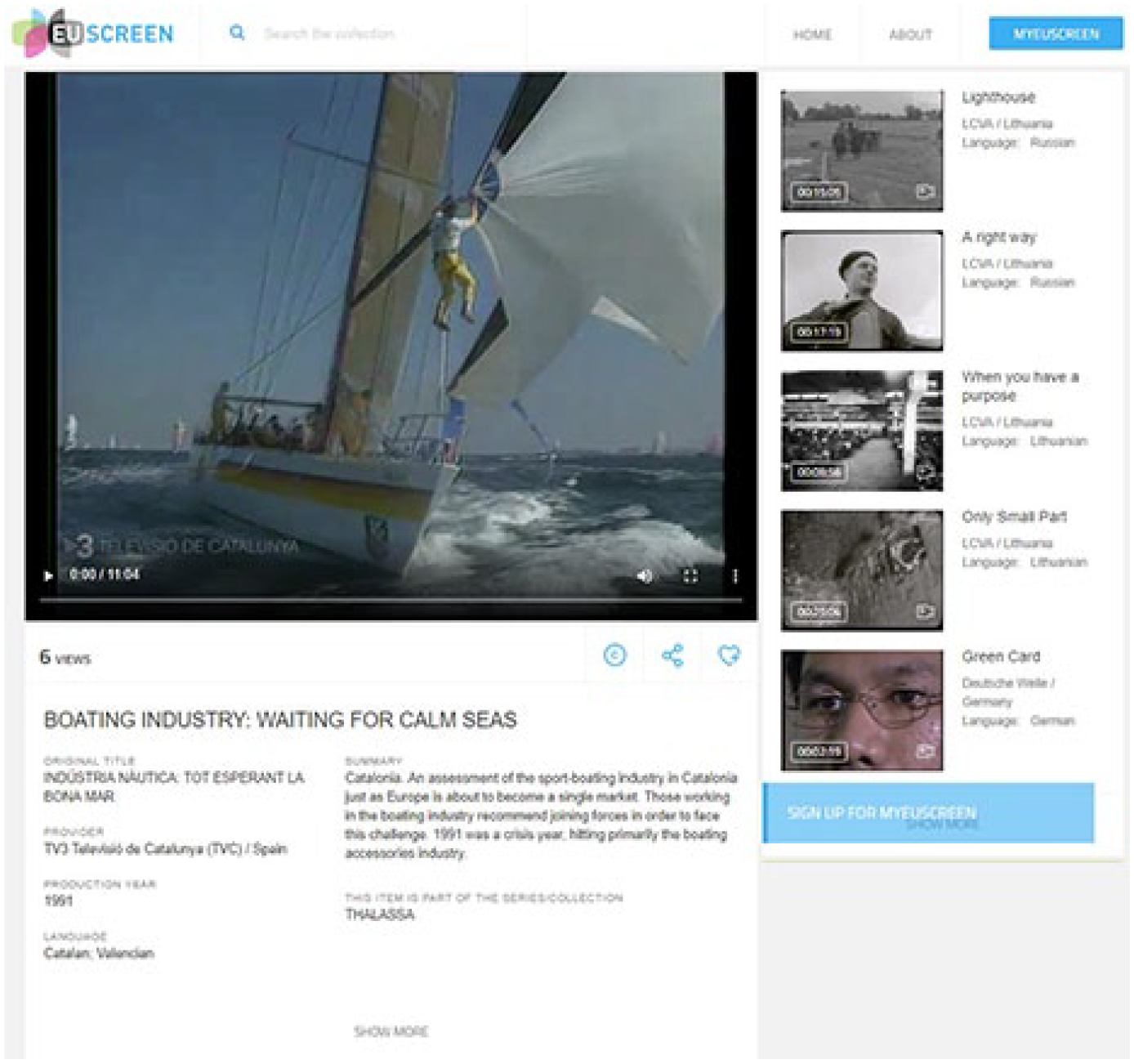
Screenshot EUscreen website. Item page ‘Boating Industry: Waiting for Calm Seas’ (TVC, 1991). Available at: http://euscreen.eu/item.html?id=EUS_7179660C054B4EEC8C98ED5970D0BDD8.
Event narrative level
Finally, what are the ‘fine-grained’ media events and connected discourses in the selected audio-visual materials, and more specifically, how are they narrated? For example, news and documentary programmes showcase the possibilities for narrativizing transnational conflicts and crises on specific personal levels. Some series utilize archival footage and interviews with key persons to present new findings. For instance, the live editorial programme It’s the Culture, Stupid (NINA, 2012) co-produced by the National Audio-visual Institute and Polish Television, invites artists, journalists and columnists to discuss the current state of Poland’s cultural and social affairs. In the episode ‘The end of the Gutenberg era’, guests of the programme discuss the crisis in printed news, which is losing sales to digital newspapers. The report ‘Newspapers’ (RTÉ, 1971) also offered an insight into the financial and political pressures placed on newspaper editors in Ireland. Other programmes instead use filmed reconstructions of events. The documentary Greece’s Economic Crisis (DW, 2010) features in-depth interviews with key persons, and reflects on the major economic and financial crisis in Greece, which affected the majority of the population. It features DW-TV reporter Militiades Arsenopoulos travelling to Athens and speaking to a newspaper vendor, a worker at a travel agency, an independent car mechanic and a member of the teachers’ union about how the crisis is impacting on their personal lives and work. As a result, items in the collection also reflect on the memory of the medium of television and on other forms of media experiencing crises in specific countries in Europe.
Comparative analysis of digital audio-visual heritage offers new opportunities for interpretation and research, and found event narratives in television content can even support the researcher to retrieve more ‘serendipitous’ (Sauer and De Rijke, 2016) insights. This is demonstrated, for instance, in the retrieved news item ‘Franco-German relations amid Euro crisis’, featured in the German broadcast news (DW, 2011). This item’s event narrative shows that most of the countries in the Eurozone are grappling with weakening economies, while Germany is booming, and this has stirred long-forgotten prejudices in France (see Figure 2). Such historical political events, processes and decisions created the conditions for the multiple crises that European citizens have been experiencing more recently (Castells, 2017).
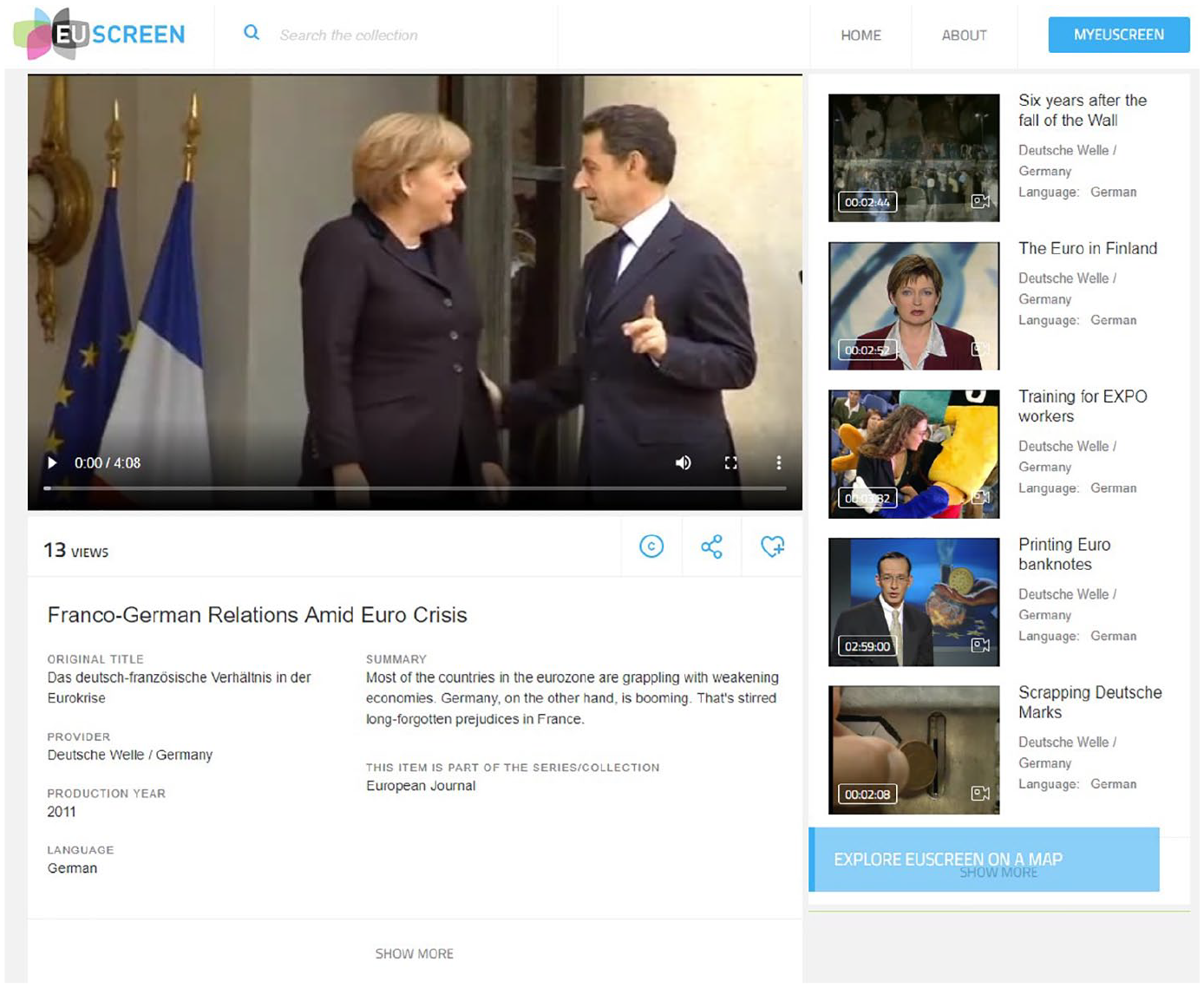
Screeenshot EUscreen website. Item page ‘Franco-German relations amid the Euro crisis’ (DW, 2011). Available at: http://euscreen.eu/item.html?id=EUS_6293DFE0357B4FC293320040444AB89A.
It is important here to reiterate that research into and debates about Europe’s crises should include reflection on the representations of (past) disruptive events, as these are crucial for cultural memory formation and for understanding Europe’s past, present and future. In turn, such research should include reflection on the so-called politics of archiving: the practices of selection and curation in the archives and databases used, and how these selections frame, support and filter researchers’ interpretations of analysed representations in the era of information overload.
In order for media and culture studies researchers to better decide and share what is relevant for their research, information about the content selection policy – and thus more insight into what kind of information bubble(s) EUscreen allows us to navigate – is therefore necessary. Researchers almost always need further information about how materials are selected, as well as how selected online collections compare to full archival collections. What is the proportion of (un)available materials and why? What is the place of a particular selected item within a larger collection, or an item’s relationship to ‘what is out there’? And what are the connections between items on the portal (linked data), for instance suggestions for related items, actually based on? This can also help in dealing with the ‘distrust’ of researchers towards sources they have not themselves selected (media students are, for instance, taught to explore ‘about’ pages to judge the validity of online content providers). Researchers also need to be able to combine different search profiles and ways of searching (such as named entity search or data visualization). Researchers may wish to be able to trace a clip’s circulation across news channels and other media in different European countries, for example. Items which are only available in a foreign language may constitute an impediment to such research. Researchers require explanatory textual information on television culture in different countries and the enrichment of metadata by expert users who can add articles or enhance the available metadata. Finally, it is important to note that the EUscreen portal is also partly a ‘living’ archive, in the sense that content may continuously be added but also disappear, as in the example of the former content provider the Swedish Royal Library, which recently removed its content from the portal. As a result, by collecting and assembling materials on a particular topic, researchers can create relevant datasets, allowing for research analysis into the development of particular events, and their representations and connected discourses, over time.
Navigating information bubbles: curated memory in the digital audio-visual archive
This reflective article has revealed digitized and digital television heritage as a ‘site of discursive struggle’ (Anderson, 2001: 22), which provides departure points for the further investigation of digital audio-visual heritage and television’s capacity to promote particular (partial) views – of a personal, national or international kind – on crises in modern Europe, and for comparative media research with (digital) audio-visual heritage. This reflection points to television’s centrality in mediating and negotiating sociocultural, political and ethical aspects of complex expressions of power in modern European societies. In this manner, European audio-visual heritage can be understood as what Bignell and Fickers (2008: 35) have termed ‘a mechanism and conduit for the production of a sense of shared history, and the continuity of European identities of different kinds’.
Digitization has made comparative studies across borders and the linking of historical datasets possible (De Boer et al., 2015; Müller et al., 2014; Van den Akker et al., 2011). Whilst collaborative studies (Bignell and Fickers, 2008; Fickers and Johnson, 2010; Bourdon and Hagedoorn, 2013) are very much to be encouraged, researchers usually ‘stick’ to their own national paradigm. In this essay, I position myself as a media and culture studies researcher in different national contexts in Europe, using digital technologies to aid the analysis of a more complex dataset (Fickers, 2012; Meuzelaar, 2014; Rogers, 2013) of digitized audio-visual sources. A comparative textual analysis was used to identify meanings and interpretations in a larger dataset. EUscreen is therefore not only a hub or database for digital audio-visual heritage, but also a prompt for reflection on comparative European research and the contextualization of digital audio-visual heritage. As Chapman (2005) has argued, researchers should use ‘enthusiastic caution’ when carrying out comparative research, aiming to diminish the risks of comparative work, which can carry comparisons too far through over-selection, simplification, generalization or obsession. Ultimately, further possibilities for comparative work in the digital age can be revealed, including support for overcoming language barriers through the translation of metadata descriptions, subtitling (at present only available in very few instances on the EUscreen portal) and multi-language search.
Different user roles in the active construction of a working cultural memory (Assmann, 2008; Hagedoorn, 2013) are subsequently made explicit. The role of the professional documentalist is emphasized through practices of selection and reframing, resulting in the assembly, selection and collection of content and research materials. Such roles can be expanded in the digital era by means of user interaction and the incorporation of user-generated content. This is especially relevant considering that television users are, more and more, becoming akin to media producers in their own selection of and interaction with content.
Audio-visual online and digital materials play a key role in the ways that current generations learn about the past. Importantly, audio-visual and cross-media materials shape our perspectives by their framing of media events. However, creators select these representations and make them available within a specific context. Representation implies active meaning-making (Hall, 1988; 1997), and today more people, data and tools than ever before are involved in this process across diverse media platforms, including programme websites, apps, social media such as Facebook and Instagram, and ‘living’ archives online such as YouTube. 11 Contemporary programming by public service broadcasters reusing audio-visual materials not only involves creative reuse and search by television professionals, but also by archivists, researchers, digital media experts and media audiences too. The inclusion of audio-visual materials in digital databases by broadcasters and archival institutions adds further complexity to rich, multifaceted texts. On each level (media texts, media users and digital search tools) there are selections that have already made an impact on interpretation. I invoke the concept of ‘information bubbles’ here, to signify how these practices and processes of (unconscious) selection impact upon the formation of audio-visual cultural memory. Professionals, curators, researchers and other storytellers therefore need to become more accustomed to actively practising tool criticism, source criticism and critical self-reflexivity, especially with providing transparency regarding their poetics and processes of selection, filtering and interpretation. In the information age, such contextualization is necessary for the sharing of reliable interpretations, and for audio-visual content to remain usable for research. On the one hand, the European market for audio-visual archival reuse is growing and narratives and aesthetics are becoming transnationalized. On the other hand, there are different national realities of how the local and the global go hand in hand. Supporting comparative analysis of experiences of crisis and disruption across Europe can therefore offer new interpretations of events from dissimilar perspectives.
Current digital humanities and big data studies have been risking a growing separation between data analysis and people’s lived realities, including data that cannot distinguish between socio-cultural groups and generations (Livingstone, 2018). The ‘double exclusions’ of non-elite and marginalized voices (Chouliaraki and Zaborowski, 2017) in both Western media productions and in academic research is especially problematic. Therefore, sufficient insights into provenance and selection on digital audio-visual heritage portals are required to evaluate the level of inclusion on such portals, as well as the (mis)representation and silencing of minority voices that may occur in European television content on crises and disruption.
A deeper understanding of the processes of selection, construction and manipulation of meanings involved in research, search and the creative reuse of audio-visual materials is thus necessary in the current media landscape. Especially so, because media professionals and archives work with frameworks and ‘information bubbles’ that impact on the representations that producers and consumers of audio-visual sources engage with and can (re)use. Understanding the impact of the complexities of the new global media landscape on cultural memory formation in Europe is vital, as remediation is the very dynamic (Erll, 2017) keeping cultural memories alive.
The audio-visual archive is an interpretation and classification, not just a documentation of what was screened (Spigel, 2010: 66–7; see also Hagedoorn and Agterberg, 2016; Bryant, 2010). Digital search tools and collections in archives mediate the attitudes of compilers, archivists and other memory-makers, and such attitudes are culturally informed and often unconscious. However, archive users are usually less aware of this (Hagedoorn and Sauer, 2019). Although digitized audio-visual heritage is increasingly recognized as a rich object for memory analysis in different fields, there is a scarcity, first, of research into this audio-visual cultural memory from a European comparative perspective. Second, there is a scarcity of research into this kind of cultural memory from the perspective of television as a constellation of dynamic and cross-media storytelling practices (see, for instance, the critique of Kay et al. (2015) in Hagedoorn, 2018). Television culture in Europe sits between transnationalism and Euroscepticism: national paradigms still persist, but do so in relation to new global symbolic spaces, developing at a different pace across Europe (De Leeuw, 2017), with new complexities for mediatization and memory negotiation – so-called ‘hyperconnected memories’ (Kalinina and Menke, 2016). Researchers therefore need to develop methods that include and venture beyond the understanding of practices by public service broadcasters and archival institutions as existing only in local contexts. The study of audio-visual sources and their use in the new media landscape (which, for television, can include very recent, previously broadcast, online and digital sources) can both help to construct as well as to critically reflect on new discourses of audio-visual media as a cultural memory practice in Europe.
Footnotes
Acknowledgements
I wish to thank the EUscreen Foundation, including for permission to use screenshots from their website. I also wish to thank Sabrina Sauer. Research developing a comparative model for studying disruptive media events was supported by the Netherlands Institute for Sound and Vision during my Fellowship as a Sound and Vision Researcher in Residence, which was followed up in a Research Pilot CLARIAH-CORE project financed by the Dutch Research Council (NWO), named Narrativizing Disruption (project website:  ).
).