



Abstract
Girls in South Asia are exposed to different forms of social inequality and discriminatory gender norms which create a barrier to their education. Available research suggests that there is a gender divide in the use of digital technology for learning but remains silent about the factors that cause such a divide. This paper presents the role of gender in marginalised schoolchildren's access to and use of technology for learning in Bangladesh and Nepal. A total of 80 students, 8 teachers and 32 parents participated in the study. Multiple methods of data collection (focus group discussions, interviews and classroom observation) were used to ensure that research questions of the study are addressed with sufficient depth. Findings suggest that gender inequality in the use of digital technology persists in the two countries as traditional socio-cultural structures continue to create barriers to girls’ access to technology. Pedagogical implications of the study are discussed.
Introduction
Gender is a key social dimension connected to educational marginalisation in many parts of the developing world as girls are often overburdened with household chores and family responsibilities. Despite the rhetoric of educational benefits for girls and governmental initiatives to bring them into mainstream education, girls lag behind in terms of their access to education (Rogers & Nairn, 2021). Girls are exposed to various forms of social inequality, gender-based violence, gender stereotypes, biases, and discriminatory socio-cultural norms.
All these factors create hurdles to their education and careers (Tabassum & Nayak, 2021). In addition, they are subject to adverse cultural practices like child marriage, male favouritism and child labour. Girls who are from poor families, have physical disabilities, and who live in remote villages are known to be at risk of different kinds of socio-cultural malpractices such as gender related biases (Dasgupta, 2024). In some countries, the directive to exclude women/girls from public spaces like parks and gyms, and other restrictions limiting women's ability to work and travel independently, combined with deeply rooted patriarchy, discrimination and adverse stereotypes have hugely contributed to a widening gender gap in education, and in use of information and communication technology (ICT) (Alhawsawi & Jawhar, 2023). Hence, many girls are doubly or triply marginalised.
Technology is considered to play an important role in education as it facilitates students’ learning. Therefore, there has been a rapid increase in the adoption of digital technology in education, even in some of the remotest areas of developing countries (Huang & Chiu, 2015), but the use of technology in education creates further inequalities. Gender inequality with regard to technology has been observed in several contexts including Nepal and Bangladesh (Alhawsawi & Jawhar, 2023; Dawadi et al., 2020; Khan et al., 2021). Technology use seems to remain a heavily gendered, usually male-dominated, space. Hence, many female students are less likely than male students to have access to digital devices at home and they use the devices less frequently (Mathrani et al., 2022; Vekiri & Chronaki, 2008). Indeed, in most developing countries, “girls face disadvantages in acquiring ICT skills, whether in school or at home” (UNICEF, 2020a).
This paper presents findings from a study that explored marginalised children's experiences of using technology for learning in two South Asian countries, namely Bangladesh and Nepal. Gender equality issues in this study are explored in terms of girls’ access to and use of technology. To our best knowledge it is the first study that captures marginalised children's experiences of using technology for learning, with a major focus on gender roles, in the two research countries. Hence, its originality can be seen in terms of knowledge contribution to the field of marginalised children's use of technology and the role of gender.
Literature Review
Scholars have identified discrepancies between governments’ policies on tackling educational inequality and their implementation (Shrestha & Gnawali, 2021). Shrestha and Gnawali further suggest that there is a lack of comprehensive educational inclusion management plans at the government level. Consequently, tackling educational inequality has been a patchwork of initiatives which are mostly donor driven in most low-income countries (LICs), and these initiatives have had no major sustained impact on tackling inequality in education. Recently, the urgency for gender equality in education has been compounded by the severe impacts of the Covid-19 pandemic and climate crises, which have exacerbated and created new forms of intersecting inequalities and injustices associated with gender and education (UNESCO, 2021).
At present, ICT provision is generally seen as a positive contribution to education around the world, enhancing teaching and learning for children (Liu et al., 2023; UNESCO, 2016).
However, as Tam et al. (2020) point out, gender stereotyping in ICT is a long-standing issue in most LICs. According to UNICEF (2021) “girls are disadvantaged when it comes to digital adoption, have lower levels of access to and use of digital technology than boys, and often they are not benefiting from digital technology in the same way as boys” (p.1). Bao et al. (2013) found that since girls are less experienced in using digital devices, they have lower self-efficacy in using technology. This, in turn, might negatively affect their learning practices and academic achievement, and limit their future career opportunities.
Several studies have also explored gender differences in students’ attitudes towards technology. However, findings related to the relationship between gender and attitudes are not conclusive. For instance, while some studies suggest that boys usually have more positive attitudes towards technology than girls do (Ardies et al., 2015; Mawson, 2010; Rees & Noyes, 2007), others argue the opposite (e.g., Aytekin & Isiksal-Bostan, 2019). For instance, in the context of Flanders, boys were reported to be more interested in technology than girls and considered technology to be a masculine subject (Ardies et al., 2015). Nevertheless, some studies demonstrate no gender differences in technology attitudes among schoolchildren (Dündar & Akçayır, 2014; Ho, 2004).
Research also shows that female students show more behavioural engagement at school than male students (Kessels & Van Houtte, 2022) and that boys and girls use technology for different purposes. For instance, according to Cotton et al. (2014), girls spend more time listening to music and communicating over media, while boys spend more time playing games. Rideout et al. (2010) reported that girls spent more time on social networking sites, listening to music and online reading than boys.
To sum up, there is a role of gender in children's access to technology and learning but the issues around this social phenomenon are inadequately understood. The traditional socio-economic approach to understanding adolescent girls as a family liability and their roles being solely to take care of siblings, home and family, has its limitations (Chavez et al., 2020). Girls’ marginalisation needs to be understood as a ‘mosaic’ of social, cultural, educational, economic, linguistic and digital inequalities. These factors intersect in shaping life and learning opportunities. While some factors have been extensively researched and widely published, there is one aspect which is notably absent in recent research on the two target countries (Bangladesh and Nepal): stories of the lived experiences of girls in using technology for learning. As Lakew and Janoch (2023) suggest in their study, there are certain populations that do not usually get a chance to inform the global conversation, so we must listen to their voices and experiences. Hence, it is important to ensure that efforts are made to use technology to break down gender barriers, and to create “opportunities for females that lead more directly to […] knowledge economy development” (Wiseman et al., 2018, p. 240). The present study aimed at bridging the outlined gaps in research, and examining the extent to what there is equity in the use of technology in learning. The following research questions were addressed:
RQ1: What are schoolchildren's attitudes towards the use of technology for learning and is there any gender difference in their attitudes? RQ2: What factors affect girls’ opportunity and motivation to use technology in support of their education?
Theoretical Framework
In order to understand the discrepancies in policies and practices, discussed above, we applied Activity Theory (AT) as a theoritical lens to design the research. It offers a socio-cultural and historical perspective for analyzing human activity systems (Engeström, 1999). Rather than functioning as a predictive theory, AT provides a broad conceptual framework emphasizing the dynamic interaction between human activity, cognition, and the surrounding environment (Batiibwe, 2019). The theory evolved through Engeström's focus on activity systems, addressing tensions and contradictions that drive collective learning and transformation (Batiibwe, 2019). These contradictions, which manifest as misfits, disruptions, or conflicts within or between activity elements or phases, represent systemic tensions that can provoke change and innovation (Engeström, 2001).
This model depicts an activity system as a triangle (Figure 1 below) where subjects (individuals or groups) engage in object-oriented activities mediated by artifacts. Additional components include rules (formal and informal norms regulating activity), community (the social group sharing the activity's object), and division of labour (the allocation of tasks within the community). These social mediators influence the activity, and the outcome emerges from the subject's mediated actions transforming the object, often resulting in broader societal effects (Engeström, 2015). The community represents the collective engagement in the activity, while division of labour and rules govern task distribution and behavioural norms, respectively (Engeström, 2015). With a wider interaction between all the components, the subjects achieve outcomes. Challenges or barriers are categorized into the domains of tools, rules, community and division of labour. In this way, activity systems are dynamic and continuously reconstructed as individuals innovate tools and reformulate rules. The presence of multiple perspectives within these systems can generate contradictions, which serve as catalysts for development and change (Engeström, 2015). This framework, thus, provides a comprehensive lens for understanding the complexity and evolution of human activity in social contexts.
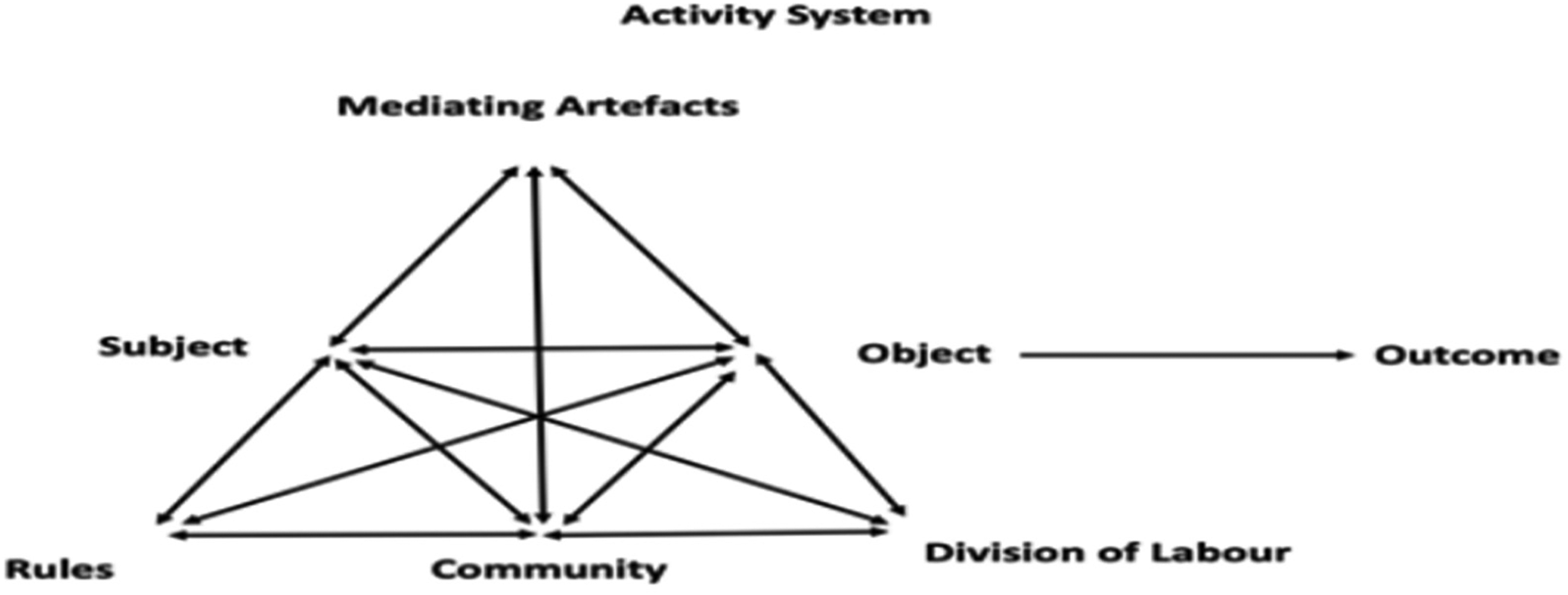
Activity System and Potential Challenges Related to Rules, Community and Division of Labour (Engeström, 1999).
This framework recognises learning and development as social phenomena and conceptualises human activity as object (goal)-oriented, collective and social. It provides a lens with which we understand human relationships as interwoven with a range of contradictions which are a driving force for change. The model as an activity system indicates an interaction between rules or social norms, community and division of labour (i.e., both horizontal division of tasks among the members of the community and the vertical division of power and status). In other words, it explores the interplay between social and individual processes in accessing ICT for learning, taking gender as a case study (Kang & Pyun, 2013). For instance, the (female) subject, as an agentic individual, directs activity (accessing ICT) toward an object—essentially the goal (learning)—which is transformed into an outcome through mediating artifacts such as tools (ICT) and language.
In this article, we unpack the issues of marginalisation to shed light on how the rules, discrepancies, contradictions, factors and social norms affect marginalised groups (including young girls) and create social contradictions, what divide and challenges the marginalised groups experience and what they think can be done to mitigate the situation (the object) and to be inclusive (the outcome). In other words, we employed the conceptual framework to analyse how the broader activity context (the context in which females access ICT) and the role of subjects (e.g., females), rules or cultural norms, and community interact or intersect in promoting or reducing marginalisation. We applied AT to identify the underlying contradictions and barriers marginalised students face when using technology and getting access to education.
Research Contexts
Gender parity has been recently achieved in school enrolment in Bangladesh and Nepal, and they have made considerable progress in providing access to education; enrolments for both boys and girls have gone up. In the context of Bangladesh, girls have surpassed boys in gross enrolment at all educational levels except the highest (Blunch & Das, 2015; Hahn et al., 2018; Tanaka et al., 2019). Nevertheless, who receives quality education is socioeconomically and geographically determined. A UNESCO report (2010) showed that girls from the lowest poverty quintile are marginalised and have limited access to resources and opportunities. Despite national efforts to address gender inequality, girls—especially from ethnic minority and impoverished backgrounds—face greater educational barriers than boys (Aziz, 2020b). In slum areas, child marriage and forced labour disproportionately affect girls’ education (Quattri & Watkins, 2019). According to Khondoker (2020), girls in the rural Hill Tracts areas of Bangladesh are less likely to access or complete schooling due to financial constraints, cultural norms, and lack of resources, resulting in significantly higher dropout rates compared to urban areas.
Similarly, in the context of Nepal, there is a low basic school completion rate of female learners and there are considerable differences in learning outcomes (literacy and numeracy) for children from marginalised castes and socioeconomic groups (for example, Dalit, Janajatis and Musahar girls), and children who reside in remote communities: “a national average of 41.7% for primary completion drops to 24.7% in hill regions and to an alarming 11.8% in the Terai” (Bhatt & Shrestha, 2022, p. 9). As pointed out by Cunningham and D’Arcy (2017), “it is common for boys to attend English-medium private schools, while girls attend less costly Nepali-medium government schools” (p.12). Furthermore, the authors argue that girls have little access to ICT and media which has affected girls’ capability development. Therefore, ways of combating discrimination in education need to be reviewed without delay.
As Al-Sammarai (2009) notes, inequalities and marginalisation persist beyond access to education. For instance, girls in the two research countries have little access to ICT and media, which has affected their capability development (Kukulska-Hulme et al., 2024). Indeed, girls in some social groups are not allowed to possess a phone, its abuse cited as a reason. This sort of inequality can have a knock-on effect on learning and building career pathways (Tyers, 2013). The COVID-19 pandemic exacerbated gender inequality, forcing more girls to drop out of their studies (Chinkondenji, 2022).
In both research countries, several efforts have been made to improve girls’ education and digital skills. For instance, the British Council implemented a project, ‘English and Digital for Girls’ Education’ (EDGE), in both countries which utilized non-formal community-based girls’ clubs that are effective in reducing barriers, developing girls’ English and digital skills. However, gender-based disparities in educational attainment and digital access remain acute (UNICEF, 2020a, 2020b), with girls being more vulnerable to exclusion and less likely to benefit from technological advancements (Malik, 2019).
The Study
Research Methodology
The study reported in this paper is part of a larger study which explored the role of technology in promoting and/or reducing marginalisation in four developing countries, namely Bangladesh, Nepal, Senegal and Sudan, and was funded by a grant from the British Council's Widening Participation programme. This paper focuses exclusively on the findings related to the roles of gender in marginalised children's use of technology for learning in Bangladesh and Nepal.
The premise of our study was that marginalised children (along with their parents and teachers) have important things to tell us about matters that concern them, and their voices need to be heard. We wanted to give power and voice to our research participants, which may provide insights into their subjective world, i.e., their lived experiences, the way they construct their own identity and perceive themselves, and the ways in which they perceive other members of their society. We believe that giving power and voice to research participants involves issues of research methodology that can create an opportunity for participants “to express their views freely and contribute to research agendas” (Grover, 2004, p. 28). We have used a qualitative research design and sought to privilege the voices, experiences, and lives of marginalised children along with their parents and teachers by involving them as active participants in our study.
Participants
A total of 80 students (male = 38, female = 40) aged 13–15, 32 parents (14 male, 16 female) and 8 teachers (3 male, 5 female) participated in the study. In order to select participants, in each country, four state schools (2 from rural and 2 from urban settings) were purposively selected and then 10 students in each school were purposively selected using the following criteria:
Students are 8th Graders At least 50% have little or no access to technology At least 50% are female Parents are illiterate or simply literate (i.e., with low education)
Similarly, two teachers in each school were purposively selected using two main criteria: there is a gender balance, and they teach different subjects. It was also ensured that the students interviewed were in the classes of the teachers. All the students selected for this study (n = 80) were from marginalised communities.
In Bangladesh, half were slum children from Dhaka (urban setting) whereas the other half were from Bandarban – a remote part of the country where the literacy rate is 34.0%. In Nepal, half were from a Squatter Community in the capital city (urban location) while the other half were from Tharu community, a marginalised ethnic community (rural location). Students’ parents (n = 16 in each country, 4 from each school) also took part in this study. The participating parents had different occupations (mostly rickshaw pullers, vendors, office clerks, cooks and domestic help workers). Additionally, eight teachers (2 from each school – one teacher of English and another teaching other subjects) in each country participated in this study. Figure 2 summarises participant information.
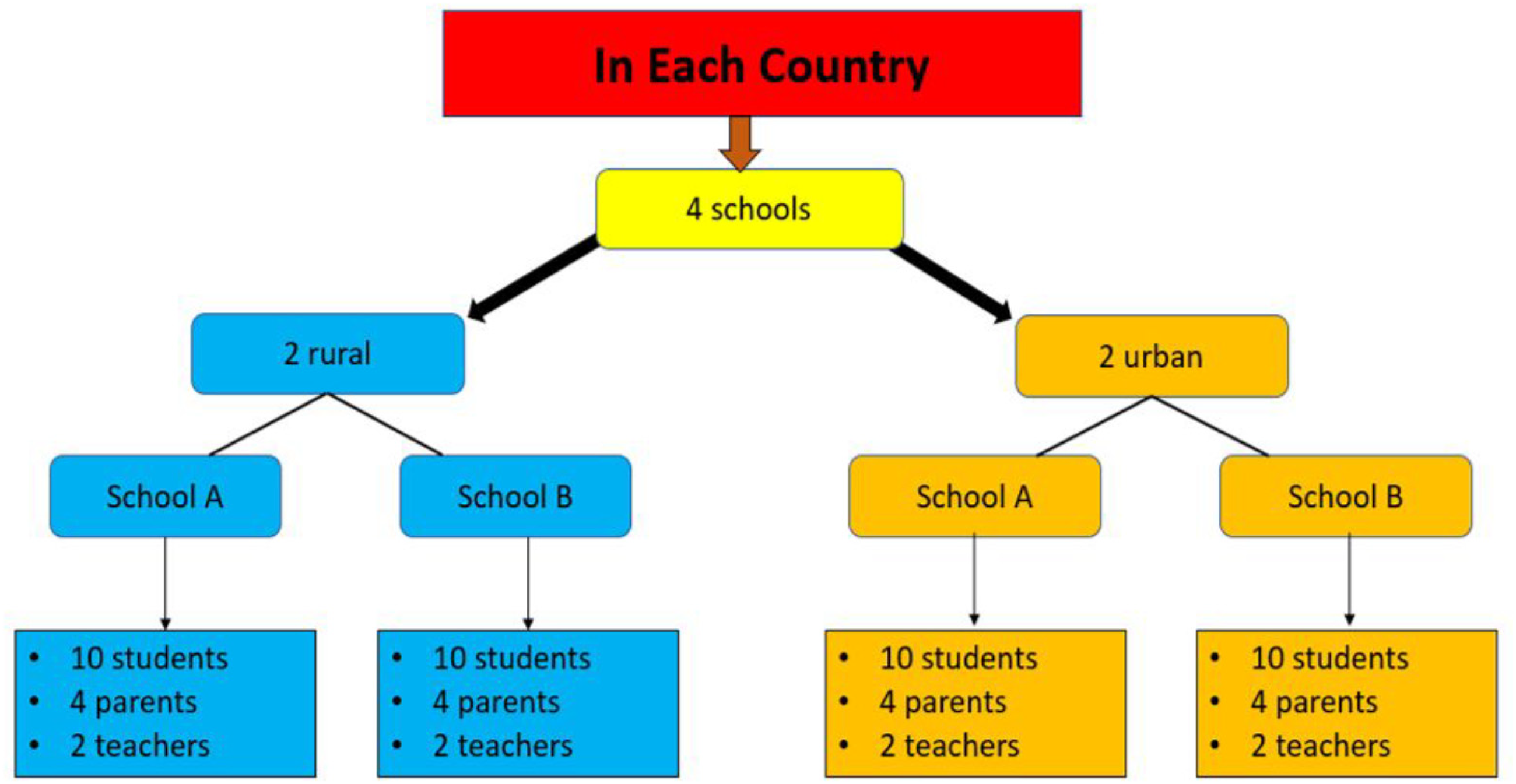
Research Participants.
Methods of Data Collection
Semi-structured interviews, focus group discussions (FGDs) and classroom observations were used as the main methods of data collection to facilitate conversation and participant engagement. Hence, a total of 16 (8 in each country) FGDs, each with 5 students, were conducted, followed by an interview with one student from each FGD. This means, a total of 16 students (male = 7, female = 9) participated in a follow up interview. The main selection criteria for the students that were interviewed from each FGD group was: they seem to have something more to share with the research team. It should be noted that during the FGDs and interviews, only the interviewer and students were present.
Additionally, a semi-structured interview was conducted with each parent (n = 32) and teacher (n = 8); two classes of each teacher were observed prior to the interviews. In order to facilitate the observations and collect focused data, a classroom observation sheet was used. During the observations, the major focus was on students’ access to technology, use of technology for teaching and learning, seating arrangement and the use of language in the classroom. The rationale for collecting data from different sources was to have rich information about the research issues.
The prompts for interviews and FGDs were designed based on the research questions that we wanted to address and the Activity Theory (Engeström, 1999) that guided this study. They concerned participants’ attitudes towards technology and experiences of using it for student learning. The prompts were piloted with groups of students (n = 10, 5 in each country) and teachers (n = 4, 2 in each country) prior to collecting data for the study. The pilot study indicated that the prompts were suitable, and that they would enable us to collect rich data from the participants.
During the discussions and interviews, our focus was on creating an environment that enables children to express their views freely to an adult researcher. For this, following Johnson et al. (2014), we used some key strategies such as: (a) building supportive and trustful relationships with the children; (b) creating a safe environment in which children feel able to speak in confidence and give their undivided attention; (c) using every child's name whenever possible as it conveys that the researcher is interested in them; (d) praising the children often for their contributions and not dismissing their opinions or cutting across their conversations, and ensuring that all children are listened to and feel included. Additionally, in order to ensure that students feel comfortable to share their ideas freely, the research team visited each school informally and developed friendly relationships with the participants before conducting any interviews and FGDs. Additionally, all the interviews and FGDs were conducted in the language that the participants felt most comfortable with. It is worth pointing out that all the FGDs and interviews were semi-structured and the prompts for the discussions included students’ access to and use of technology at home, at school and outside, participants’ attitudes and experiences of using technology, and use of the English language.
Indeed, we made every effort not to impose our views on children, but to encourage them to share their lived experiences of using technology in their learning. We listened to their views and respected each child. We also provided adequate responses to the questions that arose from children. Additionally, we took power dynamics into account that can lead children to respond in particular ways to interview questions. Therefore, we tried our best to underplay our role as a researcher and minimise the social and knowledge gap between researchers and participants. In order to ensure that we do not impose or bias the responses, we even allowed some time for the children to lead discussions as it might make them feel that they have some power (Johnson et al., 2014).
We used similar strategies while interviewing parents and teachers. For instance, we developed friendly relationship before conducting interviews, used the language that the participants felt most comfortable with and underplayed our roles as a researcher to reduce social and knowledge gaps between the participants and ourselves. We even adapted our schedules to the parents’ variable availability, to enable them to participate.
Research Ethics
The study was carried out in accordance with ethical guidelines from the British Educational Research Association (BERA, 2018) and ethics approval was obtained from the lead researcher's university (Ref number: HREC/4107). Informed consent was obtained from each participant (including children's parents) before collecting any data from them. During the FGDs and interviews, we made every effort not to impose our views on participants, but to encourage them to share their lived experiences of using technology for learning.
Data Analysis
All the interviews and FGDs were transcribed, translated, and the translations were coded into themes by the project team members (n = 6) employing a semi-directed thematic analysis approach. It was semi-directed since the coding scheme followed the Activity Theory framework domains. However, this does not mean that the coding overlooked aspects of interviews that are not covered by the framework. Thus, while being directed by Activity Theory, the coding was open to new categories. Activity theory framework codes included Tools (sub-codes – Technology at home, Technology at school, Technology outside school), Rules on the use of technology (subcodes – Rules to use technology at home, Rules to use technology at school, Community (People that students work with), Division of labour (sub-codes – How technology is used at home, How technology is used at school and outside), Attitudes towards the roles of technology, and Tensions/contradictions (sub-codes included- Gender norms for technology, Access to digital devices, Use of technology, Challenges faced in using technology; language used in the classrooms). Emerging or open codes included Roles of gender and Parents in gender digital divide. An inductive coding scheme was followed to ensure all the information relevant to the study was coded and NVivo was employed to aid the systematic organisation of themes emerging through the analysis.
Gender related findings emerged in two different steps. In the first step, initial codes and readings indicated some important cultural issues that affected girls’ access to technology. Therefore, in the second step, some text excerpts that indicated gender roles in using technology were identified. To minimise subjectivity of coding and to increase reliability of the findings, following Cheung and Tai (2023), 16 interviews/FGDs (22% of the data) were independently coded by a project team member and an independent researcher. The mean percentage agreement of 92.5% for the inter-coder reliability showed a good reliability level. Additionally, to avoid bias in the interpretation of our data, we adopted a fully collaborative approach to analysis to incorporate multiple views from research participants. There was a dialogue and a joint focus among team members regarding a shared body of data, to produce an agreed interpretation. For instance, regarding the two gender-focused themes, in-country leads were asked to reread the coded texts and take part in a discussion. Similarly, for the rest of the interpretation, due attention was paid to cultural aspects, and regular discussions were held with the in-county leads. Furthermore, since our literature search indicated considerable evidence around gender bias, it was crucial for us to avoid confirmation bias in our analysis and interpretation of the results. Hence, we followed an inductive approach to look at the data and had frequent discussions on the emerging themes with the in-country teams.
Findings
Findings of the study have been organised into two gender-focused themes, presented below.
Gender and Attitudes Towards Technology
Our findings do not reveal any explicit gender differences in terms of attitudes towards technology. Participants from all the three groups reported four major benefits of using technology: it facilitates and/or improves teaching and/or learning; it helps students understand the contents taught at school better; it creates better job opportunities; and it makes people's lives easier: Technology makes our life easier” (Student in Bangladesh) : “It [technology] helps to understand the lessons clearly, mainly to eradicate our confusion in lessons we learn at school” (Student in Nepal); “If they [children] know how to use technology, they’ll have better chances and job opportunities (Parent in Nepal).
However, some parents of both genders expressed negative attitudes towards technology. These parents do not seem to believe that technology helps their children in learning. Instead, they think technology distracts the children: We wouldn’t have given the phone as it causes problems with the studies, although we had to provide him with an old smartphone so that he could read and write for the exams. But we take the phone once he is done with the exam (Parent in Bangladesh).
Findings further indicated that parents, particularly in Nepal, make strict rules for children relating to technology use at home. In some families, children are allowed to use technology only when they have to do their assignments and take a test.
Teachers interviewed for the project suggested that technology plays a significant role in the lives of individuals, and it enhances their access to resources and learning. “Technology is important in our life … It also helps students in their learning” (Teacher in Nepal). Indeed, most participants expressed the view that their lives become complicated if they do not have functional knowledge of technology.
Findings further indicated some gender differences in terms of students’ motivation and interest to use technology. Almost all the teachers reported that girls are more interested in using technology “To my understanding, girls are more motivated to use technology. They are always interested to learn about it and also use it” (Teacher in Nepal).
Gender Equality and Differences in Using Technology
The findings of the study regarding gender equality in using technology are mixed. In terms of students’ use of technology at school, narratives from the participants indicated that there is no gender discrimination in schools: “There is not any discrimination between boys and girls in school” (Student in Nepal); “All our students get an equal opportunity to learn” (Teacher in Bangladesh).
Schools reported having some forms of technological devices, including computers, laptops, whiteboard and the internet: “We have a computer lab” (Teacher in Nepal); “In my school, there are laptops and computers” (Student in Bangladesh). However, it seems that there are not enough computers in schools and some computers are not in good condition: “There are ten computers in our lab. But only two are working properly. We use one computer for five students” (Student in Nepal).
Students in a couple schools, particularly in Bangladesh, reported having almost no access to technology: “We haven't got any. But our teachers said that they are thinking of bringing them to our school. No, we don’t have any access to internet in our school, nor do we have any usage of projector in our school” (Student in Bangladesh); “No, there is no technology, only have CC camera […] Doesn't use a mobile phone even. There is no computer. There is no projector” (Student in Bangladesh); “Nope, there is nothing digital in the school.” (Parent in Bangladesh).
Indeed, another notable finding is that students rarely get an opportunity to use technology in schools. During our classroom observations, we could hardly see any teachers and students using technology in the classrooms. Although schools reported having multiple devices (school owned devices included laptops, PCs, tablets, and overhead projectors), such devices were usually available only for teachers or administrators, and not students.
It was also found that schools make strict rules for students’ use of technology. For instance, students are not allowed to bring their digital devices to school. As reported by a student in Nepa, all technological items are prohibited by the school rules: “If you go to school with a phone, it is confiscated”. This means that students are not allowed to use mobile phones in their classrooms. Neverthelss, our study did not find evidence of any gender discrimination in terms of students’ access to technology in schools.
Findings of the study present a complex reality of gender equality in terms of access to and use of technology for learning at home. Although some participants reported that both boys and girls get an equal opportunity to use technology at home, there are some indications that female students in some families get fewer opportunities to use technology mainly for two reasons: they get less access to technology, and less time for technology use, as they have to do more household chores than boys: At present, many girls get to use the phone, but the number is less compared to boys. Especially for boys, they get to use mobile phones. Girls have a duty towards their home, so they don't get the opportunity like that (Student in Bangladesh). We have equal opportunity, but boys get more time to use it. We need to do more household chores at home (Student in Nepal).
Additionally, a few teachers reflected that boys enjoy more opportunities compared to girls because of the culturally constructed image of ‘son’ and the aim of capacitating sons for the emerging labour market in foreign countries: Boys are given a little more chance [to use technology], because in our village parents have intentions to send their son to foreign country for work (Teacher in Bangladesh).
Findings suggest that it is the parents who create gender differences in using technology.
They seemed to be more concerned about how their daughters use technology than their sons, especially mobile phones. So, they either do not allow their daughters to use technology or they take extra measures to monitor how their daughters use it: Parents generally do not provide mobiles to daughters in the threat that they abuse it, but they do not care about sons; so sons overuse that (Teacher in Nepal). For girls, I think that it would be good for them to have computers, but phones may not be appropriate for them. Because girls may use their phones for other things than learning (Parent in Bangladesh).
Some parents, particularly in Bangladesh, showed concern about the security of their daughters. So, they usually did not allow their daughters to use mobile phones: In the case of girls, usually guardians do not want to give mobile phones. Mobiles have negative contents. Almost all boys use mobile phones […] Parents do not feel it is safe to give a mobile phone to a girl child, because of negative contents or because of having love affairs with others (Teacher in Bangladesh). They [her parents] don’t give the phone to girls. What if we do bad things (Student in Bangladesh).
Additionally, parents seemed to be worried that mobile phones might help their daughters develop a relationship with boys (and/or find a boyfriend): Girls may use their phones for other things than learning. At the beginning, they may use them for learning but later they may be connected to others, probably boys, who may call them for a different purpose than learning. Boys start relationships and girls may find it difficult to refuse what boys propose to them (Parent in Bangladesh).
One of the parents in Bangladesh even reported that they have not bought any mobile phone yet, though they can afford it, as they want to ensure that their daughter does not have access to it: It is better to go without a mobile and it's also safe […] We have the opportunity to buy the mobile phone, but we don’t buy it because we are very careful with the girl. Don't you understand if Allah destroys honour (i.e., when she does something unethical using internet/smartphone) (Parent in Bangladesh).
The comments of two parents from Bangladesh raise a serious issue of gender equality in using technology in their family space. One parent said “Girls should not use a smartphone. It's only for my son.” And another parent of a female child said, “She [daughter] doesn’t use any [technology]. You can see, this is a very bad time, where bad things are done through the internet. The Internet has much more dark sides than positive sides.”
Both of these parents were concerned about a lack of security, abuse of technology and possible negative impacts on their children. Such a gender difference is not found only in Bangladesh. In Nepal as well, a few female children reported that they are not allowed to use smart phones when they go outside home. A Tharu girl said, “My parents do not allow me to use the mobile phone freely” (Student in Nepal).
Another girl from a squatter family in the city reported that she is not allowed to visit a cyber cafe and her brother always asks her if she has ‘unwanted’ chats: “They [family members] even watch what I see and who I talk to, they feel I may make unwanted talk with the boys” (Student in Nepal). However, a few parents in Bangladesh, although living in slum areas, expressed their willingness to provide their daughters with an opportunity to learn technology outside the home. They even regretted that because of the absence of computer centres in their area, their daughters were deprived of the opportunities to learn about technology. For instance, one mother said: ‘If there were any facility to use computers, I would send my daughter to learn too’’ (Parent in Bangladesh).
There are also some indications that girls use technology more sensibly than boys; and that boys and girls use technology for different purposes. For instance, a teacher from Nepal thinks that girls use technology for learning, but boys use it mainly for playing video games and they lose interest in their study. In the case of learning, girls are found to be more sincere [compared] to boys. They may use it for learning, but boys mostly play video games. This has become a problem in the case of some boys, they are losing attention in their study (Teacher in Nepal).
Another teacher commented in a similar tone, Girls use technology to make videos and post them on social networks. Boys use it by creating a group, chatting with friends, and playing games (Teacher in Nepal).
Narratives from students, parents and teachers from both countries reveal that there is no uniform understanding of gender and use of technology. Most of the children see hardly any gender difference in accessing and using technology. However, the analysis of narratives from parents and teachers shows that there exists a gender difference in access and use of technology for learning. Most parents in this study believe that there exist gender differences due to the threat to the safety and security of the female children. Because of this, many parents (as well as other senior members of the family) guard their female children and watch over their use of smartphones.
In summary, the study findings do not reveal any explicit gender differences in terms of attitudes towards technology. Almost all participants highlighted positive roles that technology can play in students’ learning. However, a gender digital divide exists in some families because of social reasons, though such a divide does not exist in schools.
Discussion
This section elucidates the ways in which community dynamics, social norms, and regulatory rules intersect to perpetuate social and educational exclusion of female students through restricted access to ICT in Bangladesh and Nepal. Findings reveal that gendered social norms and community expectations constitute powerful regulatory mechanisms that systematically constrain girls’ access to digital technologies, thereby reinforcing entrenched patriarchal structures that prioritize domestic and caregiving roles over educational and technological engagement. Indeed, gender inequality in ICT persists in the two countries as traditional socio-cultural structures and economic status continue to create barriers to girls’ access to technology. Gender stereotyping regarding the access and use of ICT seems to be a long-standing issue in the two countries that leads to gender imbalance in the use of ICT, with girls’ low participation in ICT (Tyers, 2013). Female students are less likely than male students to have access to digital devices and they use the devices less frequently at home. Therefore, they are less experienced in using digital devices (Malik, 2019). This may, in turn, negatively affect their learning practices and academic achievement, and limit their future career opportunities (UNICEF, 2021). The intersection of these elements manifests in several critical issues. Given below is a discussion of issues that emerge from the findings of the study.
Firstly, the study highlights that some communities in both countries uphold deeply ingrained patriarchal values that discourage girls from engaging with digital devices. Concerns about safety, morality, and family reputation are frequently invoked to justify restrictions on girls’ ownership and use of ICT. These collective attitudes are not merely individual biases but are embedded within the social fabric, making it challenging for girls to negotiate or resist these limitations without social repercussions. Consequently, community norms act as gatekeepers that regulate girls’ digital participation and reinforce gendered boundaries in technology use (Cunningham & D’Arcy, 2017). Secondly, beyond informal social norms, formal and informal rules within households and educational institutions further regulate girls’ ICT access. Parents and educators often impose stricter controls on female students’ technology use compared to their male counterparts, reflecting broader societal gender biases. These rules limit girls’ opportunities to engage with digital learning tools, thereby exacerbating educational exclusion (Tyers, 2013). For instance, parents in these marginalised communities in both countries were worried about their female children as they may use technology to connect with boys and develop undesirable relationships. Since love marriage is still not easily accepted in many families/communities in the two countries, it is not surprising that parents are worried about such issues. Despite this informal rule, as highlighted by Longjam (2022), parents feel stressed and anxious about their children's learning as they lack access to a reliable source of internet and technology.
Thus, the study's findings highlight how these systems, grounded in socio-cultural norms and rules, restrict girls’ agency and perpetuate gender disparities in educational technology access. In addition, the gendered division of roles within families and communities imposes disproportionate domestic and caregiving responsibilities on girls, which significantly reduces their available time and energy to engage with ICT for learning purposes (Cunningham & D’Arcy, 2017). This unequal allocation of labour not only limits girls’ practical access to technology but also diminishes their capacity to benefit from educational opportunities mediated by ICT, reinforcing cycles of marginalisation (Cunningham & D'Arcy, 2017). Finally, the contradictions identified within the activity system—between the aspirational goal of equitable educational access through ICT and the restrictive socio-cultural norms and community rules—expose systemic tensions that sustain gender inequality. Although ICT holds transformative potential to democratize education, these intersecting social factors inhibit female students from fully realizing such benefits, thereby entrenching existing patterns of social and educational exclusion.
Furthermore, with regards to attitudes towards the use of ICT, there is a plethora of literature suggesting gendered differences (see for example, Ardies et al., 2015; Aytekin & Isiksal-Bostan, 2019; Mawson, 2010). However, our data regarding this is inconclusive, indicating that there are no such definitive differences. This is in line with Ho (2004) and Dündar and Akçayır (2014) who suggest no gendered difference in terms of schoolchildren's attitudes towards technology. The study also found that girls are more interested in learning technology, which is inconsistent with a few previous studies indicating boys to be more interested in technology than girls (Ardies et al., 2015; Aytekin & Işıksal-Bostan, 2019).
To sum up, then, our study reveals that the confluence of community attitudes, gendered social norms, and regulatory rules creates a complex and reinforcing matrix of exclusion that limits female students’ access to ICT and educational resources. Addressing these intersecting barriers demands comprehensive and transformative interventions that challenge patriarchal norms, actively engage communities in redefining gender roles, and reform institutional and household practices to foster equitable access to technology. Only through such multidimensional approaches can the structural impediments to girls’ digital and educational inclusion be effectively dismantled, paving the way for their empowerment and enhanced learning outcomes.
Limitations of the Study
The study has revealed some interesting findings regarding the roles of gender in using technology for student learning in developing contexts. More research is needed to verify the findings as they are not conclusive. The study has some limitations. The first concerns its sample size, which was restricted to 128 participants in each research country. This may limit the generalisation of the research findings. Future research in this area with a larger sample obtained from the same or similar populations is recommended to validate the findings of this study.
The second limitation considers translation of the data. All the interviews and FGDs were conducted in national languages of the research countries and then translated into English.
Even though we tried our best to ensure that translated data faithfully captures the original meanings that the participants expressed as part of this study, the process is not without its drawbacks. Another limitation of the study concerns qualitative data coding. Despite great efforts to code the data with rigour, it is possible there could have been some inconsistencies while coding the data.
Conclusions and Implications
The study applied Activity Theory to explore socio-cultural and economic situations in which female students’ use ICT for accessing learning resources. It points out a stark reality that, despite notable progress made in school enrolment for girls in Bangladesh and Nepal, deep-rooted gender inequalities continue to hinder female students’ access to and effective use of digital technology for learning. The research reveals that traditional socio-cultural norms, economic constraints, and entrenched gender stereotypes collectively form a complex barrier that marginalises girls, limiting their educational opportunities and digital inclusion.
Female students in marginalised communities face a myriad of intersecting inequalities—social, cultural, economic, and digital—that shape their life chances and learning experiences. These barriers are not merely about access to devices but are embedded in social norms, attitudes and household rules that restrict girls’ technology use, reinforcing their roles as care-providers rather than learners and digital participants. The study's findings highlight that even as governments promote digital education, the lived realities of girls in these contexts reveal persistent exclusion driven by patriarchal norms and economic hardship.
The discussion of findings above has shown that despite technological advancements in Bangladesh and Nepal, the socio-economic and cultural factors create barriers that affect girls’ access to and use of technology. The study reveals that though marginalised children, along with their teachers, have positive attitudes towards technology, students rarely make use of technology for learning.
The study has several important implications. The first implication concerns the gender-divide that exists mainly because of parental restrictions. These findings question the roles of parents in student learning. Parents are concerned that children, particularly girls, can misuse technology and it can be harmful for them. However, there are equal chances that boys also misuse technology, and they are also vulnerable to digital abuse. Therefore, instead of controlling only daughters’ use of technology, parents could make their children aware of the negative sides of technology.
Female students have lower levels of access to and use of digital technology than boys at home. So, they are not benefiting from digital technology in the same way as boys. A good quality education, designed based on female students’ immediate and strategic needs to use technology for learning, will enable them to learn more effectively and better prepare them to seize opportunities in the public and private domains, leading them to have a better career in future. Therefore, concerned authorities need to ensure that a policy and provision are in place to give children equitable access to technology.
Moreover, sudden transition to online education during the COVID-19 pandemic (20020–2022) exacerbated these inequalities, pushing more girls out of school and further limiting their access to ICT, which is increasingly vital for education. The study calls for urgent, multi-layered interventions that go beyond infrastructure provision to address the socio-cultural and economic dimensions of exclusion. This includes community engagement to challenge gender norms, policy reforms to ensure equitable access, and pedagogical strategies that empower girls as active technology users and learners.
Bridging the gender digital divide in education requires listening to the voices of marginalised girls themselves and recognizing their experiences as central to shaping inclusive digital learning environments. Only through such comprehensive and context-sensitive approaches can the promise of technology as a tool for educational equity and empowerment be realized for all children, regardless of gender.
Footnotes
Acknowledgements
The research project was developed with funding support from the British Council. It is a collaborative project between researchers in the UK, Australia, and in partner universities in the target countries.

Funding
The authors disclosed receipt of the following financial support for the research, authorship, and/or publication of this article: This work was supported by the British Council.
Declaration of Conflicting Interests
The authors declared no potential conflicts of interest with respect to the research, authorship, and/or publication of this article.