



Abstract
As distance learning is a broadening mode in education, students have new roles: they are responsible for arranging their surroundings so that it supports learning appropriately. Eventually, teachers and educational institutes have a decreasing role as facilitators of physical learning surroundings. In this paper, we examine how students experience the impact of contextual factors in their everyday lives in distance learning settings. The flora, fauna and good weather emerged from the data as the characteristics of contextual features in distance learning. Our framework of the contextual reality is derived from the findings of a survey (n = 93) conducted in a higher educational institution. The results deliver contextual factors which have an impact on learning experience: environmental, personal, social, task, spatiotemporal change, device, service, access network, and time. Considering the ambivalent characteristics, we offer viewpoints to incorporate contextual factors for the technical and pedagogical development of distance learning systems.
Keywords
Introduction
With the technological advances of digitalization enabling a more symbiotic relationship with computers, educators have discovered innovative methods to actively engage with students (Barbetta, 2023; Stephanidis et al., 2019). The transition from a face-to-face classroom to a remote setting has been swift (Bates, 2018; Barbetta, 2023; El Said, 2021), even before the pandemic (Bates, 2018). With the increasing popularity of distance learning and discussion about the impact of it-systems on learning is a need for further exploration of the supportive actions and infrastructure for distance learning (Musumba & Wario, 2019; Singh et al., 2021).
Students’ satisfaction with distance learning hinges on factors such as their background, experience, collaboration, interaction, and autonomy (Abuhassna et al., 2020). Furthermore, the level of satisfaction also impacts their academic achievements (Abuhassna et al., 2020). When studying outside the campus, learning is more susceptible to interruptions compared to the traditional classroom. Students may also experience a scarcity of resources, such as devices, software, and the associated technical skills (Owusu-Fordjour et al., 2020).
The unpredictability of daily life and the complexity of the informal context place high demands on students’ productive autonomy and self-regulation (Turan et al., 2022). Educators must enhance their teaching practice to better support distance learners (El Said, 2021), and comprehend the context in which learning occurs to effectively address their learning demands.
Contextual factors have been studied in general for user experience (UX) design (Korhonen et al., 2010; Lallemand & Koenig, 2020). Previous studies of distance learning have highlighted the importance of understanding the student's experience (see eg. Adi Badiozaman et al., 2024; Althunibat et al., 2023; Bates, 2018; Deng & Benckendorff, 2021; Dirin & Nieminen, 2015), especially in ubiquitous settings in higher education (Adi Badiozaman et al., 2024; Faimau et al., 2022). There have already been studies such as (Kari et al., 2020) on how context affects continuance in exergaming. Nonetheless, there is limited evidence regarding how contextual factors may impact the learning experience and levels of students’ satisfaction (Virtanen et al., 2018). However, prior research suggests, that multifarious contexts play a significant role in shaping the learning environment and overall learning experience (Faimau et al., 2022). The it-system approach has previously been studied within the context of ambivalent learning environments, aiming to support adaptability in students’ choices of learning materials (Musumba & Wario, 2019). We emphasize factors that can either encourage, disrupt, or support the learner, with the goal of aiding in the design of learning environments that consider the practical context of the everyday lives of higher education students engaged in distance learning.
Ng (2021) provides a roadmap for improving distance learning with three perspectives: individual learning space, physical environment (behavior setting), and virtual environment, and points out the need to address ambient features and behavior settings affecting distance learning. Ciordas-Hertel et al. (2021) present the model of cognitive, physiological and affective effects introducing contextual and spatial elements impacting the distance learning situation. In the model context dependency and special comfort are introduced and opened for more detailed elaboration. This article examines the natural, everyday context of students in the distance learning surroundings complementing the models proposed by Ng and Ciordas-Hertel et al. We describe the versatility and adaptability of learners’ context, exploring how physical, emotional, and social factors can influence the learning experience. Through this, we aim to provide an understanding that can be used to enhance the design and user experience with the identified research gap about strategies to provide education for successful learning, and the phenomenon of human life with technology (see e.g., Bates, 2018; Stephanidis et al., 2019). This knowledge can support crafting simple, engaging, and enjoyable distance learning experiences that foster sustained participation in distance courses. Consequently, it is essential to understand the learner's needs derived from their natural context.
In this research, we employed a qualitative survey as a method for data collection, conducted at the Finnish University of Applied Sciences. The typical higher education institution (HEI) in Finland is an example of HEIs in general, since educational it-systems are adopted across various cultural regions, including the United Kingdom (Scalabrin Bianchi et al., 2021), Germany (Osadcha et al., 2023) or United States (Powell, 2020). To delve into the student's perspective on the learning experience within their situational context, selected groups of distance learning students were invited to respond to the survey. We applied both qualitative and quantitative data analysis methods, using Atlas.ti to analyse the content.
Theoretical Framework
Distance Learning
Distance education can be described as a general concept of remote learning, in which there are no physical classes on campus (Bates, 2018). In this mode, learning can happen completely online or in a blended setting, where students can visit the classroom occasionally for e.g., teamwork or personalized support. In distance learning, students can be governed by a synchronous schedule, or be free to work at their own pace (Bates, 2018). As today's learning management systems can be accessed any time of the day and with different digital devices, students are free to choose the natural context in which they engage the learning activities. This makes the learning experience highly personalized and interactive, as the different technological systems can identify the learner's technological context and customize the learning experience accordingly (Schmidt & Huang, 2022).
Designing Good Learning Experiences
The design of digital experiences is guided by the UX methodology, which takes a humane, activity-oriented approach to user interfaces that enable people's interactions with technology, brands, products, and services (Law et al., 2009). Often digital learning experience is considered to build up with interaction with learning management system (Althunibat et al., 2023). Recently, academic discussions have been expanding towards more holistic approaches, expanding user experience beyond interfaces to enhance overall user satisfaction across various digitally driven industries (Linxen et al., 2021; Roto et al., 2018).
As learning services are provided through distance learning management systems, they too can benefit from experiential inspection from the viewpoint of users. However, the area of Learning Experience (LX) design takes these ideas closer to the context of education, adding more layers to the picture (Schmidt & Huang, 2022). Even though no clear consensus has been established on what LX entails, we already know many characteristics of satisfying learning experiences. Martin and Bolliger (2022) express a good LX design to be a mix of learner-, course- and instructor-related factors, as well as the program and organization-related aspects of the learning experience. Course design influences improving the learning experience in general leading to a positive learning experience (Deng & Benckendorff, 2021; El Said, 2021). Previous authors have highlighted the importance of the it-system design approach in supporting learning and teaching activities in distance learning (Singh et al., 2022). The significance of it-system design in creating learning experiences for evolving contexts is recognized (Ciordas-Hertel et al., 2021; Ng, 2021).
Other characteristics include the perceived quality and methods of teaching, as well as the space learning takes place in, along with its related equipment (Iordache-Platis, 2018). The way in which the user engages with the content and the amount of cognitive load can be subject to conscious design (Rohles et al., 2022). Also, students value the sense of community and interaction with peers (Awidi et al., 2019; El Said, 2021) which is often missing from the distance learning experience. Learning experience design regarding people's needs, their contextual factors and individual experiences emerge as unrevealed perspectives towards LX (Schmidt & Huang, 2022). A need towards more holistic approach to designing learning experiences is recognized in previous literature (Deng & Benckendorff, 2021; Schmidt & Huang, 2022), as learning experiences can be considered intricate and varied (Deng & Benckendorff, 2021).
Understanding the Context of Learners
Context as a concept in the HCI tradition is not easily defined, since there are numerous aspects affecting it and it is dependent on different (Dirin & Nieminen, 2015) and various ethnographic phenomena (Dourish, 2004). The context of use is related to how people interact daily, considering the changing and uncertain nature of life and the world (Dourish, 2004; Louhab et al., 2018). Understanding the context of use is central when designing technology used in different fields and practices (Dourish, 2004), and in education (Dirin & Nieminen, 2015). The concept of context should be seen as a dynamic idea since many usage situations are often varying (Greenberg, 2001). Recent definitions follow the earlier understanding of the context of use and emphasize its significance in UX. Individual experiences are acknowledged as perceived contextual dimensions, which manifest across various types of contexts, such as physical, social, internal, technical, task and temporal (Lallemand & Koenig, 2020).
The contextual factors of use are defined as specific surroundings, environment, and conditions of use for a particular design solution (Lazar et al., 2017). Context of use in mobile human-computer interaction is defined as to construct from different forms of use: physical context, task context, social context, technical and information context, and temporal context (Roto et al., 2011, see also Lallemand & Koenig, 2020). The physical context describes the situation in which human-computer interaction occurs. The task context refers to interruptions and multitasking during device usage. Social context and temporal context impact device usage, encompassing when and how long it's used, from specific moments to years. Additionally, the framework considers technical and information context, which describes the complexity of the device entity in which the mobile computer is used (Roto et al., 2011).
The contexts of use features are similar in mobile HCI, but the transition-related phenomena in HCI refer to occurring changes in the other contextual components (Jumisko-Pyykkö & Vainio, 2010). Context of use is often described as a central concept in user experience (Bargas-Avila & Hornbaek, 2011; Lallemand & Koenig, 2020). As distance learning can happen with different kinds of software tools and in versatile locations, these frameworks are relevant. Korhonen et al. (2010) have outlined the context factors categories for mobile users: environmental, personal, social, task, spatiotemporal, device, service, and access network. Researchers suggest that these affect user experience. Environmental factor means the properties of the physical environment in the user context. Personal factor indicates the feelings of the user. Social factor refers to other persons present during the system used in the physical context. Spatio-temporal factor signals to context environmental changes over time. The service factor emphasizes the features of the service and interaction with the service provided via the information technology system. Access network factor refers to internet connection and its reliability (Korhonen et al., 2010).
In recent studies in the HCI field, the context has been understood as a combination of human and nonhuman aspects (Entwistle et al., 2015). The Contextual Wheel of Practice categorizes contextual elements into four: societal structure, infrastructure, near materiality, and the individual. The it-system usage has social, cultural, and material settings in the everyday practices of users. Societal structure refers to formal and informal norms. Infrastructure includes physical environmental aspect, which affects behavior. Near materiality refers i.e., to technology or room appliances. The individual signals one's personal values (Entwistle et al., 2015).
Research Questions and Methodology
The objective of this study is to investigate the impact of situational context on the distance learning experience. To achieve this, we address the following research questions:
RQ1. What are the contextual factors affecting the distance learning experience?
RQ2. What is the impact of identified factors on the distance learning experience?
This research follows the academic endeavors of the Human-Computer Interaction community, which has concentrated its attention on human-oriented, context-aware approaches (context-aware systems) (Gurcan et al., 2021). The recognized contemporary challenge in HCI is in the relationship between humans and the technological ecosystem, which is understood as an entity with a physical and digital world (Stephanidis et al., 2019). Context of use also falls into this continuum which is also relevant in an educational setting (Dirin & Nieminen, 2015).
This empirical survey describes how English- and Finnish-speaking students of the higher educational institution experience their distance learning environment. We describe the state of their distance learning contexts descriptively (Braun et al., 2021), using mainly qualitative methods and a naturalistic stance. We observe the students’ subjective reality as they perceive themselves the experience (Lazar et al., 2017; Wohlin et al., 2003, p. 15), with a qualitative survey (Braun et al., 2021). However, our work should be considered interpretive, since its goal is to comprehend the various interpretations, students give to their personal context in the distance learning experience (Orlikowski & Baroudi, 1991).
Qualitative Survey as a Data Collection Method
This research employs a qualitative approach to investigate e-learning phenomena in their natural environment, a suitable approach in software engineering research. Distance learning involves multiple persons, e.g., students, peers, and teachers interacting with technology in distance learning environments leading to complex real-life issues (see e.g., Lazar et al., 2017).
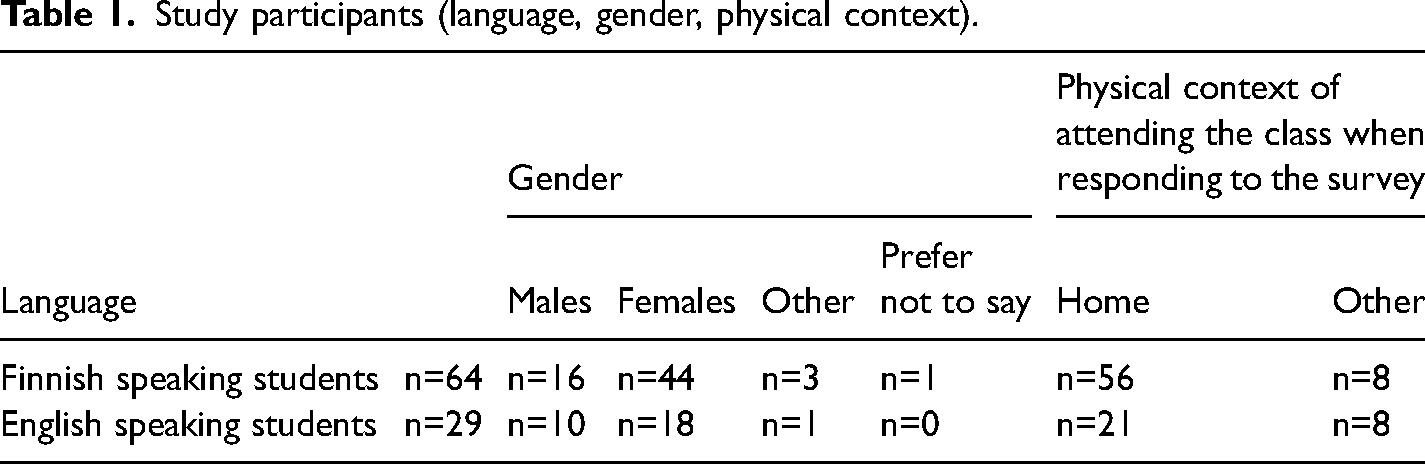
This study was conducted at higher educational institution in the Department of International Business, and Business Information Technology. The chosen higher educational institution is a typical Finnish university, with diverse Business Information Technology students in both Finnish and English degree programs. The research subjects exhibit homogeneity in gender and work experience proportions. Background information is gathered and analyzed to depict the participant's diversity. Tables 1 and 2, display the requested background information, encompassing gender, approximate number of completed credit units, years of work experience, and the e-learning context (physical). Figures 2 and 3 describes the survey participants’ most typical physical learning space during their studies and most used technologies in their studies. The language information in the participants’ background information was asked to report by the degree language, Finnish or English.
Study participants (language, gender, physical context).
Study participants’ study phase and work experience.
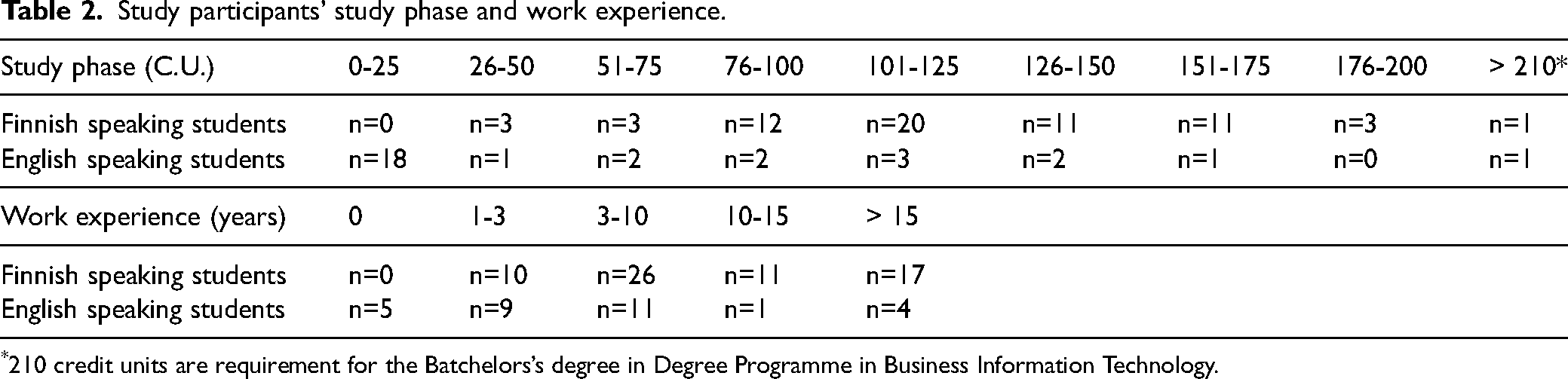
210 credit units are requirement for the Batchelors’s degree in Degree Programme in Business Information Technology.
We used a survey as a qualitative empirical inquiry research method and analyzed the results with qualitative analysis methods (Braun et al., 2021). The survey instrument was created especially for this study since a proper survey instrument was not found for this research context (Kitchenham & Pfleeger, 2002a, 2002b). The scope of the survey created was to explore the phenomena of distance learning, but some questions were precisely focused on the objectives set beforehand. The authors with their experts in supporting learning as educators, revised both open-ended and closed questions to enhance respondents’ comprehension and facilitate their responses. After piloting the questionnaire, some alterations were made based on the direct feedback and indirect feedback based on the answers (Kitchenham & Pfleeger, 2002a, 2002b).
Data Collection and Sample Description
The data was gathered from fifteen distance learning courses in the Spring, Summer, and Fall semesters in 2022 (Figure 1). In the courses, there were approximately 600 students participating. The learning management system (LMS) for the courses is Moodle v.3.9 to support learning. The online tool for the teacher for meeting the students is Zoom v.5.14.2 or Microsoft Office Teams v.2016 or there are no online meetings with teacher at all.
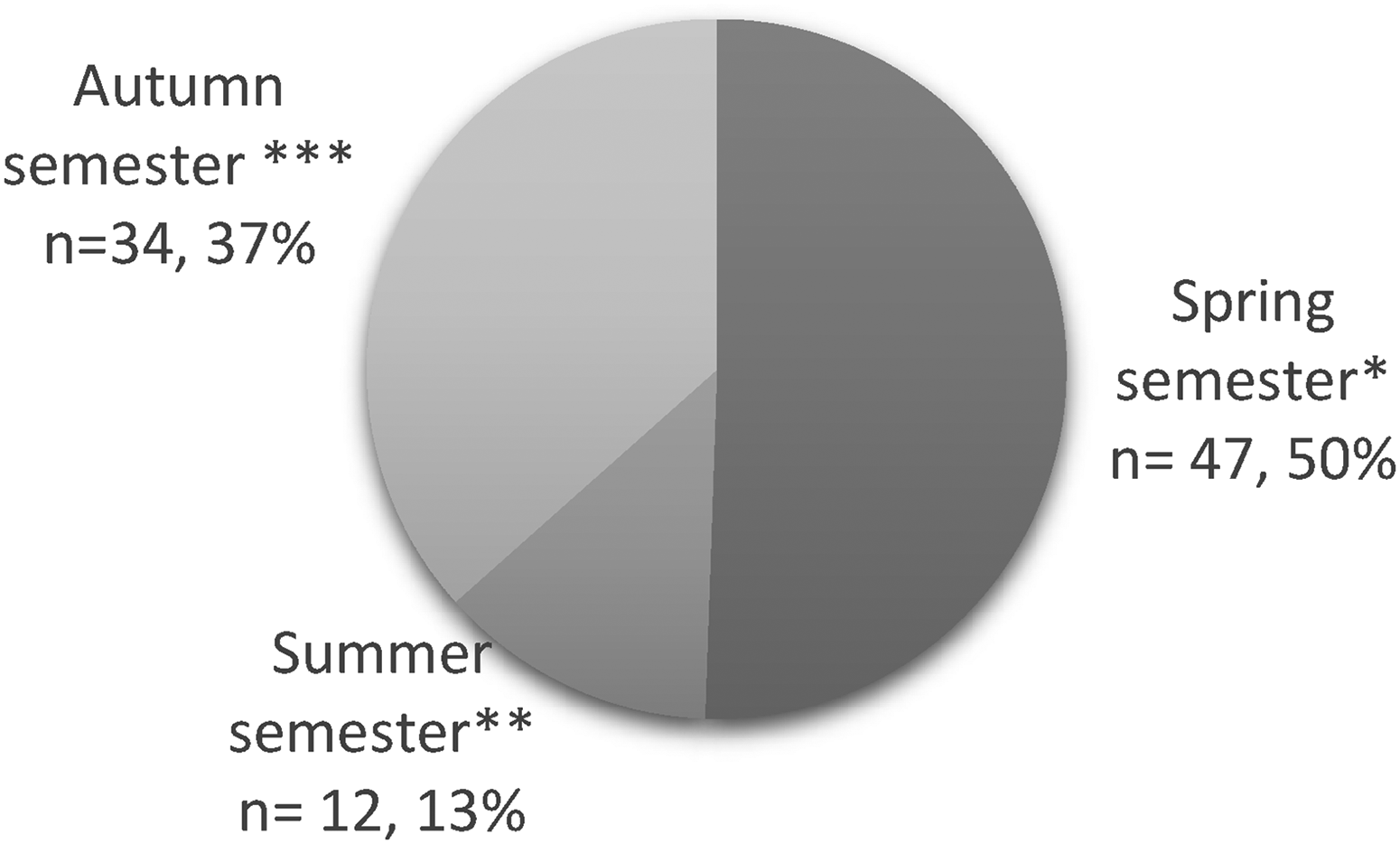
Survey replies (% values from the total n) in the year 2022. *January – April, **May – July, ***August – December.
Participating to the research was voluntary, but approximately 90 answers was expected to accomplish acceptable quantitative research sample size for rich qualitative data (Braun et al., 2021). The qualitative survey was conducted with Webpropol version 3.0, and the survey link was sent via LMS to students. The follow-up reminders were sent once after the first invitation to participate. 93 survey responses were received.
The sample and study participant profiles are described in Tables 1 and 2 and in Figures 2 and 3. The physical context of attending the class on the day the survey was filled was mostly home. The other contexts mentioned were public transportation (n = 2), coffee shop (n = 3), hospital (n = 1), outdoors (n = 3), summer cottage (n = 1), campus (n = 2), workplace (n = 1) and library (n = 3). The participants informed their most typical learning environment or learning space during the last month was home (Figure 2). The participants were allowed to choose as many options as they wanted. The result indicated that the participants are mainly doing their studies remotely or in hybrid-mode, when studying is happening partly at the campus and partly remotely. The other physical spaces reported were hospital (n = 1), outside (“walking”, n = 1) and summer cottage (n = 2). Additionally, the participants informed what technologies they have used for studying (Figure 3). The other technologies reported were an additional screen (n = 1), pen and a paper (n = 2) and television (n = 1).
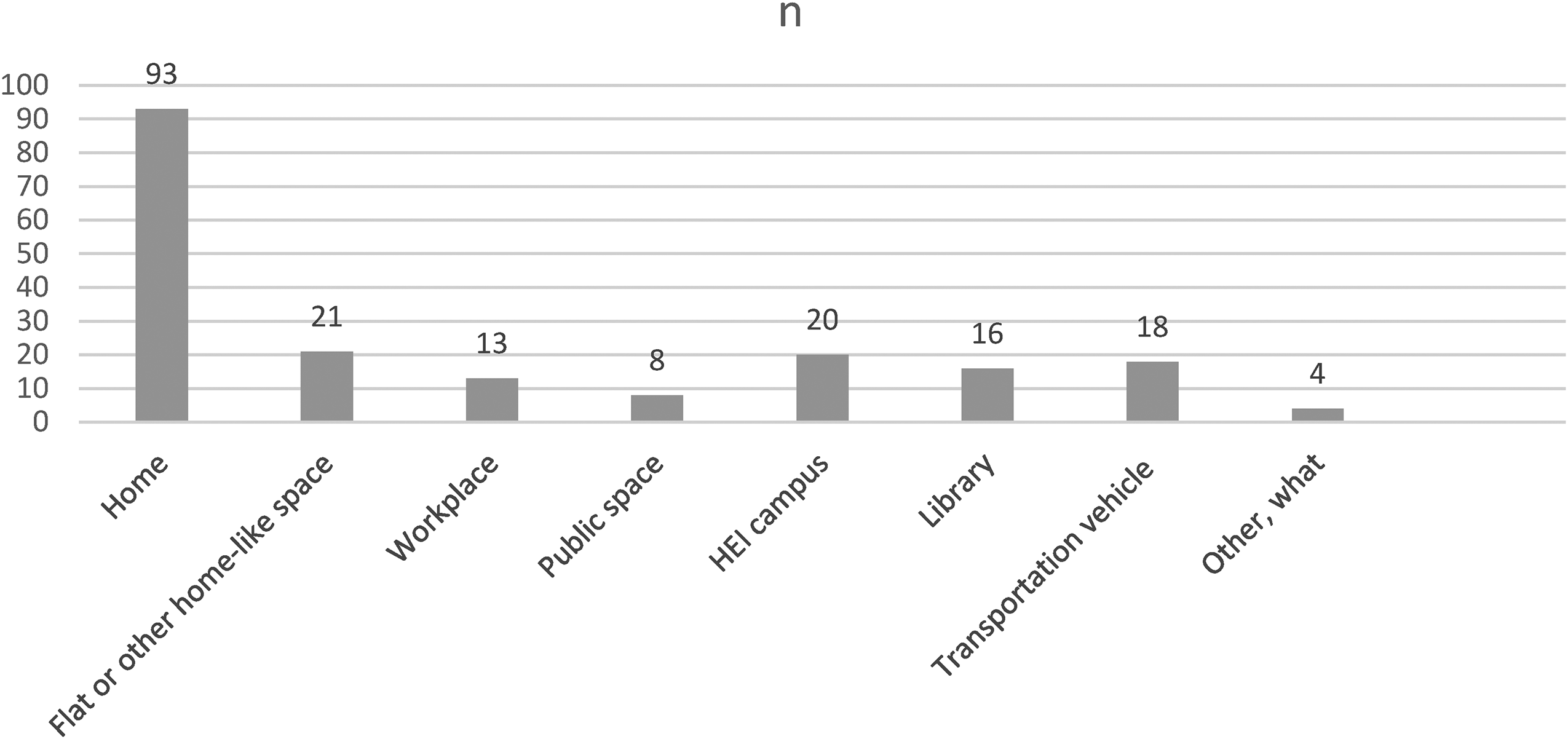
The most typical physical learning environments survey participants informed they have studied during the last month.
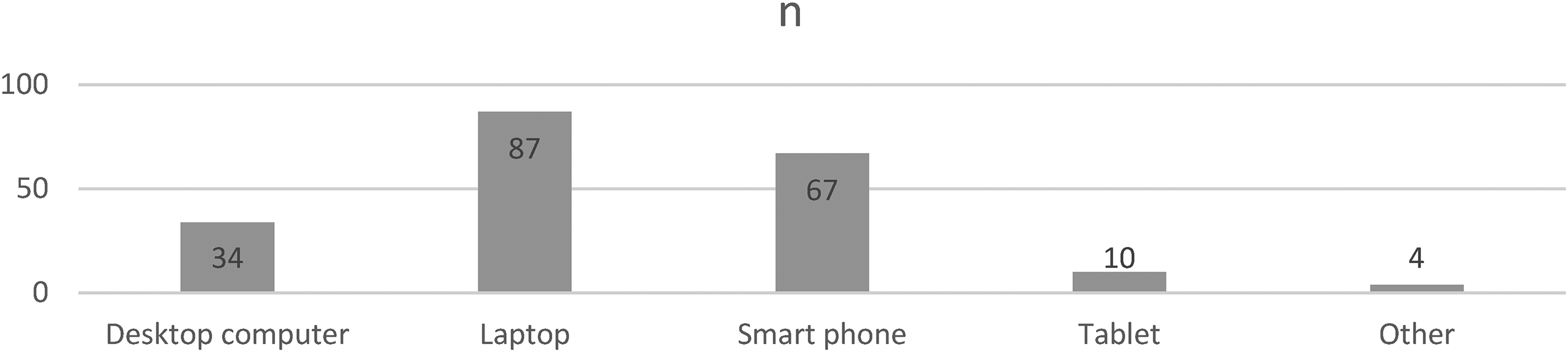
The technologies survey participants informed they use for distance learning.
The participators’ studies at the UAS typically encompassed 70–100 credit unit (cu) on average, out of a total 210 credits required for Batchelors Degree. This indicates that in average the students were almost in the middle of their study path. Participators’ median work experience was 3–10 years. Therefore, it can be stated that survey participating students are in their early career phase mainly, but some of the participants are already reasonably experienced in their career. The survey participants were college aged students (age ≤ 30 years, n = 61) and adult learners (age >30 years, n = 32).
Results
The qualitative data from surveys’ open-ended questions was analysed in two parts with the qualitative data analysis software Atlas.ti v.9. At first, the data from open ended survey questions modified based on the previous literature was analysed: What factors had a positive impact on your distance learning today? Name the three most important., and What factors had a negative impact on your distance learning today? Name the three most important. The analysis was conducted by theory-driven content analysis a priori (Lazar et al., 2017), as the framework for code categories used based on context categories according to Korhonen et al. (2010). The categories used in coding were: Environmental, Personal, Social, Task, Spatio-Temporal, Device, Service and Access Network. The coding is presented in the Table 3. In the coding subcategories were found for categories in the used framework (see Table 3). Additionally, one more category for time was discovered from the data. Subcategories were derived from the data. This emerging code is known phenomena (Xavier & Meneses, 2022), but not presented in the theoretical framework (Korhonen et al., 2010) used for coding. The coding was executed separately first by the second authors and then by the first author. From the data from two survey questions 472 analytical units were found, negative contextual factors affecting learning 188 units and positive contextual factors affecting learning 284 units. Krippendorff's Alfa was calculated to evaluate intercoder agreement for reliability (Krippendorf, 2004/2012/2018).
Positive and negative factors affecting on learning experience, categories, frequencies, examples and Krippendorff's Alpha
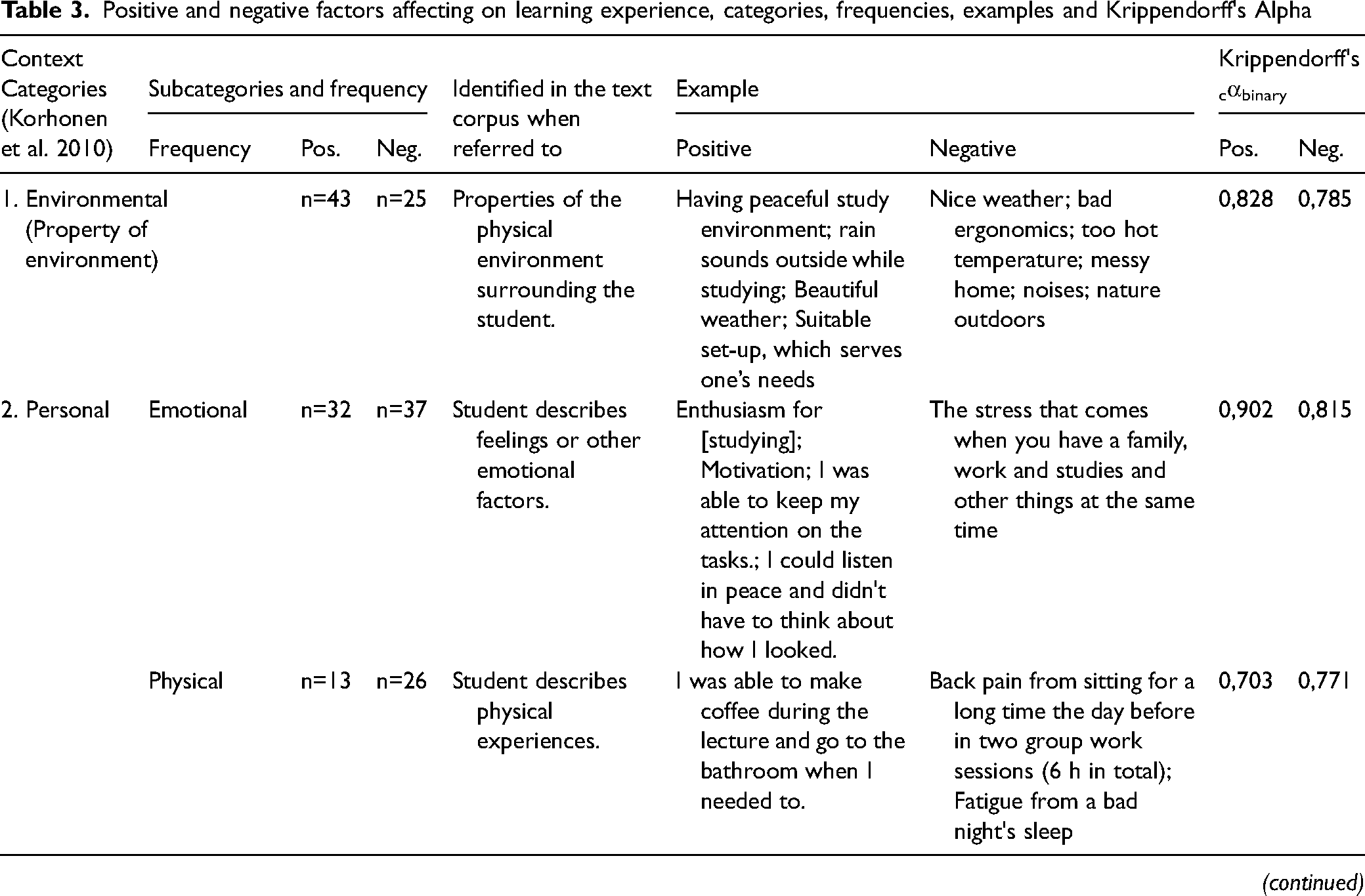
Based on the students’ reported perceptions about the factors they felt affected negatively or positively in their studying context following was discovered. The category frequencies indicate that most positive learning affects time-related issues (n = 50), service–course level (n = 48), property of environment (n = 43), social-people factors (n = 40), and personal emotional factors (n = 32). The most negatively affecting factors on learning are personal emotional factors (n = 37), service–course level factors (n = 30), tasks i.e., primary or secondary activity (n = 24), time-related factors (n = 20), and social–people factors (n = 19). Based on the frequencies it can stated that service–course level factors can affect significantly both negatively and positively. Also, personal emotional factors can affect positively and negatively on learning. Social – people factor affects both negatively and positively, but data indicates that the positive side is stronger. Time-related factors can be interpreted to affect positively or negatively, depending on the time resource viewpoint. In this qualitative survey data, factor categories Social – animal (total n = 2), spatio – temporal (change) (total n = 13), device (total n = 7), and access network (total n = 12) have less significant meaning for learning. Service – teacher category (total n = 20) seems to indicate, that teachers’ role might be moderate in this data when considering factors affecting learning.
In Figure 4 (positive) and Figure 5 (negative), percentual rates of each main category are presented. In the visualization, the category frequency is compared to the number of answers (n = 93) to reveal the significance of a category. In the positive factors the most significant context categories that surveys participants report to affect their learning are Environmental (46.2%), Personal – emotional (34.4%), Social – people (43.0%), Service – course level (51.6%) and Time-related issues (53.8%), see Figure 4.
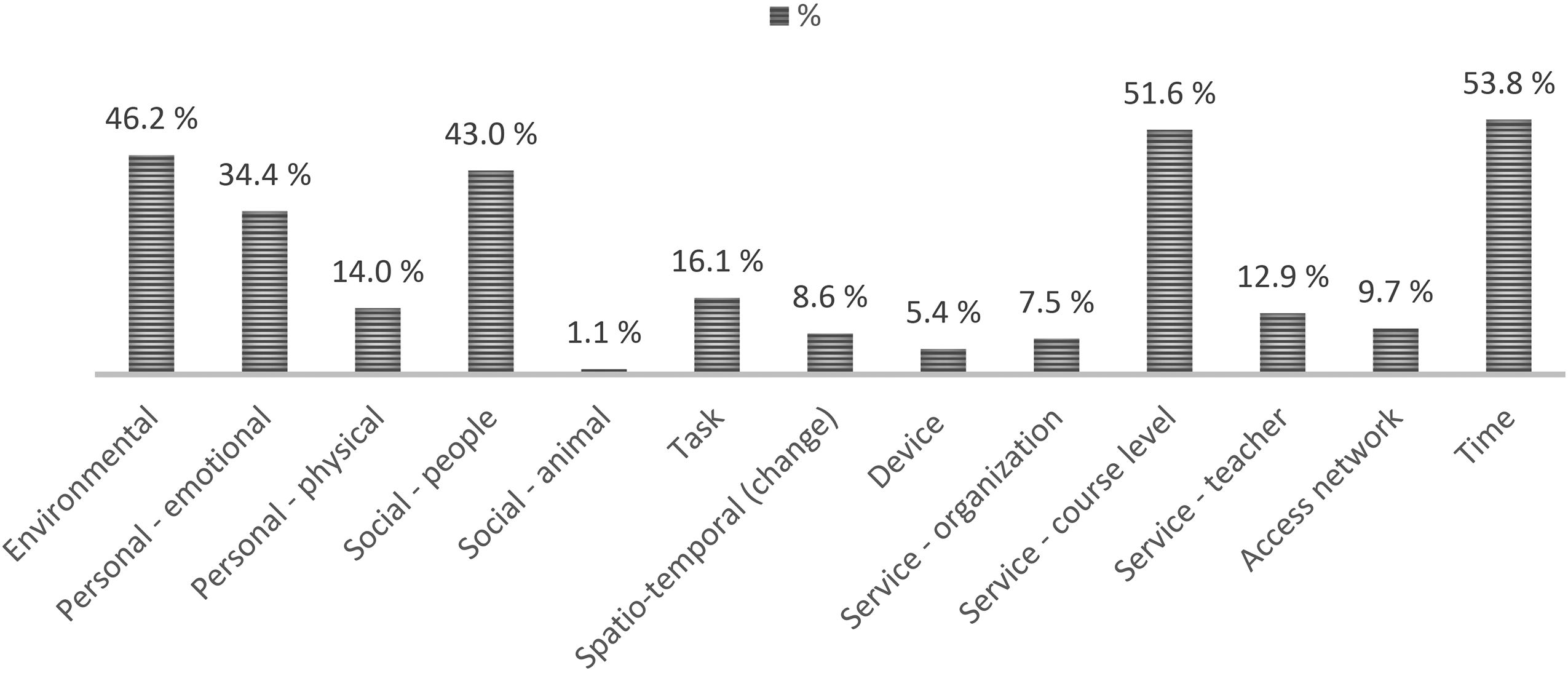
Positively mentioned contextual factor categories and sub-categories, percentage distribution compared to the number of answers (n = 93).
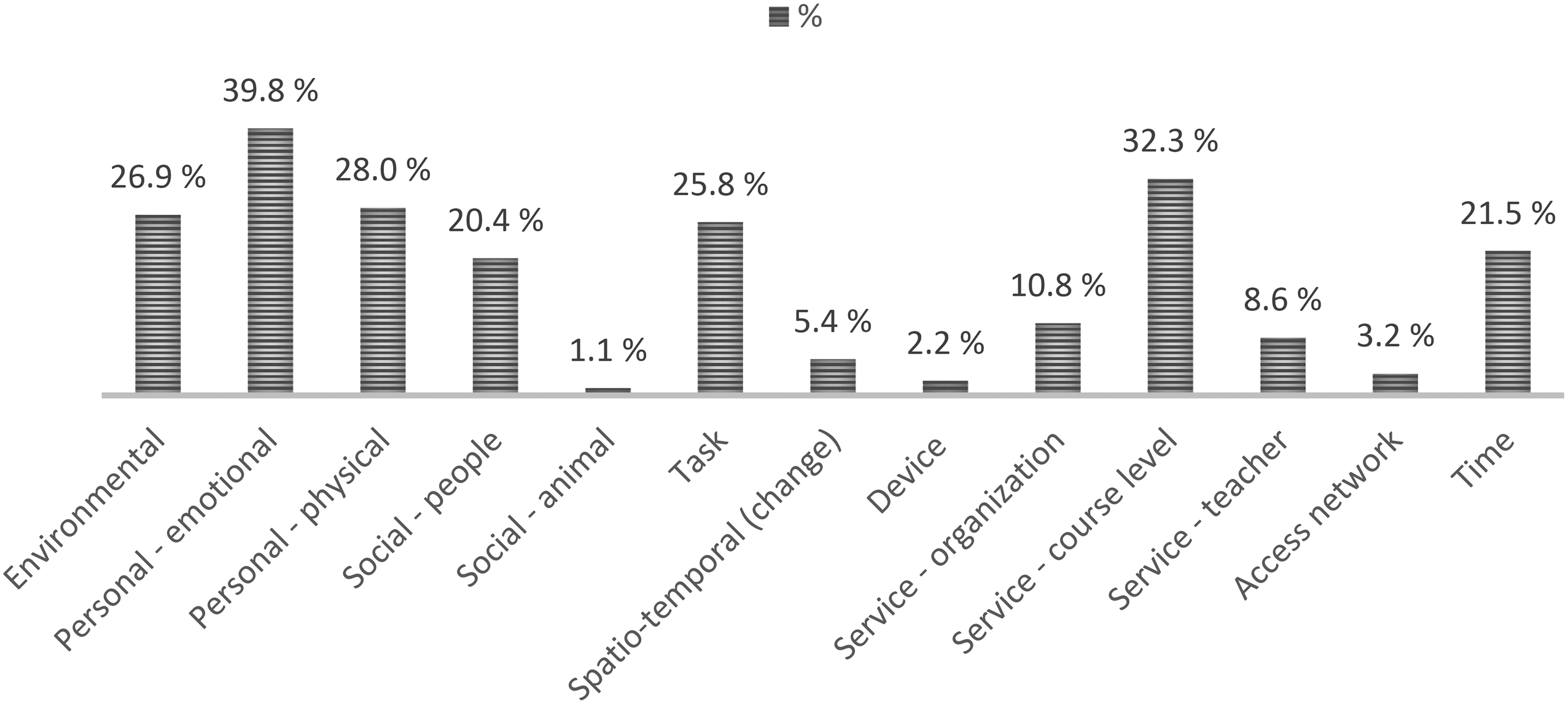
Negatively mentioned contextual factor categories and sub-categories, percentage distribution compared to the number of answers (n = 93).
In the negative factors the most significant categories the participants report affecting their learning negatively are: Environmental (26.9%), Personal – emotional (39.8%), Personal – physical (28%), Social – people (20.4%), Task (25.8), Service – course level (32.3%) and Time-related issues (21.5%), see Figure 5.
To explore further context categories, we searched more descriptive quotations from the data. In addition to positive and negative aspects of affecting factors informants were asked in open-ended questions the questions: Describe your day shortly? What peripheral activities you have performed alongside your studying? If you have had people or animals present in your physical surroundings, how they have affected you? To illustrate and summarize the results, findings and examples from the data are presented in subtheme sections. Lastly, we outline both negative and positive contextual factors that have an influence on the learning experience.
Property of Environment
Distance learning students participate in their studying sessions from various locations; therefore, the environment must be regarded as an influencing factor. Environmental factors or property of environment referred to respondents’ answers to properties of the physical environment surrounding the student. Our surveys revealed that the most typical location for studying activities is home (n = 77, 82.7%), but other surroundings were mentioned in the data as well. For example, locations as outdoors (n = 3), public transportation (n = 3), coffee shops (n = 3), summer cottage (n = 1), campus (n = 2), workplace (n = 1), library (n = 3) or even hospital(n = 1). One participant describes his/her learning session by the side of the sea: “I sat on the rock listening to the lecture and admired the sea whenever there was no slide, Female, FIN”. The data from the survey in this study indicates that the property of any environment is essential in the distance learning context. From the positive perspective, participants express that, aspects such as the possibility of having coffee and snacks easily or quiet workplace affect positively on learning. Additionally, weather conditions affect positively on learning experience. Respondents mention, that “beautiful”, “good” or “sunny” weather or even the season, such as springtime affects positively on the learning experience. Peaceful or silent surroundings or relaxing natural soundscape creates a positive learning experience: “There heard a nice patter of rain outside when I kept the window open, Female, FIN”. Also, the personalized set-up in the physical context was considered a positive feature. Negatively affecting factors, and similar properties of environmental features was mentioned in the data (see Table 3). Good weather and sunny days were found to be a potential distraction to learning. Poor seasonal conditions, such as dark weather, were mentioned to affect negatively on distance learning conditions. Additionally, noisy environment, poor air-conditioning, too warm room temperature, and messiness were considered negative factors. Some of the factors were positive and negative at the same time, for example, good weather. When asking distance learning students to name context features affecting their learning experience, the context was understood widely. Weather conditions and seasonal outdoor conditions were mentioned to affect on learning experience. Respondents brought up that the outside world and even season or weather affect their capabilities to study remotely – positively or negatively.
Emotional and Physical Personal Viewpoints
In the data, emotional and physical factors were categorized to be personal factors, that effect on learning experience. On the data students described feelings or other emotional factors. In emotional personal factors (Table 3) distance learners typically mentioned stress or tight schedules. Also, difficulties in concentrating or general restless mood were categorized as emotional personal challenges. The lack of good night's sleep was a usual negative personal factor. Additionally, motivational challenges and difficulties to focus were mentioned. One respondent summarized: “[It] feels more difficult to speak up during the class, Female, ENG”. Sometimes distance learning in general was considered exhausting: “Before distance learning, I was in virtual training for the previous two hours. Too much distance learning on the same day, Female, FIN”. On the contrary, emotional personal factors, such as “enthusiasm”, “financial stability”, “right mindset”, “good motivation” and “success” in the studies were mentioned as positive factors. Distance learning gave freedom to physical expression when participating in distance lectures: “I could listen in peace and didn't have to think about how I looked, Female, FIN”.
Physical personal views in data describes the physical experiences of students. For example, distance learning enables proper night sleep, when a student can sleep longer because there is no transition to the campus. Also, nap between lectures or work and studying was possible: “I took a nap between lectures and also made coffee several times during the day, neither of which would be successful on campus, Gender not known (didn’t want to inform), FIN”. Participating in lectures and learning activities from home made possible to have a quick walk outside for fresh air, stretch and do physical jerks while participating distance learning session or go to the gym between or during the lectures: “I have spent the day half studying, half lounging on the couch. My intention is to continue the study day with an hour-long walk, during which I listen to the lecture recording, Female, FIN”. Also, some negative experiences were described from distance learning in relation to physical issues: “My tools are not ergonomically adequate, Male, FIN” or “I couldn't bear to stare at the screen anymore after a day at work. Female, FIN”. Physical learning experiences were reported even with severe symptoms: “I got back pain from sitting for a long time the day before in two group work sessions (total 6 h), Female, FIN”.
Social Aspects Related to Other People or Animals
The data suggests that social aspects are also present in the context of distance learning. In the data, with the category “people” was referred to other people there are around the user and an influence of those people. Likewise, the category “animal” pertains to creatures in the user's vicinity that exert an influence on those animals. Both people and animals are considered, but people had a more significant role than animals (see Figures 4 and 5) since respondents mentioned animals only once in both the negative and positive side. Though, both have a positive and negative influence on the distance learning experience. Distance learning enables social relations with the nearest people, as one responded expressed the idea: “In the morning I took the children to daycare, then home for remote work. A quick walk outside with a friend during the lunch break and after work study until 8 pm. Then evening entertainment for the children and time for yourself with your spouse. Female, FIN” Distance learning makes possibilities for very young children's parents, since they can participate studying activities flexibly: “I've been at home and gone out for a stroller walk with my 12-month-old. During the child's nap time, I did code tasks and otherwise I was with the child and did housework. My husband was working remotely today, so we had lunch together. Female, FIN” Sometimes student peers participated distance learning together: “My student friend and I listened to the lecture, which had a positive effect. It was nice to discuss things to come after the lecture, Female, FIN”.
Negative effects arose from social interaction because of distractions: “It is difficult to follow remote training when another person's remote meeting is going on in the same space, Female, FIN” or “During the Teams meeting, the children's bickering temporarily disturbed the concentration, Female, FIN”.
Participants reported some social interaction in relation to animals, such as cats and dogs, as well. In the data, there were found few mentions about the phenomenon: “The presence of my dog helped [to study] because he was sleeping and I didn’t want to wake him up, so I had to stay still and study, Female, ENG”. Some disturbing incidents were also reported: “Sometimes a little disturbing (like now the cat on the table in the way of the keyboard), but with a more positive overall effect, pets bring cheer to the day. Male, FIN”.
Tasks
In distance studying there are possibilities for additional activities, which are not related to studies. In the data analysis, category “task” refers to the student's description of a primary or secondary activity other than studying. In this study data indicates, that additional tasks have slightly more negative than positive effects on the learning experience (see Figures 4 and 5). Multi-tasking was considered sometimes to make every day routines easier: “Sometimes I walk around my apartment, and clean and cook while listening to the teacher, if it is not necessary to see the screen all the time. I have wireless headphones. Female, FIN” or “I had a coffee at the same time as the teacher meeting, clever. Female, FIN”.
On the contrary, additional everyday tasks were reported as disruptions: “At home, you notice all the little things that you should take care of. Thoughts wander more easily to cleaning and planning weekend expenses than, for example, at school or the library. Female, FIN” Also, phone or work-related tasks were reported to challenge concentrating on study activities.
Spatio-temporal Change
Spatio-temporal change -category refers to a change in the physical environment. From the data distance learning experience was combined with moving lifestyle. Participants appreciated the possibilities to participate in learning activities despite the time and place. Also, participating was possible when moving from one place to another, as one distance learner expressed: “At 16:15 I take a car ride towards the Pasila campus, and I started a remote meeting in the car with a group from one of the courses. I had an on-campus course starting at 5:40 p.m., after which I returned home at 9:00 p.m. Gender: other, FIN” Additionally, not needing to do spatio-temporal changes during the day was considered increasing fluent transition between work and study activities: “There was no rush for the first Teams meeting, but I had plenty of time to do my own things after arriving home before the meeting started, Female, FIN”.
Device
In the Device-category students describes the physical properties of a device or an interaction with it. The survey revealed that device issues is not affecting that much for distance learning experience. It seems that other issues are more relevant. The overall device set-up was mentioned to improve learning experience, since some students reported they have better device set-up at home than university can provide at campus: “Functional physical working environment: laptop computer, separate keyboard, mouse, separate monitor, quiet space, singing tit outdoors, spring sun” Female, FIN.
Service in Organizational, Course and Teacher Levels
From the data, learning experience motives were discovered from service in organizational, course and teacher levels. In the analysis organizational level services were referred to expressions when the student i.e., user describes the organization of the learning experience (general education service). The course-level category contains expressions when the user describes the properties of a learning platform or interactions with it and course-level activities. Teacher teacher-level service category includes the expressions in which the survey participant expresses something about a person who provides the learning service i.e., teacher.
Mostly course level solutions were affecting positively. Organizational level issues were rarely mentioned, but for example, the general possibility for remote studies was mentioned to improve the learning experience in general: “The tools provided by the school are functional and up to date. Female, ENG” Negative effects on learning experience can be related for example to organizational it-systems: “Overcomplicated studying system (Lukkarikone [scheduling it-system], Peppi [study management system], long process of switching to another program)” Female, ENG. In the data analysis, both positive (n = 7) and negative (n = 10) hits were scarce, and researchers disagreed on positive factors. It was difficult to define the difference between organizational and course-level factors.
In course level learning experience is building with the ensemble of different solutions related to pedagogy and practical issues. Practical instructions related to communication were mentioned: “Online calls alone (especially without videos) lack the cheerfulness and motivation to stick to the school day.” Difficulties in group work were mentioned to diminish the learning experience: “One group member's busyness and passivity in group work caused more work for other group members” Female, FIN. Unclear instructions or scarce learning material were also typical viewpoints to a weakened learning experience. However, course-level practicalities often made the learning experience also positive. For example, students mentioned that video calls with peers, simple instructions, clear schedule made the experience positive.
Survey participants also emphasized the meaning of the teacher to create a learning experience. Negative factors affecting the learning experience created by teachers are described for example: “Teachers who are not very good at keeping interactive online lectures, and instead just talk monotonously while going through PowerPoint slides. Female, ENG” On the other hand, teachers’ professional skills are embraced as factors improving the learning experience: “Some teachers are really good, and their lectures are easy to follow and understand. And listen of course. Female, ENG” Communication-related issues are typical viewpoints when students describe teacher-level factors affecting distance learning experience.
Network Access
Network access as an essential requirement for participating in distance learning activities was emphasized in the distance learner learning experience. In the analysis, this category includes expressions when the student describes the exchange of information between a service or a device. It seems that in the modern distance learning education in Finland, a reliable network is important for the learning experience (see Figures 4 and 5). As a positive factor affecting on learning experience for example suitable network rate was required at least for online video purposes. Even if other participants, i.e., group work peers, had poor access to the network, it was experienced as an experience diminishing factor.
Time-related Issues
Time-related issues were the learning experience factor, which was mentioned widely in the data. In this survey participants described time issues affect more positively than negatively. It might indicate that time issues are better managed by student in distance learning education. Part-time students, who are working at the same time with their studies, appreciate the flexibility: “Flexibility: I do schoolwork when I have time, which is a variable even in the short term! Female, FIN” Also, small children's’ parents bring up the scheduling challenges: “Balancing between different areas of life is sometimes like an art. I try to keep studying and the overall picture of the tasks of the courses in my mind. I know that my studies are focused on the nighttime, when the small children are sleeping, because studies require concentration. Female, FIN”.
Participants bring up difficulties to separate learning activities and free time. In general, students feel that time is a scarce resource and there is lot of time pressure in their life. They report sometimes they feel that time management is difficult with group work as a learning activity, since peers have similar challenges in their everyday life: “Group work is sometimes difficult to organize due to scheduling challenges, Female, FIN”. In addition to the framework (Korhonen et al., 2010), time with different aspects is essential for distance education learners.
Discussion
In this qualitative study, our primary objective was to identify factors influencing the student learning experience within a distance learning setting. Our findings are elaborated upon through exploration of the research questions outlined for this study.
RQ1. What are the contextual factors affecting the distance learning experience?
Table 3 delves into the nine categories of user contexts feature there were identified in this study. These categories were formulated based on the context feature categories identified in previous research conducted on mobile product users (Korhonen et al., 2010). Korhonen et al. (2010) identified already eight categories as Environmental, Personal, Social, Task, Spatio-temporal, Device, Service, and Access to network. Additionally, feature category for timing issues were discovered. Timing in distance learning as a challenge has been discussed previously (Xavier & Meneses, 2022), but as a discrete feature. The outcomes indicate that timing serves as a significant influencing factor for the learning experience among distance learners.
To outline the broader theoretical framework, the identified categories can be regarded as both abstract and tangible elements (see Entwistle et al., 2015). In the findings of this study, both tangible and abstract elements can be discerned. Environmental, Device, or Access Network factors can be considered as more tangible or physical elements. Conversely, the more abstract elements encompass categories such as Personal, Social, Task, Spatio-temporal, Service, and Time. As user context is often considered to be in relation to physical surroundings, there are elements included, which are more immaterial and abstract from their nature. Additionally, context-related factors can be divided into more human and nonhuman elements (Entwistle et al., 2015). Based on the data presented in Table 3, Figures 1 and 2, it becomes apparent that both human and nonhuman elements have an impact on distance learning experiences. Non-human elements as factor categories can be categorized as follows: Environmental including “flora”, Task, Spatio-temporal, Service (organization/ course level), Access Network, and Time. Clearly, human elements can be recognized from the categories: Personal, Social including “fauna”, and Service (teacher).
Entwistle et al. (2015) draws a contextual wheel of practice in which outlines different features on the user context in HCI. In the framework, four elements create the core structure of the context. Abstract elements in the wheel are: Societal Structure and The Individual. Physical elements are Infrastructure and Near Materiality. The nine viewpoints in distance learning affecting factors from context can be discussed based on these four elements. This previous model can be applied to our findings well, but time as an affecting factor is not clearly considered in the framework. Since Societal structure is considered as social norms or rules (Entwistle et al., 2015), some environmental factors have a relation to the element. For example, a messy home as a physical surrounding for distance learning may affect the use of video connection in the online learning session. Social norms may have connections to the factor category of tasks or services, as well. Social interaction happens also at the course level service actions, i.e., when learning activities require interaction between students or between students and a teacher. The individual element in the context referring to personal values and competencies (Entwistle et al., 2015) has similarities in the factor categories Personal (subcategories: emotional or physical) and Social (subcategories: people or animal), Task, Spatio-temporal, Service and Time. In these categories, there can be recognized plenty of examples, which have their nature in personal viewpoints. Relations to other people around the distance learner in the physical surroundings in practice or emotionally are individually shaped and may base on the historical events in the relationships. Personal factors such as emotional or physical issues were reported vide variety of different issues. For example, motivation, self-esteem, back pain, concentration ability and so on are personal issues, in which many factors are affecting. The other people around the learner have been studied previously in the distance learning settings, but the emphasis has been often in the peer learners and in social learning environment (see e.g., Ifenthaler et al., 2023; Peters, 2002; Raspopovic et al., 2017).
The physical infrastructure refers to the environment, which effect on user (Entwistle et al., 2015). Environmental factor in this study refers to this group of context elements. Environmental factors i.e., property of the environment includes all the physical environment properties. The student surrounding environment should be considered a wide phenomenon, since participants described for example the weather to affect their learning besides more classical environmental aspects, such as a suitable set up for learning, hot temperature, or noises. Near Materiality as another physical element of context refers to devices near the user, which the user can control (Entwistle et al., 2015) From data in this study, the categories of Device, Environmental, and Access network are most closely associated with this element. Devices and access to the network are evidently the elements over which the distance learner has control. Certain environmental factors, such as study set-up and ergonomics, may be linked to this context element.
Given that time, as an influential factor in distance learning, is a personal phenomenon, it should be regarded within the contextual element. The study data suggests that this is a significant issue and should be considered as an additional theme in the context of HCI discussions. Accordingly, the influence of context affecting on the learning experience should be regarded as a more holistic phenomenon. Various levels exist within each factor categories that impact the distance learning experience in connection with the broader context. The distance learning should not be seen as a bundle of single factors, but as an interactive entity of various factors, including contextual features.
RQ2. What is the impact of identified factors on the distance learning experience?
Prior research suggests that the user context is a dynamic construct (Greenberg, 2001). This study reveals that context is a dynamic, layering and ambivalent concept. It was observed that the same factor can manifest as both negative and positive. Surprisingly, within the environmental factor category, several participants reported that weather conditions or the season could have affected both negatively and positively on learning experience. For example, sunny weather with birds singing outside made learning easier, or on the contrary, sunny weather made concentrating harder, since the weather was appealing for outside activities other than studies. Additionally, informants reported that rain sounds from the outside made the mood more relaxed, and therefore concentrating on studying was easier. On the contrary, poor weather made the mood more depressed, which affected the general learning experience negatively. This phenomenon can be recognized as parallel to the holistic human reality experience, which previous researchers have recognized (see eg. Kaptelinin, 2018).
From all factor categories, negatively and positively affecting factors to learning experience were discovered. This illustrates the ambivalent characteristic arising from contextual features. Even exactly same contextual element may appear as negative or positive for the same learner depending on time and situation. Additionally, cultural factors affect the situational experience across diverse learners e.g., on experiences of rain or forest. Due to the ambivalent nature of contextual features in human existence (Frie, 2011) these factors should receive special elaboration when recommending elements for distance learning contexts. Nevertheless, the results indicate, according to previous studies, that situated experience can be adjusted and improved in technology-supported distant education with contextual understanding (Kuru Gönen, 2019).
Reliability and Validity
The data were collected within the higher educational institution to ensure access to participants who are engaged in distance learning. The survey was distributed to students participating enrolled in selected distance learning courses under the researchers’ supervision, enhancing the study's reliability. Data analysis was conducted collaboratively by the first and the second authors to ensure reliability. Additionally, Krippendorff's cαbinary analysis in Atlas.ti. However, due to limited number of categories in in collected user demographics it has been excluded from the analysis.
During the data analysis, the authors reached a consensus on most categories. However, it was observed that the subcategory of Service Organizational factor had the highest incidence of disagreements. This can be due to the unclarity which factor should be considered as an organizational issue. Organizational issues include factors such as which distance learning tools are provided for students, what kind of (complicated or easy-to-use) studying it-systems are provided or curriculum-related decisions. Though, organizing the education is essential and its success affects significantly for large number of courses. Therefore, the practice supporting students’ learning experience should be researched further as an independent phenomenon.
The limitations of this research are based on the local nature of the study. The results of this study may not be applicable in other educational institutions and more research in different educational organizations and distance learning student groups is needed. However, the influence of contextual factors remains pertinent, especially considering that the organization represents typically HEI in Finland. Previous research indicates that comparable it-systems implemented in HEIs are similar to those in various global settings (see eg. Osadcha et al., 2023; Powell, 2020; Scalabrin Bianchi et al., 2021). It is possible to reveal different student profiles based on engagement (Saqr et al., 2023), emotions (Lau et al., 2024) or self-regulation (Liz-Dominguez et al., 2022), for example. More research is needed to explore the characteristics of different student groups’ distance learning habits and contexts to address similarities or differences between individual students, different student groups from different study fields or other profiling features.
As the qualitative survey was conducted several times during the year, the data created a clear understanding of the variation of contextual factors. This enabled the phenomena data to indicate in which seasonal weather or other climate-related conditions were reported to effect on learning experience.
Conclusion
As defined in the standard (Finnish Standards Association, 2019) the context of use is more than physical surroundings, room or its facilities. It can be defined by its’ different viewpoints: environmental (good weather/ nature), personal (emotional/ physical), social (people/ animal), task, spatio-temporal, device, service (organization/ course level/ teacher), access network and time.
Based on the results, our recommendations to practitioners mainly suggest presenting recommendations to distance learners, awareness in pedagogical distance learning design and in it-system design to improve learning experience and learning results (Figure 6). Since context is affecting learning experience widely from various angles, all three viewpoints should be considered. Contextual approach to distance learning design helps to achieve contemporary emerging trend of sustainability especially in the sense of social sustainability, in which possibilities to participate on learning are open for different people in different life circumstances.
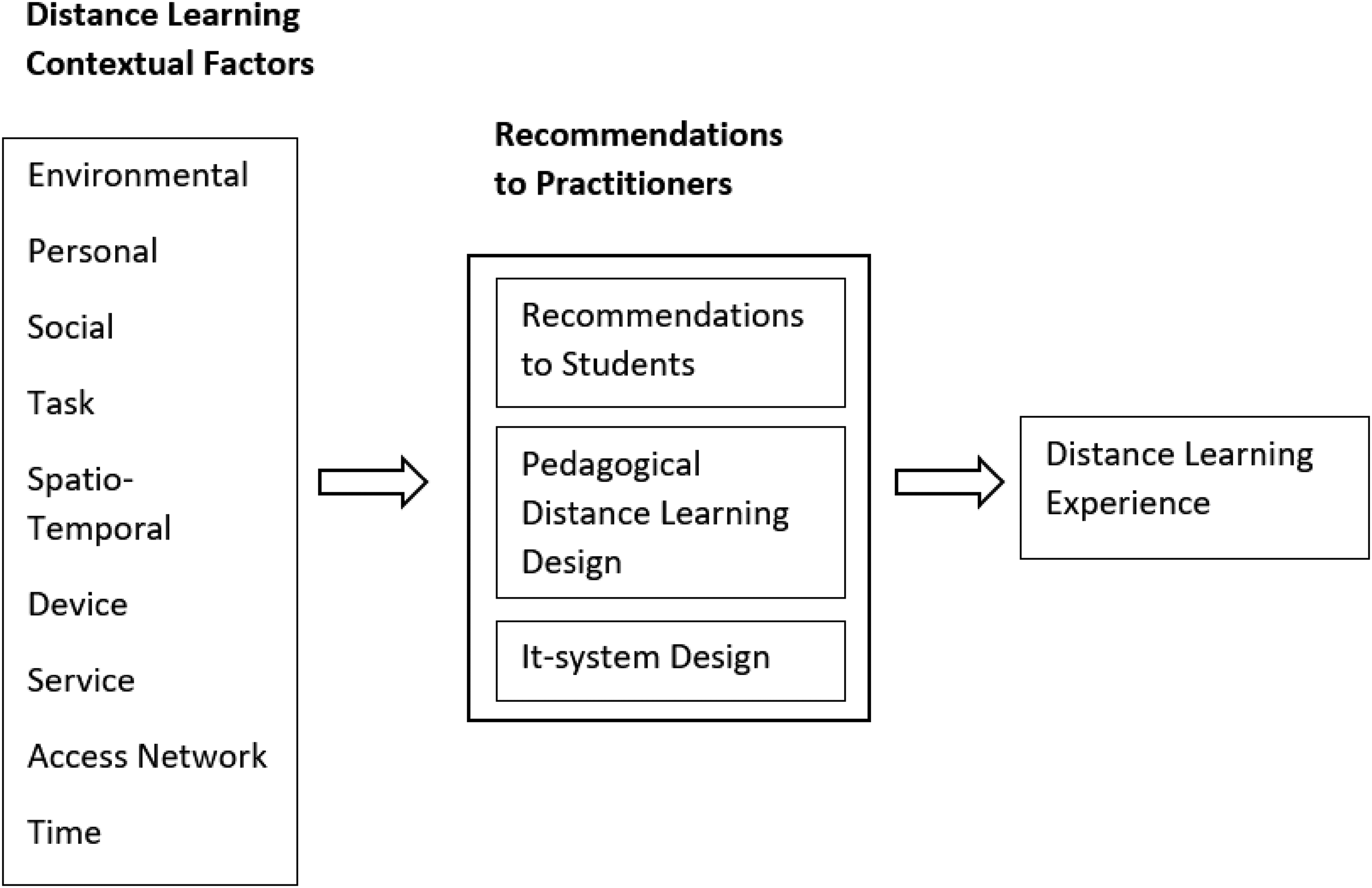
Recommended distance learning design framework based on Korhonen et al. and Xavier & Meneses contextual factors (see Korhonen et al., 2010; Xavier & Meneses, 2022).
Based on the findings it can be outlined, that contextual settings affect ambivalently learning experience in general. The students may experience the same contextual characteristics differently and have different attitudes toward learning. The same situational surroundings can be seen in a positive or negative light, as an opportunity or threat. For example, social interaction in distance learning settings may cause disturbance, but also small children's parents may have the only possibility to educate themselves remotely at the same time when they watch over their baby's sleep. Sometimes it can be useful to be able to participate in learning sessions for example during the train journey to save time in everyday life. Though online learning in a vehicle may cause connection problems or harm focus, it can be stated that participating in learning sessions is not always recommended during a spatio-temporal change. Additionally, sometimes changing distance learning location to nature from inner surroundings may increase the learner's well-being and concentration, but sometimes appealing outdoor activities in good weather may cause harmful barriers to learning.
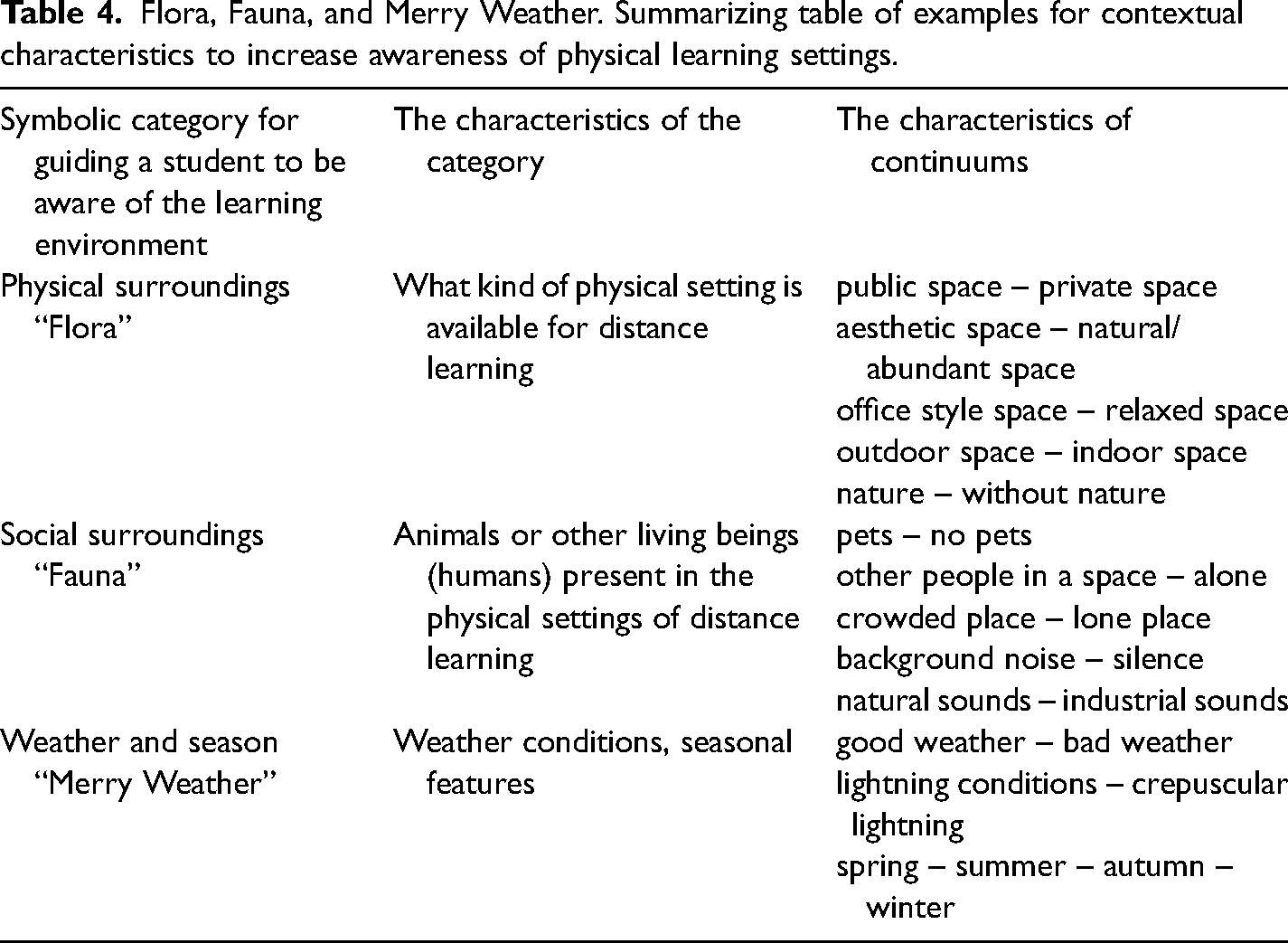
Students can better arrange their surroundings to support their learning if teachers guide their choices with specific instructions. The teacher's instructions to students as their best may result better premises to ideal experiential learning than learning at campus. Students could be guided to be aware of the contextual matters to affect their learning results and learning experiences. Further, students could be guided to use suitable technology to support their learning and encourage them to arrange their learning settings ergonomically. To operationalize our findings for teachers from the pedagogical perspective (Ketelle, 2017), we propose the use of the well-known fairytale Sleeping beauty (e.g., Rackham & Evans, 1972) to facilitate the emergence of persistent engram (Mortimer & Escalante, 2022) among students. The three fairies Flora, Fauna, and Merryweather can be used to reflect the physical, social and seasonal categories, which were identified as central characteristics affecting the distance learning situation. Table 4 reflects this proposal.
Flora, Fauna, and Merry Weather. Summarizing table of examples for contextual characteristics to increase awareness of physical learning settings.
It is essential for teachers to understand learners’ perspectives and experience when designing the learning process and learning experience. Because the nature of communication in distance learning, student experiences may not transfer that efficiently to teacher for the background information to support appropriate design of learning management system. Also, better understanding about distance learners’ life in general creates more possibilities to empathize students and create a more permissive atmosphere for different situational and personal contexts in distance learning.
Additionally, distance learning context should be considered when designing it-system i.e., learning management system or organizational it-system combinations to create digital environment for distance learners. Good learning experience can be created by understanding different circumstances of learners and different user needs. Learning management system improvements based on learner-need creates better learning experience for the students (Althunibat et al., 2023).
This observational data in this study is not able to reach students’ inner experiences and preferences for recognizing the factors that support achieving the set learning objectives. When considering distance learning experience, it should be defined what is the operational objective for studying (Table 4). Learning can be hard work, and therefore not so pleasant experience all the time. Learning can be frustrating, difficult and laborious. An enjoyable learning experience may turn into a negative outcome in learning if learning objectives are not achieved. Systems’ utility is seen as constituting system usefulness alongside usability (Nielsen, 1993, pp. 24–25). If it-system-supporting learning does not result in enough learning used in different distance learning environments, some modification is needed to the aspects affecting distance learning. Further operationalizing the contextual factors should be explored and measured in future research.
Also, for the future work we suggest further exploration for each context category as such. Each category should be researched further to get deeper understanding about learners’ life and the context distance learners are participating learning activities. In general, based on our research we propose a more holistic approach to modelling distance learning contexts. This is aligned with Kaptelinin's (2018) idea about human experience as an existential matter in HCI. As educational technology constantly creates and delivers ambivalent learning experiences in students’ contexts, deeper understanding of the contextual and situational elements during learning activities should be recognized and guided to support better learning outcomes and experiences. We suggest further research towards creating recommendations on contextual elements for distance learning contexts which teachers could use to support their students in more effective distance learning activities. As this study confirms the impact of contexts for distance learning, for future work we recommend research on how contextual factors and their interactions could be researched and elaborated.
Further research in education digitalization should address empathy's impact on learning experience, also. Different pedagogical means to emphasize empathy might bring successful learning outcomes through increased motivation and learning engagement in digital learning. Practical implications considering the contextual factors should be tested in the future to explore more detailed information about it-system design and pedagogical practice. With design research approach for exploring practical implication for design solution could improve conceptual models.
Footnotes
Abbreviations
Acknowledgements
Not applicable.
Availability of Data and Material
The datasets analyzed during the current study are available from the first author on reasonable request.
Consent for Publication
Though the data there is not any sensitive content, the organization in which the case study was conducted has formally consented to participate this research following the organizational protocol for research permits. The consent for publishing the research report is also provided by the case study organization.
Declaration of Conflicting Interests
The authors declared no potential conflicts of interest with respect to the research, authorship, and/or publication of this article.
Ethics Approval and Consent to Participate
Ethics approval not applicable, since the survey was sent to adults and no personal or sensitive data was collected. The research setting does not involve any harmful consequences to participants (Finnish National Board on Research Integrity TENK, 2019). Despite this, we secured research authorization from the university through the approval granted by the ethics committee for our research (25.3.2022, 18.8.2022). Furthermore, each participant gave their consent to participate by filling the survey form. In the form, the details of the research activities were presented and voluntarily participating was emphasized. The participation was anonymous and from the results, individuals cannot be recognized.
Funding
The authors received no financial support for the research, authorship, and/or publication of this article.
