




Abstract
This multiple case study aimed to investigate ESL teachers’ practices when they learn and design their ESL lesson activities, with a particular emphasis on the integration of computational thinking through Scratch. Scratch was considered as the computational thinking platform, and teachers were designers of language instruction with/for computational thinking. We aimed to explore ESL teachers’ lesson designs incorporating computational tools. We collected audio and video recordings from individual workshops and semi-structured interviews and then conducted a thematic analysis. Five themes emerged: (a) learning experiences shaped project designs, (b) teachers’ understanding of student's interests and age appropriateness shaped Scratch projects and pedagogical choices, (c) integrating computational thinking with ESL instruction was challenging, (d) efforts were made to reduce technical and content challenges, and (e) teachers considered and used Scratch as an ESL tool. Our findings underscored teacher agency in how teachers adapted their instruction based on perceived student needs and capabilities.
Keywords
Introduction
English as a Second Language (ESL) students may encounter disadvantages due to various factors, including financial problems and language proficiency issues (Fu & Wang, 2021). Financial problems pose obstacles for ESL students to access computers and the Internet, impeding their progress in computer science (CS) courses (S. Jacob et al., 2018). ESL students receive only half as much CS instruction as their peers, leading to significant disparities in computing education and career prospects (S. Jacob et al., 2018) because many subject teachers lack the necessary training to effectively teach their subject matter to ESL students (Baecher et al., 2014; Harper & De Jong, 2009). Further, subject teachers, such as mathematics, may incorrectly assume that ESL teachers are responsible for teaching ESL students in every subject (Fu & Wang, 2021).
To bridge the divide between ESL and mainstream students, more support is required for ESL students to learn Computational Thinking (CT), which is a fundamental concept in CS (Lu & Fletcher, 2009). CT entails thinking about representation and abstraction to solve problems (Lu & Fletcher, 2009). However, efforts to equip K-12 teachers with CT skills focus on CS teachers (Yadav et al., 2014), thereby leaving ESL teachers without the capacity to integrate CT and coding into their ESL instructions. Little attention has been devoted to investigating ESL teachers’ practices regarding integrating CT into their ESL instructions. Quan (2015) investigated the perception of pre-service teachers from Applied Linguistics in the use of Scratch. While the participants provided feedback to evaluate Scratch as a teaching tool, understanding their emic perspectives and reasoning about integrating CT and coding into their ESL instruction remains unclear. Boz and Allexsaht-Snider (2022) recruited elementary school teachers to investigate their coding learning experiences during professional development sessions. Notably, one ESL teacher was included in their research. The task given in their study was to program a robot to travel on a shape similar to a quarter-sized circle. Given that this task was designed for all teachers participating in the professional development sessions, it is unclear how the ESL teacher intended to apply CT and coding within her ESL lessons.
We employed Scratch in our examination of the integration of CT into ESL lessons. Scratch, a block-based programming environment, is an accessible tool designed to help students learn the basics of coding and CT. By assembling colored code blocks, Scratch empowers its users to build interactive stories, games, and other visual elements in an engaging and visually stimulating environment. Observing virtual agents promotes thinking and learning processes based on users’ actions and decisions (e.g., S. Wu et al., 2022a, 2022b).
Students are intrigued by Scratch's visual and interactive features, which make difficult computational ideas more applicable (Calder, 2018; Mouza et al., 2020). With Scratch, students actively engage in learning, fostering a sense of ownership over their products (Y. B. Kafai & Peppler, 2011). Further, ESL students can develop narratives within Scratch, honing their language skills through developing stories, characters, and conversations (Parsazadeh et al., 2021). The adaptive nature of Scratch enables its application across various ESL subjects, including vocabulary and grammar (Ade-Ojo & Yacoub, 2019). The accessibility and inherent educational value of Scratch make it an ideal choice for bridging the divide between computational thinking and ESL instruction. So, the following question guided the research: How do ESL teachers consider computational thinking and language when designing an ESL lesson that employs Scratch as a platform for teaching CT and language?
Computational Thinking
Because of its focus on systematic problem-solving, computational thinking (CT) has become a fundamental ability in the twenty-first century and is considered necessary for both STEM and non-STEM fields. CT was popularized by Wing (2006, p. 33), who defined it as: Computational thinking involves solving problems, designing systems, and understanding human behavior, by drawing on the concepts fundamental to computer science. Computational thinking includes a range of mental tools that reflect the breadth of the field of computer science.
Many researchers highlighted CT's value across varied fields, such as biology (Navlakha & Bar-Joseph, 2011), mathematics (Ye et al., 2023), physics (Hutchins et al., 2020), and art (Knochel & Patton, 2015). CT consists of decomposition (breaking down complicated issues), pattern recognition, abstraction (concentrating on key features and eliminating unimportant ones), and algorithmic thinking (developing a methodical approach to problem-solving) (Shute et al., 2017; Srinivasa et al., 2022; T.-T. Wu et al., 2024). Brennan and Resnick (2012) further elaborated CT via computational concepts, computational practices, and computational perspectives. CT's value in education is highlighted to help students better understand and learn difficult concepts (T.-C. Hsu et al., 2018).
Integrating CT in education has shown promise in equipping learners with problem-solving and reasoning skills (Román-González et al., 2017; Tsarava et al., 2022), which are critical for success in today's technology-driven world. Studies have demonstrated that CT enhances algorithmic thinking, learning, and debugging (Juškevičienė, 2020; Wong & Jiang, 2018), contributing to a hypothesis-driven problem-solving approach (Grover et al., 2017). Moreover, as CT concepts have been successfully integrated into areas such as science and language arts, research advocates for integrating multiple disciplines (Hambrusch et al., 2009; Hermans et al., 2024; Wolz et al., 2011), ensuring learners benefit from computational literacy regardless of their primary field of study. Still, the interdisciplinary integration of CT into language arts might have challenges on “epistemic commitments, identities, cultures and histories of the disciplines” that might need prior attention before the integration (Santo et al., 2023, p. 1228).
Pedagogical Content Knowledge (PCK)
The combination of subject-matter expertise and instructional techniques necessary for successful teaching is pedagogical content knowledge (Mishra & Koehler, 2008). The PCK was defined by Mishra and Koehler (2006, p. 1021) as: PCK exists at the intersection of content and pedagogy. Thus, it goes beyond a simple consideration of content and pedagogy in isolation from one another. PCK represents the blending of content and pedagogy into an understanding of how particular aspects of subject matter are organized, adapted, and represented for instruction.
PCK is critical for assisting learners in learning particular subjects. In contrast to broad teaching strategies, PCK is discipline or topic-specific (Hill et al., 2008; Sarkar et al., 2024). PCK involves knowledge of assessment procedures (Fernandez, 2014; Kind & Chan, 2019), finding effective teaching strategies for a given subject (Ibrahim, 2016), and understanding common student misconceptions, along with keeping in mind that students affect teachers’ PCK (S. Park & Oliver, 2008).
For teachers in STEM and non-STEM, the application of PCK is important (C.-Y. Hsu & Tsai, 2024; Raja et al., 2020; Syahmani et al., 2021). Teachers with well-developed PCK can anticipate students’ difficulties, design lessons accordingly, and foster a deeper understanding of complex concepts (Aydin et al., 2015; Motsoeneng, 2021; Rahimi et al., 2016). Moreover, research suggests that teachers’ PCK correlates with improved student outcomes (Keller et al., 2017; Y. Yang et al., 2018).
Computational Thinking and Pedagogical Content Knowledge
As computational thinking gains importance, so does the need for teachers to develop specialized PCK for CT (Kong et al., 2020; Yeni et al., 2021). Teachers face several challenges in CT instruction, including limited resources (Israel et al., 2022; Li, 2021), minimal formal training in CT-specific pedagogy (Mannila et al., 2014; Sentance & Csizmadia, 2015), and associating CT skills with the computer science field only (Tang et al., 2020). These barriers highlight the need for a robust approach that combines CT with effective teaching strategies.
The development of PCK for CT involves equipping teachers with a solid understanding of computational concepts and the pedagogical tools to convey these ideas effectively. Professional development programs and instructional resources are essential components of this developmental process. Teachers who engage in focused CT training develop more understanding and confidence in CT skills (Kong et al., 2020; Rich et al., 2021) and can better design learning experiences (T.-C. Hsu et al., 2018; Kong et al., 2020) that build students’ CT skills and content knowledge.
Case studies provide valuable insights into effective CT integration. For example, Yadav et al. (2014) reported success in teacher preparation programs that embedded CT into everyday lessons, resulting in a clearer understanding of CT as a transferable skill. Our study focused on teacher training designed to build PCK in CT as CT becomes integral to many educational standards worldwide. We aimed to empower non-STEM educators to integrate CT into their teaching and ultimately enhance teachers’ and their students’ readiness for a world that values computational thinking.
Conceptual Framework
This framework draws from constructionism (Harel & Papert, 1991) and content-based language instruction (Baecher et al., 2014). It employs Scratch as the platform for developing CT and positions teachers as designers of language instruction with/for CT. This framework offers practical and theoretical insights into the intersection of ESL and CS.
Constructionism posits that learners acquire knowledge more effectively by actively engaging in building meaningful creations (Papavlasopoulou et al., 2019) through shared artifacts (Parmaxi et al., 2016). Further, constructionism has informed the areas of making and coding (Y. B. Kafai & Burke, 2015), enabling the use of coding platforms to create personalized projects. For example, Scratch can be employed in digital storytelling activities, thus transforming students into active producers rather than passive consumers (Leinonen & Sintonen, 2014).
Content-based language instruction is teaching approaches that balance language and content learning objectives (Baecher et al., 2014). The process of planning a language learning lesson is influenced by teachers’ experiences as both learners and teachers, their knowledge about their students, established learning theories and approaches, and their pedagogical content knowledge (Baecher et al., 2014). However, when teachers consider integrating technology into their instruction, their decisions are guided by strategies to reduce difficulties and increase advantages (Gilmore, 2007; C. N. Park & Son, 2009). With that, content and language goals are not complementary but rather competing. Teachers need to navigate the dual responsibility of teaching language skills and subject matter within a limited time (Bigelow, 2010). This competition between course content and language learning challenges teachers as they design their instruction (Baecher et al., 2014; De La Cruz, 2021).
Use of Scratch as the Platform for Computational Thinking
Scratch is the most preferred programming platform for designing CT activities (T.-C. Hsu et al., 2018). Students engaging with Scratch develop their understanding of computational concepts and improve their performance in computational practices and their attentiveness to computational perspectives (Brennan & Resnick, 2012). Scratch introduces seven CT concepts that can be applied across various programming contexts: “sequences, loops, parallelism, events, conditionals, operators, and data” (Brennan & Resnick, 2012, p. 3). Mastering computational practices, such as abstracting and debugging, is equally important for programming and design activities (Diprose et al., 2017; Fagerlund et al., 2021). Scratch helps students change their perspectives on CT, facilitating their transition from mere consumers to producers (Bers, 2018; Y. B. Kafai & Burke, 2014). Additionally, students consider the authentic audience who will interact with their products (Lee & Hannafin, 2016) designed within Scratch, displaying a sense of responsibility toward others’ learning (Dinç, 2022).
When using Scratch, students are inclined to apply CT concepts to create code that makes their products work as intended. Students debug their code when their products do not yield the expected results. They tackle conceptualizing their work by assembling a large chunk of block code from smaller parts. Such problem-solving processes foster the development of computational concepts and practices, leading to a change in students’ perspectives (Brennan & Resnick, 2012; Hansen et al., 2016). Students derive a sense of empowerment from Scratch, which offers them a platform to express themselves (Y. Kafai et al., 2020; Resnick et al., 2009). Visualized grammatical rules and vocabularies, along with visualized programming, support the understanding and utilization of CT, and vice versa (Pöllänen & Pöllänen, 2019; Sabitzer et al., 2018). Scratch is a valuable instructional platform for learning and teaching programming, making it an ideal choice for introducing young students to CT (Fagerlund et al., 2021; Zhang & Nouri, 2019).
Within the context of ESL, Scratch is commonly used to create digital storytelling projects. Rich et al. (2017) recruited elementary school teachers to investigate how they could develop their computing and engineering competencies. The teachers were invited to practice coding activities on code.org and use Scratch. The professional development influenced the teachers’ beliefs regarding computing. The study revealed a correlation between teachers’ educational backgrounds in STEM subjects and their self-efficacy. Self-efficacy increased when participants perceived their implementation experiences as successful. Stevens and Verschoor (2017, p. 6) described Scratch as “a popular tool of choice for teachers wishing to integrate coding into their language learning lessons.” They noted that coding activities help students develop planning and logical thinking skills while teachers correct students’ pronunciation during peer interactions and address grammar errors in the stories created by students.
Teachers as Designers of Language Instruction with/for Computational Thinking
To engage ESL students in CT and coding, teachers plan their lessons to foster active participation in programming (S. Jacob et al., 2018). Yadav et al. (2016) advocated the integration of CT concepts into the planned course content as a promising and recommended approach for teachers, enabling the blending of CT with the curriculum rather than treating CT as an isolated concept. Studies demonstrated that integrating CT through storytelling within a coding platform motivates students in their language learning process for positive linguistic attainments (e.g., T.-C. Hsu et al., 2020; Parsazadeh et al., 2021).
Therefore, scaffolding, which supports students in their language, coding, and CT pursuits, holds a significant place in achieving desired educational goals (Kaliampos, 2019; Kim et al., 2021 Schodde et al., 2020). However, further research is needed to understand how teachers adapt to this approach and gauge their beliefs and performance in integrating CT into their language teaching practices (Adler & Beck, 2020; Parsazadeh et al., 2021; Pozos et al., 2022). This is vital because teachers’ effectiveness in promoting student learning and motivation in CT and language learning influences the overall learning process (Basawapatna et al., 2013; T.-C. Hsu et al., 2018; Y.-T. C. Yang & Wu, 2012).
In ESL education, storytelling is important for ESL teachers because it places great emphasis on plot and character development, in contrast to the efficiency of Scratch coding (Zhang & Nouri, 2019). According to Zhang and Nouri (2019), teachers also consider the age of their students when designing instructional materials for CT. For example, teachers working with young students in lower elementary grades prioritize computational perspectives, while those instructing adolescents tend to focus more on computational concepts. Teachers’ experiences as learners shape their beliefs, which in turn have a significant effect on their instructional design and teaching practices (Freeman & Johnson, 1998).
Students and teachers exist within a broader context, encompassing the ecologies of teachers’ beliefs and experiences, alongside external factors (e.g., administrators’ decisions) (Kubanyiova & Feryok, 2015). Teaching derives its collective intentionality from these larger teaching contexts (Kubanyiova & Feryok, 2015). Teachers construct their knowledge “through experiences in and with students, parents, and administrators” (Freeman & Johnson, 1998, p. 401). The sociocultural dimension of language instruction and design for/with CT through programming becomes relevant in the ecologies when considering the interactions between students and teachers, particularly those from diverse linguistic and sociocultural backgrounds (S. R. Jacob et al., 2022; Klimova & Pikhart, 2021). However, the application of knowledge acquired through teacher education programs can be challenging in the classroom. When teachers lack a thorough understanding of teaching methods, their instructional designs may not follow the intended methods (Johnson & Golombek, 2016).
In this inquiry, we aim to explore the strategies employed by ESL teachers when they prepare to design their ESL lesson activities, with a particular emphasis on the integration of CT. Thus, the significance and potential implications of this study lie in ESL teachers’ integration of CT and coding into ESL education, guided by specific strategies and beliefs that inform current language teaching practices and the integration of CT and coding. We will examine how teachers incorporate the interactive elements of Scratch while addressing the dual challenge posed by the content-based language approach.
Methods
Design
We used the multiple case study (Yin, 2003). In line with the case study methodology, we focused on a purposeful sample with “fewer cases in greater depth” (Patton, 2003, p. 5) to provide a detailed analysis of teacher experiences using coding and CT in designing language teaching. Each case was investigated using content-rich data sources (Patton, 2003), including audio and video recordings from workshops and interviews. We examined the unique aspects of each case and sought to gain insights regarding CT, coding, and language teaching processes. We explored the process (Creswell, 2014) of integrating CT and coding into language teaching practices. This endeavor also revealed the underlying mechanisms, motives, and distinctive factors (Duff, 2008) influencing CT, coding, and language teaching practices.
Participants and Setting
The two participants were selected based on their teaching experience, years of experience, and prior coding experiences. This allowed for a detailed exploration of the use of CT in language teaching design that contributes to understanding ESL teachers’ pedagogical approaches in coding and CT in similar educational contexts.
Four ESL teachers, all of whom had either completed or were currently enrolled in a TESL master's program at an R1 university in the United States, participated in this research. From this group, two female participants, Sally and Alice (pseudonyms), were purposefully selected based on specific criteria relevant to the study: teaching experience, prior coding background, and target age group of students. Sally had six years of teaching experience with K-12 ESL students, though she had no prior coding experience. Alice, by contrast, had eight years of teaching experience with adult ESL learners and some background in website coding, though neither teacher had worked with block-based coding before the workshop. We chose these participants with the expectation that their different teaching experiences, coding familiarity, and target student age groups would influence their approaches to integrating language and computational thinking (CT) into lesson design.
The workshop was designed to support ESL teachers in acquiring fundamental programming skills focusing on CT. Organized with the principles of constructionism, the workshop aimed to foster CT concepts through artifact creation. Scratch served as the centerpiece of this CT training workshop, providing a learning space for participants to explore Scratch's affordances and design language lessons incorporating CT by creating artifacts. During the workshop, ESL teachers learned how to design ESL activities using Scratch while performing the designed activities. The workshop included four activities: (a) adding sprites to talk about three favorite things, (b) using backdrops to demonstrate three places, (c) creating dialogues between two characters with broadcast blocks, and (d) creating a storytelling artifact using blocks acquired from the previous three activities.
Participants took part separately in a 3-hour coding workshop in Zoom aimed at learning Scratch for language learning practices. The workshop was administered in three stages, including tasks that progressively advanced participants’ understanding and skills. In the first stage, participants were introduced to key functions, such as backdrop, broadcast, sequence, and repeat structure. These key functions formed the basis for the next stages. In the second stage, participants practiced these functions with debugging tasks, reinforcing their proficiency. In the final stage, participants used the functions they learned from the first two stages to create their artifacts, demonstrating their mastery of Scratch and CT. The participants were invited to create a Scratch project that could be integrated into their lessons, a practical application of their newly learned CT and block-based coding skills.
Data Collection
We collected and triangulated data from different sources: audio and video recordings of workshops and semi-structured interviews. The semi-structured interview was expected to enable us “to gain a more secure understanding” (Maxwell, 2012, p. 104) of the participants’ considerations when they practiced integrating CT. The workshop recordings also facilitated our conversations with the participants during the interviews. We used the workshop recordings to stimulate the participants’ recall (Culpeper et al., 2018; Maxwell, 2012) and inspect their thought processes when they created Scratch projects during the workshop (Culpeper et al., 2018).
Based on our theoretical framework, we focused on CT learning and Scratch project development during the workshops, teaching experiences, and reflection on CT learning and lesson design during the interviews. The participants developed their conceptual understanding of CT and its applications by engaging in the Scratch activities and creating digital storytelling artifacts. The moments when participants created artifacts during the workshop were captured in audio and video recordings, allowing us to analyze the process data. Simultaneously, we explored the impact of the teachers’ language teaching experience on their projects using content-based learning.
Interviews lasted approximately 70 mins for each participant. The semi-structured interviews were conducted individually via Zoom. During the interviews, participants were asked a series of questions regarding their experience in the workshop, including how the workshop experience altered their thoughts, values, beliefs, interests, and self-efficacy regarding coding and CT and how they intended to integrate Scratch into their lesson plans. Sample interview questions: “How interested are you in creating other ESL activities in Scratch or similar programs?” and “Can you tell me how your thoughts about computational thinking and coding have changed before and after the workshop? a. if it is the same - why do you think you did not change your thoughts about CT and coding? b. if it is different - what made you change your thoughts about CT and coding?”
Data Analysis
We employed the thematic analysis approach to discover and analyze patterns in the data to answer our research question. The goal was to gain insight into the underlying themes, patterns, and conceptualizations in the data and understand how they relate to the research questions (Braun & Clarke, 2006). The thematic analysis provides an accessible approach while analyzing qualitative data from a small group (Cormack et al., 2018), which enabled us to uncover themes that may not have been initially anticipated.
We started the data analysis process by utilizing a machine transcriptions service to transcribe all the data we collected from workshops and interviews. The first author reviewed and edited the transcripts because he conducted the workshops and interviews. Subsequently, we gathered all the data and organized them into Word files. Our team read through all the data to become familiar with the participants’ discourse and actions.
The first author coded the data line-by-line and noted the meaning he noticed in particular chunks (e.g., having clear goals for the lesson, being an expert in language but a novice in Scratch, maintaining a balance between CT and language). The second author then read the notes. During discussions between the team members, the sticky point was deciding the balance (and unbalance) between CT and English language teaching in teachers’ practices within Scratch. We resolved disagreements after reaching a consensus on CT dimensions (concepts, practices, and perspectives) in participating teachers’ pedagogical strategies to teach language within Scratch. After reaching a consensus and discussing the revised notes taken as a team, the first author grouped the notes into clusters. We interpreted the meanings behind the clusters and generated these five themes.
Findings
Theme 1. Teachers’ Learning Experiences Shaped the Design of Scratch Projects That Support Language Learning Through Contextual and Project-Based Approaches
Sally and Alice drew from their learning experiences to design Scratch projects that targeted specific language goals. Sally's sociocultural approach, influenced by her TESL coursework, focused on situational learning, using everyday contexts like ordering food to teach practical language skills. Her project aimed to create a visual and contextually rich learning environment, which she felt was ideal for young learners, though potentially less so for adults who may require less concrete contexts. With a background in educational technology, Alice adopted project-based learning (PBL), using Scratch to demonstrate tense variations in a soccer-themed narrative, integrating language learning with storytelling and visualization. Both teachers aligned their methods with recognized approaches in ESL education, situating language use within familiar and practical settings.
During the workshop, Sally's objective was to make her students capable of knowing how to interact in specific contexts. To achieve this, she chose to focus on ordering food and the names of popular foods, such as cakes and tacos, because these are frequently used in the daily lives of her students. In the interview, Sally revealed that her beliefs about teaching had shifted from emphasizing well-structured grammar and correcting mistakes to a more sociocultural approach. This change was informed by her experiences in a graduate-level TESL course, which taught her the importance of teaching how to interact in specific contexts. Sally's use of the sociocultural approach in coding, computational thinking practices, and language learning coincides with the recommendations and practices in existing literature (e.g., S. R. Jacob et al., 2022; Klimova & Pikhart, 2021). Based on her learning experiences, Sally designed her project using the phrase “Can I have a cake?” to socialize and achieve a goal (see Table 1). Sally created her Scratch project to provide a concrete context for young language learners who struggle to think about abstract and imaginative situations. She believed that the visualization aspect of the project would help young learners understand what the context should look like. However, she did not think that Scratch would be as useful for adult language learners as they possess abstract thinking abilities.
Learning Experience's Influence on Sally's Language Learning Task.
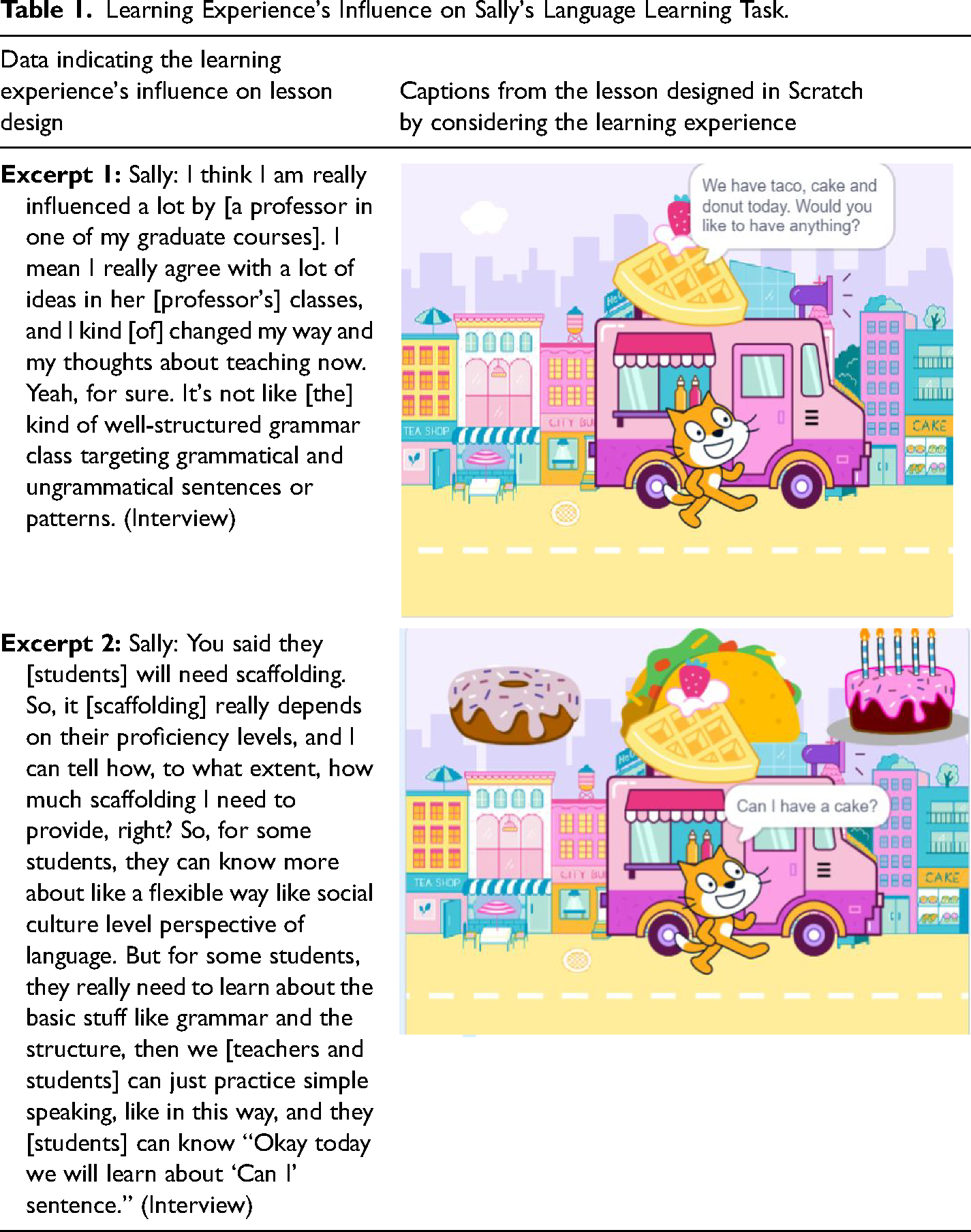
In her EdTech classes, Alice learned about project-based learning, which resonated with her due to its capacity to allow students to learn a language while working on a project. Alice aimed to teach present continuous and past continuous tenses with vocabulary in the context of playing soccer. She wanted to visualize the different English tenses with Scratch (see Table 2). Alice used two different backdrops to compare events from yesterday and today, demonstrating the disparities between occurrences in two different timeframes. While the combination of visualization and storytelling for computational thinking was highlighted in Pöllänen and Pöllänen (2019) and Sabitzer et al. (2018), Alice's approach to project-based learning, in the context of computational thinking and visualization for language teaching/learning, was more elaborated.
Learning Experience's Influence on Alice's Language Learning Task.
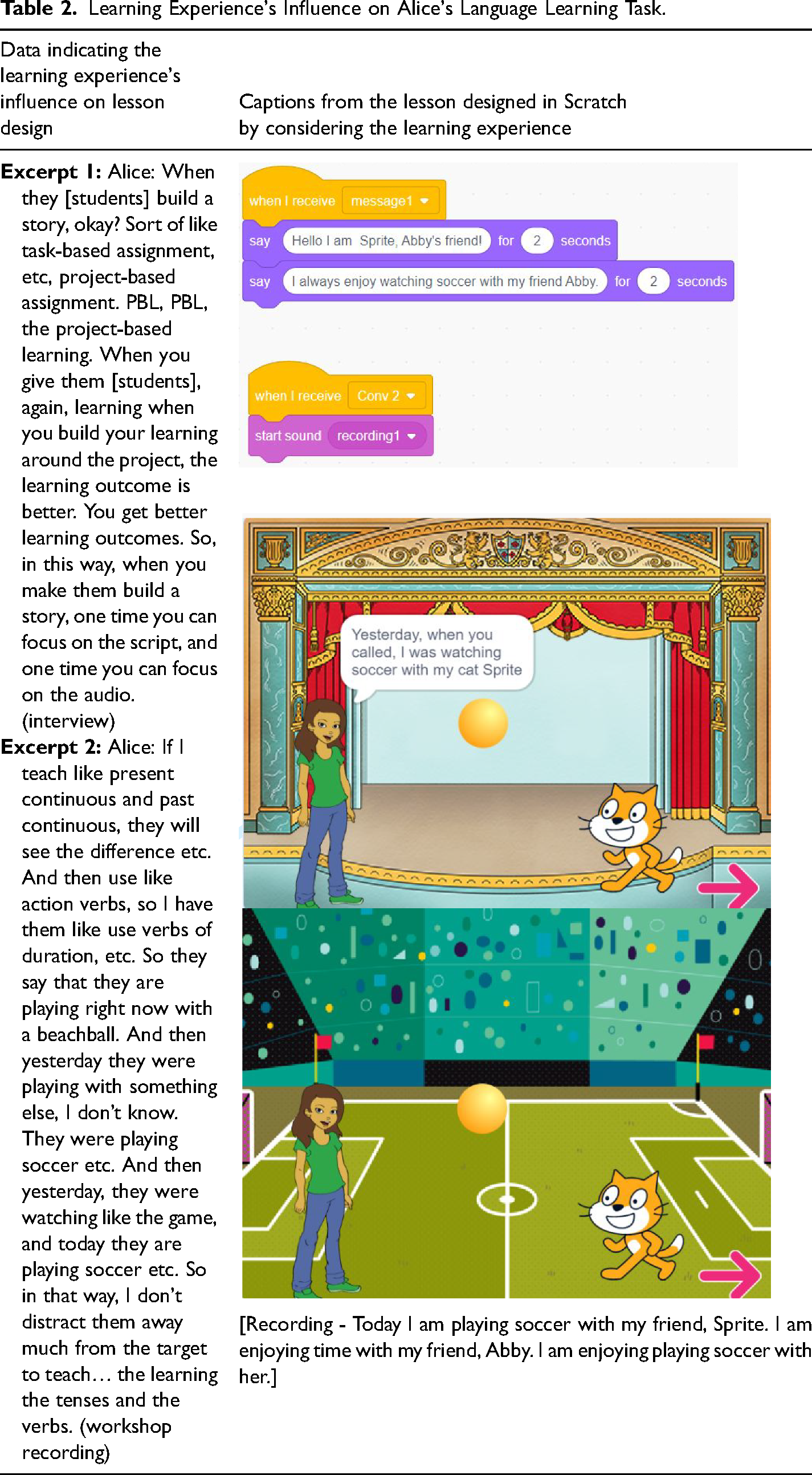
Theme 2. Teachers’ Understanding of Students’ Interests and Age Appropriateness Shaped Scratch Project Design and Pedagogical Choices
Both teachers designed their projects to suit the interests of students of different ages. Sally chose a colorful cityscape and cartoon elements to engage her younger students, believing these elements would captivate their attention and aid learning. Similarly, Alice selected a soccer field, knowing that soccer is relevant and engaging for her students. This theme highlights (a) the importance of age-appropriate and interest-driven content in project design and (b) how teacher assumptions about student interests inform instructional choices.
Sally and Alice considered how best to engage the interest of their ESL students in their Scratch project design. Sally opted for a colorful city background in her project design, with the aim of captivating young students. She expressed her preference by stating, My personal preference is some colorful things, which look vivid and relaxing. So, I choose the background, which is kind of like street for like mostly colored with pink and blue and yellow which looks pretty energetic … You can see, I choose some very colorful and a bit childish… I have assumptions about my students. They mostly like, should be all like primary schools like the lower level, younger age students. (Sally, interview)
Sally deemed the cartoon characters in Scratch to be an interesting feature for her students. However, she acknowledged that this attribute of Scratch would not appeal to adult learners by indicating, “They [students] mostly like, should be all like primary schools like the lower level, younger age students. So, it's not like adults, because I know the picture looks childish, so I think that's one of my assumptions.” Sally considered her students’ age while creating her project, highlighting the influence of her knowledge of students on the project design. Age consideration while designing a project was highlighted by Zhang and Nouri (2019) regarding the influence of teachers’ knowledge of students on teachers’ pedagogical practices.
Alice opted for a soccer field to pique the interest of her students. Expressing her conviction that the interactive features of Scratch would be particularly alluring to her students, she noted, “Scratch website is more fun, there are cartoons there, they can play with it [Scratch]. It [Scratch] is more fun, and then it is like a game more than coding websites” and created an interactive story. In her project, students were required to click a red arrow to proceed to the subsequent scene of the story (see Figure 1). She stated, “Give them [students] something like, taking into consideration, the nature of our students, they [students] love soccer… In the Middle East, even girls like soccer, by the way.” Alice explained the reason for the soccer-themed story, citing her students’ interests, and noted that many of her students are from Saudi Arabia.
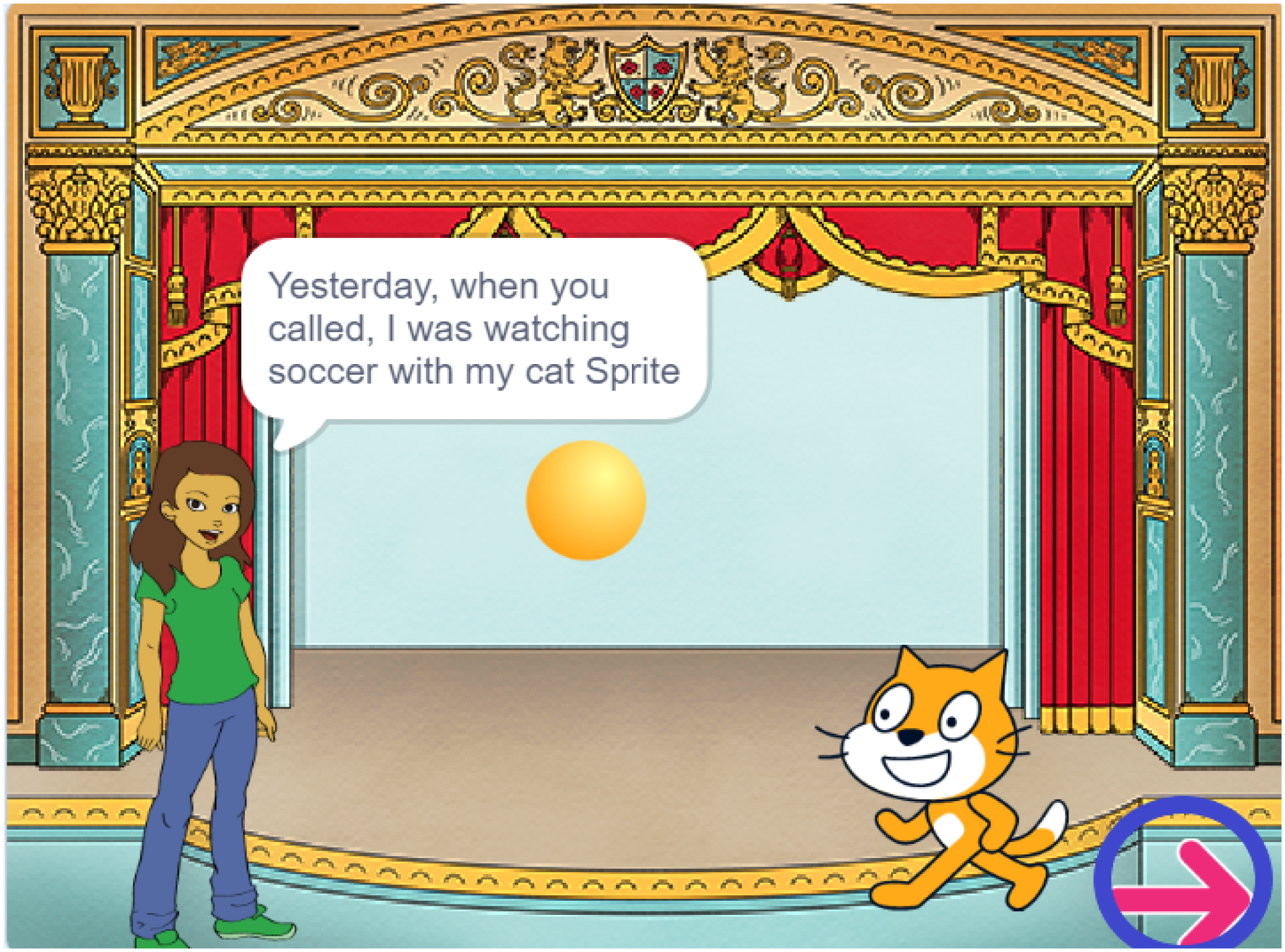
Interactive nature of Alice's project to enable students to engage in the scratch project.
Theme 3. Teachers Anticipated Challenges Integrating Computational Thinking with ESL Instruction due to Time Constraints, Pedagogical Priorities, and Administrative Expectations
Both teachers faced difficulties integrating CT and ESL, though they saw value in combining these fields. Sally expressed reservations about time constraints and the potential distraction from core language goals and suggested a gradual integration of CT throughout the curriculum to maintain balance. Alice was more optimistic and emphasized the importance of digital literacy in teaching. She noted that integrating CT can be challenging for some educators and dependent on administrative support, which often dictates the scope of technology use in language classes. This theme reflects broader challenges in combining interdisciplinary objectives within established language curricula.
Sally and Alice were preoccupied with balancing their lessons between the instruction of computational thinking (CT) and English, as the latter was their priority. However, they believe teaching CT and English concurrently would benefit English learners. Sally articulated her concern about the integration of CT and English language learning: The only thing is I think, because it's more than language skills are involved in this project, so I don’t know, for some language teachers, [the project] will be a bit like time-consuming to do this [integrate CT and English learning]. Yeah, because it [the project] is more than language practicing… As an English teacher, not a computer teacher. I will think that [learning English in Scratch] would kinda like waste my students’ time to work too much computational thinking. (Sally, interview)
Sally suggested that ESL teachers gradually introduce CT and Scratch in every class rather than teaching them once. She asserted that this would make the lessons more manageable. Sally advocated for a new curriculum that incorporates CT into an English course: If you say let me do this [CT practice for second language learning] in whole class, that will be too much for me, because I know there's more thing, there are more than language itself. So, I don’t know, but for sure, if we can prolong this through the whole curriculum. Break them down, and I think that will be interesting. Practice slightly every time. (Sally, interview)
Sally's claim indicates that integrating CT and second language learning presents a challenge, but not an insurmountable one. This finding coincides with Jacob et al. (2018), indicating some challenges occur while incorporating CT into English learners’ curricula.
Alice expressed a more positive inclination towards using CT in her classroom and emphasized the importance of being technologically adept as a teacher. She reasoned that without such proficiency, students may know more about technology than their teachers, leading to feelings of incompetence: Because otherwise you will have kids, they know more about technology than you, and you feel like a stupid teacher. And the students, they are not nice. Sometimes makes you feel like stupid because they know more than you. (Alice, interview)
To emphasize the significance of technology in her teaching, Alice drew on her experiences, pointing out that she rewards students with technological proficiency in their presentations by indicating, “But once some students do pretty good presentations and technology-wise, I give them a good grade.” She acknowledged, however, that not all English teachers agree with her: So, one of the teachers said no, I don’t care about the technology, I am teaching language here and I’m grading only the language. Doesn’t matter how much technology stuff they [students] are bringing in. They’re not getting bonuses and I’m not grading that. See what I mean? So again, depending on your objective as a teacher. And then depending on the administration that you are working with and what are they encouraging. (Alice, interview)
Therefore, integrating technology, such as Scratch, into one's teaching practices depends on individual objectives as a teacher and the encouragement of one's administration. Alice highlighted the significance of administrative decisions in integrating CT through Scratch and second language learning as an interdisciplinary concept. She provided a hypothetical scenario for that: He [a director] can say, teach them storytelling but don’t teach them Scratch. Maybe he says, like teach them something else or teach them just storytelling without the website, without being digital. Remember that as teachers, we don’t make all the decisions, we depend on administration. (Alice, interview)
Thus, regardless of ESL teachers’ personal teaching beliefs or school curricula, administrators significantly influence ESL teachers’ lessons. This finding suggests that school stakeholders need to support ESL teachers in integrating CT and coding into ESL lessons. This point is aligned with the literature concerning teachers’ inner lives (e.g., beliefs, experiences) and outer lives (e.g., administrators) affecting design decisions (Freeman & Johnson, 1998; Kubanyiova & Feryok, 2015) for incorporating CT through Scratch into ESL lessons.
Theme 4. Teachers Aimed to Reduce Technical and Content Challenges in Scratch Projects by Scaffolding Tasks and Selecting Relatable Topics for Students
To make their Scratch projects more accessible, both teachers took steps to minimize complexity. Alice decided to avoid unfamiliar topics, choosing soccer over baseball to ensure reliability, and prepared templates to reduce the technical burden on students. Confident in her students’ tech skills, Sally designed her project to be more open-ended, trusting students to engage with Scratch's interactive elements. Teachers’ scaffolding decisions reflect their understanding of their students’ technological comfort levels, highlighting the value of scaffolding to facilitate learning without overwhelming students with technical demands.
Both teachers considered the difficulty of their projects when planning how to implement them. Teachers aim to reduce the difficulty and increase positive learning outcomes in their instructional design (e.g., Gilmore, 2007; C. N. Park & Son, 2009). For her project, Alice initially considered using a baseball field as the background but chose not to because she believed it would add unnecessary difficulty. She recognized that introducing unfamiliar topics could be challenging and decided to opt for a soccer field instead, which she believed would be more relatable and engaging for her Middle Eastern students: This is baseball. If I’m teaching ESL, I will not teach baseball because that's another difficulty. I don’t want it right now. Because you, for your students, you don’t want to give many difficulties at the same time, they don’t know much about baseball, I don’t know much either. (Alice, workshop recording)
Alice also considered the technology aspect of her project and discussed it as, When you [an instructor] introduce technology, the level of difficulty is important because they [students] might be like we are here to learn a language. I don’t see the relevance of it. If you convince them [students], and if you make, and if you prepare a very good task. And then, you do with like gradually perhaps like the way you did it like a break it down and prepare very nice things like you did, maybe that could be, they [students] will take it. (Alice, interview)
Alice planned to integrate Scratch in a way that would be easy for her students to understand. She was concerned that the technical aspect might overwhelm them, so she prepared some buttons for students. She stated, “I don’t want them [students] to get too much overwhelmed by the technical part. So, I’ll prepare some buttons for them and all they [students] have to do it, just like add the sound or other sentences.” Alice was aware that integrating technology could create new difficulties for language learners, as some studies reported (e.g., C. N. Park & Son, 2009). Therefore, instead of having her students create a project from the beginning, Alice wanted to provide a template for her students. The priority of her lesson was still learning English: For me, I was, I was about to tell you that I’m going, like to put like a skeleton for the story first. Like a skeleton, the technical skeleton is to put like, for instance, the green button, I will put some buttons for them. That would be there for them, like what you did for me. For instance, you break the task for me, you gave me a half-ready task, and you asked me to correct or add more. (Alice, workshop recording)
Alice aimed to make technology integration accessible and beneficial for her students without sacrificing the main objective of learning English. Regarding her performance in the workshop, Alice was not confident in learning CT and Scratch and asked for help when she struggled with the tasks: Because for me to grasp something, I need to choose a couple of times, I need to use it three or four times. And at the beginning, I wouldn’t be correct, totally correct. I’ll mess up a lot… I will make a lot of mistakes and it [my project] wouldn’t be perfect. (Alice, interview)
Alice's experience of learning CT through Scratch affected her consideration of integrating CT into her Scratch project for her students. She decided to provide scaffolding in the form of a template. This aligns with the literature, in which scaffolding is a significant technique for reducing the difficulty of language learning (Kaliampos, 2019; Schodde et al., 2020) and practicing coding and computational thinking (Kim et al., 2021; Parsazadeh et al., 2021).
Sally imagined a specific context with Scratch instead of teaching specific English phrases to adult language learners: So, especially for teaching adults, I think there are more things than learning about the pattern of language. I mean more than that because they want to learn how to use language to socialize and think. So probably I will set up a question in a more thoughtful way to invoke thinking like so more open questions than yes or no questions. The question could be open for different answers, which is not like a correct and only answer question. (Sally, interview)
However, Sally recognized that her students with a lower level of English proficiency would require more scaffolding and support rather than a flexible space for interaction. She explained that while some students may be comfortable with a flexible approach to language learning, others would need to focus on basic skills such as grammar and sentence structure before practicing simple speaking. Sally modeled a conversation on how to order food using cartoon characters, specifically targeting young students. She trusted her students’ technology skills more than Alice did and believed that even elementary school students could create a project with some help, as they are typically adept at technology. Sally stated, So, for some students, they [students] can know more about like a flexible way like social culture level perspective of language. But for some students, they really need to learn about the basic stuff like grammar and the structure, then we can just practice simple speaking, like in this way. And they can know okay today we will learn about “Can I” sentence … But I think that's possible [for] elementary school students because they are technology smart. Like I don’t know, what's that word? Like technology cool knowledge or something. So, they kind of like need this kind of knowledge and background information about coding and programming, so I mean if they have access to it [Scratch], and I think that would be great to design their own projects. (Sally, interview)
Sally wanted to offer scaffolding to her students, but she did not specify how to offer specific scaffolding. She adopted the model-based scaffolding approach to alleviate student difficulties, even though she did not explicitly state that she had done so. According to Xiao and Yu (2017), using models as scaffolding helps problem comprehension rather than limiting thinking. Sally's perspective on reducing difficulties through scaffolding is: And for sure, I think I need to give them scaffolding information like instructions because even when we do this, I mean, project, I [as a teacher and novice programmer] also need support from you [the instructor], right? (Sally, interview)
Sally struggled less than Alice during the workshop. Sally tried to debug codes by herself and did not ask for assistance. In contrast, Alice asked for help when she could not debug the codes in the practice tasks. Alice struggled to figure out how to use broadcast blocks (see Figure 2) and next backdrop blocks (see Figure 3), while Sally performed well without encountering any problems. This different experience during the workshop could influence their respective design considerations.
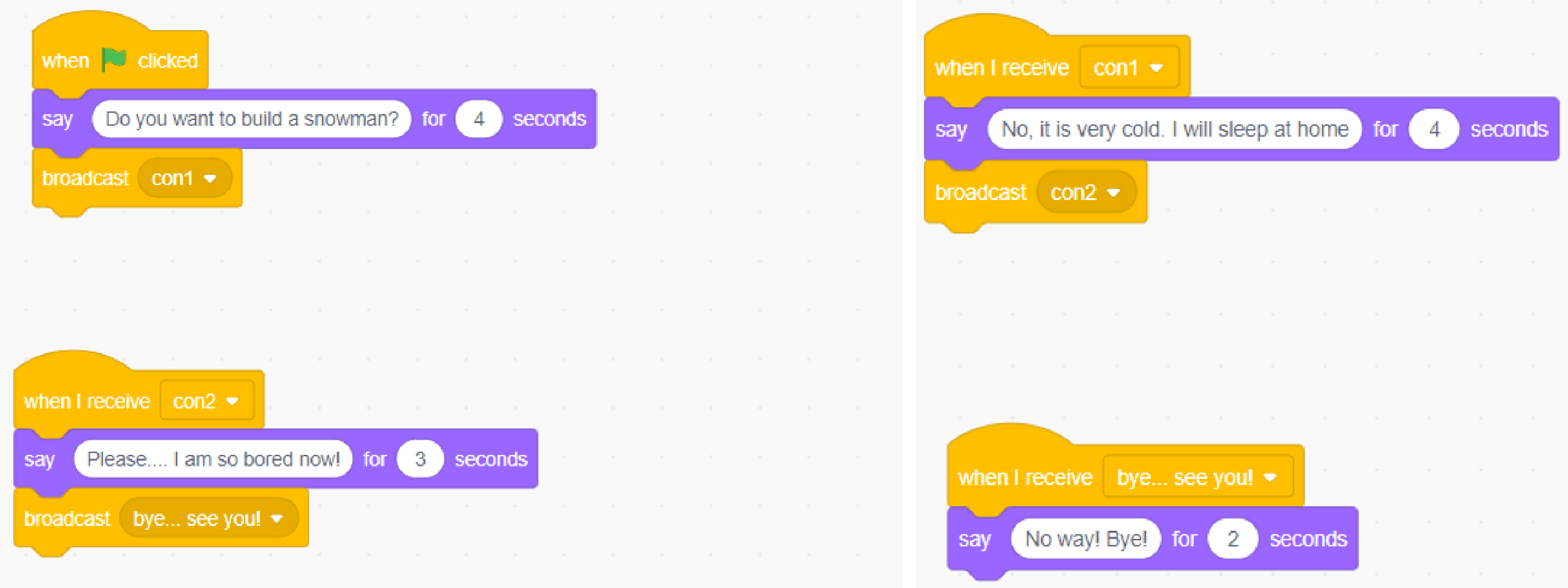
Broadcast codes of Alice.
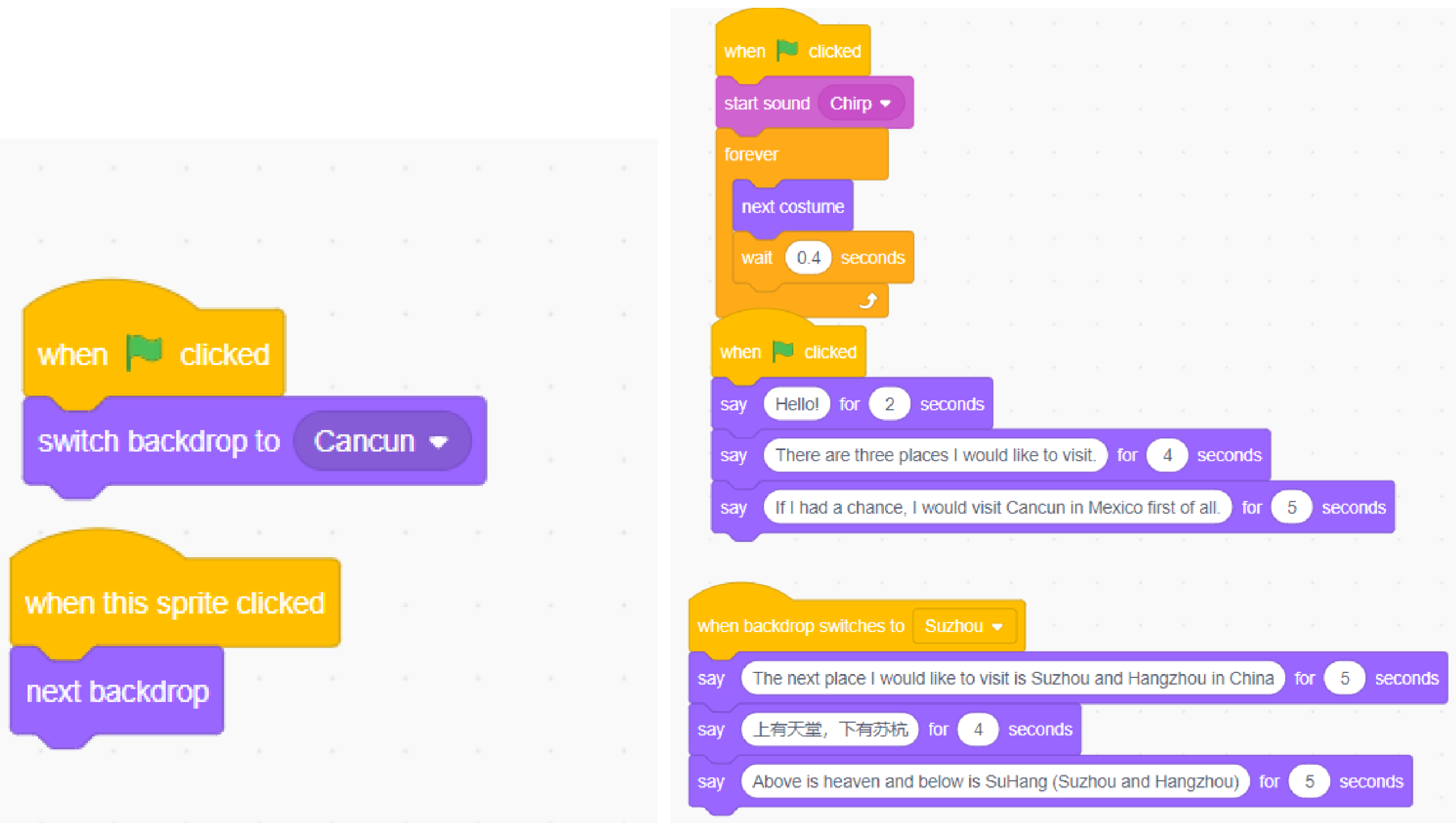
Next backdrop codes of Alice.
Theme 5. Teachers Considered and Used Scratch as an ESL Tool for Vocabulary Building, Role-Play, and Digital Storytelling, Allowing Students to Practice Language in Engaging and Multimodal Ways
In their Scratch projects, Sally emphasized interactive features that support vocabulary memorization and role-play, allowing students to practice language in multimodal ways. She viewed Scratch as a tool for ESL for full CT integration. On the other hand, Alice engaged in digital storytelling within Scratch to enhance task-based language learning, believing interactive storytelling engages students more effectively than traditional recording tasks. Her approach aligns with the current trends in digital storytelling as an ESL tool, using Scratch's interactive capabilities to make learning tasks more engaging for students.
Sally suggested that using a combination of audio, picture, and text could be helpful for young learners in memorizing new English words: They [students] can associate features and with the vocabulary and texts, things, better for them to memorize things. And the second one is also we can combine audio with everything like texts and pictures which is so helpful, I guess, especially for younger children. (Sally, interview)
Sally considered that Scratch can be a valuable tool for supporting ESL activities, such as providing a role-playing context or facilitating human-computer interaction within a project. The multimodal features of Scratch can provide students with personalized learning tasks (Y. Kafai et al., 2020; Pöllänen & Pöllänen, 2019; Sabitzer et al., 2018), and Sally confirmed this aspect of Scratch's capabilities: I think it's also possible for them [students] like practice, kind of like a role play. Like with the computer, like with this program [Scratch], they [students] can practice role-play speaking. When the pictures show the question, they [students] can answer orally… Every student can have their own electronic device. Then, definitely, they [students] can practice with a program individually. (Sally, interview)
Sally prioritized English language learning over practicing CT and coding when discussing activities. Although she mentioned evaluating ESL students using Scratch, her primary focus remained language learning. Sally used Scratch as a support tool for her English lessons, incorporating multiple modalities rather than fully integrating them with CT and language learning: Let's just play sounds but without words, then we [teachers] can that kind of like assess if they [students] remember the vocabulary and how to spell or something. Or we [teachers] just play words and let them [students] make a kind of like lip sync or something to read it out and practice speaking. Or we [teachers] just leave some blanks, and they [students] can fill them in, so practice vocabulary. So, we [teachers] have different approaches to practicing different types of things, we [teachers] want to test with the one we would exercise. (Sally, interview)
Alice used Scratch as a tool for creating digital storytelling artifacts, a popular method both students and teachers adopted (Zhang & Nouri, 2019). Regarding ESL students, Alice discussed the benefits of storytelling, stating that it could be a valuable tool for language acquisition: Storytelling was always teaching in, was always used in teaching languages and ESL in particular. And nowadays digital storytelling is the thing like a lot of people use digital storytelling. They [people] use it [storytelling] in like you see it, you go online, and then you found much storytelling. People build stories for personal reasons, for entertainment reasons, for teaching reasons. Even like National Geographic, they have a scholarship in which they give money to teachers to use storytelling in certain ways. (Alice, interview)
Alice focused on interactive digital storytelling in her project, and she believed that task-based learning would benefit her students. She anticipated that her students would learn more effectively if they needed to use English to complete a task, such as creating a story by orally narrating it or writing a dialogue between characters. Alice promoted the interactive features of Scratch, including the ability to edit projects, start and stop them on demand, move to the next page, and add audio and text with characters called Sprites. She preferred Scratch to conventional ESL recording or writing activities, arguing that “It [Scratch] is more fun when it is in a story because when you ask them [students] just to record yourself and listen to yourself. That task is a bit dry and then not interesting and then like boring and then students don’t see the usefulness.”
Discussion
The research study yielded several key findings. First, teachers’ prior learning experiences significantly impacted the design of Scratch projects for language learning. The ESL teachers brought their own perezhivanies and designed very different lessons even though they completed the same CT activities during the workshop. Perezhivanie means “the way we feel about an experience of an encounter is a kind of prism through which we interpret it” (Johnson et al., 2022, p. 120). Teachers stated that their lesson decisions were traced back to the graduate courses that inspired them as teachers. Their computational thinking (CT) learning experience during the workshop also influenced their lesson decisions on how much scaffolding they would give their students. This indicates that (a) teachers’ pedagogical beliefs were shaped by their teacher training, and (b) their CT learning experience would affect their future lesson designs. Sally's and Alice's past experiences served as a lens through which they interpreted and shaped their instructional designs. Perezhivanie, as a prism of their past educational experiences, influenced their choice of teaching methods (e.g., role-play vs. task-based) and shaped their expectations of student capabilities. This study highlighted perezhivanie, showing how teachers’ personal histories with language pedagogy and CT shape their current instructional practices. The concept of perezhivanie expanded beyond personal emotion to include pedagogical decision-making. This connection extended our framework by situating perezhivanie as central to understanding how teachers interpret and use CT within ESL contexts.
Second, teachers’ knowledge of their students influenced their project designs and pedagogical approaches. This aligns with the literature (e.g., Baecher et al., 2014), indicating teachers’ knowledge about their students is a factor in designing lessons. Sally chose a colorful background that young learners would like, while Alice chose a soccer field that her students from the Middle East would be interested in. Sally also believed that young students are technology-smart and thought her students could create a project with appropriate instruction. In contrast, Alice wanted to develop a pre-made template, as she had less confidence in her students’ capabilities for learning CT. Our finding underscored teacher agency, especially in how Sally and Alice adapt their instruction based on perceived student needs and capabilities. This adaptability showed how teachers balance CT integration with language goals and choose the extent and type of scaffolding. This contributes to our understanding of teacher agency in CT and ESL integration and highlights how teachers exercise professional judgment when there is little to no guidance on integrating computing into the lesson in the curriculum (Larke, 2019). This adaptability can be positioned as a critical factor in effective CT integration, as it allows for customization based on the unique demands of language learning.
This study also highlighted two different approaches to Scratch project design. Sally focused on the interactive features of the artifact, while Alice focused on task-based language teaching for her students. These findings suggest that teachers integrate and use different extents of CT and coding depending on students’ interests and what the instructors perceive as students’ capabilities. This finding advances the significance of CT and coding in teacher practices and student learning (Dağ, 2019; T.-C. Hsu et al., 2018) regarding motivational factors, including interest and efficacy.
Teachers’ decisions while designing ESL lessons with CT showed an application of sociocultural theory within a CT framework. By choosing activities that reflect their sociocultural learning orientations, they demonstrated how teachers draw from sociocultural theory to make CT relevant and accessible to language learners. Sociocultural theory, combined with CT, offered insights into how teachers perceive and shape learning materials to enhance language and CT learning. This integration advanced the conceptual framework by showing that sociocultural theory provides a foundation for understanding how teachers perceive the utility and accessibility of CT in language contexts.
Teachers primarily focused on language learning goals rather than teaching their students CT skills. Teachers did not emphasize CT and coding skills because they believed they needed to prioritize language learning goals: competing instructional goals. This aligns with Bigelow's (2010) that content and language goals are considered competitive by teachers who must achieve dual goals within a limited time. Sally identified herself as an ESL teacher, not a computer science teacher, so she feared spending too much time teaching CT and coding. Sally hesitated to integrate CT because she felt it competes with core language goals and exceeds their perceived role as language educators. The participants’ perspective is understandable, considering that integrating CT into language arts has multiple challenges that need attention before implementation (Santo et al., 2023). Alice was more favorable to technology even before this workshop, saying that students would underestimate their teachers when teachers are not good at technology. She considered what her students and administrator would think about her lessons. This insight can contribute to the literature on integrating CT in non-STEM fields, showing that the tension between content and CT is partly shaped by teachers’ sense of role and agency in navigating dual goals.
Still, teachers showed an interest in integrating CT in their ESL lessons. Sally said it is not appropriate for her to teach CT and Scratch in one class as she needs to teach English. However, it will be manageable if she can teach CT and Scratch little by little in each class, following a CT-integrated ESL curriculum in the long term. Alice also said if a teacher convinces students that CT is related to language learning and gradually teaches them with CT, as Sally said, students will accept it. We found that a structured and organized curriculum teachers can rely on in the long term is needed to avoid competition between content and language.
Our findings align with principles of constructionism, particularly in how teachers designed Scratch projects to be meaningful to themselves and their students. Reflecting constructionist values, teachers crafted project themes and learning activities connected with their teaching philosophies, such as role-play and task-based learning, drawing from their educational backgrounds. This approach underscored constructionism's emphasis on creating “personally meaningful” learning experiences (Y. B. Kafai & Fields, 2018, p. 7) through project-based activities. Also, the teachers adapted their project designs to suit their students’ interests, which aligns with constructionism's focus on contextual and relevant learning (Kafai, 2006; Morado et al., 2021). Teachers provided structured yet flexible support by deciding scaffolding levels, enabling students to construct knowledge through exploration and creation. This reflects constructionist principles by offering students opportunities to construct knowledge while interacting with the tool (Parmaxi & Zaphiris, 2014).
Conclusion
This study has various scholarly and practical contributions. In terms of CT, coding, and language learning, in addition to constructionism and content-based language instruction, the findings in this study provided advances in ESL instruction and the integration of CT and coding by highlighting Scratch as a tool for CT integration into ESL instruction and teachers as designers with and for CT in ESL instruction.
Consideration of choosing a familiar topic for students or giving scaffolding not to make them overwhelmed can be adopted to reduce the difficulties. Educators can use the findings of this study to develop strategies to overcome challenges, such as reducing programming and content difficulties and making learning more accessible for students. This could include scaffolding for students struggling with programming visual, interactive, and CT-focused projects.
Teachers’ knowledge is not static but dynamic. Even though the two participants graduated from the same graduate program, they made different design decisions and reshaped their knowledge in the design process. Teachers adjust their projects based on their prior and new knowledge, so their design activities for CT lessons continue to change through professional development or academic endeavors like educational technology courses. Teachers’ learning experiences and their knowledge of their students highlighted factors to consider when designing Scratch projects for CT and language learning. Educators can use this information to design Scratch projects that are engaging and effective for their students. Further research is needed to reveal other potential factors in designing Scratch projects for CT and language learning.
The study used a framework based on constructionism, where learners create meaning through hands-on projects. Teachers’ beliefs about language learning and technology integration were key in guiding their choices for Scratch project designs (see Figure 4). These beliefs influenced their instructional decisions, including the choice of tasks, the level of scaffolding, and the degree to which CT was integrated into language learning.
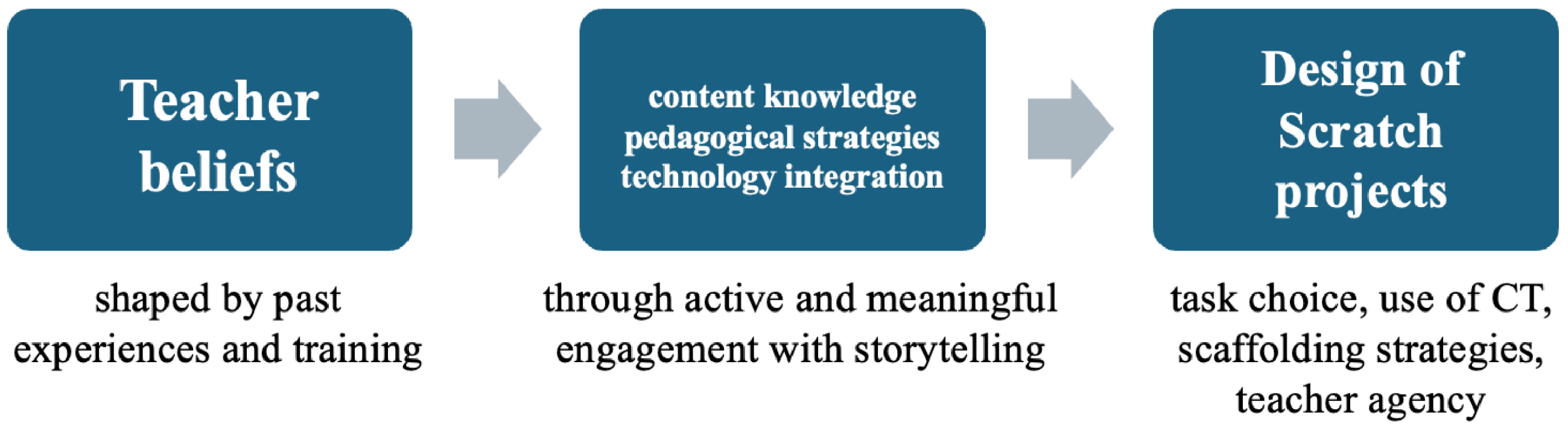
Teacher beliefs, shaped by past experiences and training, influence their content knowledge, pedagogical strategies, and technology integration, ultimately guiding the design of Scratch projects.
Implications
Findings from this study contributed to expanding the understanding of teacher agency within the CT integration framework. The study demonstrated how teachers’ unique experiences, including Perezhivanie (Johnson et al., 2022), shape their approach to CT and language integration, suggesting that future theoretical frameworks should consider the role of teacher agency. Additionally, this research expanded constructionism by showing how it can be adapted to language learning contexts, where language goals must be balanced with CT objectives. Future research should investigate how constructionism can be adapted to fit dual-focused learning environments to support theory development in CT and language acquisition. Future theoretical models for CT integration in language learning should incorporate the concept of Perezhivanie, acknowledging that teachers’ personal meaning-making processes shape their pedagogical choices.
The findings also yielded several practical recommendations for teaching and learning. First, training programs should promote flexible scaffolding strategies, empowering teachers to adapt CT activities based on their students’ CT experience levels. Second, designing CT-integrated lessons that reflect students’ interests can increase engagement and make CT learning more accessible. Third, a structured, long-term approach to CT integration in ESL curricula could help balance language and CT learning goals, reducing the perception of competition between the two. Finally, supporting teachers’ confidence in integrating CT as an extension of language teaching can strengthen their professional identities and facilitate smoother implementation of CT in ESL classrooms.
Limitations
According to Stevens and Verschoor (2017), language improvement in areas like pronunciation and grammar can be incorporated while building an artifact. Also, a short workshop focusing on teacher's professional development on CT can be helpful for teacher to improve their confidence in and understanding of CT components (Bower et al., 2017). However, a three-hour workshop would not be sufficient for the participants to grasp the details of Scratch to create a learning material. Longitudinal research that provides frequent feedback and follow-up workshops could yield more comprehensive outcomes and enable participants to comprehend the subject matter in depth.
This study was based on a small-scale, qualitative case study design, focusing on two ESL teachers’ unique experiences and perspectives as they integrated CT into language learning. Due to the case study nature of this research, the findings are not intended to be generalizable across all educational settings or teacher populations. Instead, this study explored in-depth how individual teachers’ prior experiences and teaching contexts influence their integration of CT and coding within ESL instruction. However, the study's insights offer transferability to other educators and educational contexts with similar characteristics, such as teachers in language programs with diverse student backgrounds. For example, the findings may be relevant to educators facing the challenge of balancing CT and subject-specific objectives or those aiming to incorporate interest-driven practices within technology-based language activities. This study offers actionable insights that can inform teacher training programs and curriculum development for CT integration by highlighting how personal experiences shape instructional choices.
Despite the distinct differences between the participants, the absence of collaboration also presented limitations. The participants graduated from the same program but created different projects. Future research needs to study further the same cohort of teachers’ lesson designs with CT because their personal teaching experiences, different interpretations of the graduate program, and learning experiences during workshops affect designs.
Authors Contributions
Conceptualization: Ehean Kim, Emre Dinç; Methodology: Ehean Kim, Emre Dinç; Formal analysis and investigation: Ehean Kim, Emre Dinç; Writing - original draft preparation: Ehean Kim, Emre Dinç; Writing - review and editing: Emre Dinç
Consent to Participate
Informed consent was obtained from all individual participants included in the study.
Data Availability
The data of this study are available from the corresponding author upon reasonable request.
Footnotes
Declaration of Conflicting Interests
The authors declared no potential conflicts of interest with respect to the research, authorship, and/or publication of this article.
Ethics Approval
Approval was obtained from the ethics committee of The Pennsylvania State University. The procedures used in this study adhere to the tenets of the Declaration of Helsinki.
Funding
The authors received no financial support for the research, authorship, and/or publication of this article.

Author Biographies
Dr.