



Abstract
This study explored online assessment and highlighted significant assessment strategies, such as capstone projects, quizzes, and self-assessments. Inquiry-based assessment, transformative assessment, and scaffolding with self-assessment resources formed the framework. Our goal was to determine the effects of certain self-assessment parameters on student achievement in online learning, including the frequency of answering online self-assessment questions, the points earned for correct answers, and the time spent answering questions. Data from undergraduate geoscience courses were analyzed using a hierarchical linear model, and the results showed that frequently answering online self-assessment questions is a strong predictor of higher final grades, capstone project success, and quiz results. The frequency of answering online self-assessment questions was a more significant factor than the amount of time spent on these questions and the total points earned. Educators are encouraged to redesign their courses to include self-assessment resources that promote frequent student engagement instead of just one-time interaction.
Introduction
Today's students have access to academic programs and courses from anywhere in the world due to the noteworthy rise in popularity of online education. Similar to traditional education, online education relies heavily on assessment via reliable means to gauge student learning. Assessments, whether conducted online or in an in-person setting, are critically important to offering educational quality and equity (Meyer et al., 2010; Montenegro & Jankowski, 2020). To address possible disparities that can emerge in online learning environments, it is essential to examine and improve current assessment means as we work toward a more inclusive educational landscape. Exams, capstone projects, and a variety of other assessment formats can all be used to evaluate student success in different ways. For instance, quizzes can be used to assess students’ retention of knowledge (El-Hashash, 2022), and capstone projects provide students a chance to apply what they have learned (Basholli et al., 2013). It is critical to use different assessment methods in balance in online education since they provide a thorough and all-encompassing way to gauge student learning (Arend, 2007; Millet & Dinç, 2023).
A diverse group of students may now learn in ways that offer flexibility and convenience thanks to online education. However, there are still issues with equal access to high-quality education (Alenezi et al., 2023; Gu, 2021). Assessments take on additional significance in this context. Learning outcomes for all students may be improved and inequities can be reduced by having an in-depth understanding of assessment creation and usage in online learning contexts (Coates, 2016; Fung et al., 2022). In this study, we concentrated on quizzes, capstone projects, and self-assessment, reflecting actions of remember-understand, evaluate-create, and retrieval practice, respectively (Millet & Dinç, 2023).
While quizzes allow for frequent engagement with the course content (Argyriou et al., 2022), capstone projects accommodate investigating real-world problems and integrating theory and practice (Basholli et al., 2013). Quizzes and capstone project performances both are significant predictors of success in an online course (Figueroa-Canas & Sancho-Vinuesa, 2020). Self-assessment questions are another means of assessment that contribute to student learning. Self-assessments allow for reflection on learning, critical thinking, and strength and weakness awareness through monitoring (Conrad & Openo, 2018). Factors related to self-assessment can be investigated, such as frequency, points earned, and time spent. For example, the frequency of answering self-assessment questions is positively correlated with student success in quizzes and capstone projects (Millet et al., 2022), and it also serves as a significant predictor of quiz success (Dinç & Millet, 2022). With that in mind, we sought answers to our research question: How do (a) the frequency of answering, (b) the total points earned from correctly answered, and (c) the time spent on self-assessment questions influence student success in quizzes, capstone projects, and overall course grades?
Multifaceted Assessment Strategies for Student Learning
Diverse assessment methods comprise a variety of evaluative modalities, including quizzes, capstone projects, and self-assessment. Various assessments exhibit students’ understanding and competencies, enabling them to demonstrate their knowledge and skills in multiple ways. Quizzes, for example, allow for acquisition of facts in the content and serve as a feedback mechanism during the learning process (Salas-Morera et al., 2012; Sewell et al., 2010). Assessment methods, such as capstone projects, facilitate the application of knowledge to real-world problems and events, fostering a more authentic educational experience (Maleki, 2009; Zhang et al., 2021).
Students conceptualize self-assessment as a regulatory learning strategy as self-regulated learning is dependent on its two components: self-monitoring and self-evaluation (Panadero et al., 2017; Zimmerman & Labuhn, 2012). Self-assessment requires students to assess their own thinking and cognitive processes, indicating metacognitive awareness and responsibility for the learning process (Mok et al., 2006). Through self-assessment, timely and delayed feedback, a critical element in online education, enriches students’ learning performances, empowering them to identify areas that need improvement and adapt their learning strategies (Ifenthaler et al., 2023; Thomas et al., 2017). In addition, self-assessment significantly influences student learners’ self-efficacy and allows them to take ownership of learning (Panadero et al., 2017). The meta-analysis conducted by Panadero and colleagues (2017) indicated a substantial effect size of 0.73 of self-assessment on self-efficacy. Sitzmann et al. (2010) identified strong correlations between self-assessment and motivation and satisfaction in both education and workplace settings. In addition, self-monitoring was detected to be a significant moderator of self-efficacy (Panadero et al., 2017). Self-assessment involves a wide variety of mechanisms and has been shown to improve learning's effectiveness and outcomes (Yan, 2020). Incorporation of rubrics and feedback with self-assessments further strengths its conducive effect to learning outcomes (Panadero & Jonsson, 2013; Panadero & Romero, 2014; Sitzmann et al., 2010). In parallel, data analytics in assessment, including self-assessment, provides data regarding students’ academic performance, enabling instructors to receive insights into students’ learning processes and make data-driven pedagogical adjustments (Baker & Siemens, 2022; Mattingly et al., 2012).
Transformative Assessment: Quizzes
Quizzes play a transformative role in education, influencing both teaching and learning. They offer a wide array of benefits beyond merely serving as assessment tools, contributing to the multifaceted landscape of education. Their inherent function as formative assessments guides students toward self-regulation and fosters continuous, consistent engagement with course content. Blanco and Ginovart (2012) emphasized the use of quizzes as low-stakes assessment activities, promoting self-regulation, and fostering an environment of ongoing learning, a characteristic of effective education. Online quizzes, as argued by Cook and Babon (2017) and Gamage et al. (2019), deserve special attention in the digital age. They function as robust tools, enhancing engagement, motivating students, and thus ensuring the enduring relevance of their academic efforts. The provision of automated feedback, a valuable feature of online learning platforms, proves beneficial in offering timely feedback into student performance. This feature not only streamlines the process but also represents a significant time and effort-saving aspect of instruction (El Said, 2021; Gamage et al., 2019).
Quizzes are distinguished by their diverse question types, catering to various learning needs and serving as a valuable resource for learning opportunities. Blanco and Ginovart (2012) underscored the importance of this diversity, encompassing a range of question formats, including multiple-choice, true/false, and short answers. These question structures in quizzes not only challenge students in diverse ways but also present significant opportunities for grasping factual knowledge (Enders et al., 2021). Additionally, the remote management features inherent in web-based assessment tools contribute to educational flexibility and effectiveness (DeSouza & Fleming, 2003). In the digital era, the favorable responses from students regarding quizzes (Chaqmaqchee, 2015; Gamulin & Gamulin, 2012) affirm the increasing significance of quizzes in education. Gamulin and Gamulin (2012), for instance, concentrated on the usage of online quizzes. Their research examined how formative assessments affected students’ preparation, motivation, and academic achievement. Their main conclusions showed that online quizzes improved students’ comprehension of the material and impacted how well they prepared for lab activities. The quizzes were intended to be formative, offering quick feedback and assisting in the process of learning. Their study looked at how the students perceived these quizzes in terms of their usefulness and simplicity of use. They indicated that using online quizzes to supplement classroom instruction can be a useful strategy for improving student learning and success.
Student feedback highlights that quizzes are not just assessment tools but also essential conduits for boosting student confidence and facilitating their progress in comprehending course content (Chaqmaqchee, 2015). Consequently, we can assert that quizzes are transformative educational instruments, facilitating learning, engagement, and motivation in educational settings. Quizzes are well-suited to integrate into assessment plans with other assessment types, including project-based assessments (Heil & Ifenthaler, 2023).
Inquiry-Based Assessment: Capstone Projects
Project-based assessment, such as capstone projects, embodies a dynamic and student-centered approach to learning. It departs from traditional teacher-centered instruction, encouraging students to take initiative using inquiry-based methods (Baker, 2006; Bell, 2010). Its congruence with Bloom's Taxonomy, encompassing creating a product and the development of higher-order thinking skills, is one of its notable strengths (Baker, 2006; Joo et al., 2019). The interdisciplinary character of project-based learning enables students to apply their knowledge and work together across a variety of fields, developing skills for addressing real-world problems (Joo et al., 2019; Kokotsaki et al., 2016). Further, the development of critical thinking skills and a deeper engagement with course content are advantages for students (Mitchell et al., 2019; Torrijo et al., 2021).
Project-based learning extends beyond the classroom, connecting academic content to authentic real-world problems (Bell, 2010; Mathews & Wikle, 2019). By placing an emphasis on soft skills including collaboration, practical thinking, and communication (Rice & Shannon, 2016; Torrijo et al., 2021), it prepares students for the challenges of the 21st century. However, there are obstacles, such as extensive content coverage in limited time and lack of creativity in capstone projects, adequate equipment, and guidance for students (Plotnick et al., 2009; Wan et al., 2018). To make sure that students have the necessary knowledge and skills before beginning self-directed projects, it is crucial to strike a balance between teacher's instruction and self-governed inquiry (Kokotsaki et al., 2016). The accumulative evolution of project-based assessment holds promises for fostering learning experiences that equip students with not only content knowledge but also the practical skills and competencies needed to solve problems (Joo et al., 2019; Lin, 2018; Mountrakis & Triantakonstantis, 2012). For example, Terrón-López et al. (2017) inquired about how to incorporate capstone projects, where students work on real-world problems, into the curriculum as part of a project-based learning approach. These initiatives aimed to increase student motivation, enhance learning, and foster the growth of critical problem-solving, teamwork, and communication abilities. In their study, adoption of project-based learning showed encouraging outcomes for student motivation, skill development, and academic achievement.
Scaffolding with Self-Assessment Resources
Self-assessment can function as a scaffolding method. The term scaffolding refers to a supporting framework that guides students toward proficiency in learning activities (Quintana, 2021; Tabak & Kyza, 2018). This framework for self-assessment entails providing students with the tools, resources, and opportunities to evaluate their own learning critically. Self-assessments, particularly those completed online, provide as a “no-risk” setting for students to identify gaps in their understanding and receive immediate feedback (Ćukušić et al., 2014; Mok et al., 2006; Thomas et al., 2017, p. 1063). Active participation in self-assessment helps students grasp course content and the language of the subject matter, leading to a deeper understanding of the content (G. J. Thomas et al., 2011; J. A. Thomas et al., 2017). Papanthymou and Darra (2019) investigated the influence of self-assessment on numerous educational parameters. In order to investigate the ways in which self-assessment fosters self-esteem, self-regulating learning, academic achievement, and learning motivation, they examined 37 empirical research. Results from a variety of disciplines and educational levels showed that self-assessment has a beneficial impact on these domains. Their study underlined the value of self-assessment in educational settings and highlighted how it helps students achieve better learning outcomes and grow personally.
Self-assessment is a tool that can be embedded within the learning process where students autonomously make decisions about their learning with the use of assistance offered (Boud & Falchikov, 1989; Taras, 2010). This empowerment is consistent with the idea that students become more engaged and self-confident in their education, ensuring less dependence on instructors (Ćukušić et al., 2014; Millet et al., 2021). The positive correlations between exam scores and self-assessment points (Ćukušić et al., 2014) and between final grades and self-assessment engagement (Thomas et al., 2017) emphasize the effectiveness of self-assessment as a predictive measure of academic performance, further underlining its significance as a scaffolding method. According to Taras (2010), the self-assessment process, which involves critical reflection before, during, and after learning (Fallows & Chandramohan, 2001; Mok et al., 2006), encourages metacognition and equips students with skills they need for both personal and professional growth. Self-assessment essentially serves as a scaffolding method that stimulates student growth, promotes reflective practice, and supports the entire or part of the learning process.
Method
Participants and Setting
The participants in the study were all undergraduate students enrolled in three online geoscience courses (n1 = 280, n2 = 52, n3 = 64) at an R1 university in the United States.
The students completed the course as they normally would with no additional work or assessment required of them. The students all completed the online courses asynchronously with weekly deadlines to maintain similar pacing in each course. We collected and anonymized the data at the end of the semester using queries to extract assessment data on the students who consented to being part of the study from both the central learning management system (LMS) records and our content management system (CMS). From the LMS, we collected assessment scores on quizzes, capstones, and each student's final grades. From the CMS, we collected data on the online self-assessments.
Measures
The assessment of student success in each course involved a combination of quizzes and capstone projects, which served as common evaluation tools. These assessment components were quantified as continuous variables. Additionally, the overall course success was measured using final scores, also treated as a continuous variable.
Our study examined independent variables related to online self-assessment factors. These included:
Frequency of answering online self-assessment questions: This variable captured the attempt at which students engaged with online self-assessment questions by answering the questions.
Points earned for correctly answered online self-assessment questions: This variable represented the number of points awarded to students for providing correct answers to online self-assessment questions. One point was given for each correctly answered question. Students were informed in the beginning that these points will not be aggregated into the final score in the course.
Time spent on online self-assessment questions: This variable measured the amount of time students dedicated to answering online self-assessment questions as an indicator of their self-paced learning efforts.
Data Analysis
The hierarchical linear model was used to gauge the effect of the frequency of completion of online self-assessment questions, total points for correctly answered online self-assessment questions, and the time spent on online self-assessment questions on students’ quiz grades, capstone project grades, and final course grades. Analysis was conducted in R with the lmerTest R package (Kuznetsova et al., 2017). The study variable was treated as a random effect in the hierarchical linear models to account for the fact that students are nested within each course section.
Results
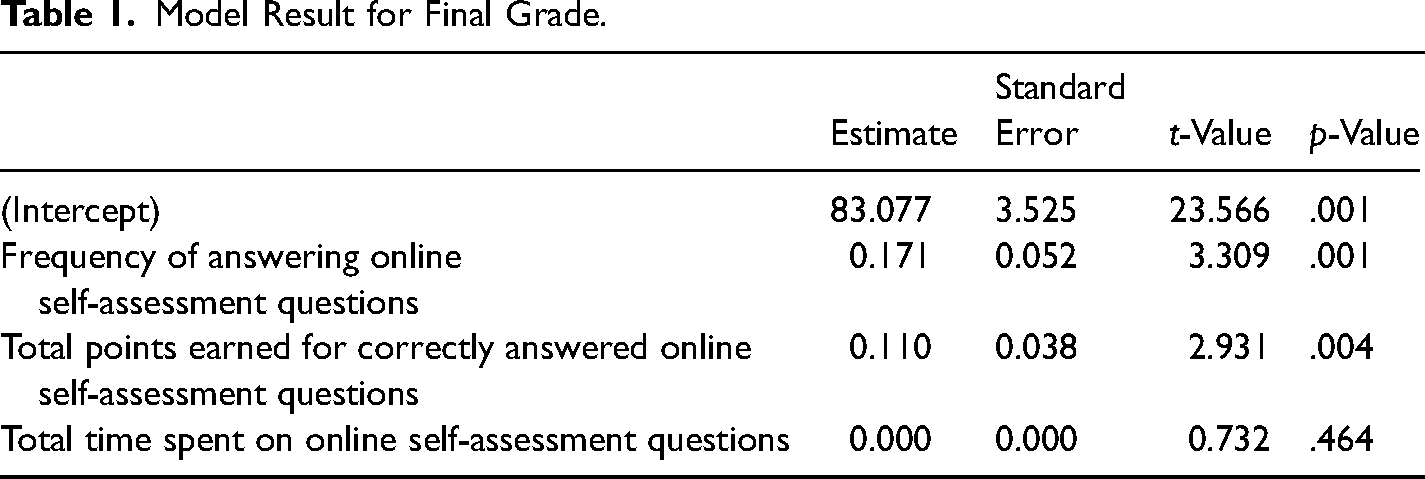
Empirical evidence showed that completing the online self-assessment questions enhanced student success on capstone projects, quizzes, and final score. Frequency and total points for correctly answered self-assessment questions are both significant positive predictors for students’ final grade (see Table 1). For each additional attempt to complete the online self-assessment questions, the student's final grade increased by 0.171 point. For one additional point earned in the self-assessment questions, the student's final grade increased by 0.11 point. Although both frequency and points earned were detected as significant positive predictors for one's final grade in the course, frequency has a larger beta estimate than total points earned, indicating that frequent checks of one's understanding might play a more significant role in one's successful completion of the course than total points earned in these assessments.
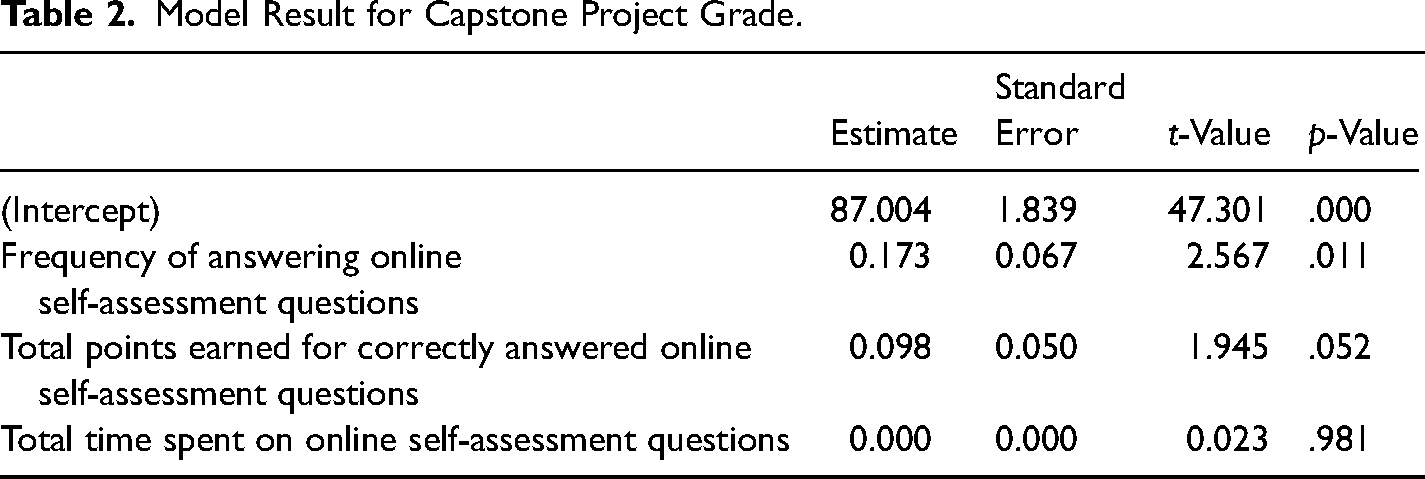
For the capstone project grade, frequency is a significant positive predictor (see Table 2). For each additional attempt to complete the online self-assessment questions, the student's final grade increased by 0.173 point. The result demonstrated that the online self-assessments had a positive effect on students learning not only on the immediate assignment (e.g., quiz) but also on the assignment later on in the semester (e.g., capstone project).
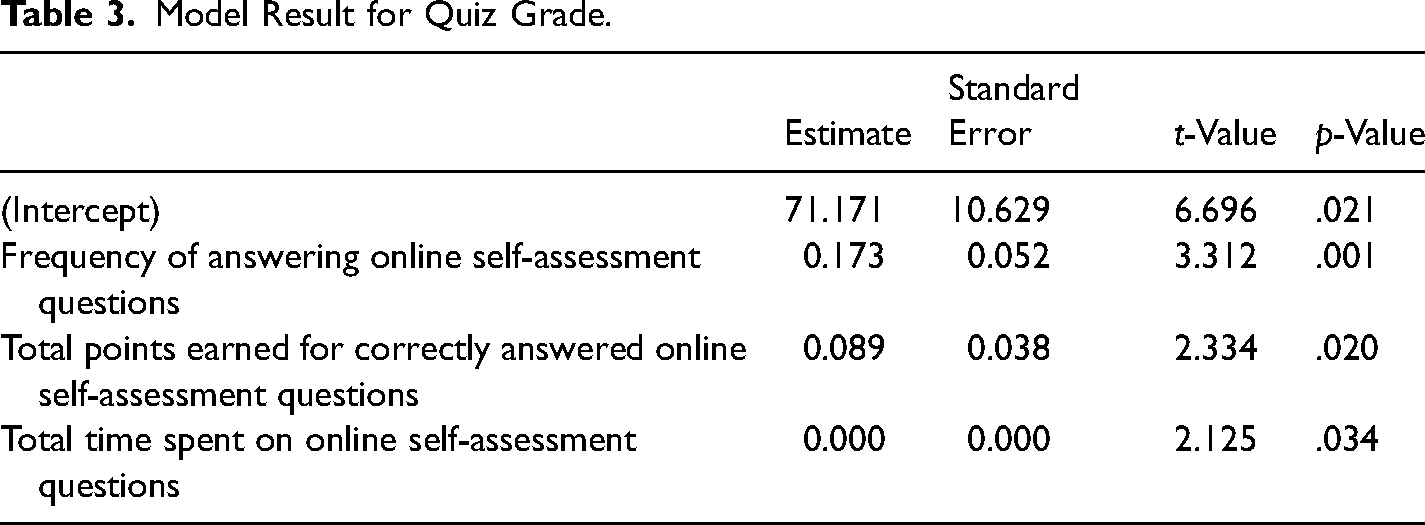
For the quiz grade, all three variables: frequency, total points for correctly answered online self-assessment questions, and time spent, are all significant positive predictors (see Table 3). For each additional attempt to complete the online self-assessment questions, the student's quiz grades increased by 0.173 point. For one more point earned in the self-assessment questions, the student's quiz grade increased by 0.089 point. For each additional minute spent on the self-assessment questions, the student's quiz grade increased by 0.00005 point (not shown on the table due to the three decimal point limit). Among all three predictors, frequency again has the highest beta estimate, indicating the conducive effect of frequently checking one's understanding.
Discussion
The results underline the significance of frequent use of online self-assessment resources by showing that the frequency with which students responds to online self-assessment questions is a major predictor of their final grade, capstone project success, and quiz success. This is especially significant since it implies that students’ frequent engagement in self-assessment greatly influences students’ comprehension and retention of course material.
The significance of continuous effort over sporadic excellence is suggested by the slightly more substantial impact of the frequency of responding to self-assessment questions relative to the total points obtained from the correct responses. It implies that students who are frequently involved in the self-assessment tend to understand the material better, which results in higher overall grades. This may be explained by the way that learning is scaffolded via frequent engagement with the self-assessment resources, leading to identifying and addressing misconceptions and misunderstandings. Considering the positive correlations between exam scores and self-assessment points (Ćukušić et al., 2014) and between final grades and self-assessment engagement (Thomas et al., 2017), our results supported the scaffolding nature of self-assessment resources.
As for capstone projects, the significance of the frequency of answering self-assessment questions as a positive predictor highlights the role of self-assessments in student success in more complex, long-term assignments. It implies that frequently engaging with self-assessment resources contribute significantly to a student's capstone success. Capstone projects inherently have a student-centered approach to learning, encouraging students to have agency (Baker, 2006; Bell, 2010). Our findings for the predictive nature of self-assessment for capstone project success serve as a supplementary resource when students have the agency while working on capstone projects based on their inquiry.
The frequency of responding to self-assessment questions, the total number of points earned for correct answers, and the amount of time spent using self-assessment tools are the three factors the study finds to predict quiz success. This result demonstrates how complex learning is and the importance of engagement quantity (time and frequency) and quality (correct responses). The assumption that frequent engagement with self-assessment resources is advantageous is further supported by the fact that frequency has the most substantial effect among these criteria. These results elaborate on the significance of self-assessment resources regarding the effect on quiz success, considering quizzes are a tool to promote self-regulation and continuous learning (Blanco & Ginovart, 2012). Also, various studies demonstrate the students’ positive feedback for the existence of quizzes in the learning process (e.g., Chaqmaqchee, 2015; Gamulin & Gamulin, 2012). Therefore, self-assessment resources as supplementary material may increase quiz success and, consequently, learning of factual knowledge presented via quizzes.
Conclusion
The frequency with which students answer self-assessment questions and the total points they gain from correct answers were both key factors that positively predict their final grades. Although both the amount of time spent for answering self-assessment questions and the points they earn were important, the frequency of answering self-assessment questions had a greater impact on the students’ final grades. For the capstone project, how often students answer self-assessment questions were a significant predictor of capstone success. In quizzes, three factors—how often questions are answered, the total points for correct answers, and the amount of time spent—were all important for predicting quiz success. Among these, the frequency of answering self-assessment questions had the highest impact.
Implications and Recommendations
According to our research, using self-assessments frequently is associated with higher academic success. Our research suggested that students’ retention, comprehension of content, and other higher-order cognitive functions can be significantly improved by frequently interacting with educational materials that incorporate self-assessments. This association's fundamental tenet is that effective learning processes need active engagement with the learning materials being studied. Frequent engagement with self-assessment resources can help students better comprehend the material, evaluate their performance and progress, and enhance their learning.
Further, the significance of self-assessment frequency in predicting student grades highlights the role of formative assessments in the teaching and learning process. Formative assessments are incorporated throughout the learning process, unlike summative assessments, which evaluate student learning at the end of an educational process. Because they offer continuous feedback, students are able to track their progress and adjust their learning strategies as necessary (Boekaerts & Corno, 2005; Nicol & Macfarlane-Dick, 2006; Sezgin-Memnun, 2013). To improve their academic achievement and get a more in-depth comprehension of the course material, students need to engage in this continuous feedback loop.
Interestingly, our research revealed that the frequency of engaging with self-assessment resources has a greater influence than the total points obtained on the correctly answered self-assessment questions. This insight raises the possibility that the criteria for evaluating academic achievement might be revised. Academic achievement has been assessed primarily on performance or outcomes. Nonetheless, the significance of the learning process and the students’ frequent efforts were emphasized by this study. There is an emerging perspective that recognizes the value of persistence, resilience, and the willingness to engage with educational materials, regardless of the immediate performance outcomes (Dweck et al., 2014).
A further noteworthy aspect of the research is the diverse influence of different predictors on different assessment types, including quizzes vs capstone projects. This variance shows the possible advantages of personalized learning approaches. Personalized learning takes into account individual student's unique needs and strengths (Akyuz, 2022). By customizing learning experiences to suit individual student's profile, teachers may better address each student's particular needs and leverage their abilities. This approach may result in more meaningful and productive learning opportunities, eventually improving achievement levels.
The importance of formative assessments, the necessity of emphasizing learning processes as well as outcomes, the necessity of active learning engagement, and the possible advantages of personalized approaches to learning are all stressed by this research. These insights can help educators and policymakers create and execute more successful instructional strategies that support students’ development of a deeper, more thorough understanding and appreciation of the learning process in addition to grades.
Educators are encouraged to redesign their courses to include self-assessment resources that promote frequent student engagement instead of just one-time interaction. Teachers can provide students with continuous feedback, supporting the learning process and assisting students in identifying areas for development by integrating self-assessment questions as continuing formative assessments and scaffolding tools throughout the course. It is also recommended that educators and educational institutions emphasize the learning process in addition to outcome-based evaluations, praising and rewarding frequent engagement and effort, a practice that has great implications to educational equity. This emphasis might entail creating courses that adjust to the unique learning needs of each student and providing more frequent and varied assessment options to meet their various needs and preferences. Additionally, LMS and other educational technologies can also be used to track student engagement with self-assessment resources and provide personalized feedback. This would allow teachers to monitor engagement and adapt learning materials to improve the learning process.
Limitations
This study has some limitations. Our investigation focused on specific types of assessments, namely quizzes and capstone projects. Those were selected to investigate the effect of online self-assessment recourses on student success. These two types of assessment represented distinct strategies within educational assessment spectrum, providing a varied yet focused scope for our analysis. Still, it is important to note that this leaves room for further investigation into additional assessment strategies. Future studies might benefit from incorporating online discussions, laboratory assignments, essays, and reflection journals.
Also, our study context was science, with a particular emphasis on geoscience education. Therefore, there exists an opportunity for further research to investigate the effect of online self-assessment resources on student success in other subject areas, such as mathematics and literature. This could yield additional insights into the adaptability and effectiveness of online self-assessment across the educational spectrum.
Model Result for Final Grade.
Model Result for Capstone Project Grade.
Model Result for Quiz Grade.
Footnotes
Authors’ Contribution
ED and ALM contributed to conceptualization and writing—original draft preparation; ED and AYZ to methodology, formal analysis and investigation, and writing—review and editing ; and ALM to supervision.
Consent
All subjects gave informed consent for inclusion before participating in the study.
Data
The datasets generated during and/or analyzed during the current study are available from the corresponding author on reasonable request.
Declaration of Conflicting Interests
The authors declared no potential conflicts of interest with respect to the research, authorship, and/or publication of this article.
Ethics Approval
The study was conducted in accordance with ethical guidelines, and the protocol was approved by the Ethics Committee of Penn State (Study ID: STUDY00010309).
Funding
The authors received no financial support for the research, authorship, and/or publication of this article.
