



Abstract
Abstract
This mixed-methods study captures multiple stakeholders’ voices and experiences of a hybrid-flexible (HyFlex) learning environment. It juxtaposes different perceptions of learning experiences, equivalency, and interactions. Tutor strategies to facilitate communication across space are explored. Thirty-six undergraduate students experienced the HyFlex model with two synchronous participation modes (i.e., on-site vs. synchronous remote) and an asynchronous option. The study explores the HyFlex setting from three different perspectives. A survey captured students’ perceptions of their motivation, learning, engagement levels, ease of communication, and collaboration experiences within or across spaces. An observation report sheds light on strategies to mediate the transition between the physical and virtual space. A tutor’s journal provides the perspective of teaching on the physical–hybrid–virtual continuum. Meeting students’ needs equally well in the physical and virtual space emerges as a key challenge. The article contributes to the research about hybrid education environments and the intentional planning of versatile interactional spaces.
Introduction
Instructors and students have a shared responsibility in crafting an effective learning environment (Detyna & Koch, 2023). A learning environment is created through an interaction between pedagogical, social, and spatial dimensions with dynamic student and tutor roles, changing expectations, and other variables that shape learning experiences (Hansson et al., 2022; Leijon et al., 2021; Radcliffe, 2008; Temple, 2014).
The hybrid virtual classroom is not only the most difficult to teach in but also the most challenging one to learn in as a remote participant (Raes et al., 2020). Many educators have recognized its potential. In a hybrid-flexible (HyFlex) model, students have maximum flexibility in choosing their participation mode for any class meeting without prior notification and without risking a negative impact on their academic achievement (Bockorny et al., 2023). Beatty (2019) is credited for the popular HyFlex model, which builds on learner choice, accessibility, equivalency, and reusability. These four values have inspired multiple variations of HyFlex, such as Studyflex (Bevacqua et al., 2022), BlendFlex (Rosen et al., 2022), Interactive Synchronous HyFlex (Mentzer et al., 2023), Here or There (HOT) instruction (Zydney et al., 2019), and Remote Live Participation (RLP) (Verdooner & Marquart, 2021). Common to these models is the notion of flexibility to accommodate the need for flexible learning trajectories (Raes et al., 2020).
The next step is to face the demand for high-quality hybrid delivery (Bevacqua et al., 2022) affording equal levels of academic rigor in all delivery modes (Boylan et al., 2022). Current research indicates that educators are trialing different flex models and initiatives with different foci, for example, establishing equivalency (Binnewies & Wang, 2019), academic rigor and quality (Boylan et al., 2022), affordances of flexible learning spaces (Reinius et al., 2021), exploring affordances and opportunities (Bockorny et al., 2023; Mentzer & Mohandas, 2022), implementation challenges (Detyna et al., 2022), effective engagement strategies (Bockorny et al., 2023; Raes, 2022; Raes et al., 2020), comparing academic performances (Mentzer et al., 2023), students’ psychological needs in HyFlex (Mentzer et al., 2023), design guidelines (Detyna & Koch, 2023; Raes, 2022; Raes et al., 2019a, 2019b), and creating learning at the intersection of the physical and virtual space (Leijon & Lundgren, 2019). New frameworks have been proposed, such as the Education Spaces Framework for the physical–hybrid–virtual continuum (Støckert et al., 2021) or DiSCo, a theoretical model for didactic spatial competence building on the potential and opportunities afforded by varied learning spaces (Leijon et al., 2021). New communities of practice have been formed, such as the HyFlex Collaborative (HyFlex, 2023).
More research has been called for to investigate the factors that shape student engagement and learning in hybrid environments from a student and teacher perspective (Raes, 2022). This mixed-methods study contributes to the research on synchronous hybrid learning environments in higher education. It juxtaposes multiple stakeholders’ voices and perceptions of their learning and teaching experiences in a HyFlex setting. While previous research largely focuses on instructors’ and students’ subjective experiences, this study makes an original contribution by emphasizing the evaluations by a non-participant observer and thus adds a third perspective of substantive value. The theory-grounded observation matrix and the reflective prompts for HyFlex instructors highlight critical areas to consider when creating learning environments on the physical–hybrid–virtual continuum (Støckert et al., 2021).
Background
This section introduces the four principles of the HyFlex model (Beatty, 2019) and the different types of flexible hybrid spaces with a focus on interactional space. It provides an overview of research on active engagement in synchronous hybrid learning environments and offers a brief discussion of the impact of HyFlex settings on learning. A summary of the affordances and challenges concludes this section.
The Four Principles of HyFlex
The HyFlex model (Beatty, 2019) is anchored in four principles. Learner choice provides the foundation that undergirds the very idea of HyFlex, namely, flexibility. Students may choose between participation modes daily, weekly, or even topically (Beatty, 2019). Without a flexible participation policy, it is just a standard hybrid course (Beatty, 2019). Previous research informed by self-determination theory (Deci & Ryan, 1985) has established a connection between students’ perceptions of flexibility and autonomy. Students feel a sense of autonomy when they have the freedom to make their own decisions. The ease with which students can flexibly join a HyFlex class affords them a sense of control over their preferred learning environment (Mentzer & Mohandas, 2022). When comparing autonomy satisfaction in a traditional and a HyFlex instructional approach, Mentzer et al. (2023) did not find significant differences; similarly, no differences were found between the on-site and the remote participants in the HyFlex option.
Equivalency is the second pillar of HyFlex (Beatty, 2019). “There are no poor cousins between the modes, that is, for equivalency - despite mode chosen, they each provide students the opportunity for equivalent stand-alone learning outcomes” (Bevacqua et al., 2022, p. 244). Learners must have access to equivalent materials and to the same supports regardless of their participation mode (Mentzer & Mohandas, 2022), for example, by having access to “computer laboratory exercises offered as high fidelity online simulated exercises” (Bevacqua et al., 2022, p. 244). In a study by Mentzer and Mohandas (2022), students in an Interactive Synchronous HyFlex module reported very similar experiences in a design thinking course, no matter how they participated. However, despite careful planning of synchronous hybrid teaching, the physical and social proximity to the teaching staff offers a clear advantage for on-site students over online students (Hayes & Tucker, 2021). Similarly, if the synchronous remote students post their thoughts or questions to the text chat, but these contributions are not heard, read, or responded to, it puts them at a disadvantage (Boylan et al., 2022).
The principle of reusability builds on the collaborative use of learning artifacts created by students in all participation modes (Beatty, 2019) and emphasizes the crossing of study mode boundaries (Bevacqua et al., 2022). All materials, activities, and resources are available on the LMS and used by all student groups. Sharing learning artifacts across spaces is one example of reusability. Remote students share their output with on-site students and vice versa. Such learning artifacts may include screen-shared products, digital posters, text chat transcripts, and Miro boards. Similarly, visuals created by on-site students can be captured and shared with the remote students.
Accessibility, which is the fourth HyFlex value, requires that all students be granted equal access to all course contents, resources, and activities, no matter whether they participate in the physical or virtual space.
Space
A hybrid learning environment encompasses different spaces. Leijon and Lundgren (2019) have unpacked four spaces, namely, “the physical space, the online space, the representational space all create a new liminal space, that is, liminal in the sense of dislocation and uncertainty – a kind of in-betweenness” (p. 2) building on previous work by Cuthell et al. (2011). The interactional space, created at the intersection of the physical and the representational space, draws from the interaction among instructors, facilitators, students, and the representation of content. Research to develop a sharper understanding of how to support effective learning and teaching in this “in-between space” and the factors that impact it, such as the level of presence, is ongoing (Detyna et al., 2022; Detyna & Koch, 2023; Raes, 2022). One issue could be that the increased space online affects on-site students’ flexibility (Leijon & Lundgren, 2019). For example, on-site students might have to move closer to the portable microphone because the cord is not long enough. On-site students might have less interaction with the instructor and fewer feedback and interaction opportunities because the instructor stays in front of her computer for the benefit of the remote participants. Room and activity diagrams (Hansson et al., 2022) are a helpful tool to visualize the place and movements of teachers and students in the room and on the communication surfaces (e.g., whiteboard, tablet, flipchart, etc.). They allow for an analysis of spatial arrangements and show how these arrangements change depending on the type of learning activity (e.g., workshops, seminars, etc.) in physical, digital, and hybrid learning environments. Taking into account the pedagogical intricacies of hybrid teaching and learning, Støckert et al. (2021) recommend that “pedagogies must focus on keeping students attached to the given practice, whether a Frontal Practice with response systems, a Participatory Practice with central instruction and coaching or Joint Problem Solving with peer activities and expert feedback” (p. 11). This is a reminder that these teaching practices are “not easy in physical spaces but even harder in hybrid and online domains” (Støckert et al., 2021, p. 11). Some of the challenges arising from facilitating a hybrid learning space affect cross-space interaction.
Interaction Spaces
Cross-space interaction happens at different levels and in different spaces. To create a sense of presence and community, it is recommended that all students collaborate across space during group work (Mentzer & Mohandas, 2022) rather than working within their own space (i.e., physical vs. virtual). The quality and amount of interaction also have an impact on how well students’ basic psychological needs are met. In an investigation of relatedness, autonomy, and competence (Mentzer et al., 2023) based on self-determination theory (Deci & Ryan, 1985), it was found that remote HyFlex students’ self-reported scores of instructor relatedness were not significantly different in the traditionally taught course compared to the HyFlex course option, indicating that students felt an equal connection to their peers and instructors (Mentzer et al., 2023). Relatedness to peers and to instructors is satisfied when there is intellectual and emotional interaction and a sense of connectedness. Conversely, relatedness is absent when students feel isolated or disconnected (Deci & Ryan, 1985; Mentzer et al., 2023). Within the HyFlex course option, however, it was found that relatedness to peers was significantly higher for on-site students compared to remote students, while relatedness to the instructor was equal in both groups (Mentzer et al., 2023). In a study by Raes et al. (2020) comparing four conditions (i.e., pure f2f, hybrid-f2f, hybrid–virtual, and pure virtual), remote students rated their relatedness to the instructor lower than f2f students. With regard to peer relatedness, hybrid–virtual participation was found to be the worst setting (Raes et al., 2020). Leijon and Lundgren (2019) describe how and where educators in HyFlex settings create interaction within the same space or at the intersection of spaces. For example, one teacher might decide to use the physical room to design the interaction with students, thus drawing all of the instructor's attention to the on-site interaction, whereas another teacher might prefer to shape more complex and versatile interactional spaces by having students interact and create learning across spaces (Leijon & Lundgren, 2019).
An important marker of interaction is transactional distance (Bolliger & Halupa, 2018; Paul et al., 2015). In an online learning environment, transactional distance may result in learners experiencing cognitive and emotional separation due to their geographic separation (Moore, 1993). Tutor strategies to reduce transactional distance include demonstrating accessibility; creating spaces and time to share ideas, peer feedback, and explore diverging points of view; offering assistance; creating engagement opportunities with other learners; and providing timely feedback on students’ academic progress (Paul et al., 2015). For example, a positive indicator of low transactional distance in a HyFlex setting would be that on-site peers and the instructor are easily accessible to remote students.
Active Engagement
On-campus students have voiced concerns about online students’ reluctance to engage and perceive it as a key barrier to successful interaction in a HyFlex setting in higher education (Detyna & Koch, 2023). Bockorny et al. (2023) recommend the following strategies to foster active engagement for HyFlex settings, namely, creating connections, creating equitable learning experiences, preparing for classroom technology, setting clear expectations, strengthening engagement, and launching synchronous and asynchronous discussions. Further examples include purposeful discussions, wise use of technology for engaging opportunities, communicating similar expectations for students regardless of participation mode, and clear assignments along with rubrics (Bockorny et al., 2023). Instructional interventions to increase remote students’ active engagement include quizzes, asking oral questions, launching polls, breakout rooms to facilitate small group work, team-based project work, and launching quizzes. Quizzes, for example, are positively related to motivation, regardless of students’ participation mode (Raes et al., 2019b). In the case of team-based projects, there is a possibility that partners may not be readily available in a hybrid class (Binnewies & Wang, 2019). Expectations and engagement opportunities vary in a dynamic interplay between pedagogy, space, and technology (Leijon et al., 2021; Radcliffe, 2008). For example, Detyna and Koch (2023) reported that “staff were using MS Teams interactive functions such as polls, chat etc. less than in online-only seminars, and this was disappointing to some students” (p. 7).
To foster accountability along with active engagement, it is recommended that students keep their cameras on (Mentzer & Mohandas, 2022). Ideally, there is a room operator or facilitator who assists the instructor and who can push certain content, launch polls and quizzes, present the results, operate the digital whiteboard, and connect with the remote students (Raes et al., 2019b). It is still unclear how and to which extent a HyFlex environment impacts engagement. Research by Buatois et al. (2022), for example, did not detect any statistically significant loss in fourth-year pharmacy students’ active engagement in a HyFlex class. In a HyFlex setting with three different participation modalities (i.e., on-site, synchronous remote with interactivity, synchronous remote through live-stream), significant differences were found between visible and invisible remote students. The students who were visible on the screens had higher engagement scores than the students following the course through live-stream without interaction or visibility to the instructor (Raes, 2022). In other words, the on-site students and the “visible” students with an opportunity to interact had a clear advantage in terms of engagement.
Impact on Learning
Studies have investigated different combinations of attendance modalities, making comparisons in terms of academic achievement rather difficult. Mentzer et al. (2023) have measured the performance of student groups in HyFlex classes, comparing the academic achievement of students who always attended on-site and students who attended remotely at least once. Median scores and grade distributions were significantly different. Mean differences, however, were similar and statistically insignificant. The ratios of students who earned each grade were significantly different in the face-to-face (f2f) only group compared to the HyFlex group enabling remote participation, with more students earning an A grade and more students earning an F grade than in the f2f only model. However, no statistically significant differences were found when comparing the academic performance of students who consistently participated f2f with those who participated remotely once or more (Mentzer et al., 2023).
Challenges and Affordances
In addition to concerns about remote students’ active engagement (Hayes & Tucker, 2021) and issues related to audiovisual communication and hybrid functionality (Detyna et al., 2022; Sanchez-Pizani et al., 2022; Støckert et al., 2021), there is also the matter of increased complexity. Bevacqua et al. (2022) observed that “excess volume can exacerbate perceptions of subject matter complexity more so than in face to face settings” (p. 247). In other words: Content appears more difficult than it really is. Thus, it is advisable to make informed decisions on whether the HyFlex model matches a specific discipline and the structure, contents, and pedagogical underpinnings of a course (Bevacqua et al., 2022). Another challenge is that students might choose remote participation “as a way of being harder to notice” (Mentzer et al., 2023, p. 85). There are concerns that the HyFlex option, which is a good fit for students with high self-regulation, intrinsic motivation, and good time management, is unsuitable for less engaged students (Boylan et al., 2022; Mentzer et al., 2023). This is in line with Raes et al. (2020) who reported that students were least motivated when attending class remotely. Conversely, intrinsic motivation was higher when all students attended remotely. The cognitive burden resulting from handling multiple layers of technology and facilitating multimodal communication (Boylan et al., 2022; Detyna et al., 2022; Støckert et al., 2021) is an additional challenge. The need for multi-tasking in multi-modal HyFlex teaching can be damaging to one's focus as a lecturer and to high-quality content delivery (Boylan et al., 2022), highlighting the importance of striking a balance between technology and pedagogy (Sanchez-Pizani et al., 2022).
Table 1 summarizes the affordances and challenges of a HyFlex learning environment, with the affordances outnumbering the challenges.
Affordances and Challenges of HyFlex.
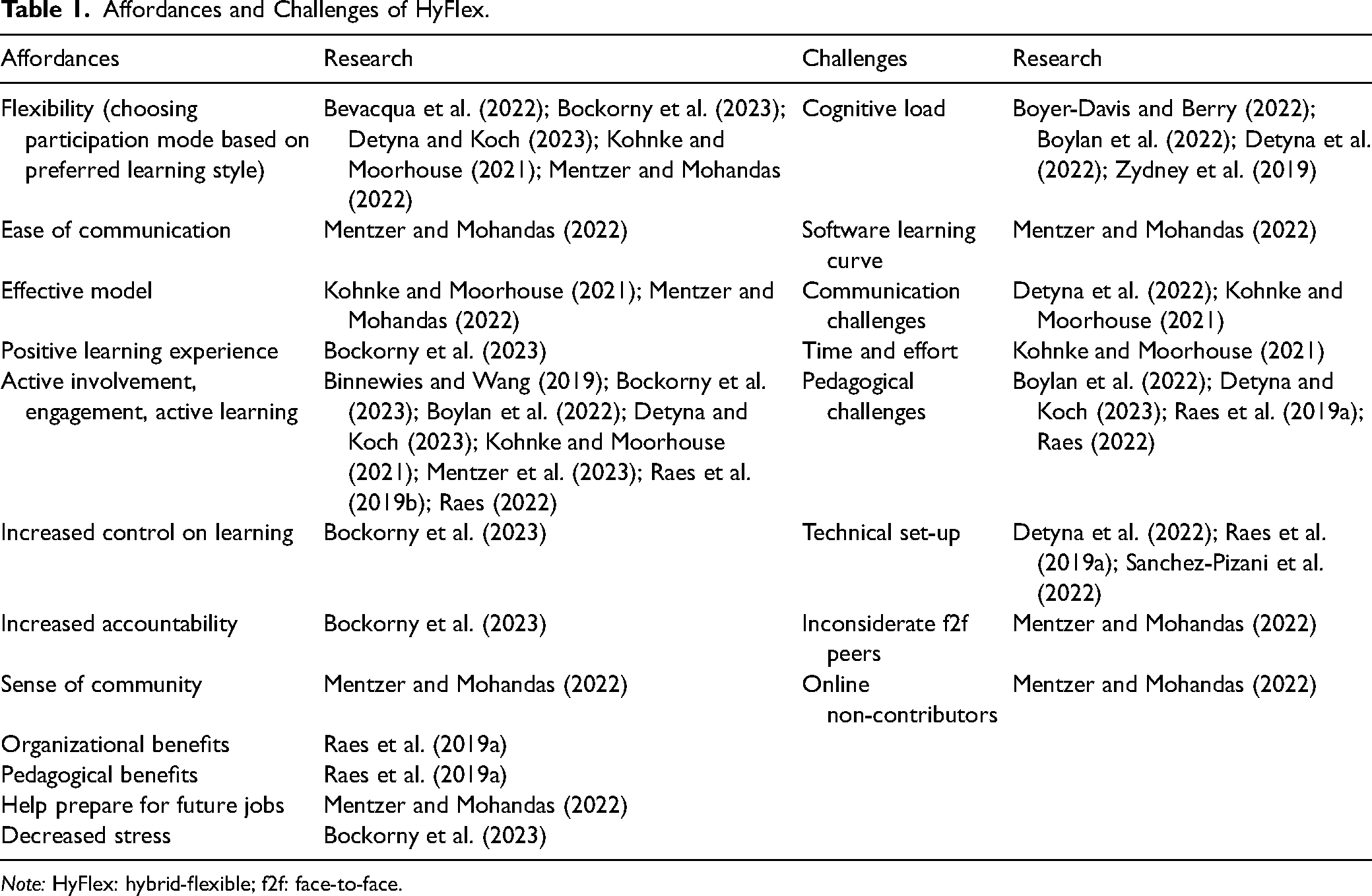
Note: HyFlex: hybrid-flexible; f2f: face-to-face.
Purpose
This study explores how students perceive their experience in a physical–virtual learning space and what they make of the choices and flexibility afforded by this HyFlex environment. For triangulation purposes, their experiences are juxtaposed to the perceptions of a non-participant observer and to the perceptions of the students’ instructor. The study is framed by four research questions:
What are undergraduate students’ perceptions of their learning experience in a HyFlex environment? What is the effectiveness of a HyFlex environment from the perspective of a non-participant observer and a HyFlex instructor? In a HyFlex environment, are students’ needs met equally well in the physical and virtual space? What are implementation challenges in HyFlex?
Methodology
The study is designed as an evaluation study to help make informed decisions about the department's future approach to hybrid education. This section describes the setting, the participants, the technology, procedures and participation modes, data collection, and data analysis procedures of both the quantitative and qualitative data.
Setting
This study was conducted at a teachers’ university in Switzerland. The first author taught two classes (n = 26, n = 10) at the undergraduate level in the spring semester of 2023, with a combined total of 26 female (72%) and 10 male (28%) students pursuing a Bachelors Degree in Primary Education. Most of the students already knew each other from previous semesters. Students were informed that their classes had been designed as HyFlex courses and that they were free to choose from two synchronous participation modalities: on-site participation or synchronous remote participation for any one of the 10 weekly sessions. Synchronous remote participation included visibility and interactivity (Raes, 2022) in that the remote students were asked to turn on their cameras and activate their microphones so that their on-site peers and the instructor could see and talk to them. The instructor was always physically present in the classroom. The third option was asynchronous. If they were prevented from attending synchronously, they completed class activities on their own time and were required to submit the mandatory deliverables on a weekly basis. In observance of the university's minimum attendance rule of 80%, the third option was limited to two sessions. Figure 1 shows a student's possible hybrid journey throughout the semester.
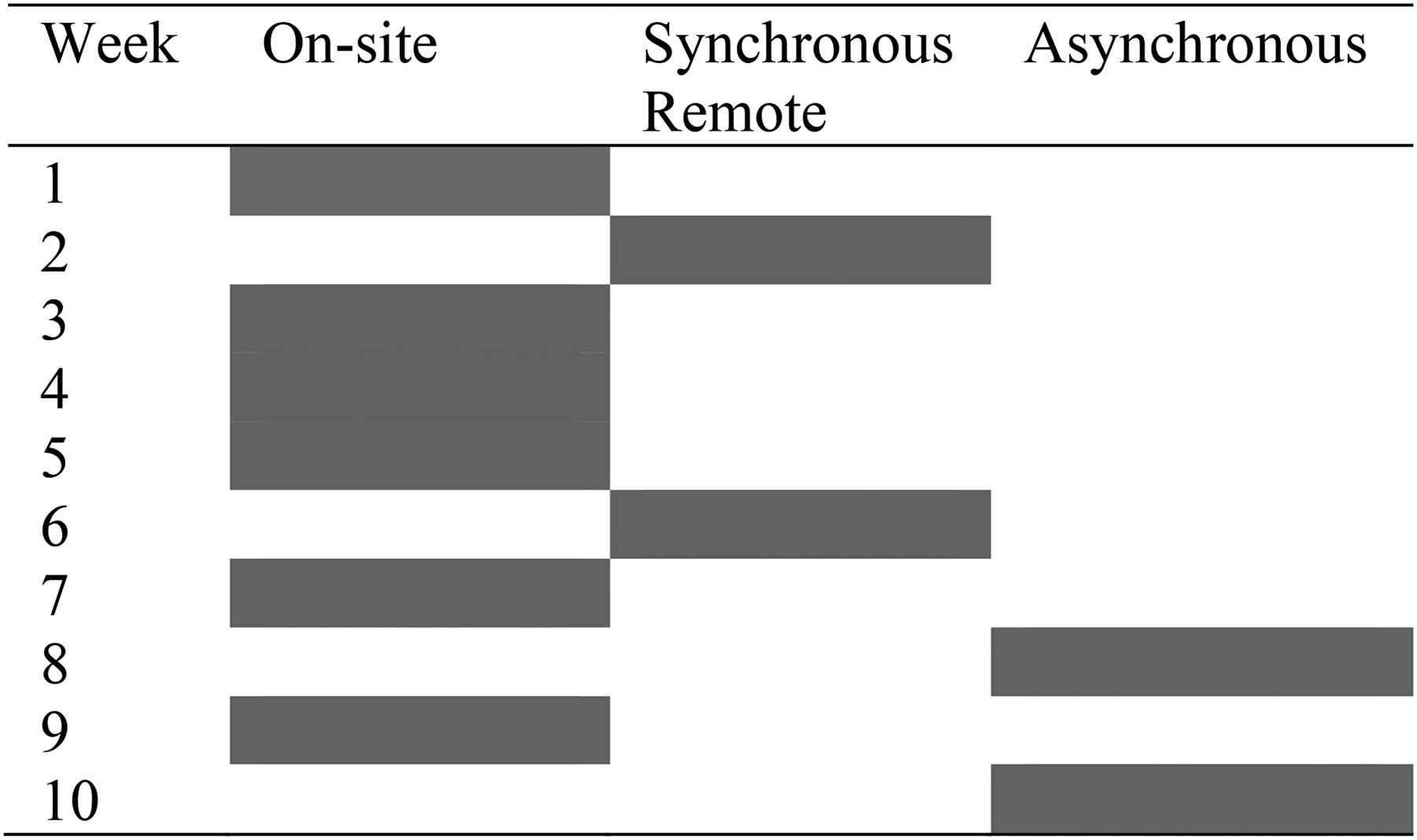
Example of a student's hybrid journey switching between on-site, synchronous remote, and asynchronous offline participation.
Classes were either held in mid-sized classrooms with traditional column-and-row seating accommodating up to 36 students or in a multimedia experimental room seating up to 30 students. The latter offers flexible seating options with chairs on casters with integrated desk shelves. Students enjoy swiveling around on their chairs to create new group constellations. Their versatility affords interactive teaching and learning settings for dynamic group sizes. This room was refurbished to provide “redesigned learning spaces [to] create novel affordances for personal and social learning and teaching activities” (Reinius et al., 2021, p. 341). The standing desks and counter chairs are a popular group space. Figure 2 shows the multimedia experimental room including the easily navigable Cisco Webex™ Room55 monitor (Cisco, 2021), which will be described in the next section.
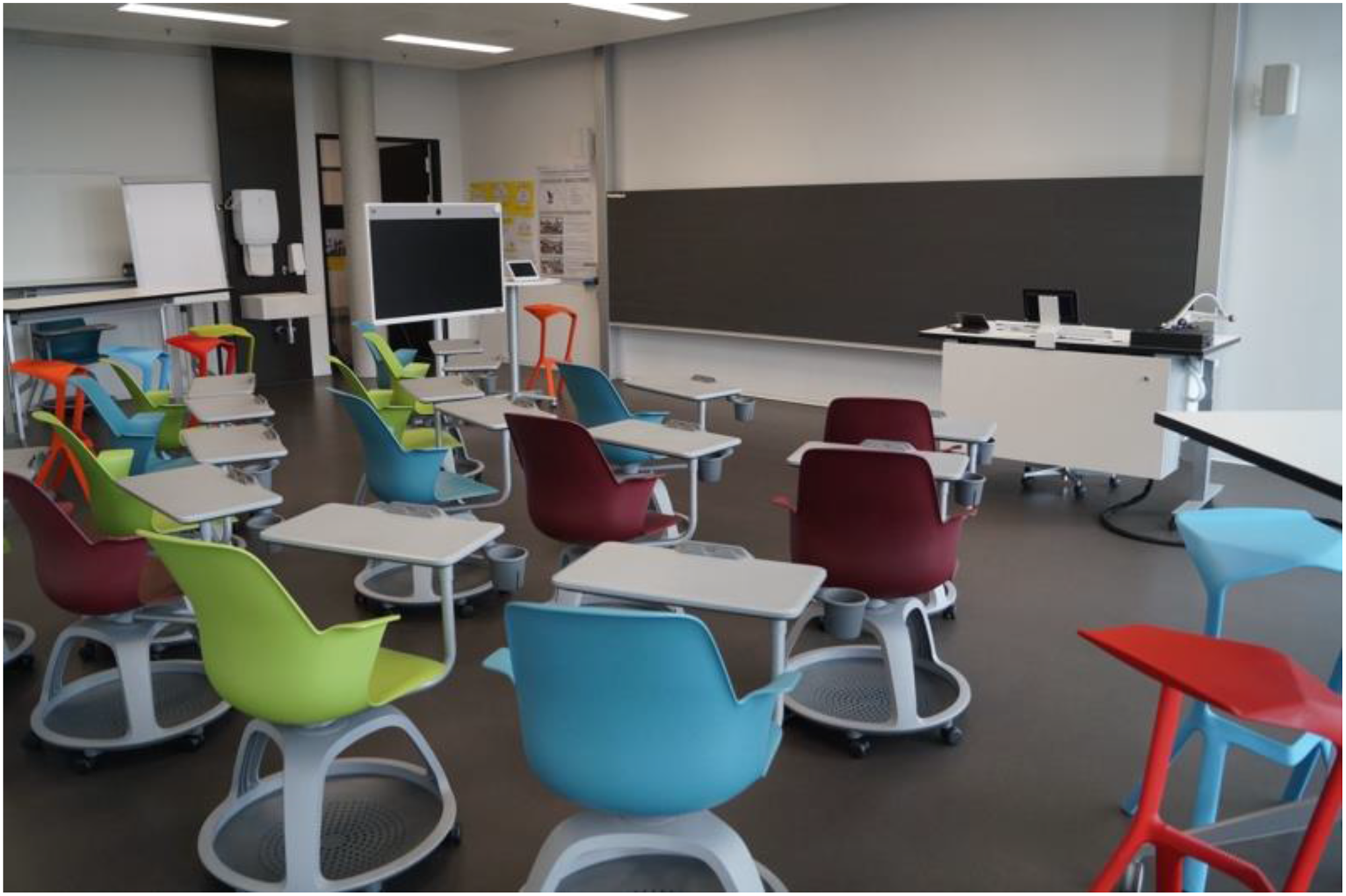
Multimedia experimental room with chairs on casters, standing desks, and Cisco Webex™ Room55.
Technology
The tutor installed Cisco Webex™ Room55 (Cisco, 2021) in each weekly session to accommodate the students who wished to join remotely. Room55 was set up eight times in each class resulting in a total of 16 hybrid sessions. Cisco Webex™ Room55 affords a fully integrated collaboration system with a large monitor, speaker tracking, and a 5 K UltraHD camera with a wide-angle lens to show everyone in the room. It comes with two highly sensitive table microphones. Acoustics being the most important factor in determining students’ satisfaction and performance (Sanchez-Pizani et al., 2022; Yang et al., 2013), special attention was paid to the acoustic quality to approximate a full experience for remote students. Similarly, Detyna et al. (2022) highlight the need for high audiovisual quality to preserve human communication in a hybrid space and to avoid that “lousy acoustics and light conditions have a negative impact” (p. 9). Students were assured that they could rely on Room55 being available at each session and that they would not need to give the instructor prior notice on how they wanted to participate, similar to Detyna and Koch (2023). Each session was streamed live but not recorded because a live recording might hinder attending students’ active participation or be an incentive for students to not attend at all (Boylan et al., 2022). Zoom was used as a meeting platform.
Participation Modes
Detailed records of students’ participation mode are shown in Appendix 1. The participation mode was documented in the weekly attendance records. Attendance (i.e., on-site and synchronous remote combined) was 92% in Group A and 97% in Group B throughout the semester. The minimum attendance stipulated by the university is 80%. On average, a large majority was on-site. Some sessions had zero synchronous remote participants, whereas other sessions had a remote participation rate of up to 35%. Average synchronous remote attendance based on eight sessions with the HyFlex option was 12%. In most sessions, students in the two observed classes called “Professional Language Competence” performed microteaching sequences to practice teacher talk appropriately graded for elementary school children learning English as a foreign language.
Data Collection
Data emerged from three sources and methods, namely, a student survey, a non-participant observation conducted by an undergraduate research assistant, and a tutor journal.
Student Survey
A survey (Appendix 2) was designed to explore the effectiveness of the HyFlex approach. The survey content was inspired by previous work (Bockorny et al., 2023; Detyna et al., 2022; Kohnke & Moorhouse, 2021; Leijon & Lundgren, 2019; Mentzer et al., 2023; Mentzer & Mohandas, 2022). The first version of the survey was piloted in the spring of 2022 with a sample of 40 respondents. The survey was revised to allow for a better differentiation between the on-site and remote students’ perspectives. Further revisions were implemented after a review by the authors and a subsequent review by the research assistant (i.e., the uninvolved observer) who, as a former student of the program, was able to provide a student perspective on each survey item. The survey was built around seven questions, namely, three multiple-choice (MC) questions (single-response or multiple-answer format), three open-ended questions, and one general comment item at the end of the survey. The MC questions each had between four and five response choices, including a “don’t know” option. There was an optional comment box after each MC item. Before completing the survey, the instructor reminded the students that the HyFlex approach had offered them a choice regarding their participation mode throughout the semester. The definition of on-site (i.e., physical classroom) and remote participation (via Zoom/ Cisco Webex™ Room55) was clarified before they started completing the survey. Students were informed that if they chose to complete the questionnaire, their responses would be used for research. The survey was administered via Moodle in session number eight. Participation was optional and anonymous. In Group A (n = 26), 15 students were on-site, nine students attended remotely, and two students, who were absent, completed the coursework asynchronously. In this class, 16 students completed the survey. In Group B (n = 10), seven students were on-site, two students attended remotely, and one student was absent. In this class, seven students completed the survey, which resulted in a total of 23 survey responses. The overall response rate was 70%. The survey was anonymous, which is why it is unknown how many on-site students and how many synchronous remote students completed the survey.
Non-Participant Observation
A research assistant, an alumna from this Bachelor's program, conducted the observation (Appendix 3) during four sessions (i.e., two 90-min sessions on two different days). The observations were conducted in week 5 and week 6 of the spring semester in 2023. A guest lecturer from the United States hosted two sessions in week 6. These sessions were purposefully selected for the observation. The observation notes resulted in 6,555 words and were of similar length for each session.
Tutor Journal
To cross-reference the research assistant's observation notes with the instructor's perceptions, the instructor documented her observations for the same four sessions. Appendix 4 shows the 21 reflective prompts on the tutor's strategies. The journal consists of 5,681 words.
Data Analysis
Mixed-methods data emerged from a student survey with single-response and multiple-answer items and two open-ended items. The percentages for each response choice will be reported. Ten predetermined categories drawn from the literature review were applied to the analysis of the observation reports and the tutor journals, namely, interaction, active engagement, tutor strategies, space, HyFlex values, communication challenges, space, time and effort, social presence, and impact on learning experience. For each predetermined category, one or several codes emerged during coding. A total of 366 units of analysis were coded, with the majority of 246 units originating from the research assistant's observation reports. The coding was done in MAXQDA 2018 to produce code frequencies. The high-frequency codes with representative statements will be reported in the Results section.
Reliability and Validity
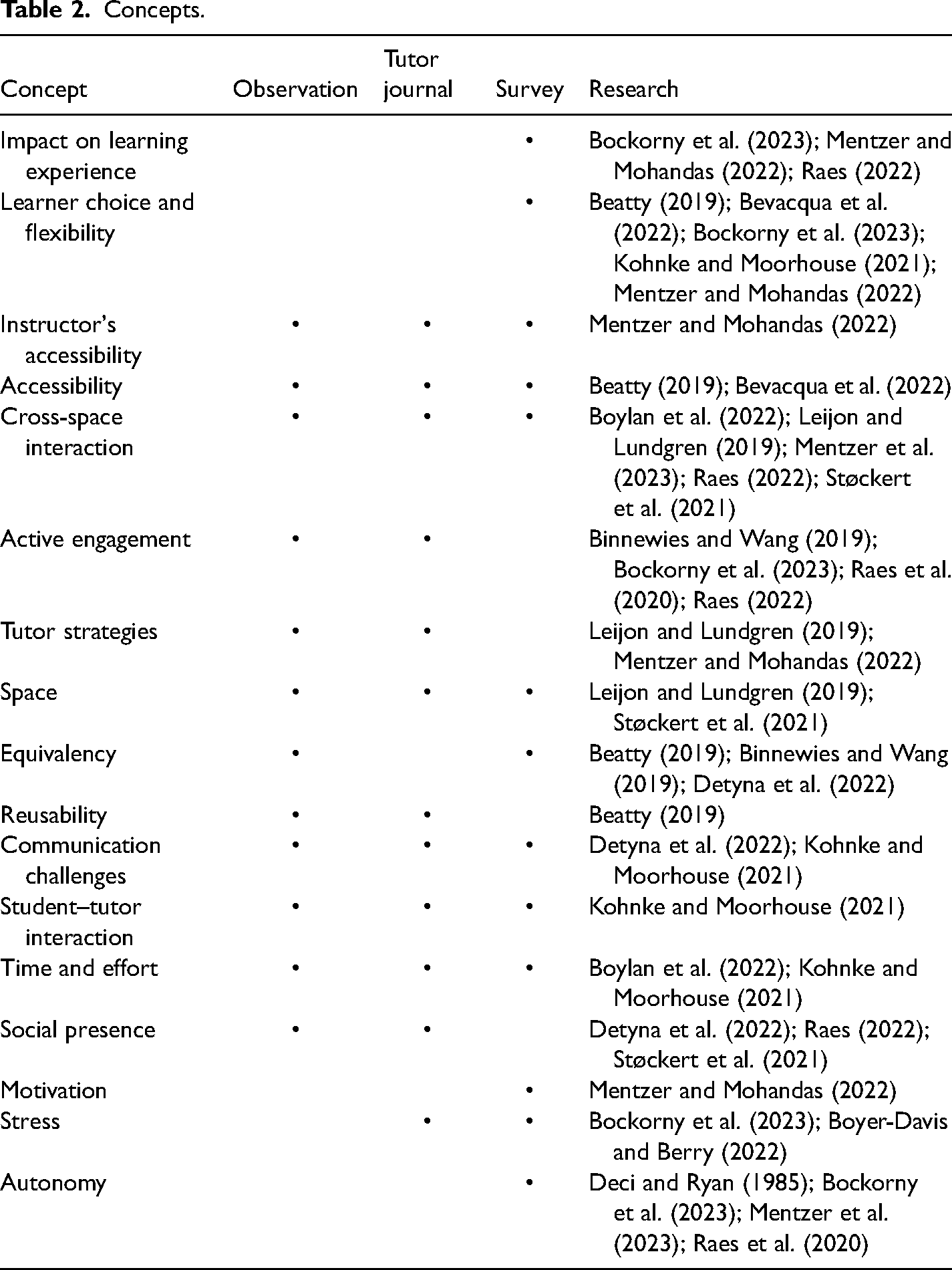
Multiple strategies supported reliability, including peer review of the student survey and the observation matrix; triangulation of methods (i.e., survey, observation, and tutor journal); parallel analysis of observation reports and tutor journals; triangulation of investigators in the data collection process; and triangulation of source (i.e., students, observer, instructor, and researcher) (Merriam & Tisdell, 2016). An audit trail was kept throughout data collection and analysis. Validity is supported by the theory-based development of the data collection tools. Table 2 shows the concepts framing the observation foci, the tutor journal prompts, and the survey questions.
Concepts.
Results
The results are organized around the research questions. According to the survey, a majority of students (73%) mostly participated on-site. Namely, 10 students (43%) never attended remotely and seven (30%) only attended remotely once. A minority reported regular remote participation, namely, four (17%) attended remotely twice and two (9%) selected “three times or more.” These self-reported numbers align with the attendance records (Appendix 1).
Students’ Perceptions
The first research question asks about students’ perceptions of their learning experience in a HyFlex environment. The impact of HyFlex, learner choices, the instructor's accessibility, student interaction, and students’ overall experiences will be reported first. The observation report and the tutor journal paint a different picture, as will be shown later.
When asked about the impact of the HyFlex setting, students’ responses indicate a minor impact, both positive and negative, of the HyFlex setting on the on-site students’ experience. A majority of 20 (87%) out of 23 respondents reported that the learning experience was not lowered by trying to include the remote students. Two students (9%) stated that including the remote students had actually enhanced the on-site students’ learning experience. Only one single student (4%) believed that the experience had been lowered. Eight comments were left in the open-comment section. “Time” was mentioned repeatedly, as in “sometimes the HyFlex [remote] students take longer to respond” and it “created some wait-times when you were explaining something to them. However, I don’t feel like this lowered my learning experience.” Overall, the comments indicated that the HyFlex option afforded students the opportunity to join when they were unable to attend in person. “It would have been less valuable if people that are sick could not have joined.”
Regarding learner choice, students appreciated the freedom to choose between on-site and synchronous remote participation for any one session. This survey item was a multiple-answer item. The two positively worded response options were each selected 18 times (78%), namely, “being allowed to choose gave me a sense of safety” and “being allowed to choose gave me a sense of control over my learning.” The two negatively worded response options were selected by a small minority, namely, “It made me feel obligated to join sessions that I usually would not have attended (e.g., when I'm sick)” was selected by three students (13%). No one selected the response choice of “having to choose was overwhelming and/or stressful.” Eleven brief comments were posted to the open-comment section. They referred to remote participation as a back-up plan if they were unable to attend in person, but also to more flexibility in scheduling, more autonomy, and increased motivation, as in “I think it made learning more flexible and therefore more enjoyable.”
When asked about the instructor's accessibility, there was consensus that the instructor was equally available to on-site and remote students. “I would say that in both situations, on site and in Zoom, I was always able to interact with the instructor. There was sometimes a short waiting time but not in a bothering way.” Both groups of students found it very easy to ask questions and obtain feedback from the instructor and that there had been “no communication problems at all.”
Regarding cross-space interaction opportunities, students’ responses align with the observer's report and the tutor's perceptions, namely, that cross-space interactions were rare. There were only seven cross-space interactions throughout the observation period of four sessions. “I only had one interaction with a remote student, when we did the weather forecast task. That was pretty easy since it was only one remote person and we just presented in front of the laptop.” When there were two or more remote participants, however, they were assigned to virtual breakout rooms for group tasks rather than being teamed up with on-site students. The instructor purposefully made the decision to save time, to avoid sound issues in the physical classroom affecting both groups, to provide remote students with higher sound and visual quality (i.e., within the virtual room), and to reduce the transactional distance (Paul et al., 2015) within the remote group. Students’ comments suggest that working within the same space was a sensible pedagogical decision. “I found interaction across spaces more difficult. Attending on-site I found it easier to just interact with students that were on-site too. When I attended online I experienced interaction within the virtual space as very practical, it worked well.”
The responses reflect a wide range of experiences regarding the interaction space. Some had positive experiences, “I think it worked great,” whereas some students perceived the interaction between on-site students and remote students as “a little bit more difficult.” One of the reasons given was physical distance in terms of “the people sitting right next to the device are much closer to them [the remote students]” and “I interacted less with the remote students because I was always sitting a little bit further away” from the Cisco Webex™ Room55 monitor.
Some statements revealed different perceptions of remote participants’ roles, such as in “I think it's more about listening when you're online.” Technology-induced challenges in communication were mentioned as an additional obstacle to cross-space interaction. “Sometimes it was difficult to understand what the students in the classroom were saying. But often the teacher repeated the answer or we could guess what they were saying based on the reaction.” When asked what changes they would make if they were the instructor, it was suggested that on-site students should have logged in to Zoom as well in order to collaborate. “I sometimes thought that it could have been easier if on site students would have joined the Zoom room.”
The last survey item asked about students’ overall experience. Some students reported increased motivation, as in “the HyFlex format worked really well and increased my motivation. It impacted my learning for the better.” It was suggested repeatedly that more courses should be delivered in HyFlex: I find the whole setting a really good alternative and would welcome if this were used more. After Corona, far too little has been done in this regard. We continue as before and do not consider whether perhaps hybrid seminars would be more useful.
A large majority, however, prefers on-site participation for various reasons, such as in “as a remote student I wouldn’t contribute that much to the class because I would feel put on the spot too much.” While some described their level of participation as being the same no matter how they attended, several students clearly expressed a higher participation level when physically present. The HyFlex format was not perceived as hindering anyone's learning nor did anyone report that it had caused anxiety, stress or confusion. Minor communication challenges, however, were mentioned repeatedly.
Changing Perspective: Perceptions of an Observer and a HyFlex Instructor
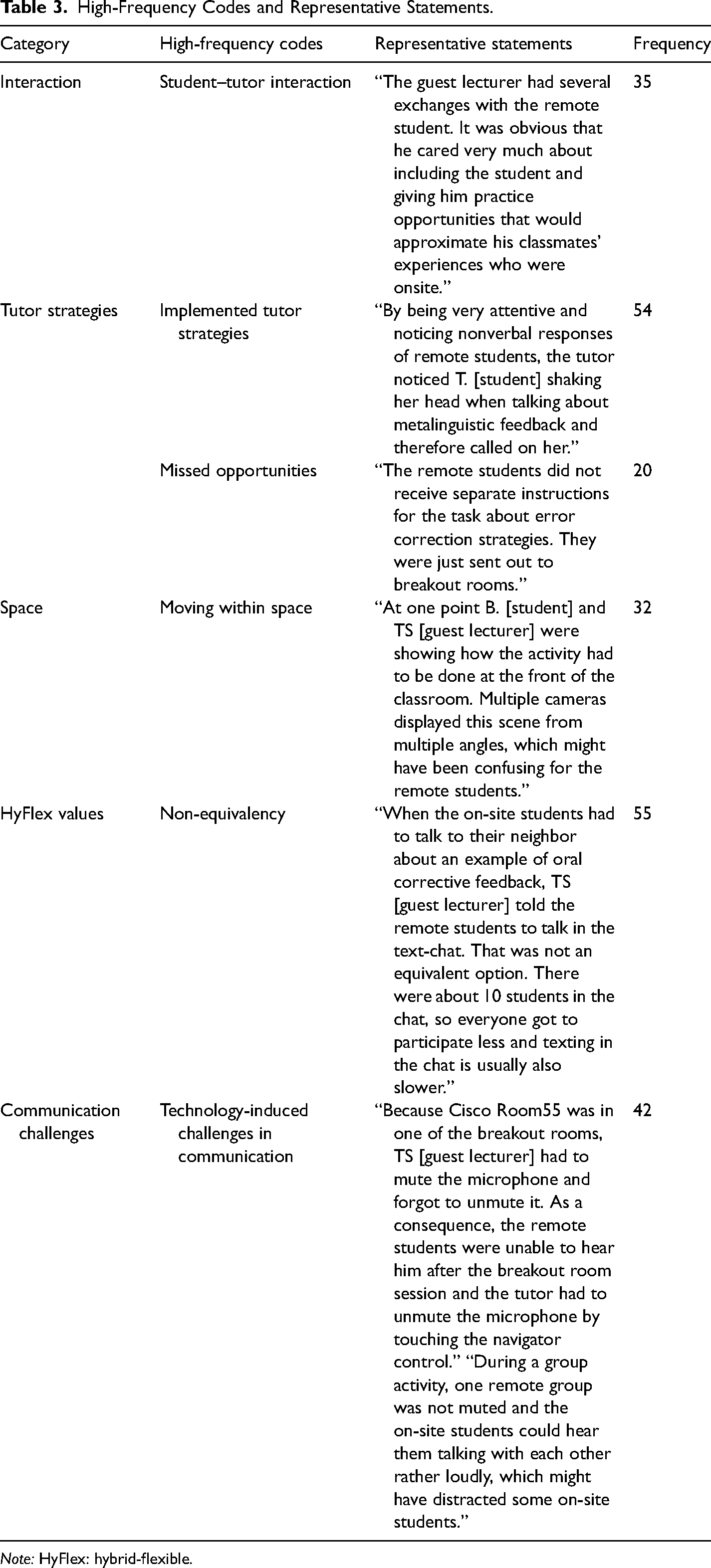
The second research question explores the perceptions of an uninvolved observer and the perceptions of a HyFlex instructor. In stark contrast to the vastly positive student responses, the observation report and the tutor journal paint a rather different picture. The observer's and the instructor's voices are much more critical and question the effectiveness of the HyFlex environment, as delivered in these two courses. As mentioned earlier, four 90-min sessions were observed. A guest lecturer (TS) from the United States hosted two of the four sessions, while the other two sessions were delivered by the usual instructor/tutor. Table 3 shows six high-frequency codes clustered around five predetermined categories. The high-frequency codes include student–tutor interaction, implemented tutor strategies and missed opportunities, moving within space, non-equivalency, and technology-induced challenges in communication. Representative statements are provided for each code.
High-Frequency Codes and Representative Statements.
Note: HyFlex: hybrid-flexible.
Regarding student–tutor interaction, 35 instances were documented over the course of four sessions. There were more student–tutor interactions when there were fewer remote students. The number of student–tutor interactions was lowest when there were a lot of remote students. Interactions were rather basic and included sound checks, asking remote students about their preferences regarding collaboration partners, as in “tutor asked J. before the session if he would rather collaborate with the guest lecturer or an on-site student since he is the only remote student” and about their preferences regarding within-space or cross-space interactions, as in “I asked T. and M. if they were OK in the breakout room or if I should set them up with two on-site students. They had no preference so I went with the easier option (breakout room).” Interactions mainly took place at the beginning and at the end of a session. Interactions throughout the session were limited to giving instructions, giving and obtaining feedback, and frequent check-ins.
The next theme, tutor strategies, is divided into implemented tutor strategies and missed opportunities. Fifty-four units were coded as implemented tutor strategies. Each session started by greeting the remote students by name individually and telling them how the instructor would be in touch throughout the session. The instructor said the names of the remote students out loud at the beginning of class so that the on-site students knew who was joining remotely. Remote students were told how to contribute, as in “I asked remote students to chime in and I asked on-site students to help me include the remote students or tell me if they saw the remote students waving.” The instructor helped remote students to locate the tasks on the learning management system (LMS) by sharing her screen. Before sharing her screen, the instructor would consistently announce “I will now share my screen with you. Can you see it?”
The instructor paid attention to remote students’ facial expressions. She tried to call on the remote students first, although not consistently. Good eye contact was established either through the laptop camera or through Cisco Webex™ Room55, as in “during class discussions she looked over her shoulder into the camera of Room55.” Sometimes, but not often enough, remote students were actively included, for example, by asking students to model an activity. Deliberate pausing was applied as a strategy to encourage active engagement. The instructor posted written instructions to the text chat on an as-needed basis. When remote students returned from the breakout room, they were welcomed back. “The tutor also made eye contact with the remote students when they came back from the breakout room and acknowledged them in that way.” At the end of each session, the instructor would ask them individually and by name about their remote experience. Although there are many more examples of implemented tutor strategies, there were numerous missed opportunities.
Twenty instances were identified as missed opportunities. For example, after the instructions for a self-reflection task, the instructor asked the on-site students if they had any questions regarding that task, ignoring the remote students. Although there were periods of high interaction between the guest lecturer and the remote student, there were also times with virtually zero contact, as evidenced in “Neither instructor looked at him or was available in the text chat” and “he was also not called on during those segments.” Too often, the remote students were treated like passive attendees. Although the instructor made an effort to acknowledge remote students at the end of the session, the observer noticed that this was not always the case (“No personal goodbye at the end of the session”). The observer also noticed that when giving instructions to both groups (i.e., on-site and remote), the tutor mostly only had eye contact with the on-site students, although she had made a conscious effort to be as inclusive as possible.
Moving within space also emerged as a high-frequency theme. There were issues with the position of the Cisco Webex™ Room55 monitor, as in “because of the positioning of Room55 (and its camera), the remote students were not able to see the whole classroom.” There were also issues with the instructor's and the guest lecturer's position. “Whenever TS [guest lecturer] looked at his Powerpoint slides and notes, it seemed like he was looking into the laptop camera. However, his notes and slides were not on the same laptop as the laptop with the camera, so sometimes he was completely out of frame when he was looking at his notes.” The observer also noticed that the instructor often had her back to the camera during class discussions. The following observation illustrates the impact of space on the tutor's limited options for movement in the classroom and a potential effect on engagement: “Throughout the whole lesson the tutor often stood in front of the laptop and did not move a lot, which might have led to a less engaging and less gripping lesson for the on-site students because the tutor was not able to move around freely.” Although the classroom was designed to seat up to 36 students, space was rather limited, especially in the front of the classroom where Room55 was positioned right next to the instructor's desk and the blackboard. The instructor occasionally repositioned Room55 while all students (i.e., remote and on-site) were occupied so that it would not disrupt the flow of the lesson, but she sometimes forgot to return it to its original place. Despite efforts to ensure access for all, there were moments when the remote students “were unable to see the checklist and the program for the lesson because it was out of frame and none of the cameras were able to pick up everything,” thus indicating limited equivalency of the physical and the virtual space.
Meeting Students’ Needs in HyFlex
Non-equivalency emerged as a response to the third research question exploring whether students’ needs were met equally well in the physical and the virtual space. Thirty-five instances of non-equivalency were observed. Often, remote students were put at a disadvantage because they were treated as passive attendees. Another problem was that “for the remote student, it was a lot harder to chime in just because he could not ‘see’ the turn-taking, whereas in the classroom you could see who is raising their hands or if the guest lecturer is about to say something else.” It was noticeable that on-site students were more efficient with task completion compared to remote students who first needed to locate the task sheets on LMS and join the breakout room. The different pace in the physical and the virtual space resulted in problems such as, “at this point, the [on-site] students were already done with the activity and we needed to move on without J. [student] having had a chance to do the activity.” The observer noted that it was considerably harder for remote students to ask questions. To save time, remote students were asked to “discuss the task in the chat again, which led to the same problems: not an equal opportunity to solve the task,” whereas the on-site students could do the task orally. On-site students, too, were occasionally at a disadvantage. For example, “at the end of class, when both on-site and remote students had questions, the on-site students had to wait because the remote students were prioritized.”
Implementation Challenges
The fourth research question addresses implementation challenges. Technology-induced challenges in communication is the last high-frequency theme with 42 counts. These challenges include sound issues likely caused by an overdue update of Cisco Webex™ Room55 as well as miscommunications between the guest lecturer and the instructor. The observer reported that “the communication between the instructor and TS was not flawless, which led to a number of small obstacles that prevented a fluid transition. For the most part it created a disadvantage for the remote students while the on-site students were not affected.” The muting and unmuting of the two portable microphones and the microphone control button on the Room55 navigator during cross-space collaboration tasks caused some of the sound issues and could have been avoided if the guest lecturer and the instructor had coordinated their actions more effectively, which, in turn, would have resulted in increased preparation time.
Discussion
Diverging Perceptions
The primary purpose of this research was to explore multiple stakeholders’ voices and experiences of a HyFlex environment. The findings indicate that the students’ (i.e., teacher candidates) experiences were vastly positive, whereas the observation reports and the tutor journal highlight major obstacles potentially impacting students’ learning experiences. Meeting students’ needs equally well in the physical and virtual space emerges as a key challenge. The main themes that emerged from the qualitative data include learner choice as a key affordance, tutor strategies as a critical prerequisite to mediate learning along the physical–hybrid–virtual continuum (Støckert et al., 2021), the challenges of establishing equivalency, overcoming the challenges in communication, creating cross-space interaction, fostering active engagement, and capturing the impact of a HyFlex environment on learning.
Learner choice, and all of the flexibility that comes with it, is the key affordance of the HyFlex model according to students’ responses, which aligns with previous research (e.g., Beatty, 2019; Bevacqua et al., 2022; Bockorny et al., 2023; Boylan et al., 2022; Kohnke & Moorhouse, 2021). The enhanced audio-visual quality had a positive impact on their synchronous remote experience and on their sense of presence. Statements such as “it felt nearly as if I was on campus” echo previous research (Detyna et al., 2022; Sanchez-Pizani et al., 2022). Støckert et al. (2021) discuss the difficulty to “expand a local physical practice into a shared hybrid space and deliver a sense of shared presence to all participants” (p. 8). One way to build a sense of co-presence is to prioritize work in smaller groups, for example, in team-based joint problem-solving scenarios (Støckert et al. (2021).
The tutor strategies implemented in this research were informed by previously published design guidelines and recommendations (Bevacqua et al., 2022; Leijon & Lundgren, 2019; Mentzer & Mohandas, 2022), both at the technological and pedagogical level (Raes et al., 2020). Examples include planning on how to integrate interactivity; welcoming remote students by name and including them to reduce the distancing effects; communicating requirements clearly and in advance; opening the virtual room early for sound checks and to ensure full hybrid functionality; clear signposting on the LMS; frequent screen-sharing; and cognitively activating students by frequent use of quizzes, polls, and asking questions (Bevacqua et al., 2022; Raes et al., 2019b). Raes et al. (2019a) provide detailed guidelines on support, clear communication, activating learners, and curriculum alignment. The students in this study noticed the use of these strategies and felt that they were implemented effectively. However, trying to include the remote students became increasingly challenging with growing numbers. Despite efforts to encourage the remote students to participate actively, responses were infrequent. Nevertheless, in terms of reusability (Beatty, 2019), there were a few opportunities to share learning artifacts across spaces. For example, when the guest lecturer started the plenum discussion, he picked out an example from the text chat, thus acknowledging the remote students’ efforts and contributions.
Regarding equivalency, the survey responses indicated that a large majority of students in this study were satisfied with their synchronous remote participation and did not report any negative impact on their learning. Nevertheless, it is advisable for educators to evaluate carefully whether the HyFlex model matches their discipline (Bevacqua et al., 2022) and whether it aligns with the structure, contents, and purpose of a specific course. The module described in this study was a hands-on, practice-oriented class pivoting around microteaching sequences. From the tutor's perspective, the synchronous remote option was beneficial insofar that it was better to participate online than miss the class entirely (Mentzer et al., 2023). It could be argued that the HyFlex principle of equivalency was not achieved because asynchronous participants did not have access to the class recordings. In the observed classes, it was impossible to create opportunities for equivalent stand-alone outcomes (Bevacqua et al., 2022, p. 244) because the student-performed microteaching scenarios took up the most space and time. This is also the reason why class recordings were not feasible. Even if the permission of all students had been obtained, it is unlikely that the remote students in asynchronous mode would have watched any of the recordings since the microteachings only served practice purposes and were not designed for content delivery. Similarly, the microteaching scenarios geared toward teaching in elementary classrooms would be rather difficult, if not impossible, to replicate in an online space. Thus, the observed classes would not be compatible with a truly HyFlex option that has no restrictions on participation modality. For example, the microteaching of an inquiry-based learning scenario involving a lot of artifacts (e.g., rocks, magnets, recyclables) would be rather impractical if students only ever attended online (i.e., synchronously or asynchronously).
Overall, the students perceived the participation modalities as equivalent and effective, which raises the question of whether the instructor's and the observer's perceptions are of any significance at all. For most students in the observed classes, it was the first time to experience the superior sound and visual quality that Cisco Webex™ Room55 affords. The authors believe that this experience contributed to their positive assessment of the HyFlex environment and that the students’ perception might have been different if more or all of their classes had been offered as HyFlex courses. Even if students who took a mostly remote path through the course with similar academic achievements and who also perceived equivalency, the discrepancies in perceptions still offer a valuable opportunity for the instructor to analyze what worked and which areas need improvement. These areas encompass curriculum development, lesson planning, teaching practices, Universal Design for Learning, equity pedagogy, cognitive learning styles, mobile pedagogy, intentionality in the use of technology, classroom management, feedback practices, collaborative learning, etc. A HyFlex instructor's analysis will not only lead to an improvement in hybrid teaching but can also have a positive impact on the overall quality of face-to-face teaching.
Implementation Challenges
Implementation challenges include issues with regard to communication, cross-space interaction, (lack of) active engagement, and impact on learning. Regarding challenges in communication, the students, the observer as well as the instructor have described several avoidable instances in which the remote students could not hear what was going on in the classroom. Had there been a room operator or a graduate teaching assistant coordinating the audiovisual equipment, as recommended in previous research (Boylan et al., 2022; Detyna et al., 2022; Detyna & Koch, 2023; Raes et al., 2019b), these problems could have been avoided. Technical and pedagogical training for educators is critical (Detyna et al., 2022; Detyna & Koch, 2023). While most universities offer on-call tech support, as does this university, room operators may not be an available service at all institutions. The university's audio-visual team support, which was called on multiple times, was critical to ensuring a positive overall hybrid flexible learning experience (Detyna & Koch, 2023). In particular, audio quality should be among the top priorities to engender an increased sense of presence and positive experience for remote participants (Detyna et al., 2022; Raes, 2022; Sanchez-Pizani et al., 2022; Yang et al., 2013).
Another priority is that hybrid functionality must be easy to use for teachers (Støckert et al., 2021). Easy and intuitive use of audiovisual and video-conferencing equipment is a prerequisite for creating “seamless connections across spaces between all participants enabling teamwork and shared workspaces so that teachers can focus on delivering the appropriate methods and guiding adapted to the hybrid learning scenario” (Støckert et al., 2021, p. 8).
The lack of cross-space interaction among students was striking. While there was frequent interaction and contact between remote students and the instructor, cross-space communication among students was mostly inexistent. Nevertheless, the students repeatedly expressed satisfaction with the instructor's decision to keep students collaborating in their own space if more than one student attended remotely. They understood that it would take extra time and effort to collaborate across space. The findings regarding cross-space interaction largely concur with Detyna and Koch (2023) whose participants reported that “some found group activities worked as an equalizer between the in-room and online experience if it worked well, or were a key dividing factor if it didn’t” (p. 8), with some of their students voicing regret that the on-site students were not teamed up with remote students. The teaching staff described in Detyna and Koch (2023) either chose to separate online and in-room students or combined them by asking those in-room to join the main call or set up separate MS Teams calls themselves. In the current study, however, the on-site students were never asked to join the main call.
To facilitate cross-space communication via Cisco Webex™ Room55, several issues remain unresolved. For example, it is not possible to switch off just one of the two portable microphones. It is either both or none. This means that due to the microphones’ high sensitivity, the remote student can still hear all other (on-site) groups speaking. The microphones are so sensitive that they even pick up the shuffling noise of paper. Conversely, hearing the remote participants speak in the background also turned out to be distracting for on-site students, which indicates that the sound issues affect both groups. If the microphones are turned off, one of the on-site group members needs to log in to Zoom on their own laptop to establish audio communication or even put on a headset. Mentzer et al. (2023) caution that “students in the classroom can only communicate with online students if they too run the software and use headsets – thus – the burden generated by adding online participation as an option is partially shouldered by students who have made the journey to the classroom” (p. 5), which illustrates that increased online flexibility affects flexibility in the campus space (Leijon & Lundgren, 2019).
Active engagement emerged as an additional challenge. It was noticeable that some remote students were participating much more actively than others. However, it should be cautioned that remote students might only appear to be disengaged, for example, because the instructor fails to provide room for them to give input, share their learning, or ask questions. Even if remote students appear disengaged, educators should consider the possibility that some “students who are easily distracted may choose to participate remotely so they can be in a quiet environment, which may allow them to focus on the course more intently” (Mentzer et al., 2023, p. 6). Students in the present study need to be reminded to turn their cameras on to be visible and “present” (Detyna & Koch, 2023; Raes, 2022). If cameras are turned off, the instructor's ability to notice off-task behavior is limited as opposed to on-site students who can be “redirected when they are distracted” (Mentzer et al., 2023, p. 5).
Impact
The impact of HyFlex on students’ learning is difficult to capture. Similar to Boylan et al. (2022), 96% of students in the present study reported positive feelings about their learning experience. This finding can be explained by students’ appreciation for increased flexibility. Some students reported feeling constrained by the university's minimum attendance requirement of 80% and called for a more relaxed attendance policy. Only one student out of 23 felt that their learning experience was lowered due to the HyFlex setting. Some of the key challenges impacting students’ learning included a lack of active remote students’ engagement (Raes, 2022), high cognitive load (Boylan et al., 2022; Zydney et al., 2019), issues around multitasking at the intersection of pedagogy, space, and technology (Boylan et al., 2022; Hansson et al., 2022; Leijon et al., 2021; Radcliffe, 2008), and challenges in communication (Detyna et al., 2022; Kohnke & Moorhouse, 2021). Although students reported having very good access to the instructor, the instructor herself experienced split attention, having to engage with on-site students and remote students simultaneously. These findings echo instructors’ narratives described in Boylan et al. (2022), such as “monitoring online chat while also trying to lecture at the same time” and “it damaged my focus as a lecturer and managing various technology around making sure the student remained engaged distracted my train of delivery somewhat” (p. 19).
Limitations and Future Directions for Research
The findings from this small-scale study should not be over-extrapolated. They are primarily relevant to a specific time, place, and space. Although this study captures three different perspectives (i.e., students, observer, and tutor), the findings are limited due to a small sample size and the number of observed teaching sessions. While it is unfortunate that only 23 out of 40 students completed the survey, the extensive observation report by an uninvolved observer as well as the tutor's journal provides substantive data. An additional perspective would have been valuable, for example, from a specialist in HyFlex teaching, educational technology, or versatile learning spaces. Given the rather small number of synchronous remote participants for any one session, it did not make sense to compare their academic performance with the students who mostly participated on-site. Finally, a greater variety of courses from different disciplines would yield more conclusive data.
There are ways to measure student learning and engagement in remote settings that go beyond achievement and perception. In the observed classes, it would have been possible to grade and cross-reference students’ output with their participation modality. For example, for each session throughout the semester, there was a mandatory deliverable, which either consisted of an online quiz, posting to a discussion forum, a written peer assessment, or a self-reflection assignment. These micro-assignments could have been graded and cross-referenced with each individual learner's attendance modality. However, the observed classes are pass/fail classes and do not provide the final grades needed for cross-referencing. The academic performance of students who consistently participated on-site with those who participated remotely once or more would provide more insights. However, different combinations of participation modalities make comparisons in terms of achievement rather difficult (Mentzer et al., 2023).
There is still a major research gap regarding students’ levels of success and academic achievements in HyFlex spaces that the present study was unable to address. Although there was evidence of cross-space student–instructor interactions, the instructor failed to initiate enough cross-space interaction among students. Thus, the study cannot provide an answer to the question of how the space at the intersection of the physical and virtual space can be used to generate additional learning. Similarly, the present study does not provide enough data to confirm a finding by Detyna and Koch (2023) according to which online students felt more included when groups were mixed across space. Further research could explore the notion of accountability and whether accountability is any different in different spaces (Bockorny et al., 2023; Boylan et al., 2022; Mentzer & Mohandas, 2022). Other questions that could be pursued include motivation, differences in learning experiences, and factors impacting academic achievement in HyFlex settings. A very promising avenue of research has been initiated in the field of Self-Determination Theory (SDT) (Deci & Ryan, 1985) and how relatedness, autonomy, and competence manifest themselves in HyFlex environments (Bockorny et al., 2023; Mentzer et al., 2023; Raes et al., 2020).
Conclusion
The study contributes to research about hybridity in the classroom. Learner choice emerged as a key affordance in this study, whereas meeting students’ needs equally well in the physical and virtual space was identified as a key challenge. The study contributes to the research on planning new learning spaces at the intersection of the physical and virtual space. It considers the changing roles and expectations of the students and the instructor in a hybrid setting and it exposes the diverging perceptions of different stakeholders. Although there were missed opportunities to maximize a participatory, interactive learning environment for on-site and synchronous remote participants, the study makes an original contribution by juxtaposing the students’ positive experiences with the critical reflections and observations from two different perspectives, thus contributing to pedagogical renewal. The findings discuss the effectiveness of the implemented tutor strategies, the challenges related to cross-space interaction and communication, and effective ways to engender active engagement. With advances in technology, such as Kubi in education (2023), educators will continue to trial different flex models to create versatile and highly engaging HyFlex learning environments.
Establishing the HyFlex principle of equivalency may be feasible but comes with major challenges. Achieving equivalency seems an ambitious goal even if the lesson content and the group activities are carefully planned with students’ individual needs and preferences in mind. Although HyFlex learning can enhance educational access, it may not fully achieve equivalency, as intended in the original HyFlex model (Beatty, 2019). This may also explain why multiple variations of the HyFlex model have been conceptualized (Bevacqua et al., 2022; Mentzer et al., 2023; Rosen et al., 2022; Verdooner & Marquart, 2021; Zydney et al., 2019). To ensure that students are successful in all three participation modalities, full equivalency would have to be established at different levels, namely, in terms of interaction (i.e., peer-to-peer, student-to-instructor, and student-to-content), space, transactional distance (Paul et al., 2015), accessibility to content and learning artifacts, learning preferences, and cognitive learning styles, to name a few. The authors agree with Bevacqua et al. (2022) who recommend that educators must carefully consider whether the HyFlex model matches their specific discipline. By applying the principles of Universal Design for Learning, at least an approximation of such equivalency can be achieved in hybrid learning environments.
Footnotes
Acknowledgments
Thanks to Dr Thor Sawin, Assistant Professor at the Middlebury Institute of International Studies in Monterey, California, for hosting two sessions in our courses and for his flexibility in delivering his excellent teaching in HyFlex mode. We also thank Luciana Palanza, alumna of the School of Education at our university, for conducting non-participant observations in four classes, her insightful observation reports, which created many eye-opening moments for the authors, and for her valuable input regarding the survey items.
Author Contributions
Natalie Nussli: Literature review, study design, data collection, data analysis and interpretation, writing the article. Kevin Oh: Study design, data analysis and interpretation, writing the article.
Declaration of Conflicting Interests
The authors declared no potential conflicts of interest with respect to the research, authorship, and/or publication of this article.
Funding
The authors disclosed receipt of the following financial support for the research, authorship, and/or publication of this article: This work was supported by the Hybrid Education Community (HEC) of the University of Applied Sciences and Arts (FHNW), Brugg, Switzerland (Grant number P250-0201-100).

Author Biographies
Appendix 1: Participation Mode
The participation modes were documented for each weekly session. Cisco Webex™ Room55 was available in eight out of 11 sessions. Figure 3 shows the number of participants in each mode for Group A (n = 26). On-site participation ranged between 15 and 26 students; synchronous remote attendance ranged between zero and nine students; and asynchronous offline participation ranged between zero and eight students.
Figure 4 shows the number of participants in each mode for Group B (n = 10). Cisco Webex™ Room55 was available in eight out of 11 sessions. On-site participation ranged between seven and 10 students; synchronous remote attendance ranged between zero and three students; and asynchronous offline participation ranged between zero and one student.