




Abstract
This study examines learners’ experiences and the use of language learning applications (“apps”) as a primary source of second or additional language learning (“L2”) instruction and assessment in higher education. It purviews the integration of artificial intelligence (AI)-powered features that support technology-enhanced language learning experiences. Principles of pedagogy, heutagogy, and self-determination theory are used to inform the appropriate design and application of AI to support language learning. We examine the congruence between learner's goals with perceived outcomes following a 4-week language learning intervention using an app. A survey of n = 151 adult learners across two Canadian universities revealed: (a) apps are perceived as an engaging, convenient, and structured approach to early stages of L2 learning and (b) the integration of AI for conversation-based simulations or speech recognition would enable more adaptive, personalized L2 learning experiences. The authors discuss implications for future developments and AI uptake for language learning apps.
Keywords
Introduction
The popularization of ChatGPT and generative artificial intelligence (AI) technologies has prompted a renewed interest in how apps can be designed to enhance students’ language-learning experiences in higher education. After examining the current state of mobile apps in supporting students with learning a second or additional language (subsequently referred to as “L2”), we explore how language-learning processes can be recalibrated with recent developments in generative AI. The present study discusses survey results collected from n = 151 Canadian post-secondary students in 2022; it attempts to reconcile the gap between adult language learners’ L2 expectations with their approaches to additional language learning assisted by mobile apps. This paper also proposes recommendations and discusses the implications of integrating generative AI features within mobile apps to support language learning processes.
Advancements in Generative AI and Language Learning
AI has become increasingly prevalent in language learning apps, revolutionizing the way adults learn and engage with additional languages (Deng & Yu, 2022). AI features in language learning apps contribute to enhancing motivation and assessment for adult learners. These features provide personalized learning materials, machine translation tools, writing assistants, chatbots, language learning software, intelligent tutoring systems, and intelligent virtual reality. In particular, intelligent chatbots have recently reemerged in mainstream media, with much of the discussion centered on new developments in generative AI tools. ChatGPT's massive dataset training has propagated itself as an impressive generative AI tool capable of understanding human natural language inputs and simulating human-like written scripts or responses. By incorporating AI, language learning apps can tailor the content and activities to each individual learner's needs and preferences. Additionally, AI-driven tools can provide immediate and constructive feedback on language proficiency and progress, giving learners a clear understanding of their strengths and areas for improvement. This not only boosts motivation by offering a sense of accomplishment but also facilitates continuous learning and self-assessment. Moreover, AI-powered language learning apps can utilize gamification techniques to create interactive and engaging learning experiences. AI features in language learning apps enable personalized and dynamic learning experiences that enhance adult learner motivation and facilitate accurate assessment of language proficiency.
Background
Literature Search
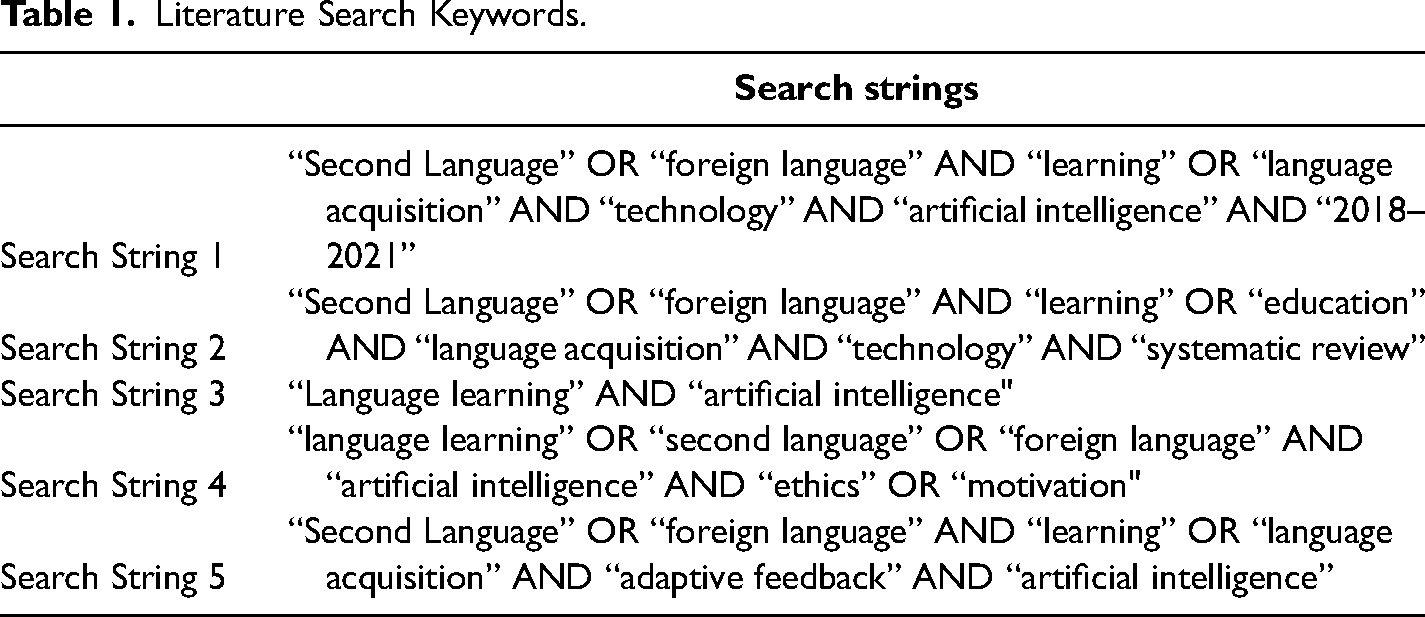
An extensive literature review of technology-assisted L2 learning was conducted to understand the present scope and uptake of mobile apps by post-secondary learners. This review consisted of articles drawn from academic library databases available via Athabasca University, University of Alberta, Western University, University of New Brunswick, Mount Royal University) as well as Google Scholar. All in all, five variations of search strings were used as described in Table 1. The first three strings constituted general searches to better understand the range of recent publications pertaining to technology-enabled L2 learning, while the last two searches focused on the relevant literature pertaining to learner motivation, technology ethics, and AI adaptive feedback models for learning.
Literature Search Keywords.
An item was included if it met the following criteria based on a review of its abstract:
The item was a peer-reviewed article, a published journal article, a presented conference paper, or a published chapter in a book. The item discussed the use of technology and AI in the context of L2 learning. The item focused on adult learners learning an additional language or on educators’ perspective on language learning. The item was available in its full version through the database.
The initial search range was limited to items dating from 2018 to 2021; however, some older items were included if they matched the criteria. Nonetheless, items published more than ten years ago were excluded. Items were also excluded if they focused on language acquisition in young children, if they did not discuss L2 learning, and if they did not make mention of technology or AI-based features.
Table 1 describes the literature keyword searches resulting in the 29 articles included in this review.
Current Technology Uptake in L2 Learning Practices
Technology supports various aspects of L2 learning, including assisting learners with increasing their vocabulary knowledge (Brown & Seibert Hanson, 2019), pronunciation skills (Guo et al., 2019), communication and conversation skills (Ayedoun et al., 2019), writing skills (Taskiran & Yazici, 2021), grammar skills (Wen & Piao, 2020), listening skills (Hu & Wu, 2020), and even cultural knowledge (Divekar et al., 2021). The following section describes language learners’ current uptake of technology in the form of mobile learning apps, adaptive feedback systems, and chatbots. These technologies generally correspond to the study's thematic findings, which reveal learners’ goals for language learning to be centered around (a) usability and design, (b) convenience, habit-formation and motivation, and (c) socialization or community-building.
Mobile Learning, User Experience Design, Motivation
The literature reveals a trend towards mobile-assisted language learning (MALL) such as smartphone devices, rather than the use of web-based applications. The primary reason for this preference is due to the convenience and integration that a mobile device affords for short, just-in-time, or informal sessions of language learning. A key contributor to its integration lies in MALL app user experience (UX) design. This theme is reflected in several research studies that employ questionnaires and interviews to explore users’ experiences with language-learning technologies in some way, even when this is not always the focus of the study (e.g., Divekar et al., 2021; Pikhart, 2020; Seppälä et al., 2022). Seppälä et al. (2020) point out that today's users have high expectations for interactivity with digital tools and that their expectations directly impact their engagement and motivation as language learners. This view is echoed in Pikhart's research (2020) about Millenial's experiences with five mobile apps. His participants expressed a need for app interfaces to be “user-friendly” and “catchy” based on the premise that Millenials spend a lot of time on digital screens, and thus any language-learning app is competing for their attention with several other applications. This directly contrasts with the needs of elderly language learners, as seen in the review of mobile applications by Sanda and Klimova (2021), who emphasize the importance of minimalist designs and easy navigation in apps used by elderly learners. Evidently, the research reveals that user demographic is an important design consideration for AI-based L2 learning technologies.
Another factor designers should consider is the intended user environment. While some of the literature focuses on informal, private language learning, other research studies discuss the use of MALL in conjunction in more formal classroom-based contexts. For instance, Brown and Seibert Hanson (2019) investigate the use of the spaced-repetition flashcard app Anki used as part of a Spanish language class at the university level, while Seppälä et al. (2020) explore the use of KoToToMo Plus, an app used in a Chinese language class.
The uptake of MALL also raises new implications for learner retention, engagement, and motivation. Seppälä et al. (2020) found that users procrastinated their use of the KoToTOMo Plus app and developed design strategies that help to increase retention and motivation, such as implementing study reminders in the form of push notifications. Similarly, Seibert Hanson and Brown (2019) found that there was an overall low and irregular usage rate of the Anki app among the students in their study. One of the reasons for this cited by their participants was a simple and unengaging user interface. Similarly, the participants in Pikhart's (2021) study criticized the old-fashioned design of the mobile apps. Pikhart also found that the apps lacked utilization of more robust features integrating AI and human–computer interactions.
Fu et al. (2020), on the other hand, took a different look at users’ continuous learning intentions by focusing on the affordances of AI-based automatic scoring applications and found key affordances to be: accurate speech recognition, social presence, peer influence, and immediate benefit. Additionally, they point out that both cognitive and emotional engagement also positively influence continuous learning intentions.
From an pedagogical perspective, MALL apps tend not to address metacognition strategies and or self-reflection practices as a way of reinforcing L2 learning and engagement. Kessler (2021) attempted to study this link by carrying out a case study of learners who logged self-reflection journal entries about their experience while using Duolingo to learn L2. The study revealed that self-reflection was a significant factor in aiding learners to develop awareness of metacognitive strategies to support L2 learning, helped them identify personal challenges with L2 learning, aided in the consolidation of their L2 understanding, and made them more cognizant of their own learning preferences (Kessler, 2021). However, the researcher also noted that when learners expressed aspects of the learning process or app that they disliked in their self-reflection, they were less motivated to continue with L2 learning.
A study conducted by Bárcena et al. (2015) utilized news (audio) recordings drawn from social media platforms to examine learner motivation in listening comprehension. The researchers contend that listening comprehension occupies half of all communication and plays a key role in the “internalization of the rules of language” (Read & Kukulska-Hulme, 2015). They argue that since MALL is readily accessible, it increases language exposure over extended periods of time, across different contexts/settings, thus enabling the language skills to be more readily integrated and applied in everyday scenarios. While language podcasts are popular, the researchers suggest its effectiveness in learning languages is diminished by the intensive production process of podcast lessons and a focus on independent study (i.e., lack of collaborative learning activities) (Read & Kukulska-Hulme, 2015, p. 1329), which is further exacerbated by the lack of integrated formative assessments or learner feedback. The study findings suggested that using audio news was an engaging and authentic way of enhancing listening comprehension for L2, particularly if the app allowed the user to choose news stories of personal interest. Social media news stories (e.g., Facebook) was also suggested as a promising avenue of L2 learning engagement, but the researchers cautioned against the superficial nature of most social media commentaries, which could become counterintuitive to improving L2 listening comprehension. The researchers noted that most L2 learners in their study did not use news/radio broadcast apps before to study their target language, and thus were not fully immersed in continuous practice.
Adaptive Learning and Feedback
AI-based technologies can also help increase learner motivation and engagement by creating personalized learning experiences. By taking on the role of a tutor rather than that of a teacher, AI-enabled technologies can adapt to the needs of the users and develop individualized learning environments (Slavuj et al., 2017). Tafazoli et al. (2019) discuss how these kinds of intelligent language tutoring systems are being used in current technologies. Meanwhile, Gutierrez and Atkinson (2011) examine a prototype of an intelligent tutoring system that selects an adaptive feedback strategy based on the errors learners make. Gavriushenko et al. (2015) reviewed several English language-learning apps and games that provide adaptive learning and found that the more complex feedback types a system has, the more adaptive it will be. Lehman et al. (2020) focus on the UX side of adaptive feedback and created an app for English spontaneous speech in which they implemented different levels of adaptive feedback with features previously identified by learners. While learners wanted more detailed feedback, their study showed that most learners did not actually utilize the functions that gave in-depth feedback. They also found high-engagement users accessed the detailed feedback more frequently than low-engagement users. This again shows the issue of low usage rates and user retention.
Chatbots and Conversational Agents
A relatively new application of AI technology in language learning is the use of social robots or chatbots. Chatbots offer learners an opportunity to practice their written or oral communication skills through intelligent conversations without the need for a native speaker to be present. Most chatbots are either web- or app-based, but physical robots also exist. For example, Engwall, Lopes, and Åhlund (2020) used a physical robot shaped like a human head to replicate the role of a host in a language café, an open gathering where language learners can practice their conversational skills with native speakers.
A common premise for the use of chatbots is that they make learners feel more at ease and more relaxed than when interacting with a human counterpart (Chuah & Kabilan, 2021; Haristiani, 2019). This is attributed to a lack of judgment made by the robots on the learners’ language performance. However, El Shazly (2021) examined English language learners’ foreign language anxiety in speaking before and after using AI chatbots and found that the learners’ speech-related anxieties were not reduced. In fact, some learners even reported slightly increased anxiety after interacting with the AI chatbots.
A related use to chatbots is the use of conversational agents. For example, Divekar et al. (2021) built an extended reality software utilizing conversational agents to provide an immersive learning experience. This software features a virtual world in which Chinese language learners can interact with AI agents that can hear, see, and understand the learners. Ayedoun et al. (2019) examined the use of an embodied conversational agent enhanced with specific conversational strategies aimed to increase learners’ willingness to communicate in a foreign language. They found that a system that combined communication strategies and affective backchannels increased participants’ conversation willingness the most.
Since mobile learning, adaptive feedback systems, and chatbots technologies are used in nearly all language learning apps, they have gained immense popularity among adult learners in technologically developed countries. These apps offer a convenient and accessible way for adults to learn a new language, allowing them to combine formal and informal learning. These apps are praised for their usability, high-resolution screens, ample storage capacity, and fast internet connectivity. According to a systematic review of foreign language learning apps, English was the most commonly learned language (Tommerdahl et al., 2022). Some of the most popular language learning apps for adult learners include Duolingo, Rosetta Stone, Babbel, Memrise, and FluentU. These apps provide a range of features, such as interactive exercises, vocabulary drills, grammar lessons, and listening comprehension practice. By incorporating gamification elements, these apps make language learning engaging and motivating for adult learners. Additionally, language learning apps offer flexibility in terms of time and location, allowing adult learners to study at their own pace and in their preferred environments. Language learning apps also provide adult learners with open-ended language content and promote learner interaction and control over complex language characteristics.
Theoretical Framework
Learning Theories for Adult Language Learners
A key approach to successful language learning is founded in literature centered on heutagogy (Hase & Kenyon, 2000), or self-determined learning. This student-centered approach is based on the premise that adult learners learn best when provided opportunities or agency to develop autonomy, capacity, and capability. Heutagogy describes processes such as double-loop learning and self-reflection, whereby the learner examines the problem and actionable outcomes (e.g., If–Then causations) in relation to their own personal beliefs and actions. The learner then critically reflects upon their personal learning assumptions, preferences, habits, and effectiveness, and works with other learners to receive feedback about other helpful strategies to solve any of the challenges encountered.
The integration of ubiquitous mobile and AI-based has inclined learners to adopt heutagogy-aligned practices based on their learning expectations or goals. These technologies provide new possibilities and offer non-linear pathways to actively engage learners—both independently and collaboratively, monitor and conceptualize their L2 acquisition process, and receive adaptive feedback for areas of improvement.
Current Study
Research Aim
This research was designed to survey language learner's current approaches to learning a second/foreign language and perspectives of how AI could be appropriately applied to enhancing the process. We investigate key considerations and gaps between learners’ expectations or goals with actual learning outcomes following their uptake of a language learning app over a 4-week continuous studying period.
Study Research Design
This study is based on an online survey conducted with adults who identified themselves as second/additional language learners, and who have previously or currently use a language learning app to support language acquisition. The 33-item survey consisted of three parts: (a) demographic and background information, (b) Technology Familiarity Test, which is based on the Computer Experience Survey (Yuen, 2020), and (c) open-ended questions regarding their personal experiences with language learning. The demographic and background information included questions about the L2 being studied, highest education level completed, gender, etc., to aid with developing a detailed learner profile of each participant. The Technology Familiarity Test included a list of 10 real and 10 mock-up technology app names based on popular language-related apps used in North America. Participants’ technology familiarity scores were calculated based on 1 point for correctly identifying real technology apps, and were deducted 1 point for each incorrectly identified mock-up technology app name on the list (range of −10 to +10 final scores). The higher the technology familiarity score, the greater the presumed technology familiarity and experience for that participant. There were also 12 open-ended questions inviting detailed descriptions about the participants’ motivations, source materials, technology use, and experience with technology-enhanced language learning. As part of the survey, participants were also invited to share images or videos of their use of language learning apps.
A total of n = 151 education students enrolled across two Canadian universities completed the survey between January to May 2022. A follow-up interview was then conducted with n = 20 randomly selected participants to gather more in-depth descriptions of their technology-enhanced language learning process. The results are shared in the following section.
Study Findings and Discussion
The following results are reported based on participants’ responses to survey questions clustered by topic and theme. The three overarching themes uncovered in this study center around: (a) app usability and design, (b) learner motivation and habit-formation, and (c) opportunities for socialization and community-building. For each theme, the authors discuss how AI features could be integrated to support language learners in their process.
App Usability and Design
When it comes to usability and app design, participants emphasized the importance of access to relevant multimedia content (e.g., videos, posts, songs, etc.) in the target language or to external resources specifically designed to support language learning processes. For example, many participants expressed the importance of embedding a robust and reliable translation feature that could be used to cross-check or provide corrective feedback for their oral and written language performance. With recent advancements in neural machine translation, tools such as Google Translate could be embedded within mobile apps and used to generate on-the-fly phrases that support learners’ experimentation with different ways of phrasing sentences in the target language.
Another important factor affecting a language-learning app's usability is the ease-of-use or convenience afforded by the technology. Cross-platform mobile apps that could be accessed on both a laptop and phone/tablet were deemed more appealing. Additionally, participants preferred lesser keypresses to access the app's main dashboard or learning exercises.
In terms of design, shorter interactive language lessons were perceived to be more accessible to learners than larger lesson modules. Many participants also expressed their hopes for better in-app social elements that could be re-purposed to assist them in their language learning. Here, AI-powered intelligent tutors or bots could be integrated to facilitate conversations between similar or higher-level language learner mentors. By matching learners based on their progress and assessed language proficiency, AI could serve as a global liason between language learners, or help learners connect with native speakers and a community of learners.
Technology Use and Design for Language Learning
The majority of participants reported using Duolingo to help them learn their L2 language. Many participants choose the apps they are using for language learning based on recommendations from other people, hearsay, or advertisement. They chose the apps for their convenience, because of specific features appealing to them (ease of use, availability of languages, app design), because they apps were free or low cost, or because they had used the apps before. These reasons also match what participants like or dislike about the apps, notably:
Participants like free apps, but do not enjoy the limitations of freemium apps that had too many advertisements or required additional costs to unlock features. Participants like apps that are intuitive, easy to use (small learning curve), and visually appealing. Participants like apps that address different skills in language learning (i.e., reading, speaking, etc.), include various types of exercises, and short lessons that can be completed in little time. Some participants also like the ability to track their learning progress and to have personalized exercises. Generally, participants perceive it as a shortcoming if an app does not allow them to practice certain aspects of language learning, such as a lack of practicing conversation skills. Some participants also criticized a lack of feedback or explanation regarding the improper use of grammar or other errors. Some participants liked the apps for their competitive gamification features (e.g., streaks, leaderboards) and study reminder notifications. However, others suggested they do not enjoy those features. This division appears to be based on individual learner preferences.
When prompted during interviews to discuss elements that learners enjoyed or disliked, 18 out of the 20 interviewed participants referenced social aspects of the language learning app, specifically, using the app to enhance language practice with other learners, to connect with native speakers, and to build a learning community to ask specific language-related questions. 16 participants spoke about accessing the app for recommended language-related content, videos, podcasts, songs, etc., Additionally, 16 participants enjoyed their current app because of its UI/UX, 13 participants enjoyed the direct integration of the target language in the app itself to support learning/immersion. 12 participants mentioned using a translation or dictionary feature within the app, and 10 participants described the useful educational/pedagogical content that supported them in teaching the language to others.
In choosing a suitable language learning app, participants explained that they found apps to be a convenient tool that enables them to study on their own schedule and from home, while also providing a structured self-directed learning program. Some participants expressed personal appreciation for the apps in offering them a way to learn a language they otherwise could not, or because the apps helped them appreciate the value of the target L2 language more.
Learning Motivation and Habit Formation
Learner Background and Context: Nonlanguage Learning Technology use
In order to understand participants’ learning needs and context, the survey gathered background information about their non-language learning technology use. Overall, participants considered their current technology exposure and comfort to be above average. Results revealed most participants regularly used non-language learning technologies such as messenger apps, social media (Facebook, Instagram), video chat platforms, YouTube, and Spotify. When asked about what they like about these technologies and why they use them, participants cited social aspects—specifically being able to communicate and connect with others—as playing a critical role in sustaining their learning efforts.
Learning Goals and Study Habits
An important component to understanding higher education students’ use of language learning apps is found in studying their learning goals and study habits. Since the data was collected from students enrolled in English-speaking higher education courses, nearly all participants (99%) self-identified English as their first language. These findings suggest native English-speaking participants benefit most from using apps when learning additional languages in one or more of the following languages: French (n = 30), Spanish (n = 17), Chinese Mandarin (n = 6), German (n = 4), Other (e.g., Norwegian, Portuguese, Chinese Cantonese, Hungarian, Japanese, Italian, Ukrainian, Dutch, Russian, Wolof, Korean, Swedish, Hebrew, Finnish, Finnish, Polish, and Latin). Most participants are studying an additional language for personal growth (25%), to enhance their employment opportunities (23%), to interact with friends and family members (19%), or to travel abroad (15%). 53 participants specifically want to improve their conversational skills (including speaking themselves and understanding others) and 43 participants want to reach a level of fluency in the language (either in one aspect like speaking or in several aspects). Following speaking skills, reading was the second-most mentioned goal, followed by writing skills. This is of particular interest to language learning educators since most apps focus on vocabulary-recognition rather than conversational practice or fluency. Some participants mentioned specific speech and reading goals such as understanding books, TV shows, or communicating with certain people (e.g., grandparents, friends).
Most participants describe their current level either as beginner (32%) or intermediate (32%). Only 5 participants from the entire study described their level as advanced. In fact, when asked about whom they think the app would be most suitable for, many participants indicated beginner learners. Most participants have been studying the language ranging from 2 months to 6 years. Some of them had prior exposure to the language as a child or studied it before in school.
About half of the participants (46%) feel positively about the progression of their language learning. 19% of participants felt that they were progressing slowly or unsatisfied with their overall progression, particularly with the misalignment between the language learning app and their desire to improve a specific skill. For example, participants cited problems with the app's constraints, such as the integration of gamification elements, lack of structure, unexplained grammar rules or nuances, and the lack of speaking exercises.
Another factor mentioned by some participants (11%) was “time” constraints; many participants identified themselves as casual learners with not enough time invested into their learning or feeling they were progressing in line with how much time they spent practicing. Most participants study in short sessions of 5–20 min daily, usually with an app. However, some spent several hours a week studying. All interviewed participants mentioned that they were actively scheduling their language learning sessions as part of their routines. When describing their schedules, some participants again indicated difficulties finding the time to study consistently, and some pointed out their mental or physical state (tiredness and exhaustion from daily responsibilities like full-time work or family care) negatively affected their willingness or ability to set some time aside for language learning.
Learning Schedule of Participants
Most survey responses conveyed a sense of busyness or a full schedule. With work, school, and family obligations, participants tend to schedule their language learning around these obligations by studying in the evening or at bedtime, on weekends, during commuting, or as part of their morning routine. The majority of the participants have made language learning a part of their daily/weekly schedule or routine or aim to make it part of their routine as best as they can. A small number mentioned just “squeezing” learning in when they can. Several participants pointed out that their mental or physical state (tiredness, exhaustion, lack of motivation due to busy schedule) negatively impacts their willingness or time set aside to study. While some learners set aside an hour or more for their language studies, many explicitly pointed out studying only in short sessions under 10 min or moderate sessions of 10–30 min.
Motivation to use app
Sixteen participants mentioned some form of self-motivation for using the app; however, some also stated that this was paired with external motivation derived from some features of the app. In terms of app features, participants were extrinsically motivated by built-in, competitive gamification feature such as day-streaks and rankings. Participants remarked on the desire to maintain good records in the app: “The app does motivate you to complete lessons by giving ‘nagging’ notifications. I would argue that this is not the same as motivating me to learn: the motivating factor is really to not miss a day” (Participant 27) and “The thing that motivates me the most is keeping up my streak” (Participant 23).
During interviews, 6 out of the 20 participants also mentioned the notifications sent by the app as motivating to some extent. Eight participants referred to the app's UI/UX as being “fun,” “easy to use,” “convenient,” or consisting of “short, digestible lessons.” These features aligned closely with participants’ descriptions of likes and dislikes of the app. Other minor themes include feelings of lack of progress and challenges to making the app part of their routine.
Meaningful Experiences
Not everyone had a memorable experience with language learning apps, but for those who had, most of them fell under one of three themes. The first theme was a sense of progress or accomplishment. Participants felt positively if they performed well using the language, noticed improvements, completed a lesson, or applied their language appropriately in a real-life context. The second theme was in-app gamification features. Some people mentioned the notification function which they found either helpful or distracting, but most referred to ‘competitive’ features like streaks and reaching a certain level in the app. In many cases, reaching a certain streak or level gave students a sense of accomplishment as well. Thus, it seems that learners want to be able to observe some form of success or positive feedback from using the app. Participants also confirmed that the gamification features generally motivated them to spend more time using the app:
“Getting into an INTENSE, personal battle on one of the early leaderboards—it had me doing three plus hours of Spanish practice a night in an effort to beat my opponent out for top place (and I did win!)” (Participant 13). “I ran out of hearts on a lesson so it cancelled my learning streak. That was frustrating because I had been trying to get a good streak in. Now I have to do it again” (Participant 28). “A memorable moment was beating my record for streaks and knowing I have been motivated to do it” (Participant 36).
The last theme was app limitations, which lead to negative experiences. Two participants, for instance, mentioned the inaccuracy of speech detection in which the app labeled their pronunciation as incorrect, leading to frustration. As such, this is related to the theme of feelings of accomplishment and success, as participants might feel negatively if their accomplishments (i.e., correct pronunciation) are not recognized or validated by the app.
Which Learners Would Benefit from Using an App?
When asked who would benefit from using language learning apps, 16 of the interviewed participants described learners with specific characteristics, such as those who are “self-motivated,” “self-directed,” or preferred “visual cues” to be primary users of these apps. Of those who referenced a particular language level, the majority believed the app is more suited for beginners rather than more experienced learners. Some also mentioned that they think the app works better as a supplement with other learning resources or as a way to maintain language skills. Thus, it seems learners perceive there to be a ceiling or certain language level in which the app would be useful, which is interesting as most learners stated that they wish to achieve fluency. Based on these responses, one would presume that language learners tend to use apps to support beginning stages of language learning and then gradually transition to more face-to-face language practice as they progress in language fluency.
Opportunities for Socialization and Community Building
Most participants wanted to engage socially within the language learning app, and recommended that the technology should be developed to provide greater opportunities to practice the language with others, connect with native speakers, and build a community to ask questions. They also enjoyed access to multimedia content such as videos, podcasts, songs, Instagram accounts, etc. via the app. Many participants suggested adding more sophisticated translation features or dictionaries (integrated with the messaging features), and more frequent inclusion of the L2 language itself as part of the immersive learning experience in the app. As one participant suggested: “Duolingo…[and] the data mining of large datasets can be used to improve algorithms…to support learners…..in reflecting on their own study habits and behaviors, assessing progress, and responding in such a way to optimize learning.”
Social media was also a popular source of helpful language learning resources—the most common being Messenger apps (e.g., WhatsApp, Discord, WeChat, text) and Instagram. The majority of participants highlighted the importance of incorporating social aspects into technology and as part of the language learning process, noting that “communicating or connecting with others” or “sharing content with others” as being impactful on their persistence and motivation. Apart from the social aspect, the app's user experience or interface (UX/UI) was the second most important element contributing to meaningful language learning. Some users also referenced entertainment value, relaxation, and access to information as reasons for using technology to support language learning. Interestingly, “media access” or “efficiency” was rarely mentioned as reasons for using technology for language learning. However, these elements were alluded to in participants’ commentaries in more subtle ways, such as discussions around the “the ability to access videos in the target language.”
An AI-Powered Future for Language Learning
Perceptions About the Future Advancements of AI for Language Learning
Several open-ended survey questions asked participants to reflect on their own perspectives of AI, and describe potential uses or challenges to its implementation in the language learning process. Table 2 summarizes and compares participants’ general understanding and uptake of AI with potential opportunities for AI integration in language learning apps:
Learner Perceptions About AI-Integration for Language Learning.
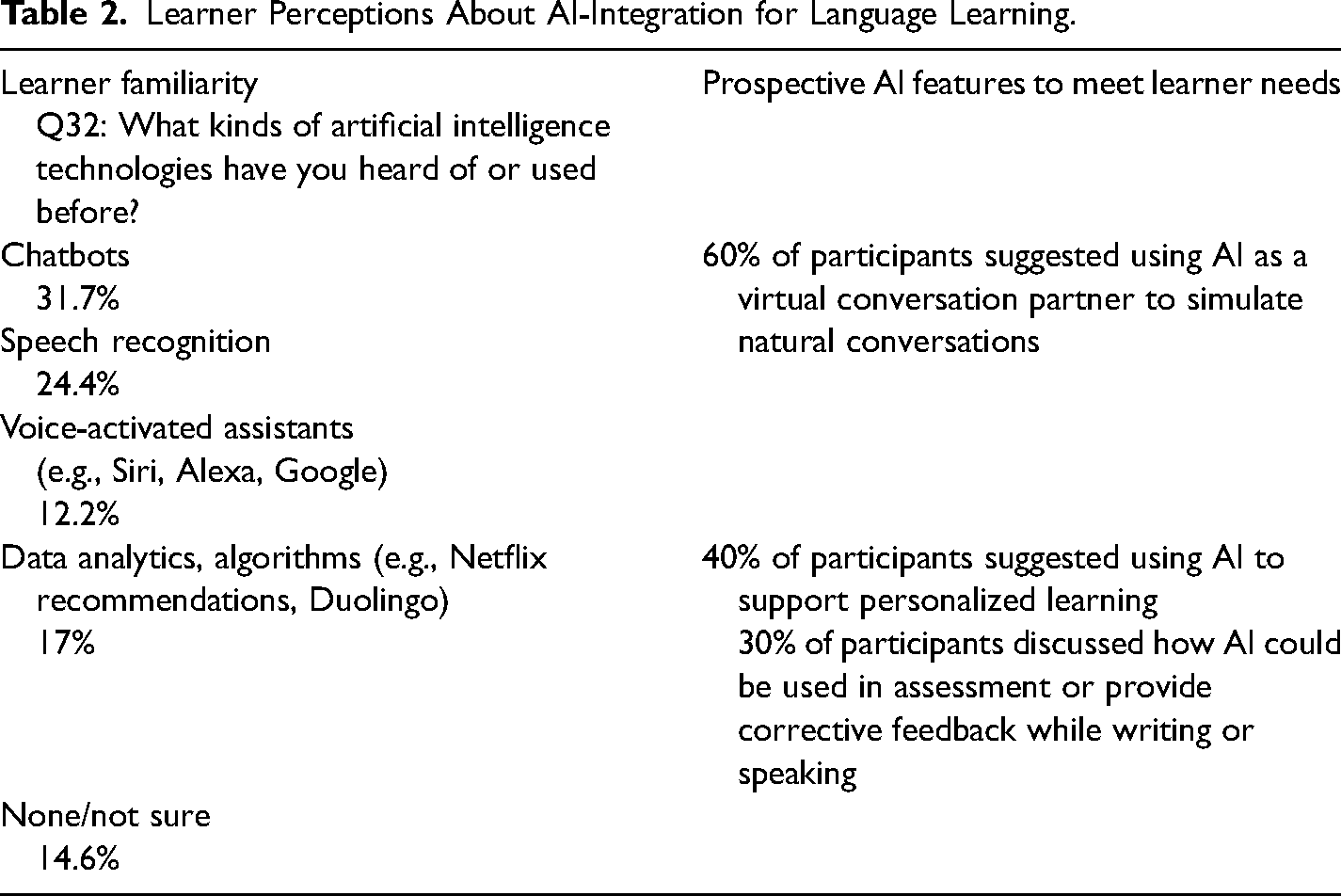
The majority of participants have heard of chatbots or speech recognition being used in a general context. A few also mentioned voice-activated assistants like Siri, Alexa, or Google, or data analytics. 14.6% of participants stated they had not heard of any AI before or were unsure.
When asked about how AI could be used for language learning, 60% of participants mentioned the use of AI as a virtual conversation partner to simulate real conversations for more language learning (speech) practice; 40% mentioned using AI to support the personalization of the learning experience; and 30% mentioned using AI to correct the learners’ mistakes and provide meaningful feedback.
Implications of AI for Language Learning and Technology Integration in Education
Based on the reported findings, the researchers propose the following recommendations and implications of using AI in the design and integration of language learning apps:
Integration of AI-powered features. An intentional integration of AI features that support open, accessible learning. This means finding ways to reduce barriers such as cost, learning curve, and general access to using technologies and AI for language learning. An attention to inclusivity and mitigating bias is also an important element that developers should consider when generating the AI algorithm. For example, considering adaptive technologies and how they might support different types of learners. AI-powered chatbots could serve as a natural conversational partner—one that is attuned to the learner's current language skill level, switch between formal and informal language learning, and quickly evaluate the use terminology for different contexts like in a business or medical situation (e.g., Baidoo-Anu & Ansah, 2023). Further research into technology-enhanced instructional design (e.g., usability), generative AI use in education (AIEd), technology ethics, and educational policies will help inform the pedagogical decisions that promote language learning (e.g., Zawacki-Richter et al, 2019). Prioritize personalization of learning. Personalization is often tied in with the use of AI in education. AI could be adapted to different “learner profiles” and “needs.” For example, an intake survey by the AI could gather data about why a learner wants to learn a language. It could then recommend resources that focus on conversational, business or work-related conversational topics, or even targeted at different age groups such as communication while talking to adult, child or senior. The growth of adaptive learning technologies and learning analytics tools, particularly cloud-based learning management systems and mobile apps, will extend educators’ and developers’ capacity in providing enhanced approaches and modalities for language learning or teaching. Immediate and adaptive feedback. AI's powerful and immediate assessment capabilities could also provide more non-linear pathways to learning based on its reliable assessment of the learner's current grasp of a second language. AI could also be developed to focus on assessing and reporting a learner's strengths and weaknesses, as well as check for a learner's understanding by (i.e., “did you mean this?”). Attention to cultural sensitivity and supports. While AI still presents ethical issues such as reflecting societal bias, it is also capable of being attuned to interconnected cultural aspects of a language (e.g., Nguyen et al., 2023). AI is also quick to locate resources to help learners make connections between the target language and relevant cultural or traditional contexts. For example, an AI bot may draw connections to the etymology of words, which could reinforce students’ language learning by providing more meaningful connections to the evolution of word usage. Further experimental research or post-phenomenological education studies (e.g., Adams & Turville, 2018) could be conducted to deepen our understanding of the relational or socio-cultural context when contemplating the uptake and implications of AI for language learning.
Conclusion
Key Considerations in the Future of AI in Language Learning and Education
Despite the numerous benefits that AI brings to language learning apps, there are also some challenges and limitations to consider. To fully harness the potential of AI in language learning apps, developers must overcome obstacles such as data privacy concerns, the need for continuous updates and improvements to AI algorithms, and ethical considerations related to potential bias in AI-powered language assessments. These biases must be identified and counter-acted to ensure fairness and inclusivity in the design and deployment of AI algorithms. New AI in education policies such as the UNESCO's Guidance for Generative AI Use in Education and Research (2023) may provide insights to develop best practices for AI integration for language learning. As a whole, the benefits of integrating AI features in language learning apps to support learner motivation and assessment outweigh the risks. Provided that educators and app developers are intentional with the integration of AI features, and comply with ethical guidelines or policies, the future of technology-enhanced language learning will continue to grow.
Footnotes
Declaration of Conflicting Interests
The authors declared no potential conflicts of interest with respect to the research, authorship, and/or publication of this article.
Funding
The authors received no financial support for the research, authorship, and/or publication of this article.

Author Biographies
Dr.
Ms.