



Abstract
A field experiment conducted across an academic semester tested the impact of a gamified experiential learning intervention strategically framing a student response system (SRS) to maximize student engagement through their technology use in class. Participants (n = 123) aged 9–16 years received an experimental intervention designed to foster intrinsic motivation through optimally challenging engagement. To achieve this, the intervention utilized teamwork, made friendly competence-enhancing competition salient, and created choice. In a comparison condition, students used SRS without these additional enhancements. Students were surveyed at three time points. The experimental intervention reported increasing psychological need satisfaction for autonomy, competence, and relatedness and greater academic well-being. An observer rating demonstrated more classroom behaviors indicative of intrinsic motivation as compared to the comparison condition. The effects of the intervention increasing student-reported and observer-rated academic well-being were due to more immediate beneficial effects of the gamified experiential condition fostering basic psychological needs for autonomy, relatedness, and competence.
A Gamified Experiential Learning Intervention for Engaging Students Through Satisfying Needs
Fun and optimally challenging learning climates that support students’ engagement are vital for academic well-being and student achievement (Chodkiewicz & Boyle, 2017; Patall & Zambrano, 2019), and they underly well-being in the classroom (Frawley, 2015; Nakata et al., 2022). Responding to students’ desire to use technology, and the growing technological resources available, educators increasingly use classroom technologies to engage students (Martin, 2019; Stockwell, 2022). While the goal of using technological resources is to engage students and increase their intrinsic motivation (Leitão et al., 2022), it may be that the optimal classroom climate—one that engages and enthuses students—is crucial for achieving the desired educational and wellness outcomes that they are designed to achieve (Cardenas et al., 2022).
Gamified experiential learning approaches offer a framework for developing strategies that engage and excite students (Isabelle, 2020) particularly when used in conjunction with technological advances that open creative avenues for engaging students (Moseikina et al., 2022). We focus on one—the Student Response System (SRS; Liu et al., 2019) as a proof of concept for the gamified use of these experiential technologies. Furthermore, we integrate these approaches with a separate literature based on self-determination theory (SDT; Deci & Ryan, 2000), and explore how educators can optimally enhance students’ academic well-being (i.e., engagement, excitement, interest, and effort) by supporting their psychological needs for autonomy (i.e., perceived choice) relatedness (connection with others), and competence (i.e., sense of efficacy; Ryan & Deci, 2017).
The experiment, conducted during an academic semester, contrasted the repeated use of a gamified experiential learning intervention with a neutral comparison that held the learning technology constant to identify the role of a gamified learning climate on forming the success of classroom technology manipulation on academic well-being. Further, we tested an SDT-based mediation model that anticipated effects on observed academic well-being by a rater (i.e., engagement and excitement) and perceived academic well-being by students’ self-report (i.e., interest and effort) are due to the more immediate beneficial effects of motivation on basic psychological needs for autonomy, relatedness, and competence.
Technology Use in the Classroom
Combining technology with interactive teaching styles has been shown to play an important role in engaging and developing their strengths (Bedwell et al., 2014). These student-oriented approaches in which education assists social, academic, and emotional development are increasingly used to make learning more fun and exciting (McCombs, 2004), support student participation, involvement, and attention, set up a team environment, stimulate responses, discussions, and practical experiences (Senthamarai, 2018).
Such Gamified Experiential Technologies (GET; David & Weinstein, 2023) engage students through interactive learning in the classroom (Pearson, 2017). For example, one such form of classroom technology, the SRS (Liu et al., 2019)—a system that consists of a handheld device named a “clicker” (Barber & Njus, 2007; Caldwell, 2007), is an increasingly popular way (Brown et al., 2014) to use game elements (Ebadi et al., 2021) to promote fun and engagement (Zainuddin et al., 2020), interest and effort (Werbach & Hunter, 2012), educational knowledge (Xi & Hamari, 2019), and broadly, academic well-being (O’Brien, 2016). More specifically, SRS is a clicker system that consists of three components: wireless handheld transmitters that look like remote controls held by each participant and teacher, a receiver that receives the signals from these wireless clickers, and software that is installed on the classroom interactive whiteboard that projects the exercises and records, displays and manages the students’ responses (Garver & Roberts, 2013). The SRS provides an excellent opportunity to explore gamified learning because it opens a world of interactive learning in the classroom (Tóth et al., 2019) where students can test their knowledge dynamically with teachers and peers and receive instant feedback that supports conceptual understanding (Jones et al., 2012).
Initial research suggests the social context that frames it matters when predicting children's reactions to technology use. For example, a study of 24 university students in Korea showed that SRS with an interactive technique can provide an active learning environment, especially when peer interaction is involved (Kent, 2019). Pearson (2017) also conducted one such experiment on 127 university students to compare teamwork with individual anonymity and found that all clickers use increased academic performance but students preferred teamwork over individual clickers and found teamwork more fun and engaging. Pearson (2017) concluded that a team-based clicker model allowed students to work with peers in a fun and engaging environment which enhanced the learning outcome.
Teamwork can be enhanced by creating friendly information-focused competition between teams. For example, Sun and Hsieh (2018) conducted an experiment on 118 junior high school students and two teachers and found that making friendly competition salient can increase intrinsic motivation and engagement. Similar findings for friendly competition were identified in a brief classroom experiment with younger students (David & Weinstein, 2023).
Need-Satisfying Climates in Education
This literature on gamified experiential learning speaks to a large body of evidence that shows students must be motivated to pursue learning in the classroom (Dabrowski & Marshall, 2018), and healthy motivational climates drive constructive goal pursuit in educational settings (Ushioda & Dörnyei, 2017). One challenge educators face is how to keep their students motivated throughout the learning procedure, especially in an environment in which the acquisition of a foreign language worldwide occurs in a traditional setting involving long hours of exam-oriented preparation (Joe et al., 2017). Research suggests teachers do not consistently create need-satisfying contexts that foster academic well-being (Gillet et al., 2012; Gnambs & Hasfstingl, 2016; Gottfried et al., 2007; Lepper et al., 2005; Scherrer & Preckel, 2019). As a result, they risk losing their students’ interest and engagement over time.
To mitigate this risk, researchers have applied the motivational framework of SDT (Deci & Ryan, 2000). SDT defines the nature of motivation that outlines teaching practices to support students’ intrinsic motivation to learn (Collie et al., 2019; Haerens et al., 2015; Vansteenkiste et al., 2012). SDT argues that teachers’ teaching styles can satisfy their students’ basic psychological needs—relatedness, autonomy, and competence—and in turn their academic well-being (Reeve & Halusic, 2009; Ryan & Deci, 2017). Autonomy need satisfaction is the experience of the student who has a sense of choice and freedom to participate in an activity; competence involves the need to feel competent to participate in challenges given by teachers and relatedness involves the need to have meaningful relationships with classmates and teachers (Howard et al., 2021).
School interventions that have successfully satisfied basic psychological needs have increased students’ intrinsic motivation (Reeve & Cheon, 2021) and well-being (Tejada-Gallardo et al., 2020). One core SDT expectation in education is that need-satisfying forms of motivation—when teachers understand, acknowledge, and attempt to respond to their students’ perspectives—increase student perceived academic well-being such as interest and effort, and observed academic well-being of classroom behavior such as engagement and excitement. Classroom interventions have understood teachers to play a key role in students’ education and engagement, and argue that training teachers to adopt a more need support style encourages more student engagement and excitement (e.g., Reeve et al., 2004). Teachers also encourage students by providing purposeful and rewarding tasks and choices to engage interest (Ryan & Deci, 2020). In other words, students benefit when they are given a choice in their learning and when tasks are relevant to their interests (Dysarz, 2018; Patall et al., 2013). Research supports this view, showing that need-satisfying teaching increases intrinsic motivation (Bao & Lam, 2008; Patall et al., 2008), performance (Murayama et al., 2015), and curiosity (Schutte & Malouff, 2019).
Current Study
The current study sought to build on this nascent work by testing a need-satisfying gamified learning intervention that paired GET with a supportive climate. It advanced the literature by testing a gamified experiential classroom intervention using SRS that enhanced jointly students’ choice, supporting collaborative teamwork and trialing friendly competition. It integrated these strategies with the theoretical framework of SDT and tested whether need satisfaction for competence, relatedness, and autonomy would mediate benefits identified. It also advanced the literature by testing effects across an academic semester (Sun and Hsieh, 2018) and tested models with school children and not the samples more common to the literature, namely university students (Annamalai et al., 2022; Kent, 2019; Pearson, 2017; Tóth et al., 2019; Yu, 2020). In addition, we assessed observed classroom behavior of engagement and excitement during the class in addition to asking students for their perceptions of and reactions to the task, as suggested (Aljaloud et al., 2019).
Hypotheses were preregistered prior to our study data collection, along with the planned design and analytic approach (https://osf.io/vzd97/).
The study was designed to test three a priori hypotheses (H):
Students assigned to the Experimental condition would report higher basic psychological need satisfaction, and perceived and observed academic well-being as compared to an anonymous Comparison condition.
Need satisfaction would mediate the effects of the condition on perceived and observed academic well-being (Figure 1).
Condition effects of the Experimental condition benefiting students’ perceived academic well-being more than the Comparison condition will extend to observed classroom behaviors of academic well-being in the classroom.
Method
Participants
The experiment involved 123 students, 56 boys (45.5%) and 67 girls (54.5%), studying in an English Language School in Greece during the school year 2021–2022. Students varied in age from 9 to 16 years (M = 11.65 years). All children had Greek citizenship and Greek was their native language.
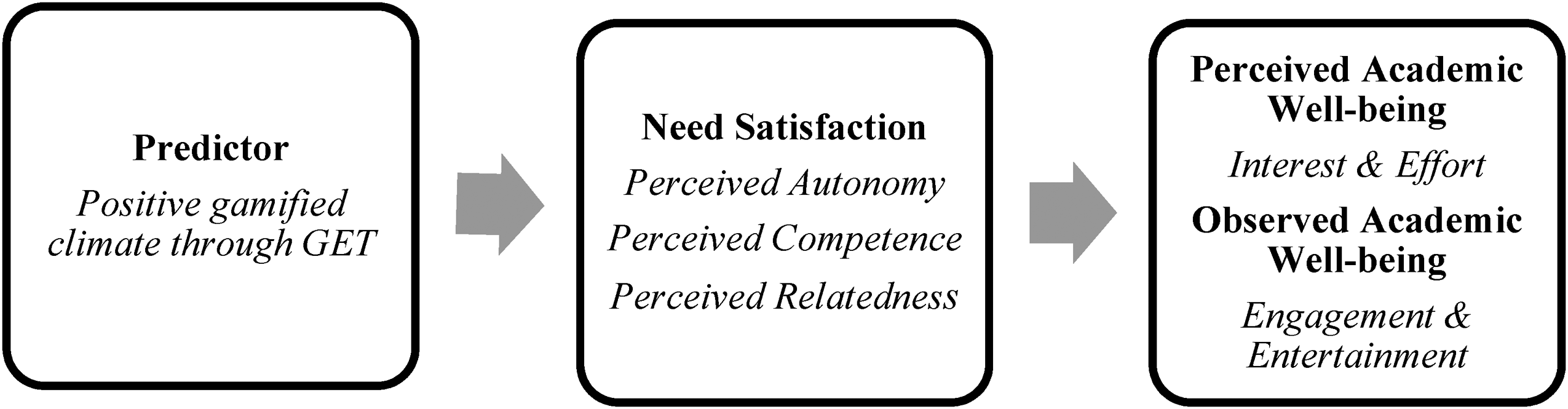
Mediation of psychological need satisfaction on perceived academic well-being and observed classroom behavior of academic well-being.
Transparency and Openness
Given we were testing young children but combining multiple positive motivational framings for GET based on our previous experiment, we anticipated a moderate effect size across all measures. There was no exclusion criteria set. We aimed for a minimum of n = 50 students in each group for a broad but equal representation of student ages. This estimation was based on an a priori power analysis (in G*Power) that anticipated a moderate effect size of d = 0.50, α = .05, with power = .80, and using one-tailed tests anticipating the Experimental condition would demonstrate more positive outcomes than the Comparison condition.
The study received Ethics approval from the University Research Ethics Committee of the University of Reading (No. 2021-123-NW) and was preregistered (https://osf.io/vzd97/). Data were analyzed using IBM SPSS Statistics, version 28.0.0 (190). Raw data and analysis code for this study can be sent without undue reservation by emailing the corresponding author.
Experimental Design
An email was sent to the parents of the students with the details of the experiment. Both parent and student consented prior to the start of the experiment. Then, students were randomly assigned to one of two conditions: an Experimental intervention or a Comparison group. Sixty-three (51.2%) students (23 girls and 40 boys) who were separated into seven smaller classes took part in an Experimental condition and 60 (48.8%) students (33 girls and 27 boys) who were also separated into seven smaller classes took part in a Comparison condition. As such, this study involved a between-subjects design. The two groups were oblivious of the existence of the other as they continued their lessons as normal with the use of technology. Students were put in smaller classes from the beginning of the school year depending on their level of English and due to government regulations for the prevention of the spread of COVID-19. The smaller group size also allowed the observer to more readily identify individual child behaviors throughout the task.
The Experimental condition jointly implemented teamwork, friendly competition salient, and choice. In the Experimental condition, students were allowed to choose whether they wanted to participate or not (no participant chose not to participate) and were also allowed to collaborate in teams of three during the task. Though they were in teams, each had their own clicker and was permitted to choose to answer differently from their group. In the end, students received feedback on their own performance and time they took to respond—which they were aware of from the beginning—this enabled them to compare themselves with all the other students if they chose to—that gave them a sense of friendly competition (Zahedi et al., 2021).
The Comparison condition involved working alone and anonymously. They were not asked if they wanted to participate or to collaborate in teams before clicking on the answer, they were given a clicker each and were told to respond as normal—they were given the feeling that it was the normal procedure of the lesson—a final game before the end of the lesson. Students in this condition could still detect their scores—which they were aware of from the beginning—on the leaderboard using an anonymous ID that they received for this purpose.
Procedure
Both groups followed the same teaching procedure at the beginning of each lesson. They were taught the planned syllabus which was based on specific grammar and vocabulary from their textbooks and they watched animated texts and answered questions on the interactive whiteboard. For the latter part of the lesson, they were given a quiz response clicker each to participate in the GET experiment. In both conditions, the teachers—who were held consistent across conditions and had experience in using SRS to assist their lessons—displayed two sets of 15 questions (previously taught grammar and vocabulary) on the interactive board with the help of the transmitter and clicker. As soon as the teacher projected a multiple-choice question on the interactive whiteboard, students clicked on the button on their clicker. Their answer was then transmitted to the system through infrared or radio frequency signals so each student answered instantly without being scrutinized by their peers. The system aggregated the responses with a histogram which offered the teacher the ability to show the results to the whole class through a leaderboard and bar chart (Chien et al., 2016).
Students answered within 30 s by using their clickers after collaborating in groups or individually, depending on the condition to which they were assigned. During the last 10 s, a sound was heard from the speakers so that they would respond in time. Then, a bar chart with percentages of correct answers was displayed and the students were shown their scores and time on a leaderboard.
GET was used in every lesson and every class throughout the first academic semester. At three time points (beginning, middle, and end of the academic semester), students also responded to the Intrinsic Motivation Inventory (IMI; Deci & Ryan, 1985), which was delivered through Qualtrics Survey Solutions after the survey was translated into Greek and back-translated (see on https://osf.io/vzd97/), which evaluated their basic psychological need satisfaction and perceived academic well-being of interest and effort. An assisting teacher, blind to the nature of the study and conditions, sat in a corner of each classroom and observed student academic well-being in classroom behavior of engagement and excitement during the task at three time points (beginning, middle, and end of the academic semester). The assisting teacher was trained prior to the experiment to detect gestures, facial expressions, and behaviors of the students during the intervention and was told to tick specific boxes for each student. Each classroom had a maximum of 10 students, allowing the assistant teacher to observe everyone taking part. The teacher reported on the students’ reactions during the use of clickers up until the students saw their scores on the leaderboard (these observed behaviors are described in more detail below).
Materials
Outcome measures employed multiple subscales of the IMI (Deci & Ryan, 1985). The IMI was used as it measures the user experience within games (De Lima et al., 2015) and is a well-validated measure used in SDT-based education research (Raes et al., 2020). Items were paired with a 7-point Likert scale ranging from 1=“not at all true”, to 4=“somewhat”, to 7=“very true”. Subscales of the IMI are described below.
Need Satisfaction
Perceptions that psychological needs were satisfied were measured through three subscales. SDT posits that supporting one psychological need (e.g., autonomy) activates another (e.g., relatedness), and indeed they show high correlations in previous research and are often modeled together (Deci & Ryan, 2000; Su & Reeve, 2011). This was therefore the approach we took in the present study. Autonomy was measured with seven items including “I believe I had some choice about doing this activity” and “I did this activity because I had no choice” (R; Time 1: α = .70; Time 2: α = .94; Time 3: α = .98). Competence was measured with six items including “I think I did pretty well at this activity, compared to other students” and “I am satisfied with my performance at this task” (Time 1: α = .69; Time 2: α = .89; Time 3: α = .89). Relatedness was measured with six items including “I felt close to my classmates” and “I felt really distant to my classmates” (R; Time 1: α = .68; Time 2: α = .85; Time 3: α = .87).
Perceived Academic Well-Being
Academic well-being was measured through both self-reported interest and effort. Interest was measured with seven items such as “I enjoyed doing this activity very much” and “I thought it was a boring activity” (R; Time 1: α = .74; Time 2: α = .88; Time 3: α = .91). Effort involved five items including “I put a lot of effort into this”, and “I did not put much energy into this” (R; Time 1: α = .73; Time 2: α = .80; Time 3: α = .90).
Observed Academic Well-Being in Classroom Behavior
Observed classroom behavior was measured by an assisting teacher, blind to the nature of the study and the conditions. The observer sat in a back corner of the room and coded immediately at the end of each lesson period. Engagement included two items “The student is engaged” and “The student is passive” (R; Time 1: α = .78; Time 2: α = .67; Time 3: α = .72). Excitement included three items “The student is excited,” “The student is smiling,” and “The student is happy” (Time 1: α = .83; Time 2: α = .81; Time 3: α = .81).
Results
Analytic Strategy
To test preregistered confirmatory H1 and H2, as well as exploratory hypotheses that effects would increase across time, a repeated measure analysis of variance was conducted with time defined as a within-person factor with three levels: Time 1, Time 2, and Time 3, and condition (Experimental vs. Comparison) as a between-subject factor.
Confirmatory Between-Subjects Effects
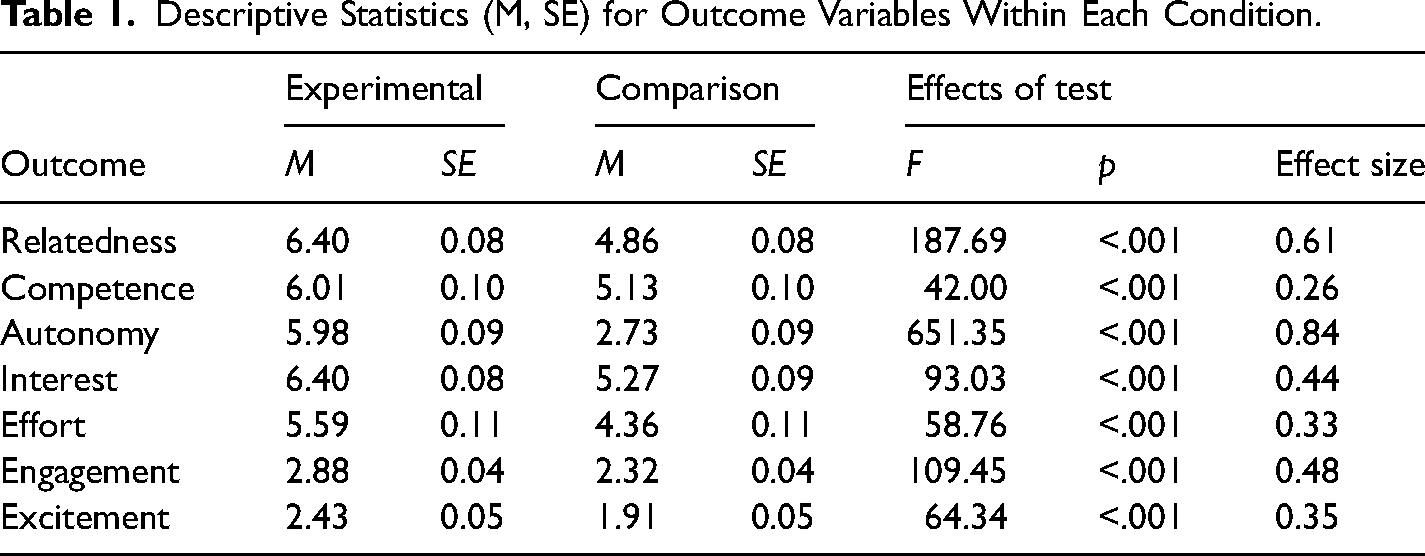
At the outset, our primary interest was in the between-person effect of conditions averaged across time points. Analyses showed a main effect of condition (Experimental or Comparison) averaged across the three time periods, wherein the Experimental condition resulted in greater psychological needs, autonomy F(1, 121) = 651.35, p < .001; competence F(1, 121) = 42.00, p < .001; relatedness F(1, 121) = 187.69, p < .001, greater perceived academic well-being, interest F(1, 121) = 93.03, p < .001; effort F(1, 121) = 58.76, p < .001, and greater observed classroom behavior, excitement, F(1, 121) = 64.34, p < .001; engagement, F(1, 121) = 109.45, p < .001. Table 1 summarizes between-subject effects and effect sizes. In all, the condition predicted all the outcomes measured, in the hypothesized direction.
Descriptive Statistics (M, SE) for Outcome Variables Within Each Condition.
Within-Subject Effects
Exploratory Psychological Need Satisfaction Across Time
An interaction of Condition × Time was observed in nearly all outcome variables: predicting psychological needs; autonomy, F(2, 242) = 124.76, p < .001, ηp2 = .508; competence, F(2, 242) = 11.88, p < .001, ηp2 = .089; relatedness, F(2, 242) = 47.34, p < .001, ηp2 = .281. We proceeded to investigate significant interaction effects by testing linear effects as a function of each of the two conditions (Experimental vs. Comparison). Predicting psychological needs, students in the Experimental condition reported increased needs linearly as a function of time (relatedness t = 6.91, p < .001; competence t = 5.54, p < .001; autonomy t = 10.63, p < .001). In contrast, students in the Comparison condition reported lower relatedness and autonomy psychological needs across time (relatedness t = −3.63, p < .001; autonomy t = 9.91, p < .001), and no change in competence need satisfaction (t = 0.73, p = .465). See Table 2 for a summary of these effects.
Between-Subject Effect Identifying Each Subject as a Separate Observation—Condition Effect for Each Time Point.
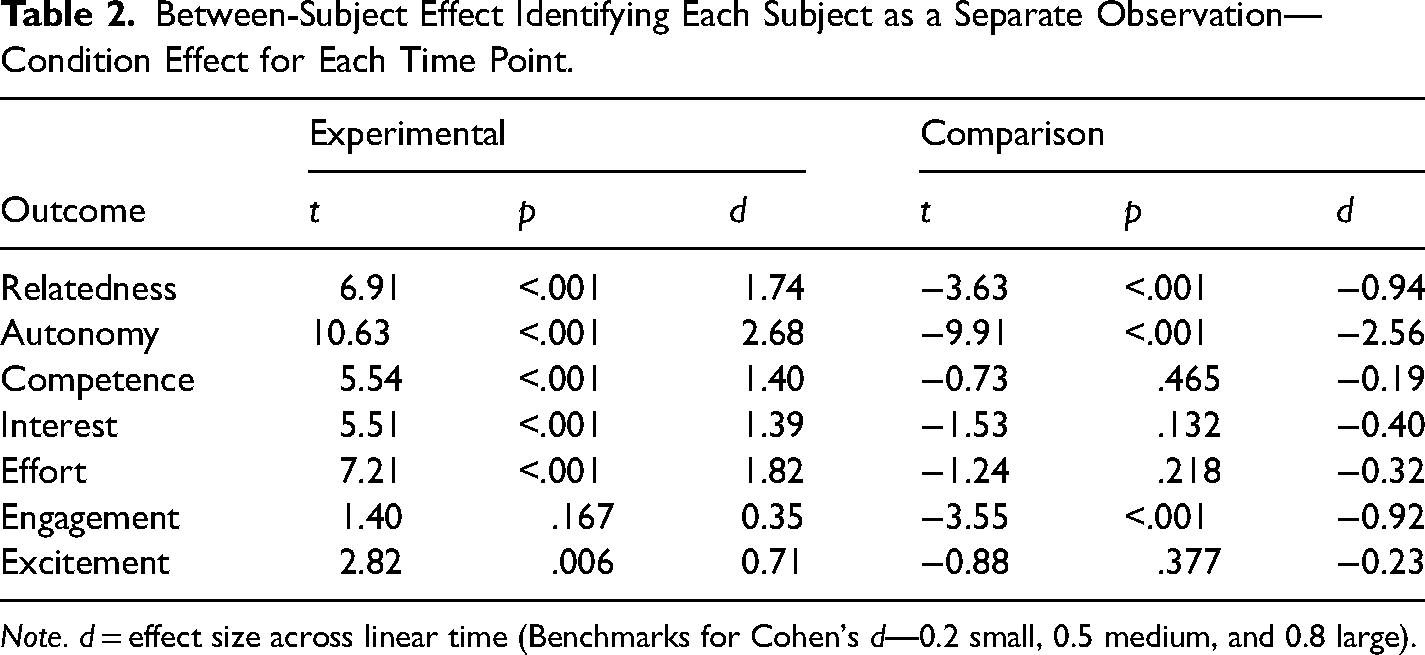
Note. d = effect size across linear time (Benchmarks for Cohen's d—0.2 small, 0.5 medium, and 0.8 large).
Exploratory Perceived Academic Well-Being Across Time
Academic well-being also showed an omnibus effect of Condition × Time, Interest, F(2, 242) = 17.04, p < .001, ηp2 = .123; effort, F(2, 242) = 15.90, p < .001, ηp2 = .116. Following this, linear increases were observed as a function of time in the Experimental condition (interest t = 5.51, p < .001; effort t = 7.21, p < .001). This is in contrast to the Comparison condition, where no change was observed (interest t = −1.53, p = .132; effort t = −1.24, p = .218; Table 2).
Exploratory Observed Classroom Behavior Across Time
An interaction between condition and time was in evidence predicting engagement, F(2, 242) = 24.80 p < .001, ηp2 = .170. The observed engagement did not change as a function of time in the Experimental condition, t = 1.40, p = .167. In contrast, the Comparison condition showed lower engagement across time, t = −3.55, p < .001 (Table 2).
As was the case for engagement, an omnibus effect was in evidence predicting observed excitement, F(2, 242) = 9.68 p < .001, ηp2 = .074. However, follow-up analyses did not show a linear change in either the Experimental, t = 2.82, p = .006, or Comparison condition t = −0.88, p = .377 (Table 2).
Indirect Effect Analyses
A PROCESS model (Model 8) with 5000 bootstrapped iterations (Hayes, 2018) was used to test a moderated mediation model defining time as the moderator and psychological need satisfaction as the mediator. Specifically, we tested the indirect effects of the intervention on perceived academic well-being and observed academic well-being in classroom behaviors through psychological need satisfaction, which we anticipated would be further moderated over time. Said another way, we anticipated that the Experimental condition (as compared to the Comparison condition) would lead to greater linear increases in psychological need satisfaction (i.e., relatedness, autonomy, and competence) across time, which would mediate the effects of the condition on linear increases we observed on perceived academic well-being and observed academic well-being in classroom behavior in the primary results reported above (Figure 2).
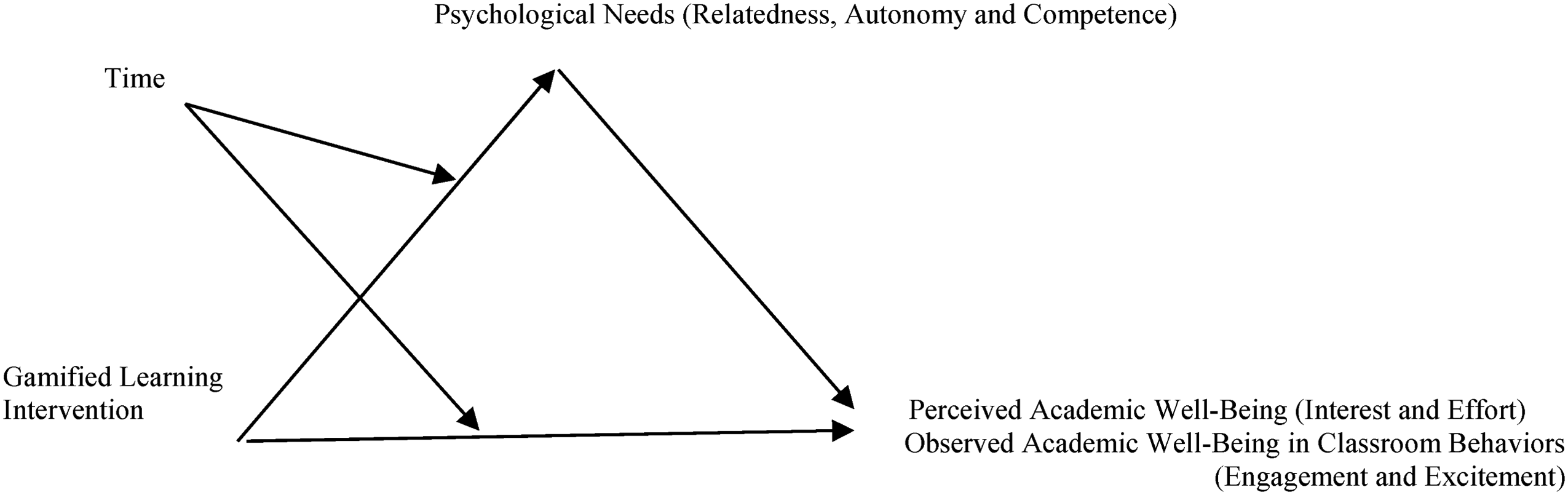
Path diagram showing mediation.
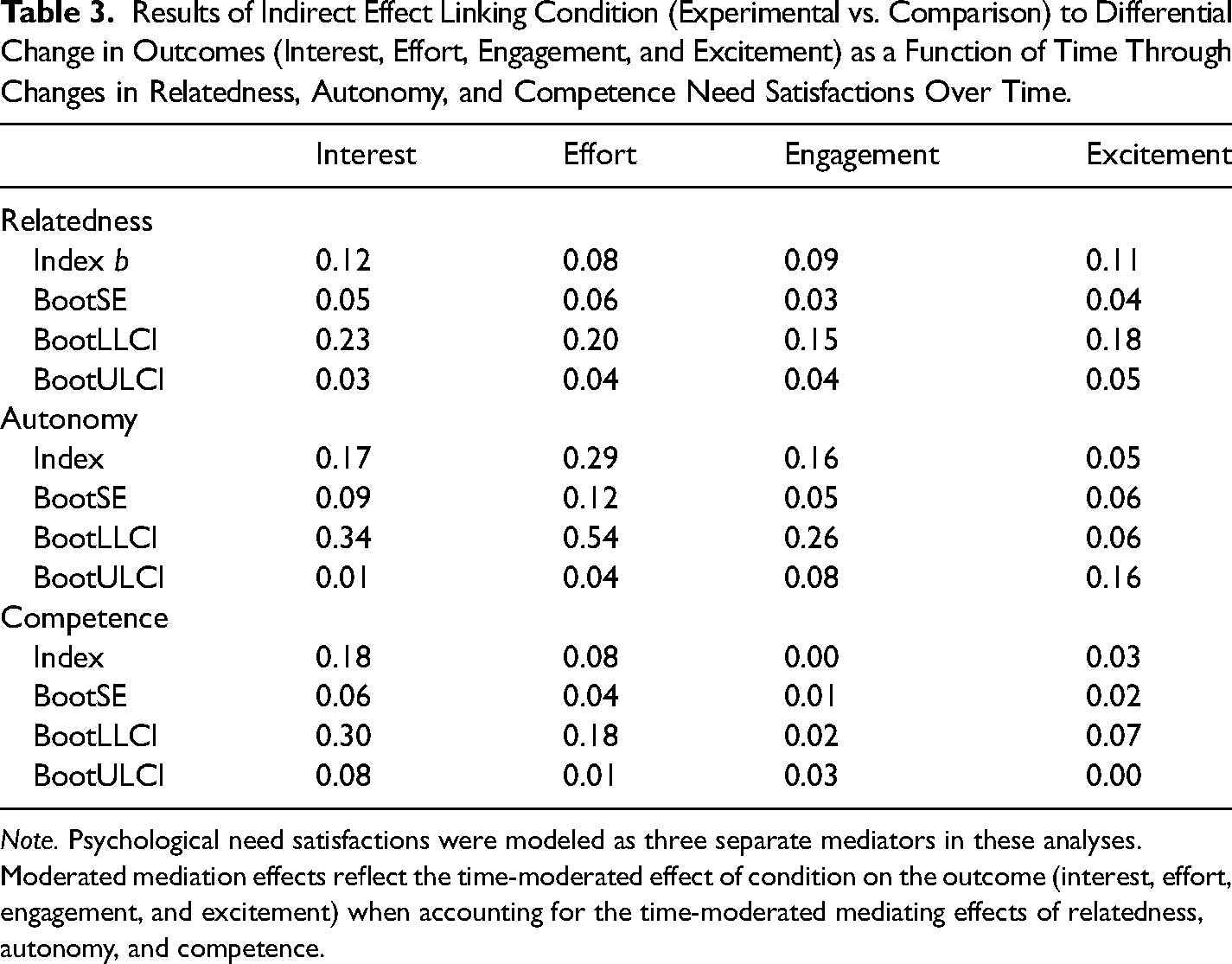
To examine the mediation portion of the model, all three psychological need satisfactions were defined simultaneously in PROCESS models, effectively testing each of their effects independently of one another. Self-reported interest and effort and students’ observed engagement and excitement were tested as separate outcomes. The indexes of mediated moderation for these models are summarized in Table 3.
Results of Indirect Effect Linking Condition (Experimental vs. Comparison) to Differential Change in Outcomes (Interest, Effort, Engagement, and Excitement) as a Function of Time Through Changes in Relatedness, Autonomy, and Competence Need Satisfactions Over Time.
Note. Psychological need satisfactions were modeled as three separate mediators in these analyses. Moderated mediation effects reflect the time-moderated effect of condition on the outcome (interest, effort, engagement, and excitement) when accounting for the time-moderated mediating effects of relatedness, autonomy, and competence.
Predicting Perceived Academic Well-Being
Linear increases in all three psychological needs mediated the effect of the Experimental condition on linear increases in academic well-being across time (interest: relatedness satisfaction b = 0.12, SE = 0.05, 95% CI [0.23, 0.03], autonomy satisfaction, b = 0.17, SE = 0.09, 95% CI [0.34, 0.01], competence satisfaction, b = 0.18, SE = 0.06, 95% CI [0.30, 0.08] and effort: relatedness satisfaction b = 0.08, SE = 0.06, 95% CI [0.20, 0.04], autonomy satisfaction, b = 0.29, SE = 0.12, 95% CI [0.54, 0.04], competence satisfaction, b = 0.08, SE = 0.04, 95% CI [0.18, 0.01]).
Predicting Observed Academic Well-Being in Classroom Behaviors
Linear increases in all three psychological needs mediated the effect of the Experimental condition on linear increases in behavioral observation (engagement: relatedness satisfaction b = 0.09, SE = 0.03, 95% CI [0.15, 0.04], autonomy satisfaction, b = 0.16, SE = 0.05, 95% CI [0.26, 0.08], competence satisfaction, b = 0.00, SE = 0.01, 95% CI [0.02, 0.03] and excitement: relatedness satisfaction b = 0.12, SE = 0.04, 95% CI [0.18, 0.05], autonomy satisfaction, b = 0.05, SE = 0.06 95% CI [0.06, 0.16], competence satisfaction, b = 0.03, SE = 0.02, 95% CI [0.07, 0.00]).
Discussion
The current field experiment tested a gamified experiential learning intervention in the classroom to test its effects on perceived academic well-being (i.e., self-reported interest and effort) and observed academic well-being in classroom behaviors (i.e., engagement and excitement) of intrinsic motivation on children between 9 and 16 years of age. We applied this gamified experiential learning intervention to enhance the learning benefits of Gamified Experiential Technology (GET), through the use of an SRS that allowed students to answer questions that were projected on the interactive whiteboard. In an Experimental group, GET use was optimized by giving students meaningful choices about their participation (whether or not to take part), encouraging them to rely on teammates to discuss and debate answers, and creating friendly competition by providing feedback about groups’ accuracy without judgment or global performance evaluations outside of the task. This approach was compared to a second group of students who worked independently and anonymously, but also received feedback on their accuracy in the task.
Findings showed that across time in the Experimental condition, those students who received GET in a gamified approach characterized by maximizing their choice, supporting collaborative teamwork, and trialing friendly competition amongst students, experienced greater psychological needs, perceived academic well-being, and more intrinsically motivated observed classroom behaviors as when compared to the Comparison condition.
These findings build on previous research (David & Weinstein, 2023), which suggested that GET enhanced the learning experience, but only when gamified experiential strategies were in use. When students engaged in GET as part of a team, had the choice to participate, or engaged in friendly competition, they felt need satisfied, which correlated with more self-reported effort and interest in contrast to using GET anonymously or when answering the same questions on paper.
The current experiment was built on several gaps in this nascent literature. As we did not have systematic knowledge about a gamified learning intervention for technology use on children, we concentrated our experiment on a broad range of students’ ages between 9 and 16 years. Other research was conducted on university students (Annamalai et al., 2022; Benson et al., 2017; Çelik & Baran, 2022; Kent, 2019; Pearson, 2017; Tóth et al., 2019; Yu, 2020) and provided little understanding of how motivationally supportive contexts—ones that enhance the basic psychological needs of autonomy, relatedness, and competence—and technology can be used in parallel to optimize learning. Second, to date, no field experiments with children have been conducted manipulating the daily use of technology in the classroom for an entire academic semester. Previous experiments applied motivational climates just once or in very few sessions (Boudadi & Gutiérrez-Colón, 2020; David & Weinstein, 2023; Sun & Hsieh, 2018). Although those analyses were exploratory, we see one of the most exciting findings of the current work the benefits observed across time when motivationally supportive education contexts were used.
There are vital gaps between practices and policies in educational institutions (Ryan & Deci, 2020). This study tested an intervention that allowed students to use technology in a gamified experiential structure characterized by maximizing their choice, supporting collaborative teamwork, and trialing friendly competition among students. This combined approach to support students’ psychological needs has not been implemented together in practice. Indeed, there is recognition that more of this kind of work—theory-informed interventions in the classroom—is needed to understand optimal classroom teaching styles (Patall & Zambrano, 2019).
Students are open to new challenges and show excitement and engagement; however, they require experience to master a task (Ryan & Deci, 2020). This was evident across time in our experiment. Students who used GET in the motivationally enhanced (i.e., need-supportive) condition showed greater enthusiasm and engagement from the beginning of the experiment to the end, but needed more time to feel related to classmates, more choiceful, and more efficacious in their GET learning and in turn show interest and effort. The psychological need satisfaction led to increases in effort and interest and kept engagement and enthusiasm consistent throughout the semester.
In contrast, students who used GET without the need-supportive motivational climate showed lower enthusiasm and engagement from the onset of the manipulation at the start of the semester. Unlike those students in the Experimental condition, they reported less interest and effort across time.
Students in the Comparison condition also reported different patterns of need satisfaction across the semester in relation to the Experimental group. Specifically, throughout the semester, they reported lower relatedness to classmates during the GET activity and felt less choiceful for the activity. These reduced psychological need satisfactions corresponded with reported decreases in effort, interest, engagement, and excitement. These results supported SDT assertions that basic psychological need satisfaction for relatedness, autonomy, and competence underlines positive learning (Ryan et al., 2019), whereas thwarting these basic psychological needs can damage motivation and well-being (Vansteenkiste et al., 2020). In the current study, using classroom technology (GET) in the absence of need-supportive motivation resulted in lower relatedness and autonomy need satisfaction, and less competence need satisfaction throughout the semester, suggesting that perhaps any need-satisfying benefits of GET wore off as novelty decreased. On the other hand, in the Experimental condition, we observed increases in all three psychological need satisfaction, which in turn predicted corresponding increases in perceived academic well-being (interest and effort) and stability in observed academic well-being in classroom behavior (engagement and excitement) across time.
Limitations
The current findings should be viewed in light of several limitations. One limitation has to do with the infrastructure of the classrooms that were studied. Students in this study were technologically literate and taught in small groups of 10 children (max) in a class. They were students of a private school who came from a more advantaged socioeconomic background that had more access to technology at home. The private school itself also had a lot of technology in the classrooms. Specifically, every class had an interactive board and an SRS. In other schools, access to these technologies may be limited due to the high cost (DeBourgh, 2008), and teachers tend to turn to online SRSs so students can use their mobile phones instead (Chen & Yang, 2022; Lepp et al., 2015). It would be interesting to expand future research to larger classrooms, as well as to classrooms with children from mixed or lower socioeconomic backgrounds to obtain more robust evidence on the role of motivational styles in technology-assisted teaching. Such future work is also useful for understanding whether other devices, such as students’ own mobile phones, would have learning benefits when used within similar motivational climates.
Future experiments could also explore the use of other gamified, motivational, or otherwise “fun” enhancing teaching strategies that optimize classroom technology benefits. In this study, we used a combined intervention of students’ teamwork, providing them with a sense of choice and supporting friendly competition. However, there are other ways that need-supportive teaching is conveyed. For example, some work suggests that a motivational tone of voice may play a role in students’ experience (Paulmann et al., 2019; Weinstein et al., 2018). Studying this, and other strategies, can help to build a deeper understanding of what need-supportive technology use looks like in the classroom.
Conclusion
Despite the merits of doing so, it is not always an easy task to promote positive students’ intrinsic motivation for learning in highly structured learning environments. Students in many developed countries show low school motivation despite substantial resources going into education (OECD, 2016, 2019), data from the United Nations Children's Fund indicates students’ well-being has been on the decline (Adamson, 2013), and analyses of 6,800 assignments of schools in America showed discouraging results in motivation and engagement (Dabrowski & Marshall, 2018; Dysarz, 2018). The current field study has provided a notable insight into the acquisition of a lesson by means of Gamified Experiential Technology (GET) use to enhance students’ perceived academic well-being and observed academic well-being in classroom behavior. The in-class experiment over a school semester indicated that implementing GET enhanced the academic environment. It showed that the students were more engaged, enthused, interested, and willing to show more effort in the learning process when GET use was delivered in supportive motivational climates that satisfied their psychological needs. All things considered, technology use is a great way to make students want to learn, especially when technologies are implemented in a way that helps them to feel supported in their psychological needs for autonomy, competence, and relatedness.
Footnotes
Author Note
Raw data and analysis code for this study can be sent without undue reservation by emailing the corresponding author.
Declaration of Conflicting Interests
The author(s) declared no potential conflicts of interest with respect to the research, authorship, and/or publication of this article.
Funding
The author(s) received no financial support for the research, authorship, and/or publication of this article.
