



Abstract
Whilst the United States’ (US) economic hegemony has existed continuously since the end of World War II, it has not been realised in the same way. In the early post-war period, the US’s hegemony rested on its dominance over gross world product and manufacturing output and exports. However, by the 1970s it began to transition to high-technology industries, services and foreign investment. Using a structural power analysis, this article argues that this transition in the economic foundations of US hegemony was not a reaction to an exogenous shift in the international division of labour, but was rather the result of the endogenous policies, decisions and priorities of the US. Moreover, the article illustrates how the interaction between the four aspects of structural power (security, production, finance and information) determined how these new hegemonic interests were embedded in international institutions and norms to better project US power globally. Through a historical analysis, the article demonstrates that the four aspects of structural power went from mutually reinforcing each other in the early post-war period to detracting from each other from the mid-1960s. This spurred a managed transition by the US from one embedded hegemonic order to another. The result was the construction of contemporary US embedded hegemonic order based on dollar hegemony (financial structural power) and the internationalisation of US corporate dominance (productive structural power), supported by the private ownership of knowledge by US corporations (informational structural power). The article also considers the implications of this analysis for current challenges to the contemporary hegemonic order.
Introduction
China’s startling economic development in the 21st century has ignited debates over the United States’ (US) position as the global economic hegemon. This is not the first time such debates over US hegemony have emerged. In the 1970s and into the 1980s, the US began to lag other industrial powers in productivity growth and manufacturing output, while also becoming beset with budget and trade deficits. As the US’s share of gross world product and exports declined, scholars, notably hegemonic stability theorists, proclaimed the impeding end of US hegemony. 1 However, in the face of an emerging consensus over the US’s alleged hegemonic decline in the 1980s, Susan Strange argued that the focus on measures such as share of trade or gross world product were ‘irrelevant’ or ‘imprecise’. 2 Rather, she argued, the US’s structural power across security, production, finance and information remained undiminished, securing its position as the global hegemon.
Whilst the US hegemony currently faces a number of challenges not just limited to China, 3 it is nevertheless clear that its prominence has persisted well past its alleged decline in the 1970s and 1980s across all four of the aspect of structural power originally proposed by Strange. 4 US dominance is particularly evident in the areas of finance, 5 corporate power 6 and the military. 7 Moreover, US economic hegemony is evident it is influence over global economic networks and ability to ‘weaponise’ the global economy. 8
However, even though Strange keenly noted the persistence of US hegemony in the 1980s, it is nevertheless clear that the nature of its hegemony changed. First, there was a shift in the international division of labour as the US economy moved towards services and knowledge-based industries, altering the US’s dominance over the ‘production’ aspect of structural power. Second, this shift in production increased the importance of ‘information’ structural power to the US’s economic dominance. Third, whilst the US dollar remained hegemonic, the role of the US in global finance changed following the collapse of the Bretton Woods system of fixed exchange rates in 1971.
This article provides insights on current threats to US hegemony by historicising the previous transition in US hegemonic power. It seeks to address the following question: how did the policies, decisions and priorities of US policymakers which were endogenous to the post-war US hegemonic system cause and ultimately craft the transition in the international system through the 1970s and 1980s? That is, to what extent is the current hegemonic order the product of a proactive strategy to maintain US economic dominance, and to what extent is a product of a reaction to the exogenous crises of the era? In particular, the analysis addresses how policymakers understood the material source of US hegemony at a time of its apparent decline, and how this impacted the strategies they pursued. The article argues that US policymakers remoulded both domestic and international institutions to maintain US hegemony. The result was a new regime of international institutions, norms and rules that supported the US’s economic dominance.
For this analysis, the article applies Stange’s four aspects of structural power. The strength of the structural power approach is threefold. First, it provides a holistic view of hegemony, incorporating security, production, finance and information. Security structural power is the power to ‘exercise control over . . . other people’s security from violence’. 9 Productive structural power is the control over the ‘system of production of goods and services’ 10 not understood in terms of share of manufacturing output and trade, but instead as ‘[w]ho decides who shall produce what, how and with what reward’. 11 Financial structural power is the ability to ‘acquire purchasing power without having either to work or to trade it’. 12 Last, informational structural power is the influence or control over the ‘acquisition, communication, and storage of knowledge and information’. 13
This holistic approach is important as existing analyses of the transition in US hegemony generally focus on one or two of these aspects. For example, there are many accounts of the end of the Bretton Woods system and the persistence of US dollar hegemony. Whilst these accounts note the security dimension of the Bretton Wood system itself, they focus mostly on financial markets, and the growing importance of mobile capital, following its collapse. 14 Varoufakis also argues that security concerns dominated the economic policies under the Bretton Woods system, however emphasises the profitability of US firms due to lower input costs (notable labour, but also the lower dependence of oil in the US economy vis-à-vis Europe) during the transition. 15
Second, the four aspects interact with each other, providing additional insights on the (in)stability of hegemonic power. As Strange explains, the four aspects act ‘like the four sides of a pyramid’, with each ‘held up and supported by the other three’. 16 Scholars such as Norrlof have demonstrated this, illustrating how different elements of contemporary US hegemony complement each other. 17 However, Strange also argues that each aspect of structural power can be ‘reinforcing or detracting from the other three’, meaning that some aspects of structural power can also come at the expense of others. 18 I argue that the four aspects of structural power under the ‘embedded liberal’ hegemonic order began to detract from each other, forcing the US to prioritise between them. The US’s response was to prioritise its security dominance, given the Cold War, which shaped its policies towards the production, finance and information aspects.
The dynamism between the fours aspects provides insight into both the institutional stability of hegemonic orders and their change. When mutually reinforcing, the four aspects create sustained periods of stable hegemonic dominance. If detracting, they instead initiate a process of change. Crucially, the move from reinforcing to detracting can occur due to factors endogenous to the hegemonic order itself. Meanwhile, existing accounts of the transition in US hegemony rely heavily on exogenous factors – notably the emergence of a ‘world that trade built’ 19 in the 1970s that states had to react to. This ‘more fully transnational, and more liberalized order’ triggered a ‘crisis of hegemony’ for the US. 20 The shift in the international division of labour and the resulting trade deficit in the US, along with the rise of neoliberal ideology, provided the external structure that agents operated within in constructing a new hegemonic order around intellectual property (IP) 21 and other services.
Last, structural power applies a materialist analysis. Scholars such as Ruggie argued that the ongoing commitment to ‘legitimate social purpose’ within international institutions and norms sustained the ‘embedded liberal’ economic order through the crisis in US leadership during the 1970s. 22 As such, despite the apparent demise of pax Americana, the international ‘liberal’ order nevertheless persisted, culminating in a reformed (neo)liberal order from the 1980s, lasting to today. 23 By contrast, Strange argued that the US’s material power was not waning at all. She described the liberalism of the so-called embedded liberal order as ‘a doctrine to be used when it was convenient and fitted the current perception of the national interest and one to be overlooked and forgotten when it did not’. 24 That is, whilst scholars such as Ikenberry argue that the global order ‘is not simply a creature of American hegemony’ but rather a ‘more general and longstanding set of ideas, principles and political agendas for organizing and reforming international order’, 25 a structural power analysis instead argues that such ideas and principles are merely a reflection of the hegemonic interests of the US. That is, the post-War order is best understood as regime of embedded hegemony and not ‘embedded liberalism’.
The second and third strengths of the structural power approach are related. Analyses of exogenous shocks, or ‘critical junctures’, tend to emphasise the role of ideas in accounting for change. 26 Indeed, existing accounts of the US hegemonic transition that depend on exogenous factors argue that the discursive efforts of political 27 and business 28 agents were crucial. However, through a structural power analysis, this article examines the shifting material foundations of US hegemony and analyses how policymakers in US came to understand and prioritise between their hegemonic interests, creating an endogenous process of change in the US’s hegemonic order.
The contributions of the article are twofold. First, conceptually I examine the interactions between Strange’s fours aspects of structural power to analyse how these interactions drove the response of the US in maintaining its hegemonic position, from the late 1960s to the 1980s. I argue that the transition was driven by endogenous factors within the order itself, rather than external factors, causing it to reform and adapt to maintain US dominance. Second, empirically I draw archival documents, including those complied in the Foreign Relations of the United States (FRUS) by the United States Department of State, Congressional committee investigations and public hearings, reports published by Presidential Administrations and documents from the General Agreement on Tariffs and Trade (GATT) to process trace the managed transition in US hegemony. Whilst the transition for the US from manufacturing to IP and finance is well documented, my analysis illustrates how this transition was part of strategic and proactive initiatives by the US state, pursued to embedded new rules and norms within institutions to maintain hegemonic dominance.
The article begins by analysing how structural power can be applied to understanding the hegemonic challenge to the US from the late-1960s. By examining historical documents, it examines how the four aspects of structural power went from mutually reinforcing each other under the early post-war period to detracting from each other. First, it examines the loss of dominance over manufacturing production, second it illustrates how security and finance were prioritised and how this helped determine the trajectory of US foreign economic policy and third it demonstrates how the US leveraged its dominance over information to re-establish dominance over production. The article ends by discussing how a structural power approach demonstrates the managed transition from one hegemonic order to another and considers the implications of the analysis for contemporary challenges to US hegemony.
Embedded hegemony and the dynamics of structural power
This article uses ‘embedded hegemony’ to describe regimes of US hegemony in the post-War era. ‘Embedded hegemony’ is defined as the stable relationship between the four aspects of a hegemon’s (in this case the US) structural power under a particular period of global governance. Meanwhile, hegemony is defined not as a benevolent form of leadership, but rather as an order whereby the hegemon benefits substantially and disproportionately from global governance arrangements. 29 Thus, the ‘embedded’ in embedded hegemony denotes how international institutions, norms and rules reinforce the interaction between four aspects of a hegemons structural power. If the interaction in the four aspects changes, then new international institutions, norms and rules will need to be established to strengthen the new arrangement – creating a new regime of embedded hegemony. Therefore, the foundations of a hegemon’s structural power can change, triggering a change in global governance, without the hegemonic state itself losing its primary position.
The following analysis traces US hegemony across three periods of embedded hegemony. First is the early post-war era, during which the US dominated all four aspects of structural power, with all four mutually reinforcing one another. The second is what I call the managed transition in the embedded hegemonic order, where the US began to recalibrate foreign and domestic economic policy around services and knowledge-based industries as its manufacturing advantage dwindled and the fours aspects of structural power began to detract, rather than mutually reinforce, one another. The third is the contemporary hegemonic order running from the early 1980s to today, whereby the US has built and maintained an international order based on its new dominance in IP, services and investment, with all four aspects of structural power once again mutually reinforcing each other, though in a different manner to the early post-war era.
In the early post-war period, the US exercised dominance over the four aspects of structural power. First, the US provided a security guarantee to its allies in Europe through the North Atlantic Treaty Organisation, and in Asia through the San Francisco system. Second, the US was clearly dominant in production: in the early 1950s the US accounted for 40% of gross world product and 30% of world manufacturing exports. 30 Third, the US and its industries were international leaders in technology. During World War II and after, the US’s developed sophisticated networks of university-military-industry collaboration on research and development. Meanwhile, new and small firms in the US led innovation in microelectronics, biotechnology and computers. 31 Last, the US was central in finance through its privileged position in the Bretton Woods System. Because central bank gold reserves were scarce outside of the US Treasury, and because the International Monetary Fund was unable to meet this shortfall, the US provided international liquidity through its dollar, which was pegged to gold at $35 an ounce.
Whilst the US ran a considerable trade surplus at the time, government aid, government loans and outward investment and defence expenditure all meant that outflows of dollars from the US exceeded its receipts for its exports. Indeed, through the 1950s the US ran modest balance of payment deficits (as they were then measured) – as shown in Figure 1.
32
These deficits allowed surplus nations to rebuild their depleted reserves by accumulating dollars in-lieu of gold. As former Secretary of the Treasure, Henry Fowler, summarised in 1968:
U.S. dollars flow from these shores for many reasons-to pay for imports and travel, to finance loans and investments, and to maintain our lines of defense around the world. When that outflow is greater than our earnings and credits from foreign nations, a deficit results in our international accounts. For 17 of the last 18 years we have had such deficits. For a time those deficits were needed to help the world recover from the ravages of World War II. They could be tolerated by the United States and welcomed by the rest of the world. They distributed more equitably the world’s monetary gold reserves and supplemented them with dollars.
33
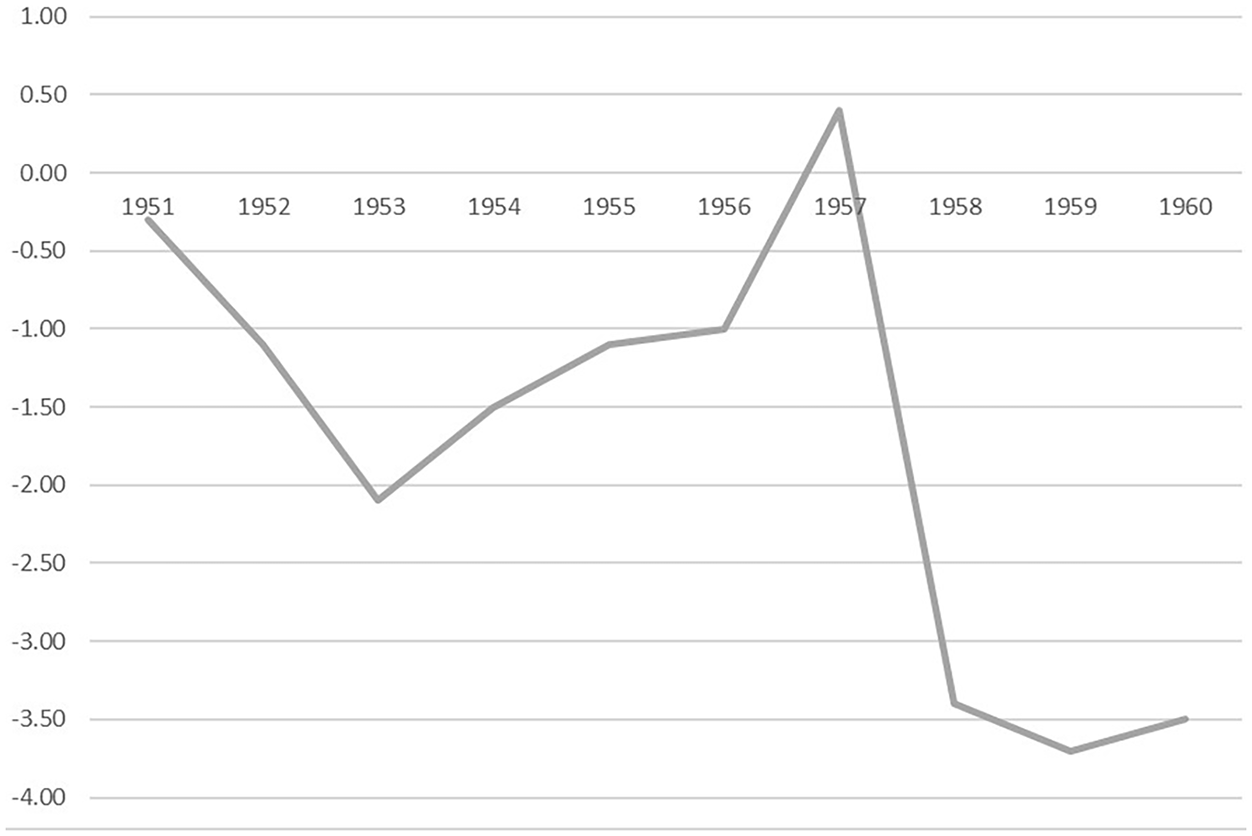
US balance of international payments, 1951–1960 ($ billion).
Therefore, in the early post-war era all four aspects were mutually reinforcing, with each ‘held up and supported by the other three’, as I show in Figure 2. 34 Technological supremacy was crucial to maintaining a military edge over the Soviet Union, while research and development by the national security state into long-term projects could also eventually be commercialised by US industry. Moreover, military procurement helped new firms scale their innovations for the market. 35 The US dominance as the manufacturing exporter also helped it accumulate a surplus that it could be recycled through aid programs such as the Marshall Plan. 36 Allies also held US dollars as reserves in return for their security guarantee from the US. 37 More broadly, the international economic order ‘was part of a larger geopolitical project of waging a global Cold War. It was built around bargains, institutions and social purposes that were tied to the West, American leadership and the global struggle against Soviet communism’. 38 Part of this bargain was trade, which in addition to its economic importance also formed a major pillar of the US’s Cold War containment strategy.
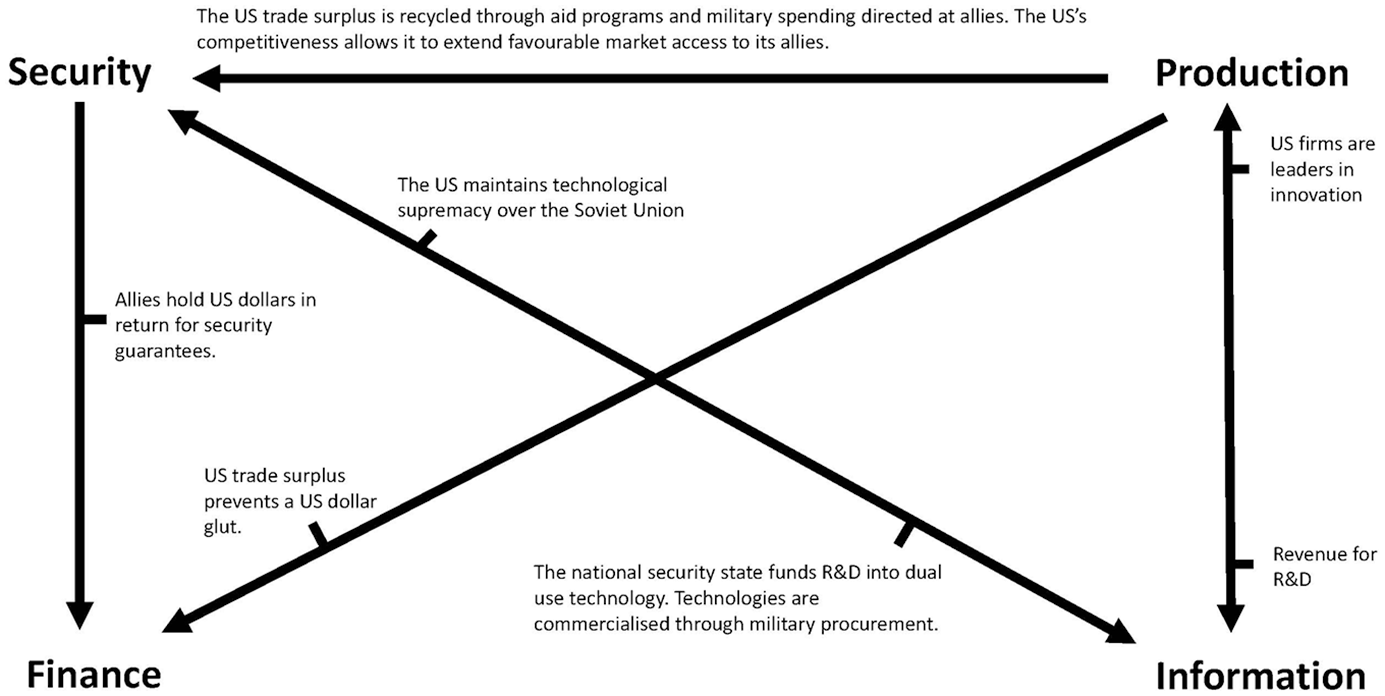
US structural power in the early post-war embedded hegemonic order.
At the centre of the non-communist trade regime was, of course, was the GATT negotiations through which the US and its allies negotiated the removal of trade barriers. However, the US’s unilateral trade policies were also of great importance. The US provided unreciprocated market access to its allies as part of the Bretton Woods bargain. By providing favourable trading terms with its allies, the US isolated and contained the Soviet Union by revitalising the war-ravaged economies of its allies in Europe and Asia whilst solidifying the alliances through economic interdependence. 40 Whilst these trade arrangements discriminated against the US, they served a broader purpose of bolstering strategic, political and security relationships.
Productive structural power and the managed transition in US hegemony
From the late 1960s the four aspects of US structural power came into conflict with one another, marking the beginning of the second period of US hegemony: the managed transition in the embedded hegemonic order. A major trigger of this was the US balance of payments. As Cohen explains, ‘by the end of the [1950s]. . . America’s deficits were ballooning and perceptions of a dollar shortage were quickly replaced by worries over a growing “dollar glut”’. 41 Whilst US balance of payments deficits were crucial to the Bretton Woods system, the size of these deficits was tempered considerably by the US’s dominance of production, namely global manufacturing output, which resulted in significant trade surpluses. However, from the late 1950s the US’s balance of payments deficits began to widen (see Figure 1), resulting in an average annual transfer of $1.5 billion of US gold reserves to foreign ownership. 42
The US was able to narrow this deficit in the early 1960s, however from 1966 it again began to expand. By 1967, according to the US Treasury Department, the US balance of payments deficit was between $3.5 and $4 billion.
43
Addressing the deficit was a major priority for the Johnson Administration, as his Secretary of the Treasury Henry Fowler put in no uncertain terms:
We cannot tolerate a deficit that could threaten the stability of the international monetary system – of which the US dollar is the bulwark. We cannot tolerate a deficit that could endanger the strength of the entire free world economy, and thereby threaten our unprecedented prosperity at home.
44
Whilst there were various reasons for the balance of payments deficit, policymakers became particularly concerned about the US’s trade surplus, which began to wane from the mid-1960s (see Figure 3). For example, in 1968 Federal Reserve board member Andrew Brimmer argued that ‘a basic improvement in our balance of payments must rely heavily on a sizable improvement in our trade surplus’.
45
Secretary Fowler agreed:
A substantial trade surplus is the keystone of a sound international financial position for the United States. During the postwar years, our trade balance has been the major sustaining element in our balance of payments and has provided the means for carrying out our international responsibilities and the encouragement of economic growth in the developing countries of the world.
46
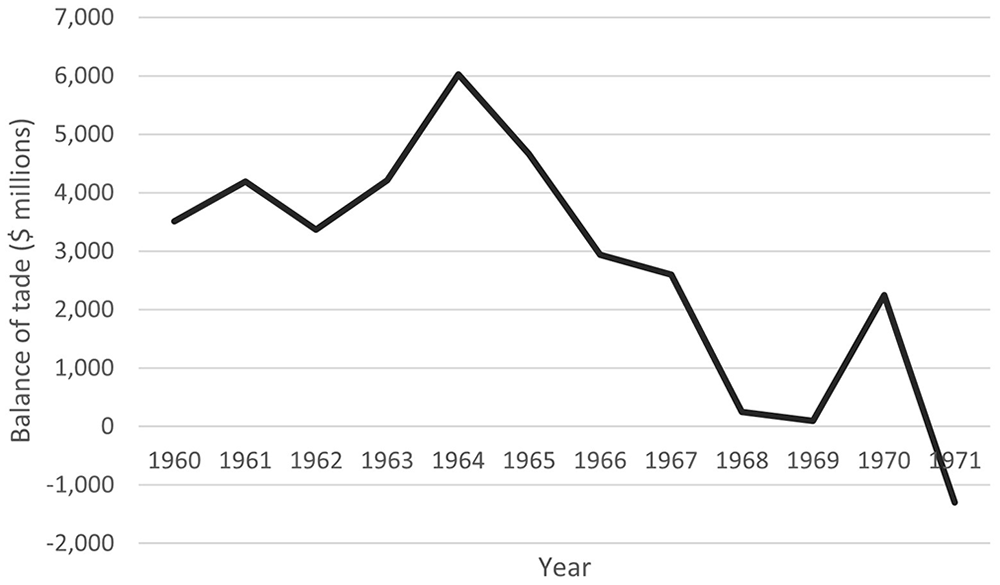
US Balance of Trade 1960–1971.
Congressional inquiries held by the House Committee on Ways and Means and the Joint Economic Committee searched for possible solutions to the US’s balance of payments challenges, as too did the Department of Treasury. 47 These investigations, whilst concerned with the deteriorating trade surplus, did not see the issue as an existential one to the hegemonic order. However, there was nevertheless acknowledgment that the ‘structural changes that have been taking place in the balance of payments of the United States have created problems that were not present when our basic trade posture was being formulated several decades ago’. 48 That is, the US’s dominance over production was weakening.
In 1968, President Johnson addressed Congress in support of his Administration’s trade legislation, arguing again that improving the US trade surplus was important to restoring the balance of payments and announcing a major investigation into the future of US trade policy conducted by the Special Representative for Trade Negotiations, William Roth. 50 The report, known as the Roth Report, was released in 1969 and argued that the ‘rebirth’ of Japan and Europe, under US leadership, and made it ‘inevitable that Europe and Japan would regain their competitive strength . . . [and] offer the United States a serious challenge in world markets’. 51 President Nixon commissioned another major report, known as the Williams Report after Albert L. Williams who chaired the Commission on International Trade and Investment Policy. The Williams Report argued that it was ‘imperative that the United States, in its own interest, bring its international trade and investment policies into line with new realities’. 52
The ‘new reality’ was that the Bretton Woods system was unsustainable, and in 1971, President Nixon decided to untie the US dollar from gold. Despite this, the US remained concerned about its balance of payments issues, and as such Nixon also launched the New Economic Policy which sought to restore the US’s balance of trade, which by 1971 was in deficit. The New Economic Policy, which included a temporary 10% surcharge on imports, signalled that the US’s generous market access for its allies may be in jeopardy. Having spent $143 billion in foreign aid to rebuild war-torn Europe and Asia over the previous 25 years, Nixon argued that ‘[t]here is no longer any need for the United States to compete with one hand tied behind her back’. 53
In 1972 the Whitehouse advisor to President Nixon on International Economic Affairs Peter Peterson, released yet another report commissioned by the President on the US’s position in a changing world economy. 54 It argued that the US’s ‘international negotiating stance will have to meet its trading partners with a clearer, more assertive version of new national interest. . .I believe we must dispel any ‘Marshal Plan psychology’ or relatively unconstrained generosity that may remain’. 55 This stands in stark contrast with the attitudes expressed in both the Roth and Williams Report only a few years prior, which stressed domestic solutions over international ones, often relying on vague remedies such as increasing innovation in the private sector.
In a meeting with Japanese officials in September 1971, the US Secretary of the Treasury John Connally warned that other states ‘would be very mistaken to assume that we are not determined to solve our [balance of payments] problem’. 56 He also informed Japanese officials that the US’s tolerance of certain trade barriers would soon expire. Meanwhile, facing election in 1972 and a protectionist sentiment from Congress, President Nixon advocated a confrontational approach to the Europeans as well. As Nixon summarised, ‘European leaders want to “screw” us and we want to “screw” them in the economic area’. 57
That is, improving the balance of trade was seen by many policymakers, rightly or wrongly, as a panacea which would allow the US to once again simultaneously pursue its economic, political and security interests. In the early post-war period US dominance over production reinforced the other aspects of US structural power, so as it waned from the 1960s it weakened the others too. However, throughout the 1970s it became clear that any efforts to maintain dominance over production as it was realised in the early post-war era would further detract from the other aspects.
Security and financial structural power and the managed transition in US hegemony
A major contributor to the balance of payments deficit was the US’s foreign military commitments. As the Treasury advised in 1971, it was because military expenditures were so high that there was ‘no prospect’ of addressing the issue ‘unless the US has a substantial merchandise trade surplus’.
58
However, cutting military spending was not seen as an option. For example, whilst recommending some policies to curb the impact of the military budget of the balance of payments, Henry Fowler nevertheless believed that the US could ‘not forgo [its] essential commitments abroad, on which America’s security and survival depend’.
59
Whilst the US was growing more anxious about its economic position, it was still more concerned about its communist rivals and was eager to keep Europe and Japan invested in their alliance with the US. This created a conflict between security dominance and productive structural power – a conflict captured in the following excerpt from President Nixon, from a meeting with his economic advisors in 1971:
[W]e should treat Japan with tender loving care because what Europe would become to the Soviets, Japan to China would be even more. Trade is important politically. Trade relationships can benefit political relationships. . . Our interests are served by being as tough as we can without going over the line where anti-US sentiment will cause them to turn against us and break with us. The Europeans recognize that they do not matter in the world any more. They know it. Economic issues are the things they now concentrate on. They are big for them and small for us. That means we will probably have to give more than our interest, strictly construed, would require. However, for the moment we should let the Europeans know that there are a lot of Americans who would welcome our getting out of Europe, and Japan.
60
The economic costs of containing the Soviet Union through military expenditure meant that the US needed to focus on improving its balance of trade if it wanted to rein in its balance of payments deficit. However, containing the Soviet Union also required the US to continue to grant its allies favourable access to the US market, undermining the US balance of trade. This created a contradiction in US trade policy bringing the security and productive aspects of US structural power into contention, which could not be resolved under the conditions of the early post-war embedded hegemonic order.
The US balance of trade improved somewhat after the move to floating exchange rates and the 1975 recession, however from 1976 the US balance of trade deteriorated significantly. Initially the US was not overly concerned by this. As President Carter noted at a G-7 summit in 1977, the US could ‘sustain our deficit because we are strong enough to do so, but some countries are too weak to accept this burden’. 61 The inflow of capital in the US from ‘Arab members of OPEC, as well as by residents of a large number of other countries’ meant that the US had little trouble financing its deficit. 62 Both these sources of income were considered secure. That is, continued dominance in the finance aspect meant that waning productive dominance was not jeopardising the US’s hegemonic position.
However, 1977 proved a pivotal year in the Administration’s attitude to the US’s trade position. As late as July and August of 1977 senior officials believed that the trade deficit was cyclical and therefore only temporary. For example, Secretary of the Treasury Blumenthal attributed the trade deficit to surging oil prices and the higher rate of economic growth in the US compared to its trading partners. However, he maintained that there was ‘no evidence that [the US’s] basic export competitive position has declined’, noting that the US ran a trade surplus outside of fuel imports, and that it had a large and growing trade surplus in services. 63 The Carter Administration focused efforts on addressing the US reliance of foreign oil for its energy needs and pressuring the Japanese and German governments to use expansionary policies to increase their economic growth and thus demand for US exports. 64
However, in late-1977 the US dollar began to depreciate and Secretary of the Treasury Blumenthal and others, such as Charles Schultze, the Chairman of the Council of Economic Advisers, believed that the US’s large current account deficit was to blame. 65 From September to December of that year, the dollar fell 5.6 points on the trade weighted US dollar index for major currencies (see Figure 4). As a depreciation of the dollar would have helped US exports, one might expect that this would be welcome news for an Administration eager to reduce the trade deficit. However, confidence in the dollar was crucial to maintaining its position as the hegemonic currency and that confidence was waning, ‘with serious implications for the preservation of the liberal trade and payments system, U.S. leadership internationally and [the US] economy’. 66 By 1978, international private capital inflows, on which the US depended to finance its current account deficit, began to slow while OPEC states also shifted some of their dollar-denominated assets into non-dollar deposits in the Euromarket. 67 Concerns also grew that OPEC states would stop denominating their oil sales in dollars. 68 The conflict between the security and productive aspect of US structural power was beginning to threaten financial dominance as well.
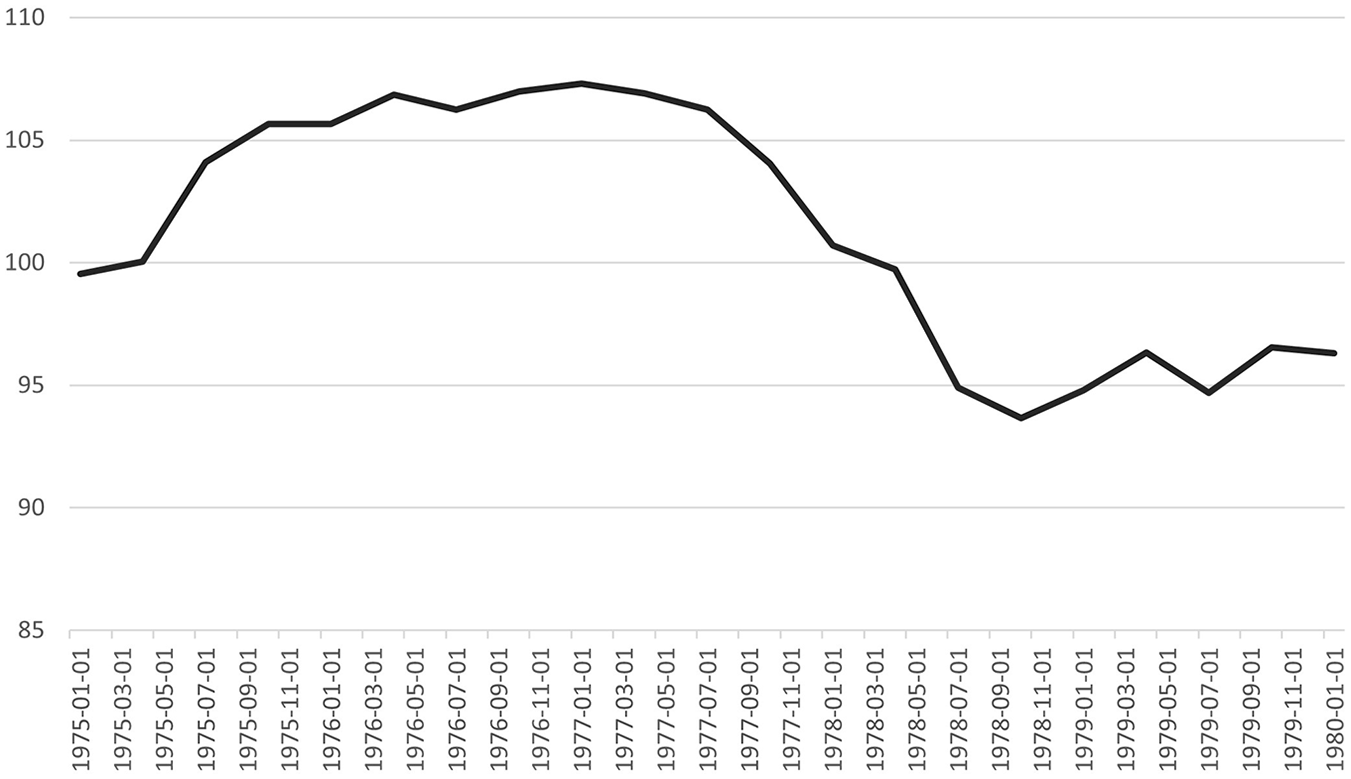
Trade weighted US dollar index (major currencies, goods), 1975–1980.
The threat to the finance aspect was a threat to US hegemony itself, as the depreciating dollar undermined the economic pillar of the US’s containment policy. In 1978, a Presidential Review Committee assembled to discuss the ‘dollar crisis’ resolved that the failure to arrest the dollar’s decline would have a ‘serious impact on Allied solidarity and the probability of adverse social and political consequences in key Allied countries’. 70 Meanwhile, the staff of the National Security Council warned that, ‘[o]ur ability to influence events in the world in order to protect our vital interests depends, in large measure, on military and economic power and foreign perceptions of our capacity to bring this power to bear’. 71 They argued that if the US was seen as being ‘either ineffective or selfish’ in maintaining the dollar, the Europeans and Japanese would question the US’s reliability as an ally. Moreover, they also argued that Japan was fearful of being discriminated against and would be particularly sensitive to the failure of the US to appreciate the dollar against the Yen.
On the first of November 1978, the Administration announced a series of monetary measures to address the depreciating dollar, which were successful in arresting its decline. 72 However, repairing the US balance of trade and reducing the current account deficit was seen as the only long-term solution to the dollar’s woes. US energy independence to reduce fuel imports remained the priority, while the US continued to pressure its trading partners to increase growth and cut their trade surpluses, although with little success. 73 However, throughout 1977, the role of non-oil trade, as well as the US’s bilateral trade with Japan, came under greater scrutiny as well. By 1978, the US trade deficit was increasingly seen as a structural rather than cyclical issue, reflecting a lack of competitiveness in the US economy. As Assistant for National Security Affairs to President Carter, Zbigniew Brzezinski argued, to ensure the dollar’s long-term strength the US needed ‘to solve the fundamental problem – the failure of the US to export enough goods and services and the non-competitiveness of major industrial sectors (auto, steel, textile)’. 74 That is, efforts by the US to maintain dominance over the security aspect of structural power at the expense of productive power was failing, as its dominance over finance waned with its declining dominance over production thus providing a new threat to US security.
Japan’s trade surplus with the US was of concern, particularly in steel, consumer electronics and most importantly – automobiles (see Figure 5). From 1978 to May 1980, the share of imports of the US automobile market rose from 21.9% to 28.4% while Japan’s share of total automobile imports rose from 68% to 80%. 75 To address Japan’s trade surplus, the US applied pressure on it to open its market to US imports. However, the ‘Marshal Plan psychology’ proved difficult to dislodge. Whilst Japan did implement a number of measures to reduce its bilateral trade surplus, the US did not believe these went far enough or that they amounted to a genuine effort to address the problem. 76
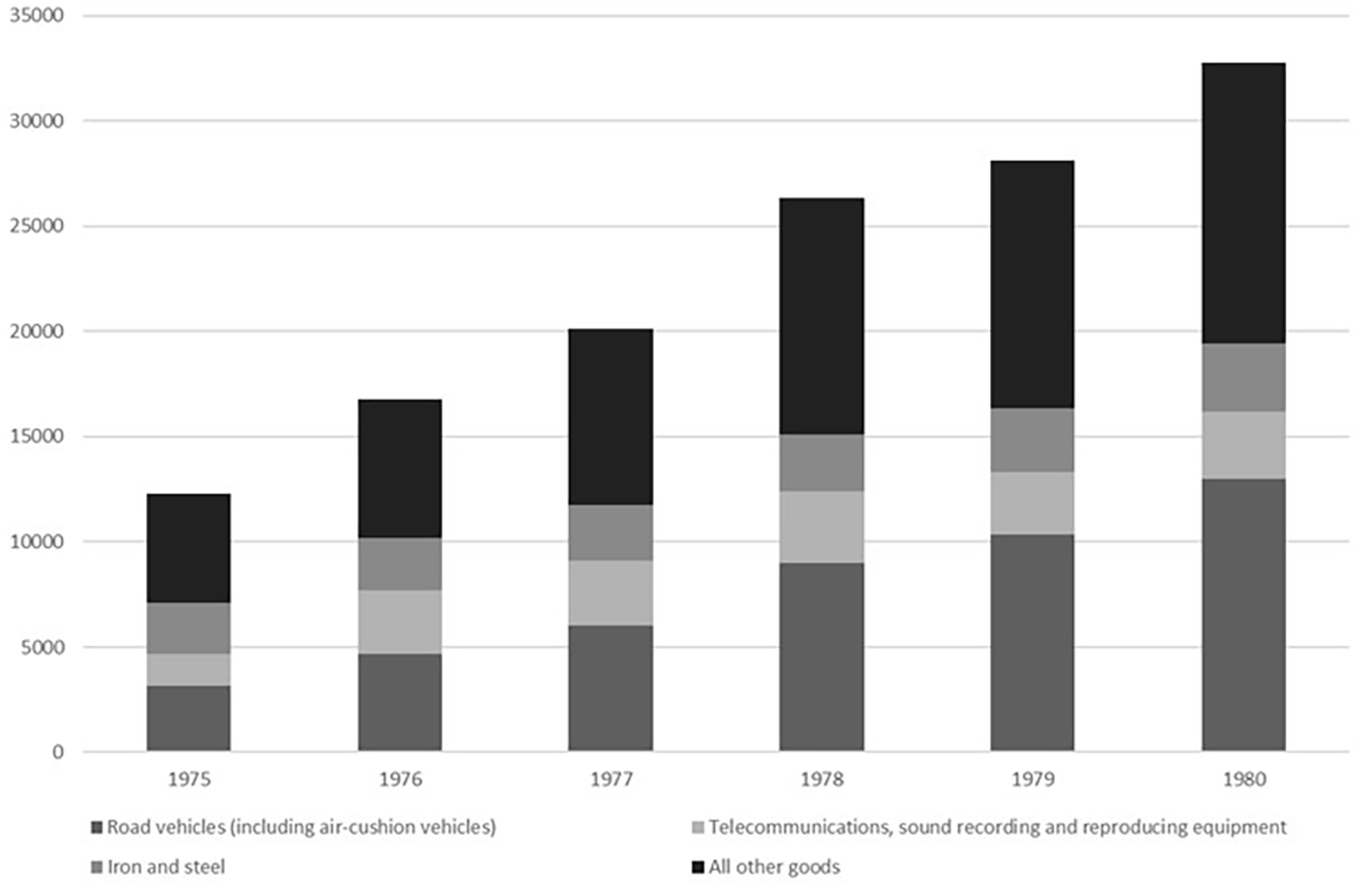
Japanese exports to the US ($ million), 1975–1980.
US pressure on trade generated resentment in Japan. Carter Administration officials were concerned that trade issues could ‘severely damage the wider US-Japanese political and security relationship’. 78 Indeed, staff of the National Security Council noted that the US’s ‘constant coordinated stress on the economic imbalance has the Japanese wondering whether we care about anything else, particularly the Mutual Security Treaty, upon which our strategic position in Asia is based’. 79 That is, much like Nixon, Carter was restrained by the US’s geopolitical priorities from applying too much pressure to its trading partners to correct widening trade imbalances. Moreover, allowing the US dollar to depreciate to correct these imbalances was also seen as a threat to US leadership and the Cold War alliance system. The security aspect of US structural power was in conflict with efforts to prop up the weakening finance and production aspects. The early post-war hegemonic order, and the rules and norms embedded within its governing institutions, were failing and needed to be replaced.
Informational structural power and the managed transition in US hegemony
From 1960 to 1980, the proportion of private sector workers employed in service industries grew from 58% to 67%.
80
Services were not only becoming more important to the domestic US economy, but also to its international trade. From 1965 to 1975, US exports in services grew by an average annual rate of 1.93% faster than imports. As a result, the US’s modest deficit in the trade of services became a surplus in 1971.
81
Through the 1970s, Congress began focusing on how to alter US trade policy to complement the US economy’s reorientation towards services. The Export Expansion Act of 1971, for example, explicitly singled out trade in services and IP to receive benefits.
82
This Bill was later broken into several separate Bills, all of which addressed trade in services in different ways. Overall, however, it was clear from the Congressional hearings that there was broad support for a new emphasis on trade in services – even the National Association of Manufacturers argued that the rise of service industries as net exporters was likely to continue.
83
The new emphasis on services in the trade legislation was welcomed by the Nixon Administration, illustrated by the testimony of State Department official Willis Armstrong:
We believe that with the U.S. becoming increasingly a service economy, there is a good to be gained in our [the export] trade from the export of services. . . Therefore, we are particularly anxious that this legislation move ahead because we believe there is a real opportunity for foreign exchange earnings and for the export of services.
84
The Trade Act of 1974, which did eventually become law, included services within the President’s trade negotiating authority. Meanwhile, domestic efforts sought to nurture the US’s advantage over services. For example, the Williams Report called on the US to increase its technological capacity as its economy transitioned to service industries. This included government support to encourage investment, research and development. Peterson’s study was more explicit, arguing that:
[O]ur continued competitiveness depends on more new investment in plants and equipment, more growth in research and development and more progress in training appropriate talent and manpower, particularly in the new skills U.S. workers will require as our society moves increasingly to more industrial sophistication and services.
85
The role of technology in maintaining US competitiveness became a focus of the Nixon Administration’s New Technologies Opportunities program established in 1971, which has been described as a ‘massive strategic industrial policy’. 86 The role of this initiative was not to install US supremacy across all technologies, but for the US to dominate certain technologies strategically.
The program was administered by two panels which assessed technologies ‘in terms of their relationship to urgent national problems, or significant economic opportunities’. 87 This was in line with the five key objectives of these panels, which included increasing productivity, especially in service industries, addressing the US trade deficit and improving US international competitiveness. The New Technology Opportunities program sought to achieve this by using government resources to create scientific and technological innovations that could in turn be ‘reprivatised’ for commercial use. 88 As President Nixon declared in his 1972 State of the Union address: ‘[t]he new technology program will . . . meet the growing technological challenge from abroad, and it will thus help to create new industries, as well as creating more jobs for America’s workers in producing for the world’s markets’. 89 That is, the US sought to leverage its dominance over information in order to strengthen its dominance over production, even as it lost its competitiveness in manufacturing.
Another emerging source of US economic power was the internationalisation of US firms through the acquisition of foreign assets. Initially, the US was unsure if it would have a positive or negative impact on the US’s economic position and was uncertain as to how it should respond to barriers to foreign investment amongst its allies. 90 As a State Department brief in 1970 argued, the US ‘may not need to press this subject since on most of these issues it is hard to see what we have to gain’. 91 However, the Williams Report considered outward investment in detail and argued that the US should promote liberalisation of investment requirements. Peterson’s report supported these conclusions, noting that ‘we have a comparative advantage here’. 92 Petersen further argued that the US needed to develop a policy to protect its foreign investments against ‘the threats of expropriation and harassment from forces of economic nationalism’. 93 This reflected another important question raised by the internationalisation of US firms; how to avoid conflicting jurisdictions and ensure equitable treatment of their firms abroad. 94 The Williams and Petersen Reports both argued for harmonisation of national regulations, laws and practices in light of growing capital mobility.
In 1977, the US launched its Bilateral Investment Treaty (BIT) program, a successor to the 190-year-old ‘Friendship, Commerce and Navigation’ treaty program. The followed the adoption of the Declaration of the New International Economic Order and Article 2.2(c) of the Charter of Economic Rights and Duties of States by the United Nation’s General Assembly in 1974, both of which affirmed the right of states to nationalise and expropriate foreign assets with no guarantee of compensation. 95 The US pursued BITs with developing countries to mitigate the threat of uncompensated expropriation. From 1977 the US began drafting a ‘model’ agreement; however, this was not finalised until 1982, marking the beginning of a ‘wave’ of BIT negotiations which lasted until 1986. 96 Whilst the model was modified at various points through the 1980’s, it consistently prioritised compensation for aggrieved investors and binding third-party arbitration of investment disputes – thus protecting US structural power over production.
The Carter Administration was also cognisant of the role of the US emerging trade surplus in services in offsetting its overall trade deficit. 97 In his final State of the Union address, President Carter argued ‘[s]ervices have been an increasingly important source of export earnings for the United States, and the United States must assure continued and increased access to foreign markets’. 98 However, the US’s emerging strength in services was overwhelmed by its burgeoning trade deficit in goods. One solution was to expand international markets for service sectors by, for example, harmonising international IP standards.
In 1978, a report issued under President Carter’s sweeping domestic policy review initiative identified the need to internationalise US patent policy as a means of supporting US competitiveness. 99 The Commerce Department began working directly with countries like China to change their patent laws. According to the Secretary of Commerce, Philip Klutznick ‘having an American-style patent system in China facilitates the business relationships between our community and China just as much as shipping does and just as much as our trade operation does’. 100 Indeed, after normalising diplomatic relations in 1979, China and the US signed a bilateral trade agreement requiring both parties to acknowledge each other’s IP rights. 101 That is, by the 1980s the US had already included IP protection in a trade agreement. To support the US’s international competitiveness, IP reform was also pursued domestically. In 1980, President Carter signed the Patent and Trademark Law Amendments Act into law, which enabled publicly-funded research to more easily transfer to the private sector and thus ‘ensure America’s ability to win the new science race’. 102 Under the reforms, small businesses and universities were given ownership of the patents resulting from federally-funded research that they conducted.
Multilateral trade and non-tariff barriers
Having determined that services, IP and foreign investment would be key sources of US structural power into the future, the next step was for the US to pursue these new preferences internationally to establish a new embedded hegemonic order. To do this the US used negotiations on non-tariff barriers (NTB) as a conduit to introduce these issues into international trade negotiations. Non-tariff barriers were well suited to introducing new issues into multinational trade because there was little consensus on what government policies and practices should qualify as NTBs. As the Roth Report and other investigations had noted, domestic regulations with no intention to prevent trade or foreign competition, for example public health and safety regulations, can conceivably be NTBs. This lack of consensus meant that NTBs were malleable; to determine what constitute a NTB is to determine what functioning’s of government should and should not be permissible under the international trading system.
The US was already preparing for NTB to be a major part of multilateral trade, even before the end of the Bretton Woods system. In 1963 a sub-committee was to identify NTBs to be included in the Kennedy Round. The US identified the following:
Anti-dumping policies
Government procurement policies
State trading
Border tax adjustments
Dumping and restrictive import policies on coal
Quantitative restrictions (quotas)
Variable levies, slice-gate pricing systems, minimum price schemes 103
Whilst the Kennedy Round included some agreements on NBTs, President Johnson argued before the Congress in 1964 that ‘major non-tariff barriers continue to impede the free flow of international commerce. These barriers now block many US products from competing on the world market’. 104 William Roth echoed this argument, saying that non-tariff barriers are ‘the area in which the next major trade negotiations must take place’. 105
Congressional representative and delegate to the Kennedy Round of negotiations, Thomas Curtis, argued that IP protections should be ‘[nationally] harmonized and internationally codified to equalise and stabilise these basic business laws’ as early as 1967.
106
However, the US’s priorities on NBTs changed little from 1964 to the early 1970s, with both the Roth Report and the Williams Report identifying similar NBTs as those listed above. Thus, whilst NTBs were a priority for the US trade policy in the late 1960s, services and IP were not priorities. In 1967, under US instigation, the GATT’s Committee on Industrial Products began to compile an inventory of NTBs in preparation for the next multilateral negotiating round. What distinguished the US submission form other participating states was its narrow definition:
[T]he United States submission is confined to those ‘non-tariff barriers’ which act directly on imports. It does not list measures such as subsidies and rebates, export controls domestic price controls, marketing controls, investment restrictions, patent laws and regulations, differential shipping costs or regulations controlling remittance of earnings such as on motion picture films. Nor does it attempt to identify non-governmental restrictive business practices.
107
Therefore, US policy at this time sought to exclude IP from negotiations on NTBs. However, by the late-1970’s, the US’s preference on NTB broaden considerably beyond those it pursued in the 1960s to align with its new emphasis on IP, services and investment.
In 1976 a Task Force on Services and Multilateral Trade Negotiations, run by the Department of Commerce, was established to ‘review international issues and problems of significance to U.S. service industries . . . [and] identify appropriate approaches to the solution of the problems and the relationship of such approaches to the Multilateral Trade Negotiations’. 108 The Task Force found that 5 of the 18 services industries it examined were experiencing serious international barriers. However, it recommended against including services in multilateral negotiations in a wholesale way, instead advising that they should be added in a highly selective manner in order to ‘pave the way for future negotiations, focusing on those service industry [NTB] most similar to goods NTBs’. 109 The US approach to NTBs in the late 1970s reflects these recommendations.
In 1977, the GATT started taking submissions from member states with trade interests impacted by NTB. The US made several submissions highlighting trade interests in services, investment and IP – which includes those listed in table one below. From 1977 the US also exploring the possibility for a ‘GATT for Investment’ to address investment issues at the multilateral level. The ‘GATT for investment’ would focus on three main issues: investor protection, government intervention and regulation of multinational enterprises. 110 Therefore, there is a clear and observable change in the US’s NTB policy during the 1970s.
Selected non-tariff barriers raised by the US in the GATT, 1977.
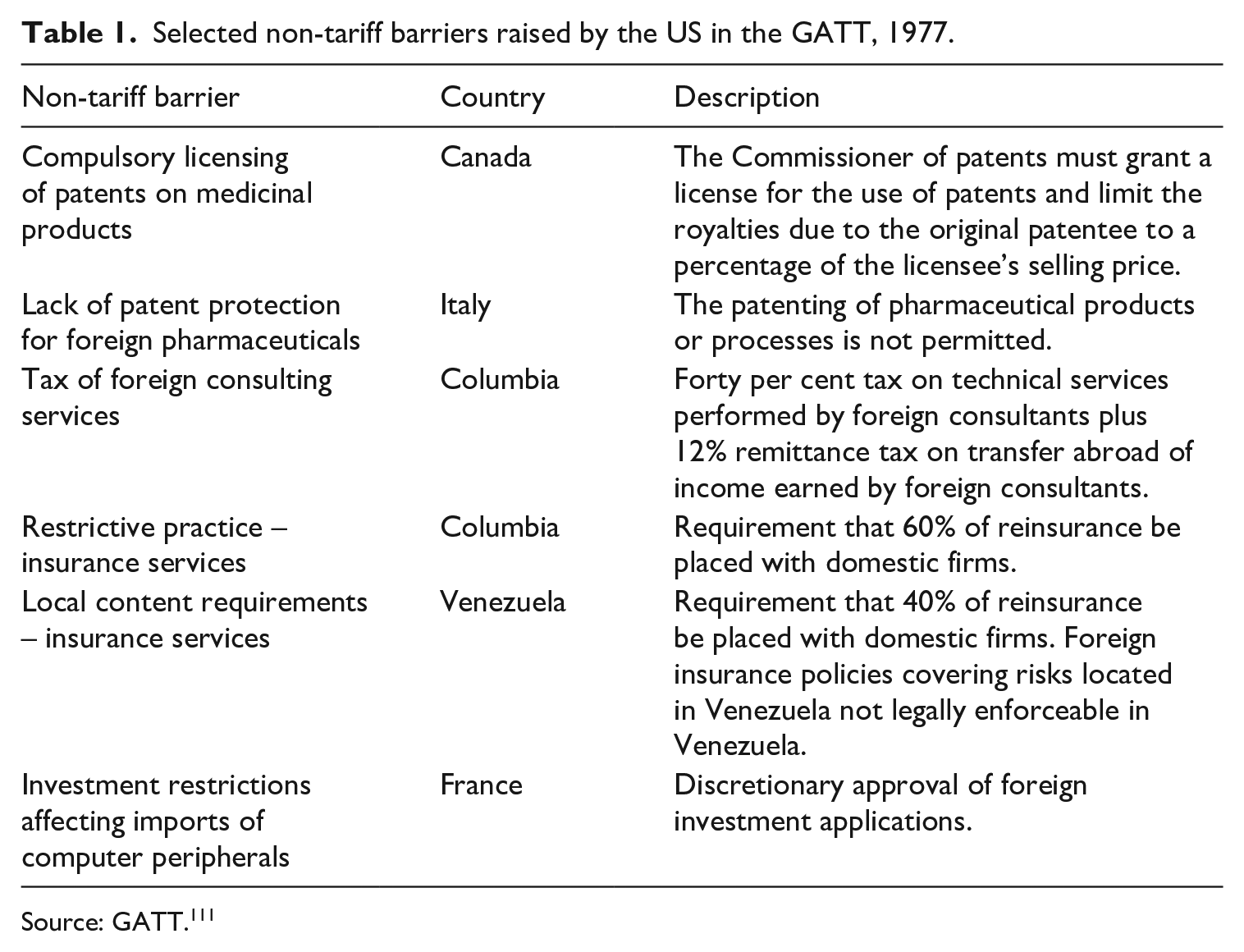
Source: GATT. 111
By the 1980s US policy makers had come to view the US’s continuing dominance over the information aspect of structural power through IP (supported by negotiations on NTB) and its internationalising firms (supported by BITs) as potential foundations of US hegemony in a post-Bretton Woods world. Indeed, IP was identified as a potential trade priority by government officials as early as 1967, with moves to expand trade to services including IP beginning as early as 1971, with IP and investment issues raised by US negotiators in the GATT as early as 1977, and trade treaties addressing IP issues as early as 1979.
It is true that none of the initiatives of the 1970s are comparable to the prominence and scope that IP trade issues took from the early 1980s. 112 However, by the end of the 1970s the US state had already, independent of the IP coalitions that would later agitate on this issue, identified IP as a major source of structural power that could be supported without applying excessive diplomatic pressure on its allies in Asia and Europe. The trade deficits of the early 1980s would have strengthen the efforts which were already underway, further integrating IP into US trade policy. This would have likely occurred even in the absence of pressure from IP industries.
Whilst services were left out of the Tokyo Round, the GATT began to examine trade in services, something they had historically dealt ‘only marginally’ with, and how they could form part of future negotiations from 1980.
113
This work began with considering how principles such as the most-favoured-nation, non-discrimination and national treatment could extend to trade in services. The US was a major supporter of this process, arguing that:
This critical area of the world economy operates in the absence of any effective disciplines that can serve as the norm for these sectors. Nor is there an established procedure for negotiations that could lead to the liberalization of barriers limiting trade in services. The United States believes that a legal framework of rules and procedures should be established dealing with internationally traded services.
114
In supporting the work at the GATT, the US noted that 19 million of the 20 million new jobs created in the US during 1970s were in service industries. 115 Yet whilst the US had undergone an economic ‘modernisation’ under the pressures of international competition, switching from ‘uncompetitive’ industries to services in the 1970s, ‘the growth of U.S. service companies abroad had stagnated due, inter alia, to barriers being imposed by foreign governments’. 116 The ‘modernisation’ of the US economy in this instance is as a euphemism for the decline of industrial sectors under intense foreign competition, aided by preferential access to the US market.
The US was successful in institutionalising its core interests through the Uruguay Round, with the foundational agreements of the World Trade Organisation providing protections for investors (Agreement on Trade-Related Investment Measures), IP (Trade-Related Aspects of Intellectual Property Rights) and services (General Agreement on Trade in Services), forming the basis of the new embedded hegemonic order. That is, new rules and norms were embedded within international institutions to preserve the US’s hegemonic position.
The contemporary embedded hegemonic order
By the 1980s, the US had identified IP and the internationalisation of US firms as a source of international competitiveness and had begun to pursue them through both domestic and foreign policies. Moreover, the US had identified NTBs, and thus multilateral trade negotiations, as the ideal means to pursue regulatory issues. However, it is not the case that the pivot towards IP, services and investment was inevitable as the US economy transitioned into service provision and out of goods production. Cold War era geostrategic concerns meant that US trade policy nurtured the emergence of competitors in its allies in Asia and Europe, whilst allowing the ‘Marshall Plan psychology’ to continue after the end of the Bretton Woods system.
Meanwhile, there were various approaches that the US could have taken to repair its balance of trade. For example, the US could also have depreciated the dollar, or even just have allowed it to depreciate from 1977, to make exports more competitive. However, the weakening dollar was seen a threat to US’s international leadership – one which could have potentially fractured the Cold War alliance system. Indeed, boosting exports was seen as a solution to the depreciating dollar, and not the other way around. The trade deficit came under greater scrutiny as the dollar depreciated from 1977, along with the structural lack of competitiveness of US industry in key manufacturing sectors. That is, as Figure 6a shows, the aspects of US structural power were detracting from rather than reinforcing each other, while the US prioritised the security aspect.
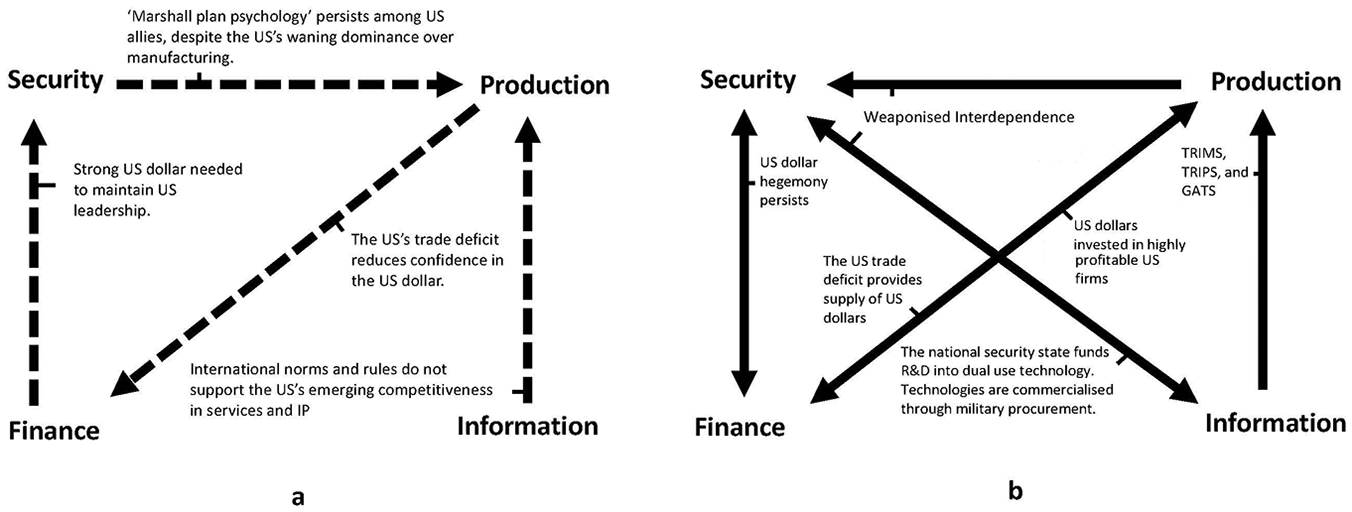
(a, b) The managed transition and the contemporary embedded hegemonic order.
The US then worked on strategies to shore up the other aspects of structural power. This required a reconfiguration of how the aspects interacted. That is, the rules and norms embedded within the early post-war era no longer served US hegemonic interests and thus needed to be supplemented with new ones that did. What emerged from this reconfiguration is a new ‘pyramid’ of structural power under the contemporary hegemonic order – shown in Figure 6b. This did not happen serendipitously but was rather a deliberate strategy devised and pursued by the US state.
First, the US did not seek to preserve dominance over manufacturing. Instead, it leveraged its dominance over information and its internationalising firms into a new basis of dominance over production. US firms dominate international commerce, operating in and leading markets across the globe. 117 This is supported through domestic and international initiatives which nurture high-technology industries, and international initiatives which have embedded new rules on IP, services and investment in international institutions via NBT negotiations and BITs. Information dominance thus supports productive dominance. Meanwhile, information dominance continues to be supported via military funding and procurement, as in the previous arrangement of US hegemony.
Second, by not seeking to preserve its dominance over manufacturing, the US also abandoned its attempts to ‘correct’ its balance of payments issues. Instead, it embraced the deficits as an asset for projecting US economic power. 118 The persistent hegemony of the US dollar is made possible by its trade and government budget deficits as the outflow of US dollars is reinvested into the US through the financial system. The US dollar continues to remain central to global capital markets, maintaining many of the ‘exorbitant privileges’ that the US enjoyed under the Bretton Woods system. 119
Meanwhile, the US’s IP-intensive firms capture an outsized share of global corporate profits. With a disproportionate share of global profits, US firms grow faster than their foreign competitors and thus attract US-dollar investment from foreign banks – maintaining robust demand for US dollars and supporting the centrality of the US financial system to the global economy. 120 In this way, dominance over information and production supports dominance over finance. Last, the centrality of the US in global economic networks allows it to ‘weaponise’ interdependence by controlling access to and/or monitoring hubs of economic activity. 121 Production and information dominance therefore reinforces security dominance. 122
However, whilst Figure 6b illustrates the four aspects of the US’s current structural power as mutually reinforcing, there is evidence to suggest that current challenges are causing them to detract from one another. First, the integration of China into the hegemonic system after the Cold War has enabled China to develop its economy by exporting to the US market. Whilst China’s trade surplus has been recycled through to the US financial market, thus supporting dollar hegemony, it has also now emerged as a potential economic competitor. China is also attempting to move higher up global value chains and challenge the US’s technological leadership. 123 This is especially true of the telecommunications, artificial intelligence and internet industries, where China has established competitive firms that are now seeking to rival US companies in the global marketplace. The financial aspect of US structural power may therefore be detracting from both the production and information aspects, as China develops competitors to US corporations.
The US has moved to protect its dominance. For example, the US has sought to curb the internationalisation of Chinese firms – most notably in the case of semiconductors – to preserve global US corporate dominance, and thus structural power over production. 124 Moreover, the tariffs imposed by the Trump Administration, and continued by the Biden Administration, were imposed, at least ostensibly, in response to insufficient IP protection in China, as well as forced knowledge transfer – that is, in response to China’s attempts to catch up on the US’s information advantage. 125 The US is also cooperating with strategic allies in Asia on artificial intelligence, semiconductors, quantum technology and ‘5G diversification’ through the recently revitalised Quadrilateral Security Dialogue (with India, Australia and Japan) and the recently created Australia-United Kingdom-US security partnership. 126
Moreover, the internationalisation of US firm may also be undermining US informational structural power. As Weiss and Thurbon argue, international IP laws have ‘unintentionally enabled massive profit- and production-shifting that increases income inequality, erodes the social contract, compromises technology leadership and weakens state power at home’. 127 The concentration of profits in IP-intensive firms is also contributing to inequality between ‘human-capital’ IP-intensive firms and ‘physical-capital’ intensive firms. 128 Investment is gravitating towards the highly-profitable IP-intensive firms, however such firms also ‘abjure new investment’, resulting in a net decrease in new investment and thus growth. 129 Domestic initiatives may be needed to address this malaise. Whilst such efforts generally run counter to the US political culture, which is sceptical of government involvement in the market, there have been bipartisan initiatives aimed at incentivising investment in technology – such as the CHIPS Act passed in 2021.
Conclusion
Using a structural power analysis this article argues that, from the 1970s, the US engaged in a managed transition in the embedded hegemonic order which reconfigured how the four aspects of its structural power (security, production, finance and information) interacted. In the early post-war period US hegemony was supported by dominance across the four aspects of structural power that were mutually reinforcing. A crucial component of this was the US supremacy in manufacturing (i.e. production), which had two primary functions. First, it generated a large trade surplus, enabling the US to provide liquidity to the global economy via balance of payments deficit but without creating a dollar glut – thus supporting its financial structural power. Second, US competitiveness in manufacturing enabled it to unilaterally open its markets allies, shoring up both their commitment to the US alliance and their strength to oppose the Soviet Union – thus supporting the security aspect of structural power. However, this very access to the US market enabled its allies to restore/develop their industrial capacity and undermine US manufacturing supremacy. As a result, the arrangement of US structural power began to detract from rather than mutually reinforce each other.
The article demonstrates how the US responded to these challenges by reconfiguring how the four aspects of its structural power interacted so that they were once again mutually reinforcing. However, this process of managed transition from one arrangement to another demanded that the US prioritise between the aspects of its structural power. The decision to prioritise the security aspect, given the Cold War, limited the policies available to the US. Over time, the US came to view IP, services and investment not only as areas of US competitiveness, but ones that could reinstate a mutually reinforcing basis to US structural power without requiring a compromise on its existing security priorities. The US leveraged its dominance over the information aspect, including through the creation of new international laws and norms in the GATT/World Trade Organisation, to establish a new dominance over production based on the internationalisation of its corporations.
Today, the US is arguably facing new challenges to its hegemony. These include the emergence a potential rival in China, which is internationalising its own firms and investing heavily in high technology, with the help of access to the US market and forced knowledge transfer from US firms. Another challenge to US dominance is how the internationalisation of US firms is reducing investment in innovation and new technologies, potentially undermining the US’s ability to maintain its dominance over information. Either or both of these challenges may require the US to adjust the interaction between the four aspects of it structural power, however this should not necessarily be interpreted as a systemic challenge to US hegemony. If the current embedded hegemonic order becomes unsustainable, the question is whether that US can transition again to a new one or not.
Footnotes
Acknowledgements
I would like to acknowledge the generous feedback from Elizabeth Thurbon and Stuart Rollo. I would also like to acknowledge the participants in the ‘AIPEN Session’ held on the 25th of March 2021, particularly my discussants Silke Trommer and Len Seabrooke, as well as the participants in the ‘Looking Back to Move Forward: Economic Liberalism in Historical Perspective’ panel at the 2019 APSA Annual Meeting, notably the discussant David A Steinberg. Last, I would like to thank the three anonymous reviewers for their close reading and thoughtful comments. All errors remain mine.
Funding
The author received no financial support for the research, authorship, and/or publication of this article.
