




Abstract
This article translates Michael Mann’s notion of infrastructural power into the foreign policy realm and develops a conceptual framework that allows for the systematic treatment of states’ strategic efforts at mobilising domestic non-state actors. Despite the common rationales underlying such efforts across regime types, the article argues that states’ systemic features matter greatly. It generates two ideal types of infrastructural power in foreign policy – bureaucratic and authoritarian – to capture the distinct mobilisational modes and trajectories of each. Using a typical case study design, it scrutinises Turkey’s shifting Africa policies under AKP rule. The empirical discussion supports two initial assumptions: first, the concept, partly by dint of its underlying organisational approach, introduces a novel take on power in IR, yet one complementary to the relational understanding prevailing in the discipline; second, it provides an original tool with which to systematically analyse crucial components in the foreign policies of democracies and autocracies.
In June 2017 a Saudi-led coalition of Arab states cut diplomatic ties with Qatar and imposed an unprecedented land, air and sea blockade on the Gulf state. These measures aimed to force Doha into accepting a 13-point ultimatum. Among the key demands was the closing of Al Jazeera, which the coalition accused of promoting domestic opposition. Roughly two years later, in May 2019, United States president Donald Trump issued Executive Order 13873, which regulated the acquisition and use of information and communications technology and services from ‘foreign adversaries’. While China went unnamed, the order effectively sought to prevent cyber intrusions into US businesses and government agencies by Chinese companies such as, most notably, Huawei, which critics maintained was independent from Beijing only in name. On the other side of the Atlantic, in March 2020, the Ukrainian government was put on alert by the deployment of Cossack units along the Russian–Ukrainian border. As similar paramilitary groups had been used during Russia’s invasion of Crimea and Donbas in 2014, Kiev anticipated that a new Russian move was imminent.
These examples illustrate how seriously states take coordinated actions between non-state actors and their countries of origin in terms of the effects they might have on their interests. Despite this empirical truism, theoretical knowledge on how states strategically integrate non-state actors into their foreign policy aspirations is scarce. It is not that International Relations (IR) theory has ignored non-state actors. Their significance has been stressed by the interdependence literature, 1 and the past decades of research have fostered our understanding of the role played by multinational enterprises, non-governmental organisations (NGOs) and international organisations in global governance, international norm diffusion or regional integration. 2 Also, headway has been made on capturing how states engage non-state actors – notably, international organisations – in pursuing joint governance goals by way of delegation or orchestration. 3 Other theoretical contributions have elaborated on how states use infrastructural projects abroad to aggrandise their power, including with the help of non-state actors 4 ; or, on how transnationally operating non-state actors can effect policy changes. 5 Yet the scope to non-state actors in crucial IR theories is often ‘ghetto-ized’, 6 and they still tend to be conceived mainly in terms of their ‘rival actorness’ to the state. 7 This latter approach is also widespread in foreign policy analysis (FPA), although theoretical models have been developed here to analyse their influence on ‘“hybrid” foreign policymaking’. 8
Despite these advances, however, further conceptual efforts must be made to capture how states attempt to make strategic use of their domestic non-state actors who, while firmly bonded to a given country, operate internationally. 9 Such actors offer a pool of resources states can avail themselves of to increase their clout: expertise, financial means, intelligence, manpower, technologies and reputation, to name but a few. To explore the ways in which states do this, then, is to investigate their modes of resource mobilisation – arguably, a notable aspect of their power. Yet there exists a dearth of appropriate frameworks with which to systematically analyse states’ attempts at mobilising domestic non-state actors for foreign policy ends.
This article seeks to fill this gap by drawing on the theory of ‘institutional statism’ developed by Michael Mann. 10 In particular, it seeks to translate his notion of ‘infrastructural power’ into the foreign policy realm. While Mann offers his own, neorealist-inclined take on IR, he primarily aims to build a non-reductionist theory of the state. 11 His notion of infrastructural power is therefore confined to the state’s territory. As suggested below, however, infrastructural power in foreign policy largely accrues from the state’s capacity to orchestrate the activities of non-state actors which occur beyond its borders. Although the kinds of non-state actors of concern here are bound to the state in question by, for instance, their legal status or their social or economic base, the state cannot manage their actions abroad in the same way it can those taking place exclusively inside national territory (regardless of the political regime in place).
Yet regime type matters greatly; refining Mann’s ideal-typical approach, this article develops two ideal types of infrastructural power in foreign policy – bureaucratic and authoritarian – to capture the distinct modes and trajectories of each regarding mobilisation. Its theoretical contribution is thus twofold. First, by building a conceptual framework with which to incorporate non-state actors into resource mobilisation, not only is an alternate way of assessing the importance of non-state actors in world politics offered but also – and essentially – a novel take on the concept of power in IR too. Second, by generating the above ideal types, a new lens is provided through which to systematically examine crucial components in the foreign policies of regimes as disparate as democracies and autocracies. Since we are currently witnessing a global rise in autocratising states, often through ostensibly democratic processes, this lens might be particularly adjuvant for the evaluation of these states’ conducting of international affairs.
Ideal types cannot represent empirical cases. They are merely heuristic tools intended to improve our understanding of an empirical phenomenon. As such, ideal types are a necessary first step to analyse a topic which has remained little-known or conceptually explored to date. In a second step, they must confront reality – that is, they must be compared with real-world cases. 12 This article’s reality check will be Turkey’s foreign policy towards sub-Saharan Africa under the rule of the Justice and Development Party (Adalet ve Kalkınma Partisi, AKP). 13 While the Turkish case is certainly not ideal-typical, it can be considered a representative one in that the changes in the dependent variable – namely, the state’s modes and trajectories vis-à-vis mobilising domestic non-state actors – are soundly explained by the shifting values of the independent variable (i.e. regime type). Put differently, the causal mechanisms identified by the conceptual framework this article will develop are supported by the empirical evidence provided by the within-case analysis of Turkey’s Africa policy. 14
The next section (‘Power, resources and resource mobilisation’) examines how resource mobilisation is debated in the literature, and illustrates its shortcomings regarding non-state resources. Section two (‘Infrastructural power in foreign policy’) discusses how institutional statism can be harnessed in the foreign policy realm and explains how ‘infrastructural power’ can be drawn on to analyse states’ efforts at mobilising non-state actors. Section three (‘Bureaucratic and authoritarian types of infrastructural power in foreign policy’) develops the bureaucratic and authoritarian types of infrastructural power in foreign policy and identifies their common and distinctive features. It also completes the article’s theoretical portion, which is followed by case-study analysis. This empirical section (‘Turkey’s pivot to Africa’) is divided into two parts, one analysing the bureaucratic mode of Turkey’s Africa policy and the other exploring its authoritarian turn. For the empirical analysis, the authors have compiled a data set depicting the evolution of the Turkish state and non-state actors’ activities in Africa and their shifting trajectories over time. 15 The conclusion discusses the limitations of the concept and points to avenues for future research.
Power, resources and resource mobilisation
Whereas power has long been assessed in terms of resources controlled by a state, resources have come to be treated as one variable defining what power is and how it works. Many studies challenging the realist power-as-resources approach have adopted a relational concept of power. 16 Dahl, for instance, considers resources as merely one dimension of power next to means, scope, domain and costs, and asserts that resources are intrinsically ‘inert, passive’ and must ‘be exploited in some fashion if the behavior of others is to be altered’. 17 What is key in relating resources to power is thus not resources per se, but that they are skilfully mobilised. 18
Resource mobilisation in foreign policy, however, still awaits further theorisation. Four factors may account for this negligence. First, Barnett and Duvall observe ‘a disciplinary tendency to associate power with realism . . . [and] rivals to realism typically distance themselves from “power” considerations’. 19 Those works questioning the realist notion of power, though, steer away from exploring resources, focussing instead on other ‘faces of power’ which, due to differing epistemological and ontological agendas, lend little conceptual value to such endeavours. 20 Realism, in turn, gives scant attention to resource mobilisation. Classical realism provides no systematic account of the state’s capacity to marshal domestic resources, 21 while structural realism implicitly assumes its unbound ability in this respect. Second, neoclassical realism has indeed furthered our understanding of resource mobilisation. 22 The analyses offered provide insights as to how states mobilise resources by highlighting, for instance, the instrumental role of ideology. 23 Yet these discussions are confined to the domestic realm and do not theorise on the mobilisation of non-state actors operating beyond state borders.
Third, one encounters some conceptual confusion when approaching the issue of resource mobilisation, and there are good reasons to differentiate between ‘control’ and ‘access’. States are not always able to access resources which are nominally under their control. 24 While in theory states can claim control over, and gain access to, all resources available within their territories, the extent to which they are able and willing to do so depends on factors such as the quality of internal and external threats 25 or state capacity, including their ability to integrate public, private and hybrid stakeholders in policymaking 26 or to monitor the latter’s behaviour to obviate agency slack. 27
These conditions have implications for the notion of ‘resource mobilisation’, defined here as encompassing the entirety of a state’s actions geared towards increasing the amount of resources available for achieving foreign policy goals. To begin with, mobilisation must entail some sort of investment – material or otherwise – to increase the quantity or quality of resources at a later stage. 28 Also, it may include resources which are neither nominally nor factually under the control of – and hence directly accessible to – the state. Likewise, resource mobilisation may transcend national borders. Most studies, however, omit discussing how states seek to mobilise both tangible and intangible resources which are legally and factually controlled by non-state actors.
This is showcased by the soft-power approach, particularly concerning its fuzzy conceptual link between outcome (i.e. soft power) and one of its key variables (i.e. resources). 29 While some studies discuss how states mobilise intangible resources and activate these through soft-power means, these examinations are confined to resources directly controlled by the state. 30 However, many soft-power resources such as universities, businesses and NGOs are beyond the direct control of the state and not necessarily responsive to its intended purposes 31 ; they ‘must be cajoled into working towards national objectives, at least in non-authoritarian states’. 32 How states mobilise non-state resources to further their foreign policy objectives remains an unresolved analytical problem, as does the question of the impact of regime type here.
Infrastructural power in foreign policy
This conceptual lacuna stands in contrast to the growing significance of non-state actors, who are not just a potential source of soft power but can also contribute to a state’s hard power. Although, for instance, it is undisputed that private enterprises pursue their own interests, they may likewise act as allies in a state’s endeavours abroad. 33 The case has been made that even global corporations are becoming ‘more clearly emissaries acting in their home states’ national interests’. 34 In the military, non-state actors often perform important functions too, either as state-employed private military and security companies or transnational militias and paramilitary groups covertly operating in tandem with, or on behalf of, one state vis-à-vis interfering in the internal affairs of another. 35
This article suggests using Mann’s notion of infrastructural power to conceptualise states’ attempts to mobilise non-state actors in support of foreign policy. His theory of institutional statism is conducive to this for at least two reasons. First, Mann conceives of the state as being ‘the embodiment of physical force in society’ within a given ‘arena’ (i.e. its territory), from which it derives ‘the very source of its autonomy’. 36 This autonomy is not absolute, however. The state does reflect societal preferences (if only partially) and social actors do make an impact, even though the state’s relative autonomy imposes limits (to varying degrees) on such endeavours. 37 In a nutshell, Mann’s theory maintains the state’s pivotal agency in IR and allows for the inclusion of non-state actors in FPA.
Second, according to Mann states are ‘polymorphous’, crystallising in multiple contexts shaped by diverse economic, military and ideological constellations prevailing both inside and outside the ‘arena’. 38 Accordingly, states can take on different forms (or regime types) without losing their defining characteristics. Their polymorphous nature, then, affords the possibility of integrating different regime types into the analysis. Applying Mann’s approach hence promises to advance our knowledge about the relationship between regime type and foreign policy.
Mann distinguishes four sources of social power – ideological, military, economic and political – yet confines ‘political power’ to ‘regulations and coercion centrally administered and territorially bounded – that is, to state power’. 39 Although the state uses all principal means of power (ideological, economic, military), it ‘adds no fourth means peculiar to itself’. 40 Therefore, state power cannot be defined via power means. To specify the nature of state power, Mann contrasts ‘state elites’ with ideological, economic and military ‘power groupings whose base lies outside of the state, in “civil society”’. 41 On this comparative basis he asserts that state power consists of, first, ‘the despotic power of the state elite, the range of actions which the elite is empowered to undertake without routine, institutionalised negotiation with civil society groups’. 42 Importantly, state power is distinguished by a second feature, ‘infrastructural power’, defined as ‘the capacity of the state to actually penetrate civil society, and to implement logistically political decisions throughout its realm’. 43 While in practice despotic and infrastructural power often go hand in hand, he maintains that ‘the two are analytically autonomous dimensions of power’, with the first denoting ‘power by the state elite itself over civil society’ and the second ‘the power of the state to penetrate and co-ordinate the activities of civil society through its own infrastructure’. 44
To harness Mann’s notion of infrastructural power in the foreign policy realm, we need to clarify the following: To begin with, there would be little reason to adapt Mann’s assumptions on infrastructural power to that realm when discussing non-state actors who chiefly operate within its borders. As soon as most of their activities take place abroad, however, infrastructural power as defined by Mann fails to apply, as it is strictly bound to state territory. 45 Yet at least in democracies such activities cannot be easily regulated, for the state may be ignorant of or lack the legal and enforcement measures to control them. As such, if infrastructural power is about ‘the logistic of political control’, 46 then the state must cope with divergent tasks when attempting to regulate non-state actors abroad, even if they are established legal entities in this very same state.
Furthermore, some categorial clarifications are in order. The first concern here is how Mann’s civil society groups relate to the non-state actors controlling economic, military and soft-power resources, as discussed above. For a start, Mann assumes that in some regime types civil society groups can (indirectly) control the state, whereas in others they cannot be treated as structurally separate from the latter. 47 Despite this, they are to be kept analytically distinct from it. Conceptually, then, they are non-state actors in the sense that they are not affiliated with, or directed by, the state and, if applicable, act under private law.
Next, Mann’s understanding of economic groups is straightforward and suitable for including actors as diverse as the Greek oikos and global corporations. 48 His conceptualisation of ideological power, in turn, is closer to the assumptions of agential constructivism than those of the soft-power approach, 49 as he views ideological power as deriving from the ability of actors to produce (or mobilise) meaning; norms; and, aesthetics/ritual practices. 50 While he refers to religious or Marxist movements, it is noteworthy that this definition allows for the inclusion of, for instance, advocacy groups. Concerning military groups, Mann concedes that ‘military power overlaps considerably with the state’. 51 Even so, he suggests ‘treat[ing] the two as distinct sources of power’. 52 Regarding the examples provided above, this makes sense empirically, though it requires a nuanced analytical process to classify, for instance, transnational militias as military, ideological or even economic groups.
If state–society relations in the institutional state are conceived of in terms of a matrix (Figure 1), most non-state actors discussed so far are located at the meso level, with few empirically significant exceptions at the micro level. 53 With two caveats, the institutional state is located at the macro level. The state remains partially responsive to the preferences of civil society groups, but it is so mainly via its elites. ‘State autonomy’, according to Mann, resides ‘less in elite autonomy than in the autonomous logic of definite political institutions’. 54 Hence, and regarding the first caveat, the state needs to be distinguished from its elites, who are to be found in the government or, in regimes which defy official hierarchies, in the inner circles of power formally and informally ruling the state. Concerning the second caveat, this article singles out state-controlled entities such as public corporations or state-owned enterprises. While not under the direct control of the state, these liminal entities are relatively easy for incumbents to mobilise and can be functionally conducive to increasing a state’s infrastructural power in foreign policy – as addressed below concerning Turkey’s flagship carrier Turkish Airlines.
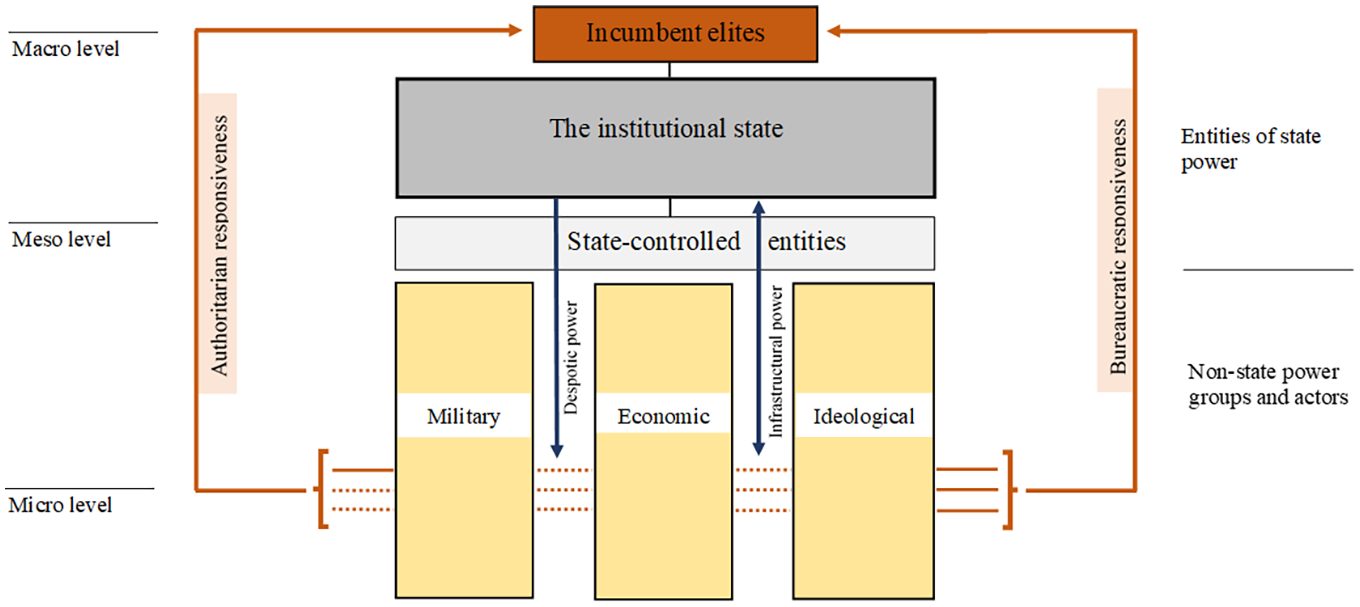
State–society relations in the institutional state.
On this basis, the key elements of infrastructural power in foreign policy can be outlined as follows: in the most general sense, it derives from a state’s capacity to mobilise the entirety of non-state actors relevant to its foreign conduct, and to logistically concentrate and control their activities within and beyond state territory in support of its foreign policy objectives.
Bureaucratic and authoritarian types of infrastructural power in foreign policy
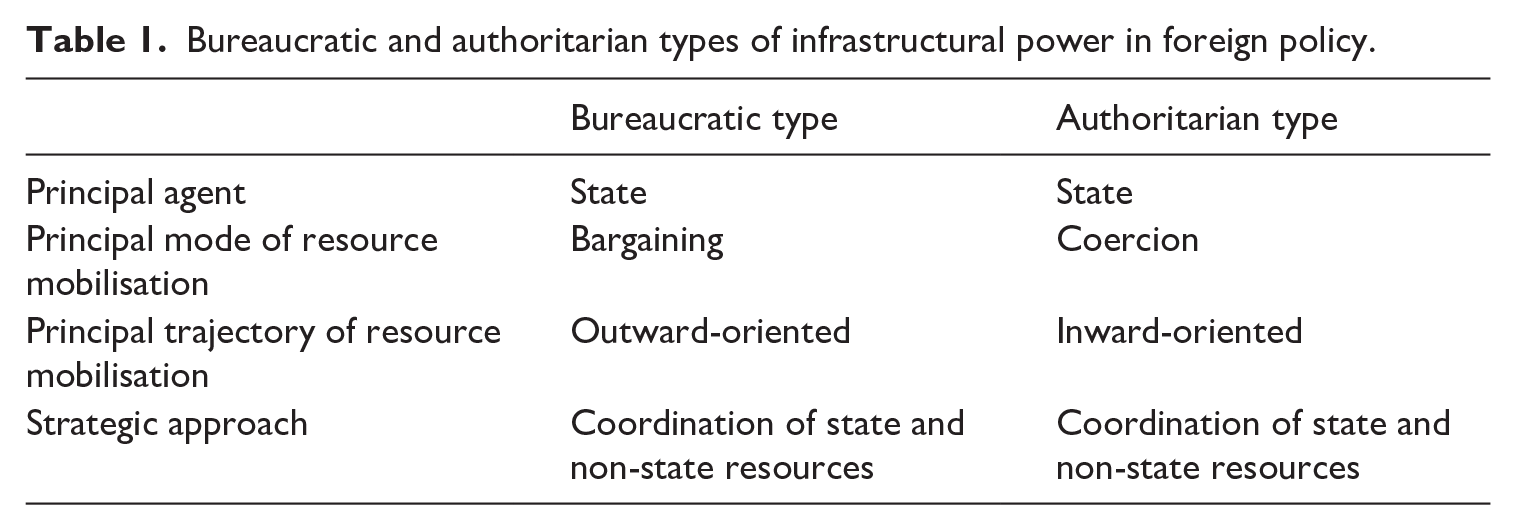
This definition would apply to all states regardless of the regime in place. The regime variable, however, can be included by continuing along the path taken above. By combining the values (low–high) of the two dimensions of state power (despotic–infrastructural), Mann arrives at four ideal-typical states. Two of these are pertinent to the further development of the arguments presented here given their applicability to modern nation states: the bureaucratic type (with a high degree of infrastructural power and a low degree of despotic power) and the authoritarian type (with a high degree of both infrastructural and despotic power). 55
Based on the premise that these two are ideal-typical, they can be adapted to the foreign policy realm in a way consistent with Mann’s original characterisation. Hence, the bureaucratic state – which Mann considers to be approximated by ‘contemporary capitalist democracies’ 56 – derives infrastructural power in foreign policy from its efforts to align the activities of non-state actors with its core objectives. Since the bureaucratic state is controlled by societal forces and does not set its own goals (foreign policy ones included), the government merely seeks to uphold the dominant social groups’ interests in international relations at a given point in time. With the low degree of despotic power existing within the bureaucratic state, the available means for incumbent elites to coerce non-state actors into complying with its demands are limited. The government – note the similarity to liberal IR theory 57 – thus primarily relies on bargaining with them and, in cases where interests converge or negotiation is successful, on coordinating their activities abroad, thereby focussing the efforts of state and non-state actors on a specific foreign policy goal. As, first, incumbent elites’ foreign policy goals represent the interests of dominant social groups and, second, the state’s institutional set-up allows for the routinised, non-violent transfer of power, resource mobilisation is strongly outwards-oriented: it is motivated by foreign policy concerns in the first place.
The foreign policy of the authoritarian state is fundamentally different in nature regarding the incumbent elites’ possible modes of engaging non-state actors. This type represents a ‘more institutionalised form of despotism, in which competing power groupings cannot evade the infrastructural reach of the state’ and in which ‘all significant social power must go through the authoritarian command structure of the state’. 58 By implication, the authoritarian state derives infrastructural power from its nearly unbound capacity to coerce non-state actors into aligning with its foreign policy objectives, which are determined solely by incumbent elites.
Yet, as Mann considers Nazi Germany and the Soviet Union to have tended towards this type, one must assume that no significant independent non-state actors remain who incumbents might coerce into complying with their foreign policy demands. 59 Therefore, the authoritarian approach to the matter must be twofold: Incumbent elites either seek to prevent the remaining independent non-state actors from becoming powerful via their activities abroad, and thus becoming potential rivals, or they attempt to neutralise the threats emanating from significant independent non-state actors in exile. Thus, to the extent that, first, non-state actors are concerned and, second, the paramount objective of authoritarian foreign policy is regime survival, resource mobilisation in this type is strongly inwards-oriented: concerns of regime stability usually reign supreme.
These ideal types provide a rough delineation of what infrastructural power in bureaucratic and authoritarian foreign policies may look like. The rest of this section elaborates further on this by identifying common and distinctive features of both types and by briefly discussing how empirical analysis can further our understanding of infrastructural power in foreign policy. To begin with common features, three points can be made, with the first pertaining to a crucial precondition. Infrastructural power in foreign policy is ‘political power’. That is, only states possess it. Put differently, it can only be increased via the state’s intentional efforts at mobilising non-state actors. This does not, however, exclude the possibility that the activities of non-state actors in a given foreign policy field precede those of the state. Indeed, it may be the case that such activities alert the state to the field and its relevance. Whether it strives to increase its infrastructural power depends on several factors, including incumbents’ preferences regarding the field in question, the capacity of relevant state institutions and the availability of non-state actors herein.
Second, states’ approaches to these matters vary widely. Their efforts to increase infrastructural power may vary; they may or may not be institutionalised, although they usually take place in the medium- and long term and are rarely situational. They can focus on relations with one state or a group of states, a region or subregion, and on single or multiple thematic fields. Likewise, a state’s efforts can concentrate on a specific set of relevant non-state actors or all ‘civil society’ groups. Third, mobilising non-state actors is one thing, but doing so skilfully – meaning integrating them into a coherent foreign policy strategy – is quite another. Irrespective of regime type, the level of infrastructural power yielded by the state hence correlates with its ability to mesh state and non-state resources in support of a strategic goal. This task is usually performed by the foreign ministry but may, depending on the nature of relevant non-state actors, involve other portfolios and state agencies, too. Importantly, whether such efforts increase the state’s clout in a concrete international conflict or not hinges on the extent to which relevant non-state resources can support the state’s traditional power means, or its statecraft techniques. 60
To reiterate, the bureaucratic and the authoritarian state are ideal types: they are abstract models delineating the recurring features of a social phenomenon (Table 1). Ideal-typically, then, the dividing line between the bureaucratic and authoritarian approach must logically be the degree of coercion applied by the state to engage non-state actors. Under the bureaucratic state, non-state actors may resist – even undermine – state attempts to engage them, without facing significant costs. In certain circumstances it is likewise possible that the bureaucratic state coerces non-state actors into adopting a specific behaviour abroad. Yet this would be exceptional, and coercion would need to be legally sanctioned. In this regard and concerning its overall foreign policy, the bureaucratic state faces serious domestic constraints. 61
Bureaucratic and authoritarian types of infrastructural power in foreign policy.
In contrast, the authoritarian state enjoys far greater capacity for making non-state actors comply with its demands. Yet, incumbent elites are not completely unfettered by domestic concerns – either in theory or in practice. Research on autocracies commonly distinguishes between militaristic, monarchical, personalistic and party regimes, all of whose leaders must consider the interests of the ‘seizure group’ to secure their survival. 62 The foreign policy of the authoritarian state, including its resource mobilisation, is thus constraint by the interests of the seizure group, 63 which may be more or less diverse in its make-up or ‘possess different bases in “civil society”’. 64 It follows that different modes of engaging non-state actors apply for those actors directly or indirectly linked to the seizure group than for those of secondary or no importance to regime stability.
Turkey’s pivot to Africa
The ongoing third wave of autocratisation, characterised by its legal and incremental nature, stands in stark contrast to previous waves marked by abrupt and unlawful seizures of power, such as military coups. 65 Mann’s notion of the polymorphous state proves invaluable in this context. Underscoring that states are not static, monolithic entities but dynamic ones capable of displaying a diverse array of characteristics and functions, his theory allows for the incorporation of various regime types into the analysis, including processes of autocratisation and democratisation. Despite Mann’s ideal-typical approach, his notion of the polymorphous nature of the state hence acknowledges the hybrid characteristics of democratising or autocratising states, facilitating a more nuanced understanding of the intricate dynamics at play during political transitions.
Turkey was recently identified as one of the top-seven autocratising countries globally. 66 In line with the general pattern of the third wave of autocratisation, however, its corresponding democratic breakdown occurred from ‘democracy with adjectives’ 67 into authoritarianism with adjectives. Before the AKP came to power in 2002, Turkey was at best a tutelary democracy, with the military serving as the guardian of the Kemalist regime. 68 The AKP’s initial tenure saw fervent democratic reforms aimed at European Union accession, uniting diverse societal factions. Between 2008 and 2010, however, the party orchestrated a transformation, with members of the Gülen Movement (GM) 69 infiltrating the judiciary and the military being neutralised. Over the following decade, the AKP’s trajectory shifted, steering Turkey towards competitive authoritarianism marked by the consolidation of state power, the erosion of checks and balances, and limited space for genuine political competition. 70 The failed coup attempt of 2016, which the government attributed to the GM, further contributed to advancing this agenda. Amid multiple attempts to periodise AKP rule, it is difficult to pinpoint a clear-cut turning point here. 71 However, since 2013 and especially following the 2016 coup attempt, the state’s relations with non-state actors changed considerably – albeit incrementally. This regime transformation offers a rare opportunity to observe both the bureaucratic and authoritarian type of infrastructural power in foreign policy within a single context.
While ‘the foreign policy effects of [democratic] backsliding have yet to be examined systematically’, 72 the international effects of Turkey’s authoritarian descent have indeed been studied in multiple regards already. Some scholars have investigated the change in foreign policy discourse and the growing anti-Westernism, 73 whereas others have focussed on Turkey’s foreign policy framework and its drift away from being a ‘trading state’. 74 The concept of infrastructural power in foreign policy, however, allows for studying Turkey’s resource mobilisation during such domestic developments, and hence its attempts at gaining international influence. Exploring Turkey’s Africa policy is motivated by two additional factors. First, although Africa was largely a clean slate for the government, it emerged as a major foreign policy field within a relatively short period of time. 75 Hence, one can observe the direct impact of domestic drivers almost without any historical baggage of past governments or bilateral relations. In fact, despite Turkey’s more intense engagement in the Middle East or Europe, it was Africa where the AKP projected its self-assumed national roles most clearly. 76 Second, Turkey’s Africa policy depicts best the scope and limits of the state’s engagement with non-state actors in foreign policy, 77 allowing us to examine the implications of both bureaucratic and authoritarian modes in a single field.
During the Cold War, Turkey aligned itself with the Western Bloc as a countermeasure to potential Soviet encroachment. Back then, foreign policy was firmly rooted in Turkey’s traditional Western orientation, bolstered by its strategic standing as NATO’s southern bulwark and preserving the status quo. The end of bipolarity transformed Turkey’s grand strategy from calculated pacificism to regional activism, redefining its national role and addressing new geographies. 78 The silent rise of its Africa policy reflects this adaptation. Turkey showed little interest in the continent until the end of the Cold War, when it sought to redefine its international role and diversify its foreign policy in response to the systemic changes afoot. This revisionism was embodied in the 1998 ‘Africa Opening Action Plan’, Turkey’s first major diplomatic initiative towards the continent. 79
However, its foray into Africa gained real momentum under AKP rule. Since declaring 2005 the ‘Year of Africa’, the party made the continent a focal point of foreign policy. Spearheaded by Recep Tayyip Erdoğan’s vision of Turkey being an ‘Afro-Euroasian state’, 80 this overture saw him personally traverse 30 African nations. Such diplomatic vigour was further underscored by a fourfold expansion in embassies to an impressive 44 by 2022. 81 Besides, Turkey also increasingly viewed Africa as a dynamic, fertile market, particularly during the 2007–2009 global recession. Boosted by, for instance, Turkey-Africa Partnership Summits in 2008, 2014 and 2021, the volume of bilateral trade expanded nearly fivefold from USD 5.4 billion in 2003 to USD 25.3 billion in 2020. Over the same period, foreign direct investment in Africa surged from USD 100 million to USD 6.5 billion. 82 Turkey’s pivot to Africa, initially driven by economic considerations in line with its role as a trading state, has since evolved into a complex foreign policy matter. From the construction of Djibouti’s largest mosque to having its most sizeable overseas military base in Somalia, Turkey’s footprint throughout Africa is immediately identifiable, helping it establish a long-term presence there. 83
The bureaucratic mode (2002–2013)
Turkey’s Africa strategy, which practically started from scratch, approximated to the bureaucratic type during the first decade of AKP rule. As mentioned, the bureaucratic state derives infrastructural power in foreign policy from its efforts to align the activities of non-state actors with its objectives. The incorporation of the latter into Turkish foreign policy is hardly a novelty, having precedents under the Ottoman Empire. 84 Likewise, after the demise of the USSR, the idea of a ‘Turkic world’, advocated by non-state actors, provided incumbents with a pragmatic foreign policy course. 85 Importantly, it was also the overseas activities of non-state actors which alerted the state to the opportunities in Africa at the time. Turkey’s Africa policy has thus been framed as a ‘civil society-led, state-followed initiative’. 86
Resource mobilisation was mainly outwardly oriented in this era for two reasons. First, the AKP was backed by the country’s dominant social groups. To circumvent the military’s tutelage over politics, the AKP moved away from traditional intra-elite politics and expanded its electoral base via a broad coalition of discontented groups from the Kemalist regime. Second, despite some authoritarian-leaning attitudes of the government, 87 the political system still had free and fair elections, allowing for the routinised, non-violent transfer of power; therefore, rival groups could wait for the next elections to reverse the trajectory of foreign policy. In fact, 2007 saw an indirect military intervention, which failed. Turning its attention away from domestic conflicts, the AKP adopted an ambitious foreign policy with a more cooperative approach towards non-state actors. 88 Hence Turkish foreign policy evolved from a ‘single-track diplomacy’ dominated by the official bureaucracy to a ‘multitrack diplomacy’ characterised by the effective participation of numerous ideological and economic groups. This was highlighted by the new concept of ‘total performance’, which incorporated non-state actors and the public into the making and implementation of foreign policy. 89
How did the state mobilise non-state actors? Due to a lack of despotic power, Turkey’s incumbent elites relied on bargaining with non-state actors, enabling goal convergence between both sides. In this approximation to the bureaucratic mode, a symbiosis developed out of the mutual benefits, allowing the state to concentrate its efforts on a single foreign policy objective. In 2008, the AKP government enacted legislation permitting charitable foundations (vakıf) to engage in transnational work, build partnerships with international organisations as well as establish branches abroad. This legislative shift, coupled with the prevailing political and legal landscape, facilitated the swift proliferation of Turkish religious organisations moving into Africa. 90 However, in the early years of the new millennium, one important non-state actor dominated ideologically and economically in Turkey’s Africa policy: the GM, a controversial transnational politico-religious movement. Domestically, both the AKP and GM pursued a marriage of convenience, with the former’s political clout reinforcing the latter’s social and bureaucratic influence, and vice versa. 91 Their symbiotic relationship persisted in Africa, too. The GM benefitted the most from Turkey’s Africa opening, which it used to expand its educational and economic network across the continent. The state provided political recognition and administrative support to the GM and other religious organisations, including easing administrative restrictions, establishing legal bases and offering tax deductions – if not exemptions.
In general, Turkey’s Africa opening, especially in 2011 and 2012, was mostly coordinated with the GM. 92 In exchange, the AKP benefitted from the GM’s groundwork when pursuing its strategic goals and promoting Turkey’s new image as an internationally engaged Muslim democracy. 93 Ideological and economic groups offered hands-on experience in the field, better insight into people’s needs and demands, and helped develop networks with local elites. Their humanitarian and economic activities established foundations of legitimacy and confidence for future Turkish involvement. 94 While they enjoyed ‘personal relationships with officials, field experience in humanitarian aid, and organizational strength’, 95 these groups were particularly effective at agenda-setting by prompting the government to act and providing information which was otherwise not available through official channels.
In Africa, the GM replicated the state-sponsored expansion strategy it once adopted in the Caucasus and Central Asia. The first schools were opened in Morocco (1994), Senegal (1997) and then Kenya, Nigeria and Tanzania (1998) – countries where Turkey already had diplomatic missions. Yet in the first decade of this century, the GM expanded significantly in many other African countries too, preceding the state. By the time of the 2016 coup attempt, the GM ran over 100 schools and one university in Africa (see Figure 2 below). 96 As an ideological group in Mann’s terms, the GM – and particularly its schools – played a significant role in promoting Turkey abroad. These institutions were known as ‘Turkish schools’ rather than ‘Gülen schools’, illustrative of their power to act in the name of the state. In the absence of diplomatic missions, they also served as informal embassies. 97 It was commonplace for Turkey’s political elite to visit these schools and give their symbolic support to them. Their Turkish-speaking graduates later became significant assets, greatly facilitating bilateral trade.
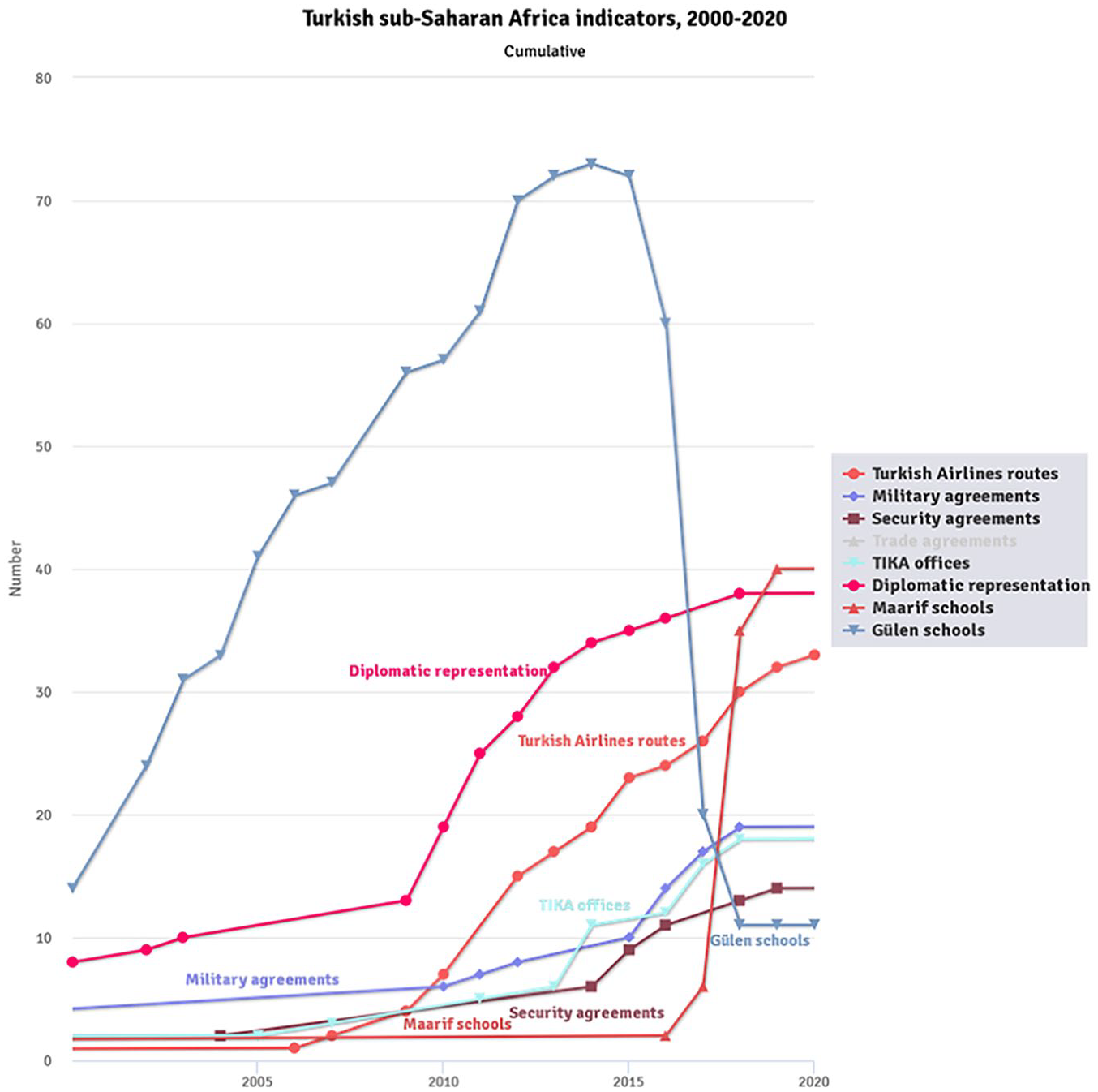
Turkey’s sub-Saharan Africa indicators, 2000–2020 (cumulative) 98 .
The GM also operated as an economic group via the Confederation of Businessmen and Industrialists of Turkey (TUSKON), an umbrella organisation representing thousands of small and medium-sized firms. 99 TUSKON pioneered the matching of Turkish and African businesspeople for cooperation and encouraged Turkish entrepreneurs to invest in Africa. This occurred simultaneously with the AKP’s efforts to support conservative Anatolian businesspeople to counterbalance the secular Turkish Industry and Business Association (TUSİAD). TUSKON promoted several business associations to foster bilateral trade and organised hundreds of reciprocal visits. In 2013, it also opened its first African office in Ethiopia.
As outlined above, upon successful bargaining with like-minded non-state actors the bureaucratic state mainly confines itself to coordinating the latter’s activities abroad regarding shared foreign policy goals. When the GM first turned to Africa, the state had yet to create a coherent policy for the continent (Figure 2). However, as pivotal the GM’s groundwork was to the success of Turkey’s Africa policy, so too was the state’s will and strategy to build its infrastructural power. This entailed the systematic incorporation of relevant non-state actors into a coherent foreign policy. Its success also depended on the capacity of state institutions. Hence, the expansion and diversification of Turkey’s foreign policy agenda coalesced with the multiplication of state means to coordinate the activities of non-state actors and expand Turkey’s sphere of influence. To this end, the AKP also instituted new agencies under its direct control such as the Office of Public Diplomacy, the Presidency for Turks Abroad and Related Communities (YTB) and the Yunus Emre Institutes. Additionally, it granted existing public agencies such as TİKA and the Presidency of Religious Affairs (Diyanet) extensive powers to operate abroad. While the AKP initially faced bureaucratic constraints and lacked a grip over the Ministry of Foreign Affairs, it sidelined the ministry and relied on these institutions under the direct control of the chief executive to freely pursue an assertive foreign policy. 100
The state, by and large, followed a concrete pattern in the course of its quest. To begin with, state-backed non-state actors (mostly the GM) arrived on the continent, delivering basic education, healthcare and services while building networks with local elites. This facilitated the entry of small and medium-sized businesses into the market, establishing channels for trade and economic cooperation. Such intensifying networks paved the way for the state to expand its infrastructural power. Turkey would then open a diplomatic mission in the country in question. With political and economic relations developing, Turkish Airlines began operating flights there. Thereafter, TİKA opened an office or introduced a humanitarian or development project. 101 This temporal sequence is remarkable, but does not challenge the conceptual assumptions outlined above. The activities of non-state actors abroad may precede those of the state, although only the latter can then build infrastructural power by aligning its policies with the activities pursued by the former.
The crucial point here, then, is how the state harnessed its foreign policy tools and institutions to steer non-state actors towards its foreign policy objectives. The Ministry of Foreign Affairs has a special division on sub-Saharan Africa, and deputy director generals in charge of East and West Africa respectively. Nevertheless, among all foreign policy bodies, TİKA assumed a pivotal role in channelling and coordinating state and non-state actors’ Africa-related projects. With expanded functions and scope, TİKA initiated several development projects and programmes in targeted countries which helped brand Turkey a benevolent state. 102 TİKA opened its first office in Africa in 2005; it has since increased the number of representative offices to 22, and carried out nearly 7000 projects in 54 African countries to date. 103 In coordination with TİKA, several official bodies – such as the Ministry of National Education, the Ministry of Culture and Tourism, Diyanet Foundation and the Turkish Red Crescent – also actively engaged in humanitarian and development activities in Africa. 104
Additionally, TİKA would be successful in integrating non-state actors in the creation of a coherent foreign policy with shared goals. Among ideological groups, TİKA predominantly worked with faith-based NGOs such as the Humanitarian Relief Foundation (IHH), the Deniz Feneri Association and the Cansuyu Foundation. 105 These organisations mostly delivered assistance to regions suffering from war, armed conflict and natural disasters, while also providing vocational training, food aid, orphan care and sanitation projects. Among such joint endeavours, for instance, the Africa Cataract surgery campaign was initiated by TİKA and IHH in 2007 and covered 10 countries in (sub-Saharan) Africa. 106 The harmonious collaboration between, and ideational ‘complementarity’ of, the incumbent elites and ideological/economic groups in the field were evident in several initiatives for which the private organisation’s logo and the Turkish flag were used together. 107
Again in the economic field, the Ministry of Foreign Affairs and the Ministry of Economy worked closely with business organisations such as the Turkish Foreign Economic Relations Council (DEİK), the Turkish Exporters’ Assembly and TUSKON. As of 2006, the latter two brought together investors and businesspeople at seven so-called Turkey-Africa Trade Bridge Summits, all attended by high-level officials from the respective countries involved. 108 Turkey has commercial counsellors in 26 African countries, and signed free trade agreements with 5, trade and economic cooperation agreements with 38 and agreements with 13 countries to prevent double taxation, enabling Turkish economic groups to flourish. 109
Political, economic and cultural ties were further buttressed by the introduction of new Turkish Airlines routes. As a state-controlled entity, Turkish Airlines assumed a functionally conducive role in increasing the state’s infrastructural power in foreign policy. The political rather than economic calculations of its aggressive growth strategy between 2008 and 2016, with expansion to destinations shunned by rivals, coalesced with Turkey’s foreign policy activism. Specifically, the inauguration of Turkish Airlines routes corresponded to the expansion of Turkey’s diplomatic network. 110 This reflected the state’s determination to increase its footprint on the continent. Flying to more destinations in Africa than any other airline, Turkish Airlines now serves 61 airports in 40 African countries (Figure 2). With this extensive network, it provided direct and sustainable access for both state and non-state actors to most African regions, thereby helping develop bilateral ties and facilitating the gradual penetration of the continent.
As the most substantive outcome of its opening to Africa, Turkish involvement in Somalia vigorously showcased how the bureaucratic state worked to integrate public and private actors to achieve its strategic foreign policy objectives. In 2011, the initial fundraising activities of private organisations such as İHH and Kimse Yok Mu increased public awareness of the devastating famine in Somalia. Against this backdrop, Erdoğan visited Mogadishu, making him the first non-African head of state to visit the war-torn capital in almost two decades; Turkey became the first country to appoint an ambassador to Somalia, too. Turkish Airlines, again first among international players, opened the Istanbul–Khartoum–Mogadishu flight route in 2012, enabling Somalia’s reconnection to the global community. 111 Whereas TİKA primarily assumed a coordinating role, several public and private organisations such as Kızılay, Doctors Worldwide and İHH launched medical-aid projects. 112 Nevertheless, after 2013, Turkey’s engagement in Somalia would also gradually showcase the former’s shift to the authoritarian mode, with military-training programmes and major construction projects occurring under increased direct state control. 113
The authoritarian mode (2013–present)
In 2011, Erdoğan won national elections for a third consecutive time. He had already subdued the Kemalist-dominated judiciary and military through the Ergenekon and Sledgehammer trials and the 2010 constitutional referendum. Yet, at a time when he could be most confident about his grip on power, he faced the anti-government Gezi protests in 2013. Meanwhile, growing transnational Kurdish activism and the brutal fight between the incumbent regime and the GM, which had long striven for state capture, further catalysed insecurity. 114 Circumstances were exacerbated further by the fragility of state institutions and weak state capacity. 115 Alongside Erdoğan’s growing concerns vis-à-vis political survival and thus attempts to consolidate power, the 2010s saw Turkey drift towards the authoritarian mode in foreign policy. The political discourse took an anti-Western twist, and foreign policy was gradually personalised – reaching its apex in the 2018 transition to a presidential system with no tangible checks and balances.
As mentioned, the authoritarian state derives infrastructural power from its nearly unbound ability to coerce non-state actors into aligning with its foreign policy objectives, which are determined solely by incumbent elites. Approaching this type, the AKP left no substantial independent non-state actor in situ whom they could not compel to agree to their foreign policy objectives (more below). Another notable change in this period – indeed a defining difference vis-à-vis the bureaucratic type – was the incipient inwards-oriented trajectory of resource mobilisation following Turkey’s increasing autocratisation, prompting its elites to focus on mitigating domestic challenges to their authority. To reiterate, resource mobilisation in the authoritarian type encompasses addressing threats to the regime emanating from autonomous non-state actors operating in exile and those still situated within the respective state – whose influence, however, may swell through their activities on foreign soil. In light of this, Turkey’s Africa policy strategically aimed: (a) to dismantle the transnational network of the AKP’s ally-turned-arch-nemesis, the GM; (b) to foster, simultaneously, the creation or bolstering of state bodies, enhancing the transnational power of existing state institutions; and (c) to mobilise wholly loyal ideological and economic groups able to replace the GM.
Inwards-oriented resource mobilisation by the state manifested itself prominently in its relations with such ideological groups. The AKP, determined to eradicate the outlawed movement at home and abroad, arranged lucrative economic, cultural or security deals with African countries contingent on the closure of GM-affiliated institutions. 116 In addition, while pressuring local governments to extradite Gülenists residing on their soil, Turkey’s National Intelligence Organisation (Millî İstihbarat Teşkilatı) conducted its own operations to bring back Gülenist suspects. 117 Also, the GM schools were taken over by the Maarif Foundation – established in 2016 exactly for this purpose. In 2017, Turkey hosted a gathering of education ministers from 38 African countries to pressure them over the Gülen schools. 118 Thanks to asymmetrical relations with most of the states concerned, it yielded significant results. By December 2021, Maarif ran 416 schools, 183 of them located in 24 (sub-Saharan) African countries (see Figure 2 above). 119 Further to the pivotal role played by Maarif in bridging the gap in Turkey’s engagement with Africa during the ‘post-Gülen era’, 120 the state notably bolstered the authority of Diyanet, too. As a cornerstone of Turkey’s soft-power strategy, one primarily directed at Muslim nations across the continent, Diyanet and its foundation provided religious services ranging from the construction of mosques to the translation of the Koran into vernacular African languages to the education of African students in Turkish religious ‘İmam-Hatip schools’. Diyanet organised a series of so-called African Muslim Religious Leaders Summits in Istanbul too. 121
Besides this centralisation, the state strategically supplanted the GM in Africa with loyal religious organisations such as Erenköy, which rapidly expanded their presence through their collaborative efforts together with state entities in delivering religious education and humanitarian aid. 122 In general, authoritarianism here was characterised by a tightening grip on non-state actors via repression and co-optation. Following the 2013 Gezi protests, and further exacerbated by the prolonged state of emergency in place after the 2016 coup attempt, state authorities imposed severe restrictions on civil societal actors, therewith quelling dissent by force. 123 The 2018 amendment to the Associations Law delegated the authority directly to the president to grant public-benefit and tax-exemption status to associations and foundations. Furthermore, the swift enactment of Law No. 7262 in 2020 authorised the minister of the interior to suspend the operations of organisations under investigation for terrorism without a prior court order, while also empowering the president to freeze their assets. 124 These measures collectively tethered the survival of non-state actors, including religious organisations, to political discretion.
In this milieu, ‘once-autonomous’ religious NGOs have increasingly fallen under state control. 125 While religious organisations have always had clientelist and transactional relations with the state, they are now more deeply embedded within the state structures. Numerous NGOs, including those operating in Africa, were gathered under the banner of the ‘National Will Platform’ and compelled to issue declarations of unwavering support for AKP policies. 126 Reflecting the extent of their integration, scholars often refer to these NGOs as Government-organised non-governmental organisations’ (GONGOs). 127
With economic groups, the state repeated the same strategy of repressing rivals, favouring loyalists and seizing full control of the various initiatives. It put a halt to TUSKON’s activities throughout Africa, imprisoned its leaders and blacklisted Gülenist businesspeople abroad. In 2015, TUSKON reported the refusal of Turkish embassies to grant visas to their members. 128 While preventing critical economic groups from acting as potential rivals, the AKP strengthened its grip on this domain by making political allegiance a precondition for state support. To fill the void left by the confiscation of Gülenist schools and businesses, the AKP expanded its support for the closely affiliated Independent Industrialists’ and Businessmen’s Association (MÜSİAD). In 2016, MÜSİAD established its first liaison offices in Sudan and South Africa. To underline the political support, Minister of Foreign Affairs Ahmet Davutoğlu and President Erdoğan were the association’s guests of honour at its February 2013 and June 2017 summits respectively. 129
Thriving on the clientelist tradition of Turkish politics, a new cohort of wealthy loyalists, particularly in the construction sector, were the primary beneficiary of Turkey’s Africa engagement, including contractors such as Kalyon, Limak, Summa and the Yenigün Group. To conduct business in Africa, one must join the business delegations accompanying Erdoğan during official visits to the continent. While TUSKON dominated the delegation’s make-up until 2014, it was then replaced by DEİK. In that year the state, seeking greater control over the economic domain, enacted a decree nationalising the previously autonomous DEİK, which aimed to facilitate contacts abroad for the private sector. The decree established DEİK as a department within the Ministry of Economy. Under tightened state control, DEİK has since formed business councils with its African counterparts, mostly filled with MÜSİAD members. 130
During the earlier bureaucratic mode, the state pushed for the de-securitisation of foreign policy and positioned itself as a reliable global actor seeking increased economic cooperation with African states. Contributions in the military realm were mainly confined to seven continental peacekeeping missions – including UNAMID (Darfur) and UNMIL (Liberia). Since 2009, Turkey also participated in the multinational Combined Task Force 151 (CTF-151) conducting anti-piracy and counterterrorism operations in the Gulf of Aden. 131 Turkey’s quest for greater strategic autonomy, however, resulted in an increase in unilateral and bilateral military initiatives. This new agenda manifested itself in a flurry of military- or security-cooperation agreements with strategic African states (see Figure 2 above), with which Turkey sought to increase its influence by creating new dependencies on its military.
Turkey steadily built up its military presence to enhance its strategic autonomy and counter the Saudi–Emirati alliance contributing to regional rivalry. As an extension of this geopolitical tussle on the Horn of Africa, 132 in 2017 Turkey inaugurated a military base in Somalia, Camp TURKSOM, to train Somali soldiers. Its deployment in Northern Cyprus aside, it is Turkey’s largest overseas military base. In 2024, Somalia also ratified a defence and economic cooperation pact with Turkey, empowering Ankara to construct, train and equip its navy, while also entrusting it with the defence of Somali territorial waters. 133 In 2017, moreover, Sudan agreed to lease Suakin Island, a ruined Ottoman port city on the Red Sea coast, for 99 years to revitalise it as a tourism hub. Despite contradictory statements from both sides, Turkey is also planning to construct a naval port to maintain civilian and military vessels. 134 While still relatively limited in capacity, this emerging security-driven approach signals Turkey’s readiness to confront other foreign powers in the region. 135
With the state as the dominant actor in the military sphere, the state-owned defence firms Aselsan and TUSAŞ also found a dynamic market in Africa, enjoying the results of military-technology investments at home. In line with a burgeoning Turkish defence industry, Aselsan, for instance, bought a local engineering firm in South Africa and established Aselsan South Africa to manufacture electro-optical systems for the South African military aerospace and maritime markets. 136 Notwithstanding the state’s monopoly on the military domain, private defence companies such as Baykar and Kamterciler manufacture unmanned aerial vehicles or armoured combat vehicles. Likewise, the activities of SADAT International Defence Consulting, which was arguably part of Turkish initiatives in countries such as Sudan, Somalia and Ethiopia to train soldiers, illustrate the possible rise of military non-state actors – a pattern which began in the 1990s. 137
Conclusion
The domestic shifts crystallising between 2013 and 2016 impacted Turkey’s Africa policy in ways the conceptual framework developed here can compellingly account for. The article also explains why Turkey was able to become a key actor on the continent within less than a decade following the AKP’s takeover. However, it must be reiterated that Turkey has never fully matched the features ascribed to the bureaucratic or authoritarian state respectively, including with respect to the modes and trajectories of resource mobilisation envisaged for both ideal types.
While Turkey presents a pertinent case for studying state mobilisation of non-state actors in foreign policy, there are other illuminating examples undergirding the conceptual claims put forth in this article. For instance, Indonesian religious associations such as Nahdlatul Ulama and Muhammadiyya – commanding distinct international networks and increasing numbers of overseas branches – have met a comparable fate of incorporation and securitisation. During the presidency of Sukarno (1945–1967) they cooperated with the state to gain formal recognition of Indonesian independence from the Arab League, for instance. Under Suharto’s authoritarian New Order regime (1968–1998), then, they were domestically suppressed and barred from playing any role in foreign policy, including with respect to their own overseas operations. After democratisation, and notably under the Widodo presidency ruling since 2014, they have become an integral part of Indonesian foreign policy. 138
In light of the empirical discussion, several conclusions can be drawn regarding the conceptual framework and its further development. To begin with, the concept of infrastructural power in foreign policy is an original contribution to discussions on power in IR. It not only suggests including non-state resources in the evaluation of states’ ‘base of influence’, but also proposes a new ‘means of influence’ 139 : namely, the distinct mobilisation modes which bureaucratic and authoritarian states (and their empirical variations) use to activate this part of the base. It thus entails, and introduces into IR, an ‘organisational’ understanding of power. For Mann, power is ‘the ability to pursue and attain goals through the mastery of one’s environment’, with ‘central problems concern[ing] organization, control, logistics, communication’. 140 Zooming in on A’s ‘capacity to organize and control [its] people and materials’ on B’s territory, this organisational approach is both novel and complementary to the relational understanding of power currently prevailing in IR.
Yet there are also limitations to the proposed concept. For one, Mann’s notion of civil societal groups does not sit well with other conceptualisations of non-state actors. His main categories (economic, ideological, military) pose less of a problem here; these might cut across prevalent ones (e.g. national, transnational, international; violent, non-violent) but can be fruitfully combined with the latter to create typologies which are more explanatory than descriptive. Of greater concern, rather, is the concept’s inherent state-centrism, which largely neglects the interests of non-state actors themselves – to the point that they forfeit their agency. Hence, the concept can aptly explain how states piggyback on non-state actors abroad (e.g. the Omar al-Bashir regime’s deployment of the Rapid Support Forces, RSF, in the recent Yemen war), and also why potent non-state actors seek state capture (e.g. the RSF in Sudan in 2023). But it faces acute difficulties, for instance, in accounting for why some non-state actors are so powerful that they manage to set foreign policy agendas without assuming formal state power (e.g. Eni and Italy’s Libya policy).
For another, and despite the merits of ideal types for concept-building, the near binaries they produce in the proposed concept (bureaucratic vs authoritarian) complicate the latter’s application to empirical analysis. Also, they ignore Comparative Politics scholars’ plea to no longer use ‘democracy’ and ‘autocracy’ as clear-cut categories but to focus on ‘appropriate conceptual and empirical tools to systematically analyze [the] obscure processes’ unfolding during autocratisation or democratisation. 141 One way of paying heed to this call, and of increasing the concept’s flexibility, would be to observe state control over societal groups over time to evaluate, first, the extent to which incumbent elites can coerce non-state actors into abiding by their foreign policy directives (i.e. the mode of mobilisation); and, second, the extent to which those elites’ handling of independent non-state actors abroad is motivated by questions of regime survival (i.e. the trajectory of mobilisation). Such an approach would turn the bureaucratic and authoritarian ideal types into two extremes demarcating a continuum along which one can assess the prerequisites for states’ modes and trajectories of resource mobilisation. To this end, future research could draw on existing indices (e.g. Varieties of Democracy) to elaborate a concept which otherwise significantly broadens our perspective on the exercising of power in international relations.
Footnotes
Acknowledgements
We would like to thank André Bank, F. Gregory Gause and Johannes Plagemann for their comments on earlier drafts. We are also grateful to Jasmin Behrends, Magdalena Wahl and Andrew Crawford for their assistance in data collection and analysis.
Funding
The author(s) disclosed receipt of the following financial support for the research, authorship, and/or publication of this article: This work was supported by the German Research Foundation (DFG, 463159331; and DFG, 451375110).
